
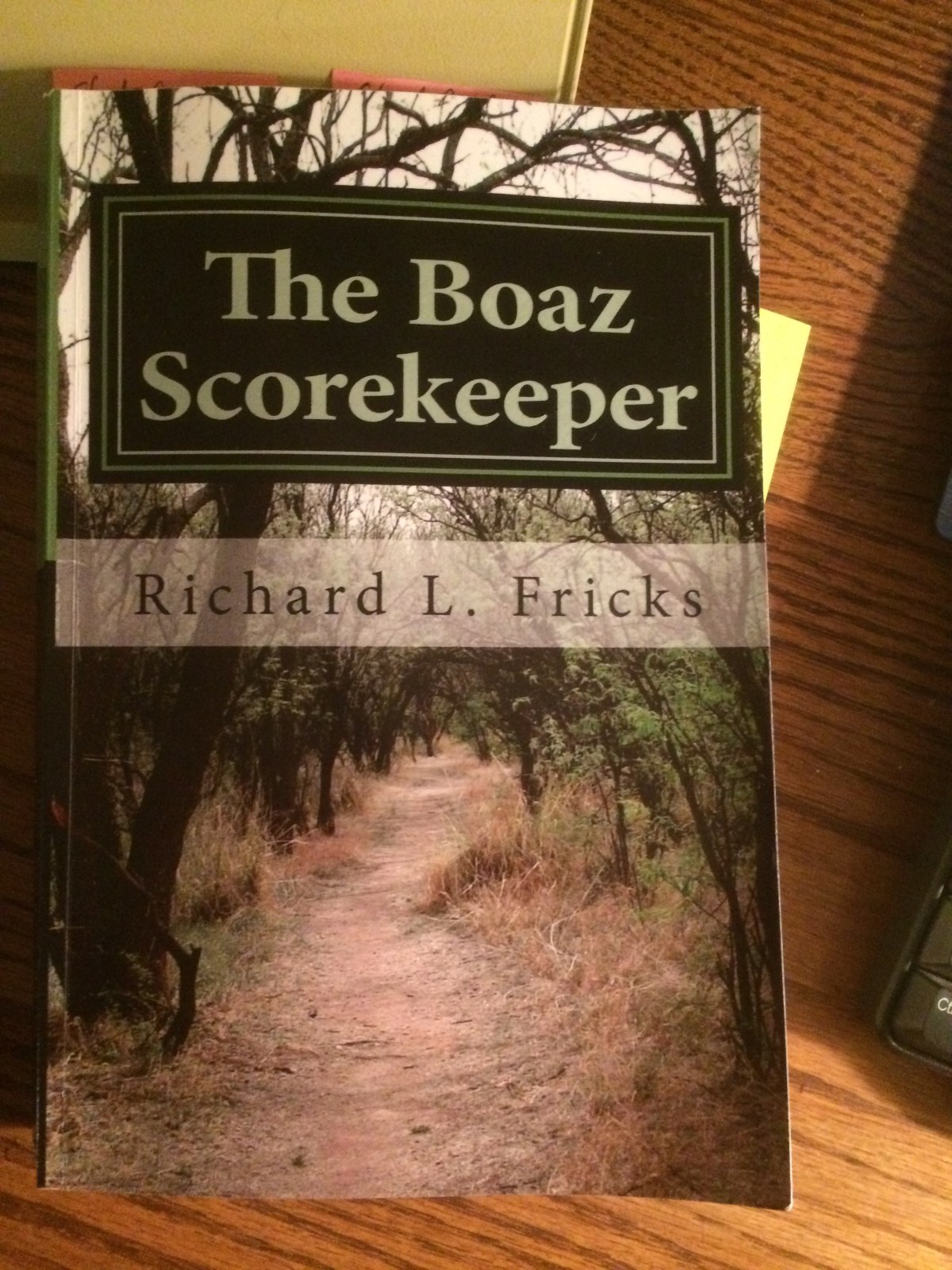
The Boaz Scorekeeper–Chapter 2

The Boaz Scorekeeper, written in 2017, is my second novel. I'll post it, a chapter a day, over the next few weeks.

I was born January 1, 1954 to Billy Joe and Mary Sue Tanner. Until I moved to Atlanta in 1973 for college, we lived on a 40-acre farm, in a two-story, Amish style house, three miles east of Boaz in the Arona community.  It was my grandfather’s birthplace. My grandparents, Frank and Elma Tanner, had lived there all their married life working the farm and caring for his widowed mother until her death in 1953.  My parents married and moved in with Gramp’s and Mama El in 1944 when Dad returned from Italy after the Army discovered he was only 16 when he enlisted.   

My parents were the hardest working folks I have ever known. My Dad was a weaver at Boaz Spinning Mills, working six nights a week from 10:30 p.m. until 6:30 a.m.  He then returned home to help my Mother complete the early morning farm work that she and I started before sunrise. By 9:30, Dad had finished his chores and breakfast and had gone upstairs to sleep for five or six hours before rejoining my Mother somewhere on our 40 acres to toil until 6:00 p.m., to then catch his ride to Boaz with neighbor and co-worker Calvin Conners.  

Mother, a city girl from Albertville, knew nothing of farming but had no choice but to learn fast.  After marrying, Mother spent a month with Gramp’s learning how to grow chickens, plant and maintain a garden, hoe cotton, and a dozen other tasks before his Diabetes cost him a leg and sent him to Gadsden to rehab for three months.  Although short on experience she was extremely long on patience and determination.  For as long as I can remember, the legend was that on Christmas Eve morning 1946 my Dad had come home tired and unusually depressed spouting threats that they should pack their bags and move to Detroit for him to make ‘good money’ at General Motors, and that he just couldn’t continue working two jobs for so little results.  The story goes that Mother rolled out her own threat. “If I ever again hear you say that you are quitting, that you can’t do something, then I’m leaving you for good.  Do you understand?”  Losing Mother would have destroyed Dad.  She was the light of his life. The story goes that Dad never breathed the ‘can’t’ word again. It was also the only time that I heard of him being depressed.    

Gramp’s had started growing chickens for Boaz Poultry Company in 1932.   The Depression was gaining momentum every day.  Gramp’s had two neighbors who were pleased with their eight-year-old decision to build two specially designed buildings that housed thousands of chickens from the time they were just a few days old.  He didn’t make the decision easily since it was the first time the home place had ever been mortgaged.  In the end, Gramp’s believed it really wasn’t much of a risk when you compared it to the only other option which was to starve to death or quit farming altogether. It turned out his decision was a good one.  The two poultry houses stabilized the farm, and later gave Mother a job and the ability to always be home when I was there.  

My first memory of Saturdays as a kid was when I was three years old, at least that’s what Mama El told me.  After breakfast, she took me to our garden and taught me how to pick peas.  She told me I could tell when to pull them from the vines by looking at the plumpness of the pod, their hardness, and by their color.  She made me watch her pick half a basket of Crowder peas before she let me pull one.  Then, she taught me about peppers and tomatoes, and returned to the house.  That Saturday, I picked two bushels of peas, and a basket full of tomatoes.  I left the peppers alone, thinking they were not quite ready but also thinking Mama El might be testing my judgment. Compared to most every other Saturday I remember, that first working Saturday was a vacation.  Normally, I was up and out by 4:30 a.m. helping Mother in the broiler houses, although I was often doing this by myself by age 10 if Mother had garden vegetables to can and freeze.  After this task was completed, I worked in our corn field, milked Molly our cow, castrated pigs if we had a new litter, cut, split, and stacked firewood, and mended fences.  If all this didn’t fill up my Saturday there was always something Mother and Mama El needed help with either in the garden or on the back porch shelling peas, snapping green beans, or cutting corn off the cob.  During cold weather, we always had four hogs to slaughter, butcher, and ready for grinding into sausage, or for salting-down in the big wooden meat box.  I was only six when Gramp’s let me use his Marlin lever-action 22 Rifle to kill a 400-pound hog just right to have it fall over on the big wood sled we used to scald off the hog’s hair.  Saturdays were always work days on the farm until I went off to college. 

Mother said she got her grit and determination from God.  I’m 91 now and have never seen a more God-fearing person.  I’ve been told that I was only three days old when I made my first appearance at Clear Creek Baptist Church.  This was Mother’s doing no doubt.  From then until I started attending First Baptist Church of Christ in Boaz when I was in the tenth grade, Mother made sure I was in church every Sunday morning and night, and every Wednesday night.  But, attendance was only the minimum requirement.  Mother read the Bible to me since I was born and made sure I had my daily devotion and prayer time for thirty minutes before I went to bed at night, although there were times that I forgot.  And, reading my Sunday School lesson was even more important than completing my homework which, according to Mother, I would never be able to choose to work and live away from the farm unless I completed every single assignment in full.  In math, she always demanded I write out every step of the calculation no matter how simple it was.  As for Dad, he was not against God, Christianity, and the Church but chose to remain relatively silent while letting Mother and Brother G be my spiritual guides.  

Brother G was, as I learned after I begin attending the big church in town, a Christian Fundamentalist.  He, without doubt, believed the Bible was written by God Himself and that obviously, there was no error in any verse throughout its sixty-six books.  To him, and me until many years later, God had been around a long time, forever in fact.  He created the world in six literal days and made man in His image.  Out of His love He sent His Son, born of a virgin, to die for the sins of all mankind, and to be resurrected forever to welcome believing sinners to His presence after death or His return in the clouds, whichever came first.  God, Jesus, and the Holy Spirit, the Trinity, were all the same and all different.  That was confusing, but I believed whatever Brother G told me.  I never questioned him because he spoke the truth, the truth that comes only from the Bible.  I read my Bible most every day, said my prayers, and lived as though the Holy Trinity was watching my every move and hearing my every thought.  Throughout my growing up years I loved God with all my heart.  That’s what I was taught to do.  It was real. God was real to me.  I believed He walked with me and talked with me.  Without Brother G and Mother, I would have drunk moonshine, smoked cigarettes, and got naked with girls.  Only by God’s grace, did I walk the high road to life and peace. 

No matter what road I walked throughout my life I always had fond memories of my growing-up Sunday afternoons.  Often Clear Creek Baptist Church had ‘dinner on the ground.’ After Brother G’s voice boomed his last and hoarse gasp, the ladies moved the towel-covered dishes filled with choice casseroles, vegetables, breads, pies, and cakes, from the small kitchen at the back of the church outdoors, laid tablecloths on the long concrete table that the men had built on the creek side of the church years before I was born, and spread a collection of food that would outrank the biggest Baptist churches in North Alabama.   

After eating two days worth of food, me and every boy and girl out of diapers would take to the grass-barren field beyond the creek to play whatever sport was in season.  From baseball to football to basketball. And, starting in 1959, to soccer, after a family of Hispanics moved in the old Elkins’ home place.  Sometimes we played until it was time to go back inside for Training Union with Sister G, Brother G’s wife.  Other than the absolute minimum chores that had to be done, Sundays were for worshiping God and relaxing.  I dearly loved Sundays. 

The Boaz Scorekeeper–Chapter 1

The Boaz Scorekeeper, written in 2017, is my second novel. I'll post it, a chapter a day, over the next few weeks.

I am Micaden Lewis Tanner. This is my life story.  As you read, please keep in mind that I write legal memorandums and briefs, and scribble out a few short stories.  However, I am not a novelist.  But, don’t think that I don’t have a story to tell. 

***

“Micaden, ‘vengeance is mine saith the Lord.’  You have been playing long enough.  Pastor Gorham will be here in less than an hour.”  Mom called out as she unpinned towels and underwear from the clothesline just off the back porch. 

“Just a little longer.  I promise I’ll be ready before he gets here.”   

Gramp’s and I had finished feeding and milking before 5:00 and he was already dozing in his chair under the big oak in our backyard.  I had played ‘Shoot to Kill’ two times already. It was more fun when Mama El was here to narrate but she was too busy cooking her cobbler.  I ran to the barn with time to play one more time. 

Bam, bam, bam, three shots rang out from the front yard.  I was finishing my chores in the barn.  I flung the pitchfork onto bales of hay and ran around the side of the house.   

Daddy was lying in a pool of blood and an army of huge men were standing behind a big black Ford. With his last breath Daddy said, “Micaden, trouble has come, be brave, I love you.” 

I grabbed Daddy’s rifle and started shooting.  In fact, I picked up my slingshot and started knocking over oil cans lined up across the hood of an old and disabled Chevy.  Nobody was a better shot than me. 

The men kept shooting at me and they kept missing.  When it was over, three men lay dead, and two more were begging for their lives.  It was not until I walked over closer that I could tell they were police officers, and my friend Billy Baker was in the back seat of their vehicle.  

All six years of my life I had heard how James David Kilpatrick, the sixteen-year-old son of Aubrey Kilpatrick, had meted out justice to the men who had gunned down his father in cold blood.  That event had taken place less than a mile from where I stood.  It happened in 1951 and James had only recently been released from prison.  Both Gramp’s and my Father had shared this story with me since I was a baby.   

I may be wrong but I think they were trying to teach me life isn’t always fair and to be ready to defend those you love when the law seems unconcerned.   

“Micaden Lewis Tanner, get in here now and wash up, Brother Gorham will be here in ten minutes,” Mama El hollered from the front porch. 

I gathered up my smooth stones scattered around the yard and went inside. 

All my life Mother had cooked supper once per month for our pastor, Gabriel Gorham. He was tall and thin with sandy blond hair and never without his thick wire rim glasses.  He always wore a black suit, white shirt, and a gold tie.  He and his family had moved to the Arona Community in 1949 from Selma to shepherd Clear Creek Baptist Church.  Tonight, his wife stayed home with their four children and a bushel of measles.  

Mother, Gramp’s, Mama El, Brother Gorham, and I sat down to one of Mom’s feasts: half a dozen fried, steamed, baked, and broiled vegetables, sugar-cured smoked ham, Mama’s El’s sourdough bread, and her first prize blackberry cobbler.  Dad was at the spinning mill. 

Gramp’s said our blessing and we dug in.  After what seemed too long a span of silence I spoke up, “Brother G,” that’s what he insisted all us kids call him, “why was James Kilpatrick sent to prison?” 

Before he could respond Mom interrupted, “honey, why don’t we let Pastor Gorham enjoy his food?” 

“Thanks Mary, I don’t mind, and by the way, everything is superb, excellent as always.”  Turning to me Brother G said, “Micaden, I suspect you are referring to the 1951 incident where James shot and killed three law enforcement officers, correct?” 

“Yes, Gramp’s said James has just been set free from prison.” 

“Paroled.” Gramp’s said. 

“Your question is a difficult one, especially so if you consider it from a theological viewpoint. The answer to your question boils down to the facts, what happened the night of May 17, 1951.  There’s usually always two sides to every story but the Prosecutor argued that James had no legal right to shoot the officers because his father was breaking the law when he started firing.  Defense attorneys Rogers and Brown had a very different take.  They contended James had no idea he was shooting at the police.  All he knew was he heard gunfire, ran around the corner of his house, saw his father laying in a pool of blood, and could see an unmarked vehicle with several men standing around with guns blazing.” 

“I think James was innocent.”  I said. 

“I agree with you, but I wasn’t there nor at his trial.  Again, the answer to your question depends on the facts, the truth of what actually happened.”  Brother G said. 

“What does God say about killing?”  Gramp’s spoke up. 

I could tell Mother was getting a little perturbed. “Mama El, why don’t you pass Pastor Gorham another slice of ham.” 

“The Bible has much to say about civil disobedience, including illustrations of when the taking of another life is permitted, not sin that is.  It speaks of war.  You have heard me preach many times on David and the giant Goliath.  Then, there’s self-defense. Which is what I think James was doing, protecting his family against an evil that had descended in the dark around his home and family.  In a couple of weeks, I’m preaching on Acts 5:29 where Peter says, ‘we must obey God rather than men.’  Maybe, that would be a good time to expand on my remarks here.  Yes, I think I will attempt to answer your question.  Thanks, Micaden for asking it.  Now, I can’t wait for Mama El’s blackberry cobbler.” 

I kept my mouth shut the remainder of our meal. I sure wanted to hear Brother G talk about justice but instead I ate nearly two bowls of cobbler made from the blackberries me and Mama El had picked right after I finished my morning chores.   

Brother G left a little before dark knowing I wouldn’t go to bed until he was gone.  Tomorrow was my first day of school.  Boaz Elementary was over three miles away and my school bus would be here at 6:30. I had to be standing out by the mailbox by 6:20 in case it was early.  My 4:30 chore-time didn’t go away now that I was a student.  I had to get to sleep. 

But, I couldn’t, not for over an hour.  I lay still for a minute and tossed for three, over and over it seemed. I felt both strong and weak.  I wasn’t worried in the least about learning and completing my school assignments.  Mother had me well prepared.  From the time I was born, she had read to me. I started reading to myself at age 3. I knew my alphabet and could count like a fifth grader, according to Mom.   

I also believed I was strong enough, brave enough, to deal with trouble if it came to me.  No doubt it would.  This is what Aubrey Kilpatrick had said according to Gramp’s. The story was that he had taught his oldest son James never to go looking for trouble.  He wouldn’t have to because it would always find its way to him.  When it did, don’t run but face it head-on and fear no man. 

After an hour I was finally still, and halfway asleep.  The last thought I had before consciousness collapsed was of a shepherd boy named David choosing five smooth stones, approaching and conversing with a giant named Goliath, and bravely declaring, “You come against me with sword and spear and javelin, but I come against you in the name of the Lord Almighty, the God of the armies of Israel, whom you defied. This day the Lord will deliver you into my hands, and I’ll strike you down and cut off your head.”  

The Boaz Scorekeeper–Prologue

The Boaz Scorekeeper, written in 2017, is my second novel. I'll post it, a chapter a day, over the next few weeks.

Kaden Tanner was awakened by a phone call at 6:00 a.m. Monday morning.  It was his father, Lewis, telling him his grandfather had passed away.  Micaden Lewis Tanner was dead at 96, twelve days short of his 97th birthday.  Claire, his live-in caregiver, had found him at 5:00 a.m. sitting in his bedroom chair when she brought him his morning coffee.  There was no sign of struggle. It appeared he had just gone to sleep. 

Lewis shared how he had spoken over the phone with his father last night as he did every night. He heard nothing that alarmed him.  He was encouraged.  Micaden had said his cold was better and he and Claire were driving to Huntsville today to take in the City’s Christmas lights. 

Kaden told his father he would book a flight to Huntsville but could be delayed.  Last night, both LaGuardia and Reagan Airports canceled flights in and out of New York City because of a blinding snowstorm. Lewis encouraged Kaden to try his best to arrive in Boaz before 9:00 a.m. Wednesday morning if possible, reminding him that Micaden might be dead, but his control continued.  Nearly five years ago, Micaden had announced his funeral plans.  Actually, he had shared his lack of funeral plans. He had asked to be cremated without any type of service or memorial, with his ashes scattered over his garden. At the same time, Micaden had revealed that he had instructed his law partners to choreograph an old-fashioned, will-reading ceremony three days after he passed. 

After hanging up with his father, Kaden lay back and reminisced.  Nearly a century before, 1954 to be exact, Micaden Lewis Tanner was born in a small country home, three miles outside Boaz, Alabama.  His parents were hardworking Scots-Irish Americans with his father toiling at Boaz Spinning Mills by night and, between naps, helping Micaden’s Mother and his grandparents maintain a farm by day—all, simply to eke out a living.  Micaden had an uneventful youth throughout his elementary and secondary school days up until the night of his Boaz High School graduation.  Kaden decided not to even think about that.  

Micaden was a decent athlete and an excellent student at Boaz High School.  He graduated in 1972 and went on to Emory University in Atlanta earning an undergraduate degree in English.  In 1980, he completed his law degree from Emory’s School of Law.  Micaden practiced law in Atlanta with the firm of Downs, Gambol, and Stevens for nearly twenty years before returning to Boaz and joining Matt Bearden’s law practice.  After a few years of general practice, Micaden found his passion to be criminal defense.  Until 2045 when he retired, Micaden was an accomplished and highly sought-after capital murder defense attorney all throughout North and Central Alabama. 

Kaden recalled his growing up years.  He and his Father lived in a mobile home on the backside of Hickory Hollow, Micaden’s hundred-acre farm eight miles outside Boaz.  Lewis’s wife, Kaden’s mother, had been killed in a car wreck leaving Lewis to raise two-year-old Kaden.  Lewis did the best he could but his truck-driving job took him out of town, usually just for the work week, but sometimes two or more weeks at a time.  Micaden and his wife Karla became Kaden’s parents by default. Kaden believed he received a dual education living with his grandparents.  Micaden encouraging him to think critically, and Karla inspiring him to root his life in the Christian faith. 

Kaden’s flight was delayed until late Tuesday night but arrived at Huntsville International Airport at midnight.  He drove his rental car to Boaz and Hickory Hollow.  He crept inside and up to his old room without waking his Father. At 7:30 a.m., he awoke to the smell of bacon, cheese-eggs, and burnt toast.  He and Lewis ate a hardy breakfast and speculated what, if any, surprises Micaden may have waiting for them at the law offices of Bearden, Tanner, Nixon, and Martin. 

The first surprise was Micaden’s choice to leave Hickory Hollow to Kaden rather than Lewis.  Instead, Lewis received the lake house in Guntersville and enough cash to greatly improve his retirement years.  Kaden knew Lewis was not disappointed with his Father’s wishes.  According to Micaden, Lewis had never been a true outdoorsman.  He had preferred fishing and sailing more than gardening, wood-splitting, and raising cattle and horses.  The second surprise was a bequest to Kaden of 80 acres described as Oak Hollow.  Neither Kaden nor Lewis had ever heard of it.  The last surprise Attorney Trevor Nixon read was Micaden’s bequest to Kaden of a safety deposit box at The Exchange Bank of Gadsden.  Lewis and Kaden had both known about and had access to Micaden’s box at First State Bank of Boaz.  But again, neither had heard of the box in Gadsden.  Nixon handed Kaden a key to the Gadsden box. 

After leaving the law office Kaden dropped his Father off at Hickory Hollow and drove to Gadsden.  The safety deposit box contained a letter and a book.  The author of The Boaz Scorekeeper was Micaden Lewis Tanner.  Kaden removed the book and turned to the copyright page, noticing the book had been self-published in 2046.  He laid the book on a small table, took out the letter, and sat down to read.  Kaden recognized his Grandfather’s writing on the outside of the envelope, “Kaden Lewis Tanner.”   

The letter was also hand-written by Micaden: “Kaden, I trust you continue to prosper in New York as an intellectual property attorney and an aspiring writer.  Well, life is over for me. If it weren’t, you wouldn’t be reading this letter.  We both know what a wonderful relationship we have always had, especially throughout your growing up years.  I believe it was built day by day as you grew up and we spent time talking as we enjoyed the outdoors at Hickory Hollow.  Our ability to be open with each other allowed us to explore topics that most people run from, but now I must confess.  I have not been totally forthright with you and I am ashamed.  By reading The Boaz Scorekeeper you will learn things about me that will shock you.  My hope is that you can come to understand why I did what I did.  I ask you to keep this book and its contents secret but it is your choice.  By the way, you have the only copy of my book.  I love you Kaden and hope you keep pursuing your own life’s meaning.” 

Another bank customer came into the vault.  Kaden pushed the book and the letter into the leather bag he had brought with him.  He left the bank and drove to Hickory Hollow, greeted a half-sleeping Lewis on the couch in the den, and went to Micaden’s book-filled library to read The Boaz Scorekeeper.