A heartening perspective on mortality by way of the physics of the cosmos and the poetics of the night-blooming cereus cactus.
BY MARIA POPOVA
“We suffer from a hallucination, from a false and distorted sensation of our own existence as living organisms,” Alan Watts wrote in contemplating how our ego keeps us separate from the universe. “It is almost banal to say so,”Henry Miller observed, “yet it needs to be stressed continually: all is creation, all is change, all is flux, all is metamorphosis.” But banal as it may be, it is also intolerably discomfiting to accept, which is why we retreat into our hallucination — we resist change, we long for immortality, and we cling to the notion of the self, despite its ever-changing essence, as anxious assurance of our own permanence in an impermanent universe.
Lightman begins with the bittersweet beauty of a deeply human rite of passage: As he walked his eldest daughter down the aisle, “radiant in her white dress, a white dahlia in her hair,” she asked to hold his hand and something else, something heavy yet inescapable, gripped Lightman’s heart. He writes:
It was a perfect picture of utter joy, and utter tragedy. Because I wanted my daughter back as she was at age ten, or twenty. As we moved together toward that lovely arch that would swallow us all, other scenes flashed through my mind: my daughter in first grade holding a starfish as big as herself, her smile missing a tooth; my daughter on the back of my bicycle as we rode to a river to drop stones in the water; my daughter telling me the day after she had her first period. Now she was thirty. I could see lines in her face.
Aware of both the absurdity and the humanity of his feelings in that moment, Lightman considers the root of that wistfully familiar existential unease:
I don’t know why we long so for permanence, why the fleeting nature of things so disturbs. With futility, we cling to the old wallet long after it has fallen apart. We visit and revisit the old neighborhood where we grew up, searching for the remembered grove of trees and the little fence. We clutch our old photographs. In our churches and synagogues and mosques, we pray to the everlasting and eternal. Yet, in every nook and cranny, nature screams at the top of her lungs that nothing lasts, that it is all passing away. All that we see around us, including our own bodies, is shifting and evaporating and one day will be gone. Where are the one billion people who lived and breathed in the year 1800, only two short centuries ago?
Nature, he argues, is unambiguous in her message — from the mayflies that “drop by the billions within twenty-four hours of birth” to the glaciers that “slowly but surely grind down the land” to our own flesh, just as slowly and surely sagging into agedness, order, with all its comforting familiarity, steadily descends into chaos. It is, after all, one of the laws of the universe:
Physicists call it the second law of thermodynamics. It is also called the arrow of time. Oblivious to our human yearnings for permanence, the universe is relentlessly wearing down, falling apart, driving itself toward a condition of maximum disorder. It is a question of probabilities. You start from a situation of improbable order, like a deck of cards all arranged according to number and suit, or like a solar system with several planets orbiting nicely about a central star. Then you drop the deck of cards on the floor over and over again… Order has yielded to disorder. Repeated patterns to change. In the end, you cannot defeat the odds. You might beat the house for a while, but the universe has an infinite supply of time and can outlast any player.
The Cat’s Eye Nebula, one of the first planetary nebulae discovered, from ‘Hubble: Imaging Space and Time.’ Click image for more.
Lightman offers an example elemental to our embodied existence — our skeletal muscles:
With age, muscles slacken and grow loose, lose mass and strength, can barely support our weight as we toddle across the room. And why must we suffer such indignities? Because our muscles, like all living tissue, must be repaired from time to time due to normal wear and tear. These repairs are made by the mechano growth factor hormone, which in turn is regulated by the IGF1 gene. When that gene inevitably loses some tines … Muscle to flab. Vigor to decrepitude. Dust to dust.
And yet something about the human experience — the human condition, with its implied pathology of consciousness — causes us to tense against this natural progression with anguishing anxiety rather than resting into it with calm acceptance:
We continue to strive for youth and immortality, we continue to cling to the old photographs, we continue to wish that our grown daughters were children again.
This resistance to change, which takes on the proportions of agonizing aversion, isn’t reserved just for our physical bodies — we loathe the redesign of our favorite sites, the reorganization of our companies, the disposal of our childhood toys. This is also, perhaps, why a gobsmacking percentage of people refuse to believe Earth is more than 6,000 years old — something about the notion of all that has been and no longer is feels unbearable in its implicit testament to our own impending non-existence. And yet change is in the fundamental building block of Earth’s DNA. Lightman traces this back to the stars:
Over its 4.5-billion-year history, our own planet has gone through continuous upheavals and change. The primitive Earth had no oxygen in its atmosphere. Due to its molten interior, our planet was much hotter than it is now, and volcanoes spewed forth in large numbers. Driven by heat flow from the core of the Earth, the terrestrial crust shifted and moved. Huge landmasses splintered and glided about on deep tectonic plates. Then plants and photosynthesis leaked oxygen into the atmosphere. At certain periods, the changing gases in the air caused the planet to cool, ice covered the Earth, entire oceans may have frozen. Today, the Earth continues to change. Something like ten billion tons of carbon are cycled through plants and the atmosphere every few years — first absorbed by plants from the air in the form of carbon dioxide, then converted into sugars by photosynthesis, then released again into soil or air when the plant dies or is eaten. Wait around a hundred million years or so, and carbon atoms are recycled through rocks, soil, and oceans as well as plants.
[…]
At some point in the future, new stars will cease being born. Slowly but surely, the stars of our universe are winking out. A day will come when the night sky will be totally black, and the day sky will be totally black as well. Solar systems will become planets orbiting dead stars. According to astrophysical calculations, in about a million billion years, plus or minus, even those dead solar systems will be disrupted from chance gravitational encounters with other stars. In about ten billion billion years, even galaxies will be disrupted, the cold spheres that were once stars flung out to coast solo through empty space.
In his characteristically elegant trapeze act of swinging between science and the humanities, Lightman turns to the Buddhist notion of anicca to make sense of our paradoxical predicament in the face of such cosmic evidence:
In Buddhism, anicca is one of the three signs of existence, the others being dukkha, or suffering, and anatta, or non-selfhood. According to the Mahaparinibbana Sutta, when the Buddha passed away, the king deity Sakka uttered the following: “Impermanent are all component things. They arise and cease, that is their nature: They come into being and pass away.” We should not “attach” to things in this world, say the Buddhists, because all things are temporary and will soon pass away. All suffering, say the Buddhists, arises from attachment.
Wryly adding that if he could “detach” from his daughter, he might feel better, Lightman considers the uncomfortably palpitating heart of the matter — the choice each of us has to make in contemplating change and eternity:
To my mind, it is one of the profound contradictions of human existence that we long for immortality, indeed fervently believe that something must be unchanging and permanent, when all of the evidence in nature argues against us. I certainly have such a longing. Either I am delusional, or nature is incomplete. Either I am being emotional and vain in my wish for eternal life for myself and my daughter (and my wingtips), or there is some realm of immortality that exists outside nature.
The first option only offers one possible course of action — come to terms with it, and move on. It’s an unfair proposition, no doubt, but not a particularly difficult one — for, as Lightman puts it, “the human mind has a famous ability to create its own reality.” The second — the idea of nature’s incompleteness, perhaps even negligence — is the hotbed of many religious explanations. Lightman, who explored the tension between science and spirituality with unparalleled grace in another essay, writes:
Despite all the richness of the physical world — the majestic architecture of atoms, the rhythm of the tides, the luminescence of the galaxies — nature is missing something even more exquisite and grand: some immortal substance, which lies hidden from view. Such exquisite stuff could not be made from matter, because all matter is slave to the second law of thermodynamics. Perhaps this immortal thing that we wish for exists beyond time and space. Perhaps it is God. Perhaps it is what made the universe.
Of these two alternatives, I am inclined to the first. I cannot believe that nature could be so amiss. Although there is much that we do not understand about nature, the possibility that it is hiding a condition or substance so magnificent and utterly unlike everything else seems too preposterous for me to believe. So I am delusional. In my continual cravings for eternal youth and constancy, I am being sentimental. Perhaps with the proper training of my unruly mind and emotions, I could refrain from wanting things that cannot be. Perhaps I could accept the fact that in a few short years, my atoms will be scattered in wind and soil, my mind and thoughts gone, my pleasures and joys vanished, my “I-ness” dissolved in an infinite cavern of nothingness. But I cannot accept that fate even though I believe it to be true. I cannot force my mind to go to that dark place. “A man can do what he wants,” said Schopenhauer, “but not want what he wants.
To alleviate the weight of this insurmountable impossibility, Lightman proposes that we should reframe the question rather than lament the answer:
If against our wishes and hopes, we are stuck with mortality, does mortality grant a beauty and grandeur all its own? Even though we struggle and howl against the brief flash of our lives, might we find something majestic in that brevity? Could there be a preciousness and value to existence stemming from the very fact of its temporary duration? And I think of the night-blooming cereus, a plant that looks like a leathery weed most of the year. But for one night each summer its flower opens to reveal silky white petals, which encircle yellow lacelike threads, and another whole flower like a tiny sea anemone within the outer flower. By morning, the flower has shriveled. One night of the year, as delicate and fleeting as a life in the universe.
The Accidental Universe is absolutely spectacular in its entirety, each essay its own poetic whirlwind of physics and philosophy. Complement it with another Alan — Watts — on our illusory reality.
During that time I began to write from vanity, covetousness, and pride. In my writings I did the same as in my life. To get fame and money, for the sake of which I wrote, it was necessary to hide the good and to display the evil. And I did so. How often in my writings I contrived to hide under the guise of indifference, or even of banter, those strivings of mine towards goodness which gave meaning to my life! And I succeeded in this and was praised.
The pursuit of that praise became a religion at the altar of which Tolstoy began to worship zealously as he came to believe that the artist’s goal was to teach mankind — a proposition at which he winces in hindsight, realizing that to teach requires to know what is meaningful to be taught:
I was considered an admirable artist and poet, and therefore it was very natural for me to adopt this theory. I, artist and poet, wrote and taught without myself knowing what. For this I was paid money; I had excellent food, lodging, women, and society; and I had fame, which showed that what I taught was very good.
This faith in the meaning of poetry and in the development of life was a religion, and I was one of its priests. To be its priest was very pleasant and profitable. And I lived a considerable time in this faith without doubting its validity.
But in a couple of years, he began to doubt this religion of authorship-as-sainthood and to notice its toxic hypocrisies, which both he and his circle of peers — his “personal micro-culture,” as William Gibson might say — embodied. And still, he found himself at once repelled by the duplicity of the acclaim he had worked so hard for and attracted to the status it bestowed upon him:
Having begun to doubt the truth of the authors’ creed itself, I also began to observe its priests more attentively, and I became convinced that almost all the priests of that religion, the writers, were immoral, and for the most part men of bad, worthless character, much inferior to those whom I had met in my former dissipated and military life; but they were self-confident and self-satisfied as only those can be who are quite holy or who do not know what holiness is. These people revolted me, I became revolting to myself, and I realized that that faith was a fraud.
But strange to say, though I understood this fraud and renounced it, yet I did not renounce the rank these people gave me: the rank of artist, poet, and teacher. I naively imagined that I was a poet and artist and could teach everybody without myself knowing what I was teaching, and I acted accordingly.
From my intimacy with these men I acquired a new vice: abnormally developed pride and an insane assurance that it was my vocation to teach men, without knowing what.
Leo Tolstoy at age 20, 1848
His most poignant lament, however, is chillingly prescient of today’s linkbait “journalism” of ceaseless listicles and vacant slideshows published by those who seek easy riches rather than the enrichment of a reader’s soul — or their own souls — with articles like “20 Amazing Things You Didn’t Know about Miley Cyrus’s Cat.” Tolstoy writes:
We were all then convinced that it was necessary for us to speak, write, and print as quickly as possible and as much as possible, and that it was all wanted for the good of humanity. And thousands of us, contradicting and abusing one another, all printed and wrote — teaching others. And without noticing that we knew nothing, and that to the simplest of life’s questions: What is good and what is evil? We did not know how to reply, we all talked at the same time, not listening to one another, sometimes seconding and praising one another in order to be seconded and praised in turn, sometimes getting angry with one another — just as in a lunatic asylum.
[…]
It was terribly strange, but is now quite comprehensible. Our real innermost concern was to get as much money and praise as possible. To gain that end we could do nothing except write books and papers. So we did that. But in order to do such useless work and to feel assured that we were very important people we required a theory justifying our activity. And so among us this theory was devised: “All that exists is reasonable. All that exists develops. And it all develops by means of Culture. And Culture is measured by the circulation of books and newspapers. And we are paid money and are respected because we write books and newspapers, and therefore we are the most useful and the best of men.” This theory would have been all very well if we had been unanimous, but as every thought expressed by one of us was always met by a diametrically opposite thought expressed by another, we ought to have been driven to reflection. But we ignored this; people paid us money and those on our side praised us, so each of us considered himself justified.
“The most important knowledge is that which guides the way you lead your life.”
BY MARIA POPOVA
On March 15, 1884, Leo Tolstoy (September 9, 1828–November 20, 1910) wrote in his diary:
I have to create a circle of reading for myself: Epictetus, Marcus Aurelius, Lao-Tzu, Buddha, Pascal, The New Testament. This is also necessary for all people.
So he set out to compile “a wise thought for every day of the year, from the greatest philosophers of all times and all people” — a florilegium five centuries after the golden age of florilegia and a Tumblr a century and a half before the golden age of Tumblr, a collection of famous words on the meaning of life long before the concept had become a cultural trope. The following year, he wrote to his assistant, describing the project:
I know that it gives one great inner force, calmness, and happiness to communicate with such great thinkers as Socrates, Epictetus, Arnold, Parker. … They tell us about what is most important for humanity, about the meaning of life and about virtue. … I would like to create a book … in which I could tell a person about his life, and about the Good Way of Life.
Armenian sculptor Sergei Dmitrievich Merkurov (1881-1952) working on his statue of Leo Tolstoy. (Public domain, Library of Congress)
Tolstoy spent the next seventeen years collecting those pieces of wisdom. In 1902, in his late seventies, seriously ill and confronting mortality, he finally sat down to write the book under the working title A Wise Thought for Every Day. Once he sent the manuscript to his publisher, he returned to the diary and exhaled:
I felt that I have been elevated to great spiritual and moral heights by communication with the best and wisest people whose books I read and whose thoughts I selected for my Circle of Reading.
Retitled to Thoughts of Wise Men, the book was first published in 1904, followed closely by an expanded and reorganized edition titled A Calendar of Wisdom, in which the quotes were organized around specific daily themes and which included several hundred of Tolstoy’s own thoughts. It wasn’t until 1997 that the compendium received its first English translation, by Peter Sekirin, titled A Calendar of Wisdom: Daily Thoughts to Nourish the Soul, Written and Selected from the World’s Sacred Texts (public library).
Tolstoy writes in the introduction:
I hope that the readers of this book may experience the same benevolent and elevating feeling which I have experienced when I was working on its creation, and which I experience again and again, when I reread it every day, working on the enlargement and improvement of the previous edition.
Running through the book are several big-picture threads that string together the different quotations. One of them is Tolstoy’s intense preoccupation with the acquisition and architecture of knowledge, ignorance, and the meaning of life. Here are several of the insights he culls from other thinkers, along with the respective days of the year to which Tolstoy assigned them:
Better to know a few things which are good and necessary than many things which are useless and mediocre.
What a great treasure can be hidden in a small, selected library! A company of the wisest and the most deserving people from all the civilized countries of the world, for thousands of years, can make the results of their studies and their wisdom available to us. The thought which they might not even reveal to their best friends is written here in clear words for us, people from another century. Yes, we should be grateful for the best books, for the best spiritual achievements in our lives.
(Ralph Waldo Emerson, January 1)
Read the best books first, otherwise you’ll find you do not have time.
(Henry David Thoreau, January 1)
Knowledge is real knowledge only when it is acquired by the efforts of your intellect, not by memory.
Only when we forget what we were taught do we start to have real knowledge.
(Henry David Thoreau, January 9)
A constant flow of thoughts expressed by other people can stop and deaden your own thought and your own initiative…. That is why constant learning softens your brain…. Stopping the creation of your own thoughts to give room for the thoughts from other books reminds me of Shakespeare’s remark about his contemporaries who sold their land in order to see other countries.
(Arthur Schopenhauer, January 9)
Real wisdom is not the knowledge of everything, but the knowledge of which things in life are necessary, which are less necessary, and which are completely unnecessary to know. Among the most necessary knowledge is the knowledge of how to live well, that is, how to produce the least possible evil and the greatest goodness in one’s life. At present, people study useless sciences, but forget to study this, the most important knowledge.
(Jean Jaques Rousseau, March 16)
Science can be divided into an infinite number of disciplines, and the amount of knowledge that can be pursued in each discipline is limitless. The most critical piece of knowledge, then, is the knowledge of what is essential to learn and what isn’t.
A huge amount of knowledge is accumulated at present. Soon our abilities will be too weak, and our lives too short, to study this knowledge. We have vast treasures of knowledge at our disposal but after we study them, we often do not use them at all. It would be better not to have this burden, this unnecessary knowledge, which we do not really need.
(Immanuel Kant, April 1)
What is important is not the quantity of your knowledge, but its quality. You can know many things without knowing that which is most important.
There are two types of ignorance, the pure, natural ignorance into which all people are born, and the ignorance of the so-called wise. You will see that many among those who call themselves scholars do not know real life, and they despise simple people and simple things.
(Blaise Pascal, April 18)
There is only one real knowledge: that which helps us to be free. Every other type of knowledge is mere amusement.
(Vishnu Purana, Indian Wisdom, June 23)
The way to true knowledge does not go through soft grass covered with flowers. To find it, a person must climb steep mountains.
(Josh Ruskin, September 20)
A sage is not afraid of lack of knowledge: he is not afraid of hesitations, or hard work, but he is afraid of only one thing — to pretend to know the things which he does not know.
You should study more to understand that you know little.
(Michel de Montaigne, October 1)
The most important knowledge is that which guides the way you lead your life.
(Seneca, November 14)
Armenian sculptor Sergei Dmitrievich Merkurov (1881-1952) working on his statue of Leo Tolstoy. (Public domain, Library of Congress)
But most poignant of all are Tolstoy’s own thoughts, which appear after the collected quotations on various days. A sampling:
The difference between real material poison and intellectual poison is that most material poison is disgusting to the taste, but intellectual poison, which takes the form of cheap newspapers or bad books, can unfortunately sometimes be attractive. (January 1)
A thought can advance your life in the right direction only when it answers questions which were asked by your soul. A thought which was first borrowed from someone else and then accepted by your mind and memory does not really much influence your life, and sometimes leads you in the wrong direction. Read less, study less, but think more.
Learn, both from your teachers and from the books which you read, only those things which you really need and which you really want to know. (January 9)
A scholar knows many books; a well-educated person has knowledge and skills; an enlightened person understands the meaning and purpose of his life.
There are a limitless number of different sciences, but without one basic science, that is, what is the meaning of life and what is good for the people, all other forms of knowledge and art become idle and harmful entertainment.
We live a senseless life, contrary to the understanding of life by the wisest people of all times. This happens because our young generations are educated in the wrong way—they are taught different sciences but they are not taught the meaning of life.
The only real science is the knowledge of how a person should live his life. And this knowledge is open to everyone. (January 18)
If all knowledge were good, then pursuit of every sort of knowledge would be useful. But many false meditations are disguised as good and useful knowledge; therefore, be strict in selecting the knowledge you want to acquire. (March 16)
If you see that some aspect of your society is bad, and you want to improve it, there is only one way to do so: you have to improve people. And in order to improve people, you begin with only one thing: you can become better yourself. (March 17)
Beware of false knowledge. All evil comes from it.
Knowledge is limitless. Therefore, there is a minuscule difference between those who know a lot and those who know very little. (April 1)
Ignorance in itself is neither shameful nor harmful. Nobody can know everything. But pretending that you know what you actually do not know is both shameful and harmful. (April 18)
Every person has only one purpose: to find perfection in goodness. Therefore, only that knowledge is necessary which leads us to this. (May 3)
There are two very clear indications of real science and real art: the first inner sign is that a scholar or an artist works not for profit, but for sacrifice, for his calling; the second, outer sign is that his works are understandable to all people. Real science studies and makes accessible that knowledge which people at that period of history think important, and real art transfers this truth from the domain of knowledge to the domain of feelings.
Creating art is not as elevated a thing as many people guess, but certainly it is a useful and kind thing to do, especially if it brings people together and arouses kind feelings in them. (July 2)
It is better to know less than necessary than to know more than necessary. Do not fear the lack of knowledge, but truly fear unnecessary knowledge which is acquired only to please vanity. (September 23)
When I was eighteen I was in an automobile accident and went through a near-death experience. I was actually taken away from the scene, presumed dead, and it wasn’t until I reached the hospital that the doctors revived my heartbeat and brought me back to life. This is the kind of experience that molds people’s beliefs. But I have found that most of my conclusions have evolved from observing life since that time. If I’ve come to know anything, it’s that these questions are as unknowable for us as they would be for a tree or for an ant.
Scholars who have studied myth and religion for many years and have connected all of the theories spawned over the ages about life and consciousness and who have taken away the superficial trappings, have come up with the same sensibility. They call it different things. They try to personify it and deal with it in different ways. But everybody seems to dress down the fact that life cannot be explained. The only reason for life is life. There is no why. We are. Life is beyond reason. One might think of life as a large organism, and we are but a small symbiotic part of it.
It is possible that on a spiritual level we are all connected in a way that continues beyond the comings and goings of various life forms. My best guess is that we share a collective spirit or life force or consciousness that encompasses and goes beyond individual life forms. There’s a part of us that connects to other humans, connects to other animals, connects to plants, connects to the planet, connects to the universe. I don’t think we can understand it through any kind of verbal, written or intellectual means. But I do believe that we all know this, even if it is on a level beyond our normal conscious thoughts.
If we have a meaningful place in this process, it is to try to fit into a healthy, symbiotic relationship with other life force. Everybody, ultimately, is trying to reach a harmony with the other parts of the life force. And in trying to figure out what life is all about, we ultimately come down to expressions of compassion and love, helping the rest of the life force, caring about others without any conditions or expectations, without expecting to get anything in return. This is expressed in every religion, by every prophet.
“We are here to laugh at the odds and live our lives so well that Death will tremble to take us.”
BY MARIA POPOVA
The quest to understand the meaning of life has haunted humanity since the dawn of existence. Modern history alone has given us a plethora of attempted answers, including ones from Steve Jobs, Stanley Kubrick, David Foster Wallace, Anais Nin, Ray Bradbury, and Jackson Pollock’s dad. In 1988, the editors of LIFE magazine posed this grand question head-on to 300 “wise men and women,” from celebrated authors, actors, and artists to global spiritual leaders to everyday farmers, barbers, and welfare mothers. In 1991, they collected the results, along with a selection of striking black-and-white photographs from the magazine’s archives that answered the question visually and abstractly, in The Meaning of Life: Reflections in Words and Pictures on Why We Are Here (public library). Here is a selection of the answers.
We are here to witness the creation and abet it. We are here to notice each thing so each thing gets noticed. Together we notice not only each mountain shadow and each stone on the beach but, especially, we notice the beautiful faces and complex natures of each other. We are here to bring to consciousness the beauty and power that are around us and to praise the people who are here with us. We witness our generation and our times. We watch the weather. Otherwise, creation would be playing to an empty house.
According to the second law of thermodynamics, things fall apart. Structures disintegrate. Buckminster Fuller hinted at a reason we are here: By creating things, by thinking up new combinations, we counteract this flow of entropy. We make new structures, new wholeness, so the universe comes out even. A shepherd on a hilltop who looks at a mess of stars and thinks, ‘There’s a hunter, a plow, a fish,’ is making mental connections that have as much real force in the universe as the very fires in those stars themselves.
Ralph Morse Albert Einstein’s study shortly after his death, Princeton, New Jersey
The human species has inhabited this planet for only 250,000 years or so-roughly.0015 percent of the history of life, the last inch of the cosmic mile. The world fared perfectly well without us for all but the last moment of earthly time–and this fact makes our appearance look more like an accidental afterthought than the culmination of a prefigured plan.
Moreover, the pathways that have led to our evolution are quirky, improbable, unrepeatable and utterly unpredictable. Human evolution is not random; it makes sense and can be explained after the fact. But wind back life’s tape to the dawn of time and let it play again–and you will never get humans a second time.
We are here because one odd group of fishes had a peculiar fin anatomy that could transform into legs for terrestrial creatures; because the earth never froze entirely during an ice age; because a small and tenuous species, arising in Africa a quarter of a million years ago, has managed, so far, to survive by hook and by crook. We may yearn for a ‘higher’ answer — but none exists. This explanation, though superficially troubling, if not terrifying, is ultimately liberating and exhilarating. We cannot read the meaning of life passively in the facts of nature. We must construct these answers ourselves — from our own wisdom and ethical sense. There is no other way.
Bill Owens Graduation dance
Frank Donofrio, a barber:
I have been asking myself why I’m here most of my life. If there’s a purpose I don’t care anymore. I’m seventy-four. I’m on my way out. Let the young people learn the hard way, like I did. No one ever told me anything.
A wise man once said that all human activity is a form of play. And the highest form of play is the search for Truth, Beauty and Love. What more is needed? Should there be a ‘meaning’ as well, that will be a bonus?
If we waste time looking for life’s meaning, we may have no time to live — or to play.
Ancient religion and modern science agree: we are here to give praise. Or, to slightly tip the expression, to pay attention. Without us, the physicists who have espoused the anthropic principle tell us, the universe would be unwitnessed, and in a real sense not there at all. It exists, incredibly, for us. This formulation (knowing what we know of the universe’s ghastly extent) is more incredible, to our sense of things, than the Old Testament hypothesis of a God willing to suffer, coddle, instruct, and even (in the Book of Job) to debate with men, in order to realize the meager benefit of worship, of praise for His Creation. What we beyond doubt do have is our instinctive intellectual curiosity about the universe from the quasars down to the quarks, our wonder at existence itself, and an occasional surge of sheer blind gratitude for being here.
Abbas Fireman at scene of bomb explosion, Belfast, Northern Ireland
For those who believe in God, most of the big questions are answered. But for those of us who can’t readily accept the God formula, the big answers don’t remain stone-written. We adjust to new conditions and discoveries. We are pliable. Love need not be a command or faith a dictum. I am my own God.
We are here to unlearn the teachings of the church, state and our educational system.
We are here to drink beer.
We are here to kill war.
We are here to laugh at the odds and live our lives so well that Death will tremble to take us.
We are here to read these words from all these wise men and women who will tell us that we are here for different reasons and the same reason.
Fine-tuning the machinery of distinguishing the valid from the non-valid.
BY MARIA POPOVA
David Foster Wallace famously argued that “learning how to think really means learning how to exercise some control over how and what you think.” Yet in an age of ceaseless sensationalism, pseudoscience, and a relentless race for shortcuts, quick answers, and silver bullets, knowing what to think seems increasingly challenging. We come up with tools like The Baloney Detection Kit and create wonderful animations to teach kids about critical thinking, but the art of thinking critically is a habit that requires careful and consistent cultivation. In his remarkable essay titled “The Burden of Skepticism,” originally published in the Fall 1987 issue of Skeptical Inquirer, Carl Sagan (November 9, 1934–December 20, 1996) — always the articulate and passionate explainer — captured the duality and osmotic balance of critical thinking beautifully:
It seems to me what is called for is an exquisite balance between two conflicting needs: the most skeptical scrutiny of all hypotheses that are served up to us and at the same time a great openness to new ideas. Obviously those two modes of thought are in some tension. But if you are able to exercise only one of these modes, whichever one it is, you’re in deep trouble.
If you are only skeptical, then no new ideas make it through to you. You never learn anything new. You become a crotchety old person convinced that nonsense is ruling the world. (There is, of course, much data to support you.) But every now and then, maybe once in a hundred cases, a new idea turns out to be on the mark, valid and wonderful. If you are too much in the habit of being skeptical about everything, you are going to miss or resent it, and either way you will be standing in the way of understanding and progress.
On the other hand, if you are open to the point of gullibility and have not an ounce of skeptical sense in you, then you cannot distinguish the useful as from the worthless ones. If all ideas have equal validity then you are lost, because then, it seems to me, no ideas have any validity at all.
Some ideas are better than others. The machinery for distinguishing them is an essential tool in dealing with the world and especially in dealing with the future. And it is precisely the mix of these two modes of thought that is central to the success of science.
Plainly there is no way back. Like it or not, we are stuck with science. We had better make the best of it. When we finally come to terms with it and fully recognize its beauty and its power, we will find, in spiritual as well as in practical matters, that we have made a bargain strongly in our favor.
But superstition and pseudoscience keep getting in the way, distracting us, providing easy answers, dodging skeptical scrutiny, casually pressing our awe buttons and cheapening the experience, making us routine and comfortable practitioners as well as victims of credulity.
And yet science, Sagan argues, isn’t diametrically opposed to spirituality. He echoes Ptolemy’s timeless awe at the cosmos and reflects on what Richard Dawkins has called the magic of reality, noting the intense spiritual elevation that science is capable of producing:
In its encounter with Nature, science invariably elicits a sense of reverence and awe. The very act of understanding is a celebration of joining, merging, even if on a very modest scale, with the magnificence of the Cosmos. And the cumulative worldwide build-up of knowledge over time converts science into something only a little short of a trans-national, trans-generational meta-mind.
“Spirit” comes from the Latin word “to breathe.” What we breathe is air, which is certainly matter, however thin. Despite usage to the contrary, there is no necessary implication in the word “spiritual” that we are talking of anything other than matter (including the matter of which the brain is made), or anything outside the realm of science. On occasion, I will feel free to use the word. Science is not only compatible with spirituality; it is a profound source of spirituality. When we recognize our place in an immensity of light years and in the passage of ages, when we grasp the intricacy, beauty and subtlety of life, then that soaring feeling, that sense of elation and humility combined, is surely spiritual. So are our emotions in the presence of great art or music or literature, or of acts of exemplary selfless courage such as those of Mohandas Gandhi or Martin Luther King Jr. The notion that science and spirituality are somehow mutually exclusive does a disservice to both.
Not every branch of science can foretell the future — paleontology can’t — but many can and with stunning accuracy. If you want to know when the next eclipse of the Sun will be, you might try magicians or mystics, but you’ll do much better with scientists. They will tell you where on Earth to stand, when you have to be there, and whether it will be a partial eclipse, a total eclipse, or an annular eclipse. They can routinely predict a solar eclipse, to the minute, a millennium in advance. You can go to the witch doctor to lift the spell that causes your pernicious anaemia, or you can take vitamin Bl2. If you want to save your child from polio, you can pray or you can inoculate. If you’re interested in the sex of your unborn child, you can consult plumb-bob danglers all you want (left-right, a boy; forward-back, a girl – or maybe it’s the other way around), but they’ll be right, on average, only one time in two. If you want real accuracy (here, 99 per cent accuracy), try amniocentesis and sonograms. Try science.
Think of how many religions attempt to validate themselves with prophecy. Think of how many people rely on these prophecies, however vague, however unfulfilled, to support or prop up their beliefs. Yet has there ever been a religion with the prophetic accuracy and reliability of science? There isn’t a religion on the planet that doesn’t long for a comparable ability — precise, and repeatedly demonstrated before committed skeptics — to foretell future events. No other human institution comes close.
In the past few decades, the United States and the Soviet Union have accomplished something that — unless we destroy ourselves first — will be remembered a thousand years from now: the first close-up exploration of dozens of other worlds. Together we have found much out there that is magnificent, instructive and of practical value. But we have found no trace, no hint of life. The Earth is an anomaly. In all the solar system, it is, so far as we know, the only inhabited planet.
We humans are one among millions of separate species who live in a world burgeoning, overflowing with life. And yet, most species that ever were are no more. After flourishing for one hundred fifty million years, the dinosaurs became extinct. Every last one. No species is guaranteed its tenure on this planet. And humans, the first beings to devise the means for their own destruction, have been here for only several million years.
We are rare and precious because we are alive, because we can think. We are privileged to influence and perhaps control our future. We have an obligation to fight for life on Earth — not just for ourselves but for all those, humans and others, who came before us and to whom we are beholden, and for all those who, if we are wise enough, will come after. There is no cause more urgent than to survive to eliminate on a global basis the growing threats of nuclear war, environmental catastrophe, economic collapse and mass starvation. These problems were created by humans and can only be solved by humans. No social convention, no political system, no economic hypothesis, no religious dogma is more important.
The hard truth seems to be this: We live in a vast and awesome universe in which, daily, suns are made and worlds destroyed, where humanity clings to an obscure clod of rock. The significance of our lives and our fragile realm derives from our own wisdom and courage. We are the custodians of life’s meaning. We would prefer it to be otherwise, of course, but there is no compelling evidence for a cosmic Parent who will care for us and save us from ourselves. It is up to us.
“Unless one is able to live fully in the present, the future is a hoax. There is no point whatever in making plans for a future which you will never be able to enjoy.”
BY MARIA POPOVA
During the 1950s and 1960s, the British philosopher Alan Watts (January 6, 1915–November 16, 1973) began popularizing Eastern philosophy in the West, offering a wholly different perspective on inner wholeness in the age of anxiety and what it really means to live a life of purpose. We owe much of today’s mainstream adoption of practices like yoga and meditation to Watts’s influence. His 1966 masterwork The Book: On the Taboo Against Knowing Who You Are (public library) builds upon his indispensable earlier work as Watts argues with equal parts conviction and compassion that “the prevalent sensation of oneself as a separate ego enclosed in a bag of skin is a hallucination which accords neither with Western science nor with the experimental philosophy-religions of the East.” He explores the cause and cure of that illusion in a way that flows from profound unease as we confront our cultural conditioning into a deep sense of lightness as we surrender to the comforting mystery and interconnectedness of the universe.
Envisioned as a packet of essential advice a parent might hand down to his child on the brink of adulthood as initiation into the central mystery of life, this existential manual is rooted in what Watts calls “a cross-fertilization of Western science with an Eastern intuition.”
Alan Watts, early 1970s (Image courtesy of Everett Collection)
Though strictly nonreligious, the book explores many of the core inquiries which religions have historically tried to address — the problems of life and love, death and sorrow, the universe and our place in it, what it means to have an “I” at the center of our experience, and what the meaning of existence might be. In fact, Watts begins by pulling into question how well-equipped traditional religions might be to answer those questions:
The standard-brand religions, whether Jewish, Christian, Mohammedan, Hindu, or Buddhist, are — as now practiced — like exhausted mines: very hard to dig. With some exceptions not too easily found, their ideas about man and the world, their imagery, their rites, and their notions of the good life don’t seem to fit in with the universe as we now know it, or with a human world that is changing so rapidly that much of what one learns in school is already obsolete on graduation day.
Watts considers the singular anxiety of the age, perhaps even more resonant today, half a century and a manic increase of pace later:
There is a growing apprehension that existence is a rat-race in a trap: living organisms, including people, are merely tubes which put things in at one end and let them out at the other, which both keeps them doing it and in the long run wears them out.
Most philosophical problems are to be solved by getting rid of them, by coming to the point where you see that such questions as “Why this universe?” are a kind of intellectual neurosis, a misuse of words in that the question sounds sensible but is actually as meaningless as asking “Where is this universe?” when the only things that are anywhere must be somewhere inside the universe. The task of philosophy is to cure people of such nonsense… Nevertheless, wonder is not a disease. Wonder, and its expression in poetry and the arts, are among the most important things which seem to distinguish men from other animals, and intelligent and sensitive people from morons.
At the heart of the human condition, Watts argues, is a core illusion that fuels our deep-seated sense of loneliness the more we subscribe to the myth of the sole ego, one reflected in the most basic language we use to make sense of the world:
We suffer from a hallucination, from a false and distorted sensation of our own existence as living organisms. Most of us have the sensation that “I myself” is a separate center of feeling and action, living inside and bounded by the physical body — a center which “confronts” an “external” world of people and things, making contact through the senses with a universe both alien and strange. Everyday figures of speech reflect this illusion. “I came into this world.” “You must face reality.” “The conquest of nature.”
This feeling of being lonely and very temporary visitors in the universe is in flat contradiction to everything known about man (and all other living organisms) in the sciences. We do not “come into” this world; we come out of it, as leaves from a tree. As the ocean “waves,” the universe “peoples.” Every individual is an expression of the whole realm of nature, a unique action of the total universe. This fact is rarely, if ever, experienced by most individuals. Even those who know it to be true in theory do not sense or feel it, but continue to be aware of themselves as isolated “egos” inside bags of skin.
(A curious aside for music aficionados and fans of the show Weeds: Watts uses the phrase “little boxes made of ticky-tacky” to describe the homogenizing and perilous effect of the American quest for dominance over “nature, space, mountains, deserts, bacteria, and insects instead of learning to cooperate with them in a harmonious order.” The following year, Malvina Reynolds used the phrase in the lyrics to her song “Little Boxes”, which satirizes suburbia and the development of the middle class. The song became a hit for Pete Seeger in 1963 and was used by Showtime as the opening credits score for the first three seasons of Jenji Kohan’s Weeds.)
Religions, Watts points out, work to reinforce rather than liberate us from this sense of separateness, for at their heart lies a basic intolerance for uncertainty — the very state embracing which is fundamental to our happiness, as modern psychology has indicated, and crucial to the creative process, as Keats has eloquently articulated. Watts writes:
Religions are divisive and quarrelsome. They are a form of one-upmanship because they depend upon separating the “saved” from the “damned,” the true believers from the heretics, the in-group from the out-group… All belief is fervent hope, and thus a cover-up for doubt and uncertainty.
Irrevocable commitment to any religion is not only intellectual suicide; it is positive unfaith because it closes the mind to any new vision of the world. Faith is, above all, open-ness — an act of trust in the unknown.
[…]
No considerate God would destroy the human mind by making it so rigid and unadaptable as to depend upon one book, the Bible, for all the answers. For the use of words, and thus of a book, is to point beyond themselves to a world of life and experience that is not mere words or even ideas. Just as money is not real, consumable wealth, books are not life. To idolize scriptures is like eating paper currency.
Instead, Watts proposes that we need “a new domain, not of ideas alone, but of experience and feeling,” something that serves as “a point of departure, not a perpetual point of reference” and offers not a new Bible but a new way of understanding human experience, “a new feeling of what it is to be an ‘I.’” In recognizing and fully inhabiting that feeling, he argues, lies the greatest taboo of human culture:
Our normal sensation of self is a hoax, or, at best, a temporary role that we are playing, or have been conned into playing — with our own tacit consent, just as every hypnotized person is basically willing to be hypnotized. The most strongly enforced of all known taboos is the taboo against knowing who or what you really are behind the mask of your apparently separate, independent, and isolated ego.
And yet, he argues, the sense of “I” and the illusion of its separateness from the rest of the universe is so pervasive and so deeply rooted in the infrastructure of our language, our institutions, and our cultural conventions that we find ourselves unable to “experience selfhood except as something superficial in the scheme of the universe.” The antidote lies in recognizing not merely that we belong to and with the rest of universe, but that there is no “rest” in the first place — we are the universe.
Möbius Structure of Relationships from David Byrne’s Arboretum.
Still, Watts cautions that this is not to be confused with the idea of unselfishness promoted by many religions and ideologies, “which is the effort to identify with others and their needs while still under the strong illusion of being no more than a skin-contained ego”:
Such “unselfishness” is apt to be a highly refined egotism, comparable to the in-group which plays the game of “we’re-more-tolerant-than-you.”
Genuine love comes from knowledge, not from a sense of duty or guilt.
[…]
Our whole knowledge of the world is, in one sense, self-knowledge. For knowing is a translation of external events into bodily processes, and especially into states of the nervous system and the brain: we know the world in terms of the body, and in accordance with its structure.
One thing that reinforces our isolated sensation of self, Watts argues, is our biological wiring to err on always either side of the figure-ground illusion, only ever able to see one half of the whole and remaining blind to the rest. He illustrates this with a beautiful analogy:
All your five senses are differing forms of one basic sense—something like touch. Seeing is highly sensitive touching. The eyes touch, or feel, light waves and so enable us to touch things out of reach of our hands. Similarly, the ears touch sound waves in the air, and the nose tiny particles of dust and gas. But the complex patterns and chains of neurons which constitute these senses are composed of neuron units which are capable of changing between just two states: on or off. To the central brain the individual neuron signals either yes or no — that’s all. But, as we know from computers which employ binary arithmetic in which the only figures are 0 and 1, these simple elements can be formed into the most complex and marvelous patterns.
In this respect our nervous system and 0/1 computers are much like everything else, for the physical world is basically vibration. Whether we think of this vibration in terms of waves or of particles, or perhaps wavicles, we never find the crest of a wave without a trough or a particle without an interval, or space, between itself and others. In other words, there is no such thing as a half wave, or a particle all by itself without any space around it. There is no on without off, no up without down.
[…]
While eyes and ears actually register and respond to both the up-beat and the down-beat of these vibrations, the mind, that is to say our conscious attention, notices only the up-beat. The dark, silent, or “off” interval is ignored. It is almost a general principle that consciousness ignores intervals, and yet cannot notice any pulse of energy without them. If you put your hand on an attractive girl’s knee and just leave it there, she may cease to notice it. But if you keep patting her knee, she will know you are very much there and interested. But she notices and, you hope, values the on more than the off. Nevertheless, the very things that we believe to exist are always on/offs. Ons alone and offs alone do not exist.
Indeed, he argues that the general conditioning of consciousness is to ignore intervals. (We’ve seen the everyday manifestation of this in Alexandra Horowitz’s fascinating exploration of what we don’t see.) We register the sound but not the silence that surrounds it. We think of space as nothingness in which certain somethings — objects, planetary bodies, our own bodies — hang. And yet:
Solids and spaces go together as inseparably as insides and outsides. Space is the relationship between bodies, and without it there can be neither energy nor motion.
What further fuels this half-sighted reliance on intervals is the way our attention — which has been aptly called “an intentional, unapologetic discriminator” — works by dividing the world up into processable parts, then stringing those together into a pixelated collage of separates which we then accept as a realistic representation of the whole that was there in the first place:
Attention is narrowed perception. It is a way of looking at life bit by bit, using memory to string the bits together — as when examining a dark room with a flashlight having a very narrow beam. Perception thus narrowed has the advantage of being sharp and bright, but it has to focus on one area of the world after another, and one feature after another. And where there are no features, only space or uniform surfaces, it somehow gets bored and searches about for more features. Attention is therefore something like a scanning mechanism in radar or television. . . . But a scanning process that observes the world bit by bit soon persuades its user that the world is a great collection of bits, and these he calls separate things or events. We often say that you can only think of one thing at a time. The truth is that in looking at the world bit by bit we convince ourselves that it consists of separate things, and so give ourselves the problem of how these things are connected and how they cause and effect each other. The problem would never have arisen if we had been aware that it was just our way of looking at the world which had chopped it up into separate bits, things, events, causes, and effects.
Nature and nurture conspire in the architecture of this illusion of separateness, which Watts argues begins in childhood as our parents, our teachers, and our entire culture “help us to be genuine fakes, which is precisely what is meant by ‘being a real person.’” He offers a fascinating etymology of the concept into which we anchor the separate ego:
The person, from the Latin persona, was originally the megaphone-mouthed mask used by actors in the open-air theaters of ancient Greece and Rome, the mask through (per) which the sound (sonus) came.
The self-conscious feedback mechanism of the cortex allows us the hallucination that we are two souls in one body — a rational soul and an animal soul, a rider and a horse, a good guy with better instincts and finer feelings and a rascal with rapacious lusts and unruly passions. Hence the marvelously involved hypocrisies of guilt and penitence, and the frightful cruelties of punishment, warfare, and even self-torment in the name of taking the side of the good soul against the evil. The more it sides with itself, the more the good soul reveals its inseparable shadow, and the more it disowns its shadow, the more it becomes it.
Thus for thousands of years human history has been a magnificently futile conflict, a wonderfully staged panorama of triumphs and tragedies based on the resolute taboo against admitting that black goes with white.
Returning to our inability to grasp intervals as the basic fabric of world and integrate foreground with background, content with context, Watts considers how the very language with which we name things and events — our notation system for what our attention notices — reflects this basic bias towards separateness:
Today, scientists are more and more aware that what things are, and what they are doing, depends on where and when they are doing it. If, then, the definition of a thing or event must include definition of its environment, we realize that any given thing goes with a given environment so intimately and inseparably that it is more difficult to draw a clear boundary between the thing and its surroundings.
[…]
“Individual” is the Latin form of the Greek “atom” — that which cannot be cut or divided any further into separate parts. We cannot chop off a person’s head or remove his heart without killing him. But we can kill him just as effectively by separating him from his proper environment. This implies that the only true atom is the universe — that total system of interdependent “thing-events” which can be separated from each other only in name. For the human individual is not built as a car is built. He does not come into being by assembling parts, by screwing a head onto a neck, by wiring a brain to a set of lungs, or by welding veins to a heart. Head, neck, heart, lungs, brain, veins, muscles, and glands are separate names but not separate events, and these events grow into being simultaneously and interdependently. In precisely the same way, the individual is separate from his universal environment only in name. When this is not recognized, you have been fooled by your name. Confusing names with nature, you come to believe that having a separate name makes you a separate being. This is — rather literally — to be spellbound.
So how are we to wake up from the trance and dissolve the paradox of the ego? It all comes down to the fundamental anxiety of existence, our inability to embrace uncertainty and reconcile death. Watts writes:
The hallucination of separateness prevents one from seeing that to cherish the ego is to cherish misery. We do not realize that our so-called love and concern for the individual is simply the other face of our own fear of death or rejection. In his exaggerated valuation of separate identity, the personal ego is sawing off the branch on which he is sitting, and then getting more and more anxious about the coming crash!
And so we return to the core of Watt’s philosophy, the basis of his earlier work, extending an urgent invitation to begin living with presence — a message all the timelier in our age of worshipping productivity, which is by definition aimed at some future reward and thus takes us out of the present moment. Watts writes:
Unless one is able to live fully in the present, the future is a hoax. There is no point whatever in making plans for a future which you will never be able to enjoy. When your plans mature, you will still be living for some other future beyond. You will never, never be able to sit back with full contentment and say, “Now, I’ve arrived!
Traditionally, humanity has handled this paradox in two ways, either by withdrawing into the depths of consciousness, as monks and hermits do in their attempt to honor the impermanence of the world, or servitude for the sake of some future reward, as many religions encourage. Both of these, Watts argues, are self-defeating strategies:
Just because it is a hoax from the beginning, the personal ego can make only a phony response to life. For the world is an ever-elusive and ever-disappointing mirage only from the standpoint of someone standing aside from it — as if it were quite other than himself — and then trying to grasp it. Without birth and death, and without the perpetual transmutation of all the forms of life, the world would be static, rhythm-less, undancing, mummified.
But a third response is possible. Not withdrawal, not stewardship on the hypothesis of a future reward, but the fullest collaboration with the world as a harmonious system of contained conflicts — based on the realization that the only real “I” is the whole endless process. This realization is already in us in the sense that our bodies know it, our bones and nerves and sense-organs. We do not know it only in the sense that the thin ray of conscious attention has been taught to ignore it, and taught so thoroughly that we are very genuine fakes indeed.
The failure to recognize this harmonious interplay, Watts argues, has triggered a lamentable amount of conflict between nations, individuals, humanity and nature, and with the individual. Again and again, he returns to the notion of figure and ground, of a cohesive whole that masquerades as separate parts under the lens of our conditioned eye for separateness:
Our practical projects have run into confusion again and again through failure to see that individual people, nations, animals, insects, and plants do not exist in or by themselves. This is not to say only that things exist in relation to one another, but that what we call “things” are no more than glimpses of a unified process. Certainly, this process has distinct features which catch our attention, but we must remember that distinction is not separation. Sharp and clear as the crest of the wave may be, it necessarily “goes with” the smooth and less featured curve of the trough… In the Gestalt theory of perception this is known as the figure/ground relationship.
The Great Wave off Kanagawa by Japanese artist Hokusai, 1831. (Available as a print and as a face mask, benefitting The Nature Conservancy.)
Noting “our difficulty in noticing both the presence and the action of the background,” Watts illustrates this with an example, which Riccardo Manzotti reiterated almost verbatim half a century later. Watts writes:
A still more cogent example of existence as relationship is the production of a rainbow. For a rainbow appears only when there is a certain triangular relationship between three components: the sun, moisture in the atmosphere, and an observer. If all three are present, and if the angular relationship between them is correct, then, and then only, will there be the phenomenon “rainbow.” Diaphanous as it may be, a rainbow is no subjective hallucination. It can be verified by any number of observers, though each will see it in a slightly different position.
Like the rainbow, all phenomena are interactions of elements of the whole, and the relationship between them always implies and reinforces that wholeness:
The universe implies the organism, and each single organism implies the universe — only the “single glance” of our spotlight, narrowed attention, which has been taught to confuse its glimpses with separate “things,” must somehow be opened to the full vision
In recognizing this lies the cure for the illusion of the separate ego — but this recognition can’t be willed into existence, since the will itself is part of the ego:
Just as science overcame its purely atomistic and mechanical view of the world through more science, the ego-trick must be overcome through intensified self-consciousness. For there is no way of getting rid of the feeling of separateness by a so-called “act of will,” by trying to forget yourself, or by getting absorbed in some other interest. This is why moralistic preaching is such a failure: it breeds only cunning hypocrites — people sermonized into shame, guilt, or fear, who thereupon force themselves to behave as if they actually loved others, so that their “virtues” are often more destructive, and arouse more resentment, than their “vices.”
In considering how an organism might realize this sense of implying the universe and how we might shake the ego-illusion in favor of a deeper sense of belonging, Watts expresses a certain skepticism for practices like yoga and meditation when driven by striving rather than total acceptance — a skepticism all the more poignant amidst our age of ubiquitous yoga studios and meditation retreats, brimming with competitive yogis and meditators:
An experience of this kind cannot be forced or made to happen by any act of your fictitious “will,” except insofar as repeated efforts to be one-up on the universe may eventually reveal their futility. Don’t try to get rid of the ego-sensation. Take it, so long as it lasts, as a feature or play of the total process — like a cloud or wave, or like feeling warm or cold, or anything else that happens of itself. Getting rid of one’s ego is the last resort of invincible egoism! It simply confirms and strengthens the reality of the feeling. But when this feeling of separateness is approached and accepted like any other sensation, it evaporates like the mirage that it is.
This is why I am not overly enthusiastic about the various “spiritual exercises” in meditation or yoga which some consider essential for release from the ego. For when practiced in order to “get” some kind of spiritual illumination or awakening, they strengthen the fallacy that the ego can toss itself away by a tug at its own bootstraps.
In asserting that the ego is “exactly what it pretends it isn’t” — not the epicenter of who we are but a false construct conditioned since childhood by social convention — Watts echoes Albert Camus on our self-imposed prisons and reminds us:
There is no fate unless there is someone or something to be fated. There is no trap without someone to be caught. There is, indeed, no compulsion unless there is also freedom of choice, for the sensation of behaving involuntarily is known only by contrast with that of behaving voluntarily. Thus when the line between myself and what happens to me is dissolved and there is no stronghold left for an ego even as a passive witness, I find myself not in a world but as a world which is neither compulsive nor capricious. What happens is neither automatic nor arbitrary: it just happens, and all happenings are mutually interdependent in a way that seems unbelievably harmonious. Every this goes with every that. Without others there is no self, and without somewhere else there is no here, so that — in this sense — self is other and here is there.
(Perhaps this is what Gertrude Stein really meant when she wrote “there is no there there.”)
And therein lies the essence of what Watts is proposing — not a negation of who we are, but an embracing of our wholeness by awakening from the zombie-like trance of separateness; not in resignation, but in active surrender to what Diane Ackerman so memorably termed “the plain everythingness of everything, in cahoots with the everythingness of everything else,” that immutable recognition of the sum that masquerades as parts:
In immediate contrast to the old feeling, there is indeed a certain passivity to the sensation, as if you were a leaf blown along by the wind, until you realize that you are both the leaf and the wind. The world outside your skin is just as much you as the world inside: they move together inseparably, and at first you feel a little out of control because the world outside is so much vaster than the world inside. Yet you soon discover that you are able to go ahead with ordinary activities—to work and make decisions as ever, though somehow this is less of a drag. Your body is no longer a corpse which the ego has to animate and lug around. There is a feeling of the ground holding you up, and of hills lifting you when you climb them. Air breathes itself in and out of your lungs, and instead of looking and listening, light and sound come to you on their own. Eyes see and ears hear as wind blows and water flows. All space becomes your mind. Time carries you along like a river, but never flows out of the present: the more it goes, the more it stays, and you no longer have to fight or kill it.
[…]
Once you have seen this you can return to the world of practical affairs with a new spirit. You have seen that the universe is at root a magical illusion and a fabulous game, and that there is no separate “you” to get something out of it, as if life were a bank to be robbed. The only real “you” is the one that comes and goes, manifests and withdraws itself eternally in and as every conscious being. For “you” is the universe looking at itself from billions of points of view, points that come and go so that the vision is forever new.
You do not ask what is the value, or what is the use, of this feeling. Of what use is the universe? What is the practical application of a million galaxies?
This is It and I am It and You are It and so is That and He is It and She is It and It is It and That is That
No words can describe just how profoundly perspective-shifting The Book: On the Taboo Against Knowing Who You Are is in its entirety, and with what exquisite stickiness it stays with you for a lifetime.
“For man to be able to live he must either not see the infinite, or have such an explanation of the meaning of life as will connect the finite with the infinite.”
BY MARIA POPOVA
Shortly after turning fifty, Leo Tolstoy (September 9, 1828–November 10, 1910) succumbed to a profound spiritual crisis. With his greatest works behind him, he found his sense of purpose dwindling as his celebrity and public acclaim billowed, sinking into a state of deep depression and melancholia despite having a large estate, good health for his age, a wife who had born him fourteen children, and the promise of eternal literary fame. On the brink of suicide, he made one last grasp at light amidst the darkness of his existence, turning to the world’s great religious and philosophical traditions for answers to the age-old question regarding the meaning of life. In 1879, a decade after War and Peace and two years after Anna Karenina, and a decade before he set out to synthesize these philosophical findings in his Calendar of Wisdom, Tolstoy channeled the existential catastrophe of his inner life in A Confession (public library) — an autobiographical memoir of extraordinary candor and emotional intensity, which also gave us Tolstoy’s prescient meditation on money, fame, and writing for the wrong reasons.
He likens the progression of his depression to a serious physical illness — a parallel modern science is rendering increasingly appropriate. Tolstoy writes:
Then occurred what happens to everyone sickening with a mortal internal disease. At first trivial signs of indisposition appear to which the sick man pays no attention; then these signs reappear more and more often and merge into one uninterrupted period of suffering. The suffering increases, and before the sick man can look round, what he took for a mere indisposition has already become more important to him than anything else in the world — it is death!
The classic symptoms of anhedonia engulfed him — he lost passion for his work and came to dismiss as meaningless the eternal fame he had once dreamt of. He even ceased to go out shooting with his gun in fear that he might be too tempted to take his own life. Though he didn’t acknowledge a “someone” in the sense of a creator, he came to feel that his life was a joke that someone had played on him — a joke all the grimmer for the awareness of our inescapable impermanence, and all the more despairing:
Today or tomorrow sickness and death will come (they had come already) to those I love or to me; nothing will remain but stench and worms. Sooner or later my affairs, whatever they may be, will be forgotten, and I shall not exist. Then why go on making any effort? . . . How can man fail to see this? And how go on living? That is what is surprising! One can only live while one is intoxicated with life; as soon as one is sober it is impossible not to see that it is all a mere fraud and a stupid fraud! That is precisely what it is: there is nothing either amusing or witty about it, it is simply cruel and stupid.
[…]
Had I simply understood that life had no meaning I could have borne it quietly, knowing that that was my lot. But I could not satisfy myself with that. Had I been like a man living in a wood from which he knows there is no exit, I could have lived; but I was like one lost in a wood who, horrified at having lost his way, rushes about wishing to find the road. He knows that each step he takes confuses him more and more, but still he cannot help rushing about. It was indeed terrible. And to rid myself of the terror I wished to kill myself.
And yet he recognized that the inquiry at the heart of his spiritual malady was neither unique nor complicated:
My question … was the simplest of questions, lying in the soul of every man from the foolish child to the wisest elder: it was a question without an answer to which one cannot live, as I had found by experience. It was: “What will come of what I am doing today or shall do tomorrow? What will come of my whole life?” Differently expressed, the question is: “Why should I live, why wish for anything, or do anything?” It can also be expressed thus: “Is there any meaning in my life that the inevitable death awaiting me does not destroy?”
Seeking to answer this seemingly simple yet paralyzingly profound question, Tolstoy first turned to science, but found that rather than recognizing and answering the question, science circumvented it and instead asked its own questions, then answered those. Most of all, he found it incapable of illuminating the infinite and instead reducing its questions and answers to finite. He writes:
These are all words with no meaning, for in the infinite there is neither complex nor simple, neither forward nor backward, nor better or worse.
[…]
One who sincerely inquires how he is to live cannot be satisfied with the reply — “Study in endless space the mutations, infinite in time and in complexity, of innumerable atoms, and then you will understand your life” — so also a sincere man cannot be satisfied with the reply: “Study the whole life of humanity of which we cannot know either the beginning or the end, of which we do not even know a small part, and then you will understand your own life.”
The problem of experimental science is the sequence of cause and effect in material phenomena. It is only necessary for experimental science to introduce the question of a final cause for it to become nonsensical. The problem of abstract science is the recognition of the primordial essence of life. It is only necessary to introduce the investigation of consequential phenomena (such as social and historical phenomena) and it also becomes nonsensical. Experimental science only then gives positive knowledge and displays the greatness of the human mind when it does not introduce into its investigations the question of an ultimate cause. And, on the contrary, abstract science is only then science and displays the greatness of the human mind when it puts quite aside questions relating to the consequential causes of phenomena and regards man solely in relation to an ultimate cause.
He then turned to philosophy, but found himself equally disillusioned:
Philosophy not merely does not reply, but is itself only asking that question. And if it is real philosophy all its labour lies merely in trying to put that question clearly.
Instead of an answer, he finds in philosophy “the same question, only in a complex form.” He bemoans the inability of either science or philosophy to offer a real answer:
One kind of knowledge did not reply to life’s question, the other kind replied directly confirming my despair, indicating not that the result at which I had arrived was the fruit of error or of a diseased state of my mind, but on the contrary that I had thought correctly, and that my thoughts coincided with the conclusions of the most powerful of human minds.
Frustrated, Tolstoy answers his own question:
“Why does everything exist that exists, and why do I exist?” “Because it exists.”
It’s a sentiment that John Cage would second a century later (“No why. Just here.”) and George Lucas would also echo (“There is no why. We are. Life is beyond reason.”) — a proposition that comes closest to the spiritual tradition of Buddhism. And, indeed, Tolstoy turns to spirituality in one final and desperate attempt at an answer — first by surveying how those in his social circle lived with this all-consuming inquiry. He found among them four strategies for managing the existential despair, but none that resolved it:
I found that for people of my circle there were four ways out of the terrible position in which we are all placed. The first was that of ignorance. It consists in not knowing, not understanding, that life is an evil and an absurdity. From [people of this sort] I had nothing to learn — one cannot cease to know what one does know.
The second way out is epicureanism. It consists, while knowing the hopelessness of life, in making use meanwhile of the advantages one has, disregarding the dragon and the mice, and licking the honey in the best way, especially if there is much of it within reach… That is the way in which the majority of people of our circle make life possible for themselves. Their circumstances furnish them with more of welfare than of hardship, and their moral dullness makes it possible for them to forget that the advantage of their position is accidental … and that the accident that has today made me a Solomon may tomorrow make me a Solomon’s slave. The dullness of these people’s imagination enables them to forget the things that gave Buddha no peace — the inevitability of sickness, old age, and death, which today or tomorrow will destroy all these pleasures.
The third escape is that of strength and energy. It consists in destroying life, when one has understood that it is an evil and an absurdity. A few exceptionally strong and consistent people act so. Having understood the stupidity of the joke that has been played on them, and having understood that it is better to be dead than to be alive, and that it is best of all not to exist, they act accordingly and promptly end this stupid joke, since there are means: a rope round one’s neck, water, a knife to stick into one’s heart, or the trains on the railways; and the number of those of our circle who act in this way becomes greater and greater, and for the most part they act so at the best time of their life, when the strength of their mind is in full bloom and few habits degrading to the mind have as yet been acquired…
The fourth way out is that of weakness. It consists in seeing the truth of the situation and yet clinging to life, knowing in advance that nothing can come of it. People of this kind know that death is better than life, but not having the strength to act rationally — to end the deception quickly and kill themselves — they seem to wait for something. This is the escape of weakness, for if I know what is best and it is within my power, why not yield to what is best? … The fourth way was to live like Solomon and Schopenhauer — knowing that life is a stupid joke played upon us, and still to go on living, washing oneself, dressing, dining, talking, and even writing books. This was to me repulsive and tormenting, but I remained in that position.
Finding himself in the fourth category, Tolstoy begins to question why he hadn’t killed himself. Suddenly, he realizes that a part of him was questioning the very validity of his depressive thoughts, presenting “a vague doubt” as to the certainty of his conclusions about the senselessness of life. Humbled by the awareness that the mind is both puppet and puppet-master, he writes:
It was like this: I, my reason, have acknowledged that life is senseless. If there is nothing higher than reason (and there is not: nothing can prove that there is), then reason is the creator of life for me. If reason did not exist there would be for me no life. How can reason deny life when it is the creator of life? Or to put it the other way: were there no life, my reason would not exist; therefore reason is life’s son. Life is all. Reason is its fruit yet reason rejects life itself! I felt that there was something wrong here.
And he discovers the solution not in science or philosophy or the life of hedonism, but in those living life in its simplest and purest form:
The reasoning showing the vanity of life is not so difficult, and has long been familiar to the very simplest folk; yet they have lived and still live. How is it they all live and never think of doubting the reasonableness of life?
My knowledge, confirmed by the wisdom of the sages, has shown me that everything on earth — organic and inorganic — is all most cleverly arranged — only my own position is stupid. And those fools — the enormous masses of people — know nothing about how everything organic and inorganic in the world is arranged; but they live, and it seems to them that their life is very wisely arranged! . . .
And it struck me: “But what if there is something I do not yet know? Ignorance behaves just in that way. Ignorance always says just what I am saying. When it does not know something, it says that what it does not know is stupid. Indeed, it appears that there is a whole humanity that lived and lives as if it understood the meaning of its life, for without understanding it could not live; but I say that all this life is senseless and that I cannot live.
Awake to what Stuart Firestein would call “thoroughly conscious ignorance” some 130 years later, Tolstoy sees his own blinders with new eyes:
In the delusion of my pride of intellect it seemed to me so indubitable that I and Solomon and Schopenhauer had stated the question so truly and exactly that nothing else was possible — so indubitable did it seem that all those milliards consisted of men who had not yet arrived at an apprehension of all the profundity of the question — that I sought for the meaning of my life without it once occurring to me to ask: “But what meaning is and has been given to their lives by all the milliards of common folk who live and have lived in the world?”
I long lived in this state of lunacy, which, in fact if not in words, is particularly characteristic of us very liberal and learned people. But thanks either to the strange physical affection I have for the real laboring people, which compelled me to understand them and to see that they are not so stupid as we suppose, or thanks to the sincerity of my conviction that I could know nothing beyond the fact that the best I could do was to hang myself, at any rate I instinctively felt that if I wished to live and understand the meaning of life, I must seek this meaning not among those who have lost it and wish to kill themselves, but among those milliards of the past and the present who make life and who support the burden of their own lives and of ours also. And I considered the enormous masses of those simple, unlearned, and poor people who have lived and are living and I saw something quite different. I saw that, with rare exceptions, all those milliards who have lived and are living do not fit into my divisions, and that I could not class them as not understanding the question, for they themselves state it and reply to it with extraordinary clearness. Nor could I consider them epicureans, for their life consists more of privations and sufferings than of enjoyments. Still less could I consider them as irrationally dragging on a meaningless existence, for every act of their life, as well as death itself, is explained by them. To kill themselves they consider the greatest evil. It appeared that all mankind had a knowledge, unacknowledged and despised by me, of the meaning of life. It appeared that reasonable knowledge does not give the meaning of life, but excludes life: while the meaning attributed to life by milliards of people, by all humanity, rests on some despised pseudo-knowledge.
He considers the necessary irrationality of faith and contemplates its unfair ask of forsaking reason:
Rational knowledge presented by the learned and wise, denies the meaning of life, but the enormous masses of men, the whole of mankind receive that meaning in irrational knowledge. And that irrational knowledge is faith, that very thing which I could not but reject. It is God, One in Three; the creation in six days; the devils and angels, and all the rest that I cannot accept as long as I retain my reason.
My position was terrible. I knew I could find nothing along the path of reasonable knowledge except a denial of life; and there — in faith — was nothing but a denial of reason, which was yet more impossible for me than a denial of life. From rational knowledge it appeared that life is an evil, people know this and it is in their power to end life; yet they lived and still live, and I myself live, though I have long known that life is senseless and an evil. By faith it appears that in order to understand the meaning of life I must renounce my reason, the very thing for which alone a meaning is required…
A contradiction arose from which there were two exits. Either that which I called reason was not so rational as I supposed, or that which seemed to me irrational was not so irrational as I supposed.
And therein he finds the error in all of his prior reasoning, the root of his melancholia about life’s meaninglessness:
Verifying the line of argument of rational knowledge I found it quite correct. The conclusion that life is nothing was inevitable; but I noticed a mistake. The mistake lay in this, that my reasoning was not in accord with the question I had put. The question was: “Why should I live, that is to say, what real, permanent result will come out of my illusory transitory life — what meaning has my finite existence in this infinite world?” And to reply to that question I had studied life.
The solution of all the possible questions of life could evidently not satisfy me, for my question, simple as it at first appeared, included a demand for an explanation of the finite in terms of the infinite, and vice versa.
I asked: “What is the meaning of my life, beyond time, cause, and space?” And I replied to quite another question: “What is the meaning of my life within time, cause, and space?” With the result that, after long efforts of thought, the answer I reached was: “None.”
In my reasonings I constantly compared (nor could I do otherwise) the finite with the finite, and the infinite with the infinite; but for that reason I reached the inevitable result: force is force, matter is matter, will is will, the infinite is the infinite, nothing is nothing — and that was all that could result.
[…]
Philosophic knowledge denies nothing, but only replies that the question cannot be solved by it — that for it the solution remains indefinite.
Having understood this, I understood that it was not possible to seek in rational knowledge for a reply to my question, and that the reply given by rational knowledge is a mere indication that a reply can only be obtained by a different statement of the question and only when the relation of the finite to the infinite is included in the question. And I understood that, however irrational and distorted might be the replies given by faith, they have this advantage, that they introduce into every answer a relation between the finite and the infinite, without which there can be no solution.
So that besides rational knowledge, which had seemed to me the only knowledge, I was inevitably brought to acknowledge that all live humanity has another irrational knowledge — faith which makes it possible to live. Faith still remained to me as irrational as it was before, but I could not but admit that it alone gives mankind a reply to the questions of life, and that consequently it makes life possible.
Tolstoy notes that, whatever the faith may be, it “gives to the finite existence of man an infinite meaning, a meaning not destroyed by sufferings, deprivations, or death,” and yet he is careful not to conflate faith with a specific religion. Like Flannery O’Connor, who so beautifully differentiated between religion and faith, Tolstoy writes:
I understood that faith is not merely “the evidence of things not seen”, etc., and is not a revelation (that defines only one of the indications of faith, is not the relation of man to God (one has first to define faith and then God, and not define faith through God); it is not only agreement with what has been told one (as faith is most usually supposed to be), but faith is a knowledge of the meaning of human life in consequence of which man does not destroy himself but lives. Faith is the strength of life. If a man lives he believes in something. If he did not believe that one must live for something, he would not live. If he does not see and recognize the illusory nature of the finite, he believes in the finite; if he understands the illusory nature of the finite, he must believe in the infinite. Without faith he cannot live…
For man to be able to live he must either not see the infinite, or have such an explanation of the meaning of life as will connect the finite with the infinite.
And yet the closer he examines faith, the more glaring he finds the disconnect between it and religion, particularly the teachings of the Christian church and the practices of the wealthy. Once again, he returns to the peasants as a paragon of spiritual salvation, of bridging the finite with the infinite, and once again seeing in their ways an ethos most closely resembling the Buddhist philosophy of acceptance:
In contrast with what I had seen in our circle, where the whole of life is passed in idleness, amusement, and dissatisfaction, I saw that the whole life of these people was passed in heavy labour, and that they were content with life. In contradistinction to the way in which people of our circle oppose fate and complain of it on account of deprivations and sufferings, these people accepted illness and sorrow without any perplexity or opposition, and with a quiet and firm conviction that all is good. In contradistinction to us, who the wiser we are the less we understand the meaning of life, and see some evil irony in the fact that we suffer and die, these folk live and suffer, and they approach death and suffering with tranquility and in most cases gladly…
In complete contrast to my ignorance, [they] knew the meaning of life and death, labored quietly, endured deprivations and sufferings, and lived and died seeing therein not vanity but good…
[…]
I understood that if I wish to understand life and its meaning, I must not live the life of a parasite, but must live a real life, and — taking the meaning given to live by real humanity and merging myself in that life — verify it.


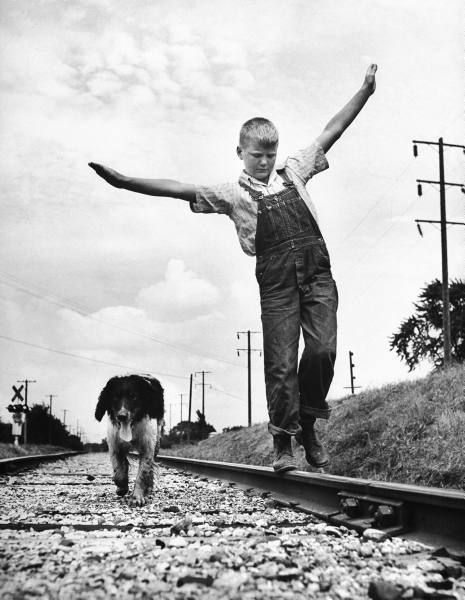

 David Foster Wallace famously argued that


 Richard L. Fricks