The More Loving One: The Science of Entropy and the Art of Alternative Endings

Here’s the link to this article.

“If equal affection cannot be, let the more loving one be me.”

BY MARIA POPOVA

This is the seventh of nine installments in the animated interlude season of The Universe in Verse in collaboration with On Being, celebrating the wonder of reality through stories of science winged with poetry. See the previous installments here.

THE ANIMATED UNIVERSE IN VERSE: CHAPTER SEVEN

In 1865 — a year before the German marine biologist Ernst Haeckel coined the word ecology, the year Emily Dickinson composed her stunning pre-ecological poem about how life-forms come into being — the German physicist Rudolf Clausius coined the word entropy to describe the undoing of being. The thermodynamic collapse of physical systems into increasing levels of disorder and uncertainty. The dissolution of cohesion along the arrow of time. Inescapable. Irreversible. Perpetually inclining us toward, in poet Mary Ruefle’s perfect phrase, “the end of time, which is also the end of poetry (and wheat and evil and insects and love).” Perpetually ensuring, in poet Edna St. Vincent Millay’s perfect phrase, that “lovers and thinkers” become “one with the dull, the indiscriminate dust.”

This transformation of order into disorder, of constancy into discontinuity, is how we register change and tell one moment from the next. Without entropy, the universe would be a vast eternal stillness — a frozen fixity in which never and forever are one. Without entropy, there would be no time — at least not for us, creatures of time.

Clausius built on the Greek word for transformation, tropē, because he believed that leaning on ancient languages to name new scientific concepts made them available to all living tongues, belonging to all people for all time. It pleased him, too, that entropy looked like energy — its twin in the making and unmaking of the universe. Energy, the giver of life. Entropy, the taker away. The frayer of every cell that animates our bodies with being. The extinguisher of every star that unlooses its thermal energy into the cold sublime of spacetime as it runs out of fuel, warming up the orbiting planets with its dying breath. We are only alive because our Sun is burning out. Without entropy, there would be no us.

W.H. Auden

The child of a physicistW.H. Auden (February 21, 1907–September 29, 1973) had no illusion about the entropic nature of reality — a science-lensed lucidity he wove into his poetic search for truth, for meaning, for a way to live with our human fragility, with our twin capacities for terror and tenderness inside an impartial universe he knew to be impervious to our plans and pleas. The child of two world wars, he had no illusion about how our humanity comes unwoven by its own pull but is also the enchanted loom that makes life worth living.

Just as Auden was reaching the peak of his poetic powers, the world’s deadliest war broke out, brutal and incomprehensible. It may be that art is simply what we call our most constructive coping mechanism for the incomprehension of life and mortality, and so Auden coped through his art. He looked at the stars and saw “ironic points of light” above a world “defenseless under the night”; he looked at himself and saw a creature “composed like them of Eros and of dust, beleaguered by the same negation and despair.”

“September 1, 1939” became a generation’s life-raft for “the waves of anger and fear” subsuming the unexamined certainties of yore, splashing awake the “euphoric dream” of a final and permanent triumph over evil. But the war went on, and in the protracted post-traumatic reckoning with its aftermath — this gasping ellipsis in the narrative of humanity — Auden revised his understanding of the world, of life, of our human imperative, and so he revised his poem.

In what may be the single most poignant one-word alteration in the history of our species, he changed the final line of the penultimate stanza to reflect his war-annealed recognition that entropy dominates all. The original version read: “We must love one another or die” — an impassioned plea for compassion as a moral imperative, the withholding of which assures the destruction of life. But the plea had gone unanswered and eighty million lives had gone unsaved. Auden came to feel that his reach for poetic truth had been rendered “a damned lie,” later lamenting that however our ideals and idealisms may play out, “we must die anyway.”

A decade of disquiet after the end of the war, he changed the line to read: “We must love one another and die.”Liminal Days. (Available as a print.)

But there was a private reckoning beneath the public one — this, after all, is the history of humanity, of our science and our art. Auden was working out the world in the arena where we so often wrestle with the vastest, austerest, most abstract and universal questions about how reality works — the fleshy, feeling concreteness of personal love.

In the summer of 1939, just before the world came unworlded, Auden met the young aspiring poet Chester Kallman and fell in love, fell hard, fell dizzily into the strangeness of spending “the eleven happiest weeks” of his life amid a world haunted by death. Over the next two years, as the war peaked, this passionate love became a lifeline of sanity and survival. But Auden, already well into his thirties, kept longing for a stable and continuous relationship of mutual fidelity — the closest thing to a marriage their epoch allowed — and Kallman, barely twenty, kept wounding him with the scattered and discontinuous affections of self-discovery.

Throughout the cycles of heartache, Auden refused to withdraw his love — a stubborn and devoted love, opposing the forces of dissolution and disorder, outlasting the fraying of passion and the abrasions of romantic disappointment, until it buoyed their bond over to the other side of the tumult, to the stable shore of lifelong friendship.

For the remainder of his life, Auden summered with Kallman in Europe. They spent twenty New York winters as roommates in a second-floor apartment at 77 St. Marks Place in the East Village, later marked with a stone plaque emblazoned with lines from Auden’s ode to the foolish, fierce devotion that had prevailed over the lazy entropy of romantic passion to salvage from its wreckage the lasting friendship, the mutual cherishment and understanding that had bound them together in the first place.

Wystan and Chester, 1940s.

“The More Loving One” — the second verse of which became the epigraph of Figuring, and which appears in Auden’s indispensable Collected Poems (public library) — is a poem both profoundly personal and profoundly universal, radiating a reminder that no matter the heartbreak, no matter the entropic undoing of everything we love and are, we are survivors. It is at once a childish fantasy chalked on the blackboard of consciousness — we do not, after all, survive ourselves — and a blazing manifesto for being, for the measure of maturity, for the only adequate attitude with which to go on living with the incremental loss that is life itself.

In this seventh installment of the animated interlude season of The Universe in Verse (which returns as a live show next week), “The More Loving One” comes alive in a reading by astrophysicist, author, and OG Universe in Verse collaborator Janna Levin (who has previous inspirited many a splendid poem), animated by Taiwanese artist and filmmaker Liang-Hsin Huang, and winged with original music by Canadian double bassist, composer, and nature-celebrator Garth Stevenson.

THE MORE LOVING ONE
by W.H. Auden

Looking up at the stars, I know quite well
That, for all they care, I can go to hell,
But on earth indifference is the least
We have to dread from man or beast.

How should we like it were stars to burn
With a passion for us we could not return?
If equal affection cannot be,
Let the more loving one be me.

Admirer as I think I am
Of stars that do not give a damn,
I cannot, now I see them, say
I missed one terribly all day.

Were all stars to disappear or die,
I should learn to look at an empty sky
And feel its total dark sublime,
Though this might take me a little time.

Previously in the series: Chapter 1 (the evolution of life and the birth of ecology, with Joan As Police Woman and Emily Dickinson); Chapter 2 (Henrietta Leavitt, Edwin Hubble, and the human hunger to know the cosmos, with Tracy K. Smith); Chapter 3 (trailblazing astronomer Maria Mitchell and the poetry of the cosmic perspective, with David Byrne and Pattiann Rogers); Chapter 4 (dark matter and the mystery of our mortal stardust, with Patti Smith and Rebecca Elson); Chapter 5 (a singularity-ode to our primeval bond with nature and each other, starring Toshi Reagon and Marissa Davis); Chapter 6 (Emmy Noether, symmetry, and the conservation of energy, with Amanda Palmer and Edna St. Vincent Millay).

Dirge Without Music: Emmy Noether, Symmetry, and the Conservation of Energy

Here is the link to this article.

“Lovers and thinkers, into the earth with you. Be one with the dull, the indiscriminate dust.”

BY MARIA POPOVA

ednastvincentmillay

This is the sixth of nine installments in the animated interlude season of The Universe in Verse in collaboration with On Being, celebrating the wonder of reality through stories of science winged with poetry. See the rest here.

THE ANIMATED UNIVERSE IN VERSE: CHAPTER SIX

As he was revolutionizing our understanding of reality, Albert Einstein kept stumbling over one monolith of mystery — why is it that while some things in physical systems change (and relativity is a theory of change: of how changes in coordinates give shape to spacetime), nature keeps other things immutable: things like energy, momentum, and electrical charge. And the crucial puzzle: Why we cannot destroy energy or create it out of nothing — we can only transform it from one form to another in ever-morphing symmetries.

The revelation, which made Einstein’s general relativity possible, came from the mathematics of Emmy Noether (March 23, 1882–April 14, 1935).

Born into a Jewish family in rural Germany in 1882, the daughter of a mathematician, Emmy Noether showed an early and exquisite gift for mathematics: this abstract plaything of thought, this deepest language of reality. She excelled through all the education available to her, completing her doctorate in 1907 as one of two women in a class of nearly a thousand, shortly after the government had declared that mixed-sex education would “overthrow all academic order.”

For seven years, while Einstein was working out his theories, Noether was working without pay as a mathematics instructor at the local university. In 1915 — the year Einstein’s general relativity reframed our picture of reality — she finally received proper employment at the country’s premier research institution. At Göttingen University, where three centuries of visionary scientists have honed their science and earned their Nobels, Emmy Noether developed the famous theorem now bearing her name. Considered one of the most important and beautiful in all of mathematics, it proves that conservation laws rely on symmetry.

A generation after the women decoding the universe for paltry pay at the Harvard College Observatory under the directorship of Edward Charles Pickering became known as “Pickering’s Harem,” Emmy Noether’s mathematics students became known as the “Noether boys.”

In 1932, she became the first woman to give the plenary address at the International Congress of Mathematicians — the world’s most venerable gathering of brilliant abstract minds. Of the 420 participating mathematicians, Emmy Noether was the only woman. Another woman would not address the Congress until 1990 — the year the Hubble Space Telescope leaned on her physics to open its colossal eye into an unseen cosmos “so brutal and alive it seemed to comprehend us back.” As of this moment in 2022, there has not been a third.

Months after Emmy Noether’s address, the Nazis banished Jewish professors from German universities. The position she had spent half a century and a lifetime earning was vanquished overnight.

Einstein sought refuge in Princeton — that epicenter of physicists and mathematicians of his and her caliber. But Princeton had no room for a her. Emmy Noether ended up at Bryn Mawr. Although she was invited as a guest lecturer on the request of the working scientists at Princeton, whose field would have been unimaginable without her contribution, the university overlords made her feel unambiguously unwelcome. Even this cheerful and uncomplaining woman, too in love with the abstract beauty of mathematics to have been thwarted by the systemic exclusion of the body carrying the mind, rued that it was “the men’s university, where nothing female is admitted.”

Symmetry now permeates our understanding of the universe and the language of physics. It is nigh impossible to publish any paper — that is, to formulate any meaningful model of reality — without referring to symmetry in some way. This was Emmy Noether’s gift to the world — a whole new way of seeing and a whole new vocabulary for naming what we see, which is the fundament of fathoming and sensemaking. What she gave us is not unlike poetry, which gives us a new way of comprehending what is already there but not yet noticed and not yet named. With her elegant, deeply original mathematics, which came to underpin the entire standard model of particle physics, Emmy Noether became the poet laureate or reality.

And yet, having devoted her life’s work to demystifying the conservation of energy, she too submitted to the dissipation awaiting us all — each of us a temporary constellation of particles assembled for a pinch in spacetime, an assemblage that has never before been and will never again be, no matter the greatness and glory attained in the brief interlude of being succumbing to the ultimate mystery.

Emmy Noether died on April 14, 1935, after complications from a seemingly banal ovarian surgery. She had just turned 53.

Two weeks later, crowds gathered for a memorial at Bryn Mawr, where the great German mathematician, physicist, and philosopher Hermann Weyl delivered the memorial address. He opened it with a verse from “Dirge Without Music” by Edna St. Vincent Millay (February 22, 1892–October 19, 1950) — another woman ahead of her epoch in many ways, who frequently reverenced science in her poems about the rapture of reality.

Inspired by one of Millay’s most passionate loves — a young woman named Dorothy Coleman, who had died in the 1918 flu pandemic — the elegy was published a decade later in her collection The Buck in the Snow and now lives on in her exquisite Collected Poems (public library).Edna St. Vincent Millay, 1920s

In this special installment in the animated interlude season of The Universe in Verse, in memory of another irreplaceable constellation of atoms (without whom the modern landscape of scientific thought would not be what it is), I asked my darling friend and longtime collaborator in the poetic endeavors Amanda Palmer to bring Millay’s poem to life in a characteristically soulful reading, then invited another beloved friend — the prolific and Caldecott-decorated children’s book author and artist Sophie Blackall (who happens to be the maker of Amanda’s son’s favorite book) to animate it (in both senses of the word) with her characteristically soulful art, scored with a soulful original composition by English musician Tom McRae (who happens to be Sophie’s cousin):

DIRGE WITHOUT MUSIC
by Edna St. Vincent Millay

I am not resigned to the shutting away of loving hearts in the hard ground.
So it is, and so it will be, for so it has been, time out of mind:
Into the darkness they go, the wise and the lovely. Crowned
With lilies and with laurel they go; but I am not resigned.

Lovers and thinkers, into the earth with you.
Be one with the dull, the indiscriminate dust.
A fragment of what you felt, of what you knew,
A formula, a phrase remains, — but the best is lost.

The answers quick and keen, the honest look, the laughter, the love,—
They are gone. They are gone to feed the roses. Elegant and curled
Is the blossom. Fragrant is the blossom. I know. But I do not approve.
More precious was the light in your eyes than all the roses in the world.

Down, down, down into the darkness of the grave
Gently they go, the beautiful, the tender, the kind;
Quietly they go, the intelligent, the witty, the brave.
I know. But I do not approve. And I am not resigned.

Previously in the series: Chapter 1 (the evolution of life and the birth of ecology, with Joan As Police Woman and Emily Dickinson); Chapter 2 (Henrietta Leavitt, Edwin Hubble, and the human hunger to know the cosmos, with Tracy K. Smith); Chapter 3 (trailblazing astronomer Maria Mitchell and the poetry of the cosmic perspective, with David Byrne and Pattiann Rogers); Chapter 4 (dark matter and the mystery of our mortal stardust, with Patti Smith and Rebecca Elson); Chapter 5 (a singularity-ode to our primeval bond with nature and each other, starring Toshi Reagon and Marissa Davis).

Singularity: An Animated Ode to Our Primeval Bond with Nature and Each Other

Here’s the link to this article.

A song of praise for life and “the smallest possible once before once.”

BY MARIA POPOVA

This is the fifth of nine installments in the animated interlude season of The Universe in Verse in collaboration with On Being, celebrating the wonder of reality through stories of science winged with poetry. See the rest here.

THE ANIMATED UNIVERSE IN VERSE: CHAPTER FIVE

Whenever I am down, I think of the gladiolus.

Whenever I ache with self-referential humanity — that evolutionary miracle of complex consciousness that endows us with the capacity for reflection and rumination at the root of all sorrow — I think of the gladiolus and its primal scream of color and its two-hundred-million-year triumph, governed by insentient forces stretching back to the Big Bang that bloomed a something out of the unimaginable nothingness.

I think of the gladiolus with its mohawk of blossoms — one-sided, bisexual, belonging to nature’s nonbinary citizenry: the “perfect flowers” — most of its 300 known species native to Africa, to which we too are native. A fierce beauty named after the Latin word for sword, known sometimes as “sword lily,” linking it to the flower for which my mother was named. A blade of blossoms pollinated by tiny wasps and long-tongued bees and hawk-moths, and then by self-conscious sapiens with opposable thumbs — a chainlink of humans holding hands across the epochs from Mendel to the young Puerto Rican woman at the Manhattan flower market, those generations of horticulturalists who hybridized and cultivated the small iridescent blossoms of the wild flower to make the towering blooms of solid red and white and yellow in my Bulgarian grandmother’s garden, on my Bulgarian grandfather’s coffin.

Gladiolus by Sydenham Teast Edwards from William Curtis’s Botanical Magazine, 1790. (Available as a print and as stationery cards, benefitting The Nature Conservancy.)

I think of the gladiolus, with which we share 98% of our DNA — that delicate arrangement of atoms forged long ago when all of them, yours and mine and the sword lily’s, banged into being 13.8 billion years ago from a single source, no larger than the dot levitating over the small i, the I lowered from the pedestal of ego.

The young poet Marissa Davis celebrates the atomic spirituality in this chainlink of kinship between us and everything alive in “Singularity (after Marie Howe)” — a poem inspired by “Singularity (after Stephen Hawking),” which the gifted and golden-souled Marie Howe composed for and premiered at the second annual Universe in Verse in 2018, commemorating the recently stardust-surrendered scientist who revolutionized our understanding of the universe by illuminating what happens to a dying star as it collapses to form a singularity — the tiny point of zero radius, infinite density, and infinite curvature of spacetime at the bottom of a black hole, kindred to the Big Bang singularity at the bottom of the Beginning — that original seed from which the universe bloomed.

Marie’s “Singularity” — which was transformed into a breathtaking animated film for the lockdown livestream of the 2020 show, a film that inspired this experimental literary-animated “season” of The Universe in Verse in the interlude between live gatherings — radiated across our Pale Blue Dot, eventually reaching Marissa to spark her own “Singularity” — an exquisite ode to our primeval bond with one another and the rest of nature.

For this fifth installment in the interlude series, in an homage to the intergenerational chainlink of inspiration from which all art is born, here is Marissa’s “Singularity” animated into vibrant aliveness by English artist Lottie Kingslake and set to song by the cosmic life-force that is Toshi Reagon.

SINGULARITY
              (after Marie Howe)

by Marissa Davis

in the wordless beginning
iguana & myrrh
magma & reef              ghost moth
& the cordyceps tickling its nerves
& cedar & archipelago & anemone
dodo bird & cardinal waiting for its red
ocean salt & crude oil              now black
muck now most naïve fumbling plankton
every egg clutched in the copycat soft
of me unwomaned unraced
unsexed              as the ecstatic prokaryote
that would rage my uncle’s blood
or the bacterium that will widow
your eldest daughter’s eldest son
my uncle, her son              our mammoth sun
& her uncountable siblings              & dust mite & peat
apatosaurus & nile river
& maple green & nude & chill-blushed &
yeasty keratined bug-gutted i & you
spleen & femur seven-year refreshed
seven-year shedding & taking & being this dust
& my children & your children
& their children & the children
of the black bears & gladiolus & pink florida grapefruit
here not allied but the same              perpetual breath
held fast to each other as each other’s own skin
cold-dormant & rotting & birthing & being born
in the olympus              of the smallest
possible once before once

Previously on The Universe in VerseChapter 1 (the evolution of life and the birth of ecology, with Joan As Police Woman and Emily Dickinson); Chapter 2 (Henrietta Leavitt, Edwin Hubble, and the human hunger to know the cosmos, with Tracy K. Smith); Chapter 3 (trailblazing astronomer Maria Mitchell and the poetry of the cosmic perspective, with David Byrne and Pattiann Rogers); Chapter 4 (dark matter and the mystery of our mortal stardust, with Patti Smith and Rebecca Elson).

Let There Always Be Light: Dark Matter and the Mystery of Our Mortal Stardust

(Patti Smith Reads Rebecca Elson)

Here’s the link to this article.

“For this we go out dark nights, searching… for signs of unseen things… Let there be swarms of them, enough for immortality, always a star where we can warm ourselves.”

BY MARIA POPOVA

This is the fourth of nine installments in the animated interlude season of The Universe in Verse in collaboration with On Being, celebrating the wonder of reality through stories of science winged with poetry. See the rest here.

THE ANIMATED UNIVERSE IN VERSE: CHAPTER FOUR

Months before Edwin Hubble finally published his epoch-making revelation about Andromeda, staggering the world with the fact that the universe extends beyond our Milky Way galaxy, a child was born under the star-salted skies of Washington, D.C., where the Milky Way was still visible before a century’s smog slipped between us and the cosmos — a child who would grow up to confirm the existence of dark matter, that invisible cosmic glue holding galaxies together and pinning planets to their orbits so that, on at least one of them, small awestruck creatures with vast complex consciousnesses can unravel the mysteries of the universe.

Night after night, Vera Rubin (July 23, 1928–December 25, 2016) peered out of her childhood bedroom and into the stars, wondersmitten with the beauty of it all — until she read a children’s book about the trailblazing astronomer Maria Mitchell, who had expanded the universe of possibility for half of our species a century earlier. The young Vera was suddenly seized with a life-altering realization: Not only was there such a thing as a professional stargazer, but it was a thing a girl could do.

Vera Rubin as an undergraduate at Vassar, 1940s

In 1965 — exactly one hundred years after Maria Mitchell was appointed the first professor of astronomy at Vassar, which Vera Rubin had chosen as her training ground in astronomy — she became the first woman permitted to use the Palomar Observatory. Peering through its colossal eye — the telescope, devised the year Rubin was born, had replaced the one through which Hubble made his discovery as the world’s most powerful astronomical instrument — she was just as wondersmitten as the little girl peering through the bedroom window, just as beguiled by the beauty of the cosmos. “I sometimes ask myself whether I would be studying galaxies if they were ugly,” she reflected in her most personal interview. “I think it may not be irrelevant that galaxies are really very attractive.”

Galaxies had taken Rubin to Palomar, and galaxies — the riddle of their rotation, which she had endeavored to solve — became the key to her epochal confirmation of dark matter. One of the most mesmerizing unsolved puzzles in astronomy, dark matter had remained only an enticing speculation since the Swiss astrophysicist Fritz Zwicky had first theorized it when Vera was five.

A generation later, a small clan of astronomers at Cambridge analyzed the deepest image of space the Hubble Space Telescope had yet captured — that iconic glimpse of the unknown, revealing a universe “so brutal and alive it seemed to comprehend us back” — to discern the origin of the mysterious dark matter halo enveloping the Milky Way. Spearheading the endeavor was an extraordinary young astronomer back to work during a remission of a rare terminal blood cancer ordinarily afflicting the elderly.

Rebecca Elson, 1987

Nursed on geology and paleontology on the shores of a prehistoric lake, Rebecca Elson (January 2, 1960–May 19, 1999) was barely sixteen and already in college when she first glimpsed Andromeda through a telescope. Instantly dazzled by its “delicate wisp of milky spiral light floating in what seemed a bottomless well of empty space,” she became a scientist but never relinquished the pull of the poetic dimensions of reality. During her postdoctoral work at Princeton’s Institute for Advanced Study, Elson found refuge from the narrow patriarchy of academic science in a gathering of poets every Tuesday evening. She became a fellow at a Radcliffe-Harvard institute for postgraduate researchers devoted to reversing “the climate of non-expectation for women,” among the alumnae of which are Anne Sexton, Alice Walker, and Anna Deavere Smith. There, in a weekly writing group, she met and befriended the poet Marie Howe, whose splendid “Singularity” became the inspiration for this animated season of The Universe in Verse.

It was then — twenty-nine and newly elected the youngest astronomer in history to serve on the Decennial Review committee steering the course of American science toward the most compelling unsolved questions — that Elson received her terminal diagnosis.

Throughout the bodily brutality of her cancer treatment, she filled notebooks with poetic questions and experiments in verse, bridging with uncommon beauty the creaturely and the cosmic — those eternal mysteries of our mortal matter that make it impossible for a consciousness born of dead stars to fathom its own nonexistence.

Rebecca Elson lived with the mystery for another decade, never losing her keen awareness that we are matter capable of wonder, never ceasing to channel it in poetry. When she returned her borrowed stardust to the universe, a spring shy of her fortieth birthday, she left behind nearly sixty scientific papers and a single, splendid book of poems titled A Responsibility to Awe (public library) — among them the staggering “Theories of Everything” (read by Regina Spektor at the 2019 Universe in Verse) and “Antidotes to Fear of Death (read by Janna Levin at the 2020 Universe in Verse).

Permeating Elson’s poetic meditations, the mystery of dark matter culminates in one particular poem exploring with uncommon loveliness what may be the most touching paradox of being human — our longing for the light of immortality as creatures of matter in a cosmos governed by the dark sublime of dissolution.

Bringing Elson’s masterpiece to life for this series is Patti Smith (who read Emily Dickinson’s pre-atomic ode to particle physics at the 2020 Universe in Verse), with animation by Ohara Hale (who animated Emily Dickinson’s pre-ecological poem about ecology in Chapter One of this experimental season of The Universe in Verse) and music by Zoë Keating (who read Rita Dove’s paleontological poem at the 2018 Universe in Verse).

LET THERE ALWAYS BE LIGHT (SEARCHING FOR DARK MATTER)
by Rebecca Elson

For this we go out dark nights, searching
For the dimmest stars,
For signs of unseen things:

To weigh us down.
To stop the universe
From rushing on and on
Into its own beyond
Till it exhausts itself and lies down cold,
Its last star going out.

Whatever they turn out to be,
Let there be swarms of them,
Enough for immortality,
Always a star where we can warm ourselves.

Let there be enough to bring it back
From its own edges,
To bring us all so close we ignite
The bright spark of resurrection.

Previously on The Universe in VerseChapter 1 (the evolution of life and the birth of ecology, with Joan As Police Woman and Emily Dickinson); Chapter 2 (Henrietta Leavitt, Edwin Hubble, and the human hunger to know the cosmos, with Tracy K. Smith); Chapter 3 (trailblazing astronomer Maria Mitchell and the poetry of the cosmic perspective, with David Byrne and Pattiann Rogers).

Achieving Perspective: Trailblazing Astronomer Maria Mitchell and the Poetry of the Cosmic Perspective

Here’s the link to this article.

“Mingle the starlight with your lives, and you won’t be fretted by trifles.”

BY MARIA POPOVA

This is the third of nine installments in the animated interlude season of The Universe in Verse in collaboration with On Being, celebrating the wonder of reality through stories of science winged with poetry. See the rest here.

THE ANIMATED UNIVERSE IN VERSE: CHAPTER THREE

To be human is to live suspended between the scale of glow-worms and the scale of galaxies, to live with our creaturely limitations without being doomed by them — we have, after all, transcended them to unravel the molecular mystery of the double helix and compose the Benedictus and land a mechanical prosthesis of our curiosity on Mars. We have dreamt these things possible, then made them real — proof that we are a species of limitless imagination along the forward vector of our dreams. But we are also a species continually blinkered — sometimes touchingly, sometimes tragically — by our own delusions about the totality around us. Our greatest limitation is not that of imagination but that of perspective — our lens is too easily contracted by the fleeting urgencies of the present, too easily blurred by the hopes and fears of our human lives.

Two centuries ago, Maria Mitchell — a key figure in Figuring — understood this with uncommon poetry of perspective.Portrait of Maria Mitchell, 1840s. (Maria Mitchell Museum. Photograph: Maria Popova)

America’s first professional female astronomer, she was also the first woman employed by the federal government for a “specialized non-domestic skill.” After discovering her famous comet, she was hired as “computer of Venus,” performing complex mathematical calculations to help sailors navigate the globe — a one-woman global positioning system a century and a half before Einstein’s theory of relativity made GPS possible.

When Maria Mitchell began teaching at Vassar College as the only woman on the faculty, the college handbook mandated that neither she nor her female students were allowed outside after nightfall — a somewhat problematic dictum, given she was hired to teach astronomy. She overturned the handbook and overwrote the curriculum, creating the country’s most ambitious science syllabus, soon copied by other universities — including the all-male Harvard, which had long dropped its higher mathematics requirement past the freshman year.

Maria Mitchell’s students went on to become the world’s first class with academic training in what we now call astrophysics. They happened to all be women.

Maria Mitchell, standing at telescope, with her students at Vassar

Science was one of Maria Mitchell’s two great passions. The other was poetry.

At her regular “dome parties” inside the Vassar College Observatory, which was also her home, students and occasional esteemed guests — Julia Ward Howe among them — gathered to play a game of writing extemporaneous verses about astronomy on scraps of used paper: sonnets to the stars, composed on the back of class notes and calculations.

Mitchell taught astronomy until the very end of her long life, when she confided in one of her students that she would rather have written a great poem than discovered a great comet. But scientific discovery is what gave her the visibility to blaze the way for women in science and enchant generations of lay people the poetry of the cosmic perspective.

Art from What Miss Mitchell Saw

It was this living example that became Maria Mitchell’s great poem, composed in the language of being — as any life of passion and purpose ultimately becomes.

“Mingle the starlight with your lives,” she often told her students, “and you won’t be fretted by trifles.”

And yet here we are, our transient lives constantly fretted by trifles as we live them out in the sliver of spacetime allotted us by chance.

A century after Maria Mitchell returned her borrowed stardust to the universe that made it, the poet Pattiann Rogers extended a kindred invitation to perspective, untrifling the tender moments that make a life worth living.

Published in her collection Firekeeper (public library), it is read for us here by the ever-optimistic David Byrne, with original art by his ever-perspectival longtime collaborator Maira Kalman and original music by the symphonic-spirited Jherek Bischoff.

ACHIEVING PERSPECTIVE
by Pattiann Rogers

Straight up away from this road,
Away from the fitted particles of frost
Coating the hull of each chick pea,
And the stiff archer bug making its way
In the morning dark, toe hair by toe hair,
Up the stem of the trillium,
Straight up through the sky above this road right now,
The galaxies of the Cygnus A cluster
Are colliding with each other in a massive swarm
Of interpenetrating and exploding catastrophes.
I try to remember that.

And even in the gold and purple pretense
Of evening, I make myself remember
That it would take 40,000 years full of gathering
Into leaf and dropping, full of pulp splitting
And the hard wrinkling of seed, of the rising up
Of wood fibers and the disintegration of forests,
Of this lake disappearing completely in the bodies
Of toad slush and duckweed rock,
40,000 years and the fastest thing we own,
To reach the one star nearest to us.

And when you speak to me like this,
I try to remember that the wood and cement walls
Of this room are being swept away now,
Molecule by molecule, in a slow and steady wind,
And nothing at all separates our bodies
From the vast emptiness expanding, and I know
We are sitting in our chairs
Discoursing in the middle of the blackness of space.
And when you look at me
I try to recall that at this moment
Somewhere millions of miles beyond the dimness
Of the sun, the comet Biela, speeding
In its rocks and ices, is just beginning to enter
The widest arc of its elliptical turn.

Previously on The Universe in VerseChapter 1 (the evolution of flowers and the birth of ecology, with Emily Dickinson); Chapter 2 (Henrietta Leavitt, Edwin Hubble, and the age of space telescopes, with Tracy K. Smith).

My God, It’s Full of Stars …

Here’s the link to this article. Please take time to read this masterpiece. It’s awe-inspiring, and deeply humbling.

My God, It’s Full of Stars: Henrietta Leavitt, Edwin Hubble, and Our Human Hunger to Know the Universe (Tracy K. Smith Reads Tracy K. Smith)

“…so brutal and alive it seemed to comprehend us back.”

BY MARIA POPOVA

This is the second of nine installments in the animated interlude season of The Universe in Verse in collaboration with On Being, celebrating the wonder of reality through stories of science winged with poetry. See the rest here.

THE ANIMATED UNIVERSE IN VERSE: CHAPTER TWO
Henrietta Swan Leavitt

In 1908, Henrietta Swan Leavitt — one of the women known as the Harvard Computers, who changed our understanding of the universe long before they could vote — was analyzing photographic plates at the Harvard Observatory, singlehandedly measuring and cataloguing more than 2,000 variable stars — stars that pulsate like lighthouse beacons — when she began noticing a consistent correlation between their brightness and their blinking pattern. That correlation would allow astronomers to measure their distance for the first time, furnishing the yardstick of the cosmos.

Glass plate of Andromeda from the archives of the “Harvard Computers.” (Photograph: Maria Popova)

Meanwhile, a teenage boy in the Midwest was repressing his childhood love of astronomy and beginning his legal studies to fulfill his dying father’s demand for an ordinary, reputable life. Upon his father’s death, Edwin Hubble would unleash his passion for the stars into formal study and lean on Leavitt’s data to upend millennia of cosmic parochialism, demonstrating two revolutionary facts about the universe: that it is vastly bigger than we thought, and that it is growing bigger by the blink.

Art by Deborah Marcero from The Boy Whose Head Was Filled with Stars: A Life of Edwin Hubble by Isabelle Marinov

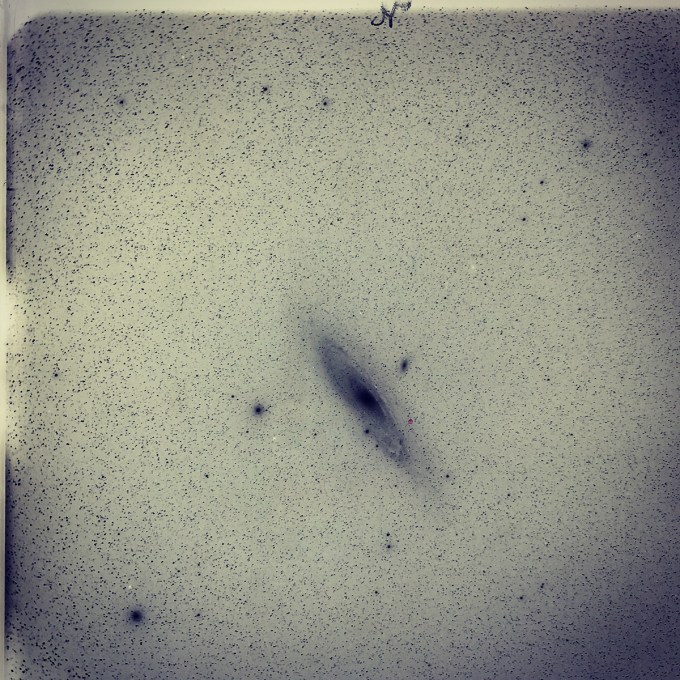
One October evening in 1923, perched at the foot of the world’s most powerful telescope at Mount Wilson Observatory in California, Hubble took a 45-minute exposure of Andromeda, which was then thought to be one of many spiral nebulae in the Milky Way. The notion of a galaxy — a gravitationally bound swirl of stars and interstellar gas, dust and dark matter — did not exist as such. The Milky Way — a name coined by Chaucer — was commonly considered an “island universe” of stars, beyond the edge of which lay cold dark nothingness.

When Hubble looked at the photograph the next morning and compared it to previous ones, he (I like to imagine) furrowed his brow, then with a gasp of revelation he (this we know for a fact) crossed out the marking N on the plate, scribbled the letters V A R beneath it, and could not help adding an exclamation point.

Edwin Hubble’s 1923 glass plate of Andromeda. (Photograph: Carnegie Observatories)

Hubble had realized that a tiny fleck in Andromeda, previously mistaken for a nova, could not possibly be a nova, given its blinking pattern across the different photographs. It was a variable star — which, given Henrietta Leavitt’s discovery, could only be so if the tiny fleck was very far away, farther than the edge of the Milky Way.

Andromeda was not a nebula in our own galaxy but a separate galaxy, out there in the cold dark nothingness.

Suddenly, the universe was a garden blooming with galaxies, with ours but a single bloom.

That same year, in another country suspended between two World Wars, another young scientist named Hermann Oberth was polishing the final physics on a daring idea: to subvert a deadly military technology with roots in medieval China and rocket-launch an enormous telescope into Earth orbit — closer to the stars, bypassing the atmosphere that occludes our terrestrial instruments.

It would take two generations of scientists to make that telescope a reality — a shimmering poem of metal, physics, and perseverance, bearing Hubble’s name.

The Hubble Space Telescope. (Photograph: NASA)

But when the Hubble Space Telescope finally launched 1990, hungry to capture the most intimate images of the cosmos humanity had yet seen, humanity had crept into the instrument’s exquisite precision — its main mirror had been ground into the wrong spherical shape, warping its colossal eye.

Up the coast from Mount Wilson Observatory, a teenage girl watched her father — who had worked on the Hubble as one of NASA’s first black engineers — come home brokenhearted. He didn’t know that his observant daughter would become Poet Laureate of his country and would come to commemorate him in the tenderest tribute an artist-daughter has ever made for a scientist-father. That tribute — the splendid poetry collection Life on Mars (public library) — earned Tracy K. Smith the Pulitzer Prize the year the Hubble’s corrected optics captured the revolutionary Ultra Deep Field image of the observable universe, revealing what neither Henrietta Leavitt nor Edwin Hubble could have imagined — that there isn’t just one other galaxy besides our own, or just a handful more, but at least 100 billion, each containing at least 100 billion stars.

MY GOD, IT’S FULL OF STARS (PART 5)
by Tracy K. Smith

When my father worked on the Hubble Telescope, he said
They operated like surgeons: scrubbed and sheathed
In papery green, the room a clean cold, a bright white.

He’d read Larry Niven at home, and drink scotch on the rocks,
His eyes exhausted and pink. These were the Reagan years,
When we lived with our finger on The Button and struggled

To view our enemies as children. My father spent whole seasons
Bowing before the oracle-eye, hungry for what it would find.
His face lit up whenever anyone asked, and his arms would rise

As if he were weightless, perfectly at ease in the never-ending
Night of space. On the ground, we tied postcards to balloons
For peace. Prince Charles married Lady Di. Rock Hudson died.

We learned new words for things. The decade changed.

The first few pictures came back blurred, and I felt ashamed
For all the cheerful engineers, my father and his tribe. The second time,
The optics jibed. We saw to the edge of all there is —

So brutal and alive it seemed to comprehend us back.

THE MAKING

Every poet is a miniaturist of meaning, building cathedrals of beauty and truth with the smallest particles of language. It is with a poet’s mindset that Brazilian graphic artist and animation director Daniel Bruson approached his contribution to The Universe in Verse. (Special thanks to On Being creative director Erin Colasacco for bringing Daniel into the project and for working with him and with composer Gautam Srikishan on making this symphonic cinepoem come alive.)

After I relayed to Daniel why I had chosen this particular poem (which Tracy read at the inaugural Universe in Verse in 2017) to illustrate the larger story of our search for cosmic truth — a search both made possible and made imperfect by our humanity — he grasped the nested layers of meaning with uncommon sensitivity, mirroring back his interpretation:

The Hubble tries to see or make sense of the Universe, the father tries to understand the Hubble, the daughter tries to make sense of the father, the decade, the world, and the poet tries to put this whole into perspective. All these efforts have to face problems of scale or distortion: something too big or small, too close or too distant, too dark or too familiar. Not to mention the original problem with the Hubble mirror.

This cascade of distortion sparked the idea “to use optics as a metaphor, to seek for these imperfect, unresolved and elusive, but also suggestive and alive images.”

Daniel set about creating his deliberately blurry cosmic animations frame by frame, painting each tiny detail onto a glass plate with nail polish, oil paint, glitter, acrylic, and other materials he mixed, scrubbed, smudged, and swirled with brushes and cotton swabs beneath the lens of a camera capturing the process of creation and destruction.

He magnified the optical enchantment by filming the vignettes through upside-down drinking glasses of various shapes and thicknesses.

In a crowning feat of ingenuity — itself a miniature masterpiece of engineering and composition — he built a tiny model of the Hubble out of cardboard, paper, and aluminum foil, dismantled it frame by frame, filmed the destruction, then reversed the footage to create the building effect. (I am reminded here of Bertrand Russell’s astute observation, made shortly after Edwin Hubble took his historic glass plate of Andromeda, that “construction and destruction alike satisfy the will to power, but construction is more difficult as a rule, and therefore gives more satisfaction to the person who can achieve it” — a truth as true of the universe itself, with its elemental triumph of something over nothing, as it is of the human endeavor to know it by building optical prosthesis of our curiosity.)

Something about Daniel’s process — the exquisite craftsmanship, the passionate patience, the tiny scale on which he made such beauty and grandeur of feeling — calls to mind Emily Dickinson and her miniature cherrywood writing desk, on the seventeen square inches of which she conjured up such cosmoses of truth, among them the poem illustrating Chapter One of this series.