The Six Motives of Creativity: Mary Gaitskill on Why Writers Write

Here’s the link to this article.

The art of integrating the ego and the impulse for empathy in a dynamic call and response.

BY MARIA POPOVA

Why do writers — great writers — write? George Orwell attributed it to four universal motivesJoan Didion saw it as access to her own mind. For David Foster Wallace, it was about funMichael Lewis ascribes it to the necessary self-delusions of creativityJoy Williams found in it a gateway from the darkness to the light. For Charles Bukowski, it sprang from the soul like a rocketItalo Calvino found in writing the comfort of belonging to a collective enterprise. For Susan Orlean, it comes from immutable love.

But one of literary history’s most beautiful answers comes from Mary Gaitskill in her essay “The Wolf in the Tall Grass,” titled after Nabokov’s famous meditation on the art of storytelling and published in the 1998 anthology Why I Write: Thoughts on the Craft of Fiction (public library) — an altogether fantastic collection, featuring David Foster Wallace’s famous essay “The Nature of the Fun” and other notable reflections on writing from Ann Patchett, Elizabeth Gilbert, Rick Bass, Norman Mailer, Rick Moody, and more.

1. To satisfy a basic, fundamental need. I think all people have this need. It’s why children like to draw pictures of houses, animals, and Mom; it’s an affirmation of their presence in the corporeal world. You come into life, and life gives you everything your senses can bear: broad currents of animal feeling running alongside the particularity of thought. Sunlight, stars, colors, smells, sounds. Tender things, sweet, temperate things, harsh, freezing, hot, salty things. All the different expressions on people’s faces and in their voices. For years, everything just pours into you, and all you can do is gurgle or scream until finally one day you can sit up and hold your crayon and draw your picture and thus shout back, Yes! I hear! I see! I feel! This is what it’s like! It’s dynamic creation and pure, delighted receptivity happening on the same field, a great call and response.

Mary Gaitskill by Ben Handzo

Her second motive reflects Susan Sontag’s assertion that “a writer is someone who pays attention to the world — a writer is a professional observer.” Gaitskill continues:

2. To give form to the things we can sense but not see. You walk into the living room where your father is lying on the couch, listening to music. You are small, so he doesn’t hear or see you. His face is reacting to the music, and his expression is soft, abstract, intensely inward. It is also pained. It is an expression that you have never seen. Then he sees you and smiles, but the music still fills the room with that other expression…

Quoting Nabokov’s famous words — “Between the wolf in the tall grass and the wolf in the tall story there is a shimmering go-between. That go-between, that prism, is the art of literature.” — Gaitskill reflects on that ability to give shape to the ineffable as the essence of storytelling:

Stories mimic life like certain insects mimic leaves and twigs. Stories are about all the things that might’ve, could’ve, or would’ve happened, encrowded around and giving density and shape to undeniable physical events and phenomena. They are the rich, unseen underlayer of the most ordinary moments.

Gaitskill contrasts this intense outrospection and sensitivity to the world’s unseen layers with her third reason — which coincides with Orwell’s first motive — and writes:

3. To feel important, in the simplest egotistical sense. … Strong thoughts and feelings about what you see and feel require a distinct point of view and an ego. If you are frequently told that your point of view is worthless, invalid, or crazy, your ego will get really insulted. It will sulk like a teenager hunched in her room muttering, “No one ever listens. No one cares. One day they’ll see!” To make them all see — i.e., see how important I am — was once a big part of why I wrote stories. As a motivation, it’s embarrassing, it’s base, and it smells bad, but it’s also an angry little engine that could: it will fight like hell to keep your point of view from being snatched away, or demeaned, fighting even when there’s no apparent threat.

But just as one begins to raise a skeptical eyebrow and summon Alan Watts for a counterpoint, Gaitskill herself acknowledges the existential paradox therein:

The only problem is, the more your ego fights, the smaller your point of view gets. For a while, I needed to take great pains to make myself feel safe, to the point of extreme social isolation, so I wouldn’t feel like I had to fight. The angry engine quieted down a bit, and I began to learn about other points of view.

Indeed, this impulse for empathy and for giving voice to the marginalized realities of others brings us to Gaitskill’s fourth motive:

4. To reveal and restore things that I feel might be ignored or disregarded. I was once at a coffee shop eating breakfast alone when I noticed a woman standing and talking to a table of people. She was young but prematurely aged, with badly dyed hair and lined skin. She was smiling and joking, but her body had a collapsed, defeated posture that looked deeply habitual. Her spine was curled, her head was slightly receded, and her shoulders were pulled down in a static flinch. She expressed herself loudly and crudely, but also diffidently. She talked like she was a joke. But there was something else to her, something pushing up against the defeat, a sweet, tough, humorous vitality that I could almost see running up her center. I realized that if I hadn’t looked closely, I would not have really seen this woman, that I would not have seen what was most human and lively in her. I wondered how many people saw it, or even if she herself saw it…

That kind of small, new, unrecognized thing is very tender to me, and I hate it when it gets ignored or mistaken for something ugly. I want to acknowledge and nurture it, but I usually leave it very small in the stories. I do that because I think part of the human puzzle is in the delicacy of those moments or phenomena, contrasted with the ignorance and lack of feeling we are subject to.

Gaitskill moves on to her fifth reason, echoing Oscar Wilde’s famous emphasis on receptivity and reflecting on the osmosis of reading and writing:

5. To communicate. … To read well is an act of dynamic receptivity that creates a profound sense of exchange, and I like being on both ends of it.

Illustration by Sydney Pink for ‘How to Overcome Creative Block.’ Click image for more.

Citing one of her favorite passages in literature, from Saul Bellow’s The Victim, she captures the highest potentiality of literature:

It opens life up down to the pit; when I read that, I can’t ignore how extraordinary it is to be alive.

In her sixth and final reason, Gaitskill returns to Nabokov:

6. To integrate; to love. One of Nabokov’s early novels, Laughter in the Dark, has an apparently simple, almost hackneyed plot: a foolish, wealthy middle-aged man (Albinus) falls in love with a vulgar, heartless sixteen-year-old girl (Margot). She and her lover, Rex, proceed to destroy Albinus and his family in a ruthless, ultimately grotesque fashion. On the face of it, it’s a soap opera, but what makes it extraordinary, aside from the beauty of the prose, is the author’s gift for inhabiting every energetic strain of his breathing animal creations. Rex and Margot are absolutely evil, but they are also full of fierce life, with, and supple, eel-like charm. Nabokov can step inside their cruelty and vitality almost as if it were an electrical current, then step out again and enter the much slower, cooler ambience of their poor stooge Albinus, or the person of Albinus’s bland, taffy-sweet wife, and emerge again, all in a flash. … The ability to do this requires a great understanding of and regard for life that is, I think, a kind of love.

Gaitskill concludes by reflecting on this “kind of integration [that] requires holding many disparate elements together in a fluid mosaic” in her own experience of writing, from the depths of which emerges the light of the creative impulse:

When I start writing a story, I don’t feel like I’m integrating anything; I feel like I’m marching through mud. But at least some of the time when there comes a moment when I feel I’m carrying all the elements I’ve just described and more in a big, clear bowl. It doesn’t feel like I’m containing them. It feels like I’m bringing them into being and letting them be, exactly as they are. My perplexity and upset may still be there, but they are no longer the main event. I feel sadness because much of what is in that bowl is sad. But because of that tender sadness, I also feel humility and joy and love. It’s strange because much of what I write about does not seem loving. But to write it makes me feel love.

Why I Write, while out of print, is still findable and very much worth the hunt. Complement it with its contemporary counterpart, one of 2013’s best books on writing, then revisit famous writers’ advice on writing.

How to Bear Your Loneliness: Grounding Wisdom from the Great Buddhist Teacher Pema Chödrön

Here’s the link to this article.

“We are cheating ourselves when we run away from the ambiguity of loneliness.”

BY MARIA POPOVA

How to Bear Your Loneliness: Grounding Wisdom from the Great Buddhist Teacher Pema Chödrön

“You are born alone. You die alone. The value of the space in between is trust and love,” the artist Louise Bourgeois wrote in her diary. How much trust and love we wrest from life and lavish upon life is largely a matter of how well we have befriended our existential loneliness — a fundamental fact of every human existence that coexists with our delicate interconnectedness, each a parallel dimension of our lived reality, each pulsating beneath our days.

In When Things Fall Apart: Heart Advice for Difficult Times (public library) — her timeless field guide to transformation through difficult times — the Buddhist teacher Pema Chödrön explores what it takes to cultivate “a nonthreatening relationship with loneliness,” to transmute it into a different kind of “relaxing and cooling loneliness” that subverts our ordinary terror of the existential void.

Sunlit Solitude by Maria Popova. (Available as a print.)

She writes:

When we draw a line down the center of a page, we know who we are if we’re on the right side and who we are if we’re on the left side. But we don’t know who we are when we don’t put ourselves on either side. Then we just don’t know what to do. We just don’t know. We have no reference point, no hand to hold. At that point we can either freak out or settle in. Contentment is a synonym for loneliness, cool loneliness, settling down with cool loneliness. We give up believing that being able to escape our loneliness is going to bring any lasting happiness or joy or sense of well-being or courage or strength. Usually we have to give up this belief about a billion times, again and again making friends with our jumpiness and dread, doing the same old thing a billion times with awareness. Then without our even noticing, something begins to shift. We can just be lonely with no alternatives, content to be right here with the mood and texture of what’s happening.

In Buddhism, all suffering is a form of resistance to reality, a form of attachment to desires and ideas about how the world should be. By befriending our loneliness, we begin to meet reality on its own terms and to find contentment with the as-is nature of life, complete with all of its uncertainty. Chödrön writes:

We are fundamentally alone, and there is nothing anywhere to hold on to. Moreover, this is not a problem. In fact, it allows us to finally discover a completely unfabricated state of being. Our habitual assumptions — all our ideas about how things are — keep us from seeing anything in a fresh, open way… We don’t ultimately know anything. There’s no certainty about anything. This basic truth hurts, and we want to run away from it. But coming back and relaxing with something as familiar as loneliness is good discipline for realizing the profundity of the unresolved moments of our lives. We are cheating ourselves when we run away from the ambiguity of loneliness.

Lone Man by Rockwell Kent, 1919. (Available as a print and as stationery cards.)

So faced, loneliness becomes a kind of mirror — one into which we must look with maximum compassion, one that beams back to us our greatest strength:

Cool loneliness allows us to look honestly and without aggression at our own minds. We can gradually drop our ideals of who we think we ought to be, or who we think we want to be, or who we think other people think we want to be or ought to be. We give it up and just look directly with compassion and humor at who we are. Then loneliness is no threat and heartache, no punishment. Cool loneliness doesn’t provide any resolution or give us ground under our feet. It challenges us to step into a world of no reference point without polarizing or solidifying. This is called the middle way, or the sacred path of the warrior.

Complement with Rachel Carson on the relationship between loneliness and creativity and Barry Lopez on the cure for our existential loneliness, then revisit poet May Sarton’s splendid century-old ode to the art of being contentedly alone.

Tenacity, the Art of Integration, and the Key to a Flexible Mind: Wisdom from the Life of Mary Somerville, for Whom the Word “Scientist” Was Coined

Here’s the link to this article.

Inside the hallmark of a great scientist and a great human being — the ability to hold one’s opinions with firm but unfisted fingers.

BY MARIA POPOVA

This essay is adapted from my book Figuring

A middle-aged Scottish mathematician rises ahead of the sun to spend a couple of hours with Newton before the day punctuates her thinking with the constant interruptions of mothering four children and managing a bustling household. “A man can always command his time under the plea of business,” Mary Somerville (December 26, 1780–November 28, 1872) would later write in her memoir; “a woman is not allowed any such excuse.”

Growing up, Somerville had spent the daylight hours painting and playing piano. When her parents realized that the household candle supply had thinned because Mary had been staying up at night to read Euclid, they promptly confiscated her candles. “Peg,” she recalled her father telling her mother, “we must put a stop to this, or we shall have Mary in a strait jacket one of these days.” Mary was undeterred. Having already committed the first six books of Euclid to memory, she spent her nights adventuring in mathematics in the bright private chamber of her mind.

Mary Somerville (Portrait by Thomas Phillips)

Despite her precocity and her early determination, it took Somerville half a lifetime to come abloom as a scientist — the spring and summer of her life passed with her genius laying restive beneath the frost of the era’s receptivity to the female mind. When Somerville was forty-six, she published her first scientific paper — a study of the magnetic properties of violet rays — which earned her praise from the inventor of the kaleidoscope, Sir David Brewster, as “the most extraordinary woman in Europe — a mathematician of the very first rank with all the gentleness of a woman.” Lord Brougham, the influential founder of the newly established Society for the Diffusion of Useful Knowledge — with which Thoreau would take issue thirty-some years later by making a case for “the diffusion of useful ignorance,” comprising “knowledge useful in a higher sense” — was so impressed that he asked Somerville to translate a mathematical treatise by Pierre-Simon Laplace, “the Newton of France.” She took the project on, perhaps not fully aware how many years it would take to complete to her satisfaction, which would forever raise the common standard of excellence. All great works suffer from and are saved by a gladsome blindness to what they ultimately demand of their creators.

As the months unspooled into years, Somerville supported herself as a mathematics tutor to the children of the wealthy. One of her students was a little girl named Ada, daughter of the mathematically inclined baroness Annabella Milbanke and the only legitimate child of the sybarite poet Lord Byron — a little girl would would grow to be, thanks to Somerville’s introduction to Charles Babbage, the world’s first computer programmer.

When Somerville completed the project, she delivered something evocative of the Nobel Prize-winning Polish poet Wisława Szymborska’s wonderful notion of “that rare miracle when a translation stops being a translation and becomes… a second original” In The Mechanism of the Heavens, published in 1831 after years of work, Somerville hadn’t merely translated the math, but had expanded upon it and made it comprehensible to lay readers, popularizing Laplace’s esoteric ideas.

Solar System quilt by Ellen Harding Baker, begun in 1869 and completed in 1876 to teach women astronomy when they were barred from higher education in science. Available as a print and a face mask. (Smithsonian)

The book was an instant success, drawing attention from the titans of European science. John Herschel, whom Somerville considered the greatest scientist of their time and who was soon to coin the word photography, wrote her a warm letter she treasured for the rest of her days:

Dear Mrs. Somerville,

I have read your manuscript with the greatest pleasure, and will not hesitate to add, (because I am sure you will believe it sincere,) with the highest admiration. Go on thus, and you will leave a memorial of no common kind to posterity; and, what you will value far more than fame, you will have accomplished a most useful work. What a pity that La Place has not lived to see this illustration of his great work! You will only, I fear, give too strong a stimulus to the study of abstract science by this performance.

Somerville received another radiant fan letter from the famed novelist Maria Edgeworth, who wrote after devouring The Mechanism of the Heavens:

I was long in the state of the boa constrictor after a full meal — and I am but just recovering the powers of motion. My mind was so distended by the magnitude, the immensity, of what you put into it!… I can only assure you that you have given me a great deal of pleasure; that you have enlarged my conception of the sublimity of the universe, beyond any ideas I had ever before been enabled to form.

Edgeworth was particularly taken with a “a beautiful sentence, as well as a sublime idea” from Somerville’s section on the propagation of sound waves:

At a very small height above the surface of the earth, the noise of the tempest ceases and the thunder is heard no more in those boundless regions, where the heavenly bodies accomplish their periods in eternal and sublime silence.

Years later, Edgeworth would write admiringly of Somerville that “while her head is up among the stars, her feet are firm upon the earth.”

Milky Way Starry Night by Native artist Margaret Nazon, part of her stunning series of astronomical beadwork.

In 1834, Somerville published her next major treatise, On the Connexion of the Physical Sciences — an elegant and erudite weaving together of the previously fragmented fields of astronomy, mathematics, physics, geology, and chemistry. It quickly became one of the scientific best sellers of the century and earned Somerville pathbreaking admission into the Royal Astronomical Society the following year, alongside the astronomer Caroline Herschel — the first women admitted as members of the venerable institution.

When Maria Mitchell — America’s first professional female astronomer and the first woman employed by the U.S. government for a professional task — traveled to Europe to meet the Old World’s greatest scientific luminaries, her Quaker shyness could barely contain the thrill of meeting her great hero. She spent three afternoons with Somerville in Scotland and left feeling that “no one can make the acquaintance of this remarkable woman without increased admiration for her.” In her journal, Mitchell described Somerville as “small, very,” with bright blue eyes and strong features, looking twenty years younger than her seventy-seven years, her diminished hearing the only giveaway of her age. “Mrs. Somerville talks with all the readiness and clearness of a man, but with no other masculine characteristic,” Mitchell wrote. “She is very gentle and womanly… chatty and sociable, without the least pretence, or the least coldness.”

Months after the publication of Somerville’s Connexion, the English polymath William Whewell — then master of Trinity College, where Newton had once been a fellow, and previously pivotal in making Somerville’s Laplace book a requirement of the university’s higher mathematics curriculum — wrote a laudatory review of her work, in which he coined the word scientist to refer to her. The commonly used term up to that point — “man of science” — clearly couldn’t apply to a woman, nor to what Whewell considered “the peculiar illumination” of the female mind: the ability to synthesize ideas and connect seemingly disparate disciplines into a clear lens on reality. Because he couldn’t call her a physicist, a geologist, or a chemist — she had written with deep knowledge of all these disciplines and more — Whewell unified them all into scientist. Some scholars have suggested that he coined the term a year earlier in his correspondence with Coleridge, but no clear evidence survives. What does survive is his incontrovertible regard for Somerville, which remains printed in plain sight — in his review, he praises her as a “person of true science.”Phases of Venus and Saturn by Maria Clara Eimmart, early 1700s. Available as a print.

Whewell saw the full dimension of Somerville’s singular genius as a connector and cross-pollinator of ideas across disciplines. “Everything is naturally related and interconnected,” Ada Lovelace would write a decade later. Maria Mitchell celebrated Somerville’s book as a masterwork containing “vast collections of facts in all branches of Physical Science, connected together by the delicate web of Mrs. Somerville’s own thought, showing an amount and variety of learning to be compared only to that of Humboldt.” But not everyone could see the genius of Somerville’s contribution to science in her synthesis and cross-pollination of information, effecting integrated wisdom greater than the sum total of bits of fact — a skill that becomes exponentially more valuable as the existing pool of knowledge swells. One obtuse malediction came from the Scottish philosopher Thomas Carlyle, who proclaimed that Somerville had never done anything original — a remark that the young sculptor Harriet Hosmer, herself a pioneer who paved the way for women in art, would tear to shreds. In a letter defending Somerville, she scoffed:

To the Carlyle mind, wherein women never played any conspicuous part, perhaps not, but no one, man or woman, ever possessed a clearer insight into complicated problems, or possessed a greater gift of rendering such problems clear to the mind of the student, one phase of originality, surely.

Somerville’s uncommon gift for seeing clearly into complexity came coupled with a deep distaste for dogma and the divisiveness of religion, the supreme blinders of lucidity. She recounted that as religious controversies swirled about her, she had “too high a regard for liberty of conscience to interfere with any one’s opinions.” She chose instead to live “on terms of sincere friendship and love with people who differed essentially” in their religious views. In her memoir, she encapsulated her philosophy of creed: “In all the books which I have written I have confined myself strictly and entirely to scientific subjects, although my religious opinions are very decided.”

Above all, Somerville possessed the defining mark of the great scientist and the great human being — the ability to hold one’s opinions with firm but unfisted fingers, remaining receptive to novel theories and willing to change one’s mind in light of new evidence. Her daughter recounted:

It is not uncommon to see persons who hold in youth opinions in advance of the age in which they live, but who at a certain period seem to crystallise, and lose the faculty of comprehending and accepting new ideas and theories; thus remaining at last as far behind, as they were once in advance of public opinion. Not so my mother, who was ever ready to hail joyfully any new idea or theory, and to give it honest attention, even if it were at variance with her former convictions. This quality she never lost, and it enabled her to sympathise with the younger generation of philosophers, as she had done with their predecessors, her own contemporaries.

Shortly after the publication of Somerville’s epoch-making book, the education reformer Elizabeth Peabody — who lived nearly a century, introduced Buddhist texts to America, and coined the term Transcendentalism — echoed the sentiment in her penetrating insight into middle age and the art of self-renewal.

How to Survive Hopelessness

Here’s the link to this article. Definitely worth your time!

“You can expect good and bad luck, but good or bad judgment is your prerogative.”

BY MARIA POPOVA

How to Survive Hopelessness

Dougal Robertson (January 29, 1924–September 22, 1991) was still a teenager, the youngest of a Scottish music teacher’s eight children, when he joined the British Merchant Navy. After a Japanese attack on a steamship during WWII killed his wife and young son, he left the navy and moved to Hong Kong, where he eventually met and married a nurse.

Together, they began a new life as dairy farmers in the English countryside, on a farm without electricity or running water. Eventually, they had a daughter, then a son, then a pair of twins.

After nearly two decades on the farm, the family had an unorthodox idea for how to best educate their children, how to show them what a vast and wondrous place the world is, full of all kinds of different people and all kinds of different ways of living: They sold everything they had, bought a schooner, and set out to sail around the world, departing on January 27, 1971.

The Robertson family

After more than a year at sea, just as they were rounding the tip of South America to begin their Pacific crossing, killer whales attacked the schooner 200 miles off the coast of Galapagos, sinking it in less than a minute. They piled into the inflatable life-raft, managed to grab a piece of sail from the water, and rigged it to the 9-foot dinghy they had on board to use it as a tugboat for the raft now housing six human beings.

Suddenly, they were a tiny speck in Earth’s largest ocean, enveloped by the vast open emptiness of infinite horizons. With no nautical instruments or charts, powered only by their makeshift sail, they had no hope of reaching land. Their only chance was rescue by a passing vessel. Given the immensity of the Pacific Ocean, it was an improbability bordering on a miracle.

The Great Wave off Kanagawa by Japanese artist Hokusai, 1831. (Available as a print and as a face mask, benefitting The Nature Conservancy.)

Seventeen days into their life as castaways, the raft deflated. All they had now was the narrow fiberglass dinghy, its rim barely above the water’s edge with all the human cargo.

By that blind resilience life has of resisting non-life, they persisted, eating turtle meat and sweet flying fish that landed in the bottom of the boat, drinking rainwater and turtle blood. Storms lashed them. Whales menaced them. Thirst and hunger subsumed them. Their bodies were covered in salt-water sores. Enormous ships passed within sight, missing their cries for help. But they pressed on, hoping against hope, toiling in every conceivable way to keep the spark of life aflame.

After 37 days as castaways, chance smiled upon them — a Japanese fishing boat spotted their distress flare and came to their rescue. Their tongues were so swollen from dehydration that they could hardly thank their saviors.

Restaging of the rescue, demonstrating how the family fit inside the dinghy.

Throughout it all, Dougal kept a journal in case they lived — an act itself emblematic of that touching and tenacious optimism by which they survived. He later drew on it to publish an account of the experience, then distilled his learnings in Sea Survival: A Manual (public library).

Nested amid the rigorously practical advice is a poetic sentiment that applies not only to survival at sea but to life itself — a soulful prescription for what it takes to live through those most trying periods when you feel like a castaway from life, beyond the reach of salvation, depleted of hope.

He writes:

I have no words to offer which may comfort the reader who is also a castaway, except that rescue may come at any time but not necessarily when you expect it; and that even if you give up hope, you must never give up trying, for, as the result of your efforts, hope may well return and with justification.

Echoing Einstein’s views on free will and personal responsibility, he adds:

You can expect good and bad luck, but good or bad judgment is your prerogative, as is good or bad management.

This simple advice reads like a Zen koan, to be rolled around the palate of the mind, releasing richer and richer meaning, deeper and deeper assurance each time.

Complement with John Steinbeck on the true meaning and purpose of hope, Jane Goodall on its deepest wellspring, and some thoughts on hope and the remedy for despair from Nick Cave and Gabriel Marcel, then zoom out to the civilizational scale and revisit Road to Survival — that wonderful packet of wisdom on resilience from the forgotten visionary who shaped the modern environmental movement.

Thanks, Nina

The Magic of Moss and What It Teaches Us About the Art of Attentiveness to Life at All Scales

Here’s the link to this attention-grabbing article by Maria Popova.

“Attention without feeling,” Mary Oliver observed in her magnificent memoir of love and loss, “is only a report.” In Gathering Moss: A Natural and Cultural History of Mosses (public library) — an extraordinary celebration of smallness and the grandeur of life, as humble yet surprisingly magical as its subject — botanist Robin Wall Kimmerer extends an uncommon and infectious invitation to drink in the vibrancy of life at all scales and attend to our world with befitting vibrancy of feeling.

One of the world’s foremost bryologists, Kimmerer is a scientist blessed with the rare privilege of belonging to a long lineage of storytellers — her family comes from the Bear Clan of the Potawatomi. There is a special commonality between her heritage and her scientific training — a profound respect for all life forms, whatever their size — coupled with a special talent for rendering that respect contagious, which places her prose in the same taxon as Mary Oliver and Annie Dillard and Thoreau. Indeed, if Thoreau was a poet and philosopher who became a de facto naturalist by the sheer force of poetic observation, despite having no formal training in science, Kimmerer is a formally trained scientist whose powers of poetic observation and contemplative reflection render her a de facto poet and philosopher. (So bewitching is her book, in fact, that it inspired Elizabeth Gilbert’s beautiful novel The Signature of All Things, which is how I first became aware of Kimmerer’s mossy masterwork.)

Scale by Maria Popova

Mosses, to be sure, are scientifically impressive beyond measure — the amphibians of vegetation, they were among the first plants to emerge from the ocean and conquer the land; they number some 22,000 species, whose tremendous range of size parallels the height disparity between a blueberry bush and a redwood; they inhabit nearly every ecosystem on earth and grow in places as diverse as the branch of an oak and the back of a beetle. But beyond their scientific notoriety, mosses possess a kind of lyrical splendor that Kimmerer unravels with enchanting elegance — splendor that has to do with what these tiny organisms teach us about the art of seeing.

She uses the experience of flying — an experience so common we’ve come to take its miraculousness for granted — to illustrate our all too human solipsism:

Between takeoff and landing, we are each in suspended animation, a pause between chapters of our lives. When we stare out the window into the sun’s glare, the landscape is only a flat projection with mountain ranges reduced to wrinkles in the continental skin. Oblivious to our passage overhead, other stories are unfolding beneath us. Blackberries ripen in the August sun; a woman packs a suitcase and hesitates at her doorway; a letter is opened and the most surprising photograph slides from between the pages. But we are moving too fast and we are too far away; all the stories escape us, except our own.

Illustration by Peter Sís from The Pilot and the Little Prince

We, of course, need not rise to the skies in order to fall into the chronic patterns of our myopia and miss most of what is going on around us — we do this even in the familiar microcosm of a city block. Kimmerer considers how our growing powers of technologically aided observation have contributed to our diminished attentiveness:

We poor myopic humans, with neither the raptor’s gift of long-distance acuity, nor the talents of a housefly for panoramic vision. However, with our big brains, we are at least aware of the limits of our vision. With a degree of humility rare in our species, we acknowledge there is much we can’t see, and so contrive remarkable ways to observe the world. Infrared satellite imagery, optical telescopes, and the Hubble space telescope bring vastness within our visual sphere. Electron microscopes let us wander the remote universe of our own cells. But at the middle scale, that of the unaided eye, our senses seem to be strangely dulled. With sophisticated technology, we strive to see what is beyond us, but are often blind to the myriad sparkling facets that lie so close at hand. We think we’re seeing when we’ve only scratched the surface. Our acuity at this middle scale seems diminished, not by any failing of the eyes, but by the willingness of the mind. Has the power of our devices led us to distrust our unaided eyes? Or have we become dismissive of what takes no technology but only time and patience to perceive? Attentiveness alone can rival the most powerful magnifying lens.

But the rewards of attentiveness can’t be forced into manifesting — rather, they are surrendered to. In a sentiment that calls to mind Rebecca Solnit’s spectacular essay on how we find ourselves by getting lost, Kimmerer writes:

A Cheyenne elder of my acquaintance once told me that the best way to find something is not to go looking for it. This is a hard concept for a scientist. But he said to watch out of the corner of your eye, open to possibility, and what you seek will be revealed. The revelation of suddenly seeing what I was blind to only moments before is a sublime experience for me. I can revisit those moments and still feel the surge of expansion. The boundaries between my world and the world of another being get pushed back with sudden clarity an experience both humbling and joyful.

[…]

Mosses and other small beings issue an invitation to dwell for a time right at the limits of ordinary perception. All it requires of us is attentiveness. Look in a certain way and a whole new world can be revealed.

[…]

Learning to see mosses is more like listening than looking. A cursory glance will not do it. Starting to hear a faraway voice or catch a nuance in the quiet subtext of a conversation requires attentiveness, a filtering of all the noise, to catch the music. Mosses are not elevator music; they are the intertwined threads of a Beethoven quartet.

Echoing Richard Feynman’s iconic monologue on knowledge and mystery, Kimmerer adds:

Knowing the fractal geometry of an individual snowflake makes the winter landscape even more of a marvel. Knowing the mosses enriches our knowing of the world.

Moss and air plant sculpture by Art We Heart

This knowing, at its most intimate, is a function of naming — for words are how we come to know meanings. Kimmerer considers this delicate dialogue between a thing’s essence and its name:

Having words for these forms makes the differences between them so much more obvious. With words at your disposal, you can see more clearly. Finding the words is another step in learning to see.

[…]

Having the words also creates an intimacy with the plant that speaks of careful observation.

[…]

Intimacy gives us a different way of seeing, when visual acuity is not enough.

The remarkable diversity of moss varieties known and named only adds to the potentiality for intimacy with the world at all scales. But among this vast multiplicity of mosses is one particular species inhabiting the small caves carved by glaciers into the lakeshore, which alone embodies immense wisdom about the mystery and meaning of life. Kimmerer writes:

Schistostega pennata, the Goblins’ Gold, is unlike any other moss. It is a paragon of minimalism, simple in means, rich in ends. So simple you might not recognize it as a moss at all. The more typical mosses on the bank outside spread themselves to meet the sun. Such robust leaves and shoots, though tiny, require a substantial amount of solar energy to build and maintain. They are costly in solar currency. Some mosses need full sun to survive, others favor the diffuse light of clouds, while Schistostega lives on the clouds’ silver lining alone.

Goblins’ Gold (Photograph: Matt Goff)

This singular species subsists solely on the light reflections emanating from the lake’s surface, which provide one-tenth of one percent of the solar energy that direct sunlight does. And yet in this unlikely habitat, Schistostega has emerged as a most miraculous jewel of life:

The shimmering presence of Schistostega is created entirely by the weft of nearly invisible threads crisscrossing the surface of the moist soil. It glows in the dark, or rather it glitters in the half light of places which scarcely feel the sun.

Each filament is a strand of individual cells strung together like beads shimmering on a string. The walls of each cell are angled, forming interior facets like a cut diamond. It is these facets which cause Schistostega to sparkle like the tiny lights of a far-away city. These beautifully angled walls capture traces of light and focus it inward, where a single large chloroplast awaits the gathering beam of light. Packed with chlorophyll ad membranes of exquisite complexity, the chloroplast converts the light energy into a stream of flowing electrons. This is the electricity of photosynthesis, turning sun into sugar, spinning straw into gold.

But more than a biological marvel, Schistostega presents a parable of patience and its bountiful rewards — an allegory for meeting the world not with grandiose entitlement but with boundless generosity of spirit; for taking whatever it has to offer and giving back an infinity more. Kimmerer writes:

Rain on the outside, fire on the inside. I feel a kinship with this being whose cold light is so different from my own. It asks very little from the world and yet glitters in response.

[…]

Timing is everything. Just for a moment, in the pause before the earth rotates again into night, the cave is flooded with light. The near-nothingness of Schistostega erupts in a shower of sparkles, like green glitter spilled on the rug at Christmas… And then, within minutes, it’s gone. All its needs are met in an ephemeral moment at the end of the day when the sun aligns with the mouth of the cave… Each shoot is shaped like a feather, flat and delicate. The soft blue green fronds stand up like a glad of translucent ferns, tracking the path of the sun. It is so little. And yet it is enough.

This tiny moss is a master of “the patient gleaming of light” — and what is the greatest feat of the human spirit, the measure of a life well lived, if not a “patient gleaming of light”? Annie Dillard knew this when she wrote: “I cannot cause light; the most I can do is try to put myself in the path of its beam.” And Carl Jung knew it when he insisted that “the sole purpose of human existence is to kindle a light in the darkness of mere being.” The humble, generous Schistostega illuminates the darkness of mere being into blazing awe at the miracle of life itself — a reminder that our existence on this unremarkable rock orbiting an unremarkable star is a glorious cosmic accident, the acute awareness of which calls to mind poet Mark Strand’s memorable words: “It’s such a lucky accident, having been born, that we’re almost obliged to pay attention.”

To pay attention, indeed, is the ultimate celebration of this accidental miracle of life. Kimmerer captures this with exuberant elegance:

The combination of circumstances which allows it to exist at all are so implausible that the Schistostega is rendered much more precious than gold. Goblins’ or otherwise. Not only does its presence depend on the coincidence of the cave’s angle to the sun, but if the hills on the western shore were any higher the sun would set before reaching the cave… Its life and ours exist only because of a myriad of synchronicities that bring us to this particular place at this particular moment. In return for such a gift, the only sane response is to glitter in reply.

Gathering Moss is a glittering read in its entirety. Complement it with Annie Dillard on the art of seeing and the two ways of looking.

The Creative Accident: Visionary Ceramicist Edith Heath on Serendipity, the Antidote to Obsolescence, and the Five Pillars of Timelessness

Here’s the link to his article.

On aligning the things we make with basic human values for an enduring world.

BY MARIA POPOVA

The Creative Accident: Visionary Ceramicist Edith Heath on Serendipity, the Antidote to Obsolescence, and the Five Pillars of Timelessness

“No one is fated or doomed to love anyone,” the philosopher-poet Adrienne Rich wrote, “the accidents happen.”

What is true of interpersonal love is also true of our labors of love — creative accidents are a mighty instrument of art, often steering entire trajectories of expression and endeavor in directions we could not have willed.

That is what the visionary ceramicist Edith Heath (May 24, 1911–December 27, 2005) explores in a previously unpublished lecture titled “The Creative Accident.”

Edith Heath at the wheel, 1960. (UC Berkeley Environmental Design Archives.)

Heath discovered art while studying to become a schoolteacher, then fell in love with the particular creative potential of clay. Largely self-taught, she spent WWII foraging materials from defunct clay pits closed during the war — brick clay from the Bay Area, talc from Southern California, fire clays from the Sierra Nevada foothills. In the final years of the war, she learned ceramic chemistry from an émigré physicist, then went on to revolutionize pottery with her alchemical approach to clay and glaze, becoming ceramicist and chemist, designer and inventor, idealist and entrepreneur, using the principles of science to place everyday beauty within reach of the working class. She lived nearly a century as an unstoppable creative force, touching millions of lives with her work that endures as the iconic Heath Ceramics.

At the heart of Heath’s creative practice was the element of fire, reminding her always of a time when “the Earth was a red-hot molten mass of chemicals and minerals,” primordial and uncontrollable. Seeing in fire a parallel of the creative force itself, Heath argues that at the center of art lies a kind of “acceptance of the accidental” that is counter to the basic human instinct for controlling chaos. The artist then emerges as a kind of shaman of the accidental, dancing between its acceptance and its control.

She writes:

Perhaps the artist has been trying to do both — accept the accident through finding meaning in it. And in finding meaning in it, it is no longer accidental and disquieting, but rather presents a state of equilibrium. This equilibrium manifests in the controlled accident of a work of art may be symbolic of all the controlled accidents that non-artists accept every day.

In sentiments epochs ahead of her time, Heath holds capitalism accountable for its tacit acceptance of practices that foment economic inequality and environmental collapse. While on the other edge of the landmass Rachel Carson was insisting that “the real wealth of the Nation lies in the resources of the earth — soil, water, forests, minerals, and wildlife,” Heath writes:

We accept the accidents of economics that necessitates (designing for obsolescence in order to maintain high employment and high standard of living). We accept the accident of over-production of food stuff in this country — setting a ceiling on what can be grown — while millions of people go hungry in other countries. We accept the accident that more natural resources are wasted in the United States than almost anywhere else in the world and proceed to waste them with no guilty conscience… We accept the accident that some people are born with dark skin, or are born to wealth of poverty, with high or low IQs.

By “accident,” of course, she means outcomes beyond the reach of our individual control — functions of a confluence of chance and choice on behalf of forces far larger than us, operating on time scales far beyond our individual lifetimes. She observes:

We can safely refer to these happenstances as accidents, for certainly no one would say they were “planned”. Certainly an error in judgment in diplomacy is not intentional. Planned obsolescence is intentional but it is nevertheless a negative solution to the unpredictability of economic forces. The farmer did not know he would be growing too much food. Our forefathers did not know this land would be filled with natural resources. Since nature bestowed them upon us, why shouldn’t we exploit them? Race, color, creed, intelligence and national pride too are accidents of heritage over which the individual had no control.

Heath Ceramics buffet service pieces, 1955 (UC Berkeley Environmental Design Archives)

Heath was far ahead of her time in her understanding of cultural dynamics and civilizational urgencies. Observing that, historically, creative breakthroughs have come far more frequently from individuals than from groups, she presages that a great impending calamity — atomic destruction in her day, climate catastrophe in ours — has the power of fomenting extraordinary collective creativity:

Because we are teetering on the probability of the most terrible accident in history… it may force more individuals to become creative as a group. In other words, terrible accidents motivate group actions toward creative solution. Potential accident is not a good motivating force, just as capital punishment does not deter crime. Real accidents, however, do in time motivate a group.

An epoch before the term “sustainability” came to bear its ecological connotations, and long before the world awoke to the hazard of climate change, Heath — whose working ethos was to “use the Earth to save the Earth” — adds:

Design for obsolescence as well as depletion of natural resources are real accidents of history that do exist today, which are beginning to compel creative people to design for more basic human values than superficial “styling.” The designer sees in these two accidents of economy a new potential for genuine development in… our whole way of life around the world.

With the depletion of natural resources, we will begin to make and build things to last. Since they must last longer, they must… take on a timeless quality.

This timeless quality, she argues, must be cultivated in all creative works — “whether a painting, a house, a piece of music, a car, or a piece of pottery.” With an eye to her own field, she offers five pillars of timelessness that a maker must follow:

TRUTH — to materials, method, use. Materials not faked to look like something else. Respect material and let it state its unique esthetic… Method of production should not simulate or be imitative of another process — respect the handmade — respect the machine-made — each has its own beauty.

USE — does it function well? Does it please the senses as well as the mind?

SENSE OF EVOLUTION — does it reflect a concept of evolution? In other words, does it give one a sense of well-being because it has evolved through man’s search for new understanding of materials, processes, and a good way of life?

SPIRIT — does it make you feel snobbish or superior or does it excite and exalt you to the point where you want to share the experience with others? In other words, does it ignoble or demean or does it bring dignity and pleasure to you and your fellow-man?

PERSPECTIVE — does it recognize relevance, relationship? Does it exist harmoniously in relationship to other things? Is it too dominant, too weak, too trite, or does it function genuinely, lively, appropriately?

Couple “The Creative Accident” with artist Ann Hamilton’s lovely notion of “making not knowing,” then revisit the poetic physicist Alan Lightman’s The Accidental Universe.

Special thanks to Sarah C. Rich at Heath Ceramics and Jennifer Volland at the UC Berkeley Environmental Design Archives for granting me access to Edith Heath’s unpublished manuscripts.

Meditation in Sunlight: May Sarton’s Stunning Poem About the Relationship Between Presence, Solitude, and Love

Here’s the link to this article.

“…and joy instead of will.”

BY MARIA POPOVA

Meditation in Sunlight: May Sarton’s Stunning Poem About the Relationship Between Presence, Solitude, and Love

May Sarton (May 3, 1912–July 16, 1995) was thirty-three when she left Cambridge for Santa Fe. She had just lived through a World War and a long period of personal turmoil that had syphoned her creative vitality — a kind of deadening she had not experienced before. Under the immense blue skies that had so enchanted the young Georgia O’Keeffe a generation earlier, she started coming back to life. Her white-washed room at the boarding house had mountain views, a rush of sunlight, and a police dog and “a very nice English teacher” for neighbors. As the sun rose over the mountains, she woke up each morning “simply on fire” with poetry — new poems she read to the English teacher, not yet knowing she was falling in love with her. Judy would become her great love, then her lifelong friend and the closest she ever had to family.

Among the constellation of Santa Fe poems composed during this creative renaissance is an especially beguiling reflection on the relationship between presence, solitude, and love, soon published in Sarton’s 1948 poetry collection The Lion and the Rose (public library) — her first in a decade — and read here for us by my longtime poetry co-invocator Amanda Palmer in her lovely oceanic voice:

https://w.soundcloud.com/player/?visual=true&url=https%3A%2F%2Fapi.soundcloud.com%2Ftracks%2F1445390686&show_artwork=true&maxheight=1000&maxwidth=680

MEDITATION IN SUNLIGHT
by May Sarton

In space in time I sit
Thousands of feet above
The sea and meditate
On solitude on love

Near all is brown and poor
Houses are made of earth
Sun opens every door
The city is a hearth

Far all is blue and strange
The sky looks down on snow
And meets the mountain-range
Where time is light not shadow

Time in the heart held still
Space as the household god
And joy instead of will
Knows love as solitude

Knows solitude as love
Knows time as light not shadow
Thousands of feet above
The sea where I am now

Complement with Sarton on the cure for despairhow to live openheartedly in a harsh world, and her stunning ode to solitude, then revisit Amanda’s soulful readings of Jane Kenyon’s meditation on life with and after depression, Elizabeth Bishop’s timeless consolation for loss, Ellen Bass’s immense and intimate poem of perspective and possibility, and Mary Oliver’s “When I Am Among the Trees.”

User-Friendly Self-Deception: Philosopher Amélie Rorty on the Value of Our Delusions and the Antidote to the Self-Defeating Ones

Here’s the link to this article.

“The question is: how can we sustain the illusions essential to ordinary life, without becoming self-damaging idiots?”

BY MARIA POPOVA

“Life is a dream. ‘Tis waking that kills us. He who robs us of our dreams robs us of our life,” Virginia Woolf wrote as she considered how our illusions keep us alive, shining a sidewise gleam on an elemental fact of human nature: We are touchingly prone to mistaking our models of reality for reality itself, mistaking the strength of our certainty for the strength of the evidence, thus moving through a dream of our own making that we call life. It can only be so — given how many parallel truths comprise any given situation, given how multifarious the data points packed into any single experience, given that this very moment “you are missing the vast majority of what is happening around you,” we are simply not capable of processing the full scope of reality. Our minds cope by choosing fragments of it to the exclusion, and often to the erasure, of the rest.

Art by Dorothy Lathrop, 1922. (Available as a print and as stationery cards.)

But what we choose and how we choose it defines the measure of our sanity, and how we go about choosing our adaptive delusions over the maladaptive ones defines our fitness for life. That is what philosopher Amélie Rorty (May 20, 1932–September 18, 2020) explores in a marvelous 1994 paper in the Journal of the Royal Institute of Philosophy, marvelously titled User-Friendly Self-Deception.

Recognizing that “many varieties of self-deception are ineradicable and useful,” Rorty writes:

We should not wish to do without the active, self-induced illusions that sustain us. Nor can we do without second order denials that they are illusions, the second order and regressive strategies that we self-deceptively believe rationalize our various self-deceptive activities. The question is: how can we sustain the illusions essential to ordinary life, without becoming self-damaging idiots? Are there forms of user-friendly self-deception that do not run the dangers that falsity, irrationality and manipulation are usually presumed to bring?

Self-deception, she notes, has various “cousins and clones” — among them “compartmentalization, adaptive denials, repressed conflicts and submerged aggressions, false consciousness, sublimation, wishful thinking, suspiciously systematic errors in self-reflection” — some of which are socially rewarded for their adaptive value in helping us attain our goals:

When we admire persistent and dedicated single-minded attention that systematically resists the distraction of fringe phenomena, we call it courage or purposeful resolution.

But as much as self-deception might animate our own inner lives, with our reflexive tendency to mistake self-righteousness for morality, we too readily indict with self-delusion anyone whose model of reality differs from ours:

The person who does not have our favoured reactions is open game for the charge of self-deception, if not of a more serious form of psychological abnormality.

One necessity of self-deception is the paradox of the self in time: We must each answer the question of what makes us and our childhood selves the “same” person despite a lifetime physical and psychological change, and we can only do so with a certain measure of self-deception, because, of course, in some essential sense we are not the same person — our personhood is pocked by inconstancy and inner contradiction, unstable across time. As Iris Murdoch reminds us, “the self, the place where we live, is a place of illusion” — the fundamental illusion upon which the structure of human life is built.

One of teenage artist Virginia Frances Sterrett’s 1920 illustrations for old French fairy tales. (Available as a print.)

Rorty considers the psychological roots and mechanisms of self-deception:

Like deception, self-deception is a species of rhetorical persuasion; and like all forms of persuasion, it involves a complex, dynamic and co-operative process. Successful deceivers are acute rhetoricians, astute seducers who know how to co-opt the psychology of their subjects. They begin with minute and subtle interactions designed to establish trust, with a manner of approach, certain gestures and intonation patterns, intimations of directed and redirected attention.

With an eye to the social dimension of all deception, she adds:

Deception and self-deception are not merely detached conclusions of invalid arguments: they are interactive processes with a complex cognitive and affective aetiology.

[…]

The canny self-deceiver puts herself in situations where her deflected attention will be strongly supported by her fellows.

[…]

It is extremely difficult to sustain self-deception without a little help from our friends, often rendered by observant but tactful silence.

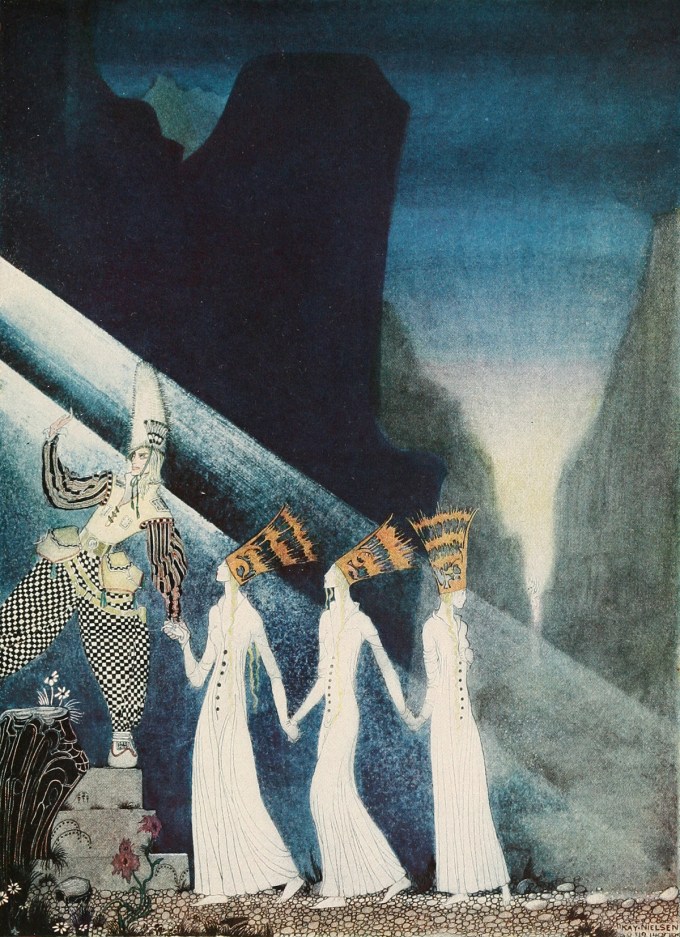
Art by Kay Nielsen from East of the Sun and West of the Moon, 1914. (Available as a print and as stationery cards.)

This very fact points at the best antidote to harmful self-deception:

Since we are highly susceptible to socially induced self-deception, the wisest practical course is to be very careful about the company we keep… Unfortunately self- deception is just the thing that prevents us from seeking its best therapy: it does not know when to expand, and when to limit its epistemological company. Fortunately, we have many other kinds of reasons for being astute about the company we keep. With luck, a canny self-deceiver’s other psychological and intellectual habits — a taste for astringency and a distrust of hypocrisy, for instance — can prevent the wild imperialistic tendencies of self-deception from becoming entrenched and ramified.

Much self-deception, Rorty observes, is not a matter of outright lying to oneself, but of selective attention and fragmentation of truth:

Self-deception need not involve false belief: just as the deceiver can attempt to produce a belief which is — as it happens — true, so too a self-deceiver can set herself to believe what is in fact true. A canny self-deceiver can focus on accurate but irrelevant observations as a way of denying a truth that is importantly relevant to her immediate projects.

This is something that stems from the psychological machinery of all deception, possible because “any experience is open to an indefinite number of true and even relatively salient descriptions”:

Clever deceivers rarely tell outright falsehoods. It’s too risky. The art of deception is closely related to the magician’s craft: it involves knowing how to draw attention to a harmless place, to deflect it away from the action. Deeply entrenched patterns of perceptual, emotional and cognitive dispositions serve as instruments of deception. A skilled deceiver is an illusionist who knows how to manipulate the normal patterns of what is salient to their audience. He places salient markers — something red, something anomalous, something desirable — in the visual field, to draw attention just where he wants it. The strategy of perceptual self-deception is identical: the trick is to place oneself where patterns of salience are likely to deflect attention away from what we do not wish to see.

But for all of its pitfalls, and for all the urgency of continually questioning when it becomes self-defeating, self-deception can be greatly beneficent in our endeavors of self-transformation and growth, offering assurance that bolsters our will and an antidote to the “generalized uncertainty about the worth of our projects.” Rorty writes:

By convincing themselves that a desired self-transformation is within relatively easy reach, canny self-improvers can use self-deception as an energizing instrument.

Art by Dorothy Lathrop, 1922. (Available as a print and as stationery cards.)

Self-deception is also necessary in propping up the precarious pillar of modern life in this century of selfing — identity:

We invent something we call our identity, resting our self-respect on our engaging in its projects, independently of any other measure of their merits.

But perhaps the most essential function of healthy self-deception is in allaying our ambivalence about projects and life-choices that bring us tremendous rewards, but also have tremendous personal costs, an accurate assessment of which might undermine our willingness to undertake them:

Without some species of self-deception, our dedications, our friendships, our work, our causes would collapse. In deciding to have children, we ignore the travails of parents, obliterating our otherwise keen awareness of the typical relations among parents and children; in devoting ourselves to writing philosophy, we conveniently forget how little philosophy we are willing to read; in the interest of sanity and joy, we sidestep our deep ambivalences about our kith and kin.

[…]

Disguising and submerging the ambivalence that is natural to most of our enterprises not only brings us the energy, verve, style and ease that successful action requires; it also helps to assure the social co-operation that is equally essential to our individual and collective projects. A good deal of the polite conversation of social life, — the public description of the joys of our social roles and functions (friend, mother, teacher, scholar) — channels and streams us to play our parts without the mess, confusion and upheaval that would occur if we openly expressed our natural and sensible ambivalence about these roles. It is virtually impossible to imagine any society that does not systematically and actively promote the self-deception of its members, particularly when the requirements of social continuity and cohesion are subtly at odds with one another and with the standard issue psychology of their members. Socially induced self-deception is an instrument in the preservation of social co-operation and cohesion.

Complement with Walter Lippmann’s superb century-old anatomy of deception and self-delusion, then revisit Rorty on what makes a person: the seven layers of identity, in literature and life.

Dinosaurs of the Sky: Consummate 19th-Century Scottish Natural History Illustrations of Birds

Here’s the link to this article.

From pigeons to parakeets, an uncommonly beautiful celebration of biodiversity.

BY MARIA POPOVA

Birds populate our metaphors, our poems, and our children’s books, entrance our imagination with their song and their chromatically ecstatic plumage, transport us on their tender wings back to the time of the dinosaurs they evolved from. But birds are a time machine in another way, too — not only evolutionarily but culturally: While the birth of photography revolutionized many sciences, birds remained as elusive as ever, difficult to capture with lens and shutter, so that natural history illustration has remained the most expressive medium for their study and celebration.

To my eye, the most consummate drawings of birds in the history of natural history date back to the 1830s, but they are not Audubon’s Birds of America — rather, they appeared on the other side of the Atlantic, in the first volume of The Edinburgh Journal of Natural History and of the Physical Sciences, with the Animal Kingdom of the Baron Cuvier, published in the wake of the pioneering paleontologist Georges Cuvier’s death.

Hundreds of different species of birds — some of them now endangered, some on the brink of extinction — populate the lavishly illustrated pages, clustered in kinship groups as living visual lists of dazzling biodiversity.

Titmice. (Available as a print and stationery cards.)
Sugarbirds. (Available as a print and stationery cards.)
Shrikes. (Available as a print and stationery cards.)
Thrush-shrikes. (Available as a print and stationery cards.)
Tangers. (Available as a print and stationery cards.)
Gnat-catchers. (Available as a print and stationery cards.)
Chats. (Available as a print and stationery cards.)
Pittas. (Available as a print and stationery cards.)
Orioles. (Available as a print and stationery cards.)
Warblers. (Available as a print and stationery cards.)
Kinglets. (Available as a print and stationery cards.)
Owls. (Available as a print and stationery cards.)

Owls. (Available as a print and stationery cards.)

Wrens. (Available as a print and stationery cards.)
Eurylaimidae. (Available as a print and stationery cards.)
Bunting. (Available as a print and stationery cards.)
Finches. (Available as a print and stationery cards.)
Crossbills. (Available as a print and stationery cards.)
Jays. (Available as a print and stationery cards.)
Sunbirds. (Available as a print and stationery cards.)
Hoopoes. (Available as a print and stationery cards.)
Bee-eaters. (Available as a print and stationery cards.)
Hornbills. (Available as a print and stationery cards.)
Woodpeckers. (Available as a print and stationery cards.)
Trogon. (Available as a print and stationery cards.)
Cockatoos. (Available as a print and stationery cards.)
Lories and parakeets. (Available as a print and stationery cards.)
Quails. (Available as a print and stationery cards.)
Harrier hawks. (Available as a print and stationery cards.)
Pigeons. (Available as a print and stationery cards.)

Among the cornucopia of species depicted — pigeons and parakeets, warblers and jays, woodpeckers and owls, sunbirds and sugarbirds — none occupy more space than hummingbirds, perhaps due to their enduring enchantment partway between science and magic.

Hummingbirds. (Available as a print and stationery cards.)

Couple with some stunning 19th-century ink illustrations of owls, dial back a century with the trailblazing 18th-century artist Sarah Stone’s paintings of exotic, endangered, and extinct species, and dive into the fascinating science of feathers.

Nick Cave on the Art of Growing Older

Here’s the link to this article.

“We’re often led to believe that getting older is in itself somehow a betrayal of our idealistic younger self, but sometimes I think it might be the other way around.”

BY MARIA POPOVA

Nick Cave on the Art of Growing Older

“The perilous time for the most highly gifted is not youth,” the visionary Elizabeth Peabody, who coined the term transcendentalism, wrote in her timeless admonition against the trap of complacency. “The perilous season is middle age, when a false wisdom tempts them to doubt the divine origin of the dreams of their youth.”

A century and a half after her, contemplating how to keep life from becoming a parody of itself, Simone de Beauvoir observed: “In old age we should wish still to have passions strong enough to prevent us turning in on ourselves.”

Moving through the stages of life and meeting each on its own terms is the supreme art of living — the ultimate test of self-respect and self-love. Often, what most blunts our vitality is the tendency for the momentum of a past stage to steer the present one, even though our priorities and passions have changed beyond recognition.

How to honor the unfolding of life without a punitive clinging to past selves is what Nick Cave explores in a passage from Faith, Hope and Carnage — one of my favorite books of 2022.

Nick Cave in Newcastle, 2022.

At sixty-five, he reflects:

We’re often led to believe that getting older is in itself somehow a betrayal of our idealistic younger self, but sometimes I think it might be the other way around. Maybe the younger self finds it difficult to inhabit its true potential because it has no idea what that potential is. It is a kind of unformed thing running scared most of the time, frantically trying to build its sense of self — This is me! Here I am! — in any way that it can. But then time and life come along, and smash that sense of self into a million pieces.

In consonance with the great Buddhist teacher Pema Chödrön’s insight that “only to the extent that we expose ourselves over and over to annihilation can that which is indestructible be found in us,” he considers what is found on the other side of that self-shattering:

Then comes the reassembled self, the self you have to put back together. You no longer have to devote time to finding out what you are, you are just free to be whatever you want to be, unimpeded by the incessant needs of others. You somehow grow into the fullness of your humanity, form your own character, become a proper person — I don’t know, someone who has become a part of things, not someone separated from or at odds with the world.

A generation earlier, Bertrand Russell touched on this in his astute observation that growing older contentedly is matter of being able to “make your interests gradually wider and more impersonal, until bit by bit the walls of the ego recede, and your life becomes increasingly merged in the universal life.”

Complement with Grace Paley on the art of growing older, then revisit Nick Cave on self-forgivenessthe relationship between vulnerability and freedom, and the antidote to our existential helplessness.