Along the spectrum of losses, from the door keys to the love of one’s life, none is more unimaginable, more incomprehensible in its unnatural violation of being and time, than a parent’s loss of a child.
Ernest Hemingway (July 21, 1899–July 2, 1961) was in his twenties and living in France when he befriend Gerald and Sara Murphy. The couple eventually returned to America when one of their sons fell ill, but it was their other son, Baoth, who died after a savage struggle with meningitis.
Upon receiving the news, the thirty-five-year-old writer sent his friends an extraordinary letter, part consolation for and part consecration of a loss for which there is no salve, found in Shaun Usher’s moving compilation Letters of Note: Grief (public library).
Ernest Hemingway
On March 19, 1935, Hemingway writes:
Dear Sara and Dear Gerald:
You know there is nothing we can ever say or write… Yesterday I tried to write you and I couldn’t.
It is not as bad for Baoth because he had a fine time, always, and he has only done something now that we all must do. He has just gotten it over with…
About him having to die so young — Remember that he had a very fine time and having it a thousand times makes it no better. And he is spared from learning what sort of a place the world is.
It is your loss: more than it is his, so it is something that you can, legitimately, be brave about. But I can’t be brave about it and in all my heart I am sick for you both.
Absolutely truly and coldly in the head, though, I know that anyone who dies young after a happy childhood, and no one ever made a happier childhood than you made for your children, has won a great victory. We all have to look forward to death by defeat, our bodies gone, our world destroyed; but it is the same dying we must do, while he has gotten it all over with, his world all intact and the death only by accident.
Art by Charlotte Pardi from Cry, Heart, But Never Break by Glenn Ringtved — a soulful Danish illustrated meditation on love and loss
Very few people ever really are alive and those that are never die; no matter if they are gone. No one you love is ever dead.
With this, echoing Auden’s insistence that “we must love one another or die,” he comes the closest he ever came to formulating the meaning of life. Like David Foster Wallace, who addressed the meaning of life with such exquisite lucidity shortly before he was slain by depression, Hemingway too would lose hold of that meaning in the throes of the agony that would take his life a quarter century later. Now, from the fortunate platform of the prime of life, he writes:
We must live it, now, a day at a time and be very careful not to hurt each other. It seems as though we were all on a boat together, a good boat still, that we have made but that we know will never reach port. There will be all kinds of weather, good and bad, and especially because we know now that there will be no landfall we must keep the boat up very well and be very good to each other. We are fortunate we have good people on the boat.
“A self that goes on changing is a self that goes on living,” Virginia Woolf wrote. Nothing is more vital to the capacity for change than the uncomfortable luxury of changing your mind — that stubborn refusal to ossify, the courageous willingness to outgrow your views, anneal your values, and keep clarifying your priorities. It is incredibly difficult to achieve because the very notion of the self hinges on our sense psychological continuity and internal consistency; because we live in a culture whose myths of heroism and martyrdom valorize completion at any cost, a culture that contractually binds the present self to the future self in mortgages and marital vows, presuming unchanging desires, forgetting that who we are is shaped by what we want and what we want goes on changing as we go on growing.
Changing — your mind, your life — is also painfully difficult because it is a form of renunciation, a special case of those necessary losses that sculpt our lives; it requires giving something up — a way of seeing, a way of being — in order for something new to come abloom along the vector of the “endless unfolding” that is a life fully lived, something that leaves your new emerging self more fully met.
The psychoanalyst Adam Phillips offers a salve for that perennial difficulty in On Giving Up (public library) — an exploration and celebration of giving up as “a prelude, a precondition for something else to happen, a form of anticipation, a kind of courage,” “an attempt to make a different future” that “get us the life we want, or don’t know that we want.”
He considers how countercultural such reframing is:
We tend to value, and even idealize, the idea of seeing things through, of finishing things rather than abandoning them. Giving up has to be justified in a way that completion does not; giving up doesn’t usually make us proud of ourselves; it is a falling short of our preferred selves… Giving up, in other words, is usually thought of as a failure rather than a way of succeeding at something else. It is worth wondering to whom we believe we have to justify ourselves when we are giving up, or when we are determinedly not giving up.
At the heart of the book is the recognition that renunciation is the fulcrum of change. We give things up, Phillips observes, “when we believe we can no longer go on as we are.” (For many, this is the central crisis of midlife.) It is a kind of sacrifice in the service of a larger, better life — but this presumes knowledge of the life we want, and it is often experiences we didn’t know we wanted that end up magnifying our lives in the profoundest ways. (Nothing illustrates this better than The Vampire Problem.)
Phillips considers the paradox:
The whole notion of sacrifice depends upon our knowing what we want… Giving up, or giving up on, anything or anyone always exposes what it is we take it we want… To give something up is to seek one’s own assumed advantage, one’s apparently preferred pleasure, but in an economy that we mostly can’t comprehend, or, like all economies, predict… We calculate, in so far as we can, the effect of our sacrifice, the future we want from it… to get through to ourselves: to get through to the life we want.
Falling Star by Witold Pruszkowski, 1884. (Available as a print.)
“I did not know that I could only get the most out of life by giving myself up to it,” the psychiatrist and artist Marion Milner wrote a century ago in her clarifying field guide to knowing what you really want — which is, in the end, the hardest thing in life, for our self-knowledge is cratered with blind spots, clouded by conditioning, and perennially incomplete. Phillips — who draws on Milner’s magnificent book, as well as on Kafka and Judith Butler, Henry and William James, Hamlet and Paradise Lost — observes that, in this regard, giving up is a kind of “gift-giving.” He writes:
Not being able to give up is not to be able to allow for loss, for vulnerability; not to be able to allow for the passing of time, and the revisions it brings.
And what would life be without continual acts of self-revision?
It is our ego-ideals — the stories we tell ourselves and the world about who we are and who we ought to be, fantasies of coherence and continuity mooring us to a static idealized self — that feed what Phillips calls the “tyranny of completion.” But human beings are rough drafts that continually mistake themselves for the final story, then gasp as the plot changes on the page of living. We do this largely because we are captives of comfort in our habits of thought and feeling, victims of certainty — that supreme narrowing of the mind — when it comes to our own desires. That we don’t fully know what we want because we are half-opaque to ourselves, that something we didn’t think we wanted may end up enlarging our lives in unimaginable ways, is a kind of uncertainty that unravels us. But if we can bear the frustration of the figuring, we may live into a larger and more authentic life.
Our frustration is the key to our desire; to want something or someone is to feel their absence; so to register or recognize a lack would seem to be the precondition for any kind of pleasure or satisfaction. Indeed, in this account, frustration, a sense of lack, is the necessary precondition for any kind of satisfaction.
[…]
The traditional story about lack and desire describes a closed system; in this story I can never be surprised by what I want, because somewhere in myself I already know what is missing; my frustration is the form my recognition takes, it is a form of remembering.
Wanting is recovery, not discovery… There is a part of oneself that needs to know what it is doing, and a part of oneself that needs not to… a part of oneself that needs to know what one wants and a part of oneself that needs not to.
It is in the continual investigation of our desires, with all the frustration of our polyphonous parts, that we find the recovery and gift-giving which giving up can bring — a way of giving our lives back to ourselves and giving ourselves forward to our lives. Phillips distills the central predicament:
The question is always: what are we going to have to sacrifice in order to develop, in order to get to the next stage of our lives?
“The things we want are transformative, and we don’t know or only think we know what is on the other side of that transformation… Never to get lost is not to live.”
BY MARIA POPOVA
“On how one orients himself to the moment,”Henry Miller wrote in reflecting on the art of living, “depends the failure or fruitfulness of it.” Indeed, this act of orienting ourselves — to the moment, to the world, to our own selves — is perhaps the most elusive art of all, and our attempts to master it often leave us fumbling, frustrated, discombobulated. And yet therein lies our greatest capacity for growth and self-transcendence.
Rebecca Solnit, whose mind and writing are among the most consistently enchanting of our time, explores this tender tango with the unknown in her altogether sublime collection A Field Guide to Getting Lost (public library).
Solnit writes in the opening essay:
Leave the door open for the unknown, the door into the dark. That’s where the most important things come from, where you yourself came from, and where you will go. Three years ago I was giving a workshop in the Rockies. A student came in bearing a quote from what she said was the pre-Socratic philosopher Meno. It read, “How will you go about finding that thing the nature of which is totally unknown to you?” I copied it down, and it has stayed with me since. The student made big transparent photographs of swimmers underwater and hung them from the ceiling with the light shining through them, so that to walk among them was to have the shadows of swimmers travel across your body in a space that itself came to seem aquatic and mysterious. The question she carried struck me as the basic tactical question in life. The things we want are transformative, and we don’t know or only think we know what is on the other side of that transformation. Love, wisdom, grace, inspiration — how do you go about finding these things that are in some ways about extending the boundaries of the self into unknown territory, about becoming someone else?
Illustration from ‘Where You Are: A Collection of Maps That Will Leave You Feeling Completely Lost.’ Click image for details.
Certainly for artists of all stripes, the unknown, the idea or the form or the tale that has not yet arrived, is what must be found. It is the job of artists to open doors and invite in prophesies, the unknown, the unfamiliar; it’s where their work comes from, although its arrival signals the beginning of the long disciplined process of making it their own. Scientists too, as J. Robert Oppenheimer once remarked, “live always at the ‘edge of mystery’ — the boundary of the unknown.” But they transform the unknown into the known, haul it in like fishermen; artists get you out into that dark sea.
But unlike the dark sea, which obscures the depths of what is, of what could be seen in the present moment, the unknown spills into the unforeseen. Solnit turns to Edgar Allan Poe, who argued that “in matters of philosophical discovery … it is the unforeseen upon which we must calculate most largely,” and considers the deliberate juxtaposition of the rational, methodical act of calculation with the ineffable, intangible nature of the unforeseen:
How do you calculate upon the unforeseen? It seems to be an art of recognizing the role of the unforeseen, of keeping your balance amid surprises, of collaborating with chance, of recognizing that there are some essential mysteries in the world and thereby a limit to calculation, to plan, to control. To calculate on the unforeseen is perhaps exactly the paradoxical operation that life most requires of us.
The poet John Keats captured this paradoxical operation elegantly in his notion of “negative capability,” which Solnit draws on before turning to another literary luminary, Walter Benjamin, who memorably considered the difference between not finding your way and losing yourself — something he called “the art of straying.” Solnit writes:
To lose yourself: a voluptuous surrender, lost in your arms, lost to the world, utterly immersed in what is present so that its surroundings fade away. In Benjamin’s terms, to be lost is to be fully present, and to be fully present is to be capable of being in uncertainty and mystery. And one does not get lost but loses oneself, with the implication that it is a conscious choice, a chosen surrender, a psychic state achievable through geography. That thing the nature of which is totally unknown to you is usually what you need to find, and finding it is a matter of getting lost.
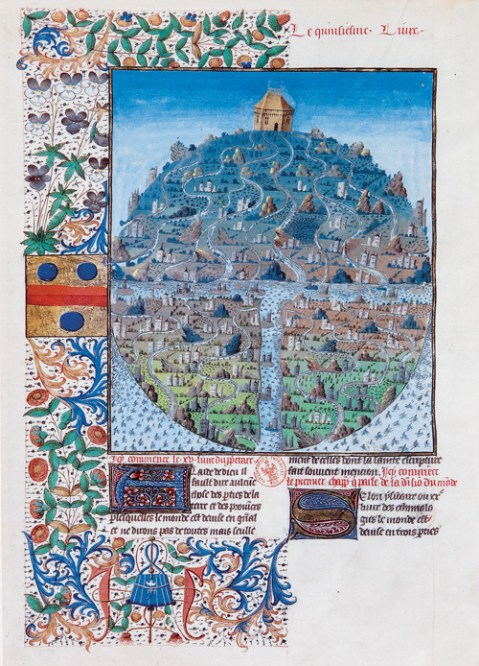
T and O map by Bartholomaeus Angelicus, 1392, from Umberto Eco’s ‘The Book of Legendary Lands.’ Click image for details.
The word “lost” comes from the Old Norse los, meaning the disbanding of an army, and this origin suggests soldiers falling out of formation to go home, a truce with the wide world. I worry now that many people never disband their armies, never go beyond what they know. Advertising, alarmist news, technology, incessant busyness, and the design of public and private space conspire to make it so.
Taking back the meaning of lost seems almost a political act, a matter of existential agency that we ought to reclaim in order to feel at home in ourselves. Solnit writes:
There’s another art of being at home in the unknown, so that being in its midst isn’t cause for panic or suffering, of being at home with being lost.
[…]
Lost [is] mostly a state of mind, and this applies as much to all the metaphysical and metaphorical states of being lost as to blundering around in the backcountry.
The question then is how to get lost. Never to get lost is not to live, not to know how to get lost brings you to destruction, and somewhere in the terra incognita in between lies a life of discovery.
Illustration for ‘Mapping Manhattan.’ Click image for details.
During a recent vacation, I went horseback riding on a California ranch, home to a tight-knit equine community. Midway along the route, my horse glimpsed his peer across the field, carrying another rider on a different route, and began neighing restlessly upon the fleeting sight. Our guide explained that the horses, despite being extraordinarily intelligent beings, had a hard time making sense of seeing their friends appear out of nowhere, then disappear into the distance. Falling out of sight held the terror of being forever lost. My horse was calling out, making sure his friend was still there — that neither was lost. Underneath the geographic disorientation, one can imagine, lies a primal fear of losing control.
Despite the evolutionary distance, this equine disposition bears a disorienting similarity to the duality of our own relationship to the concept of lost — losing something we care about, losing ourselves, losing control — which Solnit captures beautifully:
Lost really has two disparate meanings. Losing things is about the familiar falling away, getting lost is about the unfamiliar appearing. There are objects and people that disappear from your sight or knowledge or possession; you lose a bracelet, a friend, the key. You still know where you are. Everything is familiar except that there is one item less, one missing element. Or you get lost, in which case the world has become larger than your knowledge of it. Either way, there is a loss of control. Imagine yourself streaming through time shedding gloves, umbrellas, wrenches, books, friends, homes, names. This is what the view looks like if you take a rear-facing seat on the train. Looking forward you constantly acquire moments of arrival, moments of realization, moments of discovery. The wind blows your hair back and you are greeted by what you have never seen before. The material falls away in onrushing experience. It peels off like skin from a molting snake. Of course to forget the past is to lose the sense of loss that is also memory of an absent richness and a set of clues to navigate the present by; the art is not one of forgetting but letting go. And when everything else is gone, you can be rich in loss.
“The search for meaning, much like the search for pleasure, must be conducted obliquely. Meaning ensues from meaningful activity: the more we deliberately pursue it, the less likely are we to find it.”
BY MARIA POPOVA
“The sole purpose of human existence,” Carl Jung wrote in his notebooks, “is to kindle a light in the darkness of mere being.” In a universe devoid of purpose in the human sense, in which we are but a cosmic accident, the darkness of mere being can easily overwhelm us — and yet we go on striking the match of meaning. “However vast the darkness,” Stanley Kubrick urged in a 1968 interview, “we must supply our own light.”
Yalom has done for psychotherapy what Oliver Sacks has done for neurology, using case studies as a storytelling springboard for contemplating some of the largest and most perennial human questions. Through the stories of ten patients, he examines what the four main aspects of psychotherapy — the inevitability of death, the freedom to shape our own lives, our ultimate aloneness, and the absence of any obvious meaning or sense to life.
The last of the four, which Yalom considers the existential human dilemma of “a being who searches for meaning and certainty in a universe that has neither,” is both the most elusive and the most fertile, for embedded in it are the other three. He writes:
If death is inevitable, if all of our accomplishments, indeed our entire solar system, shall one day lie in ruins, if the world is contingent (that is, everything could as well have been otherwise), if human beings must construct the world and the human design within that world, then what enduring meaning can there be in life? … We are meaning-seeking creatures. Biologically, our nervous systems are organized in such a way that the brain automatically clusters incoming stimuli into configurations. Meaning also provides a sense of mastery: feeling helpless and confused in the face of random, unpatterned events, we seek to order them and, in so doing, gain a sense of control over them. Even more important, meaning gives birth to values and, hence, to a code of behavior: thus the answer to why questions (Why do I live?) supplies an answer to how questions (How do I live?).
Art from a vintage children’s-book adaptation of Voltaire’s philosophical homage to Newton and the human condition. Click image for more.
The search for meaning, much like the search for pleasure, must be conducted obliquely. Meaning ensues from meaningful activity: the more we deliberately pursue it, the less likely are we to find it; the rational questions one can pose about meaning will always outlast the answers. In therapy, as in life, meaningfulness is a by-product of engagement and commitment, and that is where therapists must direct their efforts — not that engagement provides the rational answer to questions of meaning, but it causes these questions not to matter.
Art by Jean-Pierre Weill from ‘The Well of Being.’ Click image for more.
In both therapy and life, this sidewise gleam of meaning requires cultivating a comfort level with uncertainty and continually asking what Hannah Arendt so memorably termed the “unanswerable questions” that make us human; it then requires that, to paraphrase Rilke’s immortal words, we live those questions. Yalom writes:
The capacity to tolerate uncertainty is a prerequisite… The powerful temptation to achieve certainty through embracing an ideological school and a tight therapeutic system is treacherous: such belief may block the uncertain and spontaneous encounter necessary for effective therapy.
[…]
I must assume that knowing is better than not knowing, venturing than not venturing; and that magic and illusion, however rich, however alluring, ultimately weaken the human spirit.
“The grounds for hope are in the shadows, in the people who are inventing the world while no one looks, who themselves don’t know yet whether they will have any effect…”
I’ve found no more lucid and luminous a defense of hope than the one Rebecca Solnit launches in Hope in the Dark: Untold Histories, Wild Possibilities (public library) — a slim, potent book penned in the wake of the Bush administration’s invasion of Iraq; a book that has grown only more relevant and poignant in the decade since.
Rebecca Solnit (Photograph: Sallie Dean Shatz)
We lose hope, Solnit suggests, because we lose perspective — we lose sight of the “accretion of incremental, imperceptible changes” which constitute progress and which render our era dramatically different from the past, a contrast obscured by the undramatic nature of gradual transformation punctuated by occasional tumult.
Each of our lifetimes brims with personal evidence of these collective cultural shifts: At the time I was born, no one imagined that the Cold War would end and a girl raised in communist Bulgaria would make a life for herself reading and writing about books in English while facing the Manhattan skyline; a mere decade ago, it seemed inconceivable that a distributed tribe of strangers would raise a million dollars for refugees in another part of the world via an instantaneous global communication system of 140-character neo-telegrams; just a couple of years ago, it was hard to imagine that the day would come when all of us would be able to marry the people we love.
Solnit writes:
There are times when it seems as though not only the future but the present is dark: few recognize what a radically transformed world we live in, one that has been transformed not only by such nightmares as global warming and global capital, but by dreams of freedom and of justice — and transformed by things we could not have dreamed of… We need to hope for the realization of our own dreams, but also to recognize a world that will remain wilder than our imaginations.
Imagine the world as a theater. The acts of the powerful and the official occupy center stage. The traditional versions of history, the conventional sources of news encourage us to fix our gaze on the stage. The limelights there are so bright they blind you to the shadowy spaces around you, make it hard to meet the gaze of the other people in the seats, to see the way out of the audience, into the aisles, backstage, outside, in the dark, where other powers are at work. A lot of the fate of the world is decided onstage, in the limelight, and the actors there will tell you that no other place matters.
What is onstage is a tragedy, the tragedy of the inequitable distribution of power and of the too-common silence of those who settle for being audience while paying the price of the drama. Traditionally, the audience is supposed to choose the actors, and the actors are quite literally supposed to speak for us. This is the idea behind representative democracy. In practice, various reasons keep many from participating in the choice, other forces — like money — subvert that choice, and onstage too many of the actors find other reasons — lobbyists, self-interest, conformity — to fail to represent their constituents.
Hope, Solnit observes, dies when we choose to watch the unfolding drama in resignation and abdicate all responsibility, pointing a blaming finger at those in the limelight. (Lest we forget, Joseph Brodsky put it best: “A pointed finger is a victim’s logo.”)
She considers the disposition of the hopeless:
They speak as though we should wait for improvement to be handed to us, not as though we might seize it. Perhaps their despair is in some ways simply that they are audience rather than actors.
Our most radiant horizon of hope, Solnit argues, lies in the darkness beyond the limelight:
The grounds for hope are in the shadows, in the people who are inventing the world while no one looks, who themselves don’t know yet whether they will have any effect, in the people you have not yet heard of who will be the next Cesar Chavez, the next Noam Chomsky, the next Cindy Sheehan, or become something you cannot yet imagine. In this epic struggle between light and dark, it’s the dark side — that of the anonymous, the unseen, the officially powerless, the visionaries and subversives in the shadows — that we must hope for. For those onstage, we can just hope the curtain comes down soon and the next act is better, that it comes more directly from the populist shadows.
“The victim shows us something about our own lives: we see that we too are vulnerable to misfortune, that we are not any different from the people whose fate we are watching…”
BY MARIA POPOVA
“Of all the parts of your body, be most vigilant over your index finger,” Joseph Brodsky proclaimed in the greatest commencement address of all time, “for … a pointed finger is a victim’s logo.” But while there is tremendous truth in the poet’s words, as is often the case with grandiose proclamations, it is only a partial truth beneath which lies a far more nuanced reality.
A generation after the great composer Leonard Bernstein defined democracy as “the difficult, slow method in which the dignity of A is acknowledged by B, without impairing the dignity of C,” Nussbaum turns an eye to classical Greek philosophy and tragedy to examine the mediating role of dignity in the question of agency and victimhood in a just society. She writes:
Compassion requires the judgment that there are serious bad things that happen to others through no fault of their own. In its classic tragic form, it imagines that a person possessed of basic human dignity has been injured by life on a grand scale. So it adopts a thoroughly anti-Stoic picture of the world, according to which human beings are both dignified and needy, and in which dignity and neediness interact in complex ways… The basic worth of a human being remains, even when the world has done its worst. But this does not mean that the human being has not been profoundly damaged, both outwardly and inwardly.
The society that incorporates the perspective of tragic compassion into its basic design thus begins with a general insight: people are dignified agents, but they are also, frequently, victims. Agency and victimhood are not incompatible: indeed, only the capacity for agency makes victimhood tragic. In American society today, by contrast, we often hear that we have a stark and binary choice, between regarding people as agents and regarding them as victims. We encounter this contrast when social welfare programs are debated: it is said that to give people various forms of social support is to treat them as victims of life’s ills, rather than to respect them as agents, capable of working to better their own lot.
Art by Shaun Tan for a special edition of the Brothers Grimm fairy tales
Writing a decade and a half before today’s crescendoing debates about the societal complexities surrounding rape and the criminal justice system, Nussbaum critiques how this “stark and binary choice” between agency and victimhood is keeping us from establishing a foundation of basic human dignity upon which to build our society:
We find the same contrast in recent feminist debates, where we are told that respecting women as agents is incompatible with a strong concern to protect them from rape, sexual harassment, and other forms of unequal treatment. To protect women is to presume that they can’t fight on their own against this ill treatment; this, in turn, is to treat them like mere victims and to undermine their dignity.
[…]
We are offered the same contrast, again, in debates about criminal sentencing, where we are urged to think that any sympathy shown to a criminal defendant on account of a deprived social background or other misfortune such as child sexual abuse is, once again, a denial of the defendant’s human dignity. Justice Thomas, for example, went so far as to say, in a 1994 speech, that when black people and poor people are shown sympathy for their background when they commit crimes, they are being treated like children, “or even worse, treated like animals without a soul.”
But we confer these judgments selectively and the arbitrariness of these selections, Nussbaum points out, is itself suspect — we don’t, for instance, believe that we’re undermining artists’ and writers’ dignity by protecting their freedom of speech, nor do we believe that laws protecting personal property are turning property-owners into victims. Nussbaum poses a necessary question:
If, then, we hear political actors saying such things about women, and poor people, and racial minorities, we should first of all ask why they are being singled out: what is there about the situation of being poor, or female, or black that means that help is condescending, and compassion insulting?
Art by Andrea Dezsö for a special edition of the Brothers Grimm fairy tales
In this unease lies the seedbed of our conflicted relationship to agency and victimhood:
The victim shows us something about our own lives: we see that we too are vulnerable to misfortune, that we are not any different from the people whose fate we are watching, and we therefore have reason to fear a similar reversal.
Trauma and tragedy — the circumstances that create the basic framework of victimhood — force us to confront this dual nature of the human experience: we are at once agents of our own fate and vulnerable to the whims of a larger system over much of which we have no control. But discomfiting as this duality is, Nussbaum suggests, it holds our greatest opportunity for goodness:
Tragedy asks us … to walk a delicate line. We are to acknowledge that life’s miseries strike deep, striking to the heart of human agency itself. And yet we are also to insist that they do not remove humanity, that the capacity for goodness remains when all else has been removed.
Nussbaum considers how this understanding of tragedy can help us begin to foster such foundations for dignity:
If we understand that injustice can strike its roots into the personality itself, producing rage and resentment and the roots of bad character, we have even deeper incentives to commit ourselves to giving each child the material and social support that human dignity requires. A compassionate society … is one that takes the full measure of the harms that can befall citizens beyond their own doing; compassion thus provides a motive to secure to all the basic support that will undergird and protect human dignity.
“Critical thinking without hope is cynicism. Hope without critical thinking is naïveté.”
BY MARIA POPOVA
To live with sincerity in our culture of cynicism is a difficult dance — one that comes easily only to the very young and the very old. The rest of us are left to tussle with two polarizing forces ripping the psyche asunder by beckoning to it from opposite directions — critical thinking and hope.
Critical thinking without hope is cynicism. Hope without critical thinking is naïveté.
Finding fault and feeling hopeless about improving the situation produces resignation — cynicism is both resignation’s symptom and a futile self-protection mechanism against it. Blindly believing that everything will work out just fine also produces resignation, for we have no motive to apply ourselves toward making things better. But in order to survive — both as individuals and as a civilization — and especially in order to thrive, we need the right balance of critical thinking and hope.
A plant needs water in order to survive, and needs the right amount of water in order to thrive. Overwater it and it rots with excess. Underwater it and it dries up inside.
I thought about this recently in observing my unease — my seething cauldron of deep disappointment — with an opinion piece commenting on Arianna Huffington’s decision to continue publishing necessary reporting on “what’s not working — political dysfunction, corruption, wrongdoing, etc.” but to begin giving more light to stories that embody the “perseverance, creativity, and grace” of which we humans are capable. The writer criticizing Huffington’s decision asserted, with ample indignation, that “to privilege happy stories over ‘unhappy’ ones is to present a false view of the world.”
Let’s consider for a moment the notion of an un-false view of the world — the journalistic ideal of capital-T truth. Let’s, too, put aside for now Hunter S. Thompson’s rather accurate assertion that the possibility of objectivity is a myth to begin with. Since the golden age of newspapers in the early 1900s, we’ve endured a century of rampant distortion toward the other extreme — a consistent and systematic privileging of harrowing and heartbreaking “news” as the raw material of the media establishment. The complaint which a newspaper editor issued in 1923, lamenting the fact that commercial interest rather than journalistic integrity determines what is published as the “news,” could well have been issued today — if anything, the internet has only exacerbated the problem.
The twentieth century was both the golden age of mass media and a century marked by two world wars, the Great Depression, the AIDS crisis, and a litany of genocides. Viewed through that lens, it is the worst century humanity has endured — even worse than the bubonic plague of the Middle Ages, for those deaths were caused by bacteria indifferent to human ideals and immune to human morality. This view of the twentieth century, then, is frightening enough if true, but doubly frightening if untrue — and Steven Pinker has made a convincing case that it is, indeed, untrue. Then, in a grotesque embodiment of Mark Twain’s wry remark that the worst things in his life never happened to him, we have spent a century believing the worst about ourselves as a species and a civilization.
Carl Sagan saw in books “proof that humans are capable of working magic.” The magic of humanity’s most enduring books — the great works of literature and philosophy — lies in the simple fact that they are full of hope for the human spirit. News has become the sorcerous counterpoint to this magic, mongering not proof of our goodness and brilliance but evidence of our basest capabilities.
A related point of cynicism bears consideration: Coupled with the assertion that giving positive stories more voice distorts our worldview was the accusation that Huffington’s motives were purely mercantile — a ploy to prey on Facebook’s algorithms, which incentivize heartening stories over disheartening ones. Could it be, just maybe, not that people are dumb and shallow, and algorithms dumber and shallower, but that we’ve endured a century of fear-mongering from the news industrial complex and we finally have a way of knowing we’re not alone in craving an antidote? That we finally have a cultural commons onto which we can rally for an uprising?
We don’t get to decry the alleged distortion of our worldview until we’ve lived through at least a century of good news to even the playing field so ravaged by the previous century’s extreme negativity bias.
As for Huffington, while we can only ever speculate about another person’s motives — for who can peer into the psyche of another and truly see into that person’s private truth? — this I continue to believe: The assumptions people make about the motives of others always reveal a great deal more about the assumers than the assumed-about.
This particular brand of cynicism is especially pronounced when the assumed-about have reached a certain level of success or public recognition. Take, for instance, an entity like TED — something that began as a small, semi-secret groundswell that was met with only warmth and love in its first few years of opening up to the larger world. And then, as it reached a tipping point of recognition, TED became the target of rather petty and cynical criticism. Here is an entity that has done nothing more nor less than to insist, over and over, that despite our many imperfections, we are inherently kind and capable and full of goodness — and yet even this isn’t safe from cynicism.
Let’s return, then, to the question of what is true and what is false, and what bearing this question has — if any — on what we call reality.
The stories that we tell ourselves, whether they be false or true, are always real. We act out of those stories, reacting to their realness. William James knew this when he observed: “My experience is what I agree to attend to. Only those items which I notice shape my mind.”
What storytellers do — and this includes journalists and TED and everyone in between who has a point of view and an audience, whatever its size — is help shape our stories of how the world works; at their very best, they can empower our moral imagination to envision how the world could work better. In other words, they help us mediate between the ideal and the real by cultivating the right balance of critical thinking and hope. Truth and falsehood belong to this mediation, but it is guided primarily by what we are made to believe is real.
What we need, then, are writers like William Faulkner, who came of age in a brothel, saw humanity at its most depraved, and yet managed to maintain his faith in the human spirit. In his Nobel Prize acceptance speech, he asserted that the writer’s duty is “to help man endure by lifting his heart.” In contemporary commercial media, driven by private interest, this responsibility to work in the public interest and for the public good recedes into the background. And yet I continue to stand with E.B. White, who so memorably asserted that “writers do not merely reflect and interpret life, they inform and shape life”; that the role of the writer is “to lift people up, not lower them down.”
Yes, people sometimes do horrible things, and we can speculate about why they do them until we run out of words and sanity. But evil only prevails when we mistake it for the norm. There is so much goodness in the world — all we have to do is remind one another of it, show up for it, and refuse to leave.
“We hope. We despair. We hope. We despair. This is what governs us. We have a bipolar system.”
BY MARIA POPOVA
I do loveMaira Kalman. In 2009, the celebrated visual storyteller released a wonderful and quirky illustrated twelve-part meditation on democracy in her New York Times blog. The series is now released as an equally wonderful illustrated book.
And the Pursuit of Happiness begins with Barack Obama’s inauguration on Chapter One, with each subsequent chapter representing a month in Kalman’s yearlong quest to explore the underpinnings of contemporary democracy.
In February, she travels to both costs, so the respective chapter is dedicated to Abraham Lincoln. In March, she goes to an actual town meeting, the quintessential haven of democracy. In April, she visits the Supreme Court and the office of Justice Ruth Bader Ginsburg, which prompts a rumination on women breaking social barriers. For December, she concludes with a chapter on George Washington and a thoughtful reflection on happiness itself.
Brimming with Kalman’s childlike aesthetic, delightfully kooky typography and subtle wordplay, And the Pursuit of Happiness takes you on a playful yet philosophical journey into the human side of politics and democracy — a genuine treat for eye, mind, and heart.
“There is no love of life without despair of life.”
BY MARIA POPOVA
“Those who prefer their principles over their happiness,”Albert Camus (November 7, 1913–January 4, 1960) wrote in his notebook toward the end of his life, “they refuse to be happy outside the conditions they seem to have attached to their happiness.” Indeed, our principles tend to harden into habits and although habits give shape to our inner lives, they can mutate into the rigidity of routine and create a kind of momentum that, rather than expanding our capacity for happiness, contracts it. In the trance of routine and principled productivity, we end up showing up for our daily lives while being absent from them.
Few things things break us out of our routines and awaken us to the living substance of happiness more powerfully than travel. Camus knew this. Decades earlier, when he was only twenty-two and still a long way from becoming the second-youngest recipient of the Nobel Prize in Literature, he explored this human perplexity with unparalleled intellectual elegance and spiritual grace in a gorgeous essay titled “Love of Life,” eventually included in his posthumously published collection Lyrical and Critical Essays (public library).
Recounting the sight of a young woman dancing deliriously in a Spanish cabaret, Camus — whose entire life was undergirded by the ethos that happiness is our moral obligation — writes:
Without cafés and newspapers, it would be difficult to travel. A paper printed in our own language, a place to rub shoulders with others in the evenings enable us to imitate the familiar gestures of the man we were at home, who, seen from a distance, seems so much a stranger. For what gives value to travel is fear. It breaks down a kind of inner structure we have. One can no longer cheat — hide behind the hours spent at the office or at the plant (those hours we protest so loudly, which protect us so well from the pain of being alone). I have always wanted to write novels in which my heroes would say: “What would I do without the office?” or again: “My wife has died, but fortunately I have all these orders to fill for tomorrow.” Travel robs us of such refuge. Far from our own people, our own language, stripped of all our props, deprived of our masks (one doesn’t know the fare on the streetcars, or anything else), we are completely on the surface of ourselves. But also, soul-sick, we restore to every being and every object its miraculous value. A woman dancing without a thought in her head, a bottle on a table, glimpsed behind a curtain: each image becomes a symbol. The whole of life seems reflected in it, insofar as it summarizes our own life at the moment. When we are aware of every gift, the contradictory intoxications we can enjoy (including that of lucidity) are indescribable.
But this contact with absolute bliss, Camus cautions, necessitates an equal capacity for contact with absolute despair:
There lay all my love of life: a silent passion for what would perhaps escape me, a bitterness beneath a flame. Each day I would leave this cloister like a man lifted from himself, inscribed for a brief moment in the continuance of the world… There is no love of life without despair of life.
Echoing Kierkegaard’s unforgettable admonition — “Of all ridiculous things the most ridiculous seems to me, to be busy,” the Danish philosopher wrote in contemplating our greatest source of unhappiness — Camus considers how the trance of productivity robs us of the very presence necessary for happiness:
Life is short, and it is sinful to waste one’s time. They say I’m active. But being active is still wasting one’s time, if in doing one loses oneself. Today is a resting time, and my heart goes off in search of itself. If an anguish still clutches me, it’s when I feel this impalpable moment slip through my fingers like quicksilver… At the moment, my whole kingdom is of this world. This sun and these shadows, this warmth and this cold rising from the depths of the air: why wonder if something is dying or if men suffer, since everything is written on this window where the sun sheds its plenty as a greeting to my pity? I can say and in a moment I shall say that what counts is to be human and simple. No, what counts is to be true, and then everything fits in, humanity and simplicity. When am I truer than when I am the world? My cup brims over before I have time to desire. Eternity is there and I was hoping for it. What I wish for now is no longer happiness but simply awareness.
[…]
The great courage is still to gaze as squarely at the light as at death. Besides, how can I define the link that leads from this all-consuming love of life to this secret despair? If I listen to the voice of irony, crouching underneath things, slowly it reveals itself. Winking its small, clear eye, it says: “Live as if …” In spite of much searching, this is all I know.
“This is an extraordinary time full of vital, transformative movements that could not be foreseen. It’s also a nightmarish time. Full engagement requires the ability to perceive both.”
BY MARIA POPOVA
“There is no love of life without despair of life,”wrote Albert Camus — a man who in the midst of World War II, perhaps the darkest period in human history, saw grounds for luminous hope and issued a remarkable clarion call for humanity to rise to its highest potential on those grounds. It was his way of honoring the same duality that artist Maira Kalman would capture nearly a century later in her marvelous meditation on the pursuit of happiness, where she observed: “We hope. We despair. We hope. We despair. That is what governs us. We have a bipolar system.”
In my own reflections on hope, cynicism, and the stories we tell ourselves, I’ve considered the necessity of these two poles working in concert. Indeed, the stories we tell ourselves about these poles matter. The stories we tell ourselves about our public past shape how we interpret and respond to and show up for the present. The stories we tell ourselves about our private pasts shape how we come to see our personhood and who we ultimately become. The thin line between agency and victimhood is drawn in how we tell those stories.
The language in which we tell ourselves these stories matters tremendously, too, and no writer has weighed the complexities of sustaining hope in our times of readily available despair more thoughtfully and beautifully, nor with greater nuance, than Rebecca Solnit does in Hope in the Dark: Untold Histories, Wild Possibilities (public library).
Rebecca Solnit (Photograph: Sallie Dean Shatz)
Expanding upon her previous writings on hope, Solnit writes in the foreword to the 2016 edition of this foundational text of modern civic engagement:
Hope is a gift you don’t have to surrender, a power you don’t have to throw away. And though hope can be an act of defiance, defiance isn’t enough reason to hope. But there are good reasons.
Solnit — one of the most singular, civically significant, and poetically potent voices of our time, emanating echoes of Virginia Woolf’s luminous prose and Adrienne Rich’s unflinching political conviction — originally wrote these essays in 2003, six weeks after the start of Iraq war, in an effort to speak “directly to the inner life of the politics of the moment, to the emotions and preconceptions that underlie our political positions and engagements.” Although the specific conditions of the day may have shifted, their undergirding causes and far-reaching consequences have only gained in relevance and urgency in the dozen years since. This slim book of tremendous potency is therefore, today more than ever, an indispensable ally to every thinking, feeling, civically conscious human being.
Solnit looks back on this seemingly distant past as she peers forward into the near future:
The moment passed long ago, but despair, defeatism, cynicism, and the amnesia and assumptions from which they often arise have not dispersed, even as the most wildly, unimaginably magnificent things came to pass. There is a lot of evidence for the defense… Progressive, populist, and grassroots constituencies have had many victories. Popular power has continued to be a profound force for change. And the changes we’ve undergone, both wonderful and terrible, are astonishing.
[…]
This is an extraordinary time full of vital, transformative movements that could not be foreseen. It’s also a nightmarish time. Full engagement requires the ability to perceive both.
With an eye to such disheartening developments as climate change, growing income inequality, and the rise of Silicon Valley as a dehumanizing global superpower of automation, Solnit invites us to be equally present for the counterpoint:
Hope doesn’t mean denying these realities. It means facing them and addressing them by remembering what else the twenty-first century has brought, including the movements, heroes, and shifts in consciousness that address these things now.
Enumerating Edward Snowden, marriage equality, and Black Lives Matter among those, she adds:
This has been a truly remarkable decade for movement-building, social change, and deep, profound shifts in ideas, perspective, and frameworks for broad parts of the population (and, of course, backlashes against all those things).
With great care, Solnit — whose mind remains the sharpest instrument of nuance I’ve encountered — maps the uneven terrain of our grounds for hope:
It’s important to say what hope is not: it is not the belief that everything was, is, or will be fine. The evidence is all around us of tremendous suffering and tremendous destruction. The hope I’m interested in is about broad perspectives with specific possibilities, ones that invite or demand that we act. It’s also not a sunny everything-is-getting-better narrative, though it may be a counter to the everything-is-getting-worse narrative. You could call it an account of complexities and uncertainties, with openings.
Solnit’s conception of hope reminds me of the great existential psychiatrist Irvin D. Yalom’s conception of meaning: “The search for meaning, much like the search for pleasure,”he wrote, “must be conducted obliquely.” That is, it must take place in the thrilling and terrifying terra incognita that lies between where we are and where we wish to go, ultimately shaping where we do go. Solnit herself has written memorably about how we find ourselves by getting lost, and finding hope seems to necessitate a similar surrender to uncertainty. She captures this idea beautifully:
Hope locates itself in the premises that we don’t know what will happen and that in the spaciousness of uncertainty is room to act. When you recognize uncertainty, you recognize that you may be able to influence the outcomes — you alone or you in concert with a few dozen or several million others. Hope is an embrace of the unknown and the unknowable, an alternative to the certainty of both optimists and pessimists. Optimists think it will all be fine without our involvement; pessimists take the opposite position; both excuse themselves from acting. It’s the belief that what we do matters even though how and when it may matter, who and what it may impact, are not things we can know beforehand. We may not, in fact, know them afterward either, but they matter all the same, and history is full of people whose influence was most powerful after they were gone.
Illustration from The Harvey Milk Story, a picture-book biography of the slain LGBT rights pioneer
Amid a 24-hour news cycle that nurses us on the illusion of immediacy, this recognition of incremental progress and the long gestational period of consequences — something at the heart of every major scientific revolution that has changed our world — is perhaps our most essential yet most endangered wellspring of hope. Solnit reminds us, for instance, that women’s struggle for the right to vote took seven decades:
For a time people liked to announce that feminism had failed, as though the project of overturning millennia of social arrangements should achieve its final victories in a few decades, or as though it had stopped. Feminism is just starting, and its manifestations matter in rural Himalayan villages, not just first-world cities.
She considers one particularly prominent example of this cumulative cataclysm — the Arab Spring, “an extraordinary example of how unpredictable change is and how potent popular power can be,” the full meaning of and conclusions from which we are yet to draw. Although our cultural lore traces the spark of the Arab Spring to the moment Mohamed Bouazizi set himself on fire in an act of protest, Solnit traces the unnoticed accretion of tinder across space and time:
You can tell the genesis story of the Arab Spring other ways. The quiet organizing going on in the shadows beforehand matters. So does the comic book about Martin Luther King and civil disobedience that was translated into Arabic and widely distributed in Egypt shortly before the Arab Spring. You can tell of King’s civil disobedience tactics being inspired by Gandhi’s tactics, and Gandhi’s inspired by Tolstoy and the radical acts of noncooperation and sabotage of British women suffragists. So the threads of ideas weave around the world and through the decades and centuries.
In a brilliant counterpoint to Malcolm Gladwell’s notoriously short-sighted view of social change, Solnit sprouts a mycological metaphor for this imperceptible, incremental buildup of influence and momentum:
After a rain mushrooms appear on the surface of the earth as if from nowhere. Many do so from a sometimes vast underground fungus that remains invisible and largely unknown. What we call mushrooms mycologists call the fruiting body of the larger, less visible fungus. Uprisings and revolutions are often considered to be spontaneous, but less visible long-term organizing and groundwork — or underground work — often laid the foundation. Changes in ideas and values also result from work done by writers, scholars, public intellectuals, social activists, and participants in social media. It seems insignificant or peripheral until very different outcomes emerge from transformed assumptions about who and what matters, who should be heard and believed, who has rights.
Ideas at first considered outrageous or ridiculous or extreme gradually become what people think they’ve always believed. How the transformation happened is rarely remembered, in part because it’s compromising: it recalls the mainstream when the mainstream was, say, rabidly homophobic or racist in a way it no longer is; and it recalls that power comes from the shadows and the margins, that our hope is in the dark around the edges, not the limelight of center stage. Our hope and often our power.
[…]
Change is rarely straightforward… Sometimes it’s as complex as chaos theory and as slow as evolution. Even things that seem to happen suddenly arise from deep roots in the past or from long-dormant seeds.
And yet Solnit’s most salient point deals with what comes after the revolutionary change — with the notion of victory not as a destination but as a starting point for recommitment and continual nourishment of our fledgling ideals:
A victory doesn’t mean that everything is now going to be nice forever and we can therefore all go lounge around until the end of time. Some activists are afraid that if we acknowledge victory, people will give up the struggle. I’ve long been more afraid that people will give up and go home or never get started in the first place if they think no victory is possible or fail to recognize the victories already achieved. Marriage equality is not the end of homophobia, but it’s something to celebrate. A victory is a milestone on the road, evidence that sometimes we win, and encouragement to keep going, not to stop.
Solnit examines this notion more closely in one of the original essays from the book, titled “Changing the Imagination of Change” — a meditation of even more acute timeliness today, more than a decade later, in which she writes:
Americans are good at responding to crisis and then going home to let another crisis brew both because we imagine that the finality of death can be achieved in life — it’s called happily ever after in personal life, saved in politics — and because we tend to think political engagement is something for emergencies rather than, as people in many other countries (and Americans at other times) have imagined it, as a part and even a pleasure of everyday life. The problem seldom goes home.
[…]
Going home seems to be a way to abandon victories when they’re still delicate, still in need of protection and encouragement. Human babies are helpless at birth, and so perhaps are victories before they’ve been consolidated into the culture’s sense of how things should be. I wonder sometimes what would happen if victory was imagined not just as the elimination of evil but the establishment of good — if, after American slavery had been abolished, Reconstruction’s promises of economic justice had been enforced by the abolitionists, or, similarly, if the end of apartheid had been seen as meaning instituting economic justice as well (or, as some South Africans put it, ending economic apartheid).
It’s always too soon to go home. Most of the great victories continue to unfold, unfinished in the sense that they are not yet fully realized, but also in the sense that they continue to spread influence. A phenomenon like the civil rights movement creates a vocabulary and a toolbox for social change used around the globe, so that its effects far outstrip its goals and specific achievements — and failures.
Invoking James Baldwin’s famous proclamation that “not everything that is faced can be changed, but nothing can be changed until it is faced,” Solnit writes:
It’s important to emphasize that hope is only a beginning; it’s not a substitute for action, only a basis for it.
What often obscures our view of hope, she argues, is a kind of collective amnesia that lets us forget just how far we’ve come as we grow despondent over how far we have yet to go. She writes:
Amnesia leads to despair in many ways. The status quo would like you to believe it is immutable, inevitable, and invulnerable, and lack of memory of a dynamically changing world reinforces this view. In other words, when you don’t know how much things have changed, you don’t see that they are changing or that they can change.
Illustration by Isabelle Arsenault from Mr. Gauguin’s Heart by Marie-Danielle Croteau, the story of how Paul Gauguin used the grief of his childhood as a catalyst for a lifetime of art
This lack of a long view is perpetuated by the media, whose raw material — the very notion of “news” — divorces us from the continuity of life and keeps us fixated on the current moment in artificial isolate. Meanwhile, Solnit argues in a poignant parallel, such amnesia poisons and paralyzes our collective conscience by the same mechanism that depression poisons and paralyzes the private psyche — we come to believe that the acute pain of the present is all that will ever be and cease to believe that things will look up. She writes:
There’s a public equivalent to private depression, a sense that the nation or the society rather than the individual is stuck. Things don’t always change for the better, but they change, and we can play a role in that change if we act. Which is where hope comes in, and memory, the collective memory we call history.
You row forward looking back, and telling this history is part of helping people navigate toward the future. We need a litany, a rosary, a sutra, a mantra, a war chant for our victories. The past is set in daylight, and it can become a torch we can carry into the night that is the future.







 Richard L. Fricks