Teachings of Jesus that Christians Dislike and Ignore, Number 4

Here’s the link to this article.

By David Madison, 04/28/23.

They just say NO to their Lord and Savior


When you’ve been nurtured on ideas since early childhood—they’re a source of comfort and derive from adults whom you trust—it can be hard to see that some of the ideas may be truly weird. This is especially true of the gospels, which remain, for far too many of the faithful, unexplored territory. There may be passing familiarity with gospel stories, based on texts read from the pulpit and heard in ritual. Of course, Christian children’s books have played a major role in making the best Jesus-script well-known, e.g., in the parable of the Good Samaritan (Luke 10:29-37), and “God so loved the world…” (John 3:16, may or may not be Jesus-script: there was no punctuation in the Greek manuscripts.)

But outside of fundamentalist/evangelical circles, I suspect it’s not all that common for laypeople to really dig into the gospels. With so many other entertainment options these days—movies, TV, sports—picking up the Bible and actually studying the gospels carefully doesn’t hold strong appeal. There’s also this factor: it’s unsettling to discover the weird stuff that priests and preachers seldom mention from the pulpit. There’s quite a lot of weird stuff in the Jesus-script, which prompts even devout folks to admit, “No, that can’t be right.” But they seldom stand up and declare, “Well, I don’t agree with Jesus on this!” However, our understanding of life, and our knowledge of how the world works, leads to the suspicion that a lot of Jesus-script is just plain wrong.

[Previous article in this series are here:  Number 1    Number 2    Number 3]

Mark, commonly accepted as the first gospel written, provides several examples. 

In chapter 2 we find the famous story of the paralytic who was lowered through the roof, so that he could get access to miracle-working Jesus. Indeed, Jesus heals the man—no surprise that this story gets into children’s Bible books—but what he says doesn’t sound right at all: Jesus heals him by forgiving his sins. This angers the religious bureaucrats present, because they’re sure that only God can forgive sins. This Jesus-script is based on the assumption that disease is caused by sin (vv. 9-12):

“Which is easier: to say to the paralytic, ‘Your sins are forgiven,’ or to say, ‘Stand up and take your mat and walk’? But so that you may know that the Son of Man has authority on earth to forgive sins’—he said to the paralytic— ‘I say to you, stand up, take your mat, and go to your home.’ And he stood up and immediately took the mat and went out before all of them, so that they were all amazed and glorified God, saying, ‘We have never seen anything like this!’”

The author of Mark’s gospel was pressing his theology here, i.e., Jesus has authority, just as much as god does, to forgive sins. But how much damage has this text caused? We can be sure that many devout folks have been convinced that their sins have caused illness to themselves and loved ones. But pathologists who study paralysis know for sure that sin has nothing to do with it. Maybe the guy took a bad fall, or suffered from a genetic disease. No doctor who is trying to help a paralyzed patient will ask for a list of sins the person has committed—to figure out what went wrong. Superstitious thinkers of the ancient world would have blamed sin, but we know better. If modern readers think it through, they realize that this Jesus-script is wrong.

One of the strangest texts in Mark is 4:10-12:

“When he was alone, those who were around him along with the twelve asked him about the parables. And he said to them, ‘To you has been given the secret [or mystery] of the kingdom of God, but for those outside everything comes in parables, in order that ‘they may indeed look but not perceive,   and may indeed hear but not understand; so that they may not turn again and be forgiven.’”

What was Mark thinking? The parables are meant to prevent people from repenting? That makes no sense in the context of his own gospel: Jesus appeared to “preach the good news” about his god’s kingdom. Devout New Testament scholars have been struggling with this text for a long time. Verse 12 seems to be a quote from a sinister text, Isaiah 6:9-10, but we still are left to puzzle over why Mark chose to use it. Perhaps Mark was influenced by a desire to align the Christian cult with other mystery cults of the time, in which folks in the inner circle were privy to precious sacred secrets: “…to you has been given the secret/mystery…”  I suspect that many Christians today would agree that this Jesus-script can’t be right. 

Devout Christians have always cherished the parables, e.g. the Good Samaritan, the Prodigal Son, the Mustard Seed, precisely because they convey important lessons. Later in chapter 4 we find this text (vv. 33-34), which compounds the problem: “With many such parables he spoke the word to them as they were able to hear it; he did not speak to them except in parables, but he explained everything in private to his disciples.” 

“…he did not speak to them except in parables…” These words are contradicted massively by John’s gospel, in which Jesus doesn’t teach in parables at all.

This is another occasion, by the way, to point out that the popular Message Bible specialized in lying. This is how it renders Mark 4:10-12:

“He told them, ‘You’ve been given insight into God’s kingdom—you know how it works. But to those who can’t see it yet, everything comes in stories, creating readiness, nudging them toward a welcome awakening. These are people—Whose eyes are open but don’t see a thing, Whose ears are open but don’t understand a word, Who avoid making an about-face and getting forgiven.”  

There is nothing whatever in these verses in Mark about “…creating readiness, nudging them toward a welcome awakening.” This is cringe-worthy theology designed to make Jesus look good.

In Mark 10:29-30 we find Jesus-script that makes even less sense than the claim in Mark 4 about the purpose of parables: 

“Jesus said, ‘Truly I tell you, there is no one who has left house or brothers or sisters or mother or father or children or fields for my sake and for the sake of the good news who will not receive a hundredfold now in this age—houses, brothers and sisters, mothers and children, and fields, with persecutions—and in the age to come eternal life.’”

This qualifies as cult babble! We see a religious hero who considers it routine that his followers will leave their possessions and families “for his sake,” and for the sake of his message. Cult fanatics throughout history have urged the same level of loyalty and commitment. But here in this Jesus-script a huge reward is promised: you’ll get all your stuff back—families and possessions—a hundredfold! What can that possibly mean? How can anyone get their families back, a hundred times over? Maybe it’s just a metaphor? That excuse might be used today, but how was it understood in Mark’s time? Even the devout who think about this carefully, would have to grant that this Jesus-script should just be ignored. Notice that the promise of eternal life was tacked on as well, which is a classic gimmick of cult leaders.

At Mark 10:30 we find another text that should set off alarms: “…you shall love the Lord your God with all your heart and with all your soul and with all your mind and with all your strength.” Those of us who grew up in the church are so used to hearing these words. But who does that? Most of the Christians I know have full, busy lives, their energies devoted to their families, jobs, hobbies, sports, etc. By no means is “all their, mind, soul, strength” focused on loving God. If held accountable to this text, they would admit that they don’t measure up, that this is Jesus-script that sounds nice—but doesn’t apply to how they actually live. Of course, there are Christians who aim for this, by becoming priests and nuns, joining various holy orders—to “devote their lives” to their god. But this allallallall level of commitment is a mark of cult mentality.     

In an article published here in 2018, titled, Getting the Gospels Off on the Wrong Foot, I discuss the major deficiencies of Mark’s gospel. 

I want to mention two examples of Jesus-script in Matthew that do not fit well with how Christians get along in the world. Both of them are in the Sermon on the Mount. 

In Matthew 5:17-19, the author appears to resist Paul’s downgrading of the importance of Old Testament law. There is a lot in this ancient version of scripture that Christians find distasteful and even abhorrent, hence their common way of dodging the older “word of God”: “…but that’s in the Old Testament…the New Testament, focused on Jesus, has moved beyond that.” But this Jesus-script in Matthew won’t allow this excuse:

“Do not think that I have come to abolish the Law or the Prophets; I have come not to abolish but to fulfill. For truly I tell you, until heaven and earth pass away, not one letter, not one stroke of a letter, will pass from the law until all is accomplished. Therefore, whoever breaks one of the least of these commandments and teaches others to do the same will be called least in the kingdom of heaven, but whoever does them and teaches them will be called great in the kingdom of heaven.” 

There is somewhat similar Jesus-script in Luke 16:16-17, but this only adds confusion: “The Law and the Prophets were until John came; since then the good news of the kingdom of God is being proclaimed, and everyone tries to enter it by force. But it is easier for heaven and earth to pass away than for one stroke of a letter in the law to be dropped.”

It’s hard to resist the conclusion that the gospel writers invented Jesus-script as they saw fit, but so many contemporary Christians tend to reject “words of Jesus” aimed at preserving/honoring the archaic laws found in the Old Testament.

In Matthew 6:25-33, we find an eloquent text that fails utterly in its description of human existence. It’s too long to include here, but these are the highlights: don’t worry about getting enough food and drink—just look at birds: God feeds them. Don’t worry about clothing—just look at how beautiful lilies are; that’s God’s handiwork: so God will provide you with clothes. The conclusion: “…seek first the kingdom of God…and all these things will be given to you as well.” (6:33)

Many thousands of humans starve to death every day. Is that because they’re not seeking the kingdom? But aside from that stark reality, how many contemporary Christians don’t get up and go to work, to make sure their families have enough food and clothing? “Let’s just seek the kingdom, and everything will fall into place.” And, by the way, I know devout churchgoers who care very much about fashion trends and their wardrobes. There is no way at all that they identify with this Jesus-script in Matthew 6:25-33. Here the author urges his readers to be overwhelmingly focused on “the kingdom.” This is script written by a gospel author who was sure that the kingdom—with Jesus arriving on the clouds—was about to happen. So indeed, why worry about food and clothing? That’s not how most of the faithful manage their lives today. 

Of course, preachers, priests, and apologists do their very best to make Jesus-script look good. All of these texts must be given a positive spin, to keep JesusLord and Savior intact. But they can never be clever enough to disguise the plain meaning of the texts. They specialize in game-playing. Earlier this month, on this blog, John Loftus summed up this game perfectly:

“Unfortunately, when it comes to the Bible, Christians take it literally until such time as the literal interpretation becomes indefensible. Then they find some other meaning, no matter how strange. In other words, it says what it says until refuted by reason, morality, and/or science, then it says something other than what it says.”

David Madison was a pastor in the Methodist Church for nine years, and has a PhD in Biblical Studies from Boston University. He is the author of two books, Ten Tough Problems in Christian Thought and Belief: a Minister-Turned-Atheist Shows Why You Should Ditch the Faith (2016; 2018 Foreword by John Loftus) and Ten Things Christians Wish Jesus Hadn’t Taught: And Other Reasons to Question His Words (2021). The Spanish translation of this book is also now available. 

His YouTube channel is here. He has written for the Debunking Christianity Blog since 2016.

The Cure-for-Christianity Library©, now with more than 500 titles, is here. A brief video explanation of the Library is here

Teachings of Jesus that Christians Dislike and Ignore, Number 3

Here’s the link to this article.

By David Madison, 04/07/2023.

They just say NO to their lord and savior

Most of the Old Testament is ignored today by churchgoers: trying to plough through the books of Numbers or Leviticus, Jeremiah or Ezekiel is too much of a struggle. When they turn to the New Testament, the gospels probably get most of their attention—though that is limited too—while the letters of the apostle Paul are also too much of a struggle. Of course, there are famous texts from these letters that are favorites, e.g., “love is patient, love is kind” (I Cor.13:4)—which is Paul in a good mood. So much of the time he is a bully, lashing out, scolding, savoring the wrath of his god.

Reading his letters is actually depressing. He is the typical cult fanatic, so sure that being possessed by Jesus (as he imagined him) is a good thing, and that Jesus would arrive from heaven “any day now” to set things right. It seems he was a tortured soul, and his interest in sex was close to zero; he projected this as an ideal for followers. “And those who belong to Christ have crucified the flesh with its passions and desires” (Galatians 5:24). He felt it was best for a man not to touch a woman (I Cor. 7:1), but if it can’t be helped, go ahead. However, since Jesus was about to arrive from heaven, it was best to remain pure: “…the appointed time has grown short; from now on, let even those who have wives be as though they had none…” (I Cor. 7:29).

[Previous articles in this series:  Number 1    Number 2]

When the gospel writers came along later, it’s probable they were influenced by Paul’s thinking. Hence we find Jesus-script about sexuality that many of the devout today would hesitate to endorse. There are actually quite a few of them; here are four.

One

Anyone whose interest in sex is higher than Paul’s knows that arousal happens; it’s a natural thing, built into humans by evolution—well, for those who don’t believe in evolution, it’s still very real. The advocates for the early Jesus cult, i.e., those who wrote the gospels, wanted to keep a lid on it; hence this Jesus script: “You have heard that it was said, ‘You shall not commit adultery.’ But I say to you that everyone who looks at a woman with lust has already committed adultery with her in his heart” (Matthew 5:27-28). 

Equating arousal with adultery?This falls into a category of Jesus sayings that can be identified as Bad Advice and Bad Theology (see all the categories here). If Christians heard this from anyone else—in any other context—they would dismiss it entirely. It’s dumb, sophomoric, not at all what one would expect of a great moral teacher. This text has also probably played a role in making people feel guilty about their sexual feelings. 

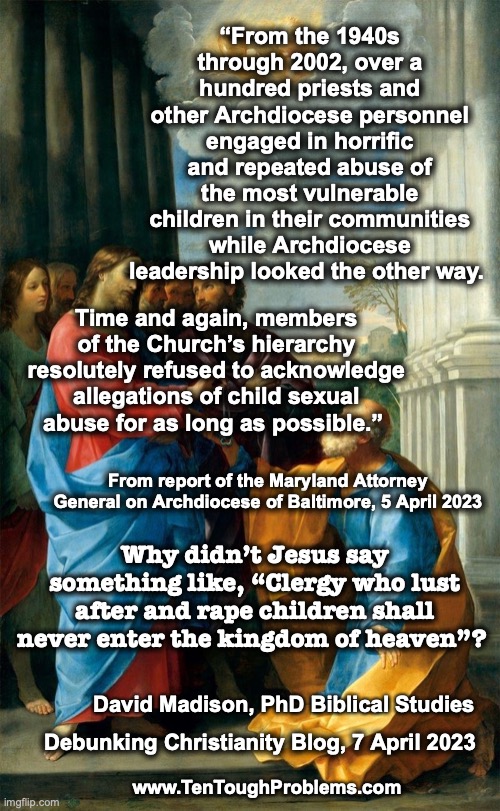
Some guilt would be a good idea, of course. Why didn’t Jesus say something like, “Clergy who lust after and rape children shall never enter the kingdom of heaven”? It’s become so common to see outrageous headlines, e.g., just this week: Maryland AG report into Archdiocese of Baltimore alleges 150 Catholic clergy members and others abused more than 600 children. Here’s a quote:“From the 1940s through 2002, over a hundred priests and other Archdiocese personnel engaged in horrific and repeated abuse of the most vulnerable children in their communities while Archdiocese leadership looked the other way. Time and again, members of the Church’s hierarchy resolutely refused to acknowledge allegations of child sexual abuse for as long as possible.”

The apostle Paul was dead wrong about sexual feelings being crucified when you “belong to Christ.” 

Two 

It is quite common for Christians to ignore Jesus-script about divorce. In one of his confrontations with the Pharisees, he said:

“Have you not read that the one who made them at the beginning ‘made them male and female,’ and said, ‘For this reason a man shall leave his father and mother and be joined to his wife, and the two shall become one flesh’?  So they are no longer two but one flesh. Therefore what God has joined together, let no one separate” (Matthew 19:4-6).

Who needed to have it explained that there was a reason for the male-and-female arrangement? Becoming “one flesh” is an obvious outcome. But then this Jesus-script wanders into truly bad theology: “…what God has joined together.” If you go along with the view that a god created the arrangement, yes, this was God’s scheme. But this script seems to imply that all marriages have been arranged by this god—he has done the joining together, which is why divorce is forbidden: you’re breaking up a divinely ordained union. There are a couple of things really wrong about this: (1) that a god meddles in intimate human affairs, he micromanages. This is totalitarian monotheism—another way for clergy/theologians to enhance the guilt-factor in religion: if you get a divorce, you’re suggesting that god made a mistake; (2) think of all the bad marriages you know of in your experience, done for so many wrong reasons. Multiply that by the number of horrible marriages throughout human history. 

God must have made a lot of mistakes. “…what God has joined together, let no one separate” is bad theology—not what we would expect of a great moral teacher.  

And it gets worse: “He said to them, ‘It was because you were so hard-hearted that Moses allowed you to divorce your wives, but from the beginning it was not so. And I say to you, whoever divorces his wife, except for sexual immorality, and marries another commits adultery, and he who marries a divorced woman commits adultery” Matthew 19:8-9). 

There can be many reasons for divorce, and it’s not all that smart to suggest that being hard-hearted is the main reason. Had Jesus done a lot of research, to be able to announce that “from the beginning it was not so”? How would be know that? Then this additional silliness: if a divorced person marries someone else, that’s adultery. It’s even worse adultery if a man marries a divorced woman. How much damage has been caused by this teaching, especially in terms to increasing guilt? By the way, Matthew’s line “except for sexual immorality” is missing from the text that he copied from Mark. He wanted to soften the harsh teaching.

Do contemporary Christians pay much attention to such Jesus-script? This quote is from a 2014 study published by Baylor University: “Despite their strong pro-family values, evangelical Christians have higher than average divorce rates—in fact, being more likely to be divorced than Americans who claim no religion…”

And this is from a 2015 survey by the Pew Research center: “Among Catholics who have ever been married, roughly one-third (34%) have experienced a divorce.” That’s especially a scandal since marriage is one of the sacraments in the Catholic church. Major games are played as well: I know a Catholic man who paid big money to have his twenty-year marriage—that resulted in three children—annulled, to avoid admitting that a divorce had been involved. Too bad Jesus didn’t mention annulment when he preached about divorce! 

So many Christians seem to be okay with ignoring Jesus-script on divorce.

Three

Right after Jesus equates arousal with adultery, he recommends self-mutilation: 

“If your right eye causes you to sin, tear it out and throw it away; it is better for you to lose one of your members than for your whole body to be thrown into hell. And if your right hand causes you to sin, cut it off and throw it away; it is better for you to lose one of your members than for your whole body to go into hell” (Matthew 5:29-30, with the same warning repeated in Matthew 18:8-9).

Although the clergy will rush to assure the devout that this is metaphor, we have to wonder why a great moral teacher would have chosen such grotesque imagery. Again, this has too much the flavor of cult fanaticism, which we have come to expect of the gospel writers who created the Jesus-script. 

Four

Robert Conner, in his book, The Jesus Cult: 2000 Years of Last Days, notes that “Jesus’ command to mutilate oneself hardly stops with an eye, hand or foot however” (p. 55), and he quotes Matthew 19:12: “For there are eunuchs who have been so from birth, and there are eunuchs who have been made eunuchs by others, and there are eunuchs who have made themselves eunuchs for the sake of the kingdom of heaven. Let anyone accept this who can.”

Jesus fails to qualify as a great moral teacher if he recommends self-castration: “Let anyone accept this who can.” Conner is right: “Surely no rational man would think himself spiritually elevated because he had removed his own testicles! That reaction would be true if we were talking about rational people, but we aren’t. We’re talking about early Christians” (p. 56). 

Conner quotes from an article by Daniel F. Caner: “…sources from the fourth century indicate that by then self-castration had become a real problem in the nascent Church…by which time an ascetic movement that included not merely renunciation of marriage but also extreme forms of self-mortification had become influential and widespread in Christian communities” (p. 56).

Matthew 19:12 is most certainly Jesus-script that is universally ignored. Conner also notes that several modern translations obscure the meaning to the Greek text (see p. 55), but the top prize for deception goes to The Message Bible

“But Jesus said, ‘Not everyone is mature enough to live a married life. It requires a certain aptitude and grace. Marriage isn’t for everyone. Some, from birth seemingly, never give marriage a thought. Others never get asked—or accepted. And some decide not to get married for kingdom reasons. But if you’re capable of growing into the largeness of marriage, do it.’”  

This is not even paraphrase; it’s the pushing of theology favored by those claiming to be translators. Bluntly stated: it’s lying.  

Churchgoers who take the time to think about these texts can appreciate that they are out of sync with the way the devout today deal with arousal and divorce—and no one gives serious thought to self-mutilation. It doesn’t help that the metaphor is so grotesque. Even the devout may wonder—despite the words printed in red—if Jesus really did say these things. They should embrace the concept of Jesus-script, that is, these sayings were invented by the gospel writers as they created their Jesus tales. But then the devout face another awkward reality: we have no way of knowing the authentic words of Jesus. Indeed, are there any at all in the gospels? New Testament scholars have known for a long time that there is no way to verify any of the words of Jesus we find in the gospels—because these documents are decades removed from the time of Jesus. 

Maybe the devout are fine with “taking it on faith” that Jesus actually uttered the words that are so tough to take seriously, but then they have to admit that they just say NO to their lord and savior. Of course, they don’t say it out loud.   

David Madison was a pastor in the Methodist Church for nine years, and has a PhD in Biblical Studies from Boston University. He is the author of two books, Ten Tough Problems in Christian Thought and Belief: a Minister-Turned-Atheist Shows Why You Should Ditch the Faith (2016; 2018 Foreword by John Loftus) and Ten Things Christians Wish Jesus Hadn’t Taught: And Other Reasons to Question His Words (2021). The Spanish translation of this book is also now available. 

His YouTube channel is here. He has written for the Debunking Christianity Blog since 2016.

The Cure-for-Christianity Library©, now with more than 500 titles, is here. A brief video explanation of the Library is here

Reading the Gospels as Informed Adults

Here’s the link to this article.

By David Madison, 04/21/23.

Rise above the credulity expected in Sunday School

For many, many people, reading the gospels eyes-wide-open for the first time can prompt serious doubt—and their departure from the Christian faith. It’s awfully hard to divest the gospels of that aura of holiness promoted by the church: the gospels are the greatest story ever told—their authors were inspired by God himself. It’s not uncommon for congregations to stand when the ritual includes a reading from the gospels. 

But an adult mentality can kick in, i.e., the assumption that I can “spot a fairy tale when I see one.” For example, eleven verses into Mark, chapter 1, we read that a “voice came from heaven” announcing to Jesus—at his baptism—that he was God’s son. But very few of us believe that gods make announcements from the sky. In Matthew, chapter 1, verse 20, we’re told that an angel of the lord tells Joseph in a dream that Mary is pregnant by the holy spirit. Most of us have weird dreams from time to time, but we don’t believe they’re messages from a god.

If this adult mentality is applied to most of the stories we find in the gospels, they fail tests of logic and reason. They are not so convincing, so compelling as we have been urged to believe—since our earliest days in Sunday school or catechism. 

Even devout New Testament scholars admit that the gospels present serious challenges that diminish their status as authentic history; they fail to measure up on so many levels—and secular scholars can be blunt about it. 

Richard Carrier specializes in the literature of the ancient world, including the New Testament. Here is his analysis—I have bolded key elements—that puts the gospels into perspective:  

“Each author just makes Jesus say or do whatever they want. They change the story as suits them and neglect to mention they did so. They craft literary artifices and symbolic narratives routinely. They frequently rewrite classical and biblical stories and just insert Jesus into them. If willing to do all that (and plainly they were), the authors of the Gospels clearly had no interest in any actual historical data. And if they had no interest in that (and plainly they didn’t), they didn’t need a historical Jesus. Even if there had been one, he was wholly irrelevant to their aims and designs. These are thus not historians. They are mythographers; novelists; propagandists. They are deliberately inventing what they present in their texts. And they are doing it for a reason (even if we can’t always discern what that is). The Gospels simply must be approached as such. We have to stop thinking we can use them as historical sources.” 

(On the Historicity of Jesus: Why We Might Have Reason for Doubt, Kindle, p. 556)

Preachers, priests, and apologists also qualify as propagandists: they earn their livings by promoting their particular versions of the Christian faith (hence Catholic priests won’t promote Mormonism, Baptist preachers won’t promote Catholicism—so many of the rival Christian brands detest each other!) 

It would be such a blessing—please excuse the term—if these champions of the gospels could be honest enough to publish this long Carrier quote in the church bulletins and newsletters, under the heading: Food for Thought: Let’s Discuss. But thinking about the gospels would be lethal to their purpose. 

We find a good example of a gospel propagandist posing as historian in the opening of Luke’s gospel. Here are the first four verses:

“Since many have undertaken to compile a narrative about the events that have been fulfilled among us, just as they were handed on to us by those who from the beginning were eyewitnesses and servants of the word, I, too, decided, as one having a grasp of everything from the start, to write a well-ordered account for you, most excellent Theophilus, so that you may have a firm grasp of the words in which you have been instructed.”

There are several problems with this text. Devout scholars have been delighted that Luke claims that his material was derived from eyewitnesses, but we have to be suspicious—and skeptical. How would that process have worked? Consider a few problems:

(1)  The author of Luke’s gospel copied so much text from Mark’s gospel (according to Encyclopedia Britannica, 50 percent) without mentioning that he had done so, which we call plagiarism. In other words, he doesn’t mention his sources. Did this author assume that Mark’s account was based on eyewitness testimony? There is, in fact, nothing in Mark’s gospel that can be verified as eyewitness accounts. It contains so much fantasy and folklore, with a heavy dose of magical thinking as well, e.g., in Mark 5 Jesus—presumable using a magic spell—transfers demons from a deranged man into a herd of swine. Nor does Luke identify the sources for his non-Marcan material. 

(2)  There is wide consensus among New Testament scholars that the gospel of Mark—upon which the gospels and Matthew and Luke were heavily dependent—was written after the destruction of Jerusalem and the temple in 70 CE, i.e., during the devastating First Jewish-Roman war (this catastrophe is reflected in Mark, chapter 13). Guesses vary as to when Luke was written, perhaps ten years or more after that, i.e., a full fifty years after the time of Jesus. Would any of the eyewitnesses to Jesus-events have survived that long? Would they have survived the war? That’s a stretch. 

(3)  Maybe the eyewitnesses wrote down their experiences? How would such documents have been preserved, cared for? How would the author of Luke’s gospel, so many years later, have had access to them—after the catastrophic war? 

(4)  The author claims that he is “one having a grasp of everything from the start,” yet never identifies himself! Never cites his credentials. But we do know that he wrote propaganda for the early Jesus cult—his gospel certainly qualifies as that. Which means that it’s hard to trust his gospel as authentic history

And he gives away his game in the first two chapters of the gospel. Here we read about how both John the Baptist and Jesus were conceived and born. Since an angel is given a speaking role, right away we know we’re dealing with religious fantasy literature. Informed adults today know right away that the Fairy God Mother in Cinderella is fantasy, but it’s harder to break away from angel-fantasy learned in Sunday School and catechism. Devout folks may nod in approval as they read about the angel speaking to Elizabeth and Mary in Luke 1, but there is no evidence whatever—reliable, verifiable data—that angels are real, despite thousands of vivid depictions in religious art. 

Moreover, the propaganda element is prominent, for example, in the angel’s promise to Mary about Jesus (Luke 1:32-33): “…and the Lord God will give to him the throne of his ancestor David. He will reign over the house of Jacob forever, and of his kingdom there will be no end.” This never happened, the angel here was dead wrong; but the author was promoting his cult theology. In Mary’s “Song of Praise” (Luke 1:46-55, as the RSV translation labels it—also known as the Magnificat), verse 50 is a description of Luke’s god: “…his mercy is for those who fear him from generation to generation.” This god is nice to those fear him, which reflects the vindictive god of the Old Testament. 

This is a helpful exercise: read Luke 1-2 carefully, and try to identify which parts of this text could have been based on eyewitness testimony. Also ask: who was there taking notes? —upon which the story could have been based as it was written down decades later. One evangelical scholar has suggested that the author of Luke took the time and trouble to interview Mary—an idea based on no evidence whatever. His desire to make the story credible was all that mattered.

When Zechariah was alone in the temple (no eyewitnesses) he was spoken to by the angel, i.e., the promise that his elderly wife Elizabeth would conceive. And so it happened (this episode is a recrafting of the story of Abraham and Sarah), Luke 1:24-25:

“After those days his wife Elizabeth conceived, and for five months she remained in seclusion. She said, ‘This is what the Lord has done for me in this time, when he looked favorably on me and took away the disgrace I have endured among my people.’”

If she remained in seclusion, how could there have been an eyewitness who heard what she said? Maybe she wrote a diary? Where was it archived, and how would the author of Luke have accessed it? 

Reading the gospels as informed adults requires curiosity, the willingness to question everything, as well as skepticism about documents that were clearly intended to enhance belief in an ancient cult. That’s why it’s important to ponder carefully every gospel episode. Study it, read what scholars have written about it—and don’t be satisfied with “study guides” written by preachers and apologists. They can highlight positives and deflect attention from negatives—and even be deceitful. This is how The Message Bible renders Luke 1:1-4:

“So many others have tried their hand at putting together a story of the wonderful harvest of Scripture and history that took place among us, using reports handed down by the original eyewitnesses who served this Word with their very lives. Since I have investigated all the reports in close detail, starting from the story’s beginning, I decided to write it all out for you, most honorable Theophilus, so you can know beyond the shadow of a doubt the reliability of what you were taught.”

This is not a translation or a paraphrase, but rather an expression of the theology of the pretend-translator, who wants to make sure his readers get the message as he imagines it.  

It’s the working hypothesis of New Testament scholars that the Book of Acts is by the same author who wrote Luke. It too, especially in the first third, gives credit to angels and the holy spirit for things that happen. There are miracles and fantasies, such as Jesus ascending through the clouds to sit down on a throne next to god (Acts 1). Acts tells that story of the apostle Paul’s dramatic conversion on the road to Damascus (three times, in fact, chapters 9, 22, 26), which Paul himself never mentions in his letters. We suspect that Luke’s literary imagination was at work.

In an article published 9 April 2023, Do the ‘We’ Passages in Acts Indicate an Eyewitness Wrote It?, Richard Carrier goes into considerable detail regarding the difficulties these “we” passages present. Are they in fact eyewitness accounts? The “we” are never identified. Did Luke have a copy of a ship log (the “we” passages appear in accounts of sea voyages)? There are parallels in other ancient stories about trips at sea. It’s clear that the “we” passages cannot be trusted as much as Christian apologists argue they should be. 

This is the basic rule: informed readers of the gospels and Acts should want to find out what can be authenticated as history—based on reliable, verifiable data. Again, Carrier states the problem bluntly:

“Christian apologists often cite [the “we” passages] as evidence the author of Acts was one of these people and therefore “was really there” and thus a reliable source. None of that follows—liars can pretend to have been there; and people who were there can lie about everything anyway; so if we accumulate evidence that the author of Acts (traditionally said to be Luke) was a habitual liar and fabricator, the whole notion that he is reliable merely because he occasionally uses a first-person narrative falls apart anyway.” (from the 9 April 2023 article)

Modern cult leaders—such as wealthy TV evangelists—commonly lie to promote their modern version of the Christian brand. Anyone who probes the gospels with serious intent to find out what’s really there will be sorely disappointed at the level of fictionalizing and mythologizing. Propagandists rarely have much respect for the truth. 

This not all that hard for Christians themselves to figure out: they ignore the propaganda peddled by the thousands of Christian brands they don’t belong to.

David Madison was a pastor in the Methodist Church for nine years, and has a PhD in Biblical Studies from Boston University. He is the author of two books, Ten Tough Problems in Christian Thought and Belief: a Minister-Turned-Atheist Shows Why You Should Ditch the Faith (2016; 2018 Foreword by John Loftus) and Ten Things Christians Wish Jesus Hadn’t Taught: And Other Reasons to Question His Words (2021). The Spanish translation of this book is also now available. 

His YouTube channel is here. He has written for the Debunking Christianity Blog since 2016.

The Cure-for-Christianity Library©, now with more than 500 titles, is here. A brief video explanation of the Library is here

If It Looks Like a Cult, Walks Like a Cult, and Quacks Like a Cult…

Here’s the link to this article.

By David Madison 05/05/23

It’s a cult!

With well more than two billion followers, Christianity ranks as humanity’s biggest religion, and thus to many it also qualifies as one of the great religions of the world. Look at all it has going for it: 2,000 years of momentum, churches in every city and town—in the countries where it predominates—as well as massive cathedrals that draw vast crowds. From my own experience, I can say that those in London, Paris, Milan, Rome, and Barcelona are indeed magnificent. Some of the great composers have set Christian stories and rituals to music, e.g., Bach, Mozart, Beethoven, Verdi. A massive propaganda engine promotes the faith as well: Sunday school, catechism, and professional apologists whose primary goal is to explain away the incoherencies that sabotage Christian theology, i.e., its many claims about god are in jarring conflict, and cannot, in truth, be reconciled. But the apologists are slick enough to make it look good.

Full Stop: In fact it doesn’t look so good. If you don’t recognize Christianity as a vast, splintered, quarreling cult, you’re not looking at it closely, critically, skeptically—as an outsider would, as John Loftus makes the case in his 2013 book, The Outsider Test for Faith: How to Know Which Religion Is True. Christian adults who went through the

Sunday School or catechism experience were trained not to do so. And they think you’re crazy if you call Christianity a cult. Those unfortunate 900 folks who drank the Kool-Aid—committing mass suicide in 1978 in Guyana—under the urging of Jim Jones: they were
members of a cult.          

But it doesn’t take all that much study, that much research into Christian origins—that is, looking below the surface of cherished dogma—to see the stark reality: core Christian beliefs are a clumsy blend of ancient superstitions, common miracle folklore, and magical thinking. All of these flourished at the time Christianity emerged.

Based on its core beliefs, Christianity is a cult. Are the folks in the pews really okay with these ideas?

Human Sacrifice 

It might be a bit troubling when the devout read in Genesis 8:21 that Yahweh was pleased with the aroma of birds that Noah burned after the flood. Likewise, we read in Leviticus 1 that this god liked the aroma of bull-flesh being burned. This reflects the naïve concept of god that prevailed at the time: he was close overhead to get a whiff of the smoke. Now we know that the Cosmos has billions of galaxies—so the idea that god is pleased by the aroma of smoke on earth just won’t do. In Mark 1:44 we read that Jesus, after healing a man, told him to “…show yourself to the priest, and offer for your cleansing what Moses commanded”—most likely a burnt offering. Incinerating animals was in fact big business at the Jerusalem Temple before it was destroyed by the Romans in 70 CE.  

But Christianity decided to make an adjustment: it upgraded to human sacrifice. Here’s what we read in the New Testament book of Hebrews, chapter 9:26-28, about the role of Christ:

“…he has appeared once for all at the end of the ages to remove sin by the sacrifice of himself. And just as it is appointed for mortals to die once and after that the judgment, so Christ, having been offered once to bear the sins of many, will appear a second time, not to deal with sin but to save those who are eagerly waiting for him.” This is Jesus-script found in Mark 10:45: “For the Son of Man came not to be served but to serve and to give his life a ransom for many.”

It strikes me as a horrible twisting of piety that, in some Christian traditions, the horror of the crucifixion is depicted as vividly as possible: the bloodier Jesus is, the better: a brutal human sacrifice. How does this possibly make sense? An all-powerful god can’t just forgive people, but somehow slipped into theological dotage, and arranged this gimmick: “I came up with this idea of having my son murdered—to enable me to forgive humans.” 

This is from the Wikipedia article on human sacrifice, as widely practiced around the world, with the Christian twist on it: 

“Christianity developed the belief that the story of Isaac’s binding was a foreshadowing of the sacrifice of Christ, whose death and resurrection enabled the salvation and atonement for man from its sins, including original sin…The beliefs of most Christian denominations hinge upon the substitutionary atonement of the sacrifice of God the Son, which was necessary for salvation in the afterlife. According to Christian doctrine, each individual person on earth must participate in, and/or receive the benefits of, this divine human sacrifice for the atonement of their sins. Early Christian sources explicitly described this event as a sacrificial offering, with Christ in the role of both priest and human sacrifice…”  

And It Gets Worse

Just as many other religions/cults embraced human sacrifice—for a variety of reasons—so it was believed that some dying gods came back to life. In other words, it was a common superstition, as Richard Carrier has explained:

“The dying-and-rising son (sometimes daughter) of god ‘mytheme’ originated in the ancient Near East over a thousand years before Christianity and was spread across the Mediterranean principally by the Phoenicians (Canaanites) from their base at Tyre (and after that by the Carthaginians, the most successful Phoenician cultural diffusers in the early Greco-Roman period), and then fostered and modified by numerous native and Greco-Roman cults that adopted it. The earliest documented examples are the cult of Inanna and Dumuzi (also known as Ishtar and Tammuz), the cult of Baal and Anat, and the cult of Marduk (also known as Bel or Baal, which basically meant ‘the Lord’), all of whose resurrection stories are told in Sumerian, Ugaritic and Assyrian tablets (respectively) long predating the advent of Christianity” (p. 169, Carrier, On the Historicity of Jesus: Why We Might Have Reason for Doubt).

Carrier discusses this belief in great detail in his 29 March 2018 blog article, Dying-and-Rising Gods: It’s Pagan, Guys. Get Over It.

The early Jesus-cult borrowed the idea, and profound ignorance of this fact has prevailed for centuries. Robert Lowry’s 1874 hymn captures Christian naivete perfectly: “Up from the grave He arose, With a mighty triumph o’er His foes, He arose a Victor from the dark domain, And He lives forever, With His saints to reign. He arose! He arose! Hallelujah! Christ arose!” 

The confusion in the Easter morning gospel stories should be a tip-off that something is wrong. The four gospels managed to attain sacred status among early Christians, so they were put side by side in the holy canon, without any thought—so it would seem—to their contradictions. Snippets of the Easter stories are read from the pulpit, but it’s not common for the laity to scrutinize the four Easter accounts side-by-side. They are, in fact, a mess, and Christian apologists have worked oh-so-hard to make them look coherent. From Mark (the first) through John (the last), the story grew with the telling. Luke alone included the Road to Emmaus story, and John alone included the account of Doubting Thomas, both of which suggest that their authors were influenced by ghost folklore. On this, see Robert Conner’s book: Apparitions of Jesus: The Resurrection as Ghost Story

The Magical Thinking Piles On

One of the great embarrassments for devout New Testament scholars is that the apostle Paul, who was the first to write about Christ, does not mention—in any of his letters—the supposed events of Easter morning, including an empty tomb. He bragged that his Christ-information did not come from any human sources, but from his visions (= hallucinations). He was locked into his conviction that Jesus had been resurrected. 

It would appear that Paul was terrified of dying, and was convinced he’d found the formula for living forever. He assured the folks in the Thessalonian congregation that their dead relatives (i.e., those who had believed in Jesus), would escape from their graves to meet Jesus: “Then we who are alive, who are left, will be caught up in the clouds together with them to meet the Lord in the air, and so we will be with the Lord forever” (I Thessalonians 4:17). The problem with death was solved! And in Romans 10:9 he was just as explicit: “…if you confess with your mouth that Jesus is Lord and believe in your heart that God raised him from the dead, you will be saved.” 

This is magical thinking, utterly, totally: if you say and believe that Jesus was raised from the dead—well, that’s the magical formula for getting out of dying. Followers of other cults that worshipped dying-and-rising savior gods were just as confident that they had the right god.

The author of John’s gospel took the magical thinking to an even higher level—actually, it’s a lower level—because it is so ghoulish. In his sixth chapter, he includes Jesus-script in which his Christ promises eternal life to those who drink his blood and eat his flesh. Other such cults had sacred meals as well, and this text probably played a role in moving the Catholic church to adopt the concept of transubstantiation: by the Miracle of the Mass, the bread and wine become the real body and blood of Jesus, i.e., magic potions. That’s just too spooky.

As mentioned above, the Easter morning stories in the gospels provide no evidence at all that Jesus was resurrected from the dead. But the people who embrace resurrection theology should notice they’ve got a big problem to deal with. So Jesus was alive and walking around (the gospels don’t agree on just how long)—so what do you eventually do with the newly alive Jesus? In the first chapter of Acts we read that, after forty days, Jesus ascended to heaven, i.e., he rose from the earth and disappeared into the clouds. Apologists today may claim that this can be taken metaphorically, but the author of Acts—knowing nothing about how the Cosmos is structured—would have assumed that his story was accurate. After all, writing decades later, he had to provide a happy ending: Jesus sitting on a throne in heaven next to Yahweh. 

But we know that there’s no throne of god somewhere above the earth. Just a few miles overhead is the intense cold of space, pulsing with radiation. A few years ago, Scott McKellar commented on the fantasy story in Acts 1: 

“In the course of his ascension, at around 15,000 feet Jesus began to

wish he had brought a sweater. At 30,000 feet he felt weak from lack of oxygen. By 100,000 feet his bodily fluids were boiling away from every orifice. If he ever did return, it would be as a fifty-pound lump of bone and frozen jerky.”  (from a Facebook post)

So newly alive Jesus—if you believe he resurrected—never left Planet Earth. Thus even devout Christians, if they give any thought at all to this, have to admit that Jesus died again. Just as Lazarus did, and the dead folks whom Matthew claims came alive when Jesus died, then walked out of their tombs on Easter morning to wander around Jerusalem. What happened to Jesus in the end? Nobody knows. The gospels don’t tell us. What an embarrassment: the New Testament is guilty of a coverup. Jesus isn’t alive somewhere in the sky guaranteeing eternal life for those who believe that he rose from the dead. The magical thinking—the cult fantasy—just doesn’t work. 

One final point: the Christian cult still embraces the idea that its god must be praised and glorified by humans. This derives from a primitive concept of god that was based on the behavior/expectations of tribal chieftains and kings. As much as theologians have tried to upgrade this concept—make it more respectable—it now seems so unlikely. Does a god who runs the Cosmos need/require continual flattery and stroking by a species of mammals on one planet? That it gets off on being sung to? In fact, that’s just silly. Yet the building boom goes on: putting up more churches for devout to gather in, to offer praise: “How great Thou art, how great Thou art, Then sings my soul, my Savior God to Thee, How great Thou art, how great Thou art.” 

There is no reliable, verifiable, objective evidence that god(s) exist—and certainly none that god(s) expect repetitive, unending praise. But cult nonsense has incredible staying power.   

David Madison was a pastor in the Methodist Church for nine years, and has a PhD in Biblical Studies from Boston University. He is the author of two books, Ten Tough Problems in Christian Thought and Belief: a Minister-Turned-Atheist Shows Why You Should Ditch the Faith (2016; 2018 Foreword by John Loftus) and Ten Things Christians Wish Jesus Hadn’t Taught: And Other Reasons to Question His Words (2021). The Spanish translation of this book is also now available. 

His YouTube channel is here. He has written for the Debunking Christianity Blog since 2016.

The Cure-for-Christianity Library©, now with more than 500 titles, is here. A brief video explanation of the Library is here

Pop-Quiz for Christians, Number 7

Here’s the link to this article by David Madison.

3/24/2023.

Dealing with some of the curiosities in Matthew’s gospel

I have often pointed
out that the gospels are a minefield. Randel Helms has said it even better: “The Bible is a self-destructing artifact.” We are far removed from the thought world of those who wrote the New Testament, so it’s hardly a surprise that we find some very strange things in the gospels. One of my purposes in these Pop Quizzes for Christians is to encourage them to look beneath the rituals, ceremonies, and sermons—all of which are designed to present a magnificent case for Christianity. But is that what we actually find in the gospels? If the brain is fully in gear, if folks were in the habit of questioning everything, they could see that far too much just doesn’t make sense. When we open the New Testament, the gospel of Matthew is the first thing we see—although Mark was actually the first to be written. There is a lot in Matthew that should make Christians wonder how/why it should be taken seriously.

This quiz is designed to draw attention to some major flaws that should not exist in a divinely inspired document. Here are the links to previous quizzes:  One   Two   Three   Four   Five   Six

Question One:

Matthew’s gospel opens with a 16-verse genealogy of Jesus, tracing his lineage back to King David; this was an essential credential to establish Jesus as the messiah. But then Matthew declares that Jesus was conceived by the holy spirit: Joseph wasn’t the father. Discuss why Matthew felt he could present—and get way with—such a contradiction.

Question Two: 

This is verse 20 of Matthew 1: “…an angel of the Lord appeared to him in a dream and said, ‘Joseph, son of David, do not be afraid to take Mary as your wife, for the child conceived in her is from the Holy Spirit.’” Discuss the problems any historian faces when the argument is made that this should be taken seriously. 

Question Three:

Read Isaiah 7 and Hosea 11. Do you find anything in these two chapters that reference Jesus of Nazareth? Yet Matthew used Isaiah 7:14 and Hosea 11:1 to boost his argument that Jesus had special divine status. Discuss Matthew’s theology in this deceptive use of scripture.

Question Four:

Matthew 6:19-20:  “Do not store up for yourselves treasures on earth, where moth and rust consume and where thieves break in and steal, but store up for yourselves treasures in heaven, where neither moth nor rust consumes and where thieves do not break in and steal.”

Explain how Christians today square this with their extravagant consumer lifestyles?   

Question Five:

We are stumped by conflicting Jesus-script that Matthew presents. Consider:

Matthew 18:21-22: “Then Peter came and said to him, ‘Lord, if my brother or sister sins against me, how often should I forgive? As many as seven times?’ Jesus said to him, ‘Not seven times, but, I tell you, seventy-seven times.’”

But when Jesus sent his disciples out to preach, this level of forgiveness is absent:

Matthew 10:14-15: If anyone will not welcome you or listen to your words, shake off the dust from your feet as you leave that house or town. Truly I tell you, it will be more tolerable for the land of Sodom and Gomorrah on the day of judgment than for that town.”

Similar severity is found in the last judgement scene in Matthew 25: Those who fail to show sufficient compassion will end up in eternal fire (vv. 41 and 45).

How can this incoherence in Matthew’s Jesus-script be explained? 

Question Six:

Here is one of the strangest texts in the New Testament:

At themoment Jesus died,Matthew reports (27:52-53): “The tombs also were opened, and many bodies of the saints who had fallen asleep were raised. After his resurrection they came out of the tombs and entered the holy city and appeared to many.” This remarkable happening is not mentioned in the other gospels or in the epistles—nor does it appear in any other records of the time. Explain why historians have trouble believing this account, which looks very much like a tale suitable for Halloween. 

Answers and Comments

Question One:

Descended from David, or conceived by a holy spirit, with no human father? For modern readers—who give it much thought—this seems to be a blend of theologies that, in fact, cannot be blended. But those for whom Matthew wrote were probably satisfied that the man who raised Jesus was descended from David; that justified the genealogy. Did it even occur to them that there is a major blunder here? 

This was an audience that accepted the superstitions and miracle folklore of the ancient world. Other cults believed that their heroes and deities had been conceived by gods and born to human women, hence Matthew probably felt, “Why not?” when he added this to his story of Jesus. Contemporary readers are right to assume that Matthew wasn’t bound by rigorous logic, and he wrote long before there was a scientific understanding of reproduction. Luke went along with Matthew’s idea, in fact he elaborated substantially on the fantasy. Mark, John, and the apostle Paul fail to mention the miraculous origin of Jesus; it’s a minority opinion in the New Testament.

Question Two:

In Matthew 1:20 we read that it was in a dream that Joseph got word about Mary being pregnant by a holy spirit. Most New Testament scholars date Matthew’s gospel to the late first century, at least fifty years after the death of Jesus—and eighty years after his birth. So historians can’t take this story seriously unless they know where/how Matthew got his information. Writing accurate, authentic history requires access to contemporaneous documentation, items that were created very near the time of an event. So how could Matthew have found out about Joseph’s dream? Maybe Joseph kept a diary? But was he literate? If he did keep a diary, where was it archived so that Matthew had access to it? And even if such a diary existed, and he wrote about a dream, how could we possibly verify that an angel had spoken to him? 

I have lots of weird dreams, and when I wake up I’m relieved to be back to reality! 

John Loftus has described the dilemma for historians: “How might anonymous gospel writers, 90-plus years later, objectively know Jesus was born of a virgin? Who presumably told them? The Holy Spirit? Why is it God always speaks to individuals in private, subjective, unevidenced whispers? Those claims are a penny a dozen.” (Debunking Christianity Blog, 25 December 2016)

Matthew 1 is fantasy literature, not history. 

Question Three:

Isaiah 7:14: “…the young woman is with child and shall bear a son and shall name him Immanuel.” Hosea 11:1: “…When Israel was a child, I loved him, and out of Egypt I called my son.” The context of these verses has nothing whatever to do with the prediction of a coming messiah or savior. But Matthew was hunting for Old Testament verses that for him were proof that Jesus had been predicted centuries in advance. Today we simply identify this as abuse/misuse of scripture—theology off on a wrong track completely. In fact, Matthew got really carried away. Read Luke’s birth story: after the birth of Jesus, Joseph and Mary headed back to Nazareth with Jesus. For Luke, that was where they lived, and there is no mention of a flight to Egypt; nor is it found in the other gospels.  But Matthew was so eager to apply Hosea 11:1 to Jesus: “Out of Egypt I have called my son.” Clearly, however, the Hosea text is about the people of Israel. Matthew was driven by his theology to make things up

Imagine a theologian, five or six centuries from now, wanting to show that Harry Potter was a divine hero, by citing Isaiah 64:8, Jeremiah 18:6, Matthew 27:7—all of which include the word potter. We’d say, “How goofy is that,” but this is exactly the technique Matthew used in applying Isaiah 7:14 and Hosea 11:1 to Jesus. But his case is even weaker: the word Jesus does not appear in these verses in Isaiah or Hosea.

Question Four:

“Do not store up treasures on earth” (Matthew 6:19) appears to have little impact on the behavior of church-going Christians I know. As much as anyone else they acquire nice houses with giant TVs and a wide array of indispensable consumer goods—and they train their kids to behave the same way. “More, more, more,” seems to be their basic creed—”as much as we can afford.” Of course, the most important storing of treasure on earth is the pension plan, and retirement savings accounts. A few verses later, in Matthew 6:25, we read: “…do not worry about your life, what you will eat or what you will drink or about your body, what you will wear. Is not life more than food and the body more than clothing?” Is that really how any of us, Christians included, manage life today? 


These verses are in the Sermon on the Mount, Matthew 5-7, which includes other commands that most believers I know simply ignore, e.g., give to anyone who begs, don’t refuse anyone who asks to borrow from you, if you are sued, hand over more than you’re sued for. And the worst advice imaginable: “Do not resist an evildoer” (verse 5:39). In fact, it would be quite a challenge for most of the devout to read the Sermon on the Mount carefully and decide what they can take seriously. It would seem that Matthew wrote his Jesus-script based on the assumption that the Kingdom of God would arrive soon, thus all earthy concerns would vanish: hence the importance of storing up treasures in heaven—whatever that means. So much advice in this famous sermon strikes us as naïve and unrealistic.    

Question Five:

From time to time when I’m watching Father Brown on TV, the good priest assures folks that god is loving and forgiving—as long as the sinner repents and asks for forgiveness. This is the kindly Man Upstairs that the devout want most to believe in. Maybe Jesus was right: he forgives seventy times seven (Matthew 18:22). But is that really the message that Matthew intended? There is too much incoherence in Matthew’s Jesus-script. Jesus assured his disciples that any village or household that refused to listen to their preaching would be destroyed—they would suffer the same fate as Sodom and Gomorrah. One of the most beloved texts in the gospels is Jesus speaking of those who do a variety of good deeds, e.g. feed the hungry, clothe the naked, visit those in prison. “…just as you did it to one of the least of these brothers and sisters of mine, you did it to me” (Matthew 25:40). This is indeed a beautiful text, but then this sentiment is wiped out by the assurance that those who don’t show sufficient compassion will be dispatched to suffer in eternal fire. Believers who want Father Brown’s version of god can’t be happy with this. It sounds very much like extreme, brutal theology typical of cults that aren’t bothered by incoherence

Question Six:

Matthew 27:52-53 has been ridiculed a lot: zombies—recently brought back to life at the moment Jesus died—then leaving their tombs on Eastern morning to tour Jerusalem. Why didn’t Jesus bother to hang out with them for a while? Just on the face of it, historians can’t be bothered to take this seriously. Other than these two verses—written decades later—there is no other mention anywhereof this macabre episode. Yes, it qualifies as a tall tale, one, in fact, that undermines belief in the resurrection of Jesus. Maybe that’s a tall tale as well, as

Robert Conner illustrates in his book, Apparitions of Jesus: The Resurrection as Ghost Story. With these two verses, Matthew makes a joke of any claim that he was a divinely inspired author—if so, he went rogue far too much of the time.

Matthew tells us nothing of his sources: did he really know anything about Jesus?  He copied most of Mark’s gospel without admitting he’d done so—and changed Mark’s wording as he saw fit. Isn’t plagiarism a sin? It sure isn’t what we’d expect if an author’s pen is guided by divine inspiration.   

David Madison was a pastor in the Methodist Church for nine years, and has a PhD in Biblical Studies from Boston University. He is the author of two books, Ten Tough Problems in Christian Thought and Belief: a Minister-Turned-Atheist Shows Why You Should Ditch the Faith (2016; 2018 Foreword by John Loftus) and Ten Things Christians Wish Jesus Hadn’t Taught: And Other Reasons to Question His Words (2021). The Spanish translation of this book is also now available. 

His YouTube channel is here. He has written for the Debunking Christianity Blog since 2016.

The Cure-for-Christianity Library©, now with more than 500 titles, is here. A brief video explanation of the Library is here

Mind Games to Protect Almighty (?) God

Here’s the link to this article.

By David Madison, 03/10/2023

The vulnerability of god is the biggest mystery

In a few of my article here I have mentioned one of the worst mind games ever used to defend god. A few days after the 2012 murder of 20 children at the Sandy Hook School in Connecticut, a devout woman was sure it had happened because “God must have wanted more angels.” Clergy and theologians know better than to say anything so blatantly grotesque, yet they feel the same obligation to get god off the hook. Why is there is so much suffering, cruelty, agony on a planet supposedly under the care of an omni-god: all good, all wise, all powerful? “This is my father’s world”—so they say. Our awareness of the everyday reality disconfirms this suggestion—at least it disconfirms the idea that a caring father-god is paying attention.

Professional theologians work hard at devising excuses to explain the obvious absence of god, and secular authors come right back at them to puncture their arguments. In John Loftus’ 2021 anthology, God and

Horrendous Suffering, there are two essays that describe some of these efforts, David Kyle Johnson’s “Refuting Skeptical Theism,” and Robert M. Price’s “Theodicy: The Idiocy.” 

At first glance, skeptical theism might sound like a step in the right direction. Johnson points out that we may be tempted to assume that it means believers edging toward agnosticism, or those who “barely believe.” But No, skeptical theism is a clumsy attempt to rule out evil and suffering as a reason for denying that a good god is in charge. Johnson sums it up this way:

“The problem of evil suggests that the seemingly unjustified (i.e., senseless or gratuitous) evils that exist in the world serve as evidence against god’s existence. But since god is so much ‘bigger’ than us—more wise and powerful and perfect—he could have reasons for allowing such evils that we simply cannot see or comprehend. Consequently, no evil, no matter how gratuitous it seems, can serve as evidence against god’s existence. 

“In other words, because we should be skeptical of our ability to fathom god’s reasoning (hence ‘skeptical theism’), the problem of suffering is no problem at all. For all we know, god has a reason to allow evil, and thus the existence of evil cannot bolster the atheist’s argument” (p. 212).

So the skeptical theist argues that we should be skeptical about our knowledge of god, who is assumed to be “more wise and powerful and perfect” than we are. But this is tiresome theobabble: theological assumptions—actually guesswork—the product of speculation for thousands of years, based on no hard data whatever.  

Among devout believers there is a tendency to embrace possibilities instead of probabilities. Especially when they’re trying to defend miracles: because their god has such extraordinary power, it has to be possible that the many divine wonders reported in the Bible actually happened, whether it’s Jesus turning water into wine, or feeding thousands of people with just a few loaves and fishes. But what is more probable? That such things actually happened, or that such stories derive from magical folklore of the ancient world—about which most laypeople seem to be unaware? If critical thinking skills are locked in neutral, of course it’s easy to take these things on faith—as devout have been trained to do since childhood. But the laws of probability don’t go away. Johnson devotes six pages to a section of the essay titled, “Skeptical Theism Is Logically and Mathematically Invalid.” There you will find what he identifies as a Simple Version of the math, then the Bayesian Version.  

The math may be daunting for many people, but the facts of evil should be even more daunting. But I suspect that the full scale of evil falls outside the horizon of awareness of most humans—except for evils that affect them directly. 

A careful study of history can be a cure for lack of awareness. 

The current issue of BBC History Magazine (Vol. 24, No. 2) includes an article by John Bulgin, titled, “How the Holocaust Began,” pp. 46-51. We read this:

“Within a matter of weeks, the targets of this mass murderer moved from military-aged men to include women, children, and the elderly. Children were spared none of the horror. Mothers were required to hold babies in their arms as both were shot, sometimes with the same bullet. 

“By the end of September 1941 the massacres reached an appalling


apex at Babyn Yar, a ravine in the Ukrainian capital, Kyiv. Over the course of two days, the Einsatzgruppen and their collaborators murdered more than 33,000 people in a single Aktion. Each consecutive group was marched to the murder site and forced to lie on top of the still-warm bodies of those who had just been killed before they were shot themselves” (p. 50).

Bulgin notes that “Senior Nazis became concerned about the emotional burden the killings were placing on their own men” (p. 50). 

Clergy and theologians also are aware of the emotional burden on believers that acute awareness of evil and suffering would bring. So this becomes the strategy: divert attention, obfuscate, come up with shallow excuses that might convince those who have already been deceived by doctrine. John Bulgin has pointed out that more than 33,000 people were murdered in two days at a ravine on Ukraine. “Oh, but god must have had some greater good in mind—he’s much wiser than we are—so hold onto your faith no matter what!” 

This provokes utter confusion, not clarity, however, as Johnson explains:

“…because people everywhere profess to have moral knowledge—to know that some things are morally good and others are morally bad. Indeed, if I can’t know that the murder of six million Jews in the Holocaust was a morally bad thing, what can I know? If I can’t lament the 2004 Indian Tsunami which killed an estimated 230,000 people in one day (because, for all I know, somehow it inexplicably prevented even more deaths), then I can lament nothing. In short, my objection here goes like this: 1. If the argument of the skeptical theist is sound, then moral knowledge is impossible. 2. Moral knowledge is possible. 3. Thus skeptical theism is not sound” (p. 222).

Skeptical theism is based on deity inflation: god is so much bigger, better, wiser than we are—his ways, his ultimate goals, are beyond our understanding (but again, please show us the data to justify this claim). 

Johnson drives home the point:

“If…god has different moral standards that make him conclude that genocide, burned fawns, and raped children are acceptable, our terms ‘loving’ and ‘moral good’ cannot apply to him—at all! Indeed, it would seem that the only words that would apply are those like ‘deplorable’” (p. 224).

“If god really is too big to understand—so big that we cannot even know whether he condemns child rape—then we really should profess to know nothing about him at all, including whether he exists” (p. 228).

“…the skeptical theist would not only have to admit that moral knowledge is impossible, but also that skeptical theism is hypocritical, irrationally unfalsifiable, and entails (at best) religious agnosticism and (at worst) global skepticism” (p. 229).

To even try to make a case that 33,000 people murdered by Nazis in two days can’t be called evil, because a god will see to it that a greater good will eventually emerge, is a foul mind game; it is just as grotesque as “God must have wanted more angels.”   

It was a smart move by the editor of the anthology to place Robert Price’s essay, “Theodicy: The Idiocy” right after the Johnson essay. It’s an additional slam-dunk—in just ten pages. Price notes that theodicy was Gottfried Leibniz’s word (coined in 1710) to describe the attempt to “vindicate God’s supposed goodness in spite of all appearances.” Price says that “the real game is to protect one’s faith in God at all costs, and that cost is great indeed” (p. 233). 

Theologians are up against the wild incoherence in Christian belief, and so many incriminating Bible stories. Price includes unanswered prayer in his discussion, since Jesus-script in Mark 11:24 presents a major challenge: does god keep his word? “I tell you, whatever you ask in prayer, believe that you will receive it, and you will.” Don’t we hit a brick wall here in protecting faith? How can this not be awkward for sincerely devout folks? Price refers to it as “… a peculiar condition of having to deal with the failure of expected divine intervention. Why has not God blessed me as I asked? Did not Jesus promise that he would? You see, here we have an unstable combination of magic and religion” (p. 235). Oh, that the devout could see to what a sweeping extent their beliefs derive from ancient magic, e.g. eat this, drink that (the eucharist) to get right with god—these are magic potions. How could a good, wise god have invented or approved of such superstitions?

The apostle Paul was a master of bad theology, and Price calls attention to that. The Old Testament vividly depicts the wrath of god on those who disobey his laws. Paul savored the wrath of his god (I Corinthians 10:6-11):

“Now these things occurred as examples for us, so that we might not desire evil as they did. Do not become idolaters as some of them did, as it is written, ‘The people sat down to eat and drink, and they rose up to play.’  We must not engage in sexual immorality, as some of them did, and twenty-three thousand fell in a single day. We must not put Christ to the test, as some of them did, and were destroyed by serpents. And do not complain, as some of them did, and were destroyed by the destroyer. These things happened to them to serve as an example, and they were written down to instruct us, on whom the ends of the ages have come.” 

Paul was a master at mind games: if you put Christ to the test, you might get destroyed by serpents; shape up, maintain your personal purity—by no means should you eat, drink, and rise up to play—because the “end of the age has come.” Well, No it didn’t, and theologians and clergy who aren’t looking to the sky for the kingdom to come have to invent even more mind games. How tiresome, as Price notes: “It is so very ironic that the massacre stories present a stumbling block only to biblical literalists who are stuck believing that every story in the Bible must be true. Everyone else can breathe a sigh of relief!” (p. 241)

Yes, of course, many devout Christians don’t engage their minds with such issues. As Price kindly puts it at the end of the essay, “…they are too busy attending to good humanitarian works of mercy in the name of their faith to waste time with theodicy…” (p. 243) Unfortunately the incoherence of their faith falsifies the entire belief system. In a footnote at the end of essay, John Loftus notes the challenge that Christopher Hitchens presented to believers: “…come up with one moral action they could do that nonbelievers could not also do…” (p. 243)

Loftus also points to a stark, cruel reality: “If readers want a complete picture of the deeds of Christians then seriously consider the many morally atrocious deeds their faith-based morals have caused. Christianity is red with blood in tooth and in claw. Throughout most of its history violence was its theme, its program, and its method for converting people and keeping believers in the fold. Its history is a history of violence. There is no escaping this” (p. 243).

Which begs the further question: How can all of this grievous Christian misbehavior have been tolerated by a good, powerful god? It seems especially grotesque to argue that it has all been part of this god’s bigger plan that we’re incapable of grasping.

David Madison was a pastor in the Methodist Church for nine years, and has a PhD in Biblical Studies from Boston University. He is the author of two books, Ten Tough Problems in Christian Thought and Belief: a Minister-Turned-Atheist Shows Why You Should Ditch the Faith (2016; 2018 Foreword by John Loftus) and Ten Things Christians Wish Jesus Hadn’t Taught: And Other Reasons to Question His Words (2021). The Spanish translation of this book is also now available. 

His YouTube channel is here. He has written for the Debunking Christianity Blog since 2016.

The Cure-for-Christianity Library©, now with more than 500 titles, is here. A brief video explanation of the Library is here.
Christianity’s Biggest Sins

Here’s the link to this article by David Madison.

03/03/2023

Fueled by scripture’s biggest mistakes

In the second chapter of Acts we find the story of Peter preaching about Jesus, with dramatic results: “So those who welcomed his message were baptized, and that day about three thousand persons were added” (v. 41). Most New Testament scholars grant that the Book of Acts was written decades after events depicted, all but conceding that authentic history is hard to find here; sources are not mentioned, and the case for Jesus is made primarily by quoting from the Old Testament. Moreover, the fantasy factor is pretty high, e.g., an angel helps Peter escape from prison: “Suddenly an angel of the Lord appeared. A light shone in the prison cell. The angel struck Peter on his side. Peter woke up. ‘Quick!’ the angel said. ‘Get up!’ The chains fell off Peter’s wrists” (Acts 12:7).  

The early Christians were a small breakaway Jewish sect, but there’s an attempt here to exaggerate its success: three thousand were baptized when they heard Peter speak.  How would an author writing decades after the “event” have been able to verify that figure? And are modern readers supposed to be impressed that three thousand people signed up because they heard the words of a preacher? Throughout the ages many cults have gathered the gullible in exactly this way.

Scripture’s First Big Mistake 

But catastrophic damage has been done by this text—and many others—by positioning the Jews as the bad guys, the enemies of God and Christ. Verse 23: “…this man, handed over to you according to the definite plan and foreknowledge of God, you crucified and killed by the hands of those outside the law.” The Christians set themselves apart from Judaism by claiming that Jesus was the messiah, and it was but a small step to assume that evil was behind the denial of this status to Jesus. 

This finds expression in the nasty verse in John’s gospel (8:44)—which John presents as Jesus-script, addressed to the Jews: “You are from your father the devil, and you choose to do your father’s desires. He was a murderer from the beginning and does not stand in the truth because there is no truth in him. When he lies, he speaks according to his own nature, for he is a liar and the father of lies.” This is pretty bad: “You Jews, your god is the devil.” 

In Paul’s letter to the Thessalonians (called I Thessalonians; II Thessalonians is widely regarded as a forgery), in chapter 2 we find these verses, 14-16:

“For you, brothers and sisters, became imitators of the churches of God in Christ Jesus that are in Judea, for you suffered the same things from your own compatriots as they did from the Jews who killed both the Lord Jesus and the prophets and drove us out; they displease God and oppose everyoneby hindering us from speaking to the gentiles so that they may be saved. Thus they have constantly been filling up the measure of their sinsbut wrath has overtaken them at last.”

There was been debate among scholars about this text—is it an interpolation? —but there it is in the New Testament, with plenty of devout Christians over the centuries willing to help overtake Jews with wrath. This has to be counted as one of Christianity’s biggest sins, which resulted in the Holocaust. Hector Avalos makes the case for this in his essay, “Atheism Was Not the Cause of the Holocaust,” in John Loftus’ 2010 anthology, The Christian Delusion: Why Faith Fails.

He quotes Catholic historian, José M. Sánchez: “There is little question that the Holocaust had its origins in the centuries-long hostility felt by Christians against Jews.” (p. 70, in Sánchez’s 2002 book, Pious XII and the Holocaust: Understanding the Controversy)

For more on this, see the Wikipedia article, Anti-Semitism and the New Testament.

Centuries-long hostility. In his essay, Avalos provides details of Martin Luther’s ferocious hatred of Jews, and William Shirer, in his classic work, The Rise and Fall of the Third Reich, notes that “…in his utterances about the Jews, Luther employed a coarseness and brutality of language unequaled in German history until the Nazi time” (p. 236). This is the holy hero so revered for launching the Reformation, and for whom a major denomination is named. It would seem that far too many Christians have failed to study church history. They fail to see this horribly ugly impact of verses in the New Testament. The willing, and in many cases, enthusiastic embrace of anti-Semitism is one of Christianity’s biggest sins. 

Scripture’s Second Big Mistake

Another one is just as grotesque. A few days ago PBS broadcast the 2000 documentary, From Swastika to Jim Crow—which describes the expulsion of Jewish scholars from Nazi Germany, many of whom ended up in the United States. But they faced heavy anti-Jewish sentiment, anti-German prejudice here as well; most of them were shunned by major universities in northern states. They were hired by Black colleges in southern states, with largely positive outcomes. The Jewish professors could identify with their Black students who faced the brutal reality of segregation. The South lost the Civil War, slavery was ended, but the loathing of Black people did not diminish; if not loathing, then keeping them in their place away from white people. Generations of southern white folks have preserved and nurtured these attitudes, resentful that their way of life—founded on slavery—had been shattered. 

And, of course, they could look to the Bible for support. There are no Bible texts at all that prohibit slavery, or call for its abolition. Many serious thinkers have noted that this in one of major flaws of the Ten Commandments, and it would take a long time for ethical sensibilities to evolve to the point of seeing the horrors of slavery. The movement to end slavery gradually gathered strength. Those fighting to end this brutal form of human oppression encountered stiff resistance from those found their world view in the Bible.

Is this the way Christianity is supposed to work? 

From Swastika to Jim Crow draws dramatic attention to how “Christian” nations fail to notice the poisonous hatreds they embrace. Love your neighbor and love your enemies have no appeal, no traction at all. The Christian advocates fail to see the dangers of relying on an ancient book that champions a vengeful god. Jesus-script includes mention of punishment by eternal fire, a coming kingdom of god that will see millions of humans killed. One of the constant themes in the apostle Paul’s letter is god’s wrath. This kind of we’ll-get-revenge thinking encourages devout people to take a severe approach toward their perceived enemies. Hence Christians in Germany and the U.S. could justify hatred of Jews, and those in the U.S. could justify hatred of Black people—were lynchings anything other than this? Laws were enacted to keep the races separate, and were enforced ruthlessly. Yes, in, of all places, the Bible Belt. What does that tell us about Bible Values? How can this not be an example of failed Christian theology? 

Moreover, it certainly shows the incompetence of the Christian god. How could a powerful, wise, all-knowing god not have noticed—not have foreseen—the consequences of the dreadful Bible verses mentioned above? When this god inspired the author of John’s gospel, surely verse 8:44 would have been erased from John’s brain before he wrote it down. Surely this wise god would have added “you shall not enslave other human beings” to the Big Ten list given to Moses—and have realized that the first two or three on the list were about the divine ego, reflecting this tribal god’s jealousy, and were not all that necessary for human happiness and well-being. 

One more thing to be said about the Holocaust. Religious indoctrination can play evil tricks on the human brain. Events that undermine or shatter faith can be ignored and denied, especially episodes of inexplicable suffering and death. Theologians and clergy try their best to explain what obviously seems like god’s indifference or incompetence: he works in mysterious ways, or has a bigger plan that we can’t know about or understand. This is actually an appeal to stop thinking about it, because there are no rational explanations. But still the games go on. 

The argument goes that a good god could not possibly have let six million of his people be killed—intentionally murdered—during World War II. Some make this argument to protect their theologies, their conception of god; for some it is an extension of anti-Semitism. Hence we see Holocaust denialism.

Hitler’s anti-Semitism was part of public policy, and his obsession to rid Germany and the world of Jews was clear from the mid-1930s on. The bureaucracy for mass killing was put into place. Hitler hired those who were fiercely committed to this goal. They thought they were doing a great service to the world, hence kept careful records, documenting their accomplishments. Twitter is actually one way to access what we know, through the presence there of Holocaust EducationAuschwitz MemorialMajdanek MemorialUS Holocaust MuseumAuschwitz Exhibition. The website of the US Holocaust Museum is especially helpful, including its treatment of denialism, here and here. Also, do a Google search for Holocaust memoirs. There are so many of them; those who survived or escaped felt the need to tell their stories of loss, grief, and trauma—and courage. Holocaust deniers would have us believe they’re all liars.   

When we closely examine slavery and anti-Semitism, there is simply no way to let Christianity and the New Testament off the hook for these huge sins. In his essay, Hector Avalos argues that “Hitler’s holocaust…is actually the most tragic consequence of a long history of Christian anti-Judaism and racism. Nazism follows principles of killing people for their ethnicity or religion annunciated in the Bible” (p. 369). 

And shame on Jesus too—for those who believe that John quoted him correctly. Hector Avalos:  “It is in the Gospel of John (8:44) where Jesus himself says that the Jews are liars fathered by the devil. That verse later shows up on Nazi road signs…” (p. 378)

David Madison was a pastor in the Methodist Church for nine years, and has a PhD in Biblical Studies from Boston University. He is the author of two books, Ten Tough Problems in Christian Thought and Belief: a Minister-Turned-Atheist Shows Why You Should Ditch the Faith (2016; 2018 Foreword by John Loftus) and Ten Things Christians Wish Jesus Hadn’t Taught: And Other Reasons to Question His Words (2021). The Spanish translation of this book is also now available. 

His YouTube channel is here. He has written for the Debunking Christianity Blog since 2016.

The Cure-for-Christianity Library©, now with more than 500 titles, is here. A brief video explanation of the Library is here

Teachings of Jesus that Christians Dislike and Ignore, Number 2

By David Madison 2/24/23.

Here’s the link to this article.

They just say NO to their Lord and Savior

Weird scripture has given rise to weird versions of Christianity. In Mark 16 the resurrected Jesus assures those who believe that they will be able to “pick up snakes”—as well as drink poison, heal people by touch, speak in tongues, and cast out demons (Mark 16:17-18). So there are indeed Christian sects today that make a big deal of handling snakes, and on occasion we read that a   snake-handling preacher has died. These folks didn’t get the word that this text is found in the fake ending of Mark—that is, verses 16:9-20 are not found in the oldest manuscripts of the gospel; these were added later by an unknown crank. Most Christians today, we can assume, do not rank these among their favorite Bible verses. 

Indeed there are many verses that the devout pretend aren’t there, because these verses have a strong cult flavor.  I’m sure that the community of the faithful today are shocked to hear their religion called a cult—they wince at this designation. But they don’t pick up on this fact because they are unaware of so many embarrassing verses, especially in Jesus-script in the gospels. Unaware is one way to put it, obtuse is also appropriate. Or they’re just careless, in the sense of not taking care to read the gospels. If they took seriously the claim that the gospels are the word of their god, why don’t they binge-read these basic four documents, to discover as much detail as possible about their lord and savior?

The clergy are thankful they don’t. Their parishioners might soon appreciate why the word cult works pretty well in describing early Christianity. New Testament scholars noticed this a long time ago. But most church folks are unaware of their writings, and are happy to worship Jesus as presented to them by the church, since they were toddlers. 

One of the signs of cult fanaticism is the demand for absolute loyalty. Another is weird belief about how a god is going to intervene in human history. One manifestation of this at the time of Jesus was messianism: belief that god would send a mighty holy hero who would put things right. For believers in first century Palestine, this included throwing out the Romans, and this would be a cataclysmic event with widespread death and suffering. The early Jesus cult embraced this idea, savoring the idea that their god would get even. This idea of vengeance—and the demand for absolute devotion to the cult—ended up in Jesus-script. It doesn’t fit at all with carefully nurtured Sunday School image of Jesus that so many of the devout adore today.  

It is quite common for Christians today to give high ratings to family values. They are confident that Jesus placed high value on family love and loyalty—hence his severe condemnation of divorce. But in Matthew’s 10th chapter we find Jesus counseling his disciples on the problems they’ll face as a consequence of following him. However, this reads more like a warning—written by Matthew well after Jesus had died—to those who belonged to the Jesus cult. Nonetheless this is presented as Jesus-script, often printed in red as a guarantee that these are authentic words of Jesus:

 “Do not think that I have come to bring peace to the earth; I have not come to bring peace but a sword.For I have come to set a man against his father, and a daughter against her mother, and a daughter-in-law against her mother-in-law,and one’s foes will be members of one’s own household” (Matthew 10:34-36). In Mark 13:12-13 we find a similar warning: “Sibling will betray sibling to death and a father his child, and children will rise against parents and have them put to death,and you will be hated by all because of my name. But the one who endures to the end will be saved.” 

The next couple of verses derail even more into cult fanaticism, i.e., the holy leader expects a supreme level of devotion: “Whoever loves father or mother more than me is not worthy of me, and whoever loves son or daughter more than me is not worthy of me, and whoever does not take up the cross and follow me is not worthy of me” (Matthew 10:37-38).

If the author of Luke’s gospel was aware of this Jesus-script, he clearly wasn’t happy with it. He wanted the meaning to be bluntly clear: “Whoever comes to me and does not hate father and mother, wife and children, brothers and sisters, yes, and even life itself, cannot be my disciple” (Luke 14:26). Luke felt that the word hate would make the point better, i.e., that the cult expected undivided loyalty. Not only hatred of family was required, but even of life itself.

Why isn’t this verse a deal breaker? If you’ve been taught for years to adore Jesus, but then discover this verse (and even the milder one in Matthew), why not head for the exit? Is this the holy hero you really want? The most common response to this text I’ve heard is, “Oh, Jesus couldn’t have meant that!” This is based on the idealized image of Jesus firmly lodged in pious brains. But the Greek word for hate is right there? How do these excuse-makers know—some 2,000 years after the fact—what Jesus was thinking? What’s the data to back up this claim? Isn’t Luke supposed to be reliable reporter—according to Christian theology? He quoted Jesus using the word hate.

It’s not hard to spot the maneuvering used by church authorities to disguise the plain meaning of the text. In the Revised Standard Version, the editors chose this heading for Luke 14:25-33: The Cost of Discipleship. Most of the devout probably assume that following Jesus makes demands on their lives, so this heading gives no offense. But an honest heading would have been, The Cult Fanaticism Displayed by Jesus. We could put it bluntly to churchgoers: do you indeed love Jesus so much that you hate your family? To keep people in the dark, some modern translations simple remove the word hate. The Message Bible’s version of Luke 14:26: “Anyone who comes to me but refuses to let go of father, mother, spouse, children, brothers, sisters—yes, even one’s own self!—can’t be my disciple.” 

Does “let go” of family members and even life itself render this text more acceptable? Even more contemptable: this is not a translation. This is a paraphrase to disguise the meaning of Luke’s Jesus-script. Plainly stated: this “translator” is lying; he doesn’t want readers to know what’s in the Bible. When cult fanaticism is so obvious, cover it up

What’s the reason for not heading for the exit? There can be major consequences for leaving the church, for saying out loud that you no longer believe. This is alarming for those who still embrace Jesus, and they often shun those who have made the brave decision. Or they declare that eternal punishment in fire is the reward for disbelief: “Whoever believes in the Son has eternal life; whoever disobeys the Son will not see life but must endure God’s wrath” (John 3:36). “The one who believes and is baptized will be saved, but the one who does not believe will be condemned” (Mark 16:16).

Even before Matthew and Luke had created their strident Jesus script about “loving Jesus more than family” and “hating family to be a disciple,” Mark presented a story of Jesus identifying true believers as his real family:

“Then his mother and his brothers came, and standing outside they sent to him and called him. A crowd was sitting around him, and they said to him, ‘Your mother and your brothers are outside asking for you.’ And he replied, ‘Who are my mother and my brothers?’And looking at those who sat around him, he said, ‘Here are my mother and my brothers! Whoever does the will of God is my brother and sister and mother.’” (Mark 3:31-35).

The Revised Standard Version editors calls this section: The True Kindred of Jesus, endorsing Jesus slighting his family.

Whoever does the will of God. Cult leaders are always confident that they know what their god wants, and they attract loyal followers who take their word for it. This cult mentality prevails today among Christians who know for sure that their god hates abortion, gay marriage, and separation of church and state. They are eager to gain power and enforce their cult fanaticism, while being blind to their own faults. I’m baffled that the Catholic Church gets away with what it does. It might qualify as the most dangerous cult in the world for this major sin: maintaining a priesthood infiltrated with men who rape children. And coverup seems to be a primary response. 

Here is another example of Luke going beyond Matthew in cult fanaticism. In Matthew 8:19-22, we read:

“A scribe then approached [Jesus] and said, ‘Teacher, I will follow you wherever you go.’ And Jesus said to him, ‘Foxes have holes, and birds of the air have nests, but the Son of Man has nowhere to lay his head.’ Another of his disciples said to him, ‘Lord, first let me go and bury my father.’ But Jesus said to him, ‘Follow me, and let the dead bury their own dead.’”

Luke added this, 9:60-62:

“And Jesus said to him, ‘Let the dead bury their own dead, but as for you, go and proclaim the kingdom of God.’ Another said, ‘I will follow you, Lord, but let me first say farewell to those at my home.’And Jesus said to him, ‘No one who puts a hand to the plow and looks back is fit for the kingdom of God.’”

The cult hero is obsessed with his understanding of the kingdom of god, in this case: if you want to say goodbye to your family, you’re not fit for the kingdom. How is this not cult fanaticism? We have to assume that most churchgoers just aren’t paying close attention. How do they really feel about this? Jesus doesn’t want to hear that a potential follower has an obligation to bury his father; that another wants to say goodbye to his family before descending into servile obedience to a religious zealot who wanders the land with “nowhere to lay his head.” If the devout bothered to read/study the gospels carefully—which in this case means examining the Matthew and Luke texts side by side—they might notice that something is wrong here. This is not attractive theology, designed to win followers who aren’t on the verge of insanity. 

And speaking of insanity, here’s one of my favorite gospel quotes, Mark 3:20-21:

“Then he went home, and the crowd came together again, so that they could not even eat. When his family heard it, they went out to restrain him, for people were saying, ‘He has gone out of his mind.’”

This is not found in the other gospels. We indeed wonder what the author of Mark could have meant by “out of his mind”—Mark who portrayed Jesus as an exorcist. Which is hardly surprising: the ancient world embraced all manner of superstitions. Mark, by the way, knew nothing of the extravagant birth narratives found in Luke and Matthew. When the shepherds visited the manger to see the newborn Jesus, and reported the message of the singing angels (that this Jesus was a savior, the messiah), “… Mary treasured all these words and pondered them in her heart” (Luke 2:19). Wouldn’t she—and the family—have expected out-of-the-ordinary behavior when Jesus set out to proclaim his message?

When we take a close look at all the Jesus-script in the gospels, there is so much that is disappointing—and even alarming, when it reflects apocalyptic delusions. In preparing my 2021 book, Ten Things Christians Wish Jesus Hadn’t Taughtmy list of not-so great—even bad—Jesus sayings came to 292

In this article I’ve focused on a few verses that reflect the extremism of the gospel authors. Article Number 1 in this series is here.

David Madison was a pastor in the Methodist Church for nine years, and has a PhD in Biblical Studies from Boston University. He is the author of two books, Ten Tough Problems in Christian Thought and Belief: a Minister-Turned-Atheist Shows Why You Should Ditch the Faith (2016; 2018 Foreword by John Loftus) and Ten Things Christians Wish Jesus Hadn’t Taught: And Other Reasons to Question His Words (2021). The Spanish translation of this book is also now available. 

His YouTube channel is here. He has written for the Debunking Christianity Blog since 2016.

The Cure-for-Christianity Library©, now with more than 500 titles, is here. A brief video explanation of the Library is here

Here’s What’s Wrong with Three Favorite Bible Texts

Here’s the link to this article.

By David Madison on 02/10/23

Psalm 23, the Lord’s Prayer & John 3:16

Sunday School and Catechism exist because the clergy know that certain articles of faith must be established as early as possible: capture young minds and hold them forever—at least that’s the hope. One of these articles of faith is that the clergy are custodians of truth about the god/gods they proclaim, so just accept what they tell you. A second article is that if certain scripture texts are recited frequently, endlessly, from the earliest years, they become part of life, fundamental truths not to be questioned. Remembering them, reciting them, are sources of comfort. Hence it would never cross the minds of many adult churchgoers to question—to critically examine—the Bible texts they’ve known and loved from an early age. They are disinclined to ask: Do these texts make sense? Do they fit with what we know about our world after a few hundred years of science and discovery?

Psalm 23

This certainly qualifies as escape-from-reality scripture. Christians cherish it especially because Jesus is presented in John’s gospel as The Good Shepherd: so, the shepherd presented in the 23rd Psalm is the way they want their Jesus to be. One of the tricks that Bible translators have pulled is the camouflaging of the divine name. In the ancient world gods had names, and the god of the Hebrew Bible was named Yahweh. But not too many Christians go around proclaiming their love for Yahweh; that would sound just too strange. So translators have spared them this embarrassment: be on the lookout, in the Old Testament, for Lord spelled with all-caps: LORD. This is a replacement for Yahweh.

So “the LORD is my shepherd” is actually, “Yahweh is my shepherd.” And although this is an escape-from-reality text, we do have to admire the author for expressing a dissenting opinion about Yahweh. For the most part in the Old Testament, Yahweh is depicted as a rampaging, angry deity, a demanding bully of a god. We see this full strength in the Noah flood story—a horrifying tale of genocide; also in Yahweh’s targeted murder of children in his epic struggle with Egypt’s pharaoh. Anyone who ventures through the Old Testament can only be shocked at this god’s murderous behavior (see especially, Steve Wells, Drunk with Blood: God’s Killings in the Bible). 

The author of Psalm 23 envisioned a kinder, gentler theology. I won’t quote the entire psalm here, since it’s so easy to find, but here are three key sentiments that the devout today find so appealing:

“The LORD is my shepherd; I shall not want. He maketh me to lie down in green pastures: he leadeth me beside the still waters. He restoreth my soul…”

Churchgoers want continual assurance that the god who runs the Cosmos knows about them, cares about them; is looking out for their well-being. It’s a calming thought that a god walks with us near “still waters,” and restores our souls. But I do wonder if this escape-from-reality text really does help ordinary folks as they grapple with what life throws at them. Do they experience serenity any more than people who don’t know/believe in the theology behind this text? In the midst of personal pain and tragedy, does this text come to the rescue? This is theology designed to divert attention from what the real world throws at us: Yahweh and Jesus love you: hold on to that thought!

“Yea, though I walk through the valley of the shadow of death, I will fear no evil: for thou art with me; thy rod and thy staff they comfort me.”

The image here is of the shepherd protecting his flock, equipped with rod and staff, to scare off predators. But is it the case that devout Christian folks don’t fear evil? As they face dangers that evoke this image of the “valley of the shadow of death,” are they certain that Jesus is their constant, reliable protector? No: life happens, and everyone—no matter their religious beliefs—gets smacked by horrible, even deadly events. Hence this is an escape-from-reality text. Some believers refuse to accept the grim truth, e.g., there’s been a serious house fire, killing a member of the family, but…the Bible was untouched by the flames: praise god…or rather, Yahweh!

The shallow theology—it sounds nice, but that’s about all—continues: “Surely goodness and mercy shall follow me all the days of my life: and I will dwell in the house of the LORD forever.” When I looked at the news today, the death toll from the Turkey/Syria earthquake has surpassed 21,000. Where were god’s goodness and mercy? It seems he was behaving in mysterious ways once again.

The Lord’s Prayer

“Our Father which art in heaven, hallowed be thy name. Thy kingdom come, thy will be done in earth, as it is in heaven.Give us this day our daily bread. And forgive us our debts, as we forgive our debtors. And lead us not into temptation, but deliver us from evil: For thine is the kingdom, and the power, and the glory, forever. Amen.”   (Matthew 6:9-13, KJV)

The very first sentence captures so much of the narrow, superstitious ancient world view, tainted with patriarchal bias. Our father: So much damage has been caused by identifying god as male, but this derives from the old god Yahweh being modeled on tribal chieftains. Surely, upon reflection, it cannot possibly be argued that a creator-god in charge of billions of galaxies possesses gender as understood by our species. Which art in heaven: thought to be a few miles overhead, which meant that holy men could get closer to god by going to mountaintops. And the story of Jesus ascending to heaven (Acts 1) made perfectly good sense at the time. Even my devout mother had figured out that heaven couldn’t be up there. She told me it is a state of being in the presence of god. But the Lord’s Prayer is rooted in the ancient cosmology.

Hallowed be thy name. Why would a god need to be reminded, assured by humans, that its name is holy? Has god benefitted from being given this ego boost for hundreds of years? If god is already all-powerful, how does this make sense? Moreover, assuming that a name is holy is an aspect of magical thinking. The name has to be protected, hence the warning: “You shall not make wrongful use of the name of Yahweh your God, for Yahweh will not acquit anyone who misuses his name.” (Exodus 20:7) This, above all, is an example of laypeople being disinclined to ask: Do these texts make sense?

Thy kingdom come, thy will be done in earth, as it is in heaven. This line seems to derive from the primary message of Mark’s gospel that the kingdom of god was imminent—there is an any-day-now feel to it—hence in this Jesus-script, the faithful are urged to keep reminding god to get the job done. Does he ever get annoyed with this continual pestering? Here’s a another issue: Do those who routinely recite these words today give any thought to what the arrival of the kingdom supposedly will entail? In other Jesus-script we find the prediction that it will bring as much suffering as happened in the time of Noah, i.e., most of the people on earth were killed. Thy kingdom come, in fact, reflects the naïve apocalypticism that the early church accepted—and that was simply wrong. For more on this see John Loftus’ essay, “At


Best Jesus Was a Failed Apocalyptic Prophet,” in his 2010 anthology, The Christian Delusion: Why Faith Fails. There is so much in the New Testament that is absolutely awful. 

John 3:16

Those of us raised in Christianity know it by heart: “For God so loved the world that he gave his only Son, so that everyone who believes in him may not perish but may have eternal life.” Anyone who has read the Bible—and studied history—knows that this claim, god so loves the world, has been falsified. Consider just the problem of horrendous human and animal suffering—and there has been plenty written about that here on this blog. Chalk this claim up to John’s tedious habit of theological exaggeration—what I sometimes have called theology inflation. But John immediately undermines this claim with what can be called the exclusionary clauses. The overwhelming majority of people who have ever lived have not believed in Jesus—so they’re out of luck. And this is stated bluntly in John 3:18: “Those who believe in him are not condemned, but those who do not believe are condemned already because they have not believed in the name of the only Son of God.” John 3:36 is even meaner: “Whoever believes in the Son has eternal life; whoever disobeys the Son will not see life but must endure God’s wrath.” This theology is a mark of cult fanaticism: if you’re not a member of our in-group, god will smash you. Notice as well the magical thinking here: it’s important to believe in the name.

We can be suspect that the folks who rave about John 3:16 pay little heed to John 3:14-15: “And just as Moses lifted up the serpent in the wilderness, so must the Son of Man be lifted up, that whoever believes in him may have eternal life.”

What’s that about? The serpent in the wilderness? The god who so loves the world was in a nasty mood, as mentioned in Numbers 21:5-9, which is worth quoting in full:

“The people spoke against God and against Moses, ‘Why have you brought us up out of Egypt to die in the wilderness? For there is no food and no water, and we detest this miserable food.’Then Yahweh sent poisonous serpents among the people, and they bit the people, so that many Israelites died. The people came to Moses and said, ‘We have sinned by speaking against Yahweh and against you; pray to Yahweh to take away the serpents from us.’ So Moses prayed for the people. And Yahweh said to Moses, ‘Make a poisonous serpent and set it on a pole, and everyone who is bitten shall look at it and live.’ So Moses made a serpent of bronze and put it upon a pole, and whenever a serpent bit someone, that person would look at the serpent of bronze and live.” 

Pay attention: This god arranged for snakes to bite people? And John is comparing Jesus on the cross to a bronze serpent hanging on a pole. If you’ve been bitten by a poisonous serpent, but look at the serpent on the pole, you won’t die. And if you’ve been bitten by sin, you will get eternal life if you believe in Yahweh’s son hanging on the cross. These are both examples of naïve magical thinking: look at something, believe in something: you’ll be cured. Do the devout ever bother to analyze such goofiness? People who have walked away from Christianity have commonly done so because there is so much in the Bible, especially the gospels, that defies a sane and healthy approach to the world. 

It doesn’t require too much effort to see that Psalm 23 is delusional, shallow piety; that key elements in the Lord’s Prayer make sense only in the context of ancient cosmology and superstitions about gods; that the faulty sentiment of John 3:16 is embedded in a chapter crippled by vindictive theology. Sad to say, these texts are honored and celebrated in Christian ritual—pushed by the clergy who don’t want them to be scrutinized. 

But the advice still stands: Pay attention, question everything.

David Madison was a pastor in the Methodist Church for nine years, and has a PhD in Biblical Studies from Boston University. He is the author of two books, Ten Tough Problems in Christian Thought and Belief: a Minister-Turned-Atheist Shows Why You Should Ditch the Faith (2016; 2018 Foreword by John Loftus) and Ten Things Christians Wish Jesus Hadn’t Taught: And Other Reasons to Question His Words (2021). The Spanish translation of this book is also now available. 

His YouTube channel is here. He has written for the Debunking Christianity Blog since 2016.

The Cure-for-Christianity Library©, now with more than 500 titles, is here. A brief video explanation of the Library is here

Teachings of Jesus that Christians Dislike and Ignore, Number 1

By David Madison at 2/03/2023

Here’s the link to this article.

They just say NO to their Lord and Savior 

Nothing undermines Christianity more than taking a close look at the teaching attributed to Jesus in the gospels—and, well, taking a close look at Christian history. Even some of the Jesus-script that deserves a high-rating reveals how far short this religion falls in real life. Moreover, there are many sayings of Jesus that would make many laypeople uneasy—they would even find them appalling—if they took the time to think about them carefully. My own list of questionable Jesus sayings comes to 292, which I’ve broken down into four categories: (1) Preaching about the end times; (2) Scary extremism; (3) Bad advice and bad theology; (4) The unreal Jesus of John’s gospel. 

This article begins a new series in which we’ll take a close look at some of the Jesus-script that many Christians themselves resist and reject—but would be reluctant to say so out loud.

Let’s begin with a Jesus quote that most Christians would endorse enthusiastically, Matthew 18:21-22: “Then Peter came and said to him, ‘Lord, if my brother or sister sins against me, how often should I forgive? As many as seven times?’ Jesus said to him, ‘Not seven times, but, I tell you, seventy-seven times.’” Some translations render the Greek as “seventy-times seven.” These words echo that line from the Lord’s Prayer, Matthew 6:12, “Forgive us our trespasses, as we forgive those who trespass against us.”  

We find similar sentiments in the Sermon on the Mount, Matthew 5:23-24: “So when you are offering your gift at the altar, if you remember that your brother or sister has something against you, leave your gift there before the altar and go; first be reconciled to your brother or sister, and then come and offer your gift.”

Let’s look at Matthew 18:21-22 from three perspectives.

ONE

Has this very generous level of forgiveness been standard Christian behavior? Do most of the faithful even aspire to it? When I served two Methodist parishes, I soon discovered, in each one of them, the factions and frictions: the people who just didn’t get along. In fact, there were toxic rivalries. There was no such thing as “a big happy family” because forgiveness wasn’t a top priority. I thought of this many years later when I read Tim Sledge’s book, Four Disturbing Question with One Simple Answer: Breaking the Spell of Christian Belief. While I was in a middle-of-the-road Protestant denomination, Tim Sledge was not, and saw what happens with evangelicals:

“Take a group of these born-again, new creations in Christ—to whom God is giving directions and guidance for day-to-day life—put them in a church and wait. Eventually, some of them will get into a disagreement about something. Sometimes they work it out, but often, no matter how much prayer takes place, one group gets angry and leaves, often to start another congregation. Wait a little longer, and the process will repeat—over and over—and that’s one reason we have not only thousands of churches, but thousands of Christian denominations.” (p. 16)

“…one group gets angry and leaves…” So here are super-Christians who fail utterly at forgiving seventy-times-seven. Egos, personal ambitions, and theological arrogance play far bigger roles than forgiveness. And what a scandal: Christians have failed so dramatically at forgiving that there are now many thousands of Christian brands. 

At one of my jobs a few years back, two of my colleagues were devout Catholic women. But one of them hated the other one, based I suspect on envy and jealousy. I saw no evidence whatever of any degree of Christian forgiveness. It never entered her mind. 

And here’s a headline that caught my attention this weekFirst Baptist Church members must now sign sexuality oath opposing LGBTQ freedomsThe opening sentence:

JACKSONVILLE, Fla. — Calling the “sexual revolution” a “threat to our church,” First Baptist Church in Jacksonville will now require congregants to sign a statement affirming their opposition to LGBTQ+ freedoms if they want to remain members.

Here again: super-Christians who banish Matthew 18:21-22 from their thinking as they devise policy about how to treat LGBTQ people. We can be sure there are gay people in that congregation. If Matthew 18:21-22 are authentic words of their Lord and Savior, we wonder What Would Jesus Do?

So much of Christian history demonstrates that Matthew 18:21-22 has failed to gain traction: the horrors of the Inquisition and the Crusades come to mind. The New Testament itself has fueled virulent anti-Semitism, and this emerged full strength in the rantings of Martin Luther. He suggested seven steps be taken against the Jews—the list is here on Wikipedia—and the first two set the tone: “First, to set fire to their synagogues or schools … This is to be done in honor of our Lord and of Christendom, so that God might see that we are Christians …” “Second, I advise that their houses also be razed and destroyed.”                                                                         

These were the folks who didn’t agree that Jesus was the messiah, so no mercy, no forgiveness whatever for them. 

TWO                                                                                                                                                                                                                        

Inexplicably, the Christian god himself is not held to this high moral standard. Jesus makes his grand pronouncement about forgiveness in Matthew 18:21-22, and then illustrates his point with the parable of the unforgiving slave: a king wanted to get rid of a slave who owed him a lot of money, i.e. he planned to sell the slave and his family. But the slave begged him not to, promising to pay him all the money he owed: “And out of pity for him, the lord of that slave released him and forgave him the debt” (v. 27). But that same slave was brutal toward another slave who owed him money, throwing “him into prison until he would pay the debt” (v. 30). When the king heard about this, he was enraged: “‘You wicked slave! I forgave you all that debt because you pleaded with me. Should you not have had mercy on your fellow slave, as I had mercy on you?’ And in anger his lord handed him over to be tortured until he would pay his entire debt’” (vv.32-34). 

We sometimes wonder what was going on inside Matthew’s head. This parable does not illustrate abundance of forgiveness. The slave whom the king had forgiven screws up badly, and gets tossed into jail. For the parable to be an illustration of Matthew 18:21-22, the king would have taken him aside and offered guidance on how to treat people better. “Okay, I forgive you for the way you treated your fellow slave, so let’s try this again. Let’s see if you can do better.” But Matthew makes an even bigger mistake, derailing into really bad theology:

“Should you not have had mercy on your fellow slave, as I had mercy on you?” And in anger his lord handed him over to be tortured until he would pay his entire debt. So my heavenly Father will also do to every one of you, if you do not forgive your brother or sister from your heart.”  (Matthew 18:34-35)

Yes, you read that right: Jesus says that the heavenly father will hand every one of you over to be tortured if you don’t forgive. Even the most pious believers should be horrified by this text. Of course this doesn’t match the cherished ideas about a loving-father-god that the church promotes. But it does match the angry, wrathful god we find portrayed in scripture. For more on this, see my article Bible god is Not a god ANYONE Would Want.

The authors of the New Testament based their theologies on the bad-tempered god of the Old Testament, hence it’s no surprise to find a carry-over of vindictive theology. There are other texts in Matthew where generous forgiveness plays no part

“I tell you, on the day of judgment you will have to give an account for every careless word you utter, for by your words you will be justified, and by your words you will be condemned” (12:36-37).

In Matthew’s famous Last Judgement scene (25:31-46) we read that those who fail to show sufficient compassion will “… depart from me into the eternal fire prepared for the devil and his angels…”(v. 41)

When Jesus sent his disciples out to preach, he advised them not to waste time on those who wouldn’t listen: “If anyone will not welcome you or listen to your words, shake off the dust from your feet as you leave that house or town. Truly I tell you, it will be more tolerable for the land of Sodom and Gomorrah on the day of judgment than for that town” (Matthew 10:14-15).

As has been the case with cults throughout the millennia, early Christian thought-leaders insisted that correct belief was a qualification for belonging. If you failed at this, you were condemned—with no generous forgiveness in sight. We have no idea who wrote the forged ending of Mark’s gospel, but he reflected this intolerance: “The one who believes and is baptized will be saved, but the one who does not believe will be condemned.” (16:16)

This strident intolerance is also found in that Bible chapter in which the devout find their favorite verse, i.e., John 3. Verse 16 states that god “so loved the world,” but we find this brutality in verse 18: “Those who believe in him are not condemned, but those who do not believe are condemned already because they have not believed in the name of the only Son of God.” And the last verse of the chapter (v. 36) reinforces this failure to forgive: “Whoever believes in the Son has eternal life; whoever disobeys the Son will not see life but must endure God’s wrath.”  

The devout who truly believe these bits of scripture were inspired by the Christian god—whom they adore, worship, sing songs to—have they made any effort to wrap their minds around these cruel, unforgiving texts? 

THREE

New Testament scholars are aware of the fundamental problem with Matthew 18:21-22—as with any text in which Jesus is quoted: how do we know if Jesus actually said any such thing? There is actually no way to find this out, which is why it is appropriate to use the term Jesus-script. It looks very much like the gospel authors imagined what they thought Jesus might have said as they created their stories. Matthew 18:21-22 is found in no other gospel. The closest parallel we find is in Luke 17:3-4: “Be on your guard! If a brother or sister sins, you must rebuke the offender, and if there is repentance, you must forgive. And if the same person sins against you seven times a day and turns back to you seven times and says, ‘I repent,’ you must forgive.” Moreover, the other gospels do not have the parable that follows, about the king and his slaves. 

We cannot take seriously the argument that these must be the words of Jesus because they’re in the Bible, which was inspired the Christian god. This is an article of faith; writing authentic history has to be based on documentary evidence, not on what the faithful hope/wish is true. The gospels fail as documentary evidence because they were written decades after the death of Jesus—and their authors never mention credible sources, i.e., sources that would satisfy secular historians. 

Add to this problem the troublesome fact that Jesus-script, just as presented in Matthew, is incoherent, as the quotes above indicate: the generous forgiveness in Matthew 18:21-22 is ignored even in the parable that follows, as well as in the texts about condemnation and eternal punishment by fire. Was it Jesus who was hopelessly confused—or did Matthew fail to think things through? I discussed this at length in my article here, Who the Hell Hired Matthew to Write a Gospel? In the following centuries, Christian theologians—of so many different varieties—have added substantially to the confusion and incoherence.  

A major contributor to the confusion and incoherence is Jesus-script itself, so much of which falls far short of being great moral teaching. We’ll get into more detail on this in the articles to come. 

David Madison was a pastor in the Methodist Church for nine years, and has a PhD in Biblical Studies from Boston University. He is the author of two books, Ten Tough Problems in Christian Thought and Belief: a Minister-Turned-Atheist Shows Why You Should Ditch the Faith (2016; 2018 Foreword by John Loftus) and Ten Things Christians Wish Jesus Hadn’t Taught: And Other Reasons to Question His Words (2021). The Spanish translation of this book is also now available. 

His YouTube channel is here. He has written for the Debunking Christianity Blog since 2016.

The Cure-for-Christianity Library©, now with more than 500 titles, is here. A brief video explanation of the Library is here
Please support us at DC by commenting on and by sharing our posts, or subscribing,donating, or buying our books at Amazon.