Magical Thinking Is Christianity’s Biggest Mistake

Here’s the link to this article.

By David Madison at 7/14/2023

There are plenty of other mistakes as well

If I were asked to debate a flat-earther, Holocaust denier, or someone who is convinced the moon landings were faked, I would decline the invitation. Nor would I debate an astrologer, the local store-front medium who tells futures using a crystal ball, or anyone who believes in chem-trails. All of these folks have been groomed in one way or another, by various kooks and quacks. 

They haven’t done/ refuse to do /don’t know how to do the study/research to find out how wrong they are.

Then there are those who have been groomed to believe in ancient superstitions about a god who keeps a close watch on every person, and whose anger about human sin was modified by a human sacrifice—who, in fact, was this god’s only son, “the lamb of God who takes away the sins of the world.” (John 1:29) 

How can we get people to just say NO? This is pathetic magical thinking, that derives from the belief that killing an animal was a method for making a god less angry that you’ve done something wrong. This practice is on full view in the Old Testament. Check out the first chapter of Leviticus, vv. 4-5: 

“You shall lay your hand on the head of the burnt offering, and it shall be acceptable on your behalf as atonement for you. The bull shall be slaughtered before the Lord, and Aaron’s sons the priests shall offer the blood, dashing the blood against all sides of the altar…”

Before the Jerusalem temple was destroyed in 70 CE, this was still common practice, as we find in Jesus-script in Mark 1:44. After Jesus had healed a man with a skin disease, he ordered him: 

 “See that you say nothing to anyone, but go, show yourself to the priest, and offer for your cleansing what Moses commanded as a testimony to them.” 

This ancient superstition thrives today because there’s a huge bureaucracy dedicated to keeping it going, with one big change. The early Jesus cult was convinced that a single human sacrifice had replaced animal sacrifices. Among other things, this bureaucracy has been obsessed with building, and many of these structures are filled with splendid works of art, e.g., paintings, sculpture, stained glass—truly, wonders to behold. But the rituals practiced in these places of worship often represent the worst of ancient superstitions: drinking the blood and eating the flesh of the human sacrifice. Religion thriving on magic potions as well as magical thinking. (John 6:53-57) When I was growing up, this was communion—across town at the Catholic church it was the miracle of the Mass. It was naïvely accepted. We had been trained to be gullible.

Another example of Christian magical thinking: if the thoughts bouncing around in your head are the right thoughts—well, guess what: you win eternal life! Belief in Jesus happens to be one of those right thoughts, but woe to you if you’ve not been convinced: 

John 3:18: “Those who believe in him are not condemned, but those who do not believe are condemned already because they have not believed in the name of the only Son of God.”

John 3:36: “Whoever believes in the Son has eternal life; whoever disobeys the Son will not see life but must endure God’s wrath.”

Mark 16:16: “The one who believes and is baptized will be saved, but the one who does not believe will be condemned.”

Romans 10:9: “…if you confess with your mouth that Jesus is Lord and believe in your heart that God raised him from the dead, you will be saved.”

In Meredith Wilson’s classic show, The Music Man, the con man professor Harold Hill was finally held accountable on his promise to teach the kids how to play the instruments he sold. Under duress, he takes the conductor’s podium, and pleads with those seated in front of him, holding their instruments: “Now, think men, think.” He has bragged about his Think System: if you think hard about the tune, it’ll just happen when you blow into the instrument. But the result is noise. 

Christian theology is a variation on the Think System: If you’ve got it in your head that Jesus is lord and savior, you’ll produce the perfect result—the most pleasing tune imaginable—salvation. Harold Hill’s version of magical thinking didn’t work. There is no reason whatever to suppose theology’s version actually does the trick.

The ecclesiastical bureaucracy employs professional apologists ( = excuse makers) who work hard to position these ancient superstition in a positive light, to make them appear intellectually respectable. Their task is especially difficult because (1) In our modern world—if you’re trying to make the case with people who think—magical thinking is hard to defend; (2) the theology of the New Testament is incoherent, i.e., there is so much disagreement in these documents about how to get right with god; (3) the supposed teachings of Jesus include so many quotes that are bad, mediocre, and alarming (here’s a list of 292 of them). Yes, there are Christians who seek to downplay human sacrifice, and ask people to focus on the wonderful life of Jesus, their great moral teacher. But when people actually read the gospels, the wonderful great moral teacher turns out to be pretty elusive.

Why do the apologists even try? For one thing, it’s how they make a living. But more critically, belief in Jesus is their way to secure eternal life: they want their think system to work. Hence the supreme effort to convince others as well as themselves. But to the extent that magical thinking survives and thrives, human well-being is in jeopardy. 

In my article here last week, I mentioned John’s Loftus’ high praise for Daniel Bastian’s 2013 essay, What Would Convince You? in which Bastian lists twenty reasons for not taking Christianity seriously. “Read ’em and weep Christians,” Loftus said, “Ya got nothing. You’ll have to whine about something else from now on.”  Christianity is perfect storm of magical thinking, a giant mess of bad theology. Bastian’s essay is indeed essential homework. Study it carefully, ponder all of the issues he describes in detail.

Consider especially his issue Number 11: Infant Mortality Rates. This alone is a fatal blow to theism. How can it possibly be argued that god is paying attention to what’s going on? So much heartache for parents throughout millennia. God couldn’t be bothered? Bastian points out:

“Two hundred years ago, there was a 50 percent chance of your child not surviving past its first year. By 1850, IMR for babies born in America was 217 per 1,000 for whites and 340 for African Americans. By 1950, global IMR was down to 152 per 1,000 babies born (15.2 percent). 

“It is thanks to advancements in medicine and biomedical science that these numbers have been reduced to 4.3 percent today and continue to fall…New life is still shuttered at staggering rates across the third world from malnutrition, infectious diseases, and a miscellany of genetic factors. One can only imagine how high these numbers have climbed historically, prior to when these types of records were kept. Salvation of these newborns has clearly been delivered by the hands of science, not by any god or goddess.”

Tim Sledge, in his book, Four Disturbing Questions, with One Simple Answer: Breaking the Spell of Christian Belief, has a chapter titled, “The Germ Warfare Question.” How can believers not be stumped that, in a thousand-age book of revealed truths, the god who supposedly inspired it decided it was okay not to mention germs? Instead of the tedious book of Leviticus, why not a long lesson on how to detect and fight germs? Sledge notes the irony: “Not only did Jesus fail to mention germs, but he steered his listeners in the wrong direction when he told him not to worry about washing their hands” (p. 41). And Jesus healed a blind man by smearing mud on the guy’s eyes. Yet another example of magical folklore—and shame on god for presenting this as a way to cure blindness.     

In his issue Number 17, Bastian notes a major flaw in the argument that the Bible qualifies as the word of God:

“Most Christians assume their nicely printed and bound book, conveniently translated into modern English idiom, contains the pure, unvarnished words passed down from their time of origin. This could not be further from the truth…What survives are copies of the originals several centuries removed from their point of provenance…these texts have been edited, revised, and redacted down through the centuries, often by way of mistake but also for theological and political motives…If God deemed it prudent to deliver us a textbook of instruction, then why was the same care not taken in preserving it for us?

Save the link to Bastian’s essay, keep it handy to pass on to devout folks who show a willingness to study and learn. He ends with an appropriate summary of the twenty issues he describes:

“A god that has made itself impossible to detect—that, indeed, has ostensibly crafted a universe using processes indistinguishable from nature itself—and neglected to act on our behalf when and where such intercession was most desperately needed, undercuts our expectations of a cosmos governed by a benevolent watchman.” 

David Madison was a pastor in the Methodist Church for nine years, and has a PhD in Biblical Studies from Boston University. He is the author of two books, Guessing About God, Volume 1 of Ten Tough Problems in Christian Belief  (2023) and Ten Things Christians Wish Jesus Hadn’t Taught: And Other Reasons to Question His Words (2021). The Spanish translation of this book is also now available. 

His YouTube channel is here. He has written for the Debunking Christianity Blog since 2016.

The Cure-for-Christianity Library©, now with more than 500 titles, is here. A brief video explanation of the Library is here

Asking for EVIDENCE for God: Why Is that So Hard to Grasp?

Here’s the link to this article.

By David Madison at 7/07/2023

Sentiments about Jesus do not qualify

According to the devout, evidence for their god is so obvious, “I feel Jesus in my heart!” “Just open the Bible, it’s right there.” “People all over the world have seen visions of the Virgin Mary.” “Every day I receive guidance from my god in prayer.” “The holy spirit fills me with joy during Sunday worship.” 

Please note these claims are usually made by people who have been groomed from a very young age to accept what they’re been told by preachers and priests. Or maybe they converted to Christianity as adults—which is no surprise, since the marketing of Jesus is a multi-billion-dollar business. There are thousands of churches ready to welcome converts into their grooming communities.

It doesn’t take much thought to see the doubtful quality of these pretend examples of evidence. Devout Jews and Muslims, for example, don’t feel Jesus in their hearts—they were trained much differently. Nor do devout Jews or Muslims see much evidence for god in the New Testament—it fails utterly as their scripture. It’s very common for Protestants to ridicule the very idea of the Virgin Mary showing up around the world: all those visions are obviously Catholic delusions. Devout theists of so many varieties receive very different “guidance” during their prayer experiences; for example, on any major social issue, theists will tell us their god has offered conflicting advice. And the joy derived from worship services? That especially is derived from years of careful grooming and conditioning. 

So what’s going on here? Theists themselves deny/doubt the “evidence” that other theists brag about! In fact, there is scandalous disagreement about god among the world’s most devout, fervent theists—because they’re not using valid data in depicting their god. Full Stop: when we ask for evidence for god(s), we want to see reliable, verifiable, objective evidence. Sentiments about Jesus, confidence in the Bible, visions, prayers, worship emotion simply do not qualify.  

Reliance on the Bible is especially misplaced. In an article published here on 30 June, What Would Convince Us Christianity Is True?, John Loftus asks readers to consider the problems historians face when they evaluate Matthew’s account of the Virgin Birth. Here’s what we read in Matthew 1:18-20:

“When his mother Mary had been engaged to Joseph, but before they lived together, she was found to be pregnant from the Holy Spirit. Her husband Joseph, being a righteous man and unwilling to expose her to public disgrace, planned to divorce her quietly. But just when he had resolved to do this, an angel of the Lord appeared to him in a dream and said, ‘Joseph, son of David, do not be afraid to take Mary as your wife, for the child conceived in her is from the Holy Spirit.’” 

How would the author of Matthew’s gospel—writing perhaps eighty years after the conception of Jesus—know any of this information? What were his sources? Historians look for contemporaneous documentation, i.e., records that were made very close to the time of events described. My question has always been: did Joseph keep a diary—in which he wrote about his dreams—and, if so, how could Matthew have accessed such a diary? It’s much more likely that Matthew belonged to a community of Jesus believers in which this tale had been handed down for a couple of generations. Loftus correctly calls this “2nd 3rd 4th 5th handed down testimony.” And this is crucial, as Loftus points out: 

“Christian believers are faced with a serious dilemma. If this is the kind of research that went into writing the Gospel of Matthew—by taking Mary’s word and Joseph’s dream as evidence—then we shouldn’t believe anything else we find in that Gospel without corroborating objective evidence. The lack of evidence for Mary’s story speaks directly to the credibility of the Gospel narrative as a whole.”

Moreover, dreams fail utterly as reliable, verifiable evidence. Loftus quotes the skepticism voiced by Thomas Hobbs (1588-1679): “For a man to say God hath spoken to him in a Dream, is no more than to say he dreamed that God spake to him; which is not of force to win belief from any man.”

It’s also just a fact that the virgin birth of Jesus is a minority opinion in the New Testament. It’s not found in Mark’s gospel, and the author of John’s gospel probably saw no need for it whatever. His Jesus had been present at creation, so his divine status was beyond reproach. Nor do we find virgin birth mentioned in the epistles. Would it have meant anything at all to the apostle Paul, for whom the resurrection was essential event? 

Since virgin birth—that is, a woman impregnated by a god—was a common theme in myths about heroes in the ancient world, we can suspect that Matthew and Luke thought that virgin birth would give a boost to their hero. 

No matter where we turn in the gospels, we run into the lack of contemporaneous documentation, a missing element that doesn’t seem to bother lay people at all: they’ve been trained not to evaluate the gospels critically, skeptically. Question everything is not what they’ve been taught. The clergy know very well there’s too much danger in that approach. 

Loftus forcefully drives home the point:

“Once honest inquirers admit the objective evidence doesn’t exist, they should stop complaining and be honest about its absence. It’s that simple. Since reasonable people need this evidence, God is to be blamed for not providing it. Why would a God create us as reasonable people and then not provide what reasonable people need? Reasonable people should always think about these matters in accordance to the probabilities based on the strength of the objective evidence.” 

Loftus also provides a link in this article to one he wrote in 2017, What Would Convince Atheists to Become Christians: Four Definitive Links! Here he calls believers to account for not believing in gods other than their own, for example Allah or the ancient Jewish god, Adonai—precisely because there’s no evidence for them. Years ago, in conversation with a Catholic friend, he protested that he wasn’t an atheist. I pointed out that he indeed was. Did he believe in Neptune or Poseidon, gods of seas? No, he had been groomed to believe in Yahweh—although Christianity has abandoned that name for the god of the Bible.  

On top of this huge embarrassment—that verifiable, reliable, objective evidence is missing—there have been so many tragic events that reduce the probability of a caring, powerful god to zero, as Loftus notes:

“God could’ve stopped the underwater earthquake that caused the 2004 Indian Ocean tsunami before it happened, thus saving a quarter of a million lives. Then, with a perpetual miracle God could’ve kept it from ever happening in the future. If God did this, none of us would ever know that he did. Yet he didn’t do it. Since there are millions of clear instances like this one, where a theistic God didn’t alleviate horrendous suffering even though he could do so without being detected, we can reasonably conclude that a God who hides himself doesn’t exist. If nothing else, a God who doesn’t do anything about the most horrendous cases of suffering doesn’t do anything about the lesser cases of suffering either, or involve himself in our lives.

Devout believers may be absolutely sure that their god involves himself in their lives, but without reliable, verifiable, objective evidence that this is the case, we are entitled to suspect pathetic wishful thinking. And some of the devout who get hit hard by life may come to doubt it themselves. Seventy-nine years ago, 462 women and children were murdered in a church in the village Oradour-sur-Glane in rural France, causing major slippage in belief in a good, caring god. Such a horror just didn’t make sense in the context of Christian theology.  

The wars of the last century totally destroy god-is-good theology. Tens of millions of people were killed—on the battlefields and in cities that were heavily bombed during the Second World War, e.g., the blitz in England, the fire-bombing of Dresden, the atomic bombs dropped on Hiroshima and Nagasaki. In December 1941, 50,000 people starved to death during the siege of Leningrad, six million people were murdered in the Holocaust, one of the most thoroughly documented crimes in

human history. How does god-is-good theology survive? Primarily, I suppose, because the devout aren’t supposed to think about these events—nor are they asked to consider the devastating implications. 

In his 2017 essay, Loftus provided the link to an essay by Daniel Bastian, What Would Convince You? Loftus describes this “as the most comprehensive list of answers I’ve found”—that is, reasons for giving up god-belief. Bastian’s essay is indeed worth careful study and reflection. Just a couple of excerpts: 

“In a world where Christians and other monotheists profess belief in a meddler god who influenced ancient texts, answers prayers, appoints semi-sane politicians to run for office, and worked all manner of miracles throughout history, the utter vacuum of evidence for such assertions begins to speak volumes.”

“…given the extraordinary claims made on its behalf, the Bible should exhibit an ethical blueprint that transcends the rate of cultural evolution observed across history. Yet on issues such as slavery, the status of women, penalties for various innocuous (and imaginary) crimes, and the treatment of unbelievers, the biblical texts are found to be par for the Bronze Age course.” 

Bastian also takes aim at the weaknesses of the gospels, i.e., their failure to provide credible information about Jesus. Why couldn’t a competent god have done better?  

As a preface to his presentation of twenty realities that undermine theism, Bastian notes: “My personal view is that a wider appreciation of reality reveals a universe that does not appear the way we would expect if theism were true, leaving non-belief as a supremely rational position to hold.”

The impact of all twenty is devastating, or as Loftus puts it: “Read ’em and weep Christians. Ya got nothing. You’ll have to whine about something else from now on.”  

What do Christians claim as the One True Faith? That their god required a human sacrifice to enable him to forgive sin, and that magic potions play a role in winning eternal life, i.e., eating the flesh of the human sacrifice and drinking his blood (see John 6:53-56). How crazy can you get? Loftus quotes anthropology professor James T. Houk, “Virtually anything and everything, no matter how absurd, inane, or ridiculous, has been believed or claimed to be true at one time or another by somebody, somewhere in the name of faith.”   

Loftus’ parting shot: “This is exactly what we find when Christians believe on less than sufficient objective evidence.” 

David Madison was a pastor in the Methodist Church for nine years, and has a PhD in Biblical Studies from Boston University. He is the author of two books, Ten Tough Problems in Christian Thought and Belief: a Minister-Turned-Atheist Shows Why You Should Ditch the Faith, (2016; 2018 Foreword by John Loftus)now being reissued in a new series titled, Ten Tough Problems in Christian Belief, Book 1: Guessing About Godand Ten Things Christians Wish Jesus Hadn’t Taught: And Other Reasons to Question His Words (2021). The Spanish translation of this book is also now available. 

His YouTube channel is here. He has written for the Debunking Christianity Blog since 2016.

The Cure-for-Christianity Library©, now with more than 500 titles, is here. A brief video explanation of the Library is here

The Morale of Christian Clergy Is Taking a Big Hit

Here’s the link to this article.

By David Madison at 6/30/2023

No surprise, given the mess their religion is in


1.     Christians can’t agree on who is right, what god wants

When Christians are off to church on a Sunday morning, they might have to drive past a few churches of other denominations. Apparently it never crosses their minds to stop at one of these—after all, “We’re all Christians, aren’t we?” But that’s exactly the problem: Christians have never been able to agree on what Christianity is. They’ve been fighting about this for centuries; the Catholic/Protestant divide is especially pronounced. We can be sure Catholics won’t stop at Protestant churches, and Protestants—with contempt and ridicule for the Vatican—wouldn’t think of stopping at a Catholic church.

There’s a lot of confidence about who is right, based on…what exactly? Based on what authority figures—parents, priests, preachers—have taught the devout from their earliest years. These religious truths become part of life; they constitute the comfort of believing, and, as I heard a Catholic women remark recently, “We were told not to think about it.” Because, when people do think about it, there’s likely to be pushback. It’s no surprise that church membership has been declining, because the world we live in provides so much information that undermines, contradicts, basic Christian beliefs. Professional apologists, in a panic, attempt to rise to this considerable challenge: “We’ve got to show that our brand of the Christian faith is the one true religion!” 

2.     The devout can’t explain exactly why their beliefs are true

“We were told not to think about it.” Of course, there are so many things that shouldn’t be thought about. For example: “Why am I a devout Baptist or Catholic—instead of something else?” That depends on family and geography. It’s pretty likely, if you were born in Poland, you’ll be Catholic. If you were born in rural Alabama, no surprise if you’re evangelical. If you were born in Egypt, the odds are overwhelming you’d be Muslim. Yet those who have been carefully groomed to believe in the truth of these religions seldom seem to wonder if they’re right, after all—and how to prove it. That’s precisely the danger of thinking about it. “We can’t all be right”—maybe that’s a clue we’re all wrong. Maybe we’ve been misled, deceived by your   parents and clergy, who were also carefully groomed. Christians especially, when they look around at so many different brands of the own religion, should realize that something is terribly wrong: the faulty grooming has gone on for hundreds of years.

Many years ago, when I was a Methodist minister in small towns, it was not unusual for the clergy to arrange ecumenical services. That is, there would be a grand mixing of the congregations of the various denominations, Catholic and several Protestant. This was done to show how much the followers of Jesus loved each other, and got along. It was show business, because, in truth, the clergy who presided, and the parishioners who showed up, held very different ideas about god and Jesus. The clergy were always very cordial with each other, but we dared not actually discuss theology!

Nor did we dare to wonder how to demonstrate which of the various Christian brands was actually the right one—the one that Jesus or the apostle Paul would have said, “Yes, that’s it!” Not that this could ever happen: there is so much theological incoherence in the New Testament; Paul’s theology, which we read in his letters, was hopelessly messed up—and we have no way of verifying anything attributed to Jesus in the gospels. 

It would be many years later—in 2013—that John Loftus published his book, The Outsider Test of Faith: How to Know Which Religion Is TrueIt’s really not rocket science: step back from your faith and evaluate it the same way you would other religions you deem to the faulty, inferior. 


But Christians have been trained not to think about it. Hence when Mormon missionaries or Jehovah’s Witnesses come knocking at the door, most Christians send them on their way, giving no thought whatever to how they could show conclusively that these religions are wrong—while their own brand of faith is the right one. This would require a grasp of epistemology: that is, how can you verify that your ways of knowing about god are reliable? “Well, I’m sure my parents and clergy told me the truth” doesn’t work at all. Did these authority figures make any effort at all to verify that their ways of knowing about god were reliable? It’s vital to break the endless cycle of “someone else told me.” All the claimed ways for knowing about god are, in fact, unreliable and defective: revelations (e.g. scripture), visions, prayers, meditations. Most religions rely on these various mediums—and come up with vastly different understandings of god.

If the outsider test of faith is applied rigorously to one’s own faith, there is little hope that this faith will measure up. Note that we’re not looking for proof: we’re asking the devout to provide reliable, verifiable, objective data about god(s). 

3.     In recent years, the Christian mess has become an even bigger mess

John Loftus’ 2013 book, mentioned above—and about a dozen of his other books—is part of a much larger phenomenon. Since the year 2000, well more than 500 books have been published explaining, in detail, the falsification of theism, Christianity especially. Books by Richard Dawkins (The God Delusion), Christopher Hitchens (God Is Not Great: How Religion Poisons Everything), and Sam Harris (The End of Faith) were instrumental in launching, or at least stimulating, this surge in atheist publishing. But books are only part of a much bigger picture: “The Internet is where religion comes to die” —I’ve seen this attributed to various people—but it means that information about the harmful impact religion, and its feeble foundations, is so easily accessible. There are countless blogs, podcasts, YouTube channels devoted to explaining just how bad and faulty religion is. Of course, apologists have risen to this challenge; they have their own blogs, podcasts, and YouTube channels. But atheism has found its voice as never before. 

So the clergy have to make their way in this new, hostile, environment. It’s no surprise they’re not doing all that well. This recent headline caught my attention—where else, on the Internet:

‘Exhausted’ pastors suffering decline in overall health, respect, friendship: study

Here are four excerpts:

“The overall health of pastors in the U.S. has declined markedly since 2015, with increasing numbers who say that they face declining respect from their community and a lack of true friends, according to a recent study.”

“Data collected by faith-based organization Barna Group as part of its Resilient Pastor research showed a significant decrease in pastors’ spiritual, mental and emotional well-being, as well as their overall quality of life, between 2015 and 2022, the group announced last week.”

“Pastors who reported that their mental and emotional health was below average spiked from 3% in 2015 to 10% in 2022, and those who said they were in excellent mental and emotional health cratered from 39% in 2015 to 11% last year.”

“The recent report dovetails with another poll that Barna released last March that showed the rates of burnout among pastors had risen dramatically within the past year, with a staggering 42% of ministers wondering if they should abandon their vocation altogether amid unsustainable stress and loneliness.”

“…declining respect from their community…”  “…amid unsustainable stress and loneliness.”

This should surprise no one. Mainline Protestant denominations have been declining for years, and the most conservative brands of Christianity have brought no end of embarrassment. Who could have imagined the evangelical embrace of Donald Trump? How does it possibly make sense that the folks most devoted to god—well, they would have us believe it—turned this corrupt, evil person into a hero of the faith? Some have given up on him, but he still commands a large following. Moreover American democracy is under threat from these fanatics who want to abolish separation of church and state, who are eager to institute a theocracy. Because, you know, they are the only ones who are right about god. How could Pat Robertson be wrong when he blamed 9/11 on homosexuality and abortion? 

How can Catholic clergy maintain morale in the face of the ongoing scandal of child-rape? The headlines about new cases keep coming. Most priests are not pedophiles—well, we certainly hope not—but the reputation of their church has been tarnished beyond repair. The church has paid out billions of dollars in legal settlements. Even worse—if that’s possible—are the theological implications: is it not within the power of their god to intervene somehow when a priest is about to rape a child? How can the good clergy face their congregations? Trying to maintain holy celibacy must contribute to unsustainable stress and loneliness. 

Yet another example of the Christian mess: the Catholic church is evil enough because it champions misogyny—female priests? No, never! —is okay with homophobia, condemns contraception and abortion in the poorest of countries, and sits on enormous wealth. But in many parts of the world, it has been losing ground—no doubt because of the clergy-rape outrage—to an even more evil brand, Pentecostalism, which fully embraces ancient superstitions: the last thing the world needs. This can only bring grief to well-educated clergy. 

I wonder how many folks in the pews really pay attention to the sermons. Do they wonder: Is the preacher right about that point? Are they encouraged to get right on their cell-phone—before church is even over—and see if Google can provide them with answers? If people did that, and discovered that theobabble from the pulpit cannot be trusted at all, I suspect that the clergy would feel even more declining respect from their community.

David Madison was a pastor in the Methodist Church for nine years, and has a PhD in Biblical Studies from Boston University. He is the author of two books, Ten Tough Problems in Christian Thought and Belief: a Minister-Turned-Atheist Shows Why You Should Ditch the Faith (2016; 2018 Foreword by John Loftus) and Ten Things Christians Wish Jesus Hadn’t Taught: And Other Reasons to Question His Words (2021). The Spanish translation of this book is also now available. 

His YouTube channel is here. He has written for the Debunking Christianity Blog since 2016.

The Cure-for-Christianity Library©, now with more than 500 titles, is here. A brief video explanation of the Library is here

A Pop-Quiz for Christians, Number 8

Here’s the link to this article.

By David Madison, 06/16/2023

Dealbreakers in the Bible  

Based on my own experience—I was pastor of churches for nine years, and have authored two books critical of Christianity—I’m pretty sure of this: devout folks don’t want to think too much about issues that can undermine their faith. Which means that reading the Bible is almost a No-No. Because there is so much in scripture that should prompt educated people to say, “Well, that can’t be right.” There are so many deal-breaker texts, just in the gospels. So in this Pop-Quiz for Christians I want to focus on some of these really embarrassing texts. How can the faithful read, study, reflect seriously on these patches of scripture—and not head for the exit?

Every one of the questions I’ll pose has to do with texts that belong in dystopian fairy tales or science fiction. If the faithful saw them depicted on the big screen, most of them would laugh off these absurd scenes and sayings—and might even object to them for being in such poor taste. 

But, hey, my Christian friends, these are in your Bible, which your theology claims was inspired by god. A word of caution: as you try to explain these texts, it’s a sign of weakness to resort to the standard dodges or excuses, e.g., it’s a metaphor, god works in mysterious ways, look for the symbolic meaning, rather than taking it literally. 

Please deal honestly with these texts.

Question One:

Do you accept or reject Matthew 27:52-53 in your understanding of Christianity? Can you explain why Matthew included this story? Here we read that, at the moment Jesus died:

“The tombs also were opened, and many bodies of the saints who had fallen asleep were raised. After his resurrection they came out of the tombs and entered the holy city and appeared to many.”

Question Two:

Mark’s gospel could be subtitled, Jesus and the Demons: Mark portrays Jesus as an exorcist, most dramatically in Mark 5:1-20. Please read these verses carefully, critically, analytically. List a few ways in which they are an embarrassment to Christian theology.

Question Three: 

How is this not the biggest deal-breaker of all? Jesus-script in Luke 14:26 has caused no end of anguish for Christian theologians and preachers. They hope that most of their faithful followers don’t know it’s there—and indeed many don’t:

“Whoever comes to me and does not hate father and mother, wife and children, brothers and sisters, yes, and even life itself, cannot be my disciple.”

Caution: please don’t say “Jesus couldn’t have meant that”—because that answer is based on wishful thinking. It’s better to tackle this verse from another perspective: why would Luke report that Jesus said this? 

Question Four:

Now read John 6:53-57. In this Jesus-script, we read that eating the body, and drinking the blood of Jesus is a way to get to live forever. This text probably gave rise to the Catholic concept of transubstantiation, i.e., during the “miracle of the mass,” the cracker and wine become the real body and blood of Jesus. Read these graphic verses carefully, critically. How is this not a marker of dystopian fantasy: eat a god and get eternal life? 

Question Five:

In Acts 5:1-11 we find a depiction of life in the early church. We read that a couple, Ananias and Sapphira, upon selling a field, didn’t give all the money to the church, provoking the fury of Peter. He confronted Ananias (v. 3): “…why has Satan filled your heart to lie to the Holy Spirit and to keep back part of the proceeds of the land?” Ananias dropped dead on the spot, and was buried right away. A few hours later, Sapphira showed up and got a similar severe scolding—and she dropped dead too. No surprise: “And great fear seized the whole church and all who heard of these things.” (v. 11)

Is this any way to run a church? Why did the author of Acts offer no hint of criticism of Peter? Is this story compatible with your understanding of church life?

Question Six: 

The apostle Paul was one of the heroes of the early church, and his Letter to the Romans was ranked by one devout scholar as “the first great work of Christian theology.” Yet in its opening chapter (vv. 29-32), Paul became unhinged when he thought about sinners:

“Full of envy, murder, strife, deceit, craftiness, they are gossips, slanderers, God-hatres, insolent haughty, boastful, inventors of evil, rebellious toward parents, foolish, faithless, heartless, ruthless. They know God’s decree, that those who practice such things deserve to die…”

What? Gossips, boastful people, and rebellious children deserve to die? There are so many examples of Paul’s bad theology in Romans—and in his other letters. Are you able to fit this text into your understanding of how Christianity is supposed to work? How would you do that? 

Answers and Comments

Question One, Matthew 27:52-53. This story is not found in the other gospels, nor did any historians of the time report what would have been a sensation: newly alive dead people walking around Jerusalem. But Matthew frequently indulges in fantasy; he was writing propaganda for his cult, so what actually happened didn’t matter at all. There is magical thinking here: when Jesus died, bodies in tombs came alive, then on Easter morning—when he resurrected—they walked around the city. Maybe Matthew was counting on the wow-factor here, but this embarrassment adds nothing to Christian theology. Nor does Matthew describe what happened to these newly alive corpses—probably because he wasn’t interested; follow-up might have diminished the wow-factor. Did they return to their tombs and die

again? Artist James Tissot’s 1896 painting shows the shrouded corpses floating around the city. Biblical literalists who claim that this really happened aren’t doing their faith any favors by embracing this deal-breaker. Since, apparently,  Mathew made up this tall tale maybe—oh dear—the same is true about the resurrection of Jesus.

Question Two: Mark 5:1-20. This episode—Jesus transferring demons from a man into a herd of pigs—perfectly reflects ancient superstitions: the spiritual realm swarms with angels and demons, including Satan, the chief demon. Catholic theology joins in the superstition by adding to the mix thousands of saints who hear prayers. Jesus had come from this realm, hence the demons know who he was. Here mental illness is assumed to be demon possession, which begs the question why an all-knowing god—in a book designed to help humans—would allow Mark 5:1-20 to promote this misunderstanding. It would seem that Jesus used a magic spell, whereby he gave the demons permission (v. 13) to enter the pigs. And what drama! The 2,000 pigs ran off the cliff, fell into the sea and drowned. No wonder the folks in the region asked Jesus to leave! (v. 17) From Mark’s perspective, this story gives a boost to his Hero the Exorcist. But Christian theology should learn to get along without demon superstitions. Taking this story literally is a deal breaker. 

Question Three:  Luke 14:26. The positioning of this hate-your-family verse helps us see why Luke included it, since it comes after Jesus’ Parable of the Banquet. Here we’re told that, at the last minute, people invited to a dinner offered excuses for why they couldn’t attend. So the host ordered his servants: “Go out at once into the streets and lanes of the town and bring in the poor, the crippled, the blind, and the lame.” (v. 21) The point seems to be that health or social status didn’t matter to the early Jesus cult: you were welcome. But one thing that was not tolerated was divided loyalty. This rule has always been standard policy with cults, so it’s hardly a surprise that Luke would stress it as well. Of course, it won’t do today, especially for a religion that claims to champion family values.  It’s no use trying to wiggle out of the plain meaning of the text. Yes, the Greek word for hate, miseó, is right there. One way out of this awful embarrassment is to admit that we have no way at all to verify any of the supposed words of Jesus in the gospels. We have Jesus-script created by the gospel authors. But there it is—in red letters no less in some translations—which is enough to get the Bible tossed out. Luke 14:26 is a major deal breaker.

Question Four: John 6:53-57, eat Jesus’ flesh and drink his blood—to get eternal life. Of course there are other New Testament texts that suggest this isn’t true, but we’re used to the theology inflation we find in John’s gospel. In Matthew 19:21 we find Jesus-script about selling possessions and giving to the poor, to “find treasure in heaven.” And in the Last Judgement scene in Matthew 25, showing compassion is the key, while failure to show compassion will get you tossed into eternal fire. By all reasonable standards, John 6:53-57 is bad theology heavily tinged with magical thinking: the flesh and blood of Jesus have become magic potions: “eat this, drink that—and presto—you’ve won a seat in heaven.” It’s simplistic nonsense, which isn’t erased by adding elaborate ritual, i.e., the Catholic Mass. When I was a kid, growing up in the Methodist church, we had communion Sunday once a quarter. We used bread and grape juice as symbols of Jesus’ body and blood. Without noticing that it was a ghoulish thing to do. 

Question Five: Acts 5:1-11, in which we read that Peter was furious because a couple kept some of the money they got from selling a field—instead of giving it all to the church. They both dropped dead upon hearing his scathing tirade. The author of Luke also probably wrote Acts, so we’re not surprised by the cult fanaticism found here as well. Give everything to the church, even as you hate your family. But it would seem that Peter ignored the advice he got from Jesus in Matthew 18:22, i.e., to forgive people seventy-times-seven. Jesus-script created by Luke collides with Jesus-script created by Matthew! Acts 5:1-11 reflects what I call totalitarian monotheism: god watches everything you do, so keep in line, or else. Now, of course, the church can’t grab everything: it has to settle for the ten percent tithe. There’s no hint of criticism of Peter in this text, despite the ending: “great fear seized the whole church.” If this were church policy today, a lot of folks would head for the exit. 

Question Six: The Book of Romans 1:29-32. On Paul’s good days, he could say that “love is patient and kind,” but a careful reading of his letters shows that his good days were outnumbered by his bad days. He was convinced that his god’s default emotion was wrath (see Romans 2:5-8 especially). And when he got triggered, he fumed, hence this raging text in the first chapter of Romans: even rebellious children deserve to die. The gospel of Matthew was written long after Paul’s time—and in any case Paul shows little awareness of the teachings of Jesus—so he was not influenced by the Jesus-script in Matthew 18:22 about forgiving seventy-times-seven. The Book of Romans has had high impact on Christian theology, and is one of the most intensely studied documents in Western history. No doubt it has fueled so much pious rage against the “ungodly”—after all, the faithless are among those who deserve to die. But this is not the way to make the world a better place. I’m at a loss trying to figure out how this text can fit into a compassionate version of Christianity. Paul was so wrong about so many things. Just stay away from him, or read his letters to find more reasons to head for the exit. 

I’ve just scratched the surface in this exploration of dealbreakers in the Bible. There are 1,001 embarrassing Bible texts, which keeps the apologists busy. Dr. Jaco Gericke speaks the truth: 

“If you read the scriptures and are not shocked out of all your religious beliefs, you have not understood them.” (p. 137, The End of Christianity, edited by John W. Loftus)

David Madison was a pastor in the Methodist Church for nine years, and has a PhD in Biblical Studies from Boston University. He is the author of two books, Ten Tough Problems in Christian Thought and Belief: a Minister-Turned-Atheist Shows Why You Should Ditch the Faith (2016; 2018 Foreword by John Loftus) and Ten Things Christians Wish Jesus Hadn’t Taught: And Other Reasons to Question His Words (2021). The Spanish translation of this book is also now available. 

His YouTube channel is here. He has written for the Debunking Christianity Blog since 2016.

The Cure-for-Christianity Library©, now with more than 500 titles, is here. A brief video explanation of the Library is here

“Their only hope of being rescued from the hell Hitler has made of Europe”

Here’s the link to this article.

By David Madison at 6/09/2023

The ongoing scandal of god’s negligence

It’s not a stretch to say that the Bible is one of Christian theology’s biggest burdens. It portrays a god that theologians have worked so hard to modify and refine; the very rough edges have to be knocked off. Among many other negatives, the Christian god is a terror-and-guilt specialist, because nothing you say or think escapes his notice. This is Jesus-script in Matthew 12:36-37: “I tell you, on the day of judgment you will have to give an account for every careless word you utter, for by your words you will be justified, and by your words you will be condemned.” The apostle Paul also had an opinion on god getting even: “…on the day when, according to my gospel, God through Christ Jesus judges the secret thoughts of all” (Romans 2:16)—after all, how else would prayer work if god doesn’t know your secret thoughts? Hence devout Christians are confident that their god closely monitors every human being—all eight billion of us.
 

But here’s the problem: if this god is paying such super close attention, then he/she/it must also be aware of the pain, grief, and suffering of each person—and the dangers we all face because of what other people are thinking, saying, planning. This god’s failure to intervene—Christians claim he is all powerful, caring, and competent—presents theologians with a contradiction they’ve never been able to explain. Their god concept is remarkably incoherent: it just doesn’t make sense. To avoid this head-on collision with reality, clergy and theologians are sure their god has cured a few cancers (but obviously, by no means all), warms the hearts of the devout, and works in mysterious ways. All of their excuses for god’s carelessness remain pathetically inadequate. 

Barbara Tuchman, in her classic analysis of the Black Plague in the 14th century, noted that the unprecedented suffering shook Christian theology to its foundations: “If a disaster of such magnitude, the most lethal ever known, was a mere wanton act of God or perhaps not God’s work at all, then the absolutes of a fixed order were loosed from their moorings.” (p. 129, A Distant Mirror: The Calamitous 14th Century)   

The horrors of the 20th century have done even more damage to confidence in the Christian god. A few months ago, I published an article here on the theological implications of the Great War, 1914-1918: World War I: Why Didn’t It Put an End to Belief in God? The world succumbed to even more chaos a couple of decades later with the outbreak of World War II, which was an inevitable outcome of the hatreds and resentments in the wake of WWI—and the very flawed peace treaty that ended it.

Especially because of the Holocaust, the theological implications of World War II are even more devastating. The Nazi death machine, driven by Hitler’s blind hatreds, murdered six million people. Theologians claiming that there’s a good, powerful god watching over humankind (“This is my father’s world”) should just shut up and disappear—their theobabble is an insult. Another dodge sometimes used to protect god/theology is Holocaust denialism: it’s all a big lie. I have been studying the Holocaust for a long time, and such study is possible because this horror is one of the most thoroughly documented events in human history. The Nazis considered their elimination of so many Jews a great service to the world, and kept careful records. For a glimpse of this, see the 60 Minutes special, The Secret Nazi Archive that Documented the Holocaust. There are, as well, so many memoirs written by those who survived by escaping, or being liberated from the concentration camps. Both world wars are massively documented, with so many accounts of suffering, courage, and bravery.

The title of this article is a quote from Varian Fry’s book, Surrender on Demand, published in 1945. He was a 32-year-old American who headed for occupied France on a mission to rescue people fleeing from the Nazis. He had been sent by a committee whose mission it was to get as many people out alive as possible, a task that faced huge obstacles. He ended up staying on the job for thirteen months, until he was forced to leave by French authorities, working with the gestapo: the notorious regime in Vichy, headed by Philippe Pétain. In his Foreword included for the first time in the 1997 edition published in conjunction with the United States Holocaust Memorial Museum, Fry

wrote about his expulsion:

“…I left France for the last time, left leaving behind so many refugees who had come to identify me with their only hope of being rescued from the hell Hitler has made of Europe.” (p. 242-243, Surrender on Demand)

Fry was based in Marseille. The book is a harrowing account of rescue missions undertaken at enormous risk, helping people flee France via the Mediterranean and across the Pyrenees on foot into Spain. Fry and his team had to arrange the forging of passports and exit visas, had to deal with the unpredictability of Spain’s changing policy on admitting refugees, had to work overtime concealing their activities from authorities. One of their primary headaches was the U.S. Department of State, which feared admitting refugees because some of them might be spies and other undesirables.    

But Fry was motivated by the reality he saw on the ground. He was alarmed when he thought of 

“…two young men who were brought through Marseille from a concentration camp in Africa and handed over to the Gestapo to be shot because they had had the courage to defy Hitler when they were members of the seaman’s union at Hamburg, years ago. All the other men who had been dragged out of the French concentration camps and handed over to the Nazis to be tortured, hanged, beheaded or shot.” (p. 244, Surrender on Demand)   

One of the successes of Fry’s team was the rescue of Konrad Heiden, a German historian who had written a scathing account of Hitler’s success, Der Fuehrer: Hitler’s Rise to Power—744 pages. On the dustjacket of the 1944 edition of this book, these words are under the title: “Using sensational new material, the world authority on Hitler tells the whole story of the Nazi road to chaos.” If the Nazis had caught Heiden, he would have been executed.  He made it to the U.S., eventually became a citizen, and died in New York City in 1966. I was lucky to find a copy on Amazon of the 1944 edition for just $11. I’m about 200 pages into it right now, and Heiden is indeed merciless in his depiction of the nonentity who rose to power—in large part because of his skills as an orator. He also describes in detail Hitler’s ferocious hatred of Jews. We cannot be surprised at all that the Holocaust became Nazi policy.  

One of Fry’s concerns was to get people—on his special list to be rescued—released from French concentration camps. 

“The conditions in French concentration camps could, with difficulty, have been worse. There was no deliberate torture, as in Nazi concentration camps, but there was everything else: cold, hunger, parasites and disease… one man wrote that rat meat had become a much-sought delicacy in his camp…dysentery was endemic and typhoid epidemic. And everywhere there were lice, fleas, and bedbugs” (p. 124, Surrender on Demand).   

Despite warning from friends that it was far too dangerous for him, Fry decided to go to Vichy to try persuade officials to release people from these camps. 

“Going to Vichy, even from Marseille, was like making a journey into the night. Vichy was a compound of fear, rumor and intrigue. The town itself is one of the dullest watering-spots imaginable. It must be bad enough in the ‘season’ in normal times; in winter, in conquered France, it was horrible” (p. 125, Surrender on Demand).

Fry went to the American Embassy to plead his case—“they were neither very polite nor particularly sympathetic”—but was seen only by an assistant. “You must understand that we maintain friendly relations with the French government.” [That is, the Nazi-controlled puppet regime.] “Naturally, in the circumstances, we can’t support an American citizen who is helping people evade French law” (p. 128). 

Fry’s mission was to help people escape from the Hitler-hell.

After two weeks of frustration, Fry decided to head back to Marseille. “The train back was so crowded that we had to stretch out on the floor of the corridor, separated from one another by the bodies of other sleeping passengers, and chilled by the drafts and the total absence of heat” (p. 129).

Those in power—in Vichy and at the U.S. State Department—eventually forced Varian Fry to return home. But it has been estimated that he played a role in helping well more than 2,000 folks escape. The Wikipedia article on Fry includes a list of more than sixty of the prominent people he aided, including Konrad Heiden and Marc Chagall and his wife Bella Rosenfeld.  

Fry then pursued a career in journalism, but was tormented by his experience in France. He went into therapy, but continued to go downhill. His first marriage ended in divorce, and he separated from his second wife. He died from a cerebral hemorrhage at age 60 in 1967. But his heroic efforts in France have been widely recognized. In 1991 the U.S. Holocaust Memorial Council awarded him the Eisenhower Liberation Medal, and in 1994 Israel’s national Holocaust Memorial included him on its list, Righteous Among the Nations, the first American to be so honored. In Marseille, there is a plaza named after him. 

History keeps reminding us that Christian theology fails, because it cannot explain how an attentive god can be so negligent. Reading Surrender on Demand drives home this point. Varian Fry saw so much suffering and anguish that seems to have escaped god’s notice—this Christian deity who is supposed to be monitoring every human being so closely.

How can that possibly be true? In Christian Shakespeare’s book, Bunker 1945: The Last Ten Days of Adolf Hitler, we find an account of the ferocious fighting as the Russians took Berlin, while Hitler cowered in his bunker: 

“They also sprayed devastating machine gun fire into those buildings where German resistance was identified. Those defending behind barricades were blasted out by Soviet artillery that had been brought up and fired horizontally straight at them, killing and wounding many instantly. High explosive shells soon littered the streets with vomit-inducing images of body parts—a hand here, a torso there, half of a severed head were as common as the rubble.” (p. 92, Kindle)

Each one of those severed hands, torsos, and heads had been blasted from the bodies of men whom god was watching: he witnessed everything. So we are assured by Christian theology based on the New Testament. The attempts to get god off the hook can be so pathetic. “But he gave us free will—so get over it” is one excuse offered to explain god’s failure to act. I can’t imagine a more egregious example of bad theology. This doesn’t make god look good.

We’d like Christians to do better, but the incoherence of their theology pretty much rules that out. Too many of their claims about god collide head-on. The job of the clergy is to keep this from being oh so obvious. “Just take it on faith” is a diversion, and ceases to work when folks take a close, careful look at the history of horrendous human suffering.   

David Madison was a pastor in the Methodist Church for nine years, and has a PhD in Biblical Studies from Boston University. He is the author of two books, Ten Tough Problems in Christian Thought and Belief: a Minister-Turned-Atheist Shows Why You Should Ditch the Faith (2016; 2018 Foreword by John Loftus) and Ten Things Christians Wish Jesus Hadn’t Taught: And Other Reasons to Question His Words (2021). The Spanish translation of this book is also now available. 

His YouTube channel is here. He has written for the Debunking Christianity Blog since 2016.

The Cure-for-Christianity Library©, now with more than 500 titles, is here. A brief video explanation of the Library is here

Cruelty, Crime and Abuse in the Name of Jesus

Here’s the link to this article.

By David Madison at 5/26/2023


It never seems to stop

How does religion get away with it? It relies on the ignorance, gullibility and, yes, the complacency of those are committed to piety. And the consequences can be calamitous. In an article I posted here in January, Humanity’s Urgent Need to Outgrow Religion, I mentioned the plan to spend big bucks to build what amounts to a theme-park at the supposed site of Jesus’ baptism—but the developers have been careful not to call it a theme park. It’s a scam, a prank, a joke, because nobody knows where Jesus was baptized, in fact the gospel of John omits any mention of Jesus setting foot in the River Jordan. Yes, John the Baptist is there, but mainly to announce that Jesus is the “lamb of God who takes way the sins of the world.”  

But a baptism theme-park is a minor offense. We keep being hit with news about the cruelties, crimes, and abuses done in Jesus’ name. Three headlines of recent vintage illustrate the ongoing problem.

One:

The New York Times, 14 May 2023: He told followers to starve to meet Jesus. Why did so many do it? by Andrew Higgins. This happened in Kenya, when members of a cult founded by Paul Nthenge Mackenzie, “a former taxi driver turned televangelist” urged his followers to flee to Shakahola, “an evangelical Christian sanctuary from the fast-approaching apocalypse.” 

“Instead of a haven, however, the 800-acre property, a sun-scorched wasteland of scrub and spindly trees, is now a gruesome crime scene, scattered with the shallow graves of believers who starved themselves to death — or, as Mr. Mackenzie would have it, crucified themselves so that they could meet Jesus.” 

The article notes that, so far, 179 bodies have been found, and many people are still missing.  

“Mr. Mackenzie’s journey from destitute taxi driver to cult leader with his own television channel began in 2002 in a stone courtyard opposite a Catholic primary school in Malindi.” 

“Evangelical Christianity and freelance preachers have surged in popularity across Africa, part of a religious boom on the continent that stands in stark contrast to the rapid secularization of former colonial powers like Britain, which governed Kenya until 1963. About half of Kenyans are evangelicals, a far higher proportion than in the United States.” 

Mr. Mackenzie “…said that he would stay alive to help lead his followers to ‘meet Jesus’ through starvation but that once this work was done, he, too, would starve himself to death ahead of what he said was the imminent end of the world.” 

But guess who is still alive and under arrest! The venality of Mackenzie is clear from his story reported in the article. We can suspect that he promoted the scam without really believing it himself. Do Kenneth Copeland and Joel Osteen, who have become super wealthy through their “ministries,” really believe what they’re preaching? Whatever the case, they have discovered that ancient superstitions about meeting savior-Jesus work. The most natural thing in the world is that people are afraid of death—and this fear is so easily exploited. Thousands of religions have promoted so many different gimmicks to get out of dying, and the apostle Paul especially pushed the idea that Jesus would arrive on the clouds soon to rescue those who believe. It is no benefit whatever to humanity—now, in 2023—that so many minds are captive to goofy ideas: about half of Kenyans are evangelicals! 

Two:

How U.S. Evangelicals Helped Homophobia Flourish in AfricaAnti-gay sentiment had previously existed on the continent, but white American religious groups have given it a boost, by Nigerian journalist Caleb Okereke, foreignpolicy.com, 19 March 2023.

In the U.S., evangelicals have faced considerable pushback in their hostility to gay people, whose battle cry has become, “We’re mad as hell, and we’re not taking it anymore.” This resistance to hatred and abuse culminated in the Marriage Equality ruling by the Supreme Court in 2015. But conservative have the Bible on their side—they’re sure of it—because of the so-called clobber verses that show for sure that their god hates homosexuality. And armed with that certainty, some evangelicals saw Africa as a venue for advancing anti-gay hatreds and abuse. 

Full disclosure here: I am gay, and just this week my husband and I celebrated our 45th anniversary. I realized my orientation as a teenager, and was curious to know how that had happened. My father was a doctor, and among his books I found Alfred Kinsey’s 1948 book, Sexual Behavior in the Human Male. There were the statistics, i.e., maybe five percentage of males are homosexual. No condemnation, no scolding: just the facts of the matter. In 1973 the American Psychiatric Association removed homosexuality from its Diagnostic Manual because evidence was lacking that same-sex attraction is a disorder. Therapists should focus on helping their clients achieve productive lives acknowledging same-sex attraction. 

Despite what we now know—after exhaustive study—about homosexuality, evangelicals are sure it’s a moral evil, and irrationally champion the few Bible verses that seem to make their case, e.g. Leviticus 20:13 and Paul’s condemnation in Romans 1:26-27. They have their blinders on: they don’t follow most of the other laws in Leviticus, and they laugh off Paul’s advice to heterosexual couples: “…it is best for a man not to touch a woman…” (1 Corinthians 7:1) and “those who belong to Christ have crucified the flesh with its passions and desires” (Galatians 5:24).   

Caleb Okereke’s article calls attention to the lies and misinformation perpetuated by the anti-gay campaign in Africa: “It has deep links to white evangelical Christianity and is an export of a made-in-the-USA movement and ideology that is polarizing African countries and harming and endangering LGBTQ+ people.” The article concludes:

“Proponents of ex-gay and anti-gay philosophies depend on the permanence of gay people for their message to be relevant. They require an enemy for their fight to be valid, and they go to great lengths to construct this enemy as a well-funded and all-powerful foreign movement while falsely presenting the local anti-gay movement as a grassroots underdog, despite its heavy reliance on U.S. evangelicals for publicity.” 

This certainly qualifies as cruelty and abuse in the name of Jesus. How we wish evangelical would grow up. They zealously promote hate under the guise of love.

Three:

Sex Abuse in Catholic Church: Over 1,900 Minors Abused in Illinois, State Says: A new report by the attorney general of Illinois covering decades names more than 450 credibly accused sexual abusers, including priests and lay religious brothers, by Ruth Graham, 23 May 2023, The New York Times.

It’s a mystery to me that membership in the Catholic Church isn’t down to zero by now. These headlines have become routine for a long time, prompting Richard Carrier’s verdict:


“In actual fact the Catholic Church is an international rape factory. And has been for decades; possibly untold centuries. Religious belief not only allowed that to happen, it is still allowing it to happen, as believers refuse to leave the church, refusing to effect any substantive reform that would prevent it, refusing to find a less deadly and destructive religion to believe in and support.” (What’s the Harm: Why Religious Belief Is Always Bad, 10 September 2018)

Why in the world do believers refuse to leave the church? In the wake of this crime, cruelty, and abuse, Catholic churches in Illinois should now be empty. I have argued that, from the very first week of his papacy, beloved Pope Francis should have been holding weekly press conferences to let the world know exactly what has been accomplished to put an end to priests raping children: 

·      This is how many priests have been handed over to the police. 

·      This is how we have upgraded recruiting and training practices to screen for pedophiles. 

·      This is what we have done to ensure that criminal priests are not transferred to other parishes. 

Above all

·      This is what we have done to teach priests about human sexuality. 

In his book, In the Closet of the Vatican: Power, Homosexuality, Hypocrisy, Frédéric Martel notes that young men who loath their same-sex orientation opt for the priesthood to avoid suspicion. As soon as their decision is announced, questions about “Why don’t you have a girlfriend?” cease. But how do they not perceive what a huge mistake it is to opt to live in an all-male environment! Martel demonstrates (based on four years of research and interviews) that so many of the gays in the Vatican itself are virulently homophobic. This was sustained especially by popes John-Paul II and Benedict XVI, who brought their own versions of gay-hate with them to the Vatican from Poland and Germany. Even now the Vatican describes homosexuality as an intrinsic disorder.

So the pressure is there—for priests everywhere—to keep a lid on it, to follow the supposed ideal of Paul, “…those who belong to Christ have crucified the flesh with its passions and desires.” But this doesn’t work, hence children, for whom priests are ultimate authority figures, become the victims. How do priests explain to children what they’re about to do? “Don’t worry, Jesus is okay with this.” Do they clear their own consciences by going to confession?

Not that all priests are closeted gays, but even the straight priests who have sworn vows of celibacy become aware that keeping a lid on it is an unnecessary torment. Hence priest-on-priest action happens as well, as Tom Rastrelli documents in his book, Confessions of a Gay Priest: A Memoir of Sex, Love, Abuse, and Scandal in the Catholic Seminary.

By the way, in this context, “playing dress up” is not a best practice. What are they playing at? Trying to dazzle the folks who show up at church? Creating a distraction? The Vatican—to set an example for priests everywhere—should tone down theatrical ritual and absurd costuming. Its motto should not be, “There’s no business like show business.” The reputation of the Catholic church has been damaged severely, and it
cannot be repaired by the over-the-top worship outfits: get back to the reality of child abuse that needs to be eliminated. And oh—here’s a thought—pay attention to the Jesus-script in the Sermon on the Mount about not giving much thought to what to wear: “Consider the lilies of the field, how they grow; they neither toil nor spin, yet I tell you, even Solomon in all his glory was not clothed like one of these” (Matthew 6:28-29). Yet the Vatican seems determined to outdo Solomon is all his glory. But instead they have accumulated so much shame.


David Madison was a pastor in the Methodist Church for nine years, and has a PhD in Biblical Studies from Boston University. He is the author of two books, Ten Tough Problems in Christian Thought and Belief: a Minister-Turned-Atheist Shows Why You Should Ditch the Faith (2016; 2018 Foreword by John Loftus) and Ten Things Christians Wish Jesus Hadn’t Taught: And Other Reasons to Question His Words (2021). The Spanish translation of this book is also now available. 

His YouTube channel is here. He has written for the Debunking Christianity Blog since 2016.

The Cure-for-Christianity Library©, now with more than 500 titles, is here. A brief video explanation of the Library is here.
A Hugely Defective Gospel Sequel

Here’s the link to this article.

By David Madison at 5/19/2023

A high quotient of fake news

The red flags in scripture are all over the place, and easy to spot. By this I mean story elements that alert readers to be suspicious. If we came across these in a Disney fantasy or in Harry Potter story, we’d say, “Very entertaining, but not to be taken seriously.” There are so many red flags in the gospels, and they show up in the first chapters of each. In Mark, a voice from the sky tells Jesus, “You are my beloved son”—right after his baptism for the forgiveness of sins. Jesus had sins? A god yelling from the sky doesn’t sound at all like a real-world event.

The first thing we find in Matthew’s gospel is a genealogy that is supposed to prove that Jesus was descended from King David, but then Matthew reports that Jesus didn’t have a human father—nullifying the value of the genealogy. It was in a dream that an angel told Joseph that Mary got pregnant by a holy spirit. Red flag: Today if anyone tells us that they get messages from a god through angels in dreams, our reaction is likely to be, yah, sure. In Luke’s first chapter as well, angels have speaking roles, revealing the destiny of John the Baptist and Jesus to their parents. Red flag: this isn’t history, it’s fantasy literature. The author of John’s gospel claims in his opening chapter that Jesus, the Galilean peasant preacher—as portrayed in the first three gospels—was present at creation. Huge red flag: here’s a theologian presenting his speculations as fact. Any curious reader should want to know how he knows this: show us the reliable, verifiable, objective evidence. 

Surely the champion red flag winner is the author of the Book of Acts. He reports in his first chapter that newly alive Jesus left earth by ascending to heaven—he disappeared through the clouds. And in chapter 7, Stephen, about to be martyred, sees Jesus in heaven: “…filled with the Holy Spirit, he gazed into heaven and saw the glory of God and Jesus standing at the right hand of God. “Look,” he said, “I see the heavens opened and the Son of Man standing at the right hand of God!” (Acts 7:55-56) Christian doctrine would have us believe that this holy spirit that “filled him” is part of god—so couldn’t this ghost have done a better job helping separate fact from fiction? No: Jesus and god are not standing next to each other somewhere miles out in space. Any Christian today who has any understanding of how the Cosmos is built, i.e., that the earth orbits the sun, which orbits the galactic center—in the vacuum of space—can grasp that the Acts 1 story is naïve fiction. Why couldn’t the holy spirit have shared these insights with humans centuries ago?

I have made many posts on this blog about the Book of Acts, but I return to it now to call attention to Richard Carrier’s blog article dated 21 April 2023: How We Know Acts Is a Fake History. This augments his 25-page chapter on Acts in On the Historicity of Jesus: Why We Might Have Reason for Doubt, pp. 359-385. He wrote this new article in response to apologist Greg Boyd’s position that Acts in basically trustworthy. 

How can that be? The red flag pop-up frequently in the first few chapters of Acts. In Acts 5, people are healed when Peter’s shadow falls on them, and an angel helps the apostles escape from prison (this also happens in Acts 12). In Acts 10, an angel instructs a centurion named Cornelius to summon Peter. In Acts 18, the Lord in a vision tells Paul to preach—and he will be protected. The naïve, gullible first readers of Acts may have been impressed, but informed adults today, not so much: “Very entertaining, but not to be taken seriously.” Angels, healings, visions are markers of fantasy literature. 

These are surface details that should provoke skepticism about Acts, but Carrier draws attention to issues that demonstrate just how phony this book is. It is fake history. The author of Acts seemingly wasn’t aware that his story is undermined by what we find in the letters of Paul, as Carrier notes:

“If one needs Acts to be a reliable history, and not revisionist history (a.k.a. “bullshit”), one needs to ‘leave out’ all the evidence that it repeatedly contradicts the eyewitness testimony of Paul, and in precisely the ways that suit its author’s agendas, and that it mimics known tropes and features distinctive of fiction and propaganda…”

In Acts 9:26-28, we read this account of Paul’s return from Damascus—after his famous conversion experience:

“When he had come to Jerusalem, he attempted to join the disciples, and they were all afraid of him, for they did not believe that he was a disciple. But Barnabas took him, brought him to the apostles, and described for them how on the road he had seen the Lord, who had spoken to him, and how in Damascus he had spoken boldly in the name of Jesus. So he went in and out among them in Jerusalem, speaking boldly in the name of the Lord.”   

In Galatians 1:16-20, however, we find what Paul himself says:

“…I did not confer with any human, nor did I go up to Jerusalem to those who were already apostles before me, but I went away at once into Arabia, and afterward I returned to Damascus. Then after three years I did go up to Jerusalem to visit Cephas [Peter} and stayed with him fifteen days, but I did not see any other apostle except James the Lord’s brother. In what I am writing to you, before God, I do not lie!”

Then there was the contentious issue of circumcision. In Galatians 2:1-3, Paul reports:

“Then after fourteen years I went up again to Jerusalem with Barnabas, taking Titus along with me. I went up in response to a revelation. Then I laid before them (though only in a private meeting with the acknowledged leaders) the gospel that I proclaim among the gentiles, in order to make sure that I was not running, or had not run, in vain. But even Titus, who was with me, was not compelled to be circumcised, though he was a Greek.”

Yet this is what we read in Acts 16:3: “Paul wanted Timothy to accompany him, and he took him and had him circumcised because of the Jews who were in those places, for they all knew that his father was a Greek.”

Carrier calls the fake historian to account: 

“Acts gets the guy wrong (it was Titus, not Timothy, who was under pressure to circumcise), as well as the place and time (Acts has this happen after the event Paul himself relates, and far from Judea where it makes even less sense for any such pressure to exist)…”

“The author of Acts is inventing a story contrary to events as related by Paul. Moreover, this invented story completely contradicts Paul’s entire mission statement: Paul explicitly says he was not flexible about this, that this was his line in the sand, such that had he caved ‘the truth of the gospel’ would not ‘be preserved.’ In other words, resisting this pressure was of dire existential importance to Paul and his entire mission.”

“Acts thus gets history totally wrong here, contradicting Paul’s own eyewitness testimony, blatantly and in multiple ways. Its author was clearly uninterested in recounting anything true about Paul and his companions, actions, and mission; but to the contrary, only in ‘rewriting’ history to make Paul conform to the author’s own agenda to unify the factions of Christendom, by depicting its Jewish and Gentile wings as always in harmony and willing to cooperate.”

Late in the Book of Acts, Paul is arrested, and preparations are made to have him sent to Felix the governor (Acts 23:23): “Get ready to leave by nine o’clock tonight for Caesarea with two hundred soldiers, seventy horsemen, and two hundred spearmen.” How can that possibly have been true: an escort of this size for a crazy cult preacher? The author of Acts wanted to impress his readers: look how important Paul was!

Carrier notes that this is an “outrageous number of troops removed from their duties to protect one man.” But just as unbelievable is the text of the letter—quoted in Acts 23:26-30—that Claudius Lysias supposedly wrote to Felix. Carrier notes that it “conspicuously lacks all the details a real one would contain…”, and he provides several examples of the mistakes made by the author: “It seems far more certain Luke just made this letter up—and he didn’t know what a real one looked like so as to even produce a plausible fraud.” 

This Carrier article is rich in details that illustrate just how fake Acts is. Near the beginning of the article he lists more than twenty other books of acts that didn’t make it into the canon, 

“… all of which even most fundamentalists (and all actual experts) agree are bogus—making ‘bogus’ by far the normal status of any Christian ‘Acts’…Our Acts contains no indication of being any more honest or reliable; to the contrary, it’s rife with indications of being no better. Indeed, we have two entire versions of it, one some ten percent longer—and scholars cannot honestly tell which is actually the original. That is how freely Christians were willing to doctor it to suit their wishes. In actual fact, faking histories was the norm for Christians; even beyond the damning example of the entire Acts genre, the religion was always awash with forgery and lies.”

Forgery and lies—and extremism. On 5 May 2023, here on this blog, I argued that core Christian beliefs qualify it as a cultThere is one story especially in Acts that offers a perfect snapshot of a cult. In Acts 5 we find the story of Ananias and Sapphira, a couple who sold a field, but didn’t give all the money to the church: Ananias “brought only a part and laid it at the apostles’ feet” (Acts 5:2). Peter flew into a rage, scolding Ananias for lying to the holy spirit, because Satan was in his heart. Ananias dropped dead on the spot, and was buried immediately. A few hours later Sapphira showed up and received the same scolding—and she dropped dead too, and right away was buried beside her husband. The story closes with verse 11: “And great fear seized the whole church and all who heard of these things.” There is not a hint here that Peter—yes, that Peter, the rock upon which the church was built—had been too severe. I’m sure not many laypeople today who read this story would say, “Well, how cool is that, it’s okay with me.”

Cults thrive because they encourage “great fear” among their devotees, which means undivided loyalties. It’s no surprise if Acts and Luke were written by the same guy: the Jesus-script in Luke 14:26 stipulates that hatred of family and even life itself is required of those who follow their cult hero.

Serious Bible study requires in-depth homework, as is provided by this Carrier article. He includes dozens of links to other sources, and thoroughly exposes the cheap tricks of apologists who desperately want Acts to be reliable history. What a pity that it’s hard enough to get laypeople to even read the gospels and Acts, let alone do any penetrating study of these documents. 

Carrier tells it like it is:

“The evidence stacks quite high that the author of Acts is fabricating a mythological history for his religion, and didn’t have any personal knowledge of what he relates, but is relying on old sources that he deliberately alters, reference books that he uses only for local color, and his imagination. There is simply no way a companion of Paul wrote this, or anyone of his generation. Indeed he conspicuously never claims he was—and since he would have claimed any authority he actually had, his silence proves he couldn’t claim this.” 

David Madison was a pastor in the Methodist Church for nine years, and has a PhD in Biblical Studies from Boston University. He is the author of two books, Ten Tough Problems in Christian Thought and Belief: a Minister-Turned-Atheist Shows Why You Should Ditch the Faith (2016; 2018 Foreword by John Loftus) and Ten Things Christians Wish Jesus Hadn’t Taught: And Other Reasons to Question His Words (2021). The Spanish translation of this book is also now available. 

His YouTube channel is here. He has written for the Debunking Christianity Blog since 2016.

The Cure-for-Christianity Library©, now with more than 500 titles, is here. A brief video explanation of the Library is here

The Role of the Bible in Destroying Faith

Here’s the link to this article.

By David Madison at 5/12/2023

Deceptive translators don’t want readers to see the problems 

There has been a meme floating about on the Internet: “If you ever feel worthless, remember, there are people with theology degrees.” These degrees are granted by a huge variety of religious schools, ranging from fundamentalist Protestant to Vatican-loyal Catholic. So among those holding these degrees—what else would we expect?—there is substantial disagreement regarding what god is like, how he/she/it expects people to behave, how he/she/it wants to be worshipped. This is one of the reasons Christianity has splintered into thousands of quarreling brands.

This confusion and strife can be traced to many sources (e.g., personality conflicts, egos, desire for power and control), but the Bible must take a large share of the blame. It is a deeply flawed document that shows no evidence whatever of divine inspiration: it contains so many contradictions, so much incoherence and bad theology. Thus the irony that the Bible itself—carefully read, that is—has destroyed faith for so many people. Mark Twain argued that the “best cure for Christianity is reading the Bible.” Andrew Seidel has pointed out that “the road to atheism is littered with Bibles that have been read cover to cover.”

Even a casual reading of the Bible can be shocking: “God so loved the world,” yet he got so mad at humans that he destroyed all human and animal life—except for the crowd on Noah’s boat. Jesus suggested that people should forgive seventy-times seven, yet assured his disciples that any village that did not welcome their preaching would be destroyed—and that hatred of family was a requirement for following him. This is what I mean by incoherence and bad theology. Anyone with common sense can figure it out.  

These are items that are visible on the surface, and it gets worse; a closer examination reveals deeper problems. Devout Bible scholars have been aware for a long time that this is the case, and secular scholars don’t hesitate to expose the ways—unnoticed by the laity—in which the Bible itself destroys the faith that so many hold dear. On 1 May 2023, an article written by John Loftus was published on The Secular Web: Does God Exist? A Definitive Biblical Case. This is a must read. Bookmark the link for future reference. I printed the article to go in a binder of important essays. If you can manage to get Christian family and friends to do some homework on the Bible, this piece should be included.   

Loftus invites his readers to see what is actually there in the Bible:

“What is almost always overlooked in debating the existence of the theistic god is that such a divine being has had a complex evolution over the centuries from Elohim, to Yahweh, to Jesus, and then to the god of the philosophers, without asking if the original gods had any merit…If believers really understood the Bible, they wouldn’t believe in any of these gods.”

Theologians and apologists, priests and preachers, have worked so hard over the centuries to clean up the god(s) that we find in the Bible, so that the faith today—that so many people are comfortable embracing—has a noble, positive flavor. If only the devout would bother to think carefully about their most common, cherished Bible texts. For example: “Our father, who art in heaven, hallowed be thy name.” Just what is god’s name? An easy answer would be, “Well, Jesus, of course.” But before Jesus, what was it? As Loftus mentions, one of them was Elohim, but pious translators sense their god having a name might make it look like he was just one of many of the pagan gods. And that was exactly the case, as Loftus notes: “When we take the Bible seriously, we discover a significant but unsuccessful cover-up about the gods that we find in the Bible, who evolved over the centuries through polytheism to henotheism to monotheism.” 

When I printed the Loftus essay, it came to twenty pages, seven of which are about Elohim—and most of this content never comes to the attention of devout laypeople. Loftus offers a careful analysis of the first two verses of Genesis 1, which are commonly translated something like this:

“In the beginning God created the heavens and the earth. Now the earth was without form and void, and darkness covered the surface of the abyss, and the Spirit of God was moving over the waters.”

He points out that this is a more accurate rendering:

“Elohim made the skies and dry land, beginning with land that was without form and void, with darkness covering the surface of the chaos, and the wind of Elohim hovering over the waters,” while noting that “the original grammar is a bit difficult to translate. If nothing else, consider this a slightly interpretive translation using corrected wording.”

Loftus notes seven elements of this text that are commonly misunderstood, e.g., there is nothing here about the beginning of time, or creation out of nothing. Nor is the claim by contemporary theologians that an all-powerful cosmic god did the deed. Believers want to assume this was the case, and translators cooperate in promoting this deception, i.e., “In the beginning, God…” But the text says that Elohim was the initiator of this drama. 

Just who was this Elohim? “The Hebrew word Elohim is derived from the name of the Canaanite god El, a shortened version of which is El Elyon, or ‘God Most High.’” Well, there, don’t you have the grand god Christians want? No, far from it: “El was the head of the Canaanite pantheon of gods.” Loftus quotes scholar Mark S. Smith: 

“Archaeological data in the Iron I age suggests that the Israelite culture largely overlapped with and derived from Canaanite culture… In short, Israelite culture was largely Canaanite in nature.” (The Early History of God: Yahweh and Other Deities of Ancient Israel, 2002, pp. 6-7.)

The influence of Elohim-belief is reflected in so many of the names familiar to us in the Old Testament, e.g., Bethel, Michael, Daniel, and even Israel.

Elohim the tribal deity was imagined as we would expect of ancient writers who had no understanding whatever of the Cosmos. So it is silly to read the god imagined by modern believers into the Genesis story. Loftus describes the naïveté of these ancient theologians:

“Elohim showed no awareness of dinosaurs, nor the fact that the history of evolution has shown that 99.9% of all species have gone extinct, since evolution produces a lot of dead ends on its way to producing species that survive. Imagine that! On every day in Genesis 1 the supposed creator god Elohim knows nothing about the universe! … There is no excuse for a real creator to utterly fail a basic science class…There is no excuse for a real creator to mislead his creatures about something so important, which would lead generations of scientifically literate people away from the Christian religious faith and into damnation.”

Do things get any better with the other tribal deity who plays a major role in the Old Testament, namely Yahweh? Devout folks today can be forgiven if, when asked what god’s name is, they fail to answer, Yahweh. One of the most famous—and annoying—Christian cults proudly labels itself Jehovah’s Witnesses. That is, they know god’s name, as adjusted in English translation. Ancient Hebrew was written without vowels, and some of the consonants were flexible. Hence YHWH could also be JHVH. Plug in different vowels, and it becomes Jehovah instead of Yahweh. Even so, most of the devout—outside the Witness cult—wouldn’t right way agree that god’s name is Jehovah, let alone Yahweh.

One of the reasons for this, again, is that translators are eager to cover up the tribal god’s name, as Loftus points out:

“In the Old Testament, whenever you come across ‘the Lord Our God,’ or ‘the Lord God,’ or even ‘Lord,’ Christian translators have hidden the truth behind those words. It’s ‘Yahweh’ or ‘Yahweh your god.’” It’s easy to spot this coverup in the Revised Standard Version, which renders Yahweh as LORD, i.e., all capital letters. The ancient theologians who cobbled together the Old Testament were happy to put stories about Elohim right beside stories about Yahweh, e.g. the two creation stories in Genesis. 

Loftus devotes a full eight pages in this essay to Yahweh, making quite clear that this was indeed an inferior tribal deity. He presents four aspects of Yahweh that qualify him as a moral monster, especially his behavior in the story of Job: 

“In this story Yahweh lives in a separate palace in the sky and acts like a petty narcissistic king who would treat his subjects terribly simply because he could do so, just like any other despotic Mediterranean king they knew. Job was a pawn who was tortured for the pleasure of Yahweh and other sons of Elohim. At the end Yahweh doesn’t reveal why Job suffered, just that Job wasn’t capable of understanding why, so he was faulted for demanding an answer from the Almighty.”

Loftus also describes Yahweh’s guilt in terms of genocide, slavery, and child sacrifice—and limited power. Translators should be especially ashamed of labelling this deity LORD God: far from being omnipotent, its inferior status is obvious: “The LORD was with Judah, and he took possession of the hill country but could not drive out the inhabitants of the plain, because they had chariots of iron” (Judges 1:19). 

Loftus is right: “Imagine that! An all-powerful god cannot defeat men in iron chariots! What could he do against tanks and fighter jets?”

In the final pages of the essay Loftus addresses the issue of Jesus as god. He had pointed out that Yahweh was depicted as having a body (in the Genesis story of the Garden of Eden, in his meetings with Moses), but the ultimate god-in-bodily-form would have to be Jesus. But the utter moral failures of Yahweh should encourage even the devout to admit, “No, that tribal god didn’t really exist.” But Loftus notes the devastating implications for the Jesus story:

“If the embodied moral monster Yahweh doesn’t exist, then the embodied god Jesus depicted in the Gospels doesn’t exist, either, since he’s believed to be the son of Yahweh, a part of the Trinity, and in complete agreement with everything that Yahweh said and did. That should be the end of it.” 

This is not necessarily to say that Jesus as an actual historical person didn’t exist—although there are serious arguments that cause us to doubt it. But Loftus is saying that Jesus as a god is based so thoroughly on Yahweh the flawed tribal deity; hence the divine nature of Jesus can’t be taken seriously.  He also notes that Justin Martyr, “the grandfather of the entire tradition of Christian apologetics,” sought to bolster the case for divine Jesus by arguing that he was like others who came before him:

“When we say that the Word, who is the first-birth of God, was produced without sexual union, and that He, Jesus Christ, our Teacher, was crucified and died, and rose again, and ascended into heaven, we propound nothing new from what you believe regarding those whom you esteem sons of Zeus.” 

Loftus notes Richard Miller’s summation of Justin Martyr’s approach: “Our new hero is just like your own, except ours is awesome, whereas yours are the deceptions of demons.” (Miller, Resurrection and Reception in Early Christianity, 2017)  Sounds a lot like how Christians put down other brands of Christians!

In my article here last week, I argued that core Christian beliefs are a “clumsy blend of ancient superstitions, common miracle folklore, and magical thinking.” Christian theologians have worked so hard over the centuries to overcome this huge handicap. Their god must be the best, the ultimate—he must be an omni-god: all good, all powerful, all knowing. But these arguments plunge their faith into massive incoherence. Loftus notes that the “problem of horrendous suffering renders that god-concept extremely improbable to the point of refutation” (see his anthology, God and Horrendous Suffering). Their whole endeavor—creating the god of the philosophers—is a fool’s errand: “If theists think that an omni-everything God can legitimately be based on the Bible or its theology, they are fooling themselves. They are inventing their own versions of God, just like the ancient peoples in the Bible did.”

David Madison was a pastor in the Methodist Church for nine years, and has a PhD in Biblical Studies from Boston University. He is the author of two books, Ten Tough Problems in Christian Thought and Belief: a Minister-Turned-Atheist Shows Why You Should Ditch the Faith (2016; 2018 Foreword by John Loftus) and Ten Things Christians Wish Jesus Hadn’t Taught: And Other Reasons to Question His Words (2021). The Spanish translation of this book is also now available. 

His YouTube channel is here. He has written for the Debunking Christianity Blog since 2016.

The Cure-for-Christianity Library©, now with more than 500 titles, is here. A brief video explanation of the Library is here.
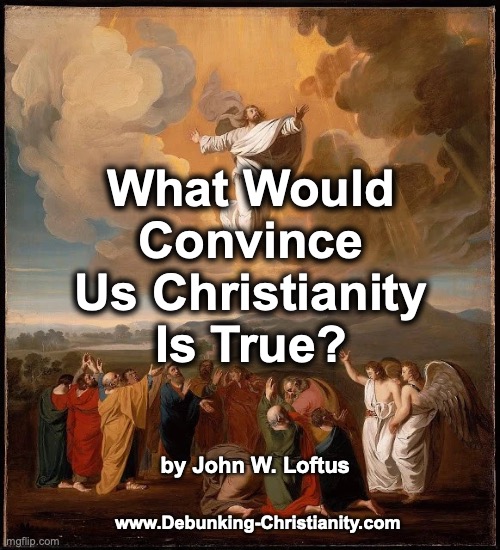
God’s Bad Habit of Oversleeping

Here’s the link to this article.

By David Madison, 04/14/23.

And the Christian bad habit of being OKAY with it

On Saturday, 10 June 1944—four days after the Allied landing at Normandy—the rural village of Oradour-sur-Glane, in Vichy occupied France, was surrounded by an SS Panzer division of German soldiers. They rounded up all of the residents, forced the men into barns and stables, the women and children into the church. Then, with machine guns and fire-bombs, they murdered all 643 of them: 462 women and children were killed in the church. The women had felt safe in the church, because, of course, that’s where God is paying the closest attention to those who worship him. So how could a caring, attentive, powerful, competent god have allowed this savagery to happen? “God is good, God is great, but since he works in mysterious ways, he allowed the German soldiers to do their job that day.” Such a response illustrates the all-too-common incoherence of Christian theology: it doesn’t make sense.

How to explain this god’s failure to act? These victims were in his church

Fast forward 52 years: One of the first shootings at a school to attract worldwide attention happened in Dunblane, Scotland, 13 March 1996. Sixteen kids and their teacher were killed. A few days later, among the many bouquets of flowers left outside the school, one included a Teddy Bear holding a message: “13 March 1996: the day God overslept.” Not: “…the day we realized there is no god,” or “…the day we found out that god too is dead…” 

Overslept actually made the point pretty well. There has been a meme floating around on Facebook for a while: “How did you sleep last night? Oh very well, thank you, just like God during the Holocaust.” 

Belief in the Christian god took a huge hit in western European countries in the wake of two world wars. The catastrophe of Oradour-sur-Glane no doubt contributed to this trend. There were devout folks who regarded the few Oradour survivors as “miracles of god,” but…

“This is not to say that the survival of certain individuals is seen in an unambiguously positive religious light. If anything, the fact that God permitted women and children to die in a church caused a crisis and even loss of faith among many believers who lived in Oradour.” (Sarah Farmer, Martyred Village: Commemorating the 1944 Massacre at Oradour-sur-Glane, p. 103) 

Louise Bardet was the mother of a schoolteacher who died in the church. She was interviewed in 1988, and was asked if she was a believer: “Oh, a little. But not like some you’ll find. But yes, at bottom I’m a believer. I’m Catholic, so to speak.” Did her faith help her cope with the death of her children? “No, I don’t think that it helped me. Because I really didn’t deserve that. Oh no, I don’t think that it helped me.” (Farmer, Martyred Village, p. 243)

Robert Pike’s book, Silent Village: Life and Death in Occupied France, includes many photos and profiles of those who lost their lives that day—and witness testimonies.

René Hyvernaud, a resident of Oradour who had escaped, described what he found the next day at the church:

“‘I was met with an horrific spectacle. Inside several meters from the main entrance, I saw the body of a woman laid out, completely unclothed. It looked as though her clothes had caught fire.’ Further into the church about 4 or 5m in, he saw a pile of bodies, around one and a half meters high and 2 to 3m in diameter. The whole thing was a reddish blaze from which smoke bellowed. You could still definitely make out the forms of bodies due to the skeletal structures. Other bodies, mainly children and half burnt, were strewn across the nave.’ He went further into the church where he saw two children both shot dead, legs intertwined. He wanted to separate them but he could not stand the thick smoke and the ‘nauseating odour which suffocated me.’ Before leaving he saw that ‘the floor of the sacristy had crumbled and that, below, fire was still blazing.’” (Robert Pike, Silent Village, p. 299) 

Another survivor, Aimé Faurgeras, made a discovery in the toilet behind the church: “At the back of one of the stalls Faugeras found the body of a baby, wrapped in its swaddling. The baby, a boy, had received mortal gunshot wounds.” (Pike, Silent Village, p. 309

The god worshipped at that church in Oradour-sur-Glane was the one derived from the Old Testament, and given a boost in the New Testament: a god who could be found above the clouds, able to spy on everyone, with a throne next to his own for Jesus. It is virtually impossible to reconcile this concept of god with what we now know about the Cosmos. There are hundreds of billions of galaxies, and trillions of stars with planets. No amount of theologizing—and, Oh how the apologists have tried! —enables us to accept that there is a god paying close attention to every planet and to every being on those planets. There are now eight billion humans on Earth: there’s a god monitoring each one of us? How can anyone make the case for this when 462 women and children were murdered in that village church? —where god should have been paying close attention. 

Events such as these should prompt theologians to just give it up

Maybe, on 10 June 1944, a god with billions of galaxies under management, was just too busy somewhere else, e.g. a few planets in the Andromeda Galaxy had collided, leaving a major mess to clean up. But that’s a lot to wrap our minds around. Let’s just accept that on 10 June 1944—as was the case on 13 March 1996—god overslept. God exists, but wasn’t paying attention. Perhaps this god isn’t even aware of what’s happening on the scattered cosmic debris that we call planets.

Apologists, in fact, must use the same excuses to account for other major lapses on god’s part. It can hardly escape notice that our brains are not perfectly, optimally designed—that is, for the pursuit of peace and love. The history of humanity is the story of ongoing warfare and barbarism. Aggression, territoriality, tribalism appear to be imbedded our brains. It was a delusional theologian who wrote Genesis 1:31: God saw everything that he had made, and indeed, it was very good.” 

Believers have a choice here: 

(1) Accept that god created man from the “dust of the ground” (Genesis 2:7), and did a pretty poor job of it, given what we know of the very dark side of human behavior. This wasn’t a matter of oversleeping. This was incompetence, which another theologian seems to admit in Genesis 6:5-6, i.e., the “very good” verdict didn’t hold up:

“Yahweh saw that the wickedness of humans was great in the earth and that every inclination of the thoughts of their hearts was only evil continually. And the Lord was sorry that he had made humans on the earth, and it grieved him to his heart.” Well, wasn’t it his own damn fault that he had created such an inferior product?     

(2) Accept that our brains are the result of evolution, which accounts for many of the flaws in our brains and bodies (see Abby Hafer’s book, The Not-So-Intelligent Designer: Why Evolution Explains the Human Body and Unintelligent Design Does Not). Some theists have accepted evolution as the “way god created life on earth,” but that doesn’t help much. Then god seems to have overslept over vast stretches of time: he wasn’t paying attention to the mess evolution was making of things, leaving humans endowed with aggression, territoriality, tribalism—and, by the way, mental illness, another grievous affliction that so often impacts our brains.

Our tribalism has wrought so much havoc. The countries that came to blows in World War I, e.g., England, France, Germany, Italy, the US, considered themselves Christian nations, worshipping Jesus as their lord and savior. But the leaders of these nations exploited love of country—tribalism—to rally their troops and citizenry to fight Christians in the enemy nations. So the Christian god just watched all this go on, with so much horrendous suffering for four years? Or maybe not: he overslept, or was caught up in business in other galaxies. The aggression and tribalism came out in extreme form on 10 June 1944 at Oradour. The brains of those who planned the operation and the brains of the soldiers—who did as they were told—were so badly damaged by biology, nationalism, tribalism, and propaganda.   

Another common attempt to exonerate god for so much evil and suffering is the claim that he gave us free will, so the fighting and wars are the fault of humans. But this really doesn’t work at all for a god who is supposedly supremely watchful, aware of what is happening to every human being, every minute of the day. Folks go to confession because their god knows what they’ve been up to. There have been countless times when god should have overridden/dismissed free will, because the evil about to happen was too horrible. Surely god especially can see that the free will excuse makes him look bad. Didn’t god have options?

[Essential reading on Free Will: the article that John Loftus published on this blog, 26 March 2023: “I Seek to Prove: Free Will Is Impossible and Immoral.” For so long we have heard the human Free Will argument to moderate god’s accountability for evil, but our choices are not what we think they are.]

It is a very common Christian belief that there are countless angels who help with the divine workload, and thousands of saints who have assigned tasks as well. The Catholic Church is sure that the Virgin Mary appears in visions throughout the world. God could have assigned her to intervene whenever and wherever a priest is about to rape a child. As soon as his pants are down, Mary could into pop into view to scream threats and painfully disable his genitals. If there is a god—especially one who ordains priests—how is it remotely conceivable that he doesn’t intervene when children are being harmed by his priests

And how is it remotely conceivable that this god couldn’t have found some way to rescue those women and children killed in the church on 10 June 1944? Couldn’t he have found a way to stop the Holocaust, to have softened Hitler’s heart in his savage hatred of Jews (the Bible tells us that he hardened the pharaoh’s heart), to have prevented the 2004 Indian Ocean tsunami that killed 225,000 people—including newborns and toddlers? 

“The massacre is, and in its own way and on a smaller scale, no less shocking than the Holocaust. The soldiers that came that day had no intention of leaving any survivors, so 643 people were killed, including 255 women and 207 children, locked in the church where some would still have been alive when the flames engulfed them. The remains were unrecognizable to family members who survived them…” (Pike, Silent Village, p. 342-343)

If you are a Christian who is okay with all of these horrors—because you’re confident, as the clergy have assured you—god must have his reasons, then you are worshipping a pathetically inept god. If you had been in that church, and god whispered in your ear, “I have my reasons for letting you die this horrible way,” would you have been okay with it? 

Oversleeping doesn’t begin to explain it. It’s an alternative to admitting that there is no god, or that god is dead. The absence of god(s) is the best explanation for the world of massive, horrendous suffering we see around us.

David Madison was a pastor in the Methodist Church for nine years, and has a PhD in Biblical Studies from Boston University. He is the author of two books, Ten Tough Problems in Christian Thought and Belief: a Minister-Turned-Atheist Shows Why You Should Ditch the Faith (2016; 2018 Foreword by John Loftus) and Ten Things Christians Wish Jesus Hadn’t Taught: And Other Reasons to Question His Words (2021). The Spanish translation of this book is also now available. 

His YouTube channel is here. He has written for the Debunking Christianity Blog since 2016.

The Cure-for-Christianity Library©, now with more than 500 titles, is here. A brief video explanation of the Library is here