
Here’s the link to this article.
 by ADAM LEE

Overview:
Keeping kids isolated from viewpoints you disagree with is a parenting strategy that never works. A better one is to teach them how to recognize propaganda and toxic memes when they see them.
Reading Time: 6 MINUTES
My son, going on seven years old, is boundlessly curious. That’s the natural state of childhood, and it’s one of the sublime joys of parenthood to nurture that curiosity and encourage it to grow.
He’s taken to reading on his own, and he wants to know about everything. He likes learning about animals and plants, space, mythology and religion, and world history. He’s also interested in American history, which my wife and I are trying to present in a nuanced way.
It was Flag Day this month, and his first-grade class did a lesson about it. When he came home, he wanted to learn more. I didn’t have any books on the subject, so I opened YouTube—which has its hazards, but can be an invaluable source of information—and searched for videos about Flag Day.
One of the top results was a video from PragerU Kids, a slick right-wing channel packed with jingoistic politics and regressive morality. The thumbnail caught his eye, but I kept scrolling past it.
I told him, “That one’s not good to watch. Let’s find something else.”
He insisted, “No, daddy, that one is fine! I watched it in school!”
Record scratch. Freeze frame.
My values, your propaganda
Admittedly, “propaganda” is a loaded term. Every story conveys values, implicitly or explicitly. No one calls a show propaganda when it has a moral they agree with.
A kids’ show like Hilda, which we watched together, uses magic and adventure to convey a powerful message about resisting the siren song of fear and xenophobia that empowers bigotry. Kids’ shows like Captain Planet (which I watched when I was my son’s age), or Wild Kratts (which he watches now), teach the importance of valuing nature and protecting the planet from despoilment. Mr. Rogers’ Neighborhood taught children about kindness and radical self-love (for which reason the modern right despises him).
Just the same way, the right has its own set of values. They teach their followers to believe in a cruel and angry god who will hurt them if they disobey orders or question what they’re told. They teach that men act one way and women act another way and it’s sinful and evil to step outside these rigid gender roles. They teach a simplistic version of history where America is always right and has never made any mistakes or committed any wrongs that need to be redressed.
PragerU, and its offshoot PragerU Kids, embody the latter set of values. Despite what the name suggests, it’s not a “university” in any sense. It doesn’t have classes, exams or professors, and it doesn’t grant degrees. It’s a media channel created by Dennis Prager, a right-wing political commentator. Prager is slightly unusual in that he’s Jewish rather than Christian, but in all other respects, he perfectly reflects the intolerant, anti-science, anti-rational outlook of the modern conservative movement.
Among other things, PragerU videos assert:
- that atheists have no good reason not to murder people, because if there is no god, all moral claims are mere opinion (even if God existed, why would his preferences not just be another opinion?);
- that creationism is true, using classic pseudoscience like the argument from design;
- that Islam is a bad religion because its sacred text contains endorsements of violence; but Judeo-Christian values are good because they created Western civilization, disregarding the enormous number of verses in the Bible that endorse violence and cruelty;
- that climate change is nothing to worry about, waving off the overwhelming consensus of scientists in favor of a few isolated cranks and oil-industry spokespeople;
- that fossil fuels are good because cheap energy increases life expectancy (focusing only on the benefits, while ignoring the downsides)—and that renewable energy is bad because the raw materials have to be mined, which causes environmental damage (focusing only on the downsides, while ignoring the benefits). This is as clear an example of a double standard as you’ll ever see.
PragerU Kids teaches the same ideas, except it uses cartoons and animation aimed at children. One of the most disgusting examples is their video about Christopher Columbus, which argues that we should continue to celebrate Columbus Day, notwithstanding the horrendous atrocities that Columbus committed:
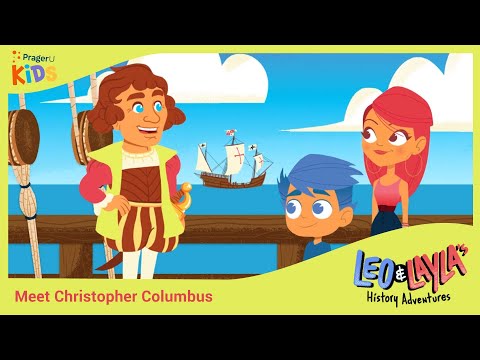
Although PragerU would never call it that, this video is an endorsement of moral relativism. It argues that we can’t condemn Columbus because it’s wrong to judge the past by the standards of the present. But if they believe that, how can they simultaneously argue that he’s deserving of a holiday in his honor?
Either we can pass judgment on figures of the past, or we can’t. If we can’t, then we can’t say anything positive or negative about them. If we can, then we can judge them worthy of condemnation, just as we can judge them worthy of fame. As with their renewable-energy videos or their Islam-versus-the-Bible videos, PragerU concocts a double standard to get to the conclusion they decided on in advance.
What is PragerU doing in public school?
So, as you can imagine, I was alarmed to hear that my son had watched a PragerU video in his public school classroom.
I didn’t think his teacher was engaged in a sinister plot to indoctrinate students. On the contrary, I was pretty sure it was an innocent mistake by a teacher who was looking for educational content, just as I was, and who didn’t realize the source of the material she found.
PragerU’s channel is designed to encourage this kind of confusion. Many of its videos aren’t political at all. They’re ordinary tutorials on topics like how to make a pinata, or how insurance works. The explicitly political videos are hidden among them like tigers lurking in tall grass.
To be sure, PragerU is clear enough about its agenda if you know what to look for. For example, its website denounces “[w]oke agendas… infiltrating classrooms, culture, and social media” and proudly declares itself to be the answer to “all the propaganda that the state is mandating be taught.” In its YouTube video descriptions, the channel says that they’re “protecting [kids] from leftist indoctrination occurring in schools”. But if you’re not on the lookout for these giveaways, they’re easy to miss.
The Flag Day video is in an intermediate category. It’s not explicitly political like the Columbus video, but it is implicitly political. It’s a fundamentally conservative view of American history: one-sided, purely laudatory, and strictly backward-looking. It praises the courage and sacrifice of the revolutionaries, hails the wisdom of the founders, and cheers for America because it won the space race and planted a flag on the Moon. It closes by encouraging kids to always love, respect and salute the flag.
There’s nothing in this video you could point to that’s false. However, it promotes an uncritical, rah-rah view of history that contradicts the nuanced, thoughtful perspective I want to raise my son with.
How would I have done it differently? Obviously, I wouldn’t expect a Flag Day video aimed at kids to recount evils like slavery or Native American genocide. However, if I had written the script, I would have featured people who fought to make America better, like Susan B. Anthony or Martin Luther King, Jr. I would have made sure to say that symbols like the flag or the Statue of Liberty represent ideals which America is still trying to live up to, and that every generation has an opportunity to help make the nation better and to uphold the promise of liberty and justice for all.
You’ve got to catapult the propaganda
Innocent mistake or not, I couldn’t let this pass. I didn’t want my son’s class, or another class, seeing more of these videos. So I wrote the teacher a letter—a polite one!—explaining what PragerU is and making some of the same points I’ve made here. I said that I didn’t blame her, but wanted to make her aware that the channel isn’t neutral educational content. It has a disguised political agenda that’s inappropriate for public schools serving children of diverse backgrounds.
The teacher wrote back, saying that she had reviewed the video beforehand but didn’t review the entire channel, and thanked me for bringing it to her notice. That was what I expected. Hopefully, she’ll share this so all the teachers at that school will be forewarned.
However, there was one more thing I had to do.
I’m not a Christian fundamentalist homeschooler. I’m not trying to keep my son ignorant of everything I disagree with. I’d rather teach him to recognize propaganda and learn how to spot and deconstruct the assumptions it smuggles in. That way, when he encounters these ideas out in the world, he’ll be able to identify them for what they are and reject them without my help.
To that end, we watched the PragerU Flag Day video again, together. We talked about what this channel wants kids to think, and how it conflicts with ideas we’ve already taught him about, like protests and civil disobedience. We talked about people who take a knee at the flag instead of saluting it, why they do that, and why that makes other people angry.
I hope and trust that we’ve equipped my son to think for himself the next time he encounters disguised propaganda. And there will be a next time, because this stuff is insidious. The propaganda mills that crank it out are everywhere, and they try their best to seem aspirational, cool or innocuous.
If we nonbelievers and progressives don’t raise our kids right, we’re leaving them vulnerable. Teaching them critical thinking early on is essential. It’s like an intellectual vaccination, giving them a defense against all the toxic memes in the wilderness of the world.
Postscript: These two videos from Big Joel’s YouTube channel were a helpful resource: PragerU for Kids: The Worst Propaganda and PragerU for Kids: A Horrible YouTube Channel. They both informed the letter I sent to my son’s school.

 Richard L. Fricks