Tag: Bart Ehrman

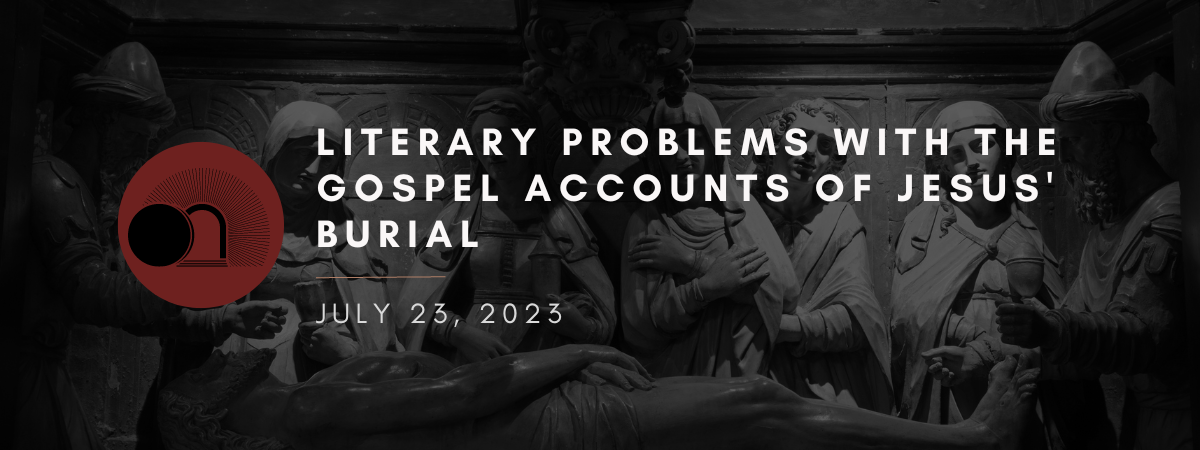
Literary Problems with the Gospel Accounts of Jesus’ Burial
Here’s the link to this article by Bart Ehrman.
July 23, 2023
Here is a section from my book How Jesus Became God (HarperOne, 2014) that deals with the question of whether Jesus was actually given a decent burial by Joseph of Arimathea. At this point of my discussion I am not looking into the question of whether it is plausible that Jesus would be buried on the day of his execution given what we know from other historical sources, about Roman practices, but at general problems with the reporting in the Gospels.
******************************
According to our earliest account, the Gospel of Mark, Jesus was buried by a previously unnamed and unknown figure, Joseph of Arimathea, “a respected member of the council” (Mark 15:43) – that is, a Jewish aristocrat who belonged to the Sanhedrin, which was the ruling body made up of “chief priests, elders, and scribes” (Mark 14:53). According to Mark 15:43, Joseph summoned up his courage and asked Pilate for Jesus’ body. When Pilate learned that Jesus was already dead, he granted Joseph his wish, and he took the body from cross, wrapped it in a linen shroud, “laid him in a tomb which had been hewn out of the rock,” and then rolled a stone in front of it (15:44-47). Mary Magdalene and another woman named Mary saw where this happened (15:48).
Let me stress that all of this – or something very much like it – needs to happen within Mark’s narrative in order to make sense of what happens next, namely that on the day after the Sabbath Mary Magdalene and two other women come to the tomb and find it empty. If there were no tomb for Jesus, or if no one knew where the tomb was, the bodily resurrection could not viably be proclaimed. You have to have a known tomb.
But was there one? Did Joseph of Arimathea really bury Jesus?
General Considerations
There are numerous reasons for doubting the tradition of Jesus’ burial by Joseph. For one thing, it is hard to make historical sense of this tradition just within the context of Mark’s own narrative. Joseph’s identification as a respected member of the Sanhedrin should immediately raise questions. Mark himself indicated that at Jesus’ trial, which took place the previous evening, the “whole council” of the Sanhedrin (not just some or most of them – all of them) tried to find evidence “against Jesus to put him to death” (14:55). At the end of this trial, because of Jesus’ statement that he was the Son of God (14:62), “they all condemned him as deserving death.” In other words, according to Mark himself, this unknown person, Joseph, was one of the people who had called for Jesus’ death just the night before he was crucified. Why now is he suddenly risking himself (as implied by the fact that he had to gather up his courage) and seeking to do an act of mercy by arranging for a decent burial for Jesus’ corpse? Mark gives us no clue.[1] My hunch is that the trial narrative is from a different set of traditions inherited by Mark from the burial narrative. Or did Mark simply invent one of the two traditions himself and overlook the apparent discrepancy?
In any event, a burial by Joseph is clearly a historical problem in light of other passages just within the New Testament. I pointed out earlier [in my book, How Jesus Became God] that Paul shows no evidence of knowing anything about a Joseph of Arimathea or a decent burial of Jesus by a “respected member of the council.” This datum was not included in the very early creed that Paul quotes in 1 Cor. 15:3-5, and if the author of that creed had known such a thing, he surely would have included it, since without naming the person who buried Jesus he has created an imbalance with the second portion of the creed where he does name the person to whom Jesus appeared (Cephas). Thus this early creed knows nothing about Joseph. And Paul himself betrays no knowledge of him.
Moreover, there is another tradition of Jesus’ burial that says nothing about Joseph of Arimathea. As I pointed out earlier, the book of Acts was written by the same author as the Gospel of Luke. When writing Luke, this unknown author (we obviously call him Luke, but we don’t know who he really was) utilized a number of earlier written and oral sources for his stories, as he himself indicates (Luke 1:1-4). Scholars today are convinced that one of his sources was the Gospel of Mark, and so Luke includes the story of Joseph of Arimathea in his version of Jesus’ death and resurrection.
When Luke wrote his second volume, the book of Acts, he had yet other sources available to him. Acts is not about the life, death, and resurrection of Jesus, but about the spread of the Christian church throughout the Roman empire afterward. About one-fourth of the book of Acts consists of speeches made by its main characters, mainly Peter and Paul; speeches, for example, to convert people to believe in Jesus or to instruct those who already believe. Scholars have long recognized that Luke himself wrote these speeches – they are not the speeches that these apostles really delivered at one time or another. Luke is writing decades after the events he narrates, and there was no one at the time who was taking notes. Ancient historians as a whole made up the speeches of their main characters, as such a stalwart historian as the Greek Thucydides explicitly tells us (Peloponnesian War 1.22.1-2). They had little choice.
When Luke composed his speeches, however, it appears that he did so, in part, on the basis of earlier sources that had come down to him — just as his accounts of Jesus’ teachings in the Gospel came from earlier sources (such as Mark). But if different traditions (speeches, for example) come from different sources, there is no guarantee that they will stand in complete harmony with one another. If they do not stand in harmony, it is almost always because someone is changing the stories or making something up .
That makes Paul’s speech in Acts 13 very interesting. Paul is speaking in a synagogue service in Antioch of Pisidia, and he uses the occasion to tell them that the Jewish leaders in Jerusalem had sinned severely against God by having Jesus killed:
Though they could charge him with nothing deserving death, yet they asked Pilate to have him killed. And when they had fulfilled all that was written of him, they took him down from the tree and laid him in a tomb. (Acts 13:28-29)
At first glance this appears to harmonize with what the Gospels say about Jesus’ death and burial, but not on closer examination. For here it is not a single member of the Sanhedrin who buries Jesus, but the council as a whole. This is a different tradition. There is no word of Joseph here, any more than there is in Paul’s own letters. Does this older (pre-Lukan) tradition represent an older tradition than what is found in Mark about Joseph of Arimathea? Is the oldest surviving burial tradition that Jesus was buried by a group of Jews?
It would make sense that this was the older tradition of the two. Any tradition that is going to lead up to an empty tomb simply has to show that Jesus was properly buried, in a tomb. But who could do the burial? According to all the traditions, Jesus did not have any family in Jerusalem, and so there was no possibility of a family tomb in which to lay him or family members to do the requisite work of burial. Moreover, the accounts consistently report that his followers had all fled the scene, so they could not do the job. The Romans were not about to do it, for reasons that will become clear in later in this chapter. That leaves only one choice. If the followers of Jesus knew that he “had” to be buried in a tomb – since otherwise there could be no story about the tomb being empty — and they had to invent a story that described this burial, then the only ones who could possibly do the deed were the Jewish authorities themselves. And so that is the oldest tradition we have, as embodied in Acts 13:29. Possibly this is the tradition that lies behind 1 Cor. 15:4 as well: “and he was buried.”
As the tradition came to be told and retold, it possibly became embellished and made more concrete. Storytellers were apt to add details to stories that previously were vague. There was a very long-lived tradition to put names on people otherwise left nameless in the tradition, and to add named individuals to stories that originally spoke only of nameless individuals or undifferentiated groups of people. This is a tradition that lived on long after the New Testament period, as my own teacher Bruce Metzger showed so elegantly in a brilliant article that he called “Names for the Nameless.”[2] Here he showed all the traditions of people who were unnamed in New Testament stories receiving names later – for example, we get names of the wise men in later traditions, and names of the priests serving on the Sanhedrin when they condemned Jesus, and names of the two robbers who were crucified with him. In the story of Joseph of Arimathea we may have an early instance of the phenomenon: what was originally a vague statement that the unnamed Jewish leaders buried him becomes a story of one leader in particular, who is named, doing so.

In addition, we have clear evidence in the Gospel traditions that as time went on, and stories were embellished, there was a tendency to find “good guys” among the “bad guys” of the stories. For example, in Mark’s Gospel both the criminals being crucified with Jesus malign and mock him on the cross; in Luke’s later Gospel only one of the two does so, and the other confesses faith in Jesus and asks him to remember him when he comes into his kingdom (Luke 22:39-43). In John’s Gospel there is an additional good guy among the Sanhedrin bad guys who wants to help in Jesus’ burial, as Nicodemus accompanies Joseph to do his duties to Jesus’ corpse (John 19:38-42). Most notable is Pontius Pilate, who condemned Jesus to death in our earliest Gospel Mark, but does so only with great reluctance in Matthew, and only after explicitly declaring Jesus innocent three times in both Luke and John; in later Gospels from outside the New Testament Pilate is portrayed as increasingly innocent, to the point that he actually converts and becomes a believer in Jesus.
In part this ongoing and increasing exoneration of Pilate is enacted in order to show where the real guilt for Jesus’ undeserved death lies. For these authors living long after the fact, the guilt lies with the recalcitrant Jews. But the pattern is also part of process of trying to find someone good in the barrel of rotten opponents of Jesus. Naming Joseph of Arimathea as a kind of secret admirer or respecter or even follower of Jesus may be part of the same process.
In addition to the rather general considerations I have just given for calling into question the idea that Jesus received a decent burial by Joseph of Arimathea, there are three more specific reasons for doubting the tradition that Jesus received a decent burial at all, in a tomb that could later be recognized as emptied.
[1] For someone who wants to take the account as historical, the best solution is that Joseph was acting out of a sense of piety, wanting to provide a decent burial for someone – even an enemy – because that was the “right” thing to do. But there is nothing in Mark’s account that leads to this suggestion, so that within the narrative itself, when the burial tradition comes on the heels of the trial tradition, it appears to create an anomaly.
[2]Metzger, Bruce, “Names for the Nameless in the New Testament: A Study in the Growth of Christian Tradition,” in Patrick Granfield & Josef A. Jungmann (eds.), Kyriakon: Festschrift Johannes Quasten, 2 vols. (Münster: Verlag Aschendorff, 1970) vol. 1: 79-99.
Announcing a NEW (Free!) Course: Why I Am Not A Christian
Here’s the link to this article (and free offer) by Bart Ehrman.
July 10, 2023
I am happy to announce that I will be doing a new course, Why I Am Not a Christian: How Leaving the Faith Led to a Life of More Meaning and Purpose. I explain it all below, but as spoilers: it is July 23, it will involve four talks and a Q&A, and it is free. You can sign up for it at bartehrman.com/lifeafterfaith
The course will be unlike any other I have given in any context. It will indeed cover major issues involving the New Testament, early Christianity, and the formation of the Christian religion. But it will also be deeply personal and autobiographical. I became a scholar because of my Christian faith; then my Christian faith changed because of my scholarship. My “quest for truth” led me to evangelical Christianity; and then – as I grew, matured, learned, and reflected – it led me to away from the Christian faith.
In this course of lectures I explain how it all happened and discuss what the results were – for my scholarship, my understanding of Jesus, the New Testament and early Christianity. But also for me personally, on the social, emotional and professional level.
The course consists of four 40-45 minute talks, to be followed by a long question and answer period. I will be covering topics I have never lectured on or written about and tell stories I have never publicly shared.
My goal will not be to deconvert or convert anyone. It will be to discuss the problems of the Christian faith as I came to see them through a serious and sustained engagement. I will explain why, in the end, these problems led me to to leave the faith and how my move into agnosticism/atheism created emotional struggles and personal turmoil. But I will also explain why, in the end, my move away from faith led me to a happier, more satisfied, and more meaningful life.
No one’s life is like any other’s. Each of us has to make decisions about what to think, what to believe, and how to live. My view is that these decisions should be made thoughtfully, not unreflectively. “The unexamined life is not worth living” (Socrates, in Plato’s Apology). I came to embrace that view already as a committed evangelical, and it ended up leading me in directions I never expected. My hope is not that this course will convince others to end up where I did, but it is to encourage others to follow a similar path, thoughtfully, honestly, and earnestly pursuing the questions of what to believe and how to live, to find a life of meaning and purpose.
My courses are not directly connected to the blog, even though, of course, I always inform blog members of them (you can see a list at bartehrman.com. Normally there is a ticket fee, but this one is a freebie. If you’re interested, go to http://bartehrman.com/lifeafterfaith
If you know of others who might be interested in such a course, please tell them about it.
Here is a summary of the lectures I’m planning to give.
Lecture One: My Escape from Fundamentalism: Reading the Bible Again for the First Time
When I was “born again” at the age of fifteen, I moved from a nominal / lukewarm faith to hard-core Christianity. Overnight I became committed to the inerrancy of the Bible and everything it teaches. But I also wanted to “follow the truth wherever it leads.” What happens when, after years of post-conversion study, a devout but open-minded person comes to realize the Bible contains contradictions, discrepancies, historical mistakes, and a range of other errors? Is it best to hope the problems will simply all go away? If not, is it possible to rethink what it means to believe without leaving the faith?
In graduate school I felt compelled to change my views about the Bible and some of the major religious beliefs based on it. Not everyone goes that route. In this lecture I discuss why I moved away from a conservative evangelical form of belief to one I thought was more intellectually respectable and honest.
Lecture Two: My Leaving the Faith: Going Where the “Truth” Leads You
A surprising number of people in our world today think that anyone who does not “believe the Bible literally” cannot be a Christian. Historically that is just non-sense. Indeed, most historical scholars of the Bible today recognize its many problems and yet remain committed believers. I was one of them for many years.
But I came to realize that there are even more serious challenges to the Christian faith than the inerrancy of Scripture. The ultimate issue is the existence of God himself: no God, no Christianity. During my years as s a conservative Christian I could (and often did) recite numerous “proofs” for God. Later, as a liberal Christian I didn’t think God was susceptible of proof like a linear equation or law of physics. Like so much else of human life, faith wasn’t based on math or science.
Even so, after a number of years, my faith in God began to crumble. I came to think there was no divine being in and over this world. Very few of my many biblical-scholar friends went that route or, to this day, agree with me. But I felt I had (and have) no choice. In this lecture I explain why.
Lecture Three: The Traumas of Deconversion: Emotional, Social, and Eschatological (Think: Fears of Afterlife!)
Christian faith is far, far more than a set of beliefs about God, Christ, sin, salvation, the nature of the world, the Bible, and so on. Like so many other committed Christians, in my church years I was surrounded by an all-embracing web of Christian significance and meaning deeply affecting my family life, friendships, social activities, morality, personal motivations, decisions about how to live, emotions, and on and on. Leaving the faith can affect nearly every part of a person’s life. Could it could possibly be worth it?
In addition, there was a very serious religious issue. The fear of hell had long been driven into me. What if I left the faith and it turned out I was simply wrong. Was I in danger of eternal torment?
In short, becoming an agnostic/atheist was a frightening prospect for me and at first I wasn’t sure if was worth it. When I made the leap, though, I quickly realized it was, despite the long term emotional and personal turmoil. In this lecture I explain why.
Lecture Four: Is There Life After Faith? What Agnosticism/Atheism Means for Well-Being, Happiness, and a Meaningful Existence.
Can there be any purpose and meaning in life if there is no God? Most believers say the answer is absolutely no. Some atheists agree, even as they struggle on with their lives. For me that was the greatest fear while questioning my faith, before leaving it.
Would I have any reason to be concerned about the lives of others and not just about myself? My entire ethical existence had always been tied up in this view — Christ wants us to love others. But what would happen when I no longer believed Christ was the son of God, let alone that there was any God at all? Would I have any guidance at all for my life? Would I be cast to the winds with no moral compass? Would my life be random anarchy?
More than that, how could there be any meaning in a world without God? If we are merely material creatures “in a material world,” with no divinely given purpose or destination, how can we have any goals, hopes, and ultimate aspirations? How can there be any meaning at all?
On the personal level, would I become completely apathetic? A sensual cretin? A nihilist? Would I live in angst and deep despair?
Once I became an agnostic/atheist, I realized all these fears were completely groundless. I actually came to appreciate and enjoy life more, to find deeper meaning in this brief existence, and to be even more concerned for the lives and well-being of others. I am more happy and content. How does that work? In this lecture I try to explain.
If We Can Know the “Gist” of What Jesus Said and Did … What’s the Gist?
Here’s the link to this article by Bart Ehrman.
June 10, 2023
I’m going to be discussing soon some of the things that appear to be “misremembered” about Jesus in our early sources, but first it’s important to emphasize some of the hugely critical positive things about memory – like, that most of the time we get it basically right. Depending, of course, on what “basically” means!
Here’s how I discuss the matter in Jesus Before the Gospels (HarperOne, 2016).
*******************
Remembering the Gist?
Let me make a point that may not be clear from what I have said so far about the psychology of memory. In stressing the fact – which appears to be a fact – that memories are always constructed and therefore prone to error, even when they are quite vivid, I am not, I am decidedly not, saying that all of our memories are faulty or wrong. Most of the time we remember pretty well, at least in broad outline. Presumably, so too did eyewitnesses to the life of Jesus. As did the person who heard a story from an eyewitness may well have remembered in broad outline he was told. And the person who heard a story from a neighbor whose cousin was married to a man whose father told him a story that he heard from a business associate whose wife once knew someone who was married to an eyewitness. Probably in the latter case – which, as far-fetched as it sounds, may be pretty close to how most people were hearing stories about Jesus – a lot more would have been changed than in the case of an eyewitness telling someone the day after he saw something happen. But my basic point here is that despite the faults of memory, we do obviously remember a lot of things, and the fundamental memories themselves can often be right.
This is a commonplace in the psychological study of memory. We tend to remember the “gist” of an experience pretty well, even if the details get messed up. You may not remember correctly (despite what you think) where, when, with whom, or how you heard about the Challenger explosion, or the results of the O. J. Simpson trial, or even (this is harder to believe, but it appears to be true) the attacks of 9/11. But you do remember that you heard about the events, and you remember that they happened.
As we will see, this is an important point, because there are gist memories of Jesus recorded in the New Testament Gospels that are almost certainly accurate. At the same time, there are a lot of details – and in fact entire episodes – that are almost certainly not accurate. These are “memories” of things that didn’t actually happen. They are distorted memories.
Still, many of the broad outlines that are narrated in the Gospels certainly happen. Much of the gist is correct. One big question, then, is just how broad does a memory have to be in order to be considered a gist memory? Different scholars may have different views about that.
John Dean as a Test Case
A famous example can demonstrate my point. There is a much cited study done of both detailed and gist memories of a person who claimed to have, and was generally conceded to have, a very good memory: John Dean, White House Counsel to Richard Nixon from July 1970 to April 1973.
During the Watergate hearings Dean testified in detail about dozens of specific conversations he had during the White House cover up. In the course of the hearings he was asked how he could possibly remember such things. He claimed to have a good memory in general. But he also indicated that he had used later newspaper clippings about events in the White House to refresh his memory and to place himself back in the context of the events that were described. It was after he publicly described his conversations with Nixon that the White House tapes were discovered. With this new evidence of what was actually said on each occasion, one could look carefully at what Dean had earlier remembered as having been said, to see if he recalled both the gist and the details correctly.
That’s exactly what the previously mentioned Ulric Neisser did, in an intriguing article called “John Dean’s Memory: A Case Study.” Neissser examined two specific conversations that took place in the Oval office, one on September 15, 1972 and the other on March 21, 1973, by comparing the transcript of Dean’s testimony with the actual recording of the conversation. The findings were striking.[1] Even when he was not elevating his own role and position (as he did), Dean got things wrong. Lots of things wrong. Even big things.
For example, the hearing that involved the September 15 conversation occurred nine months later. The contrast between what Dean claimed was said and what really was said was sharp and striking. In Neisser’s words:
Comparison with the transcript shows that hardly a word of Dean’s account is true. Nixon did not say any of the things attributed to him here…. Nor had Dean himself said the things he later describes himself as saying…. His account is plausible but entirely incorrect…. Dean cannot be said to have reported the ‘gist’ of the opening remarks; no count of idea units or comparison of structure would produce a score much above zero.[2]
It should be stressed the Neisser does not think Dean was lying about what happened in the conversation in order to make himself look good: the conversation that really happened and the one he described as happening were both highly incriminating. So why is there a difference between what he said was said and what was really said? Neisser argues that it is all about “filling in the gaps,” the problem I mentioned earlier with respect to F. C. Bartlett. Dean was pulling from different parts of his brain the traces of what had occurred on the occasion and his mind, unconsciously, filled in the gaps. Thus, he “remembered” what was said when he walked into the Oval Office based on the kinds of things that typically were said when he walked into the Oval Office. In fact, whereas they may have been said on other occasions, they weren’t on this one. Or he might have recalled how his conversations with Nixon typically began and thought that that was the case here as well, even though it was not. Moreover, almost certainly, whether intentionally or sub-consciously, he was doing what all of us do a lot of the time: he was inflating his own role in and position in the conversation: “What his testimony really describes is not the September 15 meeting itself but his fantasy of it: the meeting as it should have been, so to speak…. By June, this fantasy had become the way Dean remembered the meeting.”[3]
Neisser sums up his findings like this: “It is clear that Dean’s account of the opening of the September 15 conversation is wrong both as to the words used and their gist. Moreover, cross examination did not reveal his errors as clearly as one might have hoped….. Dean came across as a man who has a good memory for gist with an occasional literal word stuck in, like a raisin in a pudding. He was not such a man.”[4]
And so, whether Dean had a decent gist memory probably depends on how broadly one defines “gist.” He knew he had a conversation with Nixon. He knew what the topics were. Nonetheless, he appears not to have known what was actually said, either by Nixon or himself.
In this instance we are talking about an extraordinarily intelligent and educated man with a fine memory, trying to recall conversations from nine months before. What would happen if we were dealing with more ordinary people with average memories, trying to recall what someone said maybe two years ago? Or twenty? Or forty? Try it for yourself: pick a conversation that you had two years ago with someone – a teacher, a pastor, a boss. Do you remember it word for word? Even if you think you do (sometimes we think we do!) is there any actual evidence that you do? It is important to emphasize what experts have actually learned about memory, and distorted memories. Leading memory expert Elizabeth Loftus and her colleague Katherine Ketcham reflect on this issue: “Are we aware of our mind’s distortions of our past experiences? In most cases, the answer is no. As time goes by and the memories gradually change, we become convinced that we saw or said or did what we remember.”[5]
These comments are dealing with just our own personal memories. What about a report, by someone else, of a conversation that a third person had, written long afterwards? What are the chances that it will be accurate, word for word? Or even better, what about a report written by someone who had heard about the conversation from someone who was friends with a man whose brother’s wife had a cousin who happened to be there – a report written, say, several decades after the fact? Is it likely to record the exact words? In fact, is it likely to remember precisely even the gist? Or the topics?
Jesus’ Sermon on the Mount in Matthew chapters 5-7 was recorded about fifty years after he would have delivered the sermon. But can we assume he delivered it? If he did so, did he speak the specific words now found in the Sermon (all three chapters of them) while sitting on a mountain addressing the crowds? On that occasion did he really say, “Blessed are the poor in spirit, for theirs is the Kingdom of Heaven,” and “Beware of false prophets, who come to you in sheep’s clothing but inwardly are ravenous wolves,” and “Everyone who hears these words of mind and does them will be like a wise man who built his house on a rock”? Or did he say things sort of like that on the occasion? Or did he say something sort of like that on some other occasion – any occasion at all? Which is the gist and which is the detail?[6]
Or what about episodes from Jesus’ life, recorded, say, forty years later? Was Jesus crucified between two robbers who both mocked him before he died six hours later? Are those details correct? Or is the gist correct? But what is the gist? Is it that Jesus was crucified with two robbers? Is it that Jesus was crucified? Is it that Jesus died?
[1] Ulric Neisser, “John Dean’s Memory: A Case Study,” Cognition 9 (1981) 1-22.
[2] “John Dean’s Memory,” p. 9. Italics his.
[3] “John Dean’s Memory,” p. 10
[4] “John Dean’s Memory,” p. 13.
[5] Elizaeth Loftus and Katherine Ketcham, Witness for the Defense: The Accused, the eyewitness, and the Expert who Puts Memory on Trial (New York: St. Martin’s Press, 1991), p. 20.
[6] See my discussion of the sermon on pp. xxx.
Eyewitness Testimony: The Importance of Actual Expertise
Here’s the link to this article by Bart Ehrman.
June 7, 2023
It is flat-out amazing to me how many New Testament scholars talk about the importance of eyewitness testimony to the life of Jesus without having read a single piece of scholarship on what experts know about eyewitness testimony. Some (well-known) scholars in recent years have written entire books on the topic, basing their views on an exceedingly paltry amount of research into the matter. Quite astounding, really. But they appear to have gone into their work confident that they know about how eyewitness testimony works, and didn’t read the masses of scholarship that shows they simply aren’t right about it.
Here’s how I begin to talk about eyewitness scholarship in my book Jesus Before the Gospels (HarperOne, 2016).
******************************
In the history of memory studies an important event occurred in 1902.[1] In Berlin, a well-known criminologist named von Liszt was delivering a lecture when an argument broke out. One student stood up and shouted that he wanted to show how the topic was related to Christian ethics. Another got up and yelled that he would not put up with that. The first one replied that he had been insulted. A fight ensued and a gun was drawn. Prof. Liszt tried to separate the two when the gun went off.
The rest of the students were aghast. But Prof. von Liszt informed them that the event had been staged.
He chose a group of the students to write down an exact account of what they had just seen. The next day, other students were instructed to write down what they recalled, others a week later. The results of these written reports were surprising and eye-opening. This was one of the first empirical studies of eyewitness testimony.
Prof. Liszt broke down the sequence of events, which had been carefully planned in advance, into a number of stages. He then calculated how accurately the students reported the sequence, step-by-step. The most accurate accounts were in error in 26% of the details the reported. Others were in error in as many as 80%.
As you might expect, research on the reliability of eyewitness testimony has developed significantly over the years since this first rather crude attempt to establish whether it can be trusted to be reliable. Scholarship in the field has avalanched in recent decades. But the findings are consistent in one particularly important respect. A report is not necessarily accurate because it is delivered by an eyewitness. On the contrary, eyewitnesses are notoriously inaccurate.
There have been many books written about whether the Gospels were written by eyewitnesses or by authors relying on eyewitnesses. Some of these books are written by very smart people. It is very odd indeed that many of them do not appear to be particularly concerned with knowing what experts have told us about eyewitness testimony.[2]
This chapter is focused on two questions. Are the Gospels based on stories about Jesus that had been passed around, changed, and possibly invented by Christian storytellers for decades before being written down, or were they written by eyewitnesses? If they were written by eyewitnesses , would that guarantee their essential accuracy? We will deal with the second question first.
Research on Eyewitness Testimony
Psychological studies of eyewitness testimony began to proliferate in the 1980s, in part because of two important phenomena related to criminal investigations. The first is that people started recalling ugly, painful, and criminal instances of sexual abuse when they were children.[3] These recollections typically surfaced during the process of therapy, especially under hypnosis. Both those who suddenly remembered these instances and the therapists treating them often maintained that these repressed memories explained why the patients had experienced subsequent psychological damage. Some of these reports involved incest committed by relatives, especially parents; others involved abuse by other adults, for example in child care centers. As reports of such memories began to proliferate, some psychologists started to wonder if they could all be true. Some were obviously real memories of real events. But was it possible that others were not true memories at all, but false memories that had been unconsciously implanted during the process of therapy? It turns out that the answer is a resounding yes, which creates enormous complexities and problems for all parties: the victim or alleged victim, the therapist, the accused adults, and the judges and juries of the legal system.
The other phenomenon involved the use of DNA evidence to overturn criminal convictions. Once DNA became a reliable indicator of an accused person’s direct involvement in serious crimes, such as murder or rape, a large number of previous convictions were brought back for reconsideration. Numerous convictions were overturned. As Harvard psychologist Daniel Schacter has recently indicated, in about 75% of these reversed judgments, the person charged with the crime was convicted solely on the basis of eyewitness testimony.[4] What is one to make of such findings? In the words of a seminal article in the field: “Reports by eyewitnesses are among the most important types of evidence in criminal as well as in civil law cases… It is therefore disturbing that such testimony is often inaccurate or even entirely wrong.”[5]
This particular indictment emerged out of a study unrelated to DNA evidence. It involves an interesting but tragic case. On October 4, 1992, an El Al Boeing 707 that had just taken off from Schipfol Airport in Amsterdam lost power in two engines. The pilot tried to return to the airport but couldn’t make it. The plane crashed into an eleven-story apartment building in the Amsterdam suburb of Bijlmermeer. The four crew members and thirty-nine people in the building were killed. The crash was, understandably, the leading news story in the Netherlands for days.
Ten months later, in August 1993, Dutch psychology professor Hans Crombag and two colleagues gave a survey to 193 university professors, staff, and students in the country. Among the questions was the following: “Did you see the television film of the moment the plane hit the apartment building?” In their responses 107 of those surveyed (55%) said Yes, they had seen the film. Sometime later the researchers gave a similar survey with the same question to 93 law school students. In this instance, 62 (66%) of the respondents indicated that they had seen the film. There was just one problem. There was no film.
These striking results obviously puzzled the researchers, in part because basic common sense should have told anyone that there could not have been a film. Remember, this is 1992, before cell phone cameras. The only way to have a film of the event would have been for a television camera crew to have trained a camera on this particular apartment building in a suburb of Amsterdam at this exact time, in expectation of an imminent crash. And yet, between half and two-thirds of the people surveyed – most of them graduate students and professors – indicated they had seen the non-existent film. Why would they think they had seen something that didn’t exist?
Even more puzzling were the detailed answers that some of those interviewed said about what they actually saw on the film, for example, whether the plane crashed into the building horizontally or at vertical and whether the fire caused by the plane started at impact or only later. None of that information could have been known from a film, because there was no film. So why did these people remember, not only seeing the crash but also details about how it happened and what happened immediately afterward?
Obviously they were imagining it, based on logical inferences (the fire must have started right away) and on what they had been told by others (the plane crashed into the building as it was heading straight down). The psychologists argued that these people’s imaginations became so vivid, and were repeated so many times, that they eventually did not realize they were imagining something. They thought they were remembering it. They really thought that. In fact they did remember it. But it was a false memory. Not just a false memory one of them had. A false memory most of them had.
The researchers concluded: “It is difficult for us to distinguish between what we have actually witnessed, and what common sense inference tells us that must also have been the case.” In fact, commonsense inference, along with information we get by hearsay from others, together “conspire in distorting an eyewitness’s memory.” Indeed “this is particularly easy when, as in our studies, the event is of a highly dramatic nature, which almost by necessity evokes strong and detailed visual imagery.”[6]
The witnesses to the life of Jesus certainly were recalling events “of a highly dramatic nature” – Jesus’ walking on the water, calming the storm with a word, casting out a demon, raising a young girl back to life. Moreover, these stories certainly evoked “strong and detailed visual imagery.” Even if such stories were told by eyewitnesses, could we trust that they were necessarily accurate memories?
[1] This episode is recounted in Elizabeth F. Loftus, Eyewitness Testimony, 2nd ed. (Cambridge, MA: Harvard University, 1996) pp. 20-21.
[2] The best known and very large study is Richard Bauckham, Jesus and the Eyewitnesses: The Gospels as Eyewitness Testimony (Grand Rapids: Eerdmans, 2006).
[3] See Richard J. McNally, Remembering Trauma (Cambridge, Mass: Harvard University Press, 2003).
[4] Daniel L. Schacter, “Constructive Memory: Past and Future,” Dialogues in Clinical Neuroscience 14 (2012) 7-18.
[5] Hans F. M. Crombag, Willem A. Wagenaar, Peter J. Van Koppen, “Crashing Memories and the Problem of ‘Source Monitoring,’” Applied Cognitive Psychology 1 (1996) p. 95.
[6] “Crashing Memories,” p. 103.
Creation Stories of the Ancient World (Part 2): An Ancient Egyptian Account
May 11, 2023
Was the account of creation found in Genesis comparable to (or even borrowed from?) other ancient accounts in scattered throughout the world at the time?
Last month my colleague Joseph Lam, an expert in the Hebrew Bible and the languages and literature of the Ancient Near East provided us with a guest post about some of the creation stories found outside Scripture in non-Israelite cultures — stories in circulation before the ones written in Genesis (https://ehrmanblog.org/creation-stories-of-the-ancient-world-part-1-on-enuma-elish-and-genesis-1-guest-post-by-joseph-lam/)
Here now is a second and equally interesting post dealing with stories from ancient Memphis Egypt (not Tennessee!)!
This is the topic of his lecture course for the Great Courses/Wondrium, “Creation Stories of the Ancient World” (links at bottom)
****************************
In my last blog entry, I offered a brief description of the Babylonian Creation Epic, Enuma Elish, and reflected on how one might imagine its relationship to the seven-day creation story of Genesis 1. In this post, I turn to an enigmatic but fascinating text from ancient Egypt known as the Memphite Theology that has also been compared with Genesis 1, though in this case I would argue that no direct connection exists between the two texts. Instead, what we see in the Memphite Theology is an alternative expression of the idea of a supreme and intentional creator deity that is reminiscent of (and roughly contemporaneous with) Genesis 1.
The text of the Memphite Theology is preserved on a rectangular stone slab now known as the Shabako Stone, named for the Egyptian Pharaoh Shabako under whom the text was promulgated in approximately 710 BCE. The stone was subsequently converted for use as a lower millstone, which effaced a significant portion of the writing (see the British Museum photo here: https://www.britishmuseum.org/collection/object/Y_EA498). Nonetheless, the portions that remain reveal an idiosyncratic picture of creation centering on a god named Ptah, a deity associated with the city of Memphis (hence the “Memphite Theology”), one that departs from a dominant understanding of creation in ancient Egypt associated with another ancient city, Heliopolis. In fact, there is evidence to suggest that the Memphite Theology was written precisely to supplant the earlier traditional understandings. The following passage from near the beginning of the text is revealing (translation here taken from Miriam Lichtheim, Ancient Egyptian Literature, vol. I):
“This writing was copied out anew by his majesty in the House of his father Ptah-South-of-his-Wall, for his majesty found it to be a work of the ancestors which was worm-eaten, so that it could not be understood from beginning to end. His majesty copied it anew so that it became better than it had been before…”
What we have here is a trope that is found with some regularity in the ancient world—that of the “discovery” or “recovery” of an even more ancient text as a way of conferring legitimacy to what was in fact a new literary creation from the writer’s own time. (The most famous example of this is the “discovery” of the Book of the Law in the time of the biblical king Josiah in 2 Kings 22, which is widely regarded by scholars as representing the context of the promulgation of the Book of Deuteronomy.) Applying this assumption to the Memphite Theology helps to explain its contents, because the primary focus of the text is the exaltation of the god Ptah over an earlier creator deity named Atum (of the tradition of Heliopolis) by re-envisioning Atum and the other gods as proceeding from Ptah himself. This tendency can be observed in the following key passage (again, based on Lichtheim’s translation):
“There took shape in the heart, there took shape on the tongue the form of Atum. For the very great one is Ptah, who gave life to all the gods and their kas through this heart and through this tongue, in which Horus had taken shape as Ptah, in which Thoth had taken shape as Ptah…. Sight, hearing, breathing—they report to the heart, and it makes every understanding come forth. As to the tongue, it repeats what the heart has devised. Thus all the gods were born and his Ennead was completed.”
Although some of the language in this passage is obscure, it is clear that the god Ptah is at the top of the divine hierarchy that the text envisions. Ptah is “the very great one,” the one who gives life to all the other gods, and important gods such as Atum, Horus, and Thoth are all subordinated to Ptah in different ways. Since Atum is, in the Heliopolis tradition, the original creator deity and the one who gives birth to the other members of the core group of nine deities (the “Ennead”), to subordinate Atum to Ptah is to elevate Ptah to the primary role.
What is also notable about this passage, and what makes it distinctive among the conceptions of creation we encounter in ancient Egypt, is the manner in which these primordial acts of creation are described. The “heart” and the “tongue” of Ptah are both crucial in this process, with the heart being the ultimate source (“they report to the heart… as to the tongue, it repeats what the heart has devised”). While the interpretation of this language is difficult, I would take the heart to represent the seat of the will or of intention, an idea that is characteristic of many ancient forms of understanding. While today we tend to associate emotions with the heart, in ancient cultures the heart encompasses faculties that we would attribute to the brain, such as thinking, deciding, and desiring. As for the tongue, I would take that to symbolize speech as an expression of an act of thought or intention. Thus, what we have is a fascinating conception of creation as a sort of mental act of Ptah with multiple stages: the heart devises, the tongue speaks it forth, and the result is various manifestations in the form of the gods and, in fact, all things. This idea is elaborated further in the text:
“Thus all the faculties were made and all the qualities determined, they that make all foods and all provisions, through this word… Thus all labor, all crafts are made, the action of the hands, the motion of the legs, the movements of all the limbs, according to this command which is devised by the heart and comes forth on the tongue and creates the performance of every thing.”
This passage applies this heart-tongue concept to the creation of a range of other elements in the world—from food, to crafts, to bodily movement, to all things. While it’s difficult to pinpoint exactly why these elements are mentioned and not others, it does suggest that the heart’s devising leading to creative speech is envisioned in this text as a fundamental means by which the world comes into being.
In light of these passages in the Memphite Theology, the parallels to Genesis 1 are evident in that the biblical creation in seven days also takes place by means of a creator deity speaking the elements of the world into existence. One should note that in Genesis, explicit language about the “heart” or other descriptions of intention (before the act) are missing, though God does “see” the things that are created and subsequently declares them to be “good.” But the underlying conceptions of the creative process in the two texts, insofar as they both reside in the will of a specific creator god, are similar enough to warrant describing them as expressions of a common tendency emerging in the middle of the first millennium BCE.
In these two short blog posts, I have discussed two creation texts, one from Mesopotamia and one from Egypt, that in different ways illuminate the background to the creation narrative in Genesis 1. While these posts have been brief, I hope I have managed to illustrate the compelling nature of the numerous creation stories we possess from the ancient Near East. If you are interested in learning more, see my course for Wondrium/The Great Courses:
Wondrium link: https://www.wondrium.com/creation-stories-of-the-ancient-world
The Great Courses link: https://www.thegreatcourses.com/courses/creation-stories-of-the-ancient-world
Was Matthew Attacking Paul?
Here’s the link to this article by Bart Ehrman, May 9, 2023.
On my podcast this past week (Misquoting Jesus with Bart Ehrman) someone asked me if I thought any of the Gospels of the NT were influenced by Paul. It’s an interesting question that I should post on (my view: Mark, maybe; Luke, unexpectedly and oddly not; John, I doubt it; Matthew?)
Ah, Matthew. As it turns out, I think Matthew shows a rather obvious and ironic connection with Paul. Did he know Paul’s writings? I have no idea. Did he know about Paul? Same, no idea. Did he oppose a major feature of Paul’s gospel message? Sure looks like it!! (I’m trying to say that he could be opposed to Paul’s views without necessarily knowing Paul’s writings; the views may have been more widely spread than just by Paul. In fact, they almost certainly were.
Here’s how I’ve discussed the matter once when I was reflecting at greater length in the issue:
Paul certainly had opponents in his lifetime: “Judaizers,” as scholars call them — that is, Christian teachers who maintained that followers of Jesus had to follow the Jewish Law: Men were to be circumcised to join the people of God; men and women were, evidently, to adopt a Jewish lifestyle. Presumably that meant keeping kosher, observing the Sabbath, and so on. Anyone who didn’t do this was not really a member of the people of God, since to be one of God’s people meant following the law that God had given.
In Paul’s letter to the Galatians in particular he shows that he was thoroughly incensed at this interpretation of the faith and insisted with extraordinary vehemence that it was completely wrong. The gentile followers of Jesus were not, *absolutely* not, supposed to become Jewish. Anyone who thought so rendered the death of Jesus worthless. It was only that death, and the resurrection, that made a person right with God. Nothing else. Certainly not following the Torah.
I really don’t see how Paul and the author of the Gospel of Matthew could have gotten along.
Some background: Matthew’s Gospel was probably written about thirty years after Paul wrote his letter to the Galatians; Galatians is usually dated to the mid 50s, Matthew to around 80-85 CE. We don’t know who the author of Matthew was, apart from the fact that he was obviously a highly educated Greek-speaking Christian living outside of Palestine. His book is often located to Antioch Syria, but in my view that is simply a guess based on flimsy evidence. Still, it certainly *may* have been written Antioch, a city with a large Jewish population and a burgeoning Christian church.
Matthew, like the other Gospel writers, did not produce his account simply out of antiquarian interests, to inform his readers what happened 55 years earlier in the days of Jesus. His is not a disinterested biography or an objective history. It is a “Gospel.” In other words, it is intended to proclaim the “good news” about Jesus and the salvation that he brings. When Jesus teaches something in this Gospel, Matthew expects that the teaching will be relevant to his readers, that they will want to do what Jesus says.
There is no doubt that Matthew would agree with Paul that it was the death and resurrection of Jesus that brought salvation to the world. The Gospel is not *entirely* about Jesus’ death and resurrection. But it is largely about that. It is 28 chapters long, and the last 8 chapters are focused exclusively on what happened during the last week of Jesus’ life in Jerusalem, including the crucifixion and resurrection. This is clearly the climax of the story. And for Matthew, as for his predecessor Mark, the death of Jesus is seen as “a ransom for many” (Matt. 20:28). It is through his death that he “will save his people from their sins” (Matt. 1:21).
So Matthew would agree with Paul there. But so would Paul’s Judaizing opponents in Galatia. The controversy with the Galatian opposition was not over whether Jesus’ death brings salvation. It was over whether the followers of Jesus, who accept that death, need to keep the Jewish law. And it does seem to me that this is where Paul and Matthew split company. Again, remember that when Matthew decides what to present about Jesus’ life in the Gospel it is not simply so that people can know “what really happened” in the past. It is so that the life and teachings of Jesus can direct the lives of his followers in the present.
And what does Jesus say about the Jewish law in Matthew? He says that his followers have to keep it. One of the key passages is something that you will NEVER find in the writings of Paul.
Do not suppose that I came to destroy the law or the prophets. I came not to destroy but to fulfil. For truly I say to you, until heaven and earth pass away not one iota or one stroke of a letter will pass away from the law until all is fulfilled. And so, whoever looses one of the least of these commandments and teaches others in this way will be called least in the kingdom of God, but whoever does and teaches the law will be called great in the kingdom of heaven. For I say to you that if your righteousness does not exceed that of the scribes and Pharisees, you will not enter into the kingdom of heaven. (Matt 5:17-20).
This is a really interesting passage. Does it contradict Paul that the followers of Jesus were *not* to keep the law? It certainly seems to.
Now someone *could* say that here Jesus is saying simply that the entire law has to be in effect until he dies (“until all is fulfilled”). But Jesus is saying more than that. His followers must do and teach the law. None of it will pass away until the world is destroyed (“till heaven and earth pass away”). Again, Matthew is not saying this so his readers will have a good history lesson about the Savior of the world and what he taught his disciples. He is including this passage for the same reason he includes all his passages, to teach his readers how they are to believe and live. Jesus in this passage does *not* say, “Keep the law until I die.” He says he did not come to destroy the law. It is still in effect. And will be as long as the earth lasts. His followers have to keep it.
After this Jesus launches into his “antitheses,” where he indicates what the law says and explains its fuller, deeper meaning. The law says don’t kill; to fulfill it you should not engage someone with wrath. The law says not to take someone’s spouse; to fulfill it you should not want to do so. The law says to make punishments fit the crimes (an eye for an eye a tooth for a tooth; not a head for an eye or a body for a tooth); to fulfill it you should show extreme mercy and not punish another for harm done to you. And so on.
I think that Matthew’s Jesus really meant what he says (NOTE: I’m talking about Jesus as he is portrayed in Matthew, NOT about Jesus’ own historical views). He gives no hint that following the law this closely is impossible to do. He seems to think it is possible. God gave a law. You should follow it. Scrupulously. Even more scrupulously than the righteous scribes and Pharisees. If you don’t, you will not enter the kingdom of heaven.
That’s a tall order. And in my judgment it seems very much opposed to Paul’s views, who insists that *his* readers not think that they must follow the law. Pretty big difference. In fact, Paul says anyone is cursed who disagrees with his view of the matter (Gal. 1: 6-9). Surely Matthew disagreed.
“Death is nothing to us.” What Do YOU Think?
Here’s the link to this article by Bart Ehrman.
April 27, 2023
I quote:
“You need to realize that death is nothing to us. Everything that is good and bad in our lives comes from the experiences of our senses. But death brings an end to our senses/experiences. And so having the right understanding – that death is nothing to us – makes our mortality enjoyable, not because we will live forever but because we don’t pointlessly long to live forever. For there are no terrors in life for the one who fully understands that there are no terrors in not living.
It is absurd for people who fear death — not because it is afflicting them now but because they expect it will be horrible when it comes. For this allegedly most awful thing – death — is actually nothing to us: when we exist, we are not dead, but when we are dead, we no longer exist. And so death is completely irrelevant – both to those who are living and to those who are dead. Those who are living are not experiencing it and those who are dead no longer exist.”
These are not my words – just my idiomatic translation of the words of the Greek philosopher Epicurus, in his letter to an unknown person named Menoecus (taken from Diogenes Laertius, Lives of Eminent Philosophers). Epicurus has had a millenia-long bad reputation as a complete “hedonist.” But almost all his bad reputation is ill-deserved. He was a great philosopher with a view of life and how to live it that has a LOT to commend it. In fact, it is a view that many of us have today, based on scientific views that are analogous to those most of us share (VERY different as well, since he was living, well, 2300 years ago!).
Short story: Epicurus believed that people’s false religious views cause completely unnecessary psychological trauma and pain, and that life could be very much enjoyed apart from superstition and fear of death.
Here I’ll give his views in a nutshell:
- The world was not created by divine beings but is made up of atoms that are tiny, indivisible particles that combine in various ways, and we are all – rocks, plants, animals, humans, gods – made up of them. The atoms come together for a time and will disperse and recombine again later in various ways.
- As indicated, the gods too made up of particles and are the height of perfection, completely undisturbed and at rest – and have Zero involvement with us. They are what they are, existing in perfection and peace. (Epicurus lived in a polytheistic world; almost no one was an “atheist” in our sense. So naturally he assumed there were gods. But he was accused of being an atheist because he maintained the gods had nothing to do with us and we have absolutely nothing to fear from the gods.)
- Life is a gift and life is short. It’s not a gift *from* someone/something. It’s just something we’re incredibly lucky to have. And we won’t have it for long. So we should enjoy it.
- The goal of life is therefore enjoyment, for as long as we can.
- That means we should strive for “pleasure.” This is especially where Epicurus got into hot water with other philosophers.
- The Greek word for pleasure is hēdon, from which we get our world “hedonism.” Our modern use of the term, though, conjures up the wrong idea, at least with respect to Epricurus. Our view of a “hedonist” is someone who strives for all the physical pleasure that can be found – drinking bouts, endless orgies, drugs, careless and carefree riotous living that is completely self-centered, uncaring, reckless, anti-social, and harmful to self and others.
- That’s the opposite of what Epicurus meant. He explicitly and vehemently argues *against* that kind of lifestyle — precisely because it is indeed harmful to self and others. How can a lifestyle that leads to serious additions, depression, and isolation be “good”? That kind of life strives to resist a meaningful existence. It is strictly to be avoided.
- What then is “pleasure”? For one thing, it is the fulfilling richness that can come from knowing what is good for you and meaningful. That involves simple pleasures of friends, interesting and meaningful discussions, reading, thinking, trying to understand the world and life and our place in it, enjoying meals together, and relishing the time we have for as long as we have it and realizing we won’t have it forever and don’t need to have it forever.
- Above all, a life of pleasure is a life without pain. We should take good care of ourselves, treat ourselves well, and not put ourselves in positions of threat and danger. We should do our best to avoid bodily pain. And – in Epicurus’s view – when we do experience pain we should realize that most pains are endurable and do not need to affect our mental states if we have the right attitudes toward them; moreover, pains that seem unendurable do not last long (again, that’s just his view).
- The same applies to mental anguish and pains, which are often worse than physical.
- Because we are made up of atoms that will return whence they came, there is no life after death. Our souls disperse with our bodies. It is absurd to feel anguish about death. It will come whatever our fears are, and when it comes, we will have no fear. We won’t suffer. We won’t regret dying, we won’t be upset, we won’t be terrified, we certainly won’t feel any pain. We won’t have any bodies. We won’t have any minds. Our atoms have dispersed. We won’t exist any more.
- So there is nothing to fear or even regrate. That’s how it should be. It’s how nature works. Fearing that it will happen makes no sense. We won’t mind when it does happen, so why should we mind before it does? There won’t be any pain or anguish then, so why should we feel pain and anguish about a future of no pain and anguish?
- Death is nothing to us.
So, those are the views of Epicurus in a nutshell. I’ve long been attracted to them. I’m interested in your thoughts. What do you think?
Biblical Prophecy and the Coming Destruction of the Dome of the Rock
Here’s the link to this article. Here’s the link to the first article concerning this subject.
March 30, 2023
I continue here my post from yesterday, explaining the Christian background to U.S. Support of Israel, taken from my recently-published book Armageddon: What the Bible Really Says About the End
******************************
It is important to stress that evangelicals think God is faithful to Israel even if Jews are not faithful to God. He has fulfilled and will continue to fulfill his promises that Israel will have the Promised Land. But Jews who reject his messiah cannot possibly be saved. That is not God’s fault. He is not the one who broke the eternal covenant. Jews did when they rejected their own messiah. Therefore, they will be punished.
To evangelical readers that is clear from the book of Revelation, which describes “the End” as standing in straight continuity with and in fulfillment of “the Beginning.” As we have seen, according to Revelation, the only inhabitants of the earth who will be saved are those who refuse the mark of the beast and instead receive the seal of God. In Revelation 7 the two groups of these divinely sealed saints are discussed. The larger group is “a great multitude that no one could count, from every nation, from all tribes and peoples and languages” (Revelation 7:9). These are explicitly not the people of one nation (such as Israel); they are from around the world, everyone made pure because “they have washed their robes and made them white in the blood of the Lamb” (Revelation 7:14). The other group is smaller, but still sizeable: 144,000 Jews who receive the “seal of God” on their head and so become “slaves of God” – twelve thousand “people of Israel” from each of the twelve tribes (7:4-8).
Thus, God is faithful to the end. A large, symbolic number of Jews will be saved by converting to become slaves of God through their faith in Jesus. But the number is not only significantly large; it is also significantly small. Think about the global population of Jews. Even at the time John was writing, there were nearly four million Jews in the world. He would certainly not have known this exact number, but even so: if 144,000 are saved, that would be only 4% of just the Roman world. Evangelical Christians, as one would expect, take this too to be a fulfillment of Scripture, where God repeatedly says that salvation will come to only a remnant of Israel (Romans 9:27-28).
Why Israel Must Rebuild the Temple
Thus, for evangelical thinkers the entire arc of the biblical narrative from beginning to end shows that prophecies are being fulfilled in our own day. But there’s more to it than that. Ezekiel indicated that the Temple in Jerusalem had to be rebuilt. That hasn’t happened yet. It has to happen before Jesus can return. The clearest indication comes not in Ezekiel but in a seemingly obscure passage in the New Testament book of 2 Thessalonians, which I’ll discuss in greater detail shortly: Israel not only has to exist as a sovereign state in the Promised Land, it also has to have full control of Jerusalem and, in particular, the Temple Mount. The problem, of course, is that that the Temple Mount is a sacred site for Islam as well, home to the Dome of the Rock for the past thirteen centuries. The Dome is located over the site of the original Jerusalem Temple. For the prediction of 2 Thessalonians to be fulfilled, the Temple needs to be rebuilt there, which means the Dome has to go.
It has long been debated whether Paul was the author of 2 Thessalonians; many historical scholars think the book was written by a later Christian in Paul’s name.[1] Whoever wrote it, the book tries to explain to readers that the end of the age will not come right away, nor will it happen without warning (contrary to what Paul himself says in First Thessalonians, 4:13-5:11). A fore-ordained sequence of events must happen first. The events involve a mysterious figure, “the lawless one,” who will rise to a position of power. This figure is often identified by readers as the “Antichrist” and the “beast” of Revelation (666), even though he is not called either in the passage:
Let no one deceive you in any way; for that day [the “coming of our Lord Jesus Christ”] will not come unless the rebellion comes first and the lawless one is revealed, the one destined for destruction. He opposes and exalts himself above every so-called god or object of worship, so that he takes his seat in the temple of God, declaring himself to be God. (2 Thess. 2:3-4)
The author then indicates that this figure cannot appear yet because a restraining force is keeping him at bay (2:6). When that is removed, “the lawless one will be revealed, whom the Lord Jesus will destroy with the breath of his mouth, annihilating him by the manifestation of his coming” (2:8). That sounds very much like the Final Battle between Christ and the Beast as described in Revelation 19:17-20.
What matters most, though, is that before this destruction takes place, the Antichrist figure will take “his seat in the temple of God,” declaring himself to be God. That obviously cannot happen until the temple is rebuilt. Jesus therefore cannot return until Israel assume full control of the Temple Mount. There can be no question, then, about whether or not to support Israel to expand its reach into the Palestinian territories; that was what was promised Abraham “in the beginning.” And there can be no question about whether or not to support Israel in the heart of Jerusalem itself. It must destroy the Dome of the Rock and rebuilt the temple for foreordained “the end” to come.
Since American Christians who support Israeli control of Jerusalem far outnumber American Jews, it is no wonder that Israeli politicians have long pushed for evangelical support, starting in the 70’s at just the time the evangelical prophecy movement reached a fevered pitch – when Hal Lindsey, Jack van Impe, and Timothy LaHaye were all preaching that the end was almost here. For these modern-day prophets, one piece left in the puzzle remains: the temple has to be rebuilt and Israel cannot face the opposition alone.
This is not a marginal religious belief held by a tiny slice of American Christendom. It is held by millions, all of them able and encouraged to vote. And this is far from the only way that a belief in an imminent apocalypse influences our government.
[1] See Bart Ehrman, Forged: Writing in the Name of God – Why the Bible’s Authors Are Not Who We Think They Are (San Francisco: HarperOne, 2011) pp. 19-21, 105-08.
Making Sense Podcast Episode 313: Apocalypse, A Conversation with Bart D. Ehrman
Here’s the link to this episode on Sam Harris’ website.
Here’s the link on Spotify.
MARCH 25, 2023
Sam Harris speaks with Bart D. Ehrman about the prophecies contained in the book of Revelation. They discuss his latest book, Armageddon, and widespread Christian beliefs about the coming end of the world.
Bart D. Ehrman is a leading authority on the New Testament and the history of early Christianity and a Distinguished Professor of Religious Studies at the University of North Carolina at Chapel Hill. The author of six New York Times bestsellers, he has written or edited more than thirty books, including Misquoting Jesus, How Jesus Became God, The Triumph of Christianity, and Heaven and Hell. Ehrman has also created nine popular audio and video courses for The Great Courses. His books have been translated into twenty-seven languages, with over two million copies and courses sold. Website: https://ehrmanblog.org/Twitter: @BartEhrman
 Richard L. Fricks