Creative Magic and What Makes a Great Writer: Joseph Conrad’s Beautiful Tribute to Henry James

I encourage you read these powerful, awe-inspiring words from Maria Popova’s wonderful collection, Timeless Advice on Writing: The Collected Wisdom of Great Writers.

Here is the link to today’s article.

“All creative art is magic, is evocation of the unseen in forms persuasive, enlightening, familiar and surprising, for the edification of mankind.”

BY MARIA POPOVA

Creative Magic and What Makes a Great Writer: Joseph Conrad’s Beautiful Tribute to Henry James

In 1905, six years after the release of Heart of DarknessJoseph Conrad (December 3, 1857–August 3, 1924) penned a beautiful essay titled “Henry James: An Appreciation,” eventually included in Conrad’s thoroughly terrific collection Notes on Life and Letters (public library | free download). In addition to being one of the loveliest homages in literary history, on par with Thomas Mann’s tribute to Hermann Hesse, teenage James Joyce’s beautiful letter to Ibsen, and Dostoyevsky’s remembrance of George Sand, the essay — a celebration of James as a writer who “keeps a firm hold of the substance, of what is worth having, of what is worth holding” — is perhaps the most direct distillation of Conrad’s views on writing and what makes a great writer.

josephconrad

Conrad writes:

After some twenty years of attentive acquaintance with Mr. Henry James’s work, it grows into absolute conviction which, all personal feeling apart, brings a sense of happiness into one’s artistic existence. If gratitude, as someone defined it, is a lively sense of favours to come, it becomes very easy to be grateful to [Henry James]. The favours are sure to come; the spring of that benevolence will never run dry. The stream of inspiration flows brimful in a predetermined direction, unaffected by the periods of drought, untroubled in its clearness by the storms of the land of letters, without languor or violence in its force, never running back upon itself, opening new visions at every turn of its course through that richly inhabited country its fertility has created for our delectation, for our judgment, for our exploring. It is, in fact, a magic spring.

Conrad then corrects himself, noting that James’s body of work — as all great writing — is best compared to “a majestic river,” and contributes a magnificent definition of art:

All creative art is magic, is evocation of the unseen in forms persuasive, enlightening, familiar and surprising, for the edification of mankind, pinned down by the conditions of its existence to the earnest consideration of the most insignificant tides of reality.

Action in its essence, the creative art of a writer of fiction may be compared to rescue work carried out in darkness against cross gusts of wind swaying the action of a great multitude. It is rescue work, this snatching of vanishing phases of turbulence, disguised in fair words, out of the native obscurity into a light where the struggling forms may be seen, seized upon, endowed with the only possible form of permanence in this world of relative values — the permanence of memory. And the multitude feels it obscurely too; since the demand of the individual to the artist is, in effect, the cry, “Take me out of myself!” meaning really, out of my perishable activity into the light of imperishable consciousness. But everything is relative, and the light of consciousness is only enduring, merely the most enduring of the things of this earth, imperishable only as against the short-lived work of our industrious hands.

Art by Matt Kish for his illustrated edition of Heart of Darkness
Art by Matt Kish for his illustrated edition of Heart of Darkness

But however much the activity of the artist may elevate the multitude — however much it may, in the unforgettable words of William Faulkner, “help man endure by lifting his heart” — the artist, Conrad argues, doesn’t create out of selfless heroism but out of the sheer inevitability of the creative impulse:

The artist in his calling of interpreter creates (the clearest form of demonstration) because he must. He is so much of a voice that, for him, silence is like death; and the postulate was, that there is a group alive, clustered on his threshold to watch the last flicker of light on a black sky, to hear the last word uttered in the stilled workshop of the earth.

And yet whatever the interior stimulus of the artist, in its external effect art ultimately bolsters humanity’s heroism in the face of life’s perishableness:

It is safe to affirm that, if anybody, it will be the imaginative man who would be moved to speak on the eve of that day without to-morrow — whether in austere exhortation or in a phrase of sardonic comment, who can guess?

For my own part, from a short and cursory acquaintance with my kind, I am inclined to think that the last utterance will formulate, strange as it may appear, some hope now to us utterly inconceivable. For mankind is delightful in its pride, its assurance, and its indomitable tenacity. It will sleep on the battlefield among its own dead, in the manner of an army having won a barren victory. It will not know when it is beaten. And perhaps it is right in that quality. The victories are not, perhaps, so barren as it may appear from a purely strategical, utilitarian point of view.

The artist’s task, Conrad suggests, is to remind us of the larger plentitude as we stand amid the barren battlefield:

The earth itself has grown smaller in the course of ages. But in every sphere of human perplexities and emotions, there are more greatnesses than one — not counting here the greatness of the artist himself. Wherever he stands, at the beginning or the end of things, a man has to sacrifice his gods to his passions, or his passions to his gods. That is the problem, great enough, in all truth, if approached in the spirit of sincerity and knowledge.

He turns to the role of fiction, singular among the arts in how it orients us toward the truth of existence:

Fiction is history, human history, or it is nothing. But it is also more than that; it stands on firmer ground, being based on the reality of forms and the observation of social phenomena, whereas history is based on documents, and the reading of print and handwriting — on second-hand impression. Thus fiction is nearer truth. But let that pass. A historian may be an artist too, and a novelist is a historian, the preserver, the keeper, the expounder, of human experience.

Pointing to Henry James a a supreme “historian of fine consciences,” Conrad adds:

The range of a fine conscience covers more good and evil than the range of conscience which may be called, roughly, not fine; a conscience, less troubled by the nice discrimination of shades of conduct. A fine conscience is more concerned with essentials; its triumphs are more perfect, if less profitable, in a worldly sense. There is, in short, more truth in its working for a historian to detect and to show. It is a thing of infinite complication and suggestion.

Conrad observes of the great writer, that “historian of fine consciences”:

There are no secrets left within his range. He has disclosed them as they should be disclosed — that is, beautifully. And, indeed, ugliness has but little place in this world of his creation. Yet, it is always felt in the truthfulness of his art; it is there, it surrounds the scene, it presses close upon it. It is made visible, tangible, in the struggles, in the contacts of the fine consciences, in their perplexities, in the sophism of their mistakes. For a fine conscience is naturally a virtuous one. What is natural about it is just its fineness, an abiding sense of the intangible, ever-present, right. It is most visible in their ultimate triumph, in their emergence from miracle, through an energetic act of renunciation. Energetic, not violent: the distinction is wide, enormous, like that between substance and shadow.

Conrad’s wholly wonderful Notes on Life and Letters is available as a free download. Complement it with E.E. Cummings on what it really means to be an artist and Flannery O’Connor on art, integrity, and the artist’s responsibility to his or her talent, then revisit this growing collection of great writers’ advice on the craft.

Poet Jane Kenyon’s Advice on Writing: Some of the Wisest Words to Create and Live By

I encourage you read these powerful, awe-inspiring words from Maria Popova’s wonderful collection, Timeless Advice on Writing: The Collected Wisdom of Great Writers.

Here is the link to today’s article.

“Be a good steward of your gifts.”

BY MARIA POPOVA

In Still Writing: The Pleasures and Perils of a Creative Life — one of the finest, most insightful reflections on the creative experience ever committed to words — writer Dani Shapiro mentions a set of instructions by the poet Jane Kenyon (May 23, 1947–April 22, 1995), a writing mantra of sorts, which she keeps tacked above her desk.

Literature being the original internet, I followed this analog hyperlink to Kenyon’s A Hundred White Daffodils: Essays, Interviews, The Akhmatova Translations, Newspaper Columns, and One Poem (public library) — an altogether marvelous posthumous collection.

These uncommonly sage instructions appear in a piece titled Everything I Know About Writing Poetry — Kenyon’s notes for a lecture she delivered at a literary conference in 1991, a superb addition to this growing compendium of writers’ advice on the craft. Although her advice is aimed at poets, at its heart is tremendous wisdom that applies to every field of creative endeavor and can electrify any artist. Spoken with the unpretentious honesty of her own experience as a working poet with decades of trial and triumph under her belt, Kenyon’s counsel comes as an offering of love:

Tell the whole truth. Don’t be lazy, don’t be afraid. Close the critic out when you are drafting something new. Take chances in the interest of clarity of emotion.

Illustration by Kris Di Giacomo from Enormous Smallness by Matthew Burgess, a picture-book biography of E.E. Cummings

The closing passage — the one tacked above Shapiro’s desk — contains some of the most ennobling tenets for a human being to live by:

Be a good steward of your gifts. Protect your time. Feed your inner life. Avoid too much noise. Read good books, have good sentences in your ears. Be by yourself as often as you can. Walk. Take the phone off the hook. Work regular hours.

Complement this particular portion of the wholly wonderful A Hundred White Daffodils with psychoanalyst Adam Phillips on the vitality of “fertile solitude,” Thoreau on the spiritual rewards of walking, and Mary Ruefle on the nourishment of good books, then revisit Shapiro’s indispensable memoir of the writing life.

The Value of Not Understanding Everything: Grace Paley’s Advice to Aspiring Writers

I encourage you read these powerful, awe-inspiring words from Maria Popova’s wonderful collection, Timeless Advice on Writing: The Collected Wisdom of Great Writers.

Here is the link to today’s article.

“Luckily for art, life is difficult, hard to understand, useless, and mysterious.”

BY MARIA POPOVA

“As a person she is tolerant and easygoing, as a user of words, merciless,” the editors of The Paris Review wrote in the introduction to their 1992 interview with poet, short story writer, educator, and activist Grace Paley (December 11, 1922–August 22, 2007). Although Paley herself never graduated from college, she went on to become one of the most beloved and influential teachers of writing — both formally, through her professorships at Sarah Lawrence, Columbia, Syracuse University, and City College of New York, and informally, through her insightful lectures, interviews, essays, and reviews. The best of those are collected in Just As I Thought (public library) — a magnificent anthology of Paley’s nonfiction, which cumulatively presents a sort of oblique autobiography of the celebrated writer.

Grace Paley

In one of the most stimulating pieces in the volume — a lecture from the mid-1960s titled “The Value of Not Understanding Everything,” which does for writing what Thoreau did for the spirit in his beautiful meditation on the value of “useful ignorance” — Paley examines the single most fruitful disposition for great writing:

The difference between writers and critics is that in order to function in their trade, writers must live in the world, and critics, to survive in the world, must live in literature. That’s why writers in their own work need have nothing to do with criticism, no matter on what level.

[…]

What the writer is interested in is life, life as he is nearly living it… Some people have to live first and write later, like Proust. More writers are like Yeats, who was always being tempted from his craft of verse, but not seriously enough to cut down on production.

Therein, she argues, lies the key to why writers write. Echoing Joan Didion — “Had I been blessed with even limited access to my own mind there would have been no reason to write,” she wryly observed in the classic Why I Write — Paley reflects:

One of the reasons writers are so much more interested in life than others who just go on living all the time is that what the writer doesn’t understand the first thing about is just what he acts like such a specialist about — and that is life. And the reason he writes is to explain it all to himself, and the less he understands to begin with, the more he probably writes. And he takes his ununderstanding, whatever it is — the face of wealth, the collapse of his father’s pride, the misuses of love, hopeless poverty — he simply never gets over it. He’s like an idealist who marries nearly the same woman over and over. He tries to write with different names and faces, using different professions and labors, other forms to travel the shortest distance to the way things really are.

In other words, the poor writer — presumably in an intellectual profession — really oughtn’t to know what he’s talking about.

Illustration by Kris Di Giacomo from ‘Enormous Smallness’ by Matthew Burgess, a picture-book biography of E.E. Cummings. Click image for more.

With a skeptical eye to the familiar “write what you know” dictum of creative writing classes, Paley makes a case for the opposite approach in extracting the juiciest raw material for great writing:

I would suggest something different… what are some of the things you don’t understand at all?

[…]

You might try your father and mother for a starter. You’ve seen them so closely that they ought to be absolutely mysterious. What’s kept them together these thirty years? Or why is your father’s second wife no better than his first? If, before you sit down with paper and pencil to deal with them, it all comes suddenly clear and you find yourself mumbling, Of course, he’s a sadist and she’s a masochist, and you think you have the answer — drop the subject.

In classic Paley style, where what appears to be subtle sarcasm turns out to be a vehicle for great sagacity, she adds:

If, in casting about for suitable areas of ignorance, you fail because you understand yourself (and too well), your school friends, as well as the global balance of terror, and you can also see your last Saturday-night date blistery in the hot light of truth — but you still love books and the idea of writing — you might make a first-class critic… In areas in which you are very smart you might try writing history or criticism, and then you can know and tell how all the mystery of America flows out from under Huck Finn’s raft; where you are kind of dumb, write a story or a novel, depending on the depth and breadth of your dumbness…

When you have invented all the facts to make a story and get somehow to the truth of the mystery and you can’t dig up another question — change the subject.

Cautioning that writing fails when “the tension and the mystery and the question are gone,” she concludes:

The writer is not some kind of phony historian who runs around answering everyone’s questions with made-up characters tying up loose ends. She is nothing but a questioner.

Illustration by Maurice Sendak from ‘The Big Green Book’ by Robert Graves. Click image for more.

A few years later, Paley revisits the subject in a 1970 piece from the same volume titled “Some Notes on Teaching,” in which she offers fifteen insights as useful to aspiring writers as they are to professional writers like herself “who must begin again and again in order to get anywhere at all.” Noting that she aims to “stay as ignorant in the art of teaching” as she wants her students to be in the art of writing, she observes that the assignments she gives are usually questions which have stumped her, ones which she herself is still pursuing.

She first turns to the integrity of language, so often squeezed out of writers by their education:

Literature has something to do with language. There’s probably a natural grammar at the tip of your tongue… If you say what’s on your mind in the language that comes to you from your parents and your street and friends, you’ll probably say something beautiful. Still, if you weren’t a tough, recalcitrant kid, that language may have been destroyed by the tongues of schoolteachers who were ashamed of interesting homes, inflection, and language and left them all for correct usage.

She then offers an assignment that puts into practice this essential art of “ununderstanding,” with the instruction of being repeated whenever necessary:

Write a story, a first-person narrative in the voice of someone with whom you’re in conflict. Someone who disturbs you, worries you, someone you don’t understand. Use a situation you don’t understand.

Paley raises a dissenting voice in literary history’s many-bodied chorus of celebrated writers who extol the creative benefits of keeping a diary:

No personal journals, please, for about a year… When you find only yourself interesting, you’re boring. When I find only myself interesting, I’m a conceited bore. When I’m interested in you, I’m interesting.

(It is worth offering a counterpoint here, by way of Vivian Gornick’s excellent advice on how to write personal narrative of universal interest and Cheryl Strayed’s observation that “when you’re speaking in the truest, most intimate voice about your life, you are speaking with the universal voice.”)

Ignoring John Steinbeck’s admonition — “If there is a magic in story writing, and I am convinced there is,” he asserted in his Nobel Prize acceptance speech“no one has ever been able to reduce it to a recipe that can be passed from one person to another.” — Paley offers if not a recipe then a pantry inventory of the two key ingredients necessary for great storytelling:

It’s possible to write about anything in the world, but the slightest story ought to contain the facts of money and blood in order to be interesting to adults. That is, everybody continues on this earth by courtesy of certain economic arrangements; people are rich or poor, make a living or don’t have to, are useful to systems or superfluous. And blood — the way people live as families or outside families or in the creation of family, sisters, sons, fathers, the bloody ties. Trivial work ignores these two facts.

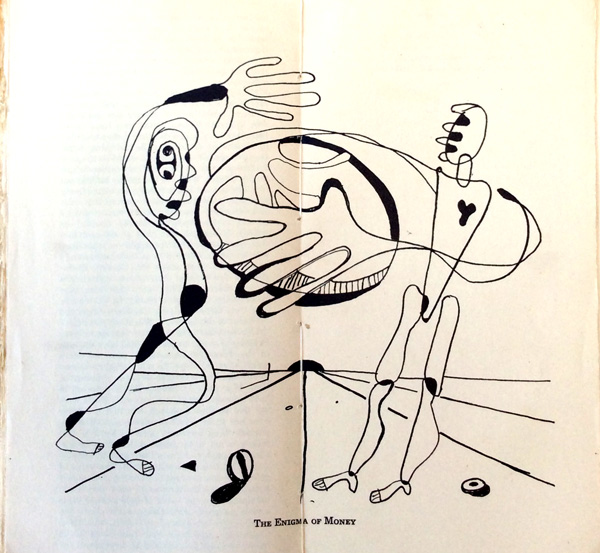
Art from the original edition of Henry Miller’s ‘Money and How It Gets That Way.’ Click image for more.

She returns to the essential fork in the vocational road that separates writers from critics:

Luckily for art, life is difficult, hard to understand, useless, and mysterious. Luckily for artists, they don’t require art to do a good day’s work. But critics and teachers do. A book, a story, should be smarter than its author. It is the critic or the teacher in you or me who cleverly outwits the characters with the power of prior knowledge of meetings and ends.

Stay open and ignorant.

Echoing Nadine Gordimer’s enduring wisdom on the writer’s task “to go on writing the truth as he sees it,” Paley adds:

A student says, Why do you keep saying a work of art? You’re right. It’s a bad habit. I mean to say a work of truth.

What does it mean To Tell the Truth?

It means — for me — to remove all lies… I am, like most of you, a middle-class person of articulate origins. Like you I was considered verbal and talented, and then improved upon by interested persons. These are some of the lies that have to be removed:

a. The lie of injustice to characters.
b. The lie of writing to an editor’s taste, or a teacher’s.
c. The lie of writing to your best friend’s taste.
d. The lie of the approximate word.
e. The lie of unnecessary adjectives.
f. The lie of the brilliant sentence you love the most.

She ends by urging aspiring writers to learn from the masters of this art of truth-telling:

Don’t go through life without reading the autobiographies of
Emma Goldman
Prince Kropotkin
Malcolm X

To that, I would heartily add the autobiography of Oliver Sacks — had she lived to read it, Paley may well have concurred.

Complement Paley’s Just As I Thought with this growing archive of great writers’ advice on the craft, including Virginia Woolf on writing and self-doubt, Susan Sontag’s advice to aspiring writers, Ann Patchett on the importance of self-forgiveness, William Zinsser on how to write well about science, and Neil Gaiman’s eight rules of writing.

New blog: Read to Death

Recently I had the idea of starting a blog about reading, and its importance. I now have two blogs. They are Write to Life and Read to Death. Since these represent the two key components of The Pencil Driven Life, I obviously intend a sort of symmetry: life vs. death. But, death of what?

Here’s my answer in short:

I encourage you to read to death. This isn’t like running yourself to death; it’s more like running to kill something else. By running, I mean reading. Read–fiction and nonfiction– until you’ve put to death your false opinions and beliefs. If you keep at it, keep reading widely and deeply, you’ll replace your wrong-headedness with the truth.

from Read to Death

You can access this blog by clicking the icon, Read to Death, at http://richardlfricks.com, or by going directly to https://readtodeath.com/.

I hope you’ll follow my new blog.

Thinking Mindsets

Below, is a chart I created. I ‘stole’ the descriptors and definitions from the brilliant Adam Grant and the first chapter of his book, Think Again: The Power of Knowing What You Don’t Know.

Read the various mindsets. Select the one that describes your most common way of thinking. Do you see the importance–assuming truth is your goal–of choosing to think like a scientist?

I encourage you to download and save this file for future reference.

Umberto Eco’s Advice to Writers

I encourage you read these powerful, awe-inspiring words from Maria Popova’s wonderful collection, Timeless Advice on Writing: The Collected Wisdom of Great Writers.

Here is the link to today’s article.

“If we think that our reader is an idiot, we should not use rhetorical figures, but if we use them and feel the need to explain them, we are essentially calling the reader an idiot. In turn, he will take revenge by calling the author an idiot.”

BY MARIA POPOVA

In 1977, Umberto Eco (January 5, 1932–February 19, 2016) — beloved novelist, author of vintage semiotic children’s books, proponent of the “antilibrary”, intellectual champion of listslover of legendary lands — published a slim book for his students, titled How to Write a Thesis (public library). Although it was intended as an academic aid for graduate students of literature, it endures as a lively, friendly, and immensely potent packet of advice for all writers. Partway between, in both time and ethos, the Strunk and White classic The Elements of Style and the contemporary counterpart A Sense of Style by Harvard psycholinguist Steven Pinker, this tiny treasure makes a fine addition to celebrated writers’ collected advice on the craft.

While the book deals with the entire ecosystem of the writing process — from choosing a topic to conducting research to planning and revision — in one particularly potent section, Eco offers his most direct advice on the writing itself. After making a general case for the value of rewriting, he offers a number of specific pointers:

You are not Proust. Do not write long sentences. If they come into your head, write them, but then break them down. Do not be afraid to repeat the subject twice, and stay away from too many pronouns and subordinate clauses.

[…]

You are not e. e. cummings. Cummings was an American avant-garde poet who is known for having signed his name with lower-case initials. Naturally he used commas and periods with great thriftiness, he broke his lines into small pieces, and in short he did all the things that an avant-garde poet can and should do. But you are not an avant-garde poet. Not even if your thesis is on avant-garde poetry.

[…]

The pseudo-poet who writes his thesis in poetry is a pitiful writer (and probably a bad poet). From Dante to Eliot and from Eliot to Sanguineti, when avant-garde poets wanted to talk about their poetry, they wrote in clear prose.

Illustration by Kris Di Giacomo from Enormous Smallness by Mathhew Burgess, a picture-book biography of E.E. Cummings

With his signature blunt wisdom — a hard-earned bluntness — he adds:

Are you a poet? Then do not pursue a university degree.

(The great prose writer William Styron believed higher education is a waste of time for all writers.)

Despite admonishing against breaking up lines in the style of the avant-garde poets, Eco does urge writers to break their prose into digestible segments:

Begin new paragraphs often. Do so when logically necessary, and when the pace of the text requires it, but the more you do it, the better.

In another point of advice, he could have easily titled “You are not Hemingway,” Eco encourages students to seek feedback from their mentors and cautions:

Do not play the solitary genius.

Eco continues:

Do not use ellipsis and exclamation points, and do not explain ironies. It is possible to use language that is referential or language that is figurative. By referential language, I mean a language that is recognized by all, in which all things are called by their most common name, and that does not lend itself to misunderstandings.

[…]

We either use rhetorical figures effectively, or we do not use them at all. If we use them it is because we presume our reader is capable of catching them, and because we believe that we will appear more incisive and convincing. In this case, we should not be ashamed of them, and we should not explain them. If we think that our reader is an idiot, we should not use rhetorical figures, but if we use them and feel the need to explain them, we are essentially calling the reader an idiot. In turn, he will take revenge by calling the author an idiot.

Given my distaste for writers who use italics and exclamation points for emphasis — a way of falling back on font styling and punctuation as the lazy substitute for prose that makes a point — I was particularly delighted by Eco’s admonition against one of the key “bad habits of the amateur writer”:

[Avoid] the exclamation point to emphasize a statement. This is not appropriate in a critical essay… It is allowed once or twice, if the purpose is to make the reader jump in his seat and call his attention to a vehement statement like, “Pay attention, never make this mistake!” But it is a good rule to speak softly. The effect will be stronger if you simply say important things.

In this short video from the same Louisiana Museum of Modern Art series that gave us Patti Smith’s advice to the young, Eco offers a higher-order — and perhaps the most important — piece of wisdom to aspiring writers:

How to Write a Thesis brims with more of Eco’s practical, pleasurably stern yet sympathetic advice on the craft. Complement it with Eco on why unread books are more valuable to our lives than read ones and his captivating narrative maps to imaginary places, then revisit other excellent advice to writers from Susan SontagGrace PaleyAnn PatchettSusan Orlean, and Neil Gaiman.

The Workhorse and the Butterfly: Ann Patchett on Writing and Why Self-Forgiveness Is the Most Important Ingredient of Great Art

I encourage you read these powerful, awe-inspiring words from Maria Popova’s wonderful collection, Timeless Advice on Writing: The Collected Wisdom of Great Writers.

Here is the link to today’s article.

“The ability to forgive oneself … is the key to making art, and very possibly the key to finding any semblance of happiness in life.”

BY MARIA POPOVA

“All makers must leave room for the acts of the spirit,” Ursula K. Le Guin wrote in her lucid and luminous essay on where ideas come from and the “secret” of writing“But they have to work hard and carefully, and wait patiently, to deserve them.” And yet our cultural mythology continues to perpetuate the perilous notion that great art is the product of great ideas that occur in a flash to those endowed with the mysterious gift of genius.

In her magnificent memoir-of-sorts This Is the Story of a Happy Marriage (public library), novelist Ann Patchett offers one of creative history’s finest and most convincing counterpoints to this myth.

Ann Patchett by Heidi Ross

She writes in the introduction:

The tricky thing about being a writer, or about being any kind of artist, is that in addition to making art you also have to make a living. My short stories and novels have always filled my life with meaning, but, at least in the first decade of my career, they were no more capable of supporting me than my dog was. But part of what I love about both novels and dogs is that they are so beautifully oblivious to economic concerns. We serve them, and in return they thrive. It isn’t their responsibility to figure out where the rent is coming from.

Patchett, who knew she wanted to be a writer since her early childhood — “A deep, early love of poetry should be mandatory for all writers,” she asserts in one of her many piercing asides — first set out to figure this out by taking a number of freelance assignments for various magazines, writing essays and other nonfiction while dreaming with crystalline determination about being a novelist. She reflects on a curious duality — on the one hand, the fundamental differences between writing fiction and writing nonfiction; on the other, the surprising ways in which the craft of the latter recompenses the art of the former:

In my mind, fiction and nonfiction stayed so far away from each other that for years I would have maintained they had no more a relationship than fiction and waitressing. Writing a novel, even when it’s going smoothly, is hard for me, and writing an article, even a challenging one, is easy. I believe nonfiction is easy for me precisely because fiction is hard; I would always rather knock off an essay than face down the next chapter of my novel. But I’ve come to realize that while all those years of writing fiction had improved my craft as a writer across the board, all those years of writing articles … had made me a workhorse, and that, in turn, was a skill I brought back to my novels.

But of all the skills essential to the fiction writer that Patchett acquired while writing nonfiction — from having her ego tamed by the constant practice of seeing her sentences slaughtered by editors to mastering “the ability to fake authority” — perhaps most valuable was the unshakable understanding that the chief purpose of writing, whatever its nature or genre, is to serve for people as Neruda unforgettable “hand through the fence.” Patchett recounts:

In the years I made my living writing nonfiction, I thought of the work I did as being temporary, with a life span that would, in most cases, not exceed a magazine’s last tattered days in a dentist’s waiting room, but the essays kept resurfacing. People would bring them to book signings and show them to me. I read this when my grandmother died. Someone gave this to me when I got divorced. They told me my story was their story, and they wondered if there was more, something they might have missed… The job of these essays had been to support art, not to be art, but maybe that was what spared them from self-consciousness.

In one of the most illuminating pieces from the book, titled “The Getaway Car” and subtitled “A Practical Memoir about Writing and Life,” Patchett considers how this writerly self-consciousness dances with our cultural narrative about great ideas being all it takes to produce great art:

Logic dictates that writing should be a natural act, a function of a well-operating human body, along the lines of speaking and walking and breathing. We should be able to tap into the constant narrative flow our minds provide, the roaring river of words filling up our heads, and direct it out into a neat stream of organized thought so that other people can read it. Look at what we already have going for us: some level of education, which has given us control of written and spoken language; the ability to use a computer or a pencil; and an imagination that naturally turns the events of our lives into stories that are both true and false. We all have ideas, sometimes good ones, not to mention the gift of emotional turmoil that every childhood provides. In short, the story is in us, and all we have to do is sit there and write it down.

But it’s right about there, right about when we sit down to write that story, that things fall apart.

[…]

If a person has never given writing a try, they assume that a brilliant idea is hard to come by. But really, even if it takes some digging, ideas are out there. Just open your eyes and look at the world. Writing the ideas down, it turns out, is the real trick.

Illustration from ‘Inside the Rainbow: Beautiful Books, Terrible Times.’ Click image for more.

She illustrates the disconnect between myth and reality by recounting an exasperating, almost absurdist encounter with a woman — not a writer — who claimed that while not everyone has in them “one algebraic proof” or “one five-minute mile,” everyone has “one great novel” tucked into their inner life, waiting to be externalized in writing. Patchett — a writer, and thus a rightfully indignant unbeliever in this strangely selective assertion — voices her incredulity:

I couldn’t stop thinking about this woman, not later that same day, not five years later. Was it possible that, in everybody’s lymph system, a nascent novel is knocking around? A few errant cells that, if given the proper encouragement, cigarettes and gin, the requisite number of bad affairs, could turn into something serious? Living a life is not the same as writing a book, and it got me thinking about the relationship between what we know and what we can put on paper.

Living up to the book’s central disclaimer that it isn’t “an instructional booklet” but a subjective record of what has worked for her, Patchett echoes Tchaikovsky’s account of the “immense bliss” of ideation and relays her own experience:

For me it’s like this: I make up a novel in my head (there will be more about this later). This is the happiest time in the arc of my writing process. The book is my invisible friend, omnipresent, evolving, thrilling… This book I have not yet written one word of is a thing of indescribable beauty, unpredictable in its patterns, piercing in its color, so wild and loyal in its nature that my love for this book, and my faith in it as I track its lazy flight, is the single perfect joy in my life. It is the greatest novel in the history of literature, and I have thought it up, and all I have to do is put it down on paper and then everyone can see this beauty that I see.

And so I do. When I can’t think of another stall, when putting it off has actually become more painful than doing it, I reach up and pluck the butterfly from the air. I take it from the region of my head and I press it down against my desk, and there, with my own hand, I kill it. It’s not that I want to kill it, but it’s the only way I can get something that is so three-dimensional onto the flat page. Just to make sure the job is done I stick it into place with a pin. Imagine running over a butterfly with an SUV. Everything that was beautiful about this living thing — all the color, the light and movement — is gone. What I’m left with is the dry husk of my friend, the broken body chipped, dismantled, and poorly reassembled. Dead. That’s my book.

Photograph by Christopher Payne from ‘North Brother Island.’ Click image for more.

Only writers, Patchett argues, bend but don’t break under this crushing dissatisfaction with how the gossamer perfection of the idea withers as it metamorphoses into the reality of the execution — and that is what sets them apart from those other people who die with their One Great Novel unwritten:

The journey from the head to hand is perilous and lined with bodies. It is the road on which nearly everyone who wants to write — and many of the people who do write — get lost… Only a few of us are going to be willing to break our own hearts by trading in the living beauty of imagination for the stark disappointment of words.

And yet that resilience isn’t something arbitrarily bestowed upon the lucky few by a fickle muse — rather, it is earned the only way any stamina is ever earned. (Annie Dillard, perhaps our most benevolent patron saint of writing, put it best“You search, you break your heart, your back, your brain, and then — and only then — it is handed to you.”) In a sentiment that calls to mind the exquisite example of how John Steinbeck disciplined his way to a Pulitzer, Patchett observes:

It turns out that the distance from head to hand, from wafting butterfly to entomological specimen, is achieved through regular practice. What begins as something like a dream will in fact stay a dream forever unless you have the tools and the discipline to bring it out.

Illustration by Kris Di Giacomo from ‘Enormous Smallness’ by Mathhew Burgess, a picture-book biography of E.E. Cummings. Click image for more.

Patchett pokes at the strange logic by which we exempt writing from the beliefs and standards to which we hold other crafts:

Why is it that we understand playing the cello will require work, but we attribute writing to the magic of inspiration? Chances are, any child who stays with an instrument for more than two weeks has some adult making her practice, and any child who sticks with it longer than that does so because she understands that practice makes her play better and that there is a deep, soul-satisfying pleasure in improvement. If a person of any age picked up the cello for the first time and said, “I’ll be playing in Carnegie Hall next month!” you would pity their delusion, yet beginning fiction writers all across the country polish up their best efforts and send them off to The New Yorker. Perhaps you’re thinking here that playing an instrument is not an art itself but an interpretation of the composer’s art, but I stand by my metaphor. The art of writing comes way down the line, as does the art of interpreting Bach. Art stands on the shoulders of craft, which means that to get to the art you must master the craft. If you want to write, practice writing. Practice it for hours a day, not to come up with a story you can publish, but because you long to learn how to write well, because there is something that you alone can say. Write the story, learn from it, put it away, write another story. Think of a sink pipe filled with sticky sediment. The only way to get clean water is to force a small ocean through the tap. Most of us are full up with bad stories, boring stories, self-indulgent stories, searing works of unendurable melodrama. We must get all of them out of our system in order to find the good stories that may or may not exist in the freshwater underneath.

With an eye to the deep rewards of practicing itself, Patchett addresses the obvious caveat:

Does this sound like a lot of work without any guarantee of success? Well, yes, but it also calls into question our definition of success. Playing the cello, we’re more likely to realize that the pleasure is the practice, the ability to create this beautiful sound; not to do it as well as Yo-Yo Ma, but still, to touch the hem of the gown that is art itself… I got better at closing the gap between my hand and my head by clocking in the hours, stacking up the pages. Somewhere in all my years of practice, I don’t know where exactly, I arrived at the art.

Illustration by JooHee Yoon from ‘Beastly Verse.’ Click image for more.

Returning to the question of transmuting inspiration into writing — one also addressed by another celebrated writer whose own relationship to butterflies was far from metaphorical — Patchett adds:

I never learned how to take the beautiful thing in my imagination and put it on paper without feeling I killed it along the way. I did, however, learn how to weather the death, and I learned how to forgive myself for it.

In this practice lies Patchett’s most empowering yet most difficult piece of advice:

Forgiveness. The ability to forgive oneself. Stop here for a few breaths and think about this because it is the key to making art, and very possibly the key to finding any semblance of happiness in life.

[…]

I believe, more than anything, that this grief of constantly having to face down our own inadequacies is what keeps people from being writers. Forgiveness, therefore, is key. I can’t write the book I want to write, but I can and will write the book I am capable of writing. Again and again throughout the course of my life I will forgive myself.

This Is the Story of a Happy Marriage is a spectacular read in its entirety. Complement it with Patchett’s commencement-address-turned-book, then explore this evolving archive of great writers’ advice on the craft, including Virginia Woolf on writing and self-doubtCheryl Strayed on faith, humility, and the art of motherfuckitudeElmore Leonard’s ten tips on writingNeil Gaiman’s eight pointersNietzsche’s ten rulesWalter Benjamin’s thirteen doctrinesHenry Miller’s eleven commandments, and Kurt Vonnegut’s eight tips for writing with style, and Vladimir Nabokov on the three qualities of a great storyteller.

The Art of Motherfuckitude: Cheryl Strayed’s Advice to an Aspiring Writer on Faith and Humility

Here’s another article drawn from her wonderful collection, Timeless Advice on Writing: The Collected Wisdom of Great Writers. I encourage you to take time to read these powerful, awe-inspiring words.

Here is the link to today’s article.

“Writing is hard for every last one of us… Coal mining is harder. Do you think miners stand around all day talking about how hard it is to mine for coal? They do not. They simply dig.”

BY MARIA POPOVA

“Nothing any good isn’t hard,” F. Scott Fitzgerald asserted in his letter of advice on writing to his fifteen-year-old daughter upon her enrollment in high school. That uncomfortable yet strangely emboldening counsel is what Cheryl Strayed offers — with greater poeticism and much better grammar — to a despairing young writer in Tiny Beautiful Things: Advice on Love and Life from Dear Sugar (public library), the ample soul-satisfactions of which have been previously extolled here.

Long before Wild — her magnificent memoir of learning, oh, just about every dimension of the art of living while hiking more than a thousand miles on the Pacific Crest Trail — was turned into a major motion picture, Strayed wielded her art as an advice columnist for The Rumpus, simply known as Sugar. Among the thousands of Dear Sugar letters she received was one from a self-described “pathetic and confused young woman of twenty-six” named Elissa Bassist, a “writer who can’t write,” a “high-functioning head case, one who jokes enough that most people don’t know the truth.” “The truth,” she tells Sugar, “[is that] I am sick with panic that I cannot — will not — override my limitations, insecurities, jealousies, and ineptitude, to write well, with intelligence and heart and lengthiness.”

Like all the letters Strayed answered as Sugar, this one is profoundly personal yet speaks to the artist’s universal dance with the fear — the same paralyzing self-doubt which Virginia Woolf so elegantly captured; which led Steinbeck to repeatedly berate, then galvanize himself in his diary; which sent Van Gogh into a spiral of floundering before he found his way as an artist.

What makes Strayed’s advice so vitalizing is that it is never dispensed as a holier-than-thou dictum; rather, it weaves tapestry of no-bullshit solace from the beautifully tattered threads of her own experience, messy and alive. This is exactly what she hands to Bassist, under the title “Write Like a Motherfucker.”

Invoking the time right before she wrote her first book, when she too was a twenty-something writer plagued by the same fear that she was “lazy and lame,” Strayed recounts how she “finally reached a point where the prospect of not writing a book was more awful than the one of writing a book that sucked”; in other words, she got off the nail. With an eye to Flannery O’Connor’s famous proclamation that “The first product of self-knowledge is humility,” which Strayed had inscribed across the chalkboard in her living room at the time, she writes:

When I was done writing it, I understood that things happened just as they were meant to. That I couldn’t have written my book before I did. I simply wasn’t capable of doing so, either as a writer or a person. To get to the point I had to get to to write my first book, I had to do everything I did in my twenties. I had to write a lot of sentences that never turned into anything and stories that never miraculously formed a novel. I had to read voraciously and compose exhaustive entries in my journals. I had to waste time and grieve my mother and come to terms with my childhood and have stupid and sweet and scandalous sexual relationships and grow up. In short, I had to gain the self-knowledge that Flannery O’Connor mentions in that quote… And once I got there I had to make a hard stop at self-knowledge’s first product: humility.

Do you know what that is, sweat pea? To be humble? The word comes from the Latin words humilis and humus. To be down low. To be of the earth. To be on the ground. That’s where I went when I wrote the last word of my first book. Straight onto the cool tile floor to weep. I sobbed and I wailed and I laughed through my tears. I didn’t get up for half an hour. I was too happy and grateful to stand. I had turned thirty-five a few weeks before. I was two months pregnant with my first child. I didn’t know if people would think my book was good or bad or horrible or beautiful and I didn’t care. I only knew I no longer had two hearts beating in my chest. I’d pulled one out with my own bare hands. I’d suffered. I’d given it everything I had.

Illustration by Kris Di Giacomo from ‘Enormous Smallness’ by Mathhew Burgess a picture-book biography of E.E. Cummings. Click image for more.

Echoing Voltaire’s memorable admonition from his letter of advice on how to write well — “beware, lest in attempting the grand, you overshoot the mark and fall into the grandiose” — and Bukowski’s lament that “bad writers tend to have the self-confidence, while the good ones tend to have self-doubt,” Strayed adds:

I’d stopped being grandiose. I’d lowered myself to the notion that the absolute only thing that mattered was getting that extra beating heart out of my chest. Which meant I had to write my book. My very possibly mediocre book. My very possibly never-going-to-be-published book. My absolutely nowhere-in-league-with-the-writers-I’d-admired-so-much-that-I-practically-memorized-their-sentences book. It was only then, when I humbly surrendered, that I was able to do the work I needed to do.

Strayed directs her tough-love incisiveness at Bassist’s paradoxical blend of self-pitying defeatism and grandiose entitlement — something not uncommon in young artists, who forget that “anything worthwhile takes a long time,” and a kernel of truth in the otherwise overly flat and ungenerously applied cultural archetype of the millennial:

Buried beneath all the anxiety and sorrow and fear and self-loathing, there’s arrogance at its core. It presumes you should be successful at twenty-six, when really it takes most writers so much longer to get there… You loathe yourself, and yet you’re consumed by the grandiose ideas you have about your own importance. You’re up too high and down too low. Neither is the place where we get any work done. We get the work done on the ground level. And the kindest thing I can do for you is to tell you to get your ass on the floor. I know it’s hard to write, darling. But it’s harder not to. The only way you’ll find out if you “have it in you” is to get to work and see if you do. The only way to override your “limitations, insecurities, jealousies, and ineptitude” is to produce.

Pointing to Bassist’s litany of women writers who ended their own lives — perhaps Plath, Sexton, Woolf — Strayed calls the young writer out on perpetuating the dangerous mythology of creativity and mental illness. Reminding her — reminding all of us — that the stories we tell ourselves shape our horizons of possibility, Strayed reality-checks this perilous narrowing of attention:

In spite of various mythologies regarding artists and how psychologically fragile we are, the fact is that occupation is not a top predictor for suicide. Yes, we can rattle off a list of women writers who’ve killed themselves and yes, we may conjecture that their status as women in the societies in which they lived contributed to the depressive and desperate state that caused them to do so. But it isn’t the unifying theme.

You know what is?

How many women wrote beautiful novels and stories and poems and essays and plays and scripts and songs in spite of all the crap they endured.

[…]

The unifying theme is resilience and faith. The unifying theme is being a warrior and a motherfucker. It is not fragility. It’s strength. It’s nerve. And “if your Nerve, deny you—,” as Emily Dickinson wrote, “go above your Nerve.” Writing is hard for every last one of us — straight white men included. Coal mining is harder. Do you think miners stand around all day talking about how hard it is to mine for coal? They do not. They simply dig.

[…]

So write, Elissa Bassist. Not like a girl. Not like a boy. Write like a motherfucker.

In this excerpt from her altogether fantastic 2012 conversation with The New York Public Library’s Paul Holdengräber, with Bassist in the audience, Strayed elaborates on the art of motherfuckitude:

https://w.soundcloud.com/player/?url=https%3A//api.soundcloud.com/tracks/200341102&auto_play=false&hide_related=false&show_comments=true&show_user=true&show_reposts=false&visual=true

But being a motherfucker, it’s a way of life, really… It’s about having strength rather than fragility, resilience, and faith, and nerve, and really leaning hard into work rather than worry and anxiety.

[…]

I think there are a lot of writers who can’t write, or they think they can’t write… I understand that feeling, I think every writer has wrestled with those anxieties and that self-loathing, and yet ultimately in order to succeed in anything we all have to in essence embrace humility, rather.

[…]

A lot of people think that to be a motherfucker is to be a person who is the dominant figure. But I actually think that true motherfuckerhood … really has to do with being humble. And it’s only when you can get out of your own ego that you can actually do what is necessary to do — in a relationship, in your professional life, as a parent, in any of those ways. It has to do with humility — doing the work.

Tiny Beautiful Things, it bears repeating, is nothing short of necessary to the liver of modern life. Complement this particular fragment with Dani Shapiro on the plight of the artist and this evolving archive of celebrated writers’ advice on the craft, including Elmore Leonard’s ten tips on writingNeil Gaiman’s eight pointersNietzsche’s ten rulesWalter Benjamin’s thirteen doctrinesHenry Miller’s eleven commandments, and Kurt Vonnegut’s eight tips for writing with styleZadie Smith on the two psychologies for writing, and Vladimir Nabokov on the three qualities of a great storyteller.

Virginia Woolf on Writing and Self-Doubt

I’m currently taking a writing and blogging sabbatical due to family health issues. For now, I’ll repost selected articles from Timeless Advice on Writing: The Collected Wisdom of Great Writers. I encourage you to take time to read these powerful, awe-inspiring words.

Here is the link to today’s article.

Consolation for those moments when you can’t tell whether you’re “the divinest genius or the greatest fool in the world.”

BY MARIA POPOVA

“Bad writers tend to have the self-confidence, while the good ones tend to have self-doubt,” Charles Bukowski lamented in an interview. Self-doubt is a familiar state for all who put pieces of their inner lives into the outside world — that is, for all artists. “Determination allows for doubt and for humility — both of which are critical,” Anna Deavere Smith counseled in her indispensable Letters to a Young Artist. And yet, integral as it may be to the creative experience by offering an antidote to the arrogance that produces most mediocre art, self-doubt isn’t something we readily or heartily embrace. Instead, we run from it, we judge it, and we hedge against it using a range of coping mechanisms, many of which backfire into self-loathing. “Don’t mask self-doubt with contempt,” Zadie Smith advised in her ten rules of writing.

But hardly anyone has captured this exasperating dance with self-doubt — which is part of the artist’s universal and necessary dance with fear — better than Virginia Woolf, she of enduring wisdom on creativity and consciousness and the challenge of writing about the soul.

In Orlando: A Biography (public library) — her subversive 1928 novel, regarded as “the longest and most charming love letter in literature” — Woolf captures the anguishing self-doubt with which all artists tussle along the creative process, rendering in spectacular relief the particular granularity familiar to writers:

Anyone moderately familiar with the rigours of composition will not need to be told the story in detail; how he wrote and it seemed good; read and it seemed vile; corrected and tore up; cut out; put in; was in ecstasy; in despair; had his good nights and bad mornings; snatched at ideas and lost them; saw his book plain before him and it vanished; acted people’s parts as he ate; mouthed them as he walked; now cried; now laughed; vacillated between this style and that; now preferred the heroic and pompous; next the plain and simple; now the vales of Tempe; then the fields of Kent or Cornwall; and could not decide whether he was the divinest genius or the greatest fool in the world.

Complement with Woolf on how to read a bookthe creative benefits of keeping a diary, and the only surviving recording of her voice, then revisit this evolving library of great writers’ wisdom on writing.

What’s this blog about?

The following can also be found at the About page.

Since 2015, I’ve written eleven novels. One thing I’ve learned from fiction writing experts is the importance of character development, especially for the story’s protagonist (aka, hero). A common ingredient in great stories is for the hero to have a positive character arc. This means, she (or he) will mature enough to overcome a weakness by the end of the story, and thus be prepared to live a better life. This maturing means she learns something new, which obviously means at the beginning of the story there are things she doesn’t know or her knowledge is incomplete or confused.

Novels represent a story world and its occupants. These stories often feel more real than the world you and I experience. However, one giant similarity between our world and story worlds is we, as characters, start off knowing very little. As time goes by, through formal schooling and life experiences, we learn more and more. Sometimes, often really, we grow stagnant believing we’ve learned all we need to know concerning certain subjects. Take football for example (American football that is). Don’t real zealous fans know more than the refs?  You bet we do, and it’s probably okay we don’t invest time learning more.

But, when it comes to more important issues (not to denigrate football), like those involving religion, politics, and science, shouldn’t we choose a positive character arc for our lives? That is, being open to learning which portends assurance we’ll grow and mature as we age. Maybe we need to return to the drawing board and start over (tell ourselves to Think Again, as does Adam Grant in his wonderful book), like a hero does at the beginning of a new novel. For some of us, we might start with assessing our weaknesses which likely include those areas we feel so certain about.

Thus, this positive character arc in real life greatly depends on a commitment to reading. In sum, this process is what I call Reading to Death–to discover and dispel false opinions and beliefs, replacing them with the truth. On the contrary, I suspect a negative character arc will be virtually guaranteed if we fail to actively pursue reading.

So, you want to adopt and implement reading as a lifelong pursuit but have trouble reading for more than a few minutes at a time. Maybe, you could benefit from an active pursuit of mindfulness, what Sam Harris (and others) refer to as meditation. To further understand what I’m talking about, I encourage you to listen to Sam Harris describe the importance of mental training (6 minute audio). Mental Training.

I have but one question. Are you open to challenging your thinking? If so, I encourage you to read this blog. It’s all about challenging the status quo.