
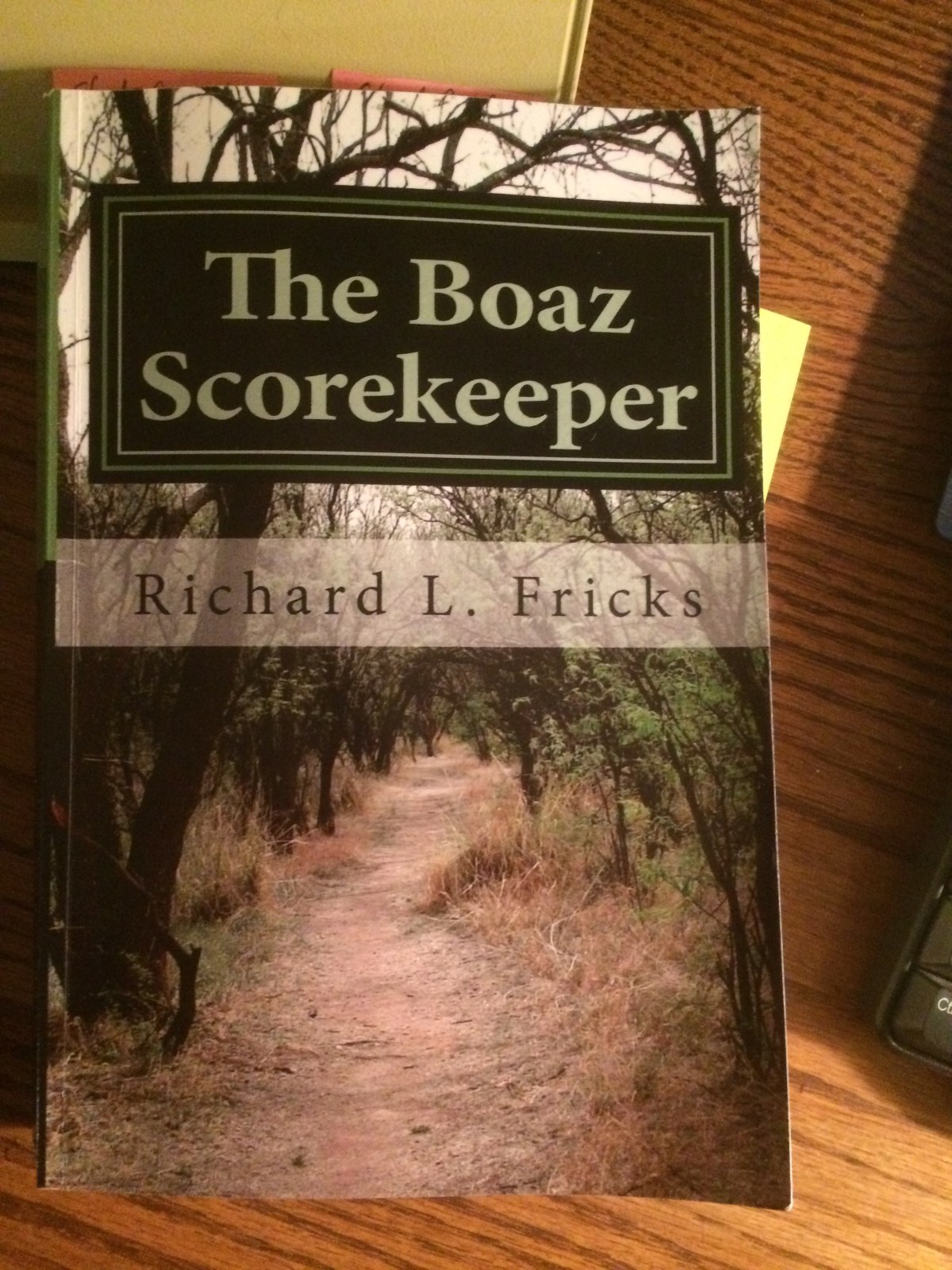
Novel Excerpts–The Boaz Scorekeeper, Chapter 49

The primary aim of the "Novel Excerpts" blog category is to showcase my creative writing, specifically from the novels I've written. Hopefully, these posts will provide a glimpse into my storytelling style, themes, and narrative skills. It's an opportunity to share my artistic expressions and the worlds I've created through my novels.
The Boaz Scorekeeper, written in 2017, is my second novel. I'll post it, a chapter a day, over the next few weeks.

After the Sand Mountain Reporter published my ‘anonymous’ indictment against the five prominent families, I knew the citizens of Boaz would be in an uproar, raving against them.   I could not have been more wrong.  The local community circled their wagons around these five families. 

For the next three weeks, in all three weekly editions of the Sand Mountain Reporter, there was a full-page ad with the title, “Boaz United: Justice for John.”  The ad included a short statement that everyone deserved forgiveness but that in this case none was called for because The Flaming Five had all been acquitted (the Newspaper got its facts wrong) of all crimes against Wendi and Cindi Murray and that not one of the nine men listed in my ‘anonymous’ indictment had ever been charged with any form of crime involving the deaths of Bill and Nellie Murray.  The ad said little about John’s disappearance other than calling for his release and return.

The ad contained five photographs: an aerial view of First Baptist Church of Christ, and frontal views of First State Bank of Boaz, Adams Buick, Chevrolet & GMC, Radford Hardware & Building Supply, and Ericson Real Estate and Property Development.  All five photos were within a large circle in the center of the ad with an upward sloping diagonal phrase printed with the words, “Boaz Loves & Supports You.”

Three-quarters of the way down the page, in bold and large print, was the phrase, “BOAZ IS UNDER ATTACK.” Underneath this title and in regular print was a paragraph that basically urged every Boaz citizen to, as always, shop in Boaz, and to be on the lookout for strangers and for “oddities” as the article put it.

At the very bottom of the ad was an invitation to the annual, Celebrate Boaz, July 4th event held on Billy Dyar Blvd.  The invitation announced that the Flaming Five would be co-hosting along with infamous country music singer Shania Twain.

Along with these full-page ads were separate quarter page ads by the families of the Flaming Five scattered throughout the newspaper.  These ads offered deep discounts on merchandise if accompanied by the ad itself.  The Church’s ad offered something even better, mercy, love, and forgiveness available anytime, at any hour of the day or night, simply by stopping in at the Family Center.  It also included a 50% discount for every new student enrolled in the Upward Bound Bible and Basketball program.

These ads, invitations, and announcements brought a new wave of unity and solidarity. Everywhere I went within Boaz I felt a team spirit enthusiasm.  Mayor Adams and the City Council had also initiated a yellow ribbon program for John revealing their desire for his return.  The City’s website also included an invitation for each citizen to come to City Hall for a small yellow ribbon to wear on their label and for a large one to tie around a tree.  The site also provided a short history of the yellow ribbon stating that during Desert Shield and Desert Storm the ribbons appeared along with the slogan “support our troops,” which obviously implied “bring our troops home.”  The site also included singer Russ Morgan’s lyrics to “She Wore a Yellow Ribbon.” This was a song he had created (he altered the original version in 1917 by George A. Norton titled ‘Round Her Neck She Wears a Yeller Ribbon’).

“Around her hair she wore a yellow ribbon

She wore it in the springtime

In the merry month of May

And if you ask her why the heck

she wore it

She wore it for her soldier who was

Far, far away

Far away, far away

She wore it for her soldier

Who was far, far away

Around the block she pushed a baby carriage

She pushed it in the springtime

In the Merry month of May

And if you ask her why the heck

she pushed it

She pushed it for her soldier who

was far, far away

Far away, far away

She pushed it for her soldier

Who was far, far away

Behind the door her daddy kept a shotgun

He kept it in the springtime

In the merry month of May

And if you ask him why the heck he kept it

He kept it for her soldier who was far

far away

Far away, far away

He kept it for her soldier

Who was far, far away

On the grave, she laid the pretty flowers

She laid them in the springtime

In the merry month of May

And if you asked her why the heck

she laid them

She laid them for her soldier who was

Far, far away

Far away, far away

She laid them for her soldier

Who was far, far away.”

Sitting in my office the end of June, just days before the July 4th Celebrate Boaz concert, I couldn’t help but associate the blind ignorance of the Boaz community with Christianity in general.  It seemed every citizen had been completely misled.  Only a handful knew the truth, and every one of these, rested softly and securely in a large and extravagant Flaming Five related mansion.  The citizens supported these five crime families because it was in their best interest to do so.  It was that simple.  These five families, in direct and indirect ways, controlled the economic well-being of every Boaz citizen.  I didn’t dispute this, but, I knew the real and deeper truth.  The Flaming Five and their families were simply smoke and mirrors.  They acted carefully to convince their audience that they were honest, hardworking, caring, God-fearing people who, blessed beyond compare, simply wanted to make life better for everyone in their community.  This seemed to me related to what Christianity does.  I still felt sad, almost ashamed, to even think of my own Christian journey.  I once, like virtually every Boaz citizen, believed with my whole heart that Jesus was God’s only begotten Son, who came to earth as a baby and grew up to die for my sins to give me eternal life in Heaven with Him and His Father.  But, that ended when I experienced and endured the Murray’s story.  That prompted me to wake up, to start researching, and with ultimately concluding that the Bible is merely man-made, there was no Adam and Eve, and even if there were an actual Jesus, he died and stayed dead just like every other man who had ever lived. 

Novel Excerpts–The Boaz Scorekeeper, Chapter 48

The primary aim of the "Novel Excerpts" category is to showcase my creative writing, specifically from the novels I've written. Hopefully, these posts will provide a glimpse into my storytelling style, themes, and narrative skills. It's an opportunity to share my artistic expressions and the worlds I've created through my novels.
The Boaz Scorekeeper, written in 2017, is my second novel. I'll post it, a chapter a day, over the next few weeks.

For the past several days I had toiled with the question whether to ‘go public’ with the John Ericson story.  Two separate things determined my decision.

First, I didn’t like that Judith (and ultimately Franklin and the entire Ericson clan) had ignored the second commandment in my ransom letter.  They had wholly failed to publish a letter of apology through Pastor Walter at church.

The second thing that gave me the answer I sought was the foresight I had had when I purchased Oak Hollow.  Technically, Terry Lynn Gaines had purchased Carl and Betty Black’s property from their son and testator Andrew.  Mr. Gaines was the defendant in the first criminal case I ever worked.  It was during my days practicing law in Atlanta with the firm of Downs, Gambol & Stevens.  Gaines was charged with viciously murdering an openly gay man in Loganville, Georgia in 1980.  Because of great lawyering by my boss Greg Gambol, a 35-year criminal defense attorney veteran, the jury acquitted Gaines.  This, despite his confession, “I was obedient to God when I killed Victor Semmes.”  The wise or lucky thing for Gaines was that he had only confessed to Greg and me in privacy under the cool shade of the attorney-client privilege umbrella. The jury never knew Terry had confessed to committing the horrible murder.

My desire that the Flaming Five receive justice had been a long-term project.  Certainly, when Andrew Black contacted me in 2013 asking whether I wanted to exercise my first right of refusal and purchase his parent’s 80 acres, I was at least subconsciously contemplating my future role. 

In 2010, at age 73, Georgia resident Terry Lynn Gaines was elected to the U.S. Senate.  Apparently, he had overcome the stigma of his criminally-accused past and gone on to win the respect of most Republican voters in Georgia.  I attempted to contact Terry with the intentions of respectively, but strongly, suggesting he purchase Oak Hollow in his name.  At first, he wouldn’t accept my call.  Then, I told his assistant that Terry and I go way back, all the way to Loganville and Criswell Park in 1980.  I guess this intrigued him.  Ultimately, Terry agreed to be my strawman, even paying for the purchase at closing, even though I did later secretly repay him the funds.  Our deal was simple.  I would not anonymously leak his Semmes confession and he would transfer ownership in Oak Hollow if I asked him to in the future.  I suspect Terry knew that it was unlikely that I would risk associating myself with such leakage for fear of losing my law license, but acting conservatively caused him to go along. 

I was thankful for my foresight.  Two days ago, I had anonymously mailed a letter to the Sand Mountain Reporter.  I felt I could safely publish the statement the Ericson’s had failed to publish.  I did this knowing that likely at some point law enforcement would eventually turn their attention to me.  I could not hope that every sharp detective would ignore or never discover my motivation for killing every member of the Flaming Five.  But, I was convinced investigators would not find I was, in all practical purposes, the real owner of Oak Hollow.  I was confident they would eventually search Hickory Hollow but never realize how close they were to locating relevant and highly prejudicial evidence.

On Saturday May 27, 2017, the Sand Mountain Reporter reluctantly published my letter.  I had followed my standard procedure in drafting, printing, and mailing this anonymous declaration.  The Reporter made no changes to my writing:

“On Monday night May 15, 2017 John Ericson of Boaz was abducted as he exited the First Baptist Church of Christ Faith and Family Life Center on Sparks Avenue in Boaz.  His family was contacted a few days later and asked to draft and have publicly read a formal apology for John’s rape and murder of Wendi and Cindi Murray in 1972.  The formal statement was to have been read by Pastor Walter Tillman at First Baptist Church of Christ on Sunday, May 21, 2017.  John’s family refused to comply with this request.

At a graduation party on the night of May 25, 1972, John Ericson, along with the other four members of a basketball team known as ‘The Flaming Five,’ repeatedly raped these two sweet and innocent young girls from Douglas, Alabama.  Later that night, early on the morning of May 26th, the Flaming Five murdered these two girls and buried their bodies in a hidden grave that was only discovered in 1997.  The fathers of the Flaming Five were also culpable in one murder, the burying of both bodies, and the ultimate long-term cover-up. 

These ten men framed a young man named Micaden Lewis Tanner.  He was jailed, indicted, and tried for the murders of Wendi and Cindi Murray.  In 1973, a jury refused to convict him.  Miraculously, 24 years later, Mr. Tanner as an attorney, along with his law partner Matt Bearden, represented Bill and Nellie Murray, the parents of Wendi and Cindi, in a wrongful death lawsuit against the Flaming Five and their fathers.  On the morning of Monday, November 2, 1998, the day the trial was to begin, Bill and Nellie Murray were found dead in their bed at their home because of cyanide poisoning.  The lawsuit died alongside the Murrays.  The deaths of Bill and Nellie Murray, along with the rape and murder of Wendi and Cindi Murray, are officially unsolved.

Unofficially, justice has been served upon John Ericson. He has forever disappeared.  But, the mighty wheels of justice do not rest.  There are nine others laying in the wake of this coming ship; nine more are sure to suffer a similar fate.  These nine are Franklin Ericson, Wade and Walter Tillman, James and David Adams, Randall and Raymond Radford, and Fred and Fritz Billingsley.”

By Sunday afternoon, after church and an hour on Facebook, I knew that Boaz, Alabama was fully aware of the severe accusations and clear threats that had been leveled against nine living members of this North Alabama community.  I felt comfortable also that these nine people were experiencing terror like they had never known.

I sat out on my balcony all afternoon.  The clouds were gray and it was cool, nearly cold, Blackberry winter of a sort was passing through even though old timers had said it had occurred nearly a month ago.  I couldn’t help but ponder how fragile civilization truly is.

I was a murderer and everyone thought I was a good citizen, a valuable member of society.  I was educated, a professional, a faithful church and Rotary Club member, and a consistent contributor to multiple hunger and homeless organizations.  Yet, I was a murderer.  As far as I knew no one except me knew the real me.  Of course, I was justified.  I suppose just like Undral Collins believed about himself.

I represented Mr. Collins from 2002 to 2004.  His was a Madison County capital murder case.  Collins was charged with four murders, two men and two women.  He was ultimately convicted and sentenced to death.  He remains on Alabama’s death row.  From his case and others, along with general observations in my own life, I have learned that it often doesn’t take much to provoke someone, provoke them to action.  Most times the action isn’t serious, most time it certainly never rises to the level of bodily harm or murder. 

As criminal defendants often do, they tell their lawyers things they would never tell anyone else.  They have this uncanny knowledge or belief that being open, even spilling the whole can of beans, is therapeutic, even contributory to a courtroom acquittal.  Whether they are truly telling the truth gets muddled up a lot of the time.  Nevertheless, Collins loved to talk.

His first victim was a friend of his mother.  The friend had made an off-the-cuff statement one afternoon over lemonade on the front porch of his mother’s home.  The woman said it was nice of Undral to look after his mother but unfortunate he had dropped out of college.  The woman indicated that Undral was not smart enough to become a college graduate.  Evidence at trial showed Undral had broken into the woman’s house and waited for her to return from grocery shopping.  When she came in her back-door, Collins stabbed her repeatedly with a butcher knife he had taken from her kitchen.  He then set her house on fire and left.

Collins stalked his second victim and shot him from a distance with a high-powered hunting rifle.  Collins told me that this man was arrogant and a bigot.  Collins said that he had visited the man’s church where he was the pastor.  At some point in the sermon the man had said “Jesus was a man’s man, you wouldn’t see him wearing an earring.”  One statement, one seemingly minor provocation, and this preacher’s fate was sealed.

Collins abducted his third victim, a 16-year-old girl.  Her body was never found.  She was collateral damage.  Collins intended victim was the girl’s mother.  She was a teacher at a local community college where Collins had taken a basic math class.  He told me that the woman knew her material but often wandered into subjects she clearly didn’t understand.  Although Collins didn’t have a college degree, he was intelligent and well-read.  This teacher often made statements that reflected her belief in God and His powers.  One evening another student came to class late and shared that her niece was in the hospital.  The teacher said that she would say a prayer for the young girl that she would be healed.  Collins took affront to this because he didn’t believe in prayer and even if he did, how could one truly know if it did any good.

Collins shot and killed his final victim while he was playing golf.  The man was a banker and a former high school classmate of Collins.  He said that the man was “a polished diamond on the outside but a pile of shit beneath the surface.”  One-day Collins was mowing a yard in a well-to-do neighborhood when he saw the banker drive up next door.  He said, “The asshole banker was looking straight at me and would have had to recognize me.  If he didn’t remember me from high school he should have known me from being a customer at his bank.”  Collins said the banker barely acknowledged him even though the mower wasn’t even running at the time.  He was filling it with gasoline.  Evidence at trial showed Collins, two days after this incident, followed the banker to the local golf course and covertly went ahead to the ninth hole and waited.  As the banker completed his final putt Collins walked from behind a tree straight toward the man and made him look at him and call his name.  Collins then shot him in the face.

No doubt Undral Collins was not the only human who was easily provoked.  Surely everyone has heard of murders committed over things as insignificant as a pair of Air Jordan running shoes, and a young girl not being chosen as a cheerleader.  I suppose if the full body of evidence on this subject could be examined these two examples would appear to be BIG things.  

To most every reasonable person what had provoked Undral Collins wasn’t common.  And, it certainly didn’t justify him committing all these murders.  However, was I the only one in the world to believe I was justified in taking justice into my own hands and killing John?  If I was, then just like all the Christians who continue to believe in a literal Noah’s Ark, they haven’t looked at the evidence.

Even though I believed that I was fully justified in bashing in the head of John Ericson, I couldn’t quite get away from the feeling that I was no better than Undral Collins.

The Boaz Scorekeeper–Chapter 47

The Boaz Scorekeeper, written in 2017, is my second novel. I'll post it, a chapter a day, over the next few weeks.

Late Wednesday night, the 17th, before going to bed, I logged onto Facebook and reviewed John’s Page.  An hour earlier a post had been made to his Newsfeed. It included a photo of Franklin Ericson and Judith standing on the front porch of a small brick house.  There was a woman standing inside the house propping open the front door.  One could speculate that Franklin was handing the woman something.  A check?  The title of the post was, ‘always supporting John’s generosity.’  There was one comment to the post.  It was by Jesse Rickles and said, “thanks to the Ericson’s for their timely and generous contribution to my family’s needs.”

I assumed Franklin and Judith had concocted some crazy story and showed up with a check.  I would never know the amount of the check but that wasn’t the point.  It appeared they were attempting to fulfill the three ransom-note requirements.

Karla and I went to church on Sunday, the 21st.  Lewis was in town so Kaden was with him.  I never saw Walter nor did Wade or anyone else read an Ericson apology letter.  This wasn’t much of a surprise.

I spent most of Monday in the Cleburne County District Court in one of the longest preliminary hearings of my career.  It was a capital case, where wealthy-parents had hired me to represent their only son.  He was charged with killing his girlfriend and her ten-year-old son.  It was rare for me to be hired in a capital murder case.  Ninety-nine percent of the time these defendants cannot afford retained counsel.  In fact, these individuals were usually indigent and were appointed legal counsel by the Court with such representation paid for by the State of Alabama.

Tuesday morning, the 23rd, I arrived at the office before 7:00 a.m. and logged onto the Fidelity Bank’s Online Banking website.  A few weeks prior to abducting John I had created Edward Simmons.  Looking back, it hadn’t been that difficult to create a whole new identity.  I had been in Dallas, Texas at a criminal defense legal conference and sat by a woman (Katherine, not her real name) from Toronto, Canada.  She had recently moved there from Albuquerque, New Mexico.  Over the course of the three-day seminar we talked about our law practices, families, and generally about our lives. 

Her husband Carter (not his real name) was also an attorney who had been paralyzed from the waist down a few years ago in a hunting accident.  Carter no longer practiced law but accompanied Katherine when she went out of town.  The night before the conference ended I had dinner with Katherine and Carter at the hotel’s restaurant.  While eating, Carter appeared to get choked.  Katherine apologized and said this was routine.  She excused herself and Carter and wheeled him to the bathroom.  When they left, I noticed he had left a small bag on the table.  In it was his wallet which contained his U.S. Social Security Card, his Driver’s License, and a Toronto photo ID card. There were also several credit and insurance cards in the wallet. Carter’s passport was in the bag.  After my inspection, I returned the bag to where Carter had left it.  He and Katherine returned a few minutes later and we finished an enjoyable meal without another incident.

The next afternoon’s session ended early and as we walked out into the hallway of the large conference room, Katherine asked me to do her a favor.  I agreed unconditionally.  She said that Carter had been down, even depressed, the past several days and that she could tell that last night’s dinner and conversation had really improved his spirit.  Katherine asked if I would come to their room and visit a few minutes with Carter while she finished packing and before they took a taxi to the airport.

I told her I would be glad to and walked with her to their room.  I sat and chatted with Carter for fifteen minutes or so.  When Katherine had all their bags packed and setting by the door, she went to the rest room and Carter wheeled himself out into the hall. By then the hotel concierge arrived and started loading their bags.  Katherine came out of the bathroom and we walked with Carter down the hall to the elevators.  I walked with them outside the hotel and waited with them as the concierge loaded their bags.  I helped get Carter into the cab, shook his hand, and hugged Katherine.  She asked me to stay in touch and I promised I would.  Just as she was about to close her door she said, “oh, stupid me.  I forgot to turn in my hotel key.  Micaden, do you mind?”  I took her key and the cab drove off.

For a reason I will probably never know, I went back up to the seventh floor and went inside their room.  If I believed in miracles or even less supernatural interventions into our natural world, I would say it was God who directed my actions.  Inside their room was Carter’s bag sitting on a small round table in the corner of the bedroom next to the door leading out onto the balcony.  I took the bag knowing they were already gone and that it would be unlikely for me to find them if I raced to the airport.  I decided to call them but realized I didn’t have a phone number for either one of them.

Ultimately, I kept the bag with Carter’s identity.  I guess you know by now that Carter’s real name was Edward Simmons.

I entered Edward’s username and password and clicked on the ‘Accounts’ link.  I almost fell out of my chair when I saw the account balance was $2,000,000.  I had never been more surprised.  Or unprepared.  I realized then that I had not given very much thought to what I would do if the Ericson’s paid a ransom of any amount.  But now wasn’t a good time to start planning how to benefit the now-extinct Murray family.  Tina walked in and asked me if I had seen today’s edition of The Sand Mountain Reporter.

The Boaz Scorekeeper–Chapter 46

The Boaz Scorekeeper, written in 2017, is my second novel. I'll post it, a chapter a day, over the next few weeks.

After work, I drove straight to Oak Hollow and went inside the house.  Since purchasing the Black’s property three years ago I had converted the house into an extension of my law office.  I often came here to conduct legal research and draft briefs for my appeals cases.  I also used one bedroom for my writing.  A few years ago, I had started writing short stories.  My ideas had mainly come from the criminal defendants I had represented.

Today, I changed clothes and sat at the kitchen table reviewing the mental plan I had prepared several weeks ago.  I had named it ‘the Kill.’  I had long determined that no matter what John’s family did after receiving my ransom note, that John would die.  That was the only true justice for what he had done.  I never promised his family they would ever see him again. 

Several months ago, I had rented a backhoe and brought it here to Oak Hollow.  I had used it to dig five graves.  They were at the back of the several acres the Black’s had cleared off, about 200 yards behind the barn.  This clearing is also fenced in.  I had bought five old horses and brought them here.  Today, two old horses would die, with one of them being the human kind.

I walked outside and to the barn and found John laying on the floor on his back.  I told him to roll over and to put his hands behind him. I unlocked the cell door and went in, cuffed his hands behind him and removed the shackle from his left hand.  I had him stand up. 

John kept saying that I was in more trouble than I could ever escape.  I just let him talk while I led him outside and down to the back of the clearing. I took one of the horses by its halter.  We walked behind John.  I had him open the gate.  The five graves were right beyond the fence.  When John saw the five holes in the ground he fell to his knees and said, “Micaden, you don’t have to do this.  It’s not too late.  I will pay you whatever you want and will never mention this ever.  Please, please don’t kill me.”

 I walked the old mare over beside the first grave and injected her with 50 mg of Diazepam as a sedative.  In less than five minutes she was laying down on her side.  I then injected her with 120 ccs sodium pentobarbital.  Within a couple more minutes, the old mare stopped breathing.  I had John lay down on his stomach, face down.

The shovel I had chosen was heavy with a long handle.  John kept trying to get up and I kept shoving him back down.  The first blow missed his head completely, hitting his neck below his left ear.  John rolled over screaming.  “God help me, Tanner please stop.”  The second blow was direct.  It centered the back side of his head. He rolled on to his left side.   I hit him again, this time across the face.  Blood began pouring from his nose and mouth.  It took five more blows before he died.

I removed the hand cuffs and pushed him into the first grave.  I used the shovel to cover his body with three or four feet of dirt.  I then used a come-a-long to pull the horse into the grave.  It took me over an hour to shovel in enough dirt to fill the ten-foot hole.

I walked back to the barn and hung up John’s cuffs.  After showering in the house, I drove home to Hickory Hollow.  Karla had my favorite meal.  Slow-cooked pintos and fried potatoes.  We spent the rest of the evening playing checkers with four-year-old Kaden.

The Boaz Scorekeeper–Chapter 45

The Boaz Scorekeeper, written in 2017, is my second novel. I'll post it, a chapter a day, over the next few weeks.

The next day I arrived at the office early and before anyone else.  I prepared a typed ransom note.  It read:

“John has been kidnapped.  For now, he is safe and sound.  The amount of fear and pain he suffers is up to you.  You can positively affect his situation by doing the following three things:

1.  Before Thursday, May 18, 2017, deliver $100,000 to Jesse Dawson, the girl John repeatedly raped when she was in the 9th grade at Boaz High School.  Jesse, now Jesse Rickles, lives at 3855 County Road 35, Rainsville, AL.  Be sure and take a photo of the certified check with it being hand-delivered to Ms. Rickles.  Post these two photos to John’s Facebook account before the 18th.

2. Before Sunday, May 21, 2017 draft a letter of apology from John to Wendi and Cindi Murray and their parents Bill and Nellie Murray.  Include details of what John did to harm this family beginning with the rapes and murders of Wendi and Cindi on May 25, 1972.  Deliver this letter to Pastor Walter Tillman and ask that it be read to the congregation of First Baptist Church of Christ on the 21st.

3. Before Tuesday, May 23, 2017, wire transfer $2,000,000 to Fidelity Bank Limited in Grand Cayman, Cayman Islands.  This bank’s physical address is: Cayman Financial Centre, 36A Dr. Roy’s Drive, Grand Cayman, KYI-1103, Cayman Islands.  The bank’s Routing Number is 063012136.  You are to have these funds deposited to Account Number is 90003070.

Of course, you can involve family, friends, police and other authorities.  That is up to you.  You are bright enough to realize such involvement might not be in John’s best interest.”

I put on tight latex gloves, printed out the two letters, and addressed two envelopes.  One to John’s wife Judith, and the other one to Franklin, his father.  I folded and inserted the letters into the envelopes and sealed them using an Aqua Ball to moisten the flap.  I almost licked a stamp before realizing what I was about to do.  I threw that one away and then affixed two stamps, again using the Aqua Ball.  I then inserted these two envelopes into one manila folder and drove to the Gadsden Post Office.  With gloveless hands, I carried the folder inside and let the two smaller envelopes slide into the outgoing mail chute being careful not to touch them.

I drove back to the law office.

The Boaz Scorekeeper–Chapter 44

The Boaz Scorekeeper, written in 2017, is my second novel. I'll post it, a chapter a day, over the next few weeks.

Matt’s auto accident was worse than originally thought.  He spent three days in the hospital and almost three weeks at home in bed.  The doctor said he had suffered extreme brain trauma and risked convulsion and a stroke if he exerted himself.

I covered both mine and Matt’s cases having court appearances nearly every day.  But, I still found time to conduct detailed planning on how I would abduct John Ericson.  I had decided against simply killing him.  That would be too easy and wouldn’t accomplish enough.  I didn’t mind the easy part but I had previously decided that my form of justice would be a combination of civil and criminal justice.  Each of the Flaming Five would pay money for the evil they had committed and they also would pay with their lives.  I doubt any reasonable person would argue this wasn’t what they each deserved.

Four weeks to the day after Career Day, and its vivid reminder of what John Ericson and family had done to Jesse Dawson and her family, I was ready for game one.  I left the office at 5:00 p.m., drove home, and ate supper with Karla and Kaden.  After eating, I told them I had a brief to complete and went to my study.  It was on the back of the house next to the master bedroom where I slept.  Karla and I had not slept together in years.  She blamed it on my snoring.  She now had her own bedroom upstairs in what used to be the loft.  I changed clothes and walked back through the study and out onto my balcony.  By now it was dark.  I walked through the back yard and the 300 or so yards to the barn.  There I backed my 2007, F150 Ford pickup out and loaded my bicycle in the back under the camper shell.

I drove back to the office, parked, and went inside long enough to turn on all the lights.  I then came back out, removed my bicycle, and rode up Main Street, crossing Highway 205. I had twenty minutes or so to kill so I rode past Snead College, the Boaz Rec Center, Corley Elementary School and then circled back toward First Baptist Church of Christ.  I crossed back over Highway 205 and turned left on Brown Street and then right on Sparks.  A block before reaching the church I pulled into the driveway of an abandoned house on the corner of Sparks and Elm Streets.  I hid my bike behind the house under an old tarp that had been left by the previous owners to cover two lidless garbage cans. 

I walked across Elm and through a grove of trees and an assortment of picnic tables and benches that were used mainly by church employees during their lunch hour.  John’s car was parked where it always was on Monday nights, in the parking lot on the west side of the Family Life Center, in parking spot number 275, facing Gethsemane, the informal name that had been assigned to the grove of trees I had just passed through.  And John, I had to assume, was where he always was on Monday nights, inside teaching and coaching the Upward Bound Basketball and Bible program.  I squatted down beside the passenger side door.  It was now 8:55 p.m. and there were no other cars in the parking lot. 

For the past three weeks, I had made this same little biking journey and hid in Gethsemane.  Each week had been almost an exact replica, the only thing that varied was the time John walked out of the west side door of the Center and approached his 2017 Chevrolet Traverse.  The earliest time had been 9:02 p.m., and the latest had been 9:06 p.m.  The kids and the other workers were always gone at the latest by 8:45 p.m.

Tonight at 9:05 p.m., I heard John rattling the Center’s door making sure it was locked.  I could hear his footsteps as he approached his vehicle. It was roughly forty feet from the Center’s door to the driver’s side door on John’s Traverse.  I started inching my way toward the back of his vehicle.  When I heard the beep of his automatic door opener I readied myself at the back corner. I counted ‘one thousand one, one thousand two.’  I knew it took John two seconds after sounding the beep to reach his vehicle and open the back door.  My entire plan could go south in a hurry if John didn’t follow his routine.  He always opened the back door and threw his duffel bag inside onto the bench seat.  If he had opened the front door and sit down in the bucket seat, my job would be much more difficult, if not impossible.  He followed his routine and opened the back door. 

Just as I heard him pull on the door handle I looked around the bumper on the driver’s side and saw him tossing in his duffel bag.  I rushed toward him making far more noise than I had intended but reached him as he was turning towards me.  Our eyes locked together as I lunged the taser in my right hand into the left side of his chest.  He fell back against the open door without saying a word. 

I had not anticipated the level of difficulty it would be to get John’s body inside his vehicle.  Even though John was tall and slim, he probably only weighed 160 to 170 pounds.  It took me three attempts to pick up his lifeless body and lean him back against the bench seat.  Every time I tried to prop him up his feet kept slipping and he collapsed.  I finally figured out that if I turned him face-forward toward the seat that his center of gravity shifted upwards enough for him to lay across the seat.  I then went around to the other side and could pull him completely inside.  I had to go back around and bend his legs upward to close the door. 

I panicked when I could not find John’s keys.  After crawling in the back seat and checking his pockets I realized he probably dropped them when I tasered him.  I got outside and down on all fours and found John’s keys up under the Traverse.  I opened the driver’s door and jumped inside.  The vehicle had been running ever since John had used his automatic door opener.  I backed up and started toward the west side parking lot and onto Elm Street when I remembered that I had forgotten to handcuff John’s hands.  I quickly stopped the vehicle, got out, walked around the Traverse, opened the back door, and pulled his arms and hands from underneath his body and behind his back.  The cuffs finally snapped shut.  I looked at my watch.  It was 9:14 p.m.  It had taken six minutes more than I had planned.  I was soaking wet from sweat and it was still pouring off my face and head.  I got back behind the wheel and drove north on Elm Street.  Only then did I remove my black hood.

It was twenty minutes before I pulled up beside the barn.  This wasn’t my barn at Hickory Hollow.  That would have been way too risky.  I could not have prevented Karla and Kaden from discovering how the Flaming Five were finally receiving their justice.  Three years ago, I had purchased the south eighty acres from the Black’s.  I had bought it from their son Andrew.  When I first purchased their north 100 acres and named it Hickory Hollow, I had asked them for a right of first refusal on their south 80.  They had agreed and I had made sure that Andrew, who lived in Jackson, Mississippi, knew about it.  Betty Black had died in 2002 and Carl in 2013.  Andrew settled the estate and, good to his word, contacted me asking whether I still wanted to buy the remaining 80 acres.  I didn’t really need it, nor have any plans for it but bought it none the same.

Oak Hollow, the name I had coined for the Black’s south 80 acres, was located on Dogwood Trail, just beyond where Leeth Gap Road begins. The northeast corner of Oak Hollow is at the dead-end of Dogwood Trail. There are only four houses on this road.  The Black’s had installed a chain gate swung from two metal poles, one on each side of the road.  Andrew had given me a key to the lock.  The Black’s simple one-story brick home was a hundred yards or so inside the gate.  Another three hundred yards deeper into the woods the Black’s had cleared off a few acres and built a barn.  I had made a lot of changes to the barn since purchasing the south 80 in 2015.  It was this barn that I now sat beside in John’s Traverse with him groaning and lying across the back seat.

I got out and flipped on two light switches that I had installed on the outer wall inside a weather proof cover.  One switch was an outside LED flood light at the top of the roof under the eve and just above the loft door.  The other switch turned on a row of lights down the center of the barn’s open hallway.  I had parked the Traverse perpendicular to the barn’s hallway.  I opened the vehicle’s back door on the driver’s side and told John to get out.  By now he was awaking, but not yet fully alert.  He moaned and I told him, “John Ericson, this is Micaden Tanner, and you have been convicted of rape and murder and sentenced to die.  Now get out of my police car.” 

I knew he couldn’t easily get out of the vehicle, not with him lying on his stomach with his hands cuffed behind his back.  I just wanted to be dramatic.  I had rehearsed over and over the past three weeks what I wanted to say when we arrived at Oak Hollow Prison. 

I took John’s ankles in my hands and started pulling him off the backseat.  When his feet were on the ground I grabbed his shirt at his shoulders with both hands and stood him upright.  He turned and looked at me with a mix of fear and disgust and said, “Tanner, what the hell are you doing?  Uncuff me right now or your ass is dead.”

I replied, “John I don’t think you are in any position to be making such bold demands.”  I pushed John further inside the barn’s hallway and inside a stall halfway down on the right side.  I made him sit down on a metal stool that was in the center of the room and secured to the cement floor.  I then used an extra pair of cuffs to connect his right hand to the stool and removed the first cuffs.  I then had him stand which allowed him to bring his arms and hands around in front of him.  When he stood up he thrust out his left hand towards me to punch my face.  I blocked his punch and told him, “I figured you would try that.  Now, you can do one of two things.  Either you let me put a shackle on your left hand which is attached to this stool and with its chain give you six feet of roaming freedom, or I will leave you just the way you are with your right-hand close-cuffed to the stool.”

John reached out his left hand and I put on the shackle that was lying on the floor next to the stool.  I had previously secured the chain to the stool.  I stepped back toward the jail cell type door that I had built and John let out the shrillest scream I had ever heard.  I turned and smiled at him.

“John, you can shout, holler, or scream as loud and as often as you want.  You are at least a mile from anyone, and in between you and the first household, are a million oak and hickory trees to resist your sound waves.  It’s up to you.”

“Tanner, okay, I get it.  But, be sensible.  Let’s make a deal.  I suspect I know what this is all about.  What will satisfy you?  What about a million dollars?”  John said.

“I appreciate your offer.  That’s about half of what I was thinking.  Two million dollars will be what I demand from your family.  Do you think you are worth that?  Will they pay that?”  I asked.

“Unshackle me right now and we can deal with this tonight.”

“Oh, my funny John.  Don’t you realize that you will never see your family again?”  With that I walked out and locked the cell’s door.  I looked back at John and told him there was water and bread within reach behind him on a table, and under the table was a pillow and a blanket.  “There’s a five-gallon bucket in the opposite corner for your creative uses.”  I couldn’t resist saying as I looked at John’s eyes.  I think he was about to cry. 

I walked across the hallway to a supply room and took a bottle of Lysol Spray and a clean towel.  For the next fifteen minutes, I scrubbed down the inside of John’s Traverse.  Even though I had used gloves I wanted to make sure there was nothing suspicious left in the vehicle.  When I finished, I drove back to the Family Life Center and parked in spot 275.  I got out, locked up, and walked through Gethsemane across Elm and retrieved my bike from under the blue tarp at the abandoned house.  In less than five minutes I was back at the law office and the bike was in the back of my truck locked inside my camper top.  I went inside and turned off all the lights and drove home.  It was after 11:00 p.m. when I walked across my balcony, back through the study, and into my bedroom.

After taking a shower, I lay down across my bed but tossed and turned for at least an hour.  I guess it was only natural to replay tonight’s events over and over in my mind.  Once I finally dozed off, I slept sound the rest of the night.

The Boaz Scorekeeper–Chapter 43

The Boaz Scorekeeper, written in 2017, is my second novel. I'll post it, a chapter a day, over the next few weeks.

For forty-four years Matt had participated in the Boaz High School Career Day program.  He had graduated Valedictorian from Boaz in 1954, the University of Alabama in 1959, and Emory University’s School of Law in 1962.  Matt practiced in Atlanta for nearly ten years before returning to his hometown and starting his solo law practice in January 1972.  My case in the fall of 1972 was Matt’s first Alabama murder case.

Matt’s forty-fifth Career Day appearance was scheduled for today at 9:00 a.m.  At 8:05 a.m., I received a call at the law office from a nurse in the Emergency Room at Marshall Medical Center South Hospital stating that Matt had asked her to call and tell me to go to Boaz High School to fill his spot.  The nurse also instructed me to find Mrs. Southerland and explain to her that Matt was unable to attend Career Day because he had been in an auto accident.  The nurse assured me that Matt had run off the road, hit a tree, and had a non-life-threatening cut on his forehead that had to be sewn up. She said that he was under heavy medication and wouldn’t be released for several hours.

I grabbed my coat and drove to Boaz High School.  After locating Mrs. Southerland and explaining why I was there, she walked with me to the English Department on second floor where students interested in a legal career would come by to chat with me, Circuit Court Judge Henagar, and District Attorney Charles Abbott. She said there was coffee in the lounge and provided directions.  I told her I would just wait here.

After she left I walked out into the hall and saw Room 201.  My mind jumped backwards forty-six years to 1971, January 3rd to be exact.  I went into the empty room, sat down at the first student desk in the third row, and closed my eyes.  I had a good memory of what had happened in my Junior Year English Literature class the first day after returning from Christmas holidays.

Mrs. Peterson, our teacher, was absent, something about a weather-related delay returning from Chicago.  We had a substitute, a Miss Barnes I believe.  She was a recent college graduate with very little ability to control thirty or more energetic teenagers.  She seriously attempted guiding the class in a reading of Shakespeare’s Macbeth but soon lost control.  John Ericson was the ring-leader in flirting with Miss Barnes.  She was probably only four or five years older than we were and could easily pass for a classmate.  She was, as they say, drop-dead gorgeous.  John, egged on by Randall Radford and Fred Billingsley, asked her if she had a boyfriend.  The more she ignored him and tried to maintain classroom order John continued to badger her.  I remember him saying, “I don’t care if you do have a boyfriend.  After a roll in the hay with me you will never think of him again.”  One of the five or six girls in the class chimed in with, “John, I hear you’re about to be a father. I doubt you’ll have time for Miss Barnes.”   John looked dumbfounded. 

His puzzled look turned to terror when the door opened and two police officers walked in.  One of them asked John to come into the hallway.  At first, he just stood frozen.  Finally, one of the officers walked over to him, took hold of his arm, and walked him outside the classroom.  As the other officer was pulling the door shut, he told Miss Barnes to keep the rest of us in the room until the bell rings.

Eerily, the classroom fell quiet.  The girl, Janice Brewster I believe, who had claimed John was about to be a father, spoke out after a few minutes of total silence.  She said, “Big Bad John is in some deep shit.”  Miss Barnes tried her best to assert control, even warning Janice and the rest of us not to use foul language.  She finally said that we could talk if we were civil and not too loud.  Janice said that her mother had told her that John had gotten a ninth grader, Jesse Dawson, pregnant, and that he was going to be charged with rape, something about him being over 16 years old and having sex with a girl that is more than two years younger.

Fred spoke up and said that little Jesse should be charged and not John, that she looked like she was eighteen and had seduced John into having sex.  Randall said that John had been dating the ninth grader for over a year and nothing would ever have come of this if Doc Yelling hadn’t blabbed to social services who in turn blabbed to an Assistant District Attorney.  Jesse had thought she was pregnant but had learned she wasn’t.

Noise from the hallway roused me up and brought me back to the present.  I looked at my watch and it was nearly 9:00 a.m.  I walked back across the hall and spent the next three hours sitting beside the Judge and the DA in front of a revolving door of students each with some curiosity of what working in the legal field is all about.  After the last group of students left, Mrs. Southerland came and reminded us that a special lunch had been prepared in the cafeteria for all who had come and participated in Career Day.  I thanked her, but declined.  I had a 2:00 p.m. hearing in Guntersville.

During my drive to court, I couldn’t help but wonder what happened to John and his statutory rape charges.  He truly was charged, but like it always seemed for members of the Flaming Five and their families, they were slick as eels, always finding a way to avoid the reality the rest of humanity must deal with. 

Even before John’s preliminary hearing, which is mandated 20 days after an arrest, Jesse Dawson and her mother had told both the Boaz Police Chief and the District Attorney that she had never had sex with John Ericson and that she was not pregnant.  The only thing she would say is that she had had sex with a 9th grade boy, but she refused to disclose his name.   John never spent a night in jail and the charges against him were dropped soon after Jesse’s statement.  I never heard how close John came to facing justice but I do remember that Jesse and her family moved to Fort Payne.  At least that’s what I heard.  I suspect that John’s family was instrumental in showing Jesse’s parents the light, including the opportunities in Dekalb County. 

The only thing I remember hearing John say about this dark little chapter in his life, was during a basketball game our senior year.  Boaz was playing Fort Payne at Fort Payne High School.  As I always did, I rode the bus with the team, not for official score keeping purposes but simply to keep Coach Pearson’s stats report, what he called, ‘The Shit Sheet.’  I was sitting on the bench watching our team warm-up after halftime had ended.  John and Fred were on the court taking long shots from right in front of where I was sitting.  I heard John tell Fred that Jesse Dawson was on the second row behind the Fort Payne cheerleaders.  Fred warned John to leave her alone.  As John took his final shot within my hearing I heard him say, “Our eyes locked a few minutes ago. I can tell she will be up for a quickie right after the game.  She never could resist my flame.”

As I pulled into the courthouse parking lot, I was unreasonably mad at Matt for making me return to Boaz High School.  I doubt that I would have remembered how arrogant and powerful John had been even as a high school student.  Graduation night was not the first time he had raped an innocent girl.  I guess if I knew the truth, there were many young girls who had melted to his flame.

The son of a bitch will not escape real justice.

The Boaz Scorekeeper–Chapter 42

The Boaz Scorekeeper, written in 2017, is my second novel. I'll post it, a chapter a day, over the next few weeks.

I drove to the law office and sat at my desk for over an hour reviewing letters and motions received since I left.  I had kept up with emails on my phone.  I determined that nothing breathtaking had occurred.  I made a pot of coffee and sat in the conference room.  I took a blank yellow pad and pencil that always sat in the middle of the table and decided to brainstorm what I had learned from over thirty-six years of representing criminal defendants.

I figured the first thing to do was to make two lists.  One would be a list of cases where the defendant was formally charged, tried, convicted, and spent time in prison. I labeled this column ‘Thoughtless.’  The other list would be cases where the defendant won his case.  These cases would include an assortment of defendants: those who were questioned and released, those who were questioned, charged and released, those who were questioned, charged, tried and found not guilty, and finally, those who were questioned, charged, tried and were ultimately released (and not retried) because of a mistrial.  I labeled this column ‘Thoughtful.’

Of course, there was a third list that I wanted and really needed to create but it was impossible.  This third list would be my attempt to name criminals who never got caught.  I imagined this list could be rather long.  These were the guys and gals who were the smartest.  But, again, this list would remain a secret. 

The main thing I was after from the first list was things not to do, things NEVER to do.  These were things that got the defendant in the cross hairs to begin with. I spent nearly two hours creating these two lists.  To be thorough, I would have to review my work journals.  From the first day, I had started practice at Downs, Gambol & Stevens in Atlanta, I had kept a personal journal listing every case I worked on, and including factual details, and instructive legal nuances and strategies. But I would not pursue this level of detail tonight.  That could wait for another day.  Tonight, I simply wanted to come up with two or three key principles my ‘successful’ clients had followed in avoiding prison or, in capital cases, the death penalty.

There were only five cases I could think of to include under ‘Thoughtful,’ and twelve for the ‘Thoughtless’ column.  On a separate sheet of paper, I jotted down the main facts of each case.  After pondering them for quite a while I wrote down related principles. 

I came up with several ‘Thoughtful’ principles.  It seemed the most common element in these five cases were the absence of a body.  I found it nearly funny that all five cases I had listed were murder cases.  I asked myself had I already decided to murder John Ericson.  I let this thought pass through my mind and not take hold.  In three of my five listed cases, the victim’s body was never found.  I decided to engage in hypothetical thinking.  Principle number one—the dead body disappears.  In looking back over my statement of facts for my five ‘Thoughtful’ cases, I saw that in four of the cases there was not even a murder scene to be investigated.  From a criminal’s standpoint, that certainly helped.  In looking over my ‘Thoughtless’ cases, I easily concluded that murder scenes often led investigators to my client.  With modern forensic tests and tools scientists could almost paint a picture of who committed the crime.  From one hair, one footprint, one fingerprint, or a thousand other elements, forensic investigators fed law enforcement teams a rich and steady diet of reliable evidence to pursue one and only one suspect.

One other thing that jumped out at me.  Eyewitnesses.  Obviously, my ‘Thoughtless’ list included case after case where my client was convicted from the testimony of an eyewitness or a witness who possessed testimony that related to my client.  Things such as a witness placing my client in a key location, or anchoring a time line that worked its magic against my client.  But, from my ‘Thoughtful’ list I noted that eyewitnesses also had enabled several of these clients to avoid conviction and punishment.  These cases included testimonies that gave my client an alibi.  It never hurt to be able to verify where my client was, considering the prosecution’s uncertainty over the time of death, or the time the victim went missing.  District Attorney’s always developed theories, and over the years I had learned the importance of countering their arguments with hard evidence, with some of the best being a witness that places my client in a time and position where it was impossible for him to have committed the subject crime.

By now it was nearly midnight and I was exhausted.  I felt I was headed in the right direction.  At a minimum, I had avoided the worst possible scenario, one where I acted spontaneously in meting out justice to John Ericson.  I now knew I had to have a very detailed plan and this plan had to include the use of proven principles.  I was proud that I had uncovered four of these key principles: there is no body discovered, there is no crime scene to investigate, there are no eyewitnesses to the murder, and there are eyewitnesses to testify to the whereabouts of the defendant.

I locked up the office and drove to Hickory Hollow to determine what type sleep a criminal in the making would experience the first night of his new life.

The Boaz Scorekeeper–Chapter 41

The Boaz Scorekeeper, written in 2017, is my second novel. I'll post it, a chapter a day, over the next few weeks.

We returned from our Kentucky fantasy land field trip late Wednesday after spending most of the day in Nashville touring the Cheekwood Estate and Gardens with its Georgian mansion, 55 acres of cultivated gardens, and art museum.  I figured this event was an add-on since it had been on last year’s schedule but had to be canceled due to an outbreak of the flu across Nashville.

     I dropped Karla and Kaden off at Hickory Hollow and drove to the office.  On the way, I decided to detour past John Ericson’s home.  When I turned on Capstone Drive I remembered that John and his wife no longer lived in the white colonial nestled in the far back corner of Dogwood Lane. Several years ago, they had purchased a 100-acre tract that bordered the south side of Boaz Country Club and accessed it via the extra lot that was south of their home on Dogwood Lane.  I had heard they built a sprawling plantation style home with Olympic size swimming pool and tennis courts.  The only way to see their current home was to travel down the long, paved driveway that started on Dogwood Lane.  I finally realized that if I was going to mete out justice to John Ericson I could not afford to act spontaneously.  Every move I made had to be carefully considered.  I had to have a plan.

The Boaz Scorekeeper–Chapter 40

The Boaz Scorekeeper, written in 2017, is my second novel. I'll post it, a chapter a day, over the next few weeks.

As often happens in life, or it seems to me, the nudge I needed to turn left or right, or jump up or down onto a different path, came totally out of the blue, and from a source I could never have imagined.

In early April 2017 Karla asked me to go with her to Williamstown, Kentucky to see Ken Ham’s Ark Encounter. It was a last-minute request.  She and twelve of her middle-school-age Sunday School students, along with thirty or so senior adults, were leaving Monday on a three-day field trip.  Karla’s co-teacher, Joan Headrick, who had planned on going and assisting, had left yesterday on an emergency trip to Orlando, Florida.  Karla had solicited help from everyone she could think of including her friend, Sandra, a cashier at Eaglemart.  I reluctantly agreed.

For Karla, teaching was her life.  If spending eight or more hours per day with a room full of 13-year-old eighth graders was not enough, she had taught The Young Seekers Sunday School class at First Baptist Church of Christ since shortly after we moved back from Atlanta.  Karla, unlike me, has remained loyal to her faith in Christ.  She is a true Christian fundamentalist.  She believes every word of the Bible.  To her, it is wholly without error.  It is Holy correct, God’s Word.

Not only did Karla supervise twelve boisterous middle-schoolers, she had promised Kaden he could come along.  After Susan died in 2015, Karla and I had just about raised Kaden.  Not long after she passed away, Lewis’ truck driving job started keeping him out of town for two to three weeks at a time and two-year-old Kaden moved in with Karla and me.  Kaden was now approaching the age of four and had an infatuation with dinosaurs.  Karla simply could not say no.  And neither could I.

Monday morning came way too soon. Karla, Kaden, and I pulled into the church parking lot at 6:00 a.m.  The church had hired a plush tour bus to haul all 55 of us.  It was already there and half-filled with people and luggage. Karla had failed to tell me that John Ericson and James Adams, and eight high school Juniors and Seniors, were also going on our little field trip.  By 7:00 a.m. we were rolling, and by the time we turned north on Highway 431, I learned that ten of Karla’s students and all eight of the high school students with John and James were part of the Upward Bound basketball program.  For nearly twenty years, the Flaming Five had grown this basketball and Bible program into a youth program that drew student-players from a five-county area.  Upward Bound had transformed First Baptist Church of Christ into a mega church in a minor town.

Ark Encounter was not only the nudge I needed to, as Christians often say, ‘put legs on my prayers,’ it was a violent push.  Just seeing the giant ark from the parking lot, before ever even taking one step inside, told me I was about to experience an ‘encounter’ unlike anything Ken Ham would have ever desired.  One could simply look at the enormity of the wooden vessel and easily and reasonably conclude that it would never survive the boisterous waves of a worldwide flood.  I wasn’t the only one who thought this.  I had spent most of the weekend reading, and a lot of that time reading what scientists and other experts said about Noah’s Ark.  This wasn’t the first time I had reviewed this material.  After the deaths of Bill and Nellie, and after my revelation of sorts, what I called ‘My Awakening,’ I had invested about as much time reading secular materials as I had in practicing law.  My whole experience with the Murrays had caused me to flee Christianity.  Not that I quit going to church with Karla but I did start learning something outside what preachers and Sunday School teachers were spouting.

In short, the Noah’s Ark story is fiction.  It is wholly imaginary.  One doesn’t have to be a scientist to reach this conclusion, but to me, a reading of the science materials makes it more interesting.  The sea-worthiness of the vessel itself is not the only problem.  The ark wasn’t big enough to hold the thousands of species alive at the time.  And, the word ‘time’ is a big problem itself.  Ken Ham, and millions of other Christians, believe the earth is around 6,000 years old.  They also believe dinosaurs and humans lived at the same time.  This belief is clearly depicted throughout the Ark Encounter exhibit.  Scientists know the earth is around 4.6 billion years old, with the universe some 13 billion years old.  Also, they know that dinosaurs lived around 65 million years ago, with modern humans existing, at most, only 200,000 years.  And, I shouldn’t fail to say that there is absolutely no evidence that there was ever a worldwide flood.  That’s because, such thing is scientifically impossible.

As we purchased our tickets, we were divided into groups and assigned a guide.  Karla, her twelve students, Kaden, and myself were in one group.  Before we started the tour, John had the idea of keeping all the Upward Bound students together in one group.  The combined group of 20 was too large for one guide but the Encounter wanted to be accommodating so we were assigned a second guide.  It was wonderful.  I had to tag along with John Ericson.

I choose to keep my mouth shut and wandered along behind our large group.  But, I did keep my ears and eyes open.  The students, and Kaden, were quickly immersed into another world.  The two guides were patient, stopping and spending extra time at most every exhibit.  They spouted out their version of ‘truth,’ extolling their scientists for clear but controversial explanations for how Noah and his eight-member family fed and watered hundreds of animals.  I noticed how the guides skipped over how the workers handled the impossible problem posed by animal waste and a sufficient supply of fresh water.  I also noted how the guides didn’t mention that the scientists who worked for Ken Ham’s organization were in the minor minority of scientists who held to these controversial stories.  In fact, the truth is, Ham’s scientists are not truly scientists at all.  But, the theory that triumphed today for these young undeveloped minds was the old catchall: when we don’t know, clearly God did it.

As the day ended and we exited the Ark, John called our group aside and gave the young people his heartfelt message.  “Before we load back on the bus and head to our hotel I wanted to tell you how much I have enjoyed today with each of you.  We have had a great day and a rich experience of learning how God works, how He takes care of His children.  For me, this giant ship, the Ark, just confirms the truth of the Bible.  Please allow your experience today to strengthen your commitment to God and your belief that God’s Word is perfectly true.  Each of you students, whether you are involved in our Upward Bound program or not, are facing great temptations ahead.  The world will try to tell you that the Bible is not true, that there was no Noah’s Ark.  But, you are blessed to have seen an exact replica of that vessel that saved mankind.  I urge you to put your trust in God and His Word and build your life on the truth.  Never forget that God is faithful, He is merciful, and that He is near to each of us, just a prayer away.  You can depend on God.”

As Karla, Kaden, and I walked back to the bus I couldn’t contain myself.  “I think I am about to throw up. I think I’ve caught the plague.”  Karla looked at me with puzzled eyes but finally understood I was referring to John’s speech.  Kaden was too young to absorb my meaning but did ask, “Papa, what’s a plague?”  After explaining to Kaden, we rode in silence back to our hotel.

I gathered our luggage and told Karla and Kaden I needed to skip dinner and stay in our room.  The hotel had agreed to provide soup and sandwiches for our group in one of its banquet rooms.  I rode the elevator to our room on the third floor and laid down across one of the beds.

I couldn’t think of anything but John and his stupid little speech.  Even according to his version of the truth, why wouldn’t someone ask why God had to kill thousands or millions of people?  Were they all sinners?  Weren’t there any children living at the time?  Did they all deserve to die?   I knew that John’s truth didn’t sell as well if God’s merciless side was brought up. 

The students were just like me.  They were at the early stages of being brainwashed, just like I was when I was a child being forced to listen to these lies.  From the time I was born, my mother had made sure I was beside her on a pew at Clear Creek Baptist Church.  I grew up hearing about Noah’s Ark, the parting of the Red Sea, and of course all the miracles Jesus performed in the New Testament.  My favorite of all time was the story of Jesus raising Lazarus from the dead after he had been dead four days and ‘stinketh.’

John surely didn’t believe what he had told these young boys and girls.  But, did he?  Maybe he did.  John is not stupid.  I had never thought any of my fellow church members were stupid, but I did grow to believe they were very ignorant.  Why wouldn’t they be?  Just like me up until 1998 when I had my awakening, they had been brought up hearing only the Bible stories.  I had never in my life heard a preacher or a Sunday School teacher say, “today, class, we are going to fully explore the truth about evolution.”  Or, Noah’s Ark for that matter.  This approach to teaching would never work in Christian churches.  One-sided explanations were mandated. 

The biggest problem I was having with John’s speech was how neatly it fit with injustice.  John believed that a person, a Christ believer, can escape punishment.  All sinners can be saved no matter what they have done.  Embedded in John’s statements was his belief that one can live like the devil and still receive God’s mercy.  John didn’t say it exactly this way but that’s what he meant.  How could he believe anything else?  John had firsthand experience of lying, deceiving, and manipulating the justice system.  He knew for a fact that one can rape and murder and avoid punishment from the criminal justice system.  And, he knew from his Christian teaching, from the mouths of Pastor Walter and all the Sunday School teachers he had listened to all his life at First Baptist Church of Christ, that God loves His children and is faithful to take care of them, always forgiving their sins, and always answering their prayers.

Am I the only one who sees John’s hypocrisy?  No doubt John had fully escaped accountability from mankind’s laws.  Yet, he was truly a rapist and a murderer.  I knew the Bible was completely man-made but even assuming it was true, John would never be held accountable for his crimes by God’s laws. I was wrong in telling Karla and Kaden that I had caught the plague.  It was John who had the plague and he was doing his best to spread his infection to every young person who joined and participated in the Upward Bound basketball and Bible program.  Plagues were historically one of the most horrendous killers of mankind.  I was just one man, wholly without skills and resources to stop the spread of the Christian plague, but I could stop this one man, John Ericson, from continuing to infect these twenty-young people, and hundreds more in the future.

Nineteen years ago, I had an awakening as I watched the construction of our home at Hickory Hollow.  It was revealed to me that if Wendi and Cindi, and their parents, were to ever get justice, it was up to me.  Yet, I had done nothing for all those years even though my mind never changed.  Now, here at the Ark Encounter, I had been vividly reminded that my slothfulness in pursuing my purpose not only continued to delay justice for the Murrays, it also was allowing the Flaming Five to continue to spread injustice.  Not one of these precious young people deserved a daily dose of this plague.

I can only do what one man can do.  But, I will do that.  I can only focus on one of the Flames at a time.  John Ericson, justice is coming your way.