Why Even Conservative Christians Should Accept Evolution: Blog Anniversary Guest Post by Michael Shermer (part 2)

September 8, 2022

Here is the link to this article.

For several months now I have been posting Guest Posts that were generoulsly provided by others in honor of the blog’s tenth anniversary.  These posts have been wide-ranging in their content and the intriguing , each pbased on the posters’ unique backgrounds and expertise.  This now is the final one in the series, the second of two posts by Michael Shermer, to continue what he was saying in his post of Sept. 3.

This one is particularly significant.  Why is it in conservative Christians’ (and everyone else’s) own best interest to accept evolution as a reality of the past?   He makes some compelling points.  Read and see!

*************************

To counter the doubts I mentioned in my previous post, I argue that, in fact, Christians and conservatives should accept the theory of evolution for at least eight reasons (again, for brevity, truncated here):

  1. Evolution happened.

The theory describing how evolution happened is one of the most well-founded in all of science. Christians and conservatives embrace the value of truth-seeking as much as non-Christians and liberals do, so evolution should be accepted by everyone because it is true. In this sense, evolution is no different than any other scientific theory already fully accepted by both Christians and conservatives, such as Big Bang cosmology, heliocentrism, gravity, continental drift and plate tectonics, the germ theory of disease, the genetic basis of heredity, the aerodynamics of flight, and more.

  1. Evolution makes for good theology.

Christians believe in a God who is omniscient, omnipotent, and eternal. Compared to eternity, what difference does it make when God created the universe—10,000 years ago or 10,000,000,000 years ago? The glory of the creation commands reverence regardless of how many zeroes there are in the age. And compared to omniscience and omnipotence, what difference does it make how God created life—spoken word or natural forces? The grandeur of life’s complexity elicits awe regardless of what creative processes were employed. Christians should embrace evolutionary theory (and cosmology) for what it has done to reveal the magnificence of the divinity in a depth and detail unmatched by ancient texts. Darwin himself made this argument in response to his critics in the 2nd edition of On the Origin of Species:

I see no good reason why the views given in this volume should shock the religious feeling of any one. It is satisfactory, as showing how transient such impressions are, to remember that the greatest discovery ever made by man, namely, the law of the attraction of gravity, was also attacked by Leibnitz, ‘as subversive of natural, and inferentially of revealed, religion.’ A celebrated author and divine has written to me that ‘he has gradually learnt to see that it is just as noble a conception of the Deity to believe that He created a few original forms, capable of self-development into other and needful forms, as to believe that He required a fresh act of creation to supply the voids caused by the actions of His laws.

Surely God has more important things to do than to track the fall of every sparrow (Matthew 10:29).

  1. Intelligent Design makes for bad theology.

ID creationism reduces God to an artificer, a divine watchmaker piecing together life out of available parts in a cosmic warehouse. If God is a being in space and time, it means that He is restrained by the laws of nature and the contingencies of chance, just like all other being of this world. An omniscient and omnipotent God must be above such constraints and not subject to law and chance. God as creator of heaven and earth and all things visible and invisible would need necessarily to be outside such created objects. If He is not, then God is like us, only smarter and more powerful; but not omniscient and omnipotent. Calling God a watchmaker is delimiting.

  1. Evolution explains Christian family values and social harmony.

The following characteristics are shared by humans and other social mammals: attachment and bonding, cooperation and mutual aid, sympathy and empathy, direct and indirect reciprocity, altruism and reciprocal altruism, conflict resolution and peace-making, community concern and reputation caring, and awareness of and response to the social rules of the group. As a social primate species we evolved the capacity for positive moral values because they enhance the survival of both family and community. Evolution created these values in us, and religion identified them as important in order to accentuate them. “The following proposition seems to me in a high degree probable,” Darwin theorized in The Descent of Man (1871, 1:71-72), “namely, that any animal whatever, endowed with well-marked social instincts, the parental and filial affections being here included, would inevitably acquire a moral sense or conscience, as soon as its intellectual powers had become as well, or nearly as well developed, as in man.” The evolution of the moral sense was a stepwise process, “a highly complex sentiment, having its first origin in the social instinct, largely guided by the approbation of our fellow-men, ruled by reason, self-interest, and in later times by deep religious feelings, confirmed by instruction and habit, all combined, constitute our moral sense and conscience.”

  1. Evolution explains evil, original sin, and the Christian model of human nature.

We may have evolved to be moral angels, but we are also immoral beasts. Whether you call it evil or original sin, humans have a dark side. Individuals in our evolutionary ancestral environment needed to be both cooperative and competitive, for example, depending on the context. Cooperation leads to more successful hunts, food sharing, and group protection from predators and enemies. Competition leads to more resources for oneself and family, and protection from other competitive individuals who are less inclined to cooperate, especially those from other groups. Thus, we are by nature, cooperative and competitive, altruistic and selfish, greedy and generous, peaceful and bellicose; in short, good and evil. Moral codes, and a society based on the rule of law, are necessary not just to accentuate the positive, but especially to attenuate the negative side of our evolved nature. Christians would find little to disagree with in this observation by Thomas Henry Huxley, Darwin’s chief defender of evolutionary theory in the nineteenth century, in his 1894 book Evolution and Ethics: “Let us understand, once for all, that the ethical process of society depends, not on imitating the cosmic process, still less in running away from it, but in combating it.”

  1. Evolution explains the origin of Christian morality.

Religions designed moral codes based on our evolved natures. For the first 90,000 years of our existence as fully modern humans, our ancestors lived in small bands of tens to hundreds of individuals. In the last 10,000 years, these bands evolved into tribes of thousands; chiefdoms of tens of thousands; states of hundreds of thousands; and empires of millions. With those increased populations came new social technologies for governance and conflict resolution: politics and religion.

The moral emotions, such as guilt and shame, pride and altruism, evolved in those tiny bands of 100 to 200 people as a form of social control and group cohesion. One means of accomplishing this was through reciprocal altruism—“I’ll scratch your back if you’ll scratch mine.” But as Madison noted, men are not angels. People defect from informal agreements and social contracts. In the long run, reciprocal altruism works only when you know who will cooperate and who will defect. This information is gathered in various ways, including through stories about other people—more commonly known as gossip. Most gossip is about relatives, close friends, those in our immediate sphere of influence and members of the community or society who have high social status. It is here we find our favorite subjects of gossip: sex, generosity, cheating, aggression, social status and standings, births and deaths, political and religious commitments, and the various nuances of human relations, particularly friendships and alliances.

When bands and tribes gave way to chiefdoms and states, religion developed as a social institution to accentuate amity and attenuate enmity. It did so by encouraging altruism and selflessness, discouraging excessive greed and selfishness, and especially by revealing the level of commitment to the group through social events and religious rituals. If I see you every week participating in our religion’s activities and following the prescribed rituals, this is signal that you can be trusted. As organizations with codified moral rules and the power to enforce the rules and punish their transgressors, religion and government responded to a need.

Consider the biblical command to “Love thy neighbor.” In the Paleolithic social environment in which our moral sentiments evolved, one’s neighbors were family, extended family, and community members who were either related to or knew well to everyone else. To help others was to help oneself. In chiefdoms, states, and empires, the decree meant one’s immediate in-group. Out-groups were not included. This explains the seemingly paradoxical nature of Old Testament morality, where on one page high moral principles of peace, justice and respect for people and property are promulgated, and on the next page killing, raping, and pillaging people who are not one’s “neighbors” are endorsed. The cultural expression of this in-group morality is not restricted to any one religion, nation, or people. It is a universal human trait common throughout history, from the earliest bands and tribes to modern nations and empires. Christian morality was designed to help us overcome these natural tendencies.

  1. Evolution explains specific Christian moral precepts.

Much of Christian morality has to do with human relationships, most notably sexual fidelity and truth-telling, because the violation of these causes a severe breakdown in trust, and once trust is gone there is no foundation on which to build a family or a community. Evolution explains why.

We evolved as pair-bonded primates for whom monogamy is the norm (or, at least, serial monogamy—a sequence of monogamous marriages). Adultery is a violation of a monogamous relationship and there is copious scientific data showing how destructive adulterous behavior is to a monogamous relationship. (In fact, one of the reasons that serial monogamy best describes the mating behavior of our species is that adultery typically destroys a relationship, forcing couples to split up and start over with someone new.) This is why most religions are unequivocal on the subject. Consider Deuteronomy 22:22: “If a man is found lying with the wife of another man, both of them shall die, the man who lay with the woman, and the woman; so you shall purge the evil from Israel.” Most religions decree adultery to be immoral, but this is because evolution made it immoral. How?

Adultery does have some evolutionary benefits. For the male, sexual promiscuity increases the probability of his genes making it into the next generation. For the female, it is a chance to trade up for better genes, greater resources, and higher social status. The evolutionary hazards of adultery, however, often outweigh the benefits, as David Buss detailed in two books, The Dangerous Passion and When Men Behave Badly. For males, revenge by the adulterous woman’s husband can be extremely dangerous, if not deadly—some nontrivial percentage of homicides involve love triangles. And while getting caught by one’s own wife is not likely to result in death, it can result in loss of contact with children, loss of family and security, and risk of sexual retaliation, thus decreasing the odds of one’s mate bearing one’s own offspring. For females, being discovered by the adulterous man’s wife involves little physical risk, but getting caught by one’s own husband can and often does lead to extreme physical abuse and even death (the primary perpetrator of homicide against women is an intimate partner). So evolutionary theory explains the origins and rationale behind the religious precept against adultery.

Likewise for truth-telling and lying. Truth telling is vital for building trust in human relations, so lying is a sin. Unfortunately, research shows that all of us lie every day, but most of these are so-called “little white lies,” where we might exaggerate our accomplishments, or lies of omission, where information is omitted to spare someone’s feelings or save someone’s life—if an abusive husband inquires whether you are harboring his terrified wife it would be immoral for you to answer truthfully. Such lies are usually considered amoral. Big lies, however, lead to the breakdown of trust in personal and social relationships, and these are considered immoral. As Robert Trivers argues in The Folly of Fools: The Logic of Deceit and Self-Deception in Human Life, evolution created a system of deception detection because of the importance of trusting social relations to our survival and fecundity. Although we are not perfect lie detectors (and thus you can fool some of the people some of the time), if you spend enough time and have enough interactions with someone, their honesty or dishonesty will be revealed, either through direct observation or by indirect gossip from other observers.

Ultimately, as I argued in The Science of Good and Evil, it is not enough to fake doing the right thing in order to fool our fellow group members, because although we are good liars, we are also good lie detectors. The best way to convince others that you are a moral person is not to fake being a moral person but to actually be a moral person. Don’t just pretend to do the right thing, do the right thing. Such moral sentiments evolved in our Paleolithic ancestors living in small communities. Subsequently, religion identified these sentiments, labeled them, and codified rules about them.

  1. Evolution explains conservative free market economics.

Charles Darwin’s theory of natural selection is precisely parallel to Adam Smith’s theory of the invisible hand. Darwin showed how complex design and ecological balance were unintended consequences of individual competition among organisms. Smith showed how national wealth and social harmony were unintended consequences of individual competition among people. The natural economy mirrors the artificial economy. Conservatives embrace free market capitalism. In fact, they are against excessive top-down governmental regulation of the economy because they understand that it is a complex emergent property of bottom-up design in which individuals are pursuing their own self-interest without awareness of the larger consequences of their actions. As Smith wrote in his 1776 book On the Nature and Causes of the Wealth of Nations:

It is not from the benevolence of the butcher, the brewer, or the baker that we expect our dinner, but from their regard to their own interest. We address ourselves, not to their humanity but to their self-love, and never talk to them of our own necessities but of their advantages.

By allowing individuals to follow their natural inclination to pursue their self-love, the country as a whole will prosper, almost as if the entire system were being directed by…yes…an invisible hand. It is here where we find the one and only use of the metaphor in The Wealth of Nations:

Every individual is continually exerting himself to find out the most advantageous employment for whatever capital he can command. … He generally, indeed, neither intends to promote the public interest, nor knows how much he is promoting it. He intends only his own security; and by directing that industry in such a manner as its produce may be of the greatest value, he intends only his own gain, and he is in this, as in many other cases, led by an invisible hand to promote an end which was no part of his intention. By pursuing his own interest he frequently promotes that of the society more effectually than when he really intends to promote it.

This brings us back to Darwin and his description of what happens in nature when organisms pursue their self-love, with no cognizance of the unintended consequences of their behavior:

It may be said that natural selection is daily and hourly scrutinising, throughout the world, every variation, even the slightest; rejecting that which is bad, preserving and adding up all that is good; silently and insensibly working, whenever and wherever opportunity offers, at the improvement of each organic being in relation to its organic and inorganic conditions of life. We see nothing of these slow changes in progress, until the hand of time has marked the long lapses of ages, and then so imperfect is our view into long past geological ages, that we only see that the forms of life are now different from what they formerly were.

By providing a scientific foundation for the core values shared by most Christians and conservatives, the theory of evolution may be fully embraced along with the rest of science. When it is, the needless conflict between science and religion—currently being played out in curriculum committees and public courtrooms over evolution and creationism—must end now, or else, as the book of Proverbs (11:29) warned:

“He that troubleth his own house shall inherit the wind.”
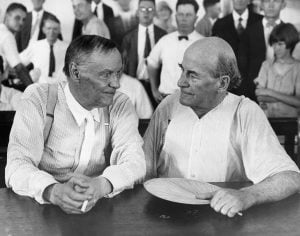
Clarence Darrow, a famous Chicago lawyer, and William Jennings Bryan, defender of Fundamentalism, have a friendly chat in a courtroom during the Scopes evolution trial. Darrow defended John T. Scopes, a biology teacher, who decided to test the new Tenessee law banning the teaching of evolution. Bryan took the stand for the prosecution as a bible expert. The trial in 1925 ended in conviction of Scopes.
Why Christians and Conservatives Should Accept Evolution: Blog Anniversary Guest Post by Michael Shermer (part 1)

September 3, 2022

Here’s the link to this article.

I have been publishing guest posts in celebration of the blog’s tenth anniversary, and am pleased to conclude the series now with two posts by Michael Shermer, whom many of you will know from his writings and media appearances discussing (especially) religion and science.  Michael was a one-time committed fundamentalist turned outspoken skeptic.   Here is the first of his two-parter, on an issue of particular cultural and religious importance.

US public acceptance of evolution is growing but is still low compared to other countries. Why? Religion and politics. Here’s why that need not be.

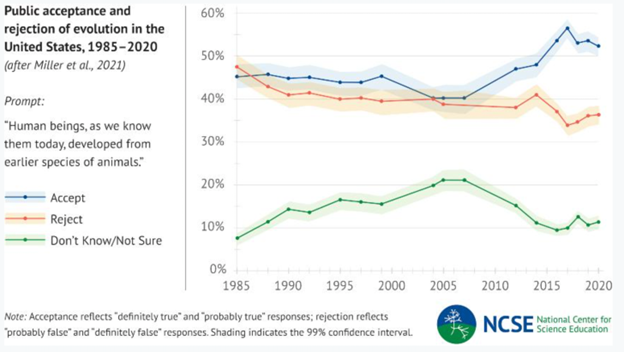
As a career-long student of the century-long evolution-creationism debate I was encouraged to read the results of a new study on “Public Acceptance and Rejection of Evolution in the United States, 1985-2020” by Jon Miller, Eugenie Scott, Mark Ackerman, and Belén Laspra, published in the journal Public Understanding of Science. “Using data from a series of national surveys collected over the last 35 years, we find that the level of public acceptance of evolution has increased in the last decade after at least two decades in which the public was nearly evenly divided on the issue,” the authors write. That sounds encouraging, and the uptick of the blue line of acceptance and downward slope of the orange line of rejection in this graph appears encouraging, until one glances over at the vertical axis showing that progress here is defined as breaking the 50 percent barrier! That’s not especially encouraging for a robust science that began 162 years ago with the publication of Charles Darwin’s On the Origin of Species and accepted by 97 percent of all scientists.

What is the cause in the recent increase (however modest) in the acceptance of the theory? According to the study’s authors:

A structural equation model indicates that increasing enrollment in baccalaureate-level programs, exposure to college-level science courses, a declining level of religious fundamentalism, and a rising level of civic scientific literacy are responsible for the increased level of public acceptance.

Those of us in academia, and especially in the science education business, should find this especially encouraging, but I want to drill down into that variable of “religious fundamentalism,” which the authors defined and quantified as belief in a personal God who hears prayers, reading the Bible as literal truth, frequency of church attendance, frequency of prayer, and agreement with the statement “We depend too much on science and not enough on faith.” There was an inverse correlation between religious fundamentalism and acceptance of evolution: 32 percent acceptance on the high end of the scale compared 91 percent on the lowest end of the scale (and 54 percent of the entire sample). That 30 percent of Americans self-identify as religious fundamentalists goes a long way to explaining their doubt. As does their political affiliation. While 83 percent of liberal Democrats accept the theory of evolution, the researchers found that only 34 percent of conservative Republicans do so.

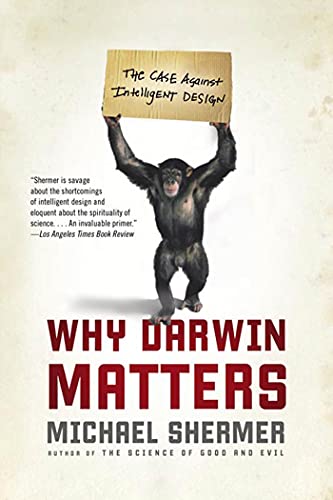
Why do Christians and conservatives doubt evolution? My 2006 book Why Darwin Matters (my only book with full frontal nudity) attempts to answer this question. For brevity here, I will outline four reasons:

          1. Belief that evolution is a threat to specific religious tenets. If one believes that the world was created within the past 10,000 years, that will be in direct conflict with the geological evidence for a 4.6 billion-year old Earth. If one insists on the findings of science squaring true with religious doctrines, this can lead to conflict between science and religion.
          2.  Misunderstanding of evolutionary theory. Many cognitive studies show, such as those by Andrew Shtulman and others in his book Scienceblind: Why Our Intuitive Theories About the World Are So Often Wrong, that most people—both religious believers and secularists alike—have a poor understanding of the theory, mixing in some Lamarckian notions of the inheritance of acquired characteristics (giraffes got their long necks by stretching), a misunderstanding of population genetics, and a fumbled explanation of what, exactly, natural selection is selecting for (not the good of the species or the group, not future environments, not structural or cognitive progress).
          3.  The fear that evolution degrades our humanity. After Copernicus toppled the pedestal of our cosmic centrality, Darwin delivered the coup de gr­ace by revealing us to be “mere” animals, subject to the same natural laws and historical forces as all other animals.
          4.  The equation of evolution with ethical nihilism and moral degeneration. This sentiment was expressed by the neo-conservative social commentator Irving Kristol in 1991: “If there is one indisputable fact about the human condition it is that no community can survive if it is persuaded—or even if it suspects—that its members are leading meaningless lives in a meaningless universe.” Similar fears were raised by Nancy Pearcey, a fellow of the Discovery Institute in a briefing on Intelligent Design before a House Judiciary Committee of the United States Congress. She cited a popular song urging “you and me, baby, ain’t nothing but mammals so let’s do it like they do on the Discovery Channel.” Pearcey went on to claim that since the U.S. legal system is based on moral principles, the only way to generate ultimate moral grounding is for the law to have an “unjudged judge,” an “uncreated creator.”

When Does Human Life Begin?

By Rich Prendergast, 10/25/22

Here is the link to this article.

The essence of the pro-life argument against abortion is their belief that “life begins at conception”. They declare that this isn’t just their opinion; science itself says so. They claim that biologists are in broad agreement on this fact. And if we’re simply talking about the organism itself, they’re 100% correct. When an egg is fertilized, and becomes a zygote, it is unquestionably a new life – one that (if all goes well for it) will eventually develop into a living, breathing person.

So, since the zygote is alive, and since we’re talking about human zygotes, they reason that the zygote is a human life, and that abortion is therefore the intentional taking of a human life (i.e. murder).

But this argument pretends that there is no significant qualitative difference between the “humanity” of the zygote, and that of a living, breathing person, when in fact, the differences are enormous and profound. So the more critical question is whether the zygote is truly a “person”. That’s a question that science alone can’t answer, because determining what truly defines a person, is a philosophical, not a scientific question. Science can only describe the qualities and nature of a zygote (or embryo or fetus).

Pro-lifers will argue that our humanity/personhood is defined by our DNA. Our DNA IS different from all other species, but some fairly significant mutations can occur, and the person is still considered to be human. But at conception, the function of DNA is to manage the workings of the cell, but more significantly, it provides the instructions that will cause this cell to eventually develop into a baby. The DNA is not the person, it’s the instructions for creating the person.

Humans are complex beings, with numerous traits that distinguish us from other animal species. Many, of course, are physical traits. Our bodies have a variety of features that are obviously different from even our closest related species, but those physical traits don’t define our personhood. We could lose all our limbs, and have numerous internal organs transplanted (sometimes with animal parts) or have organs replaced with mechanical substitutes, and few, if any, would argue that we are no longer persons.

Carrying that to the extreme, there is only one feature that is inextricably linked to our personhood – our minds. If a person suffered severe trauma, such that most of the body could not survive, but we could transplant their brain into a machine which could keep it alive, allowing it to interact with the outside world, that PERSON would still be alive. Conversely, we already have numerous examples today in which a person may lose all brain function, with their body otherwise unharmed. We can keep that body alive through the use of machines, but unless there is some reasonable hope of recovery, we don’t. Instead, we decide that their human lives have effectively ended, and we unplug them.

A person is the sum total of their experiences, memories, personality, intelligence, emotions, values, etc. When someone loses all brain function, those things are lost with it. The “person” is gone.

I’ll note that this is not the case for someone who is unconscious or in a temporary vegetative state. They may no longer be aware of their environment, potentially being temporarily non-sentient. But in this case, the “person” still exists within the unresponsive brain.

So if personhood ends with the loss of the mind, it follows that personhood doesn’t begin until the mind exists. So when does that happen? Unfortunately there is no black and white answer to that. On one extreme, the zygote clearly has no mind. On the other extreme, a newborn baby clearly DOES have one, as evidenced by (among other things) the fact that it’s capable of learning.

The fetal brain begins to develop at about 3 weeks, with the first neurons forming. At 5 weeks, a neural tube has formed. Electrical activity in the brain begins at about 8 weeks, which begin to initiate involuntary muscle movements in the womb. By 10 weeks, there is a recognizable brain structure, but it’s smooth, without the characteristic folds of a fully-formed brain. The fetus still has no cerebral cortex, and is non-sentient (i.e. unaware of either itself or its environment). While it may respond to external stimuli, the reactions are purely reflexive. It can feel no pain.

The onset of sentience occurs around 24 weeks. It is only then, that the fetus begins to become AWARE of external stimuli, including feeling pain, etc. But while the fetus is sentient, it is not yet sapient. It can feel, but it cannot think. It has no memories, no emotions, no personality, etc. It is still not yet a “person”. For that, the fetus requires not only sentience, but some degree of sapience.

And this is where things become VERY gray. Gradually over about the next 16 weeks, the fetus evolves from being merely sentient to becoming sapient. That evolution continues after birth, and in fact, the brain takes decades to fully mature. There is no single moment that defines the transition to sapience. Therefore there is no clear-cut moment at which we can say that the fetus’ human life (aka its personhood) has begun. But we know it’s not before about 24 weeks,

In my discussions with abortion opponents, they will commonly argue that these aren’t the same. If someone is in a persistent vegetative state, and it’s determined that there is little to no hope of recovery, that’s entirely different from the fetus, which has a pretty good chance of becoming a fully functioning person. While that’s true, that doesn’t change the fact that the early term fetus is NOT YET a person. Terminating the pregnancy does not kill a person, just as terminating life support for one who is brain dead, does not kill a person (that person is already gone).

Between the 1973 Roe v Wade and the 2022 Dobbs v. Jackson Women’s Health Organization decisions, the various states allowed unrestricted abortions until around 24 weeks (give or take, depending on the state), with later exceptions for severe fetal abnormalities, or to protect the life/health of the woman. The 24 week threshold is not entirely a coincidence. Those laws have typically been based on fetal viability, but it’s not surprising that fetal viability would be correlated in part to brain development. While advances in medical technology will likely continue to improve the viability for younger (earlier-term) fetuses, these are unlikely to accelerate the onset of sentience.

But given those laws, my perception is that they gave plenty of time in the overwhelming majority of cases, for women to become aware of a pregnancy, to decide if they wanted to carry it to term, and to get an abortion if not.

At the risk of inviting the “no uterus, no opinion” reactions from women, I personally think those laws were pretty good, and I’m uncomfortable with suggestions that abortion ought to be completely unrestricted, because I agree with abortion opponents, that the personhood status (from a philosophical and scientific perspective) isn’t materially changed when a baby leaves the womb and takes its first breath. (Though obviously the LEGAL personhood status DOES change at that moment).

A primary argument from many pro-choicers, is the right of women to bodily autonomy. I absolutely agree with it, but I think the argument becomes weaker as the pregnancy continues. The woman has that right, but early in the pregnancy there is, as yet, no “person” in the womb that could have any competing rights. Late in pregnancy, however, that’s not the case. At that point, there are valid ethical questions as to whether bodily autonomy should take precedence over protecting the life of a sentient being.

I draw an analogy to a situation in which I’m holding onto someone to prevent them from falling off a cliff. At that moment, the other person is completely dependent on me for their survival. But do I have an obligation to give up my own autonomy, and continue holding them? If I can do so without risking my own safety, most people would agree that it would be unethical to let that person fall to their death.

It’s really not much different than if one is driving along, and a person walks in front of your vehicle. Even though you have the legal right of way, you also have a legal obligation to attempt to avoid hitting that person, IF you can do so without significantly endangering yourself or others.

These competing interests were overtly recognized in the Roe decision, and resulted in laws that adopted a reasonable balance between those interests. Since the Dobbs decision, many states have abandoned that balance, and rejected any notion of a right to bodily autonomy, while absurdly granting rights to a single cell.

It is my opinion that we need to restore the balance that was established by Roe. I believe that women should have an unrestricted right to abortion for about the first 24 weeks, with later exceptions for cases of severe fetal abnormality, and to protect the life and health of the woman. The approximate 24 week threshold is not based on viability considerations, but rather the criterion of sentience discussed above.

I do not support unrestricted abortions throughout pregnancy. And for what it’s worth, I believe that those who push for this are hurting the greater cause, by shifting the debate to that extreme position, rather than focusing energy on the more moderate position that has pretty widespread support. I see little chance that pro-lifers will be persuaded by any argument that denies personhood considerations for late term fetuses, or declares that those considerations are completely irrelevant in the face of rights to bodily autonomy.

Faith vs. Fact, by Jerry Coyne. Reading Session #3 (continuing Chapter 1, The Problem)

This is a great book. Eye-opening, especially to those who’ve never considered the incompatibility of science and religion.

I encourage you to watch my computer screen, listen, and think as I read aloud the words written by the brilliant evolutionary biologist Jerry Coyne.

Click the link below to begin Reading Session #3 (sorry, but I think I refer to this session as Session #2). This session starts at Kindle Page 11, Location 500.

https://screencast-o-matic.com/watch/c36rYkVu1v1

Faith vs. Fact, by Jerry Coyne. Reading Session #2 (Chapter 1, The Problem).

This is a great book. Eye-opening, especially to those who’ve never considered the incompatibility of science and religion.

I encourage you to watch my computer screen, listen, and think as I read aloud the words written by the brilliant evolutionary biologist Jerry Coyne.

Click the link below to begin Reading Session #1.

https://screencast-o-matic.com/watch/c36Yr7VueFi

Faith vs. Fact, by Jerry Coyne. Reading Session #1 (Preface: The Genesis of this Book).

This is a great book. Eye-opening, especially to those who’ve never considered the incompatibility of science and religion.

I encourage you to watch my computer screen, listen, and think as I read aloud the words written by the brilliant evolutionary biologist Jerry Coyne.

Click the link below to begin Reading Session #1.

https://screencast-o-matic.com/watch/c36qqLVtWrP

The Varieties of Scientific Experience by Carl Sagan

I’m reading:

The Varieties of Scientific Experience is a great book by the brilliant, humble, and awe-inspiring Carl Sagan.

Here’s the book abstract from Amazon:

“Ann Druyan has unearthed a treasure. It is a treasure of reason, compassion, and scientific awe. It should be the next book you read.” —Sam Harris, author of The End of Faith

“A stunningly valuable legacy left to all of us by a great human being. I miss him so.”  —Kurt Vonnegut

Carl Sagan’s prophetic vision of the tragic resurgence of fundamentalism and the hope-filled potential of the next great development in human spirituality


The late great astronomer and astrophysicist describes his personal search to understand the nature of the sacred in the vastness of the cosmos. Exhibiting a breadth of intellect nothing short of astounding, Sagan presents his views on a wide range of topics, including the likelihood of intelligent life on other planets, creationism and so-called intelligent design, and a new concept of science as “informed worship.” Originally presented at the centennial celebration of the famous Gifford Lectures in Scotland in 1985 but never published, this book offers a unique encounter with one of the most remarkable minds of the twentieth century.


And, here’s a taste of what to expect—an extract from the Editor’s Introduction:

[Carl] avidly studied the world’s religions, both living and defunct, with the same hunger for learning that he brought to scientific subjects. He was enchanted by their poetry and history. When he debated religious leaders, he frequently surprised them with his ability to out-quote the sacred texts. Some of these debates led to longstanding friendships and alliances for the protection of life.


However, he never understood why anyone would want to separate science, which is just a way of searching for what is true, from what we hold sacred, which are those truths that inspire love and awe. His argument was not with God but with those who believed that our understanding of the sacred had been completed.


Science’s permanently revolutionary conviction that the search for truth never ends seemed to him the only approach with sufficient humility to be worthy of the universe that it revealed. The methodology of science, with its error-correcting mechanism for keeping us honest in spite of our chronic tendencies to project, to misunderstand, to deceive ourselves and others, seemed to him the height of spiritual discipline. If you are searching for sacred knowledge and not just a palliative for your fears, then you will train yourself to be a good skeptic.


The idea that the scientific method should be applied to the deepest of questions is frequently decried as “scientism.” This charge is made by those who hold that religious beliefs should be off-limits to scientific scrutiny—that beliefs (convictions without evidence that can be tested) are a sufficient way of knowing. Carl understood this feeling, but he insisted with Bertrand Russell that “what is wanted is not the will to believe, but the desire to find out, which is the exact opposite.” And in all things, even when it came to facing his own cruel fate—he succumbed to pneumonia on December 20, 1996, after enduring three bone-marrow transplants—Carl didn’t want just to believe: He wanted to know.


Until about five hundred years ago, there had been no such wall separating science and religion. Back then they were one and the same. It was only when a group of religious men who wished “to read God’s mind” realized that science would be the most powerful means to do so that a wall was needed. These men—among them Galileo, Kepler, Newton, and, much later, Darwin—began to articulate and internalize the scientific method. Science took off for the stars, and institutional religion, choosing to deny the new revelations, could do little more than build a protective wall around itself.


Science has carried us to the gateway to the universe. And yet our conception of our surroundings remains the disproportionate view of the still-small child. We are spiritually and culturally paralyzed, unable to face the vastness, to embrace our lack of centrality and find our actual place in the fabric of nature. We batter this planet as if we had someplace else to go. That we even do science is a hopeful glimmer of mental health. However, it’s not enough merely to accept these insights intellectually while we cling to a spiritual ideology that is not only rootless in nature but also, in many ways, contemptuous of what is natural.


Carl believed that our best hope of preserving the exquisite fabric of life on our world would be to take the revelations of science to heart. And that he did. “Every one of us is, in the cosmic perspective, precious,” he wrote in his book Cosmos. “If a human disagrees with you, let him live. In a hundred billion galaxies you will not find another.” He lobbied NASA for years to instruct Voyager 2 to look back to Earth and take a picture of it from out by Neptune. Then he asked us to meditate on that image and see our home for what it is—just a tiny “pale blue dot” afloat in the immensity of the universe.


He dreamed that we might attain a spiritual understanding of our true circumstances. Like a prophet of old, he wanted to arouse us from our stupor so that we would take action to protect our home. Carl wanted us to see ourselves not as the failed clay of a disappointed Creator but as starstuff, made of atoms forged in the fiery hearts of distant stars. To him we were “starstuff pondering the stars; organized assemblages of 10 billion billion billion atoms considering the evolution of atoms; tracing the long journey by which, here at least, consciousness arose.”


For him science was, in part, a kind of “informed worship.” No single step in the pursuit of enlightenment should ever be considered sacred; only the search was. This imperative was one of the reasons he was willing to get into so much trouble with his colleagues for tearing down the walls that have excluded most of us from the insights and values of science. Another was his fear that we would be unable to keep even the limited degree of democracy we have achieved.


Our society is based on science and high technology, but only a small minority among us has even a superficial understanding of how they work. How can we hope to be responsible citizens of a democratic society, informed decision makers regarding the inevitable challenges posed by these newly acquired powers?


This vision of a critically thoughtful public, awakened to science as a way of thinking, impelled him to speak at many places where scientists were not usually found: kindergartens, naturalization ceremonies, an all-black college in the segregated South of 1962, at demonstrations of nonviolent civil disobedience, on the Tonight show. And he did this while maintaining a pioneering, astonishingly productive, fearlessly interdisciplinary scientific career.

Sagan, Carl (2006-11-01T23:58:59.000). The Varieties of Scientific Experience . Penguin Publishing Group. Kindle Edition.