“My overdosing on religion was becoming a serious problem”

Here’s the link to this article.

By David Madison at 8/11/2023

It’s a problem for the world as well

When Christopher Hitchens died in December 2011, a volcano of Christian hate erupted. Devout folks who’d never heard of him suddenly found out that he’d written a book (2009) titled, God Is Not Great: How Religion Poisons EverythingThey spewed rage and invective on social media, savoring the idea that Hitchens was suffering—and would suffer forever—in the fires of hell. “Love your enemy” (Jesus-script, Matthew 5:44) has probably rarely been so widely ignored. Ironically, their fury probably drove sales of the book—which even now, fourteen years later, has a high Amazon sales ranking. 

It is my suspicion that most of these outraged folks are also unaware of the extensive role religion has played in poisoning the human experience. The gospel of John fueled anti-Semitism, no doubt inspiring Martin Luther’s murderous rage against the Jews, which in turn helped provide the Nazi rationale for the Holocaust. The Crusades were religion-motivated wars. Slavery was easily championed by good Christians who took their Bibles seriously. Our democracy is in jeopardy because obsessive-compulsive believers want to impose their understanding of god on everyone. The evidence of religious poison is on the news every day.

And notice this as well. Just as “love your enemy” was ignored, religious fervor stoked rage, at the same time that it has suppressed curiosityWhat percentage of those enraged believers paused to consider what Hitchens meant by those two claims in his title?

God Is Not Great and 

How Religion Poisons Everything 

Yes, the poison has manifested in such major killing events as the crusades and slavery, but the poison infects individual human minds, stimulating rage, blunting curiosity. Not too long ago, a devout Catholic woman told me that the priests and nuns had told them not to think about what they learned in catechism. Protestants can claim no superiority in this regard. Churches do not thrive on curiosity and skepticism. 

When parents are fully committed to this close-minded approach to religion, the poison is sometimes administered full strength. I recently came across an article, written in 2016 by Josiah Hesse, titled Apocalyptic Upbringing: How I Recovered from My Terrifying Evangelical Childhood.

He opens with an account of his retreat to the basement—he was ten years old—during a terrifying storm. Awareness of his sin was uppermost in his mind: “My parents were home late and my first thought was that they’d been raptured up to heaven. I was a sinner who had been left behind to face the Earth’s destruction.” 

“Thunder boomed as I opened my Bible to the Book of Revelation, a passage I knew well after years spent on my dad’s knee as he read it aloud to his kids…I would have to hide from the antichrist, who would force all those left on Earth to renounce Christ and receive the mark of the beast on their right hand or forehead. Anyone found with the beast’s mark after death would be thrown into the lake of fire.”

Is there any better example of religious poison? Richard Carrier has described the book of Revelation as “a veritable acid trip, an extended hallucination of the bizarrest kind, an example of the kind of thing going on all the time in the early churches…” (p. 136, On the Historicity of Jesus: Why We Might Have Reason for Doubt). There is such a feast of bad theology in the Bible, with the book of Revelation ranking pretty high in that category. It’s no surprise that some denominations choose to focus on these sick texts. Nor is it a surprise that parents who have been groomed to teach such religion to their children are actually guilty of abuse. 

I was raised by a very devout mother who, even so, had a high quotient of common sense. Thus I never suffered the way Josiah Hesse did:

“…my childhood was filled with more biblical prophecy than Sesame Street good times. The urgency of avoiding hell surpassed any trivial education the world had to offer. After all, if you’re staring down the barrel of eternal torment, who has the time for algebra?

“Salvation was attached to belief, and in order to protect my belief I had to censor my thoughts. The book of Mark says that ‘whoever blasphemes against the Holy Spirit never has forgiveness, but is guilty of an eternal sin.’ So I was careful to never even think a thought that could be considered blasphemous. This was profoundly exhausting; and while I was mostly successful at repressing my intellectual curiosity during the day, once sleep came I lost all security clearance to my own mind.

“My dreams were terrorized by a wide-eyed witch who worked for the devil.”

Hesse was born in 1982, so he was a teenager as the year 2,000 drew near. 

“As 2000 approached, my panic attacks grew more severe. I pondered the nature of eternity nearly every minute of the day. Whether torture or paradise, the concept itself filled me with existential dread. Eternity. As in, forever. And ever. And then more. And more. I just couldn’t wrap my head around it.” 

From his adult perspective now—yes, there’s a mostly happy ending—he saw that “…my overdosing on religion was becoming a serious problem.”

Eventually curiosity kicked in, at least at the level of trying to find outside verification for the Bible. He even read works by “those who despised Christianity’—and this included Christopher Hitchens, whose severe critique of religion is hard to refute. So Hesse was one of those Christians who gave curiosity as much space as rage. And he finally snapped out of it:

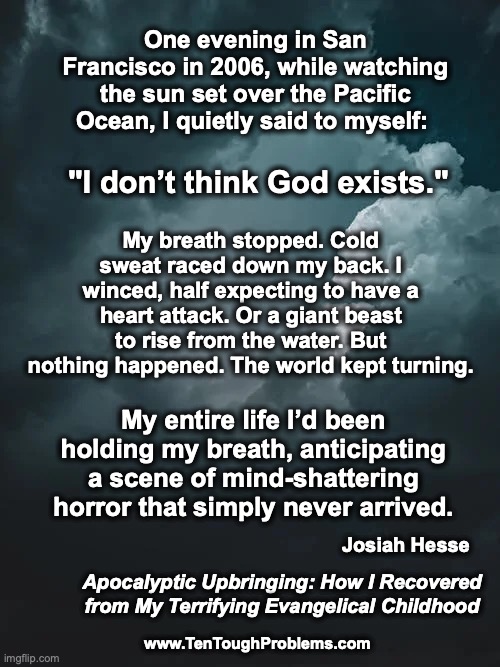
“Then one evening in San Francisco in 2006, while watching the sun set over the Pacific Ocean, I quietly said to myself: ‘I don’t think God exists.’ My breath stopped. Cold sweat raced down my back. I winced, half expecting to have a heart attack. Or a giant beast to rise from the water. But nothing happened. The world kept turning…My entire life I’d been holding my breath, anticipating a scene of mind-shattering horror that simply never arrived.”

Looking back, Hesse is generous in his assessment of his parents. “…little of the blame belongs on my parents’ shoulders. They were young, idealistic Christians when they had me, and like so many religious parents, only had the best of intentions of rearing me in their faith.” And had little understanding of how much damage can be caused by religious fervor. “I asked my dad if he’d known about the intense anxiety I’d suffered throughout my childhood. ‘I knew you were afraid. You were such a scared little boy. I didn’t know what to do.’”

Not knowing what to do can be expected when the devout are discouraged from thinking about what they’ve been taught by clergy and parents. They are sheltered from the wide world of ideas and knowledge outside the narrow religious mindset (they could learn, for example, that the book of Revelation shouldn’t be taught to children). Sometimes the abused kids descend into fear—as Josiah Hesse describes his situation. But in other cases, the result is rage, radicalization, and terrorism. Christopher Hitchens, referring to the 9/11 attacks, notes: 

“The nineteen suicide murderers of New York and Washington and Pennsylvania were beyond any doubt the most sincere believers on those planes. Perhaps we can hear a little less about how ‘people of faith’ possess moral advantages that others can only envy” (p. 32, God Is Not Great). 

Nor do the people of faith possess advantages in the realm of ideas, in their understanding of how the world works. They usually are bound to ancient superstitions—and Christianity is quite a bundle of them. But this is the case for religions in general, as Hitchens states so persuasively:

“How much effort it takes to affirm the incredible! The Azteks had to tear open a human chest cavity every day just to make sure that the sun would rise. Monotheists are supposed to pester their deity more times than that, perhaps, lest he be deaf. How much vanity must be concealed—not too effectively at that—in order to pretend that one is the personal object of a divine plan? …How many needless assumptions must be made, how much contortion is required, to receive every new insight of science and manipulate it so as to ‘fit’ with the revealed words of ancient man-made deities?”  (p. 7, God Is Not Great)

Billions of humans still overdose on religion, and thus remain unaware of what science has discovered about the world, and how the cosmos works. These discoveries provide far more awe and wonder than ancient superstitions and magical thinking ever could. But the awe and wonder delivered by science can be too scary, and prompts many to cling to religious fantasies construed as reality. “Our place in the cosmos,” Hitchens notes, “is so unimaginably small that we cannot,

with our miserly endowment of cranial matter, contemplate it for long at all” (p. 91, God Is Not Great).  

Earlier I noted that, for Josiah Hesse, it was mostly a happy ending. By which I mean that he did manage to put god-belief behind him. But, as of 2016 when he wrote the article, he was still plagued by horrible nightmares. However, he has made his way as a journalist and writer. This is his website, and a link to a recent podcast interview. 

He has moved beyond overdosing on religion—and is a much better, happier person because he managed to do it. He can still be haunted by the frightful apocalyptic imagery of his youth:

“Then I take a deep breath, reminding the frightened child inside me that he is safe, that the world may be full of uncertainty and pain and confusion, but we are here, now, and there are no locusts with the heads of lions likely to come out of the Earth any time soon.”

David Madison was a pastor in the Methodist Church for nine years, and has a PhD in Biblical Studies from Boston University. He is the author of two books, Ten ToughProblems in Christian Thought and Belief: a Minister-Turned-Atheist Shows Why You Should Ditch the Faith, now being reissued in several volumes, the first of which is Guessing About God (2023) and Ten Things Christians Wish Jesus Hadn’t Taught: And Other Reasons to Question His Words (2021). The Spanish translation of this book is also now available. 

His YouTube channel is here. At the invitation of John Loftus, he has written for the Debunking Christianity Blog since 2016.

The Cure-for-Christianity Library©, now with more than 500 titles, is here. A brief video explanation of the Library is here

Did Jesus of Nazareth Rise from the Dead?

Here’s the link to this article.

Robert Shaw | July 30, 2022 | Kiosk Article

Bible: New Testament | Christianity | History of Religion | Jesus | Resurrection ]


The majority of biblical scholars, and those with an interest in the origins of Christianity, see the crucifixion of Jesus of Nazareth as a historical reality. While it is important to recognize a vociferous and often well-informed ‘Jesus mythicism’ movement whose members hold that none of the events in Jesus’ life actually happened, the Crucifixion passes a number of tests used by historians. First, references to it appear in independent sources, and while one must be very cautious indeed when considering the hugely hagiographic Gospels, renowned chroniclers such as Tacitus[1] and Josephus[2] refer to it. The Crucifixion is also historically consistent with practices within the Roman Empire; those who were deemed to be a threat to Roman order were summarily nailed to a cross and left to die. Most convincingly, Jesus’ execution passes the so-called ‘criterion of embarrassment.’ This suggests that statements are more likely to be true if they are embarrassing to those making them and are unlike what they would be expected to invent. For the early Christians to have invented the detail of the Crucifixion seems implausible. Jesus was meant to have led Israel into a new golden age, not to be ignominiously killed by its enemy, the Romans. The Crucifixion also requires no supernatural beliefs and so does not demand that we suspend our belief that the laws of biology apply at all times.

The Resurrection is a different matter. Ultimately, organisms cannot come back to life if all biological functions have ceased for a few days. For this reason, the necessary position for humanists to take is that the events following the Crucifixion did not happen as the Bible portrays: that a human verified to be dead by a Roman centurion (Mark 15:44), wrapped in cloth, and placed in a tomb with a rock rolled in front of its entrance (Mark 15:46) was able, two days later, to revive, roll the stone away, and leave (Mark 16:4-6). It helps us, however, to have a hypothesis for the events following the Crucifixion, particularly as many of the early followers of Jesus seem to have genuinely believed and testified to the fact that he had risen from the dead.

In fact, they did not kill him, nor did they crucify him, but it appeared to them as if they did. (Qur’an 4:157)

Interestingly, one of the first attempts at supplying a naturalistic explanation for the Resurrection comes from the early days of Islam. Muslims to this day have believed that Jesus was a mere prophet, unblessed with divine powers. The most common interpretation of the above verse from the Qur’an is that someone resembling Jesus was crucified, thus providing us with an explanation as to why he was seen following the Crucifixion; it was not him on the cross, but either a willing volunteer, a stooge, or a victim of Roman mistaken identity. Another hypothesis based around the idea that Jesus did not die on the cross—the ‘swoon hypothesis’—had its first famous exponent in the form of maverick German biblical scholar Karl Friedrich Bahrdt. In the 1700s he proposed that it was actually Jesus who was crucified, but that a combination of drugs and resuscitation by Joseph of Arimathea (a follower to whom the body was subsequently entrusted) enabled him to cheat death.[3]

There is evidently a state of being when someone can appear to be dead, when the heartbeat is undetectable, though he/she is still technically alive. In the modern era, methods of determining death are of course more exact, but even as late as 1895, the physician J. C. Ouseley claimed that as many as 2,700 people were buried prematurely each year in England and Wales for this reason alone.[4] Many give the fact that the Gospels say that Jesus was only on the cross for six hours as evidence for this hypothesis—it would generally take people a couple of days before they finally expired. However, there are alternative explanations as to why Jesus was reported to have been on the cross for a short space of time. One is that the flogging that he had received prior to being crucified hastened his death (John 19:1Mark 15:15, & Matthew 27:26). It could also be suggested that he was merely reported to have been on the cross for a short time to make events compliant with Jewish law. Not only would leaving him overnight have meant that anointing would have to take place on the Sabbath—which would have involved work in contravention of the Ten Commandments (Exodus 20:8)—but there was also a law in the Torah that a body should not be “left on a tree overnight” (Deuteronomy 21:22).

However, the swoon hypothesis fails, as it takes as given the historically inconsistent assertion that Pontius Pilate, the Roman governor who presided over the province of Judaea from 27 to 37 CE (and over the Crucifixion), would allow a body to be taken down from a cross and given a burial. First, one of the purposes of crucifixion was to act as a deterrent to anybody who even harbored thoughts that they might challenge the power of Rome. To this end, crucified corpses would be left on crosses for days for all to see, with birds of prey feasting on the remains. Victims were then typically ‘buried’ in a crude common grave. Second, for Pilate to allow someone to be taken down prematurely is at odds with what we can learn about his character from the sources available to us. The Gospels paint the picture of Pilate as an amenable and weak figure. However, their writers wanted to make Jesus’ Jewish opponents guilty for the sentencing of Jesus, so it was necessary to depict Pilate as being so easily swayed by them.

Two other sources may give us a more accurate description of Pilate. Philo of Alexandria, a Jew who chronicled 1st-century Jewish life in the Levant, describes Pilate as “a man of inflexible, stubborn and cruel disposition” and recalls an incident that may have occurred in the very same year as the Crucifixion itself. Pilate had commissioned some golden shields to be made honoring the then-emperor Tiberius, which he displayed at his palace in Jerusalem. Local Jews protested at the tribute to a figure regarded as a deity, or at least a ‘son of god,’ by Romans, and requested their removal. Pilate flatly refused. He refused again when members of King Herod’s family intervened, only eventually agreeing to move them out of Jerusalem when the Emperor himself intervened after being petitioned by the Herodians.[5] The Jewish historian Josephus tells of Pilate using treasure looted from the Jewish temple in Jerusalem to pay for an aqueduct. Pilate had those taking part in the subsequent protest beaten with clubs, with many dying from the brutality of the punishment or through being trampled by horses.[6] Both events suggest that Pilate was a much more intransigent figure, unsympathetic or even ignorant of Jewish sensitivities. The suggestion that he would show compassion towards a Jewish sect’s wishes towards a leader that he had put to death for sedition seems implausible.

That said, the Resurrection was not completely an invention of the Gospel writers, writing as they did at least thirty years after the events that they claim to recount. The Resurrection was not a late addition to the legends about Jesus. Instead, it was a tradition that can be traced back to the very roots of Christianity. Our very first Christians scriptures were written in the 50s CE by Paul, who, although he had never met Jesus in his lifetime, became a key player in the early development of Christianity. Paul mentioned the Resurrection of Jesus throughout his writings, and it is clear that in his letters to churches based around the Mediterranean that it was a firmly established belief. However, there are a number of other aspects of later Christian beliefs that he did not seem to know about, such as the Virgin Birth and the Ascension (Jesus’ bodily return to Heaven after the Resurrection). Paul also made no mention of any of Jesus’ miracles, and the only quote in any of his writings is where Jesus asked his followers to partake in the breaking of bread and drinking of wine in remembrance of him (1 Corinthians 11:24-25).

Similarly, there was no mention of what many of us recognize as the key elements of the Christian account of the resurrection of Jesus in Paul’s writings. There was no mention of the taking down of the body from the cross, the tomb, the stone, the visit two days later by followers, the stone being rolled away, or the earthquakes and the presence of angelic beings (Matthew 28:2). There was no talk of the discourse and meetings that Jesus is said to have subsequently had with his disciples (Matthew 28Luke 24John 20 & John 21), or any reference to the Ascension.

[H]e appeared to Cephas [St. Peter], then to the twelve [disciples]. Then he appeared to more than five hundred brothers and sisters at one time, most of whom are still alive, though some have died. Then he appeared to James, then to all the apostles. Last of all, as to one untimely born, he appeared also to me. (1 Corinthians 15:5-8)

Paul does not mention these traditions because ultimately they did not yet exist. The renowned New Testament professor and theologian Rudolf Bultmann remarked: “the accounts of an empty tomb are legends, of which Paul as yet knew nothing.”[7] Another important point to consider is that Paul’s quote above does not reveal any distinction between the Resurrection experiences of the disciples—men who spent their time with Jesus during his earthly life—and those of his own; his encounter with the risen Jesus is not distinct from that of the disciples. And to Paul, the body that Jesus was resurrected in was “not natural,” but “spiritual” (see 1 Corinthians 15:44), and one with which he did not record any interactions, by either himself or anybody else. One can almost envisage the viewings of Jesus as akin to a ghostly apparition; this was perhaps the only way that he could be seen by followers who were cognizant of the fact that Jesus could not be resurrected in his earthly body—it would have simply been too badly damaged after days (not hours) on the cross.

In the Gospels, written at least thirty years after the event, Jesus becomes essentially a reanimated human body after the Resurrection, able to talk with disciples and eat fish—so possessive of a material digestive system and vocal tract—and with a body whose crucifixion wounds could be touched by Thomas (John 20:27). The writers of the later book of Acts, said to have been written by the same author who wrote Luke’s gospel, had to deal with the fact that Paul could not have experienced this type of risen Jesus; Paul was not part of the inner circle of the Jesus movement until some years after the Crucifixion, and was certainly not around within the forty-day window that the Book of Acts says was afforded to other followers before the Ascension (Acts 1:3). Paul is therefore depicted as seeing Jesus as a light in the sky while he is traveling on the road to Damascus some years later (Acts 9:3-9).

One of the methods used by historians to determine historical truth is to show a preference to those sources that originate closest to the time of the events that they report. As Torsten Thurén states in his highly regarded 1997 book Source Criticism, “the closer a source is to the event that it purports to describe, the more one can trust it to give an accurate historical description of what actually happened.”[8] Therefore, if we are to find any kernel of truth in the Resurrection narratives in the Bible, it must be in Paul’s initial nebulous, vision-type experiences that he suggests are experienced both by Jesus’ closest contemporary followers and by himself, a later convert. The later Gospel accounts (that disagree with each other in a number of ways) can be dismissed as fanciful invention.

In his book How Jesus Became God[9], Bart Ehrman gives three criteria that make such visions of the deceased much more common. All of them are met in the case of the death of Jesus of Nazareth. They happen when “the deceased was especially beloved; when his or her death was sudden, unexpected, or violent; and when the visionary feels guilt.” With regards to the latter, the criterion of embarrassment might suggest that there might be some truth in the Bible accounts of disciples deserting Jesus in the hours approaching the Crucifixion (see Mark 14:50 & Matthew 26:56)—an act about which Jesus’ followers may have experienced considerable guilt, thus exacerbating their visionary experiences further. Such postdeath encounters with the dead are very, very real to those undergoing them. They explain why Jesus’ early followers insisted so fervently on the resurrection of Jesus as an event grounded in reality, helping to make it such a widely held belief almost two thousand years later.

Notes

[1] Tacitus, The Annals, trans. F. Goodyear, T. Woodman, and R. Martin (Cambridge, UK: Cambridge University Press, 1972). (Originally written 2nd century CE.)

[2] Josephus, Jewish Antiquities (Cambridge, MA: Harvard University Press, 1998). (Originally written 93-94 CE.)

[3] More details about the swoon hypothesis can be found on Wikipedia.

[4] Jan Bondeson, Buried Alive: The Terrifying History of our Most Primal Fear (New York, NY: Norton, 2001).

[5] Philo, The Complete Works of Philo, trans C. D. Yonge (Peabody, MA: Hendrickson, 1991). (Originally written 1st century CE.)

[6] Josephus, Jewish Antiquities.

[7] Rudolf Bultmann, Theologie des Neuen Testaments (Tübingen, Germany: Mohr/Siebeck, 1984).

[8] Torsten Thurén, Källkritik (Stockholm, Sweden: Almqvist & Wiksell, 1997).

[9] Bart Ehrman, How Jesus Became God (New York, NY: Harper Collins, 2014).

No, it’s not ‘workism’ that’s killing the church

Here’s the link to this article.

Avatar photoby ADAM LEE

AUG 14, 2023

Times Square, cluttered with crowds and ads | Workism isn't the church's real problem
Credit: Pixabay

Overview:

Americans are overworked and overly devoted to the hustle, but that’s not why organized religion is declining. Church apologists trying to explain their decline always look outward, never inward at themselves.

Reading Time: 6 MINUTES

[Previous: Church isn’t the answer to hustle culture]

Christianity in America is suffering an unprecedented decline.

Once-thriving congregations are shrinking and graying. Parishes are being consolidated. Closed-down churches are being reborn as bookstores and breweries, concert halls and apartments.

Surveys find that nonreligious Americans—or “nones”—now constitute about 30% of the population, outnumbering every single Christian denomination. If current trends continue, nones could be a majority by 2070.

The decline has become so obvious that even Christian propagandists can’t sweep it under the carpet. So they’re in search of explanations, preferably explanations that absolve them of blame. In the Atlantic, orthodox apologist Jake Meador proposes one:

Contemporary America simply isn’t set up to promote mutuality, care, or common life. Rather, it is designed to maximize individual accomplishment as defined by professional and financial success. Such a system leaves precious little time or energy for forms of community that don’t contribute to one’s own professional life or, as one ages, the professional prospects of one’s children. Workism reigns in America, and because of it, community in America, religious community included, is a math problem that doesn’t add up.“The Misunderstood Reason Millions of Americans Stopped Going to Church.” Jake Meador, The Atlantic, 29 July 2023.

Meador paints a picture of a society that worships work above all else. He argues that high-stress jobs, inflexible schedules, and the capitalist drive to use every moment “productively” have severed the bonds of community. People are isolated, stressed, and exhausted. They’re so immersed in the hustle mindset that they drift away from religion because they can’t conceive of spending time on something that doesn’t make money.

To the churches and their defenders, this is a comforting story. It allows them to tell themselves that they haven’t been rejected. They’ve merely been pushed aside by the hustle and bustle of modern life. It holds out the promise that, if they can cut through the noise and make themselves heard, they can persuade young people to come back.

However, this face-saving explanation has a flaw.

The evidence, drawn from polls and interviews, paints a different picture. It’s not the case that young people have drifted away from church because they’re too busy with their side hustles and their TikToks. Rather, millions have chosen to cut ties with organized religion because they have stark disagreements with its moral teachings—and because the churches allow no room for dissent or difference of opinion.

The churches’ problem isn’t that they’re drowned out in the din and can’t make themselves heard. On the contrary, we hear them loud and clear.

A case in point is Charles Chaput, the archbishop of Philadelphia. In 2016, he urged liberal Catholics to quit the church. According to Chaput, people who call themselves Catholic but support abortion, contraception or LGBTQ rights are faithless liars. He declared that the church would be better off without them. Like other conservatives, he prefers a smaller, more ideologically pure church to a larger one with more diversity of opinion.

And young people are taking him at his word. According to a Pew survey, two-thirds of former Catholics left the church, not because they’re too busy, but because they stopped believing in its teachings.

Sixty years behind the times and going backward

On issue after issue, the pattern is the same. The churches’ problem isn’t that they’re drowned out in the din and can’t make themselves heard. On the contrary, we hear them loud and clear. The problem is that they’ve doubled down on moral stances that are the polar opposite of what young people believe and care about.

The second wave of feminism was more than sixty years ago, yet many churches still reject the most basic notions of gender equality. America’s two largest Christian denominations, Roman Catholic and Southern Baptist, refuse to allow women to take any leadership role. Just this year, the Southern Baptist Convention expelled two churches—including Rick Warren’s Saddleback Church—for the sin of hiring women as pastors. Women who speak out against this gross inequality have been flooded with harassment and hate mail.

To appease the religious minority that believes this, Christian churches have set themselves against the vast majority.

Above all else is the question of abortion. The repeal of Roe was a painful wake-up call, jolting women with the realization that their right to control their own bodies is slipping away. Young people recognize that opposition to abortion is motivated by religion. The churches have been loud and proud in their support of abortion bans, whereas nonbelievers are almost unanimously pro-choice.

And the religious right isn’t planning to stop there. They’re pushing for even more radical restrictions of women’s rights. Their next frontier is trying to scrap no-fault divorce, which would keep people trapped in abusive or unhappy marriages. Almost 70% of divorces are initiated by women, so this is another anti-feminist idea in thin disguise.

Putting people back in boxes

You can tell a similar story about LGBTQ rights. Millennials like me, who came of age in the early 2000s, remember the Christian crusade against gay and lesbian rights, especially same-sex marriage. The Nashville Statement, signed by more than 150 evangelical leaders, declared their eternal opposition to LGBTQ rights in every form.

Of course, they didn’t win that battle. Marriage equality is a reality, delivered by the Supreme Court and reinforced by Congressional legislation. Americans support LGBTQ rights by enormous majorities. More than two-thirds of Americans support marriage equality, including majorities in 47 of 50 states. Three-quarters say LGBTQ people should be protected from discrimination.

However, anti-gay Christians haven’t given up. They’re still fighting a rearguard action, claiming a religious right to discriminate against LGBTQ people. In red states, Christian legislators are banning books with gay characters and passing Don’t Say Gay laws.


READ: The Atlantic accidentally reveals Christianity’s growing irrelevance


In fact, the Christian opposition to gay rights has only grown more vicious. A tragic example was Urban Christian Academy, a private Christian school in Kansas City that provided underprivileged children with a tuition-free education. When the school updated its mission statement to affirm LGBTQ rights, angry religious donors pulled their support. The school lost nearly all its funding and was forced to close its doors.

Transgender people face even more brutal persecution. Wherever they have power, religious conservatives want to police their bathroom use; deny them access to gender-affirming medical care; even take away children from transgender families. So virulent is their opposition to anything and everything that smacks of weakening the gender binary, a Christian university fired two (cisgender) employees merely for putting their pronouns in their e-mail signatures.

As with women’s rights and gay rights, attacks on transgender people are rooted in a religious belief that sex and gender are strictly binary and fixed at birth, and for people to want to break out of these boxes goes against the will of God. However, to appease the religious minority that believes this, Christian churches have set themselves against the vast majority. An April 2023 poll—by Fox News, no less!—finds that 86% of Americans say political attacks on transgender kids are a serious problem.

Insular and hostile

The root cause of these culture-war clashes is that most churches, especially evangelical churches, have turned insular and hostile. They’re dens of conservatism—and not traditional small-government conservatism, but radical, norm-breaking Trumpian conservatism.

Russell Moore, a former top official of the Southern Baptist Congregation, made waves recently when he spoke about pastors whose congregants scorn the literal teachings of Jesus as “liberal talking points” and “weak”.

As churches grow more fanatical, they’re also receding further from objective reality. Many pastors complain that QAnon and other noxious conspiracy theories are swallowing up their congregations. Surveys find that as many as 50% of white evangelicals are QAnon believers.

Most churches, especially evangelical churches, have turned insular and hostile.

The few prominent Christians who aren’t caught up in the tide of conspiracies have lamented how gullible their fellow believers are. Evangelical author Ed Stetzer said in 2017 that “the spreading of these conspiracies are hurting our witness and making Christians look, yet again, foolish.”

However, no one heeded him. The plague of conspiracy beliefs only got worse—so much so that by 2020, he was pleading, “If you still insist on spreading such misinformation, would you please consider taking Christian off your bio so the rest of us don’t have to share in the embarrassment?”

Looking in the mirror

Is hustle culture a real problem? Yes. Have some people stopped attending church because they’re too busy? Almost certainly.

However, Christian apologists use this as a way to avoid looking in the mirror. They want to believe that Christianity’s decline isn’t their fault. That way, they don’t have to do anything differently. Or, at worst, the problem is that they haven’t been faithful enough—so they need to do what they’ve always been doing, just more and harder. (In his column, Meador follows suit: “[A] vibrant, life-giving church requires more, not less, time and energy from its members.”)

This inability to introspect is a widespread problem in institutional Christianity. The arrow of causality is fixed pointing outward; they never turn it back upon themselves. For all they talk about repentance, they’re consistently unwilling to consider that they might have made any mistakes of their own that they need to atone for.

None of this means that there aren’t any other problems in American society. As a culture, we do work too much—some of us by choice, others very much not by choice—and overvalue wealth and success at the expense of everything that makes life meaningful.

If Christians are serious about resisting hustle culture, their help would be welcome. They could join atheists in calling for a stronger safety net, an expanded sense of mutuality, and more guarantees for workers’ rights and leisure time. It would go a long way to repair their reputation; it might even reverse their decline.

But for the churches to truly commit to this goal, rather than merely using it to shift the blame, would require real change on their part. It would require more compassion, more tolerance, and a greater willingness to reconsider long-held dogmas than they’ve displayed until now.

Trying to Make a Horrible Jesus Quote Look Good

Here’s the link to this article.

By David Madison at 8/04/2023

But wishful thinking and tortured logic can’t make it happen


The high-profile, very wealthy televangelists—Kenneth Copeland and Joel Osteen come to mind—make us wonder if they really do believe in Jesus. They have played major roles in turning Jesus into big business. Their lifestyles don’t seem compatible with the ancient preacher portrayed in the gospels. Jesus, so we’re told, championed the poor and condemned the rich, e.g., Mark 10:25 (KJV): “It is easier for a camel to go through the eye of a needle, than for a rich man to enter into the kingdom of God.” Luke 6:20 (NRSVUE): “Blessed are you who are poor, for yours is the kingdom of God.” Matthew 19:21 (KJV): “Jesus said unto him, ‘If thou wilt be perfect, go and sell that thou hast, and give to the poor, and thou shalt have treasure in heaven, and come and follow me.’”

So pardon our suspicion that Copeland and Osteen—and many others—are phonies. They’re in it for the money.

But what about the thousands of Christian apologists—who draw ordinary salaries? They’re not in it for the money. They know for sure that belief in Jesus is the one true faith and they’ve taken on the challenge of proving it. Their intense emotional investment—without Jesus, there’s no eternal life, being saved from hell—has put their brains into feverish defense mode. They have to prove that ancient superstitions and magical thinking (of course, they don’t use these terms!) deserve a place in our modern world view. Thus Jesus-on-the-cross (a human sacrifice to divert a god’s anger about sin) has to be made to look logical and respectable. Magnificent church décor helps with this.  

However, the gospels present other challenges. I’ve often said they’re a minefield, because there are so many Jesus quotes that don’t sound right at all (here’s a list of 292 of them). So the apologists have to make Jesus himself look good. Who would have thought! In fact, this can be an even bigger challenge than making human sacrifice look legitimate.

The Jesus quote that probably causes the most angst to apologists is Luke 14:26: hatred of family is required if you want to follow Jesus. I’ve come across churchgoers who don’t even know this verse exists, and they get flustered when it’s brought to their attention. Which means that apologists have to do their best to make it go away. 

I recently came across an article by a devout fellow named Nathan Cook, titled, A Radical Call: The Challenge of Discipleship in Luke 14:26. Cook is described as “Mission Pastor” for Christ Church Memphis, with a twenty-year career in “church planting and missionary work.” Apparently this focus has enabled him to master double-speak—and to remain ignorant of the work of mainstream Bible scholars. 

According to Cook, the Jesus of Luke’s gospel “emphasizes the need for self-sacrifice, service, and a transformed heart in order to participate in God’s kingdom.” And: “Jesus is inviting His followers to join Him in His mission of bringing hope and healing to a broken world.” Just how does hating your family bring healing to a broken world? Cook’s solution—he is so in sync with Jesus that he can read his mind: “It’s hyperbole”!

“This verse does not mean that we should literally hate our family members or ourselves. Instead, Jesus is using hyperbole to emphasize the importance of putting Him first in our lives. Our love and devotion to Jesus should be so great that, in comparison, our affection for our families and ourselves seems like hatred.”

Really? Is this how most devout Christians make their way in life? Loving Jesus so much that their feelings for family “seem like hatred”? Does Cook actually believe this himself? Moreover, Luke 14:26 stipulates that followers of Jesus must hate life itself. Most of the Christians I know are happy to be alive, and want to enjoy the experience. When we come across people who hate life, our impulse it to get them into therapy. Luke 14:26 collides with reality in too many ways.

I suspect that Cook’s study of the gospels has been limited to what other apologists say, to what evangelical/fundamentalist interpreters have written. He should consider the work of scholar Hector Avalos instead. There’s a 40-page chapter titled, “The Hateful Jesus: Luke 14:26” in Avalos’ 2015 book, The Bad Jesus: The Ethics of New Testament Ethics. It would be hard to find a more thorough analysis of Luke 14:26, and it’s clear that some devout scholars, as Avalos puts it, 

“…do not fully reckon with the nature of the linguistic evidence. Often these discussions reflect theological rationales that are being substituted for linguistic and historical ones…Although the text seems as clear an expression of literal hate as any text found anywhere, Christian apologists have attempted to erase or lessen its negative connotations.”  (p. 51)

The hyperbole excuse doesn’t work. Cook’s essay should get a prize for resorting to theological rationales—and a prize for dishonesty. Translators who delete or disguise the word hate also deserve a dishonesty prize.

Avalos bluntly calls attention to the bad theology here: 

“How would we judge a modern religious leader who said that we should prefer him over our families? Why would we not treat such a person as an egomaniacal cult leader who does what all cult leaders do: transfer allegiance from one’s family to him or her. In other words, that demand would be viewed as unethical in itself” (p. 89).

What great moral teacher resorts to such grim hyperbole to make a point? Hate your family. If your eye causes you so sin, pluck it out.

Cook’s ignorance of mainstream New Testament scholarship is also obvious from his claim that this gospel was “composed by the physician Luke around AD 60-61.” The consensus of NT scholars is that we don’t know the authors of any of the gospels: the traditional names were attached to them in the second century. But Luke the physician is mentioned in Colossians 4:14 and Luke is also mentioned in 2 Timothy 4:11. There is no evidence whatever that this is the Luke who wrote the gospel. This is speculation, wishful thinking. In fact, if this Luke, a companion of Paul, later wrote the gospel, how is it possible that Paul didn’t hear about any of the details about Jesus that we find in the gospel? In all his letters, Paul doesn’t refer at all to the teachings or miracles of Jesus—nor is there any mention of the empty tomb. 

And where did Cook come up with AD 60-61? Mark is commonly dated by scholars at around 70, and Luke copied major portions of it. 

The context of Luke 14:26 helps us grasp the author’s motivation for including this verse. Jesus has just told the Parable of the Great Dinner. The host had invited many people to his table, but at the last minute they all decline, offering a variety of excuses. So the host ordered his slaves to “Go out at once into the streets and lanes of the town and bring in the poor, the crippled, the blind, and the lame”… “compel people to come in, so that my house may be filled.” (v. 21 & v. 23) The point seems to be that there are no restrictions on those who are welcome in the Jesus cult—no matter social standing or position in life. 

But there is a major requirementyou’re not welcome if you have divided loyalties. If you put family first, don’t bother. 

In fact, Luke’s author might have been trying to heighten the severity of Matthew 10:37-39:

“Whoever loves father or mother more than me is not worthy of me, and whoever loves son or daughter more than me is not worthy of me, and whoever does not take up the cross and follow me is not worthy of me. Those who find their life will lose it, and those who lose their life for my sake will find it.”

Both Matthew and Luke emphasized the demands of the Jesus cult, and Nathan Cook is doing exactly the same thing:

“Pray for the wisdom and courage to make the necessary sacrifices to put Jesus first in your life. As you grow in your relationship with Him, seek out opportunities to deepen your commitment and demonstrate your love for Him, even when it requires personal sacrifice. Remember, the cost of discipleship may be high, but the reward of a life devoted to Jesus is priceless.”

But please, back to reality: at any given moment there may be a million devout Christians claiming that they feel Jesus in their hearts, confident that their intense emotions about Jesus are ignited by the holy spirit. Non-believers don’t buy it—nor would most devout Muslims and Jews, who dismiss the hype about Jesus. Those who have been groomed since their earliest years to feel Jesus and the holy spirit fail to see that these feelings—no matter how intense—don’t qualify as reliable, verifiable, objective evidence about Jesus. 


Back to reality
 includes this candid statement by Tim Sledge: 

“Faith in Jesus produces inconsistent results because Jesus was an apocalyptic prophet who is now deceased” (Four Disturbing Questions with One Simple Answer: Breaking the Spell of Christian Belief, p. 76). This apocalyptic prophet shows up full strength in Mark’s gospel, especially in the frightful chapter 13 (also see John Loftus’ essay, “At Best Jesus Was a Failed Apocalyptic Prophet,” in his 2010 anthology, The Christian Delusion: Why Faith Fails). This ancient superstition champions the idea that the human sacrifice came back to life, and ascended through the clouds to join his god in the sky. In Mark 14:62, Jesus promised those at his trial that they would see him descending from the clouds to set up his kingdom. This is fantasy literature. 

Back to reality

“If Jesus were still alive—indwelling and empowering every individual who has believed in him and made a commitment to him—we would see consistent and compelling evidence that the Christian life is supernaturally powered. And it would be clear that Christianity —unlike every other religion—is the way that God lives through human individuals. But the opposite is true (Sledge, Four Disturbing Questions, pp. 80-81).

Nathan Cook does everything he can to sustain belief that Jesus is alive and craves devotion. He ends his essay—in which he fails utterly to make Luke 14:26 fit into even a semi-rational Christian faith—with a flattering prayer to boost his god’s ego: “Heavenly Father, we adore You for Your holiness and grandeur, for You are the sovereign Creator of all things. You are perfect in all Your ways, and Your love for us is unfailing” … “As we journey on this path of discipleship, help us to resist the temptation to live for ourselves, to seek our own pleasure, or to derive meaning from the world’s standards.”

Back to reality: It’s just a fact that the “world’s standards” include loving family and loving life—and overcoming the obstacles that work against these ideals. Our planet and humanity are much more likely to survive if we can move beyond superstitions, fantasies, and magical thinking. I hope there are common sense Christians who are alarmed and disgusted by Luke 14:26, and appalled by attempts of apologists, in the most pathetic ways imaginable, to use this text to encourage devotion to a long-dead apocalyptic prophet.

David Madison was a pastor in the Methodist Church for nine years, and has a PhD in Biblical Studies from Boston University. He is the author of two books, Ten ToughProblems in Christian Thought and Belief: a Minister-Turned-Atheist Shows Why You Should Ditch the Faith, now being reissued in several volumes, the first of which is Guessing About God (2023) and Ten Things Christians Wish Jesus Hadn’t Taught: And Other Reasons to Question His Words (2021). The Spanish translation of this book is also now available. 

His YouTube channel is here. He has written for the Debunking Christianity Blog since 2016.

The Cure-for-Christianity Library©, now with more than 500 titles, is here. A brief video explanation of the Library is here

The Bible and Self-Esteem

Here’s the link to this article.

Merle Hertzler | December 31, 2022 | Kiosk Article

Christianity | Humanism ]


Self-esteem is important. We need our self-esteem to be positive; otherwise we might become depressed. We also need our self-esteem to be realistic, else we will make bad decisions based on our misunderstanding. Sometimes those goals are conflicting. But I find it possible to achieve both.

What is the basis of your self-esteem? My self-image is based on naturalism and humanism. This view is both realistic and positive. You may have found other ways to build your self-esteem. Is your way realistic? Is your way positive? These are important questions to ask.

Many value the Bible as their basis for self-esteem. This has been confusing to me. For the Bible never specifically mentions self-esteem. It often has a low view of human nature and strongly condemns pride. The Bible even praises Job for abhorring himself (Job 42:6) and speaks with favor of people loathing themselves (Ezekiel 20:43). So, how can you turn to the Bible as your source for self-esteem?

I came from a religious background that shared the Calvinist view known as “total depravity.” When it comes to our inner self, this view offers little to feel good about. We are told we are innately bad. Later, I met Christians who had a much higher view of human nature. They also based their views on the Bible. Who was right? Struggles over this issue led me to study the Bible and self-esteem. Eventually this was one of the keys to my deconversion.

In the first chapter of his online book, Beyond Born Again, Robert Price documents these two contrasting Christian views on solving life’s psychological problems. First, there is a hardline, traditional view that sees the Bible alone as our source for human living. It has little need for psychology. Proponents (such as Jay Adams and Martin Bobgan) often take a negative view of the value of self-esteem. The hard line sees humans as justly deserving Hell because of who we are. Our problems are essentially spiritual. Christ is the answer.

By contrast, other sites (such as this one) rely heavily on psychology. Advocates of this view seek cures such as promoting self-esteem. They adopt opinions that are often consistent with humanism. They have many proof texts, but are they really learning this from the Bible? I contend they are mainly drawing from secular humanism and science, not the Bible.

If you trust the Bible, should you adopt the hardline view or the soft-line view? Or is there, perhaps a better way, one that is built honestly on a secular foundation?

I contend that the hardline, anti-psychology view is neither realistic or positive. The soft-line, pro-psychology Christian view is positive but also often unrealistic. I will contend that humanism and science are the best way.

Are we Evil?

Let’s begin with a simple question. In a moral sense, are we humans good, or are we evil? Many Christians say we are innately bad. If so, then how could we possibly have a positive image of the self?

Christian doctrinal statements have generally seen us humans as evil. For instance, the Westminster (Presbyterian) confession of faith says:

They [Adam and Eve] being the root of all mankind, the guilt of this sin was imputed; and the same death in sin, and corrupted nature, conveyed to all their posterity…

From this original corruption, whereby we are utterly indisposed, disabled, and made opposite to all good, and wholly inclined to all evil…

Every sin…does in its own nature, bring guilt upon the sinner, whereby he is bound over to the wrath of God, and curse of the law, and so made subject to death, with all miseries spiritual, temporal, and eternal.

We find we are descended from corrupted people and that we now have a corrupted nature. In fact, we read here that we are “opposite of all good,” “wholly inclined to all evil,” and properly deserving of God’s wrath. Why is God angry with us? According to this document, it is because we deserve it.

Similarly, the London Baptist Confession of Faith says we have all become “dead in Sin, and wholly defiled, in all the faculties, and parts, of soul, and body.”

The “Articles of Religion” of the Methodist Church says: “man is very far gone from original righteousness, and of his own nature inclined to evil, and that continually.”

Those statements leave little room to feel positive about ourselves.

John Calvin not only agreed with this low view of humanity but went so far as to call self-love a noxious pest that engenders all sorts of foul behavior. He said the only way to live a good life is to leave off all thought of yourself. He wrote:

This is that self-denial that Christ so strongly enforces on His disciples from the very outset (Matthew 16:24), which, as soon as it takes hold of the mind, leaves no place either, first, for pride, show, and ostentation; or, secondly, for avarice, lust, luxury, effeminacy, or other vices which are engendered by self-love (2 Timothy 3:2-5). On the contrary, wherever it does not reign, the foulest vices are indulged in without shame…

There is no other remedy than to pluck up by the roots those most noxious pests, self-love and love of victory. This the doctrine of Scripture does…

How difficult it is to perform the duty of seeking the good of our neighbor (Matthew 12:33Luke 10:29-36)! Unless you leave off all thought of yourself and in a manner cease to be yourself, you will never accomplish it. (Calvin, 1536/2009, p. 4, 7, 8).

So, if Calvin is right, we should not even love ourselves, for self-love is the source of the vilest of vices. Such views were historically taught by Christians. Did they get this from the Bible? Let’s look at what it says.

How Does the Bible See Us?

Many verses see humans in a negative light. As I mentioned above, Ezekiel approves of self-loathing. He writes: “And there you will remember your ways and all your deeds by which you have defiled yourselves; and you will loathe yourselves in your own sight for all the evil things that you have done” (Ezekiel 20:43).

As another example, the book of Job is a drama discussing various reactions to Job’s suffering. At the end of the book, God steps in and lectures everybody on the true answer. (Job 38-42) It turns out that God is so much greater than people, and people just would not understand why they suffer. So Job and his friends better just accept what comes to them. Humans just wouldn’t understand, so don’t even ask. Job responds to this lengthy reprimand saying: “Wherefore I abhor myself, and repent in dust and ashes” (Job 42:6 KJV). The book of Job implies God approved of this response.

And Isaiah 64:6 tells us “all our righteous deeds are like a filthy garment”

John 15:5 says: “Apart from me you can do nothing.” Are we that helpless on our own?

These verses are not merely telling us to recognize that we did bad things. They are telling us we are bad to the core. We should loathe ourselves, abhor ourselves, and understand that our best deeds are nothing more than filth.

What about the New Testament? Jesus says we are evil (Matthew 7:11Luke 11:13). He tells us that “when you do all the things which were commanded you, say, ‘We are unworthy slaves; we have done only that which we ought to have done.’” (Luke 17:10) I see nothing there about intrinsically being worthy of self-love. We are simply unworthy slaves who better do what we are told to do.

Paul expands on this view. In Romans 3:11-19 he tells us that all have become unprofitable and that none is good. Our tongues are full of lies, our feet are swift to shed blood, and we don’ know the way of peace. Paul even tells us the whole purpose of the law is to make us feel guilty before God. Guilt? God wants us to feel guilty? That is far from the modern Christian psychological view that encourages us to accept our inner selves and minimize our feeling of guilt.

Total Depravity and Self-Esteem

Based on verses like the ones above, many have adopted the doctrine of “total depravity.” Total depravity is the first point of the popular Calvinist TULIP acronym. Here is an example description of total depravity from a Christian site:

The doctrine of total depravity is an acknowledgement that the Bible teaches that as a result of the fall of man (Genesis 3:6) every part of man—his mind, will, emotions and flesh—have been corrupted by sin. In other words, sin affects all of our being including who we are and what we do. It penetrates to the very core of our being so that everything is tainted by sin and “all our righteous acts are like filthy rags” before a holy God (Isaiah 64:6). It acknowledges that the Bible teaches that we sin because we are sinners by nature. (“Total Depravity—Is it Biblical?” gotquestions.org)

It appears to me that total depravity is devastating to one’s positive self-esteem. Can a Christian believe total depravity and also seek to build his self-esteem? Or are these incompatible? I asked this question on the Christian Forums website. Many on that thread could see the conflict between those two concepts.

Some people there resolved the conflict by rejecting the need for high self-esteem, clinging strongly to the traditional view of total depravity. One person wrote that self-image, self-love, self-esteem, and self-confidence are incompatible with his theology. This is one way to solve the conflict, but it is a little depressing. If I had to give up either self-esteem or total depravity, I would give up total depravity.

Others did indeed reject the idea of total depravity or watered it down to the extent where it lost its original meaning.

Dropping total depravity may seem like the natural way out of the dilemma, but there is a problem. If you reject total depravity, then why does Hell exist? The hard Calvinist line says people are in Hell because they deserve it. Total depravity takes God off the hook. People that are in Hell deserve it. Don’t blame God. But that also destroys self-esteem. If we are so rotten that we deserve Hell, how can we feel positive about ourselves?

If you instead decide to reject total depravity, how can your God justify Hell? Those that deny total depravity tend to justify Hell on a technicality. They will tell me that their God has a list of demands. And if your score on life’s test is not 100%, then sorry, you go to Hell, that’s the rule.

Oh, but they also say believers have an exemption. Don’t forget that.

But what about everybody else? What about those who never heard? Sorry. If they don’t believe in Jesus, they need to score 100% on the test. One wonders why a loving God would make this be the rule. Any teacher who failed every student that scored less than 100% would be regarded as unrealistic in expectations. So how could God make such a requirement?

And if you say we can’t blame God for that requirement, for the nature of reality is such that God had no choice but to enforce this rule, then God is not all powerful. Whatever it is that made this rule is then more powerful than God.

If people go to Hell, not because they are depraved people who deserve it, but because they made a few moral mistakes without having heard of Jesus, one wonders why God would not be more tolerant. If people don’t really deserve Hell, and they are just slightly off course, why doesn’t God stop the suffering? If we deny total depravity, then we are left with people that deserve to feel good about themselves being condemned forever as utter trash. That makes no sense.

Those that have taken this course to promote self-esteem and abandon total depravity often find the doctrine of Hell is the next to go. If people aren’t totally depraved, a God who enforces such punishments on good people who are not perfect is not easy to accept. So the doctrine of Hell is frequently ignored, or even argued away.

Some people on that Christian Forums thread went through mental contortions to make total depravity and self-esteem compatible. One person suggested that “total depravity” simply means that we are good people that sometimes make mistakes. That is not total depravity.

Another person on that thread suggested that total depravity was just another way to say we were not good enough for God. But not being good enough for God is not the same thing as being totally depraved. For instance, I am not good enough to play chess in a tournament with grandmasters, but I do have significant chess skills. The fact that I could not play competitively with Magnus Carlsen does not mean I am totally deprived of chess skills.

We cannot water down “total depravity” by saying it just means “good but falling a little short of the standard.” That is an abandonment of total depravity.

Another person told me I could have a positive self-esteem if I ignored my human, evil nature. That is ersatz self-esteem. The self-esteem that comes from ignoring reality is not true self-esteem. But this is the best self-esteem this believer in total depravity could come up with for unbelievers.

So, if one adopts a view of total depravity, based on the Bible and on the need to explain Hell, one is left with a struggle to have any meaningful positive self-esteem.

In the extreme, groups like the Independent Fundamentalist Baptists, of which I was once a participant, see people as little more than a speck of worthless dust.

In conclusion, I find traditional Christian doctrines of depravity are at odds with the modern emphasis on self-esteem. Many who were once trapped in these depressing doctrines of human depravity have expressed tremendous psychological relief when leaving these doctrines of faith.

Pride

The Bible repeatedly mentions pride. Here are links to the many verses that mention prideverses that mention the proud, and verses that mention the haughty. The Bible tells us that we are to hate pride (Proverbs 8:13); that pride leads to dishonor (Proverbs 11:2); that pride leads to destruction (Proverbs 16:18); that it brings us low (Proverbs 29:23); and that God humbles those who walk in pride (Daniel 4:37). In Mark, pride is listed as one of the evil things that defile a man (Mark 7:21-23). And Proverbs 16:5 tells us that “Everyone who is proud in heart is an abomination to the LORD.” Other verses tell us God opposes the proud and gives grace to the humble (James 4:61 Peter 5:5).

And Isaiah tells us:

Moreover, the LORD said, “Because the daughters of Zion are haughty and walk with heads held high and seductive eyes, and go along with mincing steps and jingle the anklets on their feet, the Lord will afflict the scalp of the daughters of Zion with scabs, and the LORD will make their foreheads bare.” (Isaiah 3:16-17)

You do not want you scalp afflicted with scabs or your forehead bare. Isaiah says if you are haughty and walk with head held high, this will happen. Will you no longer walk with head held high? Or will you ignore this warning?

Christians who want a healthy self-esteem will tell us that high self-esteem and pride are not the same thing. One site says pride is the notion that we don’t need help, or that pride is the notion that one is superior. Where do they come up with these definitions? Nowhere does the Bible tell you that is what it is talking about. One would think that authors who wanted us to think highly of ourselves, but to avoid certain errors would be clear that they are actually praising high self-feelings, and that their condemnation applies only to certain wrong extremes of pride. The Bible does not do this. It declares a blanket condemnation of pride. It sure looks like what is condemning is essentially a high self-esteem.

Biblical Self-Esteem

In spite of the conflicts with the Bible and Christian teachings, many modern Christians have found ways to promote a high self-esteem. You will find many Christian sites arguing for the virtue of self-esteem (such as this site and this one). You will find lists of Bible verses supposedly supporting self-esteem here and here. Yet the verses they list have little to do with self-esteem. None of these sites shows a verse warning of the problem of low self-esteem. None lists a verse telling us to think generally more positively about ourselves. None can find a verse stating the need for high self-esteem.

But there are many verses that say the opposite. Romans 12:3 tells us not to think more highly of ourselves then we ought to think. Galatians 6:3 warns people that think they are something when they are nothing. No verse warns us about thinking we are nothing when we are actually something. 2 Timothy 3:2 warns us that the last days will be terrible. It gives a long list of evils, beginning with “lovers of their own selves. ” Low self-esteem or lack of self-love didn’t make the list of evils. But loving oneself is on that list.

As I said at the top of this post, it is important that our self-esteem is both accurate and positive. I find everything that is needed to build that healthy self-esteem as a Humanist. After all, we are all humans with all the inner capacities that involves. We humans are able to accomplish great things. We can fly to the moon, make great works of art, and build great nations. And so, we can simply look at ourselves, without the veil of total depravity or fear of deserving Hell, and see ourselves as who we are as humans.

Love as You Love Yourself

How can one look at the Bible and promote a high self-esteem? Many Christians turn to verses such as the commandment to love your neighbor as yourself. They say that is telling us to love both our neighbor and ourselves.

Actually the verse assumes you already love yourself. How can it assume that? Simple. It is talking about how we treat people. It assumes that all people are nice to themselves. It tells us to also be nice to others.

As Romans 13:9 puts it, the command to love neighbors is simply summing up all the other commandments, such as the one forbidding murder and the one against stealing. It is telling us to treat others nicely, just as we already try to treat ourselves nicely.

So no, the command to love our neighbor is not primarily about respect. And no, this verse does not tell us to respect ourselves more. It is about treating people nicely. It assumes we are already nice to ourselves, and should also be nice to others.

Made in God’s Image

Ah, but you might tell me that we were made in God’s image, and that this is something to feel good about. And how do you know that? You read it in a book that I think is often mistaken.

You have read that you are made in the image of God. Reality tells a different story. Actually, we are closer to the image of a chimpanzee, sharing much of its DNA and body structure. Yes, we are significantly different from other apes. There was a series of evolutionary pressures that gave us an enormous concentration of brain power and enhanced abilities to cooperate with others. But inwardly, much of our structure is like that of the ape. A grand and glorious ape that can engineer the Internet, build great civilizations, and create wonderful works of art. But still, biologically apes, made in the image of apes—truly amazing apes.

But even if it is true that we were made in God’s image, the Bible does not stop there. It proceeds to tell of a fall for which our ancestors were cursed and removed from the garden. A few chapters later, we read, “the Lord saw that the wickedness of mankind was great on the earth, and that every intent of the thoughts of their hearts was only evil continually” (Genesis 6:5). There is not much room there for feeling positive about being human.

Again, we need our self-esteem to be realistic. I find it easy to have a high self-esteem based on the reality found by science. We are mammals that have special abilities that make our species truly worth loving.

A New Nature

Many will argue that they are in Christ, and so have become a new person (2 Corinthians 5:17). They call this process regeneration. They say it gives them a new nature that makes them want to do good. Does this give them something to feel good about?

My first response is to ask: “Do you know this is true”? For many Jews, Buddhists, Muslims, Atheists, Agnostics and others also live a moral life. And many Christians fail to live up to decent standards. So, if you really have a new nature that makes you better than me, where is the evidence?

Even Paul admits that his life is far from this new standard. He argues that he actually has two natures, the flesh and the spirit (Galatians 5:17). The word translated “flesh” literally means the body. So Paul is saying he has a body that wants to do bad things, but he also has a new spirit inside him that wants to do good. And he sees that the two natures are constantly fighting each other. He writes:

For we know that the Law is spiritual, but I am fleshly, sold into bondage to sin. For I do not understand what I am doing; for I am not practicing what I want to do, but I do the very thing I hate. However, if I do the very thing I do not want to do, I agree with the Law, that the Law is good. But now, no longer am I the one doing it, but sin that dwells in me. For I know that good does not dwell in me, that is, in my flesh; for the willing is present in me, but the doing of the good is not. For the good that I want, I do not do, but I practice the very evil that I do not want. But if I do the very thing I do not want, I am no longer the one doing it, but sin that dwells in me.

I find then the principle that evil is present in me, the one who wants to do good. For I joyfully agree with the law of God in the inner person, but I see a different law in the parts of my body waging war against the law of my mind, and making me a prisoner of the law of sin, the law which is in my body’s parts. Wretched man that I am! Who will set me free from the body of this death? (Romans 7:14-24)

So yes, Paul claimed to have a new nature, but in this moment of sincerity, he admits that it really is not making that big of a difference. His flesh, his body, his natural self still does what it wants.

So yes, he talks about a spirit inside, but it doesn’t really seem to be working. If this new creation that he has become is really not winning out, how could he rightfully claim that his new, regenerated self gives him a reason for self-worth? And can he really claim that the regenerated are so much better that they can feel self-worth, but the unregenerated cannot?

Paul ended his confession above on a most dismal note: “Wretched man that I am! Who will set me free from the body of this death?” That is depressing.

But wait, don’t stop there. Read on. He answers this rhetorical question: “Thanks be to God through Jesus Christ our Lord!” (Romans 7:25). So now we find it actually works and ends with triumph in Jesus Christ.

Or does it? Read on.

“So then, on the one hand I myself with my mind am serving the law of God, but on the other, with my flesh the law of sin.” Paul could have ended on the first sentence of v25, declaring victory in Christ, and the whole thing would have a positive tone. But he doesn’t. He can’t help himself. In a moment of sincerity, the truth comes out. Yes, he does include that note of triumph in Christ, but he immediately goes back to despair: with my flesh I am serving the law of sin. In reality, that new life he claims does not really work that well.

Realizing that the flesh—the body—keeps on wanting to do things Paul considers wrong, he has a constant answer: Don’t listen to the flesh (Romans 8:13Romans 13:142 Corinthians 7:1Galatians 5:16Galatians 5:24). Crucify it! But as he himself admits in Romans 7, this strategy does not work well.

By way of comparison, the Noom weight loss program also speaks of two natures, a “rider” and an “elephant.” The elephant is the part of you that wants to eat anything in sight. The rider is the part that wants to lose weight.

If somebody is actually riding a real elephant, the goal is to get the elephant to go where the rider wants. In order to do that, the elephant needs to know there is something in it for him, that when the elephant reaches the end of the journey he will be fed and cared for. If the elephant has been trained to know this, the elephant will go where the rider wants.

But what happens if you hop on an elephant when there is nothing in it for the elephant? The elephant then has no desire to cooperate. It will do what it wants. And you then, like the Apostle Paul, might cry out “Wretched man that I am! Who will set me free from the body of this death?!”

In the Noom program, the idea is for the metaphorical rider to get the metaphorical elephant to cooperate. To do that, we need to be nice to our “elephant”—our inner bodily desire for many food calories—with the understanding that the elephant must in turn allow us to control the overall ride. The rider must bargain with the elephant.

Paul’s reaction to his flesh is nothing like Noom’s. Paul makes no room for finding ways to please the fleshly desires. No, what the flesh wants is wrong. So, the flesh must be crucified. There must be a firm “No!” But in reality, as Paul admits in Romans 7, his plan simply does not work.

We all have fleshly desires that want us to do socially undesirable things. And we all have an inner desire to do moral, socially acceptable things. Christians and non-Christians share this. When one claims that only Christians have the good nature, one is making a claim that is simply not supported by the facts.

And when one makes the assumption that the fleshly desires are all bad, and the “spirit” is all good, one simply is not being realistic. All our desires can be channeled for good or bad. We are simply a mixture of conflicting thoughts and emotions. They are the natural result of being human. The best course of action is to rationally think through all of this and find ways that best meet all our desires in ways that are morally acceptable.

But Paul and his immediate followers were against finding rational ways to please the flesh. In fact, they even opposed all efforts to approach life from a rational, scientific viewpoint. (See 1 Corinthians 2:6-13Colossians 2:8, and A Primer on Christian Anti-Intellectualism)

I find that the assertion that believers have a spirit in addition to the flesh, but unbelievers have only the flesh, is wrong. And in practice, following this two-natures approach is not realistic. If we want our self-esteem to be based on reality, then telling ourselves that Christians have these two natures is not realistic. And it is not practical.

If our self-esteem depends on this theory of transforming grace, and that grace doesn’t seem to work in reality the way it is claimed, we are setting ourselves up for discouragement. If our self-esteem is not rooted in reality, we are asking for trouble. The human mind does not like to be told it must ignore reality.

God Loves Me

Others have told me that God loves them, and this gives them reason for self-esteem. Bill Cooke describes this method of building self-esteem:

Many accounts of pious converts tell of suffering low self-esteem that was then resolved by being told that they did indeed matter; that despite being one biped among millions on one planet among millions, the creator of this entire universe is interested in their welfare. The success of religious conversions and apologetic arguments consist of religion’s ability to inject people with such quantities of anthropocentric conceit that it almost becomes plausible. (2003/2004, p. 35)

The first problem with this is that it is unrealistic. If there is indeed a Creator of the universe, I see no reason to believe he takes a special interest in us.

A second problem is that this is nothing more than an argument from authority. It says somebody says I have worth, therefore I must have worth. Couldn’t you just figure that out for yourself? Many Humanists have long seen the worth and value of being human, without needing somebody to tells us we have worth.

It is similar to a teenage girl saying that she has worth because her boyfriend loves her. It would be better if she recognized that she had worth because there is within her a core of human goodness. That way, she would not be dependent on some authority telling her she is good.

If the teenager knows she has worth because of the goodness she sees within her, she will find it easier to escape an abusive relationship.

If, on the other hand, her only reason for valuing herself is because her boyfriend loves her, abandoning that relationship would remove her source of self-esteem. The need for positive self-esteem is so strong it can drive people to do anything to keep that self-esteem up. She might hesitate to give up her only hope.

Likewise, if the only reason one has for feeling good about herself is that God says she has worth, she might be less likely to explore if this is really the case. Too much relies on it being true. So, she avoids questions about her faith. But, if we cannot explore and ask questions, we are not really free.

And besides, if we base our self-esteem on what the Bible says about us, it is not very complimentary.

All flesh is like grass, and all its glory is like the flower of grass. The grass withers, and the flower falls off. (1 Peter 1:24; cf. Romans 3:11-19Isaiah 64:6)

As a Humanist, I readily see the worth and value of all humans, including myself.

Conclusion

I conclude that many of the problems that Christians report with self-esteem may well be rooted in the Christian religion itself. The Christian view that we are naturally sinful and depraved is degrading. Attempts to balance this teaching with the teaching of a transforming grace needlessly complicate the efforts to reach a healthy self-image. Those attempts succeed only in proportion that the resulting self-image approximates reality. But if a self-image based on reality is our goal, should we not start our search with science?

There is a better way. In humanism and naturalistic science, you can simply look at the facts—at the intrinsic value of all humans including yourself—and then you can feel good. You can then move on and start living.

References

Calvin, John. (2009). “Calvin on Self-Denial [Institutes of the Christian Religion, Book 3, Chapters 7-8]. Pensacola, FL: Chapel Library. (Originally published in Latin in 1536.)

Cook, Bill. (2003/2004). “Religion’s Anthropocentric Conceit: Atheism’s Cosmic Modesty is More Moral.” Free Inquiry, Vol. 24, No. 1 (December/January): 35-38.

Merle Hertzler | December 31, 2022 | Kiosk Article

Christianity | Humanism ]

Newsom-DeSantis debate is about the future of America

Here’s the link to this article.

STEVE SCHMIDT

AUG 5, 2023


Photo credits: (L) Justin Sullivan/Getty Images and (R) Paul Hennessy/SOPA Images/LightRocket/Getty Images

I’m going to make a prediction.

The forthcoming debate between Gavin Newsom and Ron DeSantis, hosted by Sean Hannity on Fox News, will humiliate Ron DeSantis. It will demonstrate how extreme Florida politics has become, and effectively end Ron DeSantis’s life in national politics.

Gavin Newsom, on the other hand, will emerge from the Fox lion’s den unscathed and victorious with his national stature cemented.

MAGA extremists have no idea how to handle California’s razor sharp and habitually underestimated second term governor, who is a first rate communicator, fearless on issues of liberty and freedom, and aggressive on the debate stage. Newsom will maintain an affable bearing and friendly smile, while skewing the absurdities and delusions of the Tallahassee Mussolini, who seeks the presidency of the United States to “slit throats.”

Gavin Newsom has a very different temperament and character. Here is a true story about Gavin Newsom. He gave me the best parenting advice anyone has ever given me, and I will always be grateful to him for that:

James Redford produced and directed an HBO documentary called ‘The Big Picture: Rethinking Dyslexia,’ in which Governor Newsom is featured. Newsom subsequently created a brilliant children’s book about dyslexia that has helped multitudes of American parents and kids deal with the challenges and opportunities facing dyslexic kids.

Many years ago, I found myself having a conversation with Newsom about my then five-year-old son, who had just been diagnosed as dyslexic. There was a room full of people who were eager to talk to the Lt. Governor, but he didn’t excuse himself from the conversation. He said there would definitely be obstacles to face and overcome, but that, in the end, my son would come to realize that his learning difference was  “his great gift.” Whatever anyone else may think of what he told me, I regard it as brilliant, and more importantly, true. More than that, on every occasion I have seen him since, he has asked how my son is doing.

He is a good man. He is decent, and he cares about leaving the world better off. He cares about leaving America stronger for our descendants. He understands the concepts of obligation and responsibility that defend liberty that Ron DeSantis disdains and denigrates with his actions and performative cruelties. This will all come through during the Hannity debate. Newsom’s fearlessness of the MAGA mob will give courage to decent Americans — even those who disagree with him on some issues — to take a stand against the smallness, vindictiveness, and appalling disregard for the American way of life that DeSantis demonstrates through word and deed.

The American creed and the MAGA creed are oppositional, irreconcilable and diametrically opposed. The MAGA creed is a grotesquerie that imposed a dogma of obedience and submission upon the weak-minded who believe jingoism is patriotism and progress is revanchism. The concept of individual responsibility has been replaced by a gospel of grievance and resentment. It is accompanied by a shrill chorus of victimization and whining that has abandoned grit, perseverance, duty, responsibility and self-respect in favor of their opposites.

Today, the taker reigns supreme inside of the MAGA delusion-sphere in which a vast audience of brittle sheep have been coddled in their hallucinations, as opposed to being confronted directly with reality through a medium that used to be called “The News.” The world that Gavin Newsom is entering believes the lies they have been fed. The propaganda has been ceaseless and effective. Generally speaking, there have been few antidotes offered against it, and it has spread far and wide.

The Hannity audience is as deluded as it gets. No doubt vast segments believe Portland and Seattle were destroyed as thoroughly as Hiroshima by Black Lives Matter and Antifa. They have been primed to be abused with lies, lies, lies and more lies. It is tragic, but also predictable because the lie is a feature of every autocratic system and movement there has ever been. The lie is to the tyrant what gravity is for everyone else. It anchors everything. Everything is touched by gravity, as all things are touched by the lie — until the moment the veil is pierced with the truth. In this regard, Gavin Newsom is playing the role of a Cold War president speaking directly to the Soviet people without the filter of state propagandists interfering. What Hannity’s audience will hear is a profound moral choice laid out. Gavin Newsom will be making the case for America.

A twisted theology has taken root in America over the Trump era. Its despicable apostles have become the everyday voices of extremism to which we have become desensitized, at our peril. The rhetoric of fascist Charlie Kirk calling for prison or the death penalty for President Biden isn’t just a federal crime, but an inherently political proposition. The MAGA right is now explicitly embracing the murder, assassination, mayhem, street violence, and disorder that it had previously intimated. Listen:

Revenge. Intimidation. Threats. Retribution. Death. Is this what we want? Is it possible this is what the American people will choose on the eve of the 250th anniversary of American independence? Does the coalition of the extreme and apathetic outnumber the patriotic, tolerant and decent? Is thuggery appealing? If not, why are Biden and Trump running even in the polls? Shouldn’t we the people talk about such things?

Ron DeSantis may be the worst presidential candidate of the last 50 years who has received any attention whatsoever from the national media. He is a most peculiar man — to say the least.

Rarely, if ever, is the sheltered Fox crowd exposed to the concept of complexity and pragmatism. The governor of California is afforded no such luxuries, given that he has one of America’s most complicated jobs. He will be a worthy messenger from the world where there isn’t much appetite for civil war, shooting protesters, locking up political opponents, or excusing the most reckless and depraved behavior possible as essential to protecting America.

This debate will be one worth watching. It is always worth watching when America is being defended against treachery and corruption. The argument matters. The principles matter. I can’t wait to watch.

Testing our Tolerance for Tedious God-Talk

Here’s the link to this article.

By David Madison at 7/28/2023

Why would a good, wise god put up with it?


The authors of the four New Testament gospels had a simple goal: to promote belief in the Christ they worshipped. Scholar Charles Guignebert, in his 1935 classic work Jesus, wrote: 

“It was not the essence of Jesus that interested the authors of our Gospels, it was the essence of Christ, as their faith pictured him. They are exclusively interested, not in reporting what they know, but in proving what they believe.” 

In other words, they were not historians, but propagandists. In fact, intensive critical study of the gospels has demonstrated that these documents do not qualify as history. Their authors don’t identify their sources, but it’s even worse than that. Matthew and Luke copied major portions of Mark’s gospel without mentioning that’s what they’d done, i.e., they plagiarized—and changed Mark’s text to suit their own agendas.

As I pointed out in my article here last week, the author of John’s gospel is, by far, the worst offender. This would be obvious to any churchgoer—no matter how devout—who bothers to carefully compare the gospels. John imagined a theologically obsessed Jesus. I have often pointed out that this author is guilty of theology inflation, and in this article I invite readers to study John 14-17, with critical thinking skills fully engaged. In these four chapters, this author created a Religious Fanatic’s Training Manual, a prototype cult playbook for making sure that followers remain dedicated to the holy hero who commands their loyalty.   

These four chapters come at the end of the last supper. Jesus has washed the feet of the disciples, but omitted any mention of the famous eucharist scene found in the earlier gospels. He has also predicted that Peter will deny him three times. Then this extensive theology monologue begins. A critical reader—a curious reader—would want to know: how did the author of this gospel know that any of this is true? To the devout who might object, “But he was inspired by God to write these words,” the same question applies: How do you know this is true? You may have been taught this from your earliest years, but by what means can it be verified? “I take it on faith” comes right out of the cult playbook, by the way. Countless cults have kept people in their thrall with this mindless advice. We also have to ask: Why did the earlier gospel writers fail to include this major Jesus monologue—weren’t they inspired too? Was there a flaw in their inspiration?

Chapter 14

At the outset, the author wants his readers to know that their holy hero is the real thing—in fact, the only real thing, 14:6: “Jesus said to [Thomas], ‘I am the way and the truth and the life. No one comes to the Father except through me.’” Other cults, other religions, are useless. Fear of death has always been a motivator for attaching oneself to a set of beliefs, to a religious icon, hence that promise is here too, 14:2-3, KJV: “In my Father’s house are many mansions: if it were not so, I would have told you. I go to prepare a place for you. And if I go and prepare a place for you, I will come again, and receive you unto myself; that where I am, there ye may be also.”

This chapter is big on promises, 14:9, “Whoever has seen me has seen the Father”, 14:11: “Believe me that I am in the Father and the Father is in me,” 14:13: “I will do whatever you ask in my name, so that the Father may be glorified in the Son.”  

And this major promise, tied to the hero’s ego, 14:19-21: 

“In a little while the world will no longer see me, but you will see me; because I live, you also will live. On that day you will know that I am in my Father, and you in me, and I in you. They who have my commandments and keep them are those who love me, and those who love me will be loved by my Father, and I will love them and reveal myself to them.”

There is also a text that no doubt played a role in development of trinitarian theology—“god in three persons”—14:25-26: “I have said these things to you while I am still with you. But the Advocate, the Holy Spirit, whom the Father will send in my name, will teach you everything and remind you of all that I have said to you.” This sounds great, but it would seem that the Holy Spirit has done a sloppy job of “teaching everything,” given the long, painful history of Christians

disagreeing with each other—sometimes to the point of warfare and bloodshed. Dan Barker has pointed out that Christians today are deeply divided on a huge range of social and political issues, so much so, as Barker puts it, “there is either a multitude of gods handing out conflicting moral advice, or a single god who is hopelessly confused” (Losing Faith in Faith: From Preacher to Atheist, 1992).

Chapter 15

Full-blown cult fanaticism is obvious here—and well as the holy hero’s full-blown ego, 15:1-4: “I am the true vine, and my Father is the vine grower. He removes every branch in me that bears no fruit. Every branch that bears fruit he prunes to make it bear more fruit. You have already been cleansed by the word that I have spoken to you. Abide in me as I abide in you.”

Those who are in the cult have “been cleansed”—and a grim fate is in store for anyone who isn’t fully, enthusiastically devoted to the cult, 15:6: “Whoever does not abide in me is thrown away like a branch and withers; such branches are gathered, thrown into the fire, and burned.”

Cults are often despised, because of the weird beliefs and behavior—publicly displayed—of those who belong. This author expected such rejection, but that’s a consequence of being selected by the holy hero—so it’s actually a good thing, 15:18-21: 

“If the world hates you, be aware that it hated me before it hated you. If you belonged to the world, the world would love you as its own. Because you do not belong to the world, but I have chosen you out of the world, therefore the world hates you…If they persecuted me, they will persecute you; if they kept my word, they will keep yours also. But they will do all these things to you on account of my name, because they do not know him who sent me.”

Chapter 16

By far the vast majority of Jews at the time of Jesus did not believe claims of the breakaway sect that Jesus was the messiah. Thus it’s no surprise that the author of John’s gospel portrays Jews as the enemy—even accusing them of being children of the devil (see 8:44—a text that has caused so much damage).  He begins this chapter with a warning, 16:2: “They will put you out of the synagogues. Indeed, an hour is coming when those who kill you will think that by doing so they are offering worship to God. And they will do this because they have not known the Father or me.”  And more ego, 16:15: “All that the Father has is mine. For this reason I said that he will take what is mine and declare it to you.”

The cult is assured that suffering and pain will be annulled: 

“So you have pain now, but I will see you again, and your hearts will rejoice, and no one will take your joy from you. On that day you will ask nothing of me. Very truly, I tell you, if you ask anything of the Father in my name, he will give it to you. Until now you have not asked for anything in my name. Ask and you will receive, so that your joy may be complete.”

The disciples buy into it all—they set the example for other cult members to follow— 16:30: “Now we know that you know all things and do not need to have anyone question you; by this we believe that you came from God.” There is no need to ask questions: classic cult propaganda

But to avoid being fooled, duped, the opposite approach is necessary: question everything.

Chapter 17

Now back to the crucial promise, the eternal life gimmick, expressed in Jesus’ prayer, 17:1-3: “Father, the hour has come; glorify your Son so that the Son may glorify you, since you have given him authority over all people, to give eternal life to all whom you have given him. And this is eternal life, that they may know you, the only true God, and Jesus Christ, whom you have sent.” Yes, this cult is tuned in to the “only one true God.” 

This is the essence of cult fanaticism, that god himself gave this cult to Jesus, 17:6-8: 

“I have made your name known to those whom you gave me from the world. They were yours, and you gave them to me, and they have kept your word. Now they know that everything you have given me is from you, for the words that you gave to me I have given to them, and they have received them and know in truth that I came from you, and they have believed that you sent me.”

I challenge churchgoers: please read John 14-17 carefully, analyzing every sentence, every claim, and answer honestly: “Is this what your Christian faith looks like?”  And go beyond this: question everything. Are these chapters based on revelation, imagination, or hallucination? How would you know? The apostle Paul bragged in his letters that he learned nothing about Jesus from the people who had known him—everything he knew about Jesus came to him through visions/hallucinations.

Did the author of John’s gospel operate any differently? There is no evidence whatever—none at all—that he had any way of knowing the “real words” of Jesus. He claims at the very end of the gospel, 21:24, that the “beloved disciple” is the one who witnessed and reported all the events described. But this disciple is not mentioned at all in the earlier gospels; we suspect that he is an invented character, also derived from the author’s active imagination—active decades after the death of Jesus. 

Cold, hard, blunt fact: there is no contemporaneous documentation (e.g., letters, diaries, transcriptions contemporary with Jesus) by which we can verify any of the words of Jesus found in the four gospels. That’s why, for a long time now, I’ve used the term Jesus-script. In the ancient world it was common for writers to make up the speeches attributed to leaders and heroes. 

It was also common for theologians to wildly imagine the wonders of the gods they adored. The New Testament is an example of that, and there are many chapters—such as John 14-17—that make us wonder why a good, wise god couldn’t have intervened to put a stop to excessively bad, manipulative theology.  

David Madison was a pastor in the Methodist Church for nine years, and has a PhD in Biblical Studies from Boston University. He is the author of two books, Ten ToughProblems in Christian Thought and Belief: a Minister-Turned-Atheist Shows Why You Should Ditch the Faith, now being reissued in several volumes, the first of which is Guessing About God (2023) and Ten Things Christians Wish Jesus Hadn’t Taught: And Other Reasons to Question His Words (2021). The Spanish translation of this book is also now available. 

His YouTube channel is here. He has written for the Debunking Christianity Blog since 2016.

The Cure-for-Christianity Library©, now with more than 500 titles, is here. A brief video explanation of the Library is here

Religion as Undue Influence

Here’s the link to this article.

John MacDonald | February 28, 2023 | Kiosk Article


If we approach the phenomenon of religious life through the lens of brainwashing and indoctrination, or what is more commonly called undue influence, a rich organizer opens up for study. Undue influence is the most established term used in the legal system for brainwashing-type phenomena. I look at these ideas through the lens of Steven Alan Hassan’s doctoral dissertation “The Bite Model of Authoritarian Control: Undue Influence, Thought Reform, Brainwashing, Mind Control, Trafficking and the Law” (2020).

One of the most important lenses to see cultic undue influence is “illusion of choice,” where it feels like you are making choices, but really you aren’t. We see a prime example of this in Christianity with the idea of “Christ in you,” and “he (Christ) who is in you is greater than he who is within the world.” We can see a full expression of this with Jehovah’s Witnesses, where it is not the individual thinking, but the individual as a vehicle for the ideology. Hassan comments:

Businesses are penalized by law for fraudulent claims or omitting vital information, but religions are exempt from this fundamental obligation. For example, the Watchtower Society’s members have to spend time every month proselytizing, and they do so by offering to study the Bible. However, those approached may be unaware that the Bible the Jehovah’s Witnesses use is denounced by Jewish and Christian scholars as theologically unsound. They should be warned. Jehovah’s Witnesses use their own “New World Translation” which lacks Biblical scholarship (Phillips, 2015). Furthermore, potential recruits are urged to be baptized by the Watchtower Society yet are seldom informed that the group forbids blood transfusions and has a practice of disfellowshipping (shunning). Members may be shunned if the elders believe a member has sinned, even for petty acts like sending a birthday card to a nonmember. Researchers assert that if an organization is to have the benefits of non-profit status, it should be required to be transparent and practice informed consent. Deceptive recruitment violates people’s religious freedom and should be illegal, and the organization’s leadership penalized. This means that a way to legally define and measure undue influence must be found. Members should have the freedom to question the leaders, the doctrine, and the policies and have the freedom to leave the religion with harassment, threats, or experiencing trauma (2020, p. 9).

Cults operate by deconstructing one’s sense of self and belief systems to then create the person anew out of that fertile soil, which Hassan characterizes as “to drastically reinterpret their life’s history, radically alter their world view, accept a new version of reality and causality, and develop a dependency on the organization, thereby being turned into a deployable agent of the organization operating the thought reform program” (Hassan, 2020, p. 3). And this is exactly how religions work—in Christianity’s case demonizing what the apostle Paul called your fleshly/worldly nature, seeing that nature as evil and replacing it with a new spiritual nature.

The replacement religious ideology is arbitrary, but because the mind is usually on autopilot, it is not scrutinized as such and so remains intact. In Thinking, Fast and Slow Daniel Kahneman, who won the Nobel Prize in Behavior Economics, says with Amos Tversky that it was “demonstrated that most human beings depend on unconscious heuristics to make fast decisions and, only when necessary, use slow, conscious data analysis” (Hassan, 2020, p. 13). Thoughtful critique necessitates going to the core of the religious beliefs of the individual, not getting weighed down in the periphery, or with random insults.

Hassan points out we can see analogous cases where people have been subjected to undue influence in other areas:

The Brandle/Heisler/Steigel model:

This model is based on domestic violence relationships, stalking, and sexual assault. It assumes that undue influence parallels these other religious situations.

There are eight factors:

  1. The victim was kept unaware.
  2. The victim was isolated from others and information.
  3. The Influencer tried to create fear.
  4. The influencer preyed on vulnerabilities.
  5. The influencer tried to create dependencies.
  6. The influencer attempted to make victims lose faith in their own beliefs.
  7. The influencer tried to induce shame and secrecy.
  8. The influencer performed intermittent acts of kindness.

(Hassan, 2020, p. 18)

It should be obvious to anyone that this is the very heart of Christianity. The potential convert is supposed to do a thorough self-inventory until they come to see how broken they are, which then provides the ground for the reconstructive starting point: the Sinner’s prayer. Religious self-help groups function in the same way, like through the 12 Steps of Alcoholics Anonymous (AA) getting you to start alcohol abstinence by admitting that you are completely lost in an addiction that you can’t fight unless you let God transform you.

There is no difference between a religion and a cult, just that religion is a cult grown larger. In this way, we can see the features of the brainwashed cult member achieved in religion. Hassan comments:

The “thought reform” or “cult” model of Margaret Thaler Singer, PhD developed from her work on the tactics used by cults and cult leaders and has been widely referenced. The model proposes six stages: creating isolation, fostering a siege mentality, inducing dependency, promoting a sense of powerlessness, manipulating fears and vulnerabilities, and keeping the victim unaware and uninformed. The model also specifies certain tactics as follows:

  1. keeping the victim unaware of what is going on and what changes are taking place;
  2. controlling the victim’s time and, if possible, physical environment;
  3. creating a sense of powerlessness, covert fear, and dependency;
  4. suppressing much of the person’s old behavior and attitudes;
  5. instilling new behavior and attitudes; and
  6. putting forth a closed system of logic, allowing no real input or criticism.

Hassan argues that Robert J. Lifton has been instrumental in identifying the most effective look-fors in identifying environments of brainwashing/undue influence. To begin with, we can see the hallmark of the religious mindset in the first of the eight concepts below: that the in-group has the only way to view reality.

(1) Milieu Control

Milieu control involves seeing the group way as the correct and only way: “I am the way and truth and life: No one comes to the father but through me,” Jesus says. “There is often a sequence of events, such as seminars, lectures, and group encounters, which becomes increasingly intense and increasingly isolated, making it extremely difficult both physically and psychologically for one to leave” (Lifton, 1961 p. 421).

(2) Mystical Manipulation

One only needs to watch Steve Martin’s movie Leap of Faith (1992) to see the lengths to which the divine is created out of whole cloth. This can range from overt lies to overemphasizing the importance of coincidence. Yes, it’s unlikely that you will experience a healing that defies medical explanation, but in a planet of 8 billion, it’s not odd that someone will hit the lottery. Really illustrating this is that the probability of you existing at all comes out to 1 in 102,685,000—yes, that’s a 10 followed by 2,685,000 zeroes! The odds of you being alive are basically zero, but we know that there is nothing miraculous about you existing. Ali Binazir explains that there is an extremely unlikely chain of events that would have to occur for you to exist (Spector, 2012).

Typical with religions and cults is to identify specific persons as being mouthpieces for God, such as Billy Graham, and cultists trust the “prophet’s” revelations infinitely more than that of the next person, as the cult leader is said to be a mediator for God. Hassan adds:

This can be understood as a misattribution error in the person influenced—that he or she wrongly attributes “divine” forces to what is basically trickery. The person thinks the influencer is reading their mind, or that there are magical forces at work, for why things happened the way they did. Another example is a person who comes to a cult “Bible study” but does not realize that the person who invited him was instructed to learn all about his background and report it to the leader. So, when the Bible study is conducted, key teachings would be made, designed to give the new person the subjective feeling that God knew “all about him” and his struggles and was directing him to become involved. (2020, p. 29)

(3) Demand for Purity

Historically, one of the traits that has been useful for control is inspiring guilt. A culture of purity thus fosters dependence and obedience. Cults specifically target the weak and broken because they are more open to the idea that they are fundamentally flawed, and so are ripe soil in which to plant the new ideology. This is what Jesus means when he says “blessed are the poor in spirit,” which has nothing to do with money, but rather with the blessednes of those who feel spiritually broken and destitute and who thus crave a new approach to life. The apostle Paul talks about how the law was given to make the hidden sin nature conspicuous, for this would awaken the Law written on our hearts and inspire repentance. Hassan comments: “Establishing impossible standards for performance, creates an environment of guilt and shame. No matter how hard a person tries, he always falls short, feels bad, and works even harder” (2020, p. 29).

(4) The Cult of Confession

Religion is egotism, such as the idea that my being tempted by someone who isn’t my wife is part of a cosmic battle for a tug of war between God and the Devil for my soul. For what’s the alternative? The alternative is that I am an insignificant evolutionary accident. The cult is interested in every aspect of the person’s life and sees the person’s thoughts and deeds as very important and in need of cultivation. Hassan says there is “a breakdown of healthy boundaries of self/group where the cult or controller believes it is their right to know absolutely everything about the individual’s life, and this person has no right to keep any secrets which includes negative thoughts and feelings about the controller” (2020, p. 31).

(5) Sacred Science

Of course, it is obvious that religions were once cults, and cults are bizarre and silly, so you see the increased drive in religion to legitimize themselves as real science. Hassan says: “The belief that the group’s dogma is absolutely scientifically and morally true, with no room for questions or alternative viewpoints, sacred science can offer considerable security to young people because it greatly simplifies the world” (2020, p. 31).

(6) Loading the Language

A large part of entrenching someone in the religious mindset is to orient the language about it. We see this, for instance, in politicians working God into their speeches, as though it legitimized them to admit that they were superstitious. Hassan comments:

Unlike a healthy use of a large vocabulary to help navigate the world, a person influenced by thought reform has a vastly reduced set of words and concepts. The term loading the language refers to a reification of language—words or images becoming sacred or divine. A much-simplified language may seem cliché-ridden but can have enormous appeal and psychological power in its very simplification. Because every issue in one’s life—and these are often very complicated young lives—can be reduced to a single set of principles that have an inner coherence, one can claim the experience of truth and feel it. (2020, p. 32)

Stephen Colbert famously satirized “truthiness,” the idea that the truth value of something comes from its sounding true rather than being true. Jacques Derrida called this the metaphysics of presence.

(7) Doctrine over Person

Ultimately, what happens to many religious people is that their experience contradicts religious dogma and predictions, which births doubt. Talk of an all-loving and all-powerful God who has a plan for your life is fine and nice, but it is also egotism, and hardly squares with a world where 3-year-old children regularly die from cancer and starvation. The argument to God from beauty—”How can you look at the beauty of a sunset and there not be a divine artist?”—is analogous, and we can ask if a spider finds the sunset beautiful, too. Likewise, doubts are placed in the mind of a schizophrenic about his delusion that he is in a secret relationship with Drew Barrymore when he goes to the bar expecting to meet up with her and she doesn’t show up. Hassan comments: “The pattern of doctrine over person occurs when there is a conflict between what one feels oneself experiencing and what the doctrine or dogma says one should experience” (2020, p. 33).

(8) Dispensing of Existence

I’ve always wondered about Christian women dating secular men. What are they going to do without them in the afterlife? (Of course, Jesus responds that there is no marriage in the afterlife!) Members of the out-group, especially former members of the cult, are seen as being a defective use of a human life, and so are demonized, which can inspire all forms of negative responses from cult members.

Analysis

Deconstructing or deprogramming an underlying narrative is neither true nor false. A child being a good friend in school is neither correct nor incorrect, it’s just that the individual and the system functions in a healthier manner (to use Friedrich Nietzsche’s model) if the child is being friendly. So, if a child is being a problem, it may be that the underlying narrative is that the child sees naughty children get more attention from the teacher than well-behaved children and so becomes the center of attention. Deconstruction here involves identifying and challenging the underlying narrative. The naughty child is “correct” in that his underlying narrative yields the results that he wants (attention from the teacher and peers), but his approach is unhealthy and causes systemic (classroom) and individual stress. The child needs to be deprogrammed of his unhealthy attention-seeking narrative and taught that there are healthy ways to get attention. The same holds true for religion. The Christian approach is predicated on the assumption that the Christian interpretation of the evidence makes the most sense, and alternative interpretations are trivialized. So it’s a kind of egotism, which we already knew because the individual has to believe that the author of all reality cares what little insignificant you thinks and does, and there is a war between the forces of good and the forces of darkness to win what you believe.

To see the interpretive underlying narrative, the believer has to assume his religion is correct, because otherwise every act of worship could be angering the true deity (Pascal’s wager be damned!). But there is a deeper internal underlying narrative. Who’s to say? Since we’re only guessing without evidence, perhaps God sent Jesus to preach love of meekness, poverty, master (God), and enemy as a test to see who has the true warrior spirit of wealth and power, so that whoever follows Jesus fails the test and goes to Hell, while whoever maintains warrior values despite Jesus’ empty threats of Hell actually proves their warrior hearts and gains paradise. There are no uninterpreted facts from the point of view of deconstruction/deprogramming, and so weight needs to be restored to other possible interpretations to lessen the force of the popular narrative. Derrida wasn’t just being a jerk or obscure, he was arguing that restoring weight to marginalized interpretations is the way to justice—for example, when we see the violence the previously valued traditional definition of marriage does to LGBTQ+ rights, it’s an occasion to deconstruct the traditional definition and reconstruct it in a more just, inclusive way.

Religiosity is fundamentally irrational, guessing without sufficient evidence, and apologists often point to gaps in scientific knowledge to insert God in that gap, though 100% of the mysteries of reality that have been solved, have been solved by science, not God. To believe in theism means to believe that God can do anything—except appear and say hi and remove all doubt!

Because religion ultimately rests on a foundation of superstition, the secularist needs to be like a sleuth with liberal theists, wading through the theists’ “naturalistic smokescreen” to get to the superstitious elements, frameworks, and foundations. If the liberal theist does not believe in life after death, this is not an issue to focus on. Remember, religion always needs to legitimize itself, because unconsciously it knows that it is illegitimate, and so will bend over backward to present itself as a science. We should not infer that someone is wise about the existential religious questions just because they are a liberal theistic critical historian of religion. To give an analogy: someone can be competent on the piano, but not on the violin. Regarding liberal theists, Richard Carrier comments:

But even liberal-minded, progressive Christians like Justin Brierley are still echoing ancient anti-empirical sentiments. Of course the reason the “response” to this observed defect in Christianity is still never to promote actually reliable methods is that that erodes faith—for reasons only obvious to atheists. Reliable methods + correct information + time = atheism…. That this is fundamental to Christianity is proved by how it infects even its liberals. As I just noted, even Justin Brierley “lets his Bible tell him to consider as ‘blessed’ those who choose to believe things without evidence,” explicitly citing John 20:2, thus demonstrating that the ancient Christian Bible’s anti-intellectualism is corrupting the minds even of its most liberal of devotees. And that’s a problem. This is why all religion is bad for us. As I wrote before, Brierley’s “religion has literally taught him to praise the rejection of evidence-based reasoning,” which is “dangerous as all hell,” a “disastrously bad effect” of his religion on his mind. And we see this across the whole of modern Christendom. It still preaches hostility to sound inductive logic, and elevates in its place completely unempirical deductive systems of logic instead, the ones most easily corrupted to sell anything as true. And even when Christians pay lip service to sound methods of inductive logic, they completely misuse them, rendering them totally unsound. (Carrier, 2022)

References

Carrier, Richard. (2022, June 1). “A Primer on Christian Anti-Intellectualism.” Richard Carrier Blogs. <https://www.richardcarrier.info/archives/20432&gt;.

Hassan, Steven Alan. (2020). “The Bite Model of Authoritarian Control: Undue Influence, Thought Reform, Brainwashing, Mind Control, Trafficking and the Law.” (Publication No. 28263630) [Doctoral dissertation, Fielding Graduate University]. ProQuest Dissertations and Theses Global.

Lifton, Robert Jay (1961). Thought Reform and the Psychology of Totalism: A Study of “Brainwashing” in China. W. W. Norton & Company.

Spector, Dina. (2012, June 11). “The Odds Of You Being Alive are Incredibly Small.” Business Insider. <https://www.businessinsider.com/infographic-the-odds-of-being-alive-2012-6&gt;.

You may regret reading this

Here’s the link to this article.

Avatar photoby ADAM LEE JUL 31, 2023

A man doubled over, holding his head in regret | You may regret reading this
Credit: Alex Green, Pexels

Overview:

The religious right’s legislative strategy of the moment is to restrict abortion and gender transition because some people might later regret them. But why don’t they apply that same logic to other major life decisions?

Reading Time: 5 MINUTES

“Abortion regret” has been a linchpin of the anti-choice strategy for decades. Before they had the power to ban abortion, conservative legislators tried to guilt and shame women out of seeking termination. They spread bogus narratives and required doctors to read scripts full of misinformation that abortion causes depression. They even floated the idea of allowing women to sue their doctors, even years later, if they changed their minds and decided getting an abortion wasn’t the right decision.

More recently, the religious right has adopted the same strategy with transgender people. Conservative pundits say that a small number of people who transition regret the choice and try to undo it. They consider this an adequate reason to ban or severely restrict surgery and hormones for everyone.

Now, it should be said: if conservatives really stand for “freedom”, then whether or not people regret these things should be irrelevant. Real freedom means having the right to make our own choices and then live with the consequences. It doesn’t mean paternalistically restricting people’s choices in the belief that we know better than they do.

However, there’s a better argument to prove that this is a bad-faith strategy. Namely, they aren’t trying to discourage people from making other decisions that millions regret, because those choices line up with the conservative vision of the world.

Let’s look at some examples:

Getting married. Although Christian conservatives treat marriage as the ideal state of human existence, actual humans seem to disagree. In 2021, the U.S. had 1,985,000 marriages and 689,000 divorces, or slightly more than one divorce for every three marriages.

Clearly, a large fraction of people regret getting married. Does that mean we should ban marriage, or make it harder for people to marry? Should we have legally required premarital counseling, or mandated waiting periods?

By Republican logic, the answer would be yes. However, conservatives aren’t pushing for this, but the opposite. The next step in their culture war is seeking to repeal no-fault divorce laws. In other words, they want to make divorce harder. Instead of making it easy for people to undo a choice that they regret, conservatives want to force them to live with it. They want to keep people stuck in marriages that they don’t want to be in.

A fact that probably has a lot to do with this is that 70% of divorces are initiated by women. The Republican opposition to abortion and LGBTQ rights are just prongs of their overarching goal, which is the restoration of patriarchy. They want to bring back a world where straight white men ruled over everyone else, and getting rid of anything that allows women to be independent brings that goal closer.

Getting a tattoo. In most states, you can get tattooed the day you turn 18. But while a tattoo is permanently etched into the skin, most of us grow, mature and change over the course of our lives. A tattoo that feels deeply meaningful to a person when they’re young may seem dated or downright embarrassing to them ten or twenty years later.

According to one survey, about one in four people with tattoos regret getting them. Should we consider outlawing or restricting tattoos to stop this regret?

Cosmetic surgery. Although conservatives are fixated on transgender people getting hormones and sex-change operations, millions of cisgender people also get surgery that alters their bodies. They get liposuction, breast implants, tummy tucks, calf implants, facelifts, chin implants, nose jobs, lip fillers, hair plugs, Botox injections, and more. We might also call these “gender-affirming” procedures, insofar as they bring people closer to what they consider the ideal appearance for their gender.

Some cosmetic surgeries are done to fix serious defects or disfiguring injuries, but others are merely for vanity. Even teenagers are getting these operations. (One hair-raising example that I’d never heard of before and that I came across while researching this article: doctors giving estrogen to girls to keep them from growing too tall.)

By some figures, the regret rate for plastic surgery is almost two-thirds. There’s no shortage of stories about celebrities who get addicted to surgery and regret the results.

If protecting kids is the goal, shouldn’t Republicans be slapping harsh restrictions on these procedures? Putting onerous regulations on plastic surgery clinics? Calling for prosecution of parents who allow their kids to get it?

Getting knee surgery. Research suggests that as many as 20% of knee-replacement patients are dissatisfied with the results. That’s a shockingly high percentage for major surgery, far higher than reported regret rates for abortion or gender transition.

As with plastic surgery, you’d think that conservatives would be against this. Should we force elderly patients to go through counseling and a waiting period? Requiring orthopedic doctors to read scripts about how these operations are dangerous and unlikely to go well?

Playing football. What parent would choose to inflict brain damage on their children? But that, like it or not, is the consequence of playing tackle football and other violent sports.

The brain is soft and squishy as a bowl of Jello. Whenever a person takes a hard hit to the head, their brain slams against the inside of their skull, bruising and tearing the delicate connections. Even hits that don’t cause concussions, when they’re repeated thousands of times, cause cumulative damage.

CTE—chronic traumatic encelopathy—is the result. The symptoms aren’t pretty: dementia, mood swings, impulsive and violent behavior, and suicidal tendencies. Athletes with CTE, and their families and loved ones, undoubtedly rue their choice to play these sports. To save people from this suffering and regret, we should give serious thought to banning football and any other sport that entails frequent blows to the head.

Buying a home. According to a 2022 survey by Zillow, 75% of recent homebuyers have regrets. Some people regret buying a house that was too expensive or needed too much maintenance, others that they didn’t look longer or search harder before buying.

What is the government doing to protect people from these regrets? Should homebuyers be able to sue sellers if they regret their decision? If this isn’t something the state should intervene in, why does it have an interest in other, equally consequential decisions?

Joining a religion. In the last few decades, there’s been a spiritual exodus in America. Millions of people are leaving the religions they grew up in. Some are switching to other faiths, while others are giving up on organized religion entirely. Of these ex-believers, many speak eloquently about the trauma they suffered from abusive, controlling, high-demand belief systems.

If you join a church and later decide it didn’t meet your needs, or even that it inflicted psychological or physical harm on you, should you be able to sue that church to compensate you for your regret? If not, why not?

Having children. In a society that holds family as a sacred ideal, it’s intensely taboo to admit this, or even to talk about it. Nevertheless, surveys consistently find that a minority of parents regret having children:

When American parents older than 45 were asked in a 2013 Gallup poll how many kids they would have if they could “do it over,” approximately 7 percent said zero. In Germany, 8 percent of mothers and fathers in a 2016 survey “fully” agreed with a statement that they wouldn’t have children if they could choose again (11 percent “rather” agreed). In a survey published in June, 8 percent of British parents said that they regret having kids. And in two recent studies, an assistant psychology professor at SWPS University, Konrad Piotrowski, placed rates of parental regret in Poland at about 11 to 14 percent, with no significant difference between men and women. Combined, these figures suggest that many millions of people regret having kids.“The Two Reasons Parents Regret Having Kids.” Gail Cornwall, The Atlantic, 31 August 2021.

Regretful parents cite all manner of concerns: from a lack of free time and money, to exhaustion and burnout, to the especially grueling challenges of raising special-needs children. Some people regret having kids with an absent or abusive partner, while others never wanted kids but had them to appease a partner who did.

Having children is the most personal decision a person can make. No other choice has such immense and intimate consequences, whether for better or for worse. That’s why it’s so abhorrent for any outside force to interfere in it, one way or the other. It shows the extreme hypocrisy of political parties that cite “regret” as a reason to ban abortion, but feel no concern about forcing people to have children whether they want to or not.