Does God Punish Those Who Do *Right*?

Here’s the link to this article by Bart Ehrman.

March 15, 2023

In my last post I began discussing the dialogues at the heart of the book of Job, where Job’s friends declare that hs is simply getting what he deserves because he is so sinful, and he defending himself by saying he has done nothing to deserve this.  It turns out he’s right.  But why then is he suffering.  Here is how the dialogue continues, as the “friends” intensify their attacks on his morals and Job stands firm in declaring his righteousness.

******************************

Sometimes the friends bar no holds in accusing Job, wrongly, of great sin before God, as when Eliphaz later declares:

Is it for your piety that he reproves you,

and enters into judgment with you?

Is not your wickedness great?

There is no end to your iniquities.

For you have … stripped the naked of their clothing.

You have given no water to the weary to drink,

and you have withheld bread from the hungry…

You have sent widows away empty handed,

and the arms of the orphans you have crushed.

Therefore snares are around you,

and sudden terror overwhelms you.  (22:4-7, 9-10)

That word “therefore” in the final couplet is especially important.  It is because of Job’s impious life and unjust treatment of others that he is suffering, and for no other reason.

For Job, it is this charge itself that is unjust.  He has done nothing to deserve his fate, and to maintain his personal integrity he has to insist on his own innocence.  To do otherwise would  be to lie to himself, the world, and to God.  He cannot repent of sins he has never committed and pretend that his suffering is deserved, when in fact he has done nothing wrong.  As he repeatedly tells his friends, he knows full well what sin looks like – or rather, tastes like — and he would know if he had done anything to stray from the paths of godliness:

Teach me and I will be silent;

make me understand how I have gone wrong.

How forceful are honest words!

But your reproof, what does it reprove?…

But now be pleased to look at me;

for I will not lie to your face.

Is there any wrong on my tongue?

Cannot my taste discern calamity? (6:24-25, 28, 30)

In graphic and powerful images Job insists that despite his innocence, God has lashed out at him and attacked him and ripped into his body like a savage warrior on the attack:

I was at ease, and he broke me in two;

he seized me by the neck and dashed me to pieces;

he set me up as his target;

his archers surround me.

He slashes open my kidneys, and shows no mercy;

he pours out my gall on the ground.

He bursts upon me again and again;

he rushes at me like a warrior….

My face is red with weeping,

and deep darkness is on my eyelids,

though there is no violence in my hands,

and my prayer is pure. (16:12-14, 16-17)

With violence he seizes my garment;

he grasps me by the collar of my tunic.

He has cast me into the mire,

and I have become like dust and ashes.

I cry to you and you do not answer me;

I stand, and you merely look at me.

You have turned cruel to me;

with the might of your hand you persecute me. (30:18-21)

Job constantly feels God’s terrifying presence, which he cannot escape even through sleep at night.  He pleads with God to relieve his torment, to leave him in peace just long enough to allow him to swallow:

When I say, “My bed will comfort me,

my couch will ease my complaint,”

then you scare me with dreams

and terrify me with visions,

so that I would choose strangling

and death rather than this body.

I loathe my life; I would not live forever.

Let me alone, for my days are a breath….

Will you not look away from me for a while,

Let me alone until I swallow my spittle? (7:13-16, 19)

In contrast, however, those who are wicked prosper, with nothing to fear from God:

Why do the wicked live on,

reach old age, and grow mighty in power?

Their children are established in their presence,

and their offspring before their eyes.

Their houses are safe from fear,

and no rod of God is upon them…

They sing to the tambourine and the lyre,

and rejoice to the sound of the pipe.

They spend their days in prosperity,

and in peace they go down to Sheol. (21:7-9, 12-13)

This kind of injustice might be considered fair, if there were some kind of afterlife in which the innocent were finally rewarded and the wicked punished, but for Job (as for most of the Hebrew Bible) there is no justice after death either:

As waters fail from a lake,

and a river wastes away and dries up,

so mortals lie down and do not rise again;

until the heavens are no more, they will not awake

or be roused out of their sleep. (14:11-12)

Job realizes that if he tried to present his case before the Almighty, he would not have a chance: God is simply too powerful.  But that doesn’t change the situation: Job is in fact innocent, and he knows it:

God will not turn back his anger…

How then can I answer him,

choosing my words with him?

Though I am innocent, I cannot answer him;

I must appeal for mercy to my accuser.

If I summoned him and he answered me,

I do not believe that he would listen to my voice.

For he crushes me with a tempest,

and multiplies my wounds without cause…

If it is a contest of strength, he is the strong one!

If it is a matter of justice, who can summon him?

Though I am innocent, my own mouth would condemn me;

though I am blameless, he would prove me perverse. (9:13-20)

In this, Job is prescient.  For at the end of the poetic dialogues God does appear before Job – who is innocent and blameless – and cows him into submission by his fearful presence as the Almighty Creator of all.  Still, though, Job insists on presenting his case before God, insisting on his own righteousness and his right to declare his innocence: “[M]y lips will not speak falsehood; … until I die I will not put away my integrity from me” (27:3-4).  He is sure that God must agree, if only he could find him to present his case:

Oh that I knew where I might find him,

that I might come even to his dwelling!

I would lay my case before him,

and fill my mouth with arguments.

I would learn what he would answer me,

and understand what he would say to me.

Would he contend with me in the greatness of his power?

No; but he would give heed to me.

There an upright person could reason with him,

and I should be acquitted forever by my judge. (23:3-7)

Would that it were so.  But unfortunately, Job’s earlier claims turn out instead to be true.  God doesn’t listen to the pleas of the innocent; he overpowers them by his almighty presence.  Still, at the end of the dialogues Job throws down the gauntlet and demands a divine audience:

O that I had one to hear me!

(Here is my signature! Let the Almighty answer me!)

O that I had the indictment written by my adversary!

Surely I would carry it on my shoulder;

I would bind it on me like a crown;

I would give him an account of all my steps;

like a prince I would approach him.” (31:35-37)

This final demand receives a divine response.  But not before another “friend” appears to state still more forcefully the “prophetic” case against Job, that he is being punished for his sins.  Elihu son of Barachel appears out of nowhere and enters into the discussion, delivering a speech that separates Job’s demand for a divine audience and the appearance of God himself on the scene.  In this speech Elihu rebukes Job in harsh terms and exalts God’s goodness in punishing the wicked and rewarding the righteous.

My next and final post on Job will discuss the denouement of these back-and-forths, one of the most stunning passages of the entire Bible.

Commentary on D. James Kennedy’s book Why I Believe–Chapter 5-6

Here’s the link to this article.

(Non Sequitur)

After that long analysis of the chapter on creationism, I need a rest! Fortunately, the next two chapters in Why I Believe can be reviewed relatively quickly.

The chapter on Heaven begins by first trying to establish the immortality of the human soul. Let me say that I personally do not reject the idea of a human soul. In science, absence of evidence can be, in many cases, evidence of absence. However, the existence of souls is a question not addressed by science. Therefore I have found no convincing reason to deny the existence of my soul. Indeed, I acknowledge evidence for it. I realize that such evidence is not observable by experiment. Neither is it repeatable in the scientific sense, but the observation of such evidence is certainly repeated, consistently and many times over, by independent observers, a fact which I cannot dismiss.

However, I think Kennedy’s fails to justify his reasons for believing in an immortal soul, and he fails to support his opinion about what happens after death. He presents rationales for the idea of an immortal soul based on science, nature, and the universal longing of mankind for eternity. I’ll go over these points briefly.

First, the thermodynamics argument Kennedy presents is a non sequitur, meaning that the conclusion he draws is not logically connected with his premise. The First Law of Thermodynamics, which says energy and matter can be transformed from one to the other, but not created nor destroyed, says nothing about the human spirit. That law is still just as valid if humans had no soul. Then, consciousness would simply be the manifestation of all electrical and chemical processes in the body operating harmoniously, which ceases when the physical body dies (and the body’s matter then gets converted to energy as it is consumed).

Second, in his analogy from nature, where Kennedy quotes William Jennings Bryan, he gives us another non sequitur. The facts that “cold and pulseless” seeds grow into living plants, or that rosebushes whither in autumn and then recover in spring, say nothing about death. Those facts relate to reproduction and metabolic changes in living physical organisms, not dying.

Third, in considering a universal longing for eternity as evidence for the existence of an immortal soul Kennedy presents still another non sequitur. One could as easily argue that a universal longing for eternity, combined with a subconscious fear that no soul exists, is the reason all creatures embody the desire to reproduce and thus continue their existence the only way possible.

Despite his use of more appeals to questionable authority, reference to Scripture (for which he has so far not established a record of reliability), irrelevant poetry quotations, and the idea that what the majority believes must be true, Kennedy does point out that some elegant philosophical arguments have been put forward throughout human history for the existence of an eternal soul. Having “established” human immortality, he then writes about dying. This is where he really stumbles.

In particular, Kennedy cites the excellent and fascinating book Life After Life, by Raymond A. Moody, Jr. (Kennedy refers to him as “Dr.” although Moody wrote his book before getting his doctoral degree – which indicates another attempt on Kennedy’s part to appear more authoritative). The book is a collection of accounts of people who had been pronounced dead but returned to consciousness. To provide evidence of Heaven’s existence, Kennedy, adhering to his practice in other chapters, takes great care to select only those pieces of evidence which conform to his preconceptions while ignoring everything else. Look at what Moody wrote at the end of the book in his “Questions” chapter:

Through all of my research, however, I have not heard a single reference to a heaven or a hell or anything like the customary picture to which we are exposed in this society. Indeed, many persons have stressed how unlike their experiences were to what they had been led to expect in the course of their religious training. One woman who “died” reported: “I had always heard that when you die, you see both heaven and hell, but I didn’t see either one.” Another lady who had an out-of-body experience after severe injuries said, “The strange thing was that I had always been taught in my religious upbringing that the minute you died you would be right at these beautiful gates, pearly gates. But there I was hovering around my own physical body, and that was it! I was just baffled.” Furthermore, in quite a few instances reports have come from persons who had no religious beliefs or training at all prior to their experiences, and their descriptions do not seem to differ in content from people who had quite strong religious beliefs.[1]

Moody also does not rule out psychological or neurological explanations for the accounts he recorded. For example, the physical and chemical effects of blood loss to neurons in the brain are the same from one brain to the next, so it is not unreasonable to expect people to experience similar hallucinations from such a trauma.

Dr. Kennedy, however, doggedly interprets all life-after-death accounts to support his belief not only in the soul, but in the existence of Heaven and Hell. He imagines that the only alternative is the cessation of existence, which he regards as unthinkable. He doesn’t offer any reason whatsoever why we shouldn’t believe, for instance, in reincarnation as a possibility for the soul’s future. Moody wrote:

Not one of the cases I have looked into is in any way indicative to me that reincarnation occurs. However, it is important to bear in mind that not one of them rules out reincarnation, either. If reincarnation does occur, it seems likely that an interlude in some other realm would occur between the time of separation from the old body and the entry into the new one. Accordingly, the technique of interviewing people who come back from close calls with death would not be the proper mode for studying reincarnation, anyway.[2]

Keep in mind that personal death experiences show no evidence Heaven, Hell, or reincarnation. However, outside of these experiences, one finds substantially more evidence supporting the idea of reincarnation than for the concepts of Heaven and Hell, even if one ignores the deep personal revelations experienced by individuals like Carlos Castañeda and Shirley MacLaine. The Tibetan Book of the Dead not only recounts with remarkable accuracy the stages of near-death encounters (in agreement with Moody’s observations), but it also says that reincarnation does occur. Naturally, Kennedy neglects to mention anything about it. He suggests that the idea of an immortal soul is valid because so many people believe it (the argumentum ad numerum fallacy) -then, by his own flawed logic, the concept of reincarnation has validity also.

In the experimental technique of hypnotic regression, a subject under hypnosis is made to go back to successively earlier times in life. When told to go back beyond the earliest present-life experiences, many subjects tell stories about previous lives in earlier times and different places. Some of these stories can be checked, and have turned out to be amazingly accurate, even when it is definitely established that the subject could not have known about the events, people, and places described so accurately. Many impressive and well-documented cases of hypnotic regression exist (see, for example, Twenty Cases Suggestive of Reincarnation by Ian Stevenson, MD).

Another body of evidence for reincarnation comes from documented accounts of young children who, when they learn to talk, report knowledge of relationships to other families in distant places, with uncanny accuracy. I remember one case where a young girl described her memories as an elderly man in a tiny rural English community. She was able to describe the man’s relatives and friends (many of whom still lived), and details of the town. She eventually had a reunion with her “previous” friends and family, who welcomed her as the spirit of the man they knew. Reincarnation, as one explanation, appears more reasonable than Christian interpretations of such cases, because it requires only that the soul exist without having to introduce other entities like God and the Devil. Occam’s Razor! Of course, one might also argue that not requiring the existence of a soul results in the simplest explanations.

Still more evidence for reincarnation, although more indirect, comes from accounts of the deceased communicating with loved ones, a phenomenon known as After Death Communication, or ADC. This is direct and spontaneous communication that does not include a third party like a psychic or a medium. ADC experiences are fairly common, discussed freely in many other parts of the world; anthropologists run across them often.[3]

I recall one case where a Christian mother lost her teenage son in a drunk-driving accident in which he was a passenger. For a while afterward, she could hold conversations with him, and he told her things about his other friend in the accident which she did not know but which were later confirmed, as well as where in the wrecked car to find his class ring, which the police could not find. He reported that neither he nor anyone else he met in his realm knew anything about a “god” as described by many religions, and told her he was deciding where to go for his next life, saying that even other planets were possible options.

Kennedy refers to probably the best-known author on this subject, Elizabeth Kübler-Ross, MD, who spent much of her career helping the dying. She now lives in the desert of Arizona, where she moved after surviving a religious-motivated attack on her house in Virginia following statements she made about life-after-death experiences. Now isn’t it ironic that churches also teach the doctrine of life after death? Why do so many fundamentalists become irate about ADCs? The reason is that they believe the devil speaks through all people who have those experiences. These misguided Christians believe anything not Christianity is evil. But why then do people become better people (many of whom are Christian) after ADC experiences? Perhaps some Christians should re-think their worldview.

Regarding Hell as Christians define it, I notice that the concept is often used as a threat against non-Christians. This tactic is nothing more than a variant of Pascal’s wager, which was refuted several different ways near the end of my commentary on chapter 3. Besides, I find that the threat has scant Biblical backing. Hell, in the medieval sense of fire and brimstone, is described primarily in the dream of Revelations. The literal concept of it probably got started in the Middle Ages when the Church wanted to keep the population under their control, toeing their line. Paul mentions God using flaming fire to take vengeance on unbelievers, although we don’t know where he got this concept (from the author of Revelations, perhaps?). In any case, it’s hard to take Revelations seriously when it claims the events described will “shortly come to pass” (1:1). The events in the dream have not come to pass, least of all “shortly,” even after nearly 2,000 years.

The main point here is, regardless of what you believe, there is much corroborating evidence for alternatives to the Heaven/Hell dichotomy. Heaven and Hell, in the original sense, may be interpreted simply as allegories for what one might experience in future lives. Or, of course, we might simply just cease to exist when we die. The issue is not settled, in my opinion. Soon enough I will know anyway, so I don’t fret about it.[4]

Job and His “Friends.” With Friends Like These…

Here’s the link to this article by Bart Ehrman.

March 14, 2023

I have been doing a series of posts on the views of suffering in the book of Job.  I quite intentionally use the plural “views” because, unlike what most people think or assume (those who have any opinion on the matter) the book of Job does not present a solitary view but several views that are at odds with each other.  One of those views is opposed by the author.  But two of them – that are at odds! – are embraced by the author.  Or, rather, we need to use the plural again: by the “authors.”   As I point out, there are at least two authors behind our book of Job, writing at different times, in different places, for different audiences, and setting forth different views.  Only later did some unknown third person combine the writings – one of them a narrative folk tale told in prose (chs. 1-2, 42) and the other a set of dialogues presented in poetry (chs. 3-42).

If you haven’t read the previous posts, no worries.  This one and the ones that follow will make sense on their own.  These will be on the view of suffering found in the main part of the book the poetic dialogues.  They again will be drawn from my book God’s Problem: How the Bible Fails to Answer our Most Important Question – Why We Suffer (HarperOne 2008).

******************************

The view found in these dialogues is very, very different from the one in the narrative framing story of the prologue and epilogue.  The issue dealt with, however, is the same.  If God is ultimately in charge of all of life, why is it that the innocent suffer?

For the folktale it is because God tests people to see if they can retain their piety despite undeserved pain and misery.  For the poetic dialogues, there are different answers for different ones of the figures involved: for Job’s so-called friends, suffering comes as a punishment for sin (this view appears to be rejected by the narrator).  Job himself, in the poetic speeches, cannot figure out a reason for innocent suffering.  And God, who appears at the end of the poetic exchanges, refuses to give a reason.  It appears that for this author the answer to innocent suffering is that there is no answer.  That, in itself, is obviously very interesting!

The Overall Structure of the Poetic Dialogues

The poetic dialogues are set up as a kind of back and forth between Job and his three “friends.”  Job makes a statement and one of his friends replies; Job responds and the second friend replies; Job responds again and then the third friend replies.  This sequence happens three times, so that there are three cycles of speeches. The third cycle however, has  become muddled, possibly in the copying of the book over the ages: one of the friend’s (Bildad’s) comments are inordinately short in the third go-around (only five verses); another friend’s (Zophar’s) comments are missing this time; and Job’s response at one point appears to take the position that his friends had been advocating and that he had been opposing in the rest of the book (ch. 27).  Scholars typically think something has gone awry in the transmission of the dialogues at this point (i.e., in the copying of the text).

But the rest of the structure is clear.  After the friends have had their say, a fourth figure appears; this is a young man name Elihu, who is said to be dissatisfied with the strength of the case laid out by the other three.  Elihu tries to state the case more forcefully: Job is suffering because of his sins.  This restatement appears to be no more convincing than anything the others have said, but before Job can reply, God himself appears, wows Job into submission by his overpowering presence, and informs him that he, Job, has no right to challenge the workings of the one who created the universe and all that is in it.  Job repents of his desire to understand, and grovels in the dirt before the awe-inspiring challenge of the Almighty.  And that’s where the poetic dialogues end.

Job and His Friends

The poetic section begins with Job, out of his misery, cursing the day he was born and wishing that he had died at birth:

After this Job opened his mouth and cursed the day of his birth.  Job said:

“Let the day perish in which I was born,

and the night that said ‘A man-child is conceived.’…

Why did I not die at birth,

come forth from the womb and expire?

Why were there knees to receive me,

or breasts for me to suck?…

Or why was I not buried like a stillborn child,

like an infant that never sees the light?” (3:1-3; 11-12; 16)

Eliphaz is the first friend to respond, and his response sets the tone for what all the friends will say.  In their opinion, Job has received what was coming to him. God does not, they claim (wrongly, as readers of the prologue know), punish the innocent but only the guilty:

Then Eliphaz the Temanite answered:

“If one ventures a word with you, will you be offended?

But who can keep from speaking.?…

Think now, who that was innocent ever perished?

Or where were the upright cut off?

As I have seen, those who plow iniquity

and sow trouble reap the same.

By the breath of God they perish,

and by the blast of his anger they are consumed.”  (4:1-2; 7-9)

All three friends will have similar things to say throughout the many chapters of their speeches.  Job is guilty, he should repent, and if he does so God will relent and return him to his favor.  If he refuses, he is simply showing his recalcitrance and willfulness before the God who punishes those who deserve it.  (These friends seem well versed in the views of the Israelite prophets we considered in chapters 2 and 3)  And so Bildad, for example, insists that God is just and seeks Job’s repentance:

Then Bildad the Shuhite answered:

“How long will you say these things,

and the words of your mouth be a great wind?

Does God pervert justice?

Or does the Almighty pervert the right?

If your children sinned against him,

he delivered them into the power of their transgression.

If you will seek God

and make supplication to the Almighty,

if you are pure and upright,

surely then he will rouse himself for you

and restore to you your rightful place.

Though your beginning was small,

your latter days will be very great.” (8:1-7)

Zophar too thinks that Job’s protestations of innocence are completely misguided and an affront to God.  If he is suffering, it is because he is guilty and is getting his due; in fact, he deserves far worse (one wonders what could be worse, if the folktale is any guide)

Then Zophar the Naamathite answered:

“Should a multitude of words go unanswered,

and should one full of talk be vindicated?

Should your babble put others to silence,

and when you mock, shall no one shame you?

For you say, ‘My conduct is pure,

and I am clean in God’s sight.’

But O that God would speak,

and open his lips to you

and that he would tell you the secrets of wisdom!

For wisdom is many-sided.

Know then that God exacts of you less than your guilt deserves.” (11:1-6)

And this is what Job’s friends are saying!   I’ll continue in the next post.

This editorial defending Coach Deion Sanders’ prayers is a massive fumble

Here’s the link to this article by Hemant Mehta.

The Gazette Editorial Board published a pathetic defense of proselytizing by an NFL legend hired to coach a college football team

Hemant Mehta

This Substack newsletter is free, but it’s only able to sustain itself due to the support I receive from a small percentage of regular readers. Would you please consider becoming one of those supporters? You can use the button below to subscribe to Substack or use my usual Patreon page!Subscribe


There are bad editorials. There are outright embarrassing ones. And then there’s the piece that was published today by the Pulitzer Prize-winning Gazette in Colorado Springs trashing the Freedom From Religion Foundation for calling out a beloved football coach.

When I first read it, I thought it had to be the work of a misinformed columnist since there’s no shortage of those, but nope, it was an editorial without a byline, representing the authority of the newspaper’s board. While the Gazette is a conservative paper owned by the same company that runs the right-wing Washington Examiner, it still stood out for how badly it defended a practice that needs to end.

Here’s the backstory: Back in December, NFL legend Deion Sanders was named the new head coach for the University of Colorado’s football team. The two-time Super Bowl winner would be paid a minimum of $5 million per year to turn around a team that went 1-11 last season and hasn’t won a bowl game in nearly two decades. Even if he failed, though, his name alone would bring attention and (some) prestige to a program that has been unable to earn it on merit.

Sanders hasn’t coached any games just yet. He’s in the process of building his staff and recruiting players for next season. But in December, one assistant coach allegedly began a meeting with an explicitly Christian prayer. And then in January, just before a team meeting, Sanders directed another coach to lead everyone in another Christian prayer:

Lord, we thank You for this day, Father, for this opportunity as a group. Father, we thank You for the movement that God has put us in place to be in charge of. We thank You for each player here, each coach, each family. In Jesus’ name, we pray. Amen.

It’s one thing to praise God during your first press conference, as Sanders did when he was hired; it’s another to foist one particular religion on students at a public university. This is something Sanders has been doing for years, too, as evidenced by pre-game warmups he did at Jackson State, where he coached before this new gig.

“Repeat after me,” Sanders tells his squad. “Lord, I love you. Lord, I thank you. Lord, I magnify you. Lord, I glorify you.

“Without You, I wouldn’t be a thing! A thing! A thing!”

The message was clear even if it went unstated: If you’re part of Sanders’ teams, then you better be on board with his prayers. Leaving the huddle, or remaining silent, or suggesting Christian prayers shouldn’t be part of of the coaching process could brand you as an athlete who’s not a team player. It could lead to less playing time. It could hamper your future opportunities. Even if that hasn’t happened yet, there’s a reason courts worry about religious coercion when it comes to adults at public schools leading or joining prayers with students. It’s true in high school and it applies to public colleges and universities.

In last year’s awful decision in Bremerton, the Supreme Court said that a public high school football coach’s post-game look-at-me-look-at-me-I’m-special prayers at midfield weren’t coercive. I believe that argument is wildly flawed, but even those conservative justices said a coach praying on his own (at least in theory) was okay even if a coach leading his team in Christian-only prayer would have crossed the line. The latter, they implied, was definitely coercive.

Deion Sanders, then, is doing something clearly illegal. It’s not just bad for team morale and a sign that the guy can’t coach since he’s relying on a Higher Power to do the heavy lifting; his Christian prayers violate the law.

That’s what FFRF reminded the university about in January when these reports surfaced. In a letter to Chancellor Phil DiStefano of the University of Colorado Boulder, attorney Chris Line explained how Sanders’ actions could jeopardize the school:

… It seems that in this case, Coach Sanders has not hired a Christian chaplain to impose religion on her players, but has done so himself, creating a Christian environment within his football programs that excludes non-Christian and non-religious players.

… Players trying to please their coach surely will feel immense pressure to participate in religious activities and go along with Coach Sanders’ proselytizing.

It is no defense to call these religious messages and activities “voluntary.” Courts have summarily rejected arguments that voluntariness excuses a constitutional violation.

Coach Sanders’ team is full of young and impressionable student athletes who would not risk giving up their scholarship, giving up playing time, or losing a good recommendation from the coach by speaking out or voluntarily opting out of his unconstitutional religious activities—even if they strongly disagreed with his beliefs. Coaches exert great influence and power over student athletes and those athletes will follow the lead of their coach. Using a coaching position to promote Christianity amounts to religious coercion.

FFRF wasn’t suing the school. They were just reminding the chancellor of the law and giving him the opportunity to correct the mistake. Sanders could run his program as he saw fit, but there were legal limits. Pushing Jesus on his athletes was not an option. (The conservative legal group First Liberty Institute sent its own letter telling the school Sanders was in the clear. As usual, FLI is wrong.)

FFRF’s letter worked. The university wrote back to them the following week and said they spoke with Sanders about the problem:

“Last Friday, the Office of Institutional Equity and Compliance personally met with Coach Sanders to provide guidance on the nondiscrimination policies, including guidance on the boundaries in which players and coaches may and may not engage in religious expression,” University of Colorado Executive Vice Chancellor and Chief Operating Officer Patrick T. O’Rourke recently responded to FFRF“Coach Sanders was very receptive to this training and came away from it with a better understanding of the University of Colorado’s policies and the requirements of the Establishment Clause.”

Even if you don’t believe a word of that, the university did the right thing. They acknowledged the line had been crossed, they made clear that Sanders was also aware of it, and they assured FFRF it wouldn’t happen again.

That should’ve been the end of the story. Everyone was on the same page.

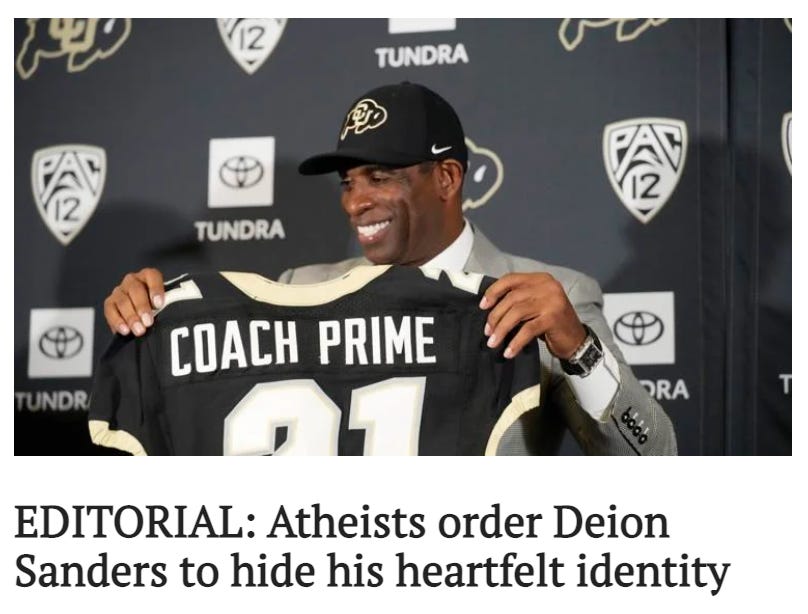
Except, that is, the editorial board of The Gazette. Their headline gives away the game: “Atheists order Deion Sanders to hide his heartfelt identity.”

We could refute the headline alone, but it’s worth going through the whole piece. Right from the beginning, things start going downhill:

Diversity must threaten the Freedom From Religion Foundation. The club’s 15-member “honorary board” consists only of white anti-religionists. These self-righteous faux legal proselytizers want everyone to live and believe as they do.

It’s bizarre that they focus on the honorary board rather than the actual board of directors which includes people of color, but the central point is still wrong: FFRF, which is unabashedly atheistic, wasn’t asking Sanders or the university to adopt a position of atheism. Sanders can talk about God all he wants in his personal life. He won’t even get much backlash for doing it during press conferences. Well-deserved eyerolls? Maybe. But no lawsuits.

That nuance, which is the basis of this whole controversy, was lost on the editorial board. But they kept going.

It is no surprise this outfit wants national treasure Deion Sanders to behave as they dictate in his new role as the University of Colorado’s football coach. They want the NFL Hall of Famer and former pro baseball player to shut up and coach. They demand he suppress something central to his being — a trait no less important than his racial identity.

This is not Laura Ingraham telling LeBron James to “shut up and dribble” rather than speak out in support of protests shortly after the murder of George Floyd. This is an atheist group reminding a public university that it is, in fact, a public university.

To pretend a reminder to follow the law is the equivalent of a racist taunt tells you the editors of this newspaper have no clue how the law works, what the law is, or how the law must be followed.

They’re either willfully ignorant or eager propagandists. Take your pick.

While you think about that, the editorial continued acting like this was all about race and a desire to impede diversity:

Boulder and the University of Colorado’s flagship have long struggled in futility to achieve diversity. Blacks comprise 1.2% of Boulder’s population. Last fall, among the 36,122 CU-Boulder students, 2.6% were black.

Boulder and CU lack the big three in diversity — race, ethnicity and religion. Nearly 60% of Boulder residents surveyed claim “no religion.” Non-denominational Christians are such an anomaly they show up as 0.0% on surveys. A Gallup poll ranks Boulder the second-least religious city in the United States.

The hiring of an iconic, universally respected Black man with a household name has ignited hope for mitigating Boulder’s diversity problem.

There are plenty of reasons sports commentators could offer for why the school shouldn’t have hired Sanders. But literally no one involved in this discussion cares about his race. If Sanders’ presence helps bring more Black students to the school, great. (I mean, if you think hiring a famous Black athlete is the solution to fixing your school’s diversity problems, you’re ignoring all kinds of larger issues, but that’s besides the point.)

But that passage actually justifies what FFRF is doing! The people in Boulder are largely non-religious! Even if most players are recruited from other places, that suggests there’s a greater likelihood that some of those athletes might not be on board with performative Christian prayers.

It wouldn’t be okay if an atheist coach did it. It’s not okay when a Christian coach does it.

Later in the piece, the editorial board attempts to law-splain the Constitution to a group of First Amendment experts:

The law is not on [FFRF’s] side. The First Amendment says the free exercise of religion may not be infringed. We have freedom of religious expression, not freedom from it. The Constitution doesn’t carve an exception for coaches at state-funded schools. The First Amendment prohibits governments from obstructing religious beliefs, meaning private entities probably have more authority than their public counterparts to regulate expressions of faith.

The 2022 U.S. Supreme Court ruling in Kennedy v. Bremerton School District erased any doubt about Sanders’ right to speak and pray in his public-sector job. The court ruled against the district for firing a football coach for praying in the middle of the field in view of players and the public, with players often joining him.

This is how you know you’re dealing with the dumbest people in the newspaper business. They’re rehashing right-wing talking points about the First Amendment, not realizing everything they say supports FFRF’s position.

As I mentioned earlier, the Bremerton ruling doesn’t support Sanders’ actions here because Sanders wasn’t praying privately. If Joe Kennedy led his team in Christian prayer before a game, he would’ve lost the case. His entire position was that he was praying privately… even if people saw him and joined in. Using that case to support Sanders’ actions shows a remarkable lack of understanding of what’s going on right now.

The editors continued digging their own grave:

Sanders should not and does not coerce prayer or acceptance of his faith by anyone on campus. Oh, say the Freedom From Religion bullies, religious coaches will bench players who don’t appreciate their displays of faith. That amounts to coercion, they insist. It is hard to imagine a sillier hypothesis. Coaches win or get fired. They play those who increase the odds of winning, whether they worship trees or the secular movement’s Flying Spaghetti Monster.

Sanders adds to Boulder’s racial and religious diversity, and that’s a good thing. He is, through and through, a Black man who openly worships God. That is his identity, of which he is proud, and he should not change it for anyone. The law, as ruled by the court of final appeal, has the coach’s back in this attack on who he is.

It’s almost laughable to say hiring a Christian adds to our religious diversity, as if Christianity has ever not been represented on a football team. And if racial diversity matters to the University of Colorado, you’ll never believe how many Black professors you can hire for $5 million a year! (Spoiler: It’s more than one.)

Or—I’m just spitballing here—spend just $2 million hiring professors of color and then offer $3 million in scholarships to students of color! There are all kinds of ways to increase racial diversity in Boulder that don’t involve hiring a single famous Black athlete who commands a giant salary. But the editorial board didn’t do that math because they don’t actually give a shit about diversity.

This isn’t about a Black Christian. This is about a football coach who thinks he can push his faith on his athletes. The identity of the coach is irrelevant.

What the editorial board chooses not to understand is that coercion isn’t just about benching someone who doesn’t pray. (To use language they’ll understand, you don’t have to wear a KKK hood to be a racist.) The fear, as we’ve seen in so many actual cases, is that a student who doesn’t pray could be ostracized by teammates and looked down upon by coaches in a way that’s independent of his on-field talent. Sure, star players may get great opportunities regardless of their beliefs, but every football team has dozens of players on the cusp of greatness who need as many chances as possible to prove themselves to people who can make or break their careers.

The benefit of the doubt shouldn’t go to an athlete who professes a belief in Christ.

Why is there more of a rush to defend Sanders’ public Christianity than the rights of players not to participate in those prayers? They don’t have a $5 million contract to fall back on. There’s far more pressure on them to just stay and pray.

We wouldn’t even be having this discussion if Sanders weren’t Christian. If he began promoting Islam to his team the way he’s been pushing Christianity, the Gazette’s editorial board would never just sit back and relax. You know they’d immediately demand his resignation.

To pretend FFRF’s concerns are somehow racist is a red herring. The Gazette can’t defend what Sanders is doing because, in the editors’ minds, there are always special rules carved out for Christians.

Incidentally, I asked FFRF’s co-president Annie Laurie Gaylor what she thought about this editorial. She made several of the same points I’ve mentioned above, but she added that “even if every single one of the team members claimed to be Christian… it would still be unconstitutional and inappropriate to introduce his religion into public university sports.”

FFRF’s Chris Line, who wrote the letter to the school, added this:

FFRF does not find Coach Sanders’ faith offense. We find his inability to perform his secular position at a public university without incorporating his religious beliefs into his official job duties offensive…

No one, certainly not FFRF, is asking that Coach Sanders change his identity. We are simply asking that he abide by the law, which requires him to act in a neutral manner with regard to religion in his official capacity as a public school employee.

We are not attacking who he is, we are trying to protect students from what he is trying to do. 

He’s right. This is all about protecting the students from the religious zeal of their coach, who knows every rule about boundary lines on the field yet appeared to be oblivious to where they are off of it.

The Gazette’s editorial board—Ryan McKibben (Chairman), Christian Anschutz (Vice Chairman), Chris Reen (Publisher), Wayne Laugesen (Editorial Page Editor), and Pula Davis (Newsroom Operations Director)—are lazy writers who think Christianity deserves more leeway than all other religions (and far more than no religion).

If they actually cared about the students at the university, they would tell the coaches to focus on coaching instead of using their platform to preach.

For now, at least, Sanders and the university seem to have gotten that message even if their biggest defenders still don’t get it.

Commentary on D. James Kennedy’s book Why I Believe–Chapter 4

Here’s the link to this article.

(Bifurcation)

I said to myself concerning the sons of men, God has surely tested them in order for them to see that they are but beasts. For the fate of the sons of men and the fate of beasts is the same. As one dies so dies the other; indeed, they all have the same breath [Gen. 6:17; 7:15, 22] and there is no advantage for man over beast, for all is vanity. All go to the same place. All came from the dust and all return to the dust [Gen. 3:19]. Who knows that the breath of man ascends upward and the breath of the beast descends downward to the earth?

Ecclesiastes 3:18-21

Thus the Bible makes a grand and poetic testimonial to human evolution. Why bring this up? Because despite its title, this chapter concerns itself with evolution and cosmology, not creation. Dr. Kennedy advances no support, no evidence beyond circular references to the Bible, to show a skeptic why one should believe in creation; instead he writes at length on why he thinks evolution theory is flawed. And in doing so, he badly misrepresents (or misunderstands) basic facts.

For the most part, the arguments he uses come from those Christians who call themselves “creation scientists” like Henry Morris and Duane Gish, both of the Institute for Creation Research (ICR). This organization is well-known (and well-documented) for publishing books and pamphlets of propaganda rife with factual errors, distortions, misquotations, and plain bad science. They do not represent the views of most Christians interested in considering science and all its evidence seriously. In this commentary, when I use the term “creationist” I do not mean to generalize about all Christians, but refer instead only to those of the ICR and their ilk.

Evolution and origin theories encompass such a vast body of knowledge, spanning anatomy, animal behavior, astronomy, biology, chemistry, cosmology, ecology, genetics, geology, history, paleontology, and physics, that one person cannot adequately grasp all the evidence. Creationists often don’t grasp it, nor do they want to, nor do they need expertise in these fields to retain their faith; but anyone trying to address creationist claims must first learn essentially all of science!

For the previous chapters, my commentary explored some of the author’s chosen topics in more detail, and also delved into areas he chose not to touch. This chapter cries out for a different approach. Below, the chapter is quoted with a K> symbol. It’s a good springboard for exploring many issues in science and philosophy. When necessary, I will interrupt and add my commentary. This article is rather lengthy. If you want a concise summary of some basic misunderstandings about evolution, see the Appendix to this chapter commentary (“Five Major Misconceptions About Evolution” by Mark Isaak, from usenet’s talk.origins archives). See also the appendix to Douglas Futuyma’s book Science on Trial, which lists brief capsule responses to many more creationist arguments.

The chapter begins:

K> We live in a time when there are only two religions competing for the minds, hearts and loyalties of intelligent Western Man. The future of this world will be determined, humanly speaking, by intelligent Western Man.

Those are rather broad and culturally prejudiced assumptions. To what time-frame of “the future” does he refer? How does he define Western Man? Certainly the United States and Western Europe hold the balance of economic power at the moment, but this power could conceivably shift to Asia. Note that Russian criminals deciding whether to sell nuclear bombs to Islamic fundamentalists can also determine the future of this world.

K> One of those religions is Christianity; the other religion is evolution. Anyone who does not realize that evolution is a religion does not know much about evolution.

True to creationist form, here Dr. Kennedy offers up a classic logical fallacy of unwarranted assumption, a standard debating technique practiced by some Christian fundamentalists. This fallacy is called bifurcation, or false dilemma, or false dichotomy. In an extreme form of the argument, whatever is not Christianity must be Paganism (reference: the public-access cable TV series Pagan Invasion). Round-earth-ism or gravitation-ism would be “religions” by Kennedy’s standards. By lumping together all religions that don’t live up to his ideals, this variety of argument makes one wonder if he really can’t tell the difference between Mormonism and Hinduism (both religions are supposedly based on “evolution” although both existed before Darwin, so the usage of the word in that context is at least misleading if not entirely deceitful). There’s another major “religion” making great inroads in Western societies – the New Age movement. Besides that, Hinduism, Buddhism, and especially Islam are all growing among Western societies. I’m surprised he can’t tell them apart.

Furthermore, he errs with respect to taking Christianity as one big lump, by falsely dichotomizing creation versus evolution in claiming that no Christian can honestly accept evolution. Millions of Christians reject the notion that evolution is anti-Christian. The Papal Academy of Science, in the 1960s, claimed “evolution is a fact beyond all reasonable dispute,” although they had questions about the evolution of humans and of how life originally started. On June 28, 1982, the 194th General Assembly of the United Presbyterian Church in the USA adopted a resolution accepting evolution. On September 14 of the same year, the 67th General Convention of the Episcopal Church adopted a similar resolution. See also “Scholar opposes `biblical biology’” in the National Catholic Reporter, March 13, 1981, or “Cardinal urges accord of science and religion” in the New York Times, September 29, 1981. For further information, see Is God a Creationist? by Roland Frye.

Many Christians accept theistic evolution, not because they’ve been brainwashed, but because they simply don’t find it a problem. For example, Charles D. Walcott, who discovered the Burgess Shale fossils, was a convinced Darwinian and an equally firm Christian. He believed that God had ordained natural selection to create a history of life according to His plans and purposes. My own observations indicate that those Christians who reject the evolution concept are mostly evangelical Christians. These constitute only one-third of Christian Americans, according to the “State of the Union” demographic survey in Time (January 30, 1995, p. 72).

If a Christian happens also to accept the current scientific understanding of evolution, then to strict fundamentalists they’re not True Christians. But if a Christian is one who follows Christ, and an “evolutionist” is one who accepts the current state of scientific understanding as generally accurate, in what way are these concepts incompatible? It is true that Paul warned against “human tradition and the basic principles of the world” (Colossians 2:8), but his own argument suffers from the fact that Paul himself was human and just as fallible as the rest of us. Jesus, on the other hand, said “do not judge, or you too will be judged” (Matthew 7:1). By judging as non-Christian all who accept evolution, Kennedy contradicts his own belief system.

When Dr. Kennedy refers to “competing for the minds, hearts and loyalties” he misunderstands the nature of science. Loyalty is not a demand of science. Without realizing it, he makes it obvious in this chapter that anyone who thinks evolution is a religion knows nothing about evolution.

K> It is a religion that is passionately held to by its devotees.

No religion or passion is required. The vast body of evidence for evolution comes from more scientific disciplines than any one human could possibly master. The degree of coherent integration of this body of evidence is overwhelming compared to the sparse, selective evidence used in support of the creation hypothesis.

The controversy has roots in one primary difference between creationist and scientific thinking. Creationists have a Bible that gives them an unchanging set of data. They implicitly assume that science also has a fixed, immutable set of evidence. Few creationists understand, at more than a surface level, that science is a process, not a conclusion, and that evidence continues to come in all the time. Scientific theories are revised as new facts come to light.

Just because something conflicts with a person’s beliefs, that does not automatically make it a religion. By inventing a religion to represent a large body of science, Kennedy shows he doesn’t even know what science is, or even what constitutes a scientific theory. This is important. Let’s review a definition of science, and how it relates to evolution and creationism.

Scientific theories must be falsifiable: one must be able to conceive of ways to prove them wrong. Evidence that weakened some evolution models, like Gradualism, have given rise to others such as Punctuated Equilibrium. And of course, many scientific theories would be neatly falsified by any clear, unambiguous, unquestionable, repeated instances of an observed divine miracle having no scientific explanation. But nothing so grand is needed to falsify evolution. Evolution models would be falsified if, say, just one insect fossil was found in Precambrian rock. Creationism cannot claim this criterion of falsifiability; one cannot even conceive of evidence that could overturn the creationist model. Furthermore, evolution science is predictive: it makes predictions about what we can expect to observe. Creationism has no predictive power, at least none that can be verified or disproved.

By the common definition of science, creationism does not qualify. Let’s look at the identifying fingerprints of a “good” scientific theory (from Casti, p. 460) and compare them with creationism:

  • Consistency – Good theories contain no self-contradictory statements. A good theory of genetics involves no situations where identical genotypes result in radically different phenotypes. The Biblical creation story, on the other hand, contains two contradictory accounts concerning the order in which things were created, and fails to explain physical contradictions such as days with no sun.
  • Non-circular – Good theories contain no circular arguments. By contrast, many creationists often point to the Bible to support notions which originated there.
  • Cumulative – Good theories explain all the phenomena that older theories explain, but add something new. For example, Einstein’s special relativity contains all the predictions of Newton’s laws of motion, but extends Newton’s work to include special cases at near-lightspeed velocities. In a similar fashion Punctuated Equilibrium explains fossil record observations better than Gradualism, and Natural Selection explains speciation better than its predecessor, Lamarckism. By contrast, creationism holds fast to a fixed and unchanging hypothesis.
  • Testable – The claims or predictions of good theories must be testable by experiment. Thus, we can make predictions about environmental effects on speciation, or about what we might find in the fossil record, and then observe the evidence that either supports or falsifies the theory. Creationism does make both testable and untestable claims; however, those few claims which are testable (like evidence for the Biblical flood) have been falsified. All that remains are untestable, unfalsifiable claims. Falsifiability is the line of demarcation between scientific and non-scientific theories; the absence of this quality prohibits labelling the theories of astrology, Marxism, and creationism as “scientific.”

There are other criteria as well: Most good theories provide insight into issues not addressed by older theories; most good theories generate new questions as well answer old ones; good theories propose the simplest models that agree with observations. This last criterion, known as the Occam’s Razor principle, asserts roughly that one should not multiply hypotheses beyond what one needs to explain observations. Creationism violates this principle by postulating unnecessarily the existence of a supernatural creator, which begs the question of who or what created the creator.

I would ask creationists like Dr. Kennedy to come up with a clear picture of what science is. If it does not match the description above, then he has mistaken science for something else.

Kennedy doesn’t actually claim that creationism is science. However, his arguments are identical to those of the ICR and other creationists who do make this claim in order to endow creationism with an air of legitimacy for teaching it in science classes. For the record, I think creationism should be taught in public school, with equal time given to the myths of all religions. But not in science class. What kind of science is creationism? More on this later.

K> Listen to what some well-known evolutionists, all highly placed scientists in the world, have to say. Professor Louis T. More, one of the most vocal evolutionists: “The more one studies paleontology [the fossil record], the more certain one becomes that evolution is based on faith alone.” (Louis T. More, The Dogma of Evolution, Princeton University Press, 1925, p. 160)

Quoting a little-known source from 1925 really fails to make a point. A lot has changed in the last 70 years, especially in new fossil record discoveries. Thousands of transitional fossils have been discovered, closing many gaps in the fossil record. This is particularly amazing considering we probably haven’t unearthed more than 0.1% of the Earth’s fossils. Again, Dr. Kennedy implies falsely that science is stagnant (but then, he also tries to paint evolution as a religion, which would make it stagnant).

In addition, we have plenty of other evidence besides that from paleontology. Much of this evidence, such as geological distribution, was even known to Darwin, but other evidence has only recently come within the reach of our technology to discover. Molecular biology provides some good examples, for instance, the similarities in DNA of related organisms, or quantitative variations in cytochrome-C proteins that confirm genealogical relationships. Creationists tend to focus on paleontology in part because Darwin saw the imperfect geological record as a weakness in his theory – he devoted a full chapter to it. For an example of the DNA hybridization technique, see Sibley and Ahlquist, “Reconstructing Bird Phylogeny by Comparing DNAs,” Scientific American, February 1986. I’ll write briefly on molecular biology later. Some other molecular evidence is briefly summarized in “Molecular Evidence for Evolution” by Thomas H. Jukes, in the book Scientists Confront Creationism. The point here is that, 70 years after More made his statement, paleontology is far from the only source of evidence for evolution.

K> Professor D. M. S. Watson, a famous evolutionist,

Not anymore. Why does Kennedy quote obscure professors and call them “well-known” or “famous”? Famous evolutionists would include people like Darwin, Huxley, Gould, Eldredge, Mayr, Simpson, Johanson, Leakey, Sagan, and Asimov, but not Louis T. More or D. M. S. Watson. The fact that Kennedy picked these obscure authors reveals that he either knows nothing at all about the subject or that he deliberately misrepresents it.

Perhaps he confused D. M. S. Watson with James D. Watson, author of The Double Helix and co-discoverer of the DNA code.

K> made the remarkable observation that evolution itself is a theory universally accepted, “not because it has been observed to occur or can be proved by logically coherent evidence to be true, but only because the alternative – special creation – is clearly incredible.” (Quoted in Henry M. Morris, Scientific Creationism, Creation-Life Publishers, 1974, p. 8)

In researching this chapter, I discovered that many creationists are notorious for quoting scientists out of context, or even misquoting them. Dr. Kennedy provides us with an exquisite example here, using a misquotation from Morris, who effectively puts words into Watson’s mouth! This same misquotation also appears in Duane Gish’s Evolution: The Challenge of the Fossil Record. In reading creationist publications, you can’t help but notice that they recycle each other’s unreliable quotations for rhetorical purposes. Quotes of this nature have little if any scientific value. Gish even leaves out the author’s initials, so you might logically assume James D. Watson rather than D. M. S. Watson.

D. M. S. Watson never even mentions special creation, nor does he say that evolution is unsupported. Let’s look at the original quote (Watson, p. 231, emphasis mine):

Evolution itself is accepted by zoologists not because it has been observed to occur or is supported by logically coherent arguments, but because it does fit all the facts of taxonomy, of paleontology, and of geographical distribution, and because no alternative explanation is credible.

Quite a difference! What can Kennedy or Morris possibly hope to gain by lying about scientists’ statements? Such dishonesty only makes creationists look like slippery charlatans. Is it any wonder, then, that the scientific and educational communities do not take them seriously?

Dr. Kennedy also neglects to mention the date this was written: 1929, when only the two theories of Darwin and Lamarck had gained currency. Watson says toward the end of the article, “We know as surely as ever that evolution has occurred; but we do not know how this evolution was brought about.” (Watson, p. 234) Thanks to progress, now we have other fields of science, like genetics and molecular biology, to add new factual observations, and more detailed and refined theories encompassing a wide variety of disciplines, to explain evolution’s mechanisms.

In any case, nothing in science can be “proved” by the standards described by Kennedy’s misquotation. Proof is a concept not applicable to science, except in mathematics. And yes, evolution has been observed, and there exists a logically coherent body of evidence supporting it. And “special creation” is not the only alternative, or even the only brand of creationism. If Dr. Kennedy wishes to set up a creation/evolution dichotomy, it is misleading to use the claim that evolution contradicts special creation as any kind of argument against evolution.

Besides differing Christian interpretations, what alternatives are there? Alien intervention is one example, others are the creation concepts of Hinduism or the Navajo Indians. Alternative scientific-based origin theories include the “molecular genome” theory which proposes that all life forms had not one origin, but each had a different origin. Another example is the “two source cosmogony” whopper that Horselover Fat lays forth in Philip K. Dick’s novel Valis – it is certainly no less believable than other myths.

Leaving aside for now that the use of the term “special creation” confuses evolution with abiogenesis (origin-of-life) theories unrelated to evolution, let’s look at a small sample of logically coherent argument concerning abiogenesis.

Back in 1953, Stanley Miller and Harold Urey at the University of Chicago published what is now known as the Miller-Urey experiment. It showed that most organic acids (the building blocks of RNA) could be produced in an atmosphere similar to that believed to exist in the early Earth. This created a stir at the time, and the experiment made the “best of the year” list in NatureScienceScientific American, etc. It has also been shown that RNA molecules can be made to replicate in a test tube, and evolve, with the help of suitable enzymes and nucleotides (Cairns-Smith, Seven Clues, p. 55).

More recently, British chemist A. Graham Cairns-Smith determined that life needs two things to come into existence: a cell membrane and an RNA base. Any introductory biochemistry textbook (for example, by Lehringer) explains how micelles form spontaneously by electrostatic interactions with water molecules (essentially, get some molecules that are polar on one side and non-polar on the other and you get membranous bubbles), so the cell membrane is easy to come by. Micelles form from compounds like soap, waxes, DMPC, DMSO, and others. He also proposes, that since RNA was an original component of clay, that life arose from clay (Cairns-Smith, Genetic Takeover).

So, given a source for a cell membrane and a source for RNA, formation of a primitive cell doesn’t seem so inconceivable. For a good book at the popular level, available from both mainstream and creationist booksellers, look at Origins by Robert Shapiro, which critically examines a number of viewpoints, both scientific and creationist.

That bit about clay leads to an interesting allegorical interpretation of the creation of Adam in Genesis. Possibly the Bible, if interpreted properly, can be reconciled with scientific theories of origins after all.

K> To the reprobate mind, the unregenerate mind, creation is incredible because it requires belief in a creator, and that is totally unacceptable to such men as these.

The implication is that they are wrong by virtue of their knowledge conflicting with Kennedy’s beliefs. In arguing for why one should believe his religion (the subject of the book as a whole), Kennedy cannot assume the truth of his religion to begin with. Circulus in demonstrando.

The words “reprobate” and “unregenerate” indicate that Kennedy associates evolution with immorality. He doesn’t expand on this line of thinking this chapter. Suffice it to say for now science makes no moral value judgments, and the philosophical and ethical implications of evolution have nothing to do with its scientific validity. Chemistry, for example, is responsible for many deaths each year, but that doesn’t mean we should reject its findings. I should add that morality exists independently of any god, and the absence of a god does not signify moral decay (at least among people I know). Civil evils are more highly correlated with ignorance and provincialism.

He also ignores the idea of divinely-guided evolution and the many people who accept it. Many Christian churches accept the Bible’s creation story as metaphoric truth, reflecting the state of science at the time it was written. Also, all the world’s religions have their own creation myths, full of startling and delightful parallels, contradictions and insights. Kennedy never gives us any reason why we should favor his particular myth over another.

K> A famous British evolutionist, Sir Arthur Keith, is just as frank in his admission. He says, “Evolution is unproved and unprovable. We believe it because the only alternative is special creation which is unthinkable.” (quoted in Fred John Meldan, Why We Believe in Creation Not in Evolution, Christian Victory Publishing, 1959, p. 27)

That quote was not true even in 1959 when it appeared in Meldan’s book. The facts that mosquitoes are no longer bothered by DDT or many diseases are not stopped by antibiotics support evolution theories. For that matter, anybody who claims that evolution is impossible probably speaks from before the discovery of DNA and genes. Dr. Kennedy gives us more second-hand sources from obscure publishers. It’s not a good sign, and we can expect more of the same later in the chapter.

Sir Arthur Keith, by the way, was fooled by the Piltdown Man forgery, so it’s probably no coincidence that Meldan (and Kennedy) chose to quote him in particular. Just before the actual quote, did you notice the deceptive use of the present tense to give Keith’s words the appearance of contemporary thought? Keith died in 1955.

K> What would happen if I were to stand up before my congregation and say, “My friends, Christianity is unproved and unprovable, but you still ought to believe it”?

One can easily argue that Christianity is unprovable. Belief is a matter of faith. Even if you had direct evidence of actions violating every known physical law (which would require throwing out or re-thinking a lot of science), this no more proves Christianity than it does the power of Zeus.

K> They would get up and walk out, and rightly so. But that is the way men accept evolution.

No, that is the way people accept Christianity. Here Dr. Kennedy displays an incredible lack of understanding of the scientific method as a means of seeking truth. Nothing in science is ever “proved.” If a prediction fails, the model it’s based on has been falsified and must be abandoned or re-thought; if a model passes a crucial test, it is not validated but only “corroborated” and the process of testing must go on. Evidence corroborating evolution theories continues to accumulate, but no evolution theory will ever be “proved.” Theories that have survived extensive scrutiny, or make many new predictions which are confirmed, or explain observations more completely, are not proven, but rather “accepted” by scientists as true.

K> Professor David Allbrook, Professor of Anatomy at the University of Western Australia, says that evolution is “a time-honored scientific tenet of faith.” (Quoted in Meldan, p. 8).

Another appeal to authority using an obscure professor. Should we be convinced merely from reading someone’s opinion?

K> A great many people have been led to believe it was a fact, but it is not so. Dr. Duane Gish, noted biologist,

Gish may be “noted” and a “biologist” but that doesn’t make him a “noted biologist.” In scientific circles, Gish is “noted” (and also well-documented, along with Morris and McDowell, with many examples – such as misquoting Watson) for being one of the most intellectually dishonest “creation scientists” ever to draw breath. Strictly speaking, having a PhD in biochemistry doesn’t in itself make him a biologist, but we’ll give him the benefit of the doubt and assume that he is one. On the other hand, the following quote is typical of his “understanding” of biochemistry: “Is it surprising that the biochemistry (life chemistry or metabolism) of the human is very similar to that of a rat? After all, don’t we eat the same food, drink the same water, and breathe the same air?” (Gish, p. 253) Gish is primarily a debater and propagandist. Kennedy does not enhance the credibility of this chapter by quoting him.

K> says, “Evolution is a fairy tale for adults.” I believe that is exactly what it is. In Grimms’ Fairy Tales someone kisses a frog and in two seconds it becomes a prince. That is a fairy tale. In evolution, someone kisses a frog and in two million years, it becomes a prince.

A direct paraphrase of Gish, who, however gave the slightly more realistic number of “300 million years” for the time it takes a frog to evolve into a prince (Gish, p. 15). This is simply rubbish. Frogs do not “become” hominids because of some outside intervention, much less in few million years; Kennedy demonstrates his lack of understanding of evolution by bringing up an analogy so badly flawed. Analogies don’t have to be exact to have value, but they shouldn’t be outright false either.

A common misconception, which spans from lay-thinking creationists to Star Trek, is that evolution affects things directly. Every human is different. Some of these differences affect our ability to reproduce. Some are good only in certain circumstances. For example, diabetics live longer and healthier than non-diabetics in those parts of the world where food might only appear once every two or three days. In our part of the world, the normal diet of three meals per day overloads their systems so much that they need insulin treatments.

K> That is science. It is simply faith.

Ah. Now Science equals Faith. Apparently unable or unwilling to provide a scientific basis for creationism, Kennedy attempts to drag science down to his level, again displaying his profound ignorance of what science is. His confusion is understandable, though. Interestingly, surface similarities do exist between the practices of religion and science. John L. Casti wrote in Alternate Realities (p. 478):

Let’s take mathematics as an example. Here we have a field that emphasizes detachment from worldly objects, a secret language comprehensible only to the initiates, a lengthy period of preparation for the “priesthood,” holy missions (famous unsolved problems) to which members of the faith devote their entire lives, a rigid and somewhat arbitrary code to which all practitioners swear their allegiance, and so on. These features . . . bear a striking similarity to the surface appearances of many religions.

So, science and religion might appear similar on the surface. Obviously Dr. Kennedy made such an observation. However, anyone who looks more closely can see that the areas of difference are deeper and more significant:

  • Language – The language of science concerns prediction and controls. The language of religion concerns expressions of commitment, ethical dedication, and philosophies of existence. The semantic content of scientific and religious languages are completely different.
  • Reality – Science is directed toward discovering reality. In contrast, religion presupposes the nature of reality. Science embodies a basic belief in the comprehensibility of the universe. This belief is not shared by many religions.
  • Models – Both religious and scientific models are used to organize images for interpreting life experiences. But the religious model says, basically, “live by these rules think this way and you’ll see that it works.” This rigid faith-based philosophy clearly contrasts with science.
  • Paradigms – Scientific paradigms are subject to constraints, such as simplicity (Occam’s Razor), falsification, and influence of theory on observation. These features do not exist in religious paradigms.
  • Methods – Observation, hypothesis, and experiment characterize the scientific method. Religion’s method involves divine enlightenment. The religious method is not repeatable, nor is it available to every investigator.

Equating science with religious faith cannot be justified. The approaches used by each are completely inverted. Science takes empirical evidence and modifies the assumptions (hypotheses) to fit the evidence. Religion takes empirical evidence and re-interprets or disregards the evidence to fit an assumption that might be thousands of years out of date. If science worked like religion, water wouldn’t be H2O, it would simply be water, one of the Four Elements (fire, water, earth, and air), and wood would consist of earth and fire.

Scientists admit there are things we don’t understand, but that doesn’t mean we should all give up, throw up our hands, and take refuge in “intelligent design” as explanation. Religion has a meaningful purpose as it is; it should not be substituted for science. History shows that scientific interpretations of unexplained phenomena are eventually discovered, and there’s no reason why this process shouldn’t continue.

The differences between science and religion do not mean, of course, that science has anything to do with atheism (as Kennedy believes). Science does not deny God. As far as science is concerned, regardless of whether God exists or not, it is unnecessary to consider God, or even faith, in attempting to define the causes of various phenomena. Science does not address the question of the existence of supernatural deities. Science is accessible to anyone regardless of their religion or lack of it.

K> Robert T. Clark and James D. Bales wrote an interesting and heavily documented book entitled Why Scientists Accept Evolution. It contains numerous letters written by Darwin, Huxley, Spencer, and other early evolutionists. It points out that these men indicated in their letters, by their own admission, that because of their hostility toward God and their bias against the supernatural, they jumped at the doctrine of evolution. (Robert T. Clark and James D. Bales, Why Scientists Accept Evolution, Baker Book House, 1966)

The authors of that book are themselves creationists who also demonstrate their unfortunate ignorance of science by taking the familiar and wrong “evolution equals faith” position, and harping on evolution not being “proved.” I question the context of some quotations they use, also. But more importantly, Dr. Kennedy misrepresents this book!

The book describes Darwin as wanting to become a clergyman in college, then becoming more uncertain about God as he aged. The authors state (p. 37), “Darwin never became an atheist,” and although Darwin may have developed prejudice, he “believed that evolution was compatible with faith in God.” (p. 44) Huxley was agnostic; although he had anti-supernatural leanings, “Huxley did not think that there were any a priori arguments against God, nor did he contend that evolution had undermined every type of argument from design of the existence of God.” (p. 75) Spencer was also agnostic, and biased against creation, but he recognized that evolution was independent of his ontological views (pp. 60-61). Kennedy reaches at straws to consider these attitudes as “hostility.” How can anyone trust what he says about evolution when he misrepresents literature from his own camp?

In any case, what bearing can old letters, which most scientists have probably never seen, have on the reasons for scientists accepting evolution today? This is more sleight-of-hand on Dr. Kennedy’s part. He wants to distract the reader’s attention away from the physical evidence that actually led people like Darwin and Huxley to argue for the idea of evolution in the first place. Remember this: In science, it is arguments that ultimately count, not personal views.

More than a century ago, some of the early evolution proponents also happened to be non-Christian. So what? Were there no religious men among them (not that it should matter)? The chapter doesn’t even address why biologists and paleontologists today accept evolution, except to dismiss it by claiming science is faith.

Yes, at one time, evolution did require faith that physical characteristics were transmitted from parent to offspring. When genes and DNA were discovered, the need for this faith evaporated. Anything written by early evolutionists along this line is of no more relevance to the current status of evolution than their views on astrology.

K> Sir Julian Huxley, one of the world’s leading evolutionists, head of UNESCO, descendant of Thomas Huxley – Darwin’s bulldog – said on a talk show, “I suppose the reason we leaped at The Origin of Species was because the idea of God interfered with our sexual mores.” (Henry M. Morris, The Troubled Waters of Evolution, Creation-Life Publishers, 1974, p. 58)

I was unable to find this anywhere in Morris’s book. Kennedy’s citation is incorrect, so this quote is impossible to check. Did he make it up? Assuming he didn’t, what’s the context? Who’s “we”? That statement has a definite twang of sarcasm or jest in it. Given that the quote supposedly comes from Morris, whose books reek of dishonesty, as school boards have found in reviewing five of them (Hughes, pp. 93-111), and given Morris’s previous misquotation of Watson, I wouldn’t be surprised if Huxley was taken out of context here. As I have observed, this tactic appears to be a favorite among creationists, especially with Darwin quotes – see for example, The Collapse of Evolution, where author Scott M. Huse “shows” (p. 73) how Darwin supports creation by excising significant portions of Darwin’s words on the human eye; naturally this example gets recycled elsewhere in other creationist writings.

K> Probably the most prevalent reason the average layman believes in evolution – if he does – is that he is told that all scientists believe it. However, a recent newspaper article indicated that one group of over five hundred scientists disbelieved it completely, in every single facet.

Dr. Kennedy provides no reference for this factoid; he might as well have invented it. What kind of newspaper? What is “recent”? What was the context of the article? I imagine he refers to the Creation Research Society, whose members numbered about 600 in 1991 (Gish, p. 20). I can’t think of another group of over 500 scientists who would reject evolution “completely, in every single facet.”

K> One of the world’s leading scientists, Sir Cecil Wakely, whose credentials are rather impressive – K.B.E., C.B., LL.D., M.CH., Doctor of Science, F.R.C.S., past president of Royal College of Surgeons of Great Britain –

More appeal to authority. Let’s look at some of those credentials, with which Kennedy relies on the reader’s unfamiliarity in order to sound impressive: K.B.E. (Knight Commander of the British Empire) – irrelevant. LL.D. (Doctor of Laws) – irrelevant. F.R.C.S. (Fellow of the Royal College of Surgeons) – not necessarily relevant. Some others can’t be found in Webster’s unabridged dictionary. Sir Cecil Wakely has all those impressive letters, but as the example of Duane Gish shows, even PhD doesn’t necessarily mean anything. What are his arguments?

K> said, “Scripture is quite definite that God created the world, and I for one believe that to be a fact, not fiction. There is no evidence, scientific or otherwise, to support the theory of evolution.” (Quoted in H. Enoch, Evolution or Creation?, Evangelical Press, 1966, p. v)

See? Kennedy offers no arguments from Wakely, just a personal opinion. And this opinion illustrates Wakely’s lack of knowledge: the creation of the world concerns cosmology; it is certainly not an event that falls within the bounds of evolution, which only describes changes in the gene pool of a population over time. He doesn’t even know what evolution is. So, this “authority” falls flat from scientific ignorance.

K> As famous a scientist as Sir Ambrose Fleming completely rejects it, as does the Harvard scientist, Louis Agassiz, probably one of the greatest scientists America has produced.

More appeal to authority. Ambrose Fleming was the inventor of the diode tube. Kennedy might have used his name due to similarity with Alexander Fleming, discoverer of penicillin. On the other hand, Agassiz was probably the last of the truly respectable creationist geologists. He was not “produced” in America; he was Swiss (though he did move to the United States where he was a professor at Harvard, at age 40).

Dr. Kennedy’s use of the present tense for both men marks another sneaky attempt at deception. An uninformed reader would be misled into thinking that they reject evolution in our present time. Fleming died in 1945, and Agassiz died way back in 1873, according to the Encyclopedia Britannica.

K> In the first chapter of the Book of Genesis is an amazing statement, coming from 3,500 years ago, of the divine creation of the universe.

The mistake here lies in assuming that the poetic verses of Genesis represent a record of historical fact. There are many amazing things in Genesis, especially its own internal disagreement about order in which things were created. Considered as literal historical fact, what’s really amazing is that people as late as a mere three and a half millennia ago got it so wrong. On the other hand, considered as allegory, one can appreciate the limited scientific knowledge of the ancients, and interpret it in ways that don’t oppose science.

K> But it should be pointed out that it is not possible to combine the Bible and evolution, as some people want to do. I believe they engage in this compromise only because they think that science has proved evolution and they must take the Scripture as some sort of putty nose to twist around until they have made it conform to evolution. Those who are evolutionists laugh at the idea that you can put evolution and the Bible together.

This also exudes a faint scent of appeal to authority; the authority of Scripture. Possibly some people might be swayed by such arguments. I think that instead, those who “engage in this compromise” recognize the evidence, and attempt to re-interpret the Bible so that it doesn’t contradict the evidence. I don’t personally see anything wrong with that exercise. If it leads to a more “correct” interpretation of the Bible, that’s certainly better than a wrong interpretation.

There are evolutionists out there who are quite devout Christians. I think the millions of Bible-believing Christians who accept evolution would be offended by this paragraph.

K> Thomas Huxley, probably the most famous proponent of evolution who ever lived, stated, “It is clear that the doctrine of evolution is directly antagonistic to that of Creation. . . . Evolution, if consistently accepted, makes it impossible to believe the Bible.” (Coppedge, p. 177)

I’ve heard others disagree. However, this isn’t surprising as something Huxley (who coined the word “agnostic”) might have said. I’d really like to know what was left out of this quotation, though. Creationists have a nasty habit of using ellipses to distort what was actually said. The fact that Kennedy doesn’t give a direct citation to Huxley makes me wonder.

In any case, nobody who accepts basic biological facts can believe the Bible as a reliable source of scientific facts. For example, the Bible says birds and insects have four legs (Lev. 11:20-23) rabbits ruminate (Lev. 11:6), camels do not have cloven hooves (Lev. 11:4) – glaring errors in basic biology! These examples are so clear and unambiguous, yet wrong. If these are indeed the words of God, he must not care much for accuracy.

The Bible also contains errors regarding our planet. The view that the Earth is fixed, immovable and nonrotating (Josh. 10:12, 1 Chron. 16:30, Psalms 93:1, 96:10, 104:5) was used in the Holy Writ to convict Galileo of heresy. The Bible also says the Earth rests on pillars (1 Sam. 2:8) and has four corners (Isa. 11:12, Rev. 7:1). Daniel (4:10-11) “saw a tree of great height at the centre of the Earth, reaching with its top to the sky, and visible on the Earth’s farthest bounds.” This would only be possible if the Earth was flat. In the New Testament (Mat. 6:13), Satan took Jesus to the top of a mountain from where they could see all the kingdoms on Earth.

Incredibly, some creationists actually still believe the Earth is flat. Others know the form of our planet but they deny all evidence that it rotates and orbits the sun (see The Earth Is Not Moving by Marshall Hall, 1991). These convictions make a powerful testament to their commitment to dogma in the face of overwhelming evidence. They do this in accordance with their Biblical view of the world. Other creationists rightfully reject these foolish notions, which means they interpret literally only parts of the Bible, but they still face contradictions. Geologist Ian Plimer writes in his book Telling Lies for God: “Such selective literalism traps creationists in their own dogma.”

Our modern view of the world, based upon a vast and coherent body of scientific knowledge, is considerably more sophisticated. Nevertheless, our modern view can and does change as new evidence arises. Most people deem the fixed literalist Biblical view as nonsense; indeed, many Christians regard this view as a mockery of the Bible and un-Christian.

K> Evolution is the religion of modern unbelieving man, and it has been the pseudoscientific foundation of every false and anti-Christian “ism” that has come down the pike in the last hundred years.

Here Kennedy provides Christians an emotional stake in denouncing evolution. This is understandable. After all, if evolution attacks their beliefs, it’s better to stop evolution before another anti-Christian “ism” crops up.

However, his implication that creationism is, by contrast, not pseudoscience, demonstrates Dr. Kennedy’s ignorance about the subject. Let’s look at the criteria for pseudoscience. A theory need only meet one of these measures to qualify (Casti, pp. 474-477), and so-called “scientific creationism” certainly conforms to several of them:

  • Anachronistic Thinking – reverting to outmoded theories discarded years or even centuries ago as being inadequate, simplistic, or just plain wrong. For example, creationists often associate evolution with uniformitarian geological activity, and claim that geology supports catastrophism. This is anachronistic; it presents the uniformitarianism-catastrophism dichotomy as if it were still a live debate (Futuyma, p. 226), and shows a misunderstanding of uniformitarianism.
  • Seeking Mysteries – setting out to look for anomalous events, with the philosophy that anything that can be seen as a mystery ought to be seen as one. Scientists do not expect to shake up science with their experiments, nor do they reject one theory in favor of another because the second theory explains one anomaly. However, an entire area of pseudoscience is dedicated to enigmas and mysteries like the Bermuda Triangle, UFOs, spontaneous combustion and other offbeat phenomena. Similarly, creationists play up apparent anomalies like the Paluxy River footprints or the bombardier beetle, without bothering to understand them fully.
  • Appeals to Myth – here creationists shine. They consider an ancient myth to be an historical account, explain the events by postulating conditions which existed then but no longer hold today (e.g. dramatic departures from the laws of physical sciences), then consider the myth to provide support for the hypothesis, then go one step further and claim that the myth confirms the hypotheses along with selected evidence from geology, paleontology, or archaeology. This methodology is absent from science.
  • Casual Approach to Evidence – the attitude that sheer quantity of evidence makes up for any quality deficiencies. In spite of experiments or study showing certain evidence to be questionable, such evidence is never dropped from the list. One example of this practice is creationist literature pointing to the Paluxy River footprints as evidence that dinosaurs and humans coexisted, despite the fact that the alleged “human” prints involved a variety of phenomena, including forms of metatarsal dinosaur tracks, erosional features, and some carvings on loose blocks. After years of ignoring the embarrassing truth, most creationists finally dropped the Paluxy River example from their literature, although they still cling to other specious and out-of-date “evidence” such as the absence of fossils in Precambrian rock (which contains many fossils), or the nonexistence of transitional fossils (of which thousands have been found in the last century).
  • Irrefutable Hypotheses – this relates to the falsifiability criterion of science. We should always be able to ask what it would take to produce evidence against any hypothesis. If nothing can conceivably falsify the hypothesis, it has no claim to be scientific. Creationism is the best example; it is just not possible to falsify the creationist model of the world.
  • Spurious Similarities – arguing that principles underpinning a pseudoscientific theory are already part of legitimate science. For example, biorhythm theorists maintain that biorhythms are consistent with current biological thought, because the claims of biorhythm studies are similar to claims of biologists studying circadian rhythms and chemical and electrical oscillations in the human body. Likewise, creationists often misconstrue scientific concepts such as the Second Law of Thermodynamics to support their view.
  • Explanation by Scenario – if scientists offer scenarios to explain certain phenomena when we don’t have a complete set of data to construct the exact circumstances, they make sure the scenarios are consistent with known laws and principles. On the other hand, pseudoscience engages in explanation by scenario without proper backing of known laws. For example, creationist Immanuel Velikovsky posits that a near-collision with Venus caused the Earth to flip over and reverse its magnetic poles. He offers no mechanism by which this event could have possibly happened, and totally ignores the basic idea of deducing consequences from general principles.
  • Research by Literary Interpretation – regarding any statement by any scientist as open to interpretation. Practitioners of pseudoscience focus on the words instead of the underlying facts and reasons for the statements in scientific literature. Dr. Kennedy applies this principle by selectively quoting opinions (often out of context) rather than supporting arguments.
  • Refusal to Revise – pseudoscientists never revise their pet theories even when shown to be wrong, refusing to acknowledge any criticism. A variant of this ploy is to reply to criticism but never revise one’s position in light of it. Creationists such as Gish and Morris serve as sterling examples of the power of this principle; both continue to publish error-ridden books and pamphlets long after the factual errors have been pointed out to them. As this chapter by Dr. Kennedy superbly demonstrates, these creationists don’t see scientific debate as a mechanism for progress, but rather as a rhetorical contest. (In fairness, I must say that there are revised theories of creationism where the age of the Earth is concerned. “Old Earth” creationists recognize and accept evidence from geology, radiometry, paleontology, etc., and interpret the “days” of creation in Genesis as geological periods. The “young Earth” creationists, like Henry Morris, refuse to revise their notion that the Earth is a few thousand years old. Creationism may well be losing this attribute of pseudoscience, although it still qualifies in other areas.)
  • Shifting the Burden of Proof – When proposing a new hypothesis, support should be provided by the person making the claims. A typical ploy of creationists is to present their hypothesis and then demand that it be proven wrong, without realizing that the burden of proof is on them. They act as if arguments supporting the theory are peripheral to it; they fail to see that what makes a theory acceptable is not just the theory itself, but also its supporting arguments.

Now Kennedy continues with appeals to authority of a different sort, and other distortions:

K> For example, consider Nazism. Hitler accepted the evolutionary platitudes of Nietzsche: the idea of a super race.

Nietzsche said little if anything of evolution; his main points had nothing whatsoever to do with evolution. And Hitler “believed” whatever suited his purposes at the moment; in fact Christianity was only one such thing. Hitler also admired the control the Catholic Church had over people; that does not make Catholics bad and many Catholics died resisting Hitler. See Mein Kampf for details about Hitler’s beliefs; also William Shirer’s The Rise and Fall of the Third Reich contains chapters based on Hitler’s own writings which should settle any argument about Hitler’s scruples with respect to rationalizing his actions.

K> “Preservation of Favoured Races in the Struggle for Life,” a subtitle of Darwin’s book, had to do with the survival of the fittest race.

Irrelevant. Here Dr. Kennedy employs the fallacy of equivocation. He twists together two completely different meanings of the word “fittest.” He also makes a clever play on the ambiguity of meaning in the word “race.” Darwin used the word in the sense of biological populations, such as subspecies, or the various breeds of pigeons.

K> Hitler’s master race was simply an outgrowth of evolutionary thinking.

What a barefaced lie. Hitler’s master race was an outgrowth of primitive prejudice and superstition, amply fuelled by the general anti-Semitism of the time and area, which drew upon any source it could – including the Church. Fitness, in evolutionary terms, is something entirely different (recall the earlier example about diabetics).

K> Mussolini, who frequently quoted Darwin in catch phrases, said that the idea of peace was repugnant to the idea of the survival of the fittest and the progress of the race; war was essential for the survival of the fittest.

It is irrelevant that Mussolini quoted Darwin. Mussolini probably quoted a lot of people. What does a fascist politician know of biology? Mussolini’s version of “fittest” may have been “most ruthless,” which might be correct in times of war, but not in general, and certainly not in a biological sense.

The phrase “the survival of the fittest” is from Herbert Spencer’s philosophy of Social Darwinism, which has little to do with Darwin’s views (though Darwin himself quoted Spencer’s phrase from time to time in later editions of The Origin of Species). Kennedy fails to understand that the misapplication of poorly understood ideas of evolution has no bearing on the question of whether evolution has happened.

K> It is well-known that Karl Marx asked Darwin to write the introduction to Das Kapital since he felt that Darwin had provided a scientific foundation for Communism.

In a single sentence, Dr. Kennedy achieves the dubious distinction of having three flaws of reasoning crash down on him at once. Here he employs a fallacy known as the Red Herring: Marx’s feelings are irrelevant to the validity of evolution. Are we now interviewing economists and philosophers for their opinions on evolutionary biology?

Furthermore, Kennedy fabricates a distortion of fact. Marx wanted to dedicate volume 2 of Das Kapital to Darwin, but Darwin declined the offer (Gould, Ever Since Darwin, p. 26).

Lastly, it is well-known that Hitler was a strong opponent of Marxism. By making the erroneous assumption that both Nazism and Marxism are both derived from a foundation of evolution, Dr. Kennedy has reached a contradiction.

K> All over the world, those who are pushing the Communist conspiracy are also pushing an evolutionary, imperialistic, naturalistic view of life, endeavoring to crowd the Creator right out of the cosmos.

What communist conspiracy is that? Oh yes, the book was written in 1980. Communism is no longer a real threat, and evolution science has been quite unaffected by its demise.

This comparison with Nazism and Communism is the worst sort of emotional appeal I have run across in quite some time. Not only that, but Kennedy fails to name specific groups. Conspiracy theories need more than bare assertion to back them up.

K> In the first chapter of Genesis, the Hebrew term bara, indicating the direct creation of God, is used three times. It is used, first of all, for the creation of matter – the material cosmos. Second, it is used for the creation of life, and third, for the creation of man.

This fallacy is called circulus in demonstrando – using the Bible to support Biblical creationism. And how does a Hebrew word support creationism?

K> Every peg upon which evolution has stood is collapsing and crumbling about it today, and more and more scientists are in rebellion.

I note that the chapter supplies no examples to support this statement. Indeed, every peg on which creationism stood already crumbled over the last century, but many creationists insist on remaining blind to this fact. No biologist would think of submitting a paper entitled “New Evidence for Evolution” because it simply is not regarded as an issue. As stated earlier, new fields and methods of science (e.g. molecular biology, genetics, various dating methods) have spectacularly corroborated the conclusions from older sciences (e.g. paleontology, geology), to the point where the relevant knowledge is so diverse that one person cannot possibly comprehend it all.

This “rebellion” is news to me, unless one takes it to mean that more and more creationists passing themselves off as scientists are in rebellion, which is true. Again, the failure to supply names is significant. It is up to Kennedy to substantiate his assertion by giving specific names of the scientists in question. More to the point, he should give their reasons for abandoning evolution.

K> The leading scientist in France today, author of an eighteen-volume encyclopedia of zoology, whose knowledge of zoology, according to the evolutionist Theodosius Dobzhansky, is absolutely encyclopedic, came out with an attack about six years ago [1974] that demolished evolution on every front. Dobzhansky says that though we may disagree with him, we certainly cannot ignore him, because his knowledge is absolutely staggering.

Dobzhansky is a believing Russian Orthodox Christian, which shows the compatibility of evolution with religious beliefs. The French scientist in question is Pierre Paul Grassé. Dr. Kennedy not only omits his name, but he misinterprets the man’s work. Grassé’s books were critical of Darwinism specifically, not evolution per se – hardly a demolition of evolution “on every front.” Dobzhansky’s comment on Grassé’s knowledge may be found in Philip E. Johnson’s book Darwin On Trial, written by a law professor who does not accept evolution. Johnson quotes Dobzhansky:

The book of Pierre P. Grassé is a frontal attack on all kinds of “Darwinism.” Its purpose is “to destroy the myth of evolution, as a simple, understood, and explained phenomenon,” and to show that evolution is a mystery about which little is, and perhaps can be, known. Now one can disagree with Grassé but not ignore him. He is the most distinguished of French zoologists, the editor of the 28 volumes of Traite de Zoologie, author of numerous original investigations, and ex-president of the Academie des Sciences. His knowledge of the living world is encyclopedic. (Johnson, p. 158)

Note that Grassé disagrees both with Darwinism and with the idea that evolution is simple, understood, and explained. He maintains instead that evolution is a mystery (Grassé actually favors Lamarckism for philosophical and chauvinistic reasons – Lamarck was French). He does not disagree that evolution is a fact. Jeremy Rifkin, in his book Algeny, also mentioned Grassé’s criticism of Darwinism. Notes Stephen Jay Gould: “Rifkin then suggests that the entire field of evolution may be pseudoscience because the great French zoologist Pierre-Paul Grassé is so critical of Darwinism (the theory of natural selection might be wrong, but Grassé devoted his entire life to studying the facts of evolution).” (Gould, An Urchin in the Storm, p. 234.)

Creationists tend to interpret any criticism of strict Darwinism as undermining the entire idea of evolution. They ignore the way science actually works. Unlike religion, science does not work by establishing absolute dogmas which are unchangeable, but by setting up hypotheses and criticizing them. Any hypothesis which fails under testing must be rejected or modified. Darwin was not 100% correct, but his theory held up better than predecessors like Lamarck’s theory that behaviorally-acquired physical characteristics could be transferred from generation to generation. Lamarck’s theory would suggest, for example, that muscles developed by weight-lifters would be passed on to their children. We know this doesn’t happen. Languages, however, do change through acquisitions, therefore linguistic evolution is Lamarckian.

If creationists think that disagreement among scientists about Darwinism undermines evolution, then by their own logic, wouldn’t disagreement among creationists about creationism invalidate creationism? Some creationists say the Earth was made in six days, others consider the “days” to be longer periods. Some believe the creation but reject the flood. Some think the Earth is flat or that it does not rotate. Some use abiogenesis as the creation date (about 4 billion years ago), some use the big bang as the creation date (about 15 billion years ago), some believe that God guides evolution, and some believe that God merely set up the initial conditions of the universe in such a way that life came into being. Many disagreements exist among creationists.

For a good book about the different creationist interpretations, see The Creationists: The Evolution of Scientific Creationism by Ronald Numbers. This book is praised by both scientists and creationists alike, including Morris.

K> This is interesting because until recently, it has been very difficult for any scientist to make antievolutionary statements in the face of the tremendous pressure that has been exerted upon them.

Dr. Kennedy makes this pronouncement without support. Rather, it is quite difficult for scientists to make antievolutionary statements without flying in the face of evidence. Here we have another conspiracy theory, now on the “suppression of creationism” theme. Conspiracy theories are by definition not falsifiable; it does Kennedy no credit to be so amply using them.

K> Let us consider one of the three uses of bara, the creation of the material universe. This is a problem that evolutionists never solved.

Why should they solve it? Evolution has nothing to do with cosmology or the so-called creation of the universe. Scientists define evolution as the change in the genetics of a population over time, or more broadly, the idea that all living things on Earth have a common ancestor (or possibly a small number of common ancestors, but the evidence is generally in favor of a single ancestor). Why Kennedy should expect any connection between biology and astrophysics makes as little sense as astrology.

This chapter purports to be about creation, but it actually concentrates on criticizing scientific ideas of origins. The book actually says very little in support of creation. Dr. Kennedy lumps all “origin” theories, biological and cosmological, into the “religion” of evolution. Which just goes to show what little Kennedy knows of origins. In this commentary, I have consistently used the term “evolution” in the scientific sense.

Besides, is there a need to “solve” a non-problem? Why does the material universe require a “creation” in order to exist? Ah, but Kennedy provides us with actual “evidence” from astronomy. Read on. . . .

K> Astronomers believe for the most part a “big bang” theory – once the universe was in one great condensed piece of matter and then it exploded with an explosion beyond our comprehension. It was an explosion that threw out particles the size of the Milky Way, our galaxy.

To be precise, the universe was once a singularity. You can’t really describe it as “great” other than in terms of mass-energy. And it threw out no particles at all; the temperature and energy levels were far too high. Particles came later on, condensing into galaxies.

K> These are speeding outward into space.

No, it is space itself that is “speeding outward.” The universe is expanding, but not as an object within a larger space. Where did the big bang take place? Everywhere. Space as we know it was condensed into the singularity.

Some newer inflation theories include such concepts as infinite universes, of which ours is but one. Those are different from the “many worlds” interpretation of quantum mechanics, which says that for all events, all possible outcomes occur, but each separate outcome results in another version of the universe.

K> If true, that would indicate that the universe was not eternal and had a beginning.

There is no reason to assume that nothing existed before the universe. Unless the law of conservation of energy is invalid, we can only assume that the components of the existing universe were around in some form prior to the Big Bang (if the words “prior to” have any meaning in such a distorted space-time). Perhaps Dr. Kennedy should follow some of the literature on early universe scenarios.

K> To overcome this, they said it would slow down and finally come to a stop. Then gravity would pull it back together again, and it would oscillate back and forth throughout all eternity, recreating itself.

This is an oversimplification of one of three possible scenarios of universal future. An oscillating universe is still a live option. It depends on whether or not enough mass exists to close the universe gravitationally and cause it to fall back in on itself. Read Stephen Hawking for details, especially A Brief History of Time, as that is his most easily-understood work.

Note also that the concept of an oscillating universe is not incompatible with more ancient religions such as Hinduism.

K> What has science to say about that? An article in the science section of Time magazine in the last two years said concerning the infinite universe: “Last week, after years of study and calculation, two respected California astronomers, Allan Sandage and James Gunn made separate but similar announcements: The universe will continue to expand forever.”

The jury is still very much out on the subject. Despite what two astronomers said many years ago, we still don’t have nearly enough data to tell. Recent (but as yet uncertain) evidence pointing to the possibility of neutrinos having mass, or to the existence of “dark matter” in space, may indicate that the universe is indeed closed. If neutrinos have mass, that fact alone might be enough to close the universe. The issue is definitely not settled yet, however.

K> Sandage, of the Hale Observatories, basing his conclusion on fifteen years of careful observations of distant galaxies, notes that measurements of the amount their light has shifted toward the red end of the spectrum indicates they are not slowing down at all but accelerating.

The referenced article says nothing of the sort! Did Dr. Kennedy lie intentionally, or did he actually misunderstand an article written for laypeople? He certainly seems to treat his other sources with such a casual disregard for content. The article never says that galaxies aren’t slowing down at all; rather it says the slowdown Sandage did observe was not as great as expected. Nor does the article say that galaxies accelerate outward; this is absurd. Rather, it explains that more distant galaxies have higher velocities than closer ones, consistent with the big bang theory. As an illustration, imagine a loaf of raisin bread expanding at a steady rate. The rate of separation between individual raisins is highest for the raisins furthest apart, but no raisin actually accelerates.

I’d like give Dr. Kennedy the benefit of the doubt and assume he’s not like other creationists, and that he didn’t intentionally misrepresent the article. But if he didn’t, then he is obviously incapable of learning even a few basic astronomy concepts from a magazine like Time, so it’s not surprising that he lacks any understanding of evolution and origin sciences, which require more specialized knowledge. It has been said that people fear what they don’t understand – Kennedy’s attacks on science would appear to substantiate this idea.

K> So there is no possibility that these will ever turn back. Even more important, the red shift measurements of nearby galaxies gave no indication of the slightest gravitational slowdown in the outward rush of the galaxies.

Yet another distortion. Kennedy’s “no indication of the slightest gravitational slowdown” means something different from the phrase “no indication of any significant gravitational slowdown” as written in the article. In any case, Sandage and Gunn came to one conclusion in their 1974 studies. Hundreds of other studies conclude the opposite. The issue is not yet settled.

K> “It’s a terrible surprise,” says Sandage, who for years had been a leading proponent of the idea that the universe would eventually close in on itself. Both men expect their conclusion to stir a storm of protest.

Well, 20 years later, the storm of protest hasn’t happened (nor did I hear of it in my graduate-level astrophysics class 12 years ago). And what has the future fate of the universe to do with evolution and the origin of life? And why are creationists like Dr. Kennedy, who seem so hell-bent on discrediting science and the scientific community, suddenly seem so very eager to utilize its fruits?

K> Gunn and Gustav Tammann, who did their work at the Mount Palomar 200-inch-telescope observatory, say that the arguments for a closed universe are almost “theological in nature.” (Time, 30 December 1974, p. 48)

25 years ago, cosmologists were theorists, short on data, spinning ideas out of conjecture and equations. That is no longer the case. New generations of telescopes and new kinds of detectors provide such a wealth of data that cosmology has become characterized more by actual experiment than theory, and experimenters collect data so fast that confusion can result (“Rethinking Cosmic Questions,” Los Angeles Times, 6 March 1995). Cosmology is now experiencing radical changes, but “theological” it isn’t.

K> People hold to them passionately because if they give them up, they must then acknowledge a beginning of the universe. Along with a beginning, there must be a creator, a God, to whom they must answer.

And this creator was created by. . . ? This is the “first cause” ontological argument.

K> “This expansion is such a strange conclusion,” Gunn said, “that one’s first assumption is that it cannot really be true, and yet, it is the premier fact.” And for that premier fact of modern astronomy – that the universe had a beginning – the evolutionist now has no explanation whatsoever.

Again, Dr. Kennedy displays confusion about the meaning of “evolution.” The research he cites is now 20 years out of date. The current status of the future of the universe still lacks certainty due to insufficient data. As to the origin, quantum physics suggests that the universe originated out of a mere quantum fluctuation. To someone knowledgeable, divine intervention seems like one of the less likely scenarios.

K> Then consider the creation of life. Darwin repeatedly referred to the simple single cell. With the crude microscopes available in his time, the single cell looked a little bit like a tiny basketball with a seed in the middle of it. But now the human cell is known to be fantastically complex,

Wait a minute! Why this sudden jump from simple cells to human cells in the same breath? Darwin wasn’t talking of any human cells. A better candidate would be some suitably primitive prokaryote, or something even simpler still.

K> made up of hundreds of thousands of smaller protein molecules, and Harvard University paleontologist George Gaylord Simpson tells us that a single protein molecule is the most complicated substance known to mankind.

Which protein is that? There are many. Some are simpler that others. And many, like cytochrome C, exist in a seemingly limitless variety of forms.

K> A single cell is so infinitely complex that it boggles the minds of scientists who have studied it.

If one could quantify complexity, the complexity of a cell is far closer to zero than to infinity. But it is complex. Any human cell is far more complex than a bacterium, but even a bacterium is a highly complex cell with four billion years of history behind it. It would be foolish to expect no change from primitive simplicity in four billion years. Despite a cell’s complexity, we can still model it, and achieve some success in doing so. We cannot prove or disprove the divine intervention hypothesis, but we might be able to find support or disproof of the catalyst theory of cellular formation.

K> A recent science that has developed is the science of probability. Dr. James Coppedge, PhD, director of the Center for Probability Research in Biology in California, applied all the laws of probability studies to the possibility of a single cell coming into existence by chance.

In his description of Coppedge’s work, Dr. Kennedy sets up an elaborate straw man fallacy. A straw man argument consists of misrepresenting a position so that it can be attacked more easily, then knocking down that misrepresented position, then concluding that the original position has been demolished, all the while failing to deal with what was actually claimed.

This whole probability experiment is a straw man fallacy because it refutes a position that no scientist takes. Some problems should be immediately obvious:

1. The earliest life did not have the full complexity of a modern cell.

2. The probability of a complex modern cell arising spontaneously is a meaningless number. You might as well argue the probability of an elephant materializing out of thin air.

3. This estimate of probability presupposes falsely that basic mechanisms, like laws of chemical bonding, do not take place.

4. The experiment also makes the erroneous assumption that only one molecular configuration will make a viable living cell, out of a virtually infinite number not considered.

Garbage in, garbage out. The results cannot be used to argue against evolution.

K> He considered in the same way a single protein molecule, and even a single gene. His discoveries are revolutionary. He computed a world in which the entire crust of the earth – all the oceans, all the atoms, and the whole crust were available. He then had these amino acids bind at a rate of one and one-half trillion times faster than they do in nature. In computing the possibilities, he found that to provide a single protein molecule by chance combination would take 10^262 years.

This entire “spontaneous protein” argument gets replayed over and over again in creationist literature. Proteins do not appear by chance combinations, nor are the various steps involved necessarily independent, therefore this argument is entirely irrelevant, and wrong.

Let me make an analogy. Consider one of those novelty devices containing a fluid and different colors of sand. When you turn it upside-down, the sand takes several minutes to settle, and always seems to make a pretty pattern that looks remarkably like a painting of hills and mountains, complete with ridges, ravines, and shadows. If you were to compute the probability that hundreds of thousands of sand grains arranged randomly would produce a particular pattern, you would come up with pretty long odds – much worse than 1 in 10^262. Yet it happens every time you invert this device. What about the probability of getting the same landscape image twice in a row? The odds against that are even greater. This analogy makes two points:

1. Patterns contained in living organism do not arise purely at random. There are other forces at work, just as there was on the sand. Chemistry is not a random process – molecules do not bond randomly; their behavior conforms to specific attractive forces, and the presence of catalysts will affect reaction rates. Various combinations are not equally probable, nor equally stable. As longer structures form, metastable states are likely to persist. Coppedge’s exercise neglected to consider any of these issues. Since 1 in 10^262 was derived from an analysis of random events, the simple fact that the events are not actually random voids the analysis.

2. Whatever the probability of life arising spontaneously might be, the probability is vanishingly small that, if started all over again from scratch, it would take an identical or even a similar path to what Earth’s history has already seen. This is because, although evolution does not derive its complexity from random events, it is certainly influenced by them. Expecting all of the random events that influenced evolution on Earth to be repeated exactly is immensely unrealistic. It is like the sand in the fluid producing a picture identical to a previous one. Physical forces always form it into similar patterns, but never the same one twice.

K> Most of us do not have any idea what this means. To get a single cell – the single smallest living cell known to mankind – which is called the mycroplasm hominis H 39, would take 10^119,841 years.

I presume “mycoplasma” is meant here. Calculating the probability of forming a contemporary cell by chance, which is much more complex than, say, a primitive prokaryote, is meaningless. No scientist believes that is how life arose. All these arguments make use of false assumptions, such as molecules behaving randomly rather than combining according to the rules of chemistry and physics.

K> That means that if you took thin pieces of paper and wrote 1 and then wrote zeros after them, you would fill up the entire known universe with paper before you could even write that number.

Wrong. That number is 1 with 119,841 zeros after it. You would fill up all the pages of a long pamphlet (or this chapter commentary). Likely he really means filling paper with 10^119,841 marks instead of just 119,841 zeros. After witnessing Dr. Kennedy fail to grasp simple concepts in astronomy, I’m not surprised to see that he doesn’t understand large numbers either.

K> That is how many years it would take to make one living cell, smaller than any human cell!

Size does not equal complexity. Complexity comes into being in hierarchical stages, not by some gigantic lottery! Since we already have observed that molecules of fewer than a dozen monomers are capable of self-replication, it seems clear that one does not need much complexity initiate the process. Random chance does not determine the outcome of molecular combinations; it only influences it. And once there is replication, natural selection takes over as an anti-chance agency.

Let me describe the process of cell formation briefly. A naturally-occurring self-replicating molecule (SRM), like RNA, can replicate without enzymes (there are many SRMs; nobody knows what was the first to occur, although the Miller-Urey experiment demonstrated that RNA was probably one of them). RNA’s association with simple proteins (formed by the RNA itself or elsewhere) make it more stable. DNA then forms, probably through an error in RNA replication. DNA is more stable, can exist in longer chains, store information better, replicate more efficiently, and is more error-free. Association with protein causes the DNA to grow more useful and more complex, resulting in primitive virus-like forms, which lead to simple prokaryotes, from which other life evolves. Laws of molecular behavior, influenced by chance, determine how events will happen.

It is even possible that the process of evolution was at work even before the first SRM formed. All you need is some selection process which favors the precursors of the original SRM over other molecules. Perhaps these simpler molecules tended to stick to each other forming a dense mat. Or perhaps these molecules tended to cling to rocks or clay, whereas other molecules washed away. Or perhaps they were more resistant to extremes of temperature or UV light. The possibilities are endless, but any one of these could have provided a greater abundance of the constituents of the original SRM than random chance alone would allow. Cairns-Smith proposes that the original self-replicating molecules were crystals of inorganic material, and that organic SRMs came from them. We don’t know if this is likely, but it does point out nicely the vast number of possibilities for abiogenesis.

As an analogy to Coppedge’s calculation, consider the Bergeron process, the mechanism by which water condenses on clay particles. Without it, surface tension is quite a strong electrostatic force, causing small droplets of water to evaporate spontaneously, even if the surrounding air is totally saturated. Add dust to the picture, however, and the Bergeron process will cause a local reduction in surface tension and vapor pressure near a droplet, allowing condensation to occur.

Now, if you ignore this process while calculating the probability of a raindrop forming by water molecules randomly combining, one at a time, until an average-size drop was formed, assuming all the Earth’s water is in cloud form, and the molecules have an expected average velocity at an appropriate dew-point temperature, you get a probability of about 1 in 10^56. It would take about 20 billion years to form a single raindrop!

The mathematics is valid, but neglecting the Bergeron process makes the physics just plain wrong. Similarly, Coppedge’s mathematics is correct, but his chemistry is fiction. In reality, thanks to the laws of physics, we have rain. And thanks to chemistry, we have life.

K> In trying to explain to us the length of time it would take for chance to produce one usable gene, Dr. Coppedge suggested that we imagine a single amoeba trying to carry the known universe one atom at a time across the entire width of the universe (which astronomers estimate to be thirty billion light years). At what speed would this energetic and never-dying one-celled animal carry out this stupendous task? Dr. Coppedge reduced its speed to the slowest conceivable speed, namely, one angstrom unit every fifteen billion years. This means that the amoeba would be traveling the width of the smallest known atom, the hydrogen atom, in the supposed entire time that the universe has existed; that is, fifteen billion years.

Well, that’s between 10 to 20 billion years. At least he acknowledges that the universe might be older than 4004 BC, but I notice he puts a qualifier on it.

K> At this incredibly slow speed, how long would it take our superpersistent amoeba to move the entire universe over the width of one universe? The time requirements for such a transgalactic job are mind-boggling. However, before one usable gene could be produced by chance, our indefatigable amoeba would not only have moved the entire universe one atom at a time, but would have moved more universes than the four billion people living on this planet could count if every one of them counted twenty-four hours a day as fast as they could for the next five thousand years. Yet evolutionists would have us believe that things vastly more complex than this happen all of the time. (Coppedge, chap. 6)

Aside from the weakness of this Argument from Personal Incredulity, abiogenesis doesn’t happen “all of the time” because the general state of the planet is not conducive to its occurrence anymore. Kennedy also forgets that evolution is not dependent on abiogenesis. Evolution only describes how living stuff develops once it’s already alive.

K> Emile Borel, the great French scientist and probability expert, points out that if anything on the cosmic level is of a probability ratio of more than 10^50 to 1, it will never happen.

So, because we can calculate the probability against a raindrop forming to be 10^56 to 1, we must conclude that it never rains? Wouldn’t these exercises in probability be more meaningful if they had relevance to the real world?

K> The probability of producing a human cell by chance is 10^119,000 to 1, a number we cannot even comprehend.

This is typical of creationists presenting irrelevant results as “evidence.” It’s a classic straw man argument. Contrary to what Kennedy suggests, science does not say that human cells occurred “by chance,” let alone by molecules coming together all at once. That’s a ridiculous concept. Human cells evolved! Mutation, having an element of chance, provides variation. A selection process determines the future of those variations. That is what evolution is all about. The combined mechanisms account for change and diversity in ways that strict random chance never could.

I get impatient with such blatant pseudoscientific misuse of statistics. Christians don’t like it when non-Christians quote the Bible out of context; scientists don’t like it when creationists don’t take the time to understand basic scientific principles. The Pharisees took the Scriptures out of context to further their own agenda. Jesus told us not to do that. One reasonably expects creationists to show science the same courtesy.

A good criticism of creationist probability arguments is “Probability and the Origin of Life” by Russell F. Doolittle, in Godfrey’s Scientists Confront Creationism. Shapiro’s Origins also contains a very good layman’s treatment of order-of-magnitude probability analysis regarding origin-of-life hypotheses.

K> According to the probability scientists, it could never happen. The same is true with all other development, including man’s. We are told that somehow in the last two billion years, not only did this come to pass, but this single living cell also evolved into every other kind of living creature – that all living beings evolved from that one single thing. (Coppedge, pp. 166-7)

The actual number is more like 4 billion years. Nevertheless, even if a convincing theory of abiogenesis was never developed, this would in no way impact the validity of evolution. They are two separate problems.

K> Thomas Huxley said: “The primary and direct evidence in favor of evolution can be furnished only by paleontology. . . . If evolution has taken place, its marks will be left; if it has not taken place, there will be its refutation.” (Quoted in Enoch, p. 22) The great evolutionist says that it is only in paleontology – only in the fossil record – that evolution will be proved.

This information is out of date. Using such a statement today is incorrect and narrow-minded. As explained earlier, evidence of evolution exists elsewhere besides paleontology. Look at molecular biology. Look at drug resistance. Look at observed speciation in flowers, finches, and flies (more on these later). Evolution has left ample traces in both the genetic makeup and the zoology of living species.

The same Thomas Huxley also said, “In fact, the whole evidence is in favour of evolution, and there is none against it.” (Huxley, p. 63, emphasis mine) Huxley was well-acquainted with paleontology. Kennedy has yet to demonstrate even the vaguest familiarity with the field.

This is a good time to talk about molecular biology. Cell proteins, such as hemoglobin B, fibrinopeptide A, or cytochrome C, can take on a bewildering myriad of forms, and every species has unique forms of these proteins. The degree of difference in protein forms can be used to determine relation distance between two species. For example, a sparrow’s cytochrome C will have more similarity to a parrot’s than to the cytochrome C of an octopus. By analyzing molecular differences between proteins of different species, we can reconstruct a “tree of life” showing the genealogical relationships of the Earth’s creatures. Using a different proteins (other than cytochrome C), we still get a very similar tree. Biologists often use molecular studies to corroborate observations obtained through other means (Dawkins, pp. 270-274).

The fact that basing a molecular study on a different protein results in a closely similar family tree is itself amazing, considering that over 650 million possible trees can represent the relationships between just eleven creatures. For twenty creatures, the number of possible family trees is 8,200,794,532,637,981,559,375, or about 10^22 (Dawkins, p. 273). But what’s really amazing is that the resultant tree also agrees closely with the fossil record tree from paleontology! This is a beautiful example of how one science provides independent confirmation of findings from another discipline.

There are many instances of independent confirmation from different areas of science. For example, different methods of dating, using radioactivity, tree rings, ice cores, or corals, all give consistent results. Such coherence practically requires that a theory be accepted as fact for all intents and purposes. That’s why scientists accept evolution: when you have indisputable evidence, you don’t need faith.

K> “Geological research . . . does not yield the infinitely many fine gradations between past and present species required.” (Quoted in Did Man Get Here by Evolution or Creation?, Watchtower Bible Tract, 1967, p. 45) The author of that statement was Charles Darwin.

Paleontology was relatively young in Darwin’s time. This quote proves nothing, for many new discoveries have been made in the fossil record since then. Also, the Gradualism model Darwin referred to is no longer widely accepted. Science often discards or modifies old theories which are not sufficiently robust. The current model, Punctuated Equilibrium, explains that we will see long periods of stability with no significant mutations, punctuated by brief intervals of significant change (“brief” in geological time, millions of years), where a sub-population becomes isolated somehow and is forced to evolve quickly.

The Punctuated Equilibrium model describes a distribution of evidence for evolution. It makes specific predictions about the nature of the gaps that will occur in the fossil record; for example, that gaps will be observed in areas of the originating population (even so, thousands of transitional fossils have been discovered to fill many other gaps). It also makes predictions about the nature of evolution in areas conducive to fossil preservation. Examples are the detection of “gradual” evolution in the area of satellite populations that eventually speciate, the presence of physical barriers, and the occurrence of abrupt “migration events” of evolved species replacing precursor species in a large area. Punctuated Equilibrium predicts that species will appear quickly over geological time spans, and that those species may remain for a long period without much further change. Those predictions have turned out to be correct; we now have evidence for all those processes. Stephen Jay Gould co-authored the Punctuated Equilibrium model, and it has gained favor among scientists for its ability to explain what we observe.

Ignoring for the moment that this quote comes from Watchtower (a source known to play fast and loose with facts to support the Jehovah’s Witness agenda), Darwin probably would have said something to that effect, for he realized that not every animal that ever lived managed to get fossilized.

K> George Gaylord Simpson of Harvard, the high priest of evolution today,

“High priest”? Another attempt to equate science with religion? I wonder how Professor Simpson would react to being ordained thus?

K> stated, “In spite of these examples, it remains true, as every paleontologist knows, that most new species, genera, and families, and that nearly all categories above the level of families, appear in the record suddenly and are not led up to by known, gradual, completely continuous transitional sequences.” (Quoted in Morris, Troubled Waters, p. 91)

Once again, Dr. Kennedy favors us with an example of a creationist recycling another creationist’s out-of-context quotation. He omits the rest of the passage: “When paleontological collecting was still in its infancy and no clear examples of transitional origin had been found, most paleontologists were anti-evolutionists. . . . Now we do have many examples of transitional sequences.” (Simpson, p. 360) Did you notice that the quotation Kennedy used mentions examples? Preceding that passage, Simpson wrote:

The chances that remains of an organism will be buried, fossilized, preserved in the rock to our day, then exposed on the surface of dry land and found by a paleontologist before they disintegrate are extremely small, practically infinitesimal. . . . In view of these facts the record already acquired is amazingly good. . . . Among the examples are many by which, beyond the slightest doubt, a species or genus has been gradually transformed into another. Such gradual transformation is also fairly well exemplified for subfamilies and occasionally for families, as the groups are commonly ranked.

Even so, the Gradualism model described by Simpson is not supported by all the evidence, which is why it’s no longer accepted by all scientists (but Kennedy shows that creationists continue to rant about it for some reason, in accordance with the “anachronistic thinking” criterion of pseudoscience described earlier). The Gradualism theory has been replaced: Punctuated Equilibrium answers every one of Kennedy’s arguments that follow.

K> We know that in the Cambrian strata of rock, all the invertebrate animals in the world suddenly appear completely complex creatures with no ancestors before them, which is totally inexplicable to the evolutionist.

Dr. Kennedy should educate himself before making such statements. He seems unaware that invertebrate fossils do not appear “suddenly” with no ancestors in Cambrian rock – Precambrian rock contains fossils even more primitive (micro-organisms), first discovered in the late 1940s at Ediacara Hills, South Australia (Gould, Book of Life, p. 46). Creationists at the ICR only recently got around to acknowledging this, although for years they published, knowingly, erroneous statements like Kennedy’s above.

K> A scientist by the name of Richard Goldschmidt points out that it is impossible by micromutations to form any new species. He said in his book Theoretical Genetics, “It is true that nobody thus far has produced a new species, or genus, etc., by micromutation. It is equally true that nobody has produced even a species by the selection of micromutations.” (Quoted in Duane Gish, The Fossils Say No!, Creation-Life Publishers, 1978, p. 14)

Another secondhand quote from an unreliable source. Again, we see a deceptive use of the present tense to cast Goldschmidt’s views as present-day thinking. He died in 1958. And he’s wrong. New species, defined as a population reproductively isolated from a previous one (meaning the two will not interbreed), or even defined as organisms morphologically different from previous ones, have been observed many times to occur by selection of micromutations. I’ll describe just a few examples (most taken from the Speciation Frequently Asked Questions files in the talk.origins usenet archives).

Plants:

In 1905, while studying the genetics of the evening primrose, Oenothera lamarckiana, H. De Vries discovered among his plants a variant having a different chromosome number. He was unable to breed this variant with O. lamarckiana. He named the new species O. gigas. (De Vries, Species and Varieties, Their Origin By Mutation, 1905)

In 1973, L. D. Gottlieb documented the speciation of Stephanomeira malheurensis from a large population of S. exigua in Harney County, Oregon. He was able to document morphological differences in five characteristics plus chromosomal differences. Attempts at crossbreeding these plants produced hybrids having either scant seeds and pollen, or developmental abnormalities. (American Journal of Botany 60, pp. 545-553)

After five years of selective crossbreeding, E. Pasterniani in 1969 produced almost complete reproductive isolation between two varieties of corn. The species were distinguishable by seed color, white versus yellow. Other genetic markers allowed him to identify hybrids, which were not used for future breeding. (Zea mays L. Evolution 23, pp. 534547)

Insects:

There is a lot of literature about speciation in fruit flies and house flies. Different experiments have been carried out to examine separately the effects of natural selection and genetic drift. See, for example, J. Ringo, et. al, “An experiment testing two hypotheses of speciation,” The American Naturalist (1989) 126, pp. 642661, or A. B. Soans, et. al, “Evolution of reproductive isolation in allopatric and sympatric populations,” The American Naturalist (1974) 108, pp. 117-124.

Mammals:

Rapid speciation of the Faeroe Island house mouse occurred less than 250 years after humans brought it to the island. Species identification in this case was based on morphology, since breeding experiments could not be performed with the parent stock. (S. Stanley, Macroevolution: Pattern and Process, San Francisco: W. H. Freeman & Company, 1979, p. 41)

Birds:

During a series of natural catastrophes, the Galapagos island finch-species Geospitza fortis developed a larger beak, necessary for consuming a variety of seed unaffected by the ravages. This was a new phenotype never observed before, made manifest in just a few years time.

Even thoroughly convinced evolutionists might be shocked by the sheer rapidity of natural selection in this instance. Normally, phylogeny – the evolutionary history of a group of species – is not observable within hundreds or even thousands of generations. It is for this reason that the concept of Uniformitarianism is indispensable for the biologist: If we see evidence of evolution in the past, then we must assume that, as a process, it continues now, even if it may not be detectible within a lifetime. That we detect it anyway gives credibility to the concept of evolution.

K> In fact, he so abandons the possibility of ever slowly forming new species that he is led to what he calls his “hopeful monster theory.” (Gish, p. 14) The hopeful monster theory is simply that one day a lizard laid an egg and sat on it and hatched an eagle!

The hopeful monster theory says nothing so dramatic. Here we have a good example of a creationist misconstruing statements of a scientist, which in this case are also out of date. It’s pretty typical fare for Gish. The newest edition of The Fossils Say No!, now called Evolution: The Challenge of the Fossil Record contains the same sorts of mistakes as the previous edition. Gish had been corrected in person and in print even before the new edition came out, so ignorance is no excuse (and the book’s subsequent publication complies with the “refusal to revise” criterion of pseudoscience).

Early geneticists like De Vries were intrigued by the potential of mutation to produce new phenotypes. Naturally, for new structures to happen at all, they require genetic alterations. However, most mutations are lethal. Thus, a “hopeful monster” is a genuine miracle, having overcome the implausibility of its existence.

The central metaphor of mutationism (the view that evolution occurs by mutation without selection) is the hopeful monster. It is in part correct, yet its parochialism damns it. It does not take into account the effect of genes upon other genes – a point mutation might result in a cascade of phenotype changes. But the genes for the “new” traits were already there. A mutation, therefore, merely switched on or off existing genes. Although phenotypes do radically change over evolutionary time, old genotypes are generally not lost – they persist as an astounding quantity of “junk” DNA that, while energetically expensive to maintain, is perhaps necessary for the long-term survival of clades, or branches of the evolutionary tree.

Early scientists had no knowledge of such byzantine interrelationships, nor of the existence of transposons that add or subtract genetic material, so they might have been compelled to embrace a “hopeful monster” framework, therefore we can’t really fault them for formulating such an untenable model. Fortunately science continues to gain better knowledge, and discards outdated thinking.

Concerning transposons: One legitimate question casting doubt upon evolution theory had been “what is the source of new genetic material?” Humans have hundreds or thousands of times more material than primitive bacteria, so where did all the additional DNA come from if we evolved from primitive cells? This question was answered by the discovery of transposons, which are DNA fragments able to intercalate themselves into chromosomes. Therefore, DNA can be transcribed, be released, and be insinuated into some chromosome. This is how viruses work (notably HIV), releasing their genes into host cells, genes that actually become part of the host’s genetic material.

K> If you think that is amazing, a scientist by the name of Geoffrey Bourne recently stated that his examination of men and apes has led him to the definite conclusion that apes evolved from men.

This looks like another straw man argument. Assuming this isn’t another out-of-context interpretation, Kennedy describes an apparent contradiction to imply that evolution says humans evolved from apes. No such contradiction exists, because evolution makes no such claim. Evidence from fossils, genetics, and molecular biology indicates that both humans and apes had a common ancestor, and they evolved separately to their present forms (that’s why there are apes on Earth). It has been argued, rather eloquently, that chimpanzees and bonobos ought to be grouped into the same genus with Homo sapiens, as Homo paniscus and Homo troglodytes, respectively. Kennedy’s interpretation of Bourne’s conclusion appears to be just another way of saying the same thing.

Chimpanzees have 48 chromosomes, while humans have 46. If you compare these additional chimp chromosomes with those of humans, you find that you could get the additional ones by splitting one of the human chromosomes. Molecular studies confirm this. When humans and chimpanzees diverged from their common ancestor, the ancestor’s chromosomes remained intact in humans, but split in chimpanzees. It is understandable for a creationist to misinterpret this to mean apes evolved from humans.

K> Another scientist, B. C. Nelson, examining the similarities in blood between various animals has concluded that a pig is the closest relative to a human being – not an ape. (Enoch, p. 67) If those differing conclusions can be drawn from the same evidence, what kind of evidence is being looked at?

What “same evidence”? Anatomically, the domestic pig does happen to possess similarities to humans; it’s also one of the few other species from which we can transplant organs, even temporarily, into humans. However, Nelson should have compared genetic similarity, not blood-type similarity. Did Nelson really “conclude” that humans and pigs are the closest relatives, or did creationist Enoch infer it from Nelson’s work, the same way Kennedy inferred that galaxies accelerate? Again, who are these scientists and why aren’t they quoted directly?

K> Professor Enoch, zoologist at the University of Madras, said: “The facts of paleontology seem to support creation and the flood rather than evolution. For instance, all the major groups of invertebrates appear `suddenly’ in the first fossiliferous strata (Cambrian) of the Earth with their distinct specializations indicating that they were all created almost at the same time.” (Enoch, p. 28)

Some people insist on clinging to information proven wrong in the 1940s. Precambrian rock contains the first fossiliferous strata, not Cambrian. And remember, we’re talking geological scales of time here. “Suddenly” “at the same time” spans at least 2 million years (the limit to accurate dating at the 4 billion year mark), and given the immense advantage of invertebrate structures being strong enough to survive fossilization, unlike their predecessors, one can’t really call this a surprise.

Also, the animals that do exist in the Cambrian are not the same as their present-day relatives. A strict creationist would probably call them different “kinds.” The major phyla of animals extend back to the Cambrian, but not the classes, orders, and so on. Insects, for instance, are not found in any of the Cambrian fossils. This simple fact alone disproves Enoch’s statement. But what does any of this have to do with the flood?

K> The vocal evolutionist T. H. Morgan said in his book Evolution and Adaptation: “Within the period of human history we do not know of a single instance of the transformation of one species into another one. . . . It may be claimed that the theory of descent is lacking, therefore, in the most essential feature that it needs to place the theory on a scientific basis. This must be admitted.” Not a single instance, and yet Huxley claims that if the evidence isn’t there, it is nowhere to be found.

But a few paragraphs ago Kennedy asserted, through quoting Huxley, that paleontology, not human history, provided the only evidence for evolution! Morgan is speaking of observed speciation, and he’s wrong on that account, as shown by the examples described earlier. “Not a single instance” may have been accepted before T. H. Morgan’s death in 1945, but that concept has since been demolished.

In any case, this quote is misleading, as we haven’t had a good definition of a “species” throughout most of “the period of human history.” Different species concepts include the folk, biological, morphological, phylogenetic, and other definitions. The biological species concept is relatively recent, having gained theoretical pre-eminence in the last few decades. It defines a “species” as a reproductive community.

It can be difficult to tell if two similar populations belong to the same species. In recent years, for example, ornithologists combined the Baltimore Oriole (Icterus galbula) and Bullock’s Oriole (I. bullockii) into a single species, since they have been observed to interbreed, but on the other hand, the very similar-looking Alder Flycatcher (Empidonax alnorum) and Willow Flycatcher (E. traillii) used to be classified as a single species: Traill’s Flycatcher. This process of “lumping” and “splitting” goes on: Bicknell’s Thrush is now thought to be a separate species rather than a subspecies of the Gray-cheeked Thrush (Catharus minimus).

Until we have a good way of determining whether or not two populations belong to the same species, it is premature to make any comments about speciation within the meager “period of human history.” Creationists provide no reasons why it should be so hard to distinguish one species from another. They ignore the fact that if two related species diverged only recently from a common ancestor, it makes sense that they might be difficult to distinguish.

Even so, as shown earlier, instances of populations splitting into reproductively isolated species has been observed in plants and insects. Morphological changes accompanied some of these cases, endowing the new species with obvious visible differences. These are observations – facts. And a lot of small changes over billions of years are all that’s needed to produce whole new branches in the evolutionary tree, as indicated by the fossil record.

K> It is not there!

Wrong!

K> Some of the greatest scientists in the world look upon evolution as something absolutely absurd, impossible, and unprovable.

Not true. If you take out all the misinterpretations, misquotations, and references to obscure individuals or outdated concepts, you are left with a chapter that presents not one single example of a respected contemporary scientist who considers evolution “absurd” or “impossible.”

K> Yet millions accept it because they have been brainwashed into thinking it is true.

Theories of evolution were developed from inspecting the facts of evolution (such as observed speciation), examining evidence, and hypothesizing models that fit the evidence. Creationism is legend held up by faith. Which sounds more like brainwashing? Notice that Kennedy performs a typical creationist tactic of “supporting” creationism by pointing out, often incorrectly and dishonestly, everything that seems wrong with evolution to him, without advancing any evidence whatsoever for creationism beyond quotes from the Bible.

That’s why he needs the two-model approach. Without a false dichotomy, his arguments against evolution, even if true, would say nothing at all about creation.

K> The truth is that God made you and me. One day we will give an account to him of our lives. The Scripture plainly declares that all of us have transgressed his law and are culpable in his sight and. . . . [remainder deleted]

And so the chapter ends, with a long passage of religious rhetoric having nothing to do with evolution, creationism, origins, or anything else that was discussed before. Perhaps Dr. Kennedy needs this to give his readers emotional reassurance, for none of his arguments stand up to scrutiny. In this chapter full of polemic, I have documented his heavy use of distortions, deceptions, discredited arguments, irrelevant results, misquotations, appeals to authority and emotion, straw man arguments and other fallacies, lies, and conspiracy theories. The majority of his sources are creationist, through which he quotes scientists only indirectly (and incorrectly). The few scientific sources he does use are either unidentifiable or out of date. Dr. Kennedy’s depraved and dishonest tactics clearly reveal that “the reprobate mind, the unregenerate mind,” of which he writes earlier, is actually his own!

The misquotations alone show that Kennedy cannot be trusted. Why, then, should we believe anything he says about “Why I Believe In Creation”? Despite the vigorous attempts of Kennedy and a few fundamentalist so-called “scientists” of the ICR to discredit evolution and prove creationism as literal truth, they fail miserably. As a counterattack to challenges from nonbelievers, this is by far the weakest chapter in his book.

Dr. Kennedy appears to have received much of his science education from creationist religious sources rather than from science literature. That would be like someone learning all about Christianity from a tribe of Yanomamo. If he wants to write a critique on a subject, he ought not to learn about it secondhand. You just can’t take his “knowledge” seriously.

Regarding his fervent creationist beliefs for which he provides no direct support, I would remind Dr. Kennedy of St. Augustine of Hippo, a champion of Biblical orthodoxy, who wrote in the 5th century, “We must be on guard against giving interpretations of Scripture that are far-fetched or opposed to science, and so exposing the word of God to the ridicule of unbelievers.” (Quoted in the same issue of Time Kennedy used.) He does an admirable job of ignoring St. Augustine’s cautionary advice.

This chapter is an embarrassment to those creationists who understand science and its evidence. One person who read this chapter wrote to me in his commentary, “I claim to be a Christian, but it is a real pain having that name associated with some of those people who seem allergic to thinking!” Another was more diplomatic: “It is unfortunate that the sheer wonder of these implications [of evolution] does not appeal more broadly. I think that an authentic god is a god of wonder, not embodied in Catechism, but in a thought process that never tires from the labors.”

I have so far tried to end each chapter review with a conciliatory, positive note. This chapter has so many faults that I find it difficult to do so – any respect I had for the author was vaporized by his blatant dishonesty. Let me say only that unlike Dr. Kennedy, many Christians are capable of harmonizing their religious faith with scientific facts and evidence. If science can change our interpretation of the Bible from wrong to correct, so much the better.

Sunday Times gives a lukewarm review to an accommodationist book

Here’s the link to an interesting article written by evolutionary geneticist Jerry Coyne and posted to his website, Why Evolution is True.

March 12, 2023 • 11:15 am

The only reason to write books about reconciling science and religion—as opposed to, say, reconciling sports and religion or business and religion—is if the two fields conflict in some way, and thus require reconciliation. After all, if  religion were purely philosophical, lacking any empirical claims, there would be no need to reconcile science and religion, for science is not philosophy.

As I argued in Faith Versus Fact, the never-ending attempts to reconcile science and religion come precisely because they are in conflict—in conflict about what is true in the universe and about how to ascertain those truths. Science has a toolkit for (provisionally) ascertaining what’s true in the universe: a toolkit including observation, replication, doubt, testability, prediction, and so on.

Religion’s toolkit includes three things: authority, revelation, and scripture, none of which is a reliable guide to the universe.  If these were reliable, all religions would converge on the same truth claims. Jesus would be either a prophet, as he is in Islam, or the son of God/God, as he is in Christianity. Jesus would have visited America, as the Mormons claim, or not (as Christians believe.). I could go on, but of course as author, I recommend reading my book (for a cheaper take on my thesis, read the archived version of my 2010 USA Today column, “Science and religion aren’t friends.” (I’m still amazed I got that published.)

Though I claim that my book killed off any reconciliation between science and religion, the attempt won’t lie down. That’s because, except for fundamentalists, religious people, along with nonbelieving “faitheists” who think religion is false but still necessary for society, don’t want to think that their own religious delusions make them unfriendly to modern science, which WORKS. You’re not a credible human if you think science isn’t the best way to find out empirical truths.

Yet, the attempts continue, spurred on by philosophers like Ronald Numbers who argue that conflicts between science and religion are only apparent but not real. The Scopes Trial, or the saga of Galileo versus the Church weren’t really about science/religion conflicts, but were merely the results of sociological or political differences.

They’re partly right, but mostly wrong. Tennessee’s Butler Act, which forbad the teaching of human evolution (but not evolution of other species) was not about politics, but about the fact that the new theory of evolution directly conflicted with the accounts given in Genesis I and II.

And so accommodationism returns in this new book by Nicholas Spencer, an author described on Amazon as:

Senior Fellow at Theos, a Fellow of International Society for Science and Religion and a Visiting Research Fellow at Goldsmiths, University of London

Theos is a pro-religion think tank in London founded by “the then Archbishop of Canterbury, Rowan Williams, and the then Archbishop of Westminster, Cardinal Cormac Murphy O’Connor.” As Wikipedia notes, it ” maintains an ecumenical position.” That is, it’s pro-Christian.

Here’s Spencer’s book (click to preorder), which I haven’t read as it won’t be out in the U.S. until May 23. I’ll simply highlight today’s Sunday Times of London review.

The review of Spencer’s book by James McConnachie can be reached by clicking on the headline below; but for nearly everyone it’s paywalled. Fortunately, you can find it archived for free here.

Apparently Spencer doesn’t accept Steve Gould’s position that science and religion occupy distinct and non-overlapping magisteria (a false claim advanced in his book Rocks of Ages, which I heavily criticized in a TLS review you can see here). No, Spencer thinks it’s more complicated than that, but whatever their relationship is, it’s not antagonistic. (Indeed, in some trivial senses they aren’t antagonistic, as in the observation that there are religious scientists, one that Spencer apparently makes much of. Quotes from McConnachie’s review are indented:

For Spencer, [Buzz] Aldrin stands in a long line of scientists and scientific icons whose thought and work have been inspired and shaped by their religious convictions. Through history the “magisteria”, or realms, of science and religion have not been antagonistic, he argues, still less non-overlapping, but rather “indistinct, sprawling, untidy, and endlessly and fascinatingly entangled”.

Spencer has covered some of this ground before in sophisticated and readable histories of Darwin and religion, atheism and the centrality of Christianity to western thought. This book, though, is surely his magnum opus. It is astonishingly wide-ranging — there is a whiff of the encyclopaedia about it — and richly informed.

. . . From here on the narrative of a clash between science and religion is weighed, and found wanting. Medieval Christians, Spencer argues, responded to Greek science — transmitted through the “fragile brilliance” of medieval Islamic science — with enthusiasm. They used astronomical observation to prove what the Bible told them: that “the heavens declare the glory of God”.

Renaissance astronomers thought something similar. Even Galileo — much-championed by anticlerical types — “was no sceptic, let alone a heretic”. (And he probably didn’t mutter “And yet it moves” shortly after vowing in front of the Inquisition that the Earth was at the centre of the universe.)

The touchstone about whether one can see this history objectively is whether they admit that yes, the clash between Galileo and the church was largely about observation conflicting with religion. McConnachie continues:

“If the marriage of science and religion was harmonious across much of Europe in the Enlightenment,” Spencer writes, “it was positively blissful in England.” He traces a line of devout English theorists and experimenters from the “fiercely religious” Isaac Newton — a man more interested in theology than physics — through to a suite of English “clerical naturalists”.

This lineage culminated in Charles Darwin, who had started training for ordination as a younger man and lived in a rectory when he was older — “lacking only the dog collar and the Christian faith” to be a clergyman, as Spencer puts it. Even the older, agnostic Darwin had his religious doubts and yearnings. Spencer describes the poignant note given to him by his wife, Emma, encouraging him to leave room for faith. Underneath her words, he later wrote: “When I am dead, know that many times, I have kissed and cried over this.”

Darwin was at best a deist, and trying to claim he was conventionally religious is another touchstone of academic dishonesty.

There are so many moments like that — myths not so much busted as brought down by controlled demolition. The 1860 Oxford evolution debate, which set Darwin’s monkey-descended champions up against the scoffing bishop? By the end of the century most Christians accepted evolution.

If you know about the Oxford debates, or about the initial reaction of religious people to Darwin, you’d know that the marriage was not “blissful” at the outset. Christians accepted Darwin because they had to: the evidence was overwhelming. Yet they still held onto superstitious and antiscientific notions of Jesus, so in what sense is that a “blissful marriage”? “Cognitive dissonance” is more like it.

And of course most Christians in the U.S. do not accept evolution in the naturalistic sense. A 2019 Gallup poll showed that of all surveyed Americans, 40% believe God created humans in their present form, another 33% think that humans evolved but that the evolution was guided by God, and a mere 20% held the naturalistic view that humans evolved and God had no part in directing the process. That means that nearly 3 out of 4 Americans hold a view of human origins that contravenes science (regardless of whether God was in charge, science doesn’t show that evolution was “directed” at all).

After praising Spencer’s writing, McConnachie gets down to his overall assessment of the book:

The argument could sometimes be summed up as “it’s more complicated than that”, plus “let’s replace a narrative of conflict with one of collaboration”. It’s so reasonable. So Anglican! But then Spencer is a senior fellow at the Christian think tank Theos, which exists to challenge negative representations of religion in western countries, believing that “faith, and Christianity in particular, is a force for good in society”.

In other words, Spencer’s book is tendentious, and nothing I’ve read about it in either the Amazon summary or McConnachie’s review adds to what’s already been written by previous accommodationist authors. After all, there are only so many ways to claim that science and religion are friends.

McConnachie’s final take:

At heart, then, Magisteria is a plea for religion to remain entangled in our lives and in our science. I’m not convinced. That word from Spencer’s subtitle, “entangled”, references quantum entanglement, whereby two separate particles are mysteriously linked, so that the state of one is bound up with the other, even if they are far apart. Einstein sceptically summed this up as “spooky action at a distance”, and I feel similarly about Spencer’s view of the interaction of science and religion. The two realms overlap only if you accept the validity of religious beliefs to start with. And Spencer’s own narrative, despite himself, reveals a historical disentangling — a slow withdrawal of the spookiness from science. Whether or not you see that as a good thing depends, ultimately, whose side you are on.

It sounds to me as if McConnachie is a nonbeliever, since he appears to reject “the validity of religious beliefs.” He also recognizes that the history of the “blissful marriage” is one of inevitable divorce as science pushes God back into the corner as an ineffectual deity unable to cure children of cancer but powerful at deciding who wins football games.

I’ll close with a great paragraph on this supposedly blissful marriage written by The Great Agnostic, himself, Robert G. Ingersoll:

There is no harmony between religion and science. When science was a child, religion sought to strangle it in the cradle. Now that science has attained its youth, and superstition is in its dotage, the trembling, palsied wreck says to the athlete: “Let us be friends.” It reminds me of the bargain the cock wished to make with the horse: “Let us agree not to step on each other’s feet.”

Commentary on D. James Kennedy’s book Why I Believe–Chapter 3

Here’s the link to this article.

(Non Causa Pro Causa)

The first two chapters dealt with Biblical history as it relates to prophecy and archaeology. This chapter veers away from history and enters the realm of theology, a much more nebulous subject. As theology, I cannot address the main thrust of this chapter: that God as defined by Christianity exists. Why can’t I? Because personally, I have no opinion on the matter of God’s existence. The question does not occupy my thoughts. I find that people adopt beliefs that maximize their happiness and fulfillment in life. To that end, if someone chooses to believe in God, that’s fine.

However, Kennedy slants his arguments toward science and logic, and those are subjects I can deal with. While I do not argue against his belief in God, he does make several erroneous statements and bad assumptions. First let me comment on the key messages in this chapter; afterwards I will write on the value of worshipping the Judeo-Christian god; and lastly, I present a few pro and con arguments that Kennedy doesn’t mention.

Key points in this chapter

The question of God’s existence eclipses all others that mankind might ask.

How arrogant. Dr. Kennedy forgets that Western culture does not equal all of humanity. Even in Western cultures, many people like myself don’t consider the question worth thinking about. In non-Western cultures dominated by religions such as Hinduism, Buddhism, Taoism, etc., the concept of God as defined by Christians never enters the human mind.

As the old Newtonian physics gave way to the new sciences of quantum mechanics and relativity, new discoveries of science established more and more the teaching of the Scripture.

As shown in the last chapter on archaeology, new scientific discoveries, as often as not, cast doubt upon Scripture.

Newtonian physics describes an objective, orderly reality; in the newer science of quantum mechanics, reality depends upon the observer, and it is subject to random events requiring statistical interpretations. This led Einstein to make his famous objection to quantum theory: “God does not play dice.” Certain symmetries do exist at the subatomic level, but Dr. Kennedy grasps at straws to suggest that new advances in physics “establish” the existence of a god. And I can’t see how relativity relates to Kennedy’s reasoning.

The book fails to mention, of course, the newest of the sciences, known simply as Chaos. Rarely have humans been fortunate enough to witness the birth of a whole new field of science during their lifetime, especially one that applies to so many natural phenomena, such as weather, planetary distances, stellar distributions, population growth, and cardiac cell dynamics, to name a few. Chaos is highly theoretical. God does not enter into the picture anywhere; indeed, although chaos science can detect underlying order in seemingly random phenomena, one could say it repudiates the notion of an omniscient deity, for it explains how most natural phenomena are unpredictable because their future outcomes have extremely sensitive dependencies on initial conditions. Cosmologist Stephen Hawking has said regarding Einstein’s objection to quantum mechanics, not only does God play dice, but he throws them where you can’t see!

I find it difficult to comprehend how Kennedy can function accepting a contradiction as a basis for his faith. On one hand he credits various scientific disciplines with validating Christian concepts, and on the other hand, in the next chapter he condemns those scientific disciplines for daring to discover evidence that his theology might be faulty. He should remember that science doesn’t care! Science does not require a “god hypothesis” to explain the phenomena of our universe. It is therefore meaningless to claim that science validates this or that religious concept. If he wants, he can re-interpret his religion to fit science, but he can’t have it the other way.

Denial of God leads to every civil evil we have today. Moral values such as justice, mercy, kindness, tolerance, and self-sacrifice are incompatible with materialism.

Humans are social animals. They must cooperate with each other to maximize their success at living. This is a good enough reason to discourage nonbelievers from antisocial behavior, purely for self-preservation. My own moral behavior clearly demonstrates that God is completely unnecessary for moral values to exist. I find that morality is something created by humans, according to the way humans feel the world ought to work. I don’t see it as a set of rules decreed by a supernatural being.

Many nonbelievers behave in a moral or compassionate way simply because they feel a natural tendency to empathize with other humans. Many are guided by the Empathy Principle: Feel what others feel in response to your actions. This statement speaks more powerfully than the Golden Rule (which doesn’t require empathy). It is more difficult to apply, but it is also more rewarding. It also doesn’t require believing in God.[1]

If, as Kennedy claims, denial of God leads to civil evils, then what about the acceptance of God? How does accepting God modify moral behavior?

A survey conducted by the Roper Organization found that behavior deteriorated after “born again” experiences. While only 4% of respondents said they had driven intoxicated before being “born again,” 12% had done so after conversion. Similarly, 5% had used illegal drugs before conversion, 9% after. Two percent admitted to engaging in illicit sex before salvation; 5% after.[2]

It seems religion certainly does not have a monopoly on moral behavior! One might even conclude instead, that being saved and forgiven gives a believer license to commit sinful acts. Nonbelievers have no such convenient release from the responsibility of their actions.

I imagine one could also make a case that the civil evils of today represent a backlash against a resurgence of oppressive right-wing fundamentalist Christian dogma. One could also argue convincingly that a belief in God has led to every great evil that has plagued our history. As one small example, consider the following quotation:

The folkish-minded man, in particular, has the sacred duty, each in his own denomination, of making people stop just talking superficially of God’s will, and actually fulfill God’s will, and not let God’s word be desecrated.

For God’s will gave men their form, their essence, and their abilities. Anyone who destroys His work is declaring war on the Lord’s creation, the divine will. Therefore, let every man be active, each in his own denomination if you please, and let every man take it as his first and most sacred duty to oppose anyone who in his activity by word or deed steps outside the confines of his religious community and tries to butt into the other.[3]

A believer wrote this as justification for one of the many great evil events occurring in our history. His name was Adolf Hitler. Human history is positively tarnished with the blood of Christian sin, committed by the pious doing God’s will. To protest “Those aren’t real Christians!” as Kennedy does in a later chapter, is a transparent attempt to shift blame. The perpetrators sincerely believed their devotion to the will of God; they were Christian according to the way Christians define themselves. They were hardly engaging in “denial” of God.

Astronomers study God’s handiwork more than anybody else, and 90% of them believe in God.

Kennedy doesn’t say where this statistic comes from, but even so, it’s both irrelevant and fallacious, and he conveniently ignores the fact that unlike him, many astronomers have no problem with evolution science.

This is a good example of the false-cause fallacy known as non causa pro causa. It occurs when one identifies something as the cause of an event, when actually it may not be the cause. Dr. Kennedy implies falsely that studying astronomy compels one to believe in God. This is plainly not the case.

First, a recent Gallup poll showed that 95% of Americans believe in God.[4] Astronomy, then, boasts a smaller proportion of believers than the U.S. population as a whole. (It is safe to assume here that Dr. Kennedy’s statistic concerns only Western culture in light of bias displayed elsewhere in the book.)

Second, even if the proportion of god-believing astronomers did equal or exceed the proportion of god-believing Americans (18.5% of Americans consider themselves nonreligious, although some of them believe in God), another conclusion is still possible: The science of astronomy may attract those who already believe in God, a reverse of the cause-effect relationship implied by Dr. Kennedy. Astronomy has long been a traditional hobby of the clergy, and some significant discoveries have been made by priests. Astronomy has ancient ties to religion, when religious leaders studied the heavens to predict eclipses and identify seasons. A remnant of ancient religious-oriented astronomy still exists today in the form of astrology. And much of what became modern-day astronomy can be credited to early Muslim astronomers. It is perfectly natural for a religious person to become fascinated by the cosmos.

Atheists and evolutionists are almost invariably one and the same.

This is ridiculously false. It is easy to find evolutionists who are not atheist (like those god-believing astronomers mentioned above). He forgets that many other religions besides Christianity exist in this world. Some of those religions are compatible with evolution. Theists who follow other faiths would therefore be labelled “atheist” by Kennedy – a contradiction. Of the world’s religions, Christianity probably has been the most hostile to scientific progress, which the next chapter clearly demonstrates. It is hardly surprising that Kennedy would lump atheism together with a large body of science he disagrees with, for no other reason than it contradicts his faith.

Cosmological argument: Natural order and symmetry show that God exists.

Here the chapter briefly mentions a classic non causa pro causa Design Argument which concerns itself with order, symmetry, or perfection to “prove” the existence of God. This argument takes many forms. See Appendix 3 for a detailed analysis of these kinds of arguments.

For enlightenment on any philosophical argument for God’s existence, try reading The Blind Watchmaker by Richard Dawkins. Also see Paul Davies, God and the New Physics.

Teleological argument: The evidence that things are designed for a purpose, for an end, proves there is a God. All this could not have appeared here just by chance.

This Design Argument is another example of non causa pro causa, but the author attempts to show a causal connection. Those who believe that the complexity and diversity of living creatures on the earth is evidence of a creator are best advised to study some scientific explanations of origins. One will find that there is no scientific evidence in favor of so-called scientific creationism; indeed, a creation theory based on real science has yet to be advanced. Furthermore, a large body of evidence, observation and theory exists to explain many of the complexities of the universe and life on earth.

Kennedy uses this Design Argument as follows: The existence of something as amazingly intricate as, say, a human is so improbable that surely it cannot have come about by chance, therefore there must be some external intelligence directing things so that humans emerge from the chaos deliberately.

Makes sense, no? But if human intelligence is so unlikely, surely the existence of a mind capable of constructing an entire universe complete with conscious beings must be immeasurably more so? We can turn the argument around and apply it to Kennedy’s position.[5]

The chapter then goes on to provide environmental and biological examples supporting the Teleological Argument.

Teleological argument based on environment:

a. The earth is just the right size, is just the right distance from the sun, has just the right tilt, has just the right tides caused by the moon, and has just the right atmospheric components to support life. This unique combination of attributes cannot be coincidence. God must be responsible.

The flaw in this example should be obvious: It misses the point of the weak anthropic principle, which says that we cannot observe our universe in a state which does not enable our existence. Dr. Kennedy presents us with a tautology, saying in effect, life will flourish where life can flourish.

Certainly life as we know it could not exist if conditions were different. What’s the evidence to support the claim that life on Earth would be impossible if those conditions varied? The only examples we have of life are those on this planet; it is presumptuous to infer that the conditions here must apply universally to all life in the entire universe.

But suppose life really could not exist on earth under different conditions. If the Earth were not the perfect distance from the sun, then we simply would not exist here on this particular earth. That is, any earth that we live on must be that perfect distance from the sun. See? If life exists somewhere, then that place must be able to support life. The universe contains a wide variety of conditions, and we of course must exist in a condition favorable to our life. If our local conditions were any different, we would not exist here. But if we exist at all, then we must exist somewhere.

Suppose we have fifty different petri dishes. Each one represents different randomly-chosen conditions: some have toxins, some are exposed to ultraviolet light, some are baked in ovens. All are exposed to the bacteria and fungi that float in the air. What happens? Only on those dishes where conditions are just right do the bacteria flourish. Is it a miracle? Of course not. Life flourishes in conditions that enable it to flourish. I should also point out that, if we run many experimental trials and record only the successes, we shouldn’t be impressed by the improbability of a success if we don’t know the number of trials.

Another problem is that Kennedy assumes life should arise on this earth only, as opposed to somewhere else. The universe is mind-bogglingly huge, containing trillions of solar systems and even more planets. Any intelligent creature anywhere could wonder why its particular planet seems so well-adapted to life, whereas the answer is that the universe supports a wide range of conditions, of which a small fraction are just right. If the conditions are correct only on our planet, that would be a miracle indeed! But even that would not point to a special, deliberate design. If only one planet had the conditions favorable for life, then that planet simply would have life on it, and the living inhabitants ought not to be astonished that the conditions are right for them. In any case, at this time we know nothing about planets around other stars.

Kennedy’s reasoning resembles another argument for the existence of God, which points to accounts of people who “miraculously” survived disasters, as proof of God’s existence. The argument says nothing about those who did not survive. Why not? Because they didn’t survive, of course, thereby leaving no account behind. Similarly, pointing to the conditions of our planet as proof of God’s existence says nothing about the possibility of planets in other solar systems having comparable conditions. Why not? Because we cannot observe them yet.

This argument that conditions on earth are exactly right for life is like a puddle of water pointing to the fact that it fits its whole shape exactly, as evidence of purposeful design.

b. The unique chemical properties of water help make life possible. It exists on earth in greater abundance than anywhere else in the universe. This is evidence of God’s design.

This says only that the earth happens to have water. Dr. Kennedy misrepresents the truth. Since we have essentially no detailed knowledge of planetary systems other than our own, we do not know how much water exists elsewhere in the universe. Furthermore, since the book was published, space probe flybys have indicated that the moons Callisto and Ganymede are composed of about half water ice. Their surfaces are completely covered by water.

There is no reason to assume that life needs water. If there were no water on earth, there might be non-water-based life instead. Or maybe not. Possibly other fluids can promote life also. You wouldn’t expect life to develop the way it has, if this world was different, would you?

c. Dust particles are necessary for rain to condense around. That we happen to have dust in our air to aid the earth’s water circulation is also evidence of God’s existence.

Dust particles exist in the atmospheres of other planets, and we have no reason to believe that dust would be rare in other solar systems.

Teleological argument based on biology:

a. Red blood cells can actually live without a nucleus, enabling them to carry more oxygen than they normally could. This is evidence of God’s design.

Evolution theory explains how red blood cells adapt to a “purpose” without a real purpose. Many creationists make no distinction between a consciously held goal and an apparent purpose. Water appears to “want” to flow downhill. It appears to choose, purposefully, the best way down, but we know this is not true “purpose” but simply the action of inexorable natural laws.

b. The amazing complexity of the human eye shows that God exists.

c. The amazing complexity of the human brain shows that God exists.

Or, as said before in the first part of this Teleological Argument section, it shows that God’s existence is even more unlikely than these things evolving. Other books, (e.g. Dawkins) treat this kind of argument more thoroughly than I could. However, I’ll mention that a recent computer simulation, using the most pessimistic and conservative assumptions, showed that a fishlike eye with a retina and lens could evolve from a light-sensitive flat skin, in under 400,000 generations. Considering that the typical generation time for small animals is less than a year, the time required for a complex eye to evolve turns out to be too short for geologists to measure.[6] Our planet today hosts a huge variety of creatures having eyes at every evolutionary stage, from primitive light-sensors to the eyes of eagles.

Dr. Kennedy’s discussion of the eye is a good example of what Dawkins calls the Argument From Personal Incredulity. This is a very weak kind of argument, for it is based in ignorance. Dr. Kennedy’s personal inability to grasp a concept is irrelevant to its validity.

As a counter to the “intelligent design” argument, one can reasonably claim that certain biological design features embody sloppiness on the part of the creator:

  • Babies can swallow and breathe simultaneously, until the larynx descends after two or three months, making us prone to choking. Why would a supposedly intelligent creator combine our breathing and eating channels into one single orifice? Think of the lives this slipshod design has cost.
  • How about the appendix and tonsils? Leaving such useless and dangerous components in the final-version human speaks ill of the creator’s intelligence.
  • In human males, the urethra passes right through the prostate gland, a gland prone to infection and subsequent enlargement, which blocks the urethra. A better plumbing design requires little intelligence.
  • Most any man, when questioned, would agree that having a scrotum, leaving his reproductive organs in an extremely vulnerable position, might not have been a particularly good idea.
  • Other creatures have unnecessary features also, such as vestigial structures in whales and some snakes, or nonfunctional wings on some insects. An example of suboptimal design is also obvious in the African locust, in which the abdomen nerves are co-opted in flight because they connect to the wings located in the thorax.

If God made us out of whole cloth, wouldn’t he be capable of conceiving better plans? It’s easier to blame these biological puzzles on an evolutionary process.

I believe in God because the presence of God and Jesus in people’s lives helps them, and can transform them into better persons.

Here we see yet another rhetorical device known as ignoratio elenchi, or the fallacy of Irrelevant Conclusion, which consists of claiming that an argument supports a particular conclusion when it actually has logically nothing to do with that conclusion. He first asserts that God exists. Then he says belief in God is of great help to people. This does not mean that God exists. It’s like saying “I believe in Santa Claus because Santa Claus helps young children become better people via a system of rewards for good behavior.” Such fallacious arguments are often successful because they arouse emotions which cause others to view the supposed conclusion more favorably.

God is necessary for a happy, fulfilled life. Unbelievers are unhappy.

Most non-Christians would disagree with both statements. George Bernard Shaw said it best: “The fact that a believer may be happier than a skeptic is no more to the point than the fact that a drunk is happier than a sober man.” Nonbelievers don’t believe, simply because the kind of “happiness” offered by religion appears hollow to them, as a drug-induced high.

God’s morals and manners

Even if the Christian God of the Bible does exist, one must consider his actions and decide whether or not he warrants respect, much less worship. There is no reason to feel that being the creator earns perfect rights. Does a child owe an abusive parent perfect obedience? Let’s look at some examples of God’s behavior, as described in the Bible.

Capricious:

  • God commands Moses to plead with the Pharaoh to release the Jews from Egyptian bondage, while at the same time bragging that he will harden the Pharaoh’s heart to prevent the Jews from leaving. (Exodus 7)
  • God then visits plagues upon the Pharaoh and his people (Exodus 7-12) as punishment for the newly-heart-hardened king, as if the Pharaoh’s recalcitrance was his own doing.
  • God commands king David to take a census (2 Samuel 24:1), and then shortly thereafter (24:10) prepares to punish David for having taken a census.
  • In Genesis 19, Lot offers up his two virgin daughters to be gang-raped by a mob, in an effort to protect two angels who don’t even need that kind of help – they strike the men blind. Did the angels truly apply themselves to their task of spotting the righteous, and was this the best they could do? God accepts this scum as a “righteous” man, and spares him and his family from the destruction of Sodom.

Petulant:

  • Achan, one of Joshua’s soldiers at Jericho, violates divine prohibition by keeping some of Jericho’s sacred objects as souvenirs. God not only turns his anger toward Achan, but he also puts to death Achan’s sons, daughters, oxen, asses, and sheep, though they were innocent of complicity in Achan’s offense.
  • Jesus pronounces a withering curse upon a fig tree for not bearing fruit (Matthew 21:18-19); he apparently considers this behavior acceptable, even though, Mark adds, “it was not the season for figs.” (Mark 11:12-14, 20-21) (By the way, Mark and Matthew disagree about when the tree died: immediately, or the next day.)
  • The God of infinite mercy and wisdom sends two bears to rip apart 42 children after Elisha cursed them for mocking his baldness. (2 Kings 2:23-24)

Lying:

  • Who really sinned? Eating of the tree was not forbidden to the serpent. God lied to Adam about the consequences of eating the fruit, whereas the serpent told Eve the truth. One might also notice that Adam and Eve couldn’t know it was wrong to disobey God’s command until they learned of right and wrong via the forbidden fruit.
  • “And Samuel said, How can I go? If Saul hear it, he will kill me. And the LORD said, Take an heifer with thee, and say, I am come to sacrifice to the LORD.” (1 Samuel 16:2)

Sanctioning slavery:

All of the Bible takes slavery for granted. Exodus 21:2-6 describes rules of indenture for slaves, and Deuteronomy 20:12-14 might be interpreted as God ordering slave-capturing expeditions. In Ephesians 6:5, slaves are supposed to obey their masters almost as if they were Jesus Christ himself. The only concession in the opposite direction is that masters should be good to their slaves (6:9). Elsewhere, (1 Peter 2:1318) we find that everyone should simply obey their superiors because God wills it.

Genocidal:

  • Apparently incapable of reforming anyone, God concludes that humanity is wicked beyond redemption and decides to slaughter all but eight in a great flood.
  • Similar to the story of Achan where the innocent are exterminated, God commands the total destruction of the troublesome Amalekites – “. . . kill both man and woman, infant and suckling, ox and sheep, camel and ass.” (1 Samuel 15:2-3) Samuel found fault with King Saul because he did not try to kill all the sheep and cattle; killing all the people evidently was not enough.
  • Other examples abound. In Deuteronomy we learn that the Promised Land is for the Israelites, and not for the Hittites, the Girgashites, the Amorites, the Canaanites, the Perizzites, the Hivites, or the Jebusites; these peoples are to be exterminated without mercy. The Israelites proceed accordingly (by their own account); they kill the Amorites of Heshbon (Numbers 21:25, Deuteronomy 2:34), the followers of Og (Numbers 21:34,35), practically all the people of Jericho (Joshua 6), all the people of Makkedah, Libnah, Lachish, Gezer, Eglon, Hebron, and the surrounding landscape (Joshua 10:2840), the people of Gaza, Askelon, and Ekron (Judges 1:1819), 10,000 Moabites (Judges 3:29), 10,000 Perizzites and Canaanites (Judges 1:4), “all the hosts of Sisera” (Judges 4:16), 120,000 Midianites (Judges 8:10), the Philistines (1 Samuel 14:12, 13, 20), the Ammonites (1 Samuel 11:11), and so on, in an endless orgy of bloodshed.

One finds an interesting exception to this vile pogrom in Numbers 25:16-17 and 31:7-8. Here the Israelites were supposed to kill all the men and married women of the Midianites, but keep the virgins around for themselves.

I am disappointed that some people attempt to defend this carnage described in the Bible. The “justifications” given (often related to wickedness) certainly do not warrant killing the innocent people among the groups massacred. Consider that the Nazis had similar justifications for their genocidal activities – that Jews were the enemies of civilization, that they were loansharking bankers, that lecherous Jewish boys liked to seduce virtuous Nordic girls, etc.[7]

God commanded the Israelites, “Thou shalt not murder.” Then he told them to go and kill everyone in the land of Canaan. Christians will argue that God and the Israelites understood the difference between murder and warfare. But the injunction from God went far beyond going to war! It was an order for genocide – execution of everyone including women and children. That’s murder, any way you look at it; evidence that the Bible does not represent the word of a loving god.

Other Arguments and Counter-arguments

Just for fun, let me look at some other arguments concerning the existence or nonexistence of God, or the validity of a belief in God. Someone has to do this; Dr. Kennedy certainly ignores these challenges, although his book claims to provide information to help the faithful face attacks from unbelievers. First let me dispense with two ridiculously trivial ones I have seen:

Argument 1: The Bible says “There is no God.”

Indeed it does! (Psalms 14:1 and 53:1) However, this quote is presented grossly out of context. Proper context: The fool has said in his heart, “There is no God.”

Argument 2: God is corrupt, and should not be worshipped.

1. Power corrupts.

2. Absolute power corrupts absolutely.

3. God is all-powerful.

4. Therefore, God is absolutely corrupt.

This argument is valid, but it relies on clichés as its premises. The conclusion is sound only if you agree that the premises are true always.

Now let’s move on to more legitimate arguments.

Argument 3: God’s defining attributes lead to contradictions.

The typical form of the argument, as it relates specifically to omnipotence, goes like this: If God is omnipotent, he can do anything. This means he must be able to create a rock too heavy for him to lift. But being unable to lift it means that God cannot be omnipotent! And being unable to create such a rock means also that God cannot be omnipotent. Either way, omnipotence leads to contradiction. Therefore an omnipotent god cannot exist.

Let me try to lay out a more general version of this argument:

Knowledge of God’s existence must consist of evidence, and a definition of what God is. No evidence has been observed that cannot be explained without the God hypothesis, therefore the only logical default position to take is that of nonbelief. Furthermore, Christians define God as a logical impossibility: God is unlimited, yet limited by his own limitless attributes. God is all-powerful, all-good, all-knowing, and still is unable (not omnipotent) or unwilling (not omnibenevolent) to do certain things like stopping needless suffering. Having no evidence of God’s existence, and faced with the logical impossibility inherent in the definition of God, one is left with no other conclusion than “belief in God makes no sense.”

Having reached this conclusion, some are willing to accept a new definition of God, a God that still can’t be shown to exist or not-exist. But any new definition would not describe the same entity; saying, in effect, that a rose is not a rose.

One way to escape from this logical snare is to declare that God is not constrained to logic; or God’s logic is not human logic. This position has one nasty little problem that many Christians overlook: If God is not constrained to logic, then God’s promises, as recited in the Bible, cannot be trusted either! If “God’s logic” means that “thou shalt not murder” is not a commandment for God, then God can murder at will. If “God’s logic” means that he can say one thing and then do something else (see “Capricious” above), who is humanity to complain? A God not constrained by logic is also not constrained by any apparent promises, because God can then fulfill them in ways that seem like swindle to us! Caveat emptor. The argument cuts both ways. Most theologians have this one figured out, but the “God’s logic” rationale remains popular among Christian laity.

Sillier versions of this contradiction argument have God creating square circles or spherical blue cubes that are red. A better way out of these logical dilemmas is to devise more precise definitions of attributes like omnipotence, so that contradictions don’t enter the picture. See Argument 6 below for further details.

Argument 4: The ontological first cause argument.

This Design Argument is derived from the Cosmological Argument. Here’s how it goes: “Given any acceptance of reality, you cannot take the position that God does not exist. Something created reality. Even if the universe did begin with the Big Bang, there had to be something there in the first place to create it. If it wasn’t created then where did it come from?”

Why is it that theists never see the problem with this? One does not solve anything by introducing a superior being. This only introduces an intermediate, which begs the question, where did God come from? Who was his creator? Do you honestly believe that God just came into existence from nothing?

This leads to the question: If a creator created the universe, what created the creator? Defining “what” only carries one deeper into a spiral of improbability, an infinite regression of gods creating gods, all purely speculative. The only escape is to declare that the creator was not created and just “is” (or “was”). From here we must ask what is wrong with saying that the universe just “is” without introducing a creator? Indeed Stephen Hawking, in his book A Brief History of Time, explains his theory that the universe is closed and finite in extent, with no beginning or end. And Kennedy claims that new advances in science support Scripture?

If the known universe began with a singularity, we cannot know what came before. We can’t assume that the universe as a whole appeared in that instant; introducing such a need for a god’s existence would require violating the law of conservation of energy. Since no exceptions to the law of conservation of energy are known, why assume the universe did not exist before the Big Bang?

Certainly, it is possible that some mysterious being external to the known universe may have existed before the Big Bang, and may have even initiated it, but this tells us nothing about the nature of this being or its existence. This being doesn’t need to be a god in any meaningful sense of the word, not even a deist god.

Argument 5: The failed test.

And Jesus answering saith unto them, Have Faith in God. For verily I say unto you, That whosoever shall say unto this mountain, be thou removed, and be thou cast into the sea; and shall not doubt in his heart, but shall believe that these things he saith shall come to pass; he shall have whatsoever he saith. (Mark 11:22-23)

Here the Bible can actually be tested. Can we be shown this bona-fide miracle like Jesus promised us merely by lacking doubt? Either one can fulfill the promises Jesus said are possible, or no Christian can. And none can. So if we cannot trust the specific and testable promises from the son of God in a divinely inspired Bible, why should we trust promises of things not so readily testable, such as the promise that only those who declare Jesus is the son of God and believe in him will go to heaven?

Argument 6: The Problem of Evil.

The Problem of Evil has bedeviled conventional western monotheism (primarily Judeo-Christian-Islamic beliefs) since before such beliefs gained preeminence. Many questions arise in this vein: Was there no good or evil prior to creation? If so, then how can a God who created evil be perfect and good? If good and evil existed before creation, and he didn’t do something about evil, then how can God be omnipotent and omnibenevolent? If God just chose to ignore the problem, wouldn’t that make him culpable for all evil that has ever occurred?

Formally, the Problem of Evil goes something like this:

1. Premise: There exists a God.

2. Definition: God is by definition omniscient, omnipotent, and omnibenevolent.

3. Hence God would know about all evil that exists (being omniscient), have the ability to end all evil (being omnipotent), and have the utmost desire to do so (being omnibenevolent).

4. Premise: Yet, evil exists.

5. This fact (premise 4) contradicts the logical conclusion from premise 1 and its attendant definition.

6. Conclusion: God, as defined above, cannot exist.

This argument is tough to break. Many theists avoid it by redefining “God” to exclude or diminish omnipotence or omnibenevolence. However, this approach doesn’t quite jibe with the Christian concept, and it begs the question of evil itself. Note that this argument does not prove that no gods can exist – it works only for a narrowly-defined idea of the divine. The Problem of Evil cannot be applied to many eastern religions, Hinduism for example. Pre-Christian paganism and animism also have no Problems of Evil either.

There are other ways the Christian theist can try to avoid this problem. One way proposes that the world we live in is the best of all possible worlds. This seems rather unlikely, and it’s easy to counter. Another strategy is to posit that evil serves a purpose. That is, God “so loved us” that he gave us a choice and hence has “allowed” evil to exist. One can use a moral argument against this approach, by pointing out that if we were to love our children in such a “benevolent” fashion, no one would consider us very loving. How then can you make such a claim about a supposedly perfect being? Finally, a Fundamentalist might take the position that “evil is God’s will” (i.e. don’t question it). This position cannot be debated because there is nothing rational here to debate.

There are two counters to the Problem of Evil that actually seem to work. One is used by educated theists and the other is used by positivists. First, let’s introduce more refined definitions of omniscience and omnipotence:OmniscienceKnowledge of all things that can be known (without engendering a logical contradiction)OmnipotenceThe ability to do all things that are logically possible.

Educated Judeo-Christian-Islamic theists typically use these definitions. The “logic” limitation to these attributes means logical contradiction is outside of God’s power or knowledge (for example, God cannot create a rock too heavy for him to lift). Does this restrict such a being? No. Logical contradictions, according to conventional logic, occupy the empty set, so nothing is actually excluded. Given this, a theologian might offer the following defense against the Problem of Evil argument:

1. Premise: A universe with free will is more valuable than any universe without it.

2. Premise: God gave Man and the Angels free will.

3. Since both Angels and Man have free will, God cannot know what actions either will take beforehand, and cannot force either to perform only good actions (otherwise this would engender a logical contradiction with free will.)

4. Hence both the Angels and Man are free to commit both good actions or evil actions, by individual choice.

5. Therefore social evils are the moral responsibility of humans, while natural evils (famine, pestilence, etc.) are the moral responsibility of the fallen Angels.

The crux of this defense is obvious: God cannot be held responsible for evil. We are! If we do in fact have free will, then this defense almost works. However, it suffers from ontological extravagance: To make it work, you need to introduce a whole race of superbeings (fallen angels) that no empirical test can prove or disprove. Although this does not invalidate the defense per se, it does make it seem a bit silly to a skeptic, for whom the argument was designed to convince.

The positivist attacks the Problem of Evil argument by questioning premise 4 of the original argument (“Yet, evil exists”). You need to show a positivist what “evil” is outside a human/social context for the argument to have any meaning at all. If one has no concept of “evil” or “sin” in a non-ambiguous religion-independent way, then the argument is a non-issue. Needless to say, a Christian cannot take the positivist position.

Argument 7: You cannot prove that God does not exist.

Which god? Shiva? Odin? Poseidon? Jehovah? Zeus? The various religions of the world cannot prove that the gods of other religions don’t exist either.

The point here is, the burden of proof of Jehovah’s existence rests on the shoulders of believers in Jehovah who make the claim. Many nonbelievers have no interest in proving the nonexistence of God; after all, why prove something you never said? They simply feel the question is irrelevant to their lives, so they have no belief concerning God. These nonbelievers often become understandably impatient with Christians who can’t substantiate their claims, who demand proof of a negative instead.

Argument 8: Believing in God is a safe bet (Pascal’s wager).[8]

Blaise Pascal is presumably the first to have proposed this rationale for believing in God. It goes something like this: “If you believe in God and turn out to be wrong, you have lost nothing. If you don’t believe in God and turn out to be wrong, you will suffer for eternity. Therefore it is sensible to believe in God.” I hear this argument quite often. Theists who offer it seldom realize its flaws:

  • Which religion should you follow, and which hell should you avoid? You can choose from many mutually exclusive and contradictory religions. A follower of one religion might end up in another religion’s version of hell.
  • The statement that “If you believe in God and turn out to be wrong, you have lost nothing” is false. If you choose to believe in the one God, you risk punishment from another God. Also, note that those who reject medicine in favor of prayer often do lose something – their lives.
  • This argument rashly assumes that the two possibilities of existence or non-existence are of comparable likelihood. If God’s existence is in fact near zero probability, the argument becomes much less convincing.
  • Belief is not a matter of will or cost-benefit analysis. For intellectually honest people, belief is based on evidence, with a dash of intuition.
  • I won’t go into a formal logical analysis here, but suffice it to say that such an analysis shows that this argument either violates information entropy by creating information from no information, or one of the premises turns out to state the Christian position, which does little to convince a nonbeliever.
  • If God is omniscient, he will certainly know who really believes and who believes as a wager. He will spurn the wagerer, if God actually cares at all whether people believe in him. And if God would instead favor hypocritical piety over honest disbelief, he is not worthy of worship. Either way, Pascal’s wager when combined with God’s omniscience leads to the conclusion that it is better to doubt honestly God’s existence – a contradiction of the original argument.

Argument 9: Liar, Lunatic or Lord?

C. S. Lewis presented this argument rather eloquently in Mere Christianity (book II, chapter 3). In short, it goes something like this:

1. The Bible says Jesus called himself Lord.

2. If Jesus is not Lord, then Jesus either lied intentionally, or he must have been a madman to make such a claim.

3. We know from his morals as described in the Bible, that he likely was not a liar, and his behavior certainly does not seem like that of a lunatic.

4. Therefore, we must conclude that Jesus is Lord.

This is a good logical argument. However, it demonstrates a fallacy which we might call a “trifurcation” or a “false trilemma.” It restricts the conclusion to one of only three unlikely choices, when in fact there are more. One possible alternative is that Jesus was misquoted in the Bible. Another is that early Christians embellished or made up stories about him.

Note that in the New Testament, Jesus never actually says he is Lord (and such a concept is blasphemous to other Jesus-believing faiths such as Islam). The godhood of Jesus was declared only after the deaths of Jesus and his twelve disciples. It is true that John 10:30 has him saying “I and my Father are one,” but the ambiguity of this phrase leads to serious diverging opinions about what it means. Does it mean “We are the same person” or “We have exactly the same approaches and goals”? The Bible also says that when a couple marries, the two become one. Should we take this to mean, then, that a husband and wife are literally the same person?

Other arguments.

How do you know that your god exists? Why do you think he’s not lying to you? What proof, besides circular reference to the Bible, do you have that your god is the only god there is, as opposed to, say, Odin or Zeus? Interestingly, in the Bible Jehovah occasionally acknowledges the possible existence of other gods, for example Genesis 3:22 (“the man has become like one of US”) and Exodus 20:3 (“no other gods before Me”).

Conclusion

Dr. Kennedy writes much of this chapter on the wonders of nature, and concludes that one must credit God with designing it all. There is another, different, religious viewpoint to this. As someone who is not a member of any established religious faith, I nevertheless cannot call myself non-religious. The following quote from Albert Einstein echoes my own feelings on the wonders of the universe we live in:

The most beautiful thing we can experience is the mysterious. It is the source of all true art and science. He to whom this emotion is a stranger, who can no longer pause to wonder and stand rapt in awe, is as good as dead: his eyes are closed. This insight into the mystery of life, coupled as though it be with fear, has also given rise to religion. To know that what is impenetrable to us really exists, manifesting itself as the highest wisdom and the most radiant beauty which our dull faculties can comprehend only in their most primitive forms – this knowledge, this feeling, is at the center of true religiousness. In this sense, and in this sense only, I belong in the ranks of devoutly religious men.[9]

Commentary on D. James Kennedy’s book Why I Believe–Chapter 2

Here’s the link to this article.

(Argumentum Ad Verecundiam)

In Chapter 2 of Why I Believe, D. James Kennedy continues with his explanation of why he believes in the Bible, this time using evidence from archaeology rather than prophecy. He stands on more solid ground here. Until the 1970s, a strong alliance existed between the relatively new science of archaeology (starting in the 19th century) and the defense of the Bible as history. Archaeology has been quite useful in filling in historical gaps, and confirming or disproving beliefs for which no evidence previously existed.

As with chapter 1, Kennedy’s well-thought-out presentation impressed me before I began seeking more knowledge. Now, I find the Fallacy of Composition still looms in the background, as do other problems. In particular, as in Chapter 1, there is a lot Kennedy does not say. He is again quite selective in the evidence he chooses to present, denying the reader a complete picture from which to draw a conclusion; he also refers to questionable sources. In this essay I will cover some of his omissions and comment on his sources afterward.

Questionable evidence

One cannot deny that much evidence exists from archaeology supporting certain events and places described in the Bible. Kennedy identifies numerous examples, but he omits some crucial information.

Let us first consider the Flood, of which Kennedy writes three short paragraphs. Ignore, for now, the non-archaeological fact that a flood as described in the Bible would require an enormous volume of water to be present on the earth, and that the earth does not have a tenth as much water, even if we count the ice at the poles. Many cultures do have ancient flood stories. The fact is, there are no archaeological records supporting the notion of a world-wide deluge.

Judging from genealogies, Noah’s Flood would have taken place about 2400 BC. However, Kennedy neglects to mention that continuous written records exist during that time from both Egypt and Mesopotamia (especially the former); scribes kept writing their chronicles through that period as if nothing whatsoever had happened except for the usual annual overflow of the Nile.

It is likely that the Biblical Flood story was based, if not on legend, on some actual but local flood in Sumerian history.[1]

Sumeria was a flat land between two large rivers. As in the case of our own Missouri and Mississippi Rivers, unusual rises bring about floods. A country as flat as Sumeria would not require much flooding before large portions of the entire region are covered. A particularly bad flood would live on in the memories of later generations, and such bad floods definitely occurred. In 1929, English archaeologist Sir Charles Leonard Woolley found water-deposited layers at least ten feet thick in his excavations near the Euphrates, indicating that roughly around 3000 BC there were indeed drastic floods of at least a local nature. Such deposits were not found everywhere, however, and records of Sumerian culture showed no overall break.

Inevitably, as the story got told and retold, a flood spreading out over Sumeria and neighboring regions, with a great loss of life, would be said to have covered “all the world,” meaning the entire region. And of course, later generations, having a much broader knowledge of geography, would accept the phrase “all the world” literally. The same sort of thing happened with Alexander the Great, who “conquered the world” and then wept for “other worlds to conquer,” when he had actually conquered only 4 or 5 percent of the earth’s land surface.

Some people suspect rain alone cannot account for the seriousness of the Flood, and suggest that there may have been a sudden rise in the Persian Gulf, leading to a disastrous invasion of water from the sea. Asimov proposes a meteorite splashdown resulting in a huge wave that moved inland catastrophically, sweeping everything in its path. Indeed, Genesis 7:11 supports this concept: “. . . were all the fountains of the great deep broken up, and the windows of heaven were opened.” In other words, a tidal wave plus rain.

In 1872, English archaeologist George Smith deciphered ancient tablets from the remains of a royal Assyrian library and found a tale of Gilgamesh trying to obtain the secret of eternal life from a man claiming to be a former king of a Sumerian city who rode out a flood in a large ship. The tale is based on still older legends dating back to Sumerian times. Because the details of this Sumerian flood tale are so similar to a number of points in the Bible, it seems likely that the Biblical Flood story is a version of this much earlier tale.

Aside from the Flood, archeological evidence provides inadequate support for the conquest of Canaan by the Israelites and the genocide that they, according to their own account, allegedly practiced on the previous inhabitants. In particular, for Joshua’s conquest of Jericho, Kennedy again omits crucial information:

  • Walls can fall outward without supernatural help, contrary to the chapter’s claim. Most likely, while the attention of Jericho’s defenders was occupied by the slow procession of Joshua’s army about the city, accompanied by an awesome trumpeting, they might not have seen nor heard Joshua’s sappers slowly undermining the city’s walls.[2]
  • Archaeological evidence does not establish that the destructions of Jericho, Hazor, and Gibeon were the work of invaders, let alone the same invaders (the Israelites).
  • In fact, at site after site, firm negatives face the cities and walls Joshua supposedly stormed. Archaeology reveals that Jericho’s walls were flattened centuries before Joshua came along! Biblical historian Robin Fox writes, “After 1320 BC there may have been a fair-sized village, but nothing like a city or an impregnable wall. After 1300 the place was not settled at all; on the usual dating of the Exodus and Conquest (circa 1250 – 1230 BC), the Israelites would not even have needed to blow a trumpet to take the site by storm.”[3]

Similarly, a fortunate find in 1973 dated the ruin of Lachish (see Joshua 10:32) conclusively to the reign of Egyptian Pharaoh Ramses III (circa 1194 – 1163 BC), far too late for a conquest by Joshua. Several other sites in Palestine, named in the books of Joshua and Judges, either show no signs of walled urban settlement during Joshua’s time, or they show no signs of a single wave of common destruction.[4]

So much for the declaration, at the end of the chapter, that no archaeological discovery has ever controverted a Biblical reference. Here’s a short list of some other historical events in the Bible that should be supported by archaeological evidence, but aren’t:[5]

  • There are no Egyptian records of the events of the Exodus, had they happened as described in the Bible. The confrontation with the Israelites, the natural disasters, the pursuit of the Israelites, and the drowning of the Pharaoh and his army in the Red Sea are all events that could not have escaped the notice of any Egyptian chronicler.
  • Joshua’s telling the Sun to stop moving across the sky (Joshua 10:12-14) should be recorded in numerous existing chronicles; it would have happened around 1240 BC, when there were scribes at work not only in Egypt and Mesopotamia, but also in ancient Turkey and Crete.
  • In the Book of Jonah, we find that Jonah got the people of the Assyrian capital of Nineveh to repent of their sins. This remarkable event is not confirmed anywhere else in the Bible, nor in the chronicles and libraries of Nineveh or any neighboring city.
  • The massacre of baby boys ordered by Herod (Matthew 2) is mentioned nowhere else in the Bible, or by any outside historians, some of whom describe Herod in great detail.
  • The Star of Bethlehem (Matthew 2) is also mentioned nowhere else in the Bible, and historical evidence contradicts the generally accepted birthdate for Jesus as 4 BC. We know from Roman history that Halley’s comet appeared over Rome in 12 BC when the famous commander Marcus Agrippa died, and Chinese astronomical records allege a comet appearing at that time, which might explain a moving, not fixed, star guiding the Wise Men to Bethlehem. It’s likely that Matthew’s story isn’t history but rather was constructed from messianic prophecies, and the Wise Men were added as another legend.[6]
  • How could Jesus (according to Luke) be born at a time when a census was ordered by Caesar Augustus, when Quirinius governed Syria and Herod ruled the Jews? Historical evidence says that Herod’s rule ended in 4 BC and the census did not occur until 6 AD when Quirinius was governing Syria.[7]

For more information on historical myths in the Bible as they relate to archaeology, try the book Out Of The Desert by William H. Steibing Jr.

This chapter seems like a good place for Kennedy to address the classic argument about the age of human civilization as indicated by the Bible versus evidence from archaeology, but he neglects to do so. This is an interesting topic so I’ll examine it here.

By our calendar, the Jews of the Middle Ages calculated the date of creation as October 7, 3761 BC, and this is still used in calculating the Jewish calendar year. The most familiar and accepted Christian calculation for the date of creation is one worked out by James Ussher, an Anglican archbishop of Armagh, Ireland, in 1654. He determined that the creation took place in 4004 BC. This is the date often found at the head of the first pages in King James editions of the Bible.[8]

4004 BC is actually a pretty good date for the establishment of prehistoric times, as humans began to have a proper history only after the invention of writing a bit before 3000 BC. However, ignoring that 4004 BC contradicts geologic evidence for the age of the earth, this date also opposes archaeological evidence of the age of human civilization. The first cities were organized as early as 8,500 BC. In the Far East, 14,000-year old evidence has been found of agriculture and pottery and other expressions of human culture and technology.

Sources lacking credibility

Dr. Kennedy commits another logical fallacy throughout Chapter 2: argumentum ad verecundiam, otherwise known as Appeal To Authority, which uses the admiration of the famous to try and win support for an assertion unrelated to the field of expertise for that authority. It proves nothing to say that “Newton believed in God” (Newton’s achievements in physics have little to do with his personal beliefs), or “Roger Penrose concluded that intelligent computers are impossible” (Penrose is a famous mathematician, not necessarily well-qualified to speak about machine intelligence). Kennedy quotes archaeologist William F. Albright (who is neither linguist nor historian) to support his assertion that Moses wrote the Pentateuch, when current knowledge about ancient religious traditions, language analysis, and internal inconsistencies in Genesis point to the fact that the Pentateuch had several authors.[9] Most Biblical scholars agree on this point,[10] even without pondering the fact that the end of Deuteronomy contains an account of Moses’s own death.

I noticed also, that to give his claims an appearance of authority, Kennedy uses superlatives like “most outstanding archaeologist of the twentieth century,” “one of the great scholars of our time,” “renowned,” etc. to describe his sources (Albright, Kenyon, and Glueck, respectively). Possibly some are true, at least in Kennedy’s intellectual circle, although I think those qualifications are debatable.

In chapter 2, Kennedy cites Josh McDowell’s book, Evidence That Demands a Verdict, five times. I am not familiar with most of the other references in this chapter, but I am acquainted with McDowell’s books, which even many Christians cannot take seriously. One reviewer, James Meritt, in the introduction to his meticulous 50+ page commentary on this book, describes its intellectual dishonesty:

The entire text is rife with circular reasoning, attempts at incremental confirmation, pleading to authority, and insufficient set definition, but there are many other logical errors. . . . Since his title seems to indicate some judicial standpoint, using “verdict,” I believe that this will show that it is either wrong, unconfirmed, debatable, or biased. Thus, it “demands” no such thing. Given the wide press this book gets, I expected better.[11]

See The Jury Is In: The Ruling on McDowell’s “Evidence” for more information. Similar charges of intellectual dishonesty have been leveled, in scrupulous detail, against Henry Morris and Duane Gish, whom Kennedy cites later in chapter 4.

Conclusion

Dr. Kennedy states that Biblical skepticism has been “discredited by discovery after discovery.” He misunderstands the evidence. New discoveries discredit some skeptics, confirm others, pose new questions, and lead to newer, more accurate descriptions of history. Instead of contesting or force-fitting the evidence, is it not better to accept that the evidence helps us to read the Bible correctly? Archaeology can aid in teaching us which passages are meant as allegory or legend, and which ones represent real historical accounts.

Is the God of Job Worthy of Worship?

Here’s the link to this article by Bart Ehrman.

March 11, 2023

Is there any way to consider the God portrayed in Job as a morally upright being who deserves complete devotion?  Read the account yourself.  I have summarized the “folktale” of Job (found in Job 1-2, 42) in my previous post.  This is a tale that portrays God, Job, and the reason for human suffering very differently from the (different) composition of Job 3-42, a set of dialogues between Job and his friends and eventually God that I will discuss in my next posts.  For now I’m interested in the reasons God crushes the righteous Job with suffering in the tale.

The overarching view of suffering from the story is clear: sometimes suffering comes to the innocent in order to see whether their pious devotion to God is genuine and disinterested.  Are people faithful only when things are going well, or are they faithful no matter what the circumstances?  Obviously for this author, no matter how bad things get, God still deserves worship and praise.

But serious questions can be raised about this perspective, questions raised by the text of the folktale itself.  For one thing, many readers over the years have felt that God himself is not to be implicated in Job’s sufferings, since after all, it is the Satan who causes them.  But a close reading of the text shows that in fact it is not that simple.  It is precisely God who authorizes the Satan to do what he does; Satan could not do anything without the Lord directing him to do it.  Moreover, in a couple of places the text indicates that it is God himself who is ultimately responsible.  After the first round of Job’s sufferings God tells the Satan that Job “persists in his integrity, although you incited me against him, to destroy him for no reason” (2:3).  Here it is God who is responsible for Job’s innocent sufferings, at the Satan’s instigation.  Moreover, God points out that there was “no reason” for Job to have to suffer.  This coincides with what happens at the end of the tale, where Job’s family come to comfort him after the trials are over, showing him sympathy “for all the evil that the LORD had brought upon him” (42:11).

God himself has caused the misery, pain, agony, and loss that Job experienced.  You can’t just blame the Adversary.  And it is important to remember what this loss entailed: not just loss of property, which is bad enough: but a ravaging of the body and the savage murder of Job’s ten children.  And to what end?  For “no reason” – other than proving to the Satan that Job wouldn’t curse God even if he had every right to do so.  Did he have the right to do so?  Remember, he didn’t do anything to deserve this treatment.  He actually was innocent – as God himself acknowledges.  God did this to him in order to win a bet with Satan.  This is obviously a God above, beyond, and not subject to human standards.  Anyone else who destroyed all your property, physically mauled you, and murdered your children – simply on a whim or a bet– would be liable to the most severe punishment that justice could mete out.  But God is evidently above justice and can do whatever he pleases, if he wants to prove a point.

What then are we to make of this view of suffering, that it sometimes comes as a test of faith?  I suppose people who have a blind trust in God might see suffering as a way of displaying their devotion to him, and this could indeed be a very good thing.  If nothing else it can provide inward fortitude and a sense that despite everything that happens, God is ultimately in charge of this world and all that occurs within it.  But is this really a satisfying solution to the pain and misery that people are compelled to endure?  Are we really to imagine a divine being who wants to torment his creatures in order to see whether or not he can force them to abandon their trust in him?  What exactly are they trusting him to do?  Certainly not to do what is best for them: it is hard to believe that God inflicts people with cancer, flu, or AIDS in order to make sure they praise him to the end.  Praise him for what?  Mutilation and torture?  For his great power to inflict pain and misery on innocent people?

It is important to remember that God himself acknowledged that Job was innocent – that is, that he had done nothing to deserve his torment.  And God did not simply torment him by taking away his hard-earned possessions and physical health.  He killed Job’s children.  And why?  To prove his point; to win his bet.  What kind of God is this?  Many readers have taken comfort in the circumstance that once Job passed the test, God rewarded him – just as God rewarded Abraham before him, and Jesus after him, just as God rewards his followers now who suffer misery so that God can prove his case.  But what about Job’s children?  Why were they senselessly slaughtered?  So that God could prove a point?  Does this mean that God is willing – even eager – to take my children in order to see how I’ll react?  Am I that important, that God is willing to destroy innocent lives just to see whether I’ll be faithful to him, when he has not been faithful to me?

Possibly the most offensive part of the book of Job is the end, when God restores all that he has lost as his reward.  Including additional children.  Job lost seven sons and three daughters, and as a reward for his faithfulness, God gave him an additional seven sons and three daughters.  What is this author thinking?  That you can replace children?  That the pain of a child’s death will be removed by the birth of another?  That children are expendable and replaceable like a faulty computer or DVD player?  What kind of God is this?  Do we think that everything would be made right if the six million Jews killed in the Holocaust were “replaced” by having six million additional Jews born in the next generation?

As satisfying as the book of Job has been to people over the ages, I have to say I find it supremely dissatisfying.  If God tortures, maims, and murders people just to see how they would react – to see if they would not blame him, when in fact he is to blame – then this does not seem to me to be a God worthy of worship.  Worthy of fear, yes.  Of praise?  No.