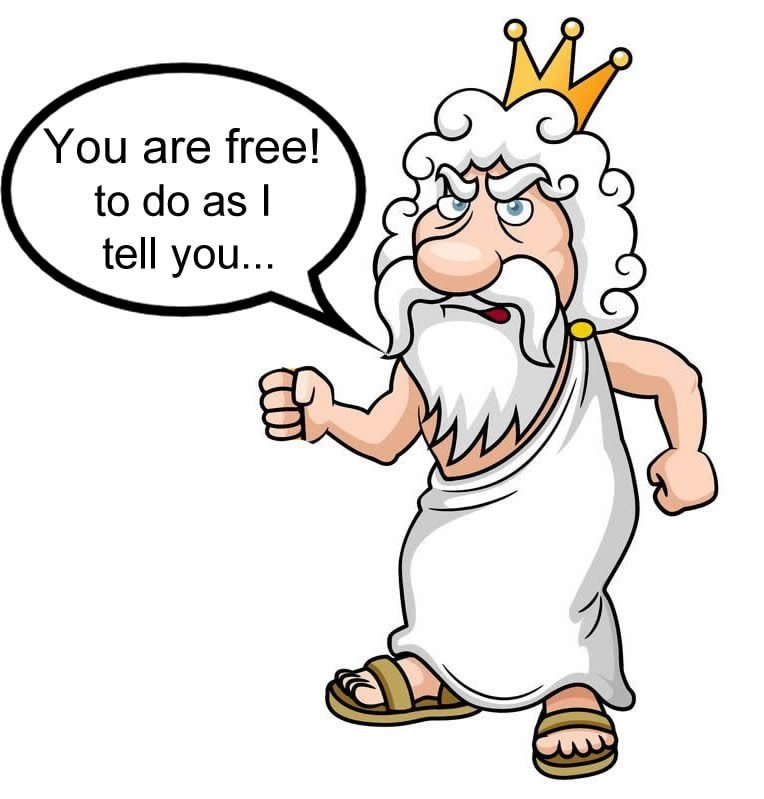
SOMETHING NEW AND DECISIVE ABOUT FREE WILL

Here’s the link to this article.

LETHAL TO THE NEED FOR SAVIOR JESUS

WHY ARE YOU WHO YOU ARE?

COMPARE THE EFFECTS — ONLY YOU KNOW – OF THE FACTORS MAKING YOU

AND IMPOSED NOT CHOSEN – CAN ANYONE HAVE FREE WILL?

By Stanley W. Ayre — March 2023

I am a retired marketing executive with 94 years completed. Those have caused me to see Free Will (FW) as the most important moral question in life — in all versions FW is wrong; in the Christian version, it is the epitome of injustice and an unending source of hate and arrogant pride. *** NOTE: This subject is so large and involves such difficult fields as physics, quantum mechanics, neuro-science, psychology, religion and others so that it is impossible for a single individual of the billions to comprehend. There comes a time when one must decide what to believe on the basis of what he- she has learned in life. I have done that here using mainly common sense.*** Christopher Hitchens, just before dying, called for “new ways” to make the case against “this lethal delusion [religion]”. This is a new way, though indirect, and is lethal to religion. Much of it is derived from philosophy and science, but ir will be understood by a far larger audience than they command since it is based on common sense (CS). The most ardent theist cannot deny the truth of its foundation because of their own personal experience. The latter engages the to-be-convinced  as an active participant in the argument offered here. He-she compares the FW claim to what only they know about their livesIn many that can touch emotional chords. Lincoln said, ‘All that I am or ever hope to be, I owe to my angel mother.’ FW entails that mothers count for nothing — not even in matters of moral choices. That fact for some may be so astounding, so insulting, so disrespectful, that itcould be a tipping point!  *** Of course, this new way is not a silver bullet but it is a mighty arrow In our argument. Everyone can relate to it and understand it. Its active ingredients are the personal experience of the to-be-convinced and his/her inherited instinct for fairness to see that humankind’s eternal destiny simply cannot depend on what we are not responsible for. *** This new way makes the complete case for determinism. Now we have a genuine Trinity — philosophy, science and common sense – and FW’ers don’t.

WITH IT WE CAN SEIZE AND HOLD THE HIGH MORAL GROUND FOREVER.

 I SEEK TO PROVE — FREE WIILL IS IMPOSSIBLE AND IMMORAL

Except in crisis situations, deciding a serious moral matter: whether to choose A or B, you bring to mind all you remember and think relevant, along with other pros and cons, then choose. Your choice is dependent on what you have become and learned, not on some FW magic with no connection to you. It must be that way for it to be your choice.

 . . St. Augustine (354-430 CE): “. . . God’s precepts would be of no use to a man unless he had real choice of will, so that by performing them he might obtain the promised rewards.”  — Retractions Book II, Chapter 66.

. . St. Paul: “And if Christ be not risen then is our preaching vain, and your faith in vain,” –1 Corinthians 15:14          

Paul could have said the same for Free Will. If your choices were caused by forces not under your control, you have no need of a Savior because you are not guilty!

WHAT IS HERE

First some absolutely essential definitions, then the new way, some gems from leading scientists, Einstein’s Credo. What many see as embarrassments for determinism (opposite of FW),  Determinism’s great virtues,– not the least is countering the HATRED engendered by a doctrine

based on the depravity of man. A conclusion and YOUR DECISION.

BRIEF DEFINITIONS

Free Will discussed here asserts that, unless mentally incompetent, a child, or acting under threat of force, you are able to choose freely between alternatives irrespective of your biological inheritance and all experiences in your life.

Determinists to the contrary, assert that your choices are determined – caused – by your biology and all your experiences as they have interacted to produce you at any point in your life. They agree that we all consider what to do and then do it. That is not a contradiction of determinism, but an affirmation of the whether-we-can-do-as-we-choose question, and an explanation of the far more important, why-do-we-choose-as-we-do question.

Compatibilists Are Determinists! but say we are free to be the self we are, play the cards we are dealt. We choose what we want, and that is not only compatible with FW, but all the FW anyone should want. As with all things philosophic there are very many variations of compatibilism, championed by very smart people.

Christianity adds ‘miracle’ to the power of FW. They claim that every person (with the exceptions mentioned above) has FW which enables each to know and choose the morally correct course!(For those who don’t choose correctly, that is their passport to HELL)

Astonishingly, the Catholic Encyclopedia limits this power of FW to overrule heredity and environment to serious moral matters, seriously deliberated!

What is that but acknowledgement that in non–deliberated and non–grave-moral matters a person cannot act freely? Of course, Christian claims are theological, not conclusions based on reasons or science.

WHAT MAKES US WHO WE ARE? HEREDITY & ENVIRONMENT — YES BUT INADEQUATE

Unfortunately, those shorthand words are utterly inadequate to convey what they include. They hide their meaning. For that one must ponder the flesh and blood details as they apply to the way one has lived his/her life. Doing that thoughtfully is key in the NEW WAY.

The new way juxtaposes the FW claim against the factors that made you. You and only you have certain knowledge of how your life developed and will  have opinions about the effects of the factors. The factors will not surprise you, but reviewing them with the FW claim in mind that none of them matter in your choices, will surely astound you, especially when all of them were imposed on you.This will guarantee a better understanding of heredity & environment and its eternal significance to those who believe in heaven or ‘suffering forever in a lake of fire’.

Consider these factors, are they not responsible for who and what you are at any point in life? Do they not apply to everyone who has ever lived or will ever live?

To find their flesh and blood meaning your memory must be seriously engaged and searched. Ask yourself how you would be different had any of the listed factors been different.

. . Being born. In Christian and Islamic theology being born means you are entered into the most consequential gamble imaginable, a chance for Heaven but a far greater chance of suffering in Hell for all eternity. Jesus said ‘few’ would be chosen but ‘the many would suffer in a lake of fire.” Scores of millions believe it.

. . Born male or female physically and emotionally or otherwise. Can you doubt that many of your ‘free’ decisions in life would have been quite different depending on which you are?

. . Your brain and body (DNA) — with or without incurable and chronic pain and countless other attributes contributing to or preventing happiness.

. .  Your life in the womb, shaping your genetic self. Many mothers many behavior addict their babies in the womb from the heavy use of drugs, alcohol or cigarettes. These babies are born sick and hurt.

.  The mutations in your brain and body throughout life, and random events that may have afflicted you in such a way that a normal life was severely impaired or impossible.

. . The time in history and where on earth you were raised. Is it likely you would make all the same choices, especially on grave moral matters seriously deliberated, whether you were born in Mecca, Calcutta or Moscow?

. . Your parents, childhood, education, intelligencepersonality, and sense of humor. Not of your choice, whether wonderful or horrible..

. . Your physical stature, looks, smile and voice, your natural ability in sports, music and dance. How would your life have been affected had any of these been significantly different? Impossible to know, but surely different.

. . Your sexual proclivities and the intensity of that drive. All are awesome in consequences.

. .  Your religious indoctrination, economic circumstances, cultural influences, political and civil rights, the prevailing customs of your times. Colossal in their importance and implications for you.

, , The blizzard of experiences throughout life, not chosen by you but which happened to you, and in many cases changed your life in most dramatic ways.

Does this not account for everything that went into the making of YOU and who you are today? If anything is missing add it.

Of course, you made decisions early on and every day of your life which had effects – some huge – but when you did so they were caused by the YOU who was made by the complex of factors listed at the time you made those decisions.

Is it not ludicrous that anything you do could be independent of everything that made you, you?

CONSIDER TOM’S WARRING WANTS

Three times Tom made a choice between committing adultery and remaining faithful to the wife he dearly loved. His company sent him to a distant city to settle a dispute and Mary was his contact there. From that day he fantasized about an affair with this much younger woman. Soon she made it clear she would welcome it.

Weighing heavily against adultery was his dread of being unfaithful for the first time in his 20 years of marriage. He obsessed if caught about the hurt to his wife, his children, his parents, reputation and his career, though he thought that very unlikely due to Mary’s distant location. He even worried that the woman might have an infection he would pass to his wife.

All of this and more caused him to decline two previous opportunites for this affair. The third time was too much, they got together without discovery. Tom both wanted to — and wanted not to.

The determinist asks you to believe the most likely reasons Tom made the to-do choice was because he, 1) was born male, 2) heterosexual, 3) had a very strong drive for Mary, 4) was turbo-charged by his certainty she wanted the affair too, 5) thought the chances of discovery were remote and 6) for a host of other reasons that neither he, we, nor all the wise men could ever know.

The reasons he declined twice before can be summarized: at those times the pull of the ‘don’t’ factors outweighed those of the ‘do’.

The FW’er asks you to believe that Tom’s FW operated all three times and every time without any influence from the listed life-shaping factors! Remember, the will can’t be free if anything outside causes its choice.

There it is. Which do you believe?

JUST HOW IMPORTANT IS ALL THIS?

Overcoming the free will illusion — “would be a bigger revolution in our thinking than Einstein, or Copernicus, or Newton, or Galileo, or Darwin — it would alter our whole conception of our relation with the universe.” — John Searle, famed philosopher and Professor of the Graduate School at the U. of CA, Berkeley.

SOME SCIENCE GEMS ON FW

What science says ought to be of greatest interest to Christians and others who believe we are created by God. Because all that science ever says on the matter is based on the deep systematicand validated study of — “God’s premier creation’. What nature reveals, surely ought to trump what men say God said – and what he meant.

. Dr. David Eagleman, Professor of Neuroscience at Stanford University, from his book INCOGNITO: As far as we can tell, all activity in the brain is driven by other activity in the brain, in a vastly complex, inter-connected network. For better or worse, this seems to have no room for anything other than neural activity – that is, no room for a ghost in the machine. … If Free Will is to have any effect on the actions of the body, it needs to influence the ongoing activity in the brain. And to do that it needs to be physically connected to at least some of the neurons, but we don’t find any spot in the brain that is not itself driven by other parts of the network. Instead, every part of the brain is densely inter-connected with – and driven by –other brain parts. And that suggests that no part is independent and therefore “free”. So in our current understanding of science we cannot find the physical gap to slip Free Will – the uncaused causer – because there seems to be no part of the machinery that does not follow in a causal relationship from the other parts.  [Emphasis added.]

Who you even have the possibility to be starts at conception. If you think genes don’t affect how people behave, consider this fact: If you are a carrier of a particular set of genes [defining males] the probability that you will commit a violent crime is” [He then cites crimes where being male is 4. 3, 5, and 8 times more likely the perpetrator is male rather than females; males have 13 times greater chance of being arrested for a sex offense and 51 times greater chance of being on Death Row!]

. . SWA NOTE: If both have FW, why would males commit crime — even if only one percent of males do — at such a greater rate than females? If everyone has FW,does it not follow that the incidence of serious moral wrong in any random group in the population will apprxomate their incidence in the population. How would you bet if records were kept on the next million newborns anywhere in the world and examined for crimes after 10, 20 and 30 years?

. . Dr.Eagleman, this time from his book, THE BRAIN –The Story of You. At this very moment, just like every moment of your life, networks in your brain are buzzing with activity: billions of electrical signals are racing along cells, triggering chemical pulses at trillions of connections between neurons. Simple acts are underpinned by a massive labor force of neurons. You remain blissfully unaware of all that activity, but your life is shaped and colored by what is happening under the hood: how you act, what matters to you, your reactions, your loves and desires, what you believe to be true and false. Your experience is the final output of these hidden networks. So who exactly is steering the ship? How do I decide? Brains are composed of multiple competing networks, each of which has its own goals and desires. . . .” [Tom’s case.– Emphasis added.]

. . Bruce Hood, PhD Psychology, formerly Professor at Harvard U. and Massachusetts Institute of Technology, now at U. of Bristol, UK, from his book, THE SELF ILLUSION. It seems absurd to question my free will here, but as much as I hate to admit it, these experiences are not what they seem. This is because of a multitude of hidden factors ranging from genetic inheritance, life experiences, current circumstances and planned goals. Some of these influences must also come from external sources, but they all play out as patterns of neuronal activity in the brain.  This is the matrix of distributed networks of nerve cells firing across my neuronal architecture. My biases, my memories, my perceptions and my thoughts are the interacting patterns of excitation and inhibition in my brain and when the checks and balances are finally done, the resulting sums of all of these complex interactions are the decisions and the choices that I make. We are not aware of these influences because they are unconscious and so we feel that the decision has been arrived at independently . . . .” [Emphasis added.]

.. Dr.Robert Sapolsky, Professor of Neuro-enterology, Stanford U from his book, BEHAVE: Adolescence shows us that the most interesting part of the brain evolved to be shapedminimally by genes and maximally by experience; that’s how we learn – context, context, context. We are constantly being shaped by seemingly irrelevant stimuli, subliminal information, and internal forces we don’t know a thing about. Our worse behaviors, ones we condemn and punish, are the products of our biology. But don’t forget that the same applies to our best behaviors. [Emphasis added.]

Dr. Sapolsky has a new book, Determined: A Science of Life Without Free Will, which  is entirely devoted to our subject. It will be published in October 2023.

.. Sam Harris, PhD, Neuroscience, UCLA  and a degree in philosophy, Stanford U.,  from his book FREE WILL,., Once we recognize that even the most terrifying predators are, in a very real sense, unlucky, the logic of hating – as opposed to fearing – them begins to unravel. . . . even if you believe that every human being has an immortal soul, the picture does not change: Anyone born with the soul of a psychopath has been profoundly unlucky.

SWA NOTE: Harris fully realized that profound luck also applied to him and all those in any field who have premier abilities, including the grit to work very hard, long hours in awful conditions and pull themselves upWhat an antidote to arrogance!

 THE PARADOX IN DETERMINISM WHICH IS EASILY EXPLAINED

Ironically, determinists must pretend we have FW. The whole world works that way – as it must — in order to demand and expect adherence to mutual promises and understandings, the essence of relations between family, friends, others, in business and everywhere.

The pretense is easy because determinists live that way too. It takes a non-emotional, thinking state to remind ourselves that our choices are effects of causes. In everyday life the determinist’s reaction to certain events is as emotional as the FW’er, and when emotional, just as judgmental. It requires effort to remember that it is a necessary fiction . . . and we do not always make it.

But it certainly makes it far easier to see Jesus’ utterly utopian “love your neighbor” as simply required to be just; to offer a soft answer which, as the Bible says, ‘turneth away wrath’ and easier to forgive slights and even serious wrongs. It reduces tensions and stress.

Determinism also has the salutary effect of reminding the above average among us that they too would be average or below but for very good luck. Many will bristle at that idea and point to the double jobs they had while going to night school and then studying to well after midnight every night! They worked hard when they could have played, that is why they are on top! Yes, no doubt. But where did they get that grit and determination? That too was in the cards they were dealt – luck.

 EINSTEIN’S 1932 SPEECH ENTITLED MY CREDO – AN EXTRACT

I do not believe in free will. Schopenhauer’s words: ‘Man can do what he wants, but he cannot will what he wills,’ accompany me in all situations throughout my life and reconcile me with the actions of others, even if they are rather painful to me. This awareness of the lack of free will keeps me from taking myself and my fellow men too seriously as acting and deciding individuals, and from losing my temper.

 Compare Einstein to those who are quite proud to have it said of them, ‘He/she does not tolerate fools gladly’

FW GIVES EXTREMISTS REASON TO HATE

FW is inescapably a source and sustainer of HATE, especially among some ardent and aggressive Christians. After all, the religion is based on guilt and the urgent necessity to repent sins, accept Jesus as savior, and be rewarded with eternal life in HEAVEN. Those who will not accept the ‘loving’ offer of salvation before they die, will suffer forever in HELL

So is it surprising that if Christ on Judgment Daysees one as so evil, that he will consign him/her to the worst fate within imagination, that some of his followers might presume to know who these evil people are and try make them suffer in the here and now – cancel their right to be heard, read, or seen, to employment, harass them wherever they are, all in an explosion of self-righteous zeal?

ACCOUNTABLE BUT NOT RESPONSIBLE? A MORTAL DISTINCTION

If a five year old pulled the trigger that killed his sister, he is not responsible for killing herbecause he is too young to know the consequences of his act. But he is accountablefor why the gun discharged.

FW’ers make much of the idea that determinists would not hold the Hitlers and CharlesMansons ofthe world responsible for their crimes. True, but we would hold them fully accountableand stop their crimes just as society does now.

THAT DETERMINIST’S MUST PRETEND FW IS TRUE HAS IMMENSE SOCIAL VALUE

Holding one to his/her commitments is an experience for them to which they will react. That is the way we all change. The arsenal of experiences includes education, example, praise, reward, work, admonition, reproof, scorn, ridicule, and punishment ranging from fine, public service, jail or prison where there is plenty of time for reflection – even to capital punishment. The experience becomes a memory recorded physically in their brain. Reflecting on it at the time or even well into the future could cause them to understand that the view of things that permitted them to engage in anti-social behavior was wrong – or, just the opposite, reinforce their bad behavior.

Whichever is the case, it is a natural process, easily accepted because wholly unforced, In a sense the miscreant reaches a new conclusion. Often enough that conclusion results in a change in a socially useful direction.

If individuals have engaged in illegal behavior they can be compelled to endure certain experiences, some extremely unpleasant. The object is, or should be, to cause them to naturally change behavior in the right way. Should this be impossible society must do whatever is necessaryfor public safety. Determinism does not entail mollycoddling criminals; but their reform if possible.

The very, very difficult challenge – in way too many cases it is impossible — is to find the right dosage of experience that will cause natural self-change as desired.

All of these measures treat the subject as if responsible for his/her behavior. But the determinist at the intellectual level realizes, or should, that no matter the crime, the subject is not responsible for whom he/she is and therefore must not be hated.

CONCLUSION

Determinism is based on the beyond-argument evidence that we are all victims of circumstances over which we had no control, compelled to exist with an imposed genetic makeup which, interacting with countless imposed experiences and perhaps sprinkled with random mutations in body and brain, combined to make us who we are. With our recipe tweaked in other ways, we would all have different selves.

This understanding fosters a more humane and sympathetic view of others as it dampens undue pride among the very lucky.

TOM’S CASE PRESENTS THE ISSUE SQUARELY

The case of Tom, the reluctant but seriously pre-meditating adulterer, presents the essence of the issue: FW or Determinism.

Did he decline adultery twice because he loved his wife; his morals forbade it, fear of discovery, etc.?

Did he go ahead once because he was born male, heterosexual, had a powerful desire for this younger woman, etc.?

Or, was his FW operating on all three occasions, and he made those decisions totally free of any influence from all the life-shaping factors that made him, and over which he had no control whatever?

That is for you to decide.

Is the Bible the Best Moral Guide?

Here’s the link to this article by Merle Hertzler.

Free hands praying on bible

So far, we have seen that the Bible is often mistaken. We haven’t seen good evidence that it was directly inspired by God. Now this does not necessarily mean that the Bible is bad. It just means that when we read it, it is okay to be on the lookout and question what we read.

You may be concerned where this is leading. Perhaps to you the Bible is the source of moral judgement. It is your only hope to find your way in life. You may wonder how anybody could attempt to chart his course through life without its moral compass. And you may be concerned that we are undercutting that hope. I can understand your concern. I once had similar views of the Bible. I still find passages in the Bible that are inspiring. But other passages? Not so much.

And I find other books that I find inspiring besides the Bible.

Perhaps you would claim that the comfort and guidance you receive from the Bible puts it in a class of its own, far above any other book. But is this really what we find in the Bible? Let’s see. Let’s take a few minutes to look at the guidance that the Bible offers. Do we need the Bible’s guidance to know what is right and wrong?

The Law of Moses

Let’s begin by looking at Deut 22:11. It says, “You shall not wear a material mixed of wool and linen together.” Do you follow that rule? Did you check the labels before you dressed this morning? I think you ignored this commandment today, just like I did. Why do we ignore it? I neglect it because I think it is unreasonable.

Why did you neglect it?

If the Bible is your source of guidance, why do you simply ignore this rule, and live as though it doesn’t exist?

This rule is unreasonable. If you and I let reason override this rule, then it seems to me that reason, not the Bible, is our ultimate guide.

Many Christians have never read the whole Bible and are not aware of the moral teachings that are found in it. Let’s look at some.

Exodus 23:19 tells us we may not cook a baby goat in its mother’s milk. Do you worry about keeping this commandment?

Gen. 17:14 tells us a child is to be punished when his parents neglect to have him circumcised. Is that fair?

Ex. 20:8-1131:15-1734:21, and 35:1-3 tell us that no work may be done on the Sabbath (Saturday) not even the lighting of a fire. The penalty is death. Do you recommend that we kill people who light a fire in their fireplace on Saturday? [1]

Lev. 3:17 tells us that we may never eat fat. So how is it that we eat hamburgers without guilt?

Lev. 27:1-7 tells us that males are more valuable than females. I doubt if many of my female readers agree! These verses are mistaken, aren’t they?

Num. 5:12-31, tells us that if we suspect our wife has committed adultery, she is to be tested by making her drink water mixed with dirt from the tabernacle. The tabernacle! This is the place where animals were sacrificed, where blood was spilt. Imagine all the germs that would be on that dirty floor! But she is to drink water with some of that dirt mixed in. If she gets sick after drinking this dirty water, she is guilty. Do you recommend that we implement this test procedure? I don’t.

By the way, there is no such test given for men. Is this fair?

Deut. 22:5 tells us we may not wear clothing of the opposite sex. Do you think it is a sin for a woman to wear her husband’s shirt? No? Then you disagree with Deuteronomy.

Deut. 23:1 tells us that a man whose testicles are crushed may not enter the assembly of the Lord. Should we set up an inspection station at the church doors, asking every man to kindly drop his drawers for inspection. Should we keep the injured people out? Or should we just pretend this verse isn’t there?

Deut. 25:11-12 tells us that a wife who grabs her husband’s attacker by his private parts must have her hand cut off and is to be shown no pity. It does not matter that she was only trying to protect her husband. Do you agree?

I could give many more examples. [2]

Was the Old Testament Mistaken?

Many will quickly distance themselves from the above verses. They will object that these verses are in the Old Testament [3], and we no longer are required to keep them. But the issue here is not whether you are still required to keep them. The issue is whether these commands are good. Do they represent a high level of morality? Or are they mistaken?

If you say they are a mistaken morality of primitive people, then why are they in the Bible? If the Old Testament is mistaken about whether an injured person can enter the assembly of the Lord, or how to properly deal with the accusation of adultery, where else is it wrong? Is it wrong also on creation? Is it wrong in its theology?

Christians that are quick to distance themselves from the Old Testament are apparently unaware of how closely the Old Testament is tied to the New Testament. For instance Matthew 23:1-3 says,

Then Jesus spoke to the crowds and to His disciples, saying: “The scribes and the Pharisees have seated themselves in the chair of Moses; therefore all that they tell you, do and observe, but do not do according to their deeds; for they say things and do not do them.”

So, do you follow these verses? They tell you to do all that the Pharisees command you from the Law of Moses. Do you do everything the teachers of the law teach?

And what about Matthew 5:18-20, which teaches that we should follow even the minor laws,

“For truly I say to you, until heaven and earth pass away, not the smallest letter or stroke shall pass from the Law until all is accomplished. “Whoever then annuls one of the least of these commandments, and teaches others to do the same, shall be called least in the kingdom of heaven; but whoever keeps and teaches them, he shall be called great in the kingdom of heaven. “For I say to you that unless your righteousness surpasses that of the scribes and Pharisees, you will not enter the kingdom of heaven.

Is the law that forbids the mixing of fabrics one of the least of the laws? According to these verses, if you ignore the least of the laws, you will be called the least in the kingdom of heaven. So why do you ignore them?

Some say that Matthew 5 does not apply, for all “was accomplished” by Jesus. But if the author was trying to teach that this only applies until the death of Jesus, he used most unclear language. Besides, the book of Matthew was not written until years after Christ died. Why did Matthew even bother to write this? Is it not clear that when Matthew was writing this he expected his readers to believe they needed to keep the law if they wanted to be great in the kingdom of heaven?

And so, it appears that Matthew, writing long after the death of Christ, still expects that his readers need to keep the law in order to be great in the kingdom of heaven.

Even Paul writes, “Do we then nullify the Law through faith? May it never be! On the contrary, we establish the Law.” (Rom 3:31) He also says, “For it is not the hearers of the Law who are just before God, but the doers of the Law will be justified.” (Romans 2:13)

So, the New Testament simply does not distance itself from the Old Testament the way many hope. If you want to escape the problem by distancing yourself from the Old Testament, you will find yourself at odds with the New Testament support of the Law.

Was the Law just a Teacher?

I once discussed these things with a pastor. He told me I misunderstood. He said that these laws were not really about morality, but were simply there to show us our sinfulness, and bring us to Christ.

But how could a frivolous and immoral law prove we are sinful? If you want to measure moral character, do you not need a reliable moral standard? You surely must not think that the laws mentioned above represent a high standard of conduct. Or do you? If they are faulty, how can they be used to prove our sinful state? If the inspection gauge in the factory is faulty, you could not use it to prove the whole production run is flawed.

And isn’t this whole view of the-law-as-teacher callused to the needs of the people before Christ? Why would God leave them with an inadequate law for centuries just to prove a point to us that would follow later on?

Also, if Jehovah did give us the Law of Moses, and we find that this first system of his to be faulty, does that prove that his second plan, the gospel, is good? If an engineer gives you a defective design, and the building collapses, would you trust him with the redesign? If he told you he deliberately gave you a deficient design in order to prove that you really needed his improved design, would you buy his argument? I think not. You would look elsewhere.

So, if Jehovah’s was behind the first covenant, the Law of Moses, and it is not good, why not look elsewhere? If that is the case, why give Jehovah a second chance?

I find no reason to believe this law was given by God. It seems more likely to me that it was an early attempt by primitive people to define morality.

Slavery

Let’s look at something more substantial than clothes or goat meat–the issue of slavery. Look at Exodus 21:2-7.

“If you buy a Hebrew slave, he shall serve for six years; but on the seventh he shall go out as a free man without payment. “If he comes alone, he shall go out alone; if he is the husband of a wife, then his wife shall go out with him. “If his master gives him a wife, and she bears him sons or daughters, the wife and her children shall belong to her master, and he shall go out alone. “But if the slave plainly says, ‘I love my master, my wife and my children; I will not go out as a free man,’ then his master shall bring him to God, then he shall bring him to the door or the doorpost. And his master shall pierce his ear with an awl; and he shall serve him permanently. If a man sells his daughter as a female slave, she is not to go free as the male slaves do.

Do you have an opinion on the morality of this passage? Is it right to buy slaves, even if the period is limited to six years? What do you think about the poor women slaves? If the men could go free after six years, why should the women be slaves for life? And look at the condition that was placed on these male slaves obtaining their freedom. If a slave had married while in slavery, his wife and children could not leave with him. Only the man could leave. Should a decent man accept this offer and abandon his family as slaves? What kind of family values is that?

Do you have an ounce of respect for the father who takes his little girl–the one that cuddles in his lap at night and calls him “Daddy”–and sells her into lifelong slavery? Why does the Bible allow it? Is it really moral to sell one’s own daughter, knowing that she and her children will become slaves for life? I can’t even imagine a person thinking this is acceptable. Help me out here. What am I missing?

You may suggest that conditions were different back then, so God had different rules. But do you really believe that? Suppose you are watching a movie. You see the story of a slave owner who buys young ladies and young men as slaves. You watch as a man sells his own daughter to be a slave. There you see the slave-owner give this young girl to another slave as his wife. You watch as her slave husband walks off after six years, free of all responsibility, leaving her and the children as slaves. On screen you see their wretched, abandoned lives as slaves without a committed father or husband. How would you react? Do you approve of these actions? I think not.

Would you approve if the movie was set in the 500 BC time frame, but disapprove if it was set at a later date? What does it matter when the movie was set? Slavery is slavery, no matter when it happens. And it seems to me that slavery is wrong.

Look, the movie is still playing. Here comes the slave-girl’s father walking down the path. Look closely, I think I see something. Yes, look at his coat. See it? It is pure wool! He has obeyed Deuteronomy 22. He has not mixed two kinds of fabric in his coat. Does this change your view of this man? Does the material of his coat change your attitude toward him? No? Then why does the Bible condemn people who wear the wrong combination of fabrics, while allowing slavery to continue? Do you really believe there was a time when slavery was fine but mixing materials in your clothing was sinful?

One of the worst practices conceived by humans was the act of owning slaves. And yet the Bible allows it. Although term limits were imposed on male Hebrew slaves, the same rights were not given to people of other nations. In Lev. 25:44-46 we read:

44’As for your male and female slaves whom you may have–you may acquire male and female slaves from the pagan nations that are around you. 45’Then, too, it is out of the sons of the sojourners who live as aliens among you that you may gain acquisition, and out of their families who are with you, whom they will have produced in your land; they also may become your possession. 46’You may even bequeath them to your sons after you, to receive as a possession; you can use them as permanent slaves. But in respect to your countrymen, the sons of Israel, you shall not rule with severity over one another.

Is not something very wrong with this book? How can you carry a book to church that allows slavery? Do you want your children to read this book?

Which of these is a better moral guide?
Hamanist Manifesto III
Deuteronomy

Death

There is a long list of sins in the Old Testament that carry the punishment of death, including homosexuality, adultery, and cursing parents. For instance:

9’If there is anyone who curses his father or his mother, he shall surely be put to death; he has cursed his father or his mother, his bloodguiltiness is upon him. 10If there is a man who commits adultery with another man’s wife, one who commits adultery with his friend’s wife, the adulterer and the adulteress shall surely be put to death…13′ If there is a man who lies with a male as those who lie with a woman, both of them have committed a detestable act; they shall surely be put to death. Their bloodguiltiness is upon them. (Lev. 20:9-10,13)

Do you suggest that we follow these commands, and kill such people? Or are these verses mistaken?

Was the law intended to be temporary?

I do not think you follow these commands to kill the adulteress. I do not think you follow the law that says to not mix fabrics. You have a low view of such laws.

Then Isaiah has something to say to you. He says you have no dawn! In Isaiah 8 he calls us to the law saying, “To the law and to the testimony! If they do not speak according to this word, it is because they have no dawn.”(Isaiah 8:20 )

Isaiah has diagnosed you. You don’t follow these commands? Ok, then Isaiah says you have no dawn.

You disagree with Isaiah, don’t you?

Yes, I expect you will tell me that Isaiah’s message to keep the law was only temporary, that the Old Testament system was given only to help people until the gospel would arrive. If the Old Testament was temporary, why doesn’t it say so? Repeatedly the Old Testament declares that this system is to last forever. For instance:

Psalm 119:60 The sum of Your word is truth, And every one of Your righteous ordinances is everlasting.

2 Kings 17:37 The statutes and the ordinances and the law and the commandment which He wrote for you, you shall observe to do forever ; and you shall not fear other gods.

Of course the law referred to in the above verses is the only law they had, that of Moses. But you disagree that this law is forever, don’t you? You don’t think that the law against wearing mixed fabrics or the law commanding the killing of those who curse parents is eternal, do you?

What about those verses above that call these ordinances are everlasting? Are they wrong?

The New Testament

Let’s look at an example from the New Testament. Luke 6:30 says, “Give to everyone who asks of you, and whoever takes away what is yours, do not demand it back.” Do you give to everyone that asks of you? If you do indeed follow this, and give to everybody that asks of you, then what if I ask you for everything you have? I suspect that everybody will refuse to give me everything they have.

But Luke says we are to give to everyone that asks.

It doesn’t matter what Luke says, does it? Common sense says this is not a good command. So we ignore the written code, and go by our common sense. This indicates to me that our ultimate source of moral guidance comes from reason, not from the Bible.

People tell me Luke does not mean to give to everyone that asks–even though he says so–but that he is only asking us to be generous. Well, I agree that we should be generous. If this was the point, then that is what the writer should have said. He could have said, “Be generous” instead of saying, “give to everyone who asks”. In that he must surely be mistaken.

New Testament morality has many problems. Luke 14:26 tells us we cannot be disciples unless we hate our father, mother, and children. What kind of family values is that? And no, you cannot get around that verse by telling me that it means “love less” instead of “hate.” If the author meant “love less” why didn’t he say what he meant?

Matt.10:34 says, “Do not think that I came to bring peace on the earth; I did not come to bring peace, but a sword.” Do you agree that the world needs yet another sword?

How should a guest treat a host? Some might respond by asking, “What would Jesus do?” Well, what would Jesus do?

Now when He had spoken, a Pharisee asked Him to have lunch with him; and He went in, and reclined at the table. When the Pharisee saw it, he was surprised that He had not first ceremonially washed before the meal. But the Lord said to him, “Now you Pharisees clean the outside of the cup and of the platter; but inside of you, you are full of robbery and wickedness. You foolish ones, did not He who made the outside make the inside also?” ( Luke 11:37-40a)

So, we find that, if Luke is to be believed, Jesus was sitting as a guest in a man’s home. His host was surprised that Jesus did not ceremonially wash his hands. And we are told that Jesus insulted his host. Is this the proper way to treat your host? If you were invited to dinner, you would not respond to your host with insults like this, would you? Is this the way you want your children to act when they are away from home?

And then there is the command of Romans 13:1-2 to obey the government, all government.

Every person is to be in subjection to the governing authorities. For there is no authority except from God, and those which exist are established by God. Therefore whoever resists authority has opposed the ordinance of God; and they who have opposed will receive condemnation upon themselves.

If we were to follow these verses, then we would be forced to always obey our government. And so it would have been wrong for the Northern Alliance to defy the Taliban, the American revolutionaries to declare independence from the British, and the people of the Soviet Union to resist Stalin. But most of us seem to honor someone who rebelled against a government. It seems to me that we allow them to ignore the verses because we know reason is a better source of moral instruction than biblical literalism.

Some will tell me that these verses are only a general rule to follow government, and that the command to obey God rather than man can override this rule. But notice the language of Romans 13. “Every person is to be in subjection…There is no authority except from God…whoever resists authority has opposed the ordinance of God.” That clearly includes everyone and every government.

Now, if the author had intended to say that most people should be in subjection to most governments, that most authority is from God, and that most people who resist the authority resist God, he could have said that. If he was trying to convey that idea with the words he wrote, then the author was incompetent. He should have said what he meant. He does not say there are a few authorities not from God. He says there is no authority except from God.

When he emphasizes the universality of the command multiple times, how can people just ignore it and say he is only referring to some authorities? If we read what it says, it must apply to all authority. It must be saying that the French Resistance to Hitler, and the American Revolution from England were wrong.

That is how it goes. People regularly ignore the Bible if it is not to their liking. They assume it must not mean what it clearly says. Wouldn’t it be more honest to accept that it means what it says, but it is wrong?

Atrocities

It gets worse.

Imagine that your child comes home from Sunday school and shows you the handout he was given. It says, “How blessed will be the one who seizes and dashes your little ones against the rock.” It shows a picture of a baby being thrown against a rock with his head splitting open. How do you react? I am sure that you would be upset with that literature. You would never want your children to be taught this, would you? But, if your children carry a Bible to church, they carry those verses with them (Psalm 137:8-9). And those verses teach that the act of throwing babies against rocks is blessed.

Those are two of the verses your children carry with them in the big black book they carry to Sunday School. Don’t worry, your child will never actually be taught those verses in Sunday school. Those verses never seem to make the cut.

Regardless of what Psalms says, it is wrong to dash
a baby’s head against the rocks.

How can a holy book praise people that smash babies against the rocks? Yes, I understand that the writer was angry against his Babylonian captors. I can empathize with his anger against the soldiers, slave drivers, and political leaders. I understand the hurt. But how can he say it was blessed to kill Babylonian babies? You surely do not approve of going to your enemy and killing his baby as an act of revenge, do you? Isn’t that an act of terrorism? Why does the Bible praise this? I would say that this writer is morally confused. I would say he is praising something wrong.

If this were the only problem, I might be able to overlook it. But there are so many morally troubling verses. Do you doubt that? I have a suggestion. Tonight, start at Genesis and start reading. Ignore the commentaries. Ignore the chapter headings. I am asking you to do what your pastor would ask you to do. Get into the word. Read it for yourself. You will be surprised.

About the Holy Bible by Robert Ingersoll
Abraham and Isaac by Bruce Gerencser

Bible Morality Links

The Plagues of Egypt

As another example, think about the story of the Passover. Moses keeps asking Pharaoh to let the people go from their bondage. Pharaoh refuses. Finally, according to the story, God comes up with a plan that breaks Pharaoh’s will to fight. It involves sending an angel to kill all of the firstborn in Egypt. And we are told that this is exactly what happened–“There was a great cry in Egypt, for there was no home where there was not someone dead.” (Ex.12:30) No home survived? What a slaughter.

Maybe I should not play Monday morning quarterback–I was not there–but an idea comes to mind. Wouldn’t it have been easier to threaten to kill Pharaoh? If he doesn’t respond, kill him. Suppose his successor maintained the evil bondage. Ok, then you kill the next Pharaoh. How many Pharaohs do you need to kill until one of them will listen and end the brutal slavery? How do you like that plan? Isn’t that more humane than killing thousands of innocent babies? Why not?

Imagine that you are watching the evening news. You see a picture of a missile being skillfully guided so that it misses the enemy bunker and slams into an orphanage. The reporter tells you that this is exactly where the missile was supposed to hit. The reporter describes the precision that was necessary to avoid the tanks and hit the babies. He tells you that these tactics will demoralize the opposition leaders and cause them to submit to our requests. How would you react? You would be outraged, wouldn’t you? When civilized countries fight modern warfare, they take special precautions to avoid killing babies.

But what happened in Exodus? If we believe the Bible, the big blow deliberately missed Pharaoh, missed the army command-and-control, and missed the slave drivers. Instead, we are told it was aimed specifically at the children. This is good? This is moral? Can you understand how I have come to the opinion that the writer of this passage was mistaken?

Slaughter of the Amalekites

The slaughter of babies was a constant theme in the Old Testament. Repeatedly we are told that God sanctioned the slaughter of babies. For instance, in I Samuel 15 we read:

Then Samuel said to Saul, “The LORD sent me to anoint you as king over His people, over Israel; now therefore, listen to the words of the LORD. 2″Thus says the LORD of hosts, ‘I will punish Amalek for what he did to Israel, how he set himself against him on the way while he was coming up from Egypt. 3 ‘Now go and strike Amalek and utterly destroy all that he has, and do not spare him; but put to death both man and woman, child and infant, ox and sheep, camel and donkey.’”

Can you imagine the gruesome scene (assuming it actually happened as recorded)? Hundreds of children would have been killed with the sword as they fled or cowered into a corner. Can you support such actions?

Suppose you had been a soldier in Saul’s army. Would you have willingly and gladly thrust your sword through a child’s heart? Would you have willingly chased a fleeing six-year-old girl from the scene, ignored her screams, and cut off her head? If you would not do this willingly, then deep inside you must know that the action described is wrong. Can you then see why many think the Bible is mistaken to sanction such things?

Some will tell me that the killing of babies was okay, for God sanctioned it. But how do they know God sanctioned it? Isn’t it possible that the writer was mistaken when he wrote that God said this?

Christian Moral Relativism

Defenders of the Bible often resort to extreme moral relativism when they try to defend such verses. They try to declare that there is no intrinsic difference between right and wrong, and that all that matters is obeying God. So, if the voice of God were to sanction rape, murder, slavery, or torture, they see no problem with doing those things. To them morality is all about obeying the rules and has nothing to do with what is best.

But if this is the attitude they have, then they would equally follow an evil tyrant God as they would a good God. For if there is no intrinsic difference between right and wrong, if all that matters is that we perform our duty as directed from above, if there is no value in questioning whether the act is right, one would then be forced to follow a God even if he commanded the most horribly depraved deeds.

No, it seems to me that some things are indeed bad. Killing innocent babies is bad. And 1 Samuel commands the killing of innocent babies. Is not this passage wrong?

If a friend told you he heard a voice from the sky claiming to be God and telling him to kill babies, you would not tell him to do it, would you? You would doubt that it really was God who was speaking, wouldn’t you? You would be skeptical of the claim that this was God. Why do you not have the same skepticism when you approach I Samuel 15? For we have found no reason to assume this passage is inspired by God. Is it possible that this writer was mistaken when he thought God was sanctioning the killing of babies?

Which is more likely? That the author was mistaken when he thought God was commanding him to kill babies, or that a sovereign God of the universe was commanding the slaughter of innocent babies?

Many of us have concluded that the writers of the Bible often presented a depraved morality.

The Good Parts

You may want to tell me that the Bible has many good parts. I agree. But much of the good teaching of the Bible is also found in other books that were written before the Bible. For instance, here is the Golden Rule as taught by others before Jesus:

What is hateful to you, do not to your fellow man. That is the entire law; all the rest is commentary. (Talmud, Shabbat 31a – thirteenth century B.C.)

Surely it is the maxim of loving kindness: Do not do unto others what you would not have them do unto you. (Analects 15:23 – sixth century B.C.)

May I do to others as I would that they should do to me. (Plato, fourth century B.C.)

So, we find that many people taught the Golden Rule long before Jesus. The Bible was not original when it proposed this idea. There have been many good books about morals.

I am for high moral standards. I am in favor of kindness, and love, and the rule of law. I am not convinced that the standard of morality that I see in the Bible is better than the standard that I reach by reason. That is why I choose reason.

Is the Bible Inspired?

Here’s the link to this article by Merle Hertzler.

man in white suit standing on street

As we have seen, parts of our Bibles are probably mistaken. But what about the original source? I was taught to believe that holy men of God wrote down the Bible as they were moved by the Holy Spirit. Is this what happened? Is the Bible in its essence the words of God?

Now this is a rather extraordinary claim–that a mere book represents the words of God. We should expect that some would be skeptical about that claim, yes? After all, you yourself are probably skeptical of the claim that the Quran or the Book of Mormon is the word of God. You demand more than a simple assertion. You would like some real evidence. Very well then. It also seems to me that, if one wants people to believe the Bible is God’s inspired word, one needs to have a good reason why we should believe it.

Why Believe in Inspiration?

So why should we believe that the Bible is God’s Word? II Timothy 3:16 comes to mind: “All Scripture is inspired by God and profitable for teaching, for reproof, for correction, for training in righteousness;” So here we have a claim. But a claim is not proof.

I think that II Timothy 3:16 does not count as significant evidence that the Bible is God’s word. First, we don’t know what books the author is referring to as scripture. He does not tell us. What do you think he refers to? The 66 books of the Protestant Bible? What makes you think he means those books? Unless he defines what he is talking about, how can we know what books he thinks are inspired?

Second, the passage has alternate translations. It could mean, “All scripture that is inspired of God is profitable.” In other words, it could simply mean that God has had a hand in certain books, and that they are worth reading. It may not even be claiming verbal inspiration or that the books are more inspired than other inspiring reading that you might find.

And finally, the author may be mistaken. After all, we don’t even know who wrote this book.

Oh yes, many will tell me that Paul wrote II Timothy. But could someone else have written it? After all, it was a common practice in those days to write a book and claim that some famous person had written it. The books could have been falsely attributed to Paul.

The vocabulary of these books does not match the rest of Paul’s writings, but rather, is similar to second century writings.[1] This book is never mentioned by the early church fathers, even though other books of Paul are frequently referenced. It appears that this book had not even been written until years after Paul. If you think Paul wrote it, why?

Even if you could show that Paul wrote it, we could argue that he could have been mistaken when he wrote this. Paul, after all, was human, and humans are sometimes mistaken.

Can you understand why many do not think that quoting this verse proves that the 66 books in your Bible are inspired?

The odd thing to me is that no book of the New Testament specifically claims to be inspired (with the possible exception of Revelation.)

Let’s look at one example. In Romans 1 we read, “Paul, a bond-servant of Christ Jesus, called as an apostle, set apart for the gospel of God… to all who are beloved of God in Rome, called as saints.” Now, according to Evangelical thinking, this book is not just expressing Paul’s thoughts. It is expressing the very thoughts of God. But where does the book say this?

Imagine that you were in the church of Rome and you received this personal letter from Paul. You would, of course, be thrilled to have a lengthy letter from this leader of your faith. But would you consider this letter to be the writings of God? You read right there that Paul wrote it. Nowhere does it say that God wrote it. Nowhere does Romans claim that Paul was merely the vehicle that God used to express his thoughts. And we have no record that the recipients thought this book was written by God.

Now look at the end of the book: In Rom 16:22 it says, “I Tertius, who wrote this epistle, salute you in the Lord.”

Okay, so perhaps Paul didn’t do the writing, but he dictated it to a scribe. Imagine the chain of command–God told Paul what to write, Paul told Tertius, and Tertius wrote it down. Isn’t it possible that something was lost in transmission?

And how did Romans 16:22 get there? Was Paul dictating these words–“And the God of peace shall bruise Satan under your feet shortly. The grace of our Lord Jesus Christ be with you… I Tertius, who wrote this epistle, salute you in the Lord.” Can you imagine what Tertius would have said if he was taking dictation and Paul had said “I Tertius”? It’s just not natural. So, most likely Tertius wrote this verse on his own.

Did God switch modes, so that he was now inspiring Tertius instead of Paul? If so, why didn’t God just inspire Tertius in the first place, and leave Paul out of the loop? Or did Tertius just inject this verse on his own? If so, how many other verses did Tertius insert?

Regardless, we find that Paul takes credit for the book, and Tertius steps in and takes credit for his contribution, but somehow, they didn’t think it was important to mention that God was the author. Why would the book give credit to the channel (Paul) and the scribe (Tertius) and fail to mention the author (God)? How odd. If God wrote this, wouldn’t he have taken the credit?

Thus saith the Lord

Oh, but people will tell me that the Old Testament prophets often wrote, “Thus saith the Lord.” Does this prove that those verses are quotes from God? I think not. How would we know that the prophets were not just pretending that God said those things? Many prophets were doing that. You can read about them in Jeremiah 23. Jeremiah writes,

16 Thus says the LORD of hosts, “Do not listen to the words of the prophets who are prophesying to you. They are leading you into futility; They speak a vision of their own imagination, Not from the mouth of the LORD… 21″I did not send these prophets, But they ran. I did not speak to them, But they prophesied. (Jer 23:16,21)

These prophets said, “Thus saith the Lord,” but Jeremiah says that they were lying. What do you think these other prophets said about Jeremiah? That’s right. They probably said that the Lord told them Jeremiah was lying. So, who was right? Can you see that merely claiming that God says something does not prove that the writer is correct?

To convince a skeptic that he is wrong, you will need to do more than state that you are right, and he is wrong. You will need evidence. What evidence do you have that the Bible is inspired? Many Christians have proposed evidence, including claimed prophetic fulfillment, miraculous biblical unity, and the Bible’s life-changing power. Do these things prove that the book is inspired? We are here to ask questions. Let’s ask.

Prophecy

One of the most frequently used arguments for the Bible’s inspiration is the claim of fulfilled prophecy. We are told that the writers miraculously predicted many things years before they happened. Let us look at some claimed examples.

One of the most famous is Micah 5:2, “But as for you, Bethlehem Ephrathah, Too little to be among the clans of Judah, From you One will go forth for Me to be ruler in Israel. His goings forth are from long ago, From the days of eternity.”

We are told that this verse predicted that Jesus would be born in Bethlehem. But does it say that? First, look at whom this verse is talking about. Look at the context. We find more about this ruler in verses 5 and 6,

This One will be our peace. When the Assyrian invades our land, When he tramples on our citadels, Then we will raise against him Seven shepherds and eight leaders of men. They will shepherd the land of Assyria with the sword, The land of Nimrod at its entrances; And He will deliver us from the Assyrian When he attacks our land And when he tramples our territory.

Micah wrote during the time of Assyrian dominance and writes of somebody who will conquer Assyria. Does this sound like a description of Jesus? Did Jesus deliver “from the Assyrian?” No. So apparently the man spoken of in Micah 5–the one that was to come out of Bethlehem and defeat Assryia– is not even Jesus.

Some might argue that this verse could be taken figuratively, that Jesus symbolically defeated the Assyrian tyranny. But how many other people could be said to have figurative conquered Assyrian tyranny? Churchill, Washington, and Martin Luther King come to mind. In fact, thousands of people can be said to have figuratively conquered Assyria. So how can you be sure this is talking about Jesus? And if the conquest of Assryia is not to be taken literally, how do we know that “Bethlehem” is to be taken literally? If we are allowed to use figurative interpretations, hundreds of towns might figurative be Bethlehem, the city of David.

There is a second problem. The verse is probably not even referring to the town of Bethlehem, but to a man named Bethlehem, the descendent of Ephratah. I Chron 4:4 speaks of this man, “These were the sons of Hur, the first-born of Ephrathah and father of Bethlehem.” Now the “prophecy” in Micah refers to Bethlehem Ephratah. Sounds like Micah is describing a descendant of Bethlehem Ephratah, not a citizen of a town.

Third, how do we even know where Jesus was born? Sure, Matthew and Luke said he was born in Bethlehem, but could they have been mistaken? Or could the books have been altered to make it look like Jesus was born in Bethlehem?

It is no use arguing that the gospels are correct because they are inspired. That is the point we are trying to determine. Unless we can prove they are inspired, we cannot simply assume the issue under consideration. That would be arguing in a circle. So, the books could possibly be wrong on this point.

And, other than these two books–which conflict on the details–we have no record of Jesus being born in Bethlehem. So maybe the writers made this up so they could show a fulfillment of prophecy as they understood it. Once more, we have reason to be less than impressed with this prophecy.

So, I don’t find Micah 5:2 to be an impressive prophecy about Jesus.

How about Isaiah 53? This tells about a suffering servant. Many think it predicts Jesus. Again, let’s look at the passage in context. Notice the language.

3 He was despised, and rejected of men; a man of sorrows, and acquainted with grief: and as one from whom men hide their face he was despised; and we esteemed him not.4 Surely he hath borne our griefs, and carried our sorrows; yet we did esteem him stricken, smitten of God, and afflicted.5 But he was wounded for our transgressions, he was bruised for our iniquities; the chastisement of our peace was upon him; and with his stripes we are healed.

It seems to be talking about somebody in the past, that is, before Isaiah. “He was despised…was wounded…was bruised.”

The theme of the suffering servant appears throughout Isaiah 40 through 55. When Isaiah refers to this suffering servant, it appears he is talking about the nation of Israel. For instance, in Isaiah 44:1-2 :

1″But now listen, O Jacob, My servant, And Israel, whom I have chosen: 2Thus says the LORD who made you And formed you from the womb, who will help you, ‘Do not fear, O Jacob My servant; And you Jeshurun whom I have chosen.

We find that Jacob (Israel) is referred to as a servant. This theme is repeated throughout the later part of Isaiah. The passage could be telling us nothing more than that the nation of Israel suffered for the sins of the people. This passage could have nothing to do with a future savior. Perhaps Isaiah was not even writing a prophecy.


Prophecies: Imaginary and Unfulfilled by Farrell Till
The Fabulous Prophecies of the Messiah by Jim Lippard
A Chassidic Rabbi Makes a Startling Discovery By Moshe Shulman A humorous look at how easy it is to make a past saying sound prophetic.

Prophesy Links

Do you think the prophecies of the Bible are impressive? May I suggest a way to check this claim out for yourself? Start at the Psalms and read through to the end of the prophets. Lay aside the commentaries and chapter headings. Every time you see something that might be a prophecy of Christ, ask yourself if this is really prophesying a future event. Is the prophecy so vague it really predicts nothing? Is it talking about a contemporaneous event, and not even talking about the future? Is the reference so cryptic that it takes a specially trained eye to pick it out of context? Would God hide things like that? Read it from the perspective of a person who has never heard of Jesus. Would he be expected from these verses to know that some particular event would happen in the life of Jesus? I think you will find that the claimed prophecies melt away when you do this.

I remember the first time I read the book of Isaiah. I was excited to read all of those marvelous prophecies in context. What a surprise it was to read what was actually in the book. The “prophecies” come rather unexpectedly, in passages that are totally unrelated to Jesus. And most of the book consists of long diatribes about ancient affairs that mean little to modern people. I am not making this up. You can see it for yourself. Simply pick the Bible off the shelf and read the book of Isaiah.

Before we move on, let’s look at one more prophecy claim. In Zechariah 11 we read:

2 I said to them, “If it is good in your sight, give me my wages; but if not, never mind!” So they weighed out thirty shekels of silver as my wages. 3Then the LORD said to me, “Throw it to the potter, that magnificent price at which I was valued by them.” So I took the thirty shekels of silver and threw them to the potter in the house of the LORD.Zechariah 11:12-13

Now this has been claimed to be a marvelous prophecy of the fee paid to Judas. If this is a prophecy, then God has hidden it well. We find it is again written in the past tense. It tells the story of a discouraged shepherd trying to lead Israel. Having given up, he asks for his wages and throws the money to the potter. Now in what way does this represent Judas? The story simply doesn’t match. If Judas happened to receive the same wage as the man in the story, that is a coincidence. How is that a prophecy? You see, if one tries to find little matches between any two stories, one can usually do it. But that does not prove that the first story prophesied the second. (See, for instance, the “startling discovery” made by a rabbi in the sidebar above.)

Even if a story in the New Testament has parallels to something in the Old Testament that does not prove the Old Testament was prophetic. It is possible that the writers of the New Testament slanted the story to make it match what they read in the Old Testament.

It is no use claiming that the New Testament is right because it is inspired. That is the point in question. You cannot prove the Bible is inspired by assuming it is inspired.

So, if fallible men wrote the gospels, maybe their bias influenced how they told the story. In many places the New Testament says something happened “that it might be fulfilled” and then it references some passage in the Old Testament. So, if the writer knew about the Old Testament passage, and wanted to show a fulfillment, isn’t it possible that he slanted the story?

It turns out that the only sources we have for any of the details that are claimed to be fulfillment of messianic prophecy are the New Testament writers themselves. Could these writers have been biased? I find no clearly unbiased sources verifying the 30 pieces of silver, the birth in Bethlehem, the virgin birth, or any of the other claimed fulfillment. Once more, those who claim miraculous fulfillment have little support.

Even if you would find an impressive prophecy, does that prove that all 66 books of the Bible are inspired? Suppose you find an impressive prophecy by Nostradamus. Would that prove that all books in a collection that includes his book are inspired of God? Of course not. Would it prove that the book that the prophecy is written in is God-inspired? I doubt if you would conclude that. So even if you do find an impressive messianic prophecy– I have not yet found one– you are far from proving that all 66 books of the Protestant Bible are inspired by God.

Unity

Others have tried to claim that the Bible must be inspired since, in their opinion, the Bible has a tremendous unity of theme. They say that 40 authors wrote over a period of 1500 years and yet they put together a completely unified book. But is this true? It does not look consistent to me.

How can the Old Testament writers spend many chapters listing genealogies, while Titus 3:9 states that genealogies are unprofitable and worthless? Are Paul and Moses working in unity? Are they teaching the same gospel?

Or how can Matthew and Luke record the life of Christ without recording any instance of Jesus making the fantastic claims we read in the book of John? Are they presenting the same message?

Why do we find the constant emphasis in the Old Testament on the Jewish nation, only to find out in the New Testament that there is no difference between Jews and Gentiles? Is this a perfect work of harmony?

Perhaps you can find ways to fit the Bible together. Fine, but understand that many others have found ways of fitting it all together and their way does not match yours. For instance, some can interpret the Bible to be in accord with Calvinism, but others find it to be consistent with Arminianism or something in between. Some find biblical consistency that teaches us to ignore the Jewish laws such as Sabbath (Saturday) worship; others find a consistency that requires us to keep the Jewish Sabbath. Some find the Bible teaches salvation by grace through faith alone; some find that it teaches faith plus works. Some find the Bible to be consistently pre-millennial; others find it to be consistently amillennial or post-millennial. If the Bible is a miraculous unity, why do Christians have so much trouble figuring out what it is united about?

Calvinism and Arminianism One example of two incompatible views that both claim to fit the whole Bible together.

You will have a hard time convincing skeptics that this is a miraculous work of unity. So, the argument from unity is not a good argument for evangelists to use with informed people.

Power

Others point to the power of the book to change lives. That may be. But other books have had a powerful influence on people also. Does the influence of the book prove that God wrote it? I think not.

Others will tell me that it is amazing that the Bible survived history. But how does that prove inspiration? Is that not rather tribute to the fanaticism with which many accepted this book?

In conclusion, I find that the arguments from prophecy, unity, and power are not very convincing.

Should I Just Have Faith?

You may tell me that we will never prove the Bible is inspired, so we should just take it by faith. So, what should I say when my Catholic friends tell me to take it by faith that they are right? What should I say when the Mormons say to take the Book of Mormon by faith? What about the robed hippie on the streets that wants me to have faith in his way? It seems to me that I should ask them the same question that I ask here: Do you have convincing evidence that your source is an accurate record of God’s thoughts? I need a reason.

You want me to take it by faith–should I have faith in every verse? What about Leviticus 11:21-22? It tells me that grasshoppers walk on four legs. Should I try to have faith that this is true? How can I do that? Grasshoppers, like all insects, have six legs. I could try to have faith that grasshoppers have four legs as this verse says. But I have a scientific mind. And I can’t help but count the grasshopper’s legs. And my faith gets weak the moment the count reaches five.

Are we really to believe this grasshopper walks on four legs?

Anything else about the Good Book?

Notes:

1. Kirby, Peter, I Timothy

Copyright Merle Hertzler 2002, 2005. All rights reserved.

Is God Sovereign and Does Everything Happen for a Reason?

Here’s the link to this article by Bruce Gerencser.

sovereignty-of-god

The first verse in the first book of the Christian Bible says, In the beginning God created the heavens and the earth. The verses that follow go on to explain all that God created. His crowning achievement was the creation of Adam and Eve — humans created in the image of God. Adam and Eve would later eat fruit from a tree that God said was off-limits. Their love of fruit brought sin and death into the world. From this point forward, humans come forth from their mother’s wombs at variance with God. According to the Bible, newborns come into the world speaking lies. Humans are, by nature, enemies of God. Wanting to repair the fractured relationship between the Creator and his creation, God cooked up a scheme through which sins could be forgiven. In the Old Testament, the Bible says God required blood sacrifices for the expiation of sin. Animals were ritually slaughtered and their blood was placed upon altars to provide atonement for national and personal sins. In the New Testament, the Bible says that God sent himself to earth in the form of a God-man by the name of Jesus. This Jesus was one hundred percent man and one hundred percent God. After traveling through Palestine for three years, working miracles, and preaching sermons, this Jesus was accused of heresy by the Jews, arrested by the Roman government, and executed. Three days later, this Jesus miraculously came back to life, spent forty days appearing to his followers, after which he ascended to Heaven. According to Christians, for the past 2,000 years, Jesus has been hanging out in heaven doing God things: building rooms (mansions) for Christians to live in, helping Christians score touchdowns, helping grandmas find their car keys, and controlling presidential elections. While Jesus, at least according to those who speak on his behalf, is intimately involved in the minutest details of the lives of his followers, it seems he can’t be bothered with important issues such as war, starvation, global climate change, human trafficking, and the Cincinnati Reds winning the World Series. Why is it that Jesus never seems to be around when you really, really need him?

Most Christian sects can be plotted along the line between Arminianism and Calvinism. While these two systematic theologies are poles apart from one another, both agree that the Christian God is the absolute, authoritative ruler of the universe. While Arminians and Calvinists argue amongst themselves about free will and the order of salvation, both agree that God is sovereign, and that he has the whole world in the palm of his hands. This God is omniscient, omnipotent, and omnipresent. The Bible says that none of us can escape the presence of this God. He is everywhere — the ultimate voyeur.

If everything is created by God, owned by God, known by God, and nothing escapes his ever-seeing eye, isn’t it logical to say that God is responsible for sin? Isn’t it logical to hold God responsible for everything that happens? If humans are not ultimately in control of their lives or their destiny, how then can they be held responsible? If God alone — either through predestination and election or prevenient grace — saves sinners and gives them keys to their Jesus-built mansions in the sky, how then can any of us be held accountable for not becoming Christians? If it is God, through the Holy Spirit, that gives life to dead sinners so they can believe, how then can any un-quickened sinners be held accountable for their depravity? Billions of people, past and present, live in places where Christianity has no influence. People can go through their entire lives without hearing the Christian gospel, yet when they die God will hold them accountable for not hearing that which they had no opportunity to hear. Does this sound just and fair?

Does any of this make sense to you? Wouldn’t it have been better for the Gods — Yahweh, Jesus, and Holy Spirit — to cut out all the bullshit and create a universe not tainted by sin and depravity? Surely it was in God’s power to create an Adam and Eve who were incapable of sinning. It’s a fair question, then, to ask why God did what he did. If God controls the universe and nothing escapes his sovereign grasp, why all the war, violence, rape, starvation, and terrible contemporary Christian music?

Start asking Christian pastors and laypeople these questions, and you’ll quickly conclude that they really don’t have any answers. Oh, they will spin some sort of elaborate theological answer that will leave you neck-deep in quicksand, but don’t expect them to give direct, succinct answers. Most often, apologists for the Christian God will give contradictory or incoherent answers, and when their nonsense is pointed out they will swiftly run to the house of faith, slamming the door while they scream, GOD’S WAYS ARE NOT OUR WAYS! GOD’S THOUGHTS ARE NOT OUR THOUGHTS! HOW DARE YOU CHALLENGE THE CREATOR! HE CAN DO WHAT HE WANTS! This screaming is the equivalent of la-la-la-la, I can’t hear you, now fuck off.

A perfect illustration of this can be found in a post on the Faith-It website by Christine Suhan. Titled, Dear Christians, Stop Saying ‘Everything Happens for a Reason,’ Suhan shows how it is impossible for Christians to develop a coherent understanding of the world while at the same time trying to hold on to Evangelical beliefs. Here’s some of what she had to say:

Have you ever found yourself, in the midst of unimaginable grief, pain, heartache or despair, wondering how you are going to make it through another day? Wondering where your next breath is going to come from? Your world has crumbled beneath you and you are left feeling shattered, empty and hopeless.

And then a well meaning friend or family member comes along and drops the infamous “Everything happens for a reason” bomb. You smile kindly and nod—that’s all you can do to keep yourself from punching them in the face.

….

Sometimes bad things happen for no reason other than we are human beings having a human experience. Pain, heartache, grief, loss, disease and death are inevitable parts of the human experience.

We hear people say “Life dealt me a crappy hand” as if pain and hardships are not the norm. We assume that life is supposed to be easy and when things don’t go our way, we feel like we have been wronged. Human beings seem to have an innate sense of entitlement. We think that we are owed a pain-free existence.

But the truth is that human beings are not exempt from the human experience. And struggle is an innate part of the human experience. None of us are exceptions to this rule. We all struggle. We all suffer. We all experience pain, heartache and loss. And sometimes, there’s just no reason other than we are human and pain is a part of the process.

I recently had a conversation with a friend who was struggling to find peace with “God’s plan” for her life including the recent death of a loved one.

“How could this possibly be God’s will?” she asked.

Here’s what I’ve come to know about God’s will:

God’s will is not the path we walk, but rather how we walk the path.

God’s plan is never for someone to have cancer. God’s will is not for an innocent child to be brutally murdered. God’s will is not for a teenage girl to be raped. God’s will is not chronic pain, illness, disability or death.

God’s will is not an event that happens to us, it’s how we respond to what happens.

God’s will for us is to walk with Him through the cancer. Through the abuse. Through the death. Through the illness. God’s will is for us to draw close to him in the midst of pain. God’s will is for us to use our painful life events to carry his message of hope, grace, forgiveness and mercy.

God’s plan was never for pain to be part of the human experience. His plan was for us to live in peace and harmony with Him. The human experience became painful when sin entered the world. Our own free will weaved threads of tragedy, loss, heartache and pain into the human experience.

God is not responsible for our pain. We are not responsible for our pain. What happened in the Garden of Eden is responsible for the human condition. And the human condition is hard wired for pain and suffering. God is not causing us to hurt. He is hurting with us. What we do with our hurt is what matters. How we handle tragedy is what brings purpose into our pain.

There’s hardly ever a justifiable reason for the bad things that happen in life. Tragic loss is not laced with inherent specs of good. I used to get so mad when people would say, “You can find good in every situation.” That’s just not true. There was nothing good about being raped. There is no good in murder or abuse.

Suhan takes the shit happens approach. Thanks to Adam and Eve and their progeny’s sin nature, pain, suffering, and death are part of the human (Westworld) experience. According to Suhan, there is no reason or purpose for these things to happen. The problem, however, is that Suhan’s worldview runs contrary to orthodox Christian doctrine. This often happens when Christians try to thoughtfully ponder about human existence. How can rape or murder be good or have some sort of higher purpose? If God is the sovereign of the universe, why does he permit, either passively or by decree, such things to happen? Surely, an all-powerful God can keep people from being raped or murdered. Why does he idly stand by and do nothing?

According to Suhan, God does do s-o-m-e-t-h-i-n-g. When a teenage girl is being ritually raped by her pastor or an altar boy is being repeatedly sodomized by his priest, Jesus is right there holding the victim’s hand. That’s right, the God who could stop sexual assault does little more than send victims a BFF text that says, I am with you in spirit. Love, Jesus. Millions of people will go to bed tonight hungry, and the God who owns the cattle on a thousand hills and sends sunshine and rain for crops to grow will do nothing to feed them, choosing instead to smile and hold their empty plates. While the risk of nuclear war between the United States and Russia continues to increase, Jesus wants everyone to know that he will be right there with them if they are turned into an ash heap. Is this the best that God can do for us — hold our hand?

If God is the supreme ruler of the universe, the creator of all things, the giver of life and death, and he who sees and knows everything, it is impossible to absolve him of culpability for pain, suffering, violence, and death. God could intervene, but he does nothing. Try as they might, Christian apologists have no suitable answer for their sovereign God’s inaction. The best these defenders of the faith can come up with is that Adam and Eve ate an apple, pissed off God in the process, and for thousands of years now he is been standing by while Evangelical pastors rape church children, serial killers murder innocents, and warring nations rain death down on the heads of innocent civilians.

And if this isn’t bad enough, Christian pastors and theologians remind us that there is coming a day when God will end his hand-holding ways, resurrecting everyone from the dead so he can judge them and fit those who don’t measure up with some sort of supernatural body that will survive an eternity of torture in a lake filled with fire and brimstone. This God, who couldn’t be bothered with stopping Hitler’s horrendous slaughter of six million Jews, will definitely be hands-on when the time comes to make his “chosen” people pay for their rejection and execution of Jesus Christ. Billions of Buddhists, Muslims, Hindus, and wrong-flavor-of-ice-cream Christians will be awakened from their slumber, only to be cast into Hell with the Devil, his angels, Barack Obama, Hillary Clinton, Joe Biden, Kamala Harris, Anthony Fauci, Nancy Pelosi, and Bruce Gerencser.

Who in their right mind would want anything to do with Evangelical Christianity?

It is for these reasons (and others) that many people turn to agnosticism, atheism, universalism, and other non-theistic religions. The only way to understand what goes on in the world is to realize that we humans are responsible for what does and does not happen. It is up to humans, not fictional deities, to put an end to violence and suffering. We are the masters of our universe, and if we want things to be different, then it is up to us to change them. A humanistic view of the world requires us to acknowledge that randomness and luck often affect our lives. Sometimes, we are at the right or wrong place at the right or wrong time. Slight variations in decisions or movements can drastically change outcomes. It is highly unlikely that a jet flying overhead will crash into my home. It’s possible, but the probability of it happening is minuscule. And when that unlikely event happens to some unlucky individuals, we must accept it as just that – an unfortunate incident that took lives, but not an act of God. Instead of attempting to develop some elaborate and often contradictory religious explanation of the world that supposedly matches the dictates of ancient religious texts, it is far better for us to just live in the moment and do what we can to improve life for not only ourselves and our progeny, but also for animals and other humans. Interjecting God into the discussion just complicates things. We humanists hope that Suhan and her fellow Christians leave off holding hands with their fictional best friend, and instead join hands with us as we try to combat violence, pain, suffering, disease, climate change, starvation, inequality, and death. Surely God is not so jealous that he can’t put off the handholding until Christians make it to the other side.

bruce-gerencser-headshot

Bruce Gerencser, 65, lives in rural Northwest Ohio with his wife of 44 years. He and his wife have six grown children and thirteen grandchildren. Bruce pastored Evangelical churches for twenty-five years in Ohio, Texas, and Michigan. Bruce left the ministry in 2005, and in 2008 he left Christianity. Bruce is now a humanist and an atheist.

Is the Bible Perfect?

Here’s the link to this article by Merle Hertzler.

Before reading Hertzler’s article, look carefully at what the Southern Baptist Convention says about the Holy Bible:

I. The Scriptures

The Holy Bible was written by men divinely inspired and is God’s revelation of Himself to man. It is a perfect treasure of divine instruction. It has God for its author, salvation for its end, and truth, without any mixture of error, for its matter. Therefore, all Scripture is totally true and trustworthy. It reveals the principles by which God judges us, and therefore is, and will remain to the end of the world, the true center of Christian union, and the supreme standard by which all human conduct, creeds, and religious opinions should be tried. All Scripture is a testimony to Christ, who is Himself the focus of divine revelation.

(excerpted from the Baptist Faith & Message 2000, here) :

And, read what a local church, Mount Vernon Baptist says about the Bible:

The Holy Bible was written by men divinely inspired and is God’s revelation of Himself to man. It is a perfect treasure of divine instruction. It has God for its author, salvation for its end, and truth, without any mixture of error, for its matter. Therefore, all Scripture is totally true and trustworthy. It reveals the principles by which God judges us, and therefore is, and will remain to the end of the world, the true center of Christian union, and the supreme standard by which all human conduct, creeds, and religious opinions should be tried. All Scripture is a testimony to Christ, who is Himself the focus of divine revelation. 

Church website, here.

They’re the same. Right? Now, look under the hood by reading Hertzler’s article.

Old vintage bible with worn

We have seen how I have come to the conclusion that the earth is billions of years old, and that we humans are the product of evolution. Many of you might see the value of my arguments from science, but you keep wondering how this all fits in with the Bible. Does not the Bible teach specific creation in 6 days? Well, yes, it does. That is literally what it says.

In response, many have found ways to interpret the Bible in a way that is consistent with evolution. I have read their arguments and somehow, I am not convinced. It seems to me that Genesis conflicts with science. So, I turn now to another question: “Is it possible that the Bible is mistaken about creation?”

Now I am sure that this question raises a few eyebrows. How dare I question the Bible? Is not the Bible infallible?

I am sorry, but it does seem like a good question to ask. So let us ask it. After all, if we were to declare all questions about the Bible to be off limits, how would we ever know how the book would stand if questioned? If the book is indeed inerrant, shouldn’t the case for the book be even stronger after it is questioned and found to stand firm?

Similarly, some have told me that the Quran is without errors. Should I accept what they say, and never question the assertion? Surely it must be okay to question the Quran. If I may question the Quran or the Book of Mormon, then why would you object to me questioning the Bible?

And so, rather than resolving the conflict between Genesis and science by creative reinterpretation of scripture, perhaps we could ask if Genesis could be mistaken. It is a good question. And I see no harm in asking. Could the Bible have some errors? If it does, then perhaps Genesis 1 is in error.

Errors?

I have read the entire Bible six times. Whenever I read the Bible, it does not take long to find something that does not look right to me. By example, Lev. 11:4-6 says, “‘Nevertheless, you are not to eat of these, among those which chew the cud…the camel…the rabbit also, for though it chews cud, it does not divide the hoof, it is unclean to you.”

Wait, what? Rabbits don’t chew their cud. Something is wrong here. Have we found a mistake?

Believers will argue that this passage is not mistaken. Some have told me that rabbits can ingest their feces, and this has some similarities to chewing the cud. Well, perhaps, but this verse does not say that rabbits do an action similar to chewing the cud. It says they chew the cud. And the original Hebrew is even stronger. The words literally mean, “bring up the cud,” In no sense does a rabbit bring up the cud.

Nope. He is not chewing his cud.

Others have told me that rabbits move their mouth to look like they are chewing the cud, and this is what the verse means. If this is the case, then the writer is mistaken. He doesn’t say they look like they chew the cud. He says they chew their cud. This statement would not be true if they merely looked like they were chewing the cud.

Others have suggested that this refers to an extinct rabbit that used to chew its cud. But we find no evidence for such a rabbit. If the writer intended modern readers to read this verse, wouldn’t he explain that he is referring to an extinct animal that is not to be confused with modern rabbits?

Not only does the verse appear to be wrong, but it appears to be rather pointless. Why do we need a verse forbidding rabbit stew? Hunters simply ignore this command. Why does the Bible condemn rabbit stew?

But some will look at these verses and explain to me that this is one small detail that we do not understand. They will tell me that God knows the solution, and that I should move past this small question to get into the big truths of the Bible.

Now if this was the only such problem, explanations like this might be acceptable. But alas, I find many similar problems in the Bible. In addition, when I look at the explanations that believing scholars have offered to defend these verses, I find much of their reasoning is just as contrived as the explanations for the rabbit verse.

Now if I am to believe that the Bible is inerrant, I must either believe such wild explanations in every case, or I must accept that at least one error could exist in the Bible.

Let’s look at another example of an apparent error. I Kings 4:26 says Solomon had 40,000 stalls of horses for his chariots, and 12,000 horsemen.”

But II Chronicles disagrees. It tells us, “Now Solomon had 4,000 stalls for horses and chariots and 12,000 horsemen.” (II Chronicles 9:25 )

So was it 4000 stalls, or 40,000? One of these verses must be wrong. Do you agree?

Granted, these issues seem trivial. Who cares how many stalls Solomon had? Who cares if rabbits actually chew their cud? What does it matter?

It matters to me. In each case, at least one of these verses must be wrong. If these are in error, then the Bible is not inerrant, and it is not perfect. If one of these verses is in error, we would need to conclude that the Bible we are reading is imperfect.

Errant Copies

However, some of you will not agree. You will tell me that God inspired the writers of the Bible to write his perfect word. Even if one believes this, he does not necessarily need to believe that the Bible he holds has no errors. After all, he is not holding the original copy that was said to be inspired.

In fact, leading Evangelical scholars often admit that the Bibles they hold may have errors.

For instance, the conservative Chicago Statement on Biblical Inerrancy affirms that the scriptures are the authoritative Word of God, but includes this caveat: “Copies and translations of Scripture are the Word of God to the extent that they faithfully represent the original.”

Do you see what these authorities are saying? You may hold a copy or a translation of the original in your hands. But you do not hold the original. They declare such copies are the authoritative Word of God only to the extent that they faithfully represent the original. In other words, they are admitting that the copy you hold in your hands might not always faithfully represent the original. Where your copy differs from the original, it might not be authoritative; it might not be inerrant; and it might not be the exact Word of God. This caveat blows the whole claim of inerrancy wide open. The copy you hold in your hands might be mistaken.

Surely this is a reason to question claims of inerrancy. Nobody has the originals. Nobody knows what was written there. Yes, one can claim that the originals were perfect, but we can never test that claim unless we were to see an exact representation of the original. If we cannot test the claim, nobody can be sure it is true. So, we will have to settle for the copies that we have, and they might be flawed. If your copy does not faithfully represent the original, then most Evangelical scholars would say your copy could be in error at that point.

Nobody knows exactly where her copy differs from the original. Therefore, nobody knows for sure if what she is reading might be mistaken.

Now let’s look at how those errors might have gotten there.

Translation Errors

First, translation errors have occurred. After all, we have many translations and they sometimes conflict with each other. Are all of those translations perfect? I doubt that anybody makes that claim. Are some of those translations perfect? If one was, how would we know it?

Most Christians acknowledge that all the translators are human. They may have made a few mistakes. Your translation may have errors.

Text Selection

The problem goes deeper. Which text are we going to translate from? There are thousands of manuscript copies, with thousands of differences. There are 1438 significant disputed readings in the New Testament alone, not including spelling errors. [1] No two manuscripts of any significant length agree on everything. So which manuscript will you select? Why should we use the one that you choose? If they all differ, and you have no good reason for declaring one to be perfect, then the one you select probably has errors.

Most translations recognize that no manuscript is perfect, so they use a document that is a combination of many texts. Scholars analyze the passages that differ and try to select the reading that has the greatest support in the available manuscripts. Do you know if they have made the right choices? They probably have good reasons for their choices. That is not the question. Are they perfect in their choices? Probably not.

For example, in II Sam 21:8, some translations speak of the five sons of Saul’s daughter Merab. Other translations translate it as the sons of a different daughter, Michal. Why the difference? Some translations have a footnote explaining this. For instance, the English Standard Version tells us that two Hebrew manuscripts and the Greek Septuagint support the reading Merab. But it also notes that most Hebrew manuscripts read Michal. Which is correct? How would you possibly know?

The difference is important. Why? Because II Samuel 6:23 tells us that “Michal the daughter of Saul had no child to the day of her death.” So, if chapter 21 is indeed telling us that Michal had 5 children, how can she have had no children to the day of her death? The reading Michal in chapter 21 is supported by the most manuscripts. But if that reading is correct, then we have a contradiction with chapter 6.

You see the issue. Translators could either follow the majority of manuscripts, and translate II Sam 21:8 as Michal. But then they have a contradiction with chapeter 6. Or they could follow the 2 manuscripts that say Merab in chapter 21. Presto! Contradiction gone. But is the choice Merab justified based on only 2 manuscripts?

Regardless of which word choice is correct, we all can see the dilemma. The translators had to choose between the available manuscripts. Do they follow the majority of manuscripts that say Michal, or do they follow the few that say Merab? If they choose wrong, the Bible they give us is not matching what the original said.

So, a possible source of error is that translators selected the wrong manuscripts.

Possibly they even followed the temptation to deliberately choose the less supported reading in order to put the Bible in its best light. After all, if they wanted to sell Bibles, they would need to consider that their readers wanted a version without this contradiction in it. Did this bias affect the manuscripts they chose?

Your Bible may sometimes be using the wrong source.

Copies of Copies

How did all of those differences end up in the various manuscripts? Well, first there are copying errors. Scribes copied documents by hand, and sometimes made mistakes.

But there is another reason that the copies differ. Perhaps the scribes were not honest. Perhaps they changed the text on purpose.

For instance, it looks like 1 John 5:7 was inserted many years later. How do we know this? No Greek manuscript before 1500 AD had this verse. None. It appears certain that this verse was added after that date. Was it an accident? I doubt it. How does one accidentally insert a whole verse into the Bible? Most likely somebody did it on purpose. The verse became popular and was included in many copies, eventually becoming incorporated into the King James Version. But modern scholars do not recognize it. If you have a modern translation, that verse is probably missing, or a footnote indicates that it is doubtful. Somebody inserted it years later.

Another example is Mark 16:9-20. These verses do not appear in the earliest manuscripts we have. Were they added later? Again, modern Bibles indicate they probably were. They suggest that somebody came along and added 12 verses to Mark. Now, when I was growing up, these 12 verses were still in the Bible. Preachers preached that it was wrong to remove these verses from the Bible. Now we carry around Bibles that say they probably don’t belong. Times have changed.

All of this causes me to question. What other insertions have been made to the Bible? We don’t know. The above insertions can be detected because they were made many years after the Bible was written. Other copies existed when the change was made, and so we now have copies that differ. But what about changes that were made before copies were widely distributed? It would have been easy to make changes the first couple of times that the book was copied, and such changes might appear in all surviving manuscripts. You may think that people had too much respect for the Bible to alter it, but the examples above indicate otherwise. People have tinkered with the Bible.

Will our grandchildren find that additional verses in our copies need to be deleted or changed? Will they delete those verses just like we have deleted the ending of Mark; the ending that our grandparents thought surely belonged there?

In conclusion, it seems we need to admit that things have been added to the Bible. This is another source of error.

The Canon

There are other reasons that errors might be there. Even if we assume that God has specifically inspired books of the Bible to be error-free, how do we know which books he has selected to be part of that error-free Bible? Do Hebrews and Revelation belong there? How about Macabees? The Shepherd of Hermas? The Epistle of James? The Epistle of Barnabas? Daniel? These books were all disputed for years. There were many books to choose from. Which ones belong?

The Protestant Bible with its 66 books is so familiar, it is easy to assume that these books were always joined together as one book. They were not. Christians have had many canons (the collection of inspired books). Which canon is correct? Are you sure you are using the right one?

We find no reference to a specific set of books anywhere in the writings of the church before 140 AD. We find only scattered references to tradition and to some of the books. Nobody seems to have gathered the inspired books into a common collection. Why not? Would not the followers of Peter and Paul want to gather the inspired writings together? Would not someone make a list of these books? Would not the Christians want to know which were genuine, which were inspired, and which were not? We find no such list.

In fact, many of the books of the New Testament are almost completely unknown before 100 AD. It appears that the early Christians did not think that these were special, inspired books. Clement of Rome, for instance, a leader in the Church at Rome at the end of the 1st century, appears to be completely unaware of the four gospels. Apparently, the whole idea of recognizing an authoritative set of books–the “canon”–did not occur until years later.

Marcion wrote the first surviving New Testament canon around 150 AD. It consisted of one gospel, the Diatessaron, (which we no longer have) and ten epistles. Was he mistaken? But his is the earliest canon on record. How do you know that the later canons are better?

Around 200 AD, the scholarly Clement of Alexandria recognized Matthew, Mark, Luke, John, the Gospel of the Hebrews, the Traditions of Matthias, Hermas, the Epistle of Barnabas, the Apocalypse of Peter, the Didakhe, Acts, 1 Peter, 1 John, Revelation, and various oral traditions. This is quite different from the modern list. Was he wrong?

Then there was the Muratorian Canon (date unknown) which lists the 4 gospels, Acts, the Apocalypse of John (not to be confused with Revelation), the Apocalypse of Peter, the Book of Wisdom, and all the epistles accepted today except for Hebrews, James, 1 Peter, 2 Peter, and 3 John. Once again, this is far from the list that is recognized today. What is wrong? Why are we finding no lists that look close to today’s lists?

Then there was a list from around 300 AD. It includes the four gospels, Acts, the Acts of Paul, 10 of Paul’s 13 epistles, 1 Peter, 2 Peter, James, Jude, 1,2, and 3 John, Barnabas, Hermas, Apocalypse of John, and the Apocalypse of Peter. Again, we find many books that modern Christians exclude. Many books from today’s list are missing.

The lists differ. Modern Christians say none of these lists are correct.[2 ] How is it that none of these early Christians got it right? None of the canons from the first 3 centuries is close to ours.

Later developments of the canon began to approach the list we now recognize. In 327 AD Eusebius recognized the four gospels, Acts, the Epistles of Paul (possibly including Hebrews), 1 Peter, 1 John, and the (now unrecognized) Apocalypse of John. He lists some texts separately as disputed texts including the now accepted books of James, Jude 2 Peter, 2 John, and 3 John. He also lists as “disputed” the Acts of Paul, Hermas, Apocalypse of Peter, Epistle of Barnabas, Gospel of Hebrews, Teachings of the Apostles, and the Apoclypse of John, none of which we recognize today. (Confusingly he lists the Apocalypse of John in both lists.)

The Codex Sinaiticus, a surviving manuscript of the whole New Testament from that period–possibly by Eusebius himself–includes the 27 books we now recognize, as well as the Epistle of Barnabas and Hermas. The surviving document ends in the middle of Hermas, so we don’t know if it originally included any other books.

In 350 AD Bishop Cyril issued an official pronouncement declaring that there were 26 books in the New Testament. He did not include Revelation. So, by 350 AD we are finding canons that are very close to modern canons, but still nobody has yet mentioned the exact list we have today. And this is over 300 years after the reported life of Christ.

All of these canons consist of the opinion of one person only. We do not have a single list that was published by a council of leading church officials before 363 AD, when the Synod of Laodicea decreed that there were 26 books in the New Testament. They excluded Revelation. So, we finally have a group pronouncement. But modern Christians would say they got it wrong! Their list differs from today’s list, for it leaves out Revelation. Do you think they made the wrong decision? If so, how do you know that you are right, and they were wrong?

In 367 AD Athanasius declared that there were not 26, but 27 books in the New Testament. His list matches the list that we have today. Finally! But it is only the stated opinion of one man. No church organization has yet endorsed this list as the correct one.

Finally, in 393AD, 397 AD, and 419 AD three councils met and confirmed this list. These councils represented the hierarchy of the Catholic Church, which had taken control. They were able to force their will over most of Christendom. Does that make them right? No? So why does your Bible use their list of 27 books, and not use one of the earlier lists? [2]

Flaws in the Process

Some may argue that it took time to sort things out, and that the surviving books are the ones that truly belong. But one needs only to look at the process to see how wrong this view is. Look at the reasoning that was used to put the canon together.

Irenaeus, for instance, decreed that there must be exactly four gospels, for there are four directions and four principal winds. Uh, no, that is not sound reasoning.

The Muratorian Canon says it rejected the Apocalypse of Peter because church leaders did not want its disturbing descriptions read aloud. Does that prove anything? Can we throw out a book simply because it is disturbing to read?

Eusebius writes that he accepted those books that were accepted by every orthodox leader he knew. Who was orthodox in his view? Of course, it was the ones that agreed with him! He ignored the lists of leaders like Marcion with whom he disagreed. So, we find that everyone that agreed with the list of Eusebius agreed with the list of Eusebius. Yes, indeed. What does that prove?

The New Testament canon selected by the councils at the end of the fourth century was accepted by most later Christians, but it was far from final. Martin Luther, for instance, did not accept Hebrews, James, Jude or Revelation. The Syrian Orthodox Church still does not accept the book of Revelation. And Catholics accept a number of books written before the New Testament–known as the Apocrypha–that Protestants do not accept.

The Formation of the New Testament Canon Excellent!
The Canon of the Bible Are you sure that all of these books belong?

Links on the Canon

Perhaps our list is wrong. We really don’t know which books, if any, God has selected. So this is another source of error. Perhaps an errant book has somehow slipped into the Bible. After all, an unauthorized ending was apparently appended to Mark. How do we know that nobody ever inserted a whole book that didn’t belong? Perhaps James or even Genesis doesn’t belong there. If they don’t belong, then they might be in error.

Some might suggest that Genesis definitely belongs because other books quote it. What does that prove? Jude quotes the book of Enoch, but we do not include that book in the Bible.

Perhaps you would argue that God guided the process. How so? If God was selecting the books, how did he allow so many differences in the early lists?

Perhaps your parents or church or denomination have told you that the books in their Bible are the correct ones. If you agree with them, then you must think that all lists that differ with yours are wrong. What reason do you have for believing that your list is right, and other lists are wrong?

If there is one thing that my years of debate have taught me, it is that we had better have a good reason for telling another person he is wrong. One cannot simply go to somebody and tell them that their list is wrong.

The fact that your pastor or mother agree with you is not sufficient reason. After all, a Mormon’s mother might agree with him. Does that prove that he is right and that you are wrong? No? It is not sufficient to say that many people agree with you. More people reject your list of books than accept it. If we go by a popular vote, you lose.

If we cannot think of a convincing reason for people to accept your list, then it seems to me that you ought to admit that your list might possibly be wrong. And if your list might be wrong, then you could be carrying around books in your Bible that don’t belong there and are in error.

In conclusion, we may have some misplaced books in our Bible. We have another possible source of error.

Errant Originals

There is one other error source that we need to consider. How do you know that the originals had no errors? Even if you believe that God inspired the originals (a claim we will examine later) isn’t it possible that the original writers got some words wrong? Isn’t it possible to be inspired yet fallible? Most evangelical scholars think the current versions of the Bible are inspired yet have errors. And they believe God can still use them. So, if you think that God uses these books today, even if they have errors in them, couldn’t he have used errant originals?

And so, even if God’s Spirit told the original writers what to write (a claim I will critique later), we would still have many possible sources of error. There may be translation errors, manuscript selection errors, copying errors, deliberate insertions or changes, wrong selection of books to include in the Bible, and misunderstandings by the original authors as to what the Spirit was saying. Even if you do not agree with all of these sources, if you agree to at least one, you agree that the Bible may be mistaken.

Contradictions

With this in mind, let’s look at some of the claimed errors. Let us not approach the problems with the attitude that the Bible cannot possibly be wrong, for we have found good reasons to believe that the copies we hold in our hand may be wrong. So perhaps, when we examine the claimed errors in the Bible, we will find that there are indeed real errors. Here is a table showing some examples, but there are many, many more.

SELECTED BIBLE CONTRADICTIONS

Who was Joseph’s father?

Matthew 1:16 Jacob was the father of Joseph the husband of Mary, by whom Jesus was born, who is called the Messiah.

Vs.

Luke 3:23 When He [Jesus] began His ministry, Jesus Himself was about thirty years of age, being, as was supposed, the son of Joseph, the son of Eli,


How did Judas die?

Mt.27:5 And he [Judas] threw the pieces of silver into the temple sanctuary and departed; and he went away and hanged himself.

Vs.

Acts 1:18 (Now this man [Judas] acquired a field with the price of his wickedness, and falling headlong, he burst open in the middle and all his intestines gushed out.


Has anyone seen God?

Gen.12:7 The LORD appeared to Abram and said, ” To your descendants I will give this land.” So he built an altar there to the LORD who had appeared to him.

Gen.32:30 So Jacob named the place Peniel, for he said, ” I have seen God face to face, yet my life has been preserved.”

Ex.33:11 Thus the LORD used to speak to Moses face to face, just as a man speaks to his friend. When Moses returned to the camp, his servant Joshua, the son of Nun, a young man, would not depart from the tent.

Vs.

Jn.1:18 No one has seen God at any time; the only begotten God who is in the bosom of the Father, He has explained Him.

1 Tim.6:16 who alone possesses immortality and) dwells in unapproachable light, whom no man has seen or can see. To Him be honor and eternal dominion! Amen.

1 Jn.4:12 No one has seen God at any time; if we love one another, God abides in us, and His love is perfected in us.


To whom did God speak at Jesus’ baptism?

Mk.1:11 and a voice came out of the heavens: ” You are My beloved Son, in You I am well-pleased.”

Lk.3:22 and the Holy Spirit descended upon Him in bodily form like a dove, and a voice came out of heaven, “You are My beloved Son, in You I am well-pleased.” Vs.

Mt.3:17 and behold, a voice out of the heavens said, “This is My beloved Son, in whom I am well-pleased.”


Is it permitted to divorce an unchaste partner?

Mk.10:11 And He said to them, “Whoever divorces his wife and marries another woman commits adultery against her;

Lk.16:18 Everyone who divorces his wife and marries another commits adultery, and he who marries one who is divorced from a husband commits adultery.

Vs.

Mt.5:32 but I say to you that everyone who divorces his wife, except for the reason of unchastity, makes her commit adultery; and whoever marries a divorced woman commits adultery.

Mt.19:9 “And I say to you, whoever divorces his wife, except for immorality, and marries another woman commits adultery.”


Was David alone when he asked for holy bread?

1 Sam.21:1,6 Then David came to Nob to Ahimelech the priest; and Ahimelech came trembling to meet David and said to him, “Why are you alone and no one with you?” 6 So the priest gave him consecrated bread; for there was no bread there but the bread of the Presence which was removed from before the LORD, in order to put hot bread in its place when it was taken away.

Vs.

Mt.12:3-4 But He said to them, “Have you not read what David did when he became hungry , he and his companions, 4 how he entered the house of God, and they ate the consecrated bread, which was not lawful for him to eat nor for those with him, but for the priests alone?


When did the cursed fig tree die?

Mt.21:19-20 Seeing a lone fig tree by the road, He came to it and found nothing on it except leaves only; and He said to it, “No longer shall there ever be any fruit from you.” And at once the fig tree withered. 20 Seeing this, the disciples were amazed and asked, “How did the fig tree wither all at once?”

Vs.

Mk.11:13-14, 20-21 Seeing at a distance a fig tree in leaf, He went to see if perhaps He would find anything on it; and when He came to it, He found nothing but leaves, for it was not the season for figs. 14 He said to it, “May no one ever eat fruit from you again!” And His disciples were listening. 20 As they were passing by in the morning, they saw the fig tree withered from the roots up. 21 Being reminded, Peter said to Him, “Rabbi, look, the fig tree which You cursed has withered.”


How should parents be treated?

Ex.20:12 Honor your father and your mother, that your days may be prolonged in the land which the LORD your God gives you.

Vs.

Lk.14:26 If anyone comes to Me, and does not hate his own father and mother and wife and children and brothers and sisters, yes, and even his own life, he cannot be My disciple.


Did Jesus come to bring peace?

Lk.2:14 Glory to God in the highest, And on earth peace among men with whom He is pleased.”

Vs.

Mt.10:34 Do not think that I came to bring peace on the earth; I did not come to bring peace, but a sword.


How many years of famine were offered to David?

II Samuel 24:13 So Gad came to David and told him, and said to him, “Shall seven years of famine come to you in your land? Or will you flee three months before your foes while they pursue you? Or shall there be three days’ pestilence in your land? Now consider and see what answer I shall return to Him who sent me.”

Vs.

I Chronicles 21:11-12 So Gad came to David and said to him, “Thus says the LORD, ‘Take for yourself 12 either three years of famine, or three months to be swept away before your foes, while the sword of your enemies overtakes you, or else three days of the sword of the LORD, even pestilence in the land, and the angel of the LORD destroying throughout all the territory of Israel.’ Now, therefore, consider what answer I shall return to Him who sent me.”


Should children be punished for the sins of their fathers?

Isaiah 14:21 Prepare for his sons a place of slaughter Because of the iniquity of their fathers. They must not arise and take possession of the earth And fill the face of the world with cities.

Exodus 20:5 You shall not worship them or serve them; for I, the LORD your God, am a jealous God, visiting the iniquity of the fathers on the children, on the third and the fourth generations of those who hate Me,

Vs.

Deut. 24:16 Fathers shall not be put to death for their sons, nor shall sons be put to death for their fathers; everyone shall be put to death for his own sin.

Ezek.18:20 “The person who sins will die. The son will not bear the punishment for the father’s iniquity, nor will the father bear the punishment for the son’s iniquity; the righteousness of the righteous will be upon himself, and the wickedness of the wicked will be upon himself.


Is salvation by faith alone?

John 5:24 Truly, truly, I say to you, he who hears My word, and believes Him who sent Me, has eternal life, and does not come into judgment, but has passed out of death into life.

John 6:47 Truly, truly, I say to you, he who believes has eternal life.

John 6:28-29 Therefore they said to Him, “What shall we do, so that we may work the works of God?” Jesus answered and said to them, “This is the work of God, that you believe in Him whom He has sent.”

Vs.

( Matt 19: 16-21 ) 16 And someone came to Him and said, “Teacher, what good thing shall I do that I may obtain eternal life?” 17 And He said to him, “Why are you asking Me about what is good? There is only One who is good; but if you wish to enter into life, keep the commandments.” 18 Then he said to Him, “Which ones?” And Jesus said, ” YOU SHALL NOT COMMIT MURDER; YOU SHALL NOT COMMIT ADULTERY; YOU SHALL NOT STEAL; YOU SHALL NOT BEAR FALSE WITNESS; 19 HONOR YOUR FATHER AND MOTHER; and YOU SHALL LOVE YOUR NEIGHBOR AS YOURSELF.” 20 The young man said to Him, “All these things I have kept; what am I still lacking?” 21 Jesus said to him, “If you wish to be complete, go and sell your possessions and give to the poor, and you will have treasure in heaven; and come, follow Me.”

Bible Numerical Problems
Old Testament Problems
New Testament Problems
Skeptic’s Annotated Bible: Contradictions By Steven Wells. Why isn’t the Bible consistent?
Are There Contradictions in the Bible? by Bruce Gerencser

Links on Contradictions

Notice that the last contradiction mentioned is a very serious one. The Bible is not even consistent on the way of salvation. In some places the Bible says salvation is by faith alone. But in other places, it declares that one must do certain works to obtain salvation. In the passage quoted from Matthew, Jesus is given the chance to settle the matter. His answer is the opposite of what the Bible declares elsewhere. He declares that salvation is based on keeping commandments and giving to the poor. ( Matt 19: 16-21) And so we find that the Bible is not even consistent on important issues, such as the way of salvation.

Apologist Responses

Apologists have many clever ways of explaining away the contradictions mentioned above. For instance, they will tell me that Luke is talking about Mary’s father, not Joseph’s. Hence, there is no contradiction with Matthew. But that is a totally unsupported assertion. Anyone can see that the passage refers to Joseph’s father, not Mary’s.

And apologists will argue that Judas died in a bizarre combination of hanging and a fall, thus making both accounts true. But their account, in which the rope broke, and Judas fell off a cliff, doesn’t really match either passage.

Likewise, they will tell me that the command to hate parents does not really mean hate. Silly translators! If it doesn’t mean “hate”, why did they translate it that way?

The list of explanations is endless. Are the explanations credible? It can be quite eye-opening to see the contortions that some go through to explain away the contradictions.

Now if we had to buy only one of their clever stories in order to believe in inerrancy, it might be possible. But when we see long lists of implausible explanations, what is the chance that every one of those excuses is true? The skeptic must show only one error to prove that the Bible is not perfect.

I cannot escape the conclusion that the Bible is not only occasionally mistaken but is quite frequently mistaken.

Conclusion

We have been dealing only with the copies of the Bible and have shown reasons to think that the copies we have today have errors. We cannot prove that the originals truly had errors. However, the extent of the errors that have been found in the copies have convinced many that the originals also must have had errors.

So, let’s get back to Genesis 1. When I look at the scientific errors in Genesis 1 when read literally, I do not need to develop an elaborate scheme of how it can be interpreted consistent with the findings of modern science. There may be a much simpler solution. Perhaps Genesis is mistaken.

You may not like to think about mistakes in the Bible. You would like to have a perfect book that tells you exactly what to do. That may well be what you want, but we are not here to discuss what we want. We are here to discuss what is true. It will do us no good to pretend the Bible is perfect. It appears it is not.

Notes

1. Aland, Barbara et al, The Greek New Testament, 4th rev. ed., United Bible Societies, 1994, p. 2. Cited by Richard Carrier

2. See The Formation of the New Testament Canon by Richard Carrier for more information on the canon.

Copyright Merle Hertzler 2002, 2004, 2005, 2022. All rights reserved.

Did We Evolve?

Here’s the link to this article by Merle Hertzler.

Years ago, people began to study the rocks. They noticed something they did not expect. They found fossils in the rocks that were the remains of plants and animals that were quite different from the life that we know today. The lower the rock layer, the more unusual the fossils became. People began to identify different layers that they had observed in the ground. Each layer had distinct characteristics and distinct fossils.

They discovered that, when the layers overlapped, they consistently appeared in the same order wherever they looked. It occurred to them that these layers might represent distinct time periods, with each being the result of the accumulation of sediments in a particular timeframe. The layers that are always lower must surely be the oldest, and the layers that are always higher must be younger. These explorers identified the different layers and put together what is known as the geologic column.

When I was an ardent defender of young-earth creationism, the geologic column began to trouble me. Why do we find nothing close to a modern mammal in layers older than the Quaternary and Tertiary periods (last 65 million years)? Why are no trilobites ever found after the Permian period (248 million years ago)? Why does every dinosaur fossil date at least 60 million years older than every human fossil? How can a creationist explain it?

Discovery of the Geologic Column

The geologic column was not invented to prove evolution. Creationists discovered it before Darwin. They simply put together what they could see in the rocks. These explorers were not evolutionists. Adam Sedgwick, for example, discovered the Cambrian and Devonian periods, and believed that God had created life. When Darwin later came along and presented his theory, Sedgwick disagreed. But he did not dispute the geologic column. He could see that life was quite different in the past.

These men had developed a viewpoint known as Catastrophism. They believed that God had created a strange world system with strange life a long time ago. They called it the Cambrian period. It seemed to them that God must have wiped out the Cambrian life in a catastrophe, for the Cambrian life was no longer found in the layers above it. So perhaps Cambrian life had been catastrophically wiped out, and God had re-created the world with different species. This they called the Ordovician period.

But as one went up from the Ordovician layer, he would again find another distinct layer. Well then, these men concluded, another catastrophe must have ended the Ordovician period, and the Creator had produced yet another world, the Silurian.

Each of the periods, in turn, was wiped out only to be replaced by something new. Finally, the current time period–the Quaternary–was reached. After each catastrophe life was created that was somewhat different from the life in the previous world.

Adam Sedgwick A creationist who helped develop the geologic column before Darwin.
How Good Are Those Young-Earth Arguments? By Dave E. Matson. More on the history of the discovery of the geologic column.
Geological Time Machine Learn more about the geologic column

Geologic Column links

Catastrophism

How could they fit this idea with the Bible? Well, folks “found” a convenient gap in Genesis 1. In Gen.1:1 we are told that God created the heavens and the earth. And people decided there was a large gap between verse 1 and verse 2. In this gap, the Cambrian, Ordovician, Silurian, Devonian, and all of the other ancient periods, took place.

Finally, the last catastrophe occurred, wiping out the Neogene Period. As a result of this last catastrophe the earth was without form and void once again until God would re-create the earth one last time. These men wrote that Genesis 1:2 picks up the story after the last period had been wiped out, making the earth void–“And the earth was without form and void”–and a new creation was ready to begin. The story of this last creation is supposedly told in the remainder of Genesis 1. So, all of these periods and catastrophes were supposedly hidden between Genesis 1:1 and 1:2. Thus, people were able to fit these geological observations with the Bible.

I think that, perhaps, their creative insertion of a gap into Genesis 1 did not do justice to the text, but we digress.

Science has advanced since the early 1800’s when this view was prevalent. Yes, science still believes there were catastrophes in the past, but these catastrophes did not actually wipe out all of life. We always find life forms that survived through the transition to the next period. We cannot explain the whole fossil record by resorting to catastrophes and new creations.

The Progression of Life

The discovery of radiometric dating has greatly increased our understanding of the geologic column. We are now able to determine the dates of rock layers that fossils are buried in and are able to track when different life forms came into existence and when they died off. We discover that new creatures were not introduced all at once at the beginning of each period. Rather, new species have been continually introduced into the environment throughout time.

This last point is troubling for creationists. For how did each of these new species emerge? How, for instance, did the Mesohippus–an early species of horse– come into existence? Imagine that you are walking through a meadow when suddenly–BOOM–an adult Mesohippus pair materializes out of nowhere right in front of your eyes. Are we to believe that this is the way God created? And did God continually create millions of species throughout the ages, always resorting to this spectacular out-of-nothing creation? BOOM! There is a new species of horse. BOOM! A new monkey. BOOM! God just decided to create a new kind of rat. Look! Right at your feet. BOOM! A lion. BOOM! Watermelon. BOOM! T Rex. BOOM! Is this even plausible?

Such creation events violate the laws of nature including the laws of conservation of mass, thermodynamics, and biogenesis. Did God suspend these laws many millions of times in order to complete these many acts of creation?

The facts are beginning to get difficult for Creationists. Now, when earth history was thought to consist of a series of creations and catastrophes, one might be able to suggest that these were magical intervals where God stepped in and re-created the world. But are we to believe that God repeated these little acts of special creation many, many millions of times?

Not only do we find that new species have repeatedly been introduced into the world, but we find an interesting thing when we arrange the fossils in the order that they first appear. We find an uncanny consistency with evolution theory. At the bottom we find simple life forms. As we move up, the fossil record begins to diversify, and includes fish, then reptiles, then mammals, and finally, humans.

My Epiphany

Years ago, I was fighting the good fight of creation on the Internet. I argued that evolution was impossible, for it required that the genetic code had to be changed to make new kinds of animals. It did not seem feasible to me that evolution could do this. I argued in the CompuServe debate forum, basing my arguments on Michael Denton’s Evolution: A Theory in Crises.

My favorite illustration was the difference between mammals and reptiles. The differences between living mammals and reptiles are substantial. Mammals all have hair, mammary glands, a four-chambered heart, and the distinct mammalian ear, with three little bones inside. These features are found in no living reptiles. I argued that this is because there is no viable intermediate between the two, that an animal could have either the reptile genetic code or the mammal code but could not be in the middle.

An evolutionist disagreed with me. He told me that in the past there had been many intermediates. He said that there were animals that, for instance, had jaw and ear bones that were intermediate between reptiles and mammals. How did he know this? He gave a reference to an essay in Stephen Gould’s Ten Little Piggies. I wrote back that since the local library had a large collection of children’s books, I should be able to find that book. (I thought that was quite a zinger.)

I borrowed the book and found an interesting account of how bones in the reptile jaw evolved and changed through millions of years to become the mammals’ ear. That sounded like such a clever tale. How could Gould believe it? Perhaps he made it up. But there was one little footnote, a footnote that would change my life. It said simply, “Allin, E. F. 1975. Evolution of the Mammalian Middle Ear. Journal of Morphology 147:403-38.” That’s it. That’s all it said. But it was about to make a huge impact on me.

You see, I had developed this habit of looking things up, and had been making regular trips to a university library. I was getting involved in some serious discussions on the Internet and was finding the scientific journals to be a reliable source of information. Well, I couldn’t believe that a real scientific journal would take such a tale seriously. But wait. Before I would declare victory, I needed to check it out.

On my next trip to the library, I found my way to the biomedical journal archive. I retrieved the specified journal and started to read. I could not believe my eyes. There were detailed descriptions of many intermediate fossils. The article described in detail how the bones evolved from reptiles to mammals through a long series of mammal-like reptiles.

I paged through the volume in my hand. There were hundreds of pages, all loaded with information. I looked at other journals. I found page after page describing transitional fossils. More significantly, there were all of those troublesome dates. If one arranged the fossils according to date, one could see how the bones changed with time. Each fossil species was dated at a specific time range. It all fit together.

I didn’t know what to think. Could all of these fossil drawings be fakes? Could all of these dates be pulled out of a hat? Did these articles consist of thousands of lies? All seemed to indicate that life evolved over many millions of years. Were all of these thousands of “facts” actually guesses?

I looked around me. The room was filled with many bookshelves; each was filled with hundreds of bound journals. Were all of these journals drenched with lies?

Several medical students were doing research there. Perhaps some day they would need to operate on my heart or fight some disease. Was I to believe that these medical students were in this room filled with misinformation, and that they were diligently sorting out the evolutionist lies while learning medical knowledge? How could so much error have entered this room? It made no sense.

The Evolution of the Mammalian Middle Ear by Edgar F. Allin. The paper that initiated my journey.
Taxonomy, Transitional Forms, and the Fossil Record By Keith B. Miller. A good overview with illustrations.
Transitional Vertebrate Fossils FAQ By Kathleen Hunt. Lists many transitionals (this link is to the mammal-like reptile section of that file)
Jaws to Ears in the Ancestors of Mammals at UC Museum of Paleontology Understanding Evolution website.

Transitional Fossil Links

How can you explain those mysterious mammal-like reptiles? Reptiles and mammals today are quite distinct from each other. Mammalian features include differentiated teeth (incisors, canines, premolars, molars), double rooted teeth, a distinct jaw joint, three bones in the ear (stapes, incus, malleus), the diaphragm, limbs under the body, a different arrangement of toe bones, and a braincase that is firmly attached to the skull. No reptile has these features. But when we look at ancient fossils, we find a strange series of animals with features in the middle.

They begin 300 Ma (million years ago) in the Pennsylvanian. It was a different world. There were no mammals, flowering plants, or even dinosaurs. According to the fossil record, these would all come later. The world belonged to amphibians and reptiles. Early Synapsids such as Haptodus appeared. Their dentary jaw bones rose in the place where later animals would have a new jaw joint–the mammalian joint.

Then advanced pelycosaurs (270 Ma) like the Dimetrodon had signs of a bony prong for the eardrum. Later, cynodonts like the Procynosuchus (236 Ma) had jawbones more similar to mammals, but they still had the reptile’s jaw hinge.

The Probainognathus (238 Ma) and the Thrinaxodons (227 Ma) have signs of two distinct jaw joints, the reptilian and the mammalian. This allowed some of the bones that had been part of the reptile’s jaw to transmit vibrations to the ear. This was the beginning of the special mammalian ear bones.

By the time the Sinoconodon appears (208 Ma) the mammalian jaw joint predominates, and the reptilian jaw joint is small.

The Morganucodon (205 Ma) has teeth like a mammal, a distinct mammalian jaw joint, and only a tiny remnant of the reptile’s jaw. It’s malleus and incus ear bones remain attached to the jaw.

 © UC Museum of Paleontology Understanding Evolution, www.understandingevolution.org.

By the late Cretaceous period (80 Ma) early placental mammals like the Asioryctes had jaws and ears that were transformed to the mammalian type. Two of the reptile’s jaw bones, the quadrate and the articular were no longer part of the jaw. Instead, they had become parts of the middle ear, the malleus and incus.

This is only a brief overview of these strange creatures. In fact, there are thousands of species that span many millions of years, with many intermediate stages of many different features.

Now what on earth was God doing? Why was he slowly introducing mammalian features into the fossil record? Why did he progressively change the design of the jaw, ear, teeth, and limbs until the animals look more and more like mammals? Should I just shrug my shoulders? “God moves in mysterious ways.” Problem resolved? No, I shall ask why.

Did God learn from experience and introduce new creatures with improvement every several thousand years or so? Creationists would cringe at that suggestion. Then why do we find this progression? It is difficult to escape the all-too-obvious conclusion: God must have allowed the first mammal to evolve from reptiles through a process involving many millions of years.

As a Creationist, I finally came to the point where I considered that possibility. It instantly become apparent that this would be a huge change in worldview. For if the first mammal evolved from reptiles, then where did the second mammal come from? If God used thousands of transitions to evolve the first mammal, did he then just copy that design to create the second and third mammals? That makes no sense. These mammals must have evolved also.

In fact, we would need to conclude that all mammals have evolved from these mammal-like reptiles. Think for a minute of all the varieties of mammals that you know–elephants, tigers, mice, dogs, and whales, to name a few. Did all of these descend from a sequence of mammal-like reptiles? Is there any other way to explain all these intermediates?

The impact of that day in the library was truly stunning. I didn’t know what to say. I could not argue against the overwhelming evidence for mammal evolution. That was hopeless. But neither could I imagine believing it. Something had happened to me. My mind had begun to think. It was becoming free. And it was not about to be stopped. Oh no. There is no stopping the mind set free.

I went to the library and borrowed a few books on evolution and creation–diligently studying both sides of the argument. I started to read the evolutionist books with amazement. I had thought that evolutionists taught that floating cows had somehow turned into whales; that hopeful monsters had suddenly evolved without transitions; that one must have blind faith since transitional fossils did not exist; that one must simply guess at the dates for the fossils; and that one must ignore all of the evidence for young-earth creation. I was surprised to learn what these scientists actually knew about the Creationist teachings of flood geology, of the proposed young-earth proofs, and of the reported problems of evolution.

And I was surprised at the convincing answers that they had for these Creationist arguments. I was surprised to see all the arguments they had for evolution. I read with enthusiasm. I learned about isochrons, intermediate fossils, the geologic column, and much, much more.

I would never see the world in the same light. Several weeks later I found myself staring at the fossil of a large dinosaur in a museum. I stared with amazement. I looked at the details of every bone in the back. I wondered if a design so marvelous could really have evolved. But I knew that someone could show me other animals that had lived earlier that had transitional features to this dinosaur. And I knew that one could trace bones back through the fossil record to illustrate the broad path through which this creature had evolved. I stared and I pondered. And then I pondered some more.

Within days, I had lost interest in fighting evolution. I began to read more and write less. When I did debate, I confined my arguments to the issue of the origin of life. But I could no longer ignore what I had learned. Several months later I first sent out an email with probing questions to a creationist who had arrived on the scene. He never responded. I have not stopped questioning.

Horse sense

A funny thing happened to me on the way to the debate forum. I was asked to sit on the wrong side. By this time, I was no longer identifying myself as a creation apologist, but as an explorer, a questioner, a fence sitter. That’s when I met Jim. Jim arrived on the debate scene filled with his message, that of Intelligent Design (ID). The ID viewpoint concedes that the earth might be billions of years old, but stresses that life forms required specific design. I liked the concept–it was my only option beside evolution.

I explained that I was sitting on the fence and could not make up my mind. Jim informed me that evolution was believed only by people that had been biased by methodological naturalism (the scientific method of looking for natural causes for everything). Me? Biased by naturalism? I, who was grasping desperately for any option but evolution? I, who had invested so much of my time fighting evolution? I, who had given thousands of dollars to creationist organizations? Me? How could it be that I was biased for naturalism?

No, I explained, it was not my bias that brought me where I was, it was the evidence that was bothering me.

“What evidence?” Jim asked.

I wrote back, explaining the strength of the evolutionary viewpoint. First there were all of those intermediate fossils. Then there was the evidence of embryology, comparative anatomy, and the geographic distribution of animals. The more I wrote, the more it all seemed to fit together. Jim disagreed.

29+ Evidences for Macroevolution by Douglas Theobald, PhD.
Horse Evolution by Kathleen Hunt
Science and Creationism: A View from the National Academy of Sciences This book helped me find my way out of Creationism.

Evolution Links

The discussion quickly centered on the well-known horse series. According to evolutionary understanding, the modern horse, donkey, and zebra evolved from something like the fox-sized creature known as hyracotherium. There are hundreds of intermediate horse fossils of dozens of species that have been found between these two extremes. Jim conceded that all of those intermediates might have indeed existed at the times claimed but insisted that the horses did not evolve from one type to another. Instead, he claimed that each new kind of horse was created unique. Apparently, God kept rolling out a new horse model every million years or so.

How did these new horses come into existence? Did a pair of adult horses suddenly materialize out of nowhere? Was God still creating horses this way today? Could I be walking through a meadow some day and suddenly have a new kind of adult horse materialize before my eyes? As a young-earth creationist, I would have envisioned creation something like that. But I would have seen it as a one-time miracle in which everything was created in one week. I could always argue that creation week was a magical week, and that things were very different then. But now I was being asked to see this as an ongoing process for millions of years. It seemed so implausible. Was Jim insisting that this is the way it happened? No, Jim had no comment on how new species came into existence. He just knew it wasn’t by evolution.

But why couldn’t it be by evolution? God could certainly do it that way, couldn’t he? After all, don’t you believe that he creates humans by allowing them to grow from a fertilized egg to a fetus to a baby to an adult? If he allows us to “evolve” from a fetus to an adult, perhaps that is the way he created animals in the first place.

I could not conceive of another way of creating new creatures that was consistent with the fossil record and made sense. Did God create an endless series of animals that popped up out of nowhere? It’s not very likely. Could he have used organic material that was in the ground from previous life forms? After all, Genesis says that he used the dust of the ground to make man. Is it evil to suggest that God could have used organic material in the ground to form the next horse in the series? I didn’t think so. But if we concede this as a possibility, can we allow that God could have used the raw material of an existing horse embryo and modified it to make the next kind of horse inside a mare’s womb? Could God have used a Mesohippus embryo to form the first Miohippus inside a Mesohippus? Would it be evil to suggest that? I didn’t think so. It does make more sense than zapping it into existence out of nowhere. Right? Could God have allowed the genetic material of one species of horse to become modified so that it became the next kind? Could he have made many small changes through many generations until the next species appeared?

As I continued to press Jim for an answer, I observed that I was now arguing for evolution– theistic evolution, yes, but definitely for evolution.

Jim was somewhat with me to the last step, but he could not make that leap to evolution. But to me, it did not seem evil to take that step. The best explanation for the horse series was that the modern horse evolved from something like the Hyracotherium. And the Hyracotherium evolved from the first mammals, which evolved from the mammal-like reptiles. And these must surely have evolved from animals similar to reptiles, which evolved from primitive animals, which evolved from one-celled creatures. The first horse evolved from a microbe. I now believed in evolution.

Human Evolution

Then there was that final hurdle, the hardest one. If God allowed a speck of life to evolve into a reptile, which evolved into mammals, which then evolved into apes, did he stop there? Where did humans come from? Is it possible that God evolved everything up to ape, and then instantly created man with the same organs that had evolved for years? Did he develop the mammal’s ear over time, and then suddenly create a human from scratch with the same ear design that had taken millions of years to evolve? Somehow that didn’t seem consistent. It sure was hard to admit that. But the facts were clear. The ear design that had surely evolved was also in me.

Martin Lubenow had written a book called Bones of Contention. It was my last hope. It argued that there was no evidence for the evolution of humans. His strongest argument, to my mind, was that fully human bones had been found which were more than 1.5 million years old, older than many of the reported transitional fossils between ape and man. This would have ruled out those creatures as direct ancestors of humans, for humans existed before them. I knew I had better not parrot what I had heard until I looked at the other side. I had seen postings on the web from a Harvard anthropology professor, Greg Laden. So, I asked him what he thought about these ancient human fossils.

“What fossils?” he wanted to know.

I told him that Lubenow had listed fossil KNM-ER 1470 in his book as a very old human fossil. I didn’t know what those numbers meant, but Greg knew.

He told me that he had used a cast of that very fossil skull in his classroom and explained in detail how the features were intermediate between humans and apes.

The creationist argument evaporated. This supposed human fossil wasn’t even human. It had many ape-like features. What was this strange creature, with characteristics of both man and ape? Many similar creatures have been found. Did God create a series of intermediate creatures between ape and man before he finally got it right? Or did he allow man to evolve? I could see only one option– evolution.

​ Fossil Hominids: The evidence for human evolution. By Jim Foley
KNM-ER 1470 Creationists can’t decide if this homo habilis is a man or an ape.

Hominid Fossil Links

What about God?

We have come a long way. Did we eliminate God? Many people think not. They have found that they can believe in both evolution and God. Could not God have used evolution as his tool? If you believe that God allowed you to grow from a single fertilized egg to a fetus to an adult, why could he not have allowed the whole human race to evolve from a single cell? Some say that God did exactly this, that he started the process of evolution and let it proceed. Others say he nudged it along as it progressed. There is nothing within the concept of evolution that eliminates God.

I will hold off discussing the existence of God until later. First, we have a more pressing concern. Perhaps you understand the evidence for evolution, but your knowledge of the Bible makes it difficult for you to accept it. So, we need to next take a close look at the Bible.

Yes, lets look at the Bible,


Addendum: Q&A

WASN’T DARWIN JUST TRYING TO GET AWAY WITH SIN?

A reader, JB, wrote that, perhaps, Darwin’s sin “was the reason for his search to find a supposed reasonable alternative”.

I recommend that JB read Darwin’s book, The Origin of the Species. This book presents the reasons for Darwin’s conclusion. The book has nothing to do with wanting to find a way to get away with sin. It involves solid reasoning. Don’t believe me? Read it for yourself.

I think JB would search long and hard to find a better explanation for the available data then the Theory of Evolution.

WHAT MAKES THINGS EVOLVE?

This question, and the ones that follow, were asked by another reader.

Animals and plants evolve because their bodies are controlled by genes which occasionally experience random changes known as mutations. Some of these changes are good for survival, some are not. The creatures that have the most favorable genes are more likely to survive and pass their genes to the next generation. This causes creatures to gradually change into a form that best allows them to survive in their environment.

WHY DID MAN DEVELOP, AND YET MONKEYS STILL EXIST?

Actually, we really didn’t come from monkeys. Rather, monkeys, apes, and humans all descended from a common ancestor (which, incidentally, was probably close to modern monkeys). The various offspring of this ancestor ended up exploiting various niches of nature to earn their survival. And so, they diversified into many species, each with its own niche. Monkeys continue to survive in the tops of the jungles, finding plenty of food up there and quickly scrambling from tree to tree to escape predators. Humans would not do good in that environment. So, we have both humans and monkeys, each surviving in a different way in a different environment. See a discussion of this at this thread.  I also discuss this in more detail later in this series.

ARE WE TRULY JUST AN ACCIDENTAL MUTATION, OR DO OTHER FORCES CAUSE SUCH CHANGES?

The mutations are random. However, the forces of selection for survival drive the creatures to survive in their niche.

WHY DO SOME ANIMALS LIKE CROCODILES STAY THE SAME FOR HUNDREDS OF THOUSANDS OF YEARS?

Once an animal has become well established in a large niche, if that environment remains stable, the physical changes to that creature often become small. Thus, since sharks and crocodiles have evolved to be well adapted to certain stable roles in the environment, they have little need of further change. Their genes continue to mutate, but the forces of natural selection hold the physical forms of the creatures stable with time.

SCIENTISTS DO ADMIT THAT IT SEEMS THERE WERE EVOLUTIONARY JUMPS FROM ONE SPECIES TO ANOTHER, SO WHAT MAKES THIS HAPPEN?

Jumps occur when isolated populations find themselves in a different environment. Creatures sometimes change “rapidly” to meet the new requirements. These changes take thousands of years, but compared to the age of the earth, the change is relatively rapid. A good picture of how this happens can be seen in the various dog breeds. Most of these breeds developed in the last several thousand years as humans guided their environment and selected those that they wanted to breed. Thus in a few thousand years, we see great differences in the dogs. Should this breeding continue, we will one day have many different species of dogs with different characteristics.

WILL WE HUMANS EVOLVE INTO SOMETHING ELSE IN A MILLION YEARS, AND IF SO WHAT DRIVES IT?

Certainly human genes will be different in a million years. The extent and direction of the changes depend on the environment. Interestingly, we as humans can affect our environment, and thus can influence the future or our species.

IS THERE ONE OR TWO BOOKS THAT COULD EXPLAIN EVOLUTION FOR ME, IN SIMPLE TERMS?

I would begin at the Talk.Origins Archive. Also, many have found The Selfish Gene and The Blind Watchmaker by Richard Dawkins to be good introductory books to the mechanisms of evolution.

Copyright Merle Hertzler 2002, 2005, 2022. All rights reserved.

You Have No Right To Question Why You Suffer. What???

Here’s the link to this article by Bart Ehrman.

March 18, 2023

We come now to the conclusion of the dialogues of Job.   His friends have stridently insisted that he is suffering because he has sinned.  He vehemently argues he has not.  As it turns out, he’s right.  Then why is God making him suffer?  Here God himself appears to explain.  Or rather, to insist that he is not going to explain and that Job has no right to ask him to.

Is this an answer to suffering?  Or, well, a satisfactory one?  We can’t even ask?

Decide for yourself.  Here’s how I explain the climax of the book of Job in my book God’s Problem (HarperOne, 2008).

******************************

Job has no time – or need – to reply to this restatement of his friends’ views.  Before he can respond, God himself appears, in power, to overwhelm Job with his presence and to cow him into submission in the dirt.  God does not appear with a still, small voice from heaven, or in human guise, or in a comforting dream.  He sends a violent and terrifying whirlwind, and speaks to Job out of it, roaring out his reprimand:

Who is this that darkens council by words without knowledge?

Gird up your loins like a man,

I will question you, and you shall declare to me.

Where were you when I laid the foundation of the earth?

Tell me, if you have understanding.

Who determined its measurements – surely you know!

Or who stretched the line upon it?

On what were its bases sunk,

or who laid its cornerstone

when the morning stars sang together

and all the heavenly beings shouted for joy?… (38:2-7)

In his anger, God reproves Job for thinking that he, a mere mortal, can contend with the one who created the world and all that is in it.  God is the Almighty, unanswerable to those who live their petty existence here on earth.  He asks Job a series of impossible questions, meant to grind him into submission before his divine omnipotence:

Have you commanded the morning since your days began,

and caused the dawn to know its place?….

Have you entered into the springs of the sea,

or walked in the recesses of the deep?

Have the gates of death been revealed to you,

or have you seen the gates of deep darkness?

Have you comprehended the expanse of the earth?

Declare if you know this….

Have you entered the storehouses of the snow,

or have you seen the storehouses of the hail?…

Do you know the ordinances of the heavens?

Can you establish their rule on the earth?

Can you lift up your voice to the clouds,

so that a flood of waters may cover you?

Can you send forth lightnings, so that they may go,

and say to you, “Here we are”?

Is it by your wisdom that the hawk soars,

and spreads its wings toward the south?

Is it at your command that the eagle mounts up

and makes its nest on high? (38:12, 16-18; 22, 33-35; 39:26-27)

This demonstration of raw divine power – it is God, not Job, who is the creator and ruler of this world — leads to the natural conclusion.  If God is Almighty and Job is a pathetically weak mortal, who is he to contend with God? (40:1-2).  Job submits in humility (40:3-4).  But God is not finished with him.  He speaks a second time from the whirlwind:

Then the LORD answered Job out of the whirlwind:

Gird up your loins like a man;

I will question you, and you declare to me.

Will you even put me in the wrong?

Will you condemn me that you may be justified?

Have you an arm like God,

and can you thunder with a voice like his? (40:6-9)

No, obviously not.  Job had predicted that if God ever were to appear to him, he would be completely overpowered by his divine majesty and driven to submit before him, whether innocent or not.  And that’s exactly what happens.  When God’s thundering voice is finally silent, Job repents and confesses:

I know that you can do all things,

and that no purpose of yours can be thwarted….

I had heard of you by the hearing of the ear,

but now my eye sees you;

therefore I despise myself,

and repent in dust and ashes. (42:2, 5-6)

Readers have read this climax to the poetic dialogues in a variety of ways.  Some think that Job got everything that he wished for – a divine audience – and that he was satisfied with that.  Others think that Job came to realize his inherent guilt before the Almighty.  Others think that once Job has recognized the enormity of God’s creation, he can put his individual suffering in a cosmic perspective.  Yet others think that the point is that God has far too much on his hands – the governance of the entire universe, after all – to be all that concerned about Job’s quibbles about innocent suffering.

I don’t think any of these answers is right.  Job did want a divine audience, but that was so he could declare his innocence before God – and he is never given a chance to get a word in.  Nor is there any sense in which Job comes to realize that in fact he was guilty before God after all: when he “repents” he does not repent of any wrongdoing (he was, after all, completely innocent!); he repents of having thought that he could make his case before the Almighty.  Nor does it seem fair to relativize a person’s suffering because the world is, after all, a very big and amazing place. And it can’t be true that the Lord God has too many other things to worry about than Job’s miserable little life: the entire point of Job’s speeches is not that God is absent from his life but that he is far too present, in punishing him in ways that make no sense, since he has done nothing wrong.

It cannot be overlooked that in the divine response from the whirlwind to Job’s passionate and desperate plea for understanding why he, an innocent man, is suffering so horribly, no answer is in fact given.  God does not explain why Job suffers.  He simply asserts that he is the Almighty and, as such, cannot be questioned.  He does not explain that Job committed sins of which he was simply unaware.  He does not say that the suffering did not come from him but from other humans (or demonic beings) who were behaving badly towards Job.  He does not indicate that it has all been a test to see if he would remain faithful.  His only answer is that he is the Almighty who cannot be questioned by mere mortals, and that the very quest for an answer, the very search for truth, the very impulse to understand is an affront to his Powerful Being.  God is not to be questioned and reasons are not to be sought.  Anyone who dares to challenge God will be withered on the spot, squashed into the dirt by his overpowering presence.  The answer to suffering is that there is no answer, and we should not look for one.  The problem with Job is that he expects God to deal rationally with him, to give him a reasonable explanation of the state of affairs; but God refuses to do so.  And he is, after all, God.  Why should he have to answer to anybody?  Who are we, mere mortals, to question GOD?

This response of God from the whirlwind seems to get God off the hook for innocent suffering – he can do whatever he pleases, since he is the Almighty and is not accountable to anyone.  On the other hand, does it really get him off the hook?  Doesn’t this view mean that God can maim, torment, and murder at will and not be held accountable?  As human beings, we’re not allowed to get away with that.  Can God?  Does the fact that he’s Almighty give him the right to torment innocent souls and murder children?  Does might make right?

Moreover, if the point is that we cannot judge the cruel acts of God by human standards (remember: Job was innocent!), where does that leave us?  In the Bible, aren’t humans made in the very image of God?  Aren’t human standards given by God?  Doesn’t he establish what is right and fair and just?  Aren’t humans to be like him in how they treat others?  If we don’t understand God by human standards (which he himself has given), how can we understand him at all, since we’re human?  Isn’t this explanation of God’s justice, at the end of the day, simply a cop out, a refusal to think hard about the disasters and evils in the world as having any meaning whatsoever?

I’m happy to know what you think.

How Old is the Earth?

Here’s the link to this article by Merle Hertzler.

NASA GOES-13 Full Disk view of Earth Captured August 17, 2010

Last night some very special packages arrived at your house. They had made a long journey. They had been traveling for millions of years, or so I have been told. Finally, they reached your house last night. I am referring, of course, to the light from the distant stars.

Some of my readers might not believe this light had been traveling that long. They have a book that they trust. They understand that book to say the universe is less than 10,000 years old. If the universe is only a few thousand years old, then no, the light was not traveling millions of years. The believer in both the Bible and science has a dilemma.

I can understand this concern. I too, was once a young earth creationist. I figured there needed to be some explanation that had the light traveling no more than 20,000 years. I now think I was wrong. There were indeed millions of years.

The calculation for the light’s travel time is quite simple. You take the total distance traveled and divide it by the speed that the light traveled. Simple math. Simple answer.

SN 1987A

Ah, but what if the stars really are not as far away as the scientists claim? How can scientists be so sure the stars are far away? Let’s look at one measurement that was made. On February 23, 1987, a supernova, which is a vast star explosion, was observed. It is known as SN 1987A. About eight months after we observed the explosion, we saw reflections from the explosion in a distant gas cloud ring that circled the supernova. The ring can be seen as an orange circle in the photo. The reason the reflected light was delayed eight months was that it took time for the light to travel from the supernova to the distant gas clouds and then to reflect from there back to earth. (See illustration below.) And so, we can conclude that it took light about eight months–or 0.66 years– to journey from the supernova to the gas ring.

Enhanced photo of SN-1987A Source: SciTechDaily

Knowing the time that it took to reach the ring, and knowing the speed of light, we can calculate the distance to the ring. Knowing this distance and measuring the angle between the supernova and the reflection as seen from the earth, we can use simple trigonometry to calculate the distance of the supernova from the earth. If you forget high school trig, no problem, astronomers have calculated it for you. The supernova was far enough away that light had to travel 169,000 years to get here.

So, if you think the universe is say 6000 years old, how is it that we can see this supernova and the reflected light? If the light really came from the supernova, it had to travel 169,000 years to reach earth. It must have left the supernova long before the traditional date of Creation, 4004 BC. And so many of us conclude that the universe must be far more than 6000 years old.

“Ah,” one might say, “You are merely assuming that the light actually began its journey at that supernova. Were you there? Maybe God created a beam of light on its way to the earth at creation. The lights came on, and the beam of light in the illustration was already created complete on its path to earth. It only looks like the light came from the supernova.”

There is a big problem with this view. We are not merely seeing a simple beam of light. We see events such as this supernova explosion in the light that arrives. Did these explosions really occur? If the light was created part way between the star and the earth in such a way that it looked like an explosion, then what we have is a hoax. We have an elaborate deception designed to look like an explosion that never happened.

Further, the light from the explosion was not seen until 1987. If the universe is 6,000 years old, then the beam had to be set up far enough away that it took 6,000 years before we first saw it. And the beginning of the light beam from the ring around the supernova needed to be set back so that it took 8 additional months for the light from the ring to reach us. The hoax is becoming more complex. What could possibly be the reason for this other than to deliberately deceive us?

Space Telescope Science Institute Additional photos of SN 1987A
Supernova 1987A  Refutes 6000 Year Old Universe by Geno Castagnoli
Properties of the SN 1987A Circumstellar Ring by N. Panagea et. al. The original paper measuring the distance to this supernova.

SN 1987A links

If we were to assume that the Bible was God’s perfect revelation, but that the light from the stars was deceiving us, how could we trust such a God’s written revelation? For if God’s physical evidence is deceptive, could not the written evidence also be deceptive?

Suppose that God had deliberately faked the light of an explosion that had never happened. If he did this, how would we know anything about the universe? Once we postulate that an all-powerful, deceptive God is manipulating the data, we could know nothing. Such a God could be fooling us in everything we observe. We may think a lightning strike is electrical, but if a deceitful God is in charge, maybe he is only fooling us. We may think the laws of physics apply, but a deceitful God could be manipulating the data. So, if God is all-powerful, and is deceitfully manipulating the universe, we would know nothing.

Let’s rule out a deceitful God. Then I can reach no other conclusion but that the distant star light has been traveling for millions of years.

Some readers may have thought of another way out of this dilemma. “Yes,” they would say, “the light traveled that far, but it went really, really fast. Perhaps the speed of light was different back then.”

This is an old Creationist claim, which has been thoroughly refuted [1]. The speed of light is constant.

Besides, in the case of this supernova, a faster speed of light would not help. Light from the supernova took 8 months to reach the outer ring. Suppose light was traveling ten times as fast when it started its journey. Then the light would have gone ten times further during those 8 months it took to reach the cloud ring. The ring would be ten times bigger than we have calculated. This would mean that the triangle in the illustration above is ten times as big, and the distance to earth is ten times as far. This only makes the problem worse! Now the light would need to travel much further to get to earth. So even if the light had started out faster, it would not resolve the problem for those that believe the earth is 6,000 years old.

The light we see in the photo above simply could not have made it to earth if the universe is less than 169,000 years old. Something is wrong with the 6000-year time frame.

I use SN 1987A as an example because it was in a galaxy that was close enough that we could photograph it. We can see that other supernovas are occurring much further away. The light that arrives from the most distant stars would have taken billions of years to reach earth. Yet we see it. Can you reach any other conclusion but that the universe is billions of years old?

But what about the Bible?

The conclusion of an old universe will not be easy for some Christians to reach. You have a high regard for the findings of true scientific observation and reason, but you also trust the Bible. And your Bible seems to indicate that the universe is thousands of years old, not billions. So, you are faced with a conflict. One solution would be to just ignore the physical observations of the universe. Another solution would be to just ignore the Bible. Neither of those is satisfactory to you.

There are some other options. Either you could modify your observations of starlight so that it is compatible with your interpretation of the Bible, or you could modify your interpretation of the Bible so that it is compatible with the physical observations. We have tried to modify our observations of the universe to match a 6000-year-old earth and failed. So, the natural follow-up question for many Christians is, “Can the Bible be interpreted to be compatible with an old universe?”

Many Christians have found that the Bible can indeed be interpreted that way. For instance, Norman Geisler, one of the foremost Evangelical apologists, writes:

One of the biggest problems for the young earth view is in astronomy. We can see light from stars that took 15 billion years to get here. To say that God created them with the appearance of age does not satisfy the question of how their light reached us. We have watched star explosions that happened billions of years ago, but if the universe is not billions of years old, then we are seeing light from stars that never existed because they would have died before Creation. Why would God deceive us with the evidence? The old earth view seems to fit the evidence better and causes no problem with the Bible.[2]

Notice that this quote does not come from a godless, atheist infidel. No, it comes from a leading Evangelical authority. He finds that an old earth causes no problem with the Bible. And many leading Evangelical scholars have been publicly open to an old-earth view, including Lee Strobel, John Ankerberg, Pat Robertson, William Lane Craig, Hugh Ross, Hank Hannegraff, and Francis Schaeffer.

Notable Christians Open to an Old Earth Interpretation, at Reasons to Believe by Hugh Ross.
Affiliation of Christian Geologists Christian geologists who believe in an old earth.
Old Earth Ministries by Greg Neyman. “Dedicated to sharing the Gospel, supporting Christians who believe in an old earth, and ending the false teaching of young earth creationism.”
Not ‘Apparent Age’: God is not deceptive A Christian perspective making many of the same points found on this page.

Evangelical Old-Earthers

There are several ways in which the Bible can be interpreted to be compatible with an old universe. One of the most popular is to assume that each “day” in Genesis actually represents a long period of time. Other options have been proposed. If your interpretation of the Bible is making it difficult to accept the obvious conclusion from nature, you may want to look at some of the links above before you proceed.

The Fossil Record

I will move on. Not only do we find that the stars are old, but we can see that the earth is old.

All around the world we find many layers of underground fossils and sediments. Where did all of these fossils come from? Glenn Morton, a former young-earth Creationist writer, has written a description of the fossil record as it appears in North Dakota. He describes the 3-mile-thick fossil record, which includes animal fossils, burrows, shark teeth, coal, and fecal pellets (click here to see it offsite).

Where did all of these layers come from? How is it that we find animal fossils, teeth, and fecal pellets spread throughout the record? It is difficult to escape the conclusion that all of these are the remains of real animals that were buried. But if animals have been buried 3 miles deep, and other animals have been buried on top of them, and still others on top of them up through all 3 miles of sediment, one must surely conclude that it took a long time for all those layers to accumulate.

Let’s look at another example of the details found in the fossil record. Specimen Ridge in Yellowstone Park is a 2000-foot-high wall of rock that includes the petrified remains of 18 forests, each one growing on sediments that were deposited on the forest layer below it. [3]

Now think about that. A forest grew and was covered up by a catastrophic volcano and landslide. The soil weathered until it became fit for plant life to grow again. Another forest grew. Many years later it too was wiped out in another catastrophe. The process repeated until at least 18 forests grew and were wiped out. Surely it takes a long time for one forest to be covered, for the soil to weather, and for another forest to grow above it, only to be covered again. Do you not agree that the bottom of this ridge–down below those 18 fossilized forests–is very old?

How can young-earth believers explain the fossil record? Some have tried to say that God created all of these layers at the beginning of the world. But is that logical? Are we really to believe that the fossil bones of dinosaurs and buried forests were put into the rocks at the creation of the world? That would mean that those dinosaur fossils did not come from real animals. Is it possible that God just buried all of those fake fossils down there? That doesn’t seem likely. Could God be so deceptive? I think we have agreed to rule out a deceptive God.

So, we must conclude that the fossils are real, and that the rocks in which dinosaur fossils were found were formed after those dinosaurs had lived and died. Therefore, many of the rocks down there could not have been formed during a one-week creation. They had to be formed later, sometime after the dinosaurs that they cover had died.

Now the same reasoning that makes me think that the dinosaurs were real, also convinces me that the fish and trilobite fossils found far below the dinosaur fossils are also the real remains of real animals that once lived. And so, these rocks must also have been formed long after the origin of the earth. These fossils simply could not have existed in the earth from the beginning. They must have been made later, and there must have been a long period of time involved.

Flood Geology

Some young-earth creationists have tried to argue that the bulk of the fossil record was formed during Noah’s flood, a view known as flood-geology. I had read such books as a teenager and was convinced that they described the way the fossil record was formed. Years later, I would find that the problems with this view are insurmountable.

For instance, in the middle of the Grand Canyon we find a buried sand dune, which was made of wind-blown sand. Now flood geologists claim that the rock layers in the Grand Canyon were created during Noah’s flood. But if those rock layers were formed during the flood, why do we see buried sand dunes amid the deposits? Something is wrong here. Surely there were no winds blowing sand around under the flood waters. How then is this dune in the middle of the deposits? If this dune occurred before the flood, how can you explain all the fossil-bearing layers below it? And if the dune occurred after the flood, how can you explain all the layers above it? Where did they come from? So, a global flood does not explain the fossil record.

Problems with a Global Flood . By Mark Isaak. Learn why scientists do not take flood-geology seriously.
The Geologic Column and its Implications for the Flood by Glenn Morton. Find out what is below the surface of the earth.
The Impossible Voyage of Noah’s Ark at National Center for Science Education.
Noah’s Flood and Creation Science at Old Earth Ministries.

Flood links

And what about the cave systems, footprints, and animal burrows that we find throughout the fossil record? How can these things be created during a raging flood? Animals would not be walking around leaving footprints if a flood was going on above them, would they? And how can a cave possibly get formed in the middle of a flood? So, it seems to me that the flood cannot explain the fossil record. The layers of rock must have been formed over a very long period of time.

Isochrons

How old is the earth? Surprisingly, modern science has been able to answer that question to a high degree of accuracy. A technique known as radiometric dating is used to find the age of the rock layers. These dates are based on the knowledge that some elements in rocks decay to form other elements. We know how fast they decay. Thus, if we know what the original concentrations of the elements in a rock were, and know what the concentrations are today, and if we can establish that there were no outside disturbances that interfered with the process, we can calculate the age of a rock. That sounds like a lot of unknowns. Young-earth Creationists love to point them out as if scientists had never thought about them. They are wrong. Scientists have dealt with these questions and understand the process.

This gets a little technical here, but I think we should take a brief look at Rb-Sr isochrons. This was the clincher for me. I had once argued that the earth is young, but when I learned about isochrons, I soon changed my mind.

Scientists use isochrons to calculate the original composition of certain elements in a rock, and to show that contamination has not affected the result. Does that sound like magic? It isn’t. It turns out that the element rubidium-87 (Rb-87) in rock decays to form strontium-87 (Sr-87) at a known rate. The more Rb-87 in a rock, the faster Sr-87 accumulates. So, if we know the concentration of Rb-87 of any sample, we will know the rate at which the Sr-87 concentration increases with time. And knowing this rate of change, we can calculate back to any time in the past and determine what the Sr-87 concentration would have been.

Rocks also have another form of strontium, Sr-86, which stays constant with time.

Scientists measure the amount of Sr-87 in a rock by looking at the Sr-87/Sr-86 ratio. As Sr-87 accumulates, the Sr-87/ Sr-86 ratio increases. What does this tell us? One sample doesn’t tell us much. Let’s look at another sample from a different location on the same formation where there is more Rb-87. This point will experience a faster change in its Sr-87/Sr-86 ratio because there is more Rb-87 to decay. Again, we can calculate this ratio back through time. In a valid sample, we will find that, at some point in the distant past, both samples had the same Sr-87 /Sr-86 ratio. Scientists can repeat the process for a number of samples in a rock formation, and all will show that they had nearly the same Sr-87/Sr-86 ratio at that point in the past (see graph).

This is interesting. For, in rock formations that come from a single flow of lava, the strontium comes from one source, and would indeed have had the same Sr-87/Sr-86 ratio throughout when the rock layer was formed. The most obvious reason for the correlation of these ratios is that this is the point when the lava that created this formation was flowing, with strontium from one source spread throughout the lava. So, this must be the date of the lava flow. This procedure yields ages of many millions of years. [4]

What other explanation is there? Could God have scattered these elements in the rocks at different concentrations, using a different Sr-87/Sr-86 ratio at each point depending on the local Rb-87 content, so that it looks like the rocks existed through millions of years of decay? Nope. Remember, we are ruling out a deceitful God.

The Ages of Rocks

We have looked at only one method of dating rocks. There are more than 40 radiometric dating methods. Scientists usually do more than one test on a rock formation and find excellent correlation between the dates found. With so many different methods–each based on different principles–and with each arriving at the same answer, isn’t that strong evidence that the dates found are correct?

Even if you do not understand the concepts, there are thousands of scientists that do. And there is a scientific consensus that radiometric dating is valid, and that these rocks are many millions of years old.

It is important to understand that there are animal fossils under these rocks. Now you agree with me that these fossils were formed from the remains of animals, don’t you? And you surely must agree that the rocks on top of those animal fossils must have been deposited after those animals had lived. So the rocks on top of the fossils–the rocks that we evaluate with radiometric dating–could not have been formed when the earth was first formed. They must have been formed later.

If we were to suggest that God deliberately manipulated the elements to change the apparent date, it would mean that he did it when the volcano that formed those rocks erupted many years after the earth began. Did God manipulate the data many hundreds of times throughout the ages as these various rocks solidified? I cannot imagine God doing that, can you? Surely, he would not be bothered with deliberately manipulating the data every time a volcano erupts.

Radiometric Dating: A Christian Perspective by Roger Wiens at American Scientific Affiliation.
Radiometric Dating and the Geological Time Scale by Andrew MacRae
How Old is the Earth? by G. Brent Dalrymple

Age of the Earth links

I can only come to one of two conclusions. Either those rocks are many millions of years old, or God used extremely elaborate means to make the rocks look old. The deception would be so subtle that nobody could have possibly been fooled by it until scientists had reached the modern understanding of radioactivity. Could God have deliberately faked all of these components of all of these rocks, just so we would arrive at the wrong answer when we tried to date them years later? That doesn’t seem likely to me. If we rule out deliberate deception, I am left with believing that the rocks are old.

So, can we blame demons?

Someone once told me that these rocks are not the work of God, but of the devil. She said the devil put these rocks down there, because that was the only way he could fool smart people. That devil was clever, huh?

Okay, suppose that a volcano erupts in Hawaii. Do a host of demons swarm over the lava to manipulate the elements and make it look old? Science cannot seem to detect such demons. Besides, if demons are doing that, shouldn’t the rocks from recent volcanoes date to millions of years old? Rocks from recent volcanoes do not yield old ages when tested. Have the demons forgotten to manipulate the elements?

Sure, we could postulate that these demons worked only in the distant past. But then I need to ask why there is so much volcanic rock down there if the earth is 6000 years old. Yes, we could postulate that another swarm of underground demons was down there causing volcanoes.

Then I would ask why we find no mammals or people in the older layers. Again, we could postulate yet another host of demons, who chased all of the mammals away from the early volcanoes.

We could continue to postulate yet another demon for every problem with this hypothesis. Do you see how throwing all of these demonic entities into the solution makes it all implausible? Every time we add yet another demon to fix a flaw in the hypothesis, the whole idea becomes less likely.

William of Occam discovered long ago that simple explanations are usually more likely to be true than explanations that require multiple ad hoc explanations. Once we start multiplying entities–once we add one demon after another to explain each detail–we could prove anything. We could state, for instance, that the earth was flat, and could propose a different demon for every evidence to the contrary. If that is acceptable, no idea could then be proven false. If everything can be proven, in actuality we would know nothing. So, scientists look for the simplest explanations, the ones that do not need multiple ad hoc assumptions.

The simplest explanation is that the rocks look old because they are old.

Other Evidence

How old is the earth? Rocks on the earth have been dated at 4 billion years old. Many meteorites have been dated, and we consistently find an age of about 4.5 billion years. Evidence indicates that the meteorites and the earth were formed at about the same time, about 4.5 billion years ago.

Perhaps you are not into the study of radioactive elements and exponential decay. How about counting? You can certainly do that. If you were to cut down a tree and count 100 rings, you would know that this tree was 100 years old. We can do a very similar thing with the polar ice caps. The ice builds up another thin layer every year. People have drilled down through the ice and counted the layers. They find more than 50,000 distinct layers before they begin to fade together. Doesn’t that prove that the earth is more than 6000 years old?

Young Earth Creationism

Years ago, organizations like the ICR had convinced me that the earth was young. They used arguments that sounded good when I heard only one side. They told me, for instance, that the earth’s magnetic field was decreasing. They said that the magnetic field must have started out strong several thousand years ago and decreased since then. That sounded convincing to me. Since I, who knew little about the earth’s magnetic field, was convinced by their argument, did that prove that the argument was correct? Of course not.

The real test of a scientific proposal is not the ability to convince the public, but the ability to convince those that understand the relevant facts. Those that understood recognized that the claim for a constantly decreasing magnetic field was false, for it did not account for all of the components of the earth’s magnetic field and did not recognize the evidence that the magnetic field has been fluctuating throughout earth history. Those who understood the earth’s magnetic field were not convinced with this young-earth argument.

You may hear arguments from the young-earth crowd that sound impressive. Please understand that scientific-sounding arguments that convince the public do not prove a concept is true. An idea should be considered scientific only if it stands up when those who understand the science involved analyze it and accept it. That is the real test.

Institute for Creation Research (ICR) is the granddaddy of the young-earth creation movement.
The Age of the Earth by Chris Stassen at Talk.Origins

Young Earth Claims

I conclude that the earth is very old. We can see distant starlight. We can dig up old fossils and date rocks to billions of years. And a lot can happen in a billion years.