In my previous Skeptic column I acknowledged the magisterium of religion, noting the power of faith in a pre-modern world lit only by fire and plagued by poverty, disease, misery, and early death. To this I would add that it was Jesus who said to help the poor, to turn the other cheek, to love thine enemies, to judge not lest ye be judged, to forgive sinners, and to give people a second chance. Many modern Christian conservatives seem to have forgotten this message.
In the name of their religion, people have helped the poor and needy in developed nations around the world, and in America they are the leading supporters of food banks for the hungry and post-disaster relief. Many Christian theologians, along with Christian churches and preachers, advocated the abolition of the slave trade, and continued to press for justice in modern times. Some civil rights leaders were motivated by their religion, most notably the Reverend Martin Luther King, Jr., whose speeches were filled with passionate religious tropes and quotes. I have deeply religious friends who are highly driven to do good and, though they may have a complex variety of motives, they often act in the name of their particular religion.
So religion can and does motivate people to do good works, and we should always acknowledge any person or institution that pushes humanity further along the path of progress, expands the moral sphere, or even just makes the life of one other person a little easier. To that end we would do well to emulate the ecumenicalism of the late astronomer Carl Sagan, who appealed to all religious faiths to join scientists in working to preserve the environment and to end the nuclear arms race. He did so because, he said, we are all in this together; our problems are “transnational, transgenerational and transideological. So are all conceivable solutions. To escape these traps requires a perspective that embraces the peoples of the planet and all the generations yet to come.”
That stirring rhetoric urges all of us—secularists and believers—to work together toward the common goal of making the world a better place.
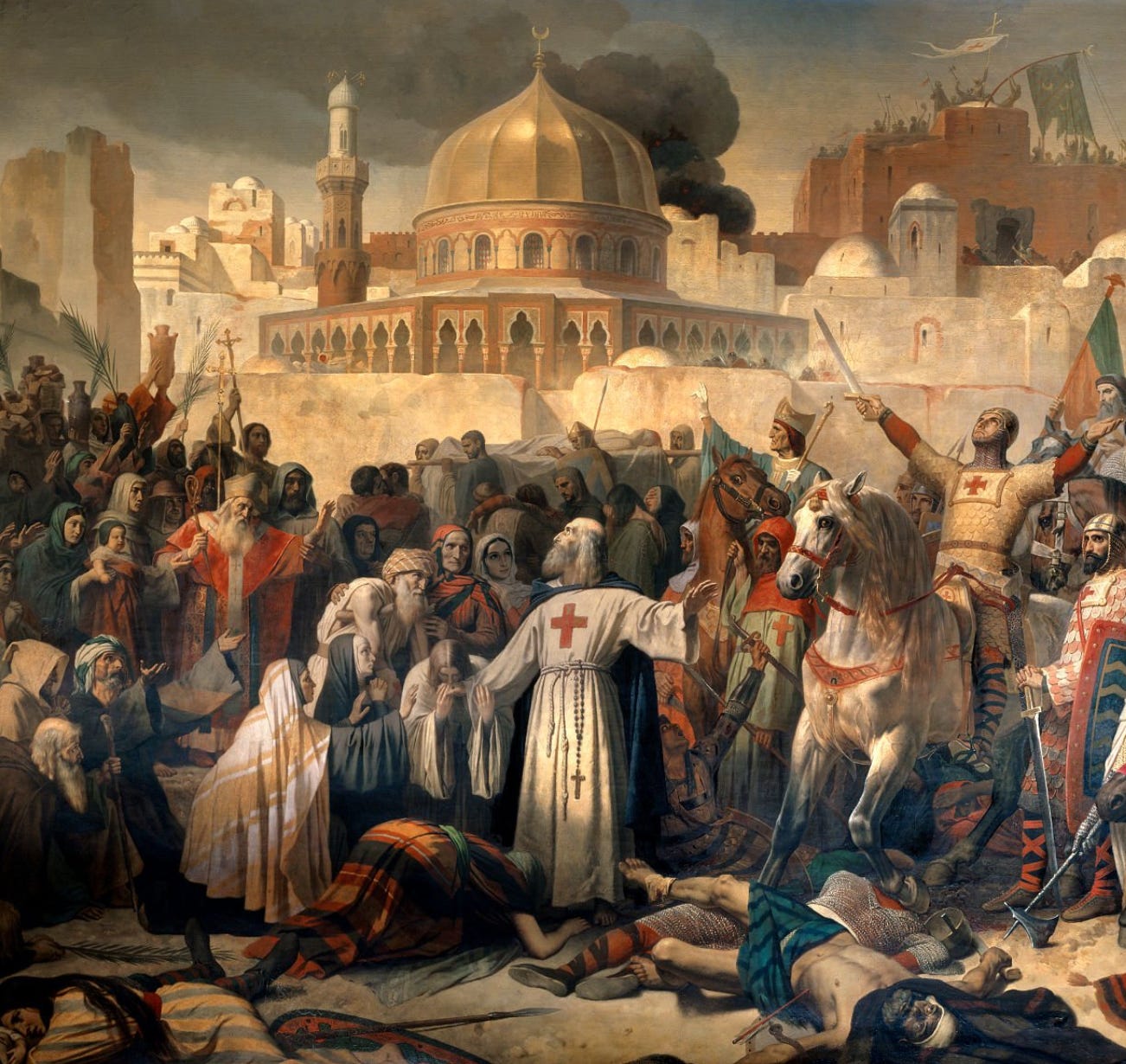
But as I document in my 2015 book The Moral Arc, for too long the scales of morality have been weighed down by the religious thumb pressing on the side of the scale marked “Good”. Religion has also promoted, or justified, such catastrophic moral blunders as the Crusades (the People’s Crusade, the Northern Crusade, the Albigensian Crusade, and Crusades One through Nine); the Inquisitions (Spanish, Portuguese, and Roman); witch hunts (a product, in part, of the Inquisitions that ran from the Middle Ages through the Early Modern Period and executed tens of thousands of people, mostly women); Christian conquistadors who exterminated native peoples by the millions through their guns, germs, and steel; the endless European Wars of Religion (the Nine Years War, the Thirty Years War, the Eighty Years War, the French Wars of Religion, the Wars of the Three Kingdoms, the English Civil War, to name just a few); the American Civil War, in which Northern Christians and Southern Christians slaughtered one another over the issue of slavery and states’ rights; and the First World War, in which German Christians fought French, British, and American Christians, all of whom believed that God was on their side. And that’s just in the Western world. There are the seemingly endless religious conflicts in India, Indonesia, Afghanistan, Pakistan, Iraq, Sudan, and numerous countries in Africa, the Coptic Christian persecution in Egypt, and of course Islamist terrorism has been a scourge on societal peace and security in recent decades and a day doesn’t go by without some act of violence committed in the name of Islam.
All of these events have political, economic, and social causes, but the underlying justification they share is religion.
Once moral progress in a particular area is underway, most religions eventually get on board—as in the abolition of slavery in the 19th century, women’s rights in the 20th century, and gay rights in the 21st century—but this often happens after a shamefully protracted lag time. Why? There are three reasons for the sclerotic nature of religion:
(1) The foundation of the belief in an absolute morality is the belief in an absolute religion grounded in the One True God. This inexorably leads to the conclusion that anyone who believes differently has departed from this truth and thus is unprotected by our moral obligations.
(2) Unlike science, religion has no systematic process and no empirical method to employ to determine the verisimilitude of its claims and beliefs, much less right and wrong.
(3) The morality of holy books—most notably the Bible—is not the morality any of us would wish to live by, and thus it is not possible for the religious doctrines derived from holy books to be the catalyst for moral evolution.
The Bible, in fact, is one of the most immoral works in all literature. Woven throughout begats and chronicles, laws and customs, is a narrative of accounts written by, and about, a bunch of Middle Eastern tribal warlords who constantly fight over land and women, with the victors taking dominion over both. It features a jealous and vengeful God named Yahweh who decides to punish women for all eternity with the often intolerable pain of childbirth, and further condemns them to be little more than beasts of burden and sex slaves for the victorious warlords.
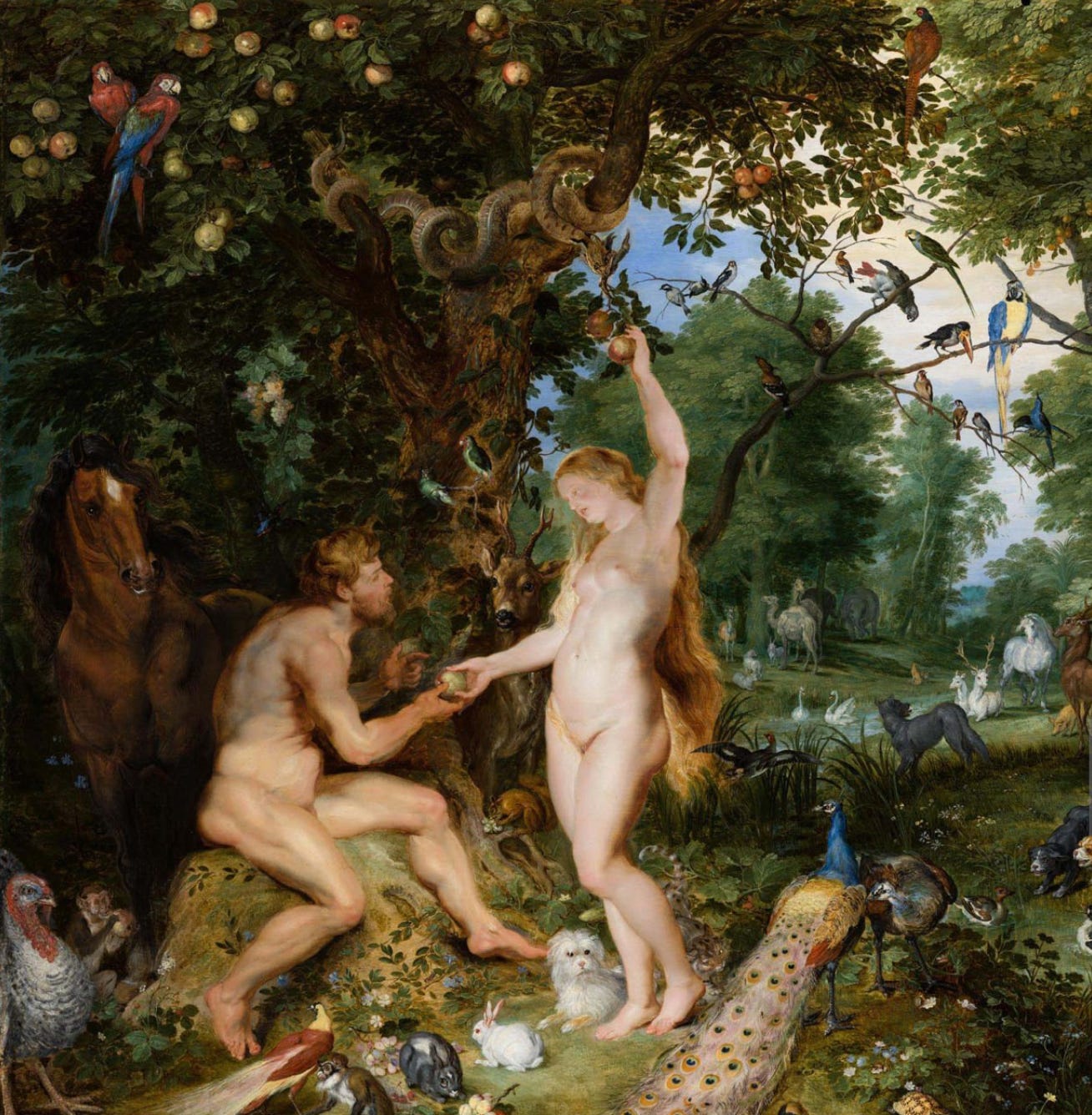
Why were women to be chastened this way? Why did they deserve an eternity of misery and submission? It was all for that one terrible sin, the first crime ever recorded in the history of humanity—a thought crime no less—when that audacious autodidact Eve dared to educate herself by partaking of the fruit of the tree of the knowledge of good and evil. Worse, she inveigled the first man—the unsuspecting Adam—to join her in choosing knowledge over ignorance. For the appalling crime of hearkening unto the voice of his wife, Yahweh condemned Adam to toil in thorn and thistle-infested fields, and further condemned him to death, to return to the dust from whence he came.
Yahweh then cast his first two delinquent children out of paradise, setting a Cherubim and a flaming sword at the entrance to be certain that they could never return. Then, in one of the many foul moods he was wont to fall into, Yahweh committed an epic hemoclysm of genocidal proportions by killing every sentient being on Earth—including unsuspecting adults, innocent children, and all the land animals—in a massive flood. In order to repopulate the planet after he decimated it of all life save those spared in the ark, Yahweh commanded the survivors—numerous times—to “be fruitful and multiply,” and rewarded his favorite warlords with as many wives as they desired. Thus was born the practice of polygamy and the keeping of harems, fully embraced and endorsed—along with slavery—in the so-called “good book.”
As an exercise in moral casuistry, and applying the principle of interchangeable perspectives, this question comes to mind: did anyone ask the women how they felt about this arrangement? What about the millions of people living in other parts of the world who had never heard of Yahweh? What about the animals and the innocent children who drowned in the flood? What did they do to deserve such a final solution to Yahweh’s anger problem?
Many Christians say that they get their morality from the Bible, but this cannot be true because as holy books go the Bible is possibly the most unhelpful guide ever written for determining right from wrong. It’s chockfull of bizarre stories about dysfunctional families, advice about how to beat your slaves, how to kill your headstrong kids, how to sell your virgin daughters, and other clearly outdated practices that most cultures gave up centuries ago.
Consider the morality of the biblical warlords who had no qualms about taking multiple wives, adultery, keeping concubines, and fathering countless children from their many polygamous arrangements. The anthropologist Laura Betzig has put these stories into an evolutionary context in noting that Darwin predicted that successful competition leads to successful reproduction. She analyzed the Old Testament and found no less than 41 named polygamists, not one of which was a powerless man. “In the Old Testament, powerful men—patriarchs, judges, and kings—have sex with more wives; they have more sex with other men’s women; they have sex with more concubines, servants, and slaves; and they father many children.” And not just the big names. According to Betzig’s analysis, “men with bigger herds of sheep and goats tend to have sex with more women, then to father more children.” Most of the polygynous patriarchs, judges, and kings had 2, 3, or 4 wives with a corresponding number of children, although King David had more than 8 wives and 20 children, King Abijah had 14 wives and 38 children, and King Rehoboam had 18 wives (and 60 other women) who bore him no fewer than 88 offspring. But they were all lightweights compared to King Solomon, who married at least 700 women, and for good measure added 300 concubines, which he called “man’s delight.” (What Solomon’s concubines called him was never recorded.)
Although many of these stories are fiction (there is no evidence, for example, that Moses ever existed, much less led his people for 40 years in the desert leaving behind not a single archaeological artifact), what these biblical patriarchs purportedly did to women was, in fact, how most men treated women at that time, and that’s the point. Put into context, the Bible’s moral prescriptions were for another time for another people and have little relevance for us today.
Upgrade to paid
In order to make the Bible relevant, believers must pick and choose biblical passages that suit their needs; thus the game of cherry picking from the Bible generally works to the advantage of the pickers. In the Old Testament, the believer might find guidance in Deuteronomy 5:17, which says, explicitly, “Thou shalt not kill”; or in Exodus 22:21, a verse that delivers a straightforward and indisputable prohibition: “You shall not wrong a stranger or oppress him, for you were strangers in the land of Egypt.”
These verses seem to set a high moral bar, but the handful of positive moral commands in the Old Testament are desultory and scattered among a sea of violent stories of murder, rape, torture, slavery, and all manner of violence, such as occurs in Deuteronomy 20:10-18, in which Yahweh instructs the Israelites on the precise etiquette of conquering another tribe:
When you draw near to a city to fight against it, offer terms of peace to it. And if its answer to you is peace and it opens to you, then all the people who are found in it shall do forced labor for you and shall serve you. But if it makes no peace with you, but makes war against you, then you shall besiege it; and when the LORD your God gives it into your hand you shall put all its males to the sword, but the women and the little ones, the cattle, and everything else in the city, all its spoil, you shall take as booty for yourselves…. But in the cities of these peoples that the LORD your God gives you for an inheritance you shall save alive nothing that breathes, but you shall utterly destroy them, the Hittites and the Amorites, the Canaanites and the Perizzites, the Hivites and the Jebusites, as the LORD your God has commanded.
Today, as the death penalty fades into history, Yahweh offers this list of actions punishable by death:
• Blaspheming or cursing or the Lord: “And he that blasphemeth the name of the Lord, he shall surely be put to death, and all the congregation shall certainly stone him: as well the stranger, as he that is born in the land, when he blasphemeth the name of the Lord, shall be put to death.” (Leviticus 24:13-16)
• Worshiping another god: “He that sacrificeth unto any god, save unto the Lord only, he shall be utterly destroyed.” (Exodus 22:20)
• Witchcraft and wizardry: “Thou shalt not suffer a witch to live.” (Exodus 22:18) “A man also or woman that hath a familiar spirit, or that is a wizard, shall surely be put to death: they shall stone them with stones: their blood shall be upon them.” (Leviticus 20:27)
• Female loss of virginity before marriage: “If any man take a wife [and find] her not a maid … Then they shall bring out the damsel to the door of her father’s house, and the men of her city shall stone her with stones that she die.” (Deuteronomy 22:13-21)
• Homosexuality: “If a man also lie with mankind, as he lieth with a woman, both of them have committed an abomination: they shall surely be put to death; their blood shall be upon them.” (Leviticus 20:13)
• Working on the Sabbath: “Six days shall work be done, but on the seventh day there shall be to you an holy day, a sabbath of rest to the Lord: whosoever doeth work therein shall be put to death.” (Exodus 35:2)
The book considered by over two billion people to be the greatest moral guide ever produced—inspired as it was by an all-knowing, totally benevolent deity—recommends the death penalty for saying the Lord’s name at the wrong moment or in the wrong context, for imaginary crimes like witchcraft, for commonplace sexual relations (adultery, fornication, homosexuality), and for the especially heinous crime of not resting on the Sabbath. How many of today’s two billion Christians agree with their own holy book on the application of capital punishment?
And how many would agree with this gem of moral turpitude from Deuteronomy 22:28-29: “If a man meets a virgin who is not engaged, and seizes her and lies with her, and they are caught in the act, the man who lay with her shall give fifty shekels of silver to the young woman’s father, and she shall become his wife. Because he violated her he shall not be permitted to divorce her as long as he lives.” I dare say no Christian today would follow this moral directive. No one today—Jew, Christian, atheist, or otherwise—would even think of such draconian punishment for such acts. That is how far the moral arc has bent in four millennia.
The comedian Julia Sweeney, in her luminous monologue Letting Go of God, makes the point when she recalls re-reading a familiar story she learned in her Catholic childhood upbringing:
This Old Testament God makes the grizzliest tests of people’s loyalty. Like when he asks Abraham to murder his son, Isaac. As a kid, we were taught to admire it. I caught my breath reading it. We were taught to admire it? What kind of sadistic test of loyalty is that, to ask someone to kill his or her own child? And isn’t the proper answer, “No! I will not kill my child, or any child, even if it means eternal punishment in hell!”?
Like so many other comedians who’ve struck the Bible’s rich vein of unintended comedic stories, Sweeney allows the material to write itself. Here she continues her tour through the Old Testament with its preposterous commandments:
Like if a man has sex with an animal, both the man and the animal should be killed. Which I could almost understand for the man, but the animal? Because the animal was a willing participant? Because now the animal’s had the taste of human sex and won’t be satisfied without it? Or my personal favorite law in the Bible: in Deuteronomy, it says if you’re a woman, married to a man, who gets into a fight with another man, and you try to help him out by grabbing onto the genitals of his opponent, the Bible says you immediately have to have your hand chopped off.
Richard Dawkins memorably characterized this God of the Old Testament as “arguably the most unpleasant character in all fiction: jealous and proud of it; a petty, unjust, unforgiving control-freak; a vindictive, bloodthirsty ethnic cleanser; a misogynistic, homophobic, racist, infanticidal, genocidal, filicidal, pestilential, megalomaniacal, sadomasochistic, capriciously malevolent bully.”
Most modern Christians, however, respond to arguments like mine and Dawkins’ by saying that the Old Testament’s cruel and fortunately outdated laws have nothing to do with how they live their lives or the moral precepts that guide them today. The angry, vengeful God Yahweh of the Old Testament, Christians claim, was displaced by the kinder, gentler New Testament God in the form of Jesus, who two millennia ago introduced a new and improved moral code. Turning the other cheek, loving one’s enemies, forgiving sinners, and giving to the poor is a great leap forward from the capricious commands and copious capital punishment found in the Old Testament.
That may be, but nowhere in the New Testament does Jesus revoke God’s death sentences or ludicrous laws. In fact, quite the opposite (Matthew 5:17-30 passim): “Think not that I am come to destroy the law, or the prophets: I am not come to destroy, but to fulfill.” He doesn’t even try to edit the commandments or soften them up: “Whosoever therefore shall break one of these least commandments, and shall teach men so, he shall be called the least in the kingdom of heaven.” In fact, if anything, Jesus’ morality is even more draconian than that of the Old Testament: “Ye have heard that it was said by them of old time, Thou shalt not kill; and whosoever shall kill shall be in danger of the judgment: But I say unto you, That whosoever is angry with his brother without a cause shall be in danger of the judgment.”
In other words, even thinking about killing someone is a capital offense. In fact, Jesus elevated thought crimes to an Orwellian new level (Matthew 9:28-29): “Ye have heard it was said by them of old time, Though shalt not commit adultery: But I say unto you, That whosoever looketh on a woman to lust after her hath committed adultery with her already in his heart.”
And if you don’t think you can control your sexual impulses Jesus has a practical solution: “If thy right eye offend thee, pluck it out, and cast it from thee: for it is profitable for thee that one of thy members should perish, and not that thy whole body should be cast into hell.”
President Bill Clinton may have physically sinned in the White House with an intern, but by Jesus’ moral code even the evangelical Christian Jimmy Carter sinned when he famously admitted in a 1976 Playboy magazine interview while running for President: “I’ve looked on a lot of women with lust. I’ve committed adultery in my heart many times.”
As for Jesus’s own family values, he never married, never had children, and he turned away his own mother time and again. For example, at a wedding feast Jesus says to her (John 2:4): “Woman, what have I to do with you?” One biblical anecdote recounts the time that Mary waited patiently off to the side for Jesus to finish speaking so that she could have a moment with him, but Jesus told his disciples, “Send her away, you are my family now,” adding (Luke 14:26): “Whoever comes to me and does not hate father and mother, wife and children, brothers and sisters, yes, and even life itself, cannot be my disciple.”
Charming. This is what cultists do when they separate followers from their families in order to control both their thoughts and their actions, as when Jesus calls to his flock to follow him or else (John 15:4-7): “Abide in me as I abide in you. Just as the branch cannot bear fruit by itself unless it abides in the vine, neither can you unless you abide in me. I am the vine, you are the branches. Those who abide in me and I in them bear much fruit, because apart from me you can do nothing. Whoever does not abide in me is thrown away like a branch and withers; such branches are gathered, thrown into the fire, and burned.” But if a believer abandons his family and gives away his belongings (Mark 10:30), “he shall receive an hundredfold now in this time, houses, and brethren, and sisters, and mothers, and children, and lands.” In other passages Jesus also sounds like the tribal warlords of the Old Testament:
Do not think that I have come to bring peace to the earth; I have not come to bring peace, but a sword. For I have come to set a man against his father, and a daughter against her mother, and a daughter-in-law against her mother-in-law; and one’s foes will be members of one’s own household. Whoever loves father or mother more than me is not worthy of me; and whoever loves son or daughter more than me is not worthy of me; and whoever does not take up the cross and follow me is not worthy of me. (Matthew 10:34-39)
Even sincere Christians cannot agree on Jesus’ morality and the moral codes in the New Testament, holding legitimate differences of opinion on a number of moral issues that remain unresolved based on biblical scripture alone. These include dietary restrictions and the use of alcohol, tobacco, and caffeine; masturbation, pre-marital sex, contraception, and abortion; marriage, divorce, and sexuality; the role of women; capital punishment and voluntary euthanasia; gambling and other vices; international and civil wars; and many other matters of contention that were nowhere in sight when the Bible was written, such as stem-cell research, gay marriage, and the like. Indeed, the fact that Christians, as a community, keep arguing over their own contemporary question “WWJD” (What Would Jesus Do?) is evidence that the New Testament is silent on the answer.
Most notably, what are we to make of the Christian moral model of sin and forgiveness? By this account, we are all sinners, born into original sin because of the Fall in the Garden of Eden. The Christian solution to this problem is to accept Jesus as your savior, as in John 3:16: “For God so loved the world, that he gave his only begotten Son, that whosoever believeth in him should not perish, but have everlasting life.” I once said these words, and for seven years lived the life of a born-again Christian, until, among other things, I recognized the flawed syllogistic reasoning behind this proposition:
1. We were originally created sinless, but because God gave us free will and Adam and Eve chose to eat the forbidden fruit of the knowledge of good and evil, we are all born with original sin.
2. God could forgive the sins we never committed, but instead He sacrificed his son Jesus, who is actually God himself in the flesh because Christians believe in only one God (monotheism) of which Jesus and the Holy Spirit are just different manifestations, as in Father, Son, and Holy Ghost.
3. The only way to avoid eternal punishment for sins we never committed from this all-loving and all-powerful God is to accept his son—who is actually himself—as our savior.
So…God sacrificed himself to himself to save us from himself.
In addition to being an exercise in twisted logic, the very idea runs contrary to centuries of Western jurisprudence, which is clear on the point that individuals cannot be blamed for something that they didn’t do. There is no such thing as a scapegoat in a court of law; pinning your crimes on an innocent person (like Jesus), and then expecting a judge (like God) to sentence the other person instead of you is what’s called redemption in the Bible, but in the real world it’s known as a miscarriage of justice. In the Western legal system, Jesus would never be allowed to bear the responsibility for anyone’s sins but his own. And blaming an innocent third party potentially leaves out the most important moral agent in the equation.If someone has been harmed by your actions, it isn’t God you should be asking for forgiveness. It is the injured party who deserves your supplications and entreaties, and only that person can forgive you and grant you absolution, assuming your apology is genuine and offered sincerely.
I could go on much more about this aspect of religion—and I do at length in Chapter 4 of The Moral Arc, but the point is made here that in addition to the acknowledged magisterium of religion documented in my previous column, faith is not the royal road to moral progress. Instead, reason, rationality, and empiricism as embodied in secular philosophy and science are the only reliable tools we have for determining the natural of reality, both physical and moral.
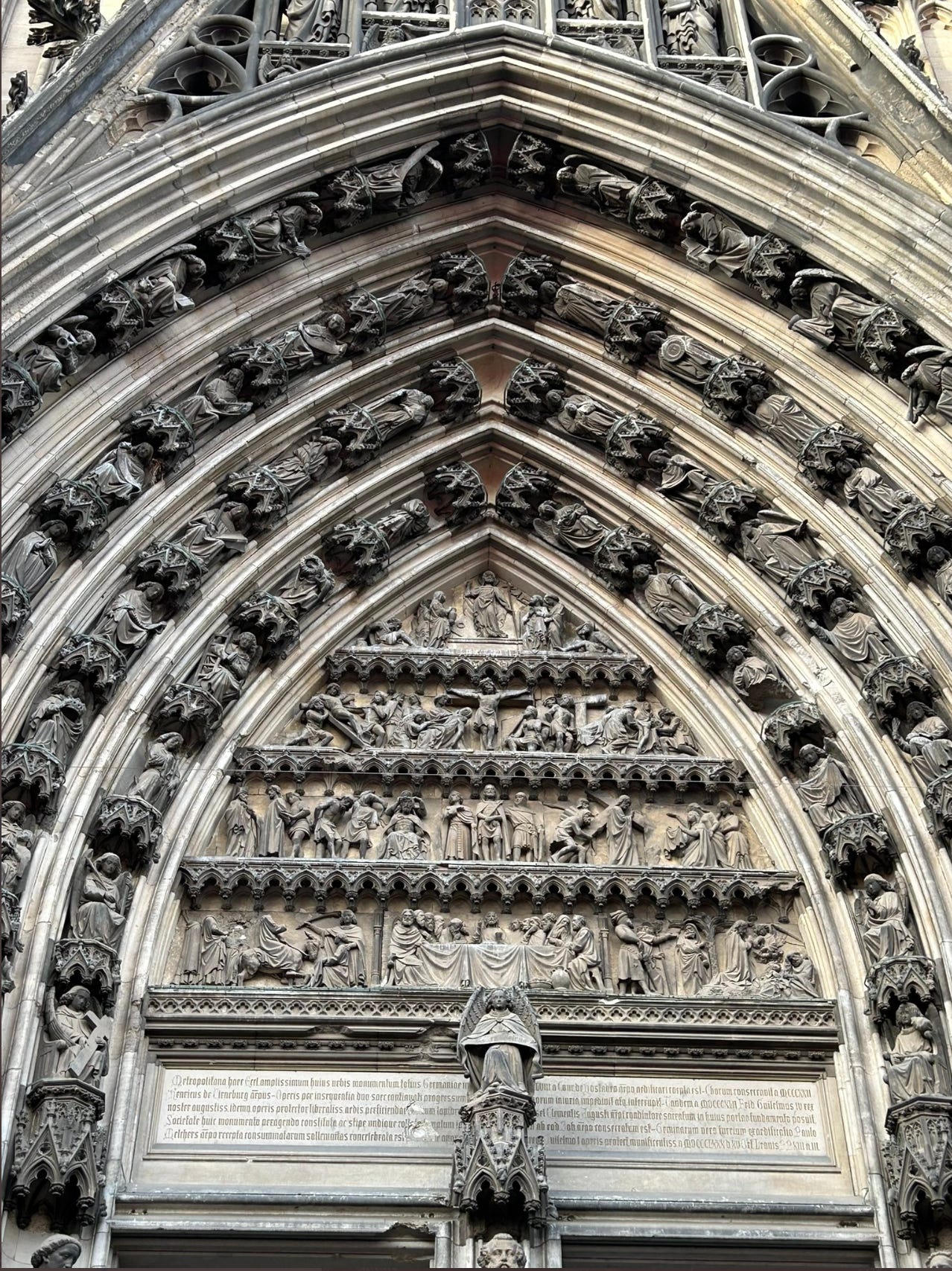
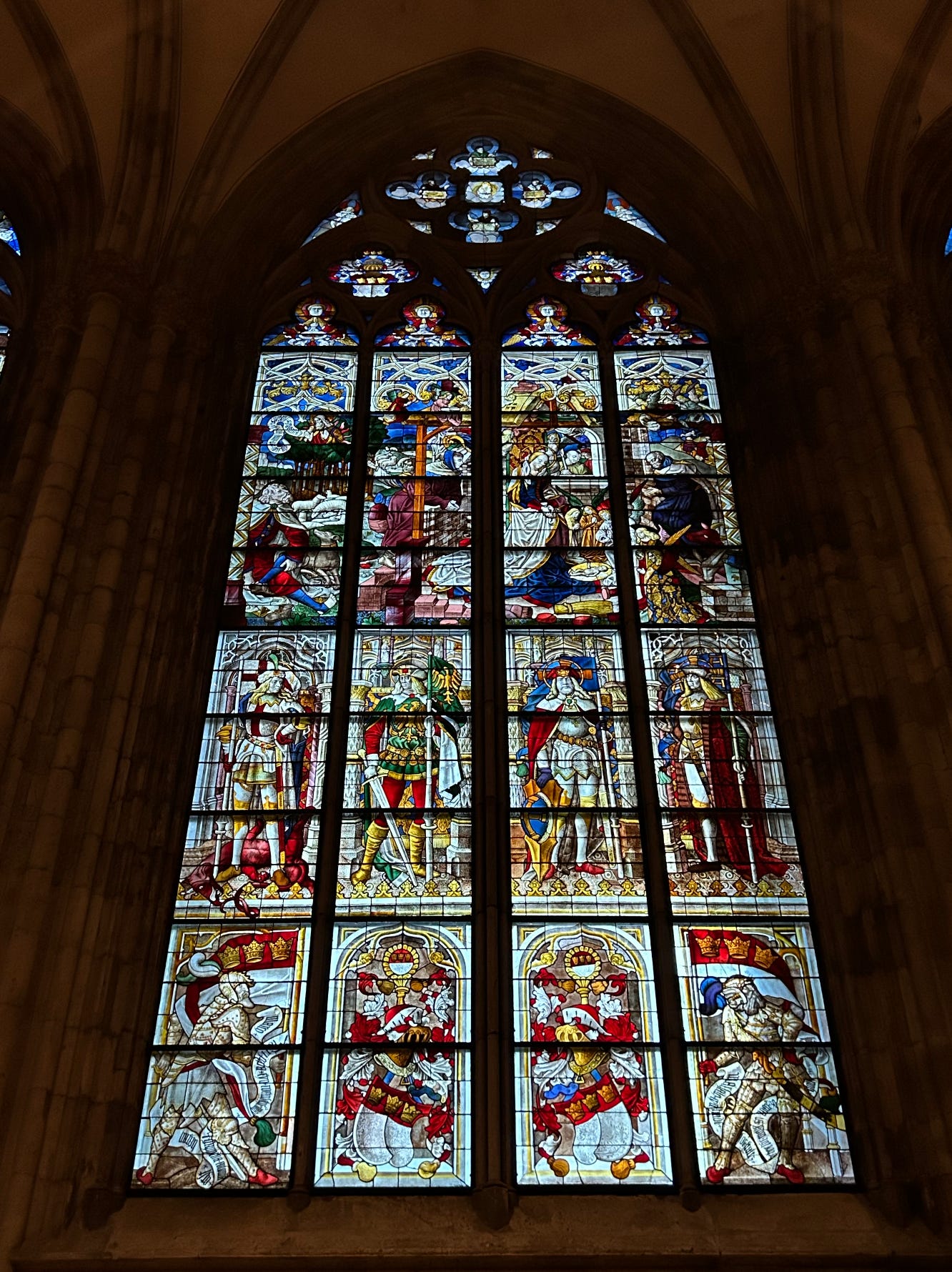
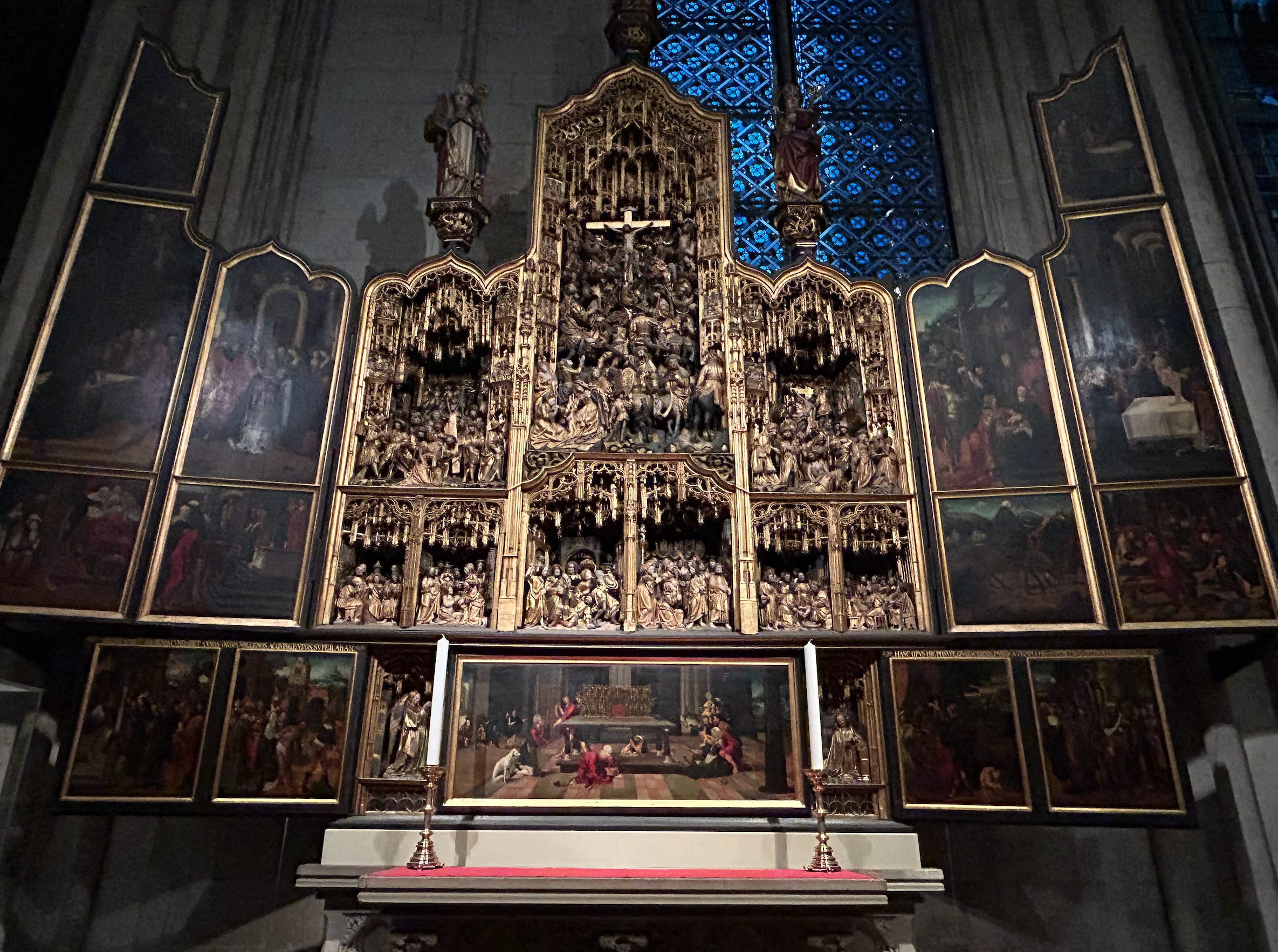
Every year for the past decade that my wife and I have returned to her home city of Köln, Germany, we make a point of visiting the magnificent cathedral in the city center that has defined the region for nearly eight centuries. Construction begun in 1248, this multi-generational project wasn’t officially completed until 1880 (and upgraded, repaired, and refurbished ever since)—six centuries of unfinished awe rising up from the banks of the mighty Rhine River that cuts through the heart of this ancient city whose pre-Medieval Roman ruins lie strewn about the landscape. It is nearly impossible for even the most jaded modern mind to be unimpressed by this architectural wonder whose ornamental details bring to life biblical chronicles and heroes.
Throughout three decades of countless articles and multiple books I have criticized religion, both its dependence on supernatural epistemology and its tribal divisiveness that led to centuries of wars, pogroms, purges, and witch hunts. But on this trip to the Cologne Cathedral I time-traveled back to the latter Middle Ages and into the late Medieval mind to imagine what it must have been like to experience the awe-inspiring magnificence of such a culturally-dominant edifice that literally and figuratively puts all other structures in the shade. Imagine walking into this sanctuary after a long and exhaustive journey from one’s provincial countryside and spartan abode…
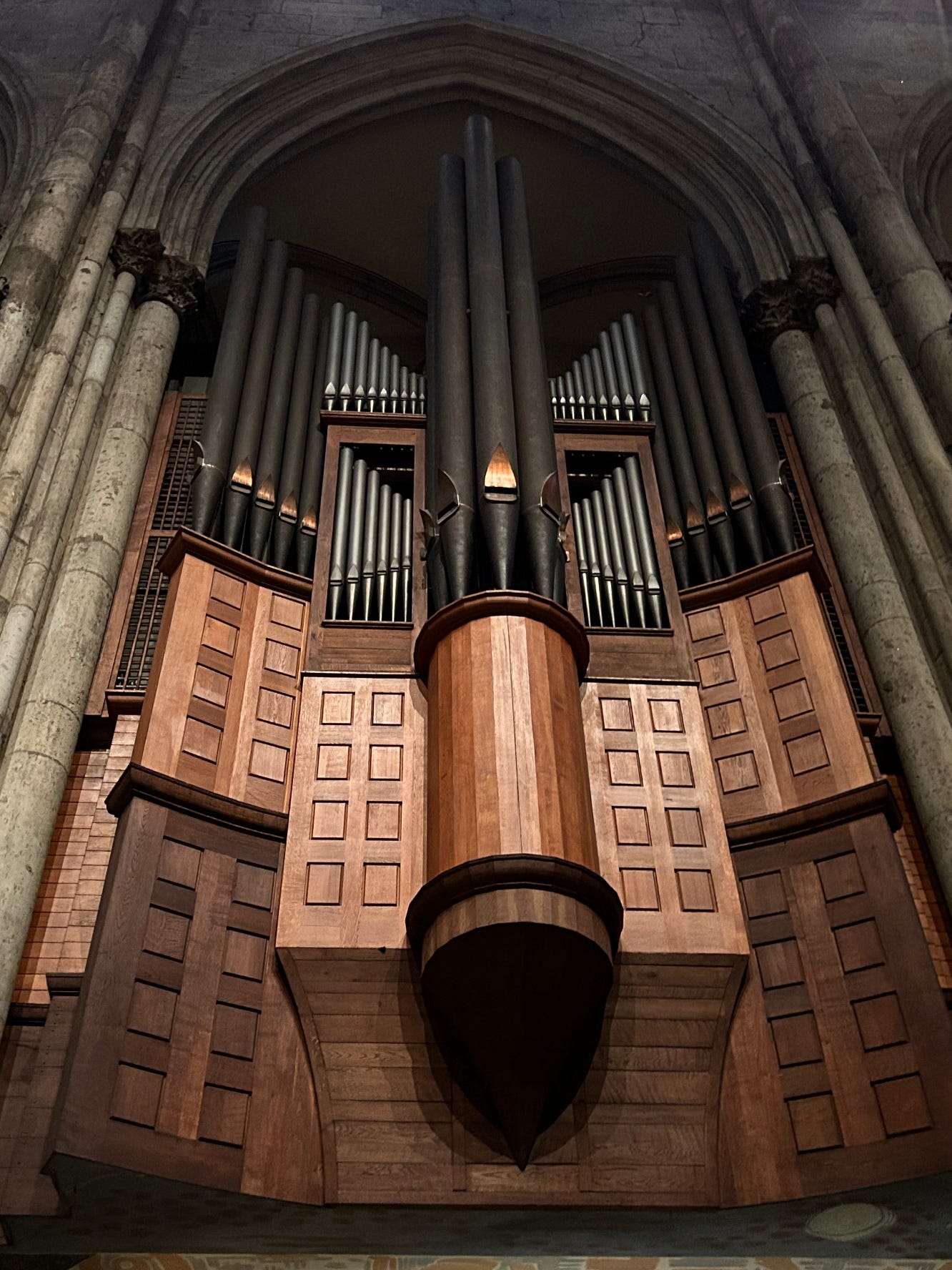
And think about what it must have been like to hear the angelic voices of divine organ music with its 20 Hertz undertones of infrasound that unconsciously generates at once feelings of awe, fear, and trembling…
And picture the joy of children playing in the footsteps of the largest construction project anyone had ever seen or would ever experience…
To fully feel that world let’s go back to a time when civilization was lit only by fire, centuries ago when populations were sparse and 80 percent of everyone lived in the countryside and were engaged in food production, largely for themselves. (I reconstruct this worldview in detail in How We Believe and The Moral Arc.) Cottage industries were the only ones around in this pre-industrial and highly-stratified society, in which one-third to one-half of everyone lived at subsistence level and were chronically under-employed, underpaid, and undernourished. Food supplies were unpredictable and plagues decimated weakened populations.
Upgrade to paid
All major cities were hit hard by disease contagions. In the century spanning 1563 to 1665, for example, there were no fewer than six major epidemics that swept through London alone, each of which annihilated between a tenth and a sixth of the population. The death tolls are almost unimaginable by today’s standards: 20,000 in 1563, 15,000 in 1593, 36,000 in 1603, 41,000 in 1625, 10,000 in 1636, and 68,000 in 1665, all in one of the world’s major metropolitan cities that had only a tiny fraction of the populations of today. Childhood diseases were unforgiving, felling 60 percent of children before the age of 17. As one observer noted in 1635, “We shall find more who have died within thirty or thirty-five years of age than passed it.” The historian Charles de La Ronciére provides examples from 15th century Tuscany in which lives were routinely cut short:
Many died at home: children like Alberto (aged ten) and Orsino Lanfredini (six or seven); adolescents like Michele Verini (nineteen) and Lucrezia Lanfredini, Orsino’s sister (twelve); young women like beautiful Mea with the ivory hands (aged twenty-three, eight days after giving birth to her fourth child, who lived no longer than the other three, all of whom died before they reached the age of two); and of course adults and elderly people.
And this does not include, La Ronciére adds parenthetically, the deaths of newborns, which historians estimate could have been as high as 30 to 50 percent.
Since magical thinking is positively correlated with uncertainty and unpredictability, we should not be surprised at the level of superstition given the grim vagaries of pre-modern life. There were no banks for people to set up personal savings accounts during times of plenty to provide a cushion of comfort during times of scarcity. There were no insurance policies for risk management, and few people had much personal property to insure anyway. With homes constructed of thatched roofs and wooden chimneys in a darkness broken only by candles, fires would routinely devastate entire neighborhoods. As one chronicler noted: “He which at one o’clock was worth five thousand pounds and, as the prophet saith, drank his wine in bowls of fine silver plate, had not by two o’clock so much as a wooden dish left to eat his meat in, nor a house to cover his sorrowful head.” Alcohol and tobacco were essential anesthetics for the easing of pain and discomfort that people employed as a form of self-medication, along with the belief in magic and superstition to mitigate misfortune.
Under such conditions it’s no wonder that almost everyone believed in sorcery, werewolves, hobgoblins, astrology, black magic, demons, prayer, providence, and, of course, witches and witchcraft. As Bishop Hugh Latimer of Worcester explained in 1552: “A great many of us, when we be in trouble, or sickness, or lose anything, we run hither and thither to witches, or sorcerers, whom we call wise men…seeking aid and comfort at their hands.” Saints were worshiped and liturgical books provided rituals for blessing cattle, crops, houses, tools, ships, wells, and kilns, along with special prayers for sterile animals, the sick and infirm, and even infertile couples. In his 1621 book, Anatomy of Melancholy, Robert Burton noted, “Sorcerers are too common; cunning men, wizards, and white witches, as they call them, in every village, which, if they be sought unto, will help almost all infirmities of body and mind.”
As well, in these late Medieval times 80-90 percent of people were illiterate. Those few who could read the local vernacular, could not read the Bible because it was written in Latin, guaranteeing that it would remain the exclusive intellectual property of an elite few. Almost everyone believed in some form of black magic. If a noble woman died, her servants ran around the house emptying all containers of water so her soul would not drown. Her Lord, in response to her death, faced east and formed a cross by laying prostrate on the ground, arms outstretched. If the left eye of a corpse did not close properly, the soul could spend extra time in purgatory (this belief led to the ritual closing of the eyes upon death). A man knew he was near death if he saw a shooting star or a vulture hovering over his home. If a wolf howled at night the one who heard him would disappear before dawn. Bloodletting was popular. Plagues were believed to be the result of an unfortunate conjuncture of the stars and planets. And the air was believed to be invested with such soulless spirits as unbaptized infants, ghouls who pulled out cadavers in graveyards and gnawed on their bones, water nymphs who lured knights to their deaths by drowning, drakes who drug children into their caves beneath the earth, and vampires who sucked the blood of stray children.
Was everyone in the pre-scientific world so superstitious? They were. As the historian Keith Thomas notes, “No one denied the influence of the heavens upon the weather or disputed the relevance of astrology to medicine or agriculture. Before the seventeenth century, total skepticism about astrological doctrine was highly exceptional, whether in England or elsewhere.” And it wasn’t just astrology. “Religion, astrology and magic all purported to help men with their daily problems by teaching them how to avoid misfortune and how to account for it when it struck.” With such sweeping power over people, Thomas concludes, “If magic is to be defined as the employment of ineffective techniques to allay anxiety when effective ones are not available, then we must recognize that no society will ever be free from it.”
That may well be, but the rise of science diminished this near universality of magical thinking by proffering natural explanations where before there were predominately supernatural ones. The decline of magic and the rise of science was a linear ascent out of the darkness and into the light. As empiricism gained status, there arose a drive to find empirical evidence for superstitious beliefs that previously needed no propping up with facts.
This attempt to naturalize the supernatural carried on for some time and spilled over into other areas. The analysis of portents was often done meticulously and quantitatively, albeit for purposes both natural and supernatural. As one diarist privately opined on the nature and meaning of comets: “I am not ignorant that such meteors proceed from natural causes, yet are frequently also the presages of imminent calamities.” Yet the propensity to portend the future through magic led to more formalized methods of ascertaining causality by connecting events in nature—the very basis of science.
In time, natural theology became wedded to natural philosophy and science arose out of magical beliefs, which it ultimately displaced. By the 18th and 19th centuries, astronomy replaced astrology, chemistry succeeded alchemy, probability theory displaced luck and fortune, insurance attenuated anxiety, banks replaced mattresses as the repository of people’s savings, city planning reduced the risks from fires, social hygiene and the germ theory dislodged disease, and the vagaries of life became less vague.
Before all this modernity came online, however, it was the magisterium of religion that soothed suffering souls, a power on poignant display in the Köln Dom.
Upgrade to paid
P.S. In my 2000 book How We Believe, I argued that one role of religion is to reinforce norms, customs, and mores of a culture—along with the moral tenets of the faith—through belief of an invisible eye in the sky. On this latest visit I noticed that on the plaza surrounding the Dom, modern eyes in the sky have been added, just in case…
“Hence both in space and time, we seem to be brought somewhat near to that great fact—that mystery of mysteries—the first appearance of new beings on this earth.” —Charles Darwin, Journal of Researches, 1845
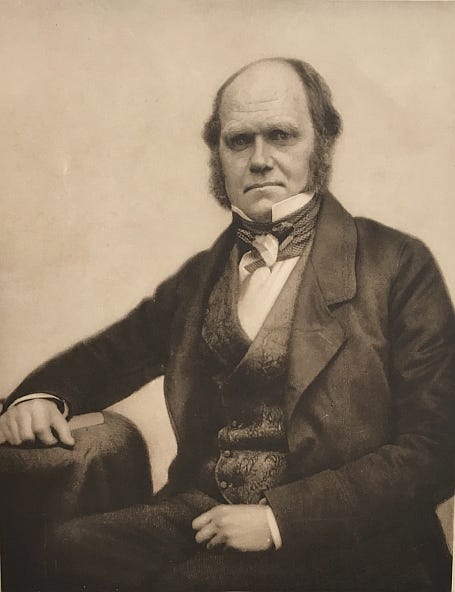
Today, February 12, 2023, is International Darwin Day, the 214th anniversary of the birth of Charles Darwin, the co-discoverer (along with Alfred Russel Wallace—see my biography In Darwin’s Shadow) of evolution by natural selection, and one of the most influential scientists in history. To honor the sage of Down I have pieced together excerpts from my 2006 book Why Darwin Matters, which attempts to answer the title question (and is my only book cover featuring full frontal nudity). His influence only continues to grow as the years pile up after his death on April 19, 1882 (age 73). (Photographs within courtesy of The Complete Photographs of Darwin by John van Wyhe, part of the Darwin Online project.)
Skeptic is a reader-supported publication. All monies go to the Skeptics Society, a 501(c)(3) nonprofit. To receive new posts and support my work, consider becoming a paid subscriber.
Upgrade to paid
The Myth of Darwin in the Galapagos
In June of 2004, historian of science Frank Sulloway and I began a month-long expedition to retrace Charles Darwin’s footsteps in the Galápagos Islands. The myth Frank set out to investigate years before was that Darwin became an evolutionist in the Galápagos when he discovered natural selection operating on finch beaks and tortoise carapaces, each species uniquely adapted by food type or island ecology. (Photos in this section from the author’s collection.)
The legend endures, Sulloway notes, because of its elegant fit into a Joseph Campbell-like tripartite myth of the hero who (1) leaves home on a great adventure (Darwin’s five-year voyage on the Beagle), (2) endures immeasurable hardship in the quest for noble truths (Darwin suffered seasickness and other maladies), and (3) returns to deliver a deep message (evolution). The myth is ubiquitous, appearing in everything from biology textbooks to travel brochures, the latter of which inveigle potential customers to come walk in the footsteps of Darwin. (See Sulloway’s papers: “Darwin and His Finches: The Evolution of a Legend.” Journal of the History of Biology, 15 (1982):1-53; “Darwin’s Conversion: The Beagle Voyage and Its Aftermath.” Journal of the History of Biology, 15 (1982):325-96; “The Legend of Darwin’s Finches.” Nature, 303 (1983):372; “Darwin and the Galapagos.” Biological Journal of the Linnean Society, 21 (1984):29-59.)
The Darwin Galápagos legend is emblematic of a broader myth that science proceeds by select eureka discoveries followed by sudden revolutionary revelations, where old theories fall before new facts. Not quite. Paradigms power percepts. Nine months after departing the Galápagos, Sulloway discovered, Darwin made the following entry in his ornithological catalogue about his mockingbird collection:
When I see these Islands in sight of each other, & possessed of but a scanty stock of animals, tenanted by these birds, but slightly differing in structure & filling the same place in Nature, I must suspect they are only varieties.
Similar varieties of fixed kinds, not evolution of separate species. Darwin was still a creationist! This explains why Darwin did not even bother to record the island locations of the few finches he collected (and in some cases mislabeled), and why these now-famous birds were never specifically mentioned in the Origin of Species.
Through careful analysis of Darwin’s notes and journals, Sulloway dates Darwin’s acceptance of evolution to the second week of March, 1837, after a meeting Darwin had with the eminent ornithologist John Gould, who had been studying his Galápagos bird specimens. With access to museum ornithological collections from areas of South America that Darwin had not visited, Gould corrected a number of taxonomic errors Darwin had made (such as labeling two finch species a “Wren” and “Icterus”), and pointed out to him that although the land birds in the Galápagos were endemic to the islands, they were notably South American in character.
Darwin left the meeting with Gould, Sulloway concludes, convinced “beyond a doubt that transmutation must be responsible for the presence of similar but distinct species on the different islands of the Galápagos group. The supposedly immutable ‘species barrier’ had finally been broken, at least in Darwin’s own mind.” That July, 1837, Darwin opened his first notebook on Transmutation of Species. By 1844 he was confident enough to write in a letter to his botanist friend and colleague Joseph Hooker:
I was so struck with distribution of Galapagos organisms &c &c, & with the character of the American fossil mammifers &c &c, that I determined to collect blindly every sort of fact which cd bear any way on what are species. At last gleams of light have come, & I am almost convinced, (quite contrary to opinion I started with) that species are not (it is like confessing a murder) immutable.
Like Confessing a Murder
Dramatic words for something as seemingly innocuous as a technical problem in biology: the immutability of species. But it doesn’t take a rocket scientist—or an English naturalist—to understand why the theory on the origin of species by means of natural selection would be so controversial: if new species are created naturally—not supernaturally—what place, then, for God? No wonder Darwin waited twenty years before publishing his theory.
From the time of Plato and Aristotle in ancient Greece to the time of Darwin and Wallace in the nineteenth century, nearly everyone believed that a species retained a fixed and immutable “essence.” A species, in fact, was defined by its very essence—the characteristics that made it like no other species. The theory of evolution by means of natural selection, then, is the theory of how kinds can become other kinds, and that upset not only the scientific cart, but the cultural horse pulling it. The great Harvard evolutionary biologist, Ernst Mayr, stressed just how radical was Darwin’s theory (in his 1982 book Growth of Biological Thought):
The fixed, essentialistic species was the fortress to be stormed and destroyed; once this had been accomplished, evolutionary thinking rushed through the breach like a flood through a break in a dike.
The dike, however, was slow to crumble. Darwin’s close friend, the geologist Charles Lyell, withheld his support for a full nine years, and even then hinted at a providential design behind the whole scheme. The astronomer John Herschel called natural selection the “law of higgledy-piggledy.” And Adam Sedgwick, a geologist and Anglican cleric, proclaimed that natural selection was a moral outrage, and penned this ripping harangue to Darwin:
There is a moral or metaphysical part of nature as well as a physical. A man who denies this is deep in the mire of folly. You have ignored this link; and, if I do not mistake your meaning, you have done your best in one or two cases to break it. Were it possible (which thank God it is not) to break it, humanity, in my mind, would suffer a damage that might brutalize it, and sink the human race into a lower grade of degradation than any into which it has fallen since its written records tell us of its history.
In a review in Macmillan’s Magazine, Henry Fawcett wrote of the great divide surrounding On the Origin of Species:
No scientific work that has been published within this century has excited so much general curiosity as the treatise of Mr. Darwin. It has for a time divided the scientific world with two great contending sections. A Darwinite and an anti-Darwinite are now the badges of opposed scientific parties.
Darwinites and anti-Darwinites. Although the scientific community is now united in agreement that evolution happened, a century and a half later the cultural world is still so divided. According to a 2005 poll by the Pew Research Center: 42 percent of Americans hold strict creationist views that “living things have existed in their present form since the beginning of time” while 48 percent believe that humans “evolved over time.” More to the point of why evolution has been in the news of late, the survey also found that 64 percent said they were open to the idea of teaching creationism in addition to evolution in public schools, while 38 percent said they think evolution should be replaced by creationism in biology classrooms. (Recent polls find the acceptance of the theory of evolution in the US increasing and creationism decreasing, but a 54% acceptance rate for the theory is not exactly a mandate for science.)
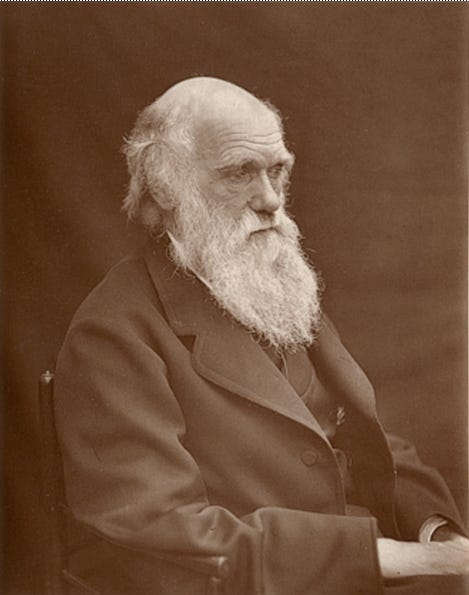
1878a Three-quarter right profile, seated in a Down House chair (according to some sources), by Leonard Darwin.
Why Evolution Matters
The influence of the theory of evolution on the general culture is so pervasive it can be summed up in a single observation: we live in the age of Darwin. Arguably the most culturally jarring theory in the history of science, the Darwinian revolution changed both science and culture in ways immeasurable, as Ernst Mayr summarized (in my own wording):
1. The static creationist model of species as fixed types, replaced with a fluid evolutionary model of species as ever-changing entities.
2. The theory of top-down intelligent design through a supernatural force, replaced with the theory of bottom-up natural design through natural forces.
3. The anthropocentric view of humans as special creations above all others, replaced with the view of humans as just another animal species.
4. The view of life and the cosmos as having design, direction, and purpose from above, replaced with the view of the world as the product of bottom-up design through necessitating laws of nature and contingent events of history.
5. The view that human nature is infinitely malleable and primarily good, replaced with the view of a constraining human nature in which we are good and evil.
In the memorable observation by Theodosius Dobzhansky: “Nothing in biology makes sense except in the light of evolution.”
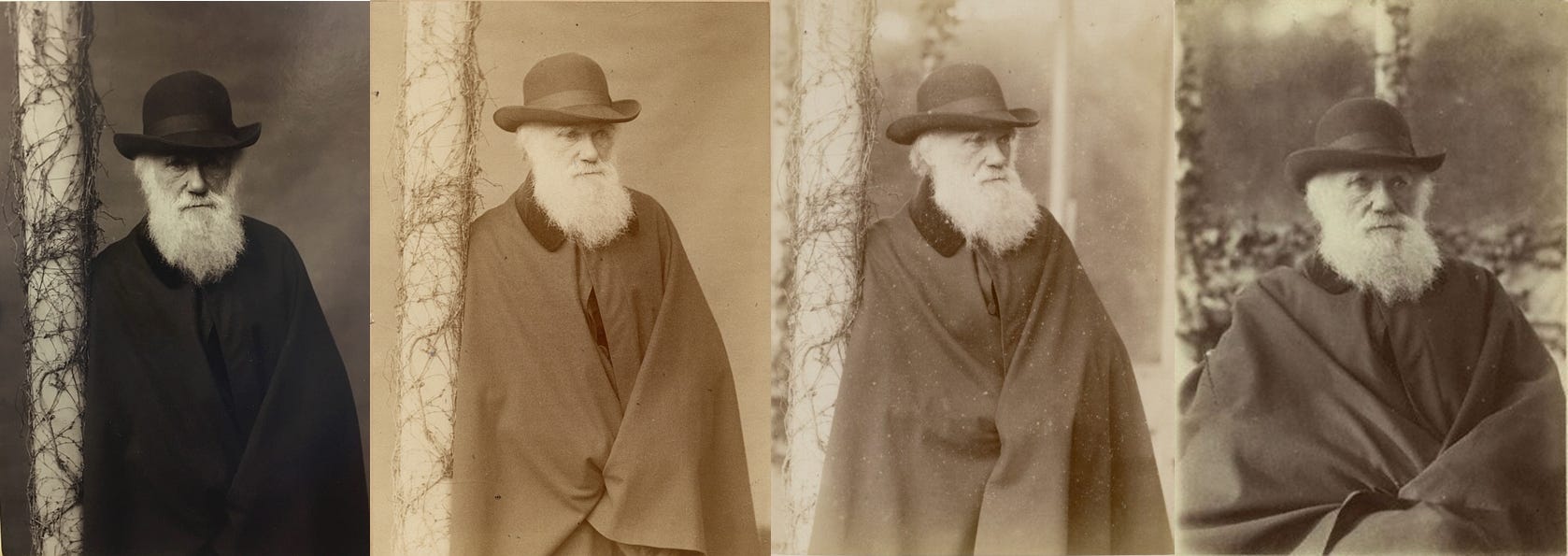
1881 Four photographs by Elliott & Fry. This well-known sitting includes the only known photographs of Darwin standing.
Skeptic is a reader-supported publication. All monies go to the Skeptics Society, a 501(c)(3) nonprofit. To receive new posts and support my work, consider becoming a paid subscriber.
Upgrade to paid
Darwin’s God and the Devil’s Chaplain
Darwin matriculated at Cambridge University in theology, but he did so only after abandoning his medical studies at the Edinburgh University because of his distaste for the barbarity of surgery. Darwin’s famous grandfather Erasmus, and his father Robert, both physicians by trade who were deeply schooled in natural history, were also confirmed freethinkers, so there was no doctrinaire pressure on the young Charles to choose theology.
In point of fact, Darwin’s selection of theology as his primary course of study allowed him to pursue his passion of natural history through the academic justification of studying “natural theology”—he was far more interested in God’s works (nature) than God’s words (the Bible). Besides, theology was one of only a handful of professions that a gentleman of the Darwin family’s high social position in the landed gentry of British society could choose. Finally, although Darwin belonged to the Church of England, membership was expected of someone in his social class.
Still, Darwin’s religiosity was not entirely utilitarian. He began and ended his five-year voyage around the world as a creationist, and he regularly attended services on board the Beagle, and even during some land excursions in South America. It was only upon his return home that his loss of his faith came about, that that loss happened gradually—even reluctantly—over many years.
Nagging doubts about the nature and existence of the deity chipped away at his faith from his studies of the natural world, particularly the cruel nature of many predator-prey relationships. “What a book a Devil’s Chaplain might write on the clumsy, wasteful, blundering low & horridly cruel works of nature!” Darwin harped in an 1856 letter to his botanist mentor Joseph Hooker. In 1860 he wrote to his American colleague, the Harvard biologist Asa Gray, about a species of wasp that paralyzes its prey (but does not kill it), then lays its eggs inside the paralyzed insect so that upon birth its offspring can feed on live flesh:
I cannot persuade myself that a beneficent God would have designedly created the Ichneumonidae with the express intention of their feeding within the living bodies of Caterpillars, or that a cat should play with mice. Not believing this, I see no necessity in the belief that the eye was expressly designed.
Pain and evil in the human world made Darwin doubt even more. “That there is much suffering in the world no one disputes,” he wrote to a correspondent. “Some have attempted to explain this with reference to man by imagining that it serves for his moral improvement. But the number of men in the world is as nothing compared with that of all other sentient beings, and they often suffer greatly without any moral improvement.” Which is more likely, that pain and evil are the result of an all-powerful and good God, or the product of uncaring natural forces? “The presence of much suffering agrees well with the view that all organic beings have been developed through variation and natural selection.” The death of Darwin’s beloved ten-year-old daughter Anne put an end to whatever confidence he had in God’s benevolence, omniscience, and thus existence. According to the great Darwin scholar and biographer Janet Browne: “This death was the formal beginning of Darwin’s conscious dissociation from believing in the traditional figure of God.”
Throughout most of his professional career, however, Darwin eschewed the God question entirely, choosing to focus instead on his scientific studies. Toward the end of his life Darwin received many letters querying him on his religious attitudes. His long-silence gave way to a few revelations. In one letter penned in 1879, just three years before he died, Darwin explained: “In my most extreme fluctuations I have never been an Atheist in the sense of denying the existence of God. I think that generally (and more and more as I grow older), but not always, that an Agnostic would be the more correct description of my state of mind.”
A year later, in 1880, Darwin clarified his reasoning to the British socialist Edward Aveling, who solicited Darwin’s endorsement of a group of radical atheists by asking his permission to dedicate a book Aveling edited entitled The Student’s Darwin, a collection of articles discussing the implications of evolutionary theory for religious thought. The book had a militant antireligious flavor that Darwin disdained and he declined the offer, elaborating his reason with his usual flare for quotable maxims:
It appears to me (whether rightly or wrongly) that direct arguments against christianity & theism produce hardly any effect on the public; & freedom of thought is best promoted by the gradual illumination of men’s minds which follow[s] from the advance of science. It has, therefore, been always my object to avoid writing on religion, & I have confined myself to science.
Darwin then appended an additional hint about a personal motive: “I may, however, have been unduly biased by the pain which it would give some members of my family, if I aided in any way direct attacks on religion.” Darwin’s wife Emma was a deeply religious woman, so out of respect for her he kept the public side of his religious skepticism in check, an admirable feat of self-discipline by a man of high moral character.
Why Darwin Matters
As pattern-seeking, storytelling primates, to most of us the pattern of life and the universe indicates design. For countless millennia we have taken these patterns and constructed stories about how life and the cosmos were designed specifically for us from above. For the past few centuries, however, science has presented us with a viable alternative in which the design comes from below through the direction of built-in self-organizing principles of emergence and complexity. Perhaps this natural process, like the other natural forces of which we are all comfortable accepting as non-threatening to religion, was God’s way of creating life. Maybe God is the laws of nature—or even nature itself—but this is a theological supposition, not a scientific one.
What science tells us is that we are but one among hundreds of millions of species that evolved over the course of three and a half billion years on one tiny planet among many orbiting an ordinary star, itself one of possibly billions of solar systems in an ordinary galaxy that contains hundreds of billions of stars, itself located in a cluster of galaxies not so different from millions of other galaxy clusters, themselves whirling away from one another in an expanding cosmic bubble universe that very possibly is only one among a near infinite number of bubble universes. Is it really possible that this entire cosmological multiverse was designed and exists for one tiny subgroup of a single species on one planet in a lone galaxy in that solitary bubble universe? It seems unlikely.
Herein lies the spiritual side of science—sciencuality, if you will pardon an awkward neologism but one that echoes the sensuality of discovery. If religion and spirituality are suppose to generate awe and humility in the face of the creator, what could be more awesome and humbling than the deep space discovered by Hubble and the cosmologists, and the deep time discovered by Darwin and the evolutionists?
Darwin matters because evolution matters; evolution matters because science matters. Science matters because it is the preeminent story of our age, an epic saga about who we are, where we came from, and where we are going.
###
Skeptic is a reader-supported publication. All monies go to the Skeptics Society, a 501(c)(3) nonprofit. To receive new posts and support my work, consider becoming a paid subscriber.
Was the account of creation found in Genesis comparable to (or even borrowed from?) other ancient accounts in scattered throughout the world at the time?
Here now is a second and equally interesting post dealing with stories from ancient Memphis Egypt (not Tennessee!)!
This is the topic of his lecture course for the Great Courses/Wondrium, “Creation Stories of the Ancient World” (links at bottom)
****************************
In my last blog entry, I offered a brief description of the Babylonian Creation Epic, Enuma Elish, and reflected on how one might imagine its relationship to the seven-day creation story of Genesis 1. In this post, I turn to an enigmatic but fascinating text from ancient Egypt known as the Memphite Theology that has also been compared with Genesis 1, though in this case I would argue that no direct connection exists between the two texts. Instead, what we see in the Memphite Theology is an alternative expression of the idea of a supreme and intentional creator deity that is reminiscent of (and roughly contemporaneous with) Genesis 1.
The text of the Memphite Theology is preserved on a rectangular stone slab now known as the Shabako Stone, named for the Egyptian Pharaoh Shabako under whom the text was promulgated in approximately 710 BCE. The stone was subsequently converted for use as a lower millstone, which effaced a significant portion of the writing (see the British Museum photo here: https://www.britishmuseum.org/collection/object/Y_EA498). Nonetheless, the portions that remain reveal an idiosyncratic picture of creation centering on a god named Ptah, a deity associated with the city of Memphis (hence the “Memphite Theology”), one that departs from a dominant understanding of creation in ancient Egypt associated with another ancient city, Heliopolis. In fact, there is evidence to suggest that the Memphite Theology was written precisely to supplant the earlier traditional understandings. The following passage from near the beginning of the text is revealing (translation here taken from Miriam Lichtheim, Ancient Egyptian Literature, vol. I):
“This writing was copied out anew by his majesty in the House of his father Ptah-South-of-his-Wall, for his majesty found it to be a work of the ancestors which was worm-eaten, so that it could not be understood from beginning to end. His majesty copied it anew so that it became better than it had been before…”
What we have here is a trope that is found with some regularity in the ancient world—that of the “discovery” or “recovery” of an even more ancient text as a way of conferring legitimacy to what was in fact a new literary creation from the writer’s own time. (The most famous example of this is the “discovery” of the Book of the Law in the time of the biblical king Josiah in 2 Kings 22, which is widely regarded by scholars as representing the context of the promulgation of the Book of Deuteronomy.) Applying this assumption to the Memphite Theology helps to explain its contents, because the primary focus of the text is the exaltation of the god Ptah over an earlier creator deity named Atum (of the tradition of Heliopolis) by re-envisioning Atum and the other gods as proceeding from Ptah himself. This tendency can be observed in the following key passage (again, based on Lichtheim’s translation):
“There took shape in the heart, there took shape on the tongue the form of Atum. For the very great one is Ptah, who gave life to all the gods and their kas through this heart and through this tongue, in which Horus had taken shape as Ptah, in which Thoth had taken shape as Ptah…. Sight, hearing, breathing—they report to the heart, and it makes every understanding come forth. As to the tongue, it repeats what the heart has devised. Thus all the gods were born and his Ennead was completed.”
Although some of the language in this passage is obscure, it is clear that the god Ptah is at the top of the divine hierarchy that the text envisions. Ptah is “the very great one,” the one who gives life to all the other gods, and important gods such as Atum, Horus, and Thoth are all subordinated to Ptah in different ways. Since Atum is, in the Heliopolis tradition, the original creator deity and the one who gives birth to the other members of the core group of nine deities (the “Ennead”), to subordinate Atum to Ptah is to elevate Ptah to the primary role.
What is also notable about this passage, and what makes it distinctive among the conceptions of creation we encounter in ancient Egypt, is the manner in which these primordial acts of creation are described. The “heart” and the “tongue” of Ptah are both crucial in this process, with the heart being the ultimate source (“they report to the heart… as to the tongue, it repeats what the heart has devised”). While the interpretation of this language is difficult, I would take the heart to represent the seat of the will or of intention, an idea that is characteristic of many ancient forms of understanding. While today we tend to associate emotions with the heart, in ancient cultures the heart encompasses faculties that we would attribute to the brain, such as thinking, deciding, and desiring. As for the tongue, I would take that to symbolize speech as an expression of an act of thought or intention. Thus, what we have is a fascinating conception of creation as a sort of mental act of Ptah with multiple stages: the heart devises, the tongue speaks it forth, and the result is various manifestations in the form of the gods and, in fact, all things. This idea is elaborated further in the text:
“Thus all the faculties were made and all the qualities determined, they that make all foods and all provisions, through this word… Thus all labor, all crafts are made, the action of the hands, the motion of the legs, the movements of all the limbs, according to this command which is devised by the heart and comes forth on the tongue and creates the performance of every thing.”
This passage applies this heart-tongue concept to the creation of a range of other elements in the world—from food, to crafts, to bodily movement, to all things. While it’s difficult to pinpoint exactly why these elements are mentioned and not others, it does suggest that the heart’s devising leading to creative speech is envisioned in this text as a fundamental means by which the world comes into being.
In light of these passages in the Memphite Theology, the parallels to Genesis 1 are evident in that the biblical creation in seven days also takes place by means of a creator deity speaking the elements of the world into existence. One should note that in Genesis, explicit language about the “heart” or other descriptions of intention (before the act) are missing, though God does “see” the things that are created and subsequently declares them to be “good.” But the underlying conceptions of the creative process in the two texts, insofar as they both reside in the will of a specific creator god, are similar enough to warrant describing them as expressions of a common tendency emerging in the middle of the first millennium BCE.
In these two short blog posts, I have discussed two creation texts, one from Mesopotamia and one from Egypt, that in different ways illuminate the background to the creation narrative in Genesis 1. While these posts have been brief, I hope I have managed to illustrate the compelling nature of the numerous creation stories we possess from the ancient Near East. If you are interested in learning more, see my course for Wondrium/The Great Courses:
My colleague Joseph Lam is an expert on the languages and texts of the Ancient Near East, including the Hebrew Bible. In terms of languages, he not only teaches ancient Hebrew, but also (brace yourself), Ugaritic, Akkadian, Syriac, Semitic linguistics, and, well, so on. He is particularly expert in the relationship of the texts and myths other Ancient Near Eastern religions with those of the Hebrew Bible.
Joseph is also a superb teacher, and so he was invited to to a course for the Great Courses (Wondrium) called “Creation Stories of the Ancient World.” The course just came out, and so I have asked Joseph to do a couple of blog posts for us, to introduce all of you to the kinds of things he covers there. Here are the links to his course and, then, his first post:
Creation stories tell us who we are, where we came from, and where we are going. They not only describe the origins of the world in a distant past, but they encapsulate a culture’s self-understanding in story form, offering insight into how different societies made sense of the human condition across history. In my new course for Wondrium/The Great Courses, titled “Creation Stories of the Ancient World,” I explore a range of creation stories from the great literate civilizations of the ancient Near East and the Mediterranean world in order to illuminate the underlying conceptions they describe—from the nature of reality, to the identity of the gods, to the role of humans in the created order. Among the texts I discuss are myths from Mesopotamia, such as the Babylonian Creation Epic (Enuma Elish) and the Atrahasis Epic; literary traditions from ancient Egypt, including the Pyramid Texts, Coffin Texts, and the Memphite Theology; an early Greek view of creation as represented in Hesiod’s Theogony; lesser known texts such as the Hurro-Hittite Kumarbi Cycle and the Ugaritic Baal Cycle; and, of course, the biblical creation accounts of Genesis 1 and 2.
As an example of the kinds of insights that one can glean from these stories, consider the opening lines of the Babylonian Creation Epic, known in antiquity as Enuma Elish (translation is mine):
When the heavens above had not been named,
nor the earth beneath been called by name,
there was Apsu, the pre-eminent, their begetter,
and creator Tiamat, who bore them all;
they mixed their waters together,
before pastures had formed and reed thickets had appeared.
When none of the gods had been made manifest,
nor been called by name, nor destinies decreed,
the gods were created in the midst of them.
Those who are familiar with the biblical account of creation in seven days (Genesis 1) may already recognize certain broad similarities, such as the pairing of “heaven” and “earth,” the idea of naming as synonymous with creation itself (compare how God speaks things into existence and names them in Genesis 1), and the presence of water in the initial state of the universe. Indeed, on this last point, the two primordial deities in this tale, the male god Apsu and the female goddess Tiamat, are both personifications of water, with Apsu representing the fresh waters and Tiamat representing the salt waters. Note that the name “Tiamat” is actually related to the Hebrew word for “deep” or “abyss” in Genesis 1:2 (Hebrew tehom).
Dr. Joseph Lam
But, while these similarities might suggest that the Mesopotamian and Israelite accounts share a common cultural vocabulary for speaking about creation, they do not imply that the same story is being told. In Enuma Elish, after the gendered pair of Apsu and Tiamat begins the process of procreation of the gods, the story proceeds to describe the two major rounds of conflict that take place among the gods. The resulting battles lead to the deaths of both Apsu and Tiamat—the latter at the hand of Marduk (technically their great-great-grandson), the patron god of Babylon who is proclaimed supreme over the divine pantheon. After Tiamat’s defeat, Marduk severs Tiamat’s body in two in order to make heaven and earth respectively; he also establishes the stars and planets to mark time as well as the other familiar features of the physical world, from mountains to springs to the weather. Most importantly, creation culminates in the founding of the city of Babylon itself as an earthly abode for the gods to be venerated regularly. Humankind is then formed from the body of a sacrificed god—specifically, the god who induced Tiamat to confront Marduk to begin with—in order to alleviate the work of the gods and to maintain the activities of divine worship. Finally, as thanks to Marduk for his lordship, the rest of the gods build the Esagila, Marduk’s temple, in the midst of Babylon. In these ways, Enuma Elish can be seen as an encapsulation of the major points of ancient Babylonian religious and political ideology. It is not surprising, then, that we have evidence that this text was recited as part of the most important festival in Babylon, the spring New Year celebration called the Akitu festival.
By contrast, Genesis 1 describes creation not as a series of battles between the gods but rather as the activity of a single god (Hebrew elohim) establishing an ordered world over the course of six days. Any potentially competing divine forces—whether the “waters” or the “deep” in 1:2, or the sun/moon/stars in 1:16, or the “great sea monsters” in 1:21—are subordinated to this one creator god. In modern times, by virtue of its prominent placement at the beginning of the Bible, this text is often read as a timeless description of how the world came to be. But it would be a mistake to overlook the strong polemical force of the story. I would argue that Genesis 1 is just as historically situated as Enuma Elish, and that its historical setting goes a long way toward explaining the emphases of the story itself. In particular, if we posit the time of the Babylonian exile to be the background for the story, two major features of the text come into alignment. First, its many allusions to Enuma Elish can be explained not only as general reflections of common ancient Near Eastern creation imagery (though that is still a useful fundamental assumption) but specifically as an effort by the Judean literary elite, living as exiles in Babylonia, to articulate an alternative vision of creation in line with their traditions. Second, the lack of an overt mention of a temple in Genesis 1 could be seen as an attempt to make sense of the aftermath of the destruction of the Jerusalem Temple: the Israelite Elohim does not necessarily need a temple, for the entirety of heaven and earth are Elohim’s abode! Moreover, just as every ancient Mesopotamian temple had a cult image of the deity residing in it, so human beings are the “image” (Gen. 1:26-27) of Elohim in the newly-established cosmos.
In my next blog entry, I will introduce another ancient Near Eastern creation text that has often been compared with Genesis 1—the Egyptian text known as the Memphite Theology.
























 Richard L. Fricks