Teach your kids about propaganda, or someone else will

Here’s the link to this article.

Avatar photoby ADAM LEE

JUN 26, 2023

A dense field of American flags | Teach your kids about propaganda, or someone else will
Credit: Pixabay

Overview:

Keeping kids isolated from viewpoints you disagree with is a parenting strategy that never works. A better one is to teach them how to recognize propaganda and toxic memes when they see them.

Reading Time: 6 MINUTES

My son, going on seven years old, is boundlessly curious. That’s the natural state of childhood, and it’s one of the sublime joys of parenthood to nurture that curiosity and encourage it to grow.

He’s taken to reading on his own, and he wants to know about everything. He likes learning about animals and plants, space, mythology and religion, and world history. He’s also interested in American history, which my wife and I are trying to present in a nuanced way.

It was Flag Day this month, and his first-grade class did a lesson about it. When he came home, he wanted to learn more. I didn’t have any books on the subject, so I opened YouTube—which has its hazards, but can be an invaluable source of information—and searched for videos about Flag Day.

One of the top results was a video from PragerU Kids, a slick right-wing channel packed with jingoistic politics and regressive morality. The thumbnail caught his eye, but I kept scrolling past it.

I told him, “That one’s not good to watch. Let’s find something else.”

He insisted, “No, daddy, that one is fine! I watched it in school!”

Record scratch. Freeze frame.

My values, your propaganda

Admittedly, “propaganda” is a loaded term. Every story conveys values, implicitly or explicitly. No one calls a show propaganda when it has a moral they agree with.

A kids’ show like Hilda, which we watched together, uses magic and adventure to convey a powerful message about resisting the siren song of fear and xenophobia that empowers bigotry. Kids’ shows like Captain Planet (which I watched when I was my son’s age), or Wild Kratts (which he watches now), teach the importance of valuing nature and protecting the planet from despoilment. Mr. Rogers’ Neighborhood taught children about kindness and radical self-love (for which reason the modern right despises him).

Just the same way, the right has its own set of values. They teach their followers to believe in a cruel and angry god who will hurt them if they disobey orders or question what they’re told. They teach that men act one way and women act another way and it’s sinful and evil to step outside these rigid gender roles. They teach a simplistic version of history where America is always right and has never made any mistakes or committed any wrongs that need to be redressed.

PragerU, and its offshoot PragerU Kids, embody the latter set of values. Despite what the name suggests, it’s not a “university” in any sense. It doesn’t have classes, exams or professors, and it doesn’t grant degrees. It’s a media channel created by Dennis Prager, a right-wing political commentator. Prager is slightly unusual in that he’s Jewish rather than Christian, but in all other respects, he perfectly reflects the intolerant, anti-science, anti-rational outlook of the modern conservative movement.

Among other things, PragerU videos assert:

PragerU Kids teaches the same ideas, except it uses cartoons and animation aimed at children. One of the most disgusting examples is their video about Christopher Columbus, which argues that we should continue to celebrate Columbus Day, notwithstanding the horrendous atrocities that Columbus committed:

YouTube video

Although PragerU would never call it that, this video is an endorsement of moral relativism. It argues that we can’t condemn Columbus because it’s wrong to judge the past by the standards of the present. But if they believe that, how can they simultaneously argue that he’s deserving of a holiday in his honor?

Either we can pass judgment on figures of the past, or we can’t. If we can’t, then we can’t say anything positive or negative about them. If we can, then we can judge them worthy of condemnation, just as we can judge them worthy of fame. As with their renewable-energy videos or their Islam-versus-the-Bible videos, PragerU concocts a double standard to get to the conclusion they decided on in advance.

What is PragerU doing in public school?

So, as you can imagine, I was alarmed to hear that my son had watched a PragerU video in his public school classroom.

I didn’t think his teacher was engaged in a sinister plot to indoctrinate students. On the contrary, I was pretty sure it was an innocent mistake by a teacher who was looking for educational content, just as I was, and who didn’t realize the source of the material she found.

PragerU’s channel is designed to encourage this kind of confusion. Many of its videos aren’t political at all. They’re ordinary tutorials on topics like how to make a pinata, or how insurance works. The explicitly political videos are hidden among them like tigers lurking in tall grass.

To be sure, PragerU is clear enough about its agenda if you know what to look for. For example, its website denounces “[w]oke agendas… infiltrating classrooms, culture, and social media” and proudly declares itself to be the answer to “all the propaganda that the state is mandating be taught.” In its YouTube video descriptions, the channel says that they’re “protecting [kids] from leftist indoctrination occurring in schools”. But if you’re not on the lookout for these giveaways, they’re easy to miss.

The Flag Day video is in an intermediate category. It’s not explicitly political like the Columbus video, but it is implicitly political. It’s a fundamentally conservative view of American history: one-sided, purely laudatory, and strictly backward-looking. It praises the courage and sacrifice of the revolutionaries, hails the wisdom of the founders, and cheers for America because it won the space race and planted a flag on the Moon. It closes by encouraging kids to always love, respect and salute the flag.

There’s nothing in this video you could point to that’s false. However, it promotes an uncritical, rah-rah view of history that contradicts the nuanced, thoughtful perspective I want to raise my son with.

How would I have done it differently? Obviously, I wouldn’t expect a Flag Day video aimed at kids to recount evils like slavery or Native American genocide. However, if I had written the script, I would have featured people who fought to make America better, like Susan B. Anthony or Martin Luther King, Jr. I would have made sure to say that symbols like the flag or the Statue of Liberty represent ideals which America is still trying to live up to, and that every generation has an opportunity to help make the nation better and to uphold the promise of liberty and justice for all.

You’ve got to catapult the propaganda

Innocent mistake or not, I couldn’t let this pass. I didn’t want my son’s class, or another class, seeing more of these videos. So I wrote the teacher a letter—a polite one!—explaining what PragerU is and making some of the same points I’ve made here. I said that I didn’t blame her, but wanted to make her aware that the channel isn’t neutral educational content. It has a disguised political agenda that’s inappropriate for public schools serving children of diverse backgrounds.

The teacher wrote back, saying that she had reviewed the video beforehand but didn’t review the entire channel, and thanked me for bringing it to her notice. That was what I expected. Hopefully, she’ll share this so all the teachers at that school will be forewarned.

However, there was one more thing I had to do.

I’m not a Christian fundamentalist homeschooler. I’m not trying to keep my son ignorant of everything I disagree with. I’d rather teach him to recognize propaganda and learn how to spot and deconstruct the assumptions it smuggles in. That way, when he encounters these ideas out in the world, he’ll be able to identify them for what they are and reject them without my help.

To that end, we watched the PragerU Flag Day video again, together. We talked about what this channel wants kids to think, and how it conflicts with ideas we’ve already taught him about, like protests and civil disobedience. We talked about people who take a knee at the flag instead of saluting it, why they do that, and why that makes other people angry.

I hope and trust that we’ve equipped my son to think for himself the next time he encounters disguised propaganda. And there will be a next time, because this stuff is insidious. The propaganda mills that crank it out are everywhere, and they try their best to seem aspirational, cool or innocuous.

If we nonbelievers and progressives don’t raise our kids right, we’re leaving them vulnerable. Teaching them critical thinking early on is essential. It’s like an intellectual vaccination, giving them a defense against all the toxic memes in the wilderness of the world.

Postscript: These two videos from Big Joel’s YouTube channel were a helpful resource: PragerU for Kids: The Worst Propaganda and PragerU for Kids: A Horrible YouTube Channel. They both informed the letter I sent to my son’s school.

Survey: Belief in God, Heaven, Hell, angels, and the devil is lower than ever before

Here’s the link to this article.

While a majority of Americans still believe in supernatural entities, Gallup found declines over the past two decades

HEMANT MEHTA

JUL 20, 2023

This newsletter is free, but it’s only able to sustain itself due to the support I receive from a small percentage of regular readers. Would you please consider becoming one of those supporters? You can use the button below to subscribe to Substack or use my usual Patreon page!

Upgrade to paid


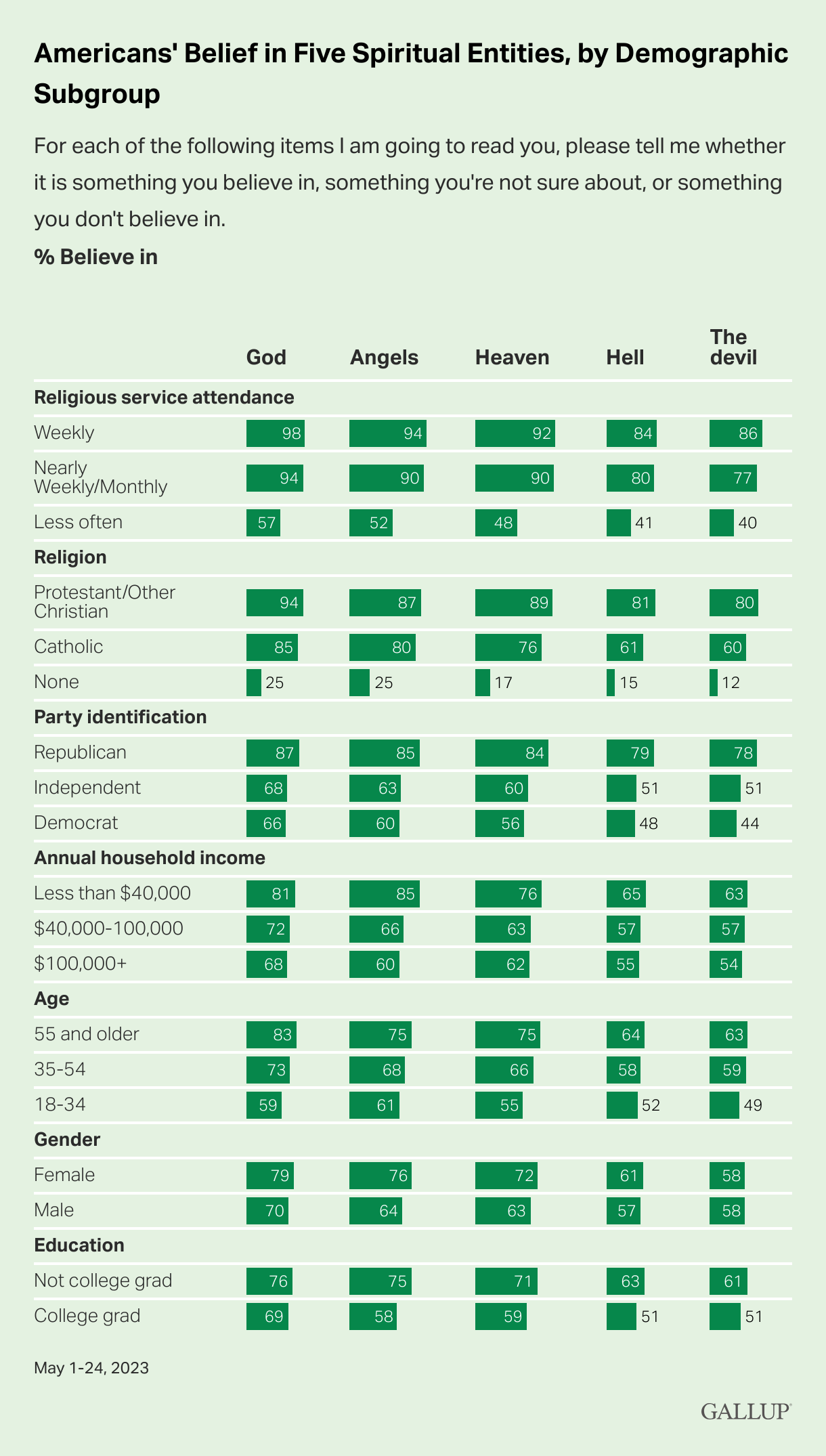
Belief in the supernatural is at an all-time low, according to a new survey from Gallup. While the majority of Americans still believe in God, angels, Heaven, Hell, and Satan, those majorities continue to dwindle, which could be bad news for the religious institutions that treat fiction as fact.

Since 2001, belief in God has gone from 90% to 74%—which implies more than a quarter of Americans are either unsure or reject the idea of God altogether. The percentage of believers has not gone up in the past two decades.

Meanwhile, while belief in the devil saw a slight rise during the George W. Bush administration, that number has also seen a drop from a high of 70% to 58% today. (Ironically, 69% of Americans still believe in angels. People seem to prefer their spiritual entities in a “glass half full” sort of way.)

51% of Americans believe in all five of those spiritual entities. 7% of Americans are “unsure” about all five. 11% reject all five. (Those 11% are correct.)

All of this is happening while plenty of other surveys have found a dramatic rise in non-belief. The Pew Research Center has found that 29% of Americans have no religious affiliation at all.

So how many atheists believe in these spiritual entities? (How many people are full of logical inconsistencies?) That’s a little harder to say. While Gallup doesn’t address the issue in this particular survey, Pew found in 2017 that 9% of people who didn’t believe in God did believe in some “higher power.” There’s a flip side to that too. There are a lot of Americans in this survey who say they believe in God but reject the concepts of Heaven, Hell, or the beings that supposedly live in them. What the hell is going on there? It suggests many Americans take a cafeteria-style approach to religion, picking and choosing the parts they like instead of purchasing the entire package.

Gallup found (perhaps not surprisingly) that believers in all of the Big Five include Protestants more than Catholics, frequent churchgoers more than casual ones, people without a college degree more than college graduates, Republicans more than Democrats, people in households that make under $40,000 a year more than those making over $100,000, adults 55 and older more than younger ones, and women more than men (except when it comes to the devil, when both numbers are the same).

All of this is bad news for church leaders that use these beliefs to bring in and control members. When fewer people believe in the devil, it’s a lot harder to scare them straight. When fewer people believe in Heaven or Hell, it raises questions about why people need to follow religious rules that don’t make sense.

Many atheists could tell you that their belief in God didn’t fade away in a split second. Rather, there was some aspect of religion that stopped making sense to them. That led to them questioning other ones. Once that first domino fell, the others followed in succession until even God couldn’t stand up to scrutiny.

What these survey results show us is that the dominoes are falling. It’ll take a while for the entire chain to go down, but religious leaders should be worried.

The busiest abortionist

Here’s the link to this article.

Avatar photoby DR. ABBY HAFER

JUL 06, 2022

busiest abortionist
Shutterstock

Reading Time: 5 MINUTES

“They took it out in pieces,” she told me.  

My friend was discussing a pregnancy that she had very much wanted as a married woman in her 20s. It had failed inside her and had to be removed, as she said, in pieces. Otherwise, she would have died of sepsis. She was devastated by this loss. Whether this is what led to the failure of her marriage a year or so later is anybody’s guess.

Women often feel guilty if their pregnancy miscarries. Religious women are often told that their bodies are the result of “Intelligent Design,” and the expectation is that their bodies are the perfect retorts for growing and continuing a pregnancy.  Even those who are not religious tend to think that our bodies, having evolved over millions of years, must be nearly perfectly adapted for the process of carrying a pregnancy and giving birth. 

Yes, our bodies did evolve. But evolution’s standard for the success of a system is not perfection, or even near-perfection. The standard for success in an evolved system is, “It doesn’t cause death before reproduction too often.” That’s a pretty low standard. It takes no account of human suffering, and it certainly takes no account of the occasional unsuccessful embryo. So long as enough people survive to reproduce, the species keeps going. Deaths or disfigurements in individual conceptuses don’t matter, so long as the population itself continues.

As a result, a human pregnancy is actually a pretty tenuous affair. One thing that would help women in general—and men as well—would be an understanding of just how tenuous a situation a human pregnancy actually is. 

 When does the soul enter the body?

We are not helped by the fact that anti-abortionists often claim that “life” begins at conception,  especially since what is formed at conception is a cell with a new combination of DNA. The life that allows that DNA molecule to replicate is the woman’s life.

However, when anti-abortionists talk about life “beginning” at conception, what they actually mean is that they believe a divine soul is actively placed into a fertilized egg at the exact moment that egg and sperm fuse. This imagined process of God turning it from meat into a human being by inserting a soul is called “ensoulment.”

The life that allows that DNA molecule to replicate is the woman’s life.

The issue of ensoulment is a matter that religious philosophers have discussed for many hundreds of years. 

In earlier eras, ensoulment was thought to happen at quickening, which was when movements inside the uterus were first experienced. Others have argued that ensoulment doesn’t take place until a baby, outside of the mother’s body, draws its first breath. 

Fertilization was only discovered after the invention of the microscope

What earlier thinkers did not think was that ensoulment took place at conception. Why didn’t they think that? Because prior to the advent of modern science, nobody knew what conception actually was. In Biblical times, nobody knew what happens at fertilization.

What actually happens at fertilization could only be discovered after the invention of the microscope. And following that invention, it still took a great deal of painstaking scientific research to figure out that sperm and egg have to meet and fuse for fertilization to take place. This painstaking research involved, among other things, putting pants on frogs. I am not kidding. 

How do you draw the line for the existence of something that doesn’t exist?

Since there is no evidence of a non-corporeal soul, and certainly no way of measuring its presence or absence, religious philosophers have always been at a loss for telling when a soul enters a body. Because a soul is immeasurable and indeed undetectable, once science discovered the fertilization of eggs, religious-philosophical cowards decided that the winking into existence of a human soul took place right at the moment of fertilization.

Why? Because they were unable to figure out where or how to draw a line. A fertilized egg changes into a born baby gradually through a continuous process. But the naïve religious concept of a binary “soul” insists that the soul either exists fully complete or does not exist at all. Further, it switches from one to the other in an instant—a serious mismatch with the reality of gestation and birth.

Faced with a difficult decision, many religious philosophers wimped out. They were actively unwilling to think about evidence of prenatal development.

They were also unwilling to make hard decisions. There is no evidence for a soul existing at the moment of conception or any other. However, the entire religious belief in a binary on-or-off soul depends on drawing a line someplace. So they decided to play it safe, drawing the line right at the moment of conception. It’s a lazy, cowardly person’s choice.

What does this have to do with miscarriages?

But we were talking about miscarriages, and about a divine soul being placed into a fertilized egg by God himself, at the moment of conception. Of these two ideas, only one is a fact. And the fact is that pregnancies miscarry at an alarming rate. Further, these two ideas—ensoulment and miscarriage—stand in direct contradiction to one another. 

The other term for miscarriage is “spontaneous abortion.”  Conservative religions go out of their way to ignore the fact that women’s bodies are hives of spontaneous abortions. These happen routinely in humans.

Conservative religions go out of their way to ignore the fact that women’s bodies are hives of spontaneous abortions.

Where human women are concerned, the bald fact is that over 31 percent of all fertilized eggs fail to result in living babies—a conservative estimate based on careful research.

I am not now talking about human-induced abortions but spontaneous miscarriages.

What’s more, according to careful research reported in the New England Journal of Medicine, about 25 percent of all fertilized eggs do not even manage to implant on the lining of the uterus, which is just the first step in a pregnancy after fertilization.

Twenty-five percent of all fertilized eggs live for only about ten days, then fail to implant. They die and pass out of the body along with menstrual fluid. This in turn means that every year many millions of fertilized eggs come into existence and then die about ten days later as undifferentiated clumps of cells. The remaining six percent of spontaneous abortions happen after implantation.

All this is supposedly God’s work. 

This means that for every 100 live births, there were at least 45 spontaneous abortions.

So we must ask ourselves: Why, if God creates these souls at conception, does he then destroy so many of them before they even have a chance to breathe? Before they ever experience life outside the womb? Before they can ever have the experience of being human? Before they can ever have an interaction with the world, which we are told, is necessary in order to find their way to God? 

These numbers show that the human female reproductive system is far from perfect. In fact, anyone who argues that the human body is the result of intelligent design has clearly never taken a close look at the female reproductive system, or for that matter the male one.  

In human females, gestation is frequently incomplete and often results in a naturally aborted fetus.

There were approximately 130 million babies born worldwide in 2018, which means approximately 58.5 million spontaneous, natural abortions in that year alone.

If God gives life to each embryo at the exact moment when egg meets sperm as conservative Christians claim, then God subsequently kills tens of millions of little unborn babies every year. Put another way, God performs tens of millions of abortions every year.

God, if he exists, is by far the world’s busiest abortionist.

What I’m reading

I encourage all my Southern Baptist friends (and others) to read this excellent book.

Here’s a quote:

Personal feelings about your relationship with any deity — no matter how deep — are not proof that what you believe is true.

Madison, David; Sledge, Tim. GUESSING ABOUT GOD (Ten Tough Problems in Christian Belief Book 1) (p. 34). Insighting Growth Publications Inc.. Kindle Edition.

Amazon abstract

In this first book of his Ten Tough Problems series, David Madison shares three critical problems in Christian belief.

Problem One: God is invisible and silent. This fact forces humanity to rely on ineffective ways of knowing God — common knowledge, sacred books, visions, prayer, personal feelings, and theologians. But all these sources of God knowledge fall short as evidenced by a world of disagreement, not just between Christians and other religions, but within Christianity itself.

Problem Two: The Bible disproves itself. In Chapter 2, Madison narrows his focus down to the world’s most famous book. He shows how two hundred years of critical scholarship — something most Christians know nothing about — have revealed the Bible to be full of archaic ideas, moral failures, and contradictions. He makes a convincing case that all these flaws rob us of any confidence that claims of biblical revelation can be taken seriously.

Problem Three: We can only guess who Jesus was. In Chapter 3, Madison turns his magnifying glass on the four Gospels and finds them severely lacking in their attempts to provide a clear understanding of who Jesus was and what he had to say. These Gospels not only contradict one another, but when reviewed under Madison’s guidance, prompt the honest reader to request, “Will the real Jesus please stand up?”

Combining rigorous scholarship with engaging personal reflections, this book offers understanding and help for individuals struggling with tough questions about belief. And the most pressing question it provides for the reader is: How could a deity competent enough to create this Universe be such a massively poor communicator who leaves humanity Guessing about God.

A biologist explains why ‘heartbeat laws’ are nonsensical

Here’s the link to this article.

Avatar photoby DR. ABBY HAFER

MAY 06, 2022

a biologist explains why heartbeat laws are nonsensical | heart cell and pulse line
Shutterstock/YouTube screenshot

Overview

The proliferation of anti-abortion ‘heartbeat laws’ cynically conflate the spontaneous pulsing of cardiac cells with the beating of a heart, and the beating of a heart with the presence of a soul. Such magical thinking belongs nowhere near the laws of a secular democracy

Reading Time: 5 MINUTES

A scientist is working in her lab, quietly culturing heart cells. She puts Petri dishes full of them into an incubator to grow. A few days later, she takes them out and inspects them under a microscope to see if they have multiplied as she wanted. 

As she innocently adjusts her scope, she sees—they are beating. What’s more, when she puts two of them near each other, they beat together! When she moves all of them together, they still beat together, in one great throbbing mass!  “IT’S ALIIIIVE!” she shrieks.


That scientist would be me. I didn’t really shriek, “It’s alive!” But I did see individual heart cells beating, cells that I had cultured, beating with no brain, nerves, organism, or even heart around them. They just contracted rhythmically—that is to say, they beat—all by themselves. 

Because that’s what heart cells do. 

Biologists sometimes have weird jobs. One summer, I worked in a lab that looked at how embryonic heart cells take up various chemicals. One of my jobs was to culture the heart cells— that is to say, grow them. I dissected embryonic chickens, took out the hearts, dissolved the connective tissue between the cells, and spread the cells out in Petri dishes along with the food and fluids they would need to be happy. Then I put them into incubators, hoping they would multiply.

After a few days, I took them out and checked them under a microscope to see if they were multiplying. And sometimes, when I looked at them, they were beating. The individual heart cells kind of looked like they were twinkling, with their little, individual contractions.

As for putting them together to see if they beat together, I didn’t actually do that. But other scientists have done so, and that’s exactly what they found: when cardiac muscle cells are placed together, they will beat together. It’s so well established that it’s common knowledge, written into textbooks. We know that they do it, and we know why they do it. Here’s a paragraph about this from the textbook Anatomy and Physiology:

If embryonic heart cells are separated into a Petri dish and kept alive, each is capable of generating its own electrical impulse followed by contraction.

It goes on to say:

When two independently beating embryonic cardiac muscle cells are placed together, the cell with the higher inherent rate sets the pace, and the impulse spreads from the faster to the slower cell to trigger a contraction.

In short, it is not mysterious, it is not magic. It’s biology doing what biology has evolved to do.

The anti-abortion movement’s cynical “heartbeat laws” are all manipulation, no science

There are many so-called “heartbeat laws” on the books in the United States at this time, laws that outlaw abortion after an embryonic “heartbeat” has been detected. Many others have been proposed. The most egregious current example is the law in Texas that states that a woman may not get an abortion after she has been pregnant for six weeks. Specifically, it bans abortion after cardiac activity is detectable. Other states are following suit as of this writing.

To most people, “cardiac activity” and “heartbeat” sound synonymous, and this mistaken assumption has been exploited by those who wish to deny women their right to an abortion. 

The assumption may be easy to make, but it is glaringly incorrect, as is illustrated by the narrative that began this article. It’s simple: heart cells beat all by themselves, entirely on their own. If an individual heart cell is alive, it contracts in a rhythmic manner—that is to say, it beats. “Cardiac activity” means that a few heart cells are alive and beating, not that a heart actually exists.  A true heartbeat, on the other hand, is, technically speaking, the beating of a heart. An actual complete heart, not a few cardiac muscle cells. A complete heart does not exist at six weeks’ gestation. 

To further illustrate just how independent a heart cell’s beating is from there being an actual living organism, consider the following two facts:

1) Beating heart cells need not come from an embryo. At Vienna University of Technology, descendants of stem cells called progenitor cells were induced to become heart cells in a laboratory, and they too beat on their own, in a Petri dish.

YouTube video

2) It is also possible for a person who is brain dead to still have a beating heart.

Heart and soul

If all of this seems spooky, it is largely because we incorrectly but understandably associate a beating heart with an intrinsic, even mystical life force; it is associated with the presence of a soul itself.

Ancient Egyptians and some ancient Greeks believed that the heart housed the soul, as well as our ability to think. Christianity adopted the idea that the heart is the seat of consciousness, intelligence, free personality, intrinsic knowledge of right and wrong, and a place over which God could have direct influence. These feelings continue in our culture to this day.  

But what we know, through science, is that the heart is a muscle that pumps blood throughout the body. We know that a heart can be transplanted from a dead person to someone else, and that a soul is not transplanted at the same time. We know that cardiac muscle cells will contract in a rhythmic manner, regardless of the state of the body around it, or even the existence of a body around it, or even the existence of a heart around it. 

The religious idea that the heart is the seat of the soul stalks the subject of abortion. In fact, in general, the religious concept of “ensoulment” has been the unspoken underpinning of the anti-abortion movement for decades.

The religious idea that the heart is the seat of the soul stalks the subject of abortion.

“Ensoulment” is the idea that there is a specific moment when a developing embryo is endowed with a soul. Once a divine soul is placed in an embryo, terminating that embryo is thought to constitute the murder of a divine soul.

The laws of a secular democracy should offer no place for magical thinking of this kind. When anti-abortionists ask “When does life begin?”, they are really asking, “When does life with a soul begin?” It should be noted that no one is arguing about whether or not the organism created through conception is alive.

The egg and sperm were alive. The parents were alive. All the ancestors back to the dawn of life on the planet were alive. Life is involved at every juncture before, during, and after conception. So the question “When does life begin?” regarding pregnancy is a nonsensical one. Once you realize this, you see that the question is a stand-in for ensoulment. 

“Cardiac activity” is likewise a stand-in for ensoulment. When such activity begins, it only means that some individual heart cells are alive. The sound is nothing more than the greatly-amplified rhythmic contracting of a collection of muscle cells that do not form a heart.

It needs to be stated in plain English: All anti-abortion fetal “heartbeat laws” are based on unscientific nonsense and should be abrogated. Cardiac muscle cells will contract on their own, even in a Petri dish, with no brain, no nervous system, no organism, and no heart attached to these cells. A “heartbeat” at six weeks’ gestation does not involve an actual heart. Further, muscle cells contracting are not the sign of a soul.

And regardless of the beliefs in the individual minds of citizens, the concept of a soul has no place in the laws of a secular democracy.

The Eccentric, Inflated, Dangerous Theology of John’s Gospel

Here’s the link to this article.

By David Madison at 7/21/2023

Read it and weep—and get over it

Here’s a book title that would dumbfound many devout churchgoers: This Tragic Gospel: How John Corrupted the Heart of Christianity. The author, Dr. Louis A. Ruprecht, Jr., states that the author of John intended his gospel to replace the earlier gospels (p. 180), and he refers to the “howling conflict between Mark and John…” (p. 13) Burton Mack wrote: “What a somersault, turning the page between Luke’s life of Jesus and the Gospel of John” (p. 175, Who Wrote the New Testament? The Making of the Christian Myth). Peter Brancazio notes that John’s gospel “will come as an astonishing surprise. Here the reader will encounter a radically different portrait of Jesus, both in terms of his message and his person” (p. 373, The Bible from Cover to Cover: How Modern-Day Scholars Read the Bible).

Surveys have shown that church folks don’t make a habit of reading the gospels—and certainly not studying the gospels, analyzing them critically. There are so many other options for entertainment. It’s common for the devout to accept the idealized version of Jesus promoted by the church, and there is special fondness for the gospel of John, e.g., 3:16, “God so loved the world…”  and 14:2: “In my Father’s house are many mansions: if it were not so, I would have told you. I go to prepare a place for you.” Yes, heaven awaits, as this quaint King James Version rendering assures the faithful. I have often challenged believers to read all of Mark’s gospel in one sitting, take a break, then do the same with John’s gospel. Gee, that would mean two or three hours of Bible reading! But the most exhausting part of this exercise would be the discovery of how differently Jesus is depicted in these two gospels. What’s going on? 

The author of John’s gospel apparently felt that the earlier writers got the story wrong—and he wanted to set the record straight. But, alas, this author was not a historian. He was a theologian who created his version of the Jesus story late in the first century or early in the second, many decades after the death of Jesus. He got carried away, hence my title for this article, suggesting that his theology was eccentric, inflated, and dangerous.  

Eccentric

No Baptism of Jesus

In John’s gospel, Jesus is not baptized. Since his divine Jesus had been present at creation (more about this later), there was no need for him to be baptized for the remission of sins. Matthew was also bothered by this, so when he copied Mark’s text, he said that John the Baptist himself didn’t like the idea of baptizing Jesus. Matthew added Jesus-script: “Let it be so now, for it is proper for us in this way to fulfill all righteousness” (Matthew 3:15). In other words, let’s do it for show. In John’s gospel, Jesus doesn’t set foot in the water. The Baptist is there to proclaim that Jesus in the “lamb of God who takes way the sins of the world” (John 1:29).

No Parables in the Teachings of Jesus

In Mark 4:10-12 we find the bizarre Jesus-script in which he claims that he taught in parables to prevent people from repenting and being forgiven. In Mark 4:34, we read that he taught only in parables. It seems that the author of John’s gospel was determined to show this was wrong. Instead of teaching in parables, we find long Jesus monologues found in none of the other gospels. 

There is no Eucharist at the Last Supper

In John’s presentation of this episode, Jesus washes the feet of the disciples—that’s the primary event (chapter 13). There is no mention of eating the bread as a symbol of Jesus’ body, and nothing about wine being his blood of the new covenant. However, late in chapter 6, which begins with the feeding of the Five Thousand, we find the especially ghoulish text about the importance of eating Jesus’ flesh and drinking his blood. More about this later too. 

There is little ethical teaching in John

This theologian-author was mainly concerned to present Jesus as the key to gaining eternal life. While Matthew added the Sermon on the Mount when he copied Mark’s text—and Luke modified the Sermon—John left it out altogether. And there’s a touch of irony here. In John 8 we find the famous story of the woman “taken in adultery,” whom the religious leaders are so eager to have stoned to death. They bring her to Jesus for his opinion on what to do. “Let anyone among you who is without sin be the first to throw a stone at her” (John 8:7). But this story, which is commonly taken as an illustration of Jesus’ compassion, was not in the original text of John’s gospel. In some manuscripts, it turns up in Luke 21. There is nothing whatever by which to verify that it is an authentic story about Jesus.

John changed the day of the crucifixion—and Jesus’ attitude 

One of John’s theological themes is that Jesus was “the lamb of God who takes away the sins of the world.” Thus it was crucial for him that Jesus die at the same time that lambs were killed for the Passover meal. The other gospels present Jesus having the Passover meal with his disciples that evening. And it was unthinkable for John that Jesus wasn’t the perfect divine being throughout the ordeal of the crucifixion. The other three gospels indicate that a man was picked out of the crowd, Simon of Cyrene, to carry the cross. In John 19:17 we read that Jesus carried the cross himself. In Mark’s gospel, the last words of Jesus were, “My God, my God, why have you forsaken me?” John would have none of that; when Jesus breathed his last, he simply said, “It is finished” — “then he bowed his head and gave up his spirit” (John 19:30).  

Inflated Theology

John chapter one sets the tone

Please read and ponder carefully John 1:1-18. Verse 14 is perhaps most famous: “And the Word became flesh and lived among us, and we have seen his glory, the glory as of a father’s only son, full of grace and truth.” We find this remarkable claim at the opening, vv. 1-3: “In the beginning was the Word, and the Word was with God, and the Word was God. He was in the beginning with God. All things came into being through him, and without him not one thing came into being.” The other gospel writers positioned Jesus as the son of god. In Mark’s gospel this was announced by a voice from the sky when Jesus was baptized. Matthew and Luke grafted onto their Jesus story an idea borrowed from other religions, that Jesus had been conceived by a god. 

John had succumbed big time to cult fanaticism. He claims that Jesus had been present at creation, indeed nothing “came into being” without the participation of Jesus. The Galilean peasant preacher has disappeared under layers of theology. Any reader today must ask—curiosity must kick in: how did he know this? Why should anyone trust the ideas that were bouncing around inside his head? So many theologians of very different faiths have made exaggerated claims about their gods, confident, of course, that their followers will be convinced, i.e., be fooled. 

The contrived Lazarus story

This spectacular episode is found only in John’s gospel. How did the other gospel writers miss it? Please read and ponder John 11:1-44. The most famous text in the story is vv. 25-26: “I am the resurrection and the life. Those who believe in me, even though they die, will live, and everyone who lives and believes in me will never die.” There can be little doubt that this is the purpose of the story—to stress again that Jesus is the key to living forever. Nor can there be any doubt that the story is contrived, given vv. 14-15: “Then Jesus told them plainly, ‘Lazarus is dead. For your sake I am glad I was not there, so that you may believe. But let us go to him.’” Jesus was glad he wasn’t there? Are churchgoers really okay with this? Would Lazarus himself have said, “Sure, let’s do this so you can score points”? 

Don’t miss the magic spell that Jesus uses here, v. 43: it’s a voice activated resurrection: “…he cried with a loud voice, ‘Lazarus, come out!’” How in the world is eternal life proved by such an event? We are told nothing else about Lazarus, namely that he died again at some point. And so did all those dead people who—so we’re told in Matthew 27:52-53 — came back to life and walked around Jerusalem on the first Easter morning. Clearly Luke knew this problem had to be avoided with Jesus, so in Acts 1 he says that Jesus disappeared above the clouds to join god in the sky. That never happened…so newly alive Jesus remained on earth, and died again as well. 

John 6: 53-57, theology reaches a low point

This chapter opens with Jesus feeding a crowd of 5,000 people. One of the disciples noticed a boy who had five barley loaves and two fish—from which Jesus, again working his magic—produced enough food for everyone. The next day he advised those whom he’d fed: “Do not work for the food that perishes but for the food that endures for eternal life, which the Son of Man will give you” (v. 27). We’re getting closer to perhaps the worst text in the New Testament, vv. 53-57: 

“So Jesus said to them, ‘Very truly, I tell you, unless you eat the flesh of the Son of Man and drink his blood, you have no life in you. Those who eat my flesh and drink my blood have eternal life, and I will raise them up on the last day, for my flesh is true food, and my blood is true drink. Those who eat my flesh and drink my blood abide in me and I in them. Just as the living Father sent me and I live because of the Father, so whoever eats me will live because of me.’” 

If Christians heard these words shouted by a deranged street preacher, they’d cross the street, run in the other direction. The author of John’s gospel was so absorbed in his version of the Jesus cult that he was okay advocating this grotesque idea. His religion embraced magic potions, i.e., eating flesh, drinking blood that belongs to a god. But when you’re deep into the cult, this no longer causes offense. Over the centuries, the ecclesiastical bureaucracy promoted this ancient superstition relentlessly. It became part of ritual—to the ridiculous extent of making a big deal of First Communion, i.e., kids are allowed to eat Jesus for the first time. I often wonder: when are Christians going to snap out of it?    

John 14-17

Anyone who decides to read this gospel nonstop will find these chapters especially tedious—a great stretch of cult theobabble: Jesus and god are one. You’d better sign on, or else, e.g. 15:6: “Whoever does not abide in me is thrown away like a branch and withers; such branches are gathered, thrown into the fire, and burned.” Any curious reader will want to know: why are these chapters missing from the other gospels? Devout scholars, who argue—without evidence— that the gospels derive from eyewitness accounts, have to be stumped that all these words of Jesus said to the disciples are missing from the earlier gospels. John seems to have followed the ancient practice of making up speeches for holy heroes. Richard Carrier, after reviewing so many of the fabrications found in this gospel, concluded: “John has thus run wild with authorial gluttony, freely changing everything and inventing whatever he wants. By modern standards, John is lying” (On the Historicity of Jesus: Why We Might Have Reason for Doubt, p. 491).   

Dangerous Theology

Religious fanaticism has been fueled by scripture. Promising that people who don’t believe will be “thrown into the fire and burned” encourages violence. Two verses after the beloved John 3:16, we find this warning: “…those who do not believe are condemned already because they have not believed in the name of the only Son of God.” And at the end of the chapter: “Whoever believes in the Son has eternal life; whoever disobeys the Son will not see life but must endure God’s wrath.” Through the centuries, Christian zealots have gone to war and burned people at the stake; these hateful verses in John’s gospel provide the justification. 

There has been a lot of commentary as well on the role this gospel has played in fueling antisemitism. The Wikipedia article on this include a section on the fourth gospel: “The Gospel of John is the primary source of the image of ‘the Jews’ acting collectively as the enemy of Jesus, which later became fixed in Christian minds.” Perhaps the worst
text is John 8:44, Jesus in conversation with the Jews: “You are from your father the devil, and you choose to do your father’s desires.” Hector Avalos has pointed out that this verse ended up on Nazi road signs (in his essay, “Atheism Was Not the Cause of the Holocaust,” in John Loftus’ anthology, The Christian Delusion: Why Faith Fails, p. 378).

Devout believers who are so sure that the Bible is the Good Book have a lot of explaining to do when the discussion turns to John’s gospel. This author—as Carrier notes—by modern standards, did a lot of lying, and in the process, as Louis Ruprecht maintains, “corrupted the heart of Christianity.”

David Madison was a pastor in the Methodist Church for nine years, and has a PhD in Biblical Studies from Boston University. He is the author of two books, Ten ToughProblems in Christian Thought and Belief: a Minister-Turned-Atheist Shows Why You Should Ditch the Faith, now being reissued in several volumes, the first of which is Guessing About God (2023) and Ten Things Christians Wish Jesus Hadn’t Taught: And Other Reasons to Question His Word(2021). The Spanish translation of this book is also now available. 

His YouTube channel is here. He has written for the Debunking Christianity Blog since 2016.

The Cure-for-Christianity Library©, now with more than 500 titles, is here. A brief video explanation of the Library is here

What Would Convince Us Christianity is True?

Here’s the link to this article.

By John W. Loftus at 6/30/2023

We atheists are asked to imagine what would convince us that Christianity is true. The short answer is this: We need sufficient objective evidence that can transform the negligible amount of human testimony found in the Bible into verified eyewitness testimony. But it does not exist. Given the extraordinary nature of the miracle tales in the Bible, this requirement means the past has to be changed and that can’t be done. Let’s explore this.

Consider the Christian belief in the virgin-birthed deity. Just ask for the objective evidence. There is no objective evidence to corroborate the Virgin Mary’s story. We hear nothing about her wearing a misogynistic chastity belt to prove her virginity. No one checked for an intact hymen before she gave birth, either. After Jesus was born, Maury Povich wasn’t there with a DNA test to verify Joseph was not the baby daddy. We don’t even have first-hand testimonial evidence for it since the story is related to us by others, not by Mary or Joseph. At best, all we have is second-hand testimony by one person, Mary, as reported in two later anonymous gospels, or two people if we include Joseph, who was incredulously convinced Mary was a virgin because of a dream–yes, a dream (see Matthew 1:19-24).[1] We never get to independently cross-examine Mary and Joseph, or the people who knew them, which we would need to do since they may have a very good reason for lying (pregnancy out of wedlock, anyone?).

Now one might simply trust the anonymous Gospel writers who wrote down this miraculous tale, but why? How is it possible they could find out that a virgin named Mary gave birth to a deity? Think about how they would go about researching that. No reasonable investigation could take Mary’s word for it, or Joseph’s word. With regard to Joseph’s dream, Thomas Hobbes tells us, “For a man to say God hath spoken to him in a Dream, is no more than to say he dreamed that God spake to him; which is not of force to win belief from any man” (Leviathan, chap. 32.6). So the testimonial evidence is down to one person, Mary, which is still second-hand testimony at best. Why should we believe that testimony?

Christian believers accept ancient 2nd 3rd 4th 5th handed-down testimony to the virgin birth of Jesus, but they would never believe two people who claimed to see a virgin give birth to an incarnate god in today’s world!

On this fact, Christian believers are faced with a serious dilemma. If this is the kind of research that went into writing the Gospel of Matthew–by taking Mary’s word and Joseph’s dream as evidence–then we shouldn’t believe anything else we find in that Gospel without corroborating objective evidence. The lack of evidence for Mary’s story speaks directly to the credibility of the Gospel narrative as a whole. There’s no good reason to believe the virgin birth myth, so there’s no good reason to believe the resurrection myth either, since the claim of Jesus’ bodily resurrection is first told in that Gospel.[2]

In a recent online discussion fundamentalist apologist Lydia McGrew suggested I got it wrong. Her knee jerk reaction to me was that the author of Matthew’s gospel merely reported that Joseph’s dream convinced him Mary’s tale was true, and nothing more. But if so, why is Joseph’s dream included in Matthew’s gospel at all? It doesn’t do anything to lead reasonable people to accept Mary’s story, as her testimony would still stand alone without any support. It would be tantamount to showing that Joseph was incredulously convinced by less than what a reasonable person should accept. So what? It would also encourage readers to consider their own dreams as convincing on other issues.

So let us imagine what could have been…

If an overwhelming number of Jews in first-century Palestine had become Christians that would’ve helped. They believed in their God. They believed their God did miracles. They knew their Old Testament prophecies. They hoped for a Messiah/King based on these prophecies.[3] We’re even told they were beloved by their God! Yet the overwhelming majority of those first-century Jews did not believe Jesus was raised from the dead.[4] They were there and they didn’t believe. So why should we?

If I could go back in time to watch Jesus coming out of a tomb that would work. But I can’t travel back in time. If someone recently found some convincing objective evidence dating to the days of Jesus, that would work. But I can’t imagine what kind of evidence that could be. As I’ve argued, uncorroborated testimonial evidence alone wouldn’t work, so an authenticated handwritten letter from the mother of Jesus would be insufficient. If a cell phone was discovered and dated to the time of Jesus containing videos of him doing miracles, that would work. But this is just as unlikely as his resurrection. If Jesus, God, or Mary were to appear to me, that would work. But that has never happened even in my believing days, and there’s nothing I can do to make it happen either. Several atheists have suggested other scenarios that would work, but none of them have panned out.[5]

Believers will cry foul, complaining that the kind of objective evidence needed to believe cannot be found, as if we concocted this need precisely to deny miracles. But this is simply what reasonable people need. If that’s the case, then that’s the case. Bite the bullet. It’s not our fault it doesn’t exist. Once honest inquirers admit the objective evidence doesn’t exist, they should stop complaining and be honest about its absence. It’s that simple. Since reasonable people need this evidence, God is to be blamed for not providing it. Why would a God create us as reasonable people and then not provide what reasonable people need? Reasonable people should always think about these matters in accordance to the probabilities based on the strength of the objective evidence.

Believers will object that I haven’t stated any criteria for identifying what qualifies as extraordinary evidence for an extraordinary miraculous claim. But I know what does not count. Second-, third-, or fourth-hand hearsay testimony doesn’t count. Nor does circumstantial evidence. Nor does anecdotal evidence as reported in documents that are centuries later than the supposed events, which were copied by scribes and theologians who had no qualms about including forgeries. I also know that subjective feelings, private experiences, or inner voices don’t count as extraordinary evidence. Neither do claims that one’s writings are inspired, divinely communicated through dreams, or were seen in visions. That should be good enough. Chasing the definitional demand for specific criteria sidetracks us away from that which matters. Concrete suggestions matter. But if Christians want more they should learn to examine the miracle claims in the Bible from the perspective of a historian.[6]

If nothing else, a God who desired our belief could have waited until our present technological age to perform miracles, because people in this scientific age of ours need to see the evidence. If a God can send the savior Jesus in the first century, whose death supposedly atoned for our sins and atoned for all the sins of the people in the past, prior to his day, then that same God could have waited to send Jesus to die in the year 2023. Doing so would bring salvation to every person born before this year, too, which just adds twenty centuries of people to save.

In today’s world it would be easy to provide objective evidence of the Gospel miracles. Magicians and mentalists would watch Jesus to see if he could fool them, like what Penn & Teller do on their show. There would be thousands of cell phones that could document his birth, life, death, and resurrection. The raising of Lazarus out of his tomb would go viral. We could set up a watch party as Jesus was being put into his grave to document everything all weekend, especially his resurrection. We could ask the resurrected Jesus to tell us things that only the real Jesus could have known or said before he died. Photos could be compared. DNA tests could be conducted on the resurrected body of Jesus, which could prove his resurrection, if we first snatched the foreskin of the baby Jesus long before his death. Plus, everyone in the world could watch as his body ascended back into the heavenly sky above, from where it was believed he came down to earth.

Christian believers say their God wouldn’t make his existence that obvious. But if their God had wanted to save more people, as we read he did (2 Peter 3:9), then it’s obvious he should’ve waited until our modern era to do so. For the evidence could be massive. If nothing else, their God had all of this evidence available to him, but chose not to use any of it, even though with the addition of each unit of evidence, more people would be saved.

It’s equally obvious that if a perfectly good, omnipotent God wanted to be hidden, for some hidden reason, we should see some evidence of this. But outside the apologetical need to explain away the lack of objective evidence for faith, we don’t find it. For there are a number of events taking place daily in which such a God could alleviate horrendous suffering without being detected. God could’ve stopped the underwater earthquake that caused the 2004 Indian Ocean tsunami before it happened, thus saving a quarter of a million lives. Then, with a perpetual miracle God could’ve kept it from ever happening in the future. If God did this, none of us would ever know that he did. Yet he didn’t do it. Since there are millions of clear instances like this one, where a theistic God didn’t alleviate horrendous suffering even though he could do so without being detected, we can reasonably conclude that a God who hides himself doesn’t exist. If nothing else, a God who doesn’t do anything about the most horrendous cases of suffering doesn’t do anything about the lesser cases of suffering either, or involve himself in our lives.[7]

In any case, imagining some nonexistent evidence that could convince us Mary gave birth to a divine son sired by a male god in the ancient superstitious world is a futile exercise, since we already know there’s no objective evidence for it. One might as well imagine what would convince us that Marshall Applewhite, of the Heaven’s Gate suicide cult, was telling the truth in 1997 that an extraterrestrial spacecraft following the comet Hale-Bopp was going to beam their souls up to it, if they would commit suicide with him. One might even go further to imagine what would convince us that he and his followers are flying around the universe today! Such an exercise would be utter tomfoolery, because faith is tomfoolery.

Anthropology professor James T. Houk has said, “Virtually anything and everything, no matter how absurd, inane, or ridiculous, has been believed or claimed to be true at one time or another by somebody, somewhere in the name of faith.”[8] This is exactly what we find when Christians believe on less than sufficient objective evidence.

——–

[1] Joseph’s dream is used in the Gospel of Matthew’s narrative to help explain why Mary was not put to death for dishonoring him because of adultery. There are five other dreams in this gospel account which were all intended to save someone’s life. So, Joseph’s dream was probably meant to save Mary’s life too (Matthew 1:19-23; 2:12; 2:19-23; & 27:19). Matthew J. Marohl shows in Joseph’s Dilemma: “Honor Killing” in the Birth Narrative of Matthew (Wipf & Stock Publisher, 2008), that “Joseph’s dilemma involves the possibility of an honor killing. If Joseph reveals that Mary is pregnant, she will be killed. If Joseph conceals Mary’s pregnancy, he will be opposing the law of the Lord. What is a ‘righteous’ man to do?” Marohl: “Early Christ-followers understood Joseph’s dilemma to involve an assumption of adultery and the subsequent possibility of the killing of Mary.” This was part of their culture. Honor killings were justified in both the Old and New Testaments. Jesus even agreed with the Mosaic Law (Exodus 21:17; Leviticus 20:9) against his opponents on behalf of honor killings of children who dishonored their parents (Mark 7:8-13). The tale of the woman caught in adultery, where Jesus exposes the hypocrisy of her accusers, doesn’t change what Jesus thinks of the law either (John 8; Matthew 5:18).

Don’t be surprised by the possibility of honor killings. Jesus affirmed their legitimacy. The Pharisees accused Jesus of being too lenient in his observance of the law. So Jesus counterpunches them in Mark 7:9-12: “You have a fine way of setting aside the commands of God in order to observe your own traditions! For Moses said, ‘Honor your father and mother,’ and, ‘Anyone who curses their father or mother is to be put to death.’ But you say that if anyone declares that what might have been used to help their father or mother is Corban (that is, devoted to God) then you no longer let them do anything for their father or mother.” (NIV) Corban is an Aramaic word that refers to a sacrifice, oath, or gift to God. The Pharisees allowed for this loophole so someone could make an oath to offer a gift to the temple, like one would set up a trust fund, in order to avoid giving it for the care of one’s aging parents.

Jesus’ first scriptural quote to “Honor your father and mother” is one of the Ten Commandments. Jesus’ second scriptural quote that “Anyone who curses (literally dishonors) their father or mother is to be put to death”, is found in Ex. 21:17 and Lev. 20:9. Jesus says the Corban loophole sets aside these two commands of God. For such a son would be disobeying a direct command of God by dishonoring his parents, while the Pharisees would be disobeying God’s command by not putting him to death. Deuteronomy 21:18-21 elaborates (i.e., the second law): “If someone has a stubborn and rebellious son who does not obey his father and mother and will not listen to them when they discipline him, his father and mother shall take hold of him and bring him to the elders at the gate of his town. They shall say to the elders, ‘This son of ours is stubborn and rebellious. He will not obey us. He is a glutton and a drunkard.’ Then all the men of his town are to stone him to death.”

In this Jesus is affirming the Old Testament law of honor killings by stoning, for only if both of the laws Jesus cites are to be obeyed can his analogy succeed, that the Pharisees have set aside the laws of God in order to observe their traditions. For more on the harms of Christianity see my anthology, Christianity is not Great (Amherst, NY: Prometheus Books, 2014).

[2] On the resurrection, see Loftus, The Case against Miracles (United Kingdom: Hypatia Press, 2019), chapter 17.

[3] To see how early Christian’s misused Old Testament prophecy, see Robert J. Miller’s excellent book, Helping Jesus Fulfill Prophecy (Eugene, OR: Cascade Books, 2015).

[4] The most plausible estimate of the first-century Jewish population comes from a census of the Roman Empire during the reign of Claudius (48 CE) that counted nearly 7 million Jews. See the entry “Population” in Encyclopedia Judaica, vol. 13. In Palestine there may have been as many as 2.5 million Jews. See Magen Broshi, “Estimating the Population of Ancient Jerusalem.” Biblical Archaeological Review Vol. 4, No. 2 (June 1978): 10-15. Despite these numbers, Catholic New Testament scholar David C. Sim shows that “Throughout the first century the total number of Jews in the Christian movement probably never exceeded 1,000.” See How Many Jews Became Christians in the First Century: The Failure of the Christian Mission to the Jews. Hervormde Teologiese Studies Vol. 61, No. 1/2 (2005): 417-440.

[5] Loftus, What Would Convince Atheists To Become Christians? The Definitive Answers! (April 4, 2017).

[6] See Bart D. Ehrman on the Historian and the Resurrection of Jesus.

[7] See my anthology, God and Horrendous Suffering for more.

[8] James T. Houk, The Illusion of Certainty (Amherst, NY: Prometheus Books, 2017), p. 16.

————–

John W. Loftus is a philosopher and counter-apologist credited with 12 critically acclaimed books, including The Case against MiraclesGod and Horrendous Suffering, and Varieties of Jesus Mythicism. Please support DC by sharing our posts, or by subscribing, donating, or buying our books at Amazon. As an Amazon Associate John earns a small amount of money from any purchases made there. Buying anything through them helps fund the work here, and is greatly appreciated!

On Thanking God for Cruel Randomness, by Rob J. Hyndman

Here’s the link to this article. And, here’s the link to Hyndman’s website where you can read his book, Unbelievable, for free.

By John W. Loftus at 7/02/2023

What follows comes from an online book by Rob J. Hyndman, titled Unbelievable. He says of himself: “I was a Christian for nearly 30 years, and was well-known as a writer and Bible teacher within the Christadelphian community. I gave up Christianity when I no longer thought that there was sufficient evidence to support belief in the Bible. This is a personal memoir describing my journey of deconversion….In this book, I reflect on how I was fooled, and why I changed my mind.”

On Thanking God for Cruel Randomness

The practice of thanking God for safety and protection, for food and drink, for health and well-being, or for any other “blessings”, might appear to be a commendable habit, but it is actually deeply troubling because of what it implies.

A miraculously intervening God is an unjust capricious God, sparing some and saving others, apparently on a whim.

If God really was selecting people to protect on the basis of some bigger picture, then you would not expect the number of people who are killed in various ways to be subject to the rules of probability. However, I can predict with remarkable accuracy the road toll each year, the number of people who will be struck by lightning, the number of people who will be killed by shark attacks, and so on. Each of these causes of death has a certain rate of occurrence that is quite predictable.

It is not just the number of deaths that is predictable, it is the whole probability distribution of deaths that is predictable. If you know the average number of deaths by car accidents in a city, then it is possible to calculate all the percentiles for that city. For example, you can estimate the numbers of deaths that would be exceeded only once every ten years. When you do this for many cities, you find that the 1-in-10-year extremes are exceeded in approximately 10% of cities each year. This is exactly what you would expect if the world was random, but not what you would expect if anyone was in control.

Car accidents, diseases, and industrial accidents all follow the same probability distribution, known as the “Poisson distribution”. The Poisson probability distribution is based on the assumption that accidents happen randomly. It is simply not possible for tragedies to appear to follow the Poisson probability distribution while actually being controlled by God. Any interventions of God that interfere in the random processes would be detectable. If they are not detectable, then they are random and God is not involved.

If we accept that the world is random, and that bad things happen to everyone by chance, where does that leave God? Either he does not exist, or he has no power, or he does not care. Whichever of those answers you prefer, God does not deserve our thanks

Religion and education: Let’s be perfectly clear

Here’s the link to this article.

Avatar photoby DARREN SHERKAT

APR 25, 2022

Religion and education: let's be perfectly clear / students studying
Shutterstock

Despite a long-time understanding among sociologists that certain forms of religious belief and identification undercut educational attainment, contrarian social scientists and religious apologists often argue that education and religion are completely compatible. Recent arguments by Ilana Horwitz and Ryan Burge go further to claim that religion may even enhance educational success.

Such arguments wither under basic scrutiny.

Reliably offered by cheerleaders of religion, this perspective sees religious belief, identification, and participation as nurturing intellectual development and educational attainment. Religion is seen as fostering conscientiousness, a striving for perfection, beliefs in a higher purpose, and connections to a faithful community.

In short, religious commitments are seen by advocates of religion as a prerequisite to achieving a meaningful and flourishing life.

The problem with this view is that it fails to contend with the nitty-gritty of religious life: Which religious identifications? What religious beliefs? Why religious participation? Situating educational outcomes in the context of American religion is crucial for understanding the results.

Educational attainment—especially higher education—has consistently been shown to increase apostasy and reduce subscription to core religious beliefs. For instance, I have used data from the Youth-Parent Socialization Panel Study (YPSPS) to show that college preparatory coursework in high school and attainment of a college degree lowers beliefs in the veracity of the Bible later in life and increases the likelihood of renouncing religious identification. Those studies used high-quality data and the analyses controlled for a variety of potentially confounding factors like ethnicity, gender, parental social status, region, and rural residence. The negative associations between educational attainment and religious factors are also evident in cross-sectional data on apostasy taken from the General Social Survey (GSS), and GSS data also show that educational attainment reduces certainty of beliefs about gods and increases the likelihood that people reject beliefs in gods.  

As a non-Twitter user, I was amused to see a tweet by my former graduate student, Ryan Burge, promoting his new book on supposed myths about religion.  

Burge tweeted the following: (click link to article to see Tweet).

I have not read 20 Myths. However, the “data” from the tweet are apparently from a large, online, non-random “panel study” used to do quick and dirty analyses.

I trust Dr. Burge is familiar with the Literary Digest fiasco, if not the Gaussian assumptions about the need for random samples to extrapolate to population parameters. In any case, I guess he didn’t take my statistics courses at Southern Illinois University. Huge fractions of Americans do not use the internet at all. Almost no normal (in the Gaussian sense) individual would agree to participate in such a panel. And online panels are notorious for producing low-quality data that have no hope of estimating true population parameters.

Table 1: Association between degree attainment and religious factors: 2000-2018 GSS
DegreeNo Religious IdentificationApostateNon-TheistBible is FablesBible Word of GodReligious ParticipationNever Participate% of Full Sample
Less than High school16%9%11%14%54%3.428%13.9%
High School17%12%18%16%36%3.424%50.9%
Junior College17%12%19%18%30%3.620%7.8%
Bachelor’s Degree19%14%26%24%20%3.720%17.6%
Graduate Degree21%16%31%34%13%3.720%9.7%
N26,66226,40217,77921,39721,39726,47326,47326,662

In his tweet, Burge amplifies the centrality of “nones” but doesn’t try to ferret out the dynamic of how one’s education might influence that. Table 1 (above) presents data from the 2000-2018 GSS across a variety of identification and belief categories. First, Burge’s problematic data get the estimates dead wrong: There is a clear, almost linear positive relationship between degree attainment and non-identification with religion. While 16% of high school drop-outs are non-identifiers, the figure is 21% among those with a graduate degree.

The relationship is even stronger if you look at apostasy—people who reported having a religious identification at age 16 and now claim no religious identification. Only 6% of high school drop-outs are apostates, while 16% of people with graduate degrees relinquished religious identification. Comparing the distribution of nones and apostates is instructive. Among drop-outs, 56% of non-identifiers are apostates, while among those with graduate degrees 76% of nones were raised in some faith. This very much suggests that education plays a role in apostasy, even though many of the less educated are growing up without a faith commitment.

Burge’s problematic data get the estimates dead wrong: There is a clear, almost linear positive relationship between degree attainment and non-identification with religion.

Looking at the three belief items, the association is even more stark. Nearly a third of people with a graduate degree are non-theists (atheists, agnostics, or people who believe in a “higher power but not a god”) which is more than twice the total found among either high school graduates or drop-outs.

A similar difference is found for belief that the Bible is a book of fables. The least educated reject secular beliefs, while the most educated embrace them. While 34% of those with a graduate education believe the Bible is only a book of fables, only 16% of high school graduates and 14% of dropouts hold this view. Belief that the Bible is the literal word of God follows the opposite trajectory, with 54% of high school dropouts embracing literalism and only 20% of college graduates and 13% of those with graduate degrees. Ideally, one would have longitudinal data (as I did in my YPSPS papers) to show the influence of education more directly, but the association is very clear: higher education is associated with weaker religious beliefs and identifications.

The association is very clear: higher education is associated with weaker religious beliefs and identifications.

One place religious apologists can find solace is in the well-known positive association between social status and religious participation: religious participation is somewhat higher among those with at least some college education when compared to those with only a high school degree or none at all. Much of this is because higher fractions of the less educated don’t participate at all. Among respondents with no high school degree, 28% report never attending religious services, while among respondents with any type of college degree the figure is 20%. The less educated believe but don’t belong, while the more educated belong but don’t believe.

The explanation for this differential relationship between belief and belonging by social status is also well-established in the sociological literature. Religious participation is a social activity that requires time and resources. It grants people myriad social benefits through social capital formation, business networking, and the attainment of status in the community. High school dropouts and those who never went to college are unlikely to find such connections useful, and interactions with people who exceed their social status are unfulfilling and likely negative. The more educated also have more free time and fewer occupational impediments to religious activities. They don’t have to work at Walmart or Popeyes on Sunday. The more educated can afford wardrobes of appropriate attire to convey their status to the rest of the congregation. They are more likely to be married and to have well-behaved children who enjoy interacting with friends in the congregation.

It isn’t “religion” that brings the more educated into religious congregations, it’s the social rewards that religious groups can generate.

The less educated believe but don’t belong, while the more educated belong but don’t believe.

     Social scientific research shows that education undermines religious commitments and that religious commitments also undercut education. Religious fundamentalists and those who identify with sectarian denominations dissuade their children from taking college preparatory coursework in high school and from going to college, and the effect of parental religiosity on children’s educational attainment is particularly negative for women. Young people who embrace fundamentalism and sectarian Protestant identifications are also less likely to attend college and to graduate if they do attend. When sectarians and fundamentalists attend college, they typically attend less prestigious schools and often choose the shelter of fundamentalist colleges which have minimal offerings and questionable curricula. In the end, this results in religious conservatives having less prestigious occupations, attaining lower levels of income, and ultimately accumulating less wealth over the life course.  

Conservative religious commitments also undermine education through the political process, hamstringing education at every level for the entire society. Political movements rooted in sectarian Christianity undermine the teaching of everything from math to science to history. These movements use political power to influence textbooks, curricula, and personnel decisions in public educational institutions, and militate for the funding of religious schools and charter schools to the detriment of secular education. The vast network of conservative Christian alternative educational institutions help facilitate this, with the goal and result that Americans are less educated and less capable of sophisticated thought and scientific understanding.

Magical Thinking Is Christianity’s Biggest Mistake

Here’s the link to this article.

By David Madison at 7/14/2023

There are plenty of other mistakes as well


If I were asked to debate a flat-earther, Holocaust denier, or someone who is convinced the moon landings were faked, I would decline the invitation. Nor would I debate an astrologer, the local store-front medium who tells futures using a crystal ball, or anyone who believes in chem-trails. All of these folks have been groomed in one way or another, by various kooks and quacks. 

They haven’t done/ refuse to do /don’t know how to do the study/research to find out how wrong they are.

Then there are those who have been groomed to believe in ancient superstitions about a god who keeps a close watch on every person, and whose anger about human sin was modified by a human sacrifice—who, in fact, was this god’s only son, “the lamb of God who takes away the sins of the world.” (John 1:29) 

How can we get people to just say NO? This is pathetic magical thinking, that derives from the belief that killing an animal was a method for making a god less angry that you’ve done something wrong. This practice is on full view in the Old Testament. Check out the first chapter of Leviticus, vv. 4-5: 

“You shall lay your hand on the head of the burnt offering, and it shall be acceptable on your behalf as atonement for you. The bull shall be slaughtered before the Lord, and Aaron’s sons the priests shall offer the blood, dashing the blood against all sides of the altar…”

Before the Jerusalem temple was destroyed in 70 CE, this was still common practice, as we find in Jesus-script in Mark 1:44. After Jesus had healed a man with a skin disease, he ordered him: 

 “See that you say nothing to anyone, but go, show yourself to the priest, and offer for your cleansing what Moses commanded as a testimony to them.” 

This ancient superstition thrives today because there’s a huge bureaucracy dedicated to keeping it going, with one big change. The early Jesus cult was convinced that a single human sacrifice had replaced animal sacrifices. Among other things, this bureaucracy has been obsessed with building, and many of these structures are filled with splendid works of art, e.g., paintings, sculpture, stained glass—truly, wonders to behold. But the rituals practiced in these places of worship often represent the worst of ancient superstitions: drinking the blood and eating the flesh of the human sacrifice. Religion thriving on magic potions as well as magical thinking. (John 6:53-57) When I was growing up, this was communion—across town at the Catholic church it was the miracle of the Mass. It was naïvely accepted. We had been trained to be gullible.

Another example of Christian magical thinking: if the thoughts bouncing around in your head are the right thoughts—well, guess what: you win eternal life! Belief in Jesus happens to be one of those right thoughts, but woe to you if you’ve not been convinced: 

John 3:18: “Those who believe in him are not condemned, but those who do not believe are condemned already because they have not believed in the name of the only Son of God.”

John 3:36: “Whoever believes in the Son has eternal life; whoever disobeys the Son will not see life but must endure God’s wrath.”

Mark 16:16: “The one who believes and is baptized will be saved, but the one who does not believe will be condemned.”

Romans 10:9: “…if you confess with your mouth that Jesus is Lord and believe in your heart that God raised him from the dead, you will be saved.”

In Meredith Wilson’s classic show, The Music Man, the con man professor Harold Hill was finally held accountable on his promise to teach the kids how to play the instruments he sold. Under duress, he takes the conductor’s podium, and pleads with those seated in front of him, holding their instruments: “Now, think men, think.” He has bragged about his Think System: if you think hard about the tune, it’ll just happen when you blow into the instrument. But the result is noise. 

Christian theology is a variation on the Think System: If you’ve got it in your head that Jesus is lord and savior, you’ll produce the perfect result—the most pleasing tune imaginable—salvation. Harold Hill’s version of magical thinking didn’t work. There is no reason whatever to suppose theology’s version actually does the trick.

The ecclesiastical bureaucracy employs professional apologists ( = excuse makers) who work hard to position these ancient superstition in a positive light, to make them appear intellectually respectable. Their task is especially difficult because (1) In our modern world—if you’re trying to make the case with people who think—magical thinking is hard to defend; (2) the theology of the New Testament is incoherent, i.e., there is so much disagreement in these documents about how to get right with god; (3) the supposed teachings of Jesus include so many quotes that are bad, mediocre, and alarming (here’s a list of 292 of them). Yes, there are Christians who seek to downplay human sacrifice, and ask people to focus on the wonderful life of Jesus, their great moral teacher. But when people actually read the gospels, the wonderful great moral teacher turns out to be pretty elusive.

Why do the apologists even try? For one thing, it’s how they make a living. But more critically, belief in Jesus is their way to secure eternal life: they want their think system to work. Hence the supreme effort to convince others as well as themselves. But to the extent that magical thinking survives and thrives, human well-being is in jeopardy. 

In my article here last week, I mentioned John’s Loftus’ high praise for Daniel Bastian’s 2013 essay, What Would Convince You? in which Bastian lists twenty reasons for not taking Christianity seriously. “Read ’em and weep Christians,” Loftus said, “Ya got nothing. You’ll have to whine about something else from now on.”  Christianity is perfect storm of magical thinking, a giant mess of bad theology. Bastian’s essay is indeed essential homework. Study it carefully, ponder all of the issues he describes in detail.

Consider especially his issue Number 11: Infant Mortality Rates. This alone is a fatal blow to theism. How can it possibly be argued that god is paying attention to what’s going on? So much heartache for parents throughout millennia. God couldn’t be bothered? Bastian points out:

“Two hundred years ago, there was a 50 percent chance of your child not surviving past its first year. By 1850, IMR for babies born in America was 217 per 1,000 for whites and 340 for African Americans. By 1950, global IMR was down to 152 per 1,000 babies born (15.2 percent). 

“It is thanks to advancements in medicine and biomedical science that these numbers have been reduced to 4.3 percent today and continue to fall…New life is still shuttered at staggering rates across the third world from malnutrition, infectious diseases, and a miscellany of genetic factors. One can only imagine how high these numbers have climbed historically, prior to when these types of records were kept. Salvation of these newborns has clearly been delivered by the hands of science, not by any god or goddess.”

Tim Sledge, in his book, Four Disturbing Questions, with One Simple Answer: Breaking the Spell of Christian Belief, has a chapter titled, “The Germ Warfare Question.” How can believers not be stumped that, in a thousand-age book of revealed truths, the god who supposedly inspired it decided it was okay not to mention germs? Instead of the tedious book of Leviticus, why not a long lesson on how to detect and fight germs? Sledge notes the irony: “Not only did Jesus fail to mention germs, but he steered his listeners in the wrong direction when he told him not to worry about washing their hands” (p. 41). And Jesus healed a blind man by smearing mud on the guy’s eyes. Yet another example of magical folklore—and shame on god for presenting this as a way to cure blindness.     

In his issue Number 17, Bastian notes a major flaw in the argument that the Bible qualifies as the word of God:

“Most Christians assume their nicely printed and bound book, conveniently translated into modern English idiom, contains the pure, unvarnished words passed down from their time of origin. This could not be further from the truth…What survives are copies of the originals several centuries removed from their point of provenance…these texts have been edited, revised, and redacted down through the centuries, often by way of mistake but also for theological and political motives…If God deemed it prudent to deliver us a textbook of instruction, then why was the same care not taken in preserving it for us?

Save the link to Bastian’s essay, keep it handy to pass on to devout folks who show a willingness to study and learn. He ends with an appropriate summary of the twenty issues he describes:

“A god that has made itself impossible to detect—that, indeed, has ostensibly crafted a universe using processes indistinguishable from nature itself—and neglected to act on our behalf when and where such intercession was most desperately needed, undercuts our expectations of a cosmos governed by a benevolent watchman.” 

David Madison was a pastor in the Methodist Church for nine years, and has a PhD in Biblical Studies from Boston University. He is the author of two books, Guessing About God, Volume 1 of Ten Tough Problems in Christian Belief  (2023) and Ten Things Christians Wish Jesus Hadn’t Taught: And Other Reasons to Question His Words (2021). The Spanish translation of this book is also now available. 

His YouTube channel is here. He has written for the Debunking Christianity Blog since 2016.

The Cure-for-Christianity Library©, now with more than 500 titles, is here. A brief video explanation of the Library is here