James A. Haught: Religion fading as intelligence rises

Here’s the link to this article.

The Religion News Foundation, Religion News Service, Associated Press and The Conversation recently announced the creation of a global religion journalism initiative, an effort to expand religion news reporting in the United States and around the world.

The initiative is funded by a $4.9 million grant from Lilly Endowment.

The endowment says part of its mission is to “deepen and enrich the religious lives of American Christians” and to “foster public understanding about religion and help lift up in fair and accurate ways the contributions that people of diverse religious faiths make to our greater civic well-being.”

Columnist James A. Haught, former editor of West Virginia’s largest newspaper, The Charleston Gazette-Mail, said he “suspects that Lilly is trying to buy a whitewash to offset endless ugly headlines about religious horrors and cruelties around the world. I wanted to give the project a jolt. Half sarcastically, I offered to write ‘curmudgeon columns’ for the Lilly-funded enterprise. Here is my first one (which I assume is doomed to rejection).”

By James A. Haught

Supernatural religion is a colossal system of falsehoods. Invisible gods, devils, heavens, hells, angels, demons and other magical church entities don’t actually exist. They’re just concoctions of the human imagination. Yet they’re the basis of a trillion-dollar labyrinth of worship around the planet.

Widespread belief in such spirits shows a deep flaw in the supposedly logical minds of our species. It’s akin to fairy tale beliefs of children.

The most dishonest people are clergy who endlessly declare God’s commands, as if an imaginary being really gave commands. I wonder how many ministers realize, at least subconsciously, that they’re spouting lies?

Studies show that religious skeptics have higher intelligence than religious believers. Maybe that’s why brilliant thinkers throughout history have doubted religion.

In Ancient Greece, thinker Prodicus reportedly said: “The gods of popular belief do not exist.”

In medieval times, while the Holy Inquisition burned skeptics, Michel de Montaigne wrote: “Man is certainly stark mad. He cannot make a worm, yet he will make gods by the dozen.”

As American radicals launched the first modern democracy, Thomas Jefferson wrote: “The day will come when the mystical generation of Jesus, by the supreme being as his father in the womb of a virgin, will be classed with the fable of the generation of Minerva in the brain of Jupiter.”

Jefferson also wrote, in an 1820 letter, that ministers “dread the advance of science as witches do the approach of daylight.”

Thomas Edison scoffed: “Religion is all bunk.”

Albert Einstein told The New York Times in 1930 that he couldn’t believe in a personal god, adding: “Neither can I believe that the individual survives the death of his body, although feeble souls harbor such thoughts through fear or ridiculous egotism.”

There you have it. The brightest people have always known that supernatural church dogmas are untrue.

The Flynn Effect shows that the average American I.Q. rises three points per decade. Educated folks are getting smarter. Maybe that’s why religion is dwindling rapidly in the United States, as it has done in Europe.

At least one-fourth of American adults now say their religion is “none” — and the ratio is one-third among those under 30. Supernatural faith is dying, right before everyone’s eyes. A new secular age is taking shape. Scientific honesty prevails. Hurrah.

It may seem harmless that millions of older Americans still attend church and pray to imaginary spirits that don’t exist. But religion has a dark side that is profoundly harmful.

It has cropped up since the time of human sacrifice, Crusades, Inquisitions, witch hunts, holy wars and pogroms against Jews.

Today, the vile side of faith erupts in Muslim suicide massacres, child molestation by Catholic priests (and Protestant evangelists), opposition to the teaching of evolution, resistance to sex education and birth control, cruel hostility to gays, opposition to lifesaving stem cell research, etc.

Another vile aspect of religion is the adherence of white evangelicals to the Republican Party. Jesus was allegedly a liberal who urged followers to help the poor, feed the hungry, heal the sick, clothe the naked and aid underdogs.That’s the formula of the social “safety net” backed by Democrats. Yet, white fundamentalists vote overwhelmingly for the GOP, which seeks to slash the safety net. In effect, those believers oppose Jesus.

It’s fortunate that supernatural religion is fading as America grows more intelligent. Bring it on. The faster the better.

James A. Haught is editor emeritus of West Virginia’s largest newspaper, the Charleston Gazette-Mail.

Relax, everyone! Russell Moore knows exactly how to reverse evangelicals’ decline

Here’s the link to this article.

You won’t believe this one weird trick

Avatar photoby CAPTAIN CASSIDY JUL 29, 2023

Russell Moore knows exactly how to reverse evangelicals' decline
Photo by AbsolutVision on Unsplash

Overview:

A recent post by Russell Moore in ‘The Atlantic’ reveals the standard-issue advice that evangelicals keep giving each other about how to reverse their decades-long decline.

It’s not that it’s terrible advice. It’s that almost nobody will do it. Any evangelicals still sticking around this dysfunctional flavor of Christianity are there for a reason. And this advice conflicts with that reason.

Reading Time: 13 MINUTES

Acouple of years ago, Russell Moore made a name for himself as the earnest leader of the Southern Baptist Convention’s (SBC) Ethics and Religious Liberty Commission (ERLC). Eventually, his fellow SBC leaders got sick of him taking his job seriously and drove him out of not just the job, but the entire denomination.

He found a soft landing, though. And now he’s written an opinion piece for The Atlantic about how evangelicals can totally reverse their ongoing decline. Let’s review that advice—and see why it won’t work in the increasingly toxic and dysfunctional culture of evangelicalism.

Russell Moore: A Southern Baptist without a denominational country

The ERLC is an interesting office. The SBC’s Cooperative Program finances it with a budget set by the top-ranked Executive Committee. It or something like it has existed in the SBC for over a century, but a huge reorganization in 1997 gave it its current name and mission:

The ERLC is dedicated to engaging the culture with the gospel of Jesus Christ and speaking to issues in the public square for the protection of religious liberty and human flourishing.“About the ERLC,” ERLC.com

In practical terms, the ERLC encourages evangelicals to vote (Republican), wages the evangelical culture wars in the media, and convinces evangelicals to toe the party line on those culture wars. In essence, the ERLC is supposed to help evangelicals regain their lost dominance over America—and other Americans’ lives.

From 1988-2013, Richard Land led the ERLC. He turned out to be quite a handful. After saying some shockingly racist things about the Trayvon Martin case, the SBC allowed him to quit-before-he-was-fired. Now, Land had been a quintessential SBC good ol’ boy—plugged into their crony network at the hip. He’d understood what his position required and involved. Under him, the ERLC operated as a freewheeling, rollicking display of casual dominance.

But the SBC needed to make a major statement about Land’s gaffes. They chose to make it by hiring Russell Moore as his replacement.

Out of every other officer the SBC has ever had in the past 20 years, Moore might just be one of the only ones who really wanted to do the actual job he’d accepted. By that, I don’t mean he’s a wonderful—or even good—person. But he always demonstrated a certain charming sincerity about the ERLC.

It’s quite clear that the very last thing the SBC’s top leaders wanted was someone who genuinely wanted to help evangelicals win their war for lost dominance. But that is precisely what they got.

After years of outraging Southern Baptists with his suggestions, it was inevitable that they’d drive him out eventually.

Nowadays, he works as the Editor in Chief for Christianity Today. And he writes opinion posts like this one in The Atlantic.

Russell Moore declares that ‘there is only one way out’ for American evangelicals

On July 25, Russell Moore penned quite a dramatic post for The Atlantic. Its title and subtitle say it all:

The American Evangelical Church Is in Crisis. There’s Only One Way Out.
Evangelicals can have revival or nostalgia—but not both.The Atlantic

Indeed, The Atlantic has provided a home for posts just like this for years now. From almost the start of Russell Moore’s time at the ERLC, The Atlantic liked the cut of his jib. In 2015, a writer for the site praised his attempts to end Southern Baptist structural racism. In 2019, another praised his opposition to Donald Trump as a political candidate. Evangelicals might be a noxious bunch, but Moore at least seemed to want to steer them in a slightly more wholesome direction.

And now, he wants to try to do that again. His post concerns evangelicals’ ongoing decline. It is, as Moore puts it, a “crisis.” He perceives only one way to reverse that decline and end that crisis:

Evangelicals must step up their Jesusing.

In other words, they must stop pining for their glory days, whatever that phrase might mean to them. Instead, they must seek revival. And not just any kind of revival, but the real-deal revival.

Revivals are very important to evangelicals

Evangelicals love the idea of revival. Revival is a Christianese word. It means a period of great zeal and rowdiness that leads to tons of new conversions and generally increased piety for years to come. Often, lots of miracle claims multiply during the initial outbreak of revival.

In evangelical reckoning, their god personally sends revivals to his followers—after, of course, they demonstrate their worthiness for it. They love to claim that revivals couldn’t possibly happen on their own.

Many evangelicals pray at least sometimes for small-scale revivals in their churches—and larger-scale ones across their countries. Earlier this year, they hoped that that recent shindig in Kentucky would become such a large-scale revival, but it petered out before it could get that far. It also sparked vanishingly few new converts, which is a requirement for the label of revival.

(That’s why the Toronto Blessing is called a blessing and not a revival. As spectacularly important as it was for evangelicals, most normies at the time barely even knew it was happening.)

So when evangelicals talk about revivals, they’re talking about an unmistakable show of power from their god. And that show of power always leads directly to them gaining both lots of new converts and more cultural power.

What a real-deal revival means to Russell Moore

In his post, Russell Moore also wants a large-scale revival. But he frets that evangelicals might be yearning for the wrong kind of revival.

If you’re wondering what that even looks like, you’re in luck:

The Christian Church still needs an organic movement of people reminding the rest of us that there’s hope for personal transformation, for the kind of crisis that leads to grace. [. . .]

Churches must stop the frantic rhetoric and desperate lack of confidence that seek to hold on to the Bible Belt of the past. Instead, those worthy of the word evangelical should nurture the joyous and tranquil fullness of faith that prays for something new, rooted in something very old—namely a commitment to personal faith and to the authority of the Bible.

That starts not with manifestos and strategic road maps, but with small-scale decisions to reawaken the awe of the God evangelicals proclaim. We must refocus our attention on conversion rather than culture wars and actually read the Bible rather than mine it for passages to win arguments.The Atlantic

Still confused? I wouldn’t blame you if you were.

Yes yes, but what did that even mean?

Evangelicals have this maddening habit of writing tons of words, words, words that don’t mean much in concrete terms. When they’re done, we don’t know what they actually mean, or what their suggestions look like in the real world, or how we’d know if someone were enacting their suggestions correctly or incorrectly. I’ve even caught evangelical ministers lamenting this unfortunate tendency. So I will translate:

Russell Moore thinks many evangelicals want a huge revival, but they want the wrong kind of revival. They want a revival that will result in them returning to their former dominance over America. For some evangelicals, that means a return to 2015:

Many mainstream evangelicals assumed that we were all just waiting out a moment of disorder: If we can just get through the 2016 presidential election, the pandemic, the racial-reckoning protests and backlashes, the 2020 presidential election, and the seemingly constant evangelical-leadership sex-and-abuse scandals, we’ll end up safely back in 2015. That’s clearly not happening.The Atlantic

That date is specific and very important. You see, 2015 was the last year evangelicals could still delude themselves into thinking that they were not, in fact, years into an unending decline of members and cultural power. That was the year that Pew Research released their 2015 Religious Landscape Study. This study revealed what some observers had been saying for years: People were leaving Christian churches by the truckload, and they were not coming back.

Other evangelicals, Moore asserts, want a revival will land them back in the 1950s:

Some evangelical Christians have confused “revival” with a return to a mythical golden age. A generation ago, one evangelical leader said that the goal of the religious right should be 1950s America, just without the sexism and racism.The Atlantic

I couldn’t figure out which evangelical leader he means in that quote, but it doesn’t surprise me. Even when I was Pentecostal in the 1980s-1990s, everyone I knew idolized that decade as the last great period of evangelical dominance. Looking back, it was like they all wanted to LARP a Jesus-themed Mad Men TV show.

But those are the wrong kind of revivals

However, the 1950s were far from the gauzy idealized decade that evangelicals crave. Sure, evangelicals got in bed with Republicans around then. That strategic alliance gave them a huge amount of cultural power—which they immediately began using to the hilt. For years, it was unsafe to vocally oppose evangelicals’ control-grabs or to express a lack of belief in their god. In some areas of America still dominated by evangelicals, it still is.

However, Christian leaders in the 1950s sure didn’t feel that way about their time. They lamented what they saw as a rising tide of secularism and disobedience to Christian demands. Back then, those leaders wanted a revival that would get them back to the Victorian Age. They were certain that Victorian-era evangelicals knew exactly how to Jesus correctly, and that nobody had dared refuse them anything they wanted. And as with the 1950s, the Victorian Age was far from that ideal as well.

No, Moore tells us, evangelicals should not crave a revival that ends with a return to dominance:

The idea of revival as a return to some real or imagined moment of greatness is not just illusory but dangerous. In the supposedly idyllic Christian America of the post–World War II era, the evangelical preacher A. W. Tozer wrote: “It is my considered opinion that under the present circumstances we do not want revival at all. A widespread revival of the kind of Christianity we know today in America might prove to be a moral tragedy from which we would not recover in a hundred years.” Tozer knew that the confusion of revival with nostalgia could amount to exactly what contemporary psychologists tell us about traumaWhat is not repaired is repeated.The Atlantic

Instead, Moore wants a revival that ends with evangelicals Jesusing like they’ve never Jesused before.

Russell Moore wants the right kind of revival here

Here’s what the right kind of revival looks like, according to Russell Moore:

The answer to the crisis of credibility facing evangelical America is not fighting a battle for the “soul of evangelicalism,” with one group winning and exiling the losers. [. . .]

The answer is instead what it has always been: Those who wish to hold on to the Old Time Religion must recognize that God is doing something new. The old alliances and coalitions are shaking apart. And the sense of disorientation, disillusionment, and political and religious “homelessness” that many Christians feel is not a problem to be overcome but a key part of the process. [. . .]

The Christian Church still needs an organic movement of people reminding the rest of us that there’s hope for personal transformation, for the kind of crisis that leads to grace.The Atlantic

Oh, okay. So evangelicals need “an organic movement” that focuses on “personal transformation.” That will, in turn, result in showers of divine grace upon them and the entire nation.

And how, you might be wondering now, shall evangelicals do that?

Out with the old, in with the new (again), sort of

To accomplish this miraculous change of priorities, evangelicals must stop doing all the stuff that Russell Moore doesn’t like and start doing the stuff he prefers. He doesn’t like social media fights, so evangelicals must stop doing that. Nor does he like “manifestos and strategic road maps,” so those must stop as well. Instead, evangelicals must talk up how awe-inspiring their god is, which will inevitably lead to conversions and increased piety.

He even, shockingly, appears to suggest that evangelicals exit the culture wars to focus like lasers on recruitment instead. Here it is again:

We must refocus our attention on conversion rather than culture wars and actually read the Bible rather than mine it for passages to win arguments.The Atlantic

Oh, that was such a sly, devious little bit. Bravo, Russell Moore!

The first time I read his post, I completely missed it. A friend had linked it to me and mentioned the culture wars line specifically, and I seriously thought they’d linked the wrong URL. What culture wars? He didn’t talk about culture wars. When I reread it (since that person’s not prone to such mistakes), I finally caught it. It’s just buried in there.

What the culture wars encompasses and what its warriors want

Right now, evangelicals fight culture wars on three main fronts:

  • Anti-trans legislation
  • Anti-LGBT efforts, generally
  • Complete opposition to elective abortion

But those aren’t their only culture wars. Here are some others:

  • Blocking gun control efforts
  • Sneaking indoctrination in front of non-evangelical children without their parents’ knowledge or approval
  • Destroying the social safety net
  • Enshrining Christian—particularly extremist evangelical—privilege into law at all levels of government and throughout its three branches
  • Rejecting climate change efforts and denying the science behind those efforts
    (Related: The 2008 documentary that mostly-correctly predicted events in a world one degree warmer.)

As well as these culture wars, evangelicals also have begun to perceive some looming schisms over racism, sex abuse, and women pastors.

None of this stuff is coincidental, either. For the most part, all of their wars and schisms boil down to sheer, blithering authoritarian panic over lost power. And they’re losing that power thanks to increasing regard for and awareness of human rights and civil liberties. Abortion care, in particular, draws upon an impressive number of recognized human rights. When it is restricted and criminalized, human rights in that society erode for everyone who isn’t in power, not just women. It cannot be restricted or criminalized without jeopardizing human rights generally.

Their other culture wars run along similar lines. They all attack human rights and civil liberties at some level. These attacks seek to weaken America’s dedication to protecting both. After all, a society that robustly protects rights and liberties certainly won’t allow evangelicals to graciously appoint themselves everyone’s Designated Adult and start unilaterally making big sweeping personal decisions for others.

And authoritarian evangelicals fall apart if they stop feeling like they own everything around themselves—or are at least in the process of seizing that ownership.

Did Russell Moore seriously suggest that evangelicals stop fighting their culture wars?

I shall not be breaking Betteridge’s Law of Headlines today: No, he did not. The guy who once led the ERLC with rock-solid conviction is not about to drop evangelicals’ ongoing war for dominion over America.

He just wants it done more nicely.

If evangelicals stop pursuing the culture wars, they will implode on themselves like a star collapsing into a black hole. The entire thrust of their end of Christianity is like America’s so-called Manifest Destiny: A sense of permission to take control of something that did not actually belong to them. As it was then, their permission slip happens to be totally signed by Jesus himself.

That’s why evangelicals keep coalescing into totalitarian, theocratic political-takeover movements. From Biblical Patriarchy to Christian Reconstructionism to Dominionism to the John Birch Society and all the way to the Seven Mountains Mandate currently festering in Republican hearts, evangelicals just can’t stop sprouting these groups. As one right-wing evangelical site admits:

The church is an environment of extremes. The trouble with extremes is that they always contain a seed of truth, making them look and sound plausible to the careless bystander. By virtue of this fact, the church is also often full of susceptible bystanders ready to lap-up the latest and greatest fad.Reformation 21

It’s always nice to hear evangelicals concede that as a group, they have absolutely no way to discern dangerous lies from divine demands.

As outraged authoritarians suffering a group-wide narcissistic injury, evangelicals can no more abandon the culture wars than they could stop breathing.

The only moral culture wars are Russell Moore’s culture wars

Russell Moore has always wanted authoritarian evangelicalism, just without the sexism and racism. In his post, he may gently criticize an unnamed previous evangelical leader for using that exact phrase, but it’s his own heart’s desire as well. It always has been.

He thinks he can have dysfunctional authoritarian evangelicalism, but somehow strip away all the bad stuff that always happens with systems like this. That never works. Dysfunctional authoritarian systems absolutely depend on everyone in power acting only in good faith. But groups created under these systems have absolutely no way to ensure that—much less to prevent bad-faith actors from achieving power, much less to remove such bad-faith actors when they become aware of ’em.

So Moore’s always been perfectly happy to wade into the culture wars himself. He still is. In just the past year or so, he’s written a slew of anti-abortion articles for Christianity Today alone. In fact, at no point have I seen him suggesting that evangelicals should back off from their attempts to restrict and criminalize this care.

Instead, he just wants evangelicals to adopt a more simpering paternalistic tone while they trample human rights in America. You know, explain things to death. That way, women in evangelical-controlled states will completely understand why they no longer have access to the same human rights that men enjoy without even thinking about it. That’s always worked before.

Though Russell Moore also wants a strengthening of the social safety net, this is pure wishful thinking. Evangelicals despise helping the poor and disadvantaged, and always have. Worse, that desire takes second place to maintaining abortion as a heavily-restricted, criminalized form of health care. It’d be nice if the social safety net thing happens, he implies, but that legal stuff is staying regardless. That legal stuff is mandatory. The rest is just him begging evangelicals to at least pretend that they care about something besides power, dominance, and control of others’ lives. And they won’t, because nobody is making them.

Dude’s as much a culture warrior as the evangelicals he’s begging to leave the culture wars behind. It sounds a lot like he just wants the faction warfare to die down. And that ain’t gonna happen for the exact same reasons that evangelicals will continue to refuse to strengthen the social safety net.

He just wants other evangelicals to adopt his priorities instead of caring about their own.

Why Russell Moore’s suggestions will not become the new face of evangelicalism

I’ve mentioned already that I had to reread the post to find his buried reference to ending the culture wars (that he doesn’t like). Well, I also had to double-check the date of the post because this exact suggestion crops up constantly in evangelical writing. I’ve double-double-checked it a couple of times already because I keep thinking I might have misread the date and it really came out in 2021 or something.

Here’s how perennial this advice is:

Evangelicals constantly exhort each other to Jesus harder as a way to fix any problem they perceive anywhere. This advice has been a constant since well before I began writing. When Ronald Sider published his famous book The Scandal of the Evangelical Conscience in 2005, he suggested that Jesusing harder would make evangelicals finally stop being such hypocrites. Since then, any number of evangelicals have made this exact same suggestion.

But they didn’t take this advice then, and they’re not about to start now for Russell Moore.

The sad truth about Jesusing harder

Anyone loudly involved in right-wing evangelicalism right now is there because they like how things work right now. They’re not there to Jesus harder. They’re there to climb the power ladder of a dysfunctional authoritarian political movement that claims to derive its mandate to rule from nothing less than the god of the entire universe.

This exact combination of factors makes evangelicalism extremely dangerous to the rest of us. Jesusing harder should theoretically keep evangelicals so busy they wouldn’t possibly have time to grab for temporal power. But evangelicals imagine that it would do the opposite by bestowing upon them all the power in the world. And since Russell Moore has a demonstrated affection for C.S. Lewis, let me offer a word of advice from the man himself about what would happen then:

Of all tyrannies, a tyranny sincerely exercised for the good of its victims may be the most oppressive. It would be better to live under robber barons than under omnipotent moral busybodies. The robber baron’s cruelty may sometimes sleep, his cupidity may at some point be satiated; but those who torment us for our own good will torment us without end for they do so with the approval of their own conscience.C.S. Lewis

If they were thinking straight about this thing, even evangelicals would not want a world where super-hard-Jesusing evangelicals rule over everyone.

But we’re all in luck, because it won’t ever happen. If some evangelical leader ever somehow did manage to force this fractious, restive tribe to Jesus harder, they’d leave immediately to remake this current version of evangelicalism elsewhere. This is the only version that suits their needs and seems likely to fulfill their dreams of rulership.

And since it requires only lip service to Jesusing harder, then that is all they shall give it.

Battling Demons of the Mind

Here’s the link to this article.

James A. Haught | January 1, 1997 | Modern Library


(1997)

[This article was originally published in the Spring 1997 issue of Free Inquiry.]

Sincere seekers of reliable knowledge lost a friend when Carl Sagan died too young at 62.

Like all good scientists, the brilliant Cornell astronomer spent his life pursuing secrets of nature, looking for facts that can be documented, tested, and retested.

Like some maturing thinkers, he decided late in life to escalate his criticism of mystical mumbo-jumbo into an all-out, no-holds-barred attack. His last book, The Demon-Haunted World: Science as a Candle in the Dark, urged intelligent people to repudiate:

Astrology horoscopes, faith-healing, UFO “abductions,” religious miracles, New Age occultism, fundamentalist “creationism,” Tarot card reading, prayer, prophecy, palmistry, Transcendental Meditation, satanism, weeping statues, “channeling” of voices from the dead, holy apparitions, extrasensory perception, belief in life after death, “dowsing,” demonic possession, “magical powers” of crystals and pyramids, “psychic phenomena” etc., etc.

Sagan’s farewell message was simple:

— Many people believe almost anything they’re told, with no evidence, which makes them vulnerable to charlatans, crackpots and superstition.

— Only the scientific outlook, mixing skepticism and wonder, can give people a sensible grasp of reality.

He scorned supernatural aspects of religion. The Demon-Haunted World abounds with comments like these:

“If some good evidence for life after death were announced, I’d be eager to examine it; but it would have to be real scientific data, not mere anecdote…. Better the hard truth, I say, than the comforting fantasy.” (p. 204)

“If you want to save your child from polio, you can pray or you can inoculate…. Try science.” (p. 30)

“Think of how many religions attempt to validate themselves with prophecy. Think of how many people rely on these prophecies, however vague, however unfulfilled, to support or prop up their beliefs. Yet has there ever been a religion with the prophetic accuracy and reliability of science? There isn’t a religion on the planet that doesn’t long for a comparable ability — precise, and repeatedly demonstrated before committed skeptics — to foretell future events. No other human institution comes close.” (p. 30)

“Since World War II, Japan has spawned enormous numbers of new religions featuring the supernatural…. In Thailand, diseases are treated with pills manufactured from pulverized sacred Scripture. ‘Witches’ are today being burned in South Africa…. The worldwide TM [Transcendental Meditation] organization has an estimated valuation of $3 billion. For a fee, they promise through meditation to be able to walk you through walls, to make you invisible, to enable you to fly.” (p. 16)

“The so-called Shroud of Turin… is now suggested by carbon-14 dating to be not the death shroud of Jesus, but a pious hoax from the 14th century — a time when the manufacture of fraudulent religious relics was a thriving and profitable home handicraft industry.” (p. 46)

Sagan quoted the Roman philosopher Lucretius:

“Nature… is seen to do all things spontaneously of herself, without the meddling of the gods.” (p. 310)

And he quoted the Roman historian Polybius as saying the masses can be unruly, so “they must be filled with fears to keep them in order. The ancients did well, therefore, to invent gods and the belief in punishment after death.” (p. 213)

Sagan recounted how the medieval church tortured and burned thousands of women on charges that they were witches who flew in the air, coupled with Satan, turned into animals, etc. He said “this legally and morally sanctioned mass murder” was advocated by great church fathers.

“In Italy, the Inquisition was condemning people to death until the end of the 18th century, and inquisitional torture was not abolished in the Catholic Church until 1816,” he wrote. “The last bastion of support for the reality of witchcraft and the necessity of punishment has been the Christian churches.” (p. 413)

The astronomer-author was equally scornful of New Age gurus, UFO buffs, seance “channelers” and others who tout mysterious beliefs without evidence.

He denounced the tendency among some groups, chiefly fundamentalists and marginal psychologists, to induce people falsely to “remember” satanic rituals or other non-existent events they supposedly experienced as children.

Sagan, a laureate in the International Academy of Humanism, had been a member of the Committee for the Scientific Investigation of Claims of the Paranormal since its founding in 1976 by Dr. Paul Kurtz. The astronomer said CSICOP serves a valuable public purpose by offering the news media “the other side of the story” in response to supernatural declarations by “every levitating guru, visiting alien, channeler, and faith-healer…. CSICOP represents a counterbalance, although not yet nearly a loud enough voice, to the pseudo-science gullibility that seems second nature to so much of the media.” (p. 299)

Again and again in his last book, Sagan said wonders revealed by science are more awesome than any claims by mystics. He said children are “natural scientists” because they incessantly ask “Why is the moon round?” or “Why do we have toes?” or the like.

He urged that youngsters be inculcated with the scientific spirit of searching for trustworthy evidence, to guide them through “the demon-haunted world.” That’s a noble wish for the young.

I’m a friend of Sagan’s sister, Cari Greene, who donated bone marrow repeatedly in a desperate attempt to fend off his marrow disease. Through her, I watched the family’s pain.

Although his unstoppable illness was cruel, I’ll bet the wise scientist didn’t personalize his misfortune, but saw it factually as part of the random lottery of life, which takes some victims early, some late.

Meanwhile, we who admired him can be grateful that his last act was a courageous battle against the many demons of the mind.

Three little words: I don’t know

Here’s the link to this article.

James A. Haught | February 11, 1997 | Modern Library


[This speech was delivered to the Marshall University chapter, Campus Freethought Alliance, Feb. 11, 1997.]

When I was a young reporter about your age, I hung out with my newspaper buddies in all-night diners (liquor clubs were illegal in those days), earnestly debating the meaning of life.

Some of us couldn’t swallow the standard explanation — that the purpose of life is to be saved by an invisible Jesus and go to an invisible heaven — but we couldn’t see any alternatives that made sense.

One day I asked my city editor, a disciple of H.L. Mencken, how an honest person can answer the ultimate questions: Is there life after death? Is there a spirit realm of unseen gods and devils, heavens and hells? Is there a divine force running the universe? Since there’s no tangible evidence, one way or the other, how can you make a sincere answer?

He replied: “You can say, I don’t know.”

That rang a bell in my mind. I suppose I had half-known it all along, in my confused search for answers, but now I saw clearly how to be truthful and straightforward about an extremely touchy, emotional subject. I felt liberated, because it gave me a way to maintain integrity. Saying “I don’t know” isn’t really an answer, but it’s the only answer I could give without lying or guessing or pretending.

Of course, those were the naive days of youth. I hadn’t yet learned of a thousand philosophers who sweated through the same dilemma and reached the same conclusion. But it became a foundation stone of my psyche, never to leave me.

Once you say “I don’t know,” you’re in conflict with the majority culture. All the supernatural religions and ministers claim that they do know. They say absolutely that invisible spirits exist. Hundreds of millions of Americans go to churches and pray to the unseen beings. Successful politicians always invoke the deities. When you say “I don’t know,” you’re clashing with all these people who claim to know.

It puts you out of step with the world — but I don’t think a truthful person can take any other stance. From my viewpoint, the only honest mind is the unsure mind, the doubtful mind. It’s the only outlook that doesn’t claim knowledge which nobody actually possesses. This is the agnostic, skeptical, rationalist, scientific posture. To me, anything else is dishonest, because it requires people to swear they know things they really don’t.

To me, priests and theologians are lying when they declare that supernatural beings are real, that people are rewarded or punished after death. It isn’t dishonest to speculate about such ideas — but the clergy flatly say spirits exist, and pray to them, and even claim to know how the spirits want us to behave. That’s absurd.

As Voltaire said, “Doubt is not a pleasant condition, but certainty is a ridiculous one.”

Once you’ve crossed the “I don’t know” threshold, maybe you’ll take some logical steps that lead you further, beyond just a neutral, hands-off position. If you’re scientific-minded, always looking for trustworthy evidence, you’ll see that there isn’t a shred of reliable proof for mystical, magical, miraculous things.

What’s the evidence for an invisible heaven or hell? For invisible deities and devils? None, except ancient tribal writings and the pronouncements of priests. It’s rather like the evidence for witches, ghosts, vampires, fairies, werewolves, demons, leprechauns, etc. Educated people know that the latter spooks are just imaginary.

By the time you reach this point, you may be pretty much convinced that the mystical beings worshiped by religions are just imaginary, too — that the whole rigmarole is a gigantic, worldwide, billion-member, trillion-dollar fantasy, a universal human delusion and self-deception that has been going on for 10,000 years.

And you may extend your skepticism to other fantastic things: astrology horoscopes, UFO abductions, seances with the dead, Ouija boards, New Age “channeling” of spirits, psychic prophecies, palm-reading, “dowsing” rods, etc., etc., etc.

See how far you can be led by three little words: I don’t know.

If you proceed along this mental path, as I did, you’ll face a tough decision: whether to dispute the True Believers you encounter, or whether to stay silent.

There’s little point in arguing with worshipers. They often become angry when challenged. (Bertrand Russell said it’s because they subconsciously realize their beliefs are irrational — so they can’t tolerate having them questioned.)

Time after time, I vow to avoid theological quarrels. But when an ardent believer tells me that God wants us to punish homosexuals, or that prayer cures cancer, or that Jesus opposes birth control, or that God disapproves of nudity and sex, I can’t restrain myself. I don’t want to be a religion-basher, yet I turn into one.

Perhaps you and I should take a pledge: When believers confront us with dogmatic declarations about miraculous things, we will just smile sweetly and say, I don’t know.


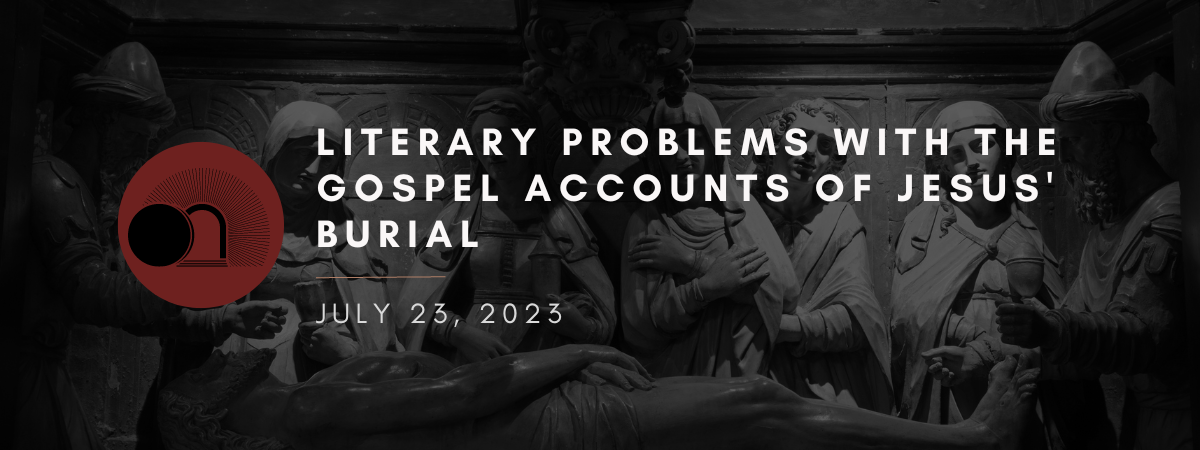
Courtroom Apologetics: You Call Them Eyewitnesses?

Here’s the link to this article.

G. P. Denken | May 31, 2023 | Kiosk Article

Believers | Bible: New Testament | Catholicism | Christian Apologetics | Fundamentalism ]


Many people blanch when a “jury duty” letter shows up in the mail. Nevertheless, some popular evangelical authors believe that recruiting jurors for an imaginary trial for Christianity is the best way to defend the faith. Courtroom apologists are recognizable by the way they season their arguments with courtroom jargon and analogies. They put Bible scholars on the stand to defend the strength of the scriptural evidence. Above all, they give great weight to four eyewitness accounts, the gospels of Matthew, Mark, Luke, and John. At trial’s end, they ask their jury of readers to reach an objective verdict based on an unbiased examination of the evidence.

But a trial analogy for Christianity is absurd unless both sides get to make their cases. Because the courtroom apologists I will highlight did not provide a genuine rebuttal case, I will present the beginnings of such a case below. Not only did these apologists misidentify the gospel authors, they ignored how these authors could not have been eyewitnesses to many famous scenes in the gospels. Hence my question: “You call them eyewitnesses?”

Three Courtroom Apologists

Three evangelical authors stand out as popularizing courtroom apologetics over the last several decades. The first is Josh McDowell, a minister with Campus Crusade for Christ (website http://www.josh.org). McDowell is perhaps best known for his 1977 bestseller More Than a Carpenter, which went into detail on his personal investigation of Christianity and his conversion while in college. However, I would argue McDowell planted the seed for courtroom apologetics with the startling title of an earlier bestseller, Evidence that Demands a Verdict, first published in 1972.

That seed sprouted with Lee Strobel (website http://www.leestrobel.com), author of the 1998 book The Case for Christ. Strobel was formerly a reporter and legal affairs editor at the Chicago Tribune, often covering crime stories. In his book, he described how his wife stunned him in 1979 by becoming a Christian. Baffled, he launched himself into a nearly 2-year investigation into the claims of Christianity, which led to his conversion in 1981. In The Case for Christ, Strobel revisited this investigation and laid out the categories of proof he examined. He used these categories to shepherd his readers into the jury room: “These are the same classifications that you’d encounter in the courtroom. And maybe taking a legal perspective is the best way to envision this process—with you in the role of a juror” (Strobel, p. 15).

The third author is J. Warner Wallace (website http://www.coldcasechristianity.com), who wrote Cold-Case Christianity in 2013. Wallace is a homicide detective who has appeared on the NBC series Dateline. In Cold-Case, he explained his ten principles of cold-case investigations and showed how each could be used to examine the Gospels. He then tested whether the Gospels pass muster as eyewitness accounts by answering four questions:

  • Were they present?
  • Were they corroborated?
  • Were they accurate?
  • Were they biased?

Wallace also likened his readers to jurors: “Jurors aren’t experts, yet they are required to make the most important decision in the courtroom…. Our justice system trusts that folks like you and me can examine the testimony of experts and come to a reasonable conclusion about the truth” (Wallace, p. 259).

The authors had similar backstories in their evangelical journeys. All converted to Christianity as young adults, although Wallace pushed the young part by waiting until he was a wizened 35-year-old. Before their conversions, all describe being an agnostic or atheist who sneered at religion, until a seminal event triggered them to investigate Christianity. Also, when they began their inquiries, none had academic backgrounds or theological expertise in the religious matters they sought to investigate. Instead, they offered the authority of a fresh set of eyes from legal disciplines (legal affairs journalism and homicide detective) that applied cold rationalism to the examination of evidence. Even McDowell raised his college kid legal expertise: “I was a prelaw student, and I knew something about evidence. I would investigate the claims of Christianity thoroughly and come back and knock the props out from under their sham religion” (McDowell, Carpenter, p. 11).

Once converted, all devoted their lives to the faith. McDowell has written or coauthored an Everest-like stack of 153 books and preached in 139 countries. Strobel has gone on to write a series of popular “Case for” books, such as The Case for Faith and The Case for a Creator. Wallace has continued to use his detective skills for more apologetics books like God’s Crime Scene and Forensic Faith. Strobel hit upon the idea of engaging youngsters with his book Case for Christ for Kids. Wallace hit upon the idea of engaging youngsters with his book Cold-Case Christianity for Kids. Do they have office cubicles at Evangelism HQ just across from each other or something?

Some Courtroom Criteria

Because these authors speak of eyewitnesses, juries, and verdicts, I expected their books to include the following basic courtroom features:

  1. both sides get an equal opportunity to present their cases and challenge the other’s case;
  2. the burden of proof falls on the prosecution;
  3. the prosecution must meet the standard of proof beyond a reasonable doubt; and
  4. procedural rules govern the trial and the admissibility of evidence.

For Bullet 4, some widely recognized rules on witnesses can be found in the Federal Rules of Evidence (website http://www.rulesofevidence.org). Under Rules 602 and 603, a fact witness must have personal knowledge of a matter and be placed under an oath or affirmation. The credibility of the witness can also be attacked (Rule 607). Experts can also give testimony (Rule 702), to offer opinions on the trial evidence based on their specialized knowledge. However, “hearsay” testimony is inadmissible (Rules 801 to 807). Generally, hearsay is when one side tries to offer as evidence the statements from someone that were not made under oath during the trial.

Sadly, these authors shortchanged their readers by failing to include all four of these features. Under Bullet 1, the authors did not give equal time to the case against Christianity, other than to attack its perceived weaknesses. None of the authors clearly addressed Bullets 2 and 3, as they never said whether the case for Christianity was the prosecution or defense case, nor did they articulate a clear standard of proof they were using. They also proposed an odd rule change under Bullet 4 to banish philosophical naturalism from the courtroom.

To get this imaginary trial moving so I can make my rebuttal, I’m going to assume the case for Christianity is the prosecution case and the proof standard is beyond a reasonable doubt (any lower standard, and the apologists would be conceding that atheists like me CAN have a reasonable doubt, an admission they would find anathema). I summarize the prosecution case below, followed by my defense case. Because I could not cover all the prosecution’s arguments from three books in one essay, my summaries focus on their shared points about eyewitnesses.

The Prosecution Case

As I visualize this trial, I see each author playing a different role. Strobel devoted each chapter of his book to a category of evidence, which he explored with “thirteen leading scholars and authorities who have impeccable academic credentials” (Strobel, p. 15). Thus, I see him as the prosecuting attorney who calls his expert witnesses to the stand. The first two chapters of The Case for Christ discuss eyewitness evidence and the interviewee is Craig Blomberg, currently professor emeritus of New Testament at Denver Seminary in Colorado.

Is see Wallace as the detective called to the stand to explain his investigation and conclusions from Cold-Case. As the earliest author, I see McDowell as a pre-law assistant for the prosecution, since many of the arguments and evidence he developed years earlier for Evidence were echoed in the latter authors’ books. If you can imagine a thick trial binder sitting on prosecutor Strobel’s desk, McDowell played a role in assembling it.

This sentence summarizes the heart of the prosecution case: “The writers of the New Testament either wrote as eyewitnesses of the events they described or recorded eyewitness firsthand accounts of the events” (McDowell, Evidence, p. 5). The prosecution accepts that the gospel authors are anonymous but underlines that the earliest church fathers from the 2nd century (such as Papias and Irenaeus) were unanimous in attributing authorship to four people: the apostles Matthew and John; John Mark, an associate of the apostle Peter, who wrote Mark; and Luke, an associate of the apostle Paul (Strobel, pp. 23-25; Wallace, pp. 77-79). While not a direct witness, Luke was like an early historian, investigating everything anew and examining what eyewitnesses had handed down (Luke 1:1-3).

The prosecution pursues what I would call a “win-win-win” strategy in examining the Gospels. In areas where the Gospels agree, then the Gospels corroborate each other, so can be accepted as eyewitness accounts (win 1). If they disagree, then the prosecution explains how eyewitnesses in real trials often recall events differently, based on their unique perspectives (Wallace, p. 74). In the case of the Gospels, their perspectives sometimes differed because of the authors’ target audiences and the differing theological aspects of Jesus they wanted to emphasize. Because we should expect such disagreements, they make the Gospels even more credible as eyewitness accounts (win 2). Goodness, how could a gospel be considered a genuine independent eyewitness account, if it was just a verbatim match to another gospel?

Then comes win 3. If a gospel records scenes that are a verbatim match to another gospel, then there is a satisfactory explanation why, leaving both eyewitness accounts credible. In The Case for Christ, Strobel asked Blomberg why Matthew would copy Mark in many places, since Matthew was a direct eyewitness while Mark was not. Blomberg responded that “It only makes sense if Mark was indeed basing his account on the recollections of the eyewitness Peter…. Peter was among the inner circle of Jesus and was privy to seeing and hearing things the other disciples didn’t” (Strobel, p. 28).

Another part of the prosecution case is assuring the jury that these eyewitness accounts remained uncorrupted as they went from oral traditions, to written documents, to Biblical canon by the 4th century. This was a particular concern for Wallace as he addressed his “Were they present?” question in Chapter 11 of Cold-Case (Wallace, pp. 159-180). Surprisingly, Wallace did not use this chapter to dissect various scenes from the Gospels and, using his cold-case skills, show his readers how the gospel authors were present in those scenes. Instead, his sole focus was defending his conclusion that the Gospels were written early, within a few decades after the death of Jesus.

As I noted earlier, the authors did not present the case against Christianity, although they implied they had. Strobel, for example, said he hit his interviewees “with the objections I had when I was a skeptic, to force them to defend their positions with solid data and cogent arguments” (Strobel, p. 15). In effect, he did the defense’s cross examination of the prosecution witnesses, perhaps as a professional courtesy to the opposing counsel. But in a real trial, defense attorneys cross-examine witnesses with leading questions that only allow a short answer, to force painful admissions from the stand. Strobel’s questioning was just the prosecutor ploy known as the prebuttal, where you ask your witnesses open-ended questions about the defense’s evidence, so they can expound at length on how weak it all is.

Strobel employed the prebuttal most clearly in Chapter 6, “The Rebuttal Evidence,” the sole chapter devoted to anything resembling the defense case (Strobel, pp. 119-138). Strobel’s interviewee was Gregory A. Boyd, currently senior pastor at Woodlawn Hills Church in Saint Paul, Minnesota. Most of Boyd’s testimony was devoted to heaping abuse on the Jesus Seminar (website http://www.westarinstitute.org), an organization that dared conclude that Jesus did not say about 82 percent of what the Gospels attributed to him (Strobel, p. 120). Boyd dismissed them as “an extremely small number of radical-fringe scholars,” not representative of mainstream scholarship (Strobel, p. 124). But did Strobel interview any members of the Jesus Seminar, to give them an equal opportunity to defend their positions with solid data and cogent arguments? No.

Finally, in what I consider a rule change that would be rejected in any real trial, the prosecution attacks philosophical naturalism and its “bias” against the supernatural (Strobel, p. 125; Wallace, pp. 25-29; McDowell, Evidence, pp. 7-9), and effectively wants to exclude it from the courtroom. They claim this bias infects those Bible scholars who seek only the historical Jesus. To reach the verdict that the Jesus of history is the Jesus of faith, they caution the jury to maintain an open mind and avoid this naturalism bias in their deliberations.

The Defense Case

My first goal as defense attorney would be to convince the jury that the prosecution has failed to prove its core claims about gospel authorship beyond a reasonable doubt. I would begin sowing that doubt via my cross-examination of the prosecution’s witnesses, to draw out admissions about the limitations of the historical evidence and how divided scholarly opinion is in many areas. I would then put my own expert witnesses on the stand.

My lead-off witness would be Bible scholar Bart D. Ehrman, author of bestsellers like Misquoting Jesus and Jesus, Interrupted. In the latter book, he described the majoritarian opinion among scholars about the Gospels: “They were not written by Jesus’ companions or by companions of his companions. They were written decades later by people who didn’t know Jesus, who lived in a different country or different countries from Jesus, and who spoke a different language from Jesus” (Ehrman, Interrupted, p. 112). So much for eyewitness accounts! For some payback, I would call some top Jesus Seminar scholars to the stand, so they can rebut the outrages in Boyd’s testimony. I would also call additional New Testament scholars to the stand, as many as necessary, to drive home to the jury that the prosecution’s task is impossible, because no scholar can know beyond a reasonable doubt who the gospel authors were.

The prosecution, I suspect, would counter by calling rebuttal expert witnesses to split hairs about what my expert witnesses said. I’d then call back my witnesses to nitpick about what the rebuttal expert witnesses said. Torturing the jury for weeks on end with competing conga lines of Bible scholars may seem cruel, but I’m confident the fatiguing debate would lead to a verdict in the defense’s favor.

But a good trial also needs a good surprise witness. Imagine the gasps as I say, “I now call to the stand … the Bishop of Rome, Vicar of Jesus Christ, Successor of the Prince of the Apostles, Supreme Pontiff of the Universal Church, Primate of Italy, Archbishop and Metropolitan of the Roman Province, Sovereign of the Vatican City State, Servant of the servants of God, His Holiness POPE FRANCIS.”

The Pope? My goal is to have a respected Catholic scholar walk the jury through my first defense exhibit, a Catholic study bible. Since this is an imaginary trial, why not the Pope?

Exhibit A – Fireside New American Bible, 2006-2007 Personal Study Edition

My copy of the Fireside New American Bible (Fireside NAB) is loaded with commentary and verse footnotes giving a Catholic perspective on the Bible. I would ask Pope Francis to read from the introductory material on each of the four Gospels. The scholarly speculation found in these introductions is clearly at odds with the prosecution’s case and much more in line with Ehrman’s position:

Matthew: The author was possibly from Antioch in Roman Syria, where there was a mixed population of Greek-speaking Gentiles and Jews. It was probably written about a decade after the Jewish revolt of 66-70 AD (Fireside NAB, pp. 1009).

Mark: The author was possibly a Hellenized Jewish Christian, writing in Syria shortly after 70 AD, who’s target audience appeared to be Gentiles unfamiliar with Jewish customs (Fireside NAB, p. 1065).

Luke: The likely author was a non-Palestinian writing to a non-Palestinian audience that was largely made up of Gentile Christians. The author was not part of the first generation of disciples. Most scholars date Luke’s composition to after the Jewish revolt of 70 AD, and many propose 80-90 AD (Fireside NAB, p. 1091).

John: Critical analysis finds difficulties with any theory of eyewitness authorship, such as John’s highly developed theology. The gospel may have had more than one author and the final editing and arrangement probably took place between 90-100 AD, with opinions differing as to where (Fireside NAB, pp. 1135-1136).

The Fireside NAB contains Nihil Obstat and Imprimatur declarations from Catholic officials, meaning it was deemed free of doctrinal or moral error. I do not think these declarations, as a matter of church doctrine, prohibit Catholics from accepting the prosecution’s proposed authors. But they do show that a Christian church with some 1.3 billion members is fine with its followers accepting that the Gospels were likely written late and by non-eyewitnesses.

This observation upends the prosecution’s notion that philosophical naturalism is behind any criticism of their case. For example, in Cold-Case, Wallace offers the Gospels’ failure to describe the destruction of the Jerusalem temple in 70 AD as his first piece of circumstantial evidence that they were written before then (pp. 161-162). Later, He attacks skeptics by saying, “The naturalistic bias of these critics prevents them from accepting any dating that precedes the destruction of the temple” (Wallace, p. 173). But the Pope could contradict Wallace directly in regards Matthew, testifying that a date after 70 AD is “is confirmed within the text by 22, 7, which refers to the destruction of Jerusalem” (Fireside NAB, p. 1009). What a dilemma! To salvage Wallace’s testimony, imagine an embarrassed prosecutor Strobel asking the Pope under cross, “Your Holiness, isn’t it true that your church accepts a composition date for Matthew after 70 AD because it is infected with philosophical naturalism?”

The second goal of my defense would be to dissect famous scenes from the Gospels to show how they fail one or more of Wallace’s four tests for eyewitness accounts. My exhibits fall in three categories:

  • scenes where neither Jesus nor his disciples could be eyewitnesses (Exhibits B through F);
  • a scene where Jesus was alone (Exhibit G); and
  • scenes where Jesus and some or all the disciples were present (Exhibits H and I).

Exhibit B – The nativity narratives (Matthew 1 and 2Luke 1:5-80Luke 2:1-40)

Are there any Christians in the world who do not know the true story of Jesus’ birth? Yes, all of them, because the true story is lost to history. Most Christians could probably describe a crèche, but only devoted Gospel readers would know that the nativity stories are only found in Matthew and Luke and that their stories differ in many details. Still fewer Christians would know that many scholars question the historical accuracy of the nativity accounts and accept that Jesus was likely born in Nazareth, not Bethlehem.

But what about the eyewitnesses? In my cross-examination of Wallace, I’d show the jury that the nativity stories fail Wallace’s “were they present?” test for eyewitnesses. To illustrate, below are just a few of the questions I would ask him regarding Matthew (I’d have similar questions for Luke). I cannot be certain how he would respond, but I provide what I think are the unavoidable admissions he would have to make:

“Detective Wallace, you concluded that the gospel of Matthew was written by the apostle Matthew, is that correct?” Yes.

“Does the apostle Matthew say anywhere in his gospel that he was a direct eyewitness to the nativity events he describes?” No.

“Does he state in his gospel that any of the other apostles were present at the nativity?” No.

“In fact, isn’t it likely that Matthew and the other apostles were either children or not even born yet at the time of Jesus’ birth?” Yes.

“Did the apostle Matthew identify, by name, any direct eyewitnesses he spoke with to create his nativity narrative?” No.

So, if the apostles were not there and Matthew and Luke did not name the direct eyewitnesses they spoke with, where did these nativity stories come from? The prosecution might claim Jesus himself or his mother Mary were the sources. Granted, Jesus was there, but he was just born. Even Jesus (the historical Jesus that is) would have learned from others his birth stories as he grew up, likely from Mary. But Mary as the eyewitness presents many problems. If Mary told Jesus’ apostles, why would Peter (via Mark) and John leave these important nativity accounts out of their gospels? Why would Mary only tell Matthew about the magi, the star of Bethlehem, and the flight to Egypt, and Luke only about the Roman census, the manger, and the shepherds? Also, both narratives have scenes where Mary was not present to be an eyewitness, such as Zechariah’s meeting with an angel in the temple sanctuary (Luke 1:11-20), King Herod’s meeting with his chief priests and the scribes (Matthew 2:4), and the slaughter of the innocents in Bethlehem after Mary and Joseph fled with Jesus to Egypt (Matthew 2:16).

The nativity stories fail Wallace’s other three eyewitness tests as well. Corroborated? Matthew and Luke only agree on a few details, such as Mary’s virginity, husband Joseph, and Jesus’ birth in Bethlehem. Otherwise, their accounts differ wildly, and Mark and John ignore the nativity altogether. Accurate? Scholars have identified many elements of the nativity stories that are clearly inaccurate, such as a lack of any Roman census that Luke reported at the time of Jesus’ birth. Biased? The anonymous Christian authors of Matthew and Luke wanted to convince people that Jesus was the prophesied Messiah of the Jews. Thus, they would have had a motivation to manufacturer legends of Jesus being born of a virgin in Bethlehem to fulfill supposed prophecies from Isaiah 7:14 and Micah 5:1-2.

With no direct eyewitnesses, the prosecution would have little choice but to open the floodgates of speculation as to what kind of hearsay evidence Matthew and Luke relied on. Maybe this is what happened: one of the shepherds abiding in the field (Luke 2:8) told his son, who years later told his wife, who told her fisherman cousin in Capernaum, who later joined the Jesus movement as one of the three thousand at Pentecost (Acts 2:41), and it was this cousin who told the story to Luke. Believers can claim this is plausible, but under the cruel constraints of the courtroom such evidence is inadmissible. This cousin is just the last link in a hearsay daisy chain, and for convenience I’ll contrive an acronym for the rest of the trial: HEArsay DAisy CHain Eyewitness (HEADACHE) evidence.

Exhibits C through F are additional scenes where neither Jesus nor his disciples were present. Since they could not be eyewitnesses, the prosecution’s only gambit would be to offer HEADACHEs to the jury, which the defense will strongly oppose!

Exhibit C – The death of John the Baptist (Matthew 14:6-11Mark 6:21-28)

Matthew and Mark describe how John’s fate was decided at a party for King Herod Antipas. Herod’s daughter-in-law dances for him, so he foolishly offers her half his kingdom. Instead, she asks for John’s head on a platter because her mother wants it. Strange family. The eyewitness problem: neither Jesus nor his disciples were invited to this party. So which drunken official sitting near King Herod started this story on its HEADACHE journey to Matthew and Mark?

Exhibit D – The treachery of Judas (Matthew 26:3-5 and 14-16Matthew 27:3-10)

All four Gospels have scenes of Judas misbehaving out of sight of Jesus and the other disciples. In the Matthew verses, Judas meets with the chief priests to betray Jesus. They pay him thirty pieces of silver. After Jesus’ arrest, Judas tries to return the money out of guilt, but the priests insult him, so he flings the money into the temple and wanders off to hang himself. The issue in all four Gospels is the same. If the only people present in these scenes were Judas and the chief priests, how did the gospel authors find out about it? HEADACHEs.

Exhibit E – Pilate authorizing tomb guards (Matthew 27:62-66)

Only Matthew places guards at Jesus’ tomb. To get them there, Matthew describes a meeting between the chief priests and the Pharisees with Pontius Pilate himself. But unless one believes that Pilate graciously admitted Matthew into the meeting to take notes, Matthew was not an eyewitness to this meeting. More HEADACHEs!

Exhibit F – The women fleeing the tomb (Mark 16:8)

The two earliest manuscripts of Mark end with Mark 16:8 (NAB): “Then they went out and fled from the tomb, seized with trembling and bewilderment. They said nothing to anyone, for they were afraid.” Scholars widely accept that verses 9 to 20, which appear in later manuscripts, were an addition written by someone other than the author of Mark (Ehrman, Misquoting Jesus, pp. 65-68). But the prosecution claims that the apostle Peter gave his eyewitness testimony to Mark, so verse 8 should be considered his final word. But this presents a testimonial impossibility. If the women were the only eyewitnesses, and they told no one, then their story ended with them. How, then, did Peter find out about it?

Exhibit G – Jesus’ temptation in the wilderness (Matthew 4:1-11Mark 1:12-13Luke 4:1-13)

My defense would next turn a different type of Gospel scene, ones where Jesus was without his disciples so none of them saw what he did. Short scenes like this are scattered throughout the Gospels, but the temptation in the wilderness is the clearest example. According to Matthew, Mark, and Luke, Satan tempted Jesus during his forty-day sojourn in the wilderness. This event happens after Jesus is baptized in the Jordan but before he gathers his disciples. Mark’s account provides few details, but Matthew and Luke give every verbal lunge and parry between Jesus and Satan, in almost identical language.

Many scholars believe Matthew and Luke were copying from a theorized manuscript of sayings called “Q,” but Q cannot be treated as an eyewitness account. The Q manuscript has never been found, the author is unknown, and the story describes Jesus and Satan as being alone anyway. The prosecution’s proposed gospel authors are even more problematic. What eyewitness could historian Luke have interviewed for his account, given that he could not have interviewed Jesus? Where did the outer-circle apostle Matthew get the additional details for his account that inner-circle apostle Peter (via Mark) failed to include in his two-verse summation? Why would the apostle John ignore the temptation story altogether in his gospel?

Because the Mark and Q sources do agree that the temptation took place, I find it likely that there were early oral traditions of Jesus preaching some version of this story during his ministry. But as Jesus himself reportedly said in John 5:31 (NAB): “If I testify on my own behalf, my testimony cannot be verified.” With no independent eyewitnesses to verify it, this scene could not be established as true beyond a reasonable doubt in a courtroom. Also, there are explanations for this preaching that would not require the jury to believe that a supernatural clash took place (here comes naturalism again!). Perhaps Jesus had a sincere conviction this confrontation happened, but it was due to delirium brought on by prolonged fasting in the desert. Or, perhaps Jesus was just the first preacher to invent a pious fiction about himself to teach about temptation, just as pastors today will sermonize about getting pestered endlessly by Satan to sin.

Exhibit H – The Sermon on the Mount (Matthew 5 to 7)

My final two exhibits are famous scenes where Jesus was with some or all of his disciples. The first is the lengthy Sermon on the Mount, where Jesus preaches the Beatitudes, the Lord’s Prayer, and other teachings. It is only found in Matthew (a much shorter “Sermon on the Plain” is found in Luke 6:20-49). As with Exhibit G, scholars suggest that Matthew got the sermon from the Q source, which again cannot be considered an eyewitness account.

The apostle Matthew as the eyewitness makes little sense. First, according to Matthew 9:9, Jesus does not even make Matthew a disciple until after the sermon takes place. Two of the prosecution’s other apostle authors, John and Peter (via Mark) could have been eyewitnesses, as they were already disciples when Jesus spoke. But in a glaring omission, neither one records this most famous of sermons in their gospels. If they were eyewitnesses, what possible reason could John and Peter have had to exclude the Lord’s Prayer from their gospels? How can the jury accept the Sermon on the Mount as an eyewitness account at all, if the two disciples who should have been there wrote nothing about it, and the one disciple who described it wasn’t among Jesus’ followers yet?

Exhibit I — The Last Supper (Matthew 26:20-30Mark 14:17-26Luke 22:14-39John 13:2 to 18:1)

My final exhibit is the Gospel accounts of Jesus’ last supper with his disciples before his arrest. No need for HEADACHE evidence here, as all twelve disciples are present, sitting mere feet from Jesus and hanging on his every word. Given this, one would expect that the testimony from the prosecution’s three eyewitnesses who were in the room would match closely, with Luke’s account in substantial agreement.

But there is a huge problem. All four Gospels quote Jesus’ words during the last supper, between the time he sat down with the disciples to when they all left for the Mount of Olives. Jesus was likely speaking Aramaic, but any Bible translation can give an approximation of the total words he said. My count: Mark – 116; Matthew – 136; Luke – 396; John – 2,887! Incredible! John’s word count is almost 25 times longer than Peter’s supposed account in Mark, and the Matthew account matches Mark’s account nearly verbatim. But all the disciples were in the same room. Were Peter and Matthew hard of hearing? Did they just dose off during Jesus’ long speech?

There are also eyewitness issues when it comes to content. Why is it that John would recall Jesus and Peter discussing the washing of Peter’s feet (John 13:6-10), while Peter apparently did not mention it to Mark? Why would John ignore the important words Jesus said to invest the Passover meal with new meaning (“this is my body,” “this is my blood”), which the other gospel authors all focus on? Who was Luke’s source for Jesus’ comments on the disciples bickering over who was greatest (Luke 22:24-30), a scene the other gospels omit?

Conclusion

I would close this imaginary trial by asking the court to throw out the prosecution’s case entirely, by filing a motion for a change to two new venues. I will illustrate by focusing on one final, famous verse from the last supper:

John 14:6 (NAB): “Jesus said to him, ‘I am the way and the truth and the life. No one comes to the Father except through me.’”

Did Jesus say this? For the secular, this is a historical question, and the proper venue for examining the historical Jesus is within the halls of academia. A courtroom is not the right venue, because the conclusions reached by Biblical historians come with varying degrees of certainty and rarely rise to proven beyond a reasonable doubt. That said, the only source for this statement is the gospel of John, written anonymously some 70 years after Jesus died. Scholarship supports that the Christian author of John promoted his theology by inventing lengthy discourses for Jesus to say, which include this verse. Simply put, decades after Jesus’ death, someone who was not an eyewitness put words in Jesus’ mouth. So no, it is highly unlikely that Jesus said this.

For many believers, this is both a historical and a faith question, and the proper venue for the latter is the church pew. Probably all Christians believe that the Bible was divinely inspired. Many accept that the Holy Spirit moved through many human authors over the course of centuries and was not constrained to using direct eyewitnesses only. As noted earlier, the Pope (fictionally) testified that the late authorship of John by a non-eyewitness can be accepted by Christians without doing violence to the faith. In this view, whoever wrote John may have put words in Jesus’ mouth, but the Holy Spirit put the right message in that author’s mind. I cannot join them in this belief, but it does mean that many believers would answer “yes,” they can accept John 14:6 as the words of Jesus as a matter of faith.

But courtroom apologists reject all this. They insist that the eyewitness evidence is so overwhelming that they want to drag everyone into the courtroom, both the secular and the faithful. Reason and historical analysis can take us all the way to the Jesus of faith, they claim, provided we put naturalism aside and embrace the Gospels as early eyewitness accounts. Wallace even says in all caps in Cold-Case, “IF THE GOSPELS ARE LATE, THEY’RE A LIE” (Wallace, p. 159). Well, they are late, and the author of John was not an eyewitness, so per Wallace’s standard John 14:6 is a lie.

References

Josh McDowell, More Than a Carpenter (Carol Stream, IL: Tyndale House Publishers, 1977). Revised and updated edition by Josh McDowell Ministry and Sean McDowell (2009 Kindle edition).

Josh McDowell, Evidence that Demands a Verdict, Volume I (San Bernardino, CA: Here’s Life Publishers, 1972). (The Kindle edition is cited here.)

Lee Strobel, The Case for Christ (Grand Rapids, MI: Zondervan, 1998).

J. Warner Wallace, Cold-Case Christianity (Colorado Springs, CO: David C. Cook, 2013). (The Kindle edition is cited here.)

Federal Rules of Evidence, 2023 Edition. <https://www.rulesofevidence.org&gt;.

Bart D. Ehrman, Misquoting Jesus (New York, NY: HarperCollins, 2005).

Bart D. Ehrman, Jesus, Interrupted (New York, NY: HarperCollins, 2009).

Fireside New American Bible, Personal Study Edition [2006-2007 Edition]. (Wichita, KS: Catholic Bible Publishers, 1970.) [This book cites multiple copyrights. The copyright holder for scriptural texts was the Confraternity of Christian Doctrine, Washington, D.C., as follows: Old Testament, 1970; Revised New Testament, 1986; and Revised Psalms, 1991.]

Why do believers cling to religion even after escaping it?

Here’s the link to this article.

Leaving religion isn’t the end of it for apostates. The seductive pull of faith remains.

Avatar photoby RICK SNEDEKER APR 28, 2023

Why do believers cling to religion even after escaping it? | young man praying
via Pixels

Overview:

Apostates often desperately cling to remnants of their rejected faiths long after leaving the fold, which slows the secular progress.

Reading Time: 5 MINUTES

Whatever we’re doing now to ensure church-state separation clearly isn’t working as the Founding Fathers intended.

The problem is that even former true believers still have religion on the brain—literally—as do continuing true believers. I’ll explain later.

The upshot is that until we change the U.S. Constitution to explicitly, categorically separate all religious intrusion and orthodoxy from tax-supported public institutions—federal, state, and local government, educational establishments, courts, etc.—the faithful will keep unconstitutionally trying to insinuate and embed themselves and their fanciful notions in public life.

Because that’s what evangelical Christians believe Jesus demands of them.

And they will succeed. As they are now succeeding. A review of recent U.S. Supreme Court decisions pointedly accommodating religious encroachment in the public sphere and dismissing secularist concerns ominously symbolizes this success. This year has been particularly florid for the Court regarding privileging of religion, mainly Christianity, the nation’s still-dominant faith.

Founders envisioned a secularly governed republic

This really isn’t what the Founders of the American experiment had in mind for their envisioned secular republic with prescribed church-state separation.

In a recent op-ed piece in The HillSteven M. Freeman, vice president of Civil Rights at ADL (the Anti-Defamation League), explained the history of church-state separation in America, quoting late Justice Sandra Day O’Connor and Founding Father (and fourth president) James Madison.

“Supporters of the basic concept of church-state separation have long understood that religion legitimately occupies a very important place in the home and in houses of worship, but not in public school classrooms or the halls of government,” Freeman writes.

So why are well-funded evangelical organizations, like Project Blitz, laboring so mightily to insert Christian dogma and symbols in “public school classrooms and the halls of government”? Like legislatively mandated and Supreme Court-authorized “In God We Trust” signs in a number of states.

Because that’s where the rubber meets the road in American democracy—where healthy change, as well as poisonous laws, are born. And regarding children, specifically, evangelists see innocent, vulnerable kids as the vanguard of the next generation of tithing believers, who must be indoctrinated in the arcane imaginings of “faith” before they know their own minds and can spot the ruse themselves.

Because Christianity over centuries has become ever-more-deeply embedded in American culture, whether everyone buys into the dogma or not, I am wary of too casually accommodating evangelical political machinations, which never stop.

And I’m extremely wary of yielding to any church or ecclesiastic representative an inch of space in the “state” domain.

Apostates who cling to religion

So when I read essays about former religious believers who call themselves atheists or agnostic or simply “not religious” but still can’t entirely break free of their birth faith (whatever it is), I am disappointed and alarmed.

Like in a recent article, “I’m a devout Muslim: Here’s what I love about religion,” by Muslim apostate Zeeshan Aleem, a senior staff writer at MIC, a news-and-views website that “helps young people process the present.”

“[H]aving been a devout atheist for all of my adult life, in recent years I have developed a far more sympathetic perspective toward those with faith,” wrote Aleem. “Liberated from the pressure to accept religion in its entirety, I’ve been able to sort through it like a toolkit, discarding the things I don’t like and embracing the ones I do. I now find debates about the existence of higher beings less interesting than before and prefer instead to study the ability of religion to organize and inspire human behavior.

“I remain as resolute an atheist as ever, but I encourage my godless brethren to consider the vast offerings of the world’s religions with care. The scope of faith in religions extends far beyond belief in God. It invests a valuable kind of hope in community, purpose, ritual and gratitude, ideas that can be embraced without embracing religion itself.”

Well, sure, religion has provided all those things over millennia but under the overweening guise of a completely fabricated reality supposedly controlled by deities. So, in my view, this enormous subterfuge—people are trained from birth to have absolute faith in nonexistent entities—largely cancels out the good stuff, which is just incidental, not foundational.

Nothing justifies believing in made-up tales or in the presumed benefits of believing in made-up tales to escape reality’s inherent difficulties. It just masks them, while the difficulties remain undiminished.

To my mind, what Aleem is doing is glorifying religion’s side-effect benefits— “community, purpose, ritual and gratitude”—as a template for secular life. And a distraction from religion’s fundamental paradox: it ain’t true.

Why reference religion in the first place?

But the question is, why even reference religion in the first place? All its positive outcomes are fully available to godless heathens even if the concept of “religion” never existed. Humanism, for example, can just as easily provide “community, purpose, ritual, and gratitude,” and it has the enormous added virtue of being verifiable.

Like many once-faithful apostates, Aleem remains filled with warm memories of the many dopamine hits his former religious life once delivered—like the joy of the closely shared communal experience.

But that doesn’t automatically make the delivery system OK.

I categorically don’t think people should, as Aleem promotes, “consider the vast offerings of the world’s religions.”

That would be like pushing recovering alcoholics, for instance, to enthusiastically patronize bars for their ritualized communal atmosphere, which is partly why some people develop drinking problems in the first place.

Getting hammered with your friends isn’t too unlike experiencing God with them. Both activities are addictive, and both provide “hope in community, purpose, ritual, and gratitude.”

Not that those things, in isolation, aren’t beneficial.

But when you credit them in any way to religion, their independent good is grossly devalued.

Unlike, as Aleem argues:

Many atheists look at religion as a device for averting one’s eyes from the harsh realities of an indifferent universe and the certainty of death. This line of thinking states that faith in God is a form of self-deception to avoid uncomfortable conclusions. The atheist’s response is to balk; the prospect of meaninglessness might be terrifying, but that doesn’t justify making up tales to escape it.

The idea of religion can’t be reduced to avoidance. It also springs from a human impulse for people to ground themselves in something bigger than themselves.

To which I respectfully say, hogwash.

Despite religious belief, human difficulties remain

Nothing justifies believing in made-up tales or in the presumed benefits of believing in made-up tales to escape reality’s inherent difficulties. It just masks them, while the difficulties remain undiminished. It’s simply self-delusion.

And while it may be a seemingly hard-wired human impulse to wish for omnipotent saviors somewhere in the cosmos, it’s a fantasy.

For sure, beings greater than ourselves may actually exist somewhere out there. But there’s zero evidence that any of them, if they exist at all, are “gods” that rule the natural universe. Or rule us.

As far as we can tell, only nature does that. But indirectly.

What’s also natural is banishing the unnatural delusions of religion from all of the public square’s necessarily secular realms.

This is made much harder when even Americans who escape religion’s tight grip still, perhaps unconsciously, cling desperately to the vestiges of their faith and resist secularization.

Fact check: The Inquisition convicted Galileo of heresy, not science fraud

Here’s the link to this article.

Christian apologists would have you believe medieval priests were, first, men of science

Avatar photoby RICK SNEDEKER

MAY 04, 2023

The Inquisition convicted Galileo of heresy, not science fraud | Jupiter and one of its moons
One Jupiter moon, Ganymede (foreground), orbits its host planet. Galileo was first to discover these moons. | Adobe Stock, Manuel Mata

Overview

Yes, religious leaders in the Middle Ages believed they honored science. But they only did so when science first agreed with scripture.

Reading Time: 6 MINUTES

Catholics even today can’t seem to give up the conceit that legendary Italian astronomer Galileo Galilei (1564-1642) wasn’t persecuted by the Church in the 17th century for heretical religion but, instead, for bad science.

As if.

No matter that the Inquisition, the Church’s fearsome heresy-prosecuting arm in the Middle Ages, convicted the pioneering, cosmos-exploring scientist of heresy—i.e., criminally unorthodox religious views—not science fraud, for proposing that the Earth orbited the Sun, rather than vice versa (the scientific consensus at the time). He was then sentenced to life under house arrest.

Were top clergy in Galileo’s day science aficionados or deniers?

After all, Catholic pundits claim today, the 17th century Catholic Church had its own in-house priest-scientist cadre and was a thoroughly rational institution based on the era’s most internationally advanced scientific knowledge and analysis.

No matter that, with zero scientific verification, the faith’s core dogma—then as now—holds that an invisible, unlocatable deity universally orchestrates all existence and also personally attends to every infinitesimal aspect of each individual human being’s life on earth—and in the hereafter.

True believers in the permanently unknowable realm (i.e., divine religion) have a serious conflict of interest when also ostensibly professing authentic fealty to the known and unknown-but-knowable realms.

Yet a 2020 article in America: The Jesuit Review ezine—“What the story of Galileo gets wrong about the church and science”—its apologist authors wave any paradoxes aside by insisting that top-ranking Catholic clergy in the time of Galileo embraced cutting-edge scientific knowledge:

When churchmen … were against Galileo, they were not denying science. They had science on their side.

But the authors then added, “Nevertheless, as we know now, they were wrong.”

With science and religion, the twain never meet

No matter how endlessly Catholic thinkers and Galileo naysayers continue to claim faith and science are two sides of the same coin, they must necessarily fail. Indeed, faith can never be rationally conjoined with or contained within science, which requires an unbreakable connection with material reality.

Gods, angels and demons, for example, are not part of material reality as far as anyone can reasonably affirm. But planetary orbits certainly are. As are heresy convictions.

Still, just this week, I tripped over several articles—particularly this one in America: The Jesuit Review—zealously trashing as “myth” the idea that the Catholic Church targeted Galileo because it was presumably “anti-science.” The apologists claim that the Church was and is, in fact, uber-scientific in outlook, and Galileo was not persecuted for his unorthodox religious views but for scientific ideas widely viewed as rubbish in his day.

Why prosecute Galileo for heresy, not fraud?

If so, why did the Inquisition try Galileo for a religious crime and not, say, have a civil court prosecute him under scientific fraud statutes?

Sure, it was a far different time then, but still. The original charge of heresy against Galileo is a big tell of the Inquisition’s core intent. No, this was no civil trial, no principled defense of science purity. It was a power move by the Church to protect liturgical orthodoxy under the guise of protecting scientific truth.

And Catholic orthodoxy in Galileo’s time was, as Ptolemy and then Aristotle had long before (erroneously) surmised and the Bible then seconded: that the Earth is the center of the universe, and all heavenly bodies—the Sun and stars and other planets, etc.—revolve around it.

The Bible—particularly Ecclesiastes 1:5 (KJV)—embedded this speculative idea as divine law in medieval Western culture:

The sun also ariseth, and the sun goeth down, and hasteth to his place where he arose.

Even lionized American author Ernest Hemingway referenced this piece of scripture in the title of his novel The Sun Also Rises.

The Bible assumes the Sun rises. It doesn’t.

Except the “ariseth” Sun wasn’t true (the Sun, not Earth, is the celestial body around which other orbs “hasteth” in our solar system), and as medieval proto-scientists started snooping around the universe available to their eyes and primitive instruments, they began to see the lie in the Bible’s astronomical assumptions.

NASA’s Earth Observatory website observes:

For nearly 1,000 years, Aristotle’s view of a stationary Earth at the center of a revolving universe dominated natural philosophy, the name that scholars of the time used for studies of the physical world. A geocentric worldview became engrained in Christian theology, making it a doctrine of religion as much as natural philosophy. Despite that, it was a priest who brought back the idea that the Earth moves around the Sun.

The Polish Catholic priest “who brought back the idea,” Nicholas Copernicus (1473-1543), was also an astronomer. In 1515 he heretically realized that the Earth floated in a heliocentric (Sun-centered) solar system, where everything orbited the Sun.

Faith can never be rationally conjoined with or contained within science, which requires an unbreakable connection with material reality.

Copernicus, reportedly fearful of Church disapproval of his theory (although some scholars believe he was more worried about his findings being falsified), did not publish his heliocentric conclusions until shortly before he passed away in 1543.

Copernicus’ revolutionary theory unheralded for many years

From a modern vantage, it seems unfathomable, but Copernicus’ revolutionary idea did not catch fire for many years after his death, because disciples in his own and other countries also feared the Church’s wrath if they publicly supported heliocentrism.

One such scientist, Italian Giordano Bruno, was burned at the stake and his tongue pulled out with a red-hot poker in 1600 for teaching his students heliocentrism, among other ideas deemed heretical by the Church.

German astronomer Johannes Kepler (1571-1630) synthesized and expanded on Copernicus’ ideas, formulating three formal laws of planetary motion, including the actuality of heliocentrism and the discovery that planets followed elliptical rather than circular orbits.

But, unhelpfully, Kepler had a mystical bias toward his discoveries, according to Encyclopaedia Britannica:

Kepler himself did not call these discoveries “laws,” as would become customary after Isaac Newton derived them from a new and quite different set of general physical principles. He regarded them as celestial harmonies that reflected God’s design for the universe.

Galileo devised a much more powerful telescope than previously existed, with which he was able to see what no one had seen before. NASA writes:

When Galileo pointed his telescope into the night sky in 1610, he saw for the first time in human history that moons orbited Jupiter. If Aristotle were right about all things orbiting Earth, then these moons could not exist. Galileo also observed the phases of Venus, which proved that the planet orbits the Sun.

Galileo friend became an enemy once elected pope

But even Galileo’s old friend Mafeo Barberini, who when he was ostensibly a science-supporting cardinal backed Galileo after his heliocentric theory was attacked by another cardinal, ultimately—after Barberini became Pope Urban III—was unconvinced by the theory and considered it biblically heretical.

Worse, Pope Urban believed Galileo had betrayed their friendship by publishing a book slyly espousing heliocentrism in a fictional conversation between three men. In Dialogue Concerning the Two Chief World Systems, one of the men, conservative Simplicio—“a composite of all of Galileo’s opponents”—promoted the geocentric system, which science was edging toward completely debunking and Galileo had spent the previous 400 pages of Dialague systematically trashing.

Opponents of Galileo convinced Pope Urban that by having Simplico endorse the threatened geocentric—earth-centered—view of the solar system, Galileo’s “intent must have been to make fun of it and, worse, of Urban himself,” noted a 1998 Washington Post article by Hal Hellman, author of Great Feuds in Science: Ten of the Liveliest Disputes Ever (1998).

READ: Religious bigotry muzzled Copernicus, Galileo, Jefferson and Darwin

Why this would matter to Christendom is plain: The centrality of mankind and Earth, which everything in the cosmos revolves around, according to scripture, are a critical precept of Christianity. This dovetails nicely with ancient Earth-centered cosmology. In addition, Hellman wrote:

The Christian idea of heaven and hell also melded beautifully with the geocentric system, which saw the heavenly bodies as perfect and immutable.

Church feared heliocentrism would ‘shred’ Christian doctrine

Hellman also suggests that Church authorities well knew even for years before Galileo published his damnable treatise that if heliocentrism were irrefutably demonstrated, “it would shred a significant portion of church doctrine.”

on the other hand
ON THE OTHER HAND | Curated contrary opinions

America/The Jesuit Review: What the story of Galileo gets wrong about the church and science

In 1616, well before Galileo published Dialogue, Cardinal Robert Bellarmine commented on a heliocentric treatise in support of Copernicus’ findings. In a letter to its author, Rev. Paolo Antonio Foscarini, he wrote:

I say that, if there were a true demonstration that the Sun was in the center of the universe… then it would be necessary to use careful consideration in explaining the Scriptures that seemed contrary… But I do not think there has been any such demonstration.

In a series of meetings between Pope Urban III and Galileo, the pontiff believed that the scientist had agreed to only write about heliocentrism as a hypothetical, not manifest fact. Urban’s view was that Dialogue sneakily did the opposite.

Inquisition ‘suspected’ Galileo of heresy

In the end, Galileo was convicted by the Roman Inquisition of having “rendered yourself suspected by this Holy Office of heresy.” After being forced to disavow heliocentrism and the integrity of his life’s work in science, and not write or talk publicly about it, he was sentenced to life under home confinement. Also, Dialogue was added to the Church’s endless list of banned books.

It wasn’t until 300 years later, in 1992, that the Church formally accepted heliocentrism, absolved Galileo, and de-banned the scientist’s earth-shaking treatise.

Even learned scientists in Galileo’s day refused to accept the idea that the Earth, rather than the Sun, moved. They offered the argument that if it were true, if you threw a ball in the air, it would land behind, in front or beside of you, depending which way the Earth was moving.

Which, of course, it wouldn’t.

But, it’s like the famous 1935 Porgy and Bess lyric by Ira Gershwin in his brother’s song, “It Ain’t Necessarily So”:

It ain’t necessarily so

It ain’t necessarily so

The things that you’re liable to read in the Bible

It ain’t necessarily so

However, as the history of religion proves, if you have enough ecclesiastic power, you can just arbitrarily command that it’s so.

A Texas district called for 22 days of prayer to launch the new school year

Here’s the link to this article.

An atheist group called on the Burnet CISD to “cease promoting prayer and remove this post”

HEMANT MEHTA

JUL 28, 2023


This newsletter is free, but it’s only able to sustain itself due to the support I receive from a small percentage of regular readers. Would you please consider becoming one of those supporters? You can use the button below to subscribe to Substack or use my usual Patreon page!

Upgrade to paid


Earlier this week, the Burnet Consolidated Independent School District in Texas posted an official call for prayer leading up to the new school year.

Their image was even titled “Pray to the First Day,” with each of the next 22 days dedicated to a different school or group of adults, with the students themselves saved until the very end.

Needless to say, a public school district has no business telling people to pray, even if it doesn’t go into detail regarding which religion or what to say.

On Thursday, the Freedom From Religion Foundation sent a letter to the district urging officials to “cease promoting prayer and remove this post from its official social media.” Anne Nicol Gaylor Legal Fellow Samantha Lawrence wrote:

The District serves a diverse community that consists of not only religious students, families, and employees, but also atheists, agnostics, and those who are simply religiously unaffiliated. By promoting prayer, the District sends an official message that excludes all nonreligious District students and community members. Thirty-seven percent of the American population is non-Christian, including the almost 30 percent who are nonreligious. At least a third of Generation Z (those born after 1996) have no religion, with a recent survey revealing almost half of Gen Z qualify as “nones” (religiously unaffiliated).

This wasn’t a lawsuit. It wasn’t a threat. It was a reminder that calls for prayer shut out every member of the community who isn’t religious. And let’s be honest: The implication is that these are Christian prayers, so non-Christians are excluded too.

If a church in the area wants to waste its time praying for a better school year, that’s their business. But it sure as hell shouldn’t be something district officials call for.

The good news is that the Burnet CISD has already relented. In an email to FFRF sent less than 90 minutes after the initial letter went out, Superintendent Keith McBurnett wrote, “The Facebook post referenced has been removed, and the District will refrain from posting anything similar in the future.”

Problem solved… unless people notice and complain, in which case it’ll be interesting to see how district officials respond.

In any case, if the people in the community actually want to make a difference, then they should demand the Republican-dominated state legislature give educators raises to keep them in the profession and reverse a statewide teacher shortage, stop banning books that challenge students’ minds, end the assault on LGBTQ students, and do more to prevent gun violence instead of putting more armed guards in schools.

They won’t. Instead, they’re just praying (for nothing in particular in most cases) while voting to make schools worse. 78% of the county voted to re-elect Republican Greg Abbott as governor in 2022. Other Republicans on the ballot won by similar margins.

The end result is that students will continue to struggle because most of the adults in their lives have no clue how to fix the problems they’ve created.

Is atheism unnatural?

Here’s the link to this article.

Avatar photoby PHIL ZUCKERMAN

FEB 03, 2023

Shutterstock

Reading Time: 8 MINUTES

Ten years ago, Psychology Professor Justin L. Barrett published a book called Born Believers, arguing that all humans are naturally wired to be religious—that we are literally born with an intrinsic propensity to believe in God. Religious faith for Barrett is therefore not only normal but deeply natural. And, thus, to be a nonbeliever is—you guessed it—abnormal and unnatural. According to Barrett, atheists and agnostics live in conflict with an innate predisposition that is an integral part of our humanity.

Barrett isn’t the only scholar to push this odd view. Leading sociologist of religion Christian Smith describes religion as “irrepressibly natural to being human.” Religious faith is so genuinely, naturally human, he says, that to live secularly is analogous to “crab-walk[ing] backwards.” Sure, it can be done, but it is awkward, untenable, if not downright idiotic. Smith even compares atheists and agnostics to individuals who choose to “repeatedly hit themselves in the head with sharp objects.” That is, we can choose to not believe in God if we really want to, but it is obviously inimical to natural, normal well-being.

Then there’s sociologist Peter Berger, who argued that the “religious impulse” is such a “perennial feature of humanity” that a lack of religiosity would entail a “mutation of the species.” Sociologist Paul Froese claims that “a religious sentiment is deeply ingrained in human nature” and that “a basic demand for a religious worldview is universal.” And economist Laurence Iannaccone recently insisted that religious faith is so naturally fundamental to being human that without it, people would “cease being recognizably human.”

And so forth.

The bottom line from this perspective is that religiosity is normal, irrepressible, and innate, while secularity is artificial, unnatural—almost unhuman.

Except it isn’t.

Religion is no more “natural” to humans than being nonreligious.

As I argue in my new book, Beyond Doubt: The Secularization of Society (co-authored with Isabella Kasselstrand and Ryan Cragun) evidence shows that: (1) there have always been nonreligious people throughout recorded history, (2) a large number of people today are not religious, (3) a growing number of societies are increasingly secular, and (4) when children are raised without religion, they tend to stay secular as adults. These facts debunk the claim that atheism and agnosticism are abnormal or unnatural.

Secularity in the past

First, there have always been secular people—at least as long as there have been religious people.

The earliest known documentation of irreligiosity comes from the Indian writings of the Carvaka —also referred to as the Lokayata—who lived in India during the 7th century BCE. The Carvaka expressed a naturalistic worldview and rejected the supernaturalism of primordial Hindu religion. They were atheistic materialists who saw no evidence for the existence of gods or karma or an afterlife. “Only the perceived exists,” they argued, and “there is no world other than this.” In ancient China, Xunzi, who lived in the 3rd century BCE, taught that only this natural world exists and that morality is a social construct, with no divine component. Also in ancient China, both Wang Ch’ung and Hsun Tzu were nonbelievers who argued that there is nothing supernatural or spiritual out there. Only natural phenomena.

Early forms of atheism, agnosticism, anti-religiosity, and naturalistic orientations were abundant among the sages of ancient Greece and Rome, including Protagoras, Xenophanes, Carneades, Lucretius, Epicurus, Democritus, Anaxagoras, Prodicus, Critias, Anaximander, Hippo of Samos, Clitomachus, Celsus – and so many others. In ancient Israel, Psalms 14, written sometime around the 3rd or 2nd century BCE, explicitly attests to the existence of atheists, and the ancient Jewish philosopher known as Kohelet, from the 3rd century BCE, voiced existential, skeptical doubt, claiming that all life is ultimately meaningless and that there is no life after death.

In early Islamic civilization, Muhammad Al-Warraq, of the 9th century, doubted the existence of Allah and was skeptical of religious prophets; Muhammad al-Razi, of the 10th century, was a freethinking man who criticized religion; Omar Khayyam, of the 11th century, expressed a decidedly naturalistic worldview; and Averroes, of the 12th century, was known for his secular skepticism.

In short, plenty of historical evidence exists of agnosticism, skepticism, atheism, naturalism, secularism, humanism, and irreligion throughout history, going back thousands of years. Such evidence illustrates that secularity has always been around, and as such, is just as much a normal, natural part of the human condition as religiosity.

High rates of secularity today

Granted, being openly secular was relatively rare in the ancient world. But it certainly isn’t anymore. Today, a massive proportion of humanity is openly secular. The existence of so many secular people in the world renders manifestly absurd the argument that secularity is unnatural.

If we totaled up all unaffiliated, non-practicing, and nonbelieving people in the world, the number of secular humans – according to Pew international data – would be around one billion. For some random global highlights: in China, over 500 million people are explicitly nonreligious, along with about 3.5 million Taiwanese individuals and at least 60 million people in Japan. In the Czech Republic, there are 6 million people alive today who are secular, 10 million in the Netherlands, 30 million in France, around 1.5 million in Argentina, and around 1 million in Uruguay. Given such demographic realities, it is irrational to characterize secularity as somehow unnatural.

To be sure, most humans the world over are religious, and only a minority are secular. No question about that. But just because a minority of humans are left-handed, or have perfect pitch, or are over six feet tall, or monolingual, or illiterate, or homosexual, or vegetarian, or colorblind, or have 20/20 vision, or are secular, does not make any of these traits, characteristics, or orientations unnatural.

And it is crucial to recognize that even though most people in the world are religious, there are now a handful of societies in which it is the other way around: secular people constitute the majority and religious people comprise the minority. The Czech Republic, the Netherlands, Japan, China, Estonia, Vietnam, Hong Kong, Macau, South Korea, Uruguay, France, Hungary, and Australia – all have religiously unaffiliated majorities. Scotland bears emphasis: with a population of 5.5 million, at least 58% the population currently has no religion. How can such widespread secularity be described as unnatural, at least with a straight face? Or consider Estonia, a Baltic country of 1.3 million, where widespread indifference towards religious beliefs and practices reigns: only 46% of adults believe in God; only 17% claim that religion is important in their life; nearly 90% never talk about religion with their friends or family; nearly 80% never think about religion; 75% never pray; only 4% engage in daily prayer. Is it accurate to describe the majority of this country as somehow unnatural? No. Their widespread secularity is simply a natural part of human cultural variation.

But haven’t these highly secular nations only had a nonreligious majority in recent years? Isn’t their explosive secularity a new historical phenomenon? Yes and yes. Yet even this indicates that religion is not irrepressibly natural and secularity artificially unnatural. For if religion can be widely abandoned and secularity widely emergent in such a short time period, then this speaks to the former not being so intrinsic to humanity after all, and secularity not being some unnatural beast.                                     

Socialization

But how is religion widely abandoned in society? One clear mechanism: parents stop socializing their children to be religious.

Socialization is the process whereby we passively, informally, and often unconsciously internalize the norms and values of our culture. Our experience of socialization is most profound and powerful when we are young, as we are growing up. And the people who most potently socialize us are those who raise us, keeping us fed and safe – usually our parents and other immediate family members. But any humans we come into contact with – either in-person or virtually – can socialize us, to varying degrees: neighbors, friends, teachers, coaches, nurses, or those we see in TV shows, movies, on TikTok and on Instagram.

Socialization is fundamental to religion’s maintenance and reproduction. Contrary to Justin Barrett’s claims, babies do not start out religious; they have to be taught religion. The process, in short, goes like this: small children are raised by religious people, who teach them the norms, beliefs, and rituals of their religion. Those children internalize that religious socialization and go on to be religious themselves as they grow up. They accept as true the religious beliefs that have been presented to them as such by their loved ones; they come to practice and value the religious rituals they have been socialized to perform; they come to personally identify with the religious group in which they were raised. And when these kids grow up and have kids of their own, the cycle is repeated.

In 2016, the Pew Research Center found that parents’ religiosity within the United States is a very strong predictor of people’s religiosity. Of Americans who identify as Protestant Christians, 80 percent of them were raised by two Protestant Christian parents; however, if one parent was a Protestant Christian and the other identified with no religion (“none”), then only 56 percent identify as Protestant Christian, with 34 percent being religiously unaffiliated. Among those who were raised by a Protestant parent and a Catholic parent, 38 percent now identify as Protestant, 29 percent as Catholic, and 26 percent as non-religious. We see similar correlations within Catholicism: of people who were raised by two Catholic parents, 62 percent are Catholic today, but of those who had one parent who was Catholic and one parent who was not, only 32 percent are Catholic today. As for people raised by two non-religious parents, 63 percent are non-religious themselves.

There are more permutations within this Pew study, but the primary finding is obvious: our parents strongly shape our religiosity, or lack thereof. Numerous studies spanning over a century bear these assertions out: people generally adhere to the religion in which they were raised; such is the unparalleled power of religious socialization.

But what is most relevant for our discussion, is that when children are raised secularly, without religion, they generally don’t become religious as adults. For example, Hart Nelsen found – looking at American families back in the 1980s – that if both parents were secular, then about 85 percent of children raised in such homes grew up to be secular themselves. These findings were confirmed in a British context by Steve Bruce and Tony Glendinning, who also found that children raised without religion rarely grow up to become religious themselves; only about 5 percent of people raised in secular homes by nonreligious parents ended up being religious themselves later in life.

Clearly, we have an innate, natural propensity to believe what our parents teach us, to accept the reality presented to us by those who care for us, to internalize the worldview of our immediate culture, and to enjoy, value, and despise what we have been socialized to enjoy, value, and despise. If religion is part of our socialization, we will most likely be religious. If it is not, then we will most likely be secular. And thus, if religiosity can evaporate in just one generation – as a result of secular socialization – it is quite erroneous to speak of it as irrepressibly innate. Barrett is mistaken to characterize humans as “born believers,” given the evidence showing that children’s religiosity is something that they get socialized into, and when that socialization is secular, children tend to remain secular.

Golden delicious

Secularity is just as normal, natural, and innate to humanity as is religiosity. While it is true that religious beliefs are popular, deep, and widespread, they are no more inborn to us than their absence. Religious faith is no more rooted in our nature than skepticism and rationalism. Maintaining a supernatural worldview is no more inherently human than maintaining a naturalistic worldview. In the strong words of historian Tim Whitmarsh:

“The notion that a human is an essential religious being…is no more cogent than the notion that apples are essentially red. When most of us think of an apple we imagine a rosy glow, because that is the stereotype that we have grown up with…and indeed it is true enough that many apples are tinctured with red. But it would be ludicrous to see a Golden Delicious as any less ‘appley’ just because it is pure green. Yet this is in effect what we do to atheists…we treat them as human beings who are not somehow complete in their humanity, even though they are genetically indistinct from their peers.”

Amen.

Er, I mean: Hear! Hear!

Literary Problems with the Gospel Accounts of Jesus’ Burial

Here’s the link to this article by Bart Ehrman.

July 23, 2023

Here is a section from my book How Jesus Became God  (HarperOne, 2014) that deals with the question of whether Jesus was actually given a decent burial by Joseph of Arimathea.  At this point of my discussion I am not looking into the question of whether it is plausible that Jesus would be buried on the day of his execution given what we know from other historical sources, about Roman practices, but at general problems with the reporting in the Gospels.

******************************

According to our earliest account, the Gospel of Mark, Jesus was buried by a previously unnamed and unknown figure, Joseph of Arimathea, “a respected member of the council” (Mark 15:43) – that is, a Jewish aristocrat who belonged to the Sanhedrin, which was the ruling body made up of “chief priests, elders, and scribes” (Mark 14:53).  According to Mark 15:43, Joseph summoned up his courage and asked Pilate for Jesus’ body.  When Pilate learned that Jesus was already dead, he granted Joseph his wish, and he took the body from cross, wrapped it in a linen shroud, “laid him in a tomb which had been hewn out of the rock,” and then rolled a stone in front of it (15:44-47).  Mary Magdalene and another woman named Mary saw where this happened (15:48).

Let me stress that all of this – or something very much like it – needs to happen within Mark’s narrative in order to make sense of what happens next, namely that on the day after the Sabbath Mary Magdalene and two other women come to the tomb and find it empty.  If there were no tomb for Jesus, or if no one knew where the tomb was, the bodily resurrection could not viably be proclaimed.   You have to have a known tomb.

But was there one?  Did Joseph of Arimathea really bury Jesus?

General Considerations

There are numerous reasons for doubting the tradition of Jesus’ burial by Joseph.  For one thing, it is hard to make historical sense of this tradition just within the context of Mark’s own narrative.  Joseph’s identification as a respected member of the Sanhedrin should immediately raise questions.   Mark himself indicated that at Jesus’ trial, which took place the previous evening, the “whole council” of the Sanhedrin (not just some or most of them – all of them) tried to find evidence “against Jesus to put him to death” (14:55).  At the end of this trial, because of Jesus’ statement that he was the Son of God (14:62), “they all condemned him as deserving death.”   In other words, according to Mark himself, this unknown person, Joseph, was one of the people who had called for Jesus’ death just the night before he was crucified.  Why now is he suddenly risking himself (as implied by the fact that he had to gather up his courage) and seeking to do an act of mercy by arranging for a decent burial for Jesus’ corpse?   Mark gives us no clue.[1]  My hunch is that the trial narrative is from a different set of traditions inherited by Mark from the burial narrative.  Or did Mark simply invent one of the two traditions himself and overlook the apparent discrepancy?

In any event, a burial by Joseph is clearly a historical problem in light of other passages just within the New Testament.   I pointed out earlier  [in my book, How Jesus Became God] that Paul shows no evidence of knowing anything about a Joseph of Arimathea or a decent burial of Jesus by a “respected member of the council.”  This datum was not included in the very early creed that Paul quotes in 1 Cor. 15:3-5, and if the author of that creed had known such a thing, he surely would have included it, since without naming the person who buried Jesus he has created an imbalance with the second portion of the creed where he does name the person to whom Jesus appeared (Cephas).  Thus this early creed knows nothing about Joseph.  And Paul himself betrays no knowledge of him.

Moreover, there is another tradition of Jesus’ burial that says nothing about Joseph of Arimathea.   As I pointed out earlier, the book of Acts was written by the same author as the Gospel of Luke.  When writing Luke, this unknown author (we obviously call him Luke, but we don’t know who he really was) utilized a number of earlier written and oral sources for his stories, as he himself indicates (Luke 1:1-4).  Scholars today are convinced that one of his sources was the Gospel of Mark, and so Luke includes the story of Joseph of Arimathea in his version of Jesus’ death and resurrection.

When Luke wrote his second volume, the book of Acts, he had yet other sources available to him.   Acts is not about the life, death, and resurrection of Jesus, but about the spread of the Christian church throughout the Roman empire afterward.   About one-fourth of the book of Acts consists of speeches made by its main characters, mainly Peter and Paul; speeches, for example, to convert people to believe in Jesus or to instruct those who already believe.  Scholars have long recognized that Luke himself wrote these speeches – they are not the speeches that these apostles really delivered at one time or another.   Luke is writing decades after the events he narrates, and there was no one at the time who was taking notes.  Ancient historians as a whole made up the speeches of their main characters, as such a stalwart historian as the Greek Thucydides explicitly tells us (Peloponnesian War 1.22.1-2).  They had little choice.

When Luke composed his speeches, however, it appears that he did so, in part, on the basis of earlier sources that had come down to him —  just as his accounts of Jesus’ teachings in the Gospel came from earlier sources (such as Mark).  But if different traditions (speeches, for example) come from different sources, there is no guarantee that they will stand in complete harmony with one another.  If they do not stand in harmony, it is almost always because someone is changing the stories or making something  up .

That makes Paul’s speech in Acts 13 very interesting.   Paul is speaking in a synagogue service in Antioch of Pisidia, and he uses the occasion to tell them that the Jewish leaders in Jerusalem had sinned severely against God by having Jesus killed:

Though they could charge him with nothing deserving death, yet they asked Pilate to have him killed.  And when they had fulfilled all that was written of him, they took him down from the tree and laid him in a tomb.  (Acts 13:28-29)

At first glance this appears to harmonize with what the Gospels say about Jesus’ death and burial, but not on closer examination.  For here it is not a single member of the Sanhedrin who buries Jesus, but the council as a whole.  This is a different tradition.  There is no word of Joseph here, any more than there is in Paul’s own letters.  Does this older (pre-Lukan) tradition represent an older tradition than what is found in Mark about Joseph of Arimathea?  Is the oldest surviving  burial tradition that Jesus was buried by a group of Jews?

It would make sense that this was the older tradition of the two.   Any tradition that is going to lead up to an empty tomb simply has to show that Jesus was properly buried, in a tomb.  But who could do the burial?  According to all the traditions, Jesus did not have any family in Jerusalem, and so there was no possibility of a family tomb in which to lay him or family members to do the requisite work of burial. Moreover, the accounts consistently report that his followers had all fled the scene, so they could not do the job.  The Romans were not about to do it, for reasons that will become clear in later in this chapter.   That leaves only one choice.  If the followers of Jesus knew that he “had” to be buried in a tomb – since otherwise there could be no story about the tomb being empty — and they had to invent a story that described this burial, then the only ones who could possibly do the deed were the Jewish authorities themselves.  And so that is the oldest tradition we have, as embodied in Acts 13:29.  Possibly this is the tradition that lies behind 1 Cor. 15:4 as well: “and he was buried.”

As the tradition came to be told and retold, it possibly became embellished and made more concrete.  Storytellers were apt to add details to stories that previously were vague.  There was a very long-lived tradition to put names on people otherwise left nameless in the tradition, and to add named individuals to stories that originally spoke only of nameless individuals or undifferentiated groups of people.   This is a tradition that lived on long after the New Testament period, as my own teacher Bruce Metzger showed so elegantly in a brilliant article that he called “Names for the Nameless.”[2]  Here he showed all the traditions of people who were unnamed in New Testament stories receiving names later – for example, we get names of the wise men in later traditions, and names of the priests serving on the Sanhedrin when they condemned Jesus, and names of the two robbers who were crucified with him.  In the story of Joseph of Arimathea we may have an early instance of the phenomenon: what was originally a vague statement that the unnamed Jewish leaders buried him becomes a story of one leader in particular, who is named, doing so.

In addition, we have clear evidence in the Gospel traditions that as time went on, and stories were embellished, there was a tendency to find “good guys” among the “bad guys” of the stories.   For example, in Mark’s Gospel both the criminals being crucified with Jesus malign and mock him on the cross; in Luke’s later Gospel only one of the two does so, and the other confesses faith in Jesus and asks him to remember him when he comes into his kingdom (Luke 22:39-43).  In John’s Gospel there is an additional good guy among the Sanhedrin bad guys who wants to help in Jesus’ burial, as Nicodemus accompanies Joseph to do his duties to Jesus’ corpse (John 19:38-42).  Most notable is Pontius Pilate, who condemned Jesus to death in our earliest Gospel Mark, but does so only with great reluctance in Matthew, and only after explicitly declaring Jesus innocent three times in both Luke and John; in later Gospels from outside the New Testament Pilate is portrayed as increasingly innocent, to the point that he actually converts and becomes a believer in Jesus.

In part this ongoing and increasing exoneration of Pilate is enacted in order to show where the real guilt for Jesus’ undeserved death lies.  For these authors living long after the fact, the guilt lies with the recalcitrant Jews.  But the pattern is also part of process of trying to find someone good in the barrel of rotten opponents of Jesus.   Naming Joseph of Arimathea as a kind of secret admirer or respecter or even follower of Jesus may be part of the same process.

In addition to the rather general considerations I have just given for calling into question the idea that Jesus received a decent burial by Joseph of Arimathea, there are three more specific reasons for doubting the tradition that Jesus received a decent burial at all, in a tomb that could later be recognized as emptied.

[1] For someone who wants to take the account as historical, the best solution is that Joseph was acting out of a sense of piety, wanting to provide a decent burial for someone – even an enemy – because that was the “right” thing to do.  But there is nothing in Mark’s account that leads to this suggestion, so that within the narrative itself, when the burial tradition comes on the heels of the trial tradition, it appears to create an anomaly.

[2]Metzger, Bruce, “Names for the Nameless in the New Testament: A Study in the Growth of Christian Tradition,” in Patrick Granfield & Josef A. Jungmann (eds.), Kyriakon: Festschrift Johannes Quasten, 2 vols. (Münster: Verlag Aschendorff, 1970) vol. 1: 79-99.