I’ve Written Three Books On How To Honestly Seek the Truth

Here’s the link to this article.

By John W. Loftus at 11/02/2023

[First Published August 2022] I’ve written three books to educate believers on how to honestly seek the truth and defend it: 1) The Outsider Test for Faith: How to Know Which Religion is True. In it I show honest believers how to approach their faith consistently without any double standards or special pleading.

2) How to Defend the Christian Faith: Advice from an Atheist. In it I show Christian apologists how to correctly defend their faith, if it can be defended at all. Apologists should read it before writing another sentence in defense of their faith. In it I challenge apologists to stop doing what they’re doing if they’re honest about defending their Christian faith. The risk is that if they stop it they cannot defend their faith at all. But the risk is worth it if they’re serious about knowing and defending the truth.

3) Unapologetic: Why Philosophy of Religion Must End. In it I show philosophers of religion and other intellectuals how to properly discuss and debate religious beliefs. What I cannot teach however, is to desire the truth. That comes from within. Taken together these three books are the antidote to the faith virus. The problem is almost none of them desire the truth, comparatively speaking. Here’s hoping a few honest believers are reading who desire the truth.

————–

John W. Loftus is a philosopher and counter-apologist credited with 12 critically acclaimed books, including The Case against MiraclesGod and Horrendous Suffering, and Varieties of Jesus Mythicism. Please support DC by sharing our posts, or by subscribing, donating, or buying our books at Amazon. Thank you so much!

Which Atheist Books Do I Recommend?

Here’s the link to this article.

By John W. Loftus at 10/31/2023

Having previously linked to some reasons why philosophical apologetics is not changing very many minds, especially the most sophisticated philosophy that every serious philosophical apologist loves to recommend, because it says that they understand it! Congrats to you!! A lot of it is obtuse and obfuscationist though. As it’s practiced today, it isn’t that helpful if one wants to change minds. After all, the more sophisticated that philosophy is, the more sophisticated the reader is. At that level it doesn’t change the minds of sophisticated readers because they are already entrenched in what they think. It also has a way of being turned around as a pat on the back! Just see how William Lane Craig responds to a very detailed and knowledgeable question about philosophical apologetics at his website, Reasonable Faith. Craig wrote:

I include your question here for the instruction and encouragement of our Reasonable Faith readers. You have masterfully surveyed for us the current philosophical landscape with respect to atheism. You give our readers a good idea of who the principal players are today.

I hope that theists, especially Christian theists, who read your account will come away encouraged by the way Christian philosophers are being taken seriously by their secular colleagues today.

The average man in the street may get the impression from social media that Christians are intellectual losers who are not taken seriously by secular thinkers. Your letter explodes that stereotype. It shows that Christians are ready and able to compete with their secular colleagues on the academic playing field.

To see this you need to read my book Unapologetic: Why Philosophy of Religion Must End. This is the first book I’m recommending, with others to follow below. If nothing else, consider the recommendation of atheist philosopher Nick Trakakis, co-editor with Graham Oppy of several important philosophy of religion books, and the author of his own book on The End of Philosophy of Religion, plus The God Beyond Belief: In Defense of William Rowe’s Evidential Argument from Evil. He even wrote a chapter in my book, God and Horrendous Suffering. He said this of my book Unapologetic:

I am in wholehearted agreement with you. I actually find it very sad to see a discipline (the philosophy of religion) I have cherished for many years being debased and distorted by so-called Christian philosophers. Like you, I have now finally and happily found my place in the atheist community. I’m slowly making my way through your “Unapologetic book”, it’s quite fascinating, loving the Nietzschean hammer style.

In Unapologetic I’m taking up the late great Dr. Hector Avalos’s call to end biblical studies as we know them, in a book he wrote that I highly recommend, just as I recommend all of his works! You can read though excerpts of his book here. I am making that same call when it comes to the philosophy of religion. Hector approved of it, telling me (per email):

My proposal is “to end biblical studies as we know it” (The End of Biblical Studies, p. 15), which means in its current religionist and apologetic orientation. So I am for ending the philosophy of religion if its only mission is to defend religion and theism. So, akin to my vision of the end of biblical studies, I would say that the only mission of the philosophy of religion is to end the philosophy of religion as we know it.

He also wrote this blurb for it:

Unapologetic is probably my favorite monograph by John Loftus. It deserves a gold medal for undertaking the Olympian task of explaining in clear and accessible prose why the area known as Philosophy of Religion should be ejected from modern academia and our intellectual life. Pretending that we have good arguments for God is about as useless as pretending we have good arguments for Zeus.

Here is a link of excerpts toUnapologetic, and more. [Skip the first post as you’re reading it now]. Since I’m calling for ending the philosophy of religion as we know it, you should know that even a few top philosophical apologists reject the force of traditional arguments to the existence of God. Since that’s true, why shouldn’t we do the same?

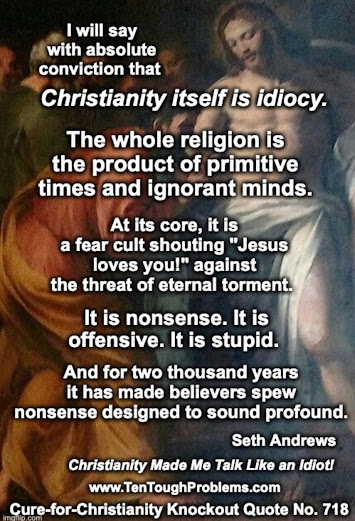
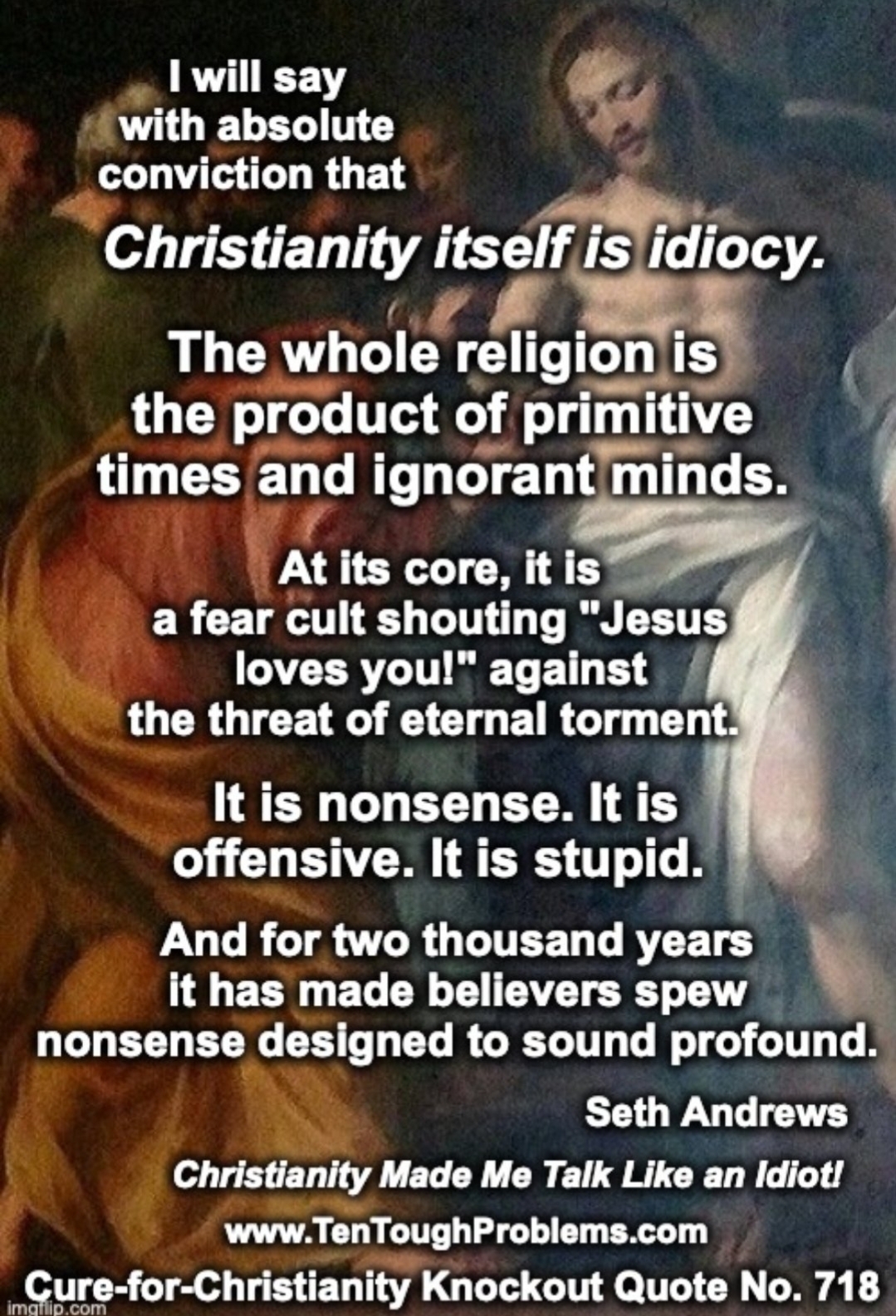
It’s even worse when we consider what some atheists say, like Seth Andrews above. Massimo Pigliucci, a professor of philosophy at City College of New York, who holds Ph.D.s in both biology and philosophy, tweeted: “I’m sorry but I can’t any longer take seriously any essay or paper that itself takes talk of god seriously. It’s simply a non starter” [March 28, 2023]. In response, “The Real Atheology Podcast” tweeted “given the serious work done by many Theistic philosophers, I have to disagree with your comments here.” Pigliucci responded: “I don’t consider any theologian to be ‘serious.’ They may be, and often are, analytically rigorous. But so is the concept of p-zombies. And yet I think it’s a waste of time.” Pigliucci again tweeted: “Consider, for instance, the Medieval Scholastics. They were rigorous and did a lot of work. But it was, as David Hume famously put it, only a bunch of sophistry and illusions. Why? Because it was based on indefensible assumptions and lack of empirical evidence” [March 30, 2023].

For a few years Keith Parsons called it quits regarding the philosophy of religion, saying:

Over the past ten years I have published, in one venue or another, about twenty things on the philosophy of religion. I have a book on the subject, God and Burden of Proof, and another criticizing Christian apologetics, Why I am not a Christian. During my academic career I have debated William Lane Craig twice and creationists twice. I have written one master’s thesis and one doctoral dissertation in the philosophy of religion, and I have taught courses on the subject numerous times. But no more. I’ve had it.

I now regard “the case for theism” as a fraud and I can no longer take it seriously enough to present it to a class as a respectable philosophical position—no more than I could present intelligent design as a legitimate biological theory. BTW, in saying that I now consider the case for theism to be a fraud, I do not mean to charge that the people making that case are frauds who aim to fool us with claims they know to be empty. No, theistic philosophers and apologists are almost painfully earnest and honest; I don’t think there is a Bernie Madoff in the bunch. I just cannot take their arguments seriously any more, and if you cannot take something seriously, you should not try to devote serious academic attention to it. I’ve turned the philosophy of religion courses over to a colleague. LINK.


While I’m at it, I recommend anything David Madison writes for very good reasons. He maintains the largest and most extensive list of atheist books I know [Scroll down]. Any of them is better than than a given apologetics book, if for no other reason than that they are right! Unfortunately, given the number of these books, many of which I have not read, I’m sure I’m overlooking some really powerful books in my recommended list.


Nearly every sophisticated philosopher and apologist looks down their noses on the so-called New Atheists. I don’t. So far I have defended Christopher Hitchens and Richard Dawkins. Recently over at The Secular Frontier website, Bradley Bowen has done an excellent job of showing why sophisticated philosophers and apologists think Dawkins’s book is a failure. But scroll down to read my response in the comments under his take down.

William Patterson has also defended Dawkins’s book! His paper was published in the Journal of Liberal Religion. He introduces his three main points by saying:

In the previous issue of this journal Jason Giannetti launched a vigorous attack against Richard Dawkins‟s best-selling book “The God Delusion.” Giannetti assailed Dawkins on three primary grounds: his understanding and definition of God, his understanding of truth, and his interpretation of religious morality. In response, I will address each of these three areas in turn and demonstrate how Giannetti’s critiques of Dawkins fail. [PDF].

I don’t have much expertise in online YouTube content creators, and I must exclude select papers in the journals, and other websites and blog posts other than mine, since there are so very many of them to choose from. I’m simply recommending the best books of what I know, and it’s only as good as my knowledge as an author myself. Some of these books led me away from the Christian faith. I’m recommending just a few important ones that have the potential to change the minds of college students and educated people in the pulpit or pews, even though this can be a very difficult and largely fruitless goal.

To begin with I recommend all thirteen books of mine and the authors in them, especially Why I Became an AtheistThe Christian DelusionChristianity is not GreatThe Outsider Test for FaithHow to Defend the Christian Faith: Advice from an AtheistChristianity in the Light of ScienceThe Case against Miracles, and God and Horrendous Suffering, although it surely is self-serving to do so! All of the chapters I wrote in my books reference many other books for further research. There were so many of them mentioned in my magnum opusWhy I Became an Atheist, that I offered a “recommended” bibliography, not an complete one. It might’ve added 30-40  pages more to an already massive book. Besides, even if I didn’t write anything in my anthologies I would still highly recommend those books. If nothing else, I was able to get the best of the best atheist and agnostic scholars to write chapters for my anthologies. [What’s the real difference between them when it comes to rejecting revealed religions? Nothing!] I highly recommend these authors and their books, even though I’m not going to recommend them separately below. Those books are awesome, even if you don’t read a word I wrote in them. I’ve written several posts that describe these thirteen books, where I offer some excerpts, and share the blurbs of readers who recommend them, most of which received high praise from Christian scholars, which is very rare. See for yourselves.

Skepticism, Epistemology and Logic:

If you think the books on miracles by apologist Craig Keener are good ones, then you need to read David Hand’s important book, The Improbability Principle: Why Coincidences, Miracles, and Rare Events Happen Every Day. Keener cannot respond to his book and others, so I don’t expect him to try.

Theodore Schick and Lewis Vaughn, How to Think About Weird Things: Critical Thinking for a New Age

Peter Boghossian, A Manual for Creating Atheists. See my defense of it here, and in the tag below it. If understood properly you can see how brilliant his core argument really is.

Boghossian’s book stands squarely in agreement with George H. Smith’s previous book, which I recommend titled:  “Atheism: The Case Against God”, for which see my defense of it.

Michael Shermer, The Believing Brain: From Ghosts and Gods to Politics and Conspiracies—How We Construct Beliefs and Reinforce Them as Truths, and also, Why People Believe Weird Things.

Philosophical Critiques:

For the record I’m not against the philosophy of religion, per se, just as Hector Avalos didn’t abandon biblical studies. That’s just one of several confusions of my book Unapologetic.

On arguments against God’s existence read Nicolas Everitt’s book, The Non-existence of God.

I recommend Michael Martin’s books, Atheism: A Justification, and The Improbability of God.

I recommend Graham Oppy’s books, especially “Arguing About Gods,” who doesn’t?

I recommend J.I. Mackie, The Miracle of Theism, who doesn’t?

William L. Vanderburgh, “David Hume on Miracles, Evidence, and Probability” which I wrote about here.

Scientific Critiques

Carl Sagan’s book, The Demon-Haunted World: Science as a Candle in the Dark.

Jerry Coyne’s “Why Evolution Is True” and Faith Versus Fact: Why Science and Religion Are Incompatible.

Victor Stenger’s, “God and the Folly of Faith: The Incompatibility of Science and Religion,” and “The Fallacy of Fine Tuning.”

Richard Dawkins, “The Greatest Show on Earth: The Evidence for Evolution”.

Matt Young, and Tanner Edis, “Why Intelligent Design Fails: A Scientific Critique of the New Creationism”.

Lawrence Krauss, A Universe from Nothing: Why There Is Something Rather than Nothing.

John C. Wathey, The Illusion of God’s Presence: The Biological Origins of Spiritual Longing.

Israel Finklestein, & Neil Asher Silberman, “The Bible Unearthed: Archaeology’s New Vision of Ancient Israel and the Origin of Its Sacred Texts.”

On God, Goodness, and Morality

Anything by Phil Zuckerman. Books like “Faith No More: Why People Reject Religion,” “Living the Secular Life: New Answers to Old Questions”, “Society without God: What the Least Religious Nations Can Tell Us About Contentment,” “What It Means to Be Moral: Why Religion Is Not Necessary for Living an Ethical Life.”

Greg Epstein, “Good Without God: What a Billion Nonreligious People Do Believe”.

Michael Werner, “What Can You Believe If You Don’t Believe in God?”

Dan Barker, “God: The Most Unpleasant Character in All Fiction.”

Michael Shermer, “The Moral Arc: How Science Makes Us Better People” and “The Science of Good and Evil: Why People Cheat, Gossip, Care, Share, and Follow the Golden Rule.”

Biblical Criticism:

Richard Friedman, “Who Wrote the Bible?”

Robert J. Miller, “Helping Jesus Fulfill Prophecy”.

Thomas Paine, “The Age of Reason”.

Francesca Stavrakopoulou, “God: An Anatomy”.

Almost anything from Richard Carrier, especially his book, “On the Historicity of Jesus: Why We Might Have Reason for Doubt.”

Thom Stark’s book, “The Human Faces of God.” While it appears as if he’s arguing just against the Christian doctrine of inerrancy (and does a superb job of it), he’s doing far more than that. He argues there are not only “scientific and historical problems” in the Bible, but also that there are “moral, ethical, theological, and ideological problems” with it (p. 208). He goes into some detail on a few of the issues found in my books, mostly in the Old Testament.

Bart D. Ehrman’s book, “Jesus Interrupted.” This is my favorite Ehrman book where he argues that the New Testament is a human, not divine book.

Randel Helms, “Gospel Fictions”, and “The Bible Against Itself: Why the Bible Seems to Contradict Itself”.

Paul Tobin’s magnum opus, “The Rejection of Pascal’s Wager: A Skeptic’s Guide to the Bible and the Historical Jesus.” He might be surprised his book is on this list but it’s deserved. This is a massive book. It will help deprogram you out of some things about the Bible and Jesus you previously believed.

G.A. Wells, “Cutting Jesus Down to Size: What Higher Criticism Has Achieved and Where It Leaves Christianity”.

Books on the Virgin Birth of an Incarnate Baby god:

Robert J. Miller, Born Divine: The Births of Jesus and Other Sons of God.

Jonathan M S Pearce, The Nativity: A Critical Examination.

On the Resurrection:

Matthew McCormick’s book, “Atheism and the Case against Christ”.

Michael Alter, “The Resurrection: A Critical Inquiry”. This is a massive book that changed the mind of Christian apologist Vincent Torley!

Jonathan M S Pearce, The Resurrection: A Critical Examination of the Easter Story.

Robert M. Price & Jeffery Jay Lowder, eds. “The Empty Tomb: Jesus Beyond The Grave.”

Kris Komarnitsky, “Doubting Jesus’ Resurrection: What Happened in the Black Box?”

Anthropology of Religion:

Anything by David Eller, especially Atheism Advanced: Further Thoughts of a Freethinker.

Counter Apologetic Books in General:

Robert Price, “The Case Against The Case For Christ: A New Testament Scholar Refutes the Reverend Lee Strobel.”

Uta Ranke-Heinemann, “Putting Away Childish Things: The Virgin Birth, the Empty Tomb, and Other Fairy Tales You Don’t Need to Believe to Have a Living Faith.”

Robin Lane Fox, “The Unauthorized Version: Truth and Fiction in the Bible.”


I know I’m missing some that I just forgot to mention and should be included, so I invite other suggestions.

Lastly, I may put out a book of papers I’ve begun publishing at Internet Infidels. I have some more papers to write. If I get them done you can consider this another book I’m recommending. LINK. No promises.

————–

John W. Loftus is a philosopher and counter-apologist credited with 13 critically acclaimed books, including The Case against MiraclesGod and Horrendous Suffering, and Varieties of Jesus Mythicism. Please support DC by sharing our posts, or by subscribing, donating, or buying our books at Amazon. As an Amazon Associate John earns a small amount of money from any purchases made there. Buying anything through them helps fund the work here, and is greatly appreciated!

Hey, Devout Christians: How Did You Get Your Bible?

Here’s the link to this article.

By David Madison at 10/20/2023

Most churchgoers seem to be clueless 


Other words come to mind as well: indifferent, complacent, gullible. Quite bluntly: There is a lack of curiosity. If the church says that the Bible was inspired by a god, isn’t that good enough? In fact, it is one of the great ironies in the ongoing debate between believers and atheists that the Bible is one of Christianity’s biggest embarrassments. Atheists—anyone outside the faith, for that matter—can point to countless passages in the Bible and ask, “Is that really the god you believe in? Why do you follow/adore/worship Jesus when so much of his advice in the gospels is so bad?” Professional Christian apologists work very hard to make the Bible look good—make it look like it came from a divine author. But the huge problem is that so much of the good book is just awful.

But then there’s the process that created the Bible—as it exists in gleaming splendor on church altars, or the plain copies the devout have in their homes. How did dozens of ancient documents, written in languages that most laypeople today don’t know, end up in a book so widely revered?    

The last stage of this process is translation—and that has produced substantial confusion. There are dozens of different English Bible translations, many of them turned out by different translators with their own faith-based agendas. In a posting here a few days ago, 16 October 2023, titled Dr. Hector Avalos on Mistranslating the Bible, John Loftus showed a few pages from Avalos’ book, The End of Biblical Studies

[For those who follow this blog, be sure to check it every Monday. Loftus has announced his intention of posting especially value material—drawing largely on the content from the past—on a weekly basis.]

Christian apologist Bible translators take on the task of disguising what the Bible actually says, and Avalos offers examples. 

It took a long time—as the Bible documents were being written over the centuries—for the concept of ONE powerful god to emerge as orthodox. But this wasn’t the case in Deuteronomy 32:8-9; Avalos quotes the Catholic New American Bible:

“When the Most High assigned the nations their heritage, when he parceled out the descendants of Adam, He set up the boundaries of the peoples after the number of the sons of God; while the LORD’s own portion was Jacob, his hereditary share was Israel.”         

Avalos comments: “Most readers will miss the fact that ‘the Most High’ and the ‘LORD’ are two different gods, among many different gods, here. The term translated as ‘the Most High’ is probably the name of a god, pronounced as Elyon, and the term translated as ‘LORD’ corresponds to the Hebrew name we pronounce as Yahweh, ancient Israel’s main god.” (p. 43, The End of Biblical Studies)

The same translator trick, Avalos notes, is used in Genesis 1:1, “In the beginning when God created…” 

“The word ‘God’ is probably best translated as the name of the specific god named ‘Elohim.’ If one were to be even more literal, one might note that Elohim is actually a plural noun, which could be translated as ‘gods’.” (p. 45, TEBS)

Since humans began imagining gods thousands of years ago, deities were given names. And the god who eventually stood out as the primary god of the Hebrews was Yahweh. Christians pay homage to this practice with the common formula, “In Jesus’ name we pray”—and even in the opening of the Lord’s Prayer, “…hallowed be thy name…” I suspect, however, if we asked Christians what their god’s name is, most would draw a blank. Yahweh wouldn’t be the first thing that comes to mind—primarily because translators have disguised it. Whenever we see the word Lord—in the Old Testament—in all caps, i.e., LORD, this is their substitution for Yahweh. Perhaps pious translators suspect that their god having a name makes him look like other gods. 

Just beyond the pages Loftus included in the 16 October post, we find a section titled Sugarcoating Jesus—that also in a project of translators, as Avalos explains:

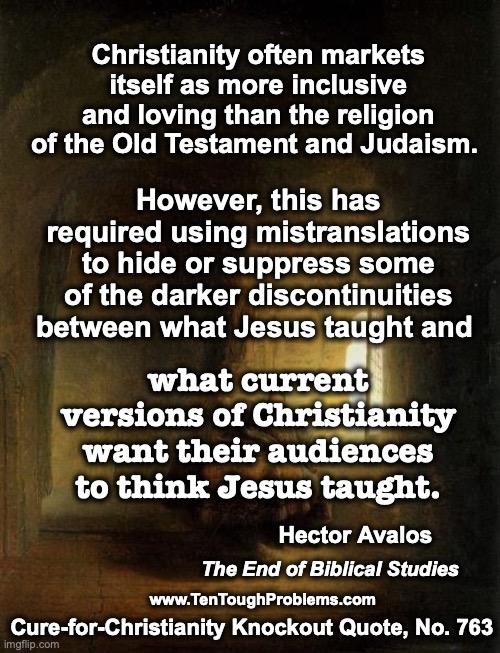
“Christianity often markets itself as more inclusive and loving than the religion of the Old Testament and Judaism. However, this has required using mistranslations to hide or suppress some of the darker discontinuities between what Jesus taught and what current versions of Christianity want their audiences to think Jesus taught.” (p. 50) 

He refers specifically to the infamous Luke 14:26, in which Jesus states that hated of family, and even life itself, is required of those who want to be his disciples. Avalos adds, “According to this text, Jesus acts more like a cult leader who actively attempts to transfer allegiance from the believer’s family to himself.” (p. 50)

And he shows the efforts of some translators to disguise the plain meaning of this text; they want to deflect attention from alarming cult flavor of this quote. For an exhaustive analysis of this verse, see the 39-page chapter, “The Hateful Jesus, Luke 14:26” in Avalos’ book, The Bad Jesus: The Ethics of New Testament Ethics. The pious scholars who oversee translations have a cherished, idealized Jesus firmly embedded at the center of their faith. They can’t let even the Bible get in the way.

Some translators/editors go so far as to print the words of Jesus in red—even Luke 14:26! —to assure readers that these are the real words of Jesus. More deception. There is no way whatever to verify that the Jesus-script in the gospels is based on words that Jesus actually spoke. Churchgoers are inclined to trust their Bibles; the use of red ink for Jesus-script is a violation of that trust. 

The beginning of the Bible-assembly process is also problematic, for those who are so sure that the Bible was divinely inspired. The blunt fact is that we don’t have any of the original Bible manuscripts. The traditional names of the gospel authors—Matthew, Mark, Luke and John—were added later to these anonymously written documents. The very first manuscripts of these authors have been lost. So how do we know exactly what they wrote? The invention of the printing press didn’t happen until well more than a thousand years later, so the manuscripts were copied by hand—in an era before electric lighting and eyeglasses. If the author of what we call Mark’s gospel handed his freshly finished document to three copyists, it is inevitable that each copyist would have made different errors—and those errors were repeated in copies made from those copies. So what do we have? Hundreds or even thousands of gospel copies that contain countless errors. There are scholars who devote their careers to careful examination of the old manuscripts, trying to discover the wording of the original. 

Here’s another factor: copyists sometimes added words that reflected their own theologies—or if they felt something was missing. Hence we have the fake ending of Mark’s gospel, i.e., 16:9-20, which isn’t in the earliest manuscripts of the gospel. What a strange text is included here (vv. 17-18), Jesus-script promising believers: 

“…by using my name they will cast out demons; they will speak in new tongues; they will pick up snakes and if they drink any deadly thing, it will not hurt them; they will lay their hands on the sick, and they will recover.”

Many modern translations put 16:9-20 in a footnote, but in two old versions of the RSV that I own, even in the footnote, vv. 17-18 are printed in red. Why would modern Christians want to be assured by Jesus that they can pick up snakes and drink poison? The translators/editors use another trick as well. The footnoted material is credited to other authorities. How do manuscripts cluttered with errors and additions qualify as authorities? Isn’t this an attempt by these pious scholars to disguise the mess that exists in the ancient manuscripts? 

What are the implications of this state of affairs for the claim that the Bible was divinely inspired? Is it even remotely credible that the Christian god who took the trouble to guide the minds of New Testament authors—to write the truth—couldn’t be bothered to protect the manuscripts from error and corruption? How does that make sense? It is even more embarrassing that the first complete manuscript of the New Testament dates from the fourth century; how many errors/additions/corruptions does it contain? How far removed is it from the content of the original manuscripts? One of the things that scholars argue/speculate a lot about is the presence of interpolations, i.e., texts that may have been inserted by copyists. There are hints that a verse or two, here and there, look out of place. What a sloppy, haphazard process. Bible god seems to have been asleep on the job.

It’s hard to argue convincingly that the Bible is the Word of God. It’s not a stretch to say that the Bible you hold in your hand today in processed Word of God. Or more correctly, the Bible is processed word of men who were confident they were somehow in tune with the divine and wrote accordingly. So much in the Bible betrays its obvious human origins: the author of Luke’s gospel—whoever he was—included the hate-your-family verse. Who wants to argue that this was divinely inspired? There is so much in the Bible that falls far short of great moral teaching—there is so much that is frankly horrifying—and this is not hard to figure out, even for ordinary churchgoers who make the effort to read/study the Bible. Which most don’t bother to do, hence far too many of the laity appear to remain clueless.     

David Madison was a pastor in the Methodist Church for nine years, and has a PhD in Biblical Studies from Boston University. He is the author of two books, Ten ToughProblems in Christian Thought and Belief: a Minister-Turned-Atheist Shows Why You Should Ditch the Faith, now being reissued in several volumes, the first of which is Guessing About God (2023) and Ten Things Christians Wish Jesus Hadn’t Taught: And Other Reasons to Question His Words (2021). The Spanish translation of this book is also now available. 

His YouTube channel is here. At the invitation of John Loftus, he has written for the Debunking Christianity Blog since 2016.

The Cure-for-Christianity Library©, now with more than 500 titles, is here. A brief video explanation of the Library is here

Freezing out the gods in Iceland

Here’s the link to this article.

Avatar photoby DALE MCGOWAN OCT 17, 2023

Cassie Boca via Unsplash

Iceland is a fascinating place for reasons geologic, geographic, linguistic, and cultural. Add to the list that it’s one of the least religious nations on Earth.

Unlike most of secular Europe, this isn’t a recent development. Prominent Icelandic expressions of nonbelief extend nearly a thousand years into the past. To gaze into the soul of a culture, look at their legends, the stories they tell about themselves. For Iceland, that would be the Sagas of Icelanders.

Consisting mostly of refugees from Norway in the 9th century, the earliest Icelanders brought Norse paganism along with them. The official religion became Christianity, though many of the settlers retained their pagan beliefs. And whenever two prominent religions cohabitate, a third strain of nonbelief is usually found nestling between them.

The first of the Sagas were written in the 13th century, at the tail end of a period wracked by violence and political uncertainty, and describe life in Iceland from the earlier period just after the Norse explorers had settled it. Among the most popular is the Saga of Hrafnkell.

13th-century Icelandic manuscript. Public domain.

Hrafnkell’s Saga tells of a warrior chief, Hrafnkell, who worships Freyr, the Norse god of such lovely things as wealth, sunshine, and sex. Hrafnkell gives Freyr his best offerings and constant devotion, even building a grand temple to the god. Despite all this devotion, Hrafnkell is attacked by an enemy, his temple burned, and he and his people enslaved.

“It is folly to believe in gods,” he says, vowing never to perform another sacrifice. Stories of lost faith in hard times are easy to come by, and you can usually count on the hero to experience a sudden epiphany that leads him back to the fold before the closing credits. But Hrafnkell’s Saga takes an unexpected turn: He escapes slavery, spares the life of his captor in exchange for freedom, and lives his life in peace and contentment without gods.

The most famous contributor to the Icelandic Sagas was the wonderfully-named Snorri Sturleson. In addition to leading the nation’s parliament and writing history, Snorri was a mythographer, a gatherer of myths and beliefs. And interestingly, Snorri came to precisely the same conclusion as the mythographer Euhemerus of Crete about the origin of god belief: Human warrior chiefs and kings were venerated in life, then venerated in death, then gradually became venerated as gods.

The more contact a person has with human mythmaking, the more he or she seems to see the man behind the curtain.

It’s unsurprising that Hrafnkell remains among the most beloved and widely-read of the Sagas of Icelanders among Icelanders today. Though most are nominally Lutheran, fully 60 percent of Icelandic respondents in a 2011 Gallup poll said religion is unimportant in their daily lives. It’s a number that is certain to have increased since then, making Iceland one of the least religious countries on Earth.

Living color: The value of atheism, diversity, and all hands on deck

Here’s the link to this article.

It’s hard to think of yourself as the default when you know so many other counterexamples.

Avatar photoby CAPTAIN CASSIDY OCT 19, 2023

The value of atheism, diversity, and all hands being on deck
Photo by David Trinks on Unsplash

Overview:

Kate Cohen’s excellent essay about the importance of atheists being open about their atheism is exactly right. But maybe we need to extend that sentiment even further.

I’ve been in both situations: a onetime Pentecostal who saw Christianity as the default setting for humanity, and an outsider who was no longer part of the tribe.

Recently, Kate Cohen wrote a moving opinion piece for Washington Post concerning atheism. In her essay, she speaks of a number of reasons why atheists should—if they can—be vocally atheistic. All of them sound perfectly fine. I’d like to add one more: the essential nature of diversity in a society that values human rights and civil liberties. That diversity destroys dysfunctional authoritarians’ perceived base of power even as it opens the door to dialogues between different people.

I learned that lesson myself at a very tender age when I got my first taste of being a despised majority.

(Related: Prayer Warriors for JesusBiff vs the Dianic Separatist LesbiansThe day I debated my M.Div professor about religion.)

PRAYER WARRIORS FOR JESUS

Set your Wayback Machine for about 1990. Grunge was taking over the world, and yet Princess Di still owned our hearts. The best Total Recall adaptation came out that year, along with The Hunt for Red October. One of the most popular songs that year was “U Can’t Touch This” by MC Hammer.

YouTube video

As far as Gallup knew that year, the percentage of Christians in America had fallen from 92% in 1952 to 81% in 1990.

As far as I knew, though, we were damn near 100% of the count.

That year, I was in college and newly married to my Evil Ex Biff. One day, he announced that he would be starting a prayer group on campus with a weird new-convert friend of his named James. Mainly, this was James’ idea, but Biff loved it.

We attended a very large state-funded university that was very generous to student groups. Thus, it cost Biff nothing whatsoever to start this group. They’d give us meeting rooms, audiovisual materials of all sorts almost upon demand, and even a small allowance we could use for campus events. All they really required in exchange for that largesse were three officers who were actively-enrolled students there, and for us to actually use what we requested from them.

Eventually, the group ran afoul of both requirements.

First of all, there simply weren’t three Pentecostals on campus willing to act as active officers of the group. James wasn’t even enrolled anywhere. And I’m female and therefore was ineligible (in our flavor of Christianity) for any leadership over men, even if my demanding school schedule allowed me to be active in any group. After some fuss, Biff discovered a friend from church who attended our school, then calmed his misogyny long enough to ask me to sign me up anyway. With Tim and me willing to pretend to be officers at least, Biff could file the startup paperwork for the group. He titled it PRAYER WARRIORS FOR JESUS. Yes, in all caps. Of course. Before its first meeting, Biff had already drawn up a logo with impressively sharp, gleaming, sword-like edges to the words.

We officers represented the entire membership of the group. Nobody ever joined for what now seem like obvious reasons.

Undeterred, Biff reserved rooms for our group to use for prayer five days a week.

Now, why did three or four individual Christians need a whole meeting room reserved for prayer? Why couldn’t they just pray anywhere in our school’s expansive, garden-like campus that they liked? Or even, dare I mention, at the school’s beautiful nondenominational chapel?

Because our university printed campus-group meeting schedules every day, then posted them all over the place. Biff wanted everyone to see PRAYER WARRIORS FOR JESUS prominently figuring in those schedules.

This desire of Biff’s had nothing to do with evangelism. Maybe that motivated James, but not Biff, who never once mentioned soulwinning as a motivation. What Biff actually said at the time was that he wanted people to see the name and know that TRUE CHRISTIANS™ were on campus.

Biff’s special calling was apparently to combat atheism on campus

In evangelicalism as well as in other flavors of Christianity, Christians believe that Jesus has created every person with a special role to play in his divine, ineffable plan for Earth. They call this role their divine calling. It represents their main purpose in life. It’s the reason they exist, the mission for which they were born.

At some point, Biff got the idea that his calling involved converting atheists and defeating atheism on our college campus. He very mistakenly thought that tons of atheists attended our university, making atheism a valid enemy to Christians like himself.

Being in Texas, most students there were Christian. But there were some outspoken atheists among the student body, and Biff glommed right onto them.

He’d been unsuccessfully evangelizing atheists for two years by the time we married and he started PRAYER WARRIORS FOR JESUS.

Something strange was happening on campus, though. People did notice the group. They just weren’t reacting as I’d expected. Biff, I think, expected all of the reactions he ever got. He was an experienced RL troll (what people sometimes more graciously term a provocateur and less graciously a chain-yanking asshole). But I sure wasn’t, and so I didn’t.

What it’s like to grow up in a cultural bubble

I grew up before everything, it feels like: Before nearly ubiquitous home computers, before the internet, before cell phones, before smartphones, before AI, before the internet of things. For the first two decades of my life, most libraries used card catalogs with actual typed-up 3×5″ cards in long drawers to keep track of their books. Local-area dial-up Bulletin Board Systems (BBSs) barely began to pop up in major cities when I was in my teens.

Making my world even more insular, I was also a military brat. My family lived on military bases sometimes, in regular houses other times, but we always tended to center our lives on my dad’s work.

So my entire world was Christian. I didn’t need to attend parochial school to be fully immersed in that bubble!

Everybody I knew was Christian. Everything in my world centered around Christianity and its rituals, its myths and folklore, its rules, its culture, its entire worldview. The only real question to ask was what flavor of Christian someone was, not whether they were Christian at all. We all already knew the answer to that.

(This is how I suspect Southerners picked up the habit of asking newcomers to their communities what church they attend. They still do it. Long ago, it was a legit question. Nowadays, it’s much more of a veiled interrogation.)

Until I went to college, I didn’t know anyone who wasn’t at least nominally Christian. If I ever ran into anyone who wasn’t, I didn’t even think about them. They were exceptions; they fell out of my mind and memory. Confirmation bias ensured that.

Nowadays, you’ve got to be a religiously-homeschooled evangelical kid with particularly controlling parents to come even close to this level of insularity. Back then, though, it was normal for kids in my area and circumstances. We just didn’t have any counterpoints or other frames of reference.

Well, college fixed that for me in a hurry.

My worldview takes a roundhouse to the jaw

I attended a couple of prayer meetings myself, but very soon I became entirely too busy for it. (I had also gotten weirded out at how non-divine prayer looked and felt when performed in a corporate meeting room.) That was fine, though. The entire idea was really the Biff and James Show, live every weekday at 12:00 noon.

One day while relaxing in a student lounge, I opened our campus newspaper. I was (and still am) a readaholic who must read All. The. Words, so I started with the letters to the editor. A minor funding squabble had erupted on campus over an increase in student fees covering campus groups, so most letters addressed that subject. One in particular stood out to me: A student making the point that that fee covered all students, even those with groups diametrically opposed to the views of any one particular student, and that this was a good thing because it encouraged diverse opinions in an educational setting.

She used PRAYER WARRIORS FOR JESUS as a specific example of what she meant in her own case.

I just stared at that letter for a long time. My brain had gone into vapor lock. My entire worldview had just tilted on its ear and divided by zero.

It’s not like I hadn’t recognized the group’s name as an attention-seeking tactic from my supremely narcissistic then-husband. But the way that student talked, she wasn’t even Christian at all.

Atheism is part of the human situation

By then, I’d been in college for two years. However, I still perceived Christianity as the default state of humanity. When I considered the overall arc of human history, I still put Christianity front and center. Though I’d met any number of atheists and pagans and Muslims (oh my!) by then, I still generally perceived them as pre-Christian. Even the other Christians I met got judged by my own doctrinal beliefs, even if I wasn’t arguing with them for anywhere near as long as Biff did.

Yes, I was exactly that Christian kid in the iconic “Jesus is so lucky to have us!” cartoon:

“Isn’t Jesus lucky to have us!” Tom’s Doubts #14, by Saji

As if by magic, that student’s letter pulled me out of my entire way of thinking. Perhaps it was because I didn’t have any idea who she was. She could have been any woman I walked past on campus. Any woman I walked past on campus, in other words, could be thinking that PRAYER WARRIORS FOR JESUS was dumb, irrelevant, and utterly counter to her own worldview. For that matter, any person period could be thinking that.

With that, my perception of myself began to subtly alter. The arrogance and privilege of my presumptuous placement of Christianity as the default began to fade. It could not survive my sudden realization that lots of people lived in this world and all had their own ideas about religion.

I suspect most people learn similar lessons in childhood. Somehow, I’d avoided that one until I was twenty. But better late than never. My world became a tapestry of living colors as if I was an extra in the movie Pleasantville.

YouTube video

Just a couple of years later, when my slow-burn deconversion began in earnest, I still didn’t know anyone who’d deconverted. For a long time, I thought I was the literal only person in the history of Christianity who’d ever believed what we called the full gospel and then realized it wasn’t true. I didn’t meet another ex-Pentecostal for a long time, and when I did, she had thought the same about herself!

We ex-Christians had to forge a path from scratch, just about, on an individual basis with each one of our deconversions. Nowadays, that’s nowhere near as common a story. There’s such a painful sense of sheer isolation when you’re positive you’re the only one who ever.

It’s not just atheism. The world needs everyone who can do so to be vocal about who and what they are.

As Kate Cohen notes in her essay, lots of people even in America aren’t free to express their beliefs/nonbelief. Anyone who’s done hard time in the Deep South likely knows this truth painfully well. It can be risky to declare one’s status as out-of-step with the lockstep march that evangelicalism in particular demands.

Insular religious communities like those are risky precisely because the members of the perceived majority like it that way. They like there being no other options besides the one they offer. There’s way less chance of someone veering out of step that way.

When someone isn’t keeping the beat, it’s glaringly obvious to everyone else. That poor schmuck stands out! As a result, it doesn’t take much effort from the rest of the group to get that person back into line. Social freezing-out, nasty comments, loss of customers, maybe trouble fomented at school or a little “evandalism” of the black sheep’s possessions: it’s minor stuff that functions as a prelude to the big guns: mysteriously losing one’s job, marriage, kids, and community standing.

But if a solid 25% of the marchers lose step and start veering off-course, the majority suddenly has a whole bunch of problems. Now there are too many targets for the tribe’s usual methods of retaliation. They can’t focus properly on any one person, much less on all of the people requiring their Christian love.

It’s like adding another person to the safety net’s edges to hold it out for the others

Oh, but matters get still worse for the majority. Thirty years ago, a whole bunch of Christians didn’t even know anyone who wasn’t Christian. Now, with so many more non-Christians floating around in the mix, Christians can’t help knowing at least one person who isn’t like themselves. In fact, they probably know a lot of non-Christians by now.

The tribe’s party line about outsiders can hold only when there aren’t a lot of ’em around. The more Christians learn about outsiders, the more they’ll realize the party line isn’t correct at all. Once one false belief gets shaken, let me tell you from painful personal experience along exactly these lines, it’s a lot easier to shake the rest.

Those false beliefs have lasted for many years precisely because the majority group heard next to no pushback about them. The sort of Christians who want to rule over everything, in particular, tend to assume that if they don’t hear any pushback, then whatever they’re doing is A-OK.

So if it’s safe for anyone to start being vocal and open about their worldview, that makes the waters just a tiny bit safer for every other person who wants to do the same, but can’t right now.

(In other words, don’t ever wonder why it’s those Christians who viciously fight against diversity and anti-racism measures.)

Whether someone is simply an ex-Christian, a None, an agnostic, an atheist, a pagan, or whatever else, they have a part in this glorious multicolored tapestry that depicts the human situation. With every new, colorful thread woven into it, it becomes progressively more difficult for the one-time majority to go back to their monochrome world.

The more hands we can get on deck, the better it’ll get for those who must watch quietly from the shore.

America doesn’t need more God. It needs more atheists.

Here’s the link to this article.

By Kate Cohen Contributing columnist

I like to say that my kids made me an atheist. But really what they did was make me honest.

I was raised Jewish — with Sabbath prayers and religious school, a bat mitzvah and a Jewish wedding. But I don’t remember ever truly believing that God was out there listening to me sing songs of praise.

I thought of God as a human invention: a character, a concept, a carry-over from an ancient time.

I thought of him as a fiction.


This essay was adapted from “We of Little Faith: Why I Stopped Pretending to Believe (and Maybe You Should Too),” by Kate Cohen, published Oct. 3 by Godine, © 2023. Excerpts reprinted by permission of Godine. All rights reserved.


Today I realize that means I’m an atheist. It’s not complicated. My (non)belief derives naturally from a few basic observations:

  1. The Greek myths are obviously stories. The Norse myths are obviously stories. L. Ron Hubbard obviously made that stuff up. Extrapolate.
  2. The holy books underpinning some of the bigger theistic religions are riddled with “facts” now disproved by science and “morality” now disavowed by modern adherents. Extrapolate.
  3. Life is confusing and death is scary. Naturally, humans want to believe that someone capable is in charge and that we continue to live after we die. But wanting doesn’t make it so.
  4. Child rape. War. Etc.

And yet, when I was younger, I would never have called myself an atheist — not on a survey, not to my family, not even to myself.

Being an “atheist,” at least according to popular culture, seems to require so much work. You have to complain to the school board about the Pledge of Allegiance, stamp over “In God We Trust” on all your paper money and convince Grandma not to go to church. You have to be PhD-from-Oxford smart, irritated by Christmas and shruggingly unmoved by Michelangelo’s “Pietà.” That isn’t me — but those are the stereotypes.

And then there are the data.Studies have shown that many, many Americans don’t trust atheists. They don’t want to vote for atheists, and they don’t want their children to marry atheists. Researchers have found that even atheists presume serial killers are more likely to be atheist than not.

Given all this, it’s not hard to see why atheists often prefer to keep quiet about it. Why I kept quiet. I wanted to be liked!

But when I had children — when it hit me that I was responsible for teaching my children everything — I wanted, above all, to tell them the truth.

Their first atheist lesson was completely impromptu. Noah was 5, Jesse was 3, and we were sitting on the couch before bed reading from “D’Aulaires’ Book of Greek Myths,” a holdover from my childhood bookshelf. One of the boys asked what a “myth” was, and I told them it was a story about how the world works. People used to believe that these gods were in charge of what happened on Earth, and these stories helped explain things they didn’t understand, like winter or stars or thunder. “See” — I flipped ahead and found a picture — “Zeus has a thunderbolt.”

“They don’t believe them anymore?” No, I said. That’s why they call it “myth.” When people still believe it, they call it “religion.” Like the stories about God and Moses that we read at Passover or the ones about Jesus and Christmas.

The little pajama-clad bodies nodded, and on we read.

That was it — the big moment. It was probably also the easiest moment.

Before one son became preoccupied with death. Before the other son had to decide whether to be bar mitzvahed. Before my daughter looked up from her math homework one day to ask, “How do we know there’s no God?”

Religion offers ready-made answers to our most difficult questions. It gives people ways to mark time, celebrate and mourn. Once I vowed not to teach my children anything I did not personally believe, I had to come up with new answers. But I discovered as I went what most parents discover: You can figure it out as you go.

Establishing a habit of honesty did not sap the delight from my children’s lives or destroy their moral compass. I suspect it made my family closer than we would have been had my husband and I pretended to our children that we believed in things we did not. We sowed honesty and reaped trust — along with intellectual challenge, emotional sustenance and joy.

Those are all personal rewards. But there are political rewards as well.

My children know how to distinguish fact from fiction — which is harder for children raised religious. They don’t assume conventional wisdom is true and they do expect arguments to be based on evidence. Which means they have the skills to be engaged, informed and savvy citizens.

We need citizens like that.

Lies, lying and disinformation suffuse mainstream politics as never before. A recent Washington Post-ABC News poll found that 29 percent of Americans believe that President Biden was not legitimately elected, a total composed of those who think there is solid evidence of fraud (22 percent) and those who think there isn’t (7 percent). I don’t know which is worse: believing there to be evidence of fraud when even the Trump campaign can’t find any or asserting the election was stolen even though you know there’s no proof.

Meanwhile, we are just beginning to grasp that artificial intelligence could develop an almost limitless power to deceive — threatening the ability of even the most alert citizen to discern what’s real.

We need Americans who demand — as atheists do — that truth claims be tethered to fact. We need Americans who understand — as atheists do — that the future of the world is in our hands. And in this particular political moment, we need Americans to stand up to Christian nationalists who are using their growing political and judicial power to take away our rights. Atheists can do that.

Fortunately, there are a lot of atheists in the United States — probably far more than you think.

Some people say they believe in God, but not the kind favored by monotheistic religions — a conscious supreme being with powers of intercession or creation. When they say “God,” they mean cosmic oneness or astonishing coincidences. They mean that sense of smallness-within-largeness they’ve felt while standing on the shore of the ocean or holding a newborn baby or hearing the final measures of Chopin’s “Fantaisie-Impromptu.”

So, why do those people use the word “God” at all? The philosopher Daniel C. Dennett argues in “Breaking the Spell”that since we know we’re supposed to believe in God, when we don’t believe in a supernatural being we give the name instead to things we do believe in, such as transcendent moments of human connection.

Whatever the case, in 2022, Gallup found that 81 percent of Americans believe in God, the lowest percentage yet recorded. This year, when it gave respondents the option of saying they’re not sure, it found that only 74 percent believe in God, 14 percent weren’t sure, and 12 percent did not believe.

Not believing in God — that’s the very definition of atheism. But when people go around counting atheists, the number they come up with is far lower than that. The most recent number from Pew Research Center is 4 percent.

What’s with the gap? That’s anti-atheist stigma (and pro-belief bias) at work. Everybody’s keeping quiet, because everybody wants to be liked. Some researchers, recognizing this problem, developed a workaround.

In 2017, psychologists Will Gervais and Maxine Najle tried to estimate the prevalence of atheism in the United States using a technique called “unmatched count”: They asked two groups, of 1,000 respondents each, how many statements were true among a list of statements. The lists were identical except that one of them included the statement “I believe in God.” By comparing the numbers, the researchers could then estimate the percentage of atheists without ever asking a direct question. They came up with around 26 percent.

If that’s true or even close, there are more atheists in the United States than Catholics.

Do you know what some of those atheists call themselves? Catholics. And Protestants, Jews, Muslims and Buddhists. General Social Survey data back this up: Among religious Americans, only 64 percent are certain about the existence of God. Hidden atheists can be found not just among the “nones,” as they’re called — the religiously unaffiliated — but also in America’s churches, mosques and synagogues.

“If you added up all the nominal Christians, Jews, Muslims, Hindus, Buddhists, etc. — those who are religious in name only,” Harvard humanist chaplain Greg M. Epstein writes in “Good Without God,”“you really might get the largest denomination in the world.”

Atheists are everywhere. And we are unusually disposed to getting stuff done.

Iused to say, when people asked me what atheists do believe, that it was simple: Atheists believe that God is a human invention.

But now, I think it’s more than that.

If you are an atheist — if you do not believe in a Supreme Being — you can be moral or not, mindful or not, clever or not, hopeful or not. Clearly, you can keep going to church. But, by definition, you cannot believe that God is in charge. You must give up the notion of God’s will, God’s purpose, God’s mysterious ways.

In some ways, this makes life easier. You don’t have to work out why God might cause or ignore suffering, what parts of this broken world are God’s plan, or what work is his to do and what is yours.

But you also don’t get to leave things up to God. Atheists must accept that people are allowing — we are allowing — women to die in childbirth, children to go hungry, men to buy guns that can slaughter dozens of people in minutes. Atheists believe people organized the world as it is now, and only people can make it better.

No wonder we are “the most politically active group in American politics today,” according to political scientist Ryan Burge, interpreting data from the Cooperative Election Study.

That’s right: Atheists take more political action — donating to campaigns, protesting, attending meetings, working for politicians — than any other “religious” group. And we vote. In his study on this data, sociologist Evan Stewart noted that atheists were about 30 percent more likely to vote than religiously affiliated respondents.

We also vote far more than most religiously unaffiliated people. That’s what distinguishes atheists from the “nones” — and what I didn’t realize at first.

Atheists haven’t just checked out of organized religion. (Indeed, we may not have.) We haven’t just rejected belief in God. (Though, obviously, that’s the starting point.) Where atheism becomes a definite stance rather than a lack of direction, a positive belief and not just a negative one, is in our understanding that, without a higher power, we need human power to change the world.

I want to be clear: There are clergy members and congregations all across this country working to do good, not waiting for God to answer their prayers or assuming that God meant for the globe to get hotter. You don’t have to be an atheist to conduct yourself as if people are responsible for the world they live in — you just have to act like an atheist, by taking matters into your own hands.

Countless good people of faith do just that. But one thing they can’t do as well as atheists is push back against the outsize cultural and political power of religion itself.

That power is crushing some of our most vulnerable citizens. And I don’t mean my fellow atheists. Atheists, it’s true, are subject to discrimination and scapegoating; somehow we’re to blame for moral chaosmass shootings and whatever the “trans cult” is. Yes, we are technically barred from serving as jurors in the state of Maryland or joining a Boy Scout troop anywhere, but we do not, as a group, suffer anything like the prejudice that, say, LGBTQ+ people face. It’s not even close.

Peel back the layers of discrimination against LGBTQ+ people, though, and you find religion. Peel back the layers of control over women’s bodies — from dress codes that punish girls for male desire all the way to the Supreme Court striking down Roe v. Wade — and you find religion. Often, there isn’t much peeling to do. According to the bill itself, Missouri’s total abortion ban was created “in recognition that Almighty God is the author of life.” Say what, now?

Peel back the layers of abstinence-only or marriage-centered or anti-homosexual sex education and you find religion. “Don’t say gay” laws, laws denying trans kids medical care, school-library book bans and even efforts to suppress the teaching of inconvenient historical facts — motivated by religion.

And when religion loses a fight and progress wins instead? Religion then claims it’s not subject to the resulting laws. “Religious belief” is — more and more, at the state and federal levels — a way to sidestep advances the country makes in civil rights, human rights and public health.

In 45 states and D.C., parents can get religious exemptions from laws that require schoolchildren to be vaccinated. Seven states allow pharmacists to refuse to fill contraceptive prescriptions because of their religious beliefs. Every business with a federal contract has to comply with federal nondiscrimination rules — unless it’s a religious organization. Every employer that provides health insurance has to comply with the Affordable Care Act’s contraceptive mandate — unless it’s, say, a craft supply store with Christian owners.

Case by case, law by law, our country’s commitment to the first right enumerated in our Bill of Rights — “Congress shall make no law respecting an establishment of religion” — is faltering. The Supreme Court has ruled that the citizens of Maine have to pay for parochial school, that a high school football coach should be free to lead a prayer on the 50-yard line, that a potential wedding website designer can reject potential same-sex clients. This past summer, Oklahoma approved the nation’s first publicly funded religious school. This fall, Texas began allowing schools to employ clergy members in place of guidance counselors.

You don’t have to be an atheist to worry about the structural integrity of Thomas Jefferson’s “wall of separation between Church & State.” You don’t have to be an atheist to think that religion should not shape public policy or that believers should have to follow the laws that everyone else does. You don’t have to be an atheist to see that Christian nationalists are using “religious liberty” to perpetuate much of the discrimination Americans suffer today.

But atheists can do one thing about the country’s drift into theocracy that our religious neighbors won’t: We can tell people we don’t believe in God. The more people who do that, the more we normalize atheism in America, the easier it will be — for both politicians and the general public — to usher religion back out of our laws.

Okay, but should you say you’re an atheist even if you believe in “God” as the power of nature or something like that?

Yes. It does no one any favors — not the country, not your neighbors — to say you believe in God metaphorically when there are plenty of people out there who literally believe that God is looking down from heaven deciding which of us to cast into hell.

In fact, when certain believers wield enough political power to turn their God’s presumed preferences into law, I would say it’s dangerous to claim you believe in “God” when what you actually believe in is awe or wonder. (Your “God is love” only lends validity and power to their “God hates gays.”)

So ask yourself: Do I think a supernatural being is in charge of the universe?

If you answer “no,” you’re an atheist. That’s it — you’re done.

But if you go further: You’ll be doing something good for your country.

When I started raising my kids as atheists, I wasn’t particularly honest with the rest of the world. I wasn’t everybody’s mom, right? Plus, I had to get along with other people. Young parents need community, and I was afraid to risk alienating new parent friends by being honest about being — looks both ways, lowers voice — an atheist.

But, in addition to making me be honest inside our home, my children pushed me to start being honest on the outside. In part, I wanted to set an example for them, and in part, I wanted to help change the world they would face.

It shouldn’t be hard to say you don’t believe in God. It shouldn’t be shocking or shameful. I know that I’m moral and respectful and friendly. And the more I say to people that I’m an atheist — me, the mom who taught the kindergarten class about baking with yeast and brought the killer cupcakes to the bake sale — the more people will stop assuming that being an atheist means being … a serial killer.

And then? The more I say I’m an atheist, the more other people will feel comfortable calling themselves atheists. And the stigma will gradually dissolve.

Can you imagine? If we all knew how many of us there are?

It would give everyone permission to be honest with their kids and their friends, to grapple with big questions without having to hold on to beliefs they never embraced.

And it would take away permission, too. Permission to pass laws (or grant exemptions to laws) based on the presumed desires of a fictional creation. Permission to be cruel to fellow human beings based on Bible verses. Permission to eschew political action in favor of “thoughts and prayers.”

I understand that, to many people, this might sound difficult or risky. It took me years to declare myself an atheist, and I was raised Reform Jewish, I live in the Northeast, I’m White, I work at home, and my family and friends are a liberal bunch. The stakes were low for me. For some, I fully concede, the stakes are too high.

If you think you’d lose your job or put your children at risk of harassment for declaring your atheism, you get a pass. If you would be risking physical harm, don’t speak out. If you’re an atheist running for school board somewhere that book bans are on the agenda, then feel free to keep it quiet, and God bless.

But for everyone else who doesn’t believe in God and hasn’t said so? Consider that your honesty will allow others to be honest, and that your reticence encourages others to keep quiet. Consider that the longer everyone keeps quiet, the longer religion has political and cultural license to hurt people. Consider that the United States — to survive as a secular democracy — needs you now more than ever.

And the next time you find yourself tempted to pretend that you believe in God? Tell the truth instead.

The Reality of Senseless Suffering, by Franz Kiekeben

Here’s the link to this article.

By Franz Kiekeben at 10/19/2023

The traditional argument from evil claimed that God was incompatible with any amount of suffering, for God could, and would want to, prevent every instance of it. Most philosophers nowadays regard that as too strong. A certain amount of suffering might be allowed by God, provided there is a morally sufficient reason for his allowing it—provided, in other words, the suffering serves some greater purpose or is the unavoidable consequence of something that justifies its existence. For instance, it may be that our having free will is a great good which more than compensates for any evil actions resulting from that freedom. Or it may be that certain types of suffering are the only way to bring about something of immense value. As an example of the latter, it is possible that in order to freely develop into the sort of beings that God wants us to become, we must first overcome certain challenges—and these may include disappointments, feelings of frustration, and other experiences we would prefer not going through. (As some theists put it, God’s intention was not to create a paradise in which to keep us perfectly happy, but to create a place where we can grow and develop into persons worthy of spending eternity with him.) It is also possible that an instance of suffering today is the least terrible means of preventing a far greater amount of suffering at some future date. Each of these, as well as several other possibilities that will be discussed below, provides a conceivable explanation for at least some of the bad things that happen in this world.

But even if God is not incompatible with all suffering, he is incompatible with suffering that cannot be justified by some outweighing benefit. Such suffering would be senseless or gratuitous, and if we are to take seriously the claim that God is perfectly good as well as all-powerful and all-knowing, we cannot suppose that he would let someone suffer without reason. If one has the ability to prevent such pointless suffering, yet fails to do so, one cannot be considered morally perfect. It follows that there can either be a God, or there can be senseless suffering, but not both. This leads to a very simple argument in support of atheism:

(1) God is incompatible with senseless suffering

(2) There is senseless suffering

(3) Therefore, there is no God

Now, the existence of suffering itself is not in question. That of senseless suffering, however, is more open to doubt. The theist can always maintain, it seems, that what may appear to us unnecessary and without justification might have some reason behind it. Thus, when faced with the above problem, most theists who are familiar with the issue deny the existence of senseless suffering. Some have attempted to develop theodicies—that is, explanations as to why God allows certain evils—as a solution. Others merely claim that there must be some explanation, even if we do not know what it is, since otherwise God would not allow such events. Either way, the denial allows them to continue believing in a perfect creator.

To others, however, it seems obvious that much of the misery and pain we see around us serves no purpose and could be avoided without incurring anything equally bad or worse. This paper will attempt to show that that intuition is in fact correct. There are cases of suffering that we have good reason for considering unjustified. But if we have good reason for thinking that there is such a thing as senseless suffering, then we have good reason for disbelieving in the existence of God.

Before proceeding, however, we have to consider another way of criticizing the above argument, for not every theist agrees as to what form the solution to the problem should take. According to some, there is something else there that should be disputed.

The Denial of the First Premise

Philosopher Stephen Wykstra once referred to the incompatibility of God and senseless suffering as “a basic conceptual truth deserving assent by theists and nontheists alike.”[1] Most believers share his view, and therefore reply to the above argument by maintaining that all suffering must in fact have some justification. According to some, however, even suffering that serves no purpose and that could be avoided without loss is compatible with God. Thus, rather than denying its existence, such theists maintain that in at least certain situations God allows senseless suffering. They challenge the argument, not by arguing against the second premise, but by arguing against the first.

For the most part, this rather unorthodox view is the result of different interpretations of what is meant by “senseless” or “gratuitous,” or of what perfect goodness entails. And in some cases, it is due to simple confusion. Nevertheless, it is important to examine the claims of those who argue this way. Doing so will at the very least clarify the nature of the problem. This section therefore surveys the main suggestions that have been advanced in defense of God-condoned senseless suffering.

Perhaps the simplest among them is that based on God’s supposed inscrutability. As is often said, God works in mysterious ways. Some therefore appeal to our ignorance of his purposes and intentions in order to argue that we may simply be incapable of understanding why he permits senseless suffering. Who are we to say God could not allow such a thing?

This suggestion, however, misses the point of the problem. One does not need to understand what God’s reasons might be in order to see the incompatibility of a perfect being with that of suffering that is not justified. That incompatibility does not depend on any specific details regarding God’s purposes. Rather, it is based on what the existence of an all-powerful, all-knowing, and perfectly good being entails. A being with that combination of attributes could not allow pointless suffering in the sense described above. God’s inscrutability is therefore an irrelevant detail.

A second argument says that it is enough for God to create beings whose lives contain more happiness than unhappiness. After all, he did not have to create anything at all. Our existence is a gift from God. It follows that if our lives are, on the whole, worth living, we have no reason to complain. And yet, such lives are compatible with a certain amount of suffering that serves no purpose and that could have been avoided. Therefore, God can allow senseless suffering.

The main problem with this solution is that creating beings whose lives are on the balance positive is not sufficient for perfect goodness. A god who allows unnecessary suffering is, everything else being equal, not as good as one who prevents its occurrence. Therefore, such a god cannot be perfect. We may have no basis for complaining to a creator who acted in this way, given that we owe everything to him. In fact, one may argue that to criticize God is to be ungrateful and rather petty. All of that is beside the point, however. This second argument, then, fails as well.

Some state that evil is not a positive property, but is instead the mere lack of goodness. This idea provides theists with a third way of claiming senseless suffering to be compatible with God. For, on this view, in allowing senseless suffering, God is not allowing some actual thing, but only the absence of something—and that, some suppose, makes all the difference.

Unfortunately, this attempt to solve the difficulty misses the point as well. In fact, there are at least two things wrong with it. First, it is obviously false that suffering is merely the lack of some property. To suffer is to experience something—for example, physical pain—and that something is very real. It makes no sense to explain away that reality by describing it as, say, “lacking substance.” To do so is to ignore the facts. But the second flaw with this proposal is, if anything, more serious. For even if we were to grant that suffering is only the absence of something, the problem would remain. God would not allow that absence any more than he would allow the presence of a positive evil. After all, the absence of something can be (and in this case, would be) a bad thing. To allow it without reason is therefore, once again, incompatible with perfection.

Another suggestion consists of claiming that we have better reasons for believing in God than for believing in the incompatibility of God with senseless suffering. In other words, instead of arguing:

 (1) God is incompatible with senseless suffering

(2) There is senseless suffering

(3) Therefore, there is no God

one may argue:

            (1*) There is a God

            (2) There is senseless suffering

            (3*) Therefore, God is compatible with senseless suffering.

This kind of move is called a “Moorean shift,” after the influential twentieth-century philosopher G. E. Moore, who used it in a different context. Now, most theists, as already mentioned, reject the second premise in the original argument rather than the first. On their view, it is more reasonable to deny the existence of senseless suffering than to deny God’s incompatibility with it. At the very least, that seems a more reasonable alternative. The main objection to the above, however, is that it does not appear that the existence of God is more certain than the incompatibility claim. Whereas that incompatibility, once understood, seems obvious, God’s existence is much more open to doubt. To a convinced believer, this may not appear to be the case. However, one should keep in mind what is meant by “God” here. It does not mean merely an intelligent creator of the universe, nor even one who created it specifically for us. It means a being who is in addition omnipotent, omniscient, and perfectly good. Now, this is a rather remarkable set of characteristics. There would have to be quite a bit of evidence in its favor to make belief in such an entity even somewhat reasonable. Yet the arguments for God that theists find the most convincing do not support the existence of anything answering that description, or even so much as approaching it. At most, one might hold that design arguments (including the fine-tuning argument) lead to the conclusion that an intelligence is responsible for the properties of the universe, and cosmological arguments to the conclusion that something (not even necessarily an intelligence) caused everything else to exist. None of them says anything about omniscience, omnipotence, or perfect goodness. And ontological arguments, which do say something about those properties, are far more problematic, and almost universally rejected.

So far, four different attempts to show God’s compatibility with senseless suffering have been discussed, none of which was very promising. The remaining ones, which are somewhat stronger, focus on the possibility of senseless suffering being either a cause or an effect of some outweighing good. In this, they mirror the explanations of justified suffering mentioned at the start of this paper.

Some of these arguments state that senseless suffering may be a necessary means for achieving a desired end. One example of this was suggested by William Lane Craig. In a book-length debate on the existence of God with philosopher Walter Sinnott-Armstrong, Craig says that perhaps “only in a world in which gratuitous natural and moral evils exist [do the] the optimal number of persons… freely come to salvation and the knowledge of God.”[2] On this sort of view, then, senseless suffering is allowed to occur in order to bring about something worthwhile, or allow something worthwhile to continue existing. But in that case, why regard the suffering as senseless? Craig recognizes this as a potential objection. He admits that his opponent might say that the suffering is not gratuitous given that it serves a greater purpose. What we have here, then, is really a semantic disagreement. Craig’s idea of what constitutes gratuitous suffering is not the one mentioned above (and presumably not the one Sinnott-Armstrong had in mind when he stated that “even one bit of unjustified evil disproves the existence of God”).[3] Much the same can be said with regards to the remaining views in this section.

A group of similar but distinct arguments involve an appeal, either directly or indirectly, to free will (where what is meant is what philosophers have traditionally called libertarian free will, the ability to act in a way that is not predetermined). Such an appeal is, of course, found in the most common reply to the problem of evil, the claim that evil exists because God gave us the freedom to make our own choices. But the same idea can also be used more narrowly as an explanation for the existence of senseless suffering. On this view, God is justified in giving us freedom of choice because such freedom is something essential, or is at least a great good. However, because we have free will, we can bring about suffering that serves no purpose. Such suffering is therefore compatible with the existence of God.

A special case of the appeal to free will is based on the view known as open theism. Open theists maintain that, although God is omniscient, he does not have complete knowledge of the future because the future is as yet undetermined. For this reason, God cannot know ahead of time every evil that will occur as a result of our free choices. Senseless suffering is therefore a real possibility, and one that has in fact occurred throughout history.

There is more than one reason why one might regard free will as indispensable. One might claim that freedom is an end in itself. For example, free will might be so valuable that its existence more than compensates for any senseless suffering that happens because of it. This, however, seems rather implausible. Even if free will is a great good, the question remains why it should have unlimited scope—or, even if not unlimited, then at least to the extent that we see. The freedom of criminals to act is obviously less important than the rights of their victims. That, after all, is why societies try to prevent crime. And God could give us freedom while ensuring that no great suffering results from our actions. Why, then, allow senseless suffering?

According to the most common view, the answer lies in treating free will, not as an end in itself, but as a necessary means toward some other end, such as the existence of virtue or the possibility of our having a personal relationship with the creator. Philosopher Michael Peterson, for instance, argues that curtailing freedom so as to eliminate the possibility of senseless suffering would undermine responsibility and morality, so that the “moral enterprise” would be greatly diminished.[4] Our freedom itself might not be sufficient justification for all of the pain and misery that humans cause, but, according to this view, the existence of morality is.

But whether it is freedom itself, or something made possible by that freedom, the argument underlying all of these views states that free will is a great good which God is justified in giving us. However, as a result of this freedom, we can bring about suffering that is not itself necessary for the existence of any outweighing good. An act of murder, for example, does not serve any purpose if its occurrence is not necessary to either bring about a greater good or prevent an equal or greater evil. Everything else being equal, the world would have been better without it. Such an act is therefore, according to the above views, senseless. Nevertheless, God permits it.

Once again, however, the actual disagreement here is about meaning. According to these views, God is justified in creating us free, in spite of the evils that result from it, because of the value of freedom. But if so, that means our freedom itself is a benefit that more than compensates for any suffering that results from its use—which means that such suffering is not in fact senseless according to our definition. While it is true that individual acts performed by us may not themselves be necessary for an outweighing good, an outweighing good—namely, free will—makes it necessary that they be allowed to occur. These views therefore also fail to show that God is compatible with senseless suffering.

The final and strongest argument we will consider is one due to the influential philosopher Peter van Inwagen. It states that there is an inherent vagueness in the amount of suffering needed for accomplishing God’s purposes, and that therefore it is to a certain extent an arbitrary matter whether some instance of it should be allowed. From this, it follows that God is justified in permitting some evils that are strictly speaking unnecessary, and therefore gratuitous.

To make this idea clearer, consider an analogy. Suppose that a city government passes a law making anyone who parks illegally subject to a fine. The purpose of such a law is, of course, to discourage illegal parking, and the amount the authorities decide to charge attempts to strike a reasonable balance between too harsh a punishment (which would create more hardship than the law justifies) and too lenient a punishment (which would fail to achieve its purpose). Does it follow, however, that there is an exact minimum that the authorities ought to set as the fine? If it is set at, say, twenty-five dollars, and that works, then it seems that twenty-four dollars and ninety cents would work just as well. But if so, then that means the government is charging violators an extra ten cents without justification. But then the same thing could be said about a twenty-four dollar and ninety-cent fine, for ten cents less than that might also work. The point is that there does not appear to be a set minimum that the fine should be set at. Nevertheless, there must be a fine in order to curb illegal parking. Thus, the government is justified in setting it at a given amount even though a slightly smaller amount would work just as well. Similarly, God may have to permit a certain amount of suffering in order to achieve his purposes, but if there is no precise minimum that God must permit, there will be instances of suffering that are not essential for those purposes. These, according to van Inwagen, are therefore gratuitous. Nevertheless, God is justified in allowing them.

Van Inwagen’s argument, if it works at all, can only do so if he is right about there being an inherent vagueness in the amount of suffering needed for God’s purposes. This isn’t necessarily the case. The analogy with a parking fine seems to make sense because, even if there is an optimum amount for such a fine in any given situation, we cannot tell that there is (much less what that amount might be). However, if there are strict cause and effect laws, there must be a specific fine that constitutes the minimum needed to discourage a given number of drivers in a particular area from parking illegally. (Nor is the number of drivers that ought to be discouraged arbitrary, for that is itself determined by the optimum balance of value accomplished versus cost incurred.) By the same reasoning, the suffering needed in the universe so as to achieve God’s purposes must be a set amount. Now, it is of course possible that in reality there are no strict cause and effect laws. But even if so, it remains the case that God could have created a world in which there are.

On the other hand, it is possible that a universe with strict cause and effect laws cannot be as desirable, and may even be incompatible with God’s purposes. One reason for maintaining this is, once again, the importance of free will. A universe with strict cause and effect laws would be deterministic, which is inconsistent with libertarian freedom. One might therefore argue that God was justified in creating the kind of world in which the amount of suffering needed is unavoidably vague.

Even if we grant this last point, however, it does not necessarily follow that any of the suffering allowed by God is senseless. Once again, that depends on what one means by the term. Van Inwagen’s argument specifically addresses the concept introduced by philosopher William Rowe, who called an instance of evil gratuitous if God could have prevented it “without thereby losing some greater good or permitting some evil equally bad or worse.”[5] As van Inwagen correctly points out, given that there is no minimum amount of suffering needed for accomplishing God’s purposes, whatever amount is sufficient will include some that could have been prevented without loss. Rowe’s definition therefore allows for at least this type of counterexample. But now consider the concept introduced above, which merely states that suffering is senseless whenever it cannot be justified by some outweighing good. If there is no minimum amount that God must allow for his purposes, does it follow that some amount will be senseless on this definition? Obviously not. For, if there is no precise amount, then it is impossible for God to ensure that no more than what is precisely needed occurs. At the same time, God is, as this argument presupposes, justified for the sake of an outweighing good in allowing some amount of suffering. It follows that every instance of suffering that he does allow is justified even if a little less might have been sufficient. This is no more problematic than the claim that a twenty-five dollar parking fine is justified. Van Inwagen’s argument, then, also fails on the definition of “senseless” used here.

Given God’s perfection, any suffering he permits must be morally justified. But if senseless suffering is suffering that is not justified by some outweighing good—and thus not morally justified—it follows that God cannot permit its occurrence. This means that any argument that attempts to provide a reason why God might allow it will either be mistaken or will mean something else by “senseless.” The only question that remains, then, is whether such suffering in fact occurs. That is the issue addressed in the final section.      

Rowe’s Argument for the Reality of Senseless Suffering

The most frequently discussed argument for the existence of gratuitous evils is William Rowe’s. It uses examples of terrible evil and suffering that do not appear to serve any purpose and thus are very likely unjustified. Rowe refers to two cases in particular. The first is that of a fawn that has been burned in a forest fire and lies injured and helpless in great pain for several days before dying. This scenario was invented by Rowe, but there is no doubt that it is the sort of thing that sometimes happens. The second example is that of an actual case of a five-year-old girl who was brutally beaten, raped and strangled to death on New Year’s Day in 1986. As Rowe points out, it does not seem reasonable to suppose that an all-powerful and perfectly good being could have any reason for permitting either of these things. The evidence we have suggests that evil and suffering of this magnitude cannot be justified. But what is worse is that events like these are not isolated incidents. Many other similarly terrible things have taken place throughout history, and continue to do so on a daily basis. The amount of pain and misery in our world is staggering—and that makes it all the more certain that there can be no justification for each and every such event.

Some of course claim that there may be reasons for such events that we are unaware of. We may simply not be able to see what those reasons are due to our limited knowledge. Consider the connection that an event today may have with some outcome in the distant future. This is not something human beings can detect. Most of us have heard of the familiar example of a butterfly that, by beating its wings, sets up a causal chain that eventually results in the formation of a hurricane. In much the same way, the movements of the suffering fawn may lead to some great good, or prevent some great catastrophe, many years from now.

But while such things are certainly possible, we have no reason for supposing that they are true. They are, at best, rather unlikely. As Sinnott-Armstrong points out, if we see a butterfly beating its wings, we have no reason to worry about a potential storm, and in fact have good reason to dismiss the possibility.[6] Most butterflies do not cause hurricanes, after all. And the same can be said with respect to other possible explanations of suffering that have been suggested. Even if they might be true, we have no reason for thinking that they are. The only evidence we have is of what appear to be a lot of pointless evils. As best as we can tell, there is no justification for them. This already makes it more likely than not that God does not exist.

However, it is not just that such events appear to be unjustified. What is even worse is that, in some cases, there does not appear to be anything that could justify them. Consider the rape and murder of the five-year-old. In a reply to Rowe, philosophers Daniel Howard-Snyder and Michael Bergmann suggest, as a possible justification, “the good of both the little girl and her murderer living together completely reconciled (which involves genuine and deep repentance on the part of the murderer and genuine and deep forgiveness on the part of the little girl) and enjoying eternal felicity in the presence of God.”[7] But in order for this to be sufficient, such a benefit must outweigh the horror of the act, and there must be no preferable alternative. Yet, neither of these seems to be the case. To begin with, there clearly appear to be better overall scenarios. In a world in which only minor evils occur, for example, those guilty of them might also come to feel deep repentance (because these would be the worst evils in that world) and be similarly forgiven by their victims. The benefits in this scenario, then, are analogous, whereas the negative act that leads to them pales by comparison. Even if we suppose that the benefits are fewer—perhaps because the amount of repentance and forgiveness involved is smaller—the overall balance of good to evil is certainly much better. In fact, of the two scenarios, only for the second is it plausible to maintain that good outweighs evil. Rowe concludes that, for any good we consider, it probably either fails to be sufficient to justify the suffering of the little girl, could have been actualized by God without such terrible suffering, or could have been replaced by some equal or greater good that could have been actualized without such terrible suffering.[8] Moreover, this is the case not only with regards to this one example of horrendous suffering, but with respect to many other instances of it, and even with respect to many lesser evils.

Rowe’s argument, then, provides us with good evidence for the existence of senseless suffering, and therefore with good evidence for the nonexistence of God. But we need not stop there. A different, and arguably stronger, way of defending this conclusion is available.

Another Argument for the Reality of Senseless Suffering

As mentioned above, there are, broadly speaking, two ways to dispute the existence of senseless suffering: by claiming that there must be some justification for it that we do not know about, or by attempting to find specific reasons God might allow it. Similarly, one might say that there are two ways of arguing for the reality of senseless suffering, each roughly corresponding to one of the methods on the negative side. We have already covered the first, the claim that there does not appear to be any justification for many of the cases we see. The second is to try to show that particular instances of it cannot be justified.

One way to do the latter involves a fact that has been neglected in discussions of the problem of suffering. Consider the causal explanation suggested above for why God might allow the prolonged pain of the fawn: perhaps the laws of cause and effect are such that this is the only way to bring about some great benefit in the future. However, even if we grant that, it is not sufficient to justify the suffering. This explanation ignores the fact that God is omnipotent, and therefore is not bound by natural laws—laws that he himself created. He can change or override those laws, and thus can ensure the occurrence of the future event without having to depend on the suffering. To put it another way, God can perform a miracle. The fact that is often overlooked, then, is that, in order for the fawn’s suffering to be justified, it must be logically impossible for the future event to be brought about without it, or something at least as bad, taking place. So long as God can accomplish a goal painlessly, however, any suffering allowed for that purpose is unjustified.

Now, with respect to certain other evils, there are plausible reasons for claiming that they are logically necessary for a given outcome. One example is that of the repentance felt by a murderer. In order for something to qualify as genuine repentance, it must be felt in response to an actual instance of wrongdoing. Thus, even God cannot ensure that someone feels genuine repentance without permitting an immoral act. (This is, of course, a different question from whether such repentance is of sufficient value to excuse something as bad as murder.) But the case of the fawn does not appear to be like this. It seems clear that its suffering is not logically necessary for any purpose God might have. In its case, a miracle is available as an alternative. This fact can therefore be used as an argument for the existence of senseless suffering.

The fawn, which experiences terrible pain as it slowly dies, does not benefit in any way from its ordeal. Even if one supposes that it enjoys an afterlife, its suffering cannot be of use to it, for, unlike a person, it is incapable of learning some valuable lesson as a result. If there is some beneficial outcome, then, it must be for the sake of others. One possibility is the one already discussed, that the movements of the suffering fawn set up a causal chain that eventually leads to some event of immense value. Another is that someone who can learn a valuable lesson, perhaps on the importance of compassion, does so by becoming aware of the fawn’s suffering. The problem is that neither of these seems to require actual suffering. The reason is simple: God can make it the case that the animal experiences no pain, yet behaves as if it does. There is more than one way for an omnipotent being to accomplish this, but perhaps the simplest would be to prevent certain neurons from firing and then cause movements in the fawn’s muscles as if they had fired. Clearly, neither of these is logically impossible. Moreover, the miracle in this case would be sufficiently limited and localized so as to go undetected. (One reason some claim that God needs to accomplish his goals by means of normal causal processes, rather than by directly creating them through miracles, is that it is important for the universe to behave in a lawful, predictable manner. A hidden miracle such as the one just described, however, avoids this problem.) In this way, God can set up a causal chain leading to some important result without, however, there being any pain. The pain that the fawn in reality experiences is therefore unjustified. And that means it is not compatible with the existence of God.

What can a theist say in response? There are a few potential objections, but none that is plausible. One might question whether it is possible for God to perform the described miracle while avoiding all harmful consequences. However, any effect the miracle might have would necessarily follow in accordance with the laws of nature, which, as already observed, cannot constrain God. Another possible response is to deny that God would perform such a miracle because doing so would constitute an act of deception. Anyone observing the fawn would believe it is suffering when in fact it is not. But such a complaint can only make sense if that act of deception is worse than the pain experienced by the fawn, which seems clearly false. Neither of these replies is convincing, then.

A third objection, and one that might occur to most people, is that perhaps the miracle scenario described is in fact what happens—in other words, that God actually does intervene to prevent animals in this type of situation from experiencing pain. In this way, the senseless suffering fails to occur. In effect, this third response consists of employing the Moorean shift described above. To argue this way is to claim that the existence of God is more certain than suffering of the fawn, and therefore that it is the existence of the latter that we must reject.

Such a Moorean shift can also be used in answer to Rowe’s argument or any other argument for the existence of such suffering. If senseless suffering is incompatible with God, and God exists, then there is no senseless suffering, and therefore there must be an explanation for why he allows such things as the murder of a five-year old. Similarly, if the fawn’s pain is incompatible with God, then according to this argument it must be the case that the fawn does not experience it. However, as we have already seen, there is a problem with maintaining that the existence of God is more certain than such things. A perfect being, with supreme power and knowledge, is not the sort of entity for which we have any good evidence. That a brutal murder cannot be justified does, on the other hand, seem fairly certain. And that animals who have been burned in a forest fire experience great pain is, if anything, even more obviously true. Therefore, given these facts, the most reasonable conclusion is that there is senseless suffering. If so, then God does not exist.


[1] Wykstra, “The Humean Obstacle to Evidential Arguments from Suffering,” 77.

[2] Craig and Sinnott-Armstrong, God?, 126.

[3] Craig and Sinnott-Armstrong, God?, 85.

[4] Peterson, Reason and Religious Belief, 126-127.

[5] Rowe, “The Problem of Evil and Some Varieties of Atheism,” 336.

[6] Craig and Sinnott-Armstrong, God?, 139-140.

[7] Howard-Snyder, Bergmann, and Rowe, “An Exchange on the Problem of Evil,” 152.

[8] Howard-Snyder, Bergmann, and Rowe, “An Exchange on the Problem of Evil,” 129.

Bibliography

Craig, William Lane, and Walter Sinnott-Armstrong. God?: A Debate between a Christian and an Atheist. New York: Oxford University Press, 2004.

Frances, Bryan. Gratuitous Suffering and the Problem of Evil: A Comprehensive Introduction. New York: Routledge, 2013.

Howard-Snyder, Daniel, Michael Bergmann, and William L. Rowe. “An Exchange on the Problem of Evil.” In William L. Rowe, ed. God and the Problem of Evil. Malden, MA: Blackwell Publishing, 2001.

Howard-Snyder, Daniel, and Frances Howard-Snyder. “Is Theism Compatible with Gratuitous Evil?” American Philosophical Quarterly 36, no. 2 (1999): 115-30.

Peterson, Michael. Reason and Religious Belief, 2nd ed. New York: Oxford University Press, 1998.

Rowe, William L. “The Problem of Evil and Some Varieties of Atheism.” American Philosophical Quarterly 16 (1979): 335-41.

Trakakis, Nick. The God Beyond Belief: In Defense of William Rowe’s Evidential Argument from Evil. Dordrecht: Springer, 2007.

Van Inwagen, Peter. “The Problem of Evil, the Problem of Air, and the Problem of Silence.” In William L. Rowe, ed. God and the Problem of Evil. Malden, MA: Blackwell Publishing, 2001.

Wykstra, Stephen. “The Humean Obstacle to Evidential Arguments from Suffering: On Avoiding the Evils of ‘Appearance’.” International Journal for the Philosophy of Religion 16 (1984): 73-93.

Crisis averted! Ken Ham knows why evangelicals ‘lost Gen Z’

Here’s the link to this article.

Indoctrinating children for me, never for thee!

Avatar photoby CAPTAIN CASSIDY OCT 06, 2023

Crisis averted! Ken Ham knows why evangelicals 'lost Gen Z'
Photo by Greg Rosenke on Unsplash

Overview:

Ken Ham says evangelicals have ‘lost Gen Z’ because he and his ilk can no longer indoctrinate children in public schools.

We explore his claims and figure out where the blame really rests.

Reading Time: 10 MINUTES

YouTube offered me a Ken Ham short video the other day, which demonstrates that I have completely confused its algorithm. In it, the serial grifter and ur-liar-for-Jesus offers his thoughts about why evangelicals “lost Gen Z.” Let’s go over his video and see if he’s right. Then let’s see where the blame really rests.

A quick introduction to Ken Ham and Creationism

Ken Ham leads a Young-Earth Creationist group called Answers in Genesis. As the label implies, he erroneously believes that his god conjured everything in the universe into existence about six thousand years ago. (I’m sure that was quite a surprise to the civilizations around back then.) Other kinds of Creationism exist, some of which come much closer to the Earth’s real age of 4.5 billion years and the universe’s real age of 10-20 billion years, but here we speak only of Young-Earth Creationism.

Creationism is a relatively new doctrinal stance that arose in the 1970s-1980s thanks to an American law professor named Phillip E. Johnson. It had the marvelous good fortune of gaining popular awareness at a time when American evangelicals were undergoing a massive shift into the hardline fundamentalist-fused culture warriors we know today. The newly-politicized and tribalism-addled group happily absorbed Creationism along the way. By the late 1990s, Creationism was a required belief for them.

(Related: Back when evangelicals loved the ACLU.)

Often, Young-Earth Creationists call their belief system “intelligent design.” In this way, they pretend it’s not just another name for Young-Earth Creationism. In the 1990s and 2000s, this dishonesty was absolutely key to their disingenuous attempts to sneak their beliefs into public schools. I will not be granting them this pious fraud.

Ham and his associates also erroneously believe that Christians who don’t accept Creationism are Jesusing all wrong.

He thinks this because of a very childish interpretation of the Bible called literalism. That means they erroneously think that everything in the Bible literally happened the way the Bible’s writers describe it. Their entire faith system depends on this belief being 100% true. So they get very fretful when other Christians have differing interpretations of the Bible. They think that such inconsistency “undermines” a Christian’s beliefs.

As far as I know, they have conducted no research into that assumption. In fact, they haven’t conducted much original research at all since their early years—because their field researchers kept realizing that Creationism was impossible and deconverting from the belief.

Ken Ham insists this is “the FIRST Post-Christian Generation,” y’all!

And now we arrive at Ken Ham’s first error. It occurs in his video’s title.

YouTube video

Ken Ham calls this video “The FIRST Post-Christian Generation – this is how we lost Gen Z.”

But this isn’t the first post-Christian generation. Ken Ham attributes this idea to Barna Group, which has also referred to Gen Z that way.

Researchers began calling America “post-Christian” back in 2013. That puts us very solidly into Millennial territory, since they were born between 1981-1996. The oldest Gen Z people (born between 1997-2012) in 2013 would have been roughly 15. Folks that young aren’t generally pushing the religion needle one way or the other.

Rather, Millennials began—and are still—turning America post-Christian, not Gen Z. That’s the generation that evangelicals panicked about in the 2010s.

Gen Z simply continues the trend of increasing secularity in America.

But okay, Ken Ham. How exactly did you lot manage to lose an entire upcoming generation of adults?

Ken Ham has lost Gen Z, everyone! (Has he looked under the sofa?)

Moving on, Ken Ham tells us in the video:

But now we have the second world view dominating because we have allowed generations of kids to be indoctrinated in an education system that has thrown God out, the Bible out, prayer out, Creation[ism] out. They teach you all came about by natural processes. There is no supernatural, there is no God.

Sorry to say this, but the majority of pastors have endorsed that system, told parents that’s fine, but don’t worry about what they’re being taught. Just come along, we’ll tell them about Jesus. And you see now we’re seeing generations who have a different foundation and a whole different worldview. And Generation Z in particular is called by George Barna, Christian researcher, “the first post-Christian generation” in this nation.“The FIRST Post-Christian Generation – this is how we lost Gen Z,” Ken Ham. Uploaded 5/20/23.

Ken Ham himself posted this video to his own channel. That fact forces me to conclude that he is actually proud of this 36-second burst of poor reasoning and dishonesty.

Christians often accuse others of exactly what they themselves do (or want to do). This time the trope is egregiously easy to see.

So is Ham’s self-interest. Gosh, the products he happens to sell could fix this awful problem! Who could have seen that coming?

Why Ken Ham is fretting about Gen Z

Ken Ham sounds very, very upset that he may no longer indoctrinate children to believe his quirky, dishonest, error-packed li’l take on the Bible. By indoctrination, of course, he means dogmatic claims shoved at people—in this case, children—who must accept them without questions or reservation. He wants to indoctrinate children, so he assumes that schools do the same. His is good, though. Theirs is ickie and evil.

But which children does he mean?

Surely not children attending his flavor of Christianity’s religious schools or being insularly-homeschooled by fellow Creationists. Those children are already being indoctrinated with his beliefs. He can’t be upset about losing them.

No, he’s upset that he can no longer indoctrinate the children attending public, taxpayer-funded schools in America. Those schools are off-limits to people like him. Those children are beyond his reach.

Unless a teacher wishes to present Creationism in the context of why it isn’t at all real science, or in the context of a religious belief alongside others, then that’s the only way children in public schools will learn about his beliefs in that setting. In other words, Creationism won’t be presented the way Ken Ham wants it presented: in science classes as an indoctrination meant to completely undermine the backbone of science, the scientific method, and the basic concepts it helped humans understand, like the Theory of Evolution.

No, if Ken Ham wants to indoctrinate those children, then he must get the explicit permission of their parents. And American law, which protects Americans’ right to freedom of religion, has placed strict rules around when and where such indoctrination may occur in a public-school context.

Alas, Ken Ham doesn’t think that his desired indoctrination will take if he can’t use public schools to push it at children. Unless children are surrounded by it 24/7, it won’t overcome what children are learning in public schools. More to the point, it won’t overcome the worldview they are absorbing.

Ken Ham’s god isn’t anywhere near strong enough to defeat a worldview that simply doesn’t lend itself to accepting the claims Ken Ham likes to make.

The ‘biblical worldview’ that’s almost extinct

You might notice that Ken Ham quoted George Barna in assessing Gen Z as ‘lost’ to evangelicals. George Barna started Barna Group many years ago (though he eventually left it to pursue a solo career). Barna Group is a for-profit survey house that sells analyses of its research and polls to worried evangelical parents and leaders. Barna Group workers’ jobs involve creating analyses that will open evangelical wallets.

And nothing worries evangelicals and opens their wallets quite like predicting imminent disaster.

Indeed, George Barna must be having quite a heyday. For years now, he has been crying in the wilderness about the extinction of the ‘biblical worldview.’

If you’re wondering what “biblical” means in this context, it’s simply a Christianese adjective that indicates that its noun is something the judging Christian likes.

Usually, you’ll only see this adjective in evangelical writing, where it modifies any number of nouns:

  • Biblical marriage. That’s opposite-sex, hetero-only, woman-subjugating marriage between one man and one woman who follow evangelicals’ weird, regressive gender-role expectations.
  • Biblical parenting. That’s the creepy, punishment-oriented, dysfunctional-authoritarian parenting style that evangelicals think is the only way to set children up for lifelong faith.
  • Biblical dating. Think “Duggar-style courtship” and you won’t be far off the mark.

Evangelicals love sneering at other flavors of Christianity as sub-par, even though there is no way whatsoever to say that any one flavor is more authentically Christian than any other. The word biblical is how they do their sneering: by implying that other takes aren’t based on the Bible like theirs is.

So a biblical worldview simply means the worldview of a hardline evangelical like Ken Ham or George Barna.

Why Ken Ham and George Barna think that their biblical worldview is going extinct

According to George Barna and his onetime business organization, that worldview is going “extinct!” In 2018, they found that only 4% of Gen Z had a biblical worldview. Then, in 2020, they found that only 2% of Millennials had one.

By 2023, Barna was alarmed to find that the percentage of Americans generally who had a biblical worldview had declined from 6% in March 2020 to 4%. Meanwhile, from 2020 to 2023, he found that the percentage of Americans calling themselves “born again” had likewise declined from 19% to 13%.

I’m not sure if Barna took into account the huge number of senior-citizen evangelicals who have refused to vaccinate or take safety precautions due to the COVID pandemic. Though we know about the evangelical leaders who FAFO, and some websites keep track of a few of the antivaxxers who have likewise died in service to their own willful ignorance, it’s hard to say just how many of those “born again,” biblical-worldview-holding evangelicals have died and brought down Barna’s numbers.

Either way, Barna certainly thinks that his worldview is going “extinct.” By extension, so does Ken Ham. In Ham’s case, he’s also very certain that public education is to blame. Of course, Creationists have never conducted any research regarding this assertion. But he’s still very certain of it, and certainty—even if it’s completely misplaced—carries a lot of weight with literalists.

(Related: “Hello, my name is Kent Hovind” — this dissertation will tell you immediately why Creationists aren’t real big on science.)

That worldview is what is most important to evangelicals

In the context of indoctrinating children, evangelicals like Ken Ham are well aware that their god is nearly helpless up against a mismatched worldview. If children cannot be taught or forced to adopt a worldview amenable to Ken Ham’s flavor of Christianity, then they’ll think for the rest of their lives that his claims are whackadoodle-squared.

We see exactly that same problem in missionary efforts. Some years ago, a then-missionary to Thailand wrote of how she learned this lesson:

I remember our first year on the field literally thinking, “No one is ever, ever going to come to faith in Christ, no matter how many years I spend here.”

I thought this because for the first time in my life, I was face-to-face with the realities that the story of Jesus was so completely other to the people I was living among. Buddhism and the East had painted such a vastly different framework than the one I was used to that I was at a loss as to how to even begin to communicate the gospel effectively.

And so, the Amy-Carmichael-Wanna-Be [a famous Irish missionary] that I was, I dug in and started learning the language. I began the long, slow process of building relationships with the nationals, and I ended up spending lots of time talking about the weather and the children in kitchens. And while over time, I became comfortable with helping cook the meal, I saw very little movement of my local friends towards faith.“Rice Christians and Fake Conversions,” Laura Parker, 1/28/13

Unfortunately for Ken Ham and his like-minded pals, they have a much worse problem than that missionary. Their worldview is very much on the outer fringes of Christianity. So they’re not just fighting reality itself, but every more-sensible flavor of their own religion. Even if a child has a generally-Christian worldview, that’s not enough to make Creationist claims sound plausible.

The demographic time bomb exploded years ago for Creationists

It’s worth mentioning, by the way, that one of the main witnesses for the plaintiffs in the landmark Creationism-based Kitzmiller v Dover Area School District lawsuit in 2005 was a Christian, Dr. Kenneth Miller. Miller, a biology professor, had, in fact, written many peer-reviewed biology articles and even a popular biology textbook.

For years prior to this lawsuit’s filing, Creationists had been champing at the bit for exactly such an opportunity. They’d been sneaking their indoctrination materials into public schools for years in hopes of provoking it. Finally, parents and science teachers in one small, out of the way town got sick of their antics and filed suit against their district’s school board—which was led by and packed with Creationists and their sycophants.

The judge in that case, John E. Jones III, was likewise a Christian—and a Dubya appointee. So Creationists were doubly sure that they’d successfully win the right to push their religious materials into public science classrooms.

They brought their A+ game to this fight, insofar as they could, I suppose.

And they got completely BTFO. They lost. They not only lost, but they lost in the most humiliating ways possible. Not only did Creationism get exposed as purely religious in nature, not only was the Dover school board leader caught red-handed lying to a federal judge, not only were their own witnesses—the ones who didn’t just withdraw from the trial, I mean—exposed as clown-shoes incompetents, but Dover-area voters also immediately replaced the Dover school board with people who understood and accepted real science.

(If you like definitive legal smackdowns or even just want to learn every single way that Creationism is not science but instead absolutely positively simply Christian indoctrination aimed at grooming children to hold a Creationism-friendly worldview, Jones’ opinion paper cannot be missed. It’s one of my favorite reads, a GOAT winner.)

And Gen Z had a front-row seat to watch it happen

Evangelicals’ decline started right around this same time. From 2006, their roller coaster only went downhill.

I really feel like that’s when the pendulum began to swing back to sanity regarding Christians trying to infiltrate public schoolrooms. People began taking those attempts a lot more seriously after that. Sure, Creationists still tried to get into public schools, and they still do try. But they’re tightly constrained compared to how things were before 2005.

I’m bringing up this trial almost 20 years later for a reason. The aftereffects of it cannot be overestimated.

Remember, Gen Z was getting born during the Dover period as well (they were born between 1997-2012). Parents with Gen Z kids were direct witnesses of this evangelical overreach. And the youngest kids in Dover classrooms in 2005 were Gen Z.

The real surprise is that even 4% of Gen Z kids have a biblical worldview, not that so few do. I doubt that percentage will rise.

Ken Ham has no clue in the world how to deal with that demographic time bomb, either

Nowadays, Ken Ham preaches to his choir in his little safe space. I don’t think he makes many new converts to his flavor of Christianity. Instead, he’s stuck in that safe space with a dwindling number of believers. I’m sure it’s very cozy, at least. But it’s going to get less comfortable as the years pass.

The problem Ken Ham is having is that his worldview doesn’t come naturally to anyone. It has to be coached extensively into people who don’t know any better. So generally, that coaching must begin very early. It must also be reinforced constantly and from all sides. Children must be absolutely shrink-wrapped to maintain it.

Even so, the moment such a child ventures out into the real world, their false worldview always risks toppling in the face of reality. There simply does not exist a way for the Ken Hams of the world to shrink-wrap a child so well that reality cannot ever penetrate those layers of indoctrination.

Not anymore, anyway. At one time, I’m sure it was a lot easier to build those bubbles.

As Ken Ham himself has admitted, evangelicals have already lost Gen Z. But let’s be clear here: they lost Gen Z because Gen X and older Millennials refused to allow their children to be indoctrinated with a Creationism-friendly worldview. He demonizes schools for this refusal, but really he’s missed a few steps here!

That said, I’m sure he wishes with all his heart that he could indoctrinate those children without their parents knowing, but it ain’t gonna happen.

Now younger Millennials are poised to start having their own children. Those children will be part of Gen Alpha (born between 2013-2025) and whatever we call the next age cohort. It seems very likely that they will also generally refuse to allow their children to learn fake science to make Ken Ham happy.

His roller coaster may be reaching the end of the ride. But the future for children has never been brighter as a result.

On Being Ignorant of One’s Ignorance and Unaware of Being Unskilled, by John Loftus

Here’s the link to this article.

[Written by John W. Loftus] As a former Christian, especially soon after I first converted, I thought I knew the answers to the riddle of existence. The answers were all in the Bible. And I thought I could also understand the Bible well enough to know, especially before I had any advanced learning. Initially I was a Bible Thumper. My motto was: God said it. I believe it. That settles it. All of the answers were to be found in the Bible, and I thought I knew them–all of them. So without any education at all I soon had the confidence to speak to college professors I met and not be intimidated at all. And I did. I remember walking away from some conversations thinking to myself how ignorant that professor was. Yep. That’s right. At that time I was what psychologists have dubbed “Unskilled and Unaware of it.” And it appears to me many Christians who comment here are just as I was. They come here with the answers. Some of them do not even have a college education. And yet they offer nothing but ignorant comments. I can’t convince them otherwise. They are like I once was.

Looking back on those initial years I could see clearly that I was not able to think through the issues of the Bible, especially hermeneutics, until after gaining a master’s degree. I would have told you upon receiving my first master’s degree that I was ignorant before then. But I kept on learning and studying. Age had a way of teaching me as well. It seems as though as every decade passed I would say I was more ignorant in the previous one. As every decade passed I see more and more wisdom in Socrates who claimed he was wise because he didn’t know. According to him the wiser that a person is, then the less he claims to know. Awareness of our ignorance only comes with more knowledge.

One writer said:

The British philosopher Bertrand Russell once wrote that “the trouble with the world is that the stupid are cocksure and the intelligent are full of doubt.” This is true whether one interprets “stupid” as foolish (short on smarts) or as ignorant (short on information). Deliberately or otherwise, his sentiment echoes that of Charles Darwin, who over one hundred years ago pointed out that “ignorance more frequently begets confidence than does knowledge.”

The Internet is a veritable all-you-can-eat buffet of such misplaced confidence. Online, individuals often speak with confident authority on a subject, yet their conclusions are flawed. It is likely that such individuals are completely ignorant of their ignorance. Cough.

And so let me link to this writer who in turn links to an important study that can help us determine whether we are ignorant or not. The psychological study is called, Unskilled and Unaware of it.

And it just doesn’t apply to Christians, but anyone who has an overconfident assessment of their skills and abilities, including atheists.

The bottom line is that the more I know the more aware of how little I know. Get it? But there is no way to help a person who has all of the answers know how little he knows except by increasing his knowledge and experience. It’s a catch-22 of sorts. Until you do know a great deal you will never really know how ignorant you are. Therefore only the ignorant are unaware of their ignorance. And only the unskilled are unaware of it too. We see this on shows like American Idol and on Who’s Got Talent? Does it not surprise you how many people audition for these shows who completely lack talent and yet claim they are good? Most bad Karaoke singers do not know they cannot sing. It’s not until they become better at it can they know this for themselves.

It’s not that the ignorant and unskilled don’t know they are at least somewhat ignorant and unskilled. They do. Just ask them. When asked even the ignorant will say so. It’s just that the ignorant do not understand how truly ignorant they really are. They might think it’s a small leap to knowledge when there is a mile (or several miles) to travel for it.

Again, the more we know the more we know that we don’t know, and only people who know can truly know this. Got it? And only people who know can discern others who know. I can have a great conversation/dialogue with some Christians here because I can tell that they know what they are talking about (even if I disagree). And I know who they are because of what they say. It’s a joy to me. In fact, if approved for publication an unnamed Christian scholar and I will be co-writing a book length dialogue about our differences because I can respect that he knows (well, at least as best as a Christian can do anyway). [I’m not defining “know” here as justified knowledge, but in terms of education and awareness, since, as you would expect, I think he’s wrong].

So I’ll continually be bothered daily at DC by ignorant people who are unaware of their ignorance, especially Christians. That’s the nature of this beast. Worse off, they don’t trust me to tell them what they should understand. They will most likely only listen when someone on their side of the fence–whom they respect–tells them.

For now I’m challenging people to consider whether they are ignorant/unskilled and unaware of it. Most Christians who comment here are. I would say this about them as a former professor of philosophy, apologetics, ethics, and the Bible. This is much more true of them now from my perspective.

So the more I know the more I know that I don’t know. But I do know this: I know a hell of a lot more than most people about Christianity. I am not ignorant when it comes to Christianity. I might be wrong, but I’m not ignorant, at least not as ignorant as most of the Christians who comment here. Is this a contradiction? Not at all. For the only way for us to know something like this is to become knowledgeable. Someone can only say he knows a lot when he knows he doesn’t know that much. And only the knowledgeable can have a proper assessment of this because the ignorant are ignorant of their own ignorance!

Is It Better to Follow Christ or to Live a Contented Life? Paul vs. Epicurus

Here’s the link to this article by Bart Ehrman.

September 20, 2023

What would other deep thinkers in the ancient world have thought of Paul’s teachings?  Short answer: not much.

Earlier this year I posted on one of my favorite Greek philosophers, Epicurus (341 – 270 BCE).  Epicurus acquired a bad reputation already in antiquity, and still has one among many people today, mainly because his views are widely misunderstood and often simply misrepresented.   As it turns out, he advocated views that have widely become dominant in our world, and for good reasons.  For that reason I’ve always read him as remarkably prescient, entertaining ideas that would not become popular for two thousand years.

And they stand precisely at odds with the views of the apostle Paul.  I’ve recently begun to think about this more deeply — especially since they talk about the same *topics* but take completely different stands on them..

Unfortunately, we do not have very many of Epicurus’s writings.  In fact, the most important sources we have are simply three long letters, quoted in toto by a significant but little-read author named Diogenes Laertius, writing around the year 200 CE or so, in his book called “Lives of Eminent Philosophers.”  In this book he discusses the lives, writings, and views of major philosophers down to his own day, and he often quotes  their writings.  Diogenes’ work comes to us in ten “books,”, and the entire tenth book is devoted to Epicurus.  That’s where we find these three letters.

I won’t summarize all his views here.  But I will say that like many scientists and other serious thinkers today Epicurus was a complete materialist.  He believed that there was no “spiritual realm” outside the material world.  The entire universe was made up of atoms that combined in an infinite number of ways to create large entities, such as our world and living creatures in it — including us and the gods.  The gods, like us, are material beings who came into existence at one point and will go out of existence later, in a never-ending cycle. Everything, except the atoms themselves, does.

Epicurus develops his understanding of physics in one of his three preserved long letters, and his closely-related understanding of how people ought to live – his ethics – in another (the letter to an otherwise unknown person named Menoeceus).  For now I’m interested in this letter on ethics, as I’ve been reading it slowly in Greek and relishing its cleverness and compelling views.

It was just a few days ago that I realized that Epicurus is very much concerned with precisely he same things as Paul is, and takes ENTIRELY different views of them.  Here is a kind of précis.

What is Most Important to Them

Paul:  The Gospel of Christ. Reading Paul’s letters it is clear that his main passion is preaching and defending his gospel message, that Christ’s death and resurrection were the fulfillment of God’s plan to provide salvation to the world, coming to all who believe.

Epicurus:  The Love of Wisdom.  Epicurus begins his letter by insisting that people should seek out wisdom, that is, they should “philosophize.”  The word “philosophy” literally means “love of wisdom” and Epicurus maintains that no one is too young to think deeply about the world so as to understand it and our place in it, and no one is too old.  And we should live in light of this wisdom.  That should be the focus our lives.

The Nature of God

Paul: There is one God, the God of the Jews, the Creator of the World, who sent Christ as the savior in fulfillment of the divine plan as found in the writings of the prophets.  God has always been and continues to be active in the world, deeply concerned about human affairs, intervening in them, and chiefly intent on judging and saving humans who have sinned against him.  Paul knew full well this was an unusual view in his polytheistic environment: he preached his gospel precisely to counter the widespread views.

Epicurus: Epicurus was a polytheist but an unusual one.  At the outset of his letter to Menoeceus he insists that wisdom shows that the common view of the gods is completely wrong.  In his case it was because the gods were perfect beings who were completely removed from the affairs of humans, having nothing to do with them and no interest in them.  They were at complete peace and harmony in their own sphere, and had never been involved with humans or concerned about how humans regarded or worshiped them.

The Central Importance of Death

Paul: there are forces of evil in the world that are opposed to God; these are the wicked nemeses of all people, and include the devil and his minions, the power of sin (which is a demonic force compelling people to violate God’s will and so be alienated from him), and, above all, death – the worst power of all, which is set to destroy people and remove them permanently from God’s presence (see e.g. Romans 5-7; 1 Corinthians 15:21-56).  Death is the enemy to be feared most of all, and only by believing and being baptized into Christ can a person escape its power.

Epicurus: death is a natural event that occurs to all living things.  Everything comes into life, everything leaves life.  Including the gods.  They too will cease to exist.  But it is senseless, even absurd, to fear death, and life can be happy when we realize that death is nothing to be afraid of.  Why fear death?  When death comes, we no longer exist; while we exist, death has not come.  So death is irrelevant to our lives.  That is, when we are alive we don’t experience the death; and when we die we don’t experience life.  Why should we be afraid of something that hasn’t happened yet, and that when it does happen, we won’t be around to experience it?  Death is not an enemy to be feared but a natural process with nothing to be afraid of.  Realizing that is one of the keys to happiness.

How Then Shall We Live?

Paul:  People should not care or fret about the present sufferings of life.  What matters is eternal life, what comes after death.  This world is controlled by evil powers and naturally those who side with the good will be opposed and oppressed by them.  But that is of no ultimate concern.  People should not seek out their own happiness but the welfare of others, serving others the way Christ served us, giving up everything for others, even their lives if necessary, being more concerned with the welfare of others than for themselves.

Epicurus:  Everyone ultimately seeks to lead a life that is happy, fulfilled, and contented.  And that is what we should seek: a life filled with pleasure and lacking in pain.  Pleasure for Epicurus was not wild, excessive, extreme bodily pleasure at all costs.  He was accused of thinking that (and still is) but it’s the opposite of his view.  His view was that it takes very little to make us truly happy, content, satisfied.  We should avoid things that cause pain — and licentious and riotous living in the end does cause pain.  So we should live a simple life without too many needs or demands.  Having good friends, loving family, eating good meals in the company of others, have interesting and meaningful conversations, not getting overly involved in the craziness of the political and social worlds so important to others and so on.  We should live for our own happiness and fulfillment, focused on contentment in this life.

In short: for Paul true life meant living the life of the crucified victim.  For Epicurus it meant living anything but the life of a crucified victim.  Two billion people in the world today consider themselves devotees of Paul, but many (most?) of them actually agree with Epicurus.