The Marginalian: John Gardner on the Key to Self-Renewal Across Life and the Art of Making Rather Than Finding Meaning

Here’s the link to this article.

BY MARIA POPOVA

John Gardner on the Key to Self-Renewal Across Life and the Art of Making Rather Than Finding Meaning

A person is not a potted plant of predetermined personality but a garden abloom with the consequences of chance and choice that have made them who they are, resting upon an immense seed vault of dormant potentialities. At any given moment, any seed can sprout — whether by conscious cultivation or the tectonic tilling of some great upheaval or the composting of old habits and patterns of behavior that fertilize a new way of being. Nothing saves us from the tragedy of ossifying more surely than a devotion to regularly turning over the soil of personhood so that new expressions of the soul can come abloom.

In the final years of his long life, former U.S. Secretary of Heath, Education, and Welfare John Gardner (October 8, 1912–February 16, 2002) expanded upon his masterwork on self-renewal in the posthumously published Living, Leading, and the American Dream (public library), examining the deepest questions and commitments of how we become — and go on becoming — ourselves as our lives unfold, transient and tender with longing for meaning.

Butterfly metamorphosis by Philip Henry Gosse from Entomologia terrae novae, 1833. (Available as a print and as stationery cards.)

With an eye to the mystery of why some people and not others manage to live with vitality until the end, and to the fact that life metes out its cruelties and its mercies with an uneven hand, Gardner writes:

One must be compassionate in assessing the reasons. Perhaps life just presented them with tougher problems than they could solve. It happens. Perhaps they were pulled down by the hidden resentments and grievances that grow in adult life, sometimes so luxuriantly that, like tangled vines, they immobilize the victim. Perhaps something inflicted a major wound on their confidence or their self-esteem. You’ve known such people — feeling secretly defeated, maybe somewhat sour and cynical, or perhaps just vaguely dispirited. Or perhaps they grew so comfortable that adventures no longer beckoned.

Recognizing that the challenges we face are both personal and structural, that we are products of our conditions and conditioning but also entirely responsible for ourselves, he adds:

We build our own prisons and serve as our own jailkeepers… but clearly our parents and the society at large have a hand in building our prisons. They create roles for us — and self-images — that hold us captive for a long time. The individual intent on self-renewal will have to deal with ghosts of the past — the memory of earlier failures, the remnants of childhood dramas and rebellions, the accumulated grievances and resentments that have long outlived their cause. Sometimes people cling to the ghosts with something almost approaching pleasure — but the hampering effect on growth is inescapable.

Art by Giuliano Cucco from Before I Grew Up by John Miller

Of the lessons we learn along the vector of living — things difficult to grasp early in life — he considers the hardest yet most liberating:

You come to understand that most people are neither for you nor against you, they are thinking about themselves. You learn that no matter how hard you try to please, some people in this world are not going to love you, a lesson that is at first troubling and then really quite relaxing.

But no learning is harder, or more countercultural amid this cult of achievement and actualization we live in, than the realization that there is no final and permanent triumph to life. A generation after the poet Robert Penn Warren admonished against the notion of finding yourself and a generation before the psychologist Daniel Gilbert observed that “human beings are works in progress that mistakenly think they’re finished,” Gardner writes:

Life is an endless unfolding, and if we wish it to be, an endless process of self-discovery, an endless and unpredictable dialogue between our own potentialities and the life situations in which we find ourselves. The purpose is to grow and develop in the dimensions that distinguish humankind at its best.

In a sentiment that mirrors the driving principle of nature itself, responsible for the evolution and survival of every living thing on Earth, he considers the key to that growth:

The potentialities you develop to the full come as the result of an interplay between you and life’s challenges — and the challenges keep coming, and they keep changing. Emergencies sometimes lead people to perform remarkable and heroic tasks that they wouldn’t have guessed they were capable of. Life pulls things out of you. At least occasionally, expose yourself to unaccustomed challenges.

The supreme reward of putting yourself in novel situations that draw out dormant potentialities is the exhilaration of feeling new to yourself, which transforms life from something tending toward an end into something cascading forward in a succession of beginnings — for, as the poet and philosopher John O’Donohue observed in his magnificent spell against stagnation, “our very life here depends directly on continuous acts of beginning.” This in turn transforms the notion of meaning — life’s ultimate aim — from a product to be acquired into a process to be honored.

One of Antoine de Saint-Exupéry’s original watercolors for The Little Prince

Gardner recounts hearing from a man whose twenty-year-old daughter was killed in a car crash. In her wallet, the grief-stricken father had discovered a printed passage from a commencement address Gardner had delivered shortly before her death — a fragment evocative of Nietzsche’s insistence that “no one can build you the bridge on which you, and only you, must cross the river of life.” It read:

Meaning is not something you stumble across, like the answer to a riddle or the prize in a treasure hunt. Meaning is something you build into your life. You build it out of your own past, out of your affections and loyalties, out of the experience of humankind as it is passed on to you, out of your own talent and understanding, out of the things you believe in, out of the things and people you love, out of the values for which you are willing to sacrifice something. The ingredients are there. You are the only one who can put them together into that unique pattern that will be your life.

Complement with the pioneering education reformer and publisher Elizabeth Peabody on middle age and the art of self-renewal, the great nonagenarian cellist Pablo Casals on the secret to creative vitality throughout life, and this Jungian field guide to transformation in midlife, then revisit Nick Cave on blooming into the fulness of your potentialities and Simone de Beauvoir on the art of growing older.

No One You Love Is Ever Dead: Hemingway on the Most Devastating of Losses and the Meaning of Life

Here’s the link to this article.

BY MARIA POPOVA

No One You Love Is Ever Dead: Hemingway on the Most Devastating of Losses and the Meaning of Life

Along the spectrum of losses, from the door keys to the love of one’s life, none is more unimaginable, more incomprehensible in its unnatural violation of being and time, than a parent’s loss of a child.

Ernest Hemingway (July 21, 1899–July 2, 1961) was in his twenties and living in France when he befriend Gerald and Sara Murphy. The couple eventually returned to America when one of their sons fell ill, but it was their other son, Baoth, who died after a savage struggle with meningitis.

Upon receiving the news, the thirty-five-year-old writer sent his friends an extraordinary letter, part consolation for and part consecration of a loss for which there is no salve, found in Shaun Usher’s moving compilation Letters of Note: Grief (public library).

Ernest Hemingway

On March 19, 1935, Hemingway writes:

Dear Sara and Dear Gerald:

You know there is nothing we can ever say or write… Yesterday I tried to write you and I couldn’t.

It is not as bad for Baoth because he had a fine time, always, and he has only done something now that we all must do. He has just gotten it over with…

About him having to die so young — Remember that he had a very fine time and having it a thousand times makes it no better. And he is spared from learning what sort of a place the world is.

It is your loss: more than it is his, so it is something that you can, legitimately, be brave about. But I can’t be brave about it and in all my heart I am sick for you both.

Absolutely truly and coldly in the head, though, I know that anyone who dies young after a happy childhood, and no one ever made a happier childhood than you made for your children, has won a great victory. We all have to look forward to death by defeat, our bodies gone, our world destroyed; but it is the same dying we must do, while he has gotten it all over with, his world all intact and the death only by accident.

Art by Charlotte Pardi from Cry, Heart, But Never Break by Glenn Ringtved — a soulful Danish illustrated meditation on love and loss

In a breathtaking sentiment evocative of Anaïs Nin’s admonition against the stupor of near-living, and of poet Meghan O’Rourke’s grief-honed conviction that “the people we most love do become a physical part of us, ingrained in our synapses, in the pathways where memories are created,” Hemingway adds:

Very few people ever really are alive and those that are never die; no matter if they are gone. No one you love is ever dead.

With this, echoing Auden’s insistence that “we must love one another or die,” he comes the closest he ever came to formulating the meaning of life. Like David Foster Wallace, who addressed the meaning of life with such exquisite lucidity shortly before he was slain by depression, Hemingway too would lose hold of that meaning in the throes of the agony that would take his life a quarter century later. Now, from the fortunate platform of the prime of life, he writes:

We must live it, now, a day at a time and be very careful not to hurt each other. It seems as though we were all on a boat together, a good boat still, that we have made but that we know will never reach port. There will be all kinds of weather, good and bad, and especially because we know now that there will be no landfall we must keep the boat up very well and be very good to each other. We are fortunate we have good people on the boat.

Complement with the young Dostoyevsky’s exultation about the meaning of life shortly after his death sentence was repealed, Emily Dickinson on love and loss, Thoreau on living through loss, and Nick Cave — who lived, twice, the unimaginable tragedy of the Murphys — on grief as a portal to aliveness, then revisit the fascinating neuroscience of your brain on grief and your heart on healing.

The Marginalian: On Giving Up: Adam Phillips on Knowing What You Want, the Art of Self-Revision, and the Courage to Change Your Mind

Here’s the link to this article.

BY MARIA POPOVA

On Giving Up: Adam Phillips on Knowing What You Want, the Art of Self-Revision, and the Courage to Change Your Mind

“A self that goes on changing is a self that goes on living,” Virginia Woolf wrote. Nothing is more vital to the capacity for change than the uncomfortable luxury of changing your mind — that stubborn refusal to ossify, the courageous willingness to outgrow your views, anneal your values, and keep clarifying your priorities. It is incredibly difficult to achieve because the very notion of the self hinges on our sense psychological continuity and internal consistency; because we live in a culture whose myths of heroism and martyrdom valorize completion at any cost, a culture that contractually binds the present self to the future self in mortgages and marital vows, presuming unchanging desires, forgetting that who we are is shaped by what we want and what we want goes on changing as we go on growing.

Changing — your mind, your life — is also painfully difficult because it is a form of renunciation, a special case of those necessary losses that sculpt our lives; it requires giving something up — a way of seeing, a way of being — in order for something new to come abloom along the vector of the “endless unfolding” that is a life fully lived, something that leaves your new emerging self more fully met.

One of English artist Margaret C. Cook’s illustrations for a rare 1913 edition of Leaves of Grass. (Available as a print.)

The psychoanalyst Adam Phillips offers a salve for that perennial difficulty in On Giving Up (public library) — an exploration and celebration of giving up as “a prelude, a precondition for something else to happen, a form of anticipation, a kind of courage,” “an attempt to make a different future” that “get us the life we want, or don’t know that we want.”

He considers how countercultural such reframing is:

We tend to value, and even idealize, the idea of seeing things through, of finishing things rather than abandoning them. Giving up has to be justified in a way that completion does not; giving up doesn’t usually make us proud of ourselves; it is a falling short of our preferred selves… Giving up, in other words, is usually thought of as a failure rather than a way of succeeding at something else. It is worth wondering to whom we believe we have to justify ourselves when we are giving up, or when we are determinedly not giving up.

At the heart of the book is the recognition that renunciation is the fulcrum of change. We give things up, Phillips observes, “when we believe we can no longer go on as we are.” (For many, this is the central crisis of midlife.) It is a kind of sacrifice in the service of a larger, better life — but this presumes knowledge of the life we want, and it is often experiences we didn’t know we wanted that end up magnifying our lives in the profoundest ways. (Nothing illustrates this better than The Vampire Problem.)

Phillips considers the paradox:

The whole notion of sacrifice depends upon our knowing what we want… Giving up, or giving up on, anything or anyone always exposes what it is we take it we want… To give something up is to seek one’s own assumed advantage, one’s apparently preferred pleasure, but in an economy that we mostly can’t comprehend, or, like all economies, predict… We calculate, in so far as we can, the effect of our sacrifice, the future we want from it… to get through to ourselves: to get through to the life we want.

Falling Star by Witold Pruszkowski, 1884. (Available as a print.)

“I did not know that I could only get the most out of life by giving myself up to it,” the psychiatrist and artist Marion Milner wrote a century ago in her clarifying field guide to knowing what you really want — which is, in the end, the hardest thing in life, for our self-knowledge is cratered with blind spots, clouded by conditioning, and perennially incomplete. Phillips — who draws on Milner’s magnificent book, as well as on Kafka and Judith Butler, Henry and William James, Hamlet and Paradise Lost — observes that, in this regard, giving up is a kind of “gift-giving.” He writes:

Not being able to give up is not to be able to allow for loss, for vulnerability; not to be able to allow for the passing of time, and the revisions it brings.

And what would life be without continual acts of self-revision?

It is our ego-ideals — the stories we tell ourselves and the world about who we are and who we ought to be, fantasies of coherence and continuity mooring us to a static idealized self — that feed what Phillips calls the “tyranny of completion.” But human beings are rough drafts that continually mistake themselves for the final story, then gasp as the plot changes on the page of living. We do this largely because we are captives of comfort in our habits of thought and feeling, victims of certainty — that supreme narrowing of the mind — when it comes to our own desires. That we don’t fully know what we want because we are half-opaque to ourselves, that something we didn’t think we wanted may end up enlarging our lives in unimaginable ways, is a kind of uncertainty that unravels us. But if we can bear the frustration of the figuring, we may live into a larger and more authentic life.

Art by Francisco de Holanda, 1550s. (Available as a print and as stationery cards.)

Building upon his excellent earlier writing on why frustration is necessary for satisfaction in love, Phillips writes:

Our frustration is the key to our desire; to want something or someone is to feel their absence; so to register or recognize a lack would seem to be the precondition for any kind of pleasure or satisfaction. Indeed, in this account, frustration, a sense of lack, is the necessary precondition for any kind of satisfaction.

[…]

The traditional story about lack and desire describes a closed system; in this story I can never be surprised by what I want, because somewhere in myself I already know what is missing; my frustration is the form my recognition takes, it is a form of remembering.

Wanting is recovery, not discovery… There is a part of oneself that needs to know what it is doing, and a part of oneself that needs not to… a part of oneself that needs to know what one wants and a part of oneself that needs not to.

It is in the continual investigation of our desires, with all the frustration of our polyphonous parts, that we find the recovery and gift-giving which giving up can bring — a way of giving our lives back to ourselves and giving ourselves forward to our lives. Phillips distills the central predicament:

The question is always: what are we going to have to sacrifice in order to develop, in order to get to the next stage of our lives?

Couple On Giving Up with John O’Donohue on beginnings, Allen Wheelis on how people change, and Judith Viorst on the life-shaping art of letting go, then revisit Phillips on why we fall in lovebreaking free from the tyranny of self-criticism, and the relationship between “fertile solitude” and self-esteem.

Ben Franklin’s noble lie

Here’s the link to this article.

Avatar photoby ADAM LEE DEC 11, 2023

A portrait of Benjamin Franklin at his desk | Ben Franklin's noble lie

Overview:

In his published works, Benjamin Franklin expressed the misanthropic view that most people can’t behave without religion to keep them in line. What does the evidence say about this noble lie?

Reading Time: 5 MINUTES

When do we need to deceive people for their own good?

Philosophers have debated this question for ages. The optimistic viewpoint holds that there’s never a conflict between truth and goodness. It’s only ignorance that gives rise to evil actions. The smarter and more informed people are, the better they’ll behave.

If this is true, that would be convenient, because it would spare us from having to make unsavory choices. However, some famous historical figures have argued that some truths are too dangerous to spread around. For people’s own good and the good of society, they say, the masses need to be taught falsehoods that keep them in line and make them behave.

The most famous expression of this idea is in Plato’s Republic, where he discusses the noble lie: a mythology taught by elites to make the common people virtuous. What’s shocking is that it was also the view of an American founding father renowned for his wisdom.

“Unchaining the tiger”

Benjamin Franklin wrote a famous letter, responding to an unknown freethinker who sent him a manuscript criticizing religion. We don’t know the identity of Franklin’s correspondent, although some historians argue it was Thomas Paine.

Whoever he was writing to, he expresses a cynical and pessimistic view of human nature:

“I have read your Manuscript with some Attention. By the Arguments it contains against the Doctrine of a particular Providence, tho’ you allow a general Providence, you strike at the Foundation of all Religion: For without the Belief of a Providence that takes Cognizance of, guards and guides and may favour particular Persons, there is no Motive to Worship a Deity, to fear its Displeasure, or to pray for its Protection.

…You yourself may find it easy to live a virtuous Life without the Assistance afforded by Religion; you having a clear Perception of the Advantages of Virtue and the Disadvantages of Vice, and possessing a Strength of Resolution sufficient to enable you to resist common Temptations. But think how great a Proportion of Mankind consists of weak and ignorant Men and Women, and of inexperienc’d and inconsiderate Youth of both Sexes, who have need of the Motives of Religion to restrain them from Vice, to support their Virtue, and retain them in the Practice of it till it becomes habitual… …I would advise you therefore not to attempt unchaining the Tyger… If Men are so wicked as we now see them with Religion what would they be if without it?

In Poor Richard’s Almanac, Franklin offered a pithier version of the same idea:

“Talking against Religion is unchaining a Tyger; The Beast let loose may worry his Deliverer.”

Notably, this was printed in a book for public consumption. That shows that this wasn’t just his private opinion which he spoke in confidence among friends, but something he was comfortable saying in the open.

The founders’ anti-democratic prejudices

With due respect to Benjamin Franklin, I wonder if he was aware of how misanthropic these words are.

He goes beyond saying that humans are often weak-willed, selfish, or corruptible—something I might be persuaded to agree with. Instead, he compares humanity to a bloodthirsty predator, a dangerous wild animal that’s only kept at bay by a chain. There might be a few wise elites, like Franklin’s correspondent and presumably Franklin himself, who can behave themselves without religious restraints, but most people can’t.

The massive irony of this is that it’s a fundamentally anti-democratic argument. Democracy rests on the basis that the people are the best guardians of their own interests. They can be trusted to decide for themselves. If they’re given the power, they’ll make better choices than distant and uncaring elites.

Franklin’s logic, on the other hand, argues that most people can’t be trusted. It’s too dangerous to let them ask questions, use their own judgment or make up their own minds. Taken to its logical conclusion, this leads straight back to the theory of government that he and America’s other founders rebelled against: that the people should be ruled by aristocrats who know better than the commoners do what’s best for them.

It’s safe to assume that Benjamin Franklin wasn’t the only American founding father who thought this way. When you know that the founders had this deep distrust of the common people, it makes sense that they designed such a creaky, stagnant electoral system, with so many roadblocks against the voters’ will.

By the standards of what existed in the world at the time, the American system was revolutionary. But as the decades pass and our politics become increasingly gridlocked or regressive, it’s showing its age. More truly democratic, more representative systems have proven their worth in creating better results for the people who live under them.

A moral epiphenomenon

There’s an obvious question that, for all Franklin’s wisdom, he never asked: What made him so sure that religion was making people better than they would otherwise have been? How did he know it wasn’t a moral epiphenomenon, sanctifying the beliefs they held already without actually changing their behavior? In fact, how did he know it wasn’t actively making the world worse?

At the time Franklin wrote those words, the United States was overwhelmingly Christian. In fact, most of the colonies had state churches and blasphemy laws which outlawed all dissenting opinions. While there were deistsfreethinkers and nonbelievers, most of them kept their opinions quiet or else suffered persecution and punishment.

When it was literally illegal to be an atheist, there was no basis for deciding whether Christianity or atheism was better for instilling morality in the average person. The law was forcing an answer without even permitting the question to be asked.

In fact, in another letter, Franklin contradicted himself by expressing doubt about whether religion was really producing any beneficial effects in the world:

“The Faith you mention has doubtless its use in the World. I do not desire to see it diminished, nor would I endeavour to lessen it in any Man. But I wish it were more productive of good Works, than I have generally seen it: I mean real good Works, Works of Kindness, Charity, Mercy, and Publick Spirit; not Holiday-keeping, Sermon-Reading or Hearing; performing Church Ceremonies, or making long Prayers, filled with Flatteries and Compliments, despis’d even by wise Men, and much less capable of pleasing the Deity. The worship of God is a Duty; the hearing and reading of Sermons may be useful; but, if Men rest in Hearing and Praying, as too many do, it is as if a Tree should Value itself on being water’d and putting forth Leaves, tho’ it never produc’d any Fruit.”

However, in the centuries since then, we’ve obtained enough data to answer this question empirically. Blasphemy laws and other theocratic conceits have been repealed almost everywhere. Especially in the last few decades, religion is in rapid decline.

Has the rise of nonbelief made us worse? Has the country spiraled into chaos without churches holding the whip over us? Have people run wild, killing and pillaging, without the fear of God to keep them in check?

Just the opposite has happened. We’ve become less violent and less warlike. We’ve abolished slavery and other cruel customs. Poverty has declined and literacy has increased. We’ve made great strides toward achieving equal rights under the law for everyone. We’ve become less prejudiced and more tolerant: of immigrants, of all races and cultures, of other religions, of LGBTQ people. The U.S. has become more democratic than it was in the founders’ day, thanks to voting-rights reforms.

To the extent that humanity still believes in cruelty, oppression and prejudice, it’s clearer than ever that religion is to blame for that. Religion sows the seeds of prejudice, inspiring xenophobia and bigotry. It promotes closed-mindedness and hostility to science, to progress, and to new and different ideas. It justifies war and violence in the name of God.

The decline of religion, rather than making us worse, has made us better. We’ve scrapped many of the mystical dogmas that never had any reason behind them. The rules with a genuine connection to human well-being have survived. We’ve also crafted some new ones as social reformers brought to light injustices that had previously been overlooked.

Benjamin Franklin got it wrong. There was never any tiger, no growling, slavering beast ready to pounce on its liberators. Human beings aren’t so vicious as that. It turns out, without that choking chain of religion, we’re more like peaceful lap cats.

Cognitive Clarity–Reality Check: What Must Be the Case if Christianity is True?

"Cognitive Clarity" blog posts are about cultivating a culture of thoughtful and informed discourse. They encourage readers to think deeply, question boldly, and approach the world with an open yet discerning mind.

Here’s the link to this article.

By John W. Loftus at 11/27/2023

In 2011 I did a series of posts called “Reality Check: What Must Be the Case if Christianity is True?”  I put some of them in the third chapter in  The End of Christianity, and the first chapter in God and Horrendous Suffering.

Below I’ve put together thirty of them that most Christians agree on and why they are all improbable:

1) There must be a God who is a simple being yet made up of three inexplicable persons existing forever outside of time without a beginning, who therefore never learned anything new, never took a risk, never made a decision, never disagreed within the Godhead, and never had a prior moment to freely choose his own nature.

2) There must be a personal non-embodied omnipresent God who created the physical universe ex-nihilo in the first moment of time who will subsequently forever experience a sequence of events in time.3) There must exist a perfectly good, omnipotent God, who created a perfectly good universe out of a desire/need to glorify himself by rewarding in heaven the few human beings who just got lucky to believe by being born at the right time and place, and who will condemn to hell those who do not believe.

4) That the highest created being, known as Satan or the Devil, led an angelic rebellion against an omnipotent omniscient omnibenelovent omnipresent God, and expected to win–which makes Satan out to be pure evil and dumber than a box of rocks.

5) That there was a first human pair (Adam & Eve) who so grievously sinned against God when tested that all of the rest of us are being punished for it (including animals), even though no one but the first human pair deserved to be punished. If it’s argued that all of us deserve to be punished because we all would have sinned, then the test was a sham. For only if some of us would not have sinned can the test be considered a fair one. But if some of us would not have sinned under the same initial conditions then there are people who are being punished for something they never would have done.

6) That although there are many other similar mythological stories told in Ancient Near Eastern Literature that pre-date what we read in the Bible, the stories in the Bible are about real events and real people.

7) That although we see completely different perspectives and evolving theologies in the Bible, including many things that are barbaric and superstitious to the core, it was authored by one divine mind.

8) That when it comes to verifiable matters of historical fact (like the Exodus, the extent of the reign of David, Luke’s reported world-wide census, etc) the Biblical stories are disconfirmed by evidence to the contrary as fairy tales, but when it comes to supernatural claims of miracles that cannot be verified like a virgin birth and resurrection from the grave, the Bible reports true historical facts.

9) That although a great number of miracles were claimed to have happened in the different superstitious cultures of the ancient world, only the ones in the Bible actually happened as claimed.

10) That an omniscient God could not foresee that his revealed will in the Bible would lead believers to commit such atrocities against others that reasonable people would conclude there is no divine mind behind the Bible. I call this The Problem of Miscommunication.

11) That God created human beings with rational minds that require evidence before they accept something, and yet this same God does not provide enough evidence but asks them to have faith instead.

12) That although people around the world are raised in different cultures to believe in their particular god(s) there is only one God and he will judge all people based upon whether or not they believe Jesus is Lord.

13) That Jesus fulfilled Old Testament prophecy even though there is not one passage in the Old Testament that is specifically fulfilled in his life, death, and resurrection that can legitimately be understood as a prophecy and singularly points to Jesus as the Messiah using today’s historical-grammatical hermeneutical method.

14) That although there were many false virgin birth claims about famous people (like Julius Caesar, Alexander the Great, Plato) mythical heroes (like Mithra, Hercules) and savior gods (like Krishna, Osiris, Dionysus) in the ancient world, Jesus was really born of a virgin.

15) That while there is no rational explanation for how a person can be 100% man and 100% God, and although ancient pagan superstitious people believed this can take place (Acts 14:11-12; 28:6), Jesus was incarnate God in the flesh.

16) That while the results of science are assured when it comes to chemistry, physics, meteorology, mechanics, forensic science, medical science, rocket science, computer science, and so forth, when it comes to evolutionary science that shows all present life forms have common ancestors, or when science tells us that dead bodies do not arise from the grave because total cell necrosis is irreversible, the results of science are wrong because the Bible says otherwise.

17) That although there is no rational explanation for why Jesus had to die on the cross to atone for our sins, his death atoned for our sins.

18) That although historical reconstructions of the past are are notoriously difficult because they depend on the poor evidence of history, and even though historians must assess that evidence by assuming a natural explanation for it, and even though historical evidence can never establish how to view that evidence, the Christian faith can be established historically anyway. My argument is that when it comes to miraculous claims, yesterday’s evidence no longer can hold water for me, for in order to see it as evidence, I must already believe in the framework that allows me to see it as evidence. In other words, in order to see yesterday’s evidence as evidence for me, I must already believe the Christian framework that allows me to see yesterday’s evidence as evidence for Christianity.

19) That although there is no cogent theodicy that can explain why there is such ubiquitous and massive human and animal suffering if a perfectly good omnipotent God exists, God is perfectly good and omnipotent anyway.

20) That while scientific tests on petitionary prayers have produced at best negligible results and at worst completely falsified them, God answers these kinds of prayers anyway.

21) That even though Christianity shows evidence that it is nothing but a cultural by-product of human invention there is a divine mind behind it anyway.

22) That Jesus is the Son of God even though the textual evidence in the New Testament conclusively shows that the founder of the Jesus cult was a failed apocalyptic prophet who prophesied that the eschaton would take place in his generation, which would involve a total cosmic catastrophe after which God inaugurates a literal kingdom on earth with the “Son of Man” reigning from Jerusalem over the nations.

23) That although there can be no moral justification for the sufferings of animals in this created world, a perfectly good God created this world anyway. We don’t even see God’s care for the lower animals in his supposed revealed word, which is described in Psalm 119 as his “perfect will.” Think otherwise? Then read what I wrote here.

24) That although the only method we have for determining the truth in factual matters is methodological naturalism, which assumes a natural explanation for any phenomena, and although this method is the hallmark of the sciences, the phenomena of the Bible can be exempted from this method as applied through Biblical Criticism, and believed anyway.

25) That although God’s supposed revelation in the canonical Bible is indistinguishable from the musings of an ancient, barbaric, superstitious people, the Bible is the word of God. As SilverBullet recently said: “…the lord doesn’t work in mysterious ways, but in ways that are indistinguishable from his non-existence. It seems to me that there is nothing in the Christian scriptures, no sentence, paragraph, or idea, that couldn’t be anything more than the product of the humans alive at the time that the apparently divinely inspired scriptures and ideas were “revealed”. Sure, its possible for a god to reveal himself in an inspired book, and throughout history, in ways that are indistinguishable from the work of human minds and human minds alone. But how probable does that seem to you?”

26) That although it’s claimed God got the attention of Abraham, Moses, the Pharaoh, Gideon, Mary, Joseph, and Saul (who became Paul) and that he knows how to get the attention of anyone and everyone, there is no objective evidence he’s trying to get the attention of the billions of people who don’t believe. In fact, Christians are much more concerned than God is that non-believers are converted. Just compare the lengths to which Christians will go in order to convert non-believers, with a God who has the means to convert everyone and yet does nothing to help them do this. If you say God is helping to convert non-believers then tell us how to objectively know God is actually doing this.

27) Christianity is a faith that must dismiss the tragedy of death. It does not matter who dies, or how many, or what the circumstances are when people die. It could be the death of a mother whose baby depends upon her for milk. It could be a pandemic like cholera that decimated parts of the world in 1918, or the more than 23,000 children who die every single day from starvation. These deaths could be by suffocation, drowning, a drive-by shooting, or being burned to death. It doesn’t matter. God is good. Death doesn’t matter. People die all of the time. In order to justify God’s goodness Christianity minimizes the value of human life. It is a pro-death faith, plain and simple.

28) That God’s punishments are good, right, and just, even though it means sinners are thrust into a surprisingly dangerous world, and in death will be blindsided by an eternal punishment in hell, which is “Christianity’s most damnable doctrine.” In this world how do you think human beings first learned that venomous creatures like certain kinds of spiders, snakes, ants or scorpions could kill us? People/children had to die, lots of them. How do you think human beings first learned that polluted water or lead poisoning could kill us? Again, people/children had to die, lots of them. It was inevitable since God never told us what to avoid in order to stay alive. We had to learn these kinds of things firsthand. The same thing can be said for hell. People do not know their choices will send them to an eternal punishment in hell. For if we knew this, and if it was possible not to sin at all, we wouldn’t sin. Do you doubt this? Then consider that if you knew with certainty that by crossing a line drawn in the sand you would get beaten to a pulp by a biker gang, you would not do it!

29) When believers like Christians or Muslims contend their faiths are based on reason, one may simply object that this can’t be so because their god in fact doesn’t allow it. Using reason to arrive at any other belief than the correct one will earn you an eternity in hell. Thus, reason is an evil to be avoided….Blind, unquestioning, and unexamined belief is what the theist’s retributive god truly desires, not a belief grounded in reason. And yet they maintain Christianity is reasonable.

30) The Christian thinks there is an objective absolute morality that stems from their perfectly good God, which is both eternal and unchangeable. But the morality we find in the Bible is something quite different than what they claim. Morality has evolved. What we find in the Bible is not something we would expect from a perfectly good God, but Christians believe there is a perfectly good God anyway. So Christians must choose, either 1) hold to a philosopher’s god divorced from the historical realities of the Bible, or 2) continue to worship a moral monster.

Cognitive Clarity: Debunking Common Logical Fallacies: Navigating the Maze of Mis-Reasoning

In the quiet of my early morning, often accompanied by the gentle scratching of my pencil in the Pencil Pit, I find myself reflecting on the myriad ways our thinking can go astray. Today, I want to delve into a topic that’s crucial for anyone striving for the clarity of thought – logical fallacies.

Logical fallacies are like traps in reasoning: deceptive and often misleading. They’re errors in reasoning that can invalidate an argument, yet they’re persuasive enough to often go unnoticed. Understanding and identifying these fallacies is vital for anyone engaged in critical thinking and rational discourse.

Let’s explore some common ones:

  1. Ad Hominem (Attack on the Person): This fallacy occurs when an argument is rebutted by attacking the character, motive, or other attributes of the person making the argument, rather than addressing the substance of the argument itself. For example, “You can’t trust John’s opinion on environmental policy; he’s a high school dropout.”
  2. Straw Man: Here, someone’s argument is misrepresented to make it easier to attack. Instead of dealing with the actual issue, the arguer invents a weaker version of it and attacks that. Imagine debating school funding and someone says, “My opponent wants to shut down all public schools,” which is a gross misrepresentation of the original argument.
  3. Appeal to Ignorance (Argumentum ad Ignorantiam): This fallacy asserts that a proposition is true because it has not yet been proven false (or vice versa). For instance, “No one has ever proven that extraterrestrial life doesn’t exist, so it must exist.”
  4. False Dilemma (Either/Or Fallacy): This involves presenting two opposing options as the only possibilities, when in fact more possibilities exist. “You’re either with us, or you’re against us.”
  5. Slippery Slope: This is a fallacy of causation where one assumes that a very minor action will lead to significant and often disastrous outcomes. “If we allow students to redo this test, next they’ll want to redo every assignment, and then they’ll expect to pass the course without doing any work.”
  6. Circular Reasoning (Begging the Question): This occurs when the conclusion of an argument is used as a premise of the same argument. For example, “The Bible is true, so you should not doubt the Word of God.”
  7. Appeal to Authority (Argumentum ad Verecundiam): This fallacy happens when an argument is deemed true or false based on the authority of the subject, rather than the merits of the argument itself. “Well, if Einstein said it, it must be true.”

Recognizing these fallacies is the first step in clearing the fog in the landscape of debate and discussion. In our daily lives, especially in an era dominated by information overload, the ability to discern flawed arguments is not just an academic skill but a necessity.

As we navigate through complex discussions and debates, let’s arm ourselves with the tools of critical thinking. Let’s not fall prey to the seductive simplicity of flawed reasoning. Our pursuit of truth in The Pencil Driven Life demands no less.

Here are examples of logical fallacies from various articles:

Ad Hominem Fallacy:

  1. A Checkered Past: Voters dismiss a politician’s road safety campaign because he lied in the past, not considering the current campaign’s merits.
  2. Driving to Work: A doctor is deemed incompetent in his profession because he was seen driving badly, which is unrelated to his professional skills.
  3. They Must Have Done It!: Students accuse two classmates of theft because they are always late, not based on evidence related to the theft.

Straw Man Fallacy:

  1. Career Advice: At a high school graduation, a speaker presents only two career options: get an office job or end up homeless, ignoring the myriad of other career paths available.
  2. Climate Change: An argument is made that we must switch solely to solar energy to combat climate change, excluding other viable green energy options.
  3. Relationship Dispute: A girlfriend accuses her boyfriend of never wanting to go out because he doesn’t want to eat out one night, misrepresenting his stance.

Appeal to Ignorance Fallacy:

  1. Ghosts and Science: The claim that ghosts exist because science cannot prove that they don’t is an appeal to ignorance, as it relies on the absence of evidence as proof of existence.
  2. Holiday Time!: Jared suggests they can afford a vacation because his partner cannot prove they cannot afford it, shifting the burden of proof.
  3. No News is Good News: A tour guide assumes he is good at his job because he hasn’t received any complaints, without presenting positive evidence of his competence.

False Dilemma Fallacy:

  1. Eat Your Veggies: The argument is made that if you’re not a vegetarian, you must hate animals, presenting only two extreme positions on a complex issue.
  2. The Big Scoop: A rookie journalist is told he must follow the rules of advertising or leave journalism, suggesting only two career paths within the field.
  3. You Are Either With Me or Against Me: An army sergeant tells troops there are only allies or enemies, neglecting the possibility of neutrality.

Slippery Slope Fallacy:

  1. Lowering the Voting Age: Arguing that lowering the voting age to 17 will lead to babies voting extrapolates to an absurdity without evidence.
  2. Soothing a Crying Baby: The claim that picking up a crying baby leads to severe attachment issues assumes a direct and extreme causation without evidence.
  3. New Laws Lead to Lost Freedom: The assertion that any restriction on freedom of speech will lead to a totalitarian state is a slippery slope without causal evidence.

These examples illustrate how logical fallacies can appear in arguments and discussions, demonstrating the importance of analyzing and questioning the underlying assumptions and logic.

The allure of tribalism in dangerous times

Here’s the link to this article.

Avatar photoby ADAM LEE NOV 06, 2023

Two rows of black and white pawns on a chessboard | The allure of tribalism in dangerous times
Credit: Pixabay

Overview:

Moral codes based on tribalism—defining the in-group and the out-group, whether by culture, religion or race—offer no solution to the Israel-Palestine conflict or any of the other wars wracking our world. The only path to peace is a morality based on empathy and universal humanity, yet it seems further from our grasp than ever.

Reading Time: 5 MINUTES

[Previous: An ouroboros of hate: How religion makes peace impossible]

Israel’s invasion of Gaza is raging across the Middle East like a wildfire. And like any other blaze, it’s sending up embers that fall back to earth, where they ignite new violence.

In Russia, bottled-up social pressure and discontent has found an outlet in the form of antisemitic hate. Last week, we saw terrifying video of an angry mob storming an airport in the Dagestan region, hunting for Jews on a just-arrived flight from Israel. They didn’t find any, but that’s all that stopped this from becoming a pogrom.

But we shouldn’t be so quick to look down on backward nations like Russia. In both the US and Europe, there’s been a rash of antisemitic attacks under the bigoted logic that all Jews everywhere bear collective responsibility for what the Israeli government does.

At the same time, it’s not only Jews who are targets of hate. The editor of a scientific journal was fired for quoting a satire from The Onion that implicitly criticized Israel. In Illinois, a 6-year-old Palestinian boy was murdered and his mother was stabbed. At Stanford University, a driver hit a Muslim student with his car in an apparently deliberate attack.

The government agencies that track such things report an uptick in both antisemitic and anti-Muslim bias crimes. Who should we sympathize with, when there’s ample evidence of persecution and victimization everywhere we look? Do we have to choose who to support based on who’s suffered the most, like some grotesque Olympics of pain?

Our moral codes weren’t built for this

What we need is a moral code built on recognition of our common humanity. We need an ethics that treats all people as fundamentally alike, and all deserving of equal rights, whatever their culture and whichever side of the border they happen to be standing on.

Most moral codes don’t do this. For the most part, the moral codes that guide us today come from times when the family or the village or the tribe was the only unit of society. They’re small and parochial, looking no further than the next hilltop. In those times, the outside world was a strange and frightening place. Banding together promised safety, and to be outside the group spelled doom.

This kind of thinking is the animating idea behind nationalism, religious orthodoxy, and cultural tribalism. These concepts of morality are different on the surface, but underneath, they’re fundamentally alike. They’re all about the in-group versus the out-group. The only thing that varies is the criteria for who’s in and who’s out.

This mindset splits the world into binary opposites. Everyone is either an ally or an enemy, a good person or an evildoer, a saint or a sinner. It’s appealingly straightforward, which makes it satisfying. Tribalism is one of those tendencies that just hits the right buttons in the human brain.

(We often conceive of justice as a set of scales, but I fear that metaphor can lead us astray into dangerously simplistic thinking. After all, scales tip one way or the other. There’s no outcome in between.)

But when we encounter a case that crosses those tidy lines, it creates uncomfortable cognitive dissonance. What happens when a person, or a people, is a genuine victim of persecution, but also an oppressor? What happens when “our side” is inflicting harm, or when there are kind, innocent people on the other side?

That doesn’t fit into a framework of right-or-wrong, in-or-out tribalism. So, these moral systems don’t try to account for it. Instead, they steamroll it into a convenient two-dimensional portrait. Whatever harm the bad guys commit is further evidence of their wickedness. Whatever harm the good guys commit is rational and justified (or alternatively, lies and propaganda made up by the enemy in a bid for sympathy).

The flattening tendency of tribalism obliterates nuance from every conflict. No one wants to be in the middle, where every side is lobbing bombs at you. Thus, everyone gets pushed to pick one side or the other, to join a team, to declare our allegiance and wave the flag.

And, the longer these debates go on, the more entrenched all sides become. The battle lines are drawn, positions harden, and resentment curdles. People start to believe, not just that they’re on the right side, but that the right side is obvious. They start to believe that everyone who doesn’t see the world the same way as they do is a puppet of imperialists, or an apologist for genocide, or a settler colonialist, or a secret Nazi.

Empathy gymnastics

Whenever I consider what’s to be done, I always go back to empathy. I said in my last column that it doesn’t offer an easy solution to this conflict. And yet, it’s the only guide we have. If there’s any way out, it will only be discovered by the embrace of mutual understanding. It will never be achieved by force of arms on either side.

Israel is the refuge of a people who were expelled from their ancestral homeland and endured centuries of brutal persecution. The Jews were scattered across the earth, forced to live among those who despised them. They were scapegoated by vicious conspiracy theories, prevented from owning land, often forbidden to practice their own religion. Ultimately, they were targeted for extermination in the worst slaughter of the 20th century.

You can’t understand Israel without grasping that bone-deep history of trauma. You can’t grasp the roots of this conflict without hearing the echo of “Never again” in the back of every Jewish person’s mind. They have very good reason to want to protect themselves, without ever having to rely on anyone else’s mercy or goodwill.

At the same time, Israelis need to understand that their current situation is of their own making. Israel will never be safe until it learns to live together in peace with its neighbors. Not only have they not done that, they’ve forced the Palestinians to live under hellish conditions.

If there’s ever going to be an end to these conflicts, the Palestinians need a realistic hope of a better future. Just as the Jews do, they deserve safety, stability, and the chance to control their own destiny. They can’t stay confined and oppressed forever, with no chance of things ever getting better for them.

Otherwise, no informed observer of human nature would expect them to respond with anything other than destructive nihilism and religious zealotry. Historically, the Jews rebelled many times against oppressive foreign rulers. How can they not expect others to do the same?

This is less a perspective flip than a perspective cartwheel. Whichever side you look at it from, it demands the overturning of sacred beliefs. It’s a gymnastic feat of empathy, and perhaps most people aren’t capable of it. But if we’re not capable of it, then this bloodshed will go on forever.

A crutch we no longer need

In the olden days, one could argue, tribalism was the only option. After all, belief in universal brotherhood was no good to anyone if the invaders from over the next hill didn’t share that view. When culture and language and religion were much deeper rifts that separated humans from each other, cleaving to the tribe was the only way to survive.

But that survival instinct is a crutch we no longer need. We live in a world where anyone can travel anywhere, learn about any culture, translate any language. We know more about each other than we ever have. We no longer have any excuse for treating other humans as aliens or dangerous creatures. By all rights, we should find it easier to get along.

Instead, millions cling fiercely to their tribalisms, even when we no longer have any need for them. Because of these imaginary distinctions, real human beings are hating each other, shedding blood, waging war, killing, and dying. It’s a tragic absurdity that should have no place in a rational world.

Christianity’s Addiction to Magical Thinking

Here’s the link to this article.

By David Madison at 11/03/2023

Churchgoers don’t even notice or care 

A thousand years from now, will there be people—with as little grasp of history as contemporary Christians—who worship a goddess named Minerva, because they believe that Minerva McGonagall in the Harry Potter stories was real? What magical powers she had! She could change herself instantly into a cat, and multiply food supplies. Will there also be a goddess Hermione, based on Hermione Granger in Harry Potter, who created a magic potion that allows the person who drinks it to assume the physical appearance of another person? Will the Fairy God Mother in Cinderella be worshipped as well, because she used a magic spell to turn a pumpkin into a splendid coach?
 
 
The New Testament authors used exactly this kind of razzle-dazzle to bring converts to the Jesus cult. These authors borrowed freely from miracle folklore of the ancient world: they depicted Jesus healing a blind man by smearing mud on his eyes; a woman was healed by touching the hem of Jesus’ garment. He transferred demons from a man into pigs, fed thousands of people with just a few loaves and fish, turned water into wine, raised a man from the dead by voice command, recommended magic potions—drinking his blood and eating his flesh—to gain eternal life. He cured a paralytic by forgiving his sins. Jesus glowed on a mountaintop while chatting with Moses and Elijah—and the voice of Yahweh came from water vapor (a cloud). Jesus walked on water and controlled with weather. At the end of his story, he floated up and away, disappearing in the clouds. 
 
There’s magic as well in the letters of the apostle Paul. He taught that by believing in your heart—and saying with your lips—that Jesus was raised from the dead, “you will be saved.” That’s a magic spell. Paul also was sure your sexual desires are cancelled (or, as he put it, crucified) if you “belong to Jesus.” 
 
The New Testament is a handbook of magic. Any one of these Jesus stories told from the pulpit evokes a feeling of awe, “Wow, wasn’t Jesus wonderful!” But a responsible study/analysis of scripture means that even the most devout readers must consider probabilities, based on how we know the world works. Which is more likely—that Jesus did such awesome things, or that the gospel authors fashioned their stories from the fantasy folklore of the time? If your favorite priest or minister claims to have pulled off miracles similar to these Jesus-deeds in the gospels, only the most gullible would be convinced. In this era of cell-phones, many churchgoers would ask for evidence: “Let’s see the pictures.” But when they believe—and adore—the magic stories in the Bible, they waive the request for evidence. 
 
There is very little curiosity about what it was like to live at the time the New Testament was written, or a grasp of how little knowledge of the world and the universe most people at that time possessed, e.g., that we live on a planet whose crust consists of seven continents and vast oceans—with a molten core at its center; that we are in a solar system that orbits the galactic center, along with billions of other solar systems. The Bible authors didn’t even know what stars are. 
 
Nor is there much curiosity among the devout about the authors of the New Testament. Who were they, after all? But it is hard to satisfy this curiosity because the gospels were written anonymously, and so many of the epistles were forgeries. Because of the apostle Paul’s own seven authentic letters, we have an abundance of information about him—which, unfortunately, is not a good thing! But from what the New Testament authors wrote, we can figure out a lot about their mind-sets—which, also unfortunately, is not a good thing. The church has done a good cover-up job by positioning these authors as saints, and this has deflected attention from the superstitions and magical thinking that they embraced and promoted.  
 
Scholars have researched and debated these realities for a long time, with devout scholars trying to put the best possible spin on ancient beliefs that should be trashed. Religions have always thrived on the appeal to belief without evidence. That’s the whole point of the story of Doubting Thomas, found only in John’s gospel (20:24-29). When the other disciples told Thomas that the resurrected Jesus had appeared to them—Thomas wasn’t there when it happened—his skepticism kicked in. A week later, Thomas was present when Jesus showed up again. He invited Thomas to touch the sword wound in his side, and that convinced him: “My Lord and my God!” And then he got a scolding from Jesus: “Have you believed because you have seen me? Blessed are those who have not seen and yet have come to believe.” 

Religions rely on this gimmick: believe what the preachers claim to know about god(s).
 
For in depth study of this issue, I recommend an article published here last November by John Loftus, Paul’s Christianity: Belief in Belief Itself. This is actually the full version of the Foreword that Loftus wrote for Robert Conner’s excellent book, The Jesus Cult: 2000 Years of the Last Days.
 
What are we up against when we face belief-in-belief? Loftus reports this encounter: “I asked one woman whether she honestly wanted to know if her faith was false. She said she didn’t, that she was happy, and that was that. She knew the implications if she concluded it was false. It would involve some adverse social repercussions she didn’t want, so she chose not even to consider whether she was wrong.” 
 
Which means that most churchgoers would not want to deal with the issues that Loftus discusses in this article. He opens with a quote from the Conner book: “…the greatest threat is the core feature of the Christian cult: belief in belief, the conviction that the Christian narrative is literally its own proof.” (p. 2, The Jesus Cult)
 
Hence churchgoers today—like the woman Loftus mentions—couldn’t care less how Christian theology emerged in the ancient world; their simple answer is sufficient: “Jesus the son of God was born, did his magic tricks—proof for sure he had divine powers—was sacrificed to atone for our sins, rose from the dead. This is what we have to belief to live with Jesus forever.” The heavy magic component here isn’t noticed—or more correctly, it is embraced as willingly as Harry Potter fans cheer on their hero. Conner is blunt:
 
“Christianity was a cult as presently understood from its inception, a toxic brew of apocalyptic delusion, sexual phobias and fixations, and a hierarchy of control, control of women by men, of slaves by masters, and society by the church.” (p. 2, The Jesus Cult)
 
This toxic brew of apocalyptic delusion got a jump start in the writings/teachings of the apostle Paul. The devout don’t seem to notice how much their religion has been damaged by Paul’s bad theology. No surprise. If few Christians make a practice of reading the gospels with full curiosity and skepticism engaged, I suspect far fewer read Paul’s letters. The gospels at least have stories, but Paul wrote extensively about his theological certainties based on his visions. It is obvious he had little—if any—knowledge about Jesus of Nazareth. 
 
Why doesn’t this example of Paul’s bragging shock churchgoers: “For I want you to know, brothers and sisters, that the gospel that was proclaimed by me is not of human origin, for I did not receive it from a human source, nor was I taught it, but I received it through a revelation of Jesus Christ.” (Galatians 1:11-12)
 
So, Jesus spoke to Paul directly from the spiritual realm? Here we go again with magical thinking, similar to the commonly accepted notion that gods speak to humans via dreams. Loftus notes that this is detached from reality:
 
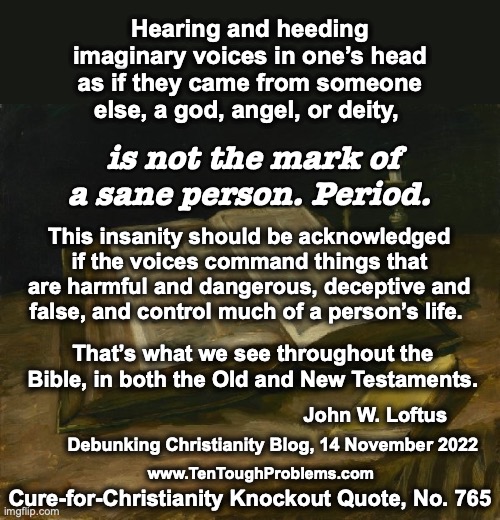
“Hearing and heeding imaginary voices in one’s head as if they came from someone else, a god, angel, or deity, is not the mark of a sane person. Period. This insanity should be acknowledged if the voices command things that are harmful and dangerous, deceptive and false, and control much of a person’s life. That’s what we see throughout the Bible, in both the Old and New Testaments.”
 
The Old Testament prophets claim that the word of Yahweh “came to them” and Joseph supposedly learned about Mary’s pregnancy in a dream. This is yet more magical thinking. 
 
There has been a lot written about Paul’s state of mind, and Loftus sums up the conclusions of many secular thinkers: “I can affirm with a great deal of confidence that Paul was functionally insane, if he were living among rational people. But in a rational society Paul wouldn’t function well at all. He would be that homeless guy on the city street corner who proselytized with bullhorns and signs to no one, calling on people to ‘REPENT! FOR THE END IS NEAR!’” 
 
Robert Conner also wrote an essay, “Paul’s Christianity,” for Loftus’ 2019 anthology, The Case Against Miracles. Conner’s conclusion, at the end of his 25-page essay: “A more mature modern psychology with superior investigative techniques and tools can now question whether Paul of Tarsus was functionally, if not clinically, insane—and whether the religion he championed is based on delusion.” (p. 545)

                                             Loftus draws attention to Gerd Ludemann’s book, Paul: The Founder of Christianity. This title might puzzle many of the devout, who don’t appreciate New Testament chronology. That is, Paul’s version of the faith was preached long before the gospels were written, and much of their content might, in fact, be derived from his thought. On this, see especially, Mark Dykstra’s book: Mark Canonizer of Paul.
 
I’ve just scratched the surface of Loftus’ essay. It is worth careful study, especially by Christians who are inclined to ignore the origins of their faith—to protect their beliefs. Their belief in belief. Loftus also references Richard Carrier’s article, Kooks and Quacks of the Roman Empire: A Look into the World of the Gospels, in which he states:


“From all of this one thing should be apparent: the age of Jesus was not an age of critical reflection and remarkable religious acumen. It was an era filled with con artists, gullible believers, martyrs without a cause, and reputed miracles of every variety. In light of this picture, the tales of the Gospels do not seem very remarkable. Even if they were false in every detail, there is no evidence that they would have been disbelieved or rejected as absurd by many people, who at the time had little in the way of education or critical thinking skills.”
 
Christianity’s addiction to magical thinking guarantees that its foundations are incredibly weak. 


David Madison was a pastor in the Methodist Church for nine years, and has a PhD in Biblical Studies from Boston University. He is the author of two books, Ten ToughProblems in Christian Thought and Belief: a Minister-Turned-Atheist Shows Why You Should Ditch the Faith, now being reissued in several volumes, the first of which is Guessing About God (2023) and Ten Things Christians Wish Jesus Hadn’t Taught: And Other Reasons to Question His Words (2021). The Spanish translation of this book is also now available. 
 
His YouTube channel is here. At the invitation of John Loftus, he has written for the Debunking Christianity Blog since 2016.
 
The Cure-for-Christianity Library©, now with more than 500 titles, is here. A brief video explanation of the Library is here