The 2020 election was neither stolen nor rigged: A primer

Here’s the link to this article.

Analysis by Philip Bump National columnist

September 15, 2022 at 5:09 p.m. EDT

A professor at a university in Utah issued an appeal this week: Is there a resource that he can present to students to dispel them of the idea that the 2020 election was stolen?

Why people believe that the presidential contest was tainted by fraud is often complex and fundamentally detached from the available evidence. It must necessarily be; there is no good evidence that anything more than a scattered handful of fraudulent votes were cast. But the point is well-taken. As someone who has tracked scores of claims over the past 22 months, I am not aware of any compendium explaining that lack of evidence.

Keeping up with politics is easy with The 5-Minute Fix Newsletter, in your inbox weekdays.

So allow this article to serve as one.

Sign up for How To Read This Chart, a weekly data newsletter from Philip Bump

I’ve broken this out into three sections: Why claims of fraud emerged, why we can be confident that the election wasn’t stolen and why we can be confident that the election wasn’t “rigged.”

Why claims of fraud emerged

It’s useful to begin by explaining how this all started.

In spring 2020, the coronavirus shutdowns began just as political primaries were gearing up. States concerned about causing outbreaks of infections began bolstering mail-in voting systems, immediately triggering a backlash from Donald Trump. If the country were to increase mail-in voting, he said in late March, “you’d never have a Republican elected in this country again.”

This began a months-long effort to undercut and disparage mail ballots as inherently suspect, lest more Democrats cast ballots. Numerous articles and analyses debunked the idea, but Trump — trailing in the polls — amplified it repeatedly.

As Election Day neared, Trump’s complaints crystallized into a quiet plan. Having helped widen a partisan divide in how people voted — Democrats by mail and Republicans at polling places — Trump and his allies recognized that Republican votes would be counted more quickly in many states and reported first. That would give the impression that he had a big lead that was only later eroded by votes for Joe Biden, allowing Trump to claim (as Florida Gov. Rick Scott (R) had in 2018) that the election was being stolen. So if things were close, he’d just announce his victory at the outset.

The election was relatively close. Trump and his allies tried to claim that vote counting should stop, according to the plan, but it didn’t work. As it turned out, though, his incessant claims about fraud had made it easy to convince his base that the election was stolen anyway — facilitating his multipronged effort to retain power despite his loss.

His argument about rampant fraud was so successful that, in polling conducted by Fox News this month, half of Republicans say that they have no confidence at all that votes were cast legitimately and counted accurately in 2020. Republican primary candidates found it useful to echo the idea that the election was stolen both because it often earned a Trump endorsement and because it’s what the Republican primary electorate wanted to hear.

In other words, a lot of the claims of fraud are inherently self-serving and cynical. Consider Don Bolduc, the Republican nominee for Senate in New Hampshire. During the primary he was adamant in arguing that the election was stolen. Then he won the primary and moved to the general election. In short order, he repented.

Claims of fraud, seemingly propagated in this case for political utility, had served their purpose.

Why we can be confident that the election wasn’t stolen

Let’s now assess those claims more broadly.

The best starting point is to note that there has been no — zero, nada, none — demonstrated, credible example of even a small-scale systematic effort to illegally cast votes. There have been a few dozen isolated arrests, generally of people illegally casting ballots for themselves or family members. In fact, the Associated Press contacted elections administrators in each swing state more than a year after the election, learning that, at most, there were a few hundred questionable ballots cast. In total. Across all of the states. Out of millions cast.

There are few better examples of the proper use of Occam’s razor than to therefore dismiss any idea that rampant fraud occurred. The idea that some systemic, multistate effort to rig the election occurred without detection nearly two years later — in an environment where there’s millions to be made exposing one — is simply noncredible in the face of the alternative: There was no such effort.

Of course, there is no shortage of claims about alleged fraud floating out there. These fall into one of three categories: claims that depend on vague statistical analyses, claims that depend on unseen evidence and claims that have already been debunked or explained.

Before presenting examples of each variety, it’s worth pointing to one of the most robust assessments of fraud claims. In July, a group of Republican officials released a lengthy report documenting and debunking each of the lawsuits filed by Trump and his allies in the wake of the election. It covers a lot of ground. The odds are good that if you’ve heard some claim about fraud or “rigging” (see below), it’s addressed in that document.

Now, instead of debunking each of the common allegations about fraud, I’ll simply list them and link to places where you can read more detailed analyses of why each is inaccurate.

Claims that depend on vague statistical analyses

Claims that depend on unseen evidence

  • There is no evidence that foreign actors somehow changed votes over the internet, as MyPillow CEO Mike Lindell has repeatedly claimed.
  • There is no evidence that nonprofits collected illegal ballots that were then distributed to drop boxes by paid staffers, as alleged in the film “2000 Mules.” The purported evidence that was presented in that film is either falsecontrived or misleading.
  • Various audits of electronic voting machines have found no evidence of improprieties. In fact, swing-state counties in which Dominion Voting Systems machines were used mostly voted for Trump.

Claims that have already been debunked or explained

There are probably examples I’m forgetting. If so, please email.

One common response to delineations like this is that of course the media/the government/the FBI are going to claim that their analysis showed no fraud. After all, you can’t have a healthy conspiracy without a gaggle of conspirators.

So we back up a step. To assume that I’m in on the con along with all of the other sources linked above is to postulate a system involving thousands or tens of thousands of people, all of whom have agreed to stay silent simply to protect Biden. Or, at least, that hundreds of people in the government have all kept quiet about agreeing to mislead the public, despite the obvious financial and moral rewards for revealing a part in such a scheme.

Occam’s razor. Who has more reason to make dishonest claims about the election, the guy trying to get people to watch his movie claiming fraud or the guy who works for a privately owned newspaper? Who is more credible on the likelihood of fraud, independent researchers or a former president eager to maintain his grip on his base?

Why we can be confident that the election wasn’t ‘rigged’

Because Donald Trump’s claims about fraud were so hard to defend, a different narrative emerged among those wishing to appeal both to Trump voters and to reality. The election may not have been stolen, exactly, but it was rigged.

The argument has two prongs. The first is that states intentionally loosened voting rules and encouraged turnout in ways that hurt Trump. The second is that the whole system — technology companies, the media, the left — arrayed against Trump to hurt his reelection chances.

It is obviously true that states made it easier to vote remotely in 2020. We’ve been over this; there was a new virus spreading and state leaders wanted to limit the number of crowded polling places. The argument, though, is that the virus was used as a pretext for making it easier to vote.

This, by itself, is revealing. There have been various arguments made about how states or counties or outside groups created opportunities for more people to vote. Sometimes, the intent is explicitly to poison perceptions of the election, as with the insistence on calling funding for expanded voting access from Meta CEO Mark Zuckerberg “Zuckerbucks,” as though Facebook itself was trying to influence the outcome. But at their heart, these arguments depend on the idea that having more legal voters cast ballots in good faith is bad. That putting a drop box that hadn’t been approved by the legislature in a place where fewer people tend to vote — and where most voters are Democrats — is a grotesque effort to steal an election. Instead, of course, one might see it as an effort to unrig a system in which barriers to voting are removed and democracy bolstered.

In some cases, state officials instituted new processes for voting that were challenged by Republicans or the Trump campaign as being in conflict with state constitutions or legislative authority. This was often cited as a reason to reject the election results. But as the chief justice of the Pennsylvania Supreme Court put it when such a case was presented to him: “there has been too much good-faith reliance, by the electorate, on the no-excuse mail-in voting regime” to warrant tossing out the ballots. In other words, it’s silly to suggest that people told they could legally vote using mail-in ballots should see those votes thrown out and the overall results overturned because the loser of the election later raised an objection.

Then there’s the claim that the system worked against Trump. At times, this is argued with specifics, such as that the decision by social media companies to limit sharing of a story about Hunter Biden’s laptop affected the results. (This claim is often tied to a partisan, loaded survey.) But often it’s just offered generally; how could Trump win with the entire political and media culture arrayed against him? This is essentially unfalsifiable, so there’s not much more to say about it other than that this perceived bias itself often crumbles on close consideration.

There are various other after-the-fact claims about impropriety that have been debunked (there were no secret illegal ballots stashed under a table in Georgia) or dismissed (covering windows as votes were counted in Michigan was a function of a law barring videotaping the process). This was obviously part of Trump’s post-election plan, too: generate enough reports of smoke that people assumed there must be a fire. It was long the case that Trump would make contradictory claims about a situation, throwing out a large number of assertions with the understanding that he only needed people to believe one to take his side. The post-election period had thousands.

Those should not distract from the simple truth at play.

Donald Trump had reason to claim that the election was going to be stolen and later that it was.

There’s been no evidence of any large-scale effort to steal votes. There have been no rampant arrests; no one has come forward to expose such a system. This is true despite the enormous amount of scrutiny paid to the election results in nearly every state.

At the same time, there’s an obvious explanation for why Trump lost: People turned out in record numbers to vote and often did so to express approval or disapproval of Trump himself. How did Biden get 18 percent more votes in 2020 than Barack Obama did in 2008? In part because the population grew by 9 percent. But in part because Donald Trump was deeply polarizing and, as in 2018, voters wanted to send him a message.

The message was not received.

By Philip Bump

Philip Bump is a Post columnist based in New York. He writes the newsletter How To Read This Chart and is the author of The Aftermath: The Last Days of the Baby Boom and the Future of Power in America. Twitter

Freedom requires education: There’s no choice without knowledge

Here’s the link to this article.

Avatar photoby ADAM LEE

SEP 07, 2023

Two doors of weathered wood side by side in a stone wall | Freedom requires education: There's no choice without knowledge
Credit: Tim Green/Flickr, CC BY 2.0

Overview:

If you want to be free, you have to have an understanding of the choices. Conservatives who push book bans and rage against pluralistic education are fighting against their own stated goal.

Reading Time: 4 MINUTES

[Previous: No one has the right to starve a child’s mind]

Imagine you find yourself in a room, facing two doors.

One door is rough, weathered wood. The other is made of boards polished smooth.

There’s carved writing on both, but it’s in a language you don’t read, in characters you’ve never seen. There are chains of intricate symbols inlaid into the frames in gold and silver, but they’re utterly meaningless to you.

There’s just one thing you know. One door is the entry into a golden existence: a long life of peace, ease and good health, full of friends and love. The other opens onto a dark and gloomy road: a hard life of unhappiness, suffering, misery, loneliness, and early death.

Knowing that your fate is riding on the choice, which door would you pick?

The cosmic shell game

The correct answer—assuming you’re a rational skeptic—is that this isn’t a choice at all.

Making a choice implies reasons for doing one thing rather than another. You have to have some background knowledge, some way to evaluate which of the options before you is better. If you could read the language carved on the doors, or if you recognized any of the symbols, you might be able to make a better-than-chance judgment about the correct one. Without this knowledge, picking either door would be a blind guess. You might as well flip a coin.

Of course, in real life, we’re in an even worse place than this pared-down hypothetical. In the real world, there are more than just two doors. There are thousands, each one densely covered with their own writing and their own symbols (notwithstanding the evangelists who think there are only two choices: “My Religion” and “Everything Else”). In addition to that, each door is surrounded by a dense crowd of people yelling that their door is the one true way to happiness and all the others are pretenders.

Making a choice implies reasons for doing one thing rather than another.

Longtime readers may remember this as the scenario in my essay “The Cosmic Shell Game“. It’s a potent reason to distrust the truth claims of religious believers. No one can investigate all these options, and very few people even try. Instead, most people choose the faith they belong to because of an accident of birth. Their decision is effectively random, no more trustworthy than flipping a coin.

This argument doesn’t just apply to religions. It works equally well as a metaphor for philosophies, nationalities, political ideologies, and every other major life decision where making one choice forecloses others. How can anyone make any trustworthy or informed choices about anything, when the space of possibility is so large as to be unnavigable?

The lay of the land

It’s impossible to study every religion, philosophy and ideology in the universe to make a definitive ranking. Nevertheless, that doesn’t mean there’s no point in trying. We’ll never have perfect knowledge, but we can always gain more knowledge. And the more knowledge we have, the better the choices we can make. It’s like trying to hike across uncharted territory. Even if you don’t have a complete map, the more you know about the lay of the land, the better able you are to find a safe path.

This goes for every field of inquiry. The more you know about history, the more you can avoid repeating the mistakes of the past. The more you know about science, the less likely you are to hold a belief that was already tested and disproven. The more you know about culture, the more capable you are of judging what is or isn’t natural for humans.

The more you know about culture, the more capable you are of judging what is or isn’t natural for humans.

For best results, this knowledge should be a broad cross-section of humanity, not limited to one gender or one race or one religion or one country. It’s the same reason why diverse groups make better decisions: it’s less likely that everyone has the same blind spots, so one person will see what another overlooks. You can achieve the same effect as an individual by stocking your mind with the widest possible selection of human thought and knowledge.

That’s why pluralism is so important in education. It’s the answer to conservatives who think it’s an underhanded liberal ploy—a way to instill leftist values to the exclusion of all others. Actually, it’s just an acknowledgment of a basic fact of reality: it’s really complicated, and figuring stuff out is hard!

Knowledge sets you free

Conservatives say that freedom is their number one value, the thing they care about above all else. Fair enough. Here’s what I say to that: Freedom is only truly possible for an educated person—and the more education you have, the more free you are.

Anyone can be “free” in the wild-animal sense of pursuing immediate desires without constraint. But the truest, most uniquely human kind of freedom is the ability to make decisions that steer the course of your life. Just as in the two-doors analogy, that kind of freedom is only possible when you have the knowledge to make responsible choices. Otherwise, it’s just random guessing or blindly following the path presented by birth or society.

It’s knowledge that sets you free: both self-knowledge, and knowledge about the world.

If you had a kitchen cabinet full of cans, some of which were nutritious and some were poison—but you had no way of knowing which is which—would you boast about your “freedom” to pick any one you felt like? Of course not, because no one values the freedom of ignorance or the freedom to plunge blindly into danger. The only kind of freedom anyone wants is the freedom to choose right—whatever you believe the right choice to be.

It’s knowledge that sets you free: both self-knowledge, and knowledge about the world. It’s knowledge that gives you the power to shake off indoctrination, recognize fallacies for what they are, and choose the worldview whose claims are borne out by evidence.

Those First Copy-Cat Christian Theologians

Here’s the link to this article.

By David Madison at 9/08/2023

The imagined, invented Jesus of the New Testament 

The huge faith bureaucracy—aka the church—is guilty of many sins, but one of its major failings is deception. It specializes in diverting the attention of its faithful followers from what has been learned about Christian origins. Perhaps the greatest irony in this exercise in cheating is that major discoveries about Christian origins—including the unreliability of the gospel accounts of Jesus—have been made by devout scholars who had set out to prove that the gospels tell the true story of their lord and savior. 

But as professionally trained historians examined the gospels, it became clear that these documents fail to qualify as history. In 1835, David Friedrich Strauss published Das Leben Jesu, kritisch bearbeitet (The Life of Jesus, Critically Examined), in which he argued that the miracle elements in Jesus stories were mythical. In 1933, Charles Guignebert published another major study, titled simply Jesus, in which he wrote: “It was not the essence of Jesus that interested in the authors of our gospels, it was the essence of Christ, as their faith pictured him. They are exclusively interested, not in reporting what they know, but in proving what they believe” (p. 53). He labeled the gospels “propaganda texts.”

In his 1988 classic, Gospel Fictions, Randel Helms stated: “The gospels are, indeed—to a much greater degree than those who read them with pious inattention even begin to realize—imaginative literature, fiction, and critics have been using such terms about them for a long time” (p. 11).                         

Those who read them with pious inattention. This is what the church and the clergy are counting on. Indeed, surveys have shown that most laypeople don’t spend a lot of time reading the gospels, let alone studying them. We can assume that the clergy do this kind of study, and know the problems presented—and they dearly hope the laity won’t notice. Again, Randel Helms:

“Perhaps the earliest revision of Mark is to be found in the Gospel of Matthew. Of the 661 verses in Mark, 606 appear in Matthew, many with deliberate stylistic and theological changes, others with fictional additions” (p. 35, Gospel Fictions). 

Thousands of Bible scholars in religious academia have examined the gospels thoroughly, and, as Helms notes, “have been using such terms [imaginative literature, fiction] for a long time.” But all of this has happened beyond the awareness of church folks, who might wonder, “What’s going on?” if they carefully considered what Matthew did with Mark’s text. And how shocking that the Jesus in John’s gospel is so very different from Mark’s Jesus. Comparison of the gospels is dangerous business, but studying the context in which Christianity arose even more so. 

The laity, however, treasure the “greatest story ever told,” without giving much—if any—thought to how the story was fashioned from so many different ideas that were circulating at the time. Nor do they want to think about it. Faith is commonly preserved by ignoring information that may jeopardize cherished beliefs—mainly, I suspect because doubts are not too far below the surface.  

Last March I published an article here in which I commented on some of the religious ideas in circulation in the first century, based on Richard Carrier’s massive documentation of these concepts when Christianity first emerged. In fact, he lists 48 elements that are crucial for an understanding of Christian origins.  See pp. 65-234 of On the Historicity of Jesus: Why We Might Have Reason for DoubtChances are close to zero that churchgoers would read this book, although Carrier has made a point of writing in an easily-accessible style—and he explains why in his Preface. 

In the March article, I focused on Elements 4, 15, 31 and 43. Let’s look at four more. 

Element 11, pages 96-107

“The earliest definitely known form of Christianity was a Judeo-Hellenistic mystery religion. This is also beyond any reasonable doubt, yet frequently denied in the field of Jesus research, often with a suspiciously intense passion” (p. 96, OHJ). Of course, Christian apologists want to resist any suggestion that their faith is derivative. 

“If we then expand that definition to include a set of specific features held in common by all other mystery religions of the early Roman era, then Christianity becomes even more demonstrably a mystery religion, so much so, in fact, that it’s impossible to deny it was deliberately constructed as such. Even the earliest discernible form of Christianity emulates numerous cultic features and concepts that were so unique to the Hellenistic mystery cults that it is statistically beyond any reasonable possibility that they all found their way into Christianity by mere coincidence” (p. 96-97 OHJ). 

“…all [mystery religions] involve a ritual meal that unites initiated members in communion with one another and their god (1 Cor. 11:23-28). All of these features are fundamental to Christianity, yet equally fundamental to all the mystery cults that were extremely popular in the very era that Christianity arose. The coincidence of all of these features together lining up this way is simply too improbable to propose as just an accident” (p. 99, OHJ).

While such beliefs thrived in the milieu which gave birth to Christianity, some aspects were much older. Carrier notes later in the book that “…the savior cult of the resurrected Zalmoxis (of Thracian origin) is clearly attested in Herodotus centuries before Christianity; the imperial cult of the resurrected Romulus is likewise attested in several pre-Christian authors…” (p. 171, OHJ).

I recommend a careful reading of Carrier’s Element 11, paying close attention to the detailed information that he provides in the footnotes. These pages do a splendid job of destroying any claim that Christianity is the one true faith. 

It’s obvious how much early Christian theologians imagined/invented their Jesus according to ideas popular in other cults at the time. 

Element 16, pages 137-141

“The earliest Christians claimed they knew at least some (if not all) facts and teachings of Jesus from revelation and scripture (rather than from witnesses), and they regarded these as more reliable sources than word-of-mouth (only many generations later did Christian views on this point noticeably change)” (p. 137, OHJ).

“…people often received communications from Jesus via revelation (even if indirectly: i.e., through intuited feelings attributed to the holy spirit, or visions or prophetic messages communicated through angels or subordinate spirits), and no one thought this was unusual or inferior to any other source. To the contrary, Paul’s argument in Galatians 1 entails Christians had the opposite view: that information derived by revelation was more authoritative and trustworthy than any human tradition” (pp. 138-139).

A startling example of this is the Christian ritual meal, known as communion or the eucharist: Just where did it come from? “Well, Jesus at the last supper, of course,” is the natural response. But where do we find this Jesus-script for the first time? In I Corinthians 11:23:26, written by the apostle Paul—well before the gospels existed—who didn’t know Jesus, was not at the last supper. Paul bragged (Galatians 1:11-12) that he learned nothing about Jesus from the people who had known him. Paul claims in the opening verse of this text that he received these words “from the lord.” Which means in his visions, i.e., his hallucinations of the heavenly Jesus. It seems likely that the author of Mark’s gospel based his last supper Jesus-script on what he found in I Corinthians 11. Oh the irony: Mark invented a scene, using Paul’s words of Jesus that he imagined in visions. 

Element 16 illustrates the primary reason why secular—and even many devout—historians distrust the stories we find in the gospels especially. They cannot be verified by contemporaneous documentation, e.g. letters, diaries, transcriptions, interviews of eyewitnesses. The early Christian authors were okay with what they saw/heard in visions. Other religions do exactly the same thing, resulting in vastly different concepts of the divine. 

Ever wonder how Christianity ended up in such a mess today? By which I mean thousands of different denominations, divisions, sects, cults. It’s such a scandal that Christians have never been able to agree on their god, Jesus, and the proper forms of worship. 

Well, it was that way from the very beginning….

Elements 20 and 21, pp. 146-148

“Element 20: (a) The earliest known Christians proselytized Gentiles but required them to convert to Judaism. (b) Paul is the first known Christian to discard that requirement (having received a special revelation instructing him to), and he had to fight the earliest known leaders of the cult for acceptance of that radical idea. (c) But some books in the NT are from the sect that did not adopt this innovation but remained thoroughly Jewish (most obviously Matthew, the letters of John and James, and Revelation)” (p. 146, OHJ).

“Element 21: Paul and other NT authors attest that there were many rival Christian sects and factions teaching different gospels throughout the first century. In fact, evidence of such divisions and disagreements date as far back as extant records go” (pp. 146-147, OHJ).

“The epistles written during the first generation of Christians (from the 30s to the 60s CE) reveal a highly fragmented church already from the earliest recorded time, rife with fabricated new gospels and teachings effectively beyond the control of any central authority” (p. 147, OHJ).

It never dawned on these ancient rivaling Christians that their visions/revelations did not deliver reliable, trustworthy information about their god and his holy hero. And the failure of critical thinking continues to this day, when the devout are confident that they know god and Jesus because they “feel him in their heart.” Yet they fight tooth and nail against other devout Christians whose heartfelt feelings are so very different. 

It’s no mystery at all that Christianity remains such a mess.  

David Madison was a pastor in the Methodist Church for nine years, and has a PhD in Biblical Studies from Boston University. He is the author of two books, Ten ToughProblems in Christian Thought and Belief: a Minister-Turned-Atheist Shows Why You Should Ditch the Faith, now being reissued in several volumes, the first of which is Guessing About God (2023) and Ten Things Christians Wish Jesus Hadn’t Taught: And Other Reasons to Question His Words (2021). The Spanish translation of this book is also now available. 

His YouTube channel is here. At the invitation of John Loftus, he has written for the Debunking Christianity Blog since 2016.

The Cure-for-Christianity Library©, now with more than 500 titles, is here. A brief video explanation of the Library is here

The Mind Held Captive

Here’s the link to this article.

By Merle Hertzler / 2023-08-28

If you search for my site, The Mind Set Free, you are likely to first find a book and sermon by Jimmy Evans, A Mind Set Free. Evans promises mental freedom. Yet he relies on the theme verse, “Casting down arguments, and every high thing that exalts itself against the knowledge of God, bringing every thought into captivity to the obedience of Christ.” That does not sound like mental freedom to me. That sounds like mental captivity.

By contrast, when I speak of the mind set free, I am encouraging intellectual freedom, which is the freedom to explore ideas that differ with your religious background or cultural demands. Evans, however, asks people to commit that they will listen only to that which is consistent with what he calls The Word of God. He asks people to consciously block out ideas that differ with that Word of God. That is mental captivity.

The Place of the Skull

He explains why he thinks they crucified Jesus at a location called The Place of the Skull. It turns out God chose this place, Evans tells us, because God wanted to show the inherent corruption of natural thoughts that takes place inside our skulls. How does Evans know this is the reason for the selection of this site for the crucifixion? He doesn’t know this. But it makes for a good story. And so, he tells it as truth, not merely as one possible explanation. We hear that Jesus died in the place of the skull so he could let us know he wanted control of what happens in the skull. Really? That explanation sounds contrived.

I know how this works. Years ago, I regularly taught Sunday School. One can simply make up an explanation that sounds feasible, and so that is what it is. There is no need to question it or say this is just one interpretation. We found an explanation, so that’s how it is. Onward.

We hear that the devil and others are corrupting our thoughts in our skulls. What is his solution? He asks us to cast those thoughts out. We cannot allow ourselves to listen to anything that differs with The Word of God, which is, or course, his name for the Bible.

Why listen to The Word of God? He explains that the words in the Bible are so powerful, they even brought into existence the very matter that forms the pulpit from which he is preaching. That is quite a stretch. First, nobody knows how the universe came into existence, but most likely the ultimate cause of the universe did not even have a mind. But even if the ultimate source of the universe had a mind, and we choose to call that mind God, we are still a long way from proving that this cause revealed himself in the ancient Hebrew scriptures and that the Bible contains his words. But even if that book contains God’s words, those words wouldn’t be the same words that created the atoms that made up his pulpit. Nevertheless, Evans somehow equates the words of the Bible with words that created all the matter we see. So, listen up!

He tells us to force ourselves to live by these words that he finds so powerful. “Every thought that comes into my mind,” he argues, “I need to point a spear under its neck and say ‘You are going to listen to what Jesus has to say’…Any thought that does not agree with the Word of God, I take it out.”

A lot of thoughts pass through my mind each day. Even if I wanted to avoid thinking them, how would I prevent my mind from thinking about these things? I don’t even know what my next thought will be. How can I prevent it from being one that opposes the Bible? He proposes that we block out those thoughts through biblical meditation.

Biblical meditation, as he defines it, is quite different from Eastern meditation, which is a process by which one empties the conscious thought stream while observing the thoughts that enter the mind outside of the normal stream of conscious thought. Some find that emptying the conscious mind this way is an effective method to see what is really going on inside the mind outside the clamor of everyday life. Others use relaxing vacations to do the same thing. The whole idea is to give the mind a little freedom to generate its own thoughts.

But biblical medication, as he proposes it, is the opposite of emptying the mind to give it freedom. Instead, he argues for purposely filling one’s mind with a particular set of thoughts. He asks us to force these thoughts from The Word of God into our consciousness night and day, constantly ruminating on them, constantly forcing the consciousness to dwell on the desired thoughts. We overcome atheist thoughts, he says, by forcing the correct thoughts–the thoughts that supposedly created atoms–into our minds.

To illustrate this, he tells us that, if we are told we should not think about a yellow elephant, we would find it hard to keep thoughts of yellow elephants out of our minds by sheer willpower. But if, instead, we force ourselves to think about purple lizards, then we won’t be thinking about yellow elephants. And so, he tells us, if we constantly think about the Bible (or purple lizards), then we won’t be able to think about atheist books (or yellow elephants).

The whole idea of trying to suppress certain thoughts often has paradoxical results. In psychology, Ironic Process Theory suggests that trying to suppress thoughts actually makes them stronger. In a famous experiment Daniel Wegner found that subjects who tried not to think of white bears later found themselves thinking of white bears even more. In another experiment subjects listening to a story on a tape were divided into three groups that were each instructed either to a) deliberately not think about the tape, b) think about anything at all, or c) think about anything including the tape during the time the tape played. After the story finished, those who had been asked not to think about the story were more likely to talk about the story compared with those in the other groups. Similarly, another experiment found that subjects with a spider phobia, who were told not to think about spiders for five minutes, found themselves more likely to speak about spiders after that period was over. In yet another experiment, subjects with chronic low back pain were asked to play a computer game against a harassing opponent. Some subjects were told to suppress feelings of anger during the game. Those subjects who were told to suppress feelings of anger were later more angry and more aware of their chronic back pain after the game was over.

All these experiments show it is not easy to suppress thoughts and feelings. Attempts to do so can have paradoxical effects. The suppressed thoughts often later rebound to become very strong. The person who is going to continually suppress thoughts against his religion and force himself to think only thoughts in line with his beliefs, can find himself needing ever larger efforts to keep the unwanted thoughts out. The result is not mental freedom. It is mental captivity.

When we hear new ideas, and our minds are interested, then it is fine to listen. That is what I refer to as the mind set free. It is simply observing that some new way of viewing the world has stimulated our thinking and then taking the time to understand and analyze that new view. If we find the new thoughts helpful, we can incorporate them into our worldview. If we find the new ideas worthless, we now understand why we don’t want to pursue those ideas further. If the ideas come up again, we know immediately why we rejected them before. No need to pursue them further. We already thought it through. Those thoughts already had their day in court. We move on. That is true mental freedom.

But Evans apparently would not have us take time to understand opposing thoughts coming from the world. He tells us instead to take those thoughts out. When the atheist speaks, we should apparently metaphorically clap our hands over our ears and shout the thought down: “I don’t hear you! I don’t hear you! Thus saith the Lord…Be gone, yellow elephant. Purple lizards, purple lizards, I am thinking of purple lizards. I don’t see no yellow elephant!”

That is not mental freedom. It is mental captivity.

Self-Esteem

One thought stream he tells us to avoid is thoughts of low self-esteem. I agree that self-esteem issues can lead to depression and anxiety, so yes, it is important to have a healthy self-esteem. The combination of our biology and previous experiences can sometimes lead many of us into dangerously negative self-thoughts. That is a real problem. To overcome this, Evans resorts again to his self-brainwashing technique, in which one overflows the mind with thoughts he considers proper such that the negative thoughts don’t even have a chance.

With his technique, we endlessly concentrate on The Word of God. One verse he suggests is Psalm 139:14, “I am fearfully and wonderfully made.” So, if you are feeling down, just keep repeating this verse? I can tell you from experience this does not work for me. Constantly repeating a verse that tells me what to think does not overcome what the mind wants to think.

Yes, we are wonderfully made. Any biology book will tell you the amazing details of human biology. And many books talk about the marvelous things that we can do. But, of course, our biology is also deeply flawed, leaving us susceptible to diseases and unnecessary limitations, and our inner selves can also be flawed. But still, the overall being is good. And so, we can find many reasons to view ourselves as something worthy of value and respect. If we understand those reasons, we can truly feel good about ourselves, while balancing this positive view with realistic knowledge of our limitations. Such understanding is far more fruitful than repeating that an ancient book says I am wonderfully made. We overcome low self-esteem by understanding what it means to be good as a human. We cannot overcome it by drowning out reason with a steady stream of preferred thoughts.

Evans turns to another verse to build our self-esteem: “I can do all things through Christ who strengthens me.” (Philippians 4:13) Here we have a statement that is simply false. You cannot do all things, even if Christ strengthens you. You are human. You have human weakness. You are limited. Endlessly repeating that we can do all things is simply brainwashing ourselves to believe something that is not true. If you truly force yourself to believe that you can do all things through Christ, then you have an unrealistically high view of yourself, a view that others that see you can easily interpret as hubris.

If your solution to negative self-thinking is unrealistically positive I-can-do-all-things thinking, it is no wonder that such positive thoughts don’t do well at crowding out the negative. Eventually those suppressed negative thoughts push their way to the forefront of consciousness. It is better to instead understand the many facts about the whole self that are both realistic and positive.

In the popular secular treatment, Cognitive Behavioral Therapy, patients learn about negative thoughts that distort reality, such as, “People always focus attention on me, especially when I fail, ”  “Only my failures matter. I am measured by my failures,” and I am responsible for every failure and every bad thing that happens.” These are distortions of reality. In Cognitive Behavioral Therapy, one learns to identify these distortions that are clouding the thinking and learns to view things more positively based on realistic assertions. Such therapy is far different from the therapy that simply brainwashes one’s self into thinking one set of thoughts that is not exactly true in the real world.

Evans tells us that it is the devil that is telling us to have low self-esteem. One wonders then why the Westminster Confession of Faith says, “We are utterly indisposed, disabled, and made opposite to all good, and wholly inclined to all evil,” and why John Calvin taught that self-love was a noxious pest. Were these people doing the work of the devil? Faced with the facts, Christians simply abandoned the historical Christian teaching on self-esteem, and conveniently find that thoughts which promote self-esteem were in their Bible all along. But the positive thoughts they are finding in the Bible are often far from reality.

Lust

Evans turns next to a discussion of sexual desire. He tells us that, when he was young, sexual thoughts overwhelmed him. He doesn’t tell us if his desires were for men or women, and I don’t care. Sexual thoughts are totally normal in young people. I have no problem with a person having and enjoying thoughts of sexual arousal, provided one doesn’t then behave and talk in ways that are inappropriate.

How did Evans conquer his lusts? “I began to meditate on scripture,” he tells us. “I got set free that quick,” he says with a snap of his fingers, “It didn’t take two seconds.”

Somehow, I don’t believe it was that simple. If sexual thoughts come to my mind, then no, constantly repeating “whoever looks at a woman to lust for her has already committed adultery with her in his heart,” (Matthew 5:28) does nothing to help me. Instead, I could simply acknowledge the thoughts and find ways to act morally and respectfully in the situation. If the drive becomes strong, there are ways for people to later relieve the urges in the privacy of one’s bedroom or with a consensual adult partner. But if one insists on removing the thoughts through self-brainwashing alone, then I doubt this will do the trick in two seconds as claimed. When faced with sexual desires, endlessly repeating Bible verses until the thought goes away only induces guilt without addressing the thoughts. Such attempts at mental freedom do not work.

Suppressing sexual desires can have all the familiar paradoxical effects of suppressing any thoughts. The suppression can lead to the thoughts becoming stronger. By contrast, understanding, accepting, and dealing rationally with the desires can break the power of those thoughts.

Bruce Gerencser has documented countless times that members of the clergy have been charged with black collar crimes, often involving sex. No doubt many of these people knew verses about sexual purity, preached them, and thought about the verses often. But in the end, somehow the urges allegedly drove these people to immoral activity. Endless meditation on commands does not end the desires. Understanding the desires and appropriate responses is far better.

Conclusion

Evans promises that his technique of metaphorically shouting down every idea that differs from the Bible is guaranteed to free you from fear, anxiety, depression, and lust, and that any Christian who does not know such verses is bound for defeat. He is simply wrong. Ask any good psychologist. There is simply no evidence that forcing yourself to think about how Jesus does not want you to fear, become discouraged, or lust will solve your problems. There are plenty of other good psychological options.

If you agree with Evans’ technique of closing your mind to every idea that differs with the Bible, it is doubtful that you have read this whole post. The words written here are specifically words he probably wants you to avoid. It is your choice. If you want to allow only those thoughts that say the Bible is God’s word, that say you can do all things through Christ, and that condemn any thought of sexual fulfillment outside of strict biblical norms, be my guest. But please, do not call that a mind set free. It is not. It is a mind held captive.

Bremerton’s praying football coach got what he wanted, so now he may quit for good

Here’s the link to this article.

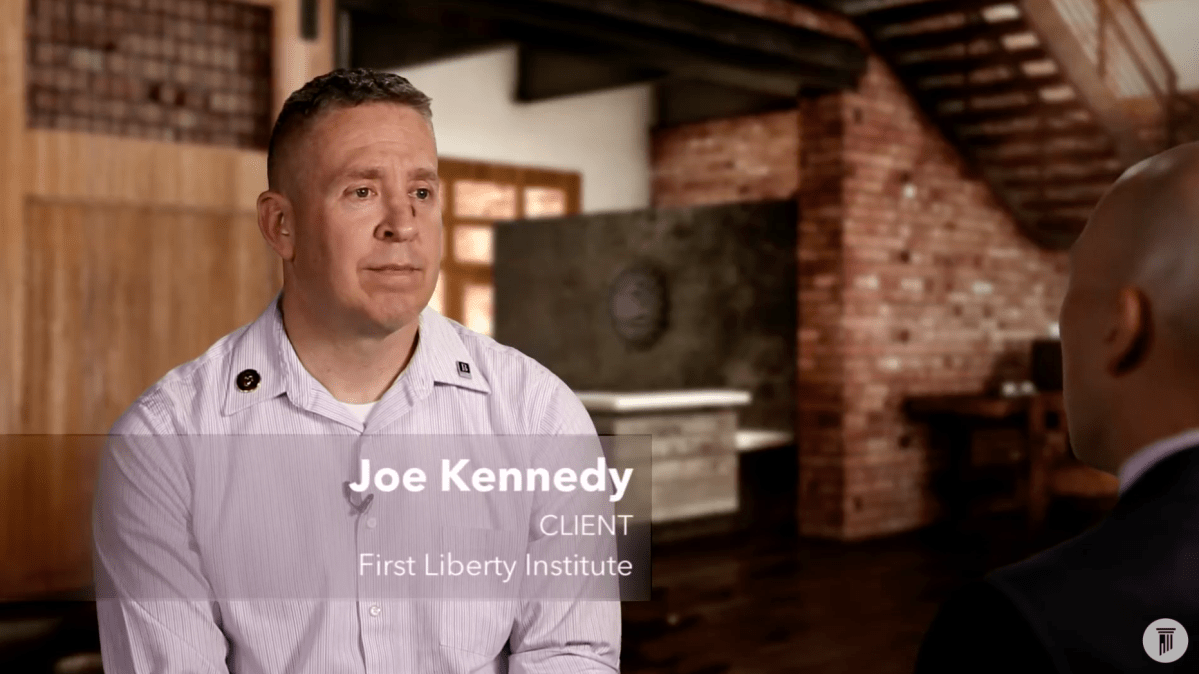
Christian football coach Joe Kennedy returned to the field Friday night, perhaps for the last time

HEMANT MEHTA

SEP 2, 2023


Last night marked the first football game of the season for the boys at Bremerton High School in Washington—they won 27-12—but the majority of spectators were there to watch something else entirely: A post-game prayer from assistant coach Joe Kennedy. A prayer made possible by a right-wing majority on the Supreme Court that ignored the facts in order to let Kennedy have his moment at the 50-yard line.

After the game was over, Kennedy walked to midfield for a brief, uneventful prayer during which he wasn’t surrounded by anyone. He got the attention he wanted before heading back to the locker room.

For all the events that led up to that moment, it may have been his last time on the field.

Joe Kennedy delivers a performative prayer after Bremerton’s game (via @JeffGrahamKS / Twitter)

A quick refresher in case you forgot: Kennedy argued that he lost his coaching job in 2015 because he wanted to deliver a quiet Christian prayer at midfield after games. All of that was exaggerated or untrue. He was never actually fired. The prayers weren’t “quiet.” And the concern was far more about the coercive nature of his showboat prayers, not his ability to privately pray. But the only reason the Bremerton case was in front of the Supreme Court at all was because, theoretically, their decision was the only way Kennedy could regain his job and the right-wing justices were eager to jump into the fray.

In 2022, the Court’s conservative majority ignored the facts of the case and sided with Kennedy, further eroding church/state separation and requiring the district to give him his old job back. The district is now obligated to pay attorneys’ fees amounting to over $1.7 million, some portion of which will be paid through their insurance.

Despite Supreme Court win, Bremerton's praying football coach is long gone | Former Bremerton football coach Joe Kennedy

The irony with the Supreme Court’s decision was that it seemed hard to believe Kennedy was just going to waltz back onto the football field. He moved away from Bremerton to Florida years ago. Was he seriously going to move back for a low-paying coach position?

Last September, months after the decision came down, the Seattle Times reported that Kennedy was nowhere to be found. Was he too busy being a conservative celebrity to actually do the job he claimed he wanted (which is precisely what atheist groups predicted would happen)? Yes and no.

It’s true that Kennedy will soon release a ghostwritten memoir called Average Joe: The Coach Joe Kennedy Story. There’s also a movie about him in the works produced by the God’s Not Dead people; while he’s not directly involved with it, he’ll presumably be involved with the publicity campaign. But the delay on the field likely had more to do with paperwork than anything else. Only this past March did the district announce that everything was finally completed:

Mr. Kennedy will be an assistant football coach for Bremerton High School for the 2023 season.  Mr. Kennedy has completed human resources paperwork and we are awaiting the results of his fingerprinting and background check.  Mr. Kennedy will need to complete all training required by WIAA.  Football coach contracts are approved by the Board at the August 3, 2023 board meeting, and begin in mid-August. As with any other assistant coach, Mr. Kennedy will be included in coaching staff communication and meetings, spring football practice and other off-season football activities.

That’s why it took until last night for Kennedy to finally get back on the field. First Liberty Institute, the conservative legal group that backed him, urged other coaches to pray at midfield Friday night in solidarity, though it’s not clear if anyone did that.

But despite everything Kennedy went through to get back his position, it may also have been his final game because the pull of Christian celebrity is as strong as ever. Besides the book and movie, the Seattle Times notes that Kennedy gets paid to give speeches and that politicians like Ron DeSantis have attempted to get his endorsement. (Not surprisingly, Kennedy is a firm Donald Trump supporter.)

Need more evidence coaching isn’t in his future? He hasn’t bothered moving back to Bremerton.

He’s currently housesitting, and said he and his wife have talked about parking an RV on her sister’s property in the area during football season.

They’re not looking for homes in the community. They haven’t sold their property in Pensacola. Kennedy wouldn’t answer questions about his plans beyond Friday:

… Will Kennedy stick around after the first game?

On the last question, he’s not saying. Everything’s been leading up to Friday’s game, he said, “the fine bow” on top of his Supreme Court victory, which overturned lower court rulings and the public school district’s directive against overt activity while on duty that could be taken as an endorsement of religion. He insisted he can’t think further ahead than Friday.

What sort of football coach can’t see past the first game of the season? One who’s already heading toward the exits, that’s who. Kennedy also added that his future plans might include “some ministry or something.”

If and when he walks away, it’ll be definitive proof that he’s only coaching for the purpose of praying on the field. Does anyone seriously think he’s doing this for the students? How shitty must those athletes feel knowing that, regardless of how they play, all the media attention will be on a coach who has already planned a future without them?

As any high school coach could tell you, the job is a sacrifice. You don’t get paid much and it takes a lot of time, but you do it because you love the students. You do it because what you get out of it is more valuable than a paycheck. When Kennedy used his platform to advertise his religion, it was clear the students were not his main priority. It’s clear that hasn’t changed in eight years.

He never cared about the kids, the team, or the job. He only ever cared about himself.

Last night, the Freedom From Religion Foundation announced that they had placed a billboard about two minutes away from the high school. It says, “Wishing Bremerton High School a safe, secular & successful school year.”

It’s a fine message that capitalizes on the story, but it’s telling that the atheists are focused on what’s best for students while Joe Kennedy’s main concern is staring back at him in the mirror.

“Coach Kennedy’s antics are a desperate way of keeping his unconstitutional agenda in the spotlight,” says FFRF Legal Director Rebecca Markert. “We’ll be countering it whichever way we can.”

To their credit, the district issued strict guidelines about Kennedy’s prayers in accordance with the SCOTUS decision and the law as it stands: Any prayers (a.k.a. “personal conduct”) had to occur outside of game time when coaches were on duty, and only when students were at least 25 feet away at the start of it. In short, they were saying the prayer had to be a solo event after the game even if students decided to join in after it began. Looks like the students didn’t want to do that last night.

If Kennedy really cared about these students, he’d accept his SCOTUS victory and let the kids play without him there. He has no reason to be there other than a desperate desire for the spotlight—and to create a postscript for the movie version of his life. He could easily have stayed in Florida and said that God gave him the ultimate victory so now, for the sake of the children, he’ll stay put in Pensacola so that the attention remains on the student athletes where it belongs. He didn’t do that. He wanted to bask in the glory once more because he thinks high school football is all about him.

Once he’s gone, which could be very soon, the attention will finally be where it belongs: on the students playing the game, not the coach using them for his personal benefit.

They’re Picking on Religion, So Onward Christian Soldiers

Here’s the link to this article.

By David Madison at 9/01/2023

But a few Standards of Honesty are in order

While I was in the process of writing my 2016 book, Ten Tough Problems in Christian Belief, I set up a Facebook page to promote it. When the book was published, I did weekly paid boosts to help sales. I specified the target markets, e.g.. atheists, secular, humanist. Even so—don’t ask me how—my boosts showed up on Christian Facebook pages. What horrible reactions! None of the enraged Christians showed the least interest in engaging in the issues I raised. It was all hate and hasty conclusions, e.g., you were never a real Christian, you’re a terrible person, you’re going to hell. I eventually gave up on the paid boosts. So I guess the Christians won that round.

I also resolved never to go onto Christian blogs or websites to advocate atheism. This would be akin to me walking into a church on Sunday morning, going up to the pulpit and arguing with the preacher. Among other things, this would be bad manners. 

But does this mean that Christians arguing with atheists on the Debunking Christianity Blog is bad manners? No, not at all

However, there are a few Standards of Honesty that should be observed, respected. On 11 August, I published an article here, “My overdosing on religion was becoming a serious problem.” I offered my comments on a 2016 essay by Josiah Hesse, in which he confessed the agonies he suffered because of childhood indoctrination, in an apocalyptic Christian cult; it had been a brutal experience. This prompted a Christian apologist—I assume—RosAnarch, to dive in with very long comments, which provoked heated exchanges with regular followers of this blog. To date, there have been 209 comments. I wondered what Standards of Honesty should apply.    

Standard of Honesty One: Don’t remain anonymous

Anyone who wants to take on a major role as expert and critic should identify themselves. Why hide behind a pseudonym? Especially since being a defender of religion is not, in the current climate, dangerous. Why RosAnarch instead of your name? Who are you, what are your credentials and your profession? What Christian brand do you represent—if indeed you are an apologist? If I were to walk into that church on a Sunday morning to argue with the preacher, I’d state my name and credentials: Ex-clergy atheist, nine years a Methodist pastor, PhD in Biblical Studies. My business card, which I give to anyone who seems interested, reads David Madison, Atheist Author and Advocate.  

Standard of Honesty Two: Address the primary point of an article, i.e., avoid diversionary tactics. 

The point of my 11 August article was that early childhood indoctrination—these days called grooming—had done considerable damage to Josiah Hesse. RosAnarch set out to show that I was misrepresenting religion, and cited studies showing that evils can derive as well from folks who are not religious at all. How can there be any debate about that? Greed, territoriality, lust for power, and just plain being terrible people has caused so much evil and suffering. But when you add fervent conviction that there is a god justifying horrible acts,the evil can be intensified. In the 11 August article I mentioned the Crusades, and anti-Semitism fueled by the gospel of John and Martin Luther’s deranged rants against the Jews. For the role of religion in rage against Jews, see especially Hector Avalos’ essay, “Atheism Was Not the Cause of the Holocaust,” in The Christian Delusion: Why Faith Fails, edited by John Loftus. 

Take a look at the French Wars of Religion, and the Thirty Years’ War, which John Loftus has pointed out 

“…pitched Christians against Christians. Roman Catholicism and Protestant Calvinism figured prominently in the opposing sides of this conflict…Estimates show that one-third of the entire population of Germany was killed…we’re talking about a Christian bloodbath.” (The Christian Delusion: Why Faith Fails, p. 194)

But enough of this diversion. My article was about the harm done by Christian grooming. Even if Sunday School, catechism, and parental coaching don’t cause the extreme damage that Josiah Hesse endured, what do the clergy construe as a positive outcome? They’re delighted if the children in their charge grow up accepting a bundle of ancient superstitions. Christian theology is grounded in the brutal, rampaging god of the Old Testament—with little improvement in the New Testament. Required animal sacrifices in the ancient scriptures were replaced—after the destruction of the Jerusalem Temple in 70 CE—by a single human sacrifice, as a way to get right with god. Some Christian theologians added the ghoulish idea that eating the flesh and drinking the blood of the human sacrifice was proper ritual for gaining eternal life. That is, magic potions. The apostle Paul added magic spells, e.g. Romans 10:9. If you believe—and say it—that the human sacrifice rose from the dead, you’ll be saved. 

How in the world does accepting this bundle of superstitions help people function in our world today? I suspect many of them just park it in the backs of their minds, and get on with life. And if any of them were asked for evidence to verify what their clergy/parents had taught them, they would be at a loss. Their response might be, “Gee, isn’t it in the Bible?”   

I recommend reading Josiah Hesse’s article, to get a full grasp of what he went through. That was the damage done by religion I hoped to convey. 

On the issue of damage caused by religion, there are historical realities that it is helpful to recall—and difficult to dismiss. Theologians have found it necessary to knock the rough edges off the god depicted in the Bible, and in their flights of speculation and fantasy, they came to portray their god as all-powerful, caring, loving—and in the bargain—aware of everything that goes on with every human. It takes a great deal of gerrymandering to make this god look good. In the face of so much suffering—genetic diseases, plagues, mental illness, very high infant mortality rates for millennia—it’s indeed a great mystery that a wise, competent god neglected to give humanity crucial information that could have helped enormously. We have a Bible—more than a thousand pages of it—with no information on why we get sick, and how to prevent it. 

In fact, there are Bible texts that are quite misleading. In the famous story of the Jesus healing the paralytic who had been lowered through the roof to reach Jesus, we find this Jesus-script:

“Which is easier: to say to the paralytic, ‘Your sins are forgiven,’ or to say, ‘Stand up and take your mat and walk’? But so that you may know that the Son of Man has authority on earth to forgive sins”—he said to the paralytic— “I say to you, stand up, take your mat, and go to your home.”  (Mark 2:9-11)

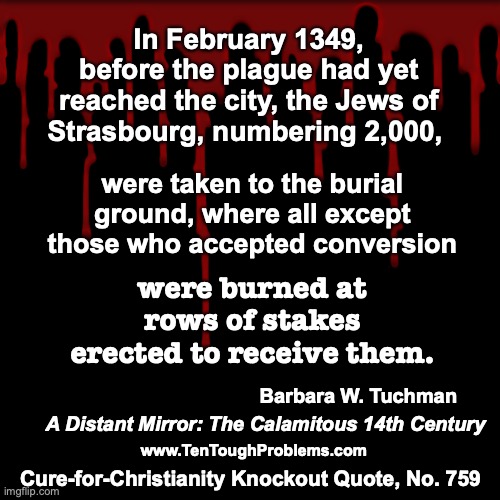
The concept here is that sin causes illness. And at the time of the Black Plague in the 14th century, this idea provoked extreme behavior. Barbara Tuchman describes the behavior of the flagellants:

“In desperate supplication for God’s mercy, their movement erupted in a sudden frenzy that sped across Europe with the same fiery contagion as the plague. Self-flagellation was intended to expressed remorse and expiate the sins of all. As a form of penance to induce God to forgive sin, it long antedated to plague years. Flagellants saw themselves as redeemers who by re-enacting the scourging of Christ upon their own bodies and making the blood flow, would atone for human wickedness and earn another chance for mankind. 

“Organized groups of 200 to 300 and sometimes more (the chroniclers mention up to 1,000) marched from city to city, stripped to the waist, scourging themselves with leather whips tipped with iron spikes until they bled. While they cried aloud to Christ and the Virgin for pity, and called upon God to ‘Spare us!’, the watching townspeople sobbed and groaned in sympathy.” (p. 119, Tuchman, A Distant Mirror: The Calamitous 14th Century

This is religion-induced misery.

Tuchman mentions another example of religion-induced rage. RosAnarch criticized me for stating that religion can result in rage—but this makes my point:

“In February 1349, before the plague had yet reached the city, the Jews of Strasbourg, numbering 2,000, were taken to the burial ground, where all except those who accepted conversion were burned at rows of stakes erected to receive them.” (p. 119, A Distant Mirror)

Why didn’t god show up in some fashion, get the word out in some way?  “No, no, no, you’re not getting sick because of sin or rebellion against Christ. It’s microbes, it’s the fleas!” How do theologians/clergy make sense of this divine neglect/incompetence? “God works in mysterious ways” is a useless cliché —it doesn’t work at all.   

Standard of Honesty Three: Try to offer balanced evaluations

At the beginning of my 11 August article, I mentioned the volcano of Christian rage that erupted on social media when Christopher Hitchens died in 2011. This was when many pious folks learned for the first time about his famous title, God Is Not Great: How Religion Poisons Everything. This set off RosAnarch, who referred to the book as “a big pile of garbage”—and provided links to a couple of very negative reviews. The review in the New York Times was candid in acknowledging Hitchens’ eccentricities, but failed to mentioned that the book was a pile of garbage. Links to a few positive reviews might have been helpful. No doubt, all those alarmed Christians who fumed on social media would have been egged on by anyone who called the book garbage—which would have been all the more reason not to read it.

Standard of Honesty Four: Avoid behavior that resembles a toddler tantrum

At one point, after being challenged and critiqued by many readers,

RosAnarch declared, “This whole blog is truly a clown circus.” So, the resort to ad hominem. No surprise, after his “pile of garbage” remark. Hey, I won’t try to defend the atheists here who might have been unkind in their responses to RosAnarch. But he—assuming it’s not she—came on the blog posing as a scholar/specialist on religion. So:  behave accordingly, act like it. 

Standard of Honesty Five: Admit that Christianity is a blend of superstitions

Well, apologetics is a major industry, so we can assume this Standard of Honestly will never gain traction. Apologists are part of the faith bureaucracy, dedicated to making sense of the superstitions, miracle folklore, magical thinking, and fanciful/bad theology preserved in the New Testament. Even the problematic Jesus-script in the gospels has become a headache, and efforts to verify any events in the life/ministry of Jesus have stalled because of the utter lack of contemporaneous documentation. Some moderate/liberal brands of Christianity are making the effort to put much of the superstition (e.g. human sacrifice) behind them. 

But apologists are dedicated to creating scenarios that overcome all these difficulties. The church bureaucracy has two thousand years of momentum, and has managed to get away with promoting the blend of superstitions. Honesty shows no signs of surfacing. 

David Madison was a pastor in the Methodist Church for nine years, and has a PhD in Biblical Studies from Boston University. He is the author of two books, Ten ToughProblems in Christian Thought and Belief: a Minister-Turned-Atheist Shows Why You Should Ditch the Faith, now being reissued in several volumes, the first of which is Guessing About God (2023) and Ten Things Christians Wish Jesus Hadn’t Taught: And Other Reasons to Question His Words (2021). The Spanish translation of this book is also now available. 

His YouTube channel is here. At the invitation of John Loftus, he has written for the Debunking Christianity Blog since 2016.

The Cure-for-Christianity Library©, now with more than 500 titles, is here. A brief video explanation of the Library is here

The lights are flickering in Red America

Here’s the link to this article. You might also want to read this article titled, “Alabama’s attorney general says the state can prosecute those who help women travel for abortions.”

Alabama’s attorney general says the state can prosecute those who help women travel for abortions

Avatar photoby ADAM LEE

AUG 31, 2023

Ante Samarzija via Unsplash

Overview:

Abortion bans, anti-vax ideology, and other right-wing culture-war issues are creating a mass exodus of doctors from red states. Conservative voters will end up paying with their lives for the policies they wanted.

Reading Time: 6 MINUTES

[Previous: Failed states]

It’s a bad time to be pregnant in Idaho:

Bonner General Health, the only hospital in Sandpoint, announced Friday that it will no longer provide obstetrical services to the city of more than 9,000 people, meaning patients will have to drive 46 miles for labor and delivery care.

… “The Idaho Legislature continues to introduce and pass bills that criminalize physicians for medical care nationally recognized as the standard of care,” the hospital’s news release said. “Consequences for Idaho physicians providing the standard of care may include civil litigation and criminal prosecution, leading to jail time or fines.”

… The release also said highly respected, talented physicians are leaving the state, and recruiting replacements will be “extraordinarily difficult.”“Idaho hospital to stop delivering babies. One reason? ‘Bills that criminalize physicians.’” Kelcie Moseley-Morris, Idaho Statesman, 17 March 2023.

The abortion bans springing up across red-state America force physicians into a cruel dilemma. If a pregnant person comes into the emergency room, hemorrhaging or suffering sepsis from a miscarriage or dying from preeclampsia—but the fetus still has a heartbeat—doctors could face criminal charges if they intervene. Their only chance is to hope that the fetus dies before it’s too late to save the mother.

This isn’t a hypothetical scenario. In Oklahoma, a woman with a molar pregnancy—a cancerous, nonviable fetus—sought medical attention, but was told the hospital couldn’t do anything to help her. Staff suggested she wait in the parking lot until she was about to die so that they could act. She gambled on traveling out-of-state instead, and got the care she needed. But it’s only a matter of time until we have an American Savita Halappanavar.

This is an impossible position for doctors and nurses. They either desecrate their professional ethics by standing by and watching someone die whom they could have saved, or else face criminal charges. Understandably, many of them are voting with their feet. They’re leaving these barbarous and backward places in favor of progressive states where they won’t be jailed for practicing medicine.

Sandpoint, Idaho is a case in point. It used to be a medical hub for north Idaho, Montana and Washington, with an ob-gyn ward that delivered hundreds of babies each year—until the fall of Roe and the enactment of abortion bans.

In March, Sandpoint’s obstetrics department completely shut down as doctors fled. Idaho women with high-risk pregnancies now have to travel much further for medical care, like St. Luke’s hospital in Boise. But that one may soon be closed too. It has only six doctors left, most of whom are near the end of their careers. Two younger, recent recruits have already left the state.

Anticipating the likely result, Idaho’s conservative legislature took action. They stopped collecting data on maternal mortality.

Red state brain drain

Red states are suffering brain drain, and not just in Idaho. Doctors are packing up and leaving states like Ohio, Tennessee, West Virginia, and more.

Wyoming has one of the worst physician shortages in the country, with rural hospitals closing their maternity wards. Meanwhile, the state legislature is mulling an abortion ban that will make the problem worse. In South Carolina, more than one-third of counties have no prenatal care at all. In Missouri, rural hospitals are closing in droves.

Texas is an especially sharp example of the problem. Doctors are fleeing the state, worsening a shortage that was already at critical levels:

Almost every provider I spoke with for this story has thought about leaving their practice or leaving Texas in the wake of S.B. 8 and Dobbs. Several have already moved or stopped seeing patients here, at least in large part because of the abortion bans. “If I was ever touch a patient again, it won’t be in the state of Texas,” said Charles Brown, chair of the Texas district of the American College of Obstetricians and Gynecologists (ACOG), who stopped seeing patients last year after decades working as a maternal fetal medicine specialist.

…In 2022, 15 percent of the state’s 254 counties had no doctor, according to data from the state health department, and about two-thirds had no OB-GYN. Texas has one of the most significant physician shortages in the country, with a shortfall that is expected to increase by more than 50 percent over the next decade, according to the state’s projections. The shortage of registered nurses, around 30,000, is expected to nearly double over the same period.

In addition to abortion bans, right-wing persecution of transgender people is worsening the problem. Dell Children’s Hospital in Austin had a world-renowned adolescent health clinic, which treated conditions from eating disorders to menstrual and hormonal problems.

But in May, Texas opened an investigation into the clinic for providing gender-affirming care to trans teenagers. In response, all its doctors quit. The clinic was effectively shuttered, and kids who had been relying on it were left without care.

In another high-profile case, Dr. Jake Kleinmahon, a nationally recognized expert in pediatric transplant surgery, announced in August he was leaving his home state of Louisiana for New York. Dr. Kleinmahon is gay, and he decided that the state’s hostility toward LGBTQ people and families was intolerable:

“Tom and I have discussed at length the benefits of continuing to live in the South, as well as the toll that it takes on our family. Because of this, we are leaving Louisiana. Our children come first. We cannot continue to raise them in this environment,” Kleinmahon wrote.

“Physicians are human beings too”

These departing doctors won’t be easy for red states to replace, if it’s possible at all. A survey of third- and fourth-year medical students—not just OB/GYNs, but other specialties as well—found that more than three-quarters said that abortion restrictions would affect where they choose to live and practice. Almost 60% said they wouldn’t apply to a state that has them.

The decrease for OB-GYN residency applications, 5.2%, was seen in all states, regardless of abortion laws. That percentage dropped by almost double—to a 10.5% decrease—in applications in states with near-total abortion bans.

If the surveys bear out, there could be a serious shortage of OB-GYNs in states with the tightest abortion restrictions. These states already tend to have higher maternal and infant mortality rates.

Another study gives similar numbers:

Our recent study published in the Journal of General Internal Medicine begins to answer this question. In a survey of more than 2,000 current and future physicians on social media, we found that most (82.3%) would prefer to work or train in states with preserved abortion access. In fact, more than three-quarters (76.4%) of respondents would not even apply to states with legal consequences for providing abortion care. The same holds true for states with early or complete bans on abortion or Plan B. In other words, many qualified candidates would no longer even consider working or training in more than half of U.S. states.

…The reasons for physicians’ practice location preferences include, but are not limited to, patient care. While 77.8% of respondents report that their preferences are influenced by patient access to abortion care, others also prioritize preserved access for themselves or their partner (56.1%) or other family members (42.5%). This should not surprise us: physicians are human beings, too, with healthcare needs and personal lives that are not wholly defined by their career choices.How Overturning Roe v. Wade Changed Match Day 2023.” Sarah McNeilly, Morgan S. Levy, Simone A. Bernstein, MD, Jessi A. Gold, MD, MS, and Vineet Arora, MD, MAPP. MedPage Today, 20 March 2023.

At the very least, red states will have to pay more to attract and keep medical practitioners. That means taxes and insurance premiums will skyrocket in these states—for everyone. Conservative voters are going to be hit squarely in the pocketbooks by these spiteful, regressive bans they wanted. It’s also likely that wait times will increase and quality of care will decrease, as these states may be forced to take practitioners who can’t get jobs anywhere else.

Heaping more weight on the pile

The U.S. was already facing a shortage of physicians. However, entrenched conservative hostility to science and medicine is making the problem worse.

This began long before the overturning of Roe v. Wade. For years, right-wing refusal to accept Medicaid expansion has been forcing dozens of rural, red-state hospitals to close. Even before abortion bans, large swaths of rural America were maternity care deserts. The South already had the worst maternal mortality and child welfare rates in the country.

Then COVID-19 came along. As the pandemic raged, Republican politicians nurtured a hydra of conspiracy theories. They displayed a bitter resistance to masks, vaccines, lockdowns, and every other policy created by people who were trying to save lives. They loudly proclaimed that “freedom” sanctified their right to get sick, infect their neighbors, and die slow, agonizing deaths. They accused doctors and hospitals of murdering their loved ones.

They paid an awful price for their obstinacy. During the pandemic, conservative voters died at disproportionate rates compared to pro-science Democrats. COVID deaths dragged life expectancy in Missouri down to a four-decade low. So many people died in Alabama that the total population shrank for the first time on record.

Their partisan rejection of science didn’t end with the pandemic, either. It’s spread to become a mistrust of all vaccines. As a result, long-vanquished diseases like measles, whooping cough and polio are making a comeback.

The people who live in red states are confronting a dire scenario of their own creation.

Republican voters are demanding policies that directly harm themselves and their loved ones. In the name of lower taxes, they forced their own hospitals to close. In the name of freedom, they refused vaccines that would have saved their lives during a pandemic. Now, in the name of banning abortion, they’re heaping even more weight on this pile. They’ve passed laws which ensure that their wives, their daughters, and they themselves won’t have medical care in a crisis. Their culture-war victories are purchased at the cost of their own lives.

The people who live in red states—especially white conservatives who live in far-flung, poverty-stricken rural areas—are confronting a dire scenario of their own creation. In the very near future, they’ll have to travel hundreds of miles for routine care, if they can get it at all. The reddest, most impoverished areas will be reduced to medieval conditions. They’ll regularly suffer from outbreaks of disease, dying from conditions that modern medicine could have cured.

For the Trump faithful, it comes down to plot armor

Here’s the link to this article.

Avatar photoby DALE MCGOWAN

AUG 30, 2023

Unsplash

Overview:

If you are trying to puzzle out reality, Donald Trump is done. If you are writing a story with Trump as the hero, he’s invulnerable. The difference comes down to an irritating artifact of bad drama.

Reading Time: 6 MINUTES

In a 2004 article in the New York Times Magazine, journalist Ron Suskind recounted a surreal conversation he had with an aide to President George W. Bush:

The aide said that guys like me were ‘in what we call the reality-based community,’ which he defined as people who ‘believe that solutions emerge from your judicious study of discernible reality’…’That’s not the way the world really works anymore,’ he continued. ‘We’re an empire now, and when we act, we create our own reality. And while you’re studying that reality—judiciously, as you will—we’ll act again, creating other new realities, which you can study too, and that’s how things will sort out.Ron Suskind, “Faith, Certainty and the Presidency of George W. Bush,” NYT Magazine, Oct 17, 2004

It was a simpler time. We thought we had reached our presidential nadir. The reaction from those of us in the reality-based community (RBC) to the statement by the aide—now believed to have been Karl Rove—was utter disbelief that such gibberish could emanate from the White House.

Like I said, a simpler time.

But in the fullness of time, that bush-league reference to created realities would be trumped…

YouTube video

…and given a shiny new name:

YouTube video

Chuck Todd’s sputtering, incredulous reaction to the invocation of “alternative facts,” like mine, was classic RBC. Conway had said something transparently insane. And then both Chuck and I went on our way, shaking our heads but never stopping to wonder if Karl and Kellyanne, each in their own era, might have signaled something useful about this ludicrous timeline of ours.

The question has a new urgency as a former president juggles the court calendar for four felony criminal indictments while his supporters retreat further into another false reality—one in which this obvious figure of unprecedented criminality, corruption, and incompetence is actually a Christ-like victim of a leftist conspiracy bent on keeping him from retaking the White House to resume his ordained mission to fix everything.

The RBC imagines that enormous energy must be required in Trump-supporting heads to manage the cognitive dissonance between the obvious reality and the Beloved Story. But there is no dissonance to manage in a mind that has never done any reality curation to begin with. It’s Beloved Story all the way down. Far from creating dissonance, a perceived attack on a Beloved Story often results in a redoubled commitment and deeper retreat into the story—a psychological defense called reactance or the backfire effect.

https://www.tiktok.com/embed/v2/7262528826960350510?lang=en-US&referrer=https%3A%2F%2Fonlysky.media%2Fdale%2Ffor-the-trump-faithful-it-comes-down-to-plot-armor%2F&embedFrom=oembed

This is the essential point that we in the RBC keep missing. When you’ve spent a lifetime trying to figure out the real world around you, despite your own weaknesses and biases, it’s natural to assume that others are doing the same thing, just really badly.

That’s not what’s happening.

One of the defining features of the human mind is the continuous creation of what research psychologist Dan McAdams calls “narrative identity”—a coherent story into which we can comfortably embed ourselves. That process is inherently subjective. As much as we’d like to think of our senses and minds as faithful recorders of reality, it is never true. Every perception and data point passes through a subjective filter, and our identity emerges from that.

As neuroscientist Mary Helen Immordino-Yang puts it, “Emotion and cognition are not ever separate. There’s no such thing as one without the other. Emotion is the quality of engagement we have with the cognition, and the cognition is driving how we’re going to react and make sense out of it.”

Being in the RBC or engaging in science doesn’t exempt someone from this. The scientific method didn’t eradicate emotion from our observations of the world. It created procedures and systems that control for the subjective emotion that is always, always present where humans are involved, so we could maybe start getting more things right.

But our basic nature has not changed. We are not just incidentally storytellers—it is, for better or worse, a defining feature of who we are.

The luxury to care about the truth

Because of mostly unearned circumstances, I’ve had the luxury to care more about figuring out what’s true than about creating a story in which I could feel safe. When new information presented itself, I learned to deploy a small kit of tools that are mostly designed to get the mess that is me out of the way. It becomes a habit, then a way of life.

As a result, I’ve been able to take in some harsh realities—death is final, there is no all-powerful protector, we broke the climate and probably can’t fix it, my country/race/gender is responsible for enormous suffering, and so on—and incorporate them into my narrative identity without much need for alternative facts. More often than not, I have enough personal security to accept reality, even when it grates against my preferences.

This isn’t the human default.

Consider someone who lacks those advantages. They were born into a family that either didn’t value critical education or couldn’t afford it. They grew up surrounded by parents and peers and pastors who reinforced comforting narratives, plus an entire mediascape devoted to the profitable maintenance of that bubble. They are continually assured that they live in the greatest country in the world, that they worship the right god in the right way, that they will live forever under his wing, and that all those who contradict this story are in thrall to [insert demonic being or social system or political party here].

Now shift the culture under their feet in a way that tips them out of dead center.

A presidential candidate comes along who shares their temperamental disregard for reality, albeit for different reasons. When during the first Republican debate in August 2015, he says, “I think the big problem this country has is being politically correct,” jaws drop on both sides of the reality barrier—the RBC in horror, the narrative-weavers in love.

At that moment, Donald Trump acquired plot armor.

Bending the rules to protect the main character

Plot armor is present when you know an important character in a drama will survive a dangerous situation because they are needed for the plot to continue.

My son discovered this phenomenon at age nine, watching a lightsaber duel in Star Wars: The Phantom Menace. “I hate these fights,” he said. “You know the good guy is going to win.” Maybe it’ll be magic, or luck, or the sudden appearance of the cavalry, or a bending of the laws of physics. One way or another, the necessary good guy will live.

That’s plot armor.

From the reality-based POV, it is beyond bizarre that 80% of white Evangelicals support Trump. But once you grasp narrative identity, it makes perfect sense. They are a people born and bred on the creation of preferred narratives that disregard inconvenient realities, narratives in which they are the good guys and they win. The reason Jesus couldn’t stay dead is the same reason Trump’s support will never drop below a certain floor: both are needed on set for the plot to continue to the cathartic fourth act.

From the white Evangelical perspective, America in 2015 had lost the plot terribly. It was agony. Church attendance and membership were plummeting, the nonreligious were on the rise, a president of the wrong color was finishing his second term, reproductive rights were near their peak, and same-sex marriage was the law of the land. They could feel themselves sliding away from the center of the culture. This was not in the script, the story with which they were raised.

And in that moment, Trump said, You’re right, the world has gone crazy with all this political correctness. Everyone is blaming you, but it’s not your fault. It’s their fault! And I alone can fix it.

That was a moment of intense narrative lock, a way to restore the triumphant story of white Christian supremacy that had been rudely interrupted by all that progress. Nobody else was talking this way. And the other 6,895 candidates in that GOP primary, with their political mealy mouths and half measures, winked out of existence.

This is the crucial realization: Trump supporters are not trying to get it right. They didn’t arrive at their support by examining evidence badly. When the reality-based community says, “How the hell can they still support him?” then trots out the Access Hollywood tape and 30,573 lies and hush money for porn stars and calls for violence and religious and political illiteracy and two open-and-shut impeachments and four criminal indictments and call it “evidence”—it’s only evidence of our failure to get through our heads what they are actually engaged in. They are not trying to get it right. They are trying to finish a story in which they are the good guys and they win.

And you, with your bad storytelling, are going to get thrown out of the writers’ room.

I don’t remember who I was talking to when this dynamic finally struck me. I was arguing against some theological nonsense with an intelligent friend, years ago, assuming that we were engaged in the same enterprise, but seeing him miss the catch over and over, when it hit with the force of revelation: He is not trying to figure it out. He is writing an acceptable story and wondering why I am being so obtuse by losing the plot.

The fortunate thing about Trump’s plot armor is that it doesn’t translate to the ballot box. The unfortunate thing is that when he loses, at the ballot box or in the courtroom, there is no extreme measure the faithful remnant will not consider in defense of the Beloved Story.

Book curses and book blessings

Here’s the link to this article.

Avatar photoby ADAM LEE

AUG 25, 2023

A medieval manuscript, with a book curse written in the margin | Book curses and book blessings
A medieval book curse. The text on the right reads: “Book of Our Lady Ter Doest donated by Lord Dean Joseph of St. Donaas in Bruges. Whoever takes it away or alienates or tears out a sheet, be damned. Amen.” Credit: Bruges Public Library

Overview:

When books were rare and precious objects, their owners protected them with curses to deter thieves and vandals. We should adopt that same attitude of repugnance toward modern-day censors.

Reading Time: 5 MINUTES

We take it for granted that books are common objects. It’s easy to find one on any subject you want to read about.

You can patronize your favorite bookstore, where the shelves are stacked floor to ceiling with books. You can borrow a treasure trove of books from your local public library for free. Or you can buy anything you want from an online bookseller with an infinite virtual catalog and have it on your doorstep in a few days.

This casual abundance makes it easy to overlook how good we’ve got it. Book lovers of past eras had a much harder time. Until very recently in human history, books were rare and precious treasures.

Before Gutenberg

For thousands of years, from the dawn of literacy until the invention of movable type (1450 in Europe, and several centuries earlier in China), the only way to copy a scroll or a book was by hand, one letter a time.

It was a slow, arduous task requiring the labor of trained scribes. Imagine a medieval scriptorium: rows of monks working by candlelight in unheated rooms, writing with quill pens and ink they made themselves from local pigments. Imagine the straining eyes, the aching backs, the cramping hands. One marginal note, written in a medieval manuscript by the copyist, gives a sense of the labor involved: “Now I’ve written the whole thing. For Christ’s sake, give me a drink!”

Even the parchment that books were written on was a valuable commodity. It was made from calfskin, and it might require the slaughter of dozens or hundreds of calves to yield enough for an entire book. There was good reason not to waste it. This led to the creation of palimpsests: a book whose previous writing was erased, washed or scraped off, so that the precious parchment could be reused for something new.

These palimpsests are a treasure trove for modern scholars. With multispectral imaging, we can read the older, nearly-invisible traces of letters underneath the newer writing. Some ancient manuscripts are only known from these remnants.

Because books were so laborious to produce, the copyists made each one an object of beauty. Many surviving ancient texts are illuminated manuscripts, decorated with elaborate border art and illustrations, sometimes made with gold or silver leaf. A particularly elaborate book like the Lindisfarne Gospels might have taken as long as ten years to craft.

All the work required meant that books were luxuries of the very rich. And to top it all off, books were fragile. Unlike, say, a marble statue or an iron tool, they could easily be destroyed by fire, by water, by rot, or by simple thoughtless vandalism. All that staggering labor could be erased in moments—and often was. (The sum total of written material in Old English comes from a mere four books that survived the centuries.)

Naturally, people who owned books were fiercely protective of them. After you’d gone to the trouble of getting a book copied for your collection, you’d be more than a little piqued if someone borrowed it and never gave it back.

“Let him be fried in a pan”

This inspired one of my favorite literary inventions: the book curse.

Scribes would write these curses at the beginning or end of a book. Like Egyptian pharaohs’ curses on anyone who desecrated their tombs, they promised an awful fate for anyone who stole the book, damaged it, mutilated it, or borrowed it and didn’t return it to the owner.

A short book curse might threaten book thieves with excommunication, damnation or general wrath of God, like this one: “May the sword of anathema slay / If anyone steals this book away.”

However, they could also be longer and more inventive. A more detailed one went like this:

“If anyone take away this book, let him die the death; let him be fried in a pan; let the falling sickness and fever seize him; let him be broken on the wheel and hanged. Amen.”Marc Drogin, Anathema: Medieval Scribes and the History of Book Curses, quoted in Atlas Obscura

Another one reads:

“To steal this book, if you should try,
It’s by the throat you’ll hang high.
And ravens then will gather ’bout
To find your eyes and pull them out.
And when you’re screaming ‘oh, oh, oh!’
Remember, you deserved this woe.”

Medieval people were seriously hardcore about protecting their books.

The evil of book burners

Of course, book curses weren’t magic spells. They had no power outside the superstitious fear they inspired in potential thieves. On the other hand, that’s why the concept is brilliant. The kind of person who’d want to steal a book, presumably, also cares deeply for the written word. That’s the same kind of person who’d be most likely to believe that words have supernatural power to inflict harm on wrongdoers.

Aside from antiques and rare editions, books aren’t so scarce anymore. On the contrary, we’re positively drowning in words. There are more books published than anyone could read in a lifetime. For the first time in history, our biggest problem isn’t finding books, but choosing which ones to read.

We live in a world those candlelit medieval scribes could scarcely have imagined. Even still, there’s something we can learn from them. The lengths they went to to safeguard their precious books—and the violent hatred they felt for thieves and vandals—is an attitude we’d do well to reclaim.

In those ancient times, it was a special kind of evil to burn or otherwise destroy a book. To do so would be to consign countless hours of labor, sweat and devotion to the flames. It was all too possible to erase a book from existence by destroying every copy.

Nowadays, book burning and censorship are merely symbolic acts. The internet enables endless digital replication, perpetual archiving and virtually free distribution, all protected by encryption if necessary. It makes wannabe book destroyers’ efforts perfectly futile. Anyone with a modicum of technical knowledge, or a little bit of money, can read any book they want with very little effort.

Even so, we should hold to the view that to burn a book—literally or metaphorically—is one of the worst crimes you can commit. To keep knowledge out of the hands of those who come seeking it is a grave sin, in the secular sense of the word. Only those with truly depraved souls would attempt such a deed.

Books are accelerators

A book is a distillation of knowledge. It condenses months or years of research into a product that can be read and absorbed in a few hours. Because of this wonderful power, books were the first accelerators that sped up the pace of human progress. The more and more widely we read, the better equipped we are to comprehend the world and to see through others’ eyes. We can each be the beneficiary of many lifetimes’ worth of progress, far more than any one individual could rediscover on their own.

It’s this acceleration that book burners and book censors want to prevent. They want to keep us all tied to a single view of the world, a single set of ideas. Every book that challenges the status quo, that proposes new ways of seeing, is a mortal threat to them. When they come knocking to take the books from our hands, we know what to say to them, courtesy of our medieval forebears. We ought to have our book curses at the ready for any who want to defile the temple of knowledge.