A Mighty Fortress Is Their Faith: Protecting Ancient Superstitions

Here’s the link to this article.

By David Madison at 10/13/2023

“…an utterly wrongheaded approach to their faith…”

About ten years ago, when was I writing drafts of chapters that would be part of my 2016 book, Ten Tough Problems in Christian Thought and Belief, I asked a few Christian friends to read and critique what I’d written. They all refused, except for one Catholic woman—showing more courage than the others—who seems to have learned something from my chapter on the gospels: “I didn’t know Jesus was supposed to come back.” I was not surprised, since so many Catholics have told me they were never encouraged to read the gospels. Another Catholic woman who refused my request was honest about her reason: she embraced her faith passionately because she is eager to see her mother again in heaven—and she wanted nothing to jeopardize that. One Protestant admitted that he worked hard to keep his faith intact, and was reluctant to read anything that might fuel his doubts.

This experience came to mind when I read John Loftus’ post here a few days ago, 9 October 2023, Ten Reasons Why Most Believers Don’t Seriously Question Their Faith (a repost from 2012). This is the third reason he mentions:

“A very large percentage of believers do not seek out disconfirming evidence for their faith, which can be decisive. They are sure of their faith so they only look for confirming evidence. This can only make them more entrenched in whatever they were raised to believe in their particular culture. But it’s an utterly wrongheaded approach to their faith.”


An utterly wrongheaded approach: Very often our identities are anchored/locked to what we were taught as children by parents and clergy. How could these trusted figures have been wrong? It’s a thought so many people refuse to entertain, secure as they are in the version of reality that seems oh so right because it has defined who they are for years. In his fifth reason, Loftus states that “…believers fear to doubt. It’s the very nature of faith in an omniscient mind-reading God that he is displeased when they doubt his promises. So in order not to displease him they do not seriously question their faith.”

But this is the tragic irony: “an omniscient mind-reading God” is a component of ancient superstition—and the Christian faith is a bundle of quite a few of these components. In the Old Testament, animal sacrifice was a major part of piety, as a way to atone for sins committed. The theologians who wrote the New Testament substituted a human sacrifice, absorbing a common cult idea that believing in a dying-rising deity assured eternal life. As Richard Carrier has put it, “…Jesus is just a late comer to the party. Yet one more dying-and-rising personal savior god. Only this time, Jewish.” (Dying-and-Rising Gods: It’s Pagan, Guys. Get Over It29 March 2018)


Of course, the ecclesiastical bureaucracy doesn’t want the laity to see this background—the blatant superstitions—and works hard with ritual and ceremony, preaching and religious education (= indoctrination) to keep people in awe of Jesus their lord and savior. Loftus’ list of Ten Reasons provides helpful insight into how the church keeps members loyal—and keeps going. And what we’re up against. Religions specialize in blunting curiosity. As an elderly Catholic women admitted to me recently, “We were told not to think about what we were taught in catechism.” 


But are there ways to breach the walls of the Mighty Fortress of Faith? Something must be working, since the church—at least in North American and Western Europe—is losing ground. For details on this, see Robert Conner’s recent article here, The Lingering Death of the American Church, and his book, The Death of Christian Belief


If we could just build little fires of curiosity, prodding the faithful to be suspicious about the plea of clergy to take their teaching “on faith”—to go ahead and think about what is taught in Sunday School and catechism. Three things come to mind when I wonder how to breach the fortress walls.

ONE


What a novel idea: let’s start with the Bible! How could people object to that? Well, it’s risky. Catholic clergy don’t urge their parishioners to read the Bible, and despite the central role of the Bible in Protestant belief, its preachers don’t make a habit of giving Bible reading assignments every Sunday, perhaps at the end of the sermon: “Please be sure to read Paul’s Letter to the Romans this week—and write reports to hand in next Sunday.” This doesn’t happen because it is risky. Any layperson who reads the Bible carefully can detect the problems, errors, contradictions, and too much silliness—and then go running for explanations to the clergy, who don’t want that burden. 

Here are a few examples: 


In Mark 4, Jesus tells his disciples that he teaches in parable to prevent people from repenting and being forgiven; his chapter 13 is a frightful depiction of the arrival of the kingdom of god. Matthew claims that, at the moment Jesus died, lots of dead people came live in their tombs, then walked around Jerusalem on Eastern morning. Luke includes the alarming Jesus-script in which he states that his followers must hate their families and even life itself (Luke 14:26), and that his mission is a destructive one: “I have come to cast fire upon the earth, and how I wish it were already ablaze!” (Luke 12:49) 

So much of Jesus-script in the gospels is riskyhere’s a list of specifics.


In Paul’s Letter to the Galatians (5:24) he teaches that “…those who belong to Christ have crucified the flesh with its passions and desires.” How many Christian couples, on their wedding day, have Galatians 5:24 in mind as they look forward to their honeymoons? In Romans 1, Paul includes gossips and rebellious children in his list of those who deserve to die. In fact, it would be remarkable for clergy to urge the folks in the pews to read the Letter to the Romans. It’s a dense, daunting patch of scripture. Conservative Christian scholar Ben Witherington III, in his massive commentary on Romans (Paul’s Letter to the Romans: A Socio-Rhetorical Commentary), states on page 1: “…the goal of understanding this formidable discourse is not reached for a considerable period of time.” Isn’t this a dangerous thing to admit? Isn’t the Bible supposed to be the accessible Word of God—perfect for placement in millions of hotel rooms? 

The Bible is a perfect tool for inciting devout believers to doubt their faith. 


TWO


The state of Christianity today should make the faithful wonder, “What the hell happened?” What does it mean (1) that this religion has splintered into thousands of different, quarreling brands, and (2) no one is working toward reconciliation? The ecclesiastical bureaucracy of each brand—enjoying prestige and power—doesn’t seem to mind. There are no serious negotiations under way for Southern Baptists and Catholics to work out their disagreements about god and worship—and merge. Every Christian should be wondering, asking: “How can I be sure that my denomination is the right one—a true representation of the religion of Jesus?” No, it won’t do to assume that your clergy have it right. What would be the basis for that assumption? 


The scandal of Christian division and disharmony should prompt deep skepticism, should be a tip-off that cherished beliefs might be dead wrong. Maybe this is another way to breach the walls of the Mighty Fortress. One tool to help with this coaching is John Loftus’ 2013 book, The Outsider Test of Faith: How to Know Which Religion Is True.


THREE


Does the biblical god concept fit with our contemporary knowledge of the Cosmos? I suspect it will be hard to get people to think seriously about this. Of the eight billion humans now on this planet, how many of the adults know what Edwin Hubble discovered a hundred years ago? Are five percent aware? Ten percent? Using one of the most powerful telescopes of his time, Hubble collected the data demonstrating that the Andromeda galaxy is indeed another galaxy, far beyond the Milky Way. Many astronomers at the time argued that our galaxy was the universe

Our perspective was changed forever: there are indeed billions of other galaxies. In December 1995, the telescope named after Hubble photographed for ten days a tiny patch of sky (about the size of a tennis ball viewed from 100 meters). The result is known as the Hubble Deep Field, and revealed almost 3,000 galaxies. 


So this is a fair question to pose to our churchgoing friends: Do you know how humanity rates in the Cosmos? The Bible deity who keeps a close watch on every human, who enjoys the aroma of burning animal sacrifices—is this idea compatible with what we now know about the universe? Theologians have worked so hard at reinventing Bible-god, to make this deity less local, provincial, tribal, petty. But we come back to the question that all theologians must answer: where can we find the reliable, verifiable, objective evidence for the god you’re constantly updating?


It’s unlikely we can breach the Mighty Fortress of faith with this approach, but it might work with a few folks. 


ANOTHER REALITY


I suspect that faith takes a hit when people face horrors they don’t expect—which their faith is supposed to protect them from—and when they contemplate so much horrendous suffering in the world. It seems that the Sunday after 9/11, church attendance was high in the New York area. I’ve wondered why. Were people looking for comfort—or answers? Why would a good, powerful, caring god have let those planes fly into the buildings? Wasn’t this horror an indictment of religion itself? The hijackers were religious fanatics, as Christopher Hitchens has pointed out:


“The nineteen suicide murderers of New York and Washington and Pennsylvania were beyond any doubt the most sincere believers on those planes. Perhaps we can hear a little less about how ‘people of faith’ possess moral advantages that others can only envy.” (p. 32, God Is Not Great: How Religion Poisons Everything)


When an earthquake killed hundreds of people in central Italy, the pope said that Jesus and his mother were there to comfort the survivors. What feeble theology. Jesus and his mother were powerless to prevent the earthquake? And the 2004 tsunami that killed perhaps 80,000 toddlers and babies—how does that align with “this is my father’s world”? We commonly hear, “god works in mysterious ways”—but that is so anemic, painfully pathetic. Theology has a lot to answer for. 


An utterly wrongheaded approach to their faith has prevailed for such a long time. There are signs it faces a much tougher road ahead. 

David Madison was a pastor in the Methodist Church for nine years, and has a PhD in Biblical Studies from Boston University. He is the author of two books, Ten ToughProblems in Christian Thought and Belief: a Minister-Turned-Atheist Shows Why You Should Ditch the Faith, now being reissued in several volumes, the first of which is Guessing About God (2023) and Ten Things Christians Wish Jesus Hadn’t Taught: And Other Reasons to Question His Words (2021). The Spanish translation of this book is also now available. 

His YouTube channel is here. At the invitation of John Loftus, he has written for the Debunking Christianity Blog since 2016.

The Cure-for-Christianity Library©, now with more than 500 titles, is here. A brief video explanation of the Library is here

Crisis averted! Ken Ham knows why evangelicals ‘lost Gen Z’

Here’s the link to this article.

Indoctrinating children for me, never for thee!

Avatar photoby CAPTAIN CASSIDY OCT 06, 2023

Crisis averted! Ken Ham knows why evangelicals 'lost Gen Z'
Photo by Greg Rosenke on Unsplash

Overview:

Ken Ham says evangelicals have ‘lost Gen Z’ because he and his ilk can no longer indoctrinate children in public schools.

We explore his claims and figure out where the blame really rests.

Reading Time: 10 MINUTES

YouTube offered me a Ken Ham short video the other day, which demonstrates that I have completely confused its algorithm. In it, the serial grifter and ur-liar-for-Jesus offers his thoughts about why evangelicals “lost Gen Z.” Let’s go over his video and see if he’s right. Then let’s see where the blame really rests.

A quick introduction to Ken Ham and Creationism

Ken Ham leads a Young-Earth Creationist group called Answers in Genesis. As the label implies, he erroneously believes that his god conjured everything in the universe into existence about six thousand years ago. (I’m sure that was quite a surprise to the civilizations around back then.) Other kinds of Creationism exist, some of which come much closer to the Earth’s real age of 4.5 billion years and the universe’s real age of 10-20 billion years, but here we speak only of Young-Earth Creationism.

Creationism is a relatively new doctrinal stance that arose in the 1970s-1980s thanks to an American law professor named Phillip E. Johnson. It had the marvelous good fortune of gaining popular awareness at a time when American evangelicals were undergoing a massive shift into the hardline fundamentalist-fused culture warriors we know today. The newly-politicized and tribalism-addled group happily absorbed Creationism along the way. By the late 1990s, Creationism was a required belief for them.

(Related: Back when evangelicals loved the ACLU.)

Often, Young-Earth Creationists call their belief system “intelligent design.” In this way, they pretend it’s not just another name for Young-Earth Creationism. In the 1990s and 2000s, this dishonesty was absolutely key to their disingenuous attempts to sneak their beliefs into public schools. I will not be granting them this pious fraud.

Ham and his associates also erroneously believe that Christians who don’t accept Creationism are Jesusing all wrong.

He thinks this because of a very childish interpretation of the Bible called literalism. That means they erroneously think that everything in the Bible literally happened the way the Bible’s writers describe it. Their entire faith system depends on this belief being 100% true. So they get very fretful when other Christians have differing interpretations of the Bible. They think that such inconsistency “undermines” a Christian’s beliefs.

As far as I know, they have conducted no research into that assumption. In fact, they haven’t conducted much original research at all since their early years—because their field researchers kept realizing that Creationism was impossible and deconverting from the belief.

Ken Ham insists this is “the FIRST Post-Christian Generation,” y’all!

And now we arrive at Ken Ham’s first error. It occurs in his video’s title.

YouTube video

Ken Ham calls this video “The FIRST Post-Christian Generation – this is how we lost Gen Z.”

But this isn’t the first post-Christian generation. Ken Ham attributes this idea to Barna Group, which has also referred to Gen Z that way.

Researchers began calling America “post-Christian” back in 2013. That puts us very solidly into Millennial territory, since they were born between 1981-1996. The oldest Gen Z people (born between 1997-2012) in 2013 would have been roughly 15. Folks that young aren’t generally pushing the religion needle one way or the other.

Rather, Millennials began—and are still—turning America post-Christian, not Gen Z. That’s the generation that evangelicals panicked about in the 2010s.

Gen Z simply continues the trend of increasing secularity in America.

But okay, Ken Ham. How exactly did you lot manage to lose an entire upcoming generation of adults?

Ken Ham has lost Gen Z, everyone! (Has he looked under the sofa?)

Moving on, Ken Ham tells us in the video:

But now we have the second world view dominating because we have allowed generations of kids to be indoctrinated in an education system that has thrown God out, the Bible out, prayer out, Creation[ism] out. They teach you all came about by natural processes. There is no supernatural, there is no God.

Sorry to say this, but the majority of pastors have endorsed that system, told parents that’s fine, but don’t worry about what they’re being taught. Just come along, we’ll tell them about Jesus. And you see now we’re seeing generations who have a different foundation and a whole different worldview. And Generation Z in particular is called by George Barna, Christian researcher, “the first post-Christian generation” in this nation.“The FIRST Post-Christian Generation – this is how we lost Gen Z,” Ken Ham. Uploaded 5/20/23.

Ken Ham himself posted this video to his own channel. That fact forces me to conclude that he is actually proud of this 36-second burst of poor reasoning and dishonesty.

Christians often accuse others of exactly what they themselves do (or want to do). This time the trope is egregiously easy to see.

So is Ham’s self-interest. Gosh, the products he happens to sell could fix this awful problem! Who could have seen that coming?

Why Ken Ham is fretting about Gen Z

Ken Ham sounds very, very upset that he may no longer indoctrinate children to believe his quirky, dishonest, error-packed li’l take on the Bible. By indoctrination, of course, he means dogmatic claims shoved at people—in this case, children—who must accept them without questions or reservation. He wants to indoctrinate children, so he assumes that schools do the same. His is good, though. Theirs is ickie and evil.

But which children does he mean?

Surely not children attending his flavor of Christianity’s religious schools or being insularly-homeschooled by fellow Creationists. Those children are already being indoctrinated with his beliefs. He can’t be upset about losing them.

No, he’s upset that he can no longer indoctrinate the children attending public, taxpayer-funded schools in America. Those schools are off-limits to people like him. Those children are beyond his reach.

Unless a teacher wishes to present Creationism in the context of why it isn’t at all real science, or in the context of a religious belief alongside others, then that’s the only way children in public schools will learn about his beliefs in that setting. In other words, Creationism won’t be presented the way Ken Ham wants it presented: in science classes as an indoctrination meant to completely undermine the backbone of science, the scientific method, and the basic concepts it helped humans understand, like the Theory of Evolution.

No, if Ken Ham wants to indoctrinate those children, then he must get the explicit permission of their parents. And American law, which protects Americans’ right to freedom of religion, has placed strict rules around when and where such indoctrination may occur in a public-school context.

Alas, Ken Ham doesn’t think that his desired indoctrination will take if he can’t use public schools to push it at children. Unless children are surrounded by it 24/7, it won’t overcome what children are learning in public schools. More to the point, it won’t overcome the worldview they are absorbing.

Ken Ham’s god isn’t anywhere near strong enough to defeat a worldview that simply doesn’t lend itself to accepting the claims Ken Ham likes to make.

The ‘biblical worldview’ that’s almost extinct

You might notice that Ken Ham quoted George Barna in assessing Gen Z as ‘lost’ to evangelicals. George Barna started Barna Group many years ago (though he eventually left it to pursue a solo career). Barna Group is a for-profit survey house that sells analyses of its research and polls to worried evangelical parents and leaders. Barna Group workers’ jobs involve creating analyses that will open evangelical wallets.

And nothing worries evangelicals and opens their wallets quite like predicting imminent disaster.

Indeed, George Barna must be having quite a heyday. For years now, he has been crying in the wilderness about the extinction of the ‘biblical worldview.’

If you’re wondering what “biblical” means in this context, it’s simply a Christianese adjective that indicates that its noun is something the judging Christian likes.

Usually, you’ll only see this adjective in evangelical writing, where it modifies any number of nouns:

  • Biblical marriage. That’s opposite-sex, hetero-only, woman-subjugating marriage between one man and one woman who follow evangelicals’ weird, regressive gender-role expectations.
  • Biblical parenting. That’s the creepy, punishment-oriented, dysfunctional-authoritarian parenting style that evangelicals think is the only way to set children up for lifelong faith.
  • Biblical dating. Think “Duggar-style courtship” and you won’t be far off the mark.

Evangelicals love sneering at other flavors of Christianity as sub-par, even though there is no way whatsoever to say that any one flavor is more authentically Christian than any other. The word biblical is how they do their sneering: by implying that other takes aren’t based on the Bible like theirs is.

So a biblical worldview simply means the worldview of a hardline evangelical like Ken Ham or George Barna.

Why Ken Ham and George Barna think that their biblical worldview is going extinct

According to George Barna and his onetime business organization, that worldview is going “extinct!” In 2018, they found that only 4% of Gen Z had a biblical worldview. Then, in 2020, they found that only 2% of Millennials had one.

By 2023, Barna was alarmed to find that the percentage of Americans generally who had a biblical worldview had declined from 6% in March 2020 to 4%. Meanwhile, from 2020 to 2023, he found that the percentage of Americans calling themselves “born again” had likewise declined from 19% to 13%.

I’m not sure if Barna took into account the huge number of senior-citizen evangelicals who have refused to vaccinate or take safety precautions due to the COVID pandemic. Though we know about the evangelical leaders who FAFO, and some websites keep track of a few of the antivaxxers who have likewise died in service to their own willful ignorance, it’s hard to say just how many of those “born again,” biblical-worldview-holding evangelicals have died and brought down Barna’s numbers.

Either way, Barna certainly thinks that his worldview is going “extinct.” By extension, so does Ken Ham. In Ham’s case, he’s also very certain that public education is to blame. Of course, Creationists have never conducted any research regarding this assertion. But he’s still very certain of it, and certainty—even if it’s completely misplaced—carries a lot of weight with literalists.

(Related: “Hello, my name is Kent Hovind” — this dissertation will tell you immediately why Creationists aren’t real big on science.)

That worldview is what is most important to evangelicals

In the context of indoctrinating children, evangelicals like Ken Ham are well aware that their god is nearly helpless up against a mismatched worldview. If children cannot be taught or forced to adopt a worldview amenable to Ken Ham’s flavor of Christianity, then they’ll think for the rest of their lives that his claims are whackadoodle-squared.

We see exactly that same problem in missionary efforts. Some years ago, a then-missionary to Thailand wrote of how she learned this lesson:

I remember our first year on the field literally thinking, “No one is ever, ever going to come to faith in Christ, no matter how many years I spend here.”

I thought this because for the first time in my life, I was face-to-face with the realities that the story of Jesus was so completely other to the people I was living among. Buddhism and the East had painted such a vastly different framework than the one I was used to that I was at a loss as to how to even begin to communicate the gospel effectively.

And so, the Amy-Carmichael-Wanna-Be [a famous Irish missionary] that I was, I dug in and started learning the language. I began the long, slow process of building relationships with the nationals, and I ended up spending lots of time talking about the weather and the children in kitchens. And while over time, I became comfortable with helping cook the meal, I saw very little movement of my local friends towards faith.“Rice Christians and Fake Conversions,” Laura Parker, 1/28/13

Unfortunately for Ken Ham and his like-minded pals, they have a much worse problem than that missionary. Their worldview is very much on the outer fringes of Christianity. So they’re not just fighting reality itself, but every more-sensible flavor of their own religion. Even if a child has a generally-Christian worldview, that’s not enough to make Creationist claims sound plausible.

The demographic time bomb exploded years ago for Creationists

It’s worth mentioning, by the way, that one of the main witnesses for the plaintiffs in the landmark Creationism-based Kitzmiller v Dover Area School District lawsuit in 2005 was a Christian, Dr. Kenneth Miller. Miller, a biology professor, had, in fact, written many peer-reviewed biology articles and even a popular biology textbook.

For years prior to this lawsuit’s filing, Creationists had been champing at the bit for exactly such an opportunity. They’d been sneaking their indoctrination materials into public schools for years in hopes of provoking it. Finally, parents and science teachers in one small, out of the way town got sick of their antics and filed suit against their district’s school board—which was led by and packed with Creationists and their sycophants.

The judge in that case, John E. Jones III, was likewise a Christian—and a Dubya appointee. So Creationists were doubly sure that they’d successfully win the right to push their religious materials into public science classrooms.

They brought their A+ game to this fight, insofar as they could, I suppose.

And they got completely BTFO. They lost. They not only lost, but they lost in the most humiliating ways possible. Not only did Creationism get exposed as purely religious in nature, not only was the Dover school board leader caught red-handed lying to a federal judge, not only were their own witnesses—the ones who didn’t just withdraw from the trial, I mean—exposed as clown-shoes incompetents, but Dover-area voters also immediately replaced the Dover school board with people who understood and accepted real science.

(If you like definitive legal smackdowns or even just want to learn every single way that Creationism is not science but instead absolutely positively simply Christian indoctrination aimed at grooming children to hold a Creationism-friendly worldview, Jones’ opinion paper cannot be missed. It’s one of my favorite reads, a GOAT winner.)

And Gen Z had a front-row seat to watch it happen

Evangelicals’ decline started right around this same time. From 2006, their roller coaster only went downhill.

I really feel like that’s when the pendulum began to swing back to sanity regarding Christians trying to infiltrate public schoolrooms. People began taking those attempts a lot more seriously after that. Sure, Creationists still tried to get into public schools, and they still do try. But they’re tightly constrained compared to how things were before 2005.

I’m bringing up this trial almost 20 years later for a reason. The aftereffects of it cannot be overestimated.

Remember, Gen Z was getting born during the Dover period as well (they were born between 1997-2012). Parents with Gen Z kids were direct witnesses of this evangelical overreach. And the youngest kids in Dover classrooms in 2005 were Gen Z.

The real surprise is that even 4% of Gen Z kids have a biblical worldview, not that so few do. I doubt that percentage will rise.

Ken Ham has no clue in the world how to deal with that demographic time bomb, either

Nowadays, Ken Ham preaches to his choir in his little safe space. I don’t think he makes many new converts to his flavor of Christianity. Instead, he’s stuck in that safe space with a dwindling number of believers. I’m sure it’s very cozy, at least. But it’s going to get less comfortable as the years pass.

The problem Ken Ham is having is that his worldview doesn’t come naturally to anyone. It has to be coached extensively into people who don’t know any better. So generally, that coaching must begin very early. It must also be reinforced constantly and from all sides. Children must be absolutely shrink-wrapped to maintain it.

Even so, the moment such a child ventures out into the real world, their false worldview always risks toppling in the face of reality. There simply does not exist a way for the Ken Hams of the world to shrink-wrap a child so well that reality cannot ever penetrate those layers of indoctrination.

Not anymore, anyway. At one time, I’m sure it was a lot easier to build those bubbles.

As Ken Ham himself has admitted, evangelicals have already lost Gen Z. But let’s be clear here: they lost Gen Z because Gen X and older Millennials refused to allow their children to be indoctrinated with a Creationism-friendly worldview. He demonizes schools for this refusal, but really he’s missed a few steps here!

That said, I’m sure he wishes with all his heart that he could indoctrinate those children without their parents knowing, but it ain’t gonna happen.

Now younger Millennials are poised to start having their own children. Those children will be part of Gen Alpha (born between 2013-2025) and whatever we call the next age cohort. It seems very likely that they will also generally refuse to allow their children to learn fake science to make Ken Ham happy.

His roller coaster may be reaching the end of the ride. But the future for children has never been brighter as a result.

On Being Ignorant of One’s Ignorance and Unaware of Being Unskilled, by John Loftus

Here’s the link to this article.

[Written by John W. Loftus] As a former Christian, especially soon after I first converted, I thought I knew the answers to the riddle of existence. The answers were all in the Bible. And I thought I could also understand the Bible well enough to know, especially before I had any advanced learning. Initially I was a Bible Thumper. My motto was: God said it. I believe it. That settles it. All of the answers were to be found in the Bible, and I thought I knew them–all of them. So without any education at all I soon had the confidence to speak to college professors I met and not be intimidated at all. And I did. I remember walking away from some conversations thinking to myself how ignorant that professor was. Yep. That’s right. At that time I was what psychologists have dubbed “Unskilled and Unaware of it.” And it appears to me many Christians who comment here are just as I was. They come here with the answers. Some of them do not even have a college education. And yet they offer nothing but ignorant comments. I can’t convince them otherwise. They are like I once was.

Looking back on those initial years I could see clearly that I was not able to think through the issues of the Bible, especially hermeneutics, until after gaining a master’s degree. I would have told you upon receiving my first master’s degree that I was ignorant before then. But I kept on learning and studying. Age had a way of teaching me as well. It seems as though as every decade passed I would say I was more ignorant in the previous one. As every decade passed I see more and more wisdom in Socrates who claimed he was wise because he didn’t know. According to him the wiser that a person is, then the less he claims to know. Awareness of our ignorance only comes with more knowledge.

One writer said:

The British philosopher Bertrand Russell once wrote that “the trouble with the world is that the stupid are cocksure and the intelligent are full of doubt.” This is true whether one interprets “stupid” as foolish (short on smarts) or as ignorant (short on information). Deliberately or otherwise, his sentiment echoes that of Charles Darwin, who over one hundred years ago pointed out that “ignorance more frequently begets confidence than does knowledge.”

The Internet is a veritable all-you-can-eat buffet of such misplaced confidence. Online, individuals often speak with confident authority on a subject, yet their conclusions are flawed. It is likely that such individuals are completely ignorant of their ignorance. Cough.

And so let me link to this writer who in turn links to an important study that can help us determine whether we are ignorant or not. The psychological study is called, Unskilled and Unaware of it.

And it just doesn’t apply to Christians, but anyone who has an overconfident assessment of their skills and abilities, including atheists.

The bottom line is that the more I know the more aware of how little I know. Get it? But there is no way to help a person who has all of the answers know how little he knows except by increasing his knowledge and experience. It’s a catch-22 of sorts. Until you do know a great deal you will never really know how ignorant you are. Therefore only the ignorant are unaware of their ignorance. And only the unskilled are unaware of it too. We see this on shows like American Idol and on Who’s Got Talent? Does it not surprise you how many people audition for these shows who completely lack talent and yet claim they are good? Most bad Karaoke singers do not know they cannot sing. It’s not until they become better at it can they know this for themselves.

It’s not that the ignorant and unskilled don’t know they are at least somewhat ignorant and unskilled. They do. Just ask them. When asked even the ignorant will say so. It’s just that the ignorant do not understand how truly ignorant they really are. They might think it’s a small leap to knowledge when there is a mile (or several miles) to travel for it.

Again, the more we know the more we know that we don’t know, and only people who know can truly know this. Got it? And only people who know can discern others who know. I can have a great conversation/dialogue with some Christians here because I can tell that they know what they are talking about (even if I disagree). And I know who they are because of what they say. It’s a joy to me. In fact, if approved for publication an unnamed Christian scholar and I will be co-writing a book length dialogue about our differences because I can respect that he knows (well, at least as best as a Christian can do anyway). [I’m not defining “know” here as justified knowledge, but in terms of education and awareness, since, as you would expect, I think he’s wrong].

So I’ll continually be bothered daily at DC by ignorant people who are unaware of their ignorance, especially Christians. That’s the nature of this beast. Worse off, they don’t trust me to tell them what they should understand. They will most likely only listen when someone on their side of the fence–whom they respect–tells them.

For now I’m challenging people to consider whether they are ignorant/unskilled and unaware of it. Most Christians who comment here are. I would say this about them as a former professor of philosophy, apologetics, ethics, and the Bible. This is much more true of them now from my perspective.

So the more I know the more I know that I don’t know. But I do know this: I know a hell of a lot more than most people about Christianity. I am not ignorant when it comes to Christianity. I might be wrong, but I’m not ignorant, at least not as ignorant as most of the Christians who comment here. Is this a contradiction? Not at all. For the only way for us to know something like this is to become knowledgeable. Someone can only say he knows a lot when he knows he doesn’t know that much. And only the knowledgeable can have a proper assessment of this because the ignorant are ignorant of their own ignorance!

The Lingering Death of the American Church, by Robert Conner

Here’s the link to this article.

By David Madison at 10/10/2023

In recent years a number of American states have passed legislation to open Lookback windows that extend the statute of limitations in cases of sexual assault. Vermont passed such a law in 2019, followed by Nevada and Louisiana in 2021, Colorado and Arkansas in 2022, and California, New York, and Maine in 2023. Lookback windows allow previously silent victims of sexual abuse to file civil claims that often result in substantial financial penalties for organizations that harbored sexual predators.

Faced with hundreds of claims for clergy sex abuse, in 2023 the Archdiocese of San Francisco and the Dioceses of Oakland and Santa Rosa, California, filed for Chapter 11 protection. According to reports, the Diocese of San Diego also plans to file for bankruptcy protection. Extending the statute of limitations for sexual assault, which Catholic leaders have vigorously opposed, has resulted in a bankruptcy stampede across the U.S.; since 2019, 6 of the 8 New York dioceses have filed for Chapter 11 protection.[1] Despite paying north of $3 billion to settle sexual abuse claims and enduring tidal waves of bad press, the culture of obstruction within the Catholic Church doesn’t appear to have materially changed. Mary Pat Fox, president of Voice of the Faithful, a group working to promote “transparency and accountability” in the Church, recently observed, “Just when we think we might be making strides in recovering from the clergy abuse crisis, we are reminded that the Church has not yet moved off the dime where clerical culture trumps the protection of our children and vulnerable adults.”[2]

Although the Catholic Church has earned its well-deserved reputation as an international viper’s nest of serial pedophile predators protected by their bosses, Protestant denominations are running a strong second place. Rarely a week passes without reports of arrests, indictments, and prison sentences for child pornography, solicitation of minors, and sexual assault by preachers, youth ministers, and teachers in Christian schools. Indeed, the frequency of such reports risks reducing them to a commonplace of public life, a form of national background noise. 

An extensive survey of sexual offenders in Protestant churches points out that there are 314,000 Protestant churches in the U.S. with 60 million members versus 17,000 Catholic parishes with 51 million members. Lacking the national hierarchical structure of the Catholic Church, “instances of sexual abuse within Protestant Christianity might appear isolated when they could be part of a larger overall pattern of offender and offending behaviors.” The author notes that “35 Southern Baptist ministers were hired at churches, despite being accused of sexual misconduct or abuse, demonstrating a pattern of institutional issues in responding to alleged sexual abuse.”[3] Given that there are 18 times as many Protestant churches as there are Catholic parishes, it would seem statistically likely, mutatis mutandis, that sexual abuse of children is more common in Protestant churches.

We do have to wonder why all this is happening—indeed, has been happening for a long time. Is it unrealistic to expect that those who become Christian clergy know Jesus in their hearts more perfectly than the rank-and-file of the congregations? But this Jesus-in-their-hearts fails to have the desired impact. The apostle Paul stated confidently that “…those who belong to Christ have crucified the flesh with its passions and desires” (Galatians 5:24). But Christianity doesn’t seem to work this way, does it? Is this just one of many goofs in the New Testament? We also have to wonder how the churches manage to survive, with the many ongoing scandals. 

Speaking of which…

Equally stunning, although nearly unreported in the national media, are the recent trends in Christian academia, epitomized by the fates of the top three evangelical seminaries in the U.S., Fuller, Trinity Evangelical, and Gordon-Conwell. Gordon-Conwell Theological Seminary saw enrollment decline from 1230 students in 2012 to 633 in 2021. According to news reports, the seminary plans to downsize and sell off a portion of its campus in order to continue operating. Fuller Theological Seminary and Trinity Evangelical Divinity School have been forced to consolidate their operations and cut faculty. “Since the 21st Century began, Gordon-Conwell’s FTE [full time equivalent] total is down 34%, Fuller’s by 48% and Trinity’s by 44%.”[4]

Seminaries have merged with other institutions in order to survive; McCormick Theological Seminary and the Lutheran School of Theology merged with the University of Chicago due to falling enrollment. After 66 years of operation, the Claremont School of Theology closed shop and moved to the campus of Westwood United Methodist Church in Los Angeles. Naturally, school officials have tried to put a positive spin on empty classrooms and vacant properties, but the handwriting is on the wall even if it’s gone from the blackboards — the era of the sprawling divinity school campus is over; both the money and the enrollment are drying up.

Other schools, such as Andover Newton Theological School, affiliated with the American Baptist Churches and the United Church of Christ, have closed completely. The roll call of the fallen now includes schools across the denominational spectrum: Iowa Wesleyan University, Cardinal Stritch University, Finlandia University, Holy Names University, Alliance University, Chatfield College, Alderson Broaddus University, Oregon’s Concordia College, Marymount California University, St. Louis Christian College, Ohio Valley University, and Holy Family College in Wisconsin. Other religious schools are planning to merge to save themselves, and failing that, to close.

Even prior to the pandemic, more churches closed annually than opened. The pandemic clearly accelerated that process, but the root cause is simple: “The biggest reason for church closings is a decline in church membership. A March poll from Gallup found that fewer than half (47%) of Americans say they belong to a church, synagogue or mosque, down from more than 70% in 2000.”[5] By current estimates, some 2.7 million people leave church each year in the U.S. and the problem for the American churches is compounded by another factor: “Of course the centre of gravity for global Christianity is shifting, with Asia, Latin America and Africa now the places where church growth is taking place.”[6]

The New Christendom is the global South, the area of the world widely considered to be the most vulnerable to the ravages of global warming, violent political movements, social instability, and the eruption of new epidemic disease, in the countries millions are desperately attempting to escape. Whatever the future holds for Christianity globally, its future in North America appears increasingly bleak.

For a broader discussion of these trends, see my book, The Death of Christian Belief.
 
Robert Conner is also the author of The Jesus Cult: 2000 Years of the Last DaysApparitions of Jesus: The Resurrection as Ghost StoryThe Secret Gospel of Markand Magic in Christianity: From Jesus to the Gnostics.


[1] Jonah McKeown, Catholic News Agency, July 24, 2023.
[2] Voice of the Faithful Statement, March 30, 2023.
[3] Andrew S. Denny, “Child Sex Abusers in Protestant Christian Churches: An Offender Typology,” Journal of Qualitative Criminal Justice & Criminology, 12/1, January 2, 2023.
[4] Richard Ostling, Get Religion, May 26, 2022.
[5] Yonat Shimron, religionnews.com, May 26, 2021.
[6] Bill Muehlenberg, Culture Watch, May 18, 2022.

The next frontier of book bans: Seahorses and talking crayons

Here’s the link to this article.

Avatar photoby ADAM LEE OCT 05, 2023

A scatter of colorful crayons | The next frontier of book bans: Seahorses and talking crayons
Dangerous and potentially subversive! (Pixabay) Credit: Pixabay

Overview:

Conservative parents demanding the banning of books and the censorship of schools have a worldview as fragile as glass. They can’t even tolerate the idea of children hearing that they might not be who or what society tells them they are.

Reading Time: 5 MINUTES

[Previous: Don’t be yourself]

Which comes first: the facts or the interpretation?

To those of us raised with a rational, scientific way of viewing the world, this is obvious. You should gather as much evidence as you can, determine what conclusion it best supports, and believe that. That way, you’re best likely to hold a worldview that accurately reflects reality.

However, religious conservatives have the opposite strategy.

They say that what you should do is first, decide what you want to believe; then make the facts conform to that, either by putting a particular spin on events, or simply omitting the ones that inconveniently contradict your preferred conclusion.

This shouldn’t be a controversial or insulting statement. This is something that religious conservatives are very open about. For example, the creationist organization Answers in Genesis says so themselves.

They argue, in postmodern, post-truth fashion, that evidence never proves one worldview over another and it’s all about what assumptions you start with, so you might as well pick the one that makes you feel the best. In their eyes, a universe where God exists and promises to reward the faithful is more comforting than a godless universe where humanity is on our own, so we should believe the former rather than the latter.

The “liberty” to read what I want you to read

This is a consistent theme in the behavior of right-wing groups like the Orwellian “Moms for Liberty,” which in reality is anti-liberty and anti-free-speech. They exist for the purpose of imposing their personal political beliefs on everyone. They want to control what should be taught in classrooms and what books should be available in libraries, and they want a heckler’s veto over any course material that makes any conservative upset.

In every school district where they pop up, they want to throw out books about racism and civil rights—whether it’s biographies of civil-rights icons like Ruby Bridges or Rosa Parks, or books about racism like The 1619 Project—because it might make white students feel guilty or ashamed to learn real history.

They only want kids to hear a sanitized, whitewashed version of the past where racism was the crime of a few misguided individuals, never a reflection of society as a whole, and everything was fixed and everyone was forgiven in the end. Even if that’s not what actually happened.

For example, in York, Pennsylvania:

“I am Rosa Parks” and “I am Martin Luther King, Jr.” … were two of more than 200 anti-racism books and resources suggested by the Central York School District’s diversity education committee last year. The Central York school board vetoed the entire list. In a clip from a meeting aired by CNN, which reported on student protests of the ban, members referred to the list of reading and educational material as “divisive” and “bad ideas.”

Banned are children’s picture books, K-5 books, middle and high school books, videos, webinars, and web links, including a memoir by Pakistani writer and activist Malala Yousafzai; a book by Supreme Court Justice Sonia Sotomayor; an adaptation of “Hidden Figures,” about Black female mathematicians at NASA; “Sulwe” by actress Lupita Nyong’o, about a little girl who fears her skin is too dark, and CNN’s “Sesame Street Town Hall” about racism.“His books on Rosa Parks and MLK were banned. Here’s what this South Florida author did.” Connie Ogle, The Miami Herald, 30 September 2021.

Or in Williamson County, Tennessee, which has become a hotbed of book censorship:

Community members and local advocacy organizations have come forward in disapproval of books like “Ruby Bridges Goes to School,” “Separate is Never Equal,” and “George vs. George,” their argument being that teaching about the darker aspects of racism in United States history isn’t appropriate in elementary grades.

…Steenman said that the mention of a “large crowd of angry white people who didn’t want Black children in a white school” too harshly delineated between Black and white people, and that the book didn’t offer “redemption” at its end.“Here’s what to know about the debate over ‘Wit & Wisdom’ curriculum in Williamson schools.” Anika Exum, The Tennesseean, 8 July 2021.

In that same district, conservatives objected to teaching kids the story of Galileo, because it makes the Catholic church look like the bad guy (!).

At one juncture, the group implores the school district to include more charitable descriptions of the Catholic Church when teaching a book about astronomer Galileo Galilei, who was persecuted by said church for suggesting that Earth revolves around the sun.

“Where is the HERO of the church?” the group’s spreadsheet asks, “to contrast with their mistakes?”“Far-Right Group Wants to Ban Kids From Reading Books on Male Seahorses, Galileo, and MLK.” Kelly Weill, The Daily Beast, 24 September 2021.

And, yes, they want to ban a kids’ book about seahorses, because it mentions that it’s the male seahorse that gets pregnant and gives birth:

Complainants stated during the hearing that there is “social conditioning” in the book, that there are concerns about the book and video “attempting to normalize that males can get pregnant” and the “suggestion that gender is fluid is too early” to be taught in first grade. It was stated that the book paired with the video is “indicative of an agenda”.

Please note: it’s not the book they object to, but the biological facts that the book describes. I can’t help but picture angry, censorious church ladies shielding their sons’ and daughters’ eyes from the seahorse exhibit at the aquarium. If they think seahorses are part of the LGBTQ agenda, isn’t their real complaint with God, who they believe created seahorses in this way?

This is a telling complaint, because it’s an explicit demand to censor reality so as not to conflict with ideology. If kids learn too much about the exuberant diversity of nature, it might give them the idea that our gender roles are cultural constructs and not universally applicable laws. And we can’t have that!

A crayon’s story

But I’ve saved the most absurd for last. According to this story on Daily Kos, the Charlotte-Mecklenburg school district in North Carolina has banned a book called Red: A Crayon’s Story, by Michael Hall, in response to parent complaints.

That title caught my eye because I know this book very well. I own a copy of it. I’ve read it to my son many times.

It’s a story about an anthropomorphic blue crayon who gets a red wrapper by mistake. His family, friends and teachers (who are also crayons) can’t look beneath the surface. They believe he must be red, because that’s what his label says.

When he tries to draw red things like strawberries or traffic lights, and, of course, fails… the other crayons double down. They insist that he can draw red things, if he just tries harder. They start gossiping that he must be lazy or slow or have something else wrong with him.

Eventually, he meets a friendly crayon who asks him to draw a blue picture. Having absorbed the messages society has placed upon him, he says he can’t. But the other crayon persuades him to try, and he succeeds beyond his wildest dreams. At last, he finds his true color. He’s so good at drawing blue things, the beauty of his art wins all the other crayons over and makes them realize they were wrong about him.

Yes, this is the book right-wingers are up in arms about.

Now you could, if you wanted to, read this as an allegory for gay or transgender people coming out of the closet… but come on. It’s a kids’ book about talking crayons. Its moral is about being true to yourself, but that’s all. It doesn’t demand any specific interpretation. If you persist in seeing it as a story about sexuality, it’s because that’s what you bring to it. (According to the author, it’s a metaphor for his diagnosis of dyslexia.)

Imagine what this says about the mindset of the book censors. They find it deeply threatening and subversive simply to say that you might not be who or what society tells you you are. Even in a story that says nothing about sexuality or gender, they can’t tolerate that. They want to keep any hint of that idea far away from the minds of children.

If these wannabe book-burners weren’t such a threat, they would be ludicrous. It’s a sign of how porcelain-fragile their worldview is that they can’t stand to have kids even consider making up their own minds about their identity. Their only hope, as shown by their own actions, is to raise children who never ask questions and never doubt anything they’re told.

Things the Clergy Won’t Tell You

Here’s the link to this article.

By David Madison at 9/29/2023

To protect thousands of different, conflicting Christian brands 

Let’s look at four forbidden topics.

ONE

Each Christian denomination—there are so many divisions, sects, cults—screens and vets those who rise to the rank of clergy. These are the champions of the faith, as it is preached across such a wide spectrum of conflicting versions. No individual congregation would tolerate any clergy who strays far from the orthodoxy cherished by that congregation. Thus we won’t find Catholic priests stepping into their pulpits on Sunday morning to explain that Mormonism or Methodism happens to be the right brand of Christianity after all. Of course not, because all clergy are paid propagandists for their own brand of the faith. That’s how they earn their living.

But that’s not something any member of the clergy will declare out loud. That is, it’s a forbidden topic. Nor will they ever challenge the folks in the pews: “How do you know that what I’m telling you is the truth? That is, ours is the true version of the Christian faith.” In general, there is a failure to urge parishioners to be curious. Here are a couple of things that could be said from the pulpit:

“Please get on your cellphones right away, do a Google search—or whatever—to find out if what I’ve said in this sermon is correct. Can my claims, my theology be verified? It’s not a good idea to just take my word for it. Be relentlessly curious.”

“Please do some homework this coming week. I’d like each one of you to read the gospel of Mark, all sixteen chapters, from start to finish. Read it carefully, critically, and come back next Sunday with a list of problems you spotted. That is, theological problems, as well as items you find hard to believe. Be relentlessly curious.” 

Chances are very slim, of course, that the paid propagandists will make such suggestions. And it is truly baffling that laypeople don’t seem to grasp that the leader of their flock has a vested interest in diverting attention from incriminating questions and embarrassing realities.     

TWO 

The scandal of Christian division and disagreement about fundamental beliefs can be traced to the very beginning, as the apostle Paul’s complaint makes clear:

“I am astonished that you are so quickly deserting the one who called you in the grace of Christ and are turning to a different gospel—not that there is another gospel, but there are some who are confusing you and want to pervert the gospel of Christ. But even if we or an angel from heaven should proclaim to you a gospel contrary to what we proclaimed to you, let that one be accursed!” (Galatians 1:6-8)

And it only got worse, as Philip Jenkins has pointed out: “By the year 500 or so, the churches were in absolute doctrinal disarray, a state of chaos that might seem routine to a modern American denomination, but which in the context of the time seemed like satanic anarchy.” (Jesus Wars: How Four Patriarchs, Three Queens, and Two Emperors Decided What Christians Would Believe for the Next 1,500 Years, p.242)

Yes, it is routine. We are entitled to ask why Christians today aren’t horrified by this “state of chaos.”  “In Christ there is no east or west, in him no south or north, but one great followship of love throughout the whole wide earth.” What a joke. Such lyrics are part of more diversion, to keep devout folks from seeing the Christian chaos. How can their faith be the “one true faith” when it’s in such a mess? How does this possibly make sense? So this is also a forbidden topic. 

Here’s a reality: the bigger the town or city, the more different churches—i.e., denominations—there will be. This is another case where be relentlessly curious is good advice. But the clergy are not about to recommend sampling other denominations. The clergy could say to their parishioners: “For the next month, we want you all to visit other denominations on Sunday morning. Do some comparison shopping. Find out what their churches look like, what their preachers have to say, how their rituals differ from ours. Carefully compare their beliefs about Jesus with our beliefs.” In other words, be relentlessly curious why this Christian mess prevails, and shows no sign of coming to an end. Why is it that Christians cannot agree? Something is seriously wrong—which, in fact, falsifies this supposedly great religion. But the clergy won’t tell you to look critically, skeptically at this state of affairs. 

THREE

Some of the laity who show up the church every week are perhaps vaguely aware that scholarly study of the Bible is a major industry. That is, thousands of devout scholars—for several generations now—have studied the gospels and epistles intensively. Not a single word of the New Testament has escaped careful analysis. For a long time this passion was driven by the assumption—the certainty—that the Bible deserved such close attention because it had been divinely inspired. But that idea has become harder and harder to defend. The more the Bible has been studied, the more its errors, contradictions, and flaws have become so obvious. Hence there are devout scholars and apologists who make it their business to account/make excuses for the many mistakes in what was supposed to be a perfect book. 

Most of this scholarly energy and activity has gone on beyond the horizon of awareness of the folks who attend church. And the clergy have no interest in telling their parishioners, “Hey, you should be paying attention to what scholars have discovered.” Bible study at that level is dangerous. For example, for a long time now Jesus-studies have been in turmoil. Many different profiles of Jesus— “This is who he was”—have been proposed by scholars who can’t agree on which gospel texts authentically represent what Jesus said and did. Laypeople can sense this is the case: if they read Mark’s gospel, then John’s, it is so obvious that each of these authors imagined Jesus very differently. 

Why would the clergy want their followers to be thinking about these issues? Here especially, be relentlessly curious can be hazardous to the health of the church. Jesus-lord-and-savior is the primary product sold, and business would suffer if that is undermined in any way. Hence it’s unlikely that clergy, at the beginning of Advent, will say from the pulpit: “Please study carefully the Jesus birth story in Matthew 2, then do the same with Luke’s version (Luke 2:1-40). How can they we reconciled?” Nor will the clergy, at the beginning of Lent, recommend careful study of the four accounts of Easter morning in the four gospels. There is no way these accounts can be reconciled, nor is there any way they qualify as history. Back in June I published an article here, The Bible Can Be a Believer’s Worst Nightmare, offering examples of why relentless curiosity about the Bible is not encouraged. Some clergy do offer carefully crafted Bible study classes for their parishioners—that is, crafted to make excuses for/divert attention from the glaring contradictions and bad theology. 

FOUR

Any Christian layperson who might adopt relentless curiosity in studying the Bible will sooner or later come across the many books by John Loftus (e.g., Christianity Is Not Great: How Faith Fails and The End of Christianity) and Dan Barker (e.g. God: The Most Unpleasant Character in All Fiction)—and will perceive that the Bible itself doesn’t do the faith any favors. 

But there is yet another area of study that falsifies the faith decisively; namely, the cultural and religious context in which Christianity arose. In fact this is extraordinarily complex, and requires as lot of relentless curiosity and discipline. Certainly the clergy will not point their followers in this direction: the information and insights are truly alarming

A very handy resource for this endeavor is a book-sized chunk, namely pages 56-234, in Richard Carrier’s 696-page On the Historicity of Jesus: Why We Might Have Reason for Doubt. In pages 56-234 Carrier describes 48 cultural and religion elements that must be grasped to understand Christianity’s origins. In two earlier articles I commented on a few of these elements (here and here). 

Two very important elements are 47 & 48 (pp. 225-234). Carrier draws attention to the fact that the Jesus story conforms to the stories of so many other holy heroes worshipped in other ancient cults. The early Christian authors specialized in borrowing; they wanted their Jesus to share equal status with other cult heroes.  

“…the most ubiquitous model ‘hero’ narrative, which pagans also revered and to which the Gospel Jesus also conforms, is the fable of the ‘divine king’, what I call the Rank–Raglan hero-type, based on the two scholars who discovered and described it, Otto Rank and Lord Raglan. 188 This is a hero-type found repeated across at least fifteen known mythic heroes (including Jesus) …” (OHJ, p. 229)

“The idea of the ‘translation to heaven’ of the body of a divine king was therefore adaptable and flexible, every myth being in various ways different but in certain core respects the same. But the Gospels conform to the Romulus model most specifically.” (OHJ, p. 226)

“Romulus, of course, was also unjustly killed by the authorities (and came from a humble background, beginning his career as an orphan and a shepherd, a nobody from the hill country), and thus also overlaps the Aesop–Socratic type (see Element 46), and it’s easy to see that by combining the two, we end up with pretty much the Christian Gospel in outline…” (OHJ, p. 227)

Some clergy may offer Bible study classes, but, No, they won’t tell you that the story of Jesus was created following other common models. Ancient superstitions celebrated a variety of savior heroes: the early authors of the Jesus cult made sure he got into the club. 

David Madison was a pastor in the Methodist Church for nine years, and has a PhD in Biblical Studies from Boston University. He is the author of two books, Ten ToughProblems in Christian Thought and Belief: a Minister-Turned-Atheist Shows Why You Should Ditch the Faith, now being reissued in several volumes, the first of which is Guessing About God (2023) and Ten Things Christians Wish Jesus Hadn’t Taught: And Other Reasons to Question His Words (2021). The Spanish translation of this book is also now available. 

His YouTube channel is here. At the invitation of John Loftus, he has written for the Debunking Christianity Blog since 2016.

The Cure-for-Christianity Library©, now with more than 500 titles, is here. A brief video explanation of the Library is here

He Was Always A Fraud

Here’s the link to this article.

DAN RATHER  AND ELLIOT KIRSCHNER

SEP 27, 2023

(Photo by Scott Olson)

Donald Trump is and has always been a fraud, a con man, and a flimflam artist in it for the quick buck and to satisfy the basest of his selfish needs. 

There is never any joy in having to remind ourselves of this truth. Instead, there is a sadness in having to face the fact that such a man became president of the United States — and may become president again.

But face it we must.

Evidence for these harsh conclusions about the man is overwhelming and longstanding and comes in many forms, the latest installment making waves yesterday courtesy of a civil trial in New York. There, the Trump business conglomerate and those who run it — including Trump, members of his family, and longtime associates — have been in the investigative crosshairs of the state’s attorney general, Letitia James. 

After reviewing the bank and insurance paperwork that Trump and his associates used to obtain favorable terms, a New York judge ruled that the documents “clearly contain fraudulent valuations which the defendants employed in their business.” And that’s how the words “Trump” and “fraud” found themselves in close proximity in blockbuster headlines across the country this week. 

The ruling could lead to a major financial hit. It is also a direct threat to the Trump brand and business. He could lose control of multiple New York properties, including his garish namesake tower on Manhattan’s Fifth Avenue. And further ripple effects could spiral from there, creating centrifugal forces that will further pull at a wobbly enterprise. 

Of course, this isn’t the only legal threat the country’s most famous multiply-indicted defendant finds himself confronting. Reading yesterday’s news reports, it was amusing how reporters tried to explain to readers that this case was different from all the others they are trying to follow. 

What all these cases have in common, however, is a return to where we started: Trump is a fraud and a liar. Whether it’s absconding with classified documents, paying hush payments to a mistress, strong-arming election officials in Georgia, or inciting a violent attempted coup, the common denominator is that Trump is only out for himself, and he will do whatever is necessary, as dangerous as that course may be, to keep his lifelong con going. 

In trying to contextualize yesterday’s news, one can’t help but think back to the NBC reality show “The Apprentice.” The portrayal of Donald Trump as a decisive leader, successful businessman, and respected member of New York society was always a fiction created through scripting, marketing, and editing. At the time, the charade was treated as harmless enough, just another offering in a form of lowbrow entertainment featuring those who sought fame and fortune at any cost. Hindsight sadly provides a much clearer — and more troubling — picture. 

Trump is a showman without shame, which just so happens to be the perfect attribute for thriving in reality television. He already had decades of experience lying about the reality of his business empire, which often teetered on the brink of collapse. But now he was aided and abetted by a team of producers, editors, and writers (plus no doubt a ton of hair and makeup help). If Trump looked good — no matter the truth — everyone stood to make a lot of money. What no one could have predicted at the time was that these years of Trump’s primetime propaganda would lay the groundwork for the most unlikely and arguably the most damaging president in American history. 

Another truth that emerges from these court cases, as with the television show, is that Trump could not have done any of this by himself. At every turn, he has had help. The idea that people would do business with him or serve in his administration after all that we have seen is a sad testimony to what greed and a thirst for power and personal advancement will drive people to do.

Time and again, those who should know better could have tried to stop him. Far too few in his orbit stepped up to the challenge. That dynamic now includes most of the Republican Party. 

For years, those who saw the truth about Trump have desperately waited for the one revelation that would finally cause his rabid supporters to understand the full scale of the grift. It has become clear now that if the events leading up to and cresting on January 6 couldn’t do that, then nothing will. But perhaps the fraud ruling in New York and other challenges Trump faces can chip away at the edifice. 

Ultimately, “The Apprentice” became a shadow of its one-time popularity. As its ratings dropped, Trump and the producers became more and more desperate for shticks that would lure viewers. Acts can get tired, especially when they lose the luster of success.

Trump has always been fiercely afraid of accountability, because he knows it shines an ugly light on his false reality. It’s why he lies about crowd sizes, vote totals, and his own body weight when he is booked in jail. It’s all related. Pull back the curtain of his threats, projections, and cheap bravado, and you’re left with a frightened man desperately trying to outrun reality, and now the law. There’s nothing quite like seeing a con man get backed into a corner by the truth. 

The questions are, will any of this resonate with Republicans? Influence independents? Or drive Democrats to the polls?

Former Southern Baptist leader: My sexual misconduct is “nobody else’s business”

Here’s the link to this article.

Johnny Hunt, who condemned same-sex marriage, says his own infidelity is a private matter

HEMANT MEHTA

SEP 25, 2023

This newsletter is free, but it’s only able to sustain itself due to the support I receive from a small percentage of regular readers. Would you please consider becoming one of those supporters? You can use the button below to subscribe to Substack or use my usual Patreon page!

Upgrade to paid


The religious hypocrisy of a former Southern Baptist Convention leader is center stage in an ongoing lawsuit, arguing that one man’s private sins shouldn’t be fodder for public allegations.

It all stems back to revelations from 2022 about the SBC, in which we learned that, over the previous decade, more than 250 SBC staffers or volunteers had been “charged with sex crimes” against more than 700 victims. We also learned in the SBC’s own investigation that a private list of alleged predators (that wasn’t shared with member churches) included “703 abusers, with 409 believed to be SBC-affiliated.” The situation was so bad that the Department of Justice announced it was investigating “multiple SBC entities,” though not specific individuals, about their mishandling of sexual abuse cases. That investigation is ongoing.

But the relevant part of that document for today’s story was the allegation about former SBC president Johnny Hunt.

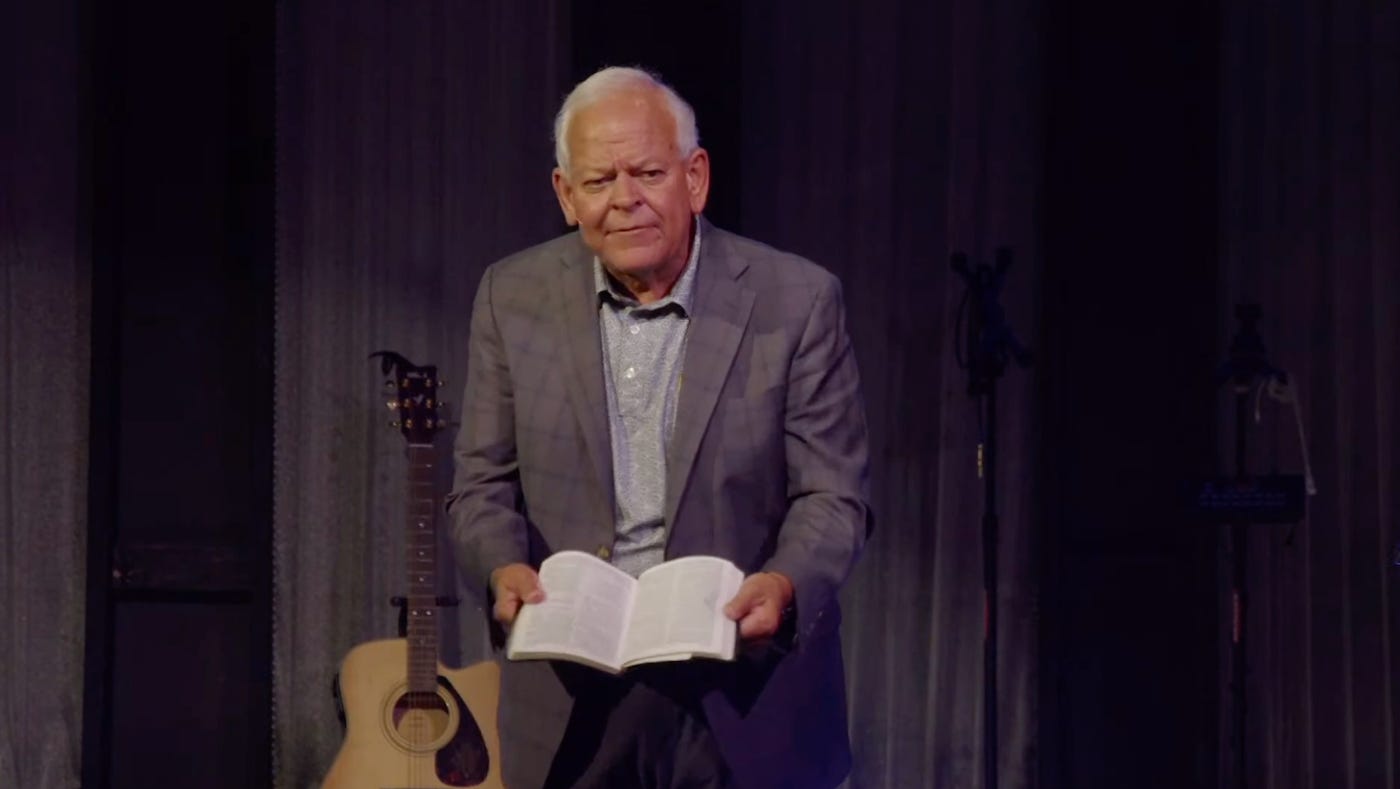
Johnny Hunt delivers a sermon on August 6, 2023 (screenshot via YouTube)

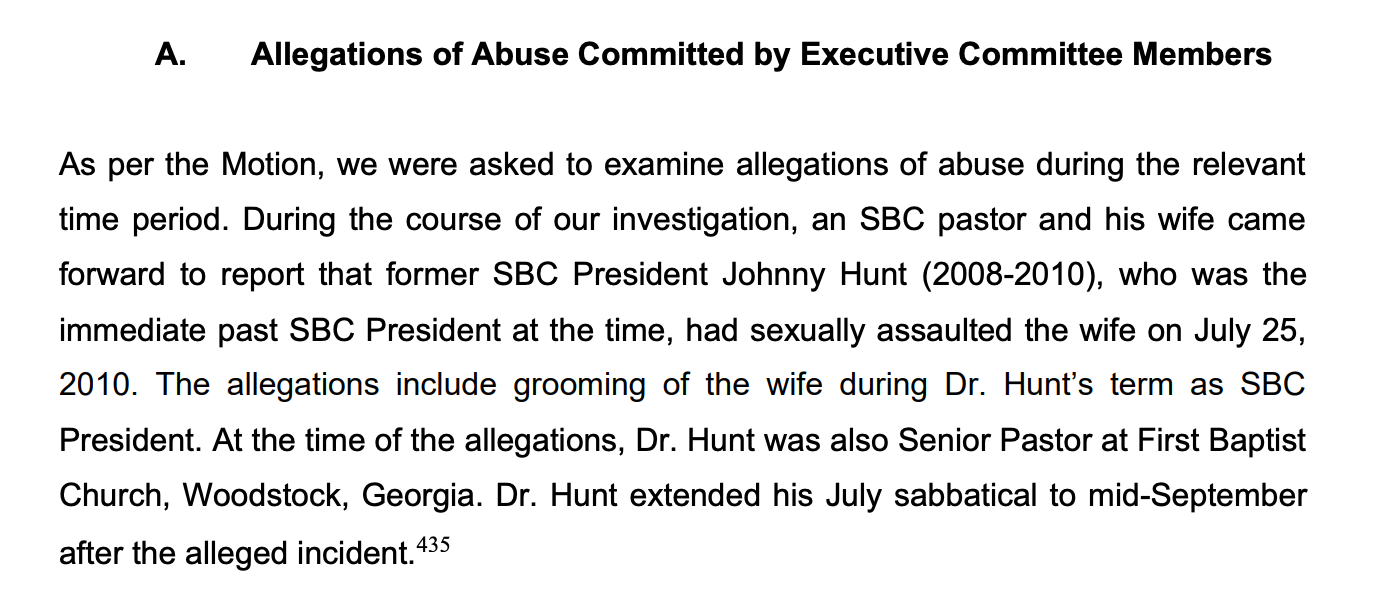
According to page 149, another pastor and his wife reported that Hunt, who ran the SBC from 2008-2010, “had sexually assaulted the wife on July 25, 2010.” (That would have been shortly after Hunt completed his second one-year term.)

Hunt, the report said, “groomed the couple with flattery and promises of help in ministry.” At the SBC’s annual meeting that year, Hunt invited the couple to spend time with his family at a beach where he was spending his planned sabbatical. They grew closer and, at a later date, the woman stayed alone at a condo that Hunt recommended. Unbeknownst to her, he was right next door.

One night, when both of them were alone, he invited her back to his place. It took a dark turn from there:

Dr. Hunt then moved towards Survivor and proceeded to pull her shorts down, turn her over and stare at her bare backside. He made sexual remarks about her body and things he had imagined about her. During this time, Survivor felt frozen. Survivor said these were some of the longest moments of her life. She mustered the courage to ask him could she turn back over, and Dr. Hunt said yes. When she turned back over, she began to pull up her shorts. Dr. Hunt then pinned her to the couch, got on top of her, and pulled up her shirt. He sexually assaulted her with his hands and mouth. Suddenly, Dr. Hunt stopped and then stood up. Survivor pulled down her shirt. Survivor said she did not want him to ruin his ministry, at which he responded he did not want to ruin hers. But he then forced himself on her again by groping her, trying to pull her shirt down, and violently kissing her. Survivor did not reciprocate, but rather stood eyes open and very stiff, hoping he would just stop and leave. He finally stopped and left.

The victim said that Hunt spoke to her shortly after that and told her “he would like to have sex with her three times a day.”

It was only the next morning that he apologized, begged for forgiveness, and asked for her to keep this a secret.

Hunt was scheduled to return to preach at his home church in Georgia following his sabbatical, but he soon announced he would be extending his break “citing physical and emotional exhaustion”

Bob Smietana of Religion News Service explains what happened after that:

Without telling his congregation — or the millions of Southern Baptists he had represented as their president — Hunt went through a secret restoration process that included counseling sessions with the woman he had fondled and her husband. He then returned to the pulpit.

For a dozen years, no one was the wiser. Hunt retired from First Baptist in 2019 and took on a new role as a senior vice president for the SBC’s North American Mission Board and continued his busy and often lucrative career as a preacher and public speaker.

Life is good when you’re an alleged sexual abuser who belongs to a religious denomination with a history of ignoring sexual abuse.

Again, all that occurred in 2010. The details of the alleged assault weren’t publicized until that report came out in 2022. Until that report was made public, it was all but impossible to connect the dots to understand the real reason for Hunt’s extended leave.

Hunt initially denied those allegations. He then claimed everything was consensual. But by the end of 2022, after going through another “restoration” program, Hunt was declared “eligible to return to professional ministry.” He returned to the pulpit earlier this year.

There were never any criminal charges filed against him. His professional career didn’t suffer any real hits. It was like the SBC didn’t really care. (Surprise.)

But Hunt seems determined to get the last word here, so this past spring, he filed a defamation lawsuit against the SBC saying they ruined his life by including him in the report. The encounter, his lawyers explained, “involved only kissing and some awkward fondling.” Infidelity, sure, but not assault. Plus, Hunt was no longer the SBC president at the time, just a civilian. Including him in the report was nothing more than a “strategic decision to deflect attention from the SBC’s historical failure to take aggressive steps to respond to reports of child sex abuse and other sex crimes in its past.”

“Pastor Johnny was not the president of the SBC or a member of the Executive Committee at the time of the incident,” they wrote in a memorandum, opposing the denomination’s attempts to have the case dismissed. “He was merely a private citizen whose marital fidelity was nobody else’s business.”

That’s the sort of sentence that will give your eyes a workout as they roll back.

First of all, citing the SBC’s “historical failure” to deal with sex abuse as an excuse for them coming after him is wild considering that Hunt was the leader of the SBC at a time when many of those failures were occurring. He’s blaming the SBC, which he led, for not doing enough to stop guys like himself.

The defamation argument is also absurd. He was a public figure. He was the immediate past president of the SBC. He was a hypocrite. He was a part of the abuse that the SBC swept under the rug. There’s no evidence that the allegations were made by people who secretly knew they were untrue (which is the whole idea of defamation).

But setting that aside, it’s ludicrous that a preacher who made everyone else’s sex life his business now demands privacy regarding his alleged assault.

As Smietana points out, Hunt was one of the signers of the 2017 Nashville Statement, which declared marriage could only be between a man and a woman, that all married couples needed to be monogamous, and that transgender people didn’t exist.

He also signed the SBC Ethics & Religious Liberty Commission’s “Statement on Marriage” written in response to the Supreme Court’s Obergefell ruling, which said the decision was the result of “marriage’s decline through divorce, cohabitation, and a worldview of almost limitless sexual freedom.”

Finally, it’s deeply ironic that in 2008, at the same convention when Hunt was elected SBC president, the SBC Executive Committee condemned sexual abuse in all forms:

“The Southern Baptist Convention is on record for having stood strongly against sexual abuse. We have long condemned those who would use our churches as a hunting ground for their own sick and selfish pleasure,” Chapman said. “At the same time, sexual abuse is a growing crisis in this nation and we must continue to do everything within our power to stop this horrendous crime. Even though the number of Southern Baptist ministers who are sexual predators may seem to be relatively small, we must be on watch and take immediate action against those who prey on the most innocent among us. One sexual predator in our midst is one too many!

We gotta stop the sex predators! Now everyone please clap for the new guy in charge, Johnny Hunt!

Notice how they acted like Southern Baptist predators were few and far between even though sexual abuse was rampant in the culture. Meanwhile they elected a man was was two years away from being credibly accused of that same behavior. They were also in the midst of covering up their own behavior, as the 2022 report would later reveal.

If Hunt wasn’t an anti-LGBTQ preacher who made sexual ethics a focal point in his personal ministry, maybe this wouldn’t have to be a public story… though I would argue it still deserved to be taken seriously because (1) if the allegations were true, it would be a serious crime and (2) he used his religious authority to gain unearned trust from another woman.

It important to remember that Hunt has always pushed the false idea that a Christian ethic means taking the moral high road. Yet he’s a living example of how Christianity can sometimes just be an excuse to cover up bad behavior. He implied that those who reject his belief system are more likely to be sinners worthy of condemnation while never taking those beliefs seriously himself. He acted like his marriage was worthy of praise while treating monogamous same-sex couples as if they were being led by the devil.

He’s not the only Christian leader who turned out to be a complete hypocrite. Ted Haggard and Jerry Falwell, Jr. had their reputations destroyed for similar reasons. (At least they were never accused of assault.) But Hunt seems intent on making sure this story stays in the public eye by making the idiotic argument that it never should have been told.

To be fair, that may be the most Southern Baptist thing about him.

GUESSINGS ABOUT GOD: Robert Conner’s review of new book by David Madison, PhD Biblical Studies

Here’s the link to this article.

By David Madison at 9/24/2023

Books that question the validity of Christian belief and the historicity of New Testament stories appear regularly these days and they raise quite a few uncomfortable questions. Did Jesus really say the things attributed to him? Was Jesus even a real person? Did the gospel writers simply make up accounts of miracles like the virgin birth? Can we harmonize the contradictory resurrection stories? Do the gospels, written decades after the life of Jesus, record any eyewitness evidence? Who actually wrote the gospels? The gospel authors never identify themselves in their texts or speak in the first person—did they even meet Jesus? Over a century of critical study of the New Testament has raised many such thorny problems.

In the newly-released Guessing About God, David Madison and Tim Sledge take a common-sense approach to a discussion of Christian belief. Although many counter-apologetic works assume some familiarity with psychology, biblical criticism, church history or philosophy, Madison asks little more of the reader than a degree of open-mindedness, access to a Bible, some familiarity with the Christian liturgy, and a willingness to argue in good faith. Like Madison, I spent part of my childhood in Indiana: “Christianity was in the drinking water where I grew up…God was just there, a given.” Questioning what is taken for granted is often painful and occurs in stages, a process tacitly acknowledged by Madison’s thoughtful and empathetic approach.

For the people of the Bible, Yahweh was never far away—an animal ritually slaughtered and burned produced “an aroma pleasing to the Lord.” (Leviticus 3:5, 16) God was close enough to Earth to smell the smoke of sacrifice, to hear the prayers, receive the praise, and observe the actions of his worshippers. The biblical God “makes the clouds his chariot and rides on the wings of the wind.” (Psalm 104:3) Yahweh even accompanies his followers into battle: “God is the one who goes with you to fight for you against your enemies to give you victory.” (Deuteronomy 20:4) However, as Madison points out, these days the God of the Bible is nowhere to be found. Modern theologians are forced to claim that God is “outside space and time,” an assertion that would have been quite incomprehensible to the Bible authors who clearly write about a God that has both location and history.

“If, say, the Space Shuttle were sent speeding toward Alpha Centauri at about 18,000 miles per hour, the journey would take about 80,000 years. And that’s to the nearest star!” Humanity no longer inhabits the biblical microcosm where “all the kingdoms of the world and their splendor” can be viewed from the top of “a very high mountain.” (Matthew 4:8) Indeed, the incomprehensible vastness of the universe threatens to reduce the biblical world and its gods to an invisible, irrelevant speck.

In “Problem 2 — The Bible Disproves Itself,” Madison discusses what I regard as the most fundamental problem of religious belief: sacred books as self-authenticating documents. Philosophy, history, or probability aside, “proving the Bible’s authenticity by quoting from the Bible is closed-loop reasoning…no document on the planet can be self-authenticating.” Truth claims made for a sacred book cannot be substantiated simply by quoting from that book. “This irony is not lost on atheists. The theists, in fact, are among those who deny that the Word of God comes in book form—when it’s the other guy’s book. They are like kids in a playground taunting others, ‘My book is holier than yours!’”

As Madison notes, “Without question, the Bible is the most researched and minutely studied book ever written. There are countless books, articles, scholarly journals, doctoral dissertations, and sermons about the Bible.” Bible study is an industry: “Most lay people, the average individuals in the pews, are unaware that thousands of scholars make their living studying and writing about the Bible.” Likely few believers have reflected on the economic implications of seminaries and departments of religion in secular universities, the Christian broadcasting and publishing empires, or multi-millionaire celebrity preachers with private jets. Religious conviction aside, churches are big business, motivation enough to keep theologizing, philosophizing, preaching, broadcasting and publishing. For many thousands, religious belief is a matter of employment.

The third section of Guessing About God addresses the vexed question of vetting the bona fides of sinless Jesus: “Let’s suppose that in the course of your research, you found that no information was available on this man’s life between the ages of 13 and 29. Wouldn’t this give you pause?” In point of fact, it is well known among scholars that apart from the New Testament, no contemporary evidence confirms the life and career of Jesus of Nazareth. Which raises some additional questions: “Are the Gospels accurate in their portrayal of Jesus? Is their content reliable? Are they history, or something else?”

Until relatively recently, even skeptics thought the gospel accounts retained some historical core of information based on oral traditions about Jesus. It is now known with near certainty that Mark was the first gospel written and that it is a literary construct “that has nothing to do with contemporaneous documentation.” In short, we are back to self-authenticating stories again, a claim that simply won’t bear examination. “It’s no surprise that many church leaders have about as much use for Bible scholars as laypeople do. The task of such leaders is to keep the Jesus brand alive.” 

The third section confronts the reader with the present state of the Jesus Studies debate: “Enter stage left The Mythicists. The people-of-faith New Testament scholars, those who cling to Jesus, even if only by a thread, now face a phalanx of scholars who argue that the whole story of Jesus could be fiction.” At this point, Madison focuses on the best internal support for the mythicist position generally: “In the earliest of the New Testament documents, penned long before the Gospels, Jesus of Nazareth isn’t there. That is, the epistles of Paul and others don’t speak at all about Jesus of Nazareth. Their focus is a divine Christ. There seems to be no awareness of Jesus’s preaching and parables, his miracles, his disputes with religious authorities, or even the Passion narratives. It’s almost as if the real Jesus hadn’t been invented yet, which would not happen until the Gospels had been created.” 

Paul is perfectly clear about the source of his gospel: “For I did not receive it from any man, nor was I taught it, but I received it through a revelation of Jesus Christ.” (Galatians 1:12) This statement is not a confession; it’s self-satisfied boasting. Paul and his house churches had little use for a historical Jesus: “Even though we once regarded Christ according to the flesh, we regard him thus no longer.” (2 Corinthians 5:16) If this represented the attitude of the primitive church, there is even less reason to expect that believers treasured and transmitted details of Jesus’ life or that those details would eventually be enshrined in the text of the gospels. 

I’m in complete agreement with Madison’s conclusion: “The managers of the Christian brand have to hold onto the Gospels for dear life and to believe there must be shreds of evidence in Gospels to underwrite the reality of Jesus. If the Jesus-was-real folks want to paint themselves into this corner, that’s fine with me. I’m delighted with the Gospels as the playing field. I want to stick with the Gospels. They are the best tool for showing that the case for a credible Jesus is weak.”

In his final section, “How I Came to Write this Book,” Madison describes his personal transition from young Bible geek to the emergence of doubts based on deeper knowledge and reflection, to the rejection of his former belief entirely. There are several similarities between my story and the story of David Madison. Although I didn’t pursue an advanced degree in Biblical Studies, I deconverted after two years of university study, convinced that religious belief is without any factual basis. As the number of believers continues to plunge and enrollment in seminaries drops, it appears many more former adherents will be making the trek from conviction to unbelief. For such travelers, Guessing About God will prove a welcome guidebook.

Robert Conner is the author of The Death of Christian BeliefThe Jesus Cult: 2000 Years of the Last DaysApparitions of Jesus: The Resurrection as Ghost StoryThe Secret Gospel of Markand Magic in Christianity: From Jesus to the Gnostics.

Theologians Squirm and Fret When We Ask for EVIDENCE

Here’s the link to this article.

By David Madison at 9/15/2023

Why does their god play hide and seek?

We can assume that some (many?) churchgoers read the gospels, but, it would appear, without critical thinking skills fully engaged. When the devout come across Mark 14:62, does it bother them that Jesus was wrong? At his trial, Jesus was asked point blank if he was the messiah, to which he replied: “I am, and you will see the Son of Man seated at the right hand of the Power and coming with the clouds of heaven.” The main thrust of Mark’s gospel was that kingdom of his god was so close. But obviously those at his trial did not witness the arrival of Jesus on the clouds. The apostle Paul was confident too that Jesus would arrive in the sky soon. He promised members of the Thessalonian congregation that their dead relatives would rise to meet Jesus—and that he too would be there to join them (I Thessalonians 1:15-17). So Paul was wrong as well.

Paul was pumped for years by his delusions, which show up continually in his letters: he knew for sure that Jesus spoke to him in his visions. Is there any better foundation for all those “words of Jesus” in the gospels?  We have no way at all to verify that the Jesus-script in Mark 14—or anywhere else—is authentic. Any historian would want to know how the author of Mark’s gospel—written some forty years after the death of Jesus—knew what was said at the trial. Was there a transcript that Mark could access? It’s very doubtful, in the wake of the very destructive first Jewish-Roman war (66-73 CE). It’s much more likely that this author created scenes as he saw fit: he was writing to promote the beliefs of his cult. 

This is but one aspect of the problem of evidence that hobbles Christianity. The gospels are so highly esteemed by churchgoers, who have been raised to believe that these documents “got the story right.” But on close examination—with critical thinking skills fully engaged—it’s hard to make the case for that. There is wide consensus among devout scholars—outside of fundamentalist circles—that the gospels were written several decades after the death of Jesus. The anonymous authors never identify their sources, not even the author of Luke’s gospel, who claims in his opening verses that his stories can be traced back to eyewitnesses. But these are never identified. So historians are stumped: there is no way to verify anything we find in the gospels.

How do historians do their job? Here’s one example: in Helen Langdon’s 391-page biography of Caravaggio (1998), at the end we find a 27-page fine-print list of her sources: details about the documentation her work is based on. That’s how historians operate. But they can’t operate that way when they take up the challenge of accurately reporting the story of Jesus. There are no letters, diaries, transcripts, stenographer notes contemporaneous with Jesus that corroborate the gospel accounts. To make matters worse, these accounts are chock full of errors, contradictions, and conflicting agendas: the four gospel authors were intent on correcting each other, culminating with John, who created a very different Jesus. 

They couldn’t even agree on the resurrection stories. Just read the four accounts of Easter morning, and you can appreciate the mess. I suspect the apostle Paul would have been horrified by John’s account of Doubting Thomas sticking his finger in the risen Jesus’ sword wound. No, no, no: our risen bodies will be different: 

“Look, I will tell you a mystery! We will not all die, but we will all be changed, in a moment, in the twinkling of an eye, at the last trumpet. For the trumpet will sound, and the dead will be raised imperishable, and we will be changed. For this perishable body must put on imperishability, and this mortal body must put on immortality” (I Corinthians 15:51-53). 

Where is the evidence to verify Paul’s claim (I’m being generous: his delusion) that the dead will be raised imperishable? Where is the evidence that John’s Doubting Thomas story (missing from the other gospels) didn’t come from the author’s imagination? —after all, he was a master at making things up! There have been memes floating around Facebook and Twitter: “This comic book is the proof that Superman is real!” “These Harry Potter books are the proof that Harry is real!” The challenge for Christians is to show how and why the gospels deserve a higher historical ranking than comic and fantasy fiction books. No, I’m not kidding. Jesus studies have been in turmoil for a long time now—totally unnoticed by the folks who attend church— because devout scholars cannot agree on which gospels texts should/can be taken seriously. 

Richard Carrier has stated the problem:

“…the NT underwent a considerable amount of editing, interpolation and revising over the course of its first two centuries, and not merely as a result of transcription and scribal error, but often with specific dogmatic intent…This is not something to sweep under the rug. It makes a real difference in how we estimate probabilities. Unlike most other questions in history, the evidence for Jesus is among the most compromised bodies of evidence in the whole of ancient history. It cannot be said that this has no effect on its reliability.”  (On the Historicity of Jesus, pp. 275-276)

Are we going to have any better luck with evidence for god

I recommend a careful reading of a recent article here by John Loftus, Daniel Mocsny’s Rebuttal of Paul Moser’s Definitional Apologetics, Which Obfuscates the Fact That Christianity is Utter Nonsense! Loftus has repeatedly requested that Christian theologians and philosophers provide objective evidence that their god is real, can be verified by data. Moser faulted Loftus for not being precise about what constitutes objective evidence. But this is a dodge, indeed obfuscation. Since theists are those claiming that god exists, they should be fully prepared to specify the evidence they have—and show us where we can find it.  


A common claim is that their god is all-powerful, in fact mighty enough to have ignited the cosmos, and now to have billions of galaxies under management. Thus we can conclude that such vast power must be detectable by science. Edwin Hubble provides a good example of what can happen when smart humans look for data. Just about 100 years ago, using the new 100-inch telescope at Mount Wilson, Hubble determined that the Andromeda Galaxy is indeed a galaxy far beyond our own; a common view among astronomers at the time was that our Milky Way Galaxy was the universe. Hubble’s search for data, for objective, verifiable data, brought this important insight to human understanding of where we are in the Cosmos. 


Is it too much to expect that theologians should be able to tell us where to find crucial data about their all-powerful god? This is where they fumble. “Oh, but our god commands a spiritual realm that is undetectable by science.” Our next question then must be: “How do you know this?” Where is the reliable, verifiable, objective data that backs up this claim? If they continue to fumble and equivocate, then

we know for sure they have retreated to theobabble, i.e., a form of eloquence designed to cover up their lack of actual knowledge. The church has thrived on theobabble for centuries.  


Daniel Mocsny holds Paul Moser’s feet to the fire in the latter’s attempt to evade the call for evidence: “But most people don’t demand rigorous compact definitions of things like ‘chairs’ because most people have a working understanding of what a chair is, and it’s good enough. In other words there’s no need to play dumb about what a chair is, and similarly no need to play dumb about what evidence is.”


And Mocsny calls attention to the stark contrast between religion and science:


“I assume Moser plies his trade from an office and never applies his thinking to solving problems in the real world – such as how might we collect raw materials and transform them into a working smartphone. Given the astronomical number of ways to combine materials at random, the overwhelming majority of which will not result in a working smartphone, presumably Moser will agree that for scientists and engineers to manage this trick billions of times with a very low failure rate, they must have rules for evidence that are stupendously good.”


“It’s trivial to show that no religion has evidence as strong as either the law or science demands. No religion can prove its supernatural claims in a legitimate court of law, and no religion relying on faith builds anything like a smartphone. What has any religion produced besides words, and manipulating people? There is nothing to suggest that any religion has the kind of deep insight into reality that enables science to work actual near-miracles.”


Author Robert Conner (The Death of Christian BeliefThe Jesus Cult: 2000 Years of Last DaysApparitions of Jesus: The Resurrection as Ghost Storycommented on the Mocsny article: 

“If Paul Moser were to call AAA for roadside assistance with a flat tire, I’m fairly sure the receptionist wouldn’t engage him in a tiresome (see what I did there?) debate about what, epistemically speaking, constitutes a flat tire. The tire, after all, still appears to be about 70-80% round; it’s just flat in that one spot.”

“Most people who are not institutionalized realize almost without reflection that Moser’s schtick is insanity on roller skates; in any real occupation his ‘thinking’ would get a person fired on the spot and escorted from the premises by security. That in Moser’s case it’s a tenured position in a Catholic university should tell us everything we need to know about the philosophy of religion.”


Embarrassed by the lack of science-based evidence for their deity, theologians and clergy commonly resort to “rounding up the usual suspects” (that classic line from the movie Casablanca), e.g., revelation through scripture, visions, prayer-based insights about god. But these all fail to deliver: Christianity has splinted into thousands of conflicting denominations because—among other things—they disagree about the god, based on the Bible itself. And, of course, the “inspired” scriptures of Mormons and Muslims are rejected. Visions too have yielded vastly different images of god(s) and saints; Protestants commonly ridicule Catholic vision claims. Christians have prayed endlessly to their god, but hold very different views on what god wants and expects.    


Isn’t it so obvious that an all-powerful, competent, wise, caring god could have cleared up this mess a long time ago? “God can do anything!” devout believers claim. “Well, good, have him say Hi!” Let the evidence be clear and obvious. The gospel resurrection story itself fails by this standard. Why didn’t the resurrected Jesus show up at Pilate’s house on Easter morning? Why didn’t he appear to Caesar himself? 

“Better still, the resurrected Jesus could have gone on a Worldwide Resurrection Tour with stops in China and every city, town, and village in the world.” (Tim Sledge, Four Disturbing Questions With One Simple Answer: Breaking the Spell of Christian Belief, p. 63)

Especially since the all-power Christian god gets really furious when humans don’t obey and worship him, it is very strange that he has failed so miserably when it comes to the presentation of evidence. 
 

David Madison was a pastor in the Methodist Church for nine years, and has a PhD in Biblical Studies from Boston University. He is the author of two books, Ten ToughProblems in Christian Thought and Belief: a Minister-Turned-Atheist Shows Why You Should Ditch the Faith, now being reissued in several volumes, the first of which is Guessing About God (2023) and Ten Things Christians Wish Jesus Hadn’t Taught: And Other Reasons to Question His Words (2021). The Spanish translation of this book is also now available. 

His YouTube channel is here. At the invitation of John Loftus, he has written for the Debunking Christianity Blog since 2016.

The Cure-for-Christianity Library©, now with more than 500 titles, is here. A brief video explanation of the Library is here