My God, It’s Full of Stars …

Here’s the link to this article. Please take time to read this masterpiece. It’s awe-inspiring, and deeply humbling.

My God, It’s Full of Stars: Henrietta Leavitt, Edwin Hubble, and Our Human Hunger to Know the Universe (Tracy K. Smith Reads Tracy K. Smith)

“…so brutal and alive it seemed to comprehend us back.”

BY MARIA POPOVA

This is the second of nine installments in the animated interlude season of The Universe in Verse in collaboration with On Being, celebrating the wonder of reality through stories of science winged with poetry. See the rest here.

THE ANIMATED UNIVERSE IN VERSE: CHAPTER TWO
Henrietta Swan Leavitt

In 1908, Henrietta Swan Leavitt — one of the women known as the Harvard Computers, who changed our understanding of the universe long before they could vote — was analyzing photographic plates at the Harvard Observatory, singlehandedly measuring and cataloguing more than 2,000 variable stars — stars that pulsate like lighthouse beacons — when she began noticing a consistent correlation between their brightness and their blinking pattern. That correlation would allow astronomers to measure their distance for the first time, furnishing the yardstick of the cosmos.
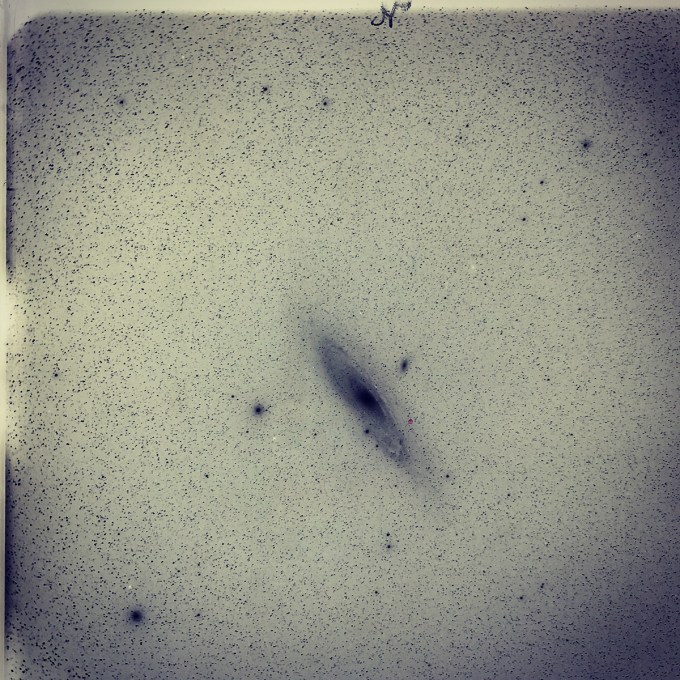
Glass plate of Andromeda from the archives of the “Harvard Computers.” (Photograph: Maria Popova)

Meanwhile, a teenage boy in the Midwest was repressing his childhood love of astronomy and beginning his legal studies to fulfill his dying father’s demand for an ordinary, reputable life. Upon his father’s death, Edwin Hubble would unleash his passion for the stars into formal study and lean on Leavitt’s data to upend millennia of cosmic parochialism, demonstrating two revolutionary facts about the universe: that it is vastly bigger than we thought, and that it is growing bigger by the blink.

Art by Deborah Marcero from The Boy Whose Head Was Filled with Stars: A Life of Edwin Hubble by Isabelle Marinov

One October evening in 1923, perched at the foot of the world’s most powerful telescope at Mount Wilson Observatory in California, Hubble took a 45-minute exposure of Andromeda, which was then thought to be one of many spiral nebulae in the Milky Way. The notion of a galaxy — a gravitationally bound swirl of stars and interstellar gas, dust and dark matter — did not exist as such. The Milky Way — a name coined by Chaucer — was commonly considered an “island universe” of stars, beyond the edge of which lay cold dark nothingness.

When Hubble looked at the photograph the next morning and compared it to previous ones, he (I like to imagine) furrowed his brow, then with a gasp of revelation he (this we know for a fact) crossed out the marking N on the plate, scribbled the letters V A R beneath it, and could not help adding an exclamation point.

Edwin Hubble’s 1923 glass plate of Andromeda. (Photograph: Carnegie Observatories)

Hubble had realized that a tiny fleck in Andromeda, previously mistaken for a nova, could not possibly be a nova, given its blinking pattern across the different photographs. It was a variable star — which, given Henrietta Leavitt’s discovery, could only be so if the tiny fleck was very far away, farther than the edge of the Milky Way.

Andromeda was not a nebula in our own galaxy but a separate galaxy, out there in the cold dark nothingness.

Suddenly, the universe was a garden blooming with galaxies, with ours but a single bloom.

That same year, in another country suspended between two World Wars, another young scientist named Hermann Oberth was polishing the final physics on a daring idea: to subvert a deadly military technology with roots in medieval China and rocket-launch an enormous telescope into Earth orbit — closer to the stars, bypassing the atmosphere that occludes our terrestrial instruments.

It would take two generations of scientists to make that telescope a reality — a shimmering poem of metal, physics, and perseverance, bearing Hubble’s name.

The Hubble Space Telescope. (Photograph: NASA)

But when the Hubble Space Telescope finally launched 1990, hungry to capture the most intimate images of the cosmos humanity had yet seen, humanity had crept into the instrument’s exquisite precision — its main mirror had been ground into the wrong spherical shape, warping its colossal eye.

Up the coast from Mount Wilson Observatory, a teenage girl watched her father — who had worked on the Hubble as one of NASA’s first black engineers — come home brokenhearted. He didn’t know that his observant daughter would become Poet Laureate of his country and would come to commemorate him in the tenderest tribute an artist-daughter has ever made for a scientist-father. That tribute — the splendid poetry collection Life on Mars (public library) — earned Tracy K. Smith the Pulitzer Prize the year the Hubble’s corrected optics captured the revolutionary Ultra Deep Field image of the observable universe, revealing what neither Henrietta Leavitt nor Edwin Hubble could have imagined — that there isn’t just one other galaxy besides our own, or just a handful more, but at least 100 billion, each containing at least 100 billion stars.

MY GOD, IT’S FULL OF STARS (PART 5)
by Tracy K. Smith

When my father worked on the Hubble Telescope, he said
They operated like surgeons: scrubbed and sheathed
In papery green, the room a clean cold, a bright white.

He’d read Larry Niven at home, and drink scotch on the rocks,
His eyes exhausted and pink. These were the Reagan years,
When we lived with our finger on The Button and struggled

To view our enemies as children. My father spent whole seasons
Bowing before the oracle-eye, hungry for what it would find.
His face lit up whenever anyone asked, and his arms would rise

As if he were weightless, perfectly at ease in the never-ending
Night of space. On the ground, we tied postcards to balloons
For peace. Prince Charles married Lady Di. Rock Hudson died.

We learned new words for things. The decade changed.

The first few pictures came back blurred, and I felt ashamed
For all the cheerful engineers, my father and his tribe. The second time,
The optics jibed. We saw to the edge of all there is —

So brutal and alive it seemed to comprehend us back.

THE MAKING

Every poet is a miniaturist of meaning, building cathedrals of beauty and truth with the smallest particles of language. It is with a poet’s mindset that Brazilian graphic artist and animation director Daniel Bruson approached his contribution to The Universe in Verse. (Special thanks to On Being creative director Erin Colasacco for bringing Daniel into the project and for working with him and with composer Gautam Srikishan on making this symphonic cinepoem come alive.)

After I relayed to Daniel why I had chosen this particular poem (which Tracy read at the inaugural Universe in Verse in 2017) to illustrate the larger story of our search for cosmic truth — a search both made possible and made imperfect by our humanity — he grasped the nested layers of meaning with uncommon sensitivity, mirroring back his interpretation:

The Hubble tries to see or make sense of the Universe, the father tries to understand the Hubble, the daughter tries to make sense of the father, the decade, the world, and the poet tries to put this whole into perspective. All these efforts have to face problems of scale or distortion: something too big or small, too close or too distant, too dark or too familiar. Not to mention the original problem with the Hubble mirror.

This cascade of distortion sparked the idea “to use optics as a metaphor, to seek for these imperfect, unresolved and elusive, but also suggestive and alive images.”

Daniel set about creating his deliberately blurry cosmic animations frame by frame, painting each tiny detail onto a glass plate with nail polish, oil paint, glitter, acrylic, and other materials he mixed, scrubbed, smudged, and swirled with brushes and cotton swabs beneath the lens of a camera capturing the process of creation and destruction.

He magnified the optical enchantment by filming the vignettes through upside-down drinking glasses of various shapes and thicknesses.

In a crowning feat of ingenuity — itself a miniature masterpiece of engineering and composition — he built a tiny model of the Hubble out of cardboard, paper, and aluminum foil, dismantled it frame by frame, filmed the destruction, then reversed the footage to create the building effect. (I am reminded here of Bertrand Russell’s astute observation, made shortly after Edwin Hubble took his historic glass plate of Andromeda, that “construction and destruction alike satisfy the will to power, but construction is more difficult as a rule, and therefore gives more satisfaction to the person who can achieve it” — a truth as true of the universe itself, with its elemental triumph of something over nothing, as it is of the human endeavor to know it by building optical prosthesis of our curiosity.)

Something about Daniel’s process — the exquisite craftsmanship, the passionate patience, the tiny scale on which he made such beauty and grandeur of feeling — calls to mind Emily Dickinson and her miniature cherrywood writing desk, on the seventeen square inches of which she conjured up such cosmoses of truth, among them the poem illustrating Chapter One of this series.

Bloom: The Evolution of Life on Earth and the Birth of Ecology (Joan As Police Woman Sings Emily Dickinson)

How flowers gave rise to life on Earth and made possible the human consciousness that came to see a world “thronged only with Music.”

Here’s a link to this article.

BY MARIA POPOVA

This is the first of nine installments in the animated interlude season of The Universe in Verse in collaboration with On Being, celebrating the wonder of reality through stories of science winged with poetry. See the rest here.

THE ANIMATED UNIVERSE IN VERSE: CHAPTER ONE

Two hundred million years ago, long before we walked the Earth, it was a world of cold-blooded creatures and dull color — a kind of terrestrial sea of brown and green. There were plants, but their reproduction was a tenuous game of chance — they released their pollen into the wind, into the water, against the staggering improbability that it might reach another member of their species. No algorithm, no swipe — just chance.

But then, in the Cretaceous period, flowers appeared and carpeted the world with astonishing rapidity — because, in some poetic sense, they invented love.

Once there were flowers, there were fruit — that transcendent alchemy of sunlight into sugar. Once there were fruit, plants could enlist the help of animals in a kind of trade: sweetness for a lift to a mate. Animals savored the sugars in fruit, converted them into energy and proteins, and a new world of warm-blooded mammals came alive.

Without flowers, there would be no us.

No poetry.

No science.

No music.

Darwin could not comprehend how flowers could emerge so suddenly and take over so completely. He called it an “abominable mystery.” But out of that mystery a new world was born, governed by greater complexity and interdependence and animal desire, with the bloom as its emblem of seduction.

In 1866, the young German marine biologist Ernst Haeckel — whose exquisite illustrations of single-celled underwater creatures had enchanted Darwin — gave that interdependence a name: He called it ecology, from the Greek oikos, or “house, and logia, or “the study of,” denoting the study of the relationship between organisms in the house of life.

A year earlier, in 1865, a young American poet — a keen observer of the house of life who made of it a temple of beauty — composed what is essentially a pre-ecological poem about ecology.

Emily Dickinson at seventeen. (Amherst College Archives & Special Collections)

She had awakened to the interdependent splendor of the natural world as a teenager, when she composed a different kind of ecological poem: In a large album bound in green cloth, she painstakingly pressed, arranged, and labeled in her neat handwriting 424 wildflowers she had gathered from her native New England — some of them now endangered, some extinct.

This herbarium — which survives — became Emily Dickinson’s first formal exercise in composition, and although she came to reverence the delicate interleavings of nature in so many of her stunning, spare, strange poems, this one — the one she wrote in 1865, just before Ernst Haeckel coined ecology — illuminates and magnifies these relationships through the lens of a single flower and everything that goes into making its bloom — this emblem of seduction — possible: the worms in the soil (which Darwin celebrated as the unsung agriculturalists that shaped Earth as we know it), the pollinators in the spring air, all the creatures both competing for resources and symbiotically aiding each other.

And, suddenly, the flower emerges not as this pretty object to be admired, but as this ravishing system of aliveness — a kind of silent symphony of interconnected resilience.

To bring Emily Dickinson’s masterpiece to life is a modern-day poet of feeling in music — also a keen observer of the house of life, also a passionate lover of nature, also an emissary of aliveness through art.

She is a composer, a multi-instrumentalist classically trained as a violinist, and above all a singer and writer of songs with uncommon sensitivity to the most poetic dimensions of life.

Here is Joan As Police Woman with Emily Dickinson and the centuries-old pressed flowers from her actual herbarium.

BLOOM
by Emily Dickinson

Bloom — is Result — to meet a Flower
And casually glance
Would cause one scarcely to suspect
The minor Circumstance
Assisting in the Bright Affair
So intricately done
Then offered as a Butterfly
To the Meridian —
To pack the Bud — oppose the Worm —
Obtain its right of Dew —
Adjust the Heat — elude the Wind —
Escape the prowling Bee
Great Nature not to disappoint
Awaiting Her that Day —
To be a Flower, is profound
Responsibility —

HOW WE MADE IT

Every true artist is a miniaturist of grandeur, determined to make every littlest thing the very best it can be — not out of egoic grandiosity but out of devotion to beauty, devotion paid for with their time and thought, those raw materials of life. When I invited the uncommonly gifted and uncommonly minded Joan As Police Woman to bring the poem to life in a typical Universe in Verse reading, this true artist instead transformed it into a soulful song — an homage that would have gladdened the poet, who in her teenage years took regular music lessons and practiced piano for two hours a day, and who grew up to believe that, in its most transcendent stillness, the world is “thronged only with Music.”

From the start, I envisioned using the teenage poet’s herbarium — a forgotten treasure at the intersection of art and science, one of my favorite discoveries during the research for the Dickinson chapters of Figuring — as the raw material for the animation art. Having collaborated on a handful of previous animated poems, I invited Ohara Hale — artist, musician, poet, illustrator, animator, maker of nature-reverent children’s books, choreographer of beauty and feeling across a multitude of art-forms — to work her visual magic on the poem-song.

In a small wood cabin at the foot of a Spanish volcano, she set about reanimating — in both senses of the word — Emily Dickinson’s spirit through her herbarium.

Ohara composed all the creatures — the bee, the caterpillar, the butterflies, the human hand — from fragments of the poet’s centuries-old pressed flowers: digitized, restored, retraced by hand, and atomized into new life-forms. Individual petals, leaves, and stamens make the wings, body, and antennae of each butterfly. Layers of petals, sepals, and anthers stripe and behair the body of the bee. A large leaf folds unto itself to shape the hand that wrote this poem and nearly two thousand others — poems that have long outlived the living matter that felt and composed them, poems that have helped generations live.

Strewing the animation are words from the poem, hand-lettered by the polymathic Debbie Millman in a style based on surviving museum samples of Emily Dickinson’s handwriting from the period in which she composed the herbarium.

In a lovely way, the art mirrors the music it serves. Joan’s composition is itself a time-traveling masterwork of layering: voice upon keys upon strings, feeling-tone upon feeling-tone, classical heritage beneath thoroughly original sensibility — all of it so consonant with the central poetic image, all of it “so intricately done,” all of it a triumph of that “profound responsibility” we have to the ecosystem of art and ideas abloom in the spacetime between Emily Dickinson and us.

It has been an honor to collaborate with these uncommonly gifted women on honoring an uncommonly gifted artistic ancestor and celebrating our common evolutionary ancestry with all life-forms in nature.

The Universe in Verse–introduction to the 2021-2022 season

I encourage you to travel with me throughout the universe over the next few weeks. We should go ahead and thank Maria Popova and her many connections for what they’ve been up to.

Here’s how Maria describes this marvelous ‘spaceship’ she calls “The Universe in Verse.”

An annual charitable celebration of the wonder of reality through stories of science winged with poetry, born in 2017 as part celebration of life and part protest against the assault on science, nature, and reality — that is, on life — in the era of “alternative facts” and vanishing environmental protections.  

Maria Popova

Here’s a link to the following article. I’d encourage you to save it. I’ll try to post something from this multi-year journey every few days.

ANIMATED INTERLUDE SEASON (2021-2022)

The Universe in Verse was born in 2017 as part celebration of the wonder of life and the splendor of reality, and part protest against the assault on science and nature — that is, on life and reality — in the era of “alternative facts” and vanishing environmental protections. An act of resistance and an act of persistence. Fierce insistence on the felicitous expression of nature in human nature, with our capacity for music and mathematics, for art and hope.

Spring after spring, it remained a live gathering and a labor of love. Then, in the gatherless disorientation of the pandemic, I joined forces with my friends at On Being to reimagine the spirit of The Universe in Verse in a different incarnation — a season of perspective-broadening, mind-deepening, heart-leavening stories about science and our search for truth, enlivened by animated poems with original music: emblems of our longing for meaning.

Carrying the animations are stories about relativity and the evolution of flowers, about entropy and space telescopes, about dark matter and the octopus consciousness, illustrated with poems new and old, by Emily Dickinson and Richard Feynman, by W.H. Auden and Tracy K. Smith, by Marilyn Nelson and Edna St. Vincent Millay, brought to life by a human constellation strewn across spacetime and difference: twenty-nine largehearted artists, musicians, writers, scientists, and other weavers of wonder, who have poured their time and talent into this improbable labor of love. The total distance between them exceeds the circumference of the globe. Half a century stretches between the youngest and the eldest.

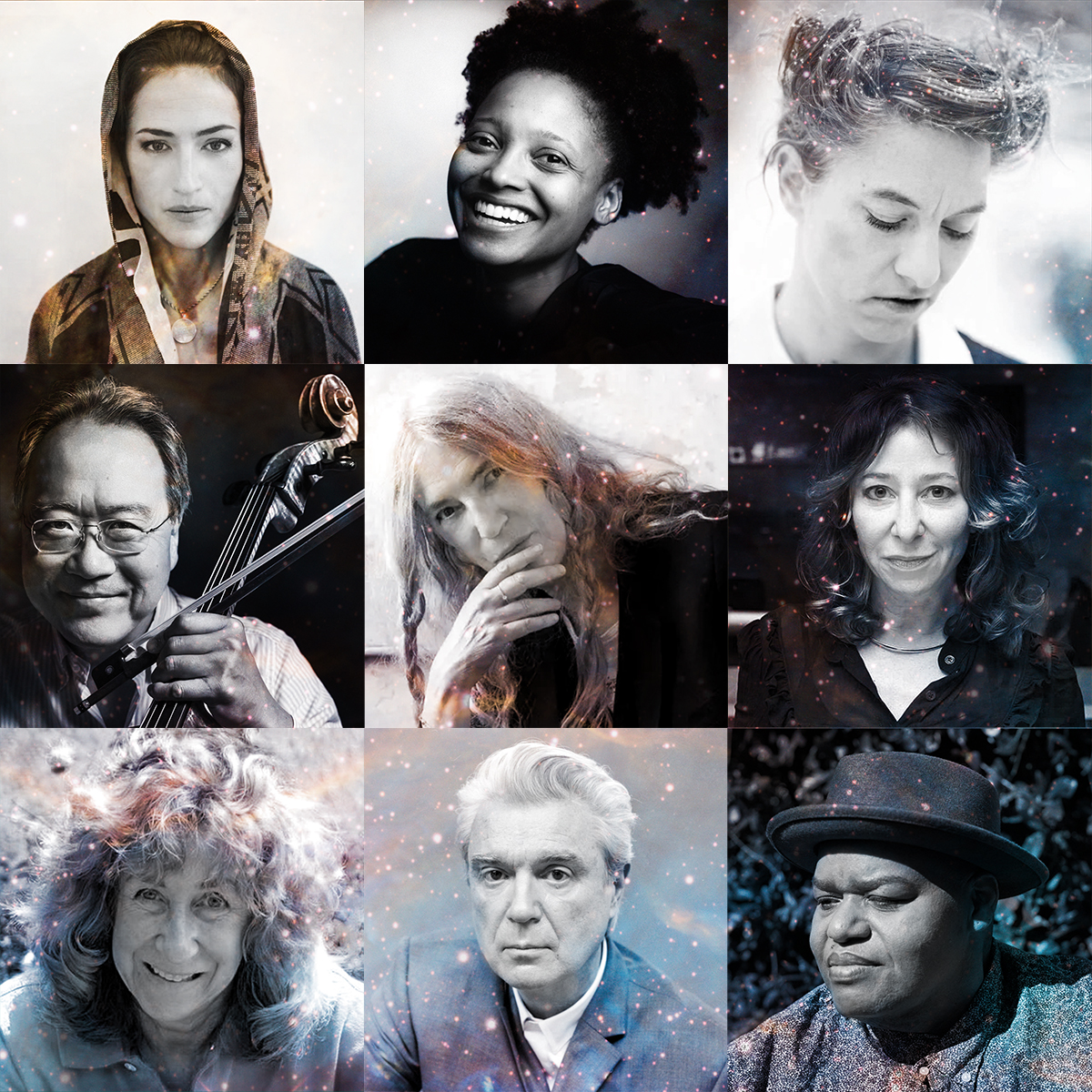
Among them are Yo-Yo Ma, Joan As Police Woman, David Byrne, Sophie Blackall, Amanda Palmer, Janna Levin, Ohara Hale, Maira Kalman, Debbie Millman, Toshi Reagon, Daniel Bruson, Zoë Keating, Garth Stevenson, Sy Montgomery, Jherek Bischoff, Edwina White, James Dunlap, Marissa Davis, Tom McRae, Topu Lyo, Gautam Srikishan, Lottie Kingslake, Kelli Anderson, Liang-Hsin Huang, and Patti Smith.

Released over the course of the season, each of the nine chapters begins with a science story and ends with an animated poem chosen to illuminate the scientific fact with the sidewise gleam of feeling. Two of the poems (including the one in the opening chapter) are set to song, and seven are soulful readings scored with original music by a different composer. Each miniature totality is brought to life by a different performer and shimmers with visual magic by a different artist. Each is a portable cosmos of gladness at the chance-miracle of aliveness: all of us, suspended here in this sliver of spacetime, with our stories and our poems and each other.


Highlights from the previous seasons can be seen here.