This is the third of nine installments in the animated interlude season of The Universe in Verse in collaboration with On Being, celebrating the wonder of reality through stories of science winged with poetry. See the rest here.
THE ANIMATED UNIVERSE IN VERSE: CHAPTER THREE
To be human is to live suspended between the scale of glow-worms and the scale of galaxies, to live with our creaturely limitations without being doomed by them — we have, after all, transcended them to unravel the molecular mystery of the double helix and compose the Benedictus and land a mechanical prosthesis of our curiosity on Mars. We have dreamt these things possible, then made them real — proof that we are a species of limitless imagination along the forward vector of our dreams. But we are also a species continually blinkered — sometimes touchingly, sometimes tragically — by our own delusions about the totality around us. Our greatest limitation is not that of imagination but that of perspective — our lens is too easily contracted by the fleeting urgencies of the present, too easily blurred by the hopes and fears of our human lives.
Two centuries ago, Maria Mitchell — a key figure in Figuring — understood this with uncommon poetry of perspective.Portrait of Maria Mitchell, 1840s. (Maria Mitchell Museum. Photograph: Maria Popova)
America’s first professional female astronomer, she was also the first woman employed by the federal government for a “specialized non-domestic skill.” After discovering her famous comet, she was hired as “computer of Venus,” performing complex mathematical calculations to help sailors navigate the globe — a one-woman global positioning system a century and a half before Einstein’s theory of relativity made GPS possible.
When Maria Mitchell began teaching at Vassar College as the only woman on the faculty, the college handbook mandated that neither she nor her female students were allowed outside after nightfall — a somewhat problematic dictum, given she was hired to teach astronomy. She overturned the handbook and overwrote the curriculum, creating the country’s most ambitious science syllabus, soon copied by other universities — including the all-male Harvard, which had long dropped its higher mathematics requirement past the freshman year.
Maria Mitchell’s students went on to become the world’s first class with academic training in what we now call astrophysics. They happened to all be women.
Maria Mitchell, standing at telescope, with her students at Vassar
Science was one of Maria Mitchell’s two great passions. The other was poetry.
At her regular “dome parties” inside the Vassar College Observatory, which was also her home, students and occasional esteemed guests — Julia Ward Howe among them — gathered to play a game of writing extemporaneous verses about astronomy on scraps of used paper: sonnets to the stars, composed on the back of class notes and calculations.
Mitchell taught astronomy until the very end of her long life, when she confided in one of her students that she would rather have written a great poem than discovered a great comet. But scientific discovery is what gave her the visibility to blaze the way for women in science and enchant generations of lay people the poetry of the cosmic perspective.
It was this living example that became Maria Mitchell’s great poem, composed in the language of being — as any life of passion and purpose ultimately becomes.
“Mingle the starlight with your lives,” she often told her students, “and you won’t be fretted by trifles.”
And yet here we are, our transient lives constantly fretted by trifles as we live them out in the sliver of spacetime allotted us by chance.
A century after Maria Mitchell returned her borrowed stardust to the universe that made it, the poet Pattiann Rogers extended a kindred invitation to perspective, untrifling the tender moments that make a life worth living.
Straight up away from this road, Away from the fitted particles of frost Coating the hull of each chick pea, And the stiff archer bug making its way In the morning dark, toe hair by toe hair, Up the stem of the trillium, Straight up through the sky above this road right now, The galaxies of the Cygnus A cluster Are colliding with each other in a massive swarm Of interpenetrating and exploding catastrophes. I try to remember that.
And even in the gold and purple pretense Of evening, I make myself remember That it would take 40,000 years full of gathering Into leaf and dropping, full of pulp splitting And the hard wrinkling of seed, of the rising up Of wood fibers and the disintegration of forests, Of this lake disappearing completely in the bodies Of toad slush and duckweed rock, 40,000 years and the fastest thing we own, To reach the one star nearest to us.
And when you speak to me like this, I try to remember that the wood and cement walls Of this room are being swept away now, Molecule by molecule, in a slow and steady wind, And nothing at all separates our bodies From the vast emptiness expanding, and I know We are sitting in our chairs Discoursing in the middle of the blackness of space. And when you look at me I try to recall that at this moment Somewhere millions of miles beyond the dimness Of the sun, the comet Biela, speeding In its rocks and ices, is just beginning to enter The widest arc of its elliptical turn.
Previously on The Universe in Verse: Chapter 1 (the evolution of flowers and the birth of ecology, with Emily Dickinson); Chapter 2 (Henrietta Leavitt, Edwin Hubble, and the age of space telescopes, with Tracy K. Smith).
A human being is a living constellation of contradictions, mostly opaque to itself. “Inward secret creatures,” Iris Murdoch called us in reckoning with the blind spots of our self-knowledge. “Humans are just the sort of organisms that interpret and modify their agency through their conception of themselves,” philosopher Amélie Rorty wrote as she examined what makes a person — a self-conception shaped by our astonishing evolutionary inheritance, which took us from bacteria to the Benedictus in a mere minute on the clock-face of the cosmos; a self-conception distorted by an ego that habitually confuses who we wish we were for who we are, redeemed only by the courage to know ourselves.
Odd of proportion, upright, unbalanced of body, feeling, and mind.
Two predator’s eyes face forward, yet seem always to be trying to look back.
Unhooved, untaloned fingers seem to grasp mostly grief and pain. To create, too often, mostly grief and pain.
Some take, in witnessed suffering, pleasure. Some make, of witnessed suffering, beauty.
On the other side — a creature capable of blushing, who chooses to spin until dizzy, likes what is shiny, demands to stay awake even when sleepy.
Learns what is basic, what acid, what are stomata, nuclei, jokes, which birds are flightless. Learns to play four-handed piano. To play, when it is needed, one-handed piano.
Hums. Feeds strays. Says, “All together now, on three.”
To be a person may be possible then, after all.
Or the question may be considered still at least open — an unused drawer, a pair of waiting workboots.
A thousand years from now, will there be people—with as little grasp of history as contemporary Christians—who worship a goddess named Minerva, because they believe that Minerva McGonagall in the Harry Potter stories was real? What magical powers she had! She could change herself instantly into a cat, and multiply food supplies. Will there also be a goddess Hermione, based on Hermione Granger in Harry Potter, who created a magic potion that allows the person who drinks it to assume the physical appearance of another person? Will the Fairy God Mother in Cinderella be worshipped as well, because she used a magic spell to turn a pumpkin into a splendid coach?
The New Testament authors used exactly this kind of razzle-dazzle to bring converts to the Jesus cult. These authors borrowed freely from miracle folklore of the ancient world: they depicted Jesus healing a blind man by smearing mud on his eyes; a woman was healed by touching the hem of Jesus’ garment. He transferred demons from a man into pigs, fed thousands of people with just a few loaves and fish, turned water into wine, raised a man from the dead by voice command, recommended magic potions—drinking his blood and eating his flesh—to gain eternal life. He cured a paralytic by forgiving his sins. Jesus glowed on a mountaintop while chatting with Moses and Elijah—and the voice of Yahweh came from water vapor (a cloud). Jesus walked on water and controlled with weather. At the end of his story, he floated up and away, disappearing in the clouds.
There’s magic as well in the letters of the apostle Paul. He taught that by believing in your heart—and saying with your lips—that Jesus was raised from the dead, “you will be saved.” That’s a magic spell. Paul also was sure your sexual desires are cancelled (or, as he put it, crucified) if you “belong to Jesus.”
The New Testament is a handbook of magic. Any one of these Jesus stories told from the pulpit evokes a feeling of awe, “Wow, wasn’t Jesus wonderful!” But a responsible study/analysis of scripture means that even the most devout readers must consider probabilities, based on how we know the world works. Which is more likely—that Jesus did such awesome things, or that the gospel authors fashioned their stories from the fantasy folklore of the time? If your favorite priest or minister claims to have pulled off miracles similar to these Jesus-deeds in the gospels, only the most gullible would be convinced. In this era of cell-phones, many churchgoers would ask for evidence: “Let’s see the pictures.” But when they believe—and adore—the magic stories in the Bible, they waive the request for evidence.
There is very little curiosity about what it was like to live at the time the New Testament was written, or a grasp of how little knowledge of the world and the universe most people at that time possessed, e.g., that we live on a planet whose crust consists of seven continents and vast oceans—with a molten core at its center; that we are in a solar system that orbits the galactic center, along with billions of other solar systems. The Bible authors didn’t even know what stars are.
Nor is there much curiosity among the devout about the authors of the New Testament. Who were they, after all? But it is hard to satisfy this curiosity because the gospels were written anonymously, and so many of the epistles were forgeries. Because of the apostle Paul’s own seven authentic letters, we have an abundance of information about him—which, unfortunately, is not a good thing! But from what the New Testament authors wrote, we can figure out a lot about their mind-sets—which, also unfortunately, is not a good thing. The church has done a good cover-up job by positioning these authors as saints, and this has deflected attention from the superstitions and magical thinking that they embraced and promoted.
Scholars have researched and debated these realities for a long time, with devout scholars trying to put the best possible spin on ancient beliefs that should be trashed. Religions have always thrived on the appeal to belief without evidence. That’s the whole point of the story of Doubting Thomas, found only in John’s gospel (20:24-29). When the other disciples told Thomas that the resurrected Jesus had appeared to them—Thomas wasn’t there when it happened—his skepticism kicked in. A week later, Thomas was present when Jesus showed up again. He invited Thomas to touch the sword wound in his side, and that convinced him: “My Lord and my God!” And then he got a scolding from Jesus: “Have you believed because you have seen me? Blessed are those who have not seen and yet have come to believe.”
Religions rely on this gimmick: believe what the preachers claim to know about god(s).
What are we up against when we face belief-in-belief? Loftus reports this encounter: “I asked one woman whether she honestly wanted to know if her faith was false. She said she didn’t, that she was happy, and that was that. She knew the implications if she concluded it was false. It would involve some adverse social repercussions she didn’t want, so she chose not even to consider whether she was wrong.”
Which means that most churchgoers would not want to deal with the issues that Loftus discusses in this article. He opens with a quote from the Conner book: “…the greatest threat is the core feature of the Christian cult: belief in belief, the conviction that the Christian narrative is literally its own proof.” (p. 2, The Jesus Cult)
Hence churchgoers today—like the woman Loftus mentions—couldn’t care less how Christian theology emerged in the ancient world; their simple answer is sufficient: “Jesus the son of God was born, did his magic tricks—proof for sure he had divine powers—was sacrificed to atone for our sins, rose from the dead. This is what we have to belief to live with Jesus forever.” The heavy magic component here isn’t noticed—or more correctly, it is embraced as willingly as Harry Potter fans cheer on their hero. Conner is blunt:
“Christianity was a cult as presently understood from its inception, a toxic brew of apocalyptic delusion, sexual phobias and fixations, and a hierarchy of control, control of women by men, of slaves by masters, and society by the church.” (p. 2, The Jesus Cult)
This toxic brew of apocalyptic delusion got a jump start in the writings/teachings of the apostle Paul. The devout don’t seem to notice how much their religion has been damaged by Paul’s bad theology. No surprise. If few Christians make a practice of reading the gospels with full curiosity and skepticism engaged, I suspect far fewer read Paul’s letters. The gospels at least have stories, but Paul wrote extensively about his theological certainties based on his visions. It is obvious he had little—if any—knowledge about Jesus of Nazareth.
Why doesn’t this example of Paul’s bragging shock churchgoers: “For I want you to know, brothers and sisters, that the gospel that was proclaimed by me is not of human origin,for I did not receive it from a human source, nor was I taught it, but I received it through a revelation of Jesus Christ.” (Galatians 1:11-12)
So, Jesus spoke to Paul directly from the spiritual realm? Here we go again with magical thinking, similar to the commonly accepted notion that gods speak to humans via dreams. Loftus notes that this is detached from reality:
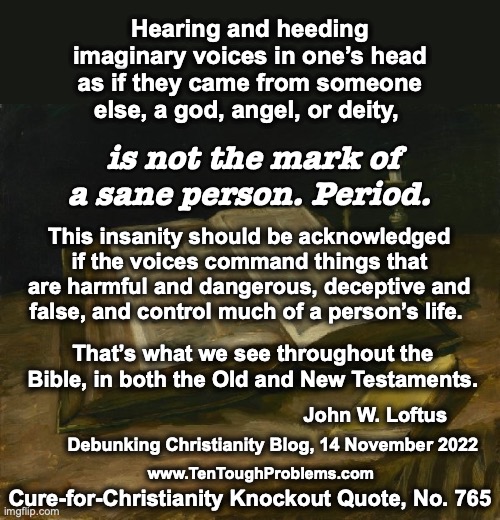
“Hearing and heeding imaginary voices in one’s head as if they came from someone else, a god, angel, or deity, is not the mark of a sane person. Period. This insanity should be acknowledged if the voices command things that are harmful and dangerous, deceptive and false, and control much of a person’s life. That’s what we see throughout the Bible, in both the Old and New Testaments.”
The Old Testament prophets claim that the word of Yahweh “came to them” and Joseph supposedly learned about Mary’s pregnancy in a dream. This is yet more magical thinking.
There has been a lot written about Paul’s state of mind, and Loftus sums up the conclusions of many secular thinkers: “I can affirm with a great deal of confidence that Paul was functionally insane, if he were living among rational people. But in a rational society Paul wouldn’t function well at all. He would be that homeless guy on the city street corner who proselytized with bullhorns and signs to no one, calling on people to ‘REPENT! FOR THE END IS NEAR!’” Robert Conner also wrote an essay, “Paul’s Christianity,” for Loftus’ 2019 anthology, The Case Against Miracles. Conner’s conclusion, at the end of his 25-page essay: “A more mature modern psychology with superior investigative techniques and tools can now question whether Paul of Tarsus was functionally, if not clinically, insane—and whether the religion he championed is based on delusion.” (p. 545)
Loftus draws attention to Gerd Ludemann’s book, Paul: The Founder of Christianity. This title might puzzle many of the devout, who don’t appreciate New Testament chronology. That is, Paul’s version of the faith was preached long before the gospels were written, and much of their content might, in fact, be derived from his thought. On this, see especially, Mark Dykstra’s book: Mark Canonizer of Paul.
I’ve just scratched the surface of Loftus’ essay. It is worth careful study, especially by Christians who are inclined to ignore the origins of their faith—to protect their beliefs. Their belief in belief. Loftus also references Richard Carrier’s article, Kooks and Quacks of the Roman Empire: A Look into the World of the Gospels, in which he states:
“From all of this one thing should be apparent: the age of Jesus was not an age of critical reflection and remarkable religious acumen. It was an era filled with con artists, gullible believers, martyrs without a cause, and reputed miracles of every variety. In light of this picture, the tales of the Gospels do not seem very remarkable. Even if they were false in every detail, there is no evidence that they would have been disbelieved or rejected as absurd by many people, who at the time had little in the way of education or critical thinking skills.”
Christianity’s addiction to magical thinking guarantees that its foundations are incredibly weak.
In their strange cosmogony predating Copernicus by two millennia, the ancient Greek scientific sect of the Pythagoreans placed at the center of the universe a ball of fire. It was not hell but the heart of creation. Hell, Milton told us centuries and civilizations later, is something else, somewhere else: “The mind is its own place,” he wrote in Paradise Lost, “and in it self can make a Heav’n of Hell, a Hell of Heav’n.”
Grief and despair, heartache and humiliation, rage and regret — this is the hellfire of the mind, hot as a nova, all-consuming as a black hole. And yet, if are courageous enough and awake enough to walk through it, in it we are annealed, forged stronger, reborn.
That is what the non-speaking autistic poet Hannah Emerson celebrates in her shamanic poem “Center of the Universe,” found in her extraordinary collection The Kissing of Kissing (public library), song of the mind electric, great bellowing yes to life.
CENTER OF THE UNIVERSE by Hannah Emerson
Please try to go to hell frequently because you will find the light there
yes yes — please try to kiss the ideas that you find there yes yes — please
try to get that it is the center of the universe yes yes — please
try to help yourself by kissing the hot hot hot life that is born there yes yes — please
try to yell in hell yes yes — please try to free yourself by pouring yourself
into the gutter all guttural guttural yell yes yes yes — please try to get that you
become the being that you came there to be yes yes — please try to go to the great
great great fire that you created because you become the light that the fire makes
inside of you yes yes — please try to kiss yourself for going there
yes yes — please get that you are reborn there yes yes — please
This is the fourth of nine installments in the animated interlude season of The Universe in Verse in collaboration with On Being, celebrating the wonder of reality through stories of science winged with poetry. See the rest here.
THE ANIMATED UNIVERSE IN VERSE: CHAPTER FOUR
Months before Edwin Hubble finally published his epoch-making revelation about Andromeda, staggering the world with the fact that the universe extends beyond our Milky Way galaxy, a child was born under the star-salted skies of Washington, D.C., where the Milky Way was still visible before a century’s smog slipped between us and the cosmos — a child who would grow up to confirm the existence of dark matter, that invisible cosmic glue holding galaxies together and pinning planets to their orbits so that, on at least one of them, small awestruck creatures with vast complex consciousnesses can unravel the mysteries of the universe.
Night after night, Vera Rubin (July 23, 1928–December 25, 2016) peered out of her childhood bedroom and into the stars, wonder smitten with the beauty of it all — until she read a children’s book about the trailblazing astronomer Maria Mitchell, who had expanded the universe of possibility for half of our species a century earlier. The young Vera was suddenly seized with a life-altering realization: Not only was there such a thing as a professional stargazer, but it was a thing a girl could do.
Vera Rubin as an undergraduate at Vassar, 1940s
In 1965 — exactly one hundred years after Maria Mitchell was appointed the first professor of astronomy at Vassar, which Vera Rubin had chosen as her training ground in astronomy — she became the first woman permitted to use the Palomar Observatory. Peering through its colossal eye — the telescope, devised the year Rubin was born, had replaced the one through which Hubble made his discovery as the world’s most powerful astronomical instrument — she was just as wondersmitten as the little girl peering through the bedroom window, just as beguiled by the beauty of the cosmos. “I sometimes ask myself whether I would be studying galaxies if they were ugly,” she reflected in her most personal interview. “I think it may not be irrelevant that galaxies are really very attractive.”
Galaxies had taken Rubin to Palomar, and galaxies — the riddle of their rotation, which she had endeavored to solve — became the key to her epochal confirmation of dark matter. One of the most mesmerizing unsolved puzzles in astronomy, dark matter had remained only an enticing speculation since the Swiss astrophysicist Fritz Zwicky had first theorized it when Vera was five.
A generation later, a small clan of astronomers at Cambridge analyzed the deepest image of space the Hubble Space Telescope had yet captured — that iconic glimpse of the unknown, revealing a universe “so brutal and alive it seemed to comprehend us back” — to discern the origin of the mysterious dark matter halo enveloping the Milky Way. Spearheading the endeavor was an extraordinary young astronomer back to work during a remission of a rare terminal blood cancer ordinarily afflicting the elderly.
Rebecca Elson, 1987
Nursed on geology and paleontology on the shores of a prehistoric lake, Rebecca Elson (January 2, 1960–May 19, 1999) was barely sixteen and already in college when she first glimpsed Andromeda through a telescope. Instantly dazzled by its “delicate wisp of milky spiral light floating in what seemed a bottomless well of empty space,” she became a scientist but never relinquished the pull of the poetic dimensions of reality. During her postdoctoral work at Princeton’s Institute for Advanced Study, Elson found refuge from the narrow patriarchy of academic science in a gathering of poets every Tuesday evening. She became a fellow at a Radcliffe-Harvard institute for postgraduate researchers devoted to reversing “the climate of non-expectation for women,” among the alumnae of which are Anne Sexton, Alice Walker, and Anna Deavere Smith. There, in a weekly writing group, she met and befriended the poet Marie Howe, whose splendid “Singularity” became the inspiration for this animated season of The Universe in Verse.
It was then — twenty-nine and newly elected the youngest astronomer in history to serve on the Decennial Review committee steering the course of American science toward the most compelling unsolved questions — that Elson received her terminal diagnosis.
Throughout the bodily brutality of her cancer treatment, she filled notebooks with poetic questions and experiments in verse, bridging with uncommon beauty the creaturely and the cosmic — those eternal mysteries of our mortal matter that make it impossible for a consciousness born of dead stars to fathom its own nonexistence.
Rebecca Elson lived with the mystery for another decade, never losing her keen awareness that we are matter capable of wonder, never ceasing to channel it in poetry. When she returned her borrowed stardust to the universe, a spring shy of her fortieth birthday, she left behind nearly sixty scientific papers and a single, splendid book of poems titled A Responsibility to Awe (public library) — among them the staggering “Theories of Everything” (read by Regina Spektor at the 2019 Universe in Verse) and “Antidotes to Fear of Death (read by Janna Levin at the 2020 Universe in Verse).
Permeating Elson’s poetic meditations, the mystery of dark matter culminates in one particular poem exploring with uncommon loveliness what may be the most touching paradox of being human — our longing for the light of immortality as creatures of matter in a cosmos governed by the dark sublime of dissolution.
LET THERE ALWAYS BE LIGHT (SEARCHING FOR DARK MATTER) by Rebecca Elson
For this we go out dark nights, searching For the dimmest stars, For signs of unseen things:
To weigh us down. To stop the universe From rushing on and on Into its own beyond Till it exhausts itself and lies down cold, Its last star going out.
Whatever they turn out to be, Let there be swarms of them, Enough for immortality, Always a star where we can warm ourselves.
Let there be enough to bring it back From its own edges, To bring us all so close we ignite The bright spark of resurrection.
Previously on The Universe in Verse: Chapter 1 (the evolution of life and the birth of ecology, with Joan As Police Woman and Emily Dickinson); Chapter 2 (Henrietta Leavitt, Edwin Hubble, and the human hunger to know the cosmos, with Tracy K. Smith); Chapter 3 (trailblazing astronomer Maria Mitchell and the poetry of the cosmic perspective, with David Byrne and Pattiann Rogers).
We were never promised any of it — this world of cottonwoods and clouds — when the Big Bang set the possible in motion. And yet here we are, atoms with consciousness, each of us a living improbability forged of chaos and dead stars. Children of chance, we have made ourselves into what we are — creatures who can see a universe of beauty in the feather of a bird and can turn a blind eye to each other’s suffering, creatures capable of the Benedictus and the bomb. Creatures who hope.
A generation after Maya Angelou held up a cosmic mirror to humanity with “A Brave and Startling Truth,”Pattiann Rogers — who writes with uncommon virtuosity about the intersection of the cosmic and the human, and whose poems have therefore been a frequentpresence in The Universe in Verse — offers a poignant cosmogony of our self-creation in the stunning final poem of her book Flickering (public library).
HOMO SAPIENS: CREATING THEMSELVES by Pattiann Rogers
I.
Formed in the black-light center of a star-circling galaxy; formed in whirlpool images of froth and flume and fulcrum; in the center image of herring circling like pieces of silver swirling fast, a shoaling circle of deception; in the whirlpool perfume of sex in the deepest curve of a lily’s soft corolla. Created within the images of the creator’s creation.
Born with the same grimacing wrench of a tree-covered cliff split wide suddenly by lightning and opened to thundering clouds of hail and rain.
Cured in the summer sun as if in a potter’s oven, polished like a stone rolled by a river, emboldened by the image of the expanse beyond earth’s horizon, inside and outside a circumference in the image of freedom.
Given the image of starlight clusters steadily silent above a hillside-silence of fallen snow… let there be sleep.
II.
Inheriting from the earth’s scrambling minions, images of thorn and bur, fang and claw, stealth, deceit, poison, camouflage, blade, and blood… let there be suffering, let there be survival.
Shaped by the image of the onset and unstoppable devouring eclipse of the sun, the tempestuous, ecliptic eating of the moon, the volcanic explosions of burning rocks and fiery hail of ashes to death… let there be terror and tears. Let there be pity.
Created in the image of fear inside a crawfish skittering backward through a freshwater stream with all eight appendages in perfect coordination, both pincers held high, backing into safety beneath a fallen leaf refuge… let there be home.
III.
Made in the image of the moon, where else would the name of ivory rock craters shine except in our eyes… let there be language.
Displayed in the image of the rotting seed on the same stem with the swelling blossom… let there be hope.
Homo sapiens creating themselves after the manner and image of the creator’s ongoing creation — slowly, eventual, alert and imagined, composing, dissembling, until the right chord sounds from one brave strum of the right strings reverberating, fading away like evening… let there be pathos, let there be compassion, forbearance, forgiveness. Let there be weightless beauty.
Of earth and sky, Homo sapiens creating themselves, following the mode and model of the creator’s creation, particle by particle, quest by quest, witness by witness, even though the unknown far away and the unknown nearby be seen and not seen… let there be goodwill and accounting, let there be praise resounding.
In her book, The Not-So-Intelligent Designer: Why Evolution Explains the Human Body and Intelligent Design Does Not (2016), Abby Hafer gives a by turns amusing and horrifying account of numerous obvious goofs in the human body that any competent designer would fix. (Or be sued by the victims.) These are all elegantly explained by evolution, and count as evidence for it. Since evolution typically proceeds by small increments of genetic change, which are often as small as a change to a single nucleotide, the corresponding changes to the phenotype are also often small adjustments to what is already there. Evolution cannot “see” that a better solution may be far away in the design space, requiring large-scale modification of the genome at many positions simultaneously. What’s worse, these modifications would have to occur in multiple individuals at the same time, to maintain a breeding population! For more about the evolutionary design space, see Daniel Dennett’s Darwin’s Dangerous Idea (1995).
An egregious example of bad evolutionary “design” is the recurrent laryngeal nerve, which is a bad-enough mistake in humans, but reaches comical proportions in giraffes. As all tetrapod vertebrates have a similar arrangement, it would have been even more comical in the longer-necked sauropod dinosaurs. The nerve would have been as long as 28m (92 ft) in Supersaurus, almost all of which was an unnecessary detour.
But I’ll focus on whales today, specifically their superhuman resistance to choking and cancer, two serious killers of humans.
Hafer explains how whales have two completely separate tubes for breathing and swallowing, respectively. Humans, in contrast, breathe and swallow through a shared tube, the pharynx, and must correctly route air, food, and liquid to the proper branch (the trachea which sends air to the lungs, and the esophagus that sends food and drink to the stomach). A moveable flap of cartilage called the epiglottis stops food from entering the larynx. That is, when everything works. But it’s very easy for people to accidentally inhale food, causing them to choke. Without some prompt means of clearing the airway, the choking human can rapidly suffocate and die. Whales don’t have this problem; they can’t choke on anything entering through their mouth. They’d have to introduce foreign objects into their blowhole. That isn’t a typical risk for a whale, whereas humans court death with every meal. According to Bard, “an estimated 5,057 people died from choking in the United States in 2020. Of these deaths, 78% were adults aged 65 years or older. Food was the most common cause of choking deaths, followed by small objects such as toys and coins.”
Hafer mentions cancer in other contexts, but she doesn’t mention Peto’s paradox. (I first learned about that by reading Principles of Evolutionary Medicine (2016) during my book version of pandemic doomscrolling. Incidentally, emerging fields of science such as evolutionary medicine, evolutionary psychology, etc., show that science creates actual value – there are no creationist counterparts.) According to the English Wikipedia, Peto’s paradox is “the observation that, at the species level, the incidence of cancer does not appear to correlate with the number of cells in an organism. For example, the incidence of cancer in humans is much higher than the incidence of cancer in whales, despite whales having more cells than humans. If the probability of carcinogenesis were constant across cells, one would expect whales to have a higher incidence of cancer than humans. Peto’s paradox is named after English statistician and epidemiologist Richard Peto, who first observed the connection.” Also see Bard’s take on cancer in humans and whales. Whales apparently have several different adaptations that make them far more resistant to cancer than humans are. Researchers are trying to figure out the whales’ advantage, with the goal of giving humans what God neglected to give them. Cancer is considered a disease of aging, in that cancer rates tend to increase rapidly with age, although cancer can strike humans of any age, including, cruelly, children. (Theodicy is a whole ‘nother challenge for folks who believe in an omni-God, addressed in other blog posts and in John W. Loftus’ books, but I’ll stick to whales here.) Some whale species have long lifespans, with the bowhead whale able to live for over 200 years. For a whale to live that long, it must have robust and durable systems for resisting cancer, far outclassing the human’s endowment.
Before modern science, human thinkers such as Plato and Aristotle flattered themselves with their scala naturae (“Ladder of Being”). The notion was further developed by medieval Christians as their great chain of being. That is “a hierarchical structure of all matter and life, thought by medieval Christianity to have been decreed by God. The chain begins with God and descends through angels, humans, animals and plants to minerals.” Further, “the higher the being is in the chain, the more attributes it has, including all the attributes of the beings below it.”
Well, whales have some desirable attributes that humans clearly lack, such as their vastly superior resistance to choking and cancer. This is another example of how faith fails. Modern science began around 400 years ago, based on the radical idea that people should test their claims against evidence. It was radical then, and is still radical to a lot of people, although much of the educated class at least pays lip service to the idea. Before modern science, even educated people had some strange views of Man’s place in the universe. Jennifer Nagel explains how modern thinking is very different than medieval thinking. However, large chunks of medieval thinking persist in the faith community, which has become an odd chimera of the two. On the one hand, most persons of faith lead modern lives, consuming the benefits of technologies made possible by scientific thinking. At the same time, they function like cognitive fossils, bringing a medieval perspective where it suits them. It is both a strength and weakness of science that almost anyone can consume the benefits of science, including science deniers.
In any case, the next time you hear a person of faith claiming to have been “fearfully and wonderfully made” (Psalm 139:14) and presenting their own rockin’ body as evidence of God’s love for us, you can point out that when it comes to choking and cancer, God apparently loves the whales more.
Having previously linked to some reasons why philosophical apologetics is not changing very many minds, especially the most sophisticated philosophy that every serious philosophical apologist loves to recommend, because it says that they understand it! Congrats to you!! A lot of it is obtuse and obfuscationist though. As it’s practiced today, it isn’t that helpful if one wants to change minds. After all, the more sophisticated that philosophy is, the more sophisticated the reader is. At that level it doesn’t change the minds of sophisticated readers because they are already entrenched in what they think. It also has a way of being turned around as a pat on the back! Just see how William Lane Craig responds to a very detailed and knowledgeable question about philosophical apologetics at his website, Reasonable Faith. Craig wrote:
I include your question here for the instruction and encouragement of our Reasonable Faith readers. You have masterfully surveyed for us the current philosophical landscape with respect to atheism. You give our readers a good idea of who the principal players are today.
I hope that theists, especially Christian theists, who read your account will come away encouraged by the way Christian philosophers are being taken seriously by their secular colleagues today.
The average man in the street may get the impression from social media that Christians are intellectual losers who are not taken seriously by secular thinkers. Your letter explodes that stereotype. It shows that Christians are ready and able to compete with their secular colleagues on the academic playing field.
I am in wholehearted agreement with you. I actually find it very sad to see a discipline (the philosophy of religion) I have cherished for many years being debased and distorted by so-called Christian philosophers. Like you, I have now finally and happily found my place in the atheist community. I’m slowly making my way through your “Unapologetic book”, it’s quite fascinating, loving the Nietzschean hammer style.
In Unapologetic I’m taking up the late great Dr. Hector Avalos’s call to end biblical studies as we know them, in a book he wrote that I highly recommend, just as I recommend all of his works! You can read though excerpts of his book here. I am making that same call when it comes to the philosophy of religion. Hector approved of it, telling me (per email):
My proposal is “to end biblical studies as we know it” (The End of Biblical Studies, p. 15), which means in its current religionist and apologetic orientation. So I am for ending the philosophy of religion if its only mission is to defend religion and theism. So, akin to my vision of the end of biblical studies, I would say that the only mission of the philosophy of religion is to end the philosophy of religion as we know it.
He also wrote this blurb for it:
Unapologetic is probably my favorite monograph by John Loftus. It deserves a gold medal for undertaking the Olympian task of explaining in clear and accessible prose why the area known as Philosophy of Religion should be ejected from modern academia and our intellectual life. Pretending that we have good arguments for God is about as useless as pretending we have good arguments for Zeus.
It’s even worse when we consider what some atheists say, like Seth Andrews above. Massimo Pigliucci, a professor of philosophy at City College of New York, who holds Ph.D.s in both biology and philosophy, tweeted: “I’m sorry but I can’t any longer take seriously any essay or paper that itself takes talk of god seriously. It’s simply a non starter” [March 28, 2023]. In response, “The Real Atheology Podcast” tweeted “given the serious work done by many Theistic philosophers, I have to disagree with your comments here.” Pigliucci responded: “I don’t consider any theologian to be ‘serious.’ They may be, and often are, analytically rigorous. But so is the concept of p-zombies. And yet I think it’s a waste of time.” Pigliucci again tweeted: “Consider, for instance, the Medieval Scholastics. They were rigorous and did a lot of work. But it was, as David Hume famously put it, only a bunch of sophistry and illusions. Why? Because it was based on indefensible assumptions and lack of empirical evidence” [March 30, 2023].
For a few years Keith Parsons called it quits regarding the philosophy of religion, saying:
Over the past ten years I have published, in one venue or another, about twenty things on the philosophy of religion. I have a book on the subject, God and Burden of Proof, and another criticizing Christian apologetics, Why I am not a Christian. During my academic career I have debated William Lane Craig twice and creationists twice. I have written one master’s thesis and one doctoral dissertation in the philosophy of religion, and I have taught courses on the subject numerous times. But no more. I’ve had it.
I now regard “the case for theism” as a fraud and I can no longer take it seriously enough to present it to a class as a respectable philosophical position—no more than I could present intelligent design as a legitimate biological theory. BTW, in saying that I now consider the case for theism to be a fraud, I do not mean to charge that the people making that case are frauds who aim to fool us with claims they know to be empty. No, theistic philosophers and apologists are almost painfully earnest and honest; I don’t think there is a Bernie Madoff in the bunch. I just cannot take their arguments seriously any more, and if you cannot take something seriously, you should not try to devote serious academic attention to it. I’ve turned the philosophy of religion courses over to a colleague. LINK.
While I’m at it, I recommend anything David Madison writes for very good reasons. He maintains the largest and most extensive list of atheist books I know [Scroll down]. Any of them is better than than a given apologetics book, if for no other reason than that they are right! Unfortunately, given the number of these books, many of which I have not read, I’m sure I’m overlooking some really powerful books in my recommended list.
Nearly every sophisticated philosopher and apologist looks down their noses on the so-called New Atheists. I don’t. So far I have defended Christopher Hitchens and Richard Dawkins. Recently over at The Secular Frontier website, Bradley Bowen has done an excellent job of showing why sophisticated philosophers and apologists think Dawkins’s book is a failure. But scroll down to read my response in the comments under his take down.
William Patterson has also defended Dawkins’s book! His paper was published in the Journal of Liberal Religion. He introduces his three main points by saying:
In the previous issue of this journal Jason Giannetti launched a vigorous attack against Richard Dawkins‟s best-selling book “The God Delusion.” Giannetti assailed Dawkins on three primary grounds: his understanding and definition of God, his understanding of truth, and his interpretation of religious morality. In response, I will address each of these three areas in turn and demonstrate how Giannetti’s critiques of Dawkins fail. [PDF].
I don’t have much expertise in online YouTube content creators, and I must exclude select papers in the journals, and other websites and blog posts other than mine, since there are so very many of them to choose from. I’m simply recommending the best books of what I know, and it’s only as good as my knowledge as an author myself. Some of these books led me away from the Christian faith. I’m recommending just a few important ones that have the potential to change the minds of college students and educated people in the pulpit or pews, even though this can be a very difficult and largely fruitless goal.
To begin with I recommend all thirteen books of mine and the authors in them, especially Why I Became an Atheist, The Christian Delusion, Christianity is not Great, The Outsider Test for Faith, How to Defend the Christian Faith: Advice from an Atheist, Christianity in the Light of Science, The Case against Miracles, and God and Horrendous Suffering, although it surely is self-serving to do so! All of the chapters I wrote in my books reference many other books for further research. There were so many of them mentioned in my magnum opus, Why I Became an Atheist, that I offered a “recommended” bibliography, not an complete one. It might’ve added 30-40 pages more to an already massive book. Besides, even if I didn’t write anything in my anthologies I would still highly recommend those books. If nothing else, I was able to get the best of the best atheist and agnostic scholars to write chapters for my anthologies. [What’s the real difference between them when it comes to rejecting revealed religions? Nothing!] I highly recommend these authors and their books, even though I’m not going to recommend them separately below. Those books are awesome, even if you don’t read a word I wrote in them. I’ve written several posts that describe these thirteen books, where I offer some excerpts, and share the blurbs of readers who recommend them, most of which received high praise from Christian scholars, which is very rare. See for yourselves.
Boghossian’s book stands squarely in agreement with George H. Smith’s previous book, which I recommend titled: “Atheism: The Case Against God”, for which see my defense of it.
Michael Shermer, The Believing Brain: From Ghosts and Gods to Politics and Conspiracies—How We Construct Beliefs and Reinforce Them as Truths, and also, Why People Believe Weird Things.
Israel Finklestein, & Neil Asher Silberman, “The Bible Unearthed: Archaeology’s New Vision of Ancient Israel and the Origin of Its Sacred Texts.”
On God, Goodness, and Morality
Anything by Phil Zuckerman. Books like “Faith No More: Why People Reject Religion,” “Living the Secular Life: New Answers to Old Questions”, “Society without God: What the Least Religious Nations Can Tell Us About Contentment,” “What It Means to Be Moral: Why Religion Is Not Necessary for Living an Ethical Life.”
Greg Epstein, “Good Without God: What a Billion Nonreligious People Do Believe”.
Michael Werner, “What Can You Believe If You Don’t Believe in God?”
Dan Barker, “God: The Most Unpleasant Character in All Fiction.”
Michael Shermer, “The Moral Arc: How Science Makes Us Better People” and “The Science of Good and Evil: Why People Cheat, Gossip, Care, Share, and Follow the Golden Rule.”
Biblical Criticism:
Richard Friedman, “Who Wrote the Bible?”
Robert J. Miller, “Helping Jesus Fulfill Prophecy”.
Thomas Paine, “The Age of Reason”.
Francesca Stavrakopoulou, “God: An Anatomy”.
Almost anything from Richard Carrier, especially his book, “On the Historicity of Jesus: Why We Might Have Reason for Doubt.”
Thom Stark’s book, “The Human Faces of God.” While it appears as if he’s arguing just against the Christian doctrine of inerrancy (and does a superb job of it), he’s doing far more than that. He argues there are not only “scientific and historical problems” in the Bible, but also that there are “moral, ethical, theological, and ideological problems” with it (p. 208). He goes into some detail on a few of the issues found in my books, mostly in the Old Testament.
Bart D. Ehrman’s book, “Jesus Interrupted.” This is my favorite Ehrman book where he argues that the New Testament is a human, not divine book.
Randel Helms, “Gospel Fictions”, and “The Bible Against Itself: Why the Bible Seems to Contradict Itself”.
Paul Tobin’s magnum opus, “The Rejection of Pascal’s Wager: A Skeptic’s Guide to the Bible and the Historical Jesus.” He might be surprised his book is on this list but it’s deserved. This is a massive book. It will help deprogram you out of some things about the Bible and Jesus you previously believed.
G.A. Wells, “Cutting Jesus Down to Size: What Higher Criticism Has Achieved and Where It Leaves Christianity”.
Books on the Virgin Birth of an Incarnate Baby god:
Robert Price, “The Case Against The Case For Christ: A New Testament Scholar Refutes the Reverend Lee Strobel.”
Uta Ranke-Heinemann, “Putting Away Childish Things: The Virgin Birth, the Empty Tomb, and Other Fairy Tales You Don’t Need to Believe to Have a Living Faith.”
Robin Lane Fox, “The Unauthorized Version: Truth and Fiction in the Bible.”
I know I’m missing some that I just forgot to mention and should be included, so I invite other suggestions.
Lastly, I may put out a book of papers I’ve begun publishing at Internet Infidels. I have some more papers to write. If I get them done you can consider this another book I’m recommending. LINK. No promises.
————–
John W. Loftus is a philosopher and counter-apologist credited with 13 critically acclaimed books, including The Case against Miracles, God and Horrendous Suffering, and Varieties of Jesus Mythicism. Please support DC by sharing our posts, or by subscribing,donating, or buying our books at Amazon. As an Amazon Associate John earns a small amount of money from any purchases made there. Buying anything through them helps fund the work here, and is greatly appreciated!
Even a casual reading of the Ten Commandments (either Exodus 20 or Deuteronomy 5) should make anyone skeptical that a supposedly good, competent god had anything to do with it. Here was this god’s big opportunity—alone with Moses on the mountaintop—to let humanity know the best moral principles to follow. Many ethicists have noticed three crucial items that are missing: (1) Thou shalt not engage in warfare; (2) Thou shalt not enslave other human beings; (3) Thou shalt not mistreat or undervalue other human beings because of the color of their skin. These omissions are surely an indication of defective, indeed bad theology.
Slavery and racism have brought so much pain and suffering to the world. But war has been, by far, the greatest destroyer, especially as weapons have become more and more advanced—very smart people have been hired by military leaders to create devastating killing machines. This prompts us to doubt, on another level entirely, that a good god was involved in the creation of humans.
Our brains are wired for aggression, territoriality, in-group loyalties—hence our endless willingness to go to war. Those who believe in a creator god have to admit that this has to be one of his biggest screwups. In Genesis 6:5-6 we read that god realized his failure:
“Yahweh saw that the wickedness of humans was great in the earth and that every inclination of the thoughts of their hearts was only evil continually.And Yahweh was sorry that he had made humans on the earth, and it grieved him to his heart.”
How could the wickedness of humans not have been god’s own design flaw? The author of Genesis was unaware that he was writing bad theology—and it got much worse with the story of the flood: god decided to kill everyone and everything on earth—with the exception of one family, and animals on the ark: “Yahweh said, ‘I will blot out from the earth the humans I have created—people together with animals and creeping things and birds of the air—for I am sorry that I have made them.’” (verse 8)
How in the world can an all-wise god have made such a huge mistake? More bad theology—and the author of Genesis had no idea he made this goof. His god was modeled on tribal chieftains.
The biggest challenge theologians face is to uphold the goodness of god in the face of so much suffering. Of course, the flood genocide in Genesis is fiction, but wars, genocides, and plagues have been constants in human history. An early version of the chapter on suffering in my book, Ten Tough Problems in Christian Thought and Belief, I had titled, Easy Acceptance of the Very Terrible. I dropped it because a few of my critical readers didn’t like it. But I still think this title sums up pretty well the goal of Christian apologists: to persuade the faithful that belief in god is not damaged by very terrible events that have happened for millennia—and that happen every day.
Author Franz Kiekeben has offered extensive comments on this in an article posted here on 19 October 2023 by John Loftus: The Reality of Senseless Suffering. In his opening paragraph he notes ways in which god may be excused for allowing suffering: “…the suffering serves some greater purpose…or it may be that certain types of suffering are the only way to bring about something of immense value.” Kiekeben goes into great detail analyzing these suggestions, offering this comment at one point:
“This section therefore surveys the main suggestions that have been advanced in defense of God-condoned senseless suffering. Perhaps the simplest among them is that based on God’s supposed inscrutability. As is often said, God works in mysterious ways. Some therefore appeal to our ignorance of his purposes and intentions in order to argue that we may simply be incapable of understanding why he permits senseless suffering. Who are we to say God could not allow such a thing? This suggestion, however, misses the point of the problem. One does not need to understand what God’s reasons might be in order to see the incompatibility of a perfect being with that of suffering that is not justified.”
There is an endless list of suffering, or horrible catastrophes—very terrible indeed—that rule out a good god who has compassion for humanity. Last October I published an article here titled, World War I: Why Didn’t It Put an End to Belief in God? That orgy of killing went on for four years: “…on average, more than 11,000 people lost their lives every single day of the conflict,” reports Holger Afflerbach, in an article titled “Did They Really Have to Fight to the Finish?” in the September 2023 issue of BBC History Magazine (p. 36, Vol. 24, No. 9).
Human pride got in the way of shortening the war: “…the enormity of human sacrifices rendered the proposal to end the war completely unattractive. Leaders on all sides were keenly aware that something positive had to come out of the war—and only military victory could provide it.” (p. 36) There was another calamity that followed: the war contributed to the Spanish Flu Pandemic (1918-1920) that killed 25 to 50 million people—some estimates put the death toll much higher. The treaty that ended World War I was a brutal one, and fueled the hatreds that brought on World War II, with even greater loss of life.
How can we have any tolerance for the feeble excuse that god works in mysterious ways? Mysterious indeed for a loving, caring, competent, all-powerful deity. “This is my father’s world” has a very hollow ring. Indeed, Keikeben’s sums up his article: “…the most reasonable conclusion is that there is senseless suffering. If so, then God does not exist.”
The Christian god—from what we read in the New Testament—keeps a close eye on every human: nothing escapes his notice. He keeps tracks of our words and thoughts.
So here’s a thought experiment: how do the devout account for these four horrible events that have happened during my lifetime (and this is a very short list)?
(1) On 10 July 1944, 462 women and children were murdered in a church in rural France. I described this event in an article here a few months ago: God’s Bad Habit of Oversleeping(here’s a 5-minute video I did about it as well). God was not able to somehow prevent this massacre in his church?
(2) On 25 July 2000, 109 people were burned to death when the Concorde burst into flames on takeoff from Charles de Gaulle Airport. A strip of metal had fallen off another plane and remained on the runway. It was hit by the Concorde and punctured a fuel tank. A decent gust of wind arranged by the Almighty could have swept the metal strip out of the way.
(3) On 26 December 2004, the Indian Ocean tsunami killed 225,000 people, many of them babies, toddlers, and children. How does it make sense that the powerful, miracle-working god described in the Bible—who parted the Red Sea—couldn’t have stopped the undersea earthquake?
(4) On 12 December 2012, Adam Lanza killed 20 kids and 6 adult staff at the Sandy Hook School in Connecticut. Was it beyond god’s almighty power to arrange for Adam to have a flat tire and crash off the road on his way to the school? Cops could have discovered his weapons…off to jail for him.
It’s very hard to argue that any of these events happened to bring about a higher good. Indeed the higher good argument is guesswork, speculation, wishful thinking, on the part of theologians who have no evidence whatever—reliable, verifiable, objective evidence—that their god works in this way. The excuse-making is tiring.
Here’s the hard work for devout folks in this thought experiment: never forgetting for a moment the horror/terror that the victims faced, and without resorting to the excuse that god works in mysterious ways or has a bigger plan, explainwhy your god just watched these things happen. Maybe your faith in this god is unwarranted. One pious woman I know, ten days after the Sandy Hook School massacre, with a nervous smile said, “God must have wanted more angels.” What more alarming example of easy acceptance of the very terrible could there be? She was willing to make her god co-murderer with the gunman.
Earlier this week, John Loftus posted here an excerpt titled, “The Parable of the Mysterious Witness,” from John C. Wathey’s book, The Illusion of God’s Presence: The Biological Origins of Religious Longing. It’s a quick read, so I won’t give away the punch line of the parable. But here’s the crucial conclusion:
“…for the believer in the omniscient, omnipotent, and benevolent personal god, every horrendous act of evil in the real world, every natural disaster, every injury, illness, and genetic defect that causes senseless suffering has just such a mysterious witness: God himself.” (p. 39)
Devout Christians: please face the implications of horrendous suffering for your cherished ideas about god.
There are other knockout blows, which I indicated in my subtitle. I’ll mention two briefly.
(1) The Bible is an embarrassment. Many people have abandoned the faith because of the awful things they find in the Bible, the Genesis flood genocide being just one. Most of the Bible is ignored by the laity, above all because it is boring/tedious. Ask any churchgoer how his/her understanding of god has been enhanced by the book of Ezekiel, or even by Paul’s Letter to the Romans. Don’t be surprised by the awkward silence that follows.
Scholar Hector Avalos got it right:
“If we were to go verse by verse, I suspect that 99 percent of the Bible would not even be missed.” (The End of Christianity, edited by John Loftus, p. 109) That is: those laypeople who do put time into Bible reading must be puzzled that so much of it has so little relevance to their piety or their daily lives. Yet, somehow, this ancient book is still touted as the Word of God.
(2) The scandal of Christianity splintering into thousands of different, conflicting brands—many of which hate the others—can be traced to the lack of reliable, verifiable, objective evidence for god(s). Revelations, scriptures, visions, prayers, meditations: theologians and clergy are disastrously split—they cannot agree—on the supposed “information” about their god derived from these sources. Because they aren’t sources at all: they are products of imagination. As is the case with hundreds of other gods whom humans have imagined, worshipped and adored, Yahweh—and the more polished versions that theologians have come up with over the centuries—will one day be considered a fossil, a relic from the past.
The Parable of the Mysterious Witness by John C. Wathey:
This fictitious story begins with a sexual predator who has been stalking a family, watching their house. His eye is on the young daughter. He has studied her habits and those of her parents long enough. He decides to attack. So he enters her room through the window, silences the frantic child with duct tape, and carries her to his car. The predator reaches a wooded area and drags the struggling girl with her muffled screams into the woods, where he brutally beats her, rapes her, and buries her alive in a shallow grave. The predator then drives away.
Shockingly there was a mysterious witness watching him, an undercover policeman. Although he carries a gun he did not intervene. Although he has a police radio he did not call for assistance. He simply watched it all take place then drove home, leaving the girl to suffocate to death. Even more shocking we’re told the policeman is the girl’s father, and that he dearly loves her! “The crime of this sexual predator must surely be among the most despicable imaginable. Yet I expect most readers of this story are even more appalled at the behavior of the mysterious witness. How can one possibly rationalize his utter failure to rescue this poor little girl, his own daughter? And yet, for the believer in the omniscient, omnipotent, and benevolent personal god, every horrendous act of evil in the world, every natural disaster, every injury, illness, and genetic defect that causes senseless suffering has just such a mysterious witness: God himself.







 Richard L. Fricks