

The God Illusion: What we learned from the Southern Baptist Convention’s annual meeting

Here’s the link to this article.

Most delegates still oppose women pastors, IVF is evil, and abuse reform can wait. But at least the new president doesn’t wear jeans in the pulpit.

JUN 13, 2024


The Southern Baptist Convention, which has been dealing with a massive sexual abuse crisis for years now, finally got its priorities in order this week at its annual meeting… by threatening churches that believe women can serve as pastors and agreeing that in vitro fertilization is “dehumanizing” and must be opposed at all costs.

Let’s start with the sexism.

On Tuesday, delegates (“Messengers“) at the convention voted overwhelmingly (6,759-563) to expel Virginia’s First Baptist Church of Alexandria, a church that currently has a woman serving as “Pastor for Children and Women” and openly declares on its website that the Bible “not only permits women to serve in the offices of pastor and deacon but confirms this with examples by name.”
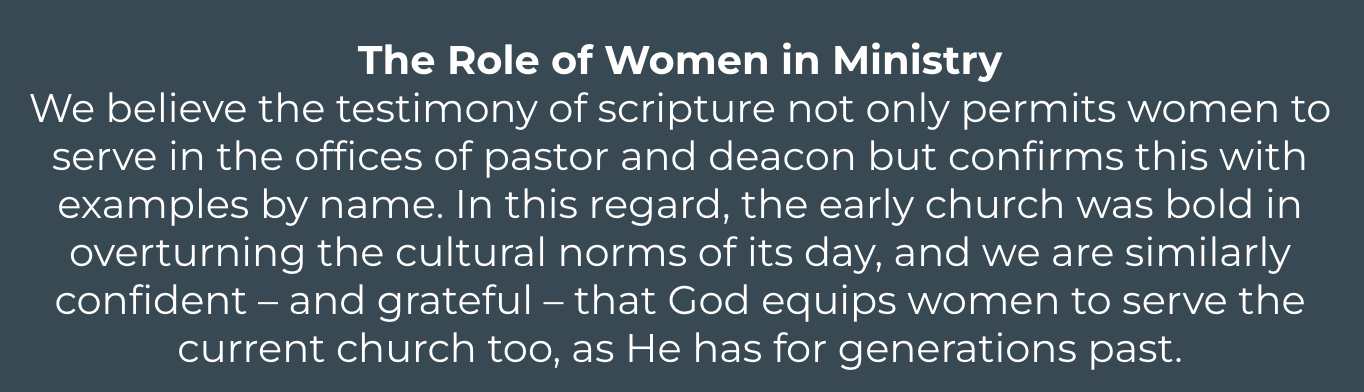
The church saw the writing on the wall two years ago when they were first ratted out for their disobedience. It didn’t matter that the church, which has existed for well over a century, donated millions of dollars to the SBC for missionary work. The Associated Press said that “the pastor of a neighboring church reported” them to the SBC after discovering they employed two women as pastors. (A man was still the “senior pastor,” but that was irrelevant.)

Their open belief that there’s nothing wrong with having women on staff as pastors is what pushed the SBC over the edge.

The vote came after the denomination’s credentials committee recommended earlier Tuesday that the denomination deem the church to be not in “friendly cooperation,” the formulation for expulsion, on the grounds that it conflicts with the Baptist Faith and Message. That statement of Southern Baptist doctrine declares only men are qualified for the role of pastor. Some interpret that only to apply to associate pastors as long as the senior pastor is male.

It would be unfair to call this church progressive given that it opposes same-sex marriage and denies the existence of transgender people, but even symbolic gender equality was a bridge too far for most Southern Baptists who voted.

The expulsion came a year after the SBC kicked out Rick Warren’s Saddleback Church for ordaining three female pastors.

But all of that was merely a prelude to what happened Wednesday when the SBC voted on a formal policy (called the “Law Amendment,” after the name of the person who proposed it) to banish any SBC church that placed women on the leadership hierarchy or openly supported that idea.

The policy, which needed two-thirds of the vote, two years in a tow, ultimately failed. They couldn’t get over the 67% threshold this time around.

Still, it’s hardly a victory when over 60% of SBC delegates support the Only-Men-In-Power doctrine. (Had this Amendment passed, the First Baptist Church of Alexandria would have been expelled from the SBC for having a female pastor and believing women can be co-equal leaders. As it stands, they were only kicked out for the latter offense.)

As reporter Kate Shellnutt of Christianity Today explained, the SBC will still be able to punish churches with “female lead pastors,” like they did with Saddleback, but they won’t have a zero tolerance policy for churches that place women in other leadership positions.

Had the Law Amendment passed, it could have led many churches to step out from under the SBC umbrella, as Bob Smietana noted at Religion News Service:

Southern Baptist churches have long relied on women to teach Sunday School, lead outreach ministries and do all the behind-the-scenes work to keep their congregations running smoothly. Southern Baptists also raise hundreds of millions of dollars every year in the names of legendary missionaries Lottie Moon and Annie Armstrong. But they have also banned women from the pastorate — especially serving as senior pastor of a church. 

… Passing this new rule, known as the “Law Amendment,” could lead to hundreds or thousands of churches leaving the SBC.   

Just because the vote failed, however, doesn’t mean those churches will stay put.

The fact that this rule—no women in church leadership!—was even an issue tells you a lot about where the SBC is at. They’re literally arguing about a mild version of gender equality while the rest of their house remains on fire. Sexual abuse runs rampant within the SBC but a large part of the focus this year was on whether a woman serving as associate pastor was substantially different from a woman serving as senior pastor. For the majority of delegates, it’s better to have women labeled as servants and let them keep doing the same work, I guess.

Had they chosen to expel churches that employ women as pastors, the expectation was that a lot of churches would quit before they could be fired. Some still may.

Some churches made the decision to leave before they might be asked.

The Rev. Christy McMillin-Goodwin, pastor of First Baptist Church in Front Royal, Virginia, said she was surprised to discover that another Virginia clergyperson had listed her church as an example of one whose clerical leader was “sinning against God.”

“Our church decided to take a vote last May (2023) and the decision was unanimous,” she said of the church that had long stopped sending donations to the SBC and is affiliated with the more moderate Cooperative Baptist Fellowship. “People actually yelled ‘Yes.’ It was very impassioned that we don’t want to be a part of an organization that does not fully support women in leadership in the church.”

They were proud to be part of a historically racist and currently anti-LGBTQ organization, but punishing churches that have women in leadership was a dealbreaker? Got it. (Someone make that make sense.)

It’s not just slightly progressive churches that need to decide their membership status. A lot of Black churches are making similar decisions, turning an organization that’s already known for its support of white Christian Nationalism into one that more closely looks the part.

When that happens, it will be a completely self-inflicted wound.

Telling women they’re equally capable of spreading the Gospel seems to be the sort of thing that would draw in more Christians than it alienates. But dogma, for many of these Southern Baptists, overrides common sense. The majority of Southern Baptists want to force underage girls to bear their rapists’ babies but they can’t handle a grown woman in the pulpit.

On top of that, the SBC also voted to oppose IVF treatments, even though plenty of white evangelicals have used the technology to have babies. While the vote wasn’t a surprise, it’s an extreme approach that may signal the next phase in the Christian Nationalist attack on reproductive rights.

IVF, of course, is a procedure in which a sperm and ova are joined outside the body, in a laboratory dish. It’s meant to help couples struggling with infertility or other health problems. The concern for anti-abortion extremists is that, in IVF, the embryos that aren’t implanted inside a uterus may be discarded or placed in a freezer. They believe that’s tantamount to murder. (Oklahoma State Senator Dusty Deevers has said parents who use IVF are “waging an assault against God.”)

If you cut through the fluff in the actual SBC amendment, these paragraphs are what it boils down to:

IVF destroys human life. IVF promotes eugenics. IVF will lead to the murder of millions of teeny tiny “human beings.” Therefore we must oppose IVF no matter what.

It’s a thoughtless statement from a heartless organization.

It’s also a slap in the face to all the Christian women who have used IVF to have babies because, without it, they were unable to have children.

While the resolution has no teeth, and people who use IVF will still be allowed to stay in their churches, it’s a signal that conservative Christians are not satisfied with the Supreme Court banning abortion rights and that they fully intend to support politicians who want to ban IVF, too. They will also use this vote to put more pressure on Republicans who support IVF because it’s overwhelmingly popular.

POLITICO puts it bluntly:

Though the resolution is nonbinding, nearly 13 million Southern Baptists across 45,000 churches may now face pressure from the pulpit or in individual conversations with pastors to eschew IVF.

The Southern Baptists’ Wednesday vote could encourage other evangelical denominations and churches to follow suit in declaring — or at least teaching about — their ethical concerns with IVF.

All of this is happening while membership in the SBC is at a 47-year low.

In 2003, the SBC had a record high 16.3 million members. In 2023, the number dropped to 12.99 million, continuing 17 straight years of declining membership.

Meanwhile, the sexual abuse crisis remains a massive problem for the SBC.

It all stems back to revelations from 2022 about the SBC, in which we learned that, over the previous decade, more than 250 SBC staffers or volunteers had been “charged with sex crimes” against more than 700 victims. We also learned in the SBC’s own investigation that a private list of alleged predators (that wasn’t shared with member churches) included “703 abusers, with 409 believed to be SBC-affiliated.” The situation was so bad that the Department of Justice announced it was investigating “multiple SBC entities,” though not specific individuals, about their mishandling of sexual abuse cases. Last month, a former seminary professor became the first person indicted in the investigation. (He has pleaded not guilty.)

This month, we got an update from the SBC as to how its internal investigations are going… and it was predictably disappointing. A volunteer task force that was supposed to implement reforms announced that it would close up shop. While they created some resources to help churches deal with the problem, the biggest reform they could have made was creating a database of abusers so that criminals and known problematic people couldn’t church-hop after getting kicked out of one place… but that “Ministry Check” never happened because of a lack of funding and fears over getting sued.

To date, no names appear on the “Ministry Check” website designed to track abusive pastors, despite a mandate from Southern Baptists to create the database. The committee has also found no permanent home or funding for abuse reforms, meaning that two of the task force’s chief tasks remain unfinished.

Because of liability concerns about the database, the task force set up a separate nonprofit to oversee the Ministry Check website. That new nonprofit, known as the Abuse Response Committee, has been unable to publish any names because of objections raised by SBC leaders.

The SBC raked in over $10 billion in 2023. They could fund abuse reforms if they really wanted to without even noticing a change in their bank account. They just don’t want to. They would rather form a task force with no teeth than risk the world finding out just how many of their leaders are alleged (or charged) abusers.

When Lifeway Christian Resources (an arm of the SBC) released the results of a survey of congregation leaders last month, they found that only 58% of them required background checks for staffers who work with kids. With the number that low, the abuse is bound to continue.

Lost in the shuffle of all these votes was the election of the SBC’s new president, Clint Pressley, a megachurch pastor from North Carolina who represents the more conservative wing of the already conservative denomination. (The Religion News Service article about his election says, in the first paragraph, that Pressley “does not wear jeans in the pulpit.” Because that would be heretical.)
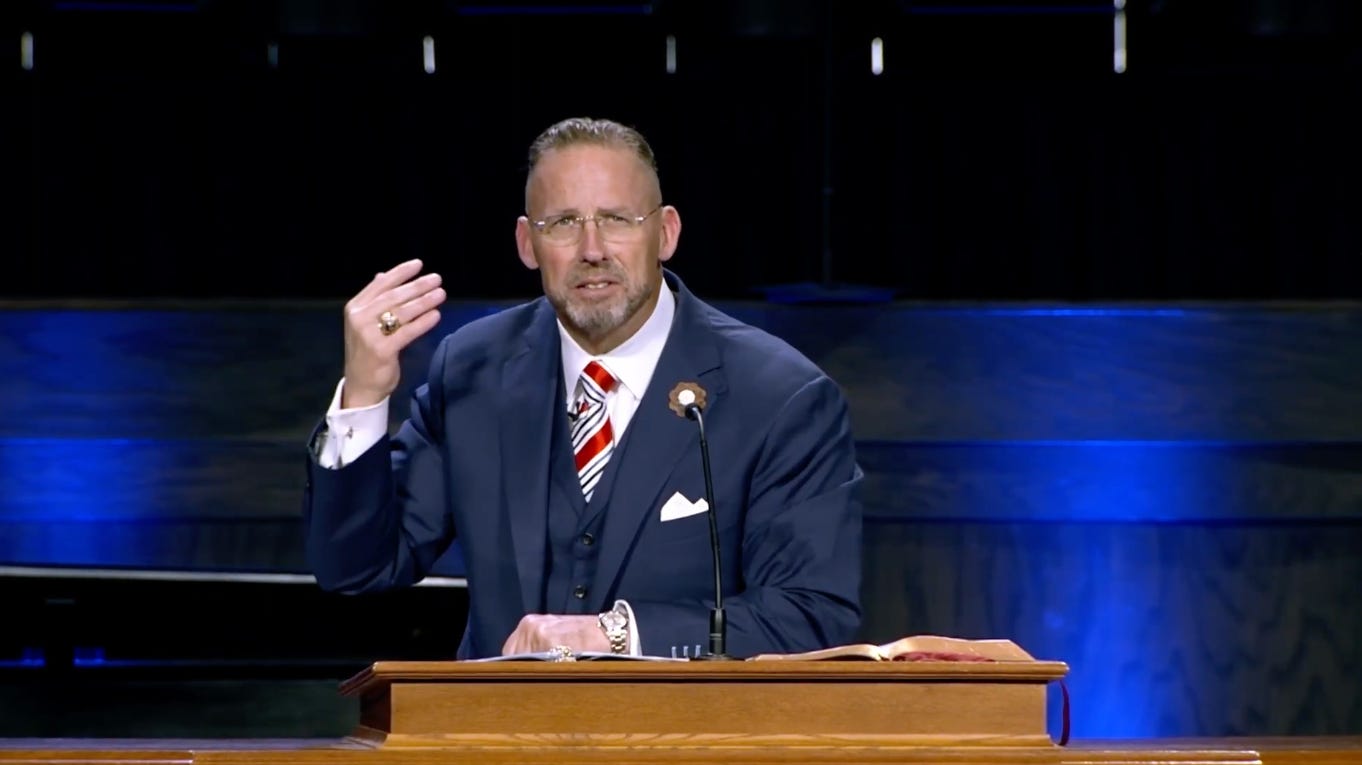
Pastor Clint Pressley speaking at Hickory Grove Baptist Church in Charlotte (screenshot via YouTube)

Pressley supported the anti-women Law Amendment and had “questions” about the proposed database of abusers, in case you had any questions about where he stands. Oh. And a volunteer at his megachurch was arrested in May after being accused of sexually abusing his own daughter. (The church thankfully reported the man to secular authorities leading to his eventual arrest.)

Keep in mind that the second largest Protestant denomination recently voted to get rid of its anti-LGBTQ policies and allow gay clergy members.

The SBC, on the other hand, is still debating which way to rearrange deck chairs on the Titanic.

(Portions of this article were published earlier)


Please share this post on Reddit, Facebook, or the godawful X/Bird app.

Share

Subscribe to Friendly Atheist

By Hemant Mehta · Hundreds of paid subscribers

Commentary about religion and politics, centered around atheism.

The Marginalian: Ursula K. Le Guin on Growing Older and What Beauty Really Means

Here’s the link to this article.

BY MARIA POPOVA

“A Dog is, on the whole, what you would call a simple soul,” T.S. Eliot simpered in his beloved 1930s poem “The Ad-dressing of Cats,” proclaiming that “Cats are much like you and me.” Indeed, cats have a long history of being anthropomorphized in dissecting the human condition — but, then again, so do dogs. We’ve always used our feline and canine companions to better understand ourselves, but nowhere have Cat and Dog served a more poignant metaphorical purpose than in the 1992 essay “Dogs, Cats, and Dancers: Thoughts about Beauty” by Ursula K. Le Guin (b. October 21, 1929), found in the altogether spectacular volume The Wave in the Mind: Talks and Essays on the Writer, the Reader, and the Imagination (public library), which also gave us Le Guin, at her finest and sharpest, on being a man.

Le Guin contrasts the archetypal temperaments of our favorite pets:

Dogs don’t know what they look like. Dogs don’t even know what size they are. No doubt it’s our fault, for breeding them into such weird shapes and sizes. My brother’s dachshund, standing tall at eight inches, would attack a Great Dane in the full conviction that she could tear it apart. When a little dog is assaulting its ankles the big dog often stands there looking confused — “Should I eat it? Will it eat me? I am bigger than it, aren’t I?” But then the Great Dane will come and try to sit in your lap and mash you flat, under the impression that it is a Peke-a-poo.

Artwork by Mark Ulriksen from ‘The Big New Yorker Book of Dogs.’ Click image for more.

Cats, on the other hand, have a wholly different scope of self-awareness:

Cats know exactly where they begin and end. When they walk slowly out the door that you are holding open for them, and pause, leaving their tail just an inch or two inside the door, they know it. They know you have to keep holding the door open. That is why their tail is there. It is a cat’s way of maintaining a relationship.

Housecats know that they are small, and that it matters. When a cat meets a threatening dog and can’t make either a horizontal or a vertical escape, it’ll suddenly triple its size, inflating itself into a sort of weird fur blowfish, and it may work, because the dog gets confused again — “I thought that was a cat. Aren’t I bigger than cats? Will it eat me?”

Illustration by Wendy MacNaughton based on Gay Talese’s taxonomy of cats. Click image for details.

More than that, Le Guin notes, cats are aesthetes, vain and manipulative in their vanity. In a passage that takes on whole new layers of meaning twenty years later, in the heyday of the photographic cat meme, she writes:

Cats have a sense of appearance. Even when they’re sitting doing the wash in that silly position with one leg behind the other ear, they know what you’re sniggering at. They simply choose not to notice. I knew a pair of Persian cats once; the black one always reclined on a white cushion on the couch, and the white one on the black cushion next to it. It wasn’t just that they wanted to leave cat hair where it showed up best, though cats are always thoughtful about that. They knew where they looked best. The lady who provided their pillows called them her Decorator Cats.

Artwork by Ronald Searle from ‘The Big New Yorker Book of Cats.’ Click image for more.

A master of bridging the playful and the poignant, Le Guin returns to the human condition:

A lot of us humans are like dogs: we really don’t know what size we are, how we’re shaped, what we look like. The most extreme example of this ignorance must be the people who design the seats on airplanes. At the other extreme, the people who have the most accurate, vivid sense of their own appearance may be dancers. What dancers look like is, after all, what they do.

Echoing legendary choreographer Merce Cunningham’s contemplation of dance as “the human body moving in time-space,” Le Guin considers the dancers she knows and their extraordinary lack of “illusions or confusions about what space they occupy.” Recounting the anecdote of one young dancer who upon scraping his ankle exclaimed, “I have an owie on my almost perfect body!” Le Guin writes:

It was endearingly funny, but it was also simply true: his body is almost perfect. He knows it is, and knows where it isn’t. He keeps it as nearly perfect as he can, because his body is his instrument, his medium, how he makes a living, and what he makes art with. He inhabits his body as fully as a child does, but much more knowingly. And he’s happy about it.

Photograph from Helen Keller’s life-changing visit to Martha Graham’s dance studio. Click image for details.

What dance does, above all, is offer the promise of precisely such bodily happiness — not of perfection, but of satisfaction. Dancers, Le Guin argues, are “so much happier than dieters and exercisers.” She considers the impossible ideals of the latter, which cripple them in the same way that perfectionism cripples creativity in writing and art:

Perfection is “lean” and “taut” and “hard” — like a boy athlete of twenty, a girl gymnast of twelve. What kind of body is that for a man of fifty or a woman of any age? “Perfect”? What’s perfect? A black cat on a white cushion, a white cat on a black one . . . A soft brown woman in a flowery dress . . . There are a whole lot of ways to be perfect, and not one of them is attained through punishment.

Photograph by Zed Nelson from his project ‘Love Me.’ Click image for more.

And just like that, Le Guin pirouettes, elegantly but imperceptibly, from the lighthearted to the serious. Reflecting on various cultures’ impossible and often painful ideals of human beauty, “especially of female beauty,” she writes:

I think of when I was in high school in the 1940s: the white girls got their hair crinkled up by chemicals and heat so it would curl, and the black girls got their hair mashed flat by chemicals and heat so it wouldn’t curl. Home perms hadn’t been invented yet, and a lot of kids couldn’t afford these expensive treatments, so they were wretched because they couldn’t follow the rules, the rules of beauty.

Beauty always has rules. It’s a game. I resent the beauty game when I see it controlled by people who grab fortunes from it and don’t care who they hurt. I hate it when I see it making people so self-dissatisfied that they starve and deform and poison themselves. Most of the time I just play the game myself in a very small way, buying a new lipstick, feeling happy about a pretty new silk shirt.

Ursula K. Le Guin

Le Guin, who writes about aging with more grace, humor, and dignity than any other writer I’ve read, turns to the particularly stifling ideal of eternal youth:

One rule of the game, in most times and places, is that it’s the young who are beautiful. The beauty ideal is always a youthful one. This is partly simple realism. The young are beautiful. The whole lot of ’em. The older I get, the more clearly I see that and enjoy it.

[…]

And yet I look at men and women my age and older, and their scalps and knuckles and spots and bulges, though various and interesting, don’t affect what I think of them. Some of these people I consider to be very beautiful, and others I don’t. For old people, beauty doesn’t come free with the hormones, the way it does for the young. It has to do with bones. It has to do with who the person is. More and more clearly it has to do with what shines through those gnarly faces and bodies.

But what makes the transformations of aging so anguishing, Le Guin poignantly observes, isn’t the loss of beauty — it’s the loss of identity, a frustratingly elusive phenomenon to begin with. She writes:

I know what worries me most when I look in the mirror and see the old woman with no waist. It’s not that I’ve lost my beauty — I never had enough to carry on about. It’s that that woman doesn’t look like me. She isn’t who I thought I was.

[…]

We’re like dogs, maybe: we don’t really know where we begin and end. In space, yes; but in time, no.

[…]

A child’s body is very easy to live in. An adult body isn’t. The change is hard. And it’s such a tremendous change that it’s no wonder a lot of adolescents don’t know who they are. They look in the mirror — that is me? Who’s me?

And then it happens again, when you’re sixty or seventy.

Artwork by Mark Ulriksen from ‘The Big New Yorker Book of Dogs.’ Click image for more.

In a sentiment that calls Rilke to mind — “I am not one of those who neglect the body in order to make of it a sacrificial offering for the soul,” he memorably wrote“since my soul would thoroughly dislike being served in such a fashion.” — Le Guin admonishes against our impulse to intellectualize out of the body, away from it:

Who I am is certainly part of how I look and vice versa. I want to know where I begin and end, what size I am, and what suits me… I am not “in” this body, I am this body. Waist or no waist.

But all the same, there’s something about me that doesn’t change, hasn’t changed, through all the remarkable, exciting, alarming, and disappointing transformations my body has gone through. There is a person there who isn’t only what she looks like, and to find her and know her I have to look through, look in, look deep. Not only in space, but in time.

[…]

There’s the ideal beauty of youth and health, which never really changes, and is always true. There’s the ideal beauty of movie stars and advertising models, the beauty-game ideal, which changes its rules all the time and from place to place, and is never entirely true. And there’s an ideal beauty that is harder to define or understand, because it occurs not just in the body but where the body and the spirit meet and define each other.

And yet for all the ideals we impose on our earthy embodiments, Le Guin argues in her most poignant but, strangely, most liberating point, it is death that ultimately illuminates the full spectrum of our beauty — death, the ultimate equalizer of time and space; death, the great clarifier that makes us see that, as Rebecca Goldstein put it, “a person whom one loves is a world, just as one knows oneself to be a world.” With this long-view lens, Le Guin remembers her own mother and the many dimensions of her beauty:

My mother died at eighty-three, of cancer, in pain, her spleen enlarged so that her body was misshapen. Is that the person I see when I think of her? Sometimes. I wish it were not. It is a true image, yet it blurs, it clouds, a truer image. It is one memory among fifty years of memories of my mother. It is the last in time. Beneath it, behind it is a deeper, complex, ever-changing image, made from imagination, hearsay, photographs, memories. I see a little red-haired child in the mountains of Colorado, a sad-faced, delicate college girl, a kind, smiling young mother, a brilliantly intellectual woman, a peerless flirt, a serious artist, a splendid cook—I see her rocking, weeding, writing, laughing — I see the turquoise bracelets on her delicate, freckled arm — I see, for a moment, all that at once, I glimpse what no mirror can reflect, the spirit flashing out across the years, beautiful.

That must be what the great artists see and paint. That must be why the tired, aged faces in Rembrandt’s portraits give us such delight: they show us beauty not skin-deep but life-deep.

The Wave in the Mind remains the kind of book that stays with you for life — the kind of book that is life.

The Marginalian: The Measure of a Life Well Lived: Henry Miller on Growing Old, the Perils of Success, and the Secret of Remaining Young at Heart

Here’s the link to this article.

BY MARIA POPOVA

“On how one orients himself to the moment,” 48-year-old Henry Miller (December 26, 1891–June 7, 1980) wrote in reflecting on the art of living in 1939, “depends the failure or fruitfulness of it.” Over the course of his long life, Miller sought ceaselessly to orient himself toward maximal fruitfulness, from his creative discipline to his philosophical reflections to his exuberant irreverence.

More than three decades later, shortly after his eightieth birthday, Miller wrote a beautiful essay on the subject of aging and the key to living a full life. It was published in 1972 in an ultra-limited-edition chapbook titled On Turning Eighty (public library), alongside two other essays. Only 200 copies were printed, numbered and signed by the author.

Miller begins by considering the true measure of youthfulness:

If at eighty you’re not a cripple or an invalid, if you have your health, if you still enjoy a good walk, a good meal (with all the trimmings), if you can sleep without first taking a pill, if birds and flowers, mountains and sea still inspire you, you are a most fortunate individual and you should get down on your knees morning and night and thank the good Lord for his savin’ and keepin’ power. If you are young in years but already weary in spirit, already on the way to becoming an automaton, it may do you good to say to your boss — under your breath, of course — “Fuck you, Jack! You don’t own me!” … If you can fall in love again and again, if you can forgive your parents for the crime of bringing you into the world, if you are content to get nowhere, just take each day as it comes, if you can forgive as well as forget, if you can keep from growing sour, surly, bitter and cynical, man you’ve got it half licked.

He later adds:

I have very few friends or acquaintances my own age or near it. Though I am usually ill at ease in the company of elderly people I have the greatest respect and admiration for two very old men who seem to remain eternally young and creative. I mean [the Catalan cellist and conductor] Pablo Casals and Pablo Picasso, both over ninety now. Such youthful nonagenarians put the young to shame. Those who are truly decrepit, living corpses, so to speak, are the middle-aged, middleclass men and women who are stuck in their comfortable grooves and imagine that the status quo will last forever or else are so frightened it won’t that they have retreated into their mental bomb shelters to wait it out.

Miller considers the downside of success — not the private kind, per Thoreau’s timeless definition, but the public kind, rooted in the false deity of prestige:

If you have had a successful career, as presumably I have had, the late years may not be the happiest time of your life. (Unless you’ve learned to swallow your own shit.) Success, from the worldly standpoint, is like the plague for a writer who still has something to say. Now, when he should be enjoying a little leisure, he finds himself more occupied than ever. Now he is the victim of his fans and well wishers, of all those who desire to exploit his name. Now it is a different kind of struggle that one has to wage. The problem now is how to keep free, how to do only what one wants to do.

He goes on to reflect on how success affects people’s quintessence:

One thing seems more and more evident to me now — people’s basic character does not change over the years… Far from improving them, success usually accentuates their faults or short-comings. The brilliant guys at school often turn out to be not so brilliant once they are out in the world. If you disliked or despised certain lads in your class you will dislike them even more when they become financiers, statesmen or five star generals. Life forces us to learn a few lessons, but not necessarily to grow.

Somewhat ironically, Anaïs Nin — Miller’s onetime lover and lifelong friend — once argued beautifully for the exact opposite, the notion that our personalities are fundamentally fluid and ever-growing, something that psychologists have since corroborated.

Miller returns to youth and the young as a kind of rearview mirror for one’s own journey:

You observe your children or your children’s children, making the same absurd mistakes, heart-rending mistakes often, which you made at their age. And there is nothing you can say or do to prevent it. It’s by observing the young, indeed, that you eventually understand the sort of idiot you yourself were once upon a time — and perhaps still are.

Like George Eliot, who so poignantly observed the trajectory of happiness over the course of human life, Miller extols the essential psychoemotional supremacy of old age:

At eighty I believe I am a far more cheerful person than I was at twenty or thirty. I most definitely would not want to be a teenager again. Youth may be glorious, but it is also painful to endure…

I was cursed or blessed with a prolonged adolescence; I arrived at some seeming maturity when I was past thirty. It was only in my forties that I really began to feel young. By then I was ready for it. (Picasso once said: “One starts to get young at the age of sixty, and then it’s too late.”) By this time I had lost many illusions, but fortunately not my enthusiasm, nor the joy of living, nor my unquenchable curiosity.

And therein lies Miller’s spiritual center — the life-force that stoked his ageless inner engine:

Perhaps it is curiosity — about anything and everything — that made me the writer I am. It has never left me…

With this attribute goes another which I prize above everything else, and that is the sense of wonder. No matter how restricted my world may become I cannot imagine it leaving me void of wonder. In a sense I suppose it might be called my religion. I do not ask how it came about, this creation in which we swim, but only to enjoy and appreciate it.

Two years later, Miller would come to articulate this with even more exquisite clarity in contemplating the meaning of life, but here he contradicts Henry James’s assertion that seriousness preserves one’s youth and turns to his other saving grace — the capacity for light-heartedness as an antidote to life’s often stifling solemnity:

Perhaps the most comforting thing about growing old gracefully is the increasing ability not to take things too seriously. One of the big differences between a genuine sage and a preacher is gaiety. When the sage laughs it is a belly laugh; when the preacher laughs, which is all too seldom, it is on the wrong side of the face.

Equally important, Miller argues, is countering the human compulsion for self-righteousness. In a sentiment Malcolm Gladwell would come to complement nearly half a century later in advocating for the importance of changing one’s mind regularly, Miller writes:

With advancing age my ideals, which I usually deny possessing, have definitely altered. My ideal is to be free of ideals, free of principles, free of isms and ideologies. I want to take to the ocean of life like a fish takes to the sea…

I no longer try to convert people to my view of things, nor to heal them. Neither do I feel superior because they appear to be lacking in intelligence.

Miller goes on to consider the brute ways in which we often behave out of self-righteousness and deformed idealism:

One can fight evil but against stupidity one is helpless… I have accepted the fact, hard as it may be, that human beings are inclined to behave in ways that would make animals blush. The ironic, the tragic thing is that we often behave in ignoble fashion from what we consider the highest motives. The animal makes no excuse for killing his prey; the human animal, on the other hand, can invoke God’s blessing when massacring his fellow men. He forgets that God is not on his side but at his side.

But despite observing these lamentable human tendencies, Miller remains an optimist at heart. He concludes by returning to the vital merriment at the root of his life-force:

My motto has always been: “Always merry and bright.” Perhaps that is why I never tire of quoting Rabelais: “For all your ills I give you laughter.” As I look back on my life, which has been full of tragic moments, I see it more as a comedy than a tragedy. One of those comedies in which while laughing your guts out you feel your inner heart breaking. What better comedy could there be? The man who takes himself seriously is doomed…

There is nothing wrong with life itself. It is the ocean in which we swim and we either adapt to it or sink to the bottom. But it is in our power as human beings not to pollute the waters of life, not to destroy the spirit which animates us.

The most difficult thing for a creative individual is to refrain from the effort to make the world to his liking and to accept his fellow man for what he is, whether good, bad or indifferent.

The entire On Turning Eighty chapbook, which includes two other essays, is a sublime read. Complement it with Miller on writingaltruismthe meaning of lifewhat creative death means, and his 11 commandments of writing.

The Marginalian: Love After Life: Nobel-Winning Physicist Richard Feynman’s Extraordinary Letter to His Departed Wife

Here’s the link to this article.

BY MARIA POPOVA

Love After Life: Nobel-Winning Physicist Richard Feynman’s Extraordinary Letter to His Departed Wife

Few people have enchanted the popular imagination with science more powerfully and lastingly than physicist Richard Feynman (May 11, 1918–February 15, 1988) — the “Great Explainer” with the uncommon gift for bridging the essence of science with the most human and humane dimensions of life.

Several months after Feynman’s death, while working on what would become Genius: The Life and Science of Richard Feynman (public library) — the masterly biography plumbing the wellspring of Feynman’s genius — James Gleick discovered something of arresting strangeness and splendor.

“My heart stopped,” Gleick tells me. “I have never had an experience like that as a biographer, before or since.”

In a mass of unread papers sent to him by Feynman’s widow, Gweneth, Gleick found a letter that discomposed his most central understanding of Feynman’s character. A generation after computing pioneer Alan Turing tussled with the binary code of body and spirit in the wake of loss, Feynman — a scientist perhaps uncommonly romantic yet resolutely rational and unsentimental in his reverence for the indomitable laws of physics that tend toward decay — penned a remarkable letter to a physical nonentity that was, for the future Nobel-winning physicist, the locus of an irrepressible metaphysical reality.

Richard Feynman as a youth

In high school, the teenage Richard spent summers at the beach in his native Far Rockaway. There, he grew besotted with a striking girl named Arline — a girl he knew he would marry. Both complement and counterpoint to his own nature, Arline met Richard’s inclination for science with ardor for philosophy and art. (The art class he took just to be near her would lay the foundation for his little-known, lifelong passion for drawing.) By his junior year, Richard proposed. Arline accepted. With the eyes of young love, they peered into a shared future of infinite possibility for bliss.

Richard and Arline, 1940s

But they were abruptly grounded when a mysterious malady began afflicting Arline with inexplicable symptoms — a lump would appear and disappear on her neck, fevers would roil over her with no apparent cause. Eventually, she was hospitalized for what was believed to be typhoid.

Gleick writes:

Feynman began to glimpse the special powerlessness that medical uncertainty can inflict on a scientific person. He had come to believe that the scientific way of thinking brought a measure of calmness and control in difficult situations — but not now.

Just as Feynman began bombarding the doctors with questions that steered them toward a closer approximation of the scientific method, Arline began to recover just as mysteriously and unpredictably as she had fallen ill. But the respite was only temporary. The symptoms returned, still shorn of a concrete explanation but now unambiguously pointing toward the terminal — a prognosis Arline’s doctors kept from her. Richard refused to go along with the deception — he and Arline had promised each other to face life with unremitting truthfulness — but he was forced to calibrate his commitment to circumstance.

Gleick writes:

His parents, Arline’s parents, and the doctors all urged him not to be so cruel as to tell a young woman she was dying. His sister, Joan, sobbing, told him he was stubborn and heartless. He broke down and bowed to tradition. In her room at Farmingdale Hospital, with her parents at her side, he confirmed that she had glandular fever. Meanwhile, he started carrying around a letter — a “goodbye love letter,” as he called it — that he planned to give her when she discovered the truth. He was sure she would never forgive the unforgivable lie.

He did not have long to wait. Soon after Arline returned home from the hospital she crept to the top of the stairs and overheard her mother weeping with a neighbor down in the kitchen. When she confronted Richard — his letter snug in his pocket — he told her the truth, handed her the letter, and asked her to marry him.

Arline and Richard, 1940s

Marriage, however, proved to be a towering practical problem — Princeton, where Feynman was now pursuing a Ph.D., threatened to withdraw the fellowships funding his graduate studies if he were to wed, for the university considered the emotional and pragmatic responsibilities of marriage a grave threat to academic discipline.

Just as Feynman began considering leaving Princeton, a diagnosis detonated the situation — Arline had contracted a rare form of tuberculosis, most likely from unpasteurized milk.

At first, Feynman was relieved that the grim alternative options of Hodgkin’s disease and incurable cancers like lymphoma had been ruled out. But he was underestimating, or perhaps misunderstanding, the gravity of tuberculosis — the very disease which had taken the love of Alan Turing’s life and which, during its two-century heyday, had claimed more lives around the globe than any other malady and all wars combined. At the time of Arline’s diagnosis in 1941, immunology was in its infancy, the antibiotic treatment of bacterial infections practically nonexistent, and the first successful medical application of penicillin a year away. Tuberculosis was a death sentence, even if it was a slow death with intervals of remission — a fact Richard and Arline faced with an ambivalent mix of brave lucidity and hope against hope.

Meanwhile, Richard’s parents met the prospect of his marriage with bristling dread. His mother, who believed he was marrying Arline out of pity rather than love, admonished him that he would be putting his health and his very life in danger, and coldly worried about how the stigma attached to tuberculosis would impact her brilliant young son’s reputation. “I was surprised to learn such a marriage is not unlawful,” she scoffed unfeelingly. “It ought to be.”

But Richard was buoyed by love — a love so large and luminous that he found himself singing aloud one day as he was arranging Arline’s transfer to a sanatorium. Determined to go through with the wedding, he wrote to his beloved:

I guess maybe it is like rolling off of a log — my heart is filled again & I’m choked with emotions — and love is so good & powerful — it’s worth preserving — I know nothing can separate us — we’ve stood the tests of time and our love is as glorious now as the day it was born — dearest riches have never made people great but love does it every day — we’re not little people — we’re giants … I know we both have a future ahead of us — with a world of happiness — now & forever.

On June 29, 1942, they promised each other eternity.

Richard and Arline on their wedding day

Gleick writes:

He borrowed a station wagon from a Princeton friend, outfitted it with mattresses for the journey, and picked up Arline in Cedarhurst. She walked down her father’s hand-poured concrete driveway wearing a white dress. They crossed New York Harbor on the Staten Island ferry — their honeymoon ship. They married in a city office on Staten Island, in the presence of neither family nor friends, their only witnesses two strangers called in from the next room. Fearful of contagion, Richard did not kiss her on the lips. After the ceremony he helped her slowly down the stairs, and onward they drove to Arline’s new home, a charity hospital in Browns Mills, New Jersey.

Meanwhile, WWII was reaching its crescendo of destruction, dragging America into the belly of death with the attack on Pearl Harbor. Now one of the nation’s most promising physicists, Feynman was recruited to work on what would become the Manhattan Project and soon joined the secret laboratory in Los Alamos.

Feynman’s Los Alamos badge

Arline entered the nearby Albuquerque sanatorium, from where she wrote him letters in code — for the sheer fun of it, because she knew how he cherished puzzles, but the correspondence alarmed the military censors at the laboratory’s Intelligence Office. Tasked with abating any breaches to the secrecy of the operation, they cautioned Feynman that coded messages were against the rules and demanded that his wife include a key in each letter to help them decipher it. This only amplified Arline’s sense of fun — she began cutting holes into her letters, covering passages with ink, and even mail-ordered a jigsaw puzzle kit with which to cut up the pages and completely confound the agents.

But the levity masked the underlying darkness which Richard and Arline tried so desperately to evade — Arline was dying. As her body failed, he steadied himself to her spirit:

You are a strong and beautiful woman. You are not always as strong as other times but it rises & falls like the flow of a mountain stream. I feel I am a reservoir for your strength — without you I would be empty and weak… I find it much harder these days to write these things to you.

In every single letter, he told her that he loved her. “I have a serious affliction: loving you forever,” he wrote.

Richard and Arline at the Albuquerque sanatorium

In early 1945, two and a half years into their marriage, Richard and Arline made love for the first time. He had been too afraid of harming her frail health somehow, she too afraid of infecting him with the deadly bacterium consuming her. But Arline insisted that this pent up desire could no longer be contained and assured Richard that this would only bring them closer — to each other, and to the life they had so lovingly dreamt up for themselves:

I’ll always be your sweetheart & first love — besides a devoted wife — we’ll be proud parents too… I am proud of you always Richard –[you are] a good husband, and lover, & well, coach, I’ll show you what I mean Sunday.

But heightened as their hopes were by this new dimension of shared experience, Arline’s health continued to plummet. Her weight dropped to eighty-four pounds. Exasperated by the helplessness of medicine, which Feynman had come to see not as a manifestation but as a mutilation of the scientific method, he invested all hope in an experimental drug made of mold growths. “Keep hanging on,” he exhorted Arline. “Nothing is certain. We lead a charmed life.” She began spitting blood.

At twenty-seven, on the precipice of a brilliant scientific career, he was terminally in love.

On June 16, 1945, while working at the computing room at Los Alamos, Feynman received a call from the sanatorium that Arline was dying. He borrowed a colleague’s car and sped to the hospital, where he found her immobile, her eyes barely tracing his movement. Early in his scientific career, he had been animated by the nature of time. Now, hours stretched and contracted as he sat at her deathbed, until one last small breath tolled the end at 9:21PM.

The wake of loss has a way of tranquilizing grief with the pressing demands of practical arrangements — a tranquilizer we take willingly, almost gratefully. The following morning, Feynman arranged for his beloved’s cremation, methodically collected her personal belongings, and on the final page of the small spiral notebook in which she recorded her symptoms he wrote with scientific remove: “June 16 — Death.”

And so we arrive at Gleick’s improbable discovery in that box of letters — improbable because of the extreme rationality with which Feynman hedged against even the slightest intimation of metaphysical conjectures untestable by science and unprovable by reason. During his courtship of Arline, he had been vexed by her enthusiasm for Descartes, whose “proof” of God’s perfection he found intellectually lazy and unbefitting of Descartes’s reputation as a champion of reason. He had impishly countered Arline’s insistence that there are two sides to everything by cutting a piece of paper and half-twisting it into a Möbius strip, the ends pasted together to render a surface with just one side.

Everything that appeared mystical, Feynman believed, was simply an insufficiently explained mystery with a physical answer not yet found. Even Arline’s dying hour had offered testing ground for conviction. Puzzlingly, the clock in the room had stopped at exactly 9:21PM — the time of death. Aware of how this bizarre occurrence could foment the mystical imagination in unscientific minds, Feynman reasoned for an explanation. Remembering that he had repaired the clock multiple times over the course of Arline’s stay at the sanatorium, he realized that the instrument’s unwieldy mechanism must have choked when the nurse picked it up in the low evening light to see and record the time.

How astonishing and how touchingly human, then, that Feynman penned the letter Gleick found in the box forty-two years later — a letter he wrote to Arline in October of 1946, 488 days after her death:

D’Arline,

I adore you, sweetheart.

I know how much you like to hear that — but I don’t only write it because you like it — I write it because it makes me warm all over inside to write it to you.

It is such a terribly long time since I last wrote to you — almost two years but I know you’ll excuse me because you understand how I am, stubborn and realistic; and I thought there was no sense to writing.

But now I know my darling wife that it is right to do what I have delayed in doing, and that I have done so much in the past. I want to tell you I love you. I want to love you. I always will love you.

I find it hard to understand in my mind what it means to love you after you are dead — but I still want to comfort and take care of you — and I want you to love me and care for me. I want to have problems to discuss with you — I want to do little projects with you. I never thought until just now that we can do that. What should we do. We started to learn to make clothes together — or learn Chinese — or getting a movie projector. Can’t I do something now? No. I am alone without you and you were the “idea-woman” and general instigator of all our wild adventures.

When you were sick you worried because you could not give me something that you wanted to and thought I needed. You needn’t have worried. Just as I told you then there was no real need because I loved you in so many ways so much. And now it is clearly even more true — you can give me nothing now yet I love you so that you stand in my way of loving anyone else — but I want you to stand there. You, dead, are so much better than anyone else alive.

I know you will assure me that I am foolish and that you want me to have full happiness and don’t want to be in my way. I’ll bet you are surprised that I don’t even have a girlfriend (except you, sweetheart) after two years. But you can’t help it, darling, nor can I — I don’t understand it, for I have met many girls and very nice ones and I don’t want to remain alone — but in two or three meetings they all seem ashes. You only are left to me. You are real.

My darling wife, I do adore you.

I love my wife. My wife is dead.

Rich.

And then, with the sole defibrillator for heartache we have — humor — Feynman adds:

PS Please excuse my not mailing this — but I don’t know your new address.

Complement this particular portion of the altogether magnificent Genius: The Life and Science of Richard Feynman with Rachel Carson’s stunning deathbed farewell to her beloved and Seneca on resilience in the face of loss, then revisit Feynman on science and religion and the meaning of life.

The Marginalian: How to Keep Life from Becoming a Parody of Itself: Simone de Beauvoir on the Art of Growing Older

Here’s the link to this article.

BY MARIA POPOVA

How to Keep Life from Becoming a Parody of Itself: Simone de Beauvoir on the Art of Growing Older

We live in a culture that dreads the entropic inevitability of growing older, treats it like a disease to be cured with potions and regimens, anesthetizes it with botox and silence, somehow forgetting that to grow old at all is a tremendous privilege — one withheld from the vast majority of humans populating the history of our young species (to say nothing of the infinite potential humans who never chanced into existing).

“For old people,” Ursula K. Le Guin wrote in her sublime meditation on aging and what beauty really means, “beauty doesn’t come free with the hormones, the way it does for the young… It has to do with who the person is.” Another way to say this, to feel it, is that to become a person worthy of old age is the triumph of life. Henry Miller, in his reflection upon turning eighty, located the triumph in remaining able to “fall in love again and again… forgive as well as forget… keep from growing sour, surly, bitter and cynical.” Grace Paley instructed in what remains the finest advice on the art of growing older: “The main thing is this — when you get up in the morning you must take your heart in your two hands. You must do this every morning.”

Life is largely a matter of how we hold ourselves — our hearts, our fears, our forgivenesses — along the procession of the years. Hardly anyone has furnished a more elegant and robust banister for the holding than Simone de Beauvoir (January 9, 1908–April 14, 1986) in her 1970 book La vieillesse, published in England as Old Age and in America as the characteristically cottoned The Coming of Age (public library).

Simone de Beauvoir by Barbara Klemm. (Städel Museum)

Two years before she came to consider how chance and choice converge to make us who we are, De Beauvoir observes that contemporary Western culture winces at old age as a “semi-death.” With an eye to the biological privilege of getting to grow old, she writes:

Old age is not a necessary end to human life.

[…]

A particular value has sometimes been given to old age for social or political reasons. For some individuals — women in ancient China, for instance — it has been a refuge against the harshness of life in adult years. Others, from a pessimistic general outlook on life, settle comfortably into it… The vast majority of mankind look upon the coming of old age with sorrow and rebellion. It fills them with more aversion than death itself.

And indeed, it is old age, rather than death, that is to be contrasted with life. Old age is life’s parody, whereas death transforms life into a destiny: in a way it preserves it by giving it the absolute dimension.

Only one thing can keep the final chapter of life from becoming a parody of itself. Growing old, she cautions, is not a project — not something one can endeavor to do industriously, to ace. It is a fact — something to be met on its own terms, something for which we spend our whole lives practicing as we learn to control for surrender.

Art by Carson Ellis from What Is Love? by Mac Barnett

She writes:

Growing, ripening, aging, dying — the passing of time is predestined, inevitable.

There is only one solution if old age is not to be an absurd parody of our former life, and that is to go on pursuing ends that give our existence a meaning — devotion to individuals, to groups or to causes, social, political, intellectual or creative work… In old age we should wish still to have passions strong enough to prevent us turning in on ourselves. One’s life has value so long as one attributes value to the life of others, by means of love, friendship, indignation, compassion.

Complement with Bertrand Russell on how to grow old and Thoreau on the greatest gift of the winter years, then revisit Simone de Beauvoir on the ultimate frontier of hope and the artist’s task to liberate the present from the past.