Why Writers Write: George Orwell on the Four Universal Motives for Creative Work

Here’s the link to this article.

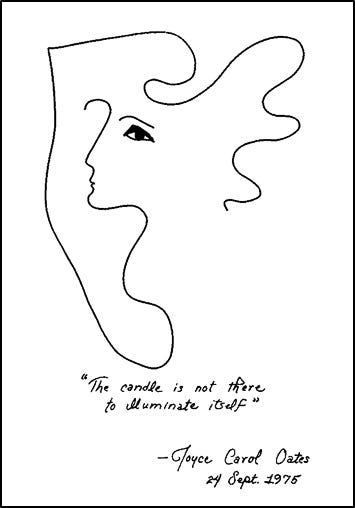
“All writers are vain, selfish, and lazy, and at the very bottom of their motives there lies a mystery.”

BY MARIA POPOVA

Literary legend Eric Arthur Blair, better known as George Orwell (June 25, 1903–January 21, 1950), remains best remembered for authoring the cult-classics Animal Farm and Nineteen Eighty-Four, but he was also a formidable, masterful essayist. Among his finest short-form feats is the 1946 essay Why I Write (public library) — a fine addition to the collected wisdom of great writers.

Orwell begins with some details about his less than idyllic childhood — complete with absentee father, school mockery and bullying, and a profound sense of loneliness — and traces how those experiences steered him towards writing, proposing that such early micro-traumas are essential for any writer’s drive. He then lays out what he believes to be the four main motives for writing, most of which extrapolate to just about any domain of creative output.

He writes:

I give all this background information because I do not think one can assess a writer’s motives without knowing something of his early development. His subject matter will be determined by the age he lives in — at least this is true in tumultuous, revolutionary ages like our own — but before he ever begins to write he will have acquired an emotional attitude from which he will never completely escape. It is his job, no doubt, to discipline his temperament and avoid getting stuck at some immature stage, in some perverse mood; but if he escapes from his early influences altogether, he will have killed his impulse to write. Putting aside the need to earn a living, I think there are four great motives for writing, at any rate for writing prose. They exist in different degrees in every writer, and in any one writer the proportions will vary from time to time, according to the atmosphere in which he is living. They are:

(i) Sheer egoism. Desire to seem clever, to be talked about, to be remembered after death, to get your own back on the grown-ups who snubbed you in childhood, etc., etc. It is humbug to pretend this is not a motive, and a strong one. Writers share this characteristic with scientists, artists, politicians, lawyers, soldiers, successful businessmen — in short, with the whole top crust of humanity. The great mass of human beings are not acutely selfish. After the age of about thirty they almost abandon the sense of being individuals at all — and live chiefly for others, or are simply smothered under drudgery. But there is also the minority of gifted, willful people who are determined to live their own lives to the end, and writers belong in this class. Serious writers, I should say, are on the whole more vain and self-centered than journalists, though less interested in money.

(ii) Aesthetic enthusiasm. Perception of beauty in the external world, or, on the other hand, in words and their right arrangement. Pleasure in the impact of one sound on another, in the firmness of good prose or the rhythm of a good story. Desire to share an experience which one feels is valuable and ought not to be missed. The aesthetic motive is very feeble in a lot of writers, but even a pamphleteer or writer of textbooks will have pet words and phrases which appeal to him for non-utilitarian reasons; or he may feel strongly about typography, width of margins, etc. Above the level of a railway guide, no book is quite free from aesthetic considerations.

(iii) Historical impulse. Desire to see things as they are, to find out true facts and store them up for the use of posterity.

(iv) Political purpose. — Using the word ‘political’ in the widest possible sense. Desire to push the world in a certain direction, to alter other peoples’ idea of the kind of society that they should strive after. Once again, no book is genuinely free from political bias. The opinion that art should have nothing to do with politics is itself a political attitude.

It can be seen how these various impulses must war against one another, and how they must fluctuate from person to person and from time to time.

After a further discussion of how these motives permeated his own work at different times and in different ways, Orwell offers a final and rather dystopian disclaimer:

Looking back through the last page or two, I see that I have made it appear as though my motives in writing were wholly public-spirited. I don’t want to leave that as the final impression. All writers are vain, selfish, and lazy, and at the very bottom of their motives there lies a mystery. Writing a book is a horrible, exhausting struggle, like a long bout of some painful illness. One would never undertake such a thing if one were not driven on by some demon whom one can neither resist nor understand. For all one knows that demon is simply the same instinct that makes a baby squall for attention. And yet it is also true that one can write nothing readable unless one constantly struggles to efface one’s own personality. Good prose is like a windowpane. I cannot say with certainty which of my motives are the strongest, but I know which of them deserve to be followed. And looking back through my work, I see that it is invariably where I lacked a POLITICAL purpose that I wrote lifeless books and was betrayed into purple passages, sentences without meaning, decorative adjectives and humbug generally.

This, of course is to be taken with a grain of salt — the granularity of individual disposition, outlook, and existential choice, that is. I myself subscribe to the Ray Bradbury model:

Writing is not a serious business. It’s a joy and a celebration. You should be having fun with it. Ignore the authors who say ‘Oh, my God, what word? Oh, Jesus Christ…’, you know. Now, to hell with that. It’s not work. If it’s work, stop and do something else.

Why I Write is part of Penguin’s Great Ideas series, excellent in its entirety. Complement it with Orwell on taxes and the four questions great writers must ask themselves.

Vladimir Nabokov on Writing, Reading, and the Three Qualities a Great Storyteller Must Have

Here’s the link to this article.

“Between the wolf in the tall grass and the wolf in the tall story there is a shimmering go-between. That go-between, that prism, is the art of literature.”

BY MARIA POPOVA

“Often the object of a desire, when desire is transformed into hope, becomes more real than reality itself,” Umberto Eco observed in his magnificent atlas of imaginary places. Indeed, our capacity for self-delusion is one of the most inescapable fundamentals of the human condition, and nowhere do we engage it more willingly and more voraciously than in the art and artifice of storytelling.

In the same 1948 lecture that gave us Vladimir Nabokov’s 10 criteria for a good reader, found in his altogether fantastic Lectures on Literature (public library), the celebrated author and sage of literature examines the heart of storytelling:

Literature was born not the day when a boy crying wolf, wolf came running out of the Neanderthal valley with a big gray wolf at his heels: literature was born on the day when a boy came crying wolf, wolf and there was no wolf behind him. That the poor little fellow because he lied too often was finally eaten up by a real beast is quite incidental. But here is what is important. Between the wolf in the tall grass and the wolf in the tall story there is a shimmering go-between. That go-between, that prism, is the art of literature.

Vladimir Nabokov by William Claxton, 1963

He considers this essential role of deception in storytelling, adding to famous writers’ wisdom on truth vs. fiction and observing, as young Virginia Woolf did, that all art simply imitates nature:

Literature is invention. Fiction is fiction. To call a story a true story is an insult to both art and truth. Every great writer is a great deceiver, but so is that arch-cheat Nature. Nature always deceives. From the simple deception of propagation to the prodigiously sophisticated illusion of protective colors in butterflies or birds, there is in Nature a marvelous system of spells and wiles. The writer of fiction only follows Nature’s lead.

Going back for a moment to our wolf-crying woodland little woolly fellow, we may put it this way: the magic of art was in the shadow of the wolf that he deliberately invented, his dream of the wolf; then the story of his tricks made a good story. When he perished at last, the story told about him acquired a good lesson in the dark around the camp fire. But he was the little magician. He was the inventor.

What’s especially interesting is that Nabokov likens the writer to an inventor, since the trifecta of qualities he goes on to outline as necessary for the great writer — not that different from young Susan Sontag’s list of the four people a great writer must be — are just as necessary for any great entrepreneur:

There are three points of view from which a writer can be considered: he may be considered as a storyteller, as a teacher, and as an enchanter. A major writer combines these three — storyteller, teacher, enchanter — but it is the enchanter in him that predominates and makes him a major writer.

To the storyteller we turn for entertainment, for mental excitement of the simplest kind, for emotional participation, for the pleasure of traveling in some remote region in space or time. A slightly different though not necessarily higher mind looks for the teacher in the writer. Propagandist, moralist, prophet — this is the rising sequence. We may go to the teacher not only for moral education but also for direct knowledge, for simple facts… Finally, and above all, a great writer is always a great enchanter, and it is here that we come to the really exciting part when we try to grasp the individual magic of his genius and to study the style, the imagery, the pattern of his novels or poems.

The three facets of the great writer — magic, story, lesson — are prone to blend in one impression of unified and unique radiance, since the magic of art may be present in the very bones of the story, in the very marrow of thought. There are masterpieces of dry, limpid, organized thought which provoke in us an artistic quiver quite as strongly as a novel like Mansfield Park does or as any rich flow of Dickensian sensual imagery. It seems to me that a good formula to test the quality of a novel is, in the long run, a merging of the precision of poetry and the intuition of science. In order to bask in that magic a wise reader reads the book of genius not with his heart, not so much with his brain, but with his spine. It is there that occurs the telltale tingle even though we must keep a little aloof, a little detached when reading. Then with a pleasure which is both sensual and intellectual we shall watch the artist build his castle of cards and watch the castle of cards become a castle of beautiful steel and glass.

Indeed, as important to the success of literature as the great writer is the wise reader, whom Nabokov characterizes by a mindset that blends the receptivity of art with the critical thinking of science:

The best temperament for a reader to have, or to develop, is a combination of the artistic and the scientific one. The enthusiastic artist alone is apt to be too subjective in his attitude towards a book, and so a scientific coolness of judgment will temper the intuitive heat. If, however, a would-be reader is utterly devoid of passion and patience — of an artist’s passion and a scientist’s patience — he will hardly enjoy great literature.

Lectures on Literature is a wealth of wisdom in its entirety. Also see Nabokov on the six short stories everyone should read, then revisit famous writers’ collected insights on writing, including Elmore Leonard’s 10 rules of writingWalter Benjamin’s thirteen doctrinesF. Scott Fitzgerald’s letter to his daughterDavid Ogilvy’s 10 no-bullshit tipsHenry Miller’s 11 commandmentsJack Kerouac’s 30 beliefs and techniquesJohn Steinbeck’s 6 pointers, and Susan Sontag’s synthesized learnings.

This I Believe

Here’s the link to this article by Joyce Carol Oates.

Five Motives for Writing

Letter, Calligraphy, Ink, Written, Write

Originally published in The Kenyon ReviewNew Series, Vol. 36, No. 4 (Fall 2014)

Edited and arranged by Robert Friedman


It is a very self-conscious thing to speak of one’s “credo.”

I think that most writers and artists love their work, which of course we don’t consider “work”—exactly. As artists love the basic materials of their art—paints, charcoal, clay, marble—so writers love the basic materials of their art—language.

Many visual artists have no “credo” at all. They offer no “artist’s statement.” And they consider those who do to be somewhat suspicious, if not frankly duplicitous.

The oracular, pontificating, self-aggrandizing vatic voice—how hollow it sounds, to others! There are great poets, including even Walt Whitman and Robert Frost, who might have known better, who have fallen into such hollowness, as one might fall into a bog.

Recall D. H. Lawrence’s admonition—Never trust the teller, trust the tale.

Criticism, as distinct from literature, or “creative” writing, has often been aligned with a particular moral, political, religious sensibility. The 1950s were perceived, proudly and without irony, as an Age of Criticism—at least, by critics. (It does seem rather narrow to define the 1950s as an age of criticism when writers like Jack Kerouac, Allen Ginsberg, Eudora Welty, and Flannery O’Connor, among numerous others, were publishing frequently.) Criticism is more naturally a kind of preaching, or propaganda; there are systems of belief underlying most criticism, intent upon rewarding those who confirm the critic’s core beliefs and punishing those who don’t. But “creative” artists resist defining their beliefs so overtly, as one might wish not to wear one’s clothing inside-out revealing seams and stitches.

However, considering my own life, or rather my career, I think it is likely that my credo, if I were to have one, involves several overlapping ideals.

Subscribe

Commemoration

Much of literature is commemorative. Home, homeland, family, ancestors. Mythology, legend. That “certain slant of light” in a place deeply imprinted in childhood, as in the oldest, most prevailing region of the brain.

Photo by Graham Gibson

Much of my prose fiction is “commemorative” in essence—it is a means of memorializing a region of the world in which I have lived, a past I’ve shared with others, a way of life that might seem to me vanishing, thus in danger of being forgotten. Not an “old” America but rather an “older” America—those years described as the Depression, through World War II, the Vietnam War, the 1960s, and so forward to the present time in upstate, quasi-rural America. Writing is our way of assuaging homesickness.

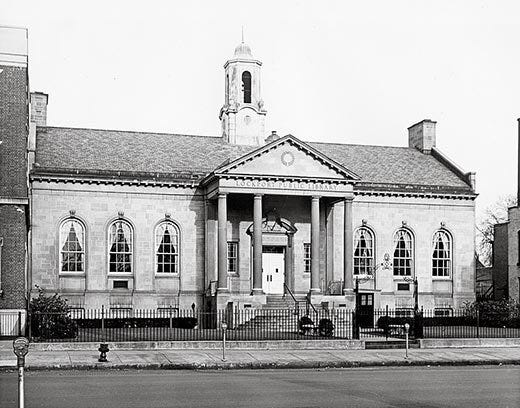
The Lockport Public Library where the author spent many happy hours, c. 1946

Commemoration is identical, for me, with setting. Where a story or a novel is set is at least as significant as what the story—the plot—“is.” In my fiction, characters are not autonomous but arise out of the very physicality of the places in which they live and the times in which they live. There is a spiritual dimension to landscape that gifted photographers can suggest and gifted writers can evoke.

Often, I am mesmerized by the descriptions of landscapes, towns, and cities in fiction—(obviously, the novels of Dickens, Hardy, Lawrence come to mind; it is difficult to name any novels of distinction that are not firmly imbued with “place.”) And if the setting is antagonistic to the spirit, as in our environmentally devastated landscapes and cityscapes, this is a part of the story.

Lockport New York
“For residents of the area who have gone to live elsewhere, it’s the canal—so deep-set in what appears to be solid rock … that resurfaces in dreams.” —Joyce Carol Oates.

Bearing witness

Most of the world’s population, through history, have not been able to “bear witness” for themselves. They lack the language, as well as the confidence, to shape the language for their own ends. They lack the education, as well as the power that comes with education. Politically, they may be totally disenfranchised—simply too poor, and devastated by poverty and the bad luck that comes with poverty, like an infected limb turning gangrenous. They may be suppressed, or terrorized into silence. My most intense sympathies tend to be for those individuals who have been left behind by history, as by the economy; they are all around us, but become visible only when something goes terribly wrong, like a natural disaster, or an outburst of madness and violence.
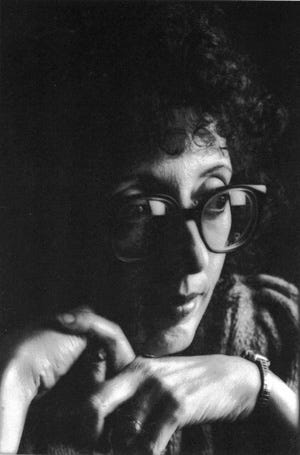
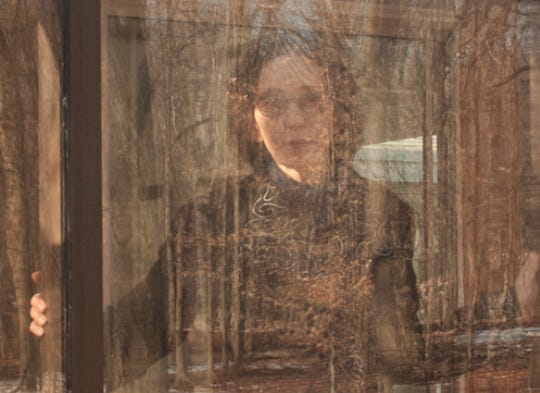
The author, photographed through the window of her Princeton home in 2008, by Charlie Gross

Particularly, I have been sympathetic with the plight of women and girls in a patriarchal society; I am struck by the ways in which weakness can be transformed into strength and vulnerability into survival.

If the writer has any obligation—and this is a debatable issue, for the writer must remain free—it’s to give voice to those who lack voices of their own.

Self-expression

The “self” is, at its core, radically young, even adolescent. Our “selves” are forged in childhood, burnished and confirmed in adolescence. That is why there are great, irresistibly engaging writers of “adolescence”—for instance, Henry David Thoreau, Emily Dickinson, Ernest Hemingway (in his early short stories set in northern Michigan).

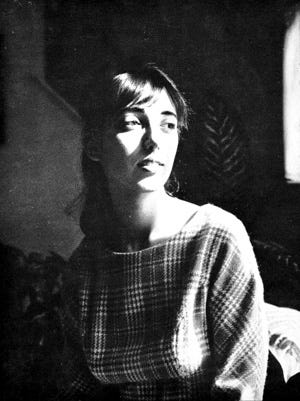
Photo by Robert Benyas for The New York Times Book Review, 1963

Since I began writing fairly seriously when I was very young, my truest and most prevailing self is that adolescent self, confronting an essentially mysterious and fascinating adult world, like a riddle to be solved, or a code to be decoded. The essence of the adolescent is rebelliousness, skepticism. It is very healthy, a stay against the accommodations and compromises of what we call adulthood, particularly “middle age.”

Propaganda, “moralizing”

Once, it was not considered gauche for literary writers (Stowe, Upton Sinclair, Tolstoy, Eliot, Dickens) to address the reader more or less directly, and to speak of moral predilections; now, since the revolution in sensibility generally associated with the early decades of the twentieth century, which we call Modernism, it is virtually impossible to indicate a moral position in any dogmatic way. Ours is still, over all, an age of irony—indirection, obliquity. As Emily Dickinson advises, speaking of her own credo—“Tell all the truth but tell it slant / Success in circuit lies.” And Virginia Woolf, in these thrilling, liberating words:

Art is being rid of all preaching: things in themselves: the sentence in itself beautiful. . . Why all this criticism of other people? Why not some system that includes the good? What a discovery that would be—a system that did not shut out.

Virginia Woolf

Still, most of us who write hope to evoke sympathy for our characters, as George Eliot and D. H. Lawrence prescribed; we would hope not to be reducible to a political position, still less a political party—though writers in other parts of the world are often adamantly political and are political activists—but we write with the expectation that our work will illuminate areas of the world that may be radically different from our readers’ experiences, and that this is a good thing. It is an “educational” instinct—one hopes it is not “preacherly.”

Aesthetic object

Writing as purely gestural, as Woolf suggests—“the sentence in itself beautiful.” In fact, it is very difficult to write a sustained work of fiction that is “purely gestural”— meaning emerges even out of the random, a moral perspective evolves even out of anarchy, nihilism, and amorality; the mere act of writing, still more the discipline of revision, seems to carry with it an ethical commitment to its subject. Yet most of us are drawn to art, not because of its moral gravity, but rather because it is “art”—that is, “artificial”—in some sort of heightened and rarified and very special relationship to reality, which (mere) reality itself can’t provide.

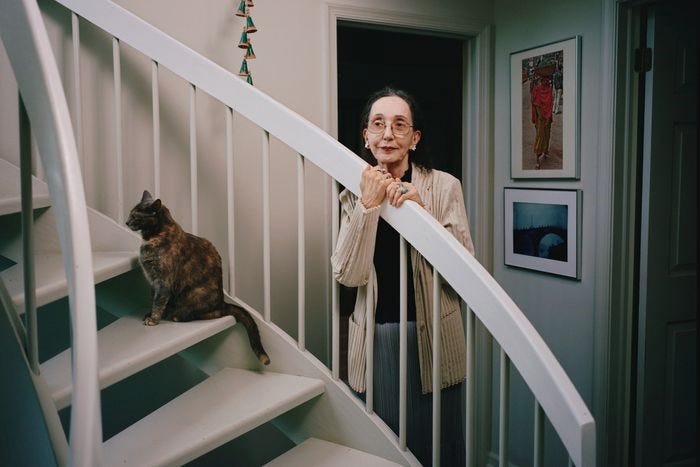
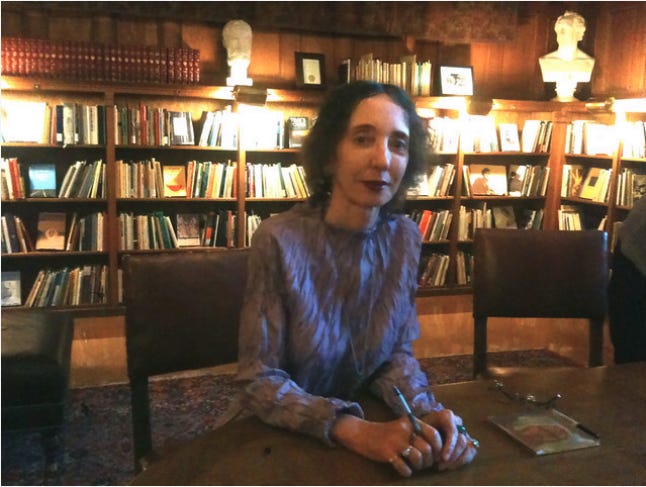
Joyce at home in Princeton 2022, with Lilith. Photo by Peter Garritano for the Wall Street Journal.

Of course, “beauty” in art can be virtually anything, including even conventional ugliness, beautifully/originally treated. In choosing a suitable language for a work of prose fiction, as well as poetry, the writer is making an aesthetic choice: she is rejecting all other languages, or “voices”; she is gambling that this particular voice is the very best voice for this material. The truism “Art for art’s sake” really means “Art for beauty’s sake”—the content of any literary novel is of less significance than the language in which the novel is told.

File:Aufgeschlagenes Buch -- 2020 -- 4204 (bw).jpg

Now that much of publishing is digital, the book as aesthetic object is endangered. Storytelling isn’t likely to vanish, but physical, three-dimensional books comprised of actual pages (paper of varying quality) —with their “hard” covers and “dust” jackets—are in a perilous state. Many of us who love to write also love books—the phenomenon of books.

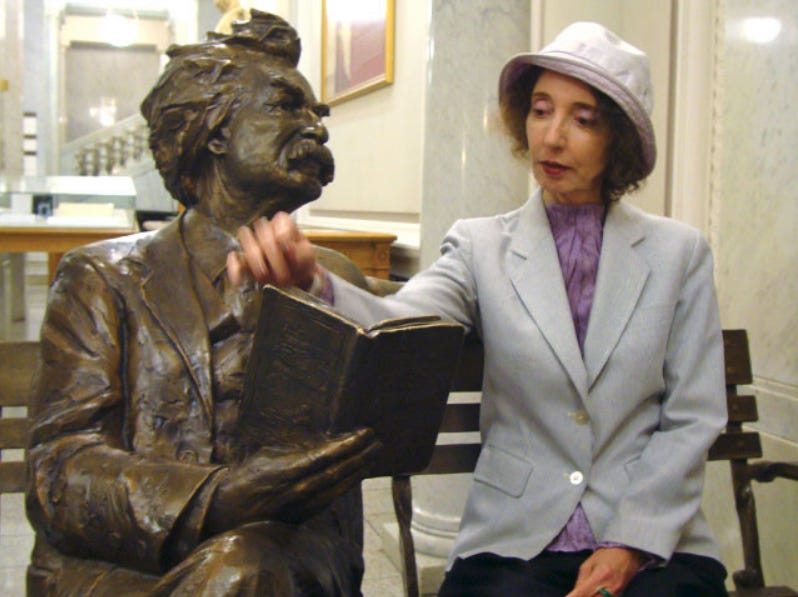
The author and friend, Doe Library UC Berkeley. Photo by Charlie Gross, 2012.

We may have been initially drawn to writing because we fell in love with a very few, select books in childhood, which we have hoped to replicate somehow; we hoped, however fantastically, to join the select society of those individuals whose names are printed on the spines of books. It isn’t to grasp at a kind of immortality—we fell into our yearning as children, long before immortality, or even mortality, was an issue. Rather, we yearn to ally ourselves with a kind of beauty, an object to be held in the hand, passed from hand to hand—an object to place upon a shelf, or to be stood upright, its beautiful cover turned outward to the world.

The author at UC Berkeley, Doe Library Reading Room

As Freud said memorably in Civilization and Its Discontents, “Beauty has no obvious use; nor is there any clear cultural necessity for it. Yet civilization could not do without it.”

Would the great writers of our tradition, James Joyce, for instance, have labored quite so hard, and with such fierce devotion, if the end-product of their labor was to have been nothing more than “online” art—sustained purely by electricity, bodiless, near-anonymous, instantaneously summoned as a genie out of a bottle, and just as instantaneously banished to the netherworld of cyberspace?

Like Joyce, most writers still crave the quasi-permanence of the book: not the book as idea but as physical, aesthetic object. This is as close as we are likely to come to the sacramental, which, for some of us, is wonderfully close enough.

Character Arcs: Making a Long Story Short

Here’s the link to this article by Jami Gold.

March 14, 2023 

A well-structured story uses events (also called story beats) to move the narrative forward — with compelling issues, rising stakes, and an organic sense of cause and effect — toward a surprising-yet-inevitable resolution. At the same time, our story’s plot events force our characters to react, adapt, make choices, and decide on priorities, often resulting in new goals and revealing a character’s values and beliefs. The biggest events are “turning points,” which send the story in new directions and create the sense of change for a story’s arc.

In other words, story structure affects both plot and character (internal/emotional) arcs. So just as we must adjust the plot aspects of story structure when writing a shorter story, we also need to consider the character arc aspects of story structure with shorter stories. Let’s dig into the ways we might tweak story structure for shorter stories, especially when it comes to character arcs.

Story Structure & Shorter Plots

On a basic level, we can understand story structure as:

  • story beginnings introduce characters and story problems,
  • story middles add stakes and depth to both characters and story problems, and
  • story endings bring issues to a satisfying conclusion.

In addition to those basics, the structure of novel-length stories fleshes out events — with inciting incidents, denouements, subplots, pinch points, or other complications — to increase the stakes, create more obstacles, explore failed attempts to solve the problems, etc. Those techniques are especially common in the middle of the story to prevent a “sagging middle.”

Those fleshing-out events like subplots and pinch points are usually the first plot aspects we trim for shorter length storiesShort stories simply don’t have the word count for subplots or other complications.

Character Arcs: What Are Our Options?

3 Types of Character Arcs

Character arcs in Western storytelling are defined by 3 categories:

  • Positive Arc: (also called a Growth Arc) The character learns and grows, bettering themselves (such as by understanding how their previous choices were self-sabotaging), as part of their journey to overcome the story obstacles.
  • Flat Arc: The character learns how to better the world around them (such as by understanding how they can take action) as part of their journey to overcome the story obstacles (think of many single-protagonist series).
  • Negative Arc: (also called a Failure Arc) The character fails to overcome the story obstacles and reach their desires (such as by becoming disillusioned, corrupted, etc.) and succumbs to their flaw (think of Anakin Skywalker to Darth Vader).

Spectrum of Character Arc Depths

Each of those types of arcs can be explored at different depths. For example, in a positive arc, a character can grow and better themselves in a…

  • simplistic way, such as being willing to trust someone else, or in a
  • deeper way, examining how that emotional journey happens, such as exploring an emotional wound from their backstory that led to them having fears and false beliefs about the world (“trust just leads to being stabbed in the back”), and the character working to overcome their fears and false beliefs to be willingly vulnerable with their trust of another.

There’s no “best” approach, as different stories might work better with certain types or depths of character arcs, and different genres have different expectations for the emotion level of character arcs. In addition, the length of our story can affect the type and depth of our character’s arc.

Character Arcs, Story Structure, and Story Length

Mapping a Simplistic Character Arc onto Story Structure

Using a positive/growth arc as an example, here’s how a simplistic character arc can be mapped onto—and explored within—a story’s structure:

  • What does the character long for and desire? (story ending)
  • What choices are they making that keep them from their dream? (story beginning)
  • What do they learn? (how they change throughout the middle)
  • What are they willing to do at the end that they weren’t willing to do before? (story climax)

Adjusting Story Structure for Deeper Arcs

If our story has the word count and setup for a deeper emotional arc for our character, we could flesh that basic story structure out with:

  • subplots that reinforce their backstory wound or fears from a different angle,
  • scenes with failed attempts to overcome their fears,
  • plot events that make them retreat into their fears,
  • scenes with the character’s growth/epiphanies tying their arc into the story’s theme, etc.

5 Options for Adjusting Story Structure & Character Arcs of Shorter Stories

If our story isn’t novel length, we have several choices for how to adjust our story’s structure for a character arc in a shorter story. For example, we could…

  • stick with a positive/growth arc but keep it simplistic rather than deep – we need a minimum of 3 spread-out sections (such as scenes, or perhaps just paragraphs in shorter stories) to explore the character’s issue, with at least: one to establish the longing, one to illustrate the struggle, and one to show the change.
  • show a positive/growth arc with deeper emotions by tying the change very tightly to the main plot, so every plot event allows for exploration of the character’s internal arc.
  • explore a deeper positive/growth arc—if the story is long enough for a subplot—by making the “subplot” actually the character’s emotional arc (or tie the change very tightly to the subplot, rather than the main plot as above).
  • use a flat character arc, which is often easier to tie directly to the main plot, as the character learns how to take action and cause the change they want to see in the world throughout the plot.
  • limit the number or depth of character arcs if we have multiple protagonists (like in a romance) by having only one of the characters complete an arc, or at most using only a flat arc with the second protagonist (such as by having one protagonist “change the world” by convincing the other protagonist in a romance that they’re perfect for each other).

Not every story needs characters to have an internal conflict arc. Not every story needs deep emotional arcs. But if we want character arcs in our story—and our story is less than novel length—we need to be more purposeful and deliberate with how we structure our story to make the most of our character’s arc with the word count we have. *smile*

Have you written shorter stories where you needed to adjust the story’s structure? How did you adjust the structure for the plot (reduced complications or subplots)? How did you adjust the structure for the character arc (changed the type or depth of the arc)? Had you thought about how your story’s length might affect story structure or character arcs before? Do you have any questions about how story length affects story structure or character arcs?

JAMI GOLD – Resident Writing Coach

Jami Gold, after muttering writing advice in tongues, decided to become a writer and put her talent for making up stuff to good use, such as by winning the 2015 National Readers’ Choice Award in Paranormal Romance for her novel Ironclad Devotion.

To help others reach their creative potential as well, she’s developed a massive collection of resources for writers. Explore her site to find worksheets—including the popular Romance Beat Sheet with 80,000+ downloads—workshops, and over 1000 posts on her blog about the craft, business, and life of writing. Her site has been named one of the 101 Best Websites for Writers by Writer’s Digest.

Fear Thesaurus Entry: Conditional Love

Here’s the link to this article.

March 11, 2023 by BECCA PUGLISI Leave a Comment

Debilitating fears are a problem for everyone, an unfortunate part of the human experience. Whether they’re a result of learned behavior as a child, are related to a mental health condition, or stem from a past wounding event, these fears influence a character’s behaviors, habits, beliefs, and personality traits. The compulsion to avoid what they fear will drive characters away from certain people, events, and situations and hold them back in life. 

In your story, this primary fear (or group of fears) will constantly challenge the goal the character is pursuing, tempting them to retreat, settle, and give up on what they want most. Because this fear must be addressed for them to achieve success, balance, and fulfillment, it plays a pivotal part in both character arc and the overall story.

This thesaurus explores the various fears that might be plaguing your character. Use it to understand and utilize fears to fully develop your characters and steer them through their story arc. Please note that this isn’t a self-diagnosis tool. Fears are common in the real world, and while we may at times share similar tendencies as characters, the entry below is for fiction writing purposes only.

Fear of Being Loved Conditionally

Notes
Conditional love has to be earned through performance or achievements. A character who has experienced love in this way is likely to develop certain habits that they believe will ensure the acceptance of others. They may also perceive their value as being tied to certain behaviors or successes. These thought patterns and actions may continue to plague the character even after they’ve recognized that this kind of love is unhealthy and they want no part of it.

What It Looks Like
Being a people pleaser
Being an overachiever
Perfectionism
Making choices based on what other people want or like rather than on the character’s own desires
Difficulty setting or maintaining personal and emotional boundaries
Being oversensitive to signs of anger, disappointment, or disapproval from others
Being slow to open up
Building up emotional walls to keep others away
Stopping romantic relationships before they progress too far; keeping things superficial
Apologizing for the smallest of mistakes
Ghosting others
Only expressing positive emotions (to avoid driving people away)
Needing frequent reminders of a friend or partner’s love
The character seeking approval for their thoughts, actions, and emotions
Only showing the best side of themselves to others
Staying in a toxic relationship
Being highly obedient or subservient
Being too permissive (not knowing how to love someone while also expressing criticism or correction) 
Loving others unconditionally
Being highly attuned to signs of conditional love in others

Common Internal Struggles
Constantly needing to prove themselves to others
Analyzing other people to determine what must be done to earn their love
Wanting to be in a relationship but being afraid of disappointing the other party
Overthinking interactions with the other person to determine if the character is doing all they should be doing or has done anything wrong
The character doubting their own worth
The character constantly doubting where they stand with the other party
Believing they are unlovable
Vowing to never love others conditionally but worrying that this is exactly what the character is doing

Flaws That May Emerge
Inhibited, Insecure, Nagging, Needy, Obsessive, Oversensitive, Perfectionist, Pushy, Resentful, Selfish, Subservient, Weak-Willed, Withdrawn

Hindrances and Disruptions to the Character’s Life
Difficulty forming intimate relationships
Getting entangled in an ongoing cycle of toxic relationships
Not knowing what true love looks or feels like
Struggling to love fully and vulnerably
The character viewing minor setbacks as major failures and defining moments
Relational friction caused by the character’s constant need for affirmation or frequent questioning of the other person’s love

Scenarios That Might Awaken This Fear
Having to interact with a parent, ex, or sibling who loved the character conditionally
Beginning a new friendship and not knowing what’s expected
Being asked out
A past abuser or manipulator asking for forgiveness
The character realizing they have loved someone conditionally
Making a mistake that hurts someone else
Falling short of the conditional standard someone has placed upon the character
Being blown off or ignored
Getting dumped

Other Fear Thesaurus entries can be found here.

Need More Descriptive Help?

While this thesaurus is still being developed, the rest of our descriptive collection (16 unique thesauri and growing) is accessible through the One Stop for Writers THESAURUS database.

If you like, swing by and check out the video walkthrough for this site, and then give our Free Trial a spin.

BECCA PUGLISI

BECCA PUGLISI

Becca Puglisi is an international speaker, writing coach, and bestselling author of The Emotion Thesaurus and its sequels. Her books are available in five languages, are sourced by US universities, and are used by novelists, screenwriters, editors, and psychologists around the world. She is passionate about learning and sharing her knowledge with others through her Writers Helping Writers blog and via One Stop For Writers—a powerhouse online library created to help writers elevate their storytelling.

An Unexpected Intimacy, by Joyce Carol Oates

This is a must read for all writers, and especially for those even faintly considering this life-changing art.

Here’s the link to this article. Click here for more by this master-writer.

Some Thoughts on Writing Through the Decades

Joyce Carol Oates

Edited and arranged by Robert Friedman


If you are a writer you locate yourself behind a wall of silence and wherever you are—in public, in solitude, in motion, utterly still—you can still be writing, because you are in that private space.

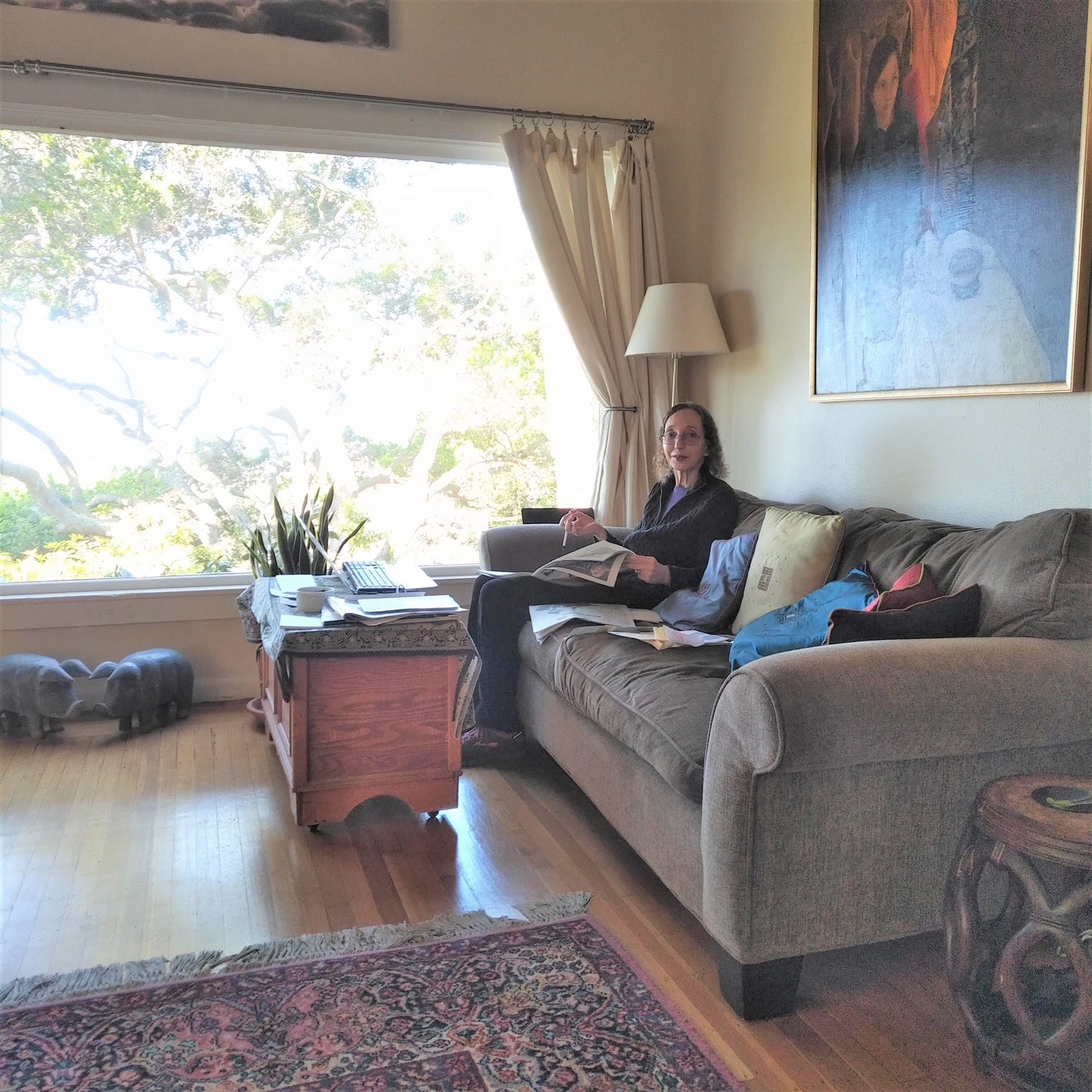
My “study” in Berkeley—at one end of the sofa in a large living room; my late husband Charlie had a desk in a farther corner at a window overlooking San Francisco bay in the distance. Photo by Henri Cole.

When writing goes with painstaking slowness—frustration, dismay—then naturally one ought to continue with the work; it would be cowardly to retreat. But when writing goes smoothly—why then one certainly should keep on working, since it would be very foolish to stop. Consequently one is always writing.

Genius is not a gift, but the way a person invents in desperate circumstances. —Sartre

(My epigraph for “Blonde” which is the innermost truth of my heart.)

Be daring, take on anything. Don’t labor over little cameo works in which every word is to be perfect. Technique holds a reader from sentence to sentence, but only content will stay in his mind.


I tell my students to write of their true subjects. How will they know when they are writing of their true subjects? By the ease with which they write. By their reluctance to stop writing. By the headachy, even guilty, joyous sensation of having done something that must be done, having confessed emotions thought unconfessable, having said what had seemed should remain unsaid. If writing is difficult, stop writing. Begin again with another subject. The true subject writes itself, it cannot be silenced. Give shape to your dreams, your day-dreams, cultivate your day-dreams and their secret meanings will come out.

Life and Biography – Celestial Timepiece
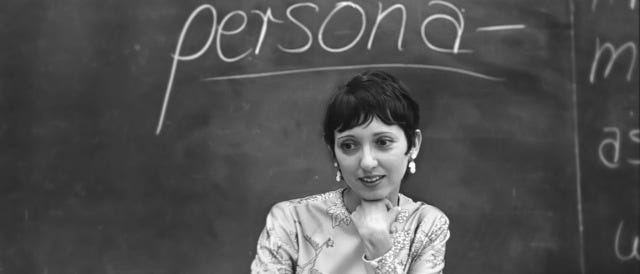
A long-ago photo of me with what appears to be a “pixie” haircut, teaching an introductory literature course at the University of Detroit

Writing is a consequence of being “haunted” by material.  You know that you are “haunted” when nothing else can retain your attention—when your thoughts swerve, in obedience to an inner gravity, to the one true subject that will bring terror and comfort.


I have forced myself to begin writing when I’ve been utterly exhausted, when I’ve felt my soul as thin as a playing card…and somehow the activity of writing changes everything.


“We work in the dark—we do what we can—we give what we have. Our doubt is our passion, and our passion is our task. The rest is the madness of art.”Henry James


The ideal art, the noblest of art: working with the complexities of life, refusing to simplify, to “overcome” doubt.


Fiction that adds up, that suggests a “logical consistency,” or an explanation of some kind, is surely second-rate fiction; for the truth of life is its mystery.


I’m drawn to failure—stories of struggle, failure, even defeat—and the aftermath of defeat. For only someone who attempts something beyond their reach can “fail.” There can be nobility in this,  a strange sort of dignity. Never having failed means never having tried.  Subscribe


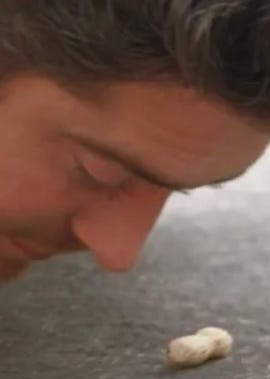
Writing a first draft is like pushing a peanut with your nose across a very dirty floor.  Only when you get to the farther side of the room do you see where you were going—now, you can try again, and you will move much more swiftly!


Revising is the blissful state subsequent to the circle of Hell that is the “first draft.”


I am drawn to write about rural and small-town upstate New York in the way in which a dreamer’s recurring dreams are likely to be set in childhood places. Our oldest memories are the most deeply imprinted in our brains—the first to be absorbed into our physical being, in neurons; the last to be lost, as consciousness fades to black.

Beset by economic crises, as by extremes of weather, upstate New York is emblematic of much of American life in the present day: its urban centers are relatively prosperous, educated, “liberal”—its rural areas, much the greater part of the state, are relatively impoverished, under-educated, “conservative.”

https://upload.wikimedia.org/wikipedia/commons/thumb/0/08/Lockport_New_York_-_Erie_Canal_Locks_34_35_-_%22siamese_twins%22%2C_where_the_upper_door_of_Lock_34_is_also_the_lower_door_of_Lock_35_-_Flickr_-_Onasill_~_Bill_-_103_Million_Views_-_Thank_You.jpg/640px-thumbnail.jpg
Erie Canal locks, Lockport, New York

The secret of being a writer: not to expect others to value what you’ve done as you value it. Not to expect anyone else to perceive in it the emotions you have invested in it. Once this is understood, all will be well. (She wants to think!)


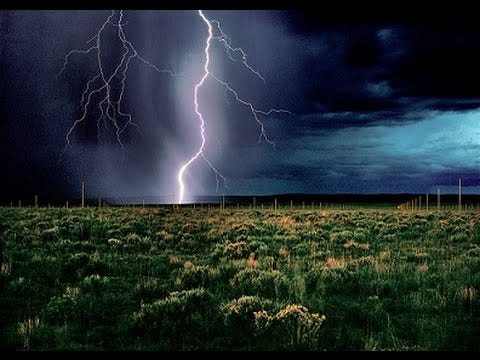
Starting a novel is like standing in a field and waiting for lightning to strike…

The Lightning Field, Catron County, New Mexico

I encourage my students to write a great deal. Keep a journal. Take notes. Write when you are feeling wretched, when your mind is about to break down…who knows what will float up to the surface? I am an unashamed believer in the magical powers of dreams; dreams enhance us. Even nightmares may be marketable—there is something to be said for the conscious, calculating exorcism of nightmares, if they give to us such works as those of Dostoyevsky, Celine, Kafka. So the most important thing is to write, and to write every day, in sickness and in health: who knows but there will come a time when you reread what you have written, not as the writer but as a reader, and a revelation comes to you in a flash—So this is what it has meant!  Now, you can begin.


I’ve never thought of writing as the mere arrangement of words on the page but the embodiment of a vision; a complex of emotions; raw experience. The effort of memorable art is to evoke in the reader or spectator emotions appropriate to that effort.


Critics sometimes appear to be addressing themselves to works other than those I remember writing.

The crucial difference between the critic and the reviewer is: one takes time, the other must meet a deadline.  


Words are like wild birds—they will come when they wish, not when they are bidden. And they may suddenly explode into the air—and disappear.

https://upload.wikimedia.org/wikipedia/commons/thumb/5/58/British_Wildlife_Centre_Apr_2015_-_Geese_%2817169605088%29.jpg/640px-British_Wildlife_Centre_Apr_2015_-_Geese_%2817169605088%29.jpg
Photo by Garry Knight

I am not conscious of working especially hard, or of “working” at all. Writing and teaching have always been, for me, so richly rewarding that I don’t think of them as work in the usual sense of the word.  


It’s up to the writer and the artist to give voice to these people. There are two impulses in art: one is rebellious and transgressive—you explore regions in which you are not wanted, and you will be punished for that. But the other is a way of sympathy—evoking sympathy for people who may be different from us—whom we don’t know. Art is a way of breaking down the barriers between people—these two seemingly antithetical impulses toward rebellion and toward sympathy come together in art.


My belief is that art should not be comforting; for comfort, we have mass entertainment and one another. Art should provoke, disturb, arouse our emotions, expand our sympathies in directions we may not anticipate and may not even wish.


To be entranced, to be driven, to be obsessed, to be under the spell of an emerging, not quite fully “comprehended” narrative—this is the greatest happiness of the writer’s life even as it burns us out and exhausts us, unfitting us for the placid contours of “normality.”


There are those—a blessed lot—who can experience life without the slightest glimmer of a need to add anything to it—any sort of “creative” effort; and there are those—an accursed lot?—for whom the activities of their own brains and imaginations are paramount. The world for these individuals may be infinitely rich, rewarding and seductive—but it is not paramount. The world may be interpreted as a gift, earned only if one has created something over and above the world.


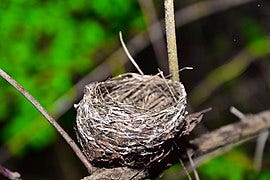
A literary work is a kind of nest: an elaborately and painstakingly woven nest of words incorporating chunks and fragments of the writer’s life in an imagined structure, as a bird’s nest incorporates all manner of items from the world outside our windows, ingeniously woven together in an original design.

File:Bird nest srilanka 001.jpg

I believe that art is the highest expression of the human spirit. I believe that we yearn to transcend the merely finite and ephemeral; to participate in something mysterious and communal called “culture”—and that this yearning is as strong in our species as the yearning to reproduce the species.

https://www.kwls.org/wp-content/uploads/2016/01/Oates-Joyce-Carol-cr-Beth-Garrabrant-cr-Brydges-Mackinney-Agency-crop.jpg
Photo by Beth Gabbert

Through the local or regional, through our individual voices, we work to create art that will speak to others who know nothing of us. In our very obliqueness to one another, an unexpected intimacy is born.

Subscribe to Joyce Carol Oates: A Writer’s Journal

Launched a year ago

On writing, living with cats, being a widow, movies, running, my current workshops & what we are reading, books, comedy, nature, gardening, friendship, more.Subscribe

How to Ask for Book Reviews (& Why You Should)

Here’s the link to this article.

March 9, 2023 by Guest Contributor 6 Comments

By Liz Alterman

You’ve written a book. Congratulations! Now for the next hurdle—gathering those all-important ratings and reviews.

When my novel, The Perfect Neighborhood, was released last July, I quickly learned how critical these are. Leading up to my launch, I reached out to a nearby library to see if they’d consider it for their book club. Before I could even offer to donate copies or attend the meeting, I was promptly told to call back when I had more than one hundred, four-star ratings. Ouch!

For many authors, myself included, knowing that people took the time to read your words feels like a gift in itself. Can you really ask them to take more time out of their busy lives to write and post a review? Yes, you can, and here’s why you must.

First, reviews and ratings serve as a form of social proof. The more you have—especially positive ones—the more likely readers are to give your book a try.

As Scott Blackburn, author of the southern crime thriller It Dies With You, pointed out, publishers are doing less and less promotional work in an increasingly crowded market, making book reviews crucial—especially for debut authors.

Even now, I often find myself scrolling Goodreads and Amazon, looking for new material to read, and more times than not, the quality and quantity of a book’s reviews will guide my decision on what to buy,” said Blackburn. “Do those criteria mean a book will be a guaranteed hit? Absolutely not. That’s all subjective. Did those reviews help the authors behind those books? Most definitely.” 

Second, while having plenty of reviews and ratings may encourage readers to take a chance on your book, there’s another reason they’re important.

“In order to qualify for certain promotions on Amazon and BookBub, you need to have 50 or 100 reviews on Amazon,” explained Andrea J. Stein, author of the novel Typecast, and a book publicist by profession. “Also, the more reviews you have, the more the algorithm will promote your book.”

So, How Do You Make the Ask?

For plenty of authors, asking readers for reviews and ratings can feel awkward, almost like fishing for compliments.

“Many authors struggle with this aspect of self-promotion because they feel rude or pushy when asking for reviews,” said Blackburn. “If this is the case for you, keep this in mind: in a world where a majority of shopping is done online, people encounter reviews and ratings on a daily basis, which means they understand why those things are so important.” 

So how does Blackburn handle it? Approach these requests with kindness and professionalism, he advised.

“Simply let people know how much reviews help and how appreciative you are to get them,” he said. “This could be done in a blanket post on social media or in a casual conversation with a reader.”

His go-to script? “If you have time, I’d really appreciate a review.”

“If the person you ask isn’t comfortable with—or simply doesn’t know how—to write a book review, it’s good to remind them that clicking a star rating only takes seconds, and those can be just as helpful,” Blackburn added.

Stein offered her strategy. “Whenever someone tells me they loved my book, my immediate response is to ask if they could post a review on Amazon,” she said. “If it’s in response to an email, I’ll tell them that they can just use the same text they used in the email as their review.”

You can also ask that they paste that same text on various retailer and review sites to boost your book on multiple platforms.

Stein added that she’s never had anyone say anything but “yes,” and most often, they keep their word.

“When I send an ARC to a potential reviewer, I simply thank them for their interest and wish them ‘happy reading!’” she said. “I then follow up to confirm they’ve received the ARC and to ask if they know when they’ll be able to read/review the book. I always point out that reviews can be short. I don’t want people to feel they’re expected to write an essay.”

Blackburn offered additional strategies, such as creating a social media post like: “I’m sitting at 97 reviews. If you read my novel, I’d love for you to help me reach 100 reviews.”

“I’ve had success with similar posts,” he said. “At minimum, it’s a reminder to readers to leave a review, and more than that, people love to be a part of a milestone. I’ve even seen authors host giveaways when they hit review milestones.” 

Author and humorist Julie Vick shared an innovative, quieter but just as effective strategy.

To spread the word about her book, Babies Don’t Make Small Talk (So Why Should  I?): The Introvert’s Guide to Surviving Parenthood, Vick connected with stewards of Little Free Libraries (LFL) and also left her book in LFLs in her area. In each copy, she placed a sticker encouraging readers to leave a review. She shared the text she included:  

“This book was donated to a Little Free Library for you to enjoy. If you enjoyed reading it, I would love it if you could leave a review on a retailer’s site or Goodreads (you don’t have to have bought a book there to leave a review).”

If friends or family haven’t had a chance to read your book yet, they can still give the work a boost by marking it “to-read” on Goodreads. How does it help? When someone checks that box, all of their Goodreads friends will see your book on their homepages, increasing its free exposure.

Courtesy Counts

Vick said that as she asked readers to rate her book, she was always conscious to “not bombard people with requests.”

Blackburn agreed there’s a line between being persistent and being pushy and said there’s no need to publicly seek reviews daily, but if you’ve recently launched a book or your reviews begin to slow, don’t be afraid to ask.

“I’ve also tried to just be a good literary citizen in terms of reviewing other authors’ books,” said Vick. “So when I read a book that I enjoy, I try to review it on one of the sites. This can often lead to reciprocal reviews from other authors you know without you having to ask.” 

Blackburn echoed the importance of returning the favor. “If you’re asking for reviews,” he said, “make sure you’re leaving reviews for your fellow authors.”

If you’re not seeing those reviews and ratings pile up, don’t panic.

“It’s also important to keep in mind that less than 15% (often less than 10%) of people review or rate the books they read, so there’s no need to panic if you’ve sold 500 books and you’re nowhere near 100 reviews,” said Blackburn. That’s totally normal.” 

While asking for ratings and reviews may feel uncomfortable, much like writing itself, once you’ve done it you’ll be glad you did. Chances are, they’ll help your book find more readers and, ultimately, isn’t that what writers want?


Liz Alterman is the author of the suspense novel, The Perfect Neighborhood. the young adult novel, He’ll Be Waiting, and the memoir, Sad Sacked. Liz lives in New Jersey with her husband and three sons. When she isn’t writing, Liz spends most days reading, microwaving the same cup of coffee, and looking up synonyms.

What’s the Difference Between an Editor and a Book Coach?

Here’s the link to this article.

March 7, 2023 by LISA POISSO – Resident Writing Coach 5 Comments

If you’re all about Mark Zuckerberg’s famous credo “move fast and break things,” you may feel confident diving from writing into self-revision and then editing. But if you like to get the lay of the land before trying new things, or if you’d appreciate having an experienced guide to call on as you’re writing, a book coach could be just what you need.

A book coach shows you the ropes from start to finish. Book coaches have been described as consultants, mentors, teachers, and personal trainers for your writing.

Book Coaching Vs. Editing

Book coaching shares a lot in common with developmental and line editing, especially from experienced editors who provide customized approaches beyond critiques or edits. Generally speaking, book coaching is more ongoing and interactive than editing, but one-to-one comparisons don’t paint the entire picture.

Editing provides feedback and guidance once the writing is complete.
Coaching provides feedback and guidance as the writing progresses.

Editing happens in stages, one person at a time: the writer writes, then the editor edits, then the writer revises, then the editor reviews …
Coaching happens collaboratively as the project progresses, with regular, real-time check-ins.

Editing is primarily text-based, using editing and written feedback.
Coaching frequently occurs via Zoom and email as well as written feedback and editing.

Editing is generally considered a distinct, one-time service for hire.
Coaching is more like short-term consulting or a long-term mentorship.

Editing seeks to identify and course-correct issues in a manuscript.
Coaching seeks to prevent issues from creeping into the manuscript to begin with.

Editing guides writers to improve their work in progress.
Coaching guides writers to improve their work in progress and develop long-term mastery.

But just because book coaching covers a lot of ground, don’t look for a book coach who claims to do it all. A jack of all trades is master of none—the best book coaches specialize.

Book coaches who specialize—certain genres (upmarket and literary fiction, SFF, historical fiction), certain types of clients (debut writers, memoirists, women, experts in a professional field), or specific tasks like self-publishing or marketing—possess a deep understanding of their fields and can offer nuanced and tailored feedback.

Coaches who claim to do it all may lag behind in rapidly evolving areas such as self-publishing or marketing. They may not edit frequently enough to stay fluent in the minutiae of copy editing. Yet when coaching companies spread these tasks across multiple points of contact, the carefully nurtured collaborative spirit of the client–coach relationship is diluted.

What Book Coaches Do

Book coaches typically lean into one or two of the following broad areas.

Story coaches help you develop and write your story. They’ll help you deepen your concept and plot and cultivate richer characters and themes. They’ll teach you how to use story form and structure to support your story. They’ll help you outline your book, and they’ll nudge your output as you write to keep it on track. They’ll help you define your genre, readers, and comp titles. These coaches are personal alpha readers, editors, and storytelling gurus rolled into one.

Support coaches focus on motivation, accountability, and emotional support for the writing journey. These coaches are like personal trainers, keeping you moving and helping you maintain a healthy outlook during the notoriously roller coaster experience of writing a novel. They’ll help you develop and stick to a writing schedule and keep you accountable for turning in pages regularly. Most book coaching encompasses at least some elements of support by virtue of regular communication and one-on-one focus.

Writing coaches are more like teachers, mentors, and editors. Their feedback may include story issues but often focuses on how authors express themselves on the page. Writing coaches will steer you through tricky narrative choices like point of view and help you master narrative techniques like narrative distance and dialogue before you’ve baked problems into the entire manuscript.

Publishing coaches are like project managers for writers. You may hear them referred to as book shepherds or book sherpas, publishing guides or consultants, or book consultants. These coaches may personally provide self-publishing or marketing services such as cover design, ebook formatting, website design, and marketing plans, or they may steer you toward reputable providers.

What Book Coaches Don’t Do

As versatile as book coaches are, you’ll want to hire other specialists for some tasks.

  • Ghostwriting If you want someone else to write your book for you, you deserve a dedicated, experienced ghostwriter.
  • Book doctoring To have someone rebuild an unsuccessful story from the ground up, doing most of the heavy lifting themselves, hire a book doctor.
  • Editing Completing your manuscript under the eyes of a book coach won’t necessarily prepare your manuscript for querying or publication. Coaching is not a form of incremental book editing. Talk to your coach about the next steps for your book, and don’t be surprised if that includes editing.

Steer clear of book coaches who promise to get you an agent or publisher as part of their services. Legitimate professionals do not guarantee representation or publication for your book.

Book Coaching Benefits

Why would someone work with a book coach? To get the jump on things. Coaching accelerates your creative development as a novelist. Think of it as professional training or a start-up cost for your writing career.

The benefits you reap from coaching begin immediately and last long after this book is out the door. Your book gets intensive one-on-one development, and you finish with storytelling and writing skills you’ll use the rest of your writing career.

What To Look for In A Book Coach

When you’re ready to work with a book coach, identify your priorities. Do you want help with story development, writing technique, accountability and support, or publishing and marketing? You can have more than one of those things, but you probably can’t have them all from one person.

Check out coaching programs from bigger companies, but keep in mind that their standardized, one-size-fits-most methods may not work for you and your book. In programs that emphasize teaching and group feedback, you might not get as much one-on-one time with the coach. Some programs use proprietary software or methods to analyze your work and guide your revisions, which may not fit your writing or work style.

When coaches advertise themselves as certified or trained in a specific methodology, recognize that they’re referring to completion of a certificate program and not a professional certification. There are no professional boards or organizations that certify book coaches. Certificates indicate the coach has completed a paid training program with a company or trainer, not that they are certified by a professional or occupational board or organization.

How Much Does Coaching Cost?

Individual coaching sessions start around $60 an hour at the low end, climbing to a more typical $100 to $150 an hour. Rates for one-time consultations are often significantly higher, due to the prep time required.

Competitive coaching programs can cost $2,000 to $3,000 for several months of coaching. Bespoke packages or plans from independent coaches who provide frequent one-on-one face time or personally handle self-publishing or marketing tasks can approach $10,000.

Hiring a book coach is a smart move if you want to improve your writing and storytelling skills while developing and polishing your work in progress. With the help of a coach to keep you on track and offer support along the way, you’ll write more efficiently, effectively, and confidently, and you’ll optimize your book’s potential to connect with readers.

Tip: If you’re looking for a great coach or editor…check out our amazing
Resident Writing Coaches!
We also list some more under Editing & Formatting Services in this post.

Here are some other helpful posts:

Feedback and Editing: The Right Eyes at the Right Time
When Are You Ready for Professional Editing?
Best Practices for Working with an Independent Editor
“Perfect to Me”: How Self-Editing Can Take Your Novel to the Next Stage

LISA POISSO – Resident Writing Coach

Lisa Poisso specializes in working with new and emerging authors. As a classically trained dancer, her approach to coaching and editing is grounded in form and technique as the doorway to freedom of movement on the page. Writers have referred to her Plot Accelerator/Story Incubator coaching as an indispensable “pre-edit in a bottle.” Find Lisa (and her industrious team of #45mphcouchpotato retired greyhounds) at LisaPoisso.com, and hop over to her Linktree to get her newsletter, download a free Manuscript Prep guide, and more.

Maya Angelou on Writing and Our Responsibility to Our Creative Gifts

“I believe talent is like electricity. We don’t understand electricity. We use it.”

Here’s the link to this article.

BY MARIA POPOVA

Maya Angelou on Writing and Our Responsibility to Our Creative Gifts

“Be a good steward of your gifts,” the poet Jane Kenyon urged in what remains some of the finest advice on writing and life ever committed to words. Our gifts come unbidden — that is what makes them gifts — but with them also comes a certain responsibility, a duty to live up to and live into our creative potential as human beings. “Talent is insignificant. I know a lot of talented ruins,” James Baldwin admonished in his advice on writing. “Beyond talent lie all the usual words: discipline, love, luck, but most of all, endurance.” That durational willingness to work at our gifts, to steward them with disciplined devotion, is our fundamental responsibility to them — our fundamental responsibility to ourselves.

Maya Angelou (April 4, 1928–May 28, 2014) considers what that means and what it takes in a wonderful 1983 interview, included in Black Women Writers at Work (public library).

Maya Angelou

She reflects:

I try to live what I consider a “poetic existence.” That means I take responsibility for the air I breathe and the space I take up. I try to be immediate, to be totally present for all my work.

[…]

My responsibility as a writer is to be as good as I can be at my craft. So I study my craft… Learning the craft, understanding what language can do, gaining control of the language, enables one to make people weep, make them laugh, even make them go to war. You can do this by learning how to harness the power of the word. So studying my craft is one of my responsibilities. The other is to be as good a human being as I possibly can be so that once I have achieved control of the language, I don’t force my weaknesses on a public who might then pick them up and abuse themselves.

With an eye to the abiding mystery of our creative gifts, she adds:

I believe talent is like electricity. We don’t understand electricity. We use it. Electricity makes no judgment. You can plug into it and light up a lamp, keep a heart pump going, light a cathedral, or you can electrocute a person with it. Electricity will do all that. It makes no judgment. I think talent is like that. I believe every person is born with talent.

When asked how she fits her art into her life, Angelou responds:

Writing is a part of my life; cooking is a part of my life. Making love is a part of my life; walking down the street is a part of it. Writing demands more time, but it takes from all of these other activities. They all feed into the writing. I think it’s dangerous to concern oneself too damned much with “being an artist.” It’s more important to get the work done. You don’t have to concern yourself with it, just get it done. The pondering pose — the back of the hand glued against the forehead — is baloney. People spend more time posing than getting the work done. The work is all there is. And when it’s done, then you can laugh, have a pot of beans, stroke some child’s head, or skip down the street.

Complement with Susan Sontag on writing and what it means to be a decent human being and Olga Tokarczuk’s magnificent Nobel Prize acceptance speech about storytelling and the art of tenderness, then revisit Maya Angelou on courage and facing evilidentity and the meaning of life, and her cosmic clarion call to humanity.