Donny Convict’s brain has gone buh-bye. this is glaringly obvious to anyone who isn’t drunk as a skunk on MAGA kool-aid.
watch any of the clips of Donny’s speeches that go around social media and you’ll marvel at the smoking crater where Trump’s cerebral cortex used to be. the verbal tics, the short circuits, the confusions and delusions — the bizarre obsessions with Hannibal Lecter, and sharks and batteries, for fuck’s sake — the version of Donald Trump that the public gets to see is pretty fucking alarming.
but now we’re learning that these are actually Donny’s good moments. behind closed doors, the deteriorating old shitbag is so much worse.Subscribe
journalist Ramin Setoodeh has written a book about Donald Trump, called “Apprentice in Wonderland.” for the book, he interviewed Donny six times — and the things he witnessed were not pretty.
“Donald Trump had severe memory issues. as the journalist who spent the most time with him, I have to say he couldn’t remember things. he couldn’t even remember me. we spent an hour together in 2021, in May, and then a few months later I went back to Trump Tower to talk to him about his time in the White House and he had this vacant look on his face, and I said to him ‘do you remember me?’ and he said no. he had no recollection of our lengthy interview that we had. I think the American public needs to see this portrait of Donald Trump because this shows what he is like and who he is.”
so, Donny had zero memory of a guy he’d recently spent hours with.
“I’ve interviewed Donald Trump more than any other journalist since he’s left the White House … he goes from one story to the next, he struggles with the chronology of events … there were some cognitive questions … he would from time to time become confused … he confidently told me and declared that Joan Rivers voted for him when he ran for president — and Joan Rivers died in 2014.”
look, it’s just an indication of how popular Trump is — dead people will rise from their graves just for the chance to vote for him.
“he also seemed to think that he still had some foreign policy powers. there was one day where he told me he needed to go upstairs to deal with Afghanistan, even though he clearly didn’t.”
Kaitlan Collins: “he told you that while you were interviewing him at Trump Tower, he told you he needed to go upstairs and deal with Afghanistan?”
“with quote ‘the Afghanistan’ is how he referred to it.”
hey, here’s a fun thing you can try out in your own home: the next time you’re with friends or family, interrupt them mid-sentence and announce that you have to go upstairs and deal with “the Afghanistan.” see how quickly they start googling for a good neurologist.
now let’s check in with the mainstream media. this is a juicy story and I’ll bet they’re all over it. front page news, am I right?
The dullest parts of the book are his interviews with Trump, whose incontinent monologues meander from memories of being on set more than a decade ago to flagrant lies about winning the 2020 election.
At Trump Tower in August 2021, journalist Ramin Setoodeh was listening to Donald Trump natter on about how much he had helped the late comedian Joan Rivers.Suddenly, pointing to his office, Trump announced, “I have to get back up because, you know, I’m doing the whole thing with the Afghanistan.”
but then they drop it, and never get back to it.
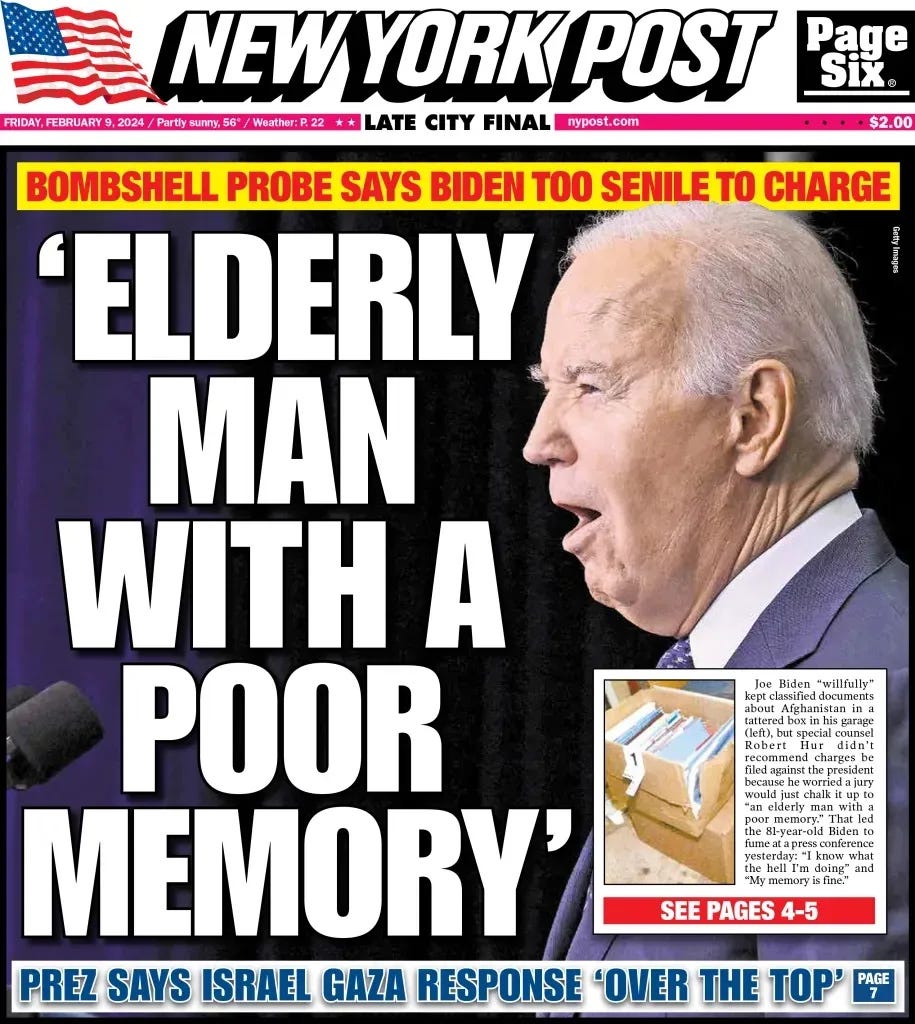
let’s suppose that the shoe were on the other foot. imagine how the press would react, for instance, if someone called Joe Biden an “elderly man with a poor memory” — oh wait, we don’t have to imagine.
we all saw the weeks-long feeding frenzy that exploded after Robert Hur released his report exonerating Joe Biden in the classified document matter.
Hur smeared Biden as broken-down old man with a decaying brain and the press gobbled it right up. the media couldn’t get enough of this story — and it wasn’t even true. the whole thing was a fucking lie invented by a MAGA operative who was just making shit up, because he wanted to damage Joe Biden politically — but that didn’t stop every newspaper and cable channel in America from demanding that Biden drop out of the presidential race.
but if it’s Donald Trump, with a credible journalist making a first-hand observation?
Donny Rottenbrain is out wandering where the buses don’t run, insisting that dead celebrities voted for him and that right now, he’s urgently needed to go deal with “the Afghanistan” — and what do we get from the press?
“look at that beautiful lake. beautiful, right? what’s better — this, or sitting on the Pacific or the Atlantic, which has sharks. you don’t have sharks, see? that’s a big advantage. I’ll take the one without the sharks.”
jesus, again with the sharks. what the fuck is it with Donny and sharks?
Galeophobia is characterized by an overwhelming and persistent fear of sharks. Those experiencing this condition may lack the ability to rationally perceive the danger sharks pose to them, leading them to participate in behaviors to avoid these animals. This phobia typically results in symptoms including a rapid heart rate, shortness of breath, shaking, hyperventilation, nausea, and dizziness. Feelings of intense anxiety and a loss of control, insomnia, and nightmares may also occur.
There are many methods available for treating galeophobia, several of which involve the help of a mental health professional.
fuck getting Trump professional help — I have a better idea.
do you think that Chevy Chase still has his “land shark” costume from his Saturday Night Live days? could we pay Chevy to dress up as Land Shark and knock on Donny’s door?
Chevy, a grateful nation would owe you a debt of gratitude if you did this.
Back in 2020, while still a high school teacher, I was contacted by Andrew Wegley, the Editor of Northwest Missouri State University’s newspaper. Andrew asked to write a piece that ultimately changed my life.
This is my origin story.
Jess Piper, a Maryville High School American literature teacher and an advocate for social justice, stands in front of her family’s farmhouse. Piper said her husband bought the house and five acres practically on accident three years ago after he “literally went out for milk.” ANDREW WEGLEY | @andrewwegley
MISSOURI. — The path between Maryville and the land on which Jess Piper lives stretches close to 20 miles, cutting through the vast fields of row crop and hoards of windmills that surround Missouri Route 148. There are grain silos and industrial-sized tractors among the rolling hills. There are signs for political candidates, almost none of whom are Democrats. There are more cornfields than houses, it seems. More shipping trucks pass through this stretch of Route 148 each day than there are residents with addresses on the roadway.
Between the “Randy Strong for Sheriff” signs and those promoting Gov. Mike Parson’s election campaign, there aren’t many inklings of liberal views, save for a “YES on Amendment 2” sign along one cornfield, nearly 5 miles away from Hopkins, Missouri. The same scenery persists once in the rural town of 532 residents.
The stretch of road that leads to Piper’s gravel driveway takes drivers by a Baptist church, a profane Trump sign and to a brick-red farmhouse on 5 acres of land, where bypassers might see Piper’s well-maintained flowerbed, the American flag she flies proudly, her overgrown vegetable garden or the two Joe Biden signs stuck firmly in her front lawn.
This is where Piper, an American Literature teacher at Maryville High School and an advocate for social justice, lives: in a picture-eqsue farmhouse near the outskirts of a conservative community where the Biden signs planted in her freshly-trimmed front yard separate her from many of her neighbors, perhaps as much as Piper’s politics do.
“I think I probably stand out because I am rural,” she said, sitting in a wooden chair underneath the shade of a tall Oak tree in her front lawn, steps away from the sidewalk, covered in grass clippings, that leads to her family’s front door. Piper tapped her right foot as she talked, flattening the grass beneath it a little more each time. She wore fashionable sandals and canary yellow toenail polish, a shade that matched her chandelier earrings and her facemask. “I am, you know, not your typical liberal.
Piper, 44, is the card-carrying, door-knocking type of Democrat who hasn’t supported a Republican presidential candidate since George Bush, when she was still stuck to the ideology she was taught growing up. Raised in a conservative household and brought up in Fundamentalist Baptist churches scattered across the South, Piper has emerged as an unlikely voice in an unlikely place.
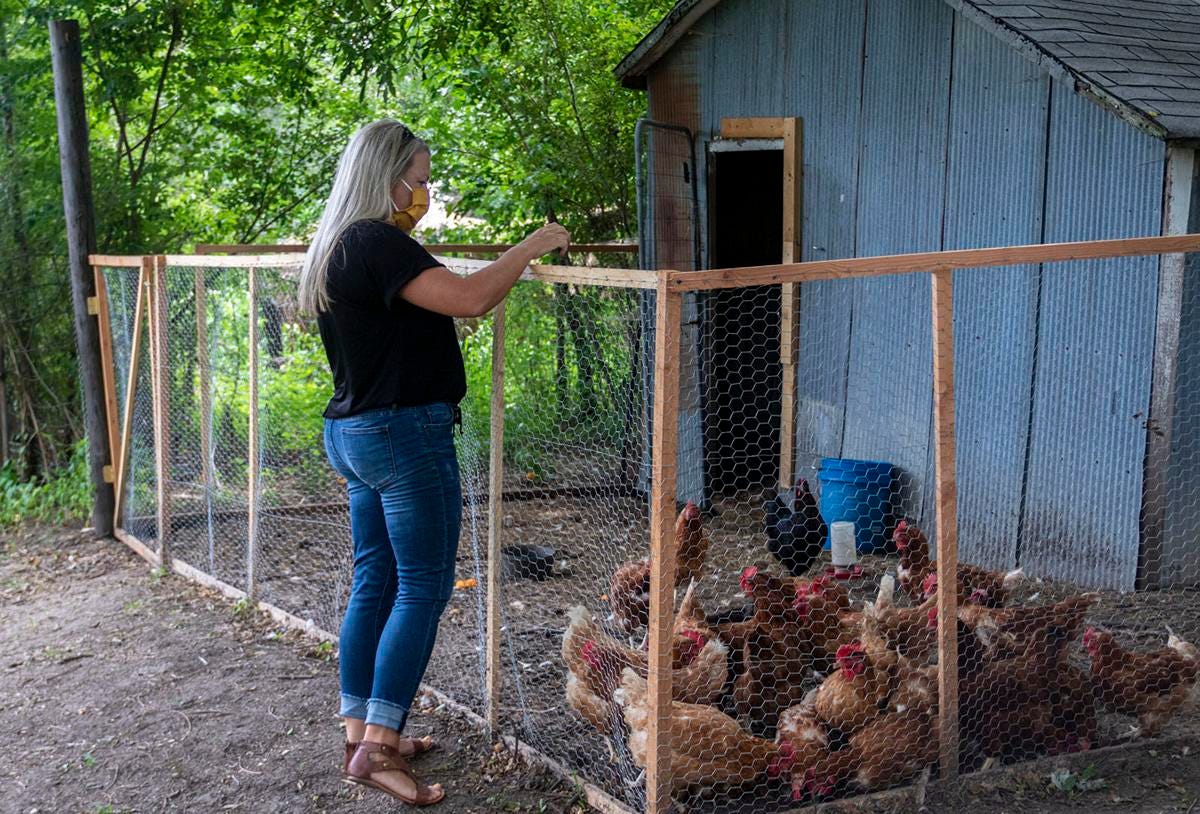
From Louisiana to Mississippi to Arkansas, Piper has lived in the most conservative corners of some of the country’s reddest states, and now she’s helping man the progressive front of a nationwide culture war in rural Nodaway County, where row crop is king and where conservatives win in landslides and where Piper raises cattle and chickens and children and fights for what she believes in every chance she gets.
“I can’t stand back while people are actually harmed,” said Piper, who has grown increasingly vocal since casting a fruitless vote for Hillary Clinton in the 2016 election. In the 43 months since President Donald Trump took office, Piper has started carrying poster boards and sharpies in the trunk of her Volkswagen Passat, never unprepared for a protest. She’s knocked doors for candidates like Claire McCaskill and Henry Martin — both of whom lost to Republicans in 2018. Her Twitter following has grown from less than 20 to more than 8,000 as Piper speaks up, louder now than ever.
“We’ve seen policies before that could harm people,” she said, critiquing the Trump Administration’s actions and inactions, both in the last four months and the last four years. “But this is a — it’s like purposeful to hurt people. … It’s that weird culture war. It’s just things meant to harm other people — especially people who are already oppressed.”
Born on a military base in Louisiana to conservative parents who would later divorce, Piper grew up dirt-poor while moving across the South — the kind of poor that left Piper and her sister without food often, that left Piper behind on class field trips, that left her searching and voting for causes and candidates that supported people like her. Piper grew up in the kind of poverty that made her different, she said. It made her want to fight.
But if it was poverty and hunger that lit a fire in Piper, it was Trump’s election that fanned the flame, or perhaps more accurately, doused the flame with gasoline. Piper has lived in Hopkins for three years, though the changes she’s seen since 2016 have extended far beyond the city limits of the place she calls home now and far beyond the state of Missouri.
Piper is used to conservative rhetoric, of course. But what she’s seen and heard in the 1,300-something days since Trump took office is different than what she used to see and hear.
“I can’t stand back while people are actually harmed.”
There have been friends and even family members who Piper thought were decent people who have grown into something she doesn’t recognize, touting racist ideology and spreading views Piper isn’t really sure they even believe, she said. She has an uncle who has stopped speaking to her since Election Day 2016. Her stepfather won’t let her into her own mother’s home. She didn’t talk to her dad for much of two years.
And the rhetoric aside — although it never really is — the disconnect between Piper, a self-described moderate and sensible Democrat, and those on the other side of the aisle has only grown in the COVID-19 era. She has watched as elected leaders at the state and federal levels have been slow to action as the COVID-19 pandemic has killed more than 170,000 Americans. She’s watched Parson refuse to issue a mask mandate as cases spike in Missouri. She’s watched officials call for the reopening of schools, putting teachers like her in danger while many officials making those calls nationwide meet via Zoom.
And as she’s listened, over the last four years and the last five months, to the racist rhetoric and the misinformation, and as she’s witnessed the actions and inactions that have harmed or will harm Piper and people like her, she’s grown frustrated, both with the officials and their constituents, with politicians voting for destructive policy changes and the citizens voting for those politicians.
Living in a county that Trump carried by close to 40% in 2016, and in a congressional district he carried by 30, Piper has a question for her rural neighbors, both in a literal and figurative sense, a question that’s been growing louder and more urgent with each passing day since Nov. 8, 2016:
“I look around and think, ‘How in the world could you guys vote for these people again?”
Twenty sixteen changed all of us. It radicalized Jess Piper.
Embracing Her Voice
In his 30 years in education, Dennis Vinzant has seen a vast array of changes come to the field. The English department chair at Maryville High School has watched as classrooms have experienced technology upgrades and as school lunches have weathered a myriad of alterations, and perhaps most importantly, Vinzant has watched as teachers have started to push back against American ideals, confronting those ideals with American realism.
Teachers — particularly in the literature and history fields — have grown from cheerleaders for the Founding Fathers into educators with a more realistic and critical view of the past 250 years or so, Vinzant said, while they’ve received pushback from parents and community members every step of the way. There was a time, Vinzant said, when he was scrutinized for teaching “Of Mice And Men,” the Great Depression-era John Steinbeck novella that landed on the American Library Association’s list of the 10 most challenged books in the 21st Century for its vulgarity.
“It is something that we all face to a certain extent,” Vinzant said. But, he said, Piper has probably experienced it more than any other teacher he’s been around in the last decade or so.
As she navigates how to teach students American literature through a modern-day scope, highlighting the hypocrisy of Founding Fathers like Thomas Jefferson, who wrote the words “all men are created equal” as a slave owner, Piper has received backlash, from parents and from elsewhere. She’s been accused of brainwashing, Vinzant said. She’s been targeted, in essence, for wanting students to think critically, and for wanting those students to back up their opinions with evidence that might support their claims, an idea that has somehow been received as radical at times, Vinzant said.
For Vinzant, who oversees Piper at Maryville High School and has worked alongside her for a half-decade, the pushback serves as a paradox. Critics equate the type of realism taught in Maryville’s English department with an attack on American values. But Vinzant said American idealism has always been challenged in American literature. It’s not the job of teachers like Piper and Vinzant to paint a rosy picture of what the country is and isn’t, he said. It’s their job to paint America’s portrait as it is.
“Being in a very conservative area here,” Vinzant said over the phone, pausing and sighing, carefully choosing her next words, “they’re uncomfortable with anything that’s not reinforcing what they already believe.”
They’re uncomfortable, of course, with Piper.
She knows it can be difficult to separate her from her politics, but Piper insists her beliefs don’t make their way into her lesson plans, though the subject matter she teaches does lend itself to social justice. And it’s true that Piper teaches the state-mandated curriculum differently than other teachers might, differently than how parents might have learned it, differently than Piper learned it herself.
The way Piper was taught, she said, both in literature and social studies, there were entire groups of people left out by way of whitewashed textbooks and lesson plans that ignore the darkest chapters in American history. Piper doesn’t ignore those chapters, and her refusal to do so is at times at odds with conventional wisdom, and perhaps more tangibly, at odds with some conservative parents and students in the community.
“I have a thick file,” Piper said. “It’s like a binder with tabs now.”
There is an actual file, Piper said, with actual letters in it. Still, the district granted her tenure last year.
Vinzant said parents seem to be used to an era when teachers didn’t have much of a voice, or at least, didn’t use it. Piper has embraced hers, perhaps more now than ever. As both Trump and Parson have called for students in public schools to return to face-to-face classes nationwide, and as the Maryville R-II School District gets set to offer face-to-face classes this fall semester for any student who wishes to learn in person, already prompting the retirement of at least one teacher, Piper has been outspoken on Twitter.
While she hasn’t directly criticized Maryville officials or the district, Piper has been adamant about her position, one she said is based on the advice of health experts and common sense: returning to class in late August, as cases of COVID-19 ebb and flow in Nodaway County, isn’t safe. A tweet she sent Aug. 15 highlights faults in logic of those comparing teachers to nurses garnered more than 20,000 retweets and 130,000 likes.
Piper laughed when thinking back to March, when many ordinary people across the U.S. praised teachers as heroes after having the homeschool their kids for several weeks when lockdowns first started. Now, teachers are labeled as lazy and cowardice for valuing their own health, she said.
“My, how things have changed,” Piper said.
For Piper, the realities of the situation are dual-edged. She understands schools serve as a food source and childcare for many parents and students across the county and the country. She recognizes the equity gaps that already exist in education, further emphasized by the pandemic and the move to online learning, a medium that can leave students in poverty behind. She wants to help those students, she said. But she wants to be safe.
She knows schools are everything, especially in places like Nodaway County. She’s frustrated, but she’ll head into work at Maryville High School later this month, prepared to teach the students who opt to learn in person. She’ll leave her 7-year-old daughter, Charlie, to learn at home.
“I don’t know what we’re going to do, but I know I can’t send her to school,” Piper said. “There’s no mask mandate for third grade.”
Both in person and on Twitter, Piper is careful in what she says, or at least, in how she says it, as she toes the line in critiquing the reopening of schools while not implicating the reopening school that employs her.
The practice of restraint is still something Piper is growing accustomed to. It wasn’t long ago that Piper was just a teacher with 14 followers on Twitter, a platform she used mostly to find lesson plans and to connect with other teachers. Now, she’s a growing voice on the platform. The commentary on social issues amid the pandemic and the protests that swept through the country beginning in late May have come with an increase of more than 3,000 followers for Piper, who helped organize and publicize Marvyille’s Black Lives Matter protest in early June. One tweet she made at the event was retweeted by McCaskill, the former senator Piper volunteered for.
But before more than 300 protestors converged on the Nodaway County Courthouse June 6 and before Piper’s tweet about the event caught fire, the educator was there two days before, protesting alongside a former Maryville High School student, with less than 20 other people.
The former student, Hayden Taylor, a 2016 graduate of Maryville High School, made plans June 4 to go protest by himself outside the courthouse and invited friends on Facebook to join him. Piper said another teacher sent the post to her from Taylor, who was conservative in high school and still identifies as conservative now. Piper dropped what she was doing to join him on the square, she said.
“I told my husband — I threw on a T-shirt and I said, ‘I’ve got to go,’” Piper said. “So I just ran down there and he was there.”
Taylor tells the story differently, though only slightly so. He made the Facebook post, of course, and announced his plans to protest for at least 46 minutes starting at 4:30 p.m. eight days in a row — honoring the eight minutes and 46 seconds it’s believed Minneapolis police officer Derek Chauvin kept his knee pressed against the neck of George Floyd. Piper did show up to support Taylor along Main Street June 4.
And Taylor said Piper showed up every day he protested, in crowds that ranged from less than 10 to a few dozen. But that first day, when Piper said she arrived at the courthouse to join the former student, Taylor said he was still on his way to the courthouse at 4:30 p.m., when he had promised his Facebook friends he’d be protesting.
“She actually beat me there,” Taylor said.
From fighting to running
Piper has a lot of bones to pick with a lot of people, but perhaps none as many as she does with Sam Graves, the U.S. representative from Missouri’s 6th Congressional District, a man many of Piper’s neighbors have voted for every two years for the last 20, and who many of them will vote for again this November.
It seems Piper’s gripes with Graves go beyond that of normal liberal-conservative disputes. She doesn’t agree politically with Allen Andrews, the Republican state representative for District 1, an area that includes Nodaway County, but she called him a “nice guy.” And her problems with state Sen. Dan Hegeman seem to begin and end at his conservative ideals. But with Graves, it feels different. It feels pointed.
Perhaps it’s because Graves, who first got elected in 2000, has taken a more permanent residence in Washington D.C. than he has in the district in the years since, Piper said. Perhaps it’s because he claims to fight for issues that affect rural voters, like infrastructure, she said, while storefronts in Hopkins sit boarded up and empty, watching over roads that range from unpaved to unkempt, in a community where the fire station resembles a steel shed and the post office might be the nicest building in town.
Or perhaps it’s because Graves has abandoned the rural voter while collecting the rural vote and collecting an annual salary that’s grown from $145,000 when he started in 2001 to $174,000 today.
“I know Sam Graves has no idea what it’s like to go hungry,” Piper said.
Piper does. She knows a lot about the rural struggles Graves has done nothing to combat, she said, and perhaps that’s why she’s so critical of him. Perhaps that’s why she might run to replace him in two years, pending the outcome of his November election.
Piper has been approached by several decision-makers and recruiters within the Democratic party to run for office, and while some have urged her to start small and run for a seat like the one Andrews occupies now, others have encouraged the teacher and activist to go big, to go after Graves.
“I make $41,000 a year; I don’t have money to go after someone that big. But then again, I’m like, ‘Why shouldn’t I go after his position?’”
There’s a lot about the inner workings of politics that Piper doesn’t know. She’s not sure how to run a campaign, she said. She’s not sure if she has a chance to win the 6th District, where Martin, the Democrat Piper knocked doors for, lost by more than 100,000 votes in 2018. But she’s not sure how Graves keeps winning, either.
If she does run against Graves, Piper will have to win the rural vote, a group that doesn’t seem to be voting any more liberally than it did when Graves first took office. Amendment 2, a ballot measure that would expand Medicaid in Missouri at no cost to taxpayers, passed statewide earlier this month but lost by more than 700 votes in Nodaway County, despite the fact that many rural Missourians are on Medicaid, Piper said.
Piper faces an uphill battle in any race she may decide to run in northwest Missouri. A Democrat hasn’t won the 6th District since Pat Danner served from 1993 to 2001 when Graves replaced Danner, the only woman to ever serve as the district’s representative, following her retirement. Graves has won at least 59% of the district’s vote in every election since.
“To go after him would be tough because I’m a teacher.
What could set Piper apart from the candidates that have tried and failed to unseat Graves for the last 20 years, she said, could be her place in the rural community. There are not rural candidates urging rural voters to vote for Democrats, she said. None of her representatives represent her, nor do they really represent Piper’s Republican neighbor’s a few hundred yards down the road, the ones with a Trump sign in their front yard that reads “NO MORE BULL—-.”
Being conservative and rural have become synonymous. Piper doesn’t understand why, but she knows that kind of campaigning won’t win voters in Hopkins.
“You’ll see people from Kansas City or St. Louis talking about the dumb hicks who vote against themselves,” Piper said. “And I’m like, ‘Well, that’s probably not a message that’s gonna resonate well out here.’”
Piper hasn’t decided yet whether she’ll run for Graves’ seat in 2022 or whether she’ll run for office at all. She’s hopeful Gena Ross, this year’s Democratic challenger in the 6th District, will unseat Graves in November. But history suggests Ross’s bid will be unsuccessful. And the last four years suggest Piper will run. She’s lost too much to stop fighting now.
Upgrade to paid
After months of silence between Piper and her father in the aftermath of the 2016 election, there was a break in late 2017, but only briefly, only for a few days, only long enough to say goodbye. Fighting a bevy of health issues, Piper’s dad, a Navy veteran, received the same low-quality healthcare veterans around the country are subjected to, Piper said.
By the time Piper walked into Britt Snodgrass’s hospital room at Kansas Medical Center, where he’d been transferred after doctors at a local hospital botched a treatment that left Snodgrass’s health declining, Piper’s dad was on his deathbed. A man that Piper described as “strong” and bear-like died a “fragile and horrible death” at the hands of malpractice, she said.
In those last waking moments, as doctors at the Medical Center burned a lavender scent in the hospital room to combat the smell of Snodgrass’s decomposing skin, Piper’s dad was apologetic, she said. He didn’t regret the politics that drove a wedge between them, but he regretted the division they caused. He asked her to read a story she wrote about growing up in poverty called “Mississippi Mudpies.” He asked Piper’s uncle to play bluegrass music, the music of his people, Piper said. And Snodgrass, who hadn’t asked his daughter for anything in more than a year, asked for advice, or perhaps for permission.
“‘What should I do? What would you do?’” Piper recounted her dad saying.
“And I said, ‘I don’t know, daddy,’” Piper said, her southern accent more pronounced now than ever, as she recalled one of the last conversations she had with her father. “‘I don’t know what I would do.’ Because I didn’t want him to go, but I didn’t want him to be in pain either.”
The next day, doctors helped him along, Piper said, pumping morphine into Snodgrass’s body every 15 minutes until he lost consciousness. His breathing slowed. He inhaled once every 90 seconds. Religious music played. Piper watched and waited as he slipped away, her father a victim of a failing healthcare system that predated 2016, their relationship very much a casualty of Trump’s America.
“Another reason why I fight,” she said.
The original article was written by Andrew Wegley. You can find him at andrewwegly on X.
Thursday morning, the Supreme Court issued decisions in four cases, none of them involving Donald Trump. Nor were any of the other high profile cases we’ve been following on the docket this morning. That means cases about the power of administrative agencies, whether it’s constitutional to make it a crime for someone under a domestic protection order to possess a firearm, and whether hospitals are obligated to stabilize patients in emergency situations, including by providing an abortion where appropriate, are still on the docket.
In Louisiana (we’ll get to it in a minute), the state legislature has passed a law requiring that the Ten Commandments be posted in all public school classrooms. The law is clearly at odds with existing First Amendment jurisprudence, suggesting that passing it was a provocative act designed to get a test case to the Supreme Court to make classrooms Christian again.
Thanks for reading Civil Discourse! If you aren’t already, I hope you’ll consider becoming a paid subscriber, which lets me devote more time & resources to this work and reach more people, by making the newsletter available for free
And there’s still more for us to discuss. It was a day!
I was up bright and early in front of a camera, only to learn we have to wait at least until Friday morning, perhaps longer, to learn whether the Court believes Donald Trump is entitled to immunity from prosecution.
The Court will announce opinions again tomorrow, Friday morning, at 10:00 a.m. ET. Quick reminder: we never know which cases or how many of them we will get on a particular day.
Today the Court decided
Moore, where the Court held it was constitutional to charge U.S. taxpayers who own shares in foreign corporations a one-time tax on their share of earnings under a provision of the 2017 Tax Cuts and Jobs Act known as the “mandatory repatriation tax.”
Chiaverini, a case involving whether a defendant in a criminal case can raise a claim of malicious prosecution if one of several charges lodged against them turns out to be baseless. The Court held that the presence of some valid charges does not prevent a malicious prosecution claim on the basis of another, invalid charge.
Diaz, where the Court ruled prosecutors could offer expert testimony that “most people” in a certain group have a particular mental state. This case involved a drug courier and an expert who testified that most people transporting drugs know what they are doing.
Gonzalez, where the Court held that the 5th Circuit failed to apply the rules for evaluating a claim of retaliatory arrest properly and sent the case back to them to do so.
I flag these cases, which we haven’t previously discussed, to give you some sense that every case that makes its way to the Supreme Court is important. If we weren’t starring down the barrel of a possible second Trump presidency, these cases would be getting far more attention, particularly the ones about possible police misconduct and the kinds of evidence that can be used in criminal cases. But we continue to live in a timeline where Trump’s attack on democracy consumes far too much attention, distracting us from other critical issues. Removing Trump from our politics is essential to facing future challenges like climate change, criminal justice reform, Supreme Court reform, and restoring the right to vote, along with a host of other issues.
Seventeen cases remain on the Supreme Court’s docket. That means next week is going to be busy if the Court intends to finish up by the end of the month, its *normal* time—although they’ve gone into the first week of July several times in recent years. The Court’s website has been updated to show they will hand down more cases next Wednesday. That means it’s highly unlikely there will be additional dates before then although we can expect to see Thursday and perhaps even Friday dates again.
We know what’s left on the Court’s calendar for this term. But we also got a preview of a case that is likely headed to the Supreme Court in a future session. The First Amendment prohibits the establishment of any religion by government. Until recently, that’s meant in schools too. But with the new conservative supermajority on the Court, there has been some erosion of precedent.
The Louisiana Legislature passed a law on Wednesday designed to get the Court to expand the role of religion in the courtroom. The law requires a display of the Ten Commandments in every public school classroom, including at the college level. The display must be 11” x 14” poster, with the Commandments the central focus in a large and easily readable font. The display must include a three paragraph statement claiming the Ten Commandments have been a prominent part of American education for almost three centuries. What’s next? Racism was also a “prominent part” of American education for decades.
Nobody involved in passing this legislation thinks it complies with the law. There’s a 1980 case, Stone v. Graham, that’s directly on point. The Court invalidated a Kentucky law that required posting the Ten Commandments in classrooms, finding it violated the Establishment Clause of the Constitution. The Court found that the requirement “had no secular legislative purpose” and was “plainly religious in nature” because the Commandments involve religious matters like worshiping God and observing the Sabbath. Louisiana’s new religious mandate clearly violates the law.
This is what people with an agenda do when they think the Supreme Court is on their side. They know the law violates established interpretations of the First Amendment. But after Dobbs and the Supreme Court’s utter abandonment of precedent, why not feel emboldened? Why not try to get decades of precedent reversed while you can? These are, after all, the folks who in Project 2025, have signaled that education will be left to the states. That means eliminating the Department of Education and permitting states to opt out of federal programs or standards. A little Ten Commandments in the classroom goes nicely with that.
This Court has already signaled interest in advancing the role of religion (presumably, that’s limited to Christianity, and they’d find a way to prohibit postings of Sharia law or satanic practices) in earlier cases. Notably, in 2022, the Court considered whether a high school football coach could engage in post-game prayer on the field, with players and students gathered around him. The Bremerton School District told Joseph Kennedy, the praying coach, that he needed to stop so they wouldn’t be sued. He refused and doubled down, reaching out to local and national television, print media, and social media for support. The school district suspended him, and Kennedy sued.
After losing in the lower court, Kennedy won in the Supreme Court. Here’s how the conservative Federalist Society characterized the ruling: “The Free Exercise and Free Speech Clauses of the First Amendment protect an individual engaging in a personal religious observance from government reprisal; the Constitution neither mandates nor permits the government to suppress such religious expression. Justice Neil Gorsuch authored the majority opinion of the Court.” The Court ruled in Kennedy v. Bremerton that the coach’s prayer was a personal religious observance and that it would actually violate his First Amendment protections for free speech and free exercise of religion to prevent him from engaging in prayer on the field.
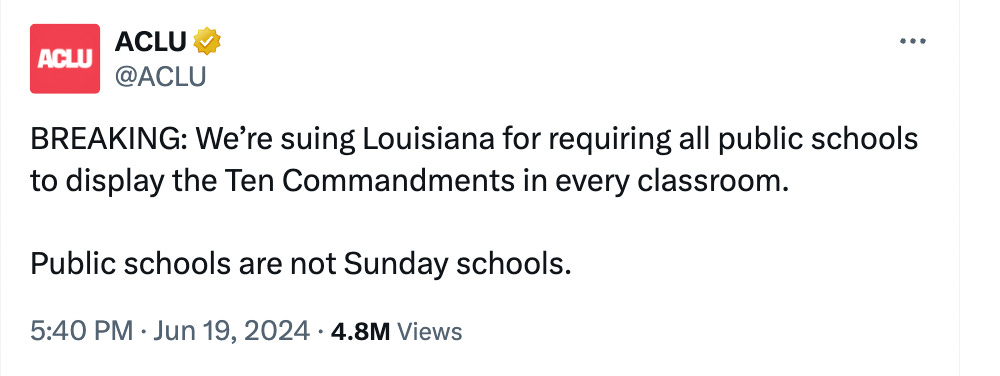
The ACLU took about 30 minutes to announce that it would be filing a lawsuit along with other groups next week.
What’s next if Louisiana gets away with this? Will the Chief Justice of a state supreme court plant a 2.5 ton granite monument of the Ten Commandments in the courthouse and refuse to remove it after he’s ordered to by the courts, saying that it serves as a reminder to lawyers and judges that justice could only be done if ‘the favor and guidance of almighty God” was invoked first? Oh wait, that already happened in Alabama, where Chief Justice Roy Moore (you may remember him. He lost a Senate race against Doug Jones following a campaign where his interest in young girls came to light) refused to remove his rock from the rotunda of the Alabama Supreme Court after the Eleventh Circuit Court of Appeals directed him to. Following his refusal, Moore was removed from office and prosecuted by Alabama Attorney General Bill Pryor, who is now the Chief Judge on the Eleventh Circuit Court of Appeals, for judicial misconduct because he failed to comply with the order of the federal court.
The Kentucky case, Stone, the Bremerton School District case, and Roy Moore’s courthouse monument case all have one thing in common, the Lemon test. That test, used to determine whether the First Amendment’s establishment of religion clause has been violated, has been in place since the Court decided Lemon v. Kurtzmanin 1971. A statute must pass all three prongs of the Lemon test to pass constitutional muster:
The statute must have a secular legislative purpose,
its principal or primary effect must be one that neither promotes nor inhibits religion, and
it must not foster “excessive government entanglement with religion.”
In the praying football coach case, the Supreme Court suggested Lemon had been “abandoned.” Now, it looks like Louisiana will ask the Court to formally overrule 40 years of precedent, permitting the Ten Commandments in classrooms, with who knows what else to follow. This is a situation to watch carefully. Its implications will affect people across the country in multiple ways, not just students in Louisiana’s classrooms. No child should feel like their religious beliefs, or lack of them, determine whether they’re welcome in the classroom. No litigant should feel like they won’t receive impartial justice from a judge because they don’t stand to pray before court starts. This is a dangerous slippery slope.
One final note tonight: we here at Civil Discourse are not alone in being concerned about Judge Aileen Cannon’s ability to handle the Mar-a-Lago case. On the eve of her unusual hearing tomorrow, where amici will argue alongside lawyers regarding the constitutionality of the special counsel appointment mechanism, the New York Times has an extraordinary report. They reveal that two federal judges in Florida, including the chief judge in the Southern District of Florida where she sits, privately urged Judge Cannon to step aside when the classified documents case was randomly assigned to her. Cannon refused, which is how we ended up where we are.
Chief judges have no supervisory authority over the other judges on their courts. They cannot tell them what to do. But a wiser judge than Cannon would have listened to other judges on her court. This gives new impetus to concerns that there is more at work here than inexperience.
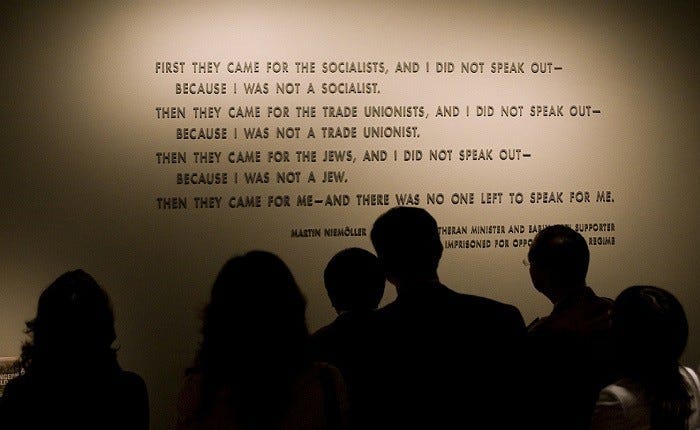
I’m also no longer shocked that MAGA dumbfucks are so uneducated, most of them have no idea that the German Nazis were not left-wing socialists. They were right-wing capitalists, who are world famous for slaughtering anyone who supports socialism:
“Hitler allied himself with leaders of German conservative and nationalist movements, and in January 1933 German President Paul von Hindenburg appointed him chancellor. Hitler’s Third Reich had been born, and it was entirely fascist in character. Within two months Hitler achieved full dictatorial power through the Enabling Act.
In April 1933 communists, socialists, democrats, and Jews were purged from the German civil service, and trade unions were outlawed the following month. That July Hitler banned all political parties other than his own, and prominent members of the German Communist Party and the Social Democratic Party were arrested and imprisoned in concentration camps.“
“In 1933–1939, before the onset of war, most prisoners consisted of German Communists, Socialists, Social Democrats, Roma, Jehovah’s Witnesses, homosexuals, and persons accused of ‘asocial’ or socially ‘deviant’ behavior by the Germans.”
I figure MAGA dumbfucks can be forgiven for not knowing this stuff, because corrupt Republican politicians have been underfunding schools to create a legion of braindead pinheads. So I don’t really expect them to know anything about European history, or even to be able to find Europe on a map.
But since many Americans are obsessed with the Civil War, as if it’s the only thing that ever happened in history, you’d think even MAGA dumbfucks know at least the basics. Like which side supported slavery, and who the good guys and the bad guys were.
Nope. Most of them don’t even know that.
They don’t even know what the Civil War was about:
Lots of Americans don’t think slavery caused the civil war
Students aren’t learning about slavery: A new report from the Southern Poverty Law Center finds that students in the U.S. simply aren’t learning much about the country’s history of slavery.
U.S. students’ disturbing lack of knowledge about slavery: Only 8 percent of U.S. high school seniors can identify slavery as the central cause of the Civil War.
There really are millions of MAGA dumbfucks who have no fucking clue that the Confederates were the bad guys who supported slavery, and the Union were the good guys who wanted to abolish slavery.
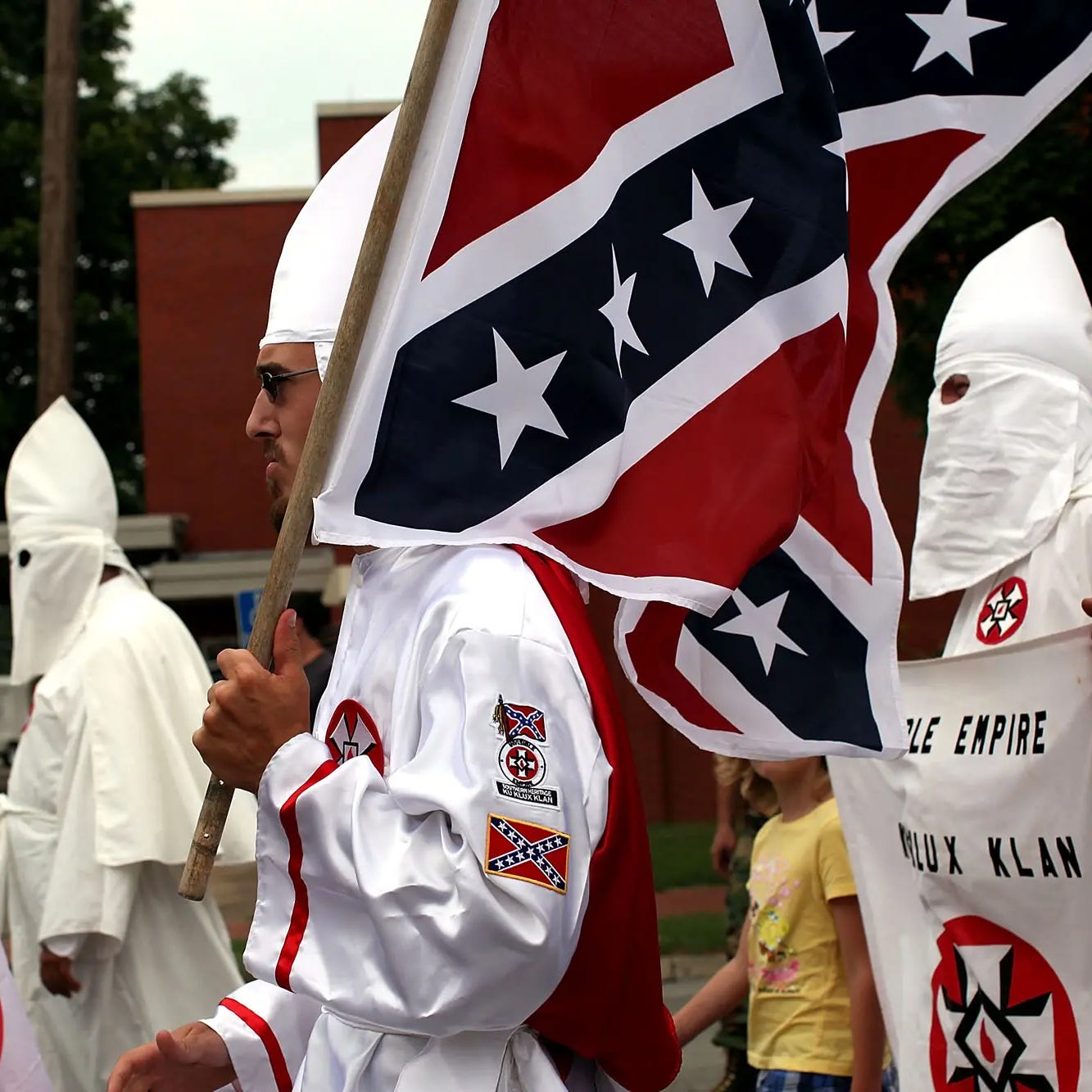
Pro-slavery Confederates = KKK = MAGA = Republicans
The reason why MAGA dumbfucks don’t know this is simple: Fox News lies to them all day every day, about everything. And they’re too dumb to know that they’re being lied to.
Fox News and corrupt Republican politicians like to confuse dumb Republican voters by pretending the KKK was founded by today’s progressive Democrats. Of course that’s complete bullshit, but MAGA dumbfucks are too dumb to see through the lies.
So let me explain it in a way even a child can understand. With simple words, short sentences, and lots of pictures:
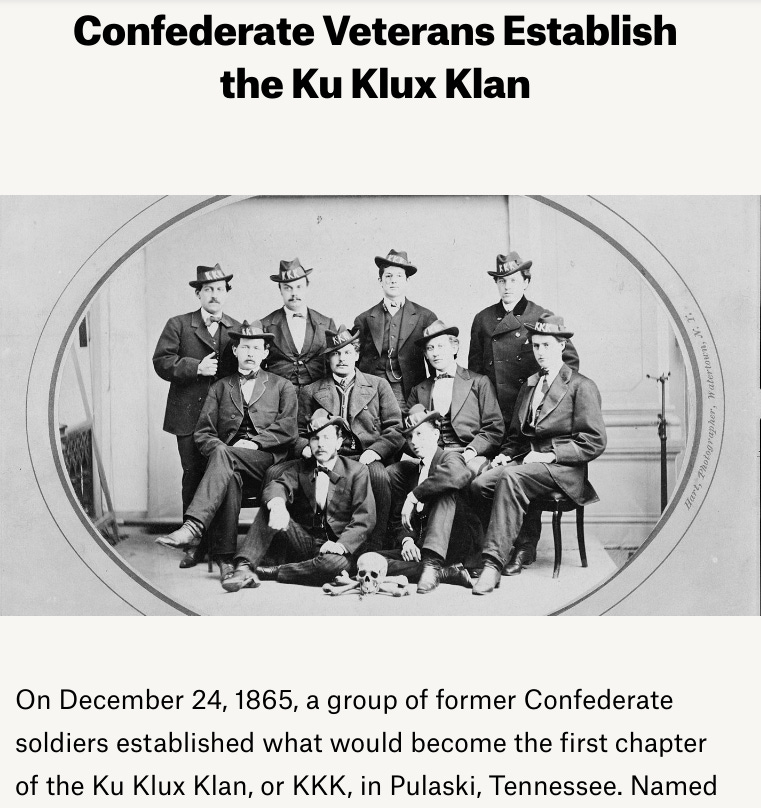
The KKK was started by pro-slavery Confederate soldiers. Today they call themselves Republicans, not Democrats.
Fact check: Democratic Party did not found the KKK, did not start the Civil War
Who gets upset when pro-slavery Confederate monuments get torn down by Democrats? Republicans.
Yes, it’s true, pro-slavery Confederates used to call themselves Democrats for a while, until they got upset because the Democratic party supported equality for black people.
That’s when the pro-slavery Confederates started to call themselves Republicans.
Princeton’s Ilyana Kuziemko and Yale’s Ebonya Washington use this data to argue that nearly all of the Democratic Party’s losses in the South from 1958-1980 can be explained by white voters’ racially conservative views.
‘Racially conservative’ attitudes led white Southerners to leave Democratic Party
Racial attitudes were the primary reason white Southerners abandoned the Democratic Party after party leaders began to advocate for civil rights legislation during the last half of the 20th century, a new study finds.
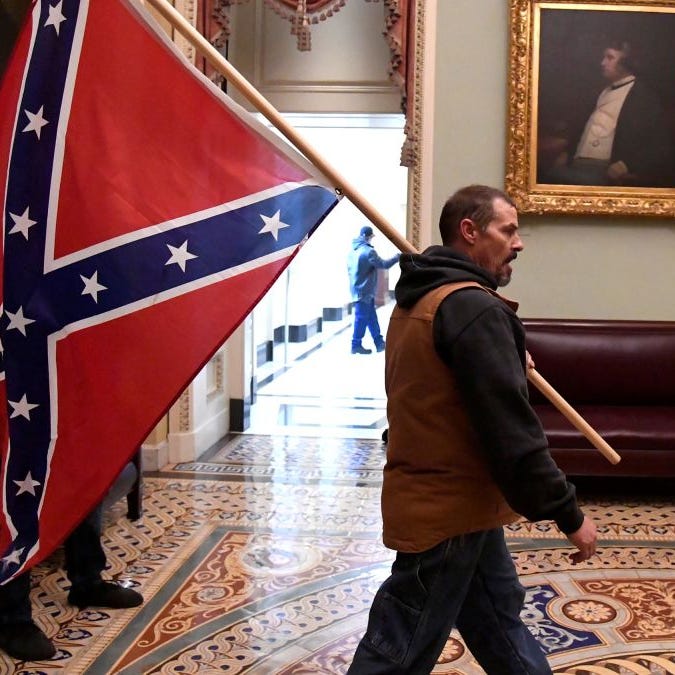
That’s why racist MAGA dumbfucks still run around with pro-slavery Confederate flags.
Conservatives want to hold on to the old ways, like slavery and white supremacy.
Progressives strive to make progress, by finding new, better ways of making everyone’s life better. For example by getting rid of old traditions like slavery and promoting new ideas like racial equality.
Sometimes words and their meanings change. Over time, people use different labels to describe themselves or others.
Lincoln would be a Democrat today, say Doris Kearns Goodwin and Tony Kushner: The Pulitzer Prize winners behind the new biopic say that the 16th president’s political beliefs would see him in a different party in 2012.
Here’s a little video that explains why Southern Baptists aka Evangelicals were pro-slavery during the Civil War, and why they’re still bat-shit crazy:
Dear MAGA dumbfucks: You are the bad guys.
You are the pro-slavery Confederates.
You are the racist KKK.
You are the racist white-supremacy pro-slavery party.
















 Richard L. Fricks