Richard L. Fricks is a novelist, former attorney and CPA, Fictionary Certified StoryCoach Editor, and creator of The Pencil-Driven Life. He lives in rural North Alabama near Boaz, where much of his fiction and reflection remain rooted. His work explores story, inherited purpose, faith and doubt, family pressure, moral contradiction, consciousness, ordinary life, and the practice of beginning again with a pencil.
Uncertainty can immobilize us—or inspire us to action.
***
You Are Here
Find greater enjoyment and meaning in navigating life’s unknowns.
In You Are Here, author and journalist Oliver Burkeman offers a collection of essays exploring the nature of limitation, uncertainty, unpredictability, accomplishment, enjoyment, and more.
“Life is so intrinsically confusing and precarious,” Burkeman says. But when we stop struggling against that reality, we are “liberated at last to give this admittedly rather preposterous business of being a human absolutely everything we’ve got.”
***
Oliver Burkemanisthe author of the New York Times bestseller Four Thousand Weeks: Time Management for Mortals, about embracing limitation and finally getting around to what counts. For many years, he wrote a popular column on psychology for The Guardian, “This Column Will Change Your Life,” and has reported from London, New York, and Washington, DC.
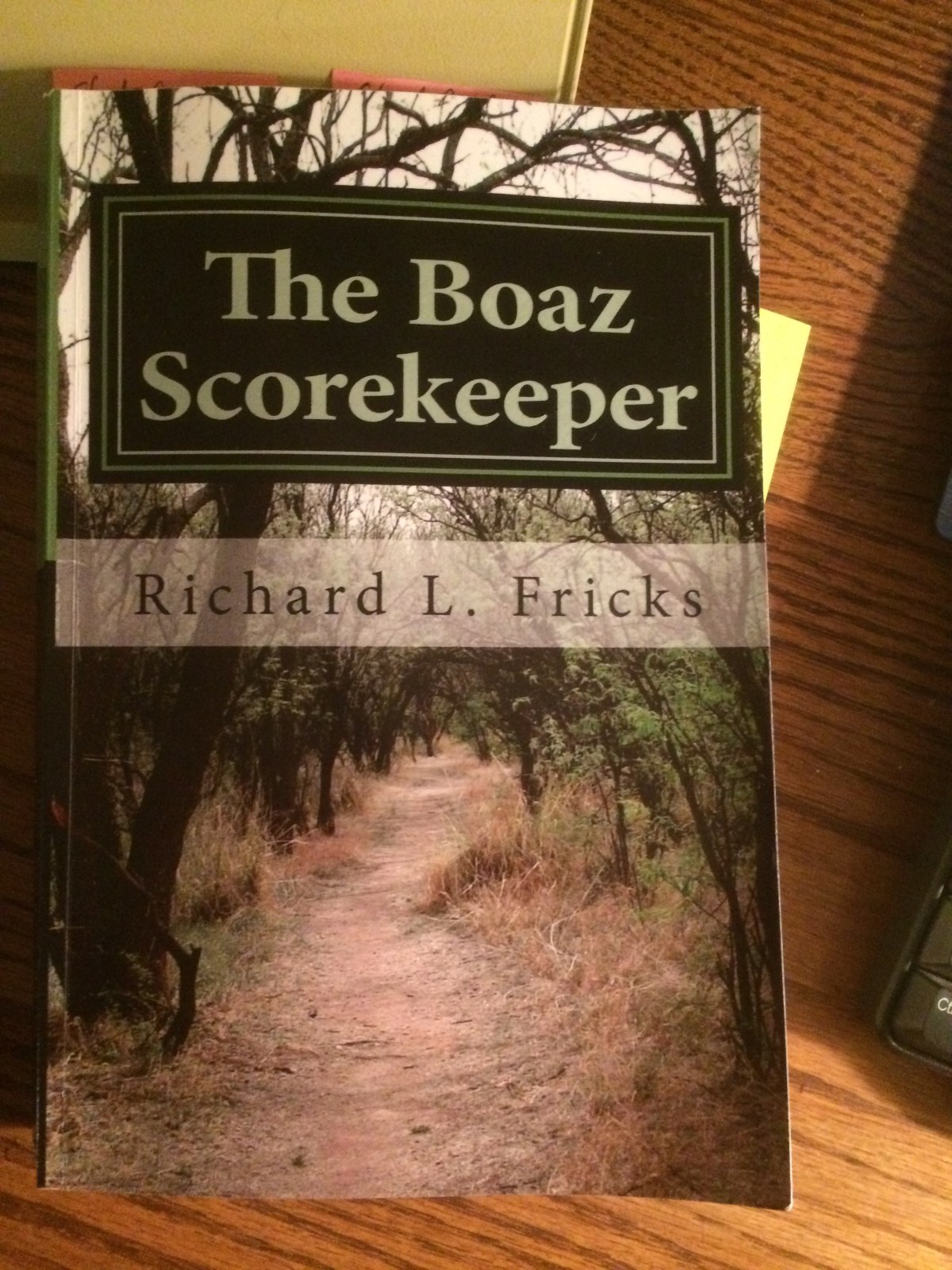
The Boaz Scorekeeper, written in 2017, is my second novel. I'll post it, a chapter a day, over the next few weeks.
The first home game of the 1969 season was with the cross-county rival Arab Knights. They had a fast and quick-trigger forward who, along with a giraffe-necked center, scorched our nets for 99 points. We had 33 less. The only bright spot was the passing and ball-stealing abilities of our point guard James Adams. He was a sophomore like me.
The season didn’t get much better. Boaz lost 32 of its 58 games, losing 18 games at home. I didn’t miss a game. I even rode the bus with the team to all Away games even though I wasn’t the scorekeeper. However, Coach Pearson was a stickler for statistics and the pet spreadsheet that he often called ‘The Shit.’
During my Sophomore year I only made one mistake. It was against the Albertville Aggies in the last home game in mid-January. There was less than two minutes left on the clock and we were down only two points when long passes and fast breaks became the mood on the court. John Ericson scored on a layup and was fouled. He missed the foul shot but for some reason I unknowingly added the point to the Board and the game continued. It was some sort of miracle that the referees continued the game even though the Aggie fans were shouting and nearly coming out of the bleachers. Boaz Center Randall Radford blocked Albertville’s next shot and Coach Pearson called time-out. Before I could stand up to stretch my legs Albertville’s coach was dragging the head ref over to my table and motioning for Coach Pearson. It was a tense few moments with tempers flaring. The refs finally recognized the mistake and ordered me to remove the point from the Boaz score. Albertville went on to beat Boaz by three points. Even though one would think that Boaz fans and players wouldn’t have been upset with me, that wasn’t the case. It seemed everyone blamed me for the loss. Several of the players said I intentionally got the Aggies fired up and cost them the game.
Biking is something I both love and hate. The conflicting emotions arise from the undeniable physical effort it demands. However, this exertion is precisely what makes it an excellent form of exercise. Most days, I dedicate over an hour to my cycling routine, and in doing so, I’ve discovered a unique opportunity to enjoy a good book or podcast. The rhythmic pedaling and the wind against my face create a calming backdrop that allows me to fully immerse myself in the content. In these moments, the time spent on the bike seems worthwhile, as I can’t help but appreciate the mental and physical rewards it offers.
I especially like having ridden. The post-biking feeling is one of pure satisfaction. The endorphin rush, coupled with a sense of accomplishment, makes the initial struggle and fatigue worthwhile. As I dismount and catch my breath, I relish the sensation of having conquered the challenge, both physically and mentally. It’s a reminder that the things we sometimes love to hate can often be the ones that bring us the most fulfillment. In the end, the love-hate relationship with biking only deepens my appreciation for the sport, as it continually pushes me to overcome my own limitations and embrace the rewards that follow the effort.
My bike
A Rockhopper by Specialized. I purchased it November 2021 from Venture Out in Guntersville; Mike is top notch! So is the bike. The ‘old’ man seat was salvaged from an old Walmart bike (update: seat replaced, new photo to follow, someday).
Something to consider if you’re not already cycling.
I encourage you to start riding a bike, no matter your age. Check out these groups:
In this conversation, podcaster and YouTube interviewer André Duqum interviews Sam on his show, Know Thyself.
They discuss pivotal events in Sam’s life, including his first MDMA trip; the default feeling of selfhood, and how it leads to suffering; peak and flow experiences; the illusion of free will, and its practical implications; the limited utility of negative emotions; distinctions among various non-dual traditions; the perpetual instability of non-dual recognition; the fundamental difficulty of the hard problem of consciousness; the substrate-independence of intelligence; the power of gratitude; reason as the basis for human cooperation and progress; and other topics.
Embrace life’s unpredictability, rather than resisting it.
***
You Are Here
Find greater enjoyment and meaning in navigating life’s unknowns.
In You Are Here, author and journalist Oliver Burkeman offers a collection of essays exploring the nature of limitation, uncertainty, unpredictability, accomplishment, enjoyment, and more.
“Life is so intrinsically confusing and precarious,” Burkeman says. But when we stop struggling against that reality, we are “liberated at last to give this admittedly rather preposterous business of being a human absolutely everything we’ve got.”
***
Oliver Burkemanisthe author of the New York Times bestseller Four Thousand Weeks: Time Management for Mortals, about embracing limitation and finally getting around to what counts. For many years, he wrote a popular column on psychology for The Guardian, “This Column Will Change Your Life,” and has reported from London, New York, and Washington, DC.
Biking is something I both love and hate. The conflicting emotions arise from the undeniable physical effort it demands. However, this exertion is precisely what makes it an excellent form of exercise. Most days, I dedicate over an hour to my cycling routine, and in doing so, I’ve discovered a unique opportunity to enjoy a good book or podcast. The rhythmic pedaling and the wind against my face create a calming backdrop that allows me to fully immerse myself in the content. In these moments, the time spent on the bike seems worthwhile, as I can’t help but appreciate the mental and physical rewards it offers.
I especially like having ridden. The post-biking feeling is one of pure satisfaction. The endorphin rush, coupled with a sense of accomplishment, makes the initial struggle and fatigue worthwhile. As I dismount and catch my breath, I relish the sensation of having conquered the challenge, both physically and mentally. It’s a reminder that the things we sometimes love to hate can often be the ones that bring us the most fulfillment. In the end, the love-hate relationship with biking only deepens my appreciation for the sport, as it continually pushes me to overcome my own limitations and embrace the rewards that follow the effort.
My bike
A Rockhopper by Specialized. I purchased it November 2021 from Venture Out in Guntersville; Mike is top notch! So is the bike. The ‘old’ man seat was salvaged from an old Walmart bike (update: seat replaced, new photo to follow, someday).
Something to consider if you’re not already cycling.
I encourage you to start riding a bike, no matter your age. Check out these groups:
The Boaz Scorekeeper, written in 2017, is my second novel. I'll post it, a chapter a day, over the next few weeks.
After 8th grade, there were three things I really enjoyed: reading, especially fiction, football, and scorekeeping. I played football four years at Boaz High School. I was pretty good at it. I started as a tight-end and linebacker during my Junior and Senior years. In the ninth grade, I tried out for basketball but never could seem to develop the necessary skills to dribble and shoot the ball. But, I was a great scorekeeper.
In the fall of my tenth-grade year Coach Pearson, who also taught Biology, asked the class one day if anyone would like to try out to be the School’s basketball scorekeeper. He relayed that Matt Simmons, the School’s scorekeeper for the past three years, was moving next week to Birmingham. Coach emphasized the importance of this job and told all interested to meet him and Principal Benson in the gym the next morning at 7:00 a.m. Later that day, the School secretary’s meek little voice made the same announcement over the intercom. I remember her voice growing deeper as she said, “the trials will be timed.”
The opportunity resounded in my mind. I was responsible and good at math. I guessed numbers figured into the mix somehow. And, most importantly, I wanted something to do after football season ended this Friday night. After the last bell, I was at my locker about to head to football practice when I saw Coach Pearson. Without any hesitation, I raised my voice above the sound of students clamoring to exit the prison, “Coach, I want to be the scorekeeper. I’ll see you in the morning.” He looked my way but barely acknowledged that he heard me.
All that night I wondered what scorekeeping tryouts would be like. I could understand why one would have to be quick, certainly never getting behind. I lay in bed trying to guess how many others would show up for the trials. At 2:30 a.m., before finally dozing off, I concluded there would be four of us.
I arrived at 6:45 a.m. to an empty gym. Coach and Principal Benson showed up together a few seconds before 7:00. We all stood at a table that had been set up at the north end of the gym about 30 feet from the big scoreboard that hung on the wall. At 7:02 a.m. Mr. Benson looked at me, shook my hand, and announced that I was the Boaz scorekeeper. It wasn’t because I did a figurative running dunk shot from the foul line with a half-second left on the game clock. I was the only one who showed up. Coach told me to sit down at the table as Mr. Benson, in full character, turned and almost jogged toward the exit. He always had a mind full of places to be and people to see.
Coach Pearson was about as good a scorekeeping instructor as he was a Biology teacher. Neither was very high on his priority list. I guess he thought any lamebrain could keep score. But, he did give me a five-minute lesson. My job was two-fold: maintain the electronic scoreboard and hand-record statistics on a paper spreadsheet. Coach showed me how to use the control panel that was setup on the table. It looked pretty much like the scoreboard on the wall, with the words “Home” and “Guest” printed and equally spaced across the top. Underneath each heading were several colored buttons with numbers written beside them: a green 2, a green 1, a red 2, and a red 1. Pearson told me to simply press the correct button to add or subtract a score. He used his best sarcasm and said I would know who the ‘Home’ team was. He also said that if I made a mistake the head referee would let me know. At this point I picked up the spreadsheet and Coach said that he had to go but to see him if I had any questions. I stayed a few more minutes learning that I was to keep up with points scored and fouls committed by player. The spreadsheet form was divided in two sections with ‘Scoring’ on the left and ‘Fouls’ on the right. I didn’t see a big problem in keeping up with who scored and who fouled. I knew all the players. They were not friends but I knew their names and faces. The good thing about the spreadsheet was I only had to keep up with the “Home” team.
Christian apologists are celebrating the supposed collapse of the atheist movement—but all that’s really happening is that a few formerly high-profile atheists have turned against recent developments in moral progress. They’re getting left behind, but the nonreligious population continues to grow and religion continues to dwindle and decline.
Did you hear? The New Atheism is defunct—and that must mean the time has come for a revival of Christianity!
Right?
Christian apologists are eager to argue this “if not A, therefore B” logic. Unfortunately for them, they’ve gotten out over their skis again. They’ve failed to recognize that they’re committing a massive fallacy of the excluded middle.
I knew something had changed when, in 2018, I received an unexpected email from atheist thinker Peter Boghossian. I couldn’t quite believe what I was reading.
At the time, Boghossian was a professor of philosophy at Portland State University. When he joined me for a podcast debate on faith in 2014, he had been as anti-religious as they come. His book A Manual For Creating Atheists (Pitchstone Publishing) was a set of strategies for talking religious people out of their beliefs, which he claimed were akin to a mental delusion.
However, four years later, when Boghossian responded to an invitation to a fresh dialogue, he told me that he was no longer participating in debates against Christians. Indeed, he now felt quite differently about people of faith: “You might be surprised at how much I have in common with you now”, he wrote.
…What had led to this dramatic change of tone? A few months later, it became clear.
Boghossian, along with two of his academic colleagues, were at the centre of a ruse, submitting hoax academic papers to peer-reviewed journals, in order to expose so-called “grievance studies”—critical theories in academia that placed gender, sexual identity and race at the centre of every subject.
The phenomenon that Brierly describes is real. However, the cause isn’t what he thinks.
What really happened is that the New Atheist movement, from the beginning, was hampered by an unrepresentative set of spokespeople—mostly male, mostly white, mostly elderly—and we’ve run into the limits of their progressivism. They were fine with questioning and critiquing religion, but they’ve proven unwilling to critique anything else.
Whether it’s feminism, transgender rights, identity politics, immigration, or war—as soon as the sword-point of skepticism was turned on one of their cherished assumptions, they became angry, hidebound cranks. They were only able to dish it out, never to take it. There was a time when they could claim to be on the vanguard of moral progress, but now it’s moved on and they’ve been left impotently sputtering in the rear view mirror. (Also, some of these figures—especially the “intellectual dark web” types—were never leaders of the secular community, except in their own minds.)
What comes after New Atheism
For these reasons, I’d agree that New Atheism, as a cultural force, is spent. But that doesn’t mean, as wishfully-thinking apologists assert, that Christianity is poised to come roaring back throughout the Western world.
On the contrary. As the one-time “thought leaders” fade further from relevance, a more enlightened, more diverse secular movement is quietly rising. Meanwhile, Christianity continues its slow, inexorable decline.
The decades-long rise of the nones — a diverse, hard-to-summarize group — is one of the most talked about phenomena in U.S. religion. They are reshaping America’s religious landscape as we know it.
… The nones account for a large portion of Americans, as shown by the 30% of U.S. adults who claim no religious affiliation in a survey by The Associated Press-NORC Center for Public Affairs Research.
Other major surveys say the nones have been steadily increasing for as long as three decades.
So who are they?
They’re the atheists, the agnostics, the “nothing in particular.” They’re the “spiritual but not religious,” and those who are neither or both. They span class, gender, age, race and ethnicity.
While the nones’ vast diversity splinters them into myriad subgroups, most of them have this in common:
They. Really. Don’t. Like. Organized. Religion.
As Smith’s story makes clear, nonbelievers are a diverse bunch—from “secular homeschoolers in the Ozark Mountains of Arkansas” to “college students who found their childhood churches unpersuasive or unwelcoming”—who have little in common. They have their own ethical codes, their own spirituality, and their own ways of finding meaning in life. They’re mostly young, mostly politically liberal, but they come from all walks of life.
However, one trait they do share is a distaste for organized religion: its cruelty, its antiquated and dogmatic morality, its power-obsessed politics, its hypocrisy, its greed. Those flaws have long been evident to those who have eyes to see. And once you see them for what they are, there’s no going back. Nobody is changing their mind about religion because some old white conservative who wrote a book about atheism twenty years ago now supports Donald Trump’s border wall.
The nones are now 30% of the U.S. population, and among younger generations, it’s more than 40%. And this trend shows no signs of slowing down. It’s only gathering momentum, as every generation is more secular than its predecessors.
Under the radar
Importantly, it’s not just the United States where this trend is playing out. It’s happening all over the world, including former Catholic strongholds like Italy:
In Italy, the cradle of Catholicism, new research suggests that only 19% of citizens attend services at least weekly, while 31% never attend at all—and it’s a trend already growing in some European nations. They’re called the “nones” and are growing in numbers every day.“Meet the ‘nones’: An ever increasing group across Europe with little to no religious affiliation.” Saskia O’Donoghue, AP, 8 October 2023.
It’s happening in Argentina, Pope Francis’ home country:
Most Latin Americans are Christian, and Catholicism remains the dominant religion; about two-thirds of Argentina’s 45 million people identify as Catholic. But the influence of the church has waned. There’s discontent following clergy sex abuse scandals and opposition to the church’s stances against abortion and LGBTQ rights.
… “The growth of those without a religion of belonging in the pope’s country is very striking,” said Hugo Rabbia, a political psychology professor at the National University of Cordoba.
He said the percentage of people who don’t identify with a religion in Argentina doubled within the last 15 years. That growth is in line with other parts of the world.
Christian apologists are celebrating prematurely because they’re confusing what gets reported on with what’s happening. They think of atheism in terms of famous individuals, and assume that what’s going on with them is reflective of the whole secular community.
But that’s not how it works. There’s no atheist pope whose decrees are binding on the rest of us.
The growth of the nonbelievers is gradual and statistical, and for that reason, it’s below the radar. But it’s proceeding regardless of figureheads who attract media attention by making inflammatory, controversial statements. Regardless of what some old sticks-in-the-mud are saying, congregations are still graying and dwindling, churches are still closing, and organized religion as a political force continues to lose power. The religious apologists who are prematurely celebrating the demise of atheism are going to be very surprised and disappointed.
Inactivity can drive us to our screens—or spark rejuvenation and creativity.
***
Embracing Discomfort
Welcome adversity into your life as a path to better physical and mental well-being.
In Embracing Discomfort, journalist and professor Michael Easter challenges us to let go of certain modern comforts and incorporate a healthy amount of adversity into our “progressively sheltered, sterile, temperature-controlled, overfed, under-challenged lives.”
“We often have to go through short-term discomfort to get long-term benefits,” Michael says—and doing so, according to the research, can help us make profoundly “positive shifts in our health, perspective, and well-being.”
***
Michael Easteris the author of two books—The Comfort Crisis, a bestseller, and the recently released Scarcity Brain—and a professor at the University of Nevada, Las Vegas. His work has been translated into 40 languages. He lives in Las Vegas on the edge of the desert with his wife and two dogs.
The Boaz Scorekeeper, written in 2017, is my second novel. I'll post it, a chapter a day, over the next few weeks.
There were no frills or extras around the Tanner household and farm. Except one. While in the Army my Dad had fallen in love with GMC trucks. I remember him and Gramp’s talking about the ‘Deuce-and-a-half.’ This was a GMC model CCKW350 series, two and a half-ton 6×6 truck. Dad said that it was ‘as stout as a tank and sexier than your mother.’
In 1954, Dad was working six nights a week at Boaz Spinning Mills and was investing nearly as many hours helping Mother, Mama El, and Gramp’s run the farm. But, he still couldn’t afford a ‘Deuce-and-a-half.’ Of course, he didn’t need a truck anywhere near that big. He knew that too but always joked about coming home with one after a hard night at the Mill.
The story goes that at 9:30 a.m. in late February, less than two months after I was born, Dad drove home in a like-new 1951 half-ton GMC 4 x 4 pickup. By then, Gramps’ 1929 1 1/2-ton Model AA was on its last leg. Dad couldn’t have been happier knowing that what otherwise would have been a frill was a necessity around a farm. However, the $1,150 price tag was an almost insurmountable problem, even with Dad’s $100 boot money.
For some strange reason, a day or two after Gramp’s funeral in 1965, Mother told me about the only argument between Gramp’s and Dad that she had ever witnessed. It was about that 1951 GMC pickup, or rather, how Dad had arranged to buy it. Mother said that Dad had seen the truck parked at Adams Chevrolet and stopped to look at it. David Adams insisted that Dad test drive the truck. When Dad returned he expressed his inability to afford such a high-priced vehicle. Adams insisted that Dad go see Fitz Billingsley at First State Bank of Boaz, even said he would give him a call as a recommendation. Long story short, the Banker offered Dad a low-interest loan with an extra year ‘for good measure if you hit the rough.’ Dad agreed, drove the truck home, and met Gramp’s coming out of the barn.
Mother said Gramp’s was always cool and calm, except when threatened. That day, he felt threatened by a thing called debt. He and his father were always against borrowing for anything unless it was a ‘piece of land.’ Gramp’s said that was the only thing that holds its value. Mother said her and Mama El heard shouting and came outside from the kitchen. Mama El was the only one who could get Gramps to settle down. She told him that Dad was right, they needed a reliable truck, and Dad had proven himself since the end of the war by working for almost ten years six days per week at the Mill. Within a couple of days Gramp’s loved the truck nearly as much as Dad.
Six months after Gramp’s died, the green 1951 GMC, known around the Tanner place as the ‘Green Giant’ had a heart attack of a different kind. Dad blamed himself and not the Giant. I don’t think Dad every got over Gramps’ death or what he claimed was his own stupidity for overloading the Giant. An old Pecan tree had blown over towards the house and Dad had tried to pull it using a long cable tied to the upper part of the tree and onto the rear axle of the truck. He also used our John Deere tractor but someway blew up the Giant’s motor. Adams Chevrolet laid out the cost of repair and the cost of trading. This time, the truck was a 1963 Chevrolet one ton 4 x 4. This time, Fitz made Dad an even better deal.
It was after Thanksgiving of my sixth-grade year. Fitz’s son Fred continued to struggle with his school work. Fitz had heard of me, through both my Dad and Fred. The day Dad went to First State Bank to sign the note to buy the 63 Chevy, Fitz introduced a unique banking twist. He would make the $35.00 per month payment on the truck if I would tutor Fred. Dad agreed and I had no choice, but I didn’t really mind since I kind of liked Fred.
For three years, nearly every afternoon after school, Fitz brought Fred to my house. Dad had suggested Fred ride the bus home with me but Fitz wouldn’t have it. He didn’t want anyone to know about his son’s learning problems. The only exception to this schedule was during the late Fall and early Winter in our 7th and 8th grade years when Fred was playing basketball on the Junior High team along with Wade Tillman, James Adams, Randall Radford, and John Ericson. During these times, Fitz would bring Fred over either after practice or early Saturday morning to stay all day.
By the end of the first semester of our 9th grade year, Fred was a solid B+ student. His problem had not been his IQ but his hyperactivity. When I started tutoring Fred, it didn’t take long for me to realize that his problem was his inability to stay focused. It was easy to see that Fred could not easily sit still working on a lesson at our kitchen table, but that out by the barn he could shoot a basketball forever without getting distracted one bit. Fitz never knew it as far as I know but about half the time Fred was at our place, we were outside fishing or hunting, and Fred fell in love with ‘Tannerville’ as he called it. I created games that helped Fred concentrate, things like tracking a rabbit, and watching one ant for an hour without looking up. I would tell Fred that reading or writing was like hunting and fishing. If he didn’t want to be the fish or the rabbit he had to learn the benefit of staying focused. I think, more than anything, Fred finally made the connection. By the end of Junior High, and certainly by the end of the first semester of our 9th grade year, Fred chose to be the hunter, the one in control. One other thing, I don’t think it hurt at all that I used a little psychology on Fred. I repeatedly told him the only way for him to someday have the resources to own a big place in the country like ‘Tannerville’ was to learn from the ant, with its slow and methodical routine.
Biking is something I both love and hate. The conflicting emotions arise from the undeniable physical effort it demands. However, this exertion is precisely what makes it an excellent form of exercise. Most days, I dedicate over an hour to my cycling routine, and in doing so, I’ve discovered a unique opportunity to enjoy a good book or podcast. The rhythmic pedaling and the wind against my face create a calming backdrop that allows me to fully immerse myself in the content. In these moments, the time spent on the bike seems worthwhile, as I can’t help but appreciate the mental and physical rewards it offers.
I especially like having ridden. The post-biking feeling is one of pure satisfaction. The endorphin rush, coupled with a sense of accomplishment, makes the initial struggle and fatigue worthwhile. As I dismount and catch my breath, I relish the sensation of having conquered the challenge, both physically and mentally. It’s a reminder that the things we sometimes love to hate can often be the ones that bring us the most fulfillment. In the end, the love-hate relationship with biking only deepens my appreciation for the sport, as it continually pushes me to overcome my own limitations and embrace the rewards that follow the effort.
My bike
A Rockhopper by Specialized. I purchased it November 2021 from Venture Out in Guntersville; Mike is top notch! So is the bike. The ‘old’ man seat was salvaged from an old Walmart bike (update: seat replaced, new photo to follow, someday).
Something to consider if you’re not already cycling.
I encourage you to start riding a bike, no matter your age. Check out these groups:

















 by
by 
 Richard L. Fricks