The 10 Things Every Action Story Needs

I’m currently taking a writing and blogging sabbatical due to family health issues. For now, I’ll repost selected articles from my Fiction Writing School.

Here is the link to this article.

The 10 Things Every Action Story Needs

Genre 4 Comments

In today’s post, I’m going to walk you through the ten action genre conventions. So, these are the character roles, settings, and events that need to be present in an action story in order for it to work and to satisfy fans of the genre. 

I’m also going to show you how these action genre conventions show up in the movie The Hunger Games.

Why movies? Why not books?

Well, the simple answer is that movies require less time investment than books. And I’m hoping that if you haven’t seen The Hunger Games movie, then you’ll at least watch it after reading this post to help cement these conventions in your mind.

But before we dive in, let’s quickly talk about what makes an action story or what makes the action genre unique.

What Makes an Action Story?

Action stories are about life and death and good versus evil. They’re about a character who has to rise up, overcome great obstacles, defeat forces of evil, and maybe even save the world.

But that being said, these stories aren’t always about superheroes. In fact, the protagonist in an action story is usually someone who is like us, but different.

They’re special or unique in some way–and because of that, they’re often misunderstood by the rest of society. And that is what makes this genre so relatable.

Because even if we don’t have magical powers, special abilities, or an unwavering faith in a certain mission or destiny, we’ve all experienced the curse of feeling different or being misunderstood. And this is where action stories come in. 

They show us how we can not only embrace the things that make us different but how we can use those things to fight against the evil forces in our lives. They show us how we have the power to be the hero of our own story and make a difference in the world, too.

Beyond that, action stories can have any tone or style, be set in any place or time, and have various levels of romance, mystery, adventure, or magic. They can include different subplots as long as the protagonist’s fight for survival (against the antagonist) remains the focus of the story.

Why do people read action stories?

People choose to read action stories to experience the excitement of the life and death stakes and situations that the protagonist is presented with.

But it’s not just about that — like I said earlier, we choose these stories because they inspire us to become the best versions of ourselves, too.

These stories show us that even a character destined for greatness has problems — and that their problems aren’t too different from our own. I mean, how many of us have had fantasies about being special or about rising up and proving that we’re better than our peers or better than those who try to keep us down? I know I have — and I’m sure you have, too.

So, it’s that plus the good versus evil dichotomy that reassures us that if we keep at it, if we embrace our unique gifts or talents, we know that good will eventually prevail.

And like all genre fiction, you have to deliver the emotional experience readers are looking for in order for your story to work. To deliver this emotional experience, you need to include the obligatory scenes and conventions of your genre in your novel.

What are obligatory scenes and conventions?

Conventions are a reasonably well-defined set of roles, settings, events, and values that are specific to a genre. They’re the things that readers intuitively expect to be present in a work of genre fiction whether they consciously realize it or not.

Obligatory scenes are the key events, decisions, and discoveries that move the protagonist along on his or her journey. They’re what help us write a story that works and when coupled with your genre’s conventions, help us evoke emotional reactions in our readers. 

Long story short, if you don’t deliver the obligatory scenes and conventions of your genre, your story just won’t work. So, what are the action genre conventions? Let’s take a look (warning–spoilers ahead):

Action Genre Conventions:

#1. The protagonist has a special talent or gift and the potential for heroism. 

This gift can be something like the ability to wield magic, a mission to do good, a strong resolve, an impenetrable faith, loyalty to friends, etc. This special talent or gift is how the reader gets to feel special by proxy because your protagonist will essentially become your readers’ avatar for experiencing the story.

And although this gift or talent or gift seems fun at first, there’s a flip side that the antagonist might try to exploit. It’s also how writers can create conflict and make our protagonists more relatable. 

For example, the antagonist might capture or harm the protagonist’s love interest or best friend. Or the antagonist might somehow use their magic against them or find a way to dampen their magic. Superman has Kryptonite, Tony Stark has a battery-powered chest. 

Either way, all action protagonists have something in common—the potential for heroism and the courage to sacrifice for others.

Case Study:

In The Hunger GamesKatniss is an excellent shot with a bow and arrows. She also has a strong desire to protect other people who aren’t as strong or skilled. Both of these things help her in the arena, but they also work to her disadvantage sometimes. If she loses the bow and arrows, what other skills would compensate? And when the game makers blast sounds of Prim screaming for Katniss or when Rue dies, we see Katniss’s resolve and ability to focus slip. All that being said, Katniss definitely has the potential for heroism (she volunteers to be a tribute in Prim’s place!) and has been sacrificing for others ever since her father died.

#2. The protagonist’s goal is to stop the antagonist and save victims.

Although the protagonist will face danger, be put in extreme situations, and be forced to take risks, they cannot stand by and let the antagonist get away with harming others.

The antagonist has created conflict by endangering the victim/s, which causes a new goal to arise within the protagonist. Their new goal is to stop the antagonist and save the victim/s.

In most cases, the protagonist’s journey to stop the antagonist and save the victim/s will take them from their familiar, everyday surroundings to a new, unfamiliar environment—whether your story takes place in real-life or in a made-up world.

Being in a strange land or a new and unknown environment will create more significant risks and challenges for the protagonist to face, increasing the tension and helping them grow.

Case Study:

In The Hunger GamesKatniss leaves the impoverished District 12 and ventures into the affluent and colorful Capital. Katniss not only has to navigate a new environment (the Capital) but a new set of politics and an arena where eleven other people are trying to kill her, too.

#3. There are multiple lives at stake (including the protagonist’s).

There must be more than one life at stake in an action story, including your protagonist’s life. Whatever they’re trying to do or accomplish forces them to make decisions that put their lives or the lives of others at risk. As the protagonist gets closer to confronting the antagonist, the threat to their life must escalate in severity. 

Case Study:

In The Hunger GamesKatniss’s life and safety are threatened when she volunteers as tribute. This escalates in severity once she gets into the arena and as more and more tributes are picked off. She also knows that to survive, she’s going to have to kill other tributes.

#4. The antagonist is stronger and/or more powerful than the protagonist. 

The action antagonist is very smart, strong, and/or powerful. Much more so than the protagonist. And whatever ordinary measures the protagonist would take to solve their problems will not work against the antagonist. They have to learn, grow, or change to become someone capable of surviving a confrontation with the antagonist. 

Case Study:

In The Hunger GamesKatniss comes from the weakest, most impoverished district possible. Not only that, but she’s just an average civilian, and President Snow is… the President. Once she gets to the Capital, she learns that some of the tributes have been training their whole lives to fight in the arena, so she’s at a disadvantage there, too. And finally, when she gets in the actual arena, the odds are definitely not in her favor.

#5. The protagonist has a moral compass that the antagonist does not.

The action antagonist can usually embrace evil, and therefore feels no shame and has no boundaries when it comes to pursuing their goals. They go about their business without noticing the harm they’re inflicting on others. Sometimes, the antagonist is so corrupt that they believe they’re doing the right thing or that the ends justify the means.

In contrast, the action protagonist is willing to sacrifice themselves for the good of others. This conflict and the protagonist’s willingness to sacrifice for others help readers relate to what’s happening in the story. They, too, want to stand up to evil and see “good” win.

Leaning into this moral code is also how the protagonist transforms from an ordinary person into a hero (and the only one who will stand up to the antagonist). 

Case Study:

In The Hunger Gamesit’s pretty obvious that Katniss disagrees with what President Snow and the game makers are doing—making kids fight in an arena and televising it as prime entertainment. And as readers, we can’t help but empathize with Katniss and root for her because we understand how terrible President Snow and the game makers actually are! It’s so unfair, and it’s so evil, that she cannot just stand by and watch it happen.

#6. There’s a speech in praise of the antagonist. 

This is when a character talks about how brilliant, strong, and powerful the antagonist is. Sometimes this is shown via a conversation between two characters, through letters or a newspaper article, or on TV during a news broadcast. Something like that.

This could also happen in the form of a revelation where the protagonist pieces together bits of information that show just how smart, strong, or powerful this antagonist is.

Case Study:

In The Hunger Gamesbefore the District 12 tributes are picked, we see the Capital’s “hype real” that talks about how wonderful everything is now that there is order amongst the districts and how thankful everyone should be to President Snow. Later, we hear President Snow tell Seneca Crane about why they allow a winner in the Hunger Games at all–he uses hope as a tool to help him control the people throughout each of the districts. We also hear Haymitch (and Katniss’s other mentors) talk about the other tributes and their unique talents and abilities too.

#7. There’s a MacGuffin (or a very specific thing the antagonist wants).

A MacGuffin is the specific thing that the antagonist is trying to get, accomplish, or achieve throughout the story. And there needs to be a plausible reason for why they want this specific thing, too. Whatever happens during the story’s inciting incident usually contains a clue about the antagonist’s MacGuffin.

Case Study:

In The Hunger GamesPresident Snow wants power and control. He wants to keep the people throughout the districts submissive. And part of the way he maintains this is through the Hunger Games each year. This year, for the 74th annual Hunger Games, his specific goal is to put on a good show! In doing so, he’ll also keep the districts in check too.

#8. There are sidekicks who help the protagonist save the victim/s.

The action protagonist can have one or multiple sidekicks—and they’re usually part of a friendship or romantic subplot.

They often act as confidants and can sometimes create conflict by opposing the protagonist’s decisions or by becoming victims themselves. They can be heralds who remind the protagonist what’s at stake and how dangerous everything is.

Sidekicks can also provide interpersonal conflict when the protagonist is not actively engaged in opposing the antagonist as well.

Case Study:

In The Hunger GamesKatniss’s two main sidekicks are Peeta and Rue. Peeta also serves as Katniss’s maybe-love interest. And Rue also serves as an almost-younger sister/friend.

#9. There’s at least one mentor figure who gives the protagonist guidance.

A mentor is someone who gives the protagonist advice, help, guidance, tools, weapons, insight, or all of the above. They help motivate the protagonist and encourage them to take the next steps forward (for better or for worse).

Sometimes, the mentor has gone through something similar to the protagonist, or they may have a history with the antagonist. Multiple characters can act as mentors, too.

Case Study:

In The Hunger GamesKatniss has Haymitch, Effie, and Seneca Crane to help her prepare for and survive the Hunger Games. 

#10. There’s a ticking clock that puts pressure on the protagonist. 

There’s a ticking clock or deadline by which the protagonist must stop the antagonist so that they can save the victim/s. The deadline (and the stakes) must be crystal clear to the protagonist and to readers. Ticking clocks usually kick into gear at the Midpoint.

Case Study:

In The Hunger Gamesthe ticking clock starts when Katniss enters the arena. Technically, there’s no time limit on the actual games, but it’s only a matter of time before she has to kill or be killed. Every other tribute is trying to be the last one standing.

Final Thoughts

You’re probably thinking, “This is so obvious! Tell me something I don’t know!” But seriously, you’d be surprised how many first drafts I see that are missing these conventions.

These are the character roles, settings, and micro-events that readers come to action stories for—they love them!

Everyone wants to see the protagonist learn to embrace their special skill or talent (or even the thing they previously perceived as a flaw!) in order to overcome the antagonist at the end, right? Can you imagine an action story without that element? 

So, long story short, don’t leave these conventions out. Find a way to give the reader what they want, in new and unexpected ways, and you’ll gain fans for life. 

Many great action stories stick with us because they include these conventions in a new or innovative way. And you can do this, too!
Prized possession

I’m currently taking a writing and blogging sabbatical due to family health issues. For now, I’ll repost selected articles from my Fiction Writing School.

The following was copied from beemgee.com .

“A prized possession is something (or even someone) the character cherishes. The loss of a prized possession may set off the character’s story by establishing the goal: to get it back. Structurally, the prized possession may be another character, for instance if your character is a parent, then the child may function as prized possession. Looked at like this, a prized possession may be seen as a McGuffin. Or merely the threat of the loss of the possession may create tension by providing what is at stake. As with special abilities, if the prized possession has no function in the story, or if its actual or threatened loss plays no role, then the prized possession is redundant and should probably be scrapped.”

To read more of Beemgee’s writing craft articles click here.

When Loved Ones Don’t Support Your Writing

I’m currently taking a writing and blogging sabbatical due to family health issues. For now, I’ll repost selected articles from my Fiction Writing School.

Here is the link to this article.

When Loved Ones Don’t Support Your Writing

Writing AdviceEncouragementRamblings

Aug 2 

Written By Shayla Raquel

This entire article was almost erased before I even started it. Each time I write, I tell myself, Be honest. Be honest. Be honest. I didn’t want to tell this story, but my hope is that it’ll encourage you.

I’ve been fortunate enough to have many people in my life who have supported my writing. They have cheered me on, purchased signed copies, and introduced me to new people with “SHE’S AN AUTHOR!” It is the best.

But, like you I’m sure, I used to have someone in my life who never supported my writing. Never “understood” it, so to speak. Just didn’t “get it.” I would make jokes about her apathy and say things like, “Ah, I’ll just give you the CliffsNotes.”

It was to lessen the pain of her not reading a single thing I had ever written.

It still hurt, though. I could make as many jokes as I wanted to lighten the mood, but the truth was: I wanted her to support my writing and cheer me on and want my books in her house. I didn’t ever experience that, though.

I’m sure you’ve experienced this hurt too. For my clients and friends, they’ve been told:

“If you talk bad about Mom in your memoir, I’m never talking to you again.”

“I think it’s nice that you’re following your dreams, but you also need to pay bills and have a fall-back plan in case this whole writing thing fails.”

“If you never finished college, then how can you get a good job as a writer? I heard they don’t pay much.”

“What are people going to think if they read that?”

“Hasn’t that been written about, like, a hundred times?”

What’s sad is that . . . I almost wish she had said something like the above. Just words in general, good or bad, about my writing. But you see, sometimes silence is worse than words.

Do you have people in your life who are silent about your writing?

Maybe you tell them about finishing your first draft or hiring a book coach or ordering your first proof copy in hardcover, and you hear . . . nothing. Maybe there’s a nod. A curt smile. Maybe there’s a “Cooooool.” Or my personal favorite: a thumbs-up emoji via text.

Silence like that, to me, hurts deeper than words. I know that’s not so for everyone. But I know you all have experienced this before. If you haven’t, consider yourself very lucky. Because when someone you love falls silent about the thing you love, it pierces your soul. Rather than listening to all the praise and excitement and encouragement from everyone else, you zero in on what that one person said (or didn’t say) about your life as a writer.

That becomes the whole narrative. So you take the silence, or you take the rejection, and you create a whole new story:

“I’m a bad daughter if I tell the true stories about life with my mom in my memoir.”

“I’m irresponsible if I try to focus on writing my book right now because it’s not stable enough and my dreams need to just wait.”

“I should’ve finished college. Now no one will want me for the writing jobs I’m seeking.”

“I have to use a different word and rewrite this scene in case someone from my church reads this.”

“I need to scrap this because it’s been written about already. A lot.”

We let other people dictate what we should do with our words. We let people we love and admire pooh-pooh all over our writing, sometimes before the ink even dries. We watch loved ones ignore our books.

As I look back on how I reacted to when a loved one did that to me each time I wrote a book, I realize I wasted a lot of energy. I had alllllll these other people excited about my books and congratulating me, but I spent time and energy wondering why my loved one wouldn’t support me.

If you’re struggling with something like this, here’s what I recommend:

1. Be honest and tell your loved one that it hurts you when they don’t acknowledge your dream or when they put a damper on it. Have an adult conversation and be kind. It’s okay to tell someone when you’ve been hurt.

2. If that doesn’t work, then accept that your loved one just doesn’t get it and that’s that. Move on. Don’t try to force someone to support your writing when you have tons of other people out there cheering you on. It’s a waste of time and energy. Give attention to those who are already supporting you.

3. Write them into your novel and have, like, a bear eat them or something.

4. Find an author support group online or in your community. That, to me, is one of the biggest reasons I have succeeded in my career. You need like-minded people rooting for you. Make this a priority!

5. Go be a light to someone else who is experiencing the same thing as you, which . . . well, is probably every writer you know. To me, that’s the most important step in all of this—besides the bear thing. Think of your writer friends and ask yourself, “If I knew that Jane was struggling with having a loved one support her, just like I struggle with, what would I want someone to do for me?” Then go do that. I can be a text message saying, “Can I read some more of your stories? They’re so good!” Just be a light.

If I had it to do all over again . . . you know, I think for every single time my loved one ignored my writing or didn’t celebrate with me when a book was published, I would go find three people to message and cheer them on and tell them how proud I was of them. Can you imagine all the positivity that would’ve brought?

Well, there’s no time like the present.

An expert editor, best-selling author, and book marketer, Shayla Raquel works one-on-one with writers every day. A lifelong lover of books, she has been in the publishing industry for ten years and specializes in self-publishing.

Her award-winning blog teaches new and established authors how to write, publish, and market their books.

She is the author of the Pre-Publishing Checklist, “The Rotting” (in Shivers in the Night), The Suicide Tree, #1 bestseller The 10 Commandments of Author Branding, and her book of poetry, All the Things I Should’ve Told You. In her not-so-free time, she acts as organizer for the Yukon Writers’ Society, studies all things true crime, and obsesses over squirrels. She lives in Oklahoma with her dogs, Chanel, Wednesday, and Baker.

self-publishing lingowhat to do when people don’t like your writingwhat to do when family doesn’t like your writingwhat to do when friends don’t like your writingwriter’s doubtself-doubt writersunsupportive family as a writerhow to deal with unsupportive family members as a writerwhat to do when your family and friends aren’t supportive of your writing

Shayla Raquel

Self-Publishing Mentor. Author. Speaker. Editor. Book Marketer.

http://www.shaylaraquel.com

How to Test an Idea Before Writing the First Draft

I’m currently taking a writing and blogging sabbatical due to family health issues. For now, I’ll repost selected articles from my Fiction Writing School.

Here is the link to this article.

How do you know if the idea you have is strong enough to support a full-length novel?

Is there a way to know the difference between a good idea and one that’s better left in your idea folder? 

If so, can you do this before spending all that time writing the first draft?

The answer is YES!

For most of us, there’s nothing worse than the thought of wasting a bunch time and energy on a story that’s going nowhere. 

But luckily, there IS a way to “test” out a story idea before writing the first draft. And in today’s post, I’ve got two different exercises that will help do just that.

So, get out your notebook and let’s dive in!

https://www.buzzsprout.com/791087/9872071-how-to-test-your-story-idea-before-writing?client_source=small_player&iframe=true&referrer=https://www.buzzsprout.com/791087/9872071-how-to-test-your-story-idea-before-writing.js?container_id=buzzsprout-player-9872071&player=small

Exercise #1: Write your storyline.

A storyline is a short summary that gives the gist of your book in 1-2 sentences.

It tells the reader who the main character is, what the conflict is, and what the stakes are. Basically, it’s the WHO, WHERE, WHAT, and WHY of your story, but not the HOW.

Before you write your storyline, let’s take a look at some examples.

Examples:

  • STAR WARS: A NEW HOPE  Luke Skywalker, a spirited farm boy, joins rebel forces to save Princess Leia from the evil Darth Vader, and the galaxy from the Empire’s planet-destroying Death Star.
  • JAWS – A police chief, with a phobia for open water, battles a gigantic shark with an appetite for swimmers and boat captains, in spite of a greedy town council who demands that the beach stay open.
  • RAIDERS OF THE LOST ARC – In 1936, archaeologist and adventurer Indiana Jones is hired by the US government to locate the ancient Ark of the Covenant before the Nazis, and stop them from becoming the most powerful army the world has ever known.
  • JURASSIC PARK – During a preview tour, a theme park suffers a major power breakdown that allows its cloned dinosaur exhibits to run amok.
  • SILENCE OF THE LAMBS – A young F.B.I. cadet must confide in an incarcerated and manipulative killer to receive his help on catching another serial killer who skins his victims.


Take Action:

Write a 1-2 sentence storyline for your book. When you’re done, ask yourself and others – does this story sound interesting to me? Is it something I’d want to read?

If the answer is yes, move onto the next exercise. But if the answer is no, you either need to re-write your logline to focus on the most interesting parts of your story or pick a different idea to work with.

Exercise #2: Write your story’s elevator pitch.

An elevator pitch is a longer summary of your story—usually, around 250 words—that does not give away the ending of the story but does cover the main conflict and stakes. It’s the summary that sometimes appears on the back cover of a book. Or it could be the summary that you’d include in your query letter if you’re planning to submit your work to agents in the future. 

When composing your elevator pitch, you want to answer these questions: WHO is this story about? WHAT is the situation? WHERE does the story take place? WHY does it matter?

  • The protagonist: WHO is your main character? What makes this character unique? What does this character want at the beginning of the story?
  • The conflict: WHAT is the situation? Who or what is standing in the way of your protagonist achieving his or her goal?
  • The stakes: WHY does it matter? What’s at risk if your protagonist doesn’t achieve their goals? What is the worst thing that will happen? What will their success or failure mean to your protagonist?
  • The setting: WHERE does the story take place? 


Examples:

THE HUNGER GAMES by Suzanne Collins
In the ruins of a place once known as North America lies the nation of Panem, a shining Capitol surrounded by twelve outlying districts. The Capitol is harsh and cruel and keeps the districts in line by forcing them all to send one boy and one girl between the ages of twelve and eighteen to participate in the annual Hunger Games, a fight to the death on live TV.

Sixteen-year-old Katniss Everdeen regards it as a death sentence when she steps forward to take her sister’s place in the Games. But Katniss has been close to dead before-and survival, for her, is second nature. Without really meaning to, she becomes a contender. But if she is to win, she will have to start making choices that weigh survival against humanity and life against love. (134 words)

THE WAY OF KINGS by Brandon Sanderson
Roshar is a world of stone and storms. Uncanny tempests of incredible power sweep across the rocky terrain so frequently that they have shaped ecology and civilization alike. Animals hide in shells, trees pull in branches, and grass retracts into the soilless ground. Cities are built only where the topography offers shelter.

It has been centuries since the fall of the ten consecrated orders known as the Knights Radiant, but their Shardblades and Shardplate remain: mystical swords and suits of armor that transform ordinary men into near-invincible warriors. Men trade kingdoms for Shardblades. Wars were fought for them, and won by them.

One such war rages on a ruined landscape called the Shattered Plains. There, Kaladin, who traded his medical apprenticeship for a spear to protect his little brother, has been reduced to slavery. In a war that makes no sense, where ten armies fight separately against a single foe, he struggles to save his men and to fathom the leaders who consider them expendable.

Brightlord Dalinar Kholin commands one of those other armies. Like his brother, the late king, he is fascinated by an ancient text called The Way of Kings. Troubled by over-powering visions of ancient times and the Knights Radiant, he has begun to doubt his own sanity.

Across the ocean, an untried young woman named Shallan seeks to train under an eminent scholar and notorious heretic, Dalinar’s niece, Jasnah. Though she genuinely loves learning, Shallan’s motives are less than pure. As she plans a daring theft, her research for Jasnah hints at secrets of the Knights Radiant and the true cause of the war. (268 words)

HARRY POTTER & THE ORDER OF THE PHOENIX by J.K. Rowling
There is a door at the end of a silent corridor. And it’s haunting Harry Potter’s dreams. Why else would he be waking in the middle of the night, screaming in terror?

Harry has a lot on his mind for this, his fifth year at Hogwarts: a Defense Against the Dark Arts teacher with a personality like poisoned honey; a big surprise on the Gryffindor Quidditch team; and the looming terror of the Ordinary Wizarding Level exams. But all these things pale next to the growing threat of He-Who-Must-Not-Be-Named—a threat that neither the magical government nor the authorities at Hogwarts can stop.

As the grasp of darkness tightens, Harry must discover the true depth and strength of his friends, the importance of boundless loyalty, and the shocking price of unbearable sacrifice.

His fate depends on them all. (138 words)

Take Action:

Write a 250-word summary for your story. When you’re done, ask yourself and others – does this story sound interesting to me? Is it something I’d want to read?

If the answer is yes, then you’re probably ready to start writing the first draft!

But if the answer is no, you’ll need to re-write your elevator pitch focusing on the most important parts of your story. Make sure you’re focusing on the storyline of your global genre. For example, in a romance, the focal storyline would be the romantic relationship between the two characters. 

Final Thoughts

Writers who don’t take the time to flesh out their ideas are the ones who get stuck in the middle of a draft or who never finish the stories they start.

Hopefully, these exercises have helped you test out your story idea so that you can write forward with confidence. But if these exercises were difficult for you, don’t give up!

Check out the descriptions of movies on imdb.com (the internet movie database). There are hundreds of examples that will show you how a 2-hour movie in your genre can be summarized in one or two sentences. 

You can also browse the descriptions of your favorite books on amazon.com. Once you’ve read through a dozen or so examples, you’ll start to see patterns and understand how to apply those patterns to your own story. 

Doing this kind of work upfront is the first step toward writing a story that works. If you need help, don’t be afraid to reach out to your fellow writers or to enlist the help of a professional book coach. You don’t have to write alone! 

A character’s special ability

I’m currently taking a writing and blogging sabbatical due to family health issues. For now, I’ll repost selected articles from my Fiction Writing School.

Here is the link to articles on the Beemgee blog about developing fictional characters.

Special ability

Is there something the character is particularly good at? Just as a character may have an inner weakness, she or he may have an inner strength, or at least a particular skill. If this skill or strength does not become relevant in the course of the story, then it is superfluous and the character should not be shown as having it in the first place. If the character needs the skill or strength to overcome an obstacle, then the reader/audience must be made aware of this strength or skill way before the character reaches the obstacle. Characters with special skills and strengths may be more interesting than those without – “ordinary” characters can be boring.

Fear

I’m currently taking a writing and blogging sabbatical due to family health issues. For now, I’ll repost selected articles from my Fiction Writing School.

Here is the link to this article.

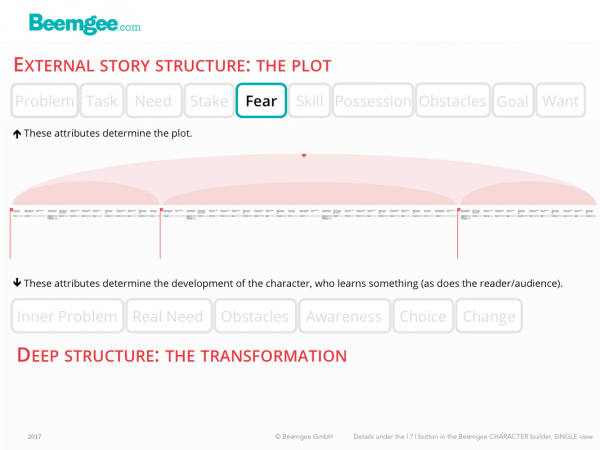
Fear is what the character is afraid of most. Many stories involve an act of overcoming. The character finds him or herself in an increasingly uncomfortable or dangerous situation, and the story is about extrication from that situation and reaching one that the character wants. But to get there, the character must struggle, must face inner and outer hindrances and obstacles. The journey towards the goal steels the character for the moment of confrontation. Since the worst obstacles are the ones we fear most, the character must face and overcome his or her worst fear. In a word, what is this character most scared of? This needs to be established near the beginning of the story.

Fear

Certain universals are feared by almost everyone. Such as death.

If a character in a story has loved ones, losing them is an even stronger fear.

story engages the audience or readers more strongly when there is something valuable at stake for the character, such as his or her own life or that of a loved one. So giving a character a universal fear is usually a good place to start.

Beemgee_Fear

Giving a character a specific fear to overcome requires this information to be placed early in the narrative. The fear is then faced at a crisis point in the story, usually the midpoint or the climax. 

Characters can have specific fears. A fear which is specific to one character must be set up early in the story, so that the audience or reader is aware of it. When the moment comes that the character must face their fear, the audience remembers that they already knew about this fear. If the author has not dropped this bit of knowledge prior to the point when it becomes relevant, the audience will not react as intensely. This is an example of a storytelling technique known as set-up/pay-off. The surface structure of a good story will be full of set-ups that are paid off later in the narrative. Sometimes the technique is called foreshadowing.

A specific fear can be concrete. Indiana Jones hates snakes, as we learn in the opening of the movie Raiders of the Lost Ark. Of course he has to enter a snake pit later. Winston Smith is mortally afraid of rats, the narrator tells us early in 1984. Of course the Party knows this and ends up using this knowledge to torture Winston most effectively.

Note that the snakes provide a dramatic scene, but not Indy’s biggest crisis. For Winston, the fear of rats is so great that it provides the climax of the story.

A character’s specific fear can also be the loss of a quality they hold dear, such as their reputation or their honour. Such a fear can be a powerful motivator to action, and can produce moments of dramatic power when the quality is endangered or the fear has to be faced.

The fear may be an expression of the internal problem. As such, the character may not even be aware of his or her fear. It is nonetheless important that the audience or readers become aware of it. For instance, it may be a fair to say that the title character of Tootsie fears genuine emotional relationships with women, or in short, fears women. By “becoming” one himself, he deals with and overcomes his fear.

9 Tension-Building Elements For Character Dialogue

I’m currently taking a writing and blogging sabbatical due to family health issues. For now, I’ll repost selected articles from my Fiction Writing School.

Here is the link to this article.

9 Tension-Building Elements For Character Dialogue

March 24, 2022 by BECCA PUGLISI Leave a Comment

By Becca Puglisi

I’ve been thinking a lot about dialogue lately, because when it’s done poorly, it pulls me right out of the story. There are a lot of issues that contribute to weak dialogue: incorrect mechanics, stilted speech, characters calling each other repeatedly by name (Hi, Bob. Hey, Mary. Could you help me with this, Bob? Sure thing, Mary!)…The list goes on. But instead of talking today about the wrong parts of our characters’ conversations, I want to focus on an important element that’s often missing: tension.

Tension is that gut-curdling, oh-crap feeling you get when you realize trouble’s coming. It’s the rising emotion that emerges at the onset or even the barest hint of conflict. Tension is incredibly important because it stirs the reader’s emotion and builds their interest. It should exist in every scene, and an easy way to add it is through our characters’ verbal interactions.

Think about recent conversations—verbal or written—that have generated tension for you. They probably come to mind pretty quickly. This is because every person is different, and when these differences manifest in our communication, it can result in misunderstandings that lead to heightened emotion. The same should be true for our characters. So if you’re looking for ways to up the tension in a scene, plan any verbal exchanges thoughtfully by incorporating one or more of the following elements.

Personality Clashes

At her core, who is your character, and how does she communicate? Maybe she’s very efficient—a fixer who quickly and accurately analyzes and applies information. Now suppose she’s talking to someone with a disorganized mind and rambling conversational style. This can cause frustration for your character, who just wants her friend to get to the point already. She responds by cutting him off, or nods her head impatiently while he’s talking. This triggers the friend’s defenses, putting him on edge. When you build your cast with personality and the potential for conflict in mind, those tension landmines are easy to set.

Opposing Goals

Characters often have conflicting story and scene goals, but what about opposing goals in conversations? We do this all the time in real life—talking to people with a subconscious objective in mind. Your protagonist might be communicating with someone because they want to be heard and appreciated. But what if the other party just wants to prove they’re right? Each character will try and guide the conversation toward what they want, and someone—maybe both parties—will be thwarted. When even our small goals are threatened, our emotions kick in, so this can be a good way to add tension to a scene.

Emotions in Play

We’ve all experienced this situation: you start a conversation with someone who, out of nowhere, bites your head off. Upon closer examination, you realize that the person was upset about something that had nothing to do with you. This universal scenario can be used in our stories. Pile on the emotional baggage just before an interaction, then sit back and watch the sparks fly.

Insecurities

Our insecurities hobble us all the time. We’re sensitive to certain kinds of comments or tones and read unintended meaning into harmless banter. Think about how this might play out with your character. What are his insecurities—in general, but also regarding this particular person or situation? How might they impact him in an upcoming conversation?

Bias

How often have you engaged in conversation with an expectation in mind for what the other person will say or how it’s going to go? Sometimes our biases are confirmed, but just as often, they taint our interactions, dooming them to failure before they even begin. We may have a chip on our shoulder that sets a negative tone for the entire exchange. Expecting certain things, we might read into what the other person is saying, misconstruing their true meaning or intent. When it comes to your character, ask yourself: Is there any bias he might bring into this conversation that could result in misunderstanding?

Assumptions

Maybe you’ve heard the old saying about the word assume: it makes an ass out of u and me. How many arguments and mix-ups have come about because of incorrect assumptions? How can we apply this common occurrence in our stories? Think about what knowledge your protagonist may take for granted—something they think the other person knows or doesn’t know. Or maybe they believe that the person shares their opinion about a certain topic when they really think the opposite. How might assumptions like these cause a conversation to go south?

Small Annoyances

Your protagonist might begin a scene with great intentions, expecting to enjoy a happy chat with one of their favorite people. And everything is fine—until that person starts doing something that grates on your character’s nerves. Frequent interruptions, talking with their mouth full, listening while checking their email, consistently mispronouncing a certain word—it could be literally anything that drives your character bonkers. What might that thing be for your protagonist? What quirks can you give the other party to add an element of tension to the conversation?

Cultural Differences

A character’s culture is going to impact their communication style, determining what is acceptable and what isn’t, what’s respectful and what’s offensive. Gestures, eye contact, word choices, personal space—these things vary from one locale to another. Your character’s ignorance about these factors could result in all kinds of fallout, from busted business deals and problems at work to the death of a budding romance. This is definitely something to keep in mine in a multi-cultural cast.

Subtext

I’ve saved this one for last because it plays a very subtle part in most conversations, but it’s so understated, we don’t always pick up on it. Subtext is what you really mean, as opposed to what you say. It’s saying He seems nice when what you really mean is He is a tool of the highest order. We’re not always 100% honest with our words, and the same should be true of our characters. When we take the time to figure out what they really think or want to hide, we end up with interactions that are realistic and nuanced. And the potential for tension and conflict are huge.

These are just some of the elements that can contribute to misunderstandings and tension in our characters’ conversations. Regardless of which you choose to explore, there’s one thing they all have in common: unrealized expectations. The protagonist expects Character B to share her beliefs, want what she wants, have a base of knowledge on which to build, or communicate the same way. When these expectations are shattered, it sets her back on her heels and triggers frustration, embarrassment, hurt, and a range of other emotions. So figure out what your character expects out of a conversation, then block her, and tension is sure to follow.

(Almost) Everything I Know About Writing Fiction I Learned From the Newspapers

I’m currently taking a writing and blogging sabbatical due to family health issues. For now, I’ll repost selected articles from my Fiction Writing School.

Here is the link to this article.

(Almost) Everything I Know About Writing Fiction I Learned From the Newspapers

Award-winning author Erica Plouffe Lazure walks through everything a newspaper has to offer fiction writers—from the truly unbelievable to examining the full arc of a person’s life to help shape the lives of those on the page.

The former Washington Post publisher Phil Graham once said that journalism is the “first rough draft of history,” and anyone who’s delved into newspaper archives in their local library knows this to be true. But perhaps journalism—and community journalism, in particular—has the potential to be a “first rough draft” of fiction.

(4 Tips for Writing About Guilt in Fiction)

When someone says “you can’t make this stuff up,” it’s because the strangest stuff is oftentimes true. Where else, but in the May 22, 1990, edition of the Lodi (Ca.) News-Sentinel, can you read about the fate of the Lady Flames softball team, or which Muppets sang at Jim Henson’s funeral, or that the theme for the new teen Queen of the International Order of Job’s Daughters, Bethel No. 276, was “A friend, like a star, is a gift of love sent by the Lord from Heaven above.”? Any writer in search of authentic details to build their characters, or to write about a particular era or region, would find what they need in a local newspaper. And as access to print issues wane, many libraries are transferring old issues into digitized and searchable newspaper archives.

I have never been to Lodi, California, but their digitized issue of the daily News-Sentinel (which I stumbled upon at random) provides a novel’s worth of storytelling. We discover that Lodi in 1990 (beyond the song made famous by Credence Clearwater Revival) needs bilingual teachers in Vietnamese, Cantonese, Punjabi, and Arabic. An op-ed columnist who quips about farmers feeding newspapers to their cows expresses a broader concern for the region’s dairy industry. And it turns out that streetsweeper safety is so worrisome that the local DPW, claiming that the “rotating brushes of a streetsweeper could squash a copper penny,” decides to host a student safety awareness program.

Any of these articles could make great starter seeds for a story, but even beyond these headlines, lesser-read sections of newspapers are loaded with potential. Often viewed as “filler” by both editors and readers alike, these sections are true gems in the rough when it comes to developing characters, sourcing local voices, and contemplating story arc. Let’s dig in:

The Classifieds

The Lodi classifieds provide a fascinating crosscut of a community, both its interests and its values as well as its oddities. Consider what kind of character might post (or respond to!) this job listing:

AUTOMOTIVE SALESPERSON WANTED
Must have neat appearance and be aggressive

This ad calls to mind Ernest Hemingway’s famous “six-word story,” which borrows from the classified ad format: “For sale: Baby Shoes. Never Worn.” Like the Hemingway story, what is unstated in these lines is as poignant as what is on the page.

Long before Craigslist and eBay, newspaper classifieds were a vast and peculiar cross-pollination of local economy, quirky regional culture, and ecumenical desire. For about four dollars a day, you could sell your Baldwin Acrosonic spinet piano, or buy bales of red oat hay (presumably for the newspaper-eating cows), or offer thanks to St. Jude via a Novena. Lost dogs and lockets, babysitting gigs, non-smoking accountants, and a “Christian certified massage therapist” all have a home in Lodi’s classifieds.

A fiction writer could consider why someone needs to sell a piano, or question what’s so special about “red oat” hay? And what exactly would Ramona, the “Christian” massage therapist, do for $30 an hour?

Advice Columns

Mostly it’s people in crisis who write to advice columnists like Dear Abby and Ann Landers, and inadvertently offer any writer a near-ready made story. In the May 22 issue of the News-Sentinel, for example, Ann Landers published a letter from someone who’d been wrongfully accused of stealing a flute from a friend in 1977. Thirteen years later, in 1990, the writer still holds a grudge against the band director, who never admitted the error.

As a fiction writer, I have questions: What was the fight with the friend about? What’s the deal with the band director? What instrument does the writer play? And who found the flute in the pawn shop two weeks later?

While Ann Landers tells the writer, “You can’t saw sawdust” in chasing after an apology, a writer could certainly reconfigure these parameters into a fiction.

(Almost) Everything I Know About Writing Fiction I Learned From the Newspapers

IndieBound | Bookshop | Amazon
[WD uses affiliate links.]

Horoscopes

Anyone in need of a character jump-start should look no further than the horoscopes crafted by Jeane Dixon. Dixon’s rise as an astrologer in the 1960s came on the heels of her prediction of JFK’s assassination, and her widely syndicated daily column dutifully parsed out a few sentences for all 12 zodiac signs for well over four decades. The potential here is storytelling gold.

Consider this horoscope from May 22, 1990:

Libra (Sept. 23-Oct. 22): Thwarting influences may upset your regular morning routine. Curb a tendency to think of “I” instead of “us.” Teamwork will help you perform miracles. Avoid financial risks. Loved one shares a secret.

Whether you believe in astrology or not, it’s clear how the constellation of elements in this Libran’s tiny cosmos might form a story. For starters, what is this character’s routine and what would thwart it?

Maybe her girlfriend reveals a financial secret, and their conversation makes her late for work. Her boss relegates her to do inventory in the stockroom, rather than attend an important meeting with the sales team. A colleague invites her to the group lunch (against the boss’s wishes), and asks if she wants in on the Super Bowl kitty that weekend—$100 to play. At first, she says no, but then, thinking about her girlfriend’s financial issues, opts to join in at the last minute.

And then what happens? Just add water and stir!

The Obits

An editor at my hometown paper, the Southbridge Evening News, once said that community journalism is important because it’s in the local paper where its citizens are literally “born” (through a birth announcement) and “die” (through an obituary).

As a fiction writer, combing through the obituaries helps you think meaningfully about the arc of a life story, how one life event leads to and shapes the next, and provides a window into the larger world and the generation in which this person lived, the choices they made, the places they worked and activities they loved, and those they left in their wake.

It is an entire biography and family tree, encapsulated in a few hundred words, and in the hands of the right writer, could easily anchor a fictional story.

News in Brief

Local newspapers often teem with “good news” tidbits that a fiction writer could co-opt for creative purposes. Consider Dan Peeler* of Ripon, California, named “Lab Person of the Year” by the California Water Pollution Control Association. At first glance, he leads a fairly normal life: college educated, married with three kids, and is a lifelong resident of Ripon.

(Almost) Everything I Know About Writing Fiction I Learned From the Newspapers

But then, we learn that not only does Peeler have dual Swiss and American citizenships, and holds four state bench-pressing records, he also plays saxophone and clarinet in TWO local polka bands and competes regularly in Swiss wrestling matches. I don’t think I could make up a character with such intriguing underpinnings, and yet this small news item about a man receiving an award provides a perfect frame from which a fictionalized story might be crafted.

*I changed his name slightly, to protect his identity

The Comics

Like most kids, I was always drawn to newspaper comics. As a writer, what I now appreciate about comics is the form’s sense of sequence and pacing when it comes to storytelling. Writers have lots to learn from graphic novels and the “funny pages,” as far as selecting key scenes, crafting succinct dialog, and accounting for our characters’ surroundings, physical attributes, and personalities.

If you’re stuck on your story, check out the comics page or a graphic novel and study it as an exercise in sequence and visual language. Then try sketching out your story, panel by panel, and see what key scenes surface. What dialog do you use? What do you scrap? What are your characters holding in their hands? What are their surroundings like?

I promise, you’ll learn a lot about your storytelling by drawing it out, and studying comics provides a great model for how to do just that.

Beyond the Headlines

For decades, local print newspapers were the center of their communities, and while many are slowly dying out or going online, their archives can bring an era and a region back to life. I first got my start in newspapers back in fifth grade, as a paper girl, and ended up as a reporter in smaller daily papers in Massachusetts and North Carolina.

There I learned firsthand the challenges and joys of getting to know a community, not only by listening to and observing the people I met, but also by attending their pancake dinners, city council meetings, and ribbon cuttings. As I’ve moved away from journalism and toward fiction, the particulars of what people are interested in and care about—what motivates someone to pen a letter to the editor, or post a classified ad, what moves them act—continue to find their way into my fiction.

If you’re lucky enough to live in an area where a small-town paper still exists, please consider subscribing or picking up an issue to see what’s making headlines—you never know what stories you’ll find lurking inside, waiting to be (re)told.

Historical Fiction
Join Donna Russo Morin to learn the definition of historical markers and how and where to unearth them. And uncover the tools to integrate history, research, and the fiction plot arc. Most of all, find out how to honor verisimilitude—the goal of any historical writing—and avoid the dreaded anachronism.

Click to continue.

(ALMOST) EVERYTHING I KNOW ABOUT WRITING FICTION I LEARNED FROM THE NEWSPAPERSWRITING TIPSNEWSPAPER WRITINGWRITING FICTION

Erica Plouffe Lazure

BY

 ERICA PLOUFFE LAZURE

Erica Plouffe Lazure is the author of the New American Fiction Prize-winning collection, PROOF OF ME AND OTHER STORIES (March 24, 2022; New American Press), as well as two flash fiction chapbooks, Sugar Mountain (Ad Hoc Press, 2020) and Heard Around Town (Arcadia, 2015), and a fiction chapbook, Dry Dock (Red Bird, 2014). Her work has appeared or is forthcoming in McSweeney’s Quarterly Concern, the Greensboro Review, The MacGuffin, Carve Magazine, Phoebe, Meridian, Iron Horse Review, American Short Fiction, The Journal of Micro Literature, Fiction Southeast, Southeast Review, Smokelong Quarterly, Flash: the International Short-Short Story Magazine (UK), and elsewhere. She is a graduate of the Bennington Writing Seminars, East Carolina University’s MA in creative writing, and UMass-Amherst. She has taught English at East Carolina University, Phillips Exeter Academy in Exeter, NH, and at School Year Abroad in Viterbo, Italy. You can visit her online at ericaplouffelazure.com.

Stake

I’m currently taking a writing and blogging sabbatical due to family health issues. For now, I’ll repost selected articles from my Fiction Writing School.

Here is the link to this article.

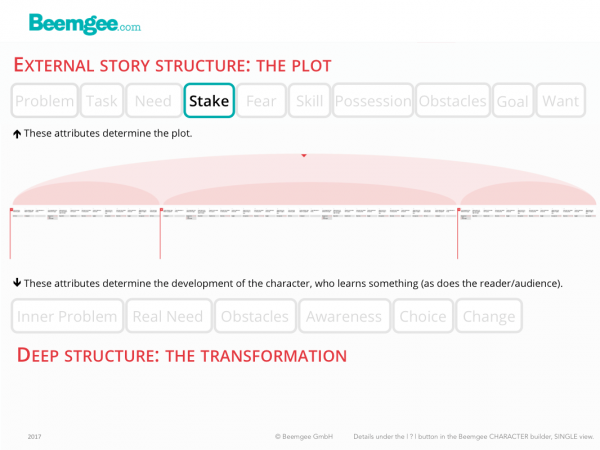
The stake is the danger or risk involved for a character. The character has a goal, and things he or she needs to do in order to achieve it. The character feels that by achieving the goal he or she will attain the want. But so what? How badly does the character want the want? What if the character does not reach the goal? What will happen if the character fails? How bad can that be? In general story terms, the worse the better. If the character has nothing to lose by failing, then he or she has nothing to worry about, and the reader/audience has nothing to care about. In a nutshell: what’s at stake?

What’s at stake?

You’re on a boat, and you see somebody fall into the water. Which of the following two cases would cause you to react with stronger emotion?

  1. The water is four feet deep and you know that the guy who fell in is a good swimmer
  2. The water is four feet deep and the person who fell in is a three year old girl who can’t swim

Presumably your emotional reaction would be stronger if the child fell off the boat. Because you know that the child’s life is at stake. The first situation is not life-threatening, the only thing at stake is the dryness of the man’s clothes and his self-esteem.

The degree you care about events that happen to people, and to yourself, is directly related to what’s at stake. This applies as much to fictional characters as in the real world.

Hence it is immensely important for storytellers to impart to their audience or readers how threatening the problems are that the characters face. The audience or reader must know what is at stake for the character. What have they got to lose? Their life? Their soul? Their mobile phone?

The risk to life and limb may be apparent from the beginning, when the problems are set up. Alternatively, the scale of the threat may increase or become more specific as the story progresses. When the threat is immediate – rather than heralded for the future – the audience or reader is more likely to respond emotionally.

What must not happen is that the level of risk, threat or danger decreases as the story goes on. What’s at stake is about the turn of the screw: at first the pain is not so great, but with each stage of the story journey the pain grows more intense. For the character, and with that for the audience or reader.

That’s why in many stories the family of the protagonist is dragged into danger, usually by a nasty antagonist. The protagonist has already risked his or her life, so how does the author increase what is at stake? Threaten the spouse or child. Then what is at stake may be greater than life because, of course, a hero loves his or her family more than life itself.

Often the stakes are basic. Certain issues recur in stories because they have resonating effects within us as a species, such as survival (the necessity of food or shelter, threats to life), procreation (the omniscience of sex), or community (protecting the clan, family or home). However, what’s at stake does not have to be as universal as life and death. It is possible for an author to set up a stake and load it with meaning in the context of the story. So the stake can be something very specific to a particular character. If, say, it becomes clear early in the story that the character lives in fear of losing his or her good reputation, then that can be the stake. In Ibsen’s A Doll’s House, for example, Torvald’s action hinges on his perceived need to maintain his reputation. It might not be something the audience or reader worries about too much for him or herself, but it helps them to understand the character’s motivation if the author has established a character-specific stake. In other words, the stake does not have to be physical life or death, but may mean the equivalent of emotional or spiritual death; the person, thing or quality a character has invested the meaningfulness of his or her life into might be at stake. In Torvald’s case, the choice of investment is also his internal problem.

If a character has a prized possession, such as Linus’ security blanket, then losing it could be at stake. Indeed, a McGuffin can have this function; it is something valuable the protagonist attains, and its loss could be the stake, for example the Bodyguard’s ward.

A character does not even necessarily have to be aware of what is at stake. But the audience or reader must know. Otherwise, why should they care?

Beemgee_Stake

The stake is what the character has to lose, what is at risk in case of failure, and must be communicated to the audience in order to arouse empathy. 

The Anonymous Road

I’m currently taking a writing and blogging sabbatical due to family health issues. For now, I’ll repost selected articles from my Fiction Writing School.

Here is the link to this article.

The Anonymous Road

May 18, 2021 by Writing Coach

One of the things I love most about being an author is the opportunity to read books from people I personally know. I have read fabulous books by authors whom readers have yet to discover, and despite efforts with marketing, despite amazing blurbs from bestselling authors, despite an enviable collection of awards, they have yet to make their name known.

And I have witnessed some of these authors give up. 

That’s the most heartbreaking thing. They did the hard, time-consuming work of developing their craft. They learned the business of writing. They made the necessary connections. They. Did. The. Work.

But…it can be hard to keep writing, when book after book gets rejection after rejection, or you just aren’t seeing the sales you hoped to see. That dream of recreating one of your books on a private island like your very own Harry Potter world? It keeps sailing off into the horizon while you’re stuck paddling after it with one oar.

Recently, my husband made me listen to a Joe Rogan podcast. Dave Chappelle was his guest and I, not being super familiar with either comedian, didn’t expect to get much out of the episode.

Then they mentioned The Anonymous Road.

The Anonymous Road

It always amazes me how closely different types of creatives’ journeys follow each other. If you were to put an author, a comedian, a painter, a potter, a singer, and an actor in the same room, we’d find common ground in under ten minutes.

So I really should not have been surprised to find myself intensely engaged in Rogan and Chappelle’s conversation.

The anonymous road–brought up in Rogan’s podcast episode #1647–is that time in which an artist, be they comedian, author, or singer, performs to an empty room. Rogan and Chappelle mentioned ten to fifteen years of walking this road.

Ten to fifteen years. For two incredibly successful and well-known creatives.

And they said this road was essential to their success.

Without this road, they wouldn’t have had the freedom to discover who they were as an artist. This road allowed them to develop their craft in a safe space. The road allowed them to fail, start over, fail again, start over again.

For those artists who leaped over the anonymous road into instant fame, many of them lacked the depth or tenacity to survive as lifelong comedians or artists.

Depth comes after time. Tenacity comes after testing. Success comes after perseverance.

It can be hard, especially after the worldwide disruption that has taken place this past year, to keep up with creative pursuits. Some days, I only write a sentence and a half before I’m called away to take care of all the other. I have to constantly remind myself that this is an extraordinary time in every sense of the word, and that it is okay to take a rest stop on the side of the anonymous road.

With that in mind, I find encouragement in these stories. I hope you do as well.

The Journey to Success

Carmen Herrera is 103 years old, and has been a minimalist abstract artist since the 1950s. However she wasn’t ‘discovered’ until 2014, some sixty years after beginning her career. Today, her art is installed in collections around the world.

Diana Galbadon started out as a comic book writer in the late 1970s, before transitioning to an educational career, then eventually back to writing. OUTLANDER was published in 1991, and won the RITA that same year for best romance novel. However it took another twenty-three years for the book to hit the New York Times Bestseller list, the same year the Outlander TV series premiered in the US.

Morgan Freeman began acting at nine years old, landing his first role in a school play. However, he didn’t land his breakout role until forty-one years later in “Street Smart” in 1987. It took another seventeen years for Freeman to win his first Academy Award for “Million Dollar Baby,” in 2004.

Lizzo, rapper, singer, songwriter, and classically-trained flutist, began her musical career in 2005 while in high school. However, she didn’t see commercial success until 2016, eleven years after making the commitment to a creative life.

Your Anonymous Road

There is no set time for how long this road is. Maybe you’ll see instant success but have to journey the road afterward. Maybe you’ve been on this road without even realizing it. Most likely, you’ve stomped your feet on the road, kicked and screamed at it, and/or thrown a few rocks.

Challenge yourself to instead thank the road. Its purpose has been well documented from artists across a wide variety of creative genres and is essential. This is the time of deepening. Savor these years and recognize them for what they are. You’re in the womb of creativity, and are still developing all the amazing parts that make up your artist voice.

N.K. Jemisin says in her Masterclass series that one of the best pieces of writing advice she received was “Persist.” She goes on to say that, “if you continue to work on your craft and continue to improve and continue to submit, you will eventually break through. I’ve found this to be true.”

Persist, people. And in the meantime, love the anonymous journey.

P.S.: N.K Jemisin worked a full-time position as a career counselor for twenty years as she developed her author career. Her writing goals during that time? “I had very modest writing goals on work days—like 100 words, or 250, no more. I was perfectly OK with doing nothing but editing a previous chapter on those days, too.” Now she’s the only author to have won the Hugo award three times in a row, as well as the first to win the Hugo for all three novels in a trilogy.

Christina Delay

Resident Writing Coach

Christina is the hostess of Cruising Writers and an award-winning psychological suspense author. She also writes award-winning supernatural suspense under the name Kris Faryn. You can find Kris at: Bookbub ǀ Facebook ǀ Amazon ǀ Instagram.