Richard L. Fricks is a novelist, former attorney and CPA, Fictionary Certified StoryCoach Editor, and creator of The Pencil-Driven Life. He lives in rural North Alabama near Boaz, where much of his fiction and reflection remain rooted. His work explores story, inherited purpose, faith and doubt, family pressure, moral contradiction, consciousness, ordinary life, and the practice of beginning again with a pencil.
Your character is a substitute teacher for a grade four class and slowly comes to realize something unusual is going on. As impossible as it seems, some of her students are reading her mind. Write the scene.
In my previous post I began to talk about how thinkers in the Jewish and Christian traditions have wrestled with the problem of suffering. I indicated that the technical term for this “problem” is “theodicy,” and it is often said to involve the status of three assertions which all are typically thought to be true by those in these two religions, but if true appear to contradict one another. The assertions are these:
God is all-powerful.
God is all-loving.
There is suffering.
How can all three be true at once? If God is all powerful, then he is able to do whatever he wants (and can therefore remove suffering). If he is all loving, then he obviously wants the best for people (and therefore does not want them to suffer). And yet people suffer. How can that be explained? As I pointed out some thinkers have tried to deny one or the other of the assertions: either God is not actually all powerful, or he is not all loving, or there is no suffering.
But as I explain in the introduction to my book God’s Problem (Oxford Press, 2008) …
******************************
Most people who wrestle with the problem want to say that all three assertions are true, but that there is some kind of extenuating circumstance that can explain it all. For example, in the classical view of the prophets of the Hebrew Bible, as we will see at length in the next couple of chapters, God is certainly all powerful and all loving; one of the reasons there is suffering is because his people have violated his law or gone against his will, and he is bringing suffering upon them in order to force them to return to him and lead righteous lives.
This kind of explanation works well so long as it is the wicked who are the ones who suffer. But what about the wicked who prosper while the ones who try to do what is right before God are wracked with interminable pain and unbearable misery? How does one explain the suffering of the righteous? For that other explanations need to be used (for example, that it will all be made right in the afterlife – a view not found in the prophets but in other biblical authors) (there are, as I’m suggesting, other explanations as well in the Bible and in popular thinking).
Even though a scholar of the Enlightenment – Leibniz – came up with the term “theodicy,” and even though the deep philosophical problem has been with us only since the Enlightenment, the basic “problem” has been around since time immemorial. This was recognized by the intellectuals of the Enlightenment themselves. One of them, the English philosopher David Hume, pointed out that the problem was stated some twenty-five hundred years ago by one of the great philosophers of ancient Greece, Epicurus:
Epicurus’s old questions are yet unanswered:
Is God willing to prevent evil but not able? Then he is impotent.
Is he able but not willing? Then he is malevolent.
Is he both able and willing? Whence, then, evil?[i]
As I was teaching my course on biblical views of suffering at Rutgers, over twenty years ago (well… thirty-five now!!), I began to realize that the students seemed remarkably, and somewhat inexplicably, detached from the problem. It was a good group of students: smart and attentive. But they were for the most part white, middle-class kids who had not experienced a lot of pain in their lives yet, and I had to do some work in order to help them realize that the problem of suffering was in fact a problem.
This was the time of one of the major Ethiopian famines. In order to drive home for my students just how disturbing suffering could be, I spent some time with them dealing with the problem of the famine. It was an enormous problem. In part because of the political situation, but even more because of a massive drought, there were eight million Ethiopians who were confronted with severe shortages and who, as a result, were starving. Every day there were pictures in the papers of poor souls, famished, desperate, with no relief in sight. Eventually one out of every eight died the horrific death of starvation.
That’s some two million people, starved to death, in a world that has far more than enough food to feed all its inhabitants, a world where American farmers are paid to destroy their crops, a world where most of us in this country ingest far more calories than our bodies need or want. To make my point, I would show pictures of the famine to the students, pictures of emaciated Ethiopian women with famished children on their breasts, desperately sucking to get nourishment that would never come, both mother and children eventually destroyed by the ravages of hunger.
Before the semester was over, I think my students got the point. Most of them did learn to grapple with the problem. When the course had started, many of them had thought that whatever problem there was with suffering could be fairly easily solved.
The most popular solution they had was one that I would judge most people in our (Western) world today still hold on to. It has to do with free will. According to this view, the reason there is so much suffering in the world is that God has given humans free will. Without the free will to love and obey God, we would simply be robots doing what we were programed to do. But since we have the free will to love and obey, we also have the free will to hate and disobey, and this is where suffering comes from. Hitler, the Holocaust, Idi Amin, corrupt governments throughout the world, corrupt humans inside government and outside of it – all of these are explained on the grounds of free will.
As it turns out, this was more or less the answer given by some of the great intellectuals of the Enlightenment, including Leibniz, who argued that humans have to be free in order for this world to be the best world that could come into existence. For Leibniz, God is all powerful and so was able to create any kind of world he wanted; and since he was all loving he obviously wanted to create the best of all possible worlds. This world – with freedom of choice given to its creatures – is therefore the best of all possible worlds.
Other philosophers rejected this view – none so famously, vitriolically, and even hilariously as the French philosopher Voltaire, whose classic novel Candide tells the story of a man (Candide) who experiences such senseless and random suffering and misery, in this allegedly “best of all worlds,” that he abandons his Leibnizian upbringing and adopts a more sensible view, that we can’t know the whys and wherefores of what happens in this world, but should simply do our very best to enjoy it while we can.[ii] Candide is still a novel very much worth reading – witty, clever, and damning. If this is the best world possible – just imagine what a worse one would be.
******************************
I will continue my reflections on the matter starting at this point, in the next post.
[i]. David Hume, Dialogues Concerning Natural Religion (the sentiments are those expressed by his fictitious caracter named Philo). Xxx?
[ii]. Voltaire. Candide: or Optimism. Tr. Theo Cuffe (New York: Penguin, 2005).
Biking is something else I both love and hate. It takes a lot of effort but does provide good exercise and most days over an hour to listen to a good book or podcast. I especially like having ridden.
Here’s my bike, a Rockhopper by Specialized. I purchased it November 2021 from Venture Out in Guntersville; Mike is top notch! So is the bike, and the ‘old’ man seat I salvaged from an old Walmart bike.
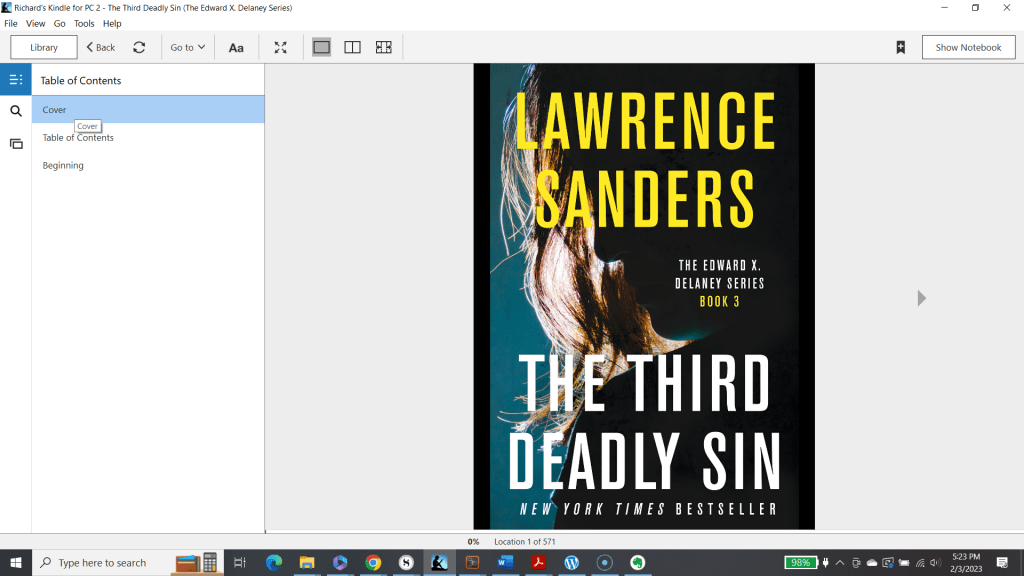
Here’s what I’m currently listening to: The Third Deadly Sin, by Lawrence Sanders
Sanders was a tremendously talented writer.
Amazon abstract:
New York Times Bestseller: A retired cop hunts for a female serial killer no one would suspect in this “first-rate thriller . . . as good as you can get” (The New York Times).
By day, she’s a middle-aged secretary no one would look at twice. But by night, dressed in a midnight-black wig, a skin-tight dress, and spike heels, she’s hard to miss. Inside her leather shoulder bag are keys, cash, mace, and a Swiss Army knife. She prowls smoky hotel bars for prey. The first victim—a convention guest at an upscale Manhattan hotel—is found with multiple stab wounds to the neck and genitals. By the time retired police detective chief Edward Delaney hears about the case from an old colleague, the Hotel Ripper has already struck twice. Unable to resist the puzzle, Delaney follows the clues and soon realizes he’s looking for a woman. As the grisly slayings continue, seizing the city in a chokehold of panic, Delaney must stop the madwoman before she kills again.
It is arguable that Lawrence Sanders never rose to greater heights as a prose stylist, suspense-writer or storyteller than he did with THE THIRD DEADLY SIN, the penultimate novel in his “deadly sin” series of books and the fourth of five to feature crusty, sandwich-obsessed Edward X. Delaney as a protagonist. Though once referred to as “Mr. Bestseller” and nearly as prolific in his day as Stephen King, Sanders seems to be forgotten now, except for his “McNally” series which was hardly representative of his best work; but at his best he was both compulsively readable and immensely satisfying, and this novel is both.
Zoe Kohler is the world’s most boring woman. Hailing from a small town somewhere in the Midwest, divorced from a husband who treated her like she was invisible, virtually friendless, and stuck in a mindless, dead-end job in the security office of an old hotel in Manhattan, she worries incessantly about her health and indulges in only one hobby: murder. Sexing herself up every Friday night, Zoe picks up unsuspecting businessmen attending conventions in different hotels around town, and delivers to each the same grisly fate: a Swiss Army knife, first to the throat and then to the jewels. But because nobody ever notices the world’s most boring woman, nobody suspects her, leaving Zoe free to indulge her hobby — over and over and over again.
Edward X. Delaney used to be a cop — and not just any cop, but the NYPD’s Chief of Detectives. Now, of course, he’s just a bored retiree, living in a Manhattan brownstone with this second wife. So when his former “rabbi” in the Department, Deputy Commissioner Ivar Thorsen, asks him to help investigate a series of baffling murders being committed in hotels around the city, Delaney agrees, but has little idea what he’s getting into: a search for a faceless, motiveless “repeater” (1970s slang for serial killer) whose vicious talents with a short-bladed knife are wreaking havoc with New York’s once-thriving convention trade. Acting as an unofficial adviser to the “Hotel Ripper” task force, Delaney begins to suspect that male prejudices, including his own, may be blinding his fellow detectives to the possibility of that the Ripper may not be a man. But he has no suspects, no witnesses, no fingerprints, and no hard evidence. Only instincts. And a growing pile of victims.
THE THIRD DEADLY SIN is a very attractive suspense novel for many reasons. Aside from Sanders prose style, which is beautiful, memorable and incredibly evocative, it works on multiple levels. Firstly, the character of Zoe Kohler. She is at once both a pitiable loser, struggling with health problems and sexist attitudes at work a burgeoning relationship with a sweet and unsuspecting man…and a remorseless, relentless killer, who hunts men for the sheer thrill of it. Second, Edward X. Delaney. This crusty, hard-nosed, sandwich-obsessed detective is neither sexy, flashy, nor gifted with any great deductive genius: he’s simply like a boulder that, starting slowly, gathers investigative momentum until he crushes just about everyone in his path, yet at the same time possesses a sensitivity — largely through his wife’s softening influence — that allows him more nuances than a typical, cigar-chewing, old school detective. And this leads me to the books third major strength, which is its examination of sexual attitudes, gender roles and (unintentionally) police procedure during the period it was written — about 35 years ago. At that time the pathology of serial killers was scarcely understood, forensic science still in its infancy, and the idea of gender equality more of a punchline than a serious idea. Delaney, an aging Irish cop with flat feet, is both brimming with cheauvanistic, patronizing, old-school attitudes and open to the possibility that those attitudes may be wrong.
No novel is perfect, of course, and this one is no exception. Sanders sometimes makes small but basic errors in matters of police procedure, slang and etiquette; the sort of mistakes which are the result of never having been a cop himself. Occasionally he tries too hard to make characters colorful, giving them a contrived rather than a naturalistic feel; and sometimes his dialogue and description betray his overwhelming love of the English language and end up sounding pretentious or, coming out of the mouths of certain characters, simply unrealistic. (This also leads him to over-write scenes with minor characters, such as Zoe’s doctor.) Most of the criticisms I can mount a this book, however, fall in the “nitpicking” category, and even when taken in the aggregate fail to outweigh all of its many pleasures.
THE THIRD DEADLY SIN may or may not have been Sanders’ best book (you could make a case for THE SIXTH COMMANDMENT or THE SECOND DEADLY SIN or THE ANDERSON TAPES or various others). It may not even be his best suspense novel. But for my money it is not merely a good read but equally satisfying upon each subsequent reading, which is about the highest praise I can give to an author’s work. So: buy it, make yourself a sandwich, and sit down to this half-forgotten but deservedly remembered author. Murder and mayhem have never been so fun.
I would greatly appreciate it if you became a full subscriber! You can use the button below to subscribe to Substack or use my usual Patreon page!
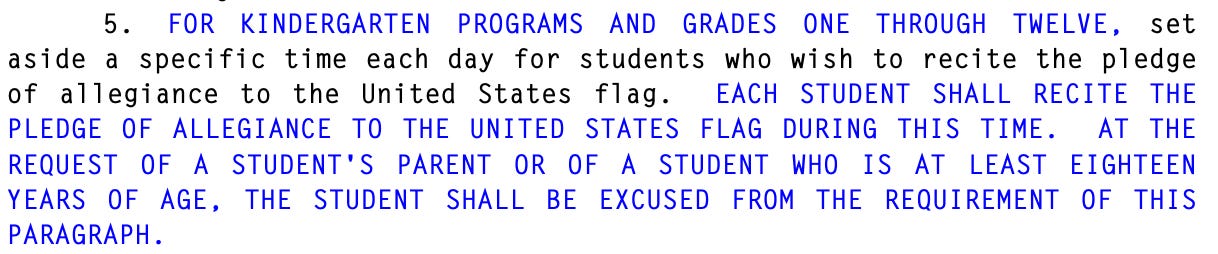
On a straight party-line vote, Arizona Republicans have backed a billforcing public school students to say the Pledge of Allegiance. While no penalty is specified for those who disobey, the illegal bill offers no exceptions for students who refuse to participate in the religious ritual.
HB2523, which passed by a slim 31-29 vote, says that all K-12 students “shall recite the Pledge of Allegiance to the United States Flag.” The only exceptions apply to students who are at least 18 or who have the explicit permission of their parents to sit out. But students who oppose saying the Pledge on principle would have no recourse here unless their parents were on their side.
The phrase “under God” pushes religion onto people who may not be religious. Even without that phrase, the very notion of pledging allegiance to a flag violates the religious beliefs of some students who believe only God deserves allegiance.
The Pledge also falsely suggests that we have “liberty and justice for all,” which is one reasons students of color have opposed it in recent years.
And frankly, our country doesn’t always deserve admiration. Why would we want to “pledge allegiance” to a nation that is so often a global embarrassment? If Saudi Arabia forced students to say a pledge to their country every day, we’d immediately call it a form of brainwashing.
Those are all reason not to say the Pledge in a normal situation, but forcing students to participate in the religious ritual against their will, unless their parents feel the same way they do, is undoubtedly a violation of students’ civil rights.
That means this bill is illegal and would provoke a lawsuit if it ever became law. In fact, the Supreme Court ruled in Barnette in 1943 that students couldn’t be forced to salute the flag or say the Pledge. (That decision overturned a notoriously awful ruling from 1940 which said the opposite.) While “Under God” wasn’t in the Pledge at the time, the justices said the government could not compel speech, with one justice famously writing, “If there is any fixed star in our constitutional constellation, it is that no official, high or petty, can prescribe what shall be orthodox in politics, nationalism, religion, or other matters of opinion or force citizens to confess by word or act their faith therein.”
None of that mattered to the bill’s sponsor, first-term Republican State Rep. Barbara Parker, who, in a speech just before the vote took place, implied that church/state separation was a myth and that the 1943 Supreme Court decision was irrelevant.
First of all, a couple of things. One is: It’s really important that we clear up a few things that should never be said again from lawmakers in a legislature.
One: The separation of church and state is in the Constitution. That was never said in the Constitution. It was written in a letter years later. The separation clause was therefore the government couldn’t form a religion or couldn’t force a state religion. So let’s never hear that again.
A second thing is that: Everybody tends to quote the Barnette ruling from 1943. First of all, “Under God” wasn’t put in in 1943. It was put in in 1954. And nobody’s really ever opposed that.
Furthermore, we stand and say the Pledge of Allegiance everyday on this floor. What’s good for us is good for the children.
Separation of church and state emerges from the First Amendment and has repeatedly been interpreted that way by the courts. To pretend the government can therefore promote religion is nothing more than willful ignorance by someone who has plenty to spare.
More importantly, Parker is flat-out wrong about the Barnette case. She cited it because a Democrat mentioned it just before she spoke, but Parker seemed to think the case was being used to push back against “Under God.” It wasn’t. It was cited to point out that government cannot force students to say or do something political against their will. (And, yes, plenty of people and judges have opposed both mandatory recitation of the Pledge and the inclusion of “Under God.”)
Parker also thinks that if her legislative colleagues do it, it should be okay for kids to follow suit. Again, she has no clue what she’s talking about. Just to give one example, the Supreme Court has permitted invocation prayers at city council meetings, but the same privilege doesn’t extend to school board meetings or graduations where children may be present.
Just because Republicans in the Arizona legislature want to use their majorities to inflict Christianity on their colleagues doesn’t mean they have any right to force that on children.
The Arizona Senate, where the bill now heads, also has a slim Republican majority of 16-14. Even if it passes there, though, Gov. Katie Hobbs, a Democrat, can thankfully veto it. If and when that happens, Hobbs would be saving taxpayers from a costly lawsuit they would inevitably lose.
The government cannot force children to say a prayer in school no matter how much misinformation Christians like Barbara Parker want to spread.
Sunday School and Catechism exist because the clergy know that certain articles of faith must be established as early as possible: capture young minds and hold them forever—at least that’s the hope. One of these articles of faith is that the clergy are custodians of truth about the god/gods they proclaim, so just accept what they tell you. A second article is that if certain scripture texts are recited frequently, endlessly, from the earliest years, they become part of life, fundamental truths not to be questioned. Remembering them, reciting them, are sources of comfort. Hence it would never cross the minds of many adult churchgoers to question—to critically examine—the Bible texts they’ve known and loved from an early age. They are disinclined to ask: Do these texts make sense? Do they fit with what we know about our world after a few hundred years of science and discovery?
Psalm 23
This certainly qualifies as escape-from-reality scripture. Christians cherish it especially because Jesus is presented in John’s gospel as The Good Shepherd: so, the shepherd presented in the 23rd Psalm is the way they want their Jesus to be. One of the tricks that Bible translators have pulled is the camouflaging of the divine name. In the ancient world gods had names, and the god of the Hebrew Bible was named Yahweh. But not too many Christians go around proclaiming their love for Yahweh; that would sound just too strange. So translators have spared them this embarrassment: be on the lookout, in the Old Testament, for Lord spelled with all-caps: LORD. This is a replacement for Yahweh.
So “the LORD is my shepherd” is actually, “Yahweh is my shepherd.” And although this is an escape-from-reality text, we do have to admire the author for expressing a dissenting opinion about Yahweh. For the most part in the Old Testament, Yahweh is depicted as a rampaging, angry deity, a demanding bully of a god. We see this full strength in the Noah flood story—a horrifying tale of genocide; also in Yahweh’s targeted murder of children in his epic struggle with Egypt’s pharaoh. Anyone who ventures through the Old Testament can only be shocked at this god’s murderous behavior (see especially, Steve Wells, Drunk with Blood: God’s Killings in the Bible).
The author of Psalm 23 envisioned a kinder, gentler theology. I won’t quote the entire psalm here, since it’s so easy to find, but here are three key sentiments that the devout today find so appealing:
“The LORD is my shepherd; I shall not want. He maketh me to lie down in green pastures: he leadeth me beside the still waters. He restoreth my soul…”
Churchgoers want continual assurance that the god who runs the Cosmos knows about them, cares about them; is looking out for their well-being. It’s a calming thought that a god walks with us near “still waters,” and restores our souls. But I do wonder if this escape-from-reality text really does help ordinary folks as they grapple with what life throws at them. Do they experience serenity any more than people who don’t know/believe in the theology behind this text? In the midst of personal pain and tragedy, does this text come to the rescue? This is theology designed to divert attention from what the real world throws at us: Yahweh and Jesus love you: hold on to that thought!
“Yea, though I walk through the valley of the shadow of death, I will fear no evil: for thou art with me; thy rod and thy staff they comfort me.”
The image here is of the shepherd protecting his flock, equipped with rod and staff, to scare off predators. But is it the case that devout Christian folks don’t fear evil? As they face dangers that evoke this image of the “valley of the shadow of death,” are they certain that Jesus is their constant, reliable protector? No: life happens, and everyone—no matter their religious beliefs—gets smacked by horrible, even deadly events. Hence this is an escape-from-reality text. Some believers refuse to accept the grim truth, e.g., there’s been a serious house fire, killing a member of the family, but…the Bible was untouched by the flames: praise god…or rather, Yahweh!
The shallow theology—it sounds nice, but that’s about all—continues: “Surely goodness and mercy shall follow me all the days of my life: and I will dwell in the house of the LORD forever.” When I looked at the news today, the death toll from the Turkey/Syria earthquake has surpassed 21,000. Where were god’s goodness and mercy? It seems he was behaving in mysterious ways once again.
The Lord’s Prayer
“Our Father which art in heaven, hallowed be thy name. Thy kingdom come, thy will be done in earth, as it is in heaven.Give us this day our daily bread. And forgive us our debts, as we forgive our debtors. And lead us not into temptation, but deliver us from evil: For thine is the kingdom, and the power, and the glory, forever. Amen.” (Matthew 6:9-13, KJV)
The very first sentence captures so much of the narrow, superstitious ancient world view, tainted with patriarchal bias. Our father: So much damage has been caused by identifying god as male, but this derives from the old god Yahweh being modeled on tribal chieftains. Surely, upon reflection, it cannot possibly be argued that a creator-god in charge of billions of galaxies possesses gender as understood by our species.Which art in heaven: thought to be a few miles overhead, which meant that holy men could get closer to god by going to mountaintops. And the story of Jesus ascending to heaven (Acts 1) made perfectly good sense at the time. Even my devout mother had figured out that heaven couldn’t be up there. She told me it is a state of being in the presence of god. But the Lord’s Prayer is rooted in the ancient cosmology.
Hallowed be thy name. Why would a god need to be reminded, assured by humans, that its name is holy? Has god benefitted from being given this ego boost for hundreds of years? If god is already all-powerful, how does this make sense? Moreover, assuming that a name is holy is an aspect of magical thinking. The name has to be protected, hence the warning: “You shall not make wrongful use of the name of Yahweh your God, for Yahweh will not acquit anyone who misuses his name.” (Exodus 20:7) This, above all, is an example of laypeople being disinclined to ask: Do these texts make sense?
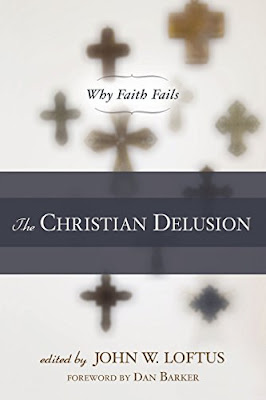
Thy kingdom come, thy will be done in earth, as it is in heaven. This line seems to derive fromthe primary message of Mark’s gospel that the kingdom of god was imminent—there is an any-day-now feel to it—hence in this Jesus-script, the faithful are urged to keep reminding god to get the job done. Does he ever get annoyed with this continual pestering? Here’s a another issue: Do those who routinely recite these words today give any thought to what the arrival of the kingdom supposedly will entail? In other Jesus-script we find the prediction that it will bring as much suffering as happened in the time of Noah, i.e., most of the people on earth were killed. Thy kingdom come, in fact, reflects the naïve apocalypticism that the early church accepted—and that was simply wrong. For more on this see John Loftus’ essay, “At
Best Jesus Was a Failed Apocalyptic Prophet,” in his 2010 anthology, The Christian Delusion: Why Faith Fails. There is so much in the New Testament that is absolutely awful.
John 3:16
Those of us raised in Christianity know it by heart: “For God so loved the world that he gave his only Son, so that everyone who believes in him may not perish but may have eternal life.” Anyone who has read the Bible—and studied history—knows that this claim, god so loves the world, has been falsified. Consider just the problem of horrendous human and animal suffering—and there has been plenty written about that here on this blog. Chalk this claim up to John’s tedious habit of theological exaggeration—what I sometimes have called theology inflation. But John immediately undermines this claim with what can be called the exclusionary clauses. The overwhelming majority of people who have ever lived have not believed in Jesus—so they’re out of luck. And this is stated bluntly in John 3:18: “Those who believe in him are not condemned, but those who do not believe are condemned already because they have not believed in the name of the only Son of God.” John 3:36 is even meaner: “Whoever believes in the Son has eternal life; whoever disobeys the Son will not see life but must endure God’s wrath.” This theology is a mark of cult fanaticism: if you’re not a member of our in-group, god will smash you. Notice as well the magical thinking here: it’s important to believe in the name.
We can be suspect that the folks who rave about John 3:16 pay little heed to John 3:14-15: “And just as Moses lifted up the serpent in the wilderness, so must the Son of Man be lifted up, that whoever believes in him may have eternal life.”
What’s that about? The serpent in the wilderness? The god who so loves the world was in a nasty mood, as mentioned in Numbers 21:5-9, which is worth quoting in full:
“The people spoke against God and against Moses, ‘Why have you brought us up out of Egypt to die in the wilderness? For there is no food and no water, and we detest this miserable food.’Then Yahweh sent poisonousserpents among the people, and they bit the people, so that many Israelites died. The people came to Moses and said, ‘We have sinned by speaking against Yahweh and against you; pray to Yahweh to take away the serpents from us.’ So Moses prayed for the people. And Yahweh said to Moses, ‘Make a poisonous serpent and set it on a pole, and everyone who is bitten shall look at it and live.’ So Moses made a serpent of bronze and put it upon a pole, and whenever a serpent bit someone, that person would look at the serpent of bronze and live.”
Pay attention: This god arranged for snakes to bite people? And John is comparing Jesus on the cross to a bronze serpent hanging on a pole. If you’ve been bitten by a poisonous serpent, but look at the serpent on the pole, you won’t die. And if you’ve been bitten by sin, you will get eternal life if you believe in Yahweh’s son hanging on the cross. These are both examples of naïve magical thinking: look at something, believe in something: you’ll be cured. Do the devout ever bother to analyze such goofiness? People who have walked away from Christianity have commonly done so because there is so much in the Bible, especially the gospels, that defies a sane and healthy approach to the world.
It doesn’t require too much effort to see that Psalm 23 is delusional, shallow piety; that key elements in the Lord’s Prayer make sense only in the context of ancient cosmology and superstitions about gods; that the faulty sentiment of John 3:16 is embedded in a chapter crippled by vindictive theology. Sad to say, these texts are honored and celebrated in Christian ritual—pushed by the clergy who don’t want them to be scrutinized.
But the advice still stands: Pay attention, question everything.
It has been very windy the past several days, especially yesterday. This has made my daily biking more difficult. I’ve had to concentrate—to avoid being swept sideways into the other lane and oncoming traffic—and use more energy and strength to pedal and oppose the persistent force. In sum, I’ve been in a battle having to use my mind and body to resist the unrelenting power of the wind.
Resistance is a common word, easily understood. It is a noun, because it is a person, place, or thing. I’ll provide the relevant definition anyway: “the action of opposing something that you disapprove or disagree with.”
I think I could say that resistance is a two-way street. I resisted the wind. The wind resisted me. The two forces, me and the wind, were in a battle. I wanted to safely complete my route. The wind wanted to stop me. Please don’t think I’m giving agency to the wind. I resist that!
The wind isn’t the only thing I resist. In fact, most everywhere I go, everywhere I look, I encounter “something that [I] disapprove or disagree with.” It might be the many and sundry excuses that slither inside my head every time I sit down to work on my novel in progress. These are forces that I try to resist, but I don’t always win.
To some degree, I find something that opposes every thing I want to do. Thankfully, most of these are relatively powerless and can be easily overcome. I just noticed these forces are also present when I need to do something. I was thinking of washing the dishes. I really don’t want to do this. But, I need to. Yet, resistance is present either way. I have to oppose the force (the thing, the thought, the excuse, whatever you call it) that’s trying to stop me from washing the dishes.
Question. Would life be easier if we never encountered “something that [we] disapprove or disagree with”? In a way, it might. Let’s say, you approve of every thing you read, hear, or see. You simply believe the person who wrote what you’re reading, spoke what you’re hearing, or otherwise created what you are seeing.
If I were this person, I suspect I would be a rare and strange person. I suspect I would be a person naked of curiosity. I would be a person who didn’t read very broadly, wasn’t the least bit skeptical. I would be a person who doesn’t care much about reality, how the world really works. I would be something akin to a zombie.
I definitely wouldn’t be the person I am. And, yes, I just looked up zombie in the dictionary. Here’s what I consider the relevant definition: “a dead body that has been brought back to life by a supernatural force.”
Okay, I admit, I misspoke. If I never disapproved or disagreed with anything, I wouldn’t be a zombie because I don’t believe in anything supernatural. Bingo. I oppose belief in that. Why? I’ve never been presented with sufficient, credible evidence such a thing exists (but, I’m still open if presented with such evidence).
My conclusion here is that neither you or I would want to be a non-resisting person. Life would be far less interesting, would have little meaning, and would likely provide a water-slide environment for bad ideas—they’d rapidly flow downward and ultimately make a big splash, maybe one destructive to civilization itself.
I suspect that without resistance our society wouldn’t be as well off as it is. We might still believe epilepsy was caused by demons. But, I digress, which, come to think of it, is fit for Mental Meanderings.
Your character is inspecting his recently purchased property when he falls through a rotten well cover. While he’s unhurt save for cuts and scrapes, no one knows he’s there, so he must get out on his own. Write his escape.
This past week I had a long talk with one of my bright undergraduates, a first-year student who had been raised in a Christian context but had come to have serious doubts driven in large part by the difficulty she had understanding how there could be suffering in a world controlled by an all-knowing and all-powerful God. I naturally resonated with the question, since this is why I myself left the Christian faith.
I get asked about that transition a lot, and it’s been five or six years since I’ve discussed it at any length on the blog. So I thought I might return to it. The one and only time I”ve talked about it at length is in my book God’s Problem: How the Bible Fails to Answer our Most Important Question – Why We Suffer (Oxford University Press, 2008). Here is how I discuss it there, slightly edited. (This will take several posts)
*******************************
I think I know when suffering started to become a “problem” for me. It was while I was still a believing Christian – in fact, it was when I was pastoring the Princeton Baptist Church in New Jersey. It was not the suffering that I observed and tried to deal with in the congregation that prompted my questioning – failed marriages, economic hardship, the suicide of a teenage son. It was in fact something that took place outside of the church, in the academy. At the time I was writing my PhD dissertation and – in addition to working in the church – was teaching part time at Rutgers University.
One of the classes that I taught that year was a new one for me. Before this I had mainly been teaching courses on the Hebrew Bible, the New Testament, and the writings of Paul. But I had been asked to teach a course called “The Problem of Suffering in the Biblical Traditions.” I welcomed the opportunity because it seemed to me to be an interesting way to approach the Bible, by examining the different responses given by biblical authors to the question of why there is suffering in the world, in particular among the people of God.
It was my belief then, and continues to be my belief now, that different biblical authors had different solutions to the question of why God’s people suffer: some (such as the prophets) thought that suffering came from God as a punishment for sin; others thought that suffering came from God’s cosmic enemies, who inflicted suffering precisely because people tried to do what was right before God; others thought that suffering came as a test to see if people would remain faithful despite suffering; others thought that suffering was a mystery and that it was wrong even to question why God allowed it; others thought that this world was just an inexplicable mess and that we should “eat, drink, and be merry” while we can. And so on.
It seemed to me that one of the ways to see the rich diversity of the Scriptural heritage of Jews and Christians was to see how different authors responded to this fundamental question of suffering..
For the class I had students do a lot of reading throughout the Bible, as well as of popular books that discuss suffering in the modern world, for example Elie Wiesel’s classic Night,[i] which describes his horrifying experiences in Auschwitz as a teenager, Rabbi Harold Kushner’s very popular book When Bad Things Happen to Good People,[ii] and the much less read but thoroughly moving story of Job as rewritten by Archibald Macleish, in his play J.B.[iii]
I began the semester by laying out for the students the classical “problem” of suffering and explaining what is meant the technical term “theodicy.” Theodicy is a word invented by one of the great intellectuals and polymaths of the seventeenth century, Gottfried Wilhelm Leibniz, who wrote a lengthy treatise trying to explain how and why there can be suffering in the world if God is all powerful and wants the absolute best for people.[iv] The term is made up of two Greek words: theos, which means “God,” and dikē, which means “justice.” Theodicy, in other words, refers to the problem of how God can be “just” or “righteous” given the fact there is so much suffering in the world that he created and is allegedly sovereign over.
As philosophers and theologians have discussed theodicy over the years, they have devised a kind of logical problem that needs to be solved to explain the suffering in the world. This problem involves three assertions which all appear to be true, but if true appear to contradict one another. The assertions are these:
God is all-powerful.
God is all-loving.
There is suffering.
How can all three be true at once? If God is all powerful, then he is able to do whatever he wants (and can therefore remove suffering). If he is all loving, then he obviously wants the best for people (and therefore does not want them to suffer). And yet people suffer. How can that be explained?
Some thinkers have tried to deny one or the other of the assertions. Some, for example, have argued that God is not really all powerful – this is ultimately the answer given by Rabbi Kushner in his book When Bad Things Happen to Good People. For Kushner, God wishes he could intervene to bring your suffering to an end, but his hands are tied. And so he is the one who stands beside you to give you the strength you need to deal with the pain in your life, but he can’t do anything to stop the pain. For other thinkers this is to put a limit on the power of God and is, in effect, a way of saying that God is not really God.
Others have argued that God is not all loving, at least in any conventional sense. This is more or less the view of those who think God is at fault for the terrible suffering that people incur – a view that seems close to what Elie Wiesel asserts, when he expresses his anger at God and declares him guilty for how he has treated his people. Others, again, object and claim that if God is not love, again he is not God.
There are some people who want to deny the third assertion; they claim that there is not really any suffering in the world. But these people are in the extreme minority and have never been very convincing to most of us, who prefer looking at the world as it is to hiding our heads in the sand like ostriches.
******************************
I will continue next time from here. (You may want to hold off explaining to us all why there is suffering until I finish with the thread; at that point I’ll be asking you what you yourself think)
Most people who wrestle with the problem want to say that all three assertions are true, but that there is some kind of extenuating circumstance that can explain it all. For example, in the classical view of the prophets of the Hebrew Bible, as we will see at length in the next couple of chapters, God is certainly all powerful and all loving; one of the reasons there is suffering is because his people have violated his law or gone against his will, and he is bringing suffering upon them in order to force them to return to him and lead righteous lives. This kind of explanation works well so long as it is the wicked who are the ones who suffer. But what about the wicked who prosper while the ones who try to do what is right before God are wracked with interminable pain and unbearable misery? How does one explain the suffering of the righteous? For that another explanation needs to be used (for example, that it will all be made right in the afterlife – a view not found in the prophets but in other biblical authors). And so it goes.
[i]. A new translation is now available by Wiesel’s wife, Marion Wiesel; Night (New York: Hill and Wang, 2006).
[ii]. Harold S. Kushner, When Bad Things Happen to Good People (New York: Anchor, 1981).
[iii]. Archibald MacLeish, J.B.: A Play in Verse. (Boston: Houghlin Mifflin, 1957).
[iv]. G. W. Leibniz, Theodicy: Essays on the Goodness of God and the Freedom of Man and the Origin of Evil (Chicago: Open Court, 1985).
Biking is something else I both love and hate. It takes a lot of effort but does provide good exercise and most days over an hour to listen to a good book or podcast. I especially like having ridden.
Here’s my bike, a Rockhopper by Specialized. I purchased it November 2021 from Venture Out in Guntersville; Mike is top notch! So is the bike, and the ‘old’ man seat I salvaged from an old Walmart bike.
Here’s what I’m currently listening to: The Third Deadly Sin, by Lawrence Sanders
Sanders was a tremendously talented writer.
Amazon abstract:
New York Times Bestseller: A retired cop hunts for a female serial killer no one would suspect in this “first-rate thriller . . . as good as you can get” (The New York Times).
By day, she’s a middle-aged secretary no one would look at twice. But by night, dressed in a midnight-black wig, a skin-tight dress, and spike heels, she’s hard to miss. Inside her leather shoulder bag are keys, cash, mace, and a Swiss Army knife. She prowls smoky hotel bars for prey. The first victim—a convention guest at an upscale Manhattan hotel—is found with multiple stab wounds to the neck and genitals. By the time retired police detective chief Edward Delaney hears about the case from an old colleague, the Hotel Ripper has already struck twice. Unable to resist the puzzle, Delaney follows the clues and soon realizes he’s looking for a woman. As the grisly slayings continue, seizing the city in a chokehold of panic, Delaney must stop the madwoman before she kills again.
It is arguable that Lawrence Sanders never rose to greater heights as a prose stylist, suspense-writer or storyteller than he did with THE THIRD DEADLY SIN, the penultimate novel in his “deadly sin” series of books and the fourth of five to feature crusty, sandwich-obsessed Edward X. Delaney as a protagonist. Though once referred to as “Mr. Bestseller” and nearly as prolific in his day as Stephen King, Sanders seems to be forgotten now, except for his “McNally” series which was hardly representative of his best work; but at his best he was both compulsively readable and immensely satisfying, and this novel is both.
Zoe Kohler is the world’s most boring woman. Hailing from a small town somewhere in the Midwest, divorced from a husband who treated her like she was invisible, virtually friendless, and stuck in a mindless, dead-end job in the security office of an old hotel in Manhattan, she worries incessantly about her health and indulges in only one hobby: murder. Sexing herself up every Friday night, Zoe picks up unsuspecting businessmen attending conventions in different hotels around town, and delivers to each the same grisly fate: a Swiss Army knife, first to the throat and then to the jewels. But because nobody ever notices the world’s most boring woman, nobody suspects her, leaving Zoe free to indulge her hobby — over and over and over again.
Edward X. Delaney used to be a cop — and not just any cop, but the NYPD’s Chief of Detectives. Now, of course, he’s just a bored retiree, living in a Manhattan brownstone with this second wife. So when his former “rabbi” in the Department, Deputy Commissioner Ivar Thorsen, asks him to help investigate a series of baffling murders being committed in hotels around the city, Delaney agrees, but has little idea what he’s getting into: a search for a faceless, motiveless “repeater” (1970s slang for serial killer) whose vicious talents with a short-bladed knife are wreaking havoc with New York’s once-thriving convention trade. Acting as an unofficial adviser to the “Hotel Ripper” task force, Delaney begins to suspect that male prejudices, including his own, may be blinding his fellow detectives to the possibility of that the Ripper may not be a man. But he has no suspects, no witnesses, no fingerprints, and no hard evidence. Only instincts. And a growing pile of victims.
THE THIRD DEADLY SIN is a very attractive suspense novel for many reasons. Aside from Sanders prose style, which is beautiful, memorable and incredibly evocative, it works on multiple levels. Firstly, the character of Zoe Kohler. She is at once both a pitiable loser, struggling with health problems and sexist attitudes at work a burgeoning relationship with a sweet and unsuspecting man…and a remorseless, relentless killer, who hunts men for the sheer thrill of it. Second, Edward X. Delaney. This crusty, hard-nosed, sandwich-obsessed detective is neither sexy, flashy, nor gifted with any great deductive genius: he’s simply like a boulder that, starting slowly, gathers investigative momentum until he crushes just about everyone in his path, yet at the same time possesses a sensitivity — largely through his wife’s softening influence — that allows him more nuances than a typical, cigar-chewing, old school detective. And this leads me to the books third major strength, which is its examination of sexual attitudes, gender roles and (unintentionally) police procedure during the period it was written — about 35 years ago. At that time the pathology of serial killers was scarcely understood, forensic science still in its infancy, and the idea of gender equality more of a punchline than a serious idea. Delaney, an aging Irish cop with flat feet, is both brimming with cheauvanistic, patronizing, old-school attitudes and open to the possibility that those attitudes may be wrong.
No novel is perfect, of course, and this one is no exception. Sanders sometimes makes small but basic errors in matters of police procedure, slang and etiquette; the sort of mistakes which are the result of never having been a cop himself. Occasionally he tries too hard to make characters colorful, giving them a contrived rather than a naturalistic feel; and sometimes his dialogue and description betray his overwhelming love of the English language and end up sounding pretentious or, coming out of the mouths of certain characters, simply unrealistic. (This also leads him to over-write scenes with minor characters, such as Zoe’s doctor.) Most of the criticisms I can mount a this book, however, fall in the “nitpicking” category, and even when taken in the aggregate fail to outweigh all of its many pleasures.
THE THIRD DEADLY SIN may or may not have been Sanders’ best book (you could make a case for THE SIXTH COMMANDMENT or THE SECOND DEADLY SIN or THE ANDERSON TAPES or various others). It may not even be his best suspense novel. But for my money it is not merely a good read but equally satisfying upon each subsequent reading, which is about the highest praise I can give to an author’s work. So: buy it, make yourself a sandwich, and sit down to this half-forgotten but deservedly remembered author. Murder and mayhem have never been so fun.






























 Richard L. Fricks
