
Did We Evolve?

Here’s the link to this article by Merle Hertzler.
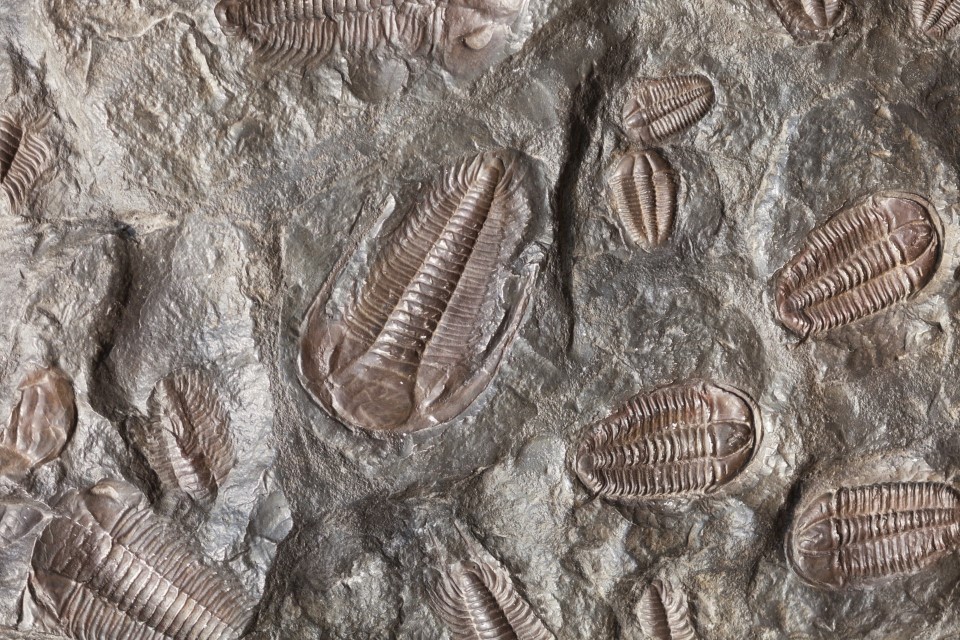
Years ago, people began to study the rocks. They noticed something they did not expect. They found fossils in the rocks that were the remains of plants and animals that were quite different from the life that we know today. The lower the rock layer, the more unusual the fossils became. People began to identify different layers that they had observed in the ground. Each layer had distinct characteristics and distinct fossils.

They discovered that, when the layers overlapped, they consistently appeared in the same order wherever they looked. It occurred to them that these layers might represent distinct time periods, with each being the result of the accumulation of sediments in a particular timeframe. The layers that are always lower must surely be the oldest, and the layers that are always higher must be younger. These explorers identified the different layers and put together what is known as the geologic column.

When I was an ardent defender of young-earth creationism, the geologic column began to trouble me. Why do we find nothing close to a modern mammal in layers older than the Quaternary and Tertiary periods (last 65 million years)? Why are no trilobites ever found after the Permian period (248 million years ago)? Why does every dinosaur fossil date at least 60 million years older than every human fossil? How can a creationist explain it?

Discovery of the Geologic Column

The geologic column was not invented to prove evolution. Creationists discovered it before Darwin. They simply put together what they could see in the rocks. These explorers were not evolutionists. Adam Sedgwick, for example, discovered the Cambrian and Devonian periods, and believed that God had created life. When Darwin later came along and presented his theory, Sedgwick disagreed. But he did not dispute the geologic column. He could see that life was quite different in the past.

These men had developed a viewpoint known as Catastrophism. They believed that God had created a strange world system with strange life a long time ago. They called it the Cambrian period. It seemed to them that God must have wiped out the Cambrian life in a catastrophe, for the Cambrian life was no longer found in the layers above it. So perhaps Cambrian life had been catastrophically wiped out, and God had re-created the world with different species. This they called the Ordovician period.

But as one went up from the Ordovician layer, he would again find another distinct layer. Well then, these men concluded, another catastrophe must have ended the Ordovician period, and the Creator had produced yet another world, the Silurian.

Each of the periods, in turn, was wiped out only to be replaced by something new. Finally, the current time period–the Quaternary–was reached. After each catastrophe life was created that was somewhat different from the life in the previous world.

Adam Sedgwick A creationist who helped develop the geologic column before Darwin.
How Good Are Those Young-Earth Arguments? By Dave E. Matson. More on the history of the discovery of the geologic column.
Geological Time Machine Learn more about the geologic column

Geologic Column links

Catastrophism

How could they fit this idea with the Bible? Well, folks “found” a convenient gap in Genesis 1. In Gen.1:1 we are told that God created the heavens and the earth. And people decided there was a large gap between verse 1 and verse 2. In this gap, the Cambrian, Ordovician, Silurian, Devonian, and all of the other ancient periods, took place.

Finally, the last catastrophe occurred, wiping out the Neogene Period. As a result of this last catastrophe the earth was without form and void once again until God would re-create the earth one last time. These men wrote that Genesis 1:2 picks up the story after the last period had been wiped out, making the earth void–“And the earth was without form and void”–and a new creation was ready to begin. The story of this last creation is supposedly told in the remainder of Genesis 1. So, all of these periods and catastrophes were supposedly hidden between Genesis 1:1 and 1:2. Thus, people were able to fit these geological observations with the Bible.

I think that, perhaps, their creative insertion of a gap into Genesis 1 did not do justice to the text, but we digress.

Science has advanced since the early 1800’s when this view was prevalent. Yes, science still believes there were catastrophes in the past, but these catastrophes did not actually wipe out all of life. We always find life forms that survived through the transition to the next period. We cannot explain the whole fossil record by resorting to catastrophes and new creations.

The Progression of Life

The discovery of radiometric dating has greatly increased our understanding of the geologic column. We are now able to determine the dates of rock layers that fossils are buried in and are able to track when different life forms came into existence and when they died off. We discover that new creatures were not introduced all at once at the beginning of each period. Rather, new species have been continually introduced into the environment throughout time.

This last point is troubling for creationists. For how did each of these new species emerge? How, for instance, did the Mesohippus–an early species of horse– come into existence? Imagine that you are walking through a meadow when suddenly–BOOM–an adult Mesohippus pair materializes out of nowhere right in front of your eyes. Are we to believe that this is the way God created? And did God continually create millions of species throughout the ages, always resorting to this spectacular out-of-nothing creation? BOOM! There is a new species of horse. BOOM! A new monkey. BOOM! God just decided to create a new kind of rat. Look! Right at your feet. BOOM! A lion. BOOM! Watermelon. BOOM! T Rex. BOOM! Is this even plausible?

Such creation events violate the laws of nature including the laws of conservation of mass, thermodynamics, and biogenesis. Did God suspend these laws many millions of times in order to complete these many acts of creation?

The facts are beginning to get difficult for Creationists. Now, when earth history was thought to consist of a series of creations and catastrophes, one might be able to suggest that these were magical intervals where God stepped in and re-created the world. But are we to believe that God repeated these little acts of special creation many, many millions of times?

Not only do we find that new species have repeatedly been introduced into the world, but we find an interesting thing when we arrange the fossils in the order that they first appear. We find an uncanny consistency with evolution theory. At the bottom we find simple life forms. As we move up, the fossil record begins to diversify, and includes fish, then reptiles, then mammals, and finally, humans.

My Epiphany

Years ago, I was fighting the good fight of creation on the Internet. I argued that evolution was impossible, for it required that the genetic code had to be changed to make new kinds of animals. It did not seem feasible to me that evolution could do this. I argued in the CompuServe debate forum, basing my arguments on Michael Denton’s Evolution: A Theory in Crises.

My favorite illustration was the difference between mammals and reptiles. The differences between living mammals and reptiles are substantial. Mammals all have hair, mammary glands, a four-chambered heart, and the distinct mammalian ear, with three little bones inside. These features are found in no living reptiles. I argued that this is because there is no viable intermediate between the two, that an animal could have either the reptile genetic code or the mammal code but could not be in the middle.

An evolutionist disagreed with me. He told me that in the past there had been many intermediates. He said that there were animals that, for instance, had jaw and ear bones that were intermediate between reptiles and mammals. How did he know this? He gave a reference to an essay in Stephen Gould’s Ten Little Piggies. I wrote back that since the local library had a large collection of children’s books, I should be able to find that book. (I thought that was quite a zinger.)

I borrowed the book and found an interesting account of how bones in the reptile jaw evolved and changed through millions of years to become the mammals’ ear. That sounded like such a clever tale. How could Gould believe it? Perhaps he made it up. But there was one little footnote, a footnote that would change my life. It said simply, “Allin, E. F. 1975. Evolution of the Mammalian Middle Ear. Journal of Morphology 147:403-38.” That’s it. That’s all it said. But it was about to make a huge impact on me.

You see, I had developed this habit of looking things up, and had been making regular trips to a university library. I was getting involved in some serious discussions on the Internet and was finding the scientific journals to be a reliable source of information. Well, I couldn’t believe that a real scientific journal would take such a tale seriously. But wait. Before I would declare victory, I needed to check it out.

On my next trip to the library, I found my way to the biomedical journal archive. I retrieved the specified journal and started to read. I could not believe my eyes. There were detailed descriptions of many intermediate fossils. The article described in detail how the bones evolved from reptiles to mammals through a long series of mammal-like reptiles.

I paged through the volume in my hand. There were hundreds of pages, all loaded with information. I looked at other journals. I found page after page describing transitional fossils. More significantly, there were all of those troublesome dates. If one arranged the fossils according to date, one could see how the bones changed with time. Each fossil species was dated at a specific time range. It all fit together.

I didn’t know what to think. Could all of these fossil drawings be fakes? Could all of these dates be pulled out of a hat? Did these articles consist of thousands of lies? All seemed to indicate that life evolved over many millions of years. Were all of these thousands of “facts” actually guesses?

I looked around me. The room was filled with many bookshelves; each was filled with hundreds of bound journals. Were all of these journals drenched with lies?

Several medical students were doing research there. Perhaps some day they would need to operate on my heart or fight some disease. Was I to believe that these medical students were in this room filled with misinformation, and that they were diligently sorting out the evolutionist lies while learning medical knowledge? How could so much error have entered this room? It made no sense.

The Evolution of the Mammalian Middle Ear by Edgar F. Allin. The paper that initiated my journey.
Taxonomy, Transitional Forms, and the Fossil Record By Keith B. Miller. A good overview with illustrations.
Transitional Vertebrate Fossils FAQ By Kathleen Hunt. Lists many transitionals (this link is to the mammal-like reptile section of that file)
Jaws to Ears in the Ancestors of Mammals at UC Museum of Paleontology Understanding Evolution website.

Transitional Fossil Links

How can you explain those mysterious mammal-like reptiles? Reptiles and mammals today are quite distinct from each other. Mammalian features include differentiated teeth (incisors, canines, premolars, molars), double rooted teeth, a distinct jaw joint, three bones in the ear (stapes, incus, malleus), the diaphragm, limbs under the body, a different arrangement of toe bones, and a braincase that is firmly attached to the skull. No reptile has these features. But when we look at ancient fossils, we find a strange series of animals with features in the middle.

They begin 300 Ma (million years ago) in the Pennsylvanian. It was a different world. There were no mammals, flowering plants, or even dinosaurs. According to the fossil record, these would all come later. The world belonged to amphibians and reptiles. Early Synapsids such as Haptodus appeared. Their dentary jaw bones rose in the place where later animals would have a new jaw joint–the mammalian joint.

Then advanced pelycosaurs (270 Ma) like the Dimetrodon had signs of a bony prong for the eardrum. Later, cynodonts like the Procynosuchus (236 Ma) had jawbones more similar to mammals, but they still had the reptile’s jaw hinge.

The Probainognathus (238 Ma) and the Thrinaxodons (227 Ma) have signs of two distinct jaw joints, the reptilian and the mammalian. This allowed some of the bones that had been part of the reptile’s jaw to transmit vibrations to the ear. This was the beginning of the special mammalian ear bones.

By the time the Sinoconodon appears (208 Ma) the mammalian jaw joint predominates, and the reptilian jaw joint is small.

The Morganucodon (205 Ma) has teeth like a mammal, a distinct mammalian jaw joint, and only a tiny remnant of the reptile’s jaw. It’s malleus and incus ear bones remain attached to the jaw.

 © UC Museum of Paleontology Understanding Evolution, www.understandingevolution.org.

By the late Cretaceous period (80 Ma) early placental mammals like the Asioryctes had jaws and ears that were transformed to the mammalian type. Two of the reptile’s jaw bones, the quadrate and the articular were no longer part of the jaw. Instead, they had become parts of the middle ear, the malleus and incus.

This is only a brief overview of these strange creatures. In fact, there are thousands of species that span many millions of years, with many intermediate stages of many different features.

Now what on earth was God doing? Why was he slowly introducing mammalian features into the fossil record? Why did he progressively change the design of the jaw, ear, teeth, and limbs until the animals look more and more like mammals? Should I just shrug my shoulders? “God moves in mysterious ways.” Problem resolved? No, I shall ask why.

Did God learn from experience and introduce new creatures with improvement every several thousand years or so? Creationists would cringe at that suggestion. Then why do we find this progression? It is difficult to escape the all-too-obvious conclusion: God must have allowed the first mammal to evolve from reptiles through a process involving many millions of years.

As a Creationist, I finally came to the point where I considered that possibility. It instantly become apparent that this would be a huge change in worldview. For if the first mammal evolved from reptiles, then where did the second mammal come from? If God used thousands of transitions to evolve the first mammal, did he then just copy that design to create the second and third mammals? That makes no sense. These mammals must have evolved also.

In fact, we would need to conclude that all mammals have evolved from these mammal-like reptiles. Think for a minute of all the varieties of mammals that you know–elephants, tigers, mice, dogs, and whales, to name a few. Did all of these descend from a sequence of mammal-like reptiles? Is there any other way to explain all these intermediates?

The impact of that day in the library was truly stunning. I didn’t know what to say. I could not argue against the overwhelming evidence for mammal evolution. That was hopeless. But neither could I imagine believing it. Something had happened to me. My mind had begun to think. It was becoming free. And it was not about to be stopped. Oh no. There is no stopping the mind set free.

I went to the library and borrowed a few books on evolution and creation–diligently studying both sides of the argument. I started to read the evolutionist books with amazement. I had thought that evolutionists taught that floating cows had somehow turned into whales; that hopeful monsters had suddenly evolved without transitions; that one must have blind faith since transitional fossils did not exist; that one must simply guess at the dates for the fossils; and that one must ignore all of the evidence for young-earth creation. I was surprised to learn what these scientists actually knew about the Creationist teachings of flood geology, of the proposed young-earth proofs, and of the reported problems of evolution.

And I was surprised at the convincing answers that they had for these Creationist arguments. I was surprised to see all the arguments they had for evolution. I read with enthusiasm. I learned about isochrons, intermediate fossils, the geologic column, and much, much more.

I would never see the world in the same light. Several weeks later I found myself staring at the fossil of a large dinosaur in a museum. I stared with amazement. I looked at the details of every bone in the back. I wondered if a design so marvelous could really have evolved. But I knew that someone could show me other animals that had lived earlier that had transitional features to this dinosaur. And I knew that one could trace bones back through the fossil record to illustrate the broad path through which this creature had evolved. I stared and I pondered. And then I pondered some more.

Within days, I had lost interest in fighting evolution. I began to read more and write less. When I did debate, I confined my arguments to the issue of the origin of life. But I could no longer ignore what I had learned. Several months later I first sent out an email with probing questions to a creationist who had arrived on the scene. He never responded. I have not stopped questioning.

Horse sense

A funny thing happened to me on the way to the debate forum. I was asked to sit on the wrong side. By this time, I was no longer identifying myself as a creation apologist, but as an explorer, a questioner, a fence sitter. That’s when I met Jim. Jim arrived on the debate scene filled with his message, that of Intelligent Design (ID). The ID viewpoint concedes that the earth might be billions of years old, but stresses that life forms required specific design. I liked the concept–it was my only option beside evolution.

I explained that I was sitting on the fence and could not make up my mind. Jim informed me that evolution was believed only by people that had been biased by methodological naturalism (the scientific method of looking for natural causes for everything). Me? Biased by naturalism? I, who was grasping desperately for any option but evolution? I, who had invested so much of my time fighting evolution? I, who had given thousands of dollars to creationist organizations? Me? How could it be that I was biased for naturalism?

No, I explained, it was not my bias that brought me where I was, it was the evidence that was bothering me.

“What evidence?” Jim asked.

I wrote back, explaining the strength of the evolutionary viewpoint. First there were all of those intermediate fossils. Then there was the evidence of embryology, comparative anatomy, and the geographic distribution of animals. The more I wrote, the more it all seemed to fit together. Jim disagreed.

29+ Evidences for Macroevolution by Douglas Theobald, PhD.
Horse Evolution by Kathleen Hunt
Science and Creationism: A View from the National Academy of Sciences This book helped me find my way out of Creationism.

Evolution Links

The discussion quickly centered on the well-known horse series. According to evolutionary understanding, the modern horse, donkey, and zebra evolved from something like the fox-sized creature known as hyracotherium. There are hundreds of intermediate horse fossils of dozens of species that have been found between these two extremes. Jim conceded that all of those intermediates might have indeed existed at the times claimed but insisted that the horses did not evolve from one type to another. Instead, he claimed that each new kind of horse was created unique. Apparently, God kept rolling out a new horse model every million years or so.

How did these new horses come into existence? Did a pair of adult horses suddenly materialize out of nowhere? Was God still creating horses this way today? Could I be walking through a meadow some day and suddenly have a new kind of adult horse materialize before my eyes? As a young-earth creationist, I would have envisioned creation something like that. But I would have seen it as a one-time miracle in which everything was created in one week. I could always argue that creation week was a magical week, and that things were very different then. But now I was being asked to see this as an ongoing process for millions of years. It seemed so implausible. Was Jim insisting that this is the way it happened? No, Jim had no comment on how new species came into existence. He just knew it wasn’t by evolution.

But why couldn’t it be by evolution? God could certainly do it that way, couldn’t he? After all, don’t you believe that he creates humans by allowing them to grow from a fertilized egg to a fetus to a baby to an adult? If he allows us to “evolve” from a fetus to an adult, perhaps that is the way he created animals in the first place.

I could not conceive of another way of creating new creatures that was consistent with the fossil record and made sense. Did God create an endless series of animals that popped up out of nowhere? It’s not very likely. Could he have used organic material that was in the ground from previous life forms? After all, Genesis says that he used the dust of the ground to make man. Is it evil to suggest that God could have used organic material in the ground to form the next horse in the series? I didn’t think so. But if we concede this as a possibility, can we allow that God could have used the raw material of an existing horse embryo and modified it to make the next kind of horse inside a mare’s womb? Could God have used a Mesohippus embryo to form the first Miohippus inside a Mesohippus? Would it be evil to suggest that? I didn’t think so. It does make more sense than zapping it into existence out of nowhere. Right? Could God have allowed the genetic material of one species of horse to become modified so that it became the next kind? Could he have made many small changes through many generations until the next species appeared?

As I continued to press Jim for an answer, I observed that I was now arguing for evolution– theistic evolution, yes, but definitely for evolution.

Jim was somewhat with me to the last step, but he could not make that leap to evolution. But to me, it did not seem evil to take that step. The best explanation for the horse series was that the modern horse evolved from something like the Hyracotherium. And the Hyracotherium evolved from the first mammals, which evolved from the mammal-like reptiles. And these must surely have evolved from animals similar to reptiles, which evolved from primitive animals, which evolved from one-celled creatures. The first horse evolved from a microbe. I now believed in evolution.

Human Evolution

Then there was that final hurdle, the hardest one. If God allowed a speck of life to evolve into a reptile, which evolved into mammals, which then evolved into apes, did he stop there? Where did humans come from? Is it possible that God evolved everything up to ape, and then instantly created man with the same organs that had evolved for years? Did he develop the mammal’s ear over time, and then suddenly create a human from scratch with the same ear design that had taken millions of years to evolve? Somehow that didn’t seem consistent. It sure was hard to admit that. But the facts were clear. The ear design that had surely evolved was also in me.

Martin Lubenow had written a book called Bones of Contention. It was my last hope. It argued that there was no evidence for the evolution of humans. His strongest argument, to my mind, was that fully human bones had been found which were more than 1.5 million years old, older than many of the reported transitional fossils between ape and man. This would have ruled out those creatures as direct ancestors of humans, for humans existed before them. I knew I had better not parrot what I had heard until I looked at the other side. I had seen postings on the web from a Harvard anthropology professor, Greg Laden. So, I asked him what he thought about these ancient human fossils.

“What fossils?” he wanted to know.

I told him that Lubenow had listed fossil KNM-ER 1470 in his book as a very old human fossil. I didn’t know what those numbers meant, but Greg knew.

He told me that he had used a cast of that very fossil skull in his classroom and explained in detail how the features were intermediate between humans and apes.

The creationist argument evaporated. This supposed human fossil wasn’t even human. It had many ape-like features. What was this strange creature, with characteristics of both man and ape? Many similar creatures have been found. Did God create a series of intermediate creatures between ape and man before he finally got it right? Or did he allow man to evolve? I could see only one option– evolution.

​ Fossil Hominids: The evidence for human evolution. By Jim Foley
KNM-ER 1470 Creationists can’t decide if this homo habilis is a man or an ape.

Hominid Fossil Links

What about God?

We have come a long way. Did we eliminate God? Many people think not. They have found that they can believe in both evolution and God. Could not God have used evolution as his tool? If you believe that God allowed you to grow from a single fertilized egg to a fetus to an adult, why could he not have allowed the whole human race to evolve from a single cell? Some say that God did exactly this, that he started the process of evolution and let it proceed. Others say he nudged it along as it progressed. There is nothing within the concept of evolution that eliminates God.

I will hold off discussing the existence of God until later. First, we have a more pressing concern. Perhaps you understand the evidence for evolution, but your knowledge of the Bible makes it difficult for you to accept it. So, we need to next take a close look at the Bible.

Yes, lets look at the Bible,


Addendum: Q&A

WASN’T DARWIN JUST TRYING TO GET AWAY WITH SIN?

A reader, JB, wrote that, perhaps, Darwin’s sin “was the reason for his search to find a supposed reasonable alternative”.

I recommend that JB read Darwin’s book, The Origin of the Species. This book presents the reasons for Darwin’s conclusion. The book has nothing to do with wanting to find a way to get away with sin. It involves solid reasoning. Don’t believe me? Read it for yourself.

I think JB would search long and hard to find a better explanation for the available data then the Theory of Evolution.

WHAT MAKES THINGS EVOLVE?

This question, and the ones that follow, were asked by another reader.

Animals and plants evolve because their bodies are controlled by genes which occasionally experience random changes known as mutations. Some of these changes are good for survival, some are not. The creatures that have the most favorable genes are more likely to survive and pass their genes to the next generation. This causes creatures to gradually change into a form that best allows them to survive in their environment.

WHY DID MAN DEVELOP, AND YET MONKEYS STILL EXIST?

Actually, we really didn’t come from monkeys. Rather, monkeys, apes, and humans all descended from a common ancestor (which, incidentally, was probably close to modern monkeys). The various offspring of this ancestor ended up exploiting various niches of nature to earn their survival. And so, they diversified into many species, each with its own niche. Monkeys continue to survive in the tops of the jungles, finding plenty of food up there and quickly scrambling from tree to tree to escape predators. Humans would not do good in that environment. So, we have both humans and monkeys, each surviving in a different way in a different environment. See a discussion of this at this thread.  I also discuss this in more detail later in this series.

ARE WE TRULY JUST AN ACCIDENTAL MUTATION, OR DO OTHER FORCES CAUSE SUCH CHANGES?

The mutations are random. However, the forces of selection for survival drive the creatures to survive in their niche.

WHY DO SOME ANIMALS LIKE CROCODILES STAY THE SAME FOR HUNDREDS OF THOUSANDS OF YEARS?

Once an animal has become well established in a large niche, if that environment remains stable, the physical changes to that creature often become small. Thus, since sharks and crocodiles have evolved to be well adapted to certain stable roles in the environment, they have little need of further change. Their genes continue to mutate, but the forces of natural selection hold the physical forms of the creatures stable with time.

SCIENTISTS DO ADMIT THAT IT SEEMS THERE WERE EVOLUTIONARY JUMPS FROM ONE SPECIES TO ANOTHER, SO WHAT MAKES THIS HAPPEN?

Jumps occur when isolated populations find themselves in a different environment. Creatures sometimes change “rapidly” to meet the new requirements. These changes take thousands of years, but compared to the age of the earth, the change is relatively rapid. A good picture of how this happens can be seen in the various dog breeds. Most of these breeds developed in the last several thousand years as humans guided their environment and selected those that they wanted to breed. Thus in a few thousand years, we see great differences in the dogs. Should this breeding continue, we will one day have many different species of dogs with different characteristics.

WILL WE HUMANS EVOLVE INTO SOMETHING ELSE IN A MILLION YEARS, AND IF SO WHAT DRIVES IT?

Certainly human genes will be different in a million years. The extent and direction of the changes depend on the environment. Interestingly, we as humans can affect our environment, and thus can influence the future or our species.

IS THERE ONE OR TWO BOOKS THAT COULD EXPLAIN EVOLUTION FOR ME, IN SIMPLE TERMS?

I would begin at the Talk.Origins Archive. Also, many have found The Selfish Gene and The Blind Watchmaker by Richard Dawkins to be good introductory books to the mechanisms of evolution.

Copyright Merle Hertzler 2002, 2005, 2022. All rights reserved.

Writing Journal—Monday writing prompt

Your character wakes up in the middle of the night. As she resettles in bed to return to sleep, something moves in the shadows. Write the scene, focusing on showing those visceral sensations as fear slams into her. 

One Stop for Writers

Here’s five story elements to consider:

  • Character
  • Setting
  • Plot
  • Conflict
  • Resolution

Never forget, writing is a process. The first draft is always a mess.

The first draft of anything is shit.

Ernest Hemingway

Random reading/listening–03/18/23 & 03/19/23

“Scientist argues that both science and faith play a role.” Part I. Here’s the link.

“Do science and faith share curiosity and a comprehensible Nature?” Part II. Here’s the link.

“Do science and faith share humility and service?” Part III. Here’s the link.

“Christian crusaders are winning battles but losing the war.” Here’s the link.

“‘How is it possible that I cannot believe!’ An atheist in the Inquisitor’s net.” Here’s the link.

“Draft bill bans everything but ‘scientific fact’ in Montana’s science classes.” Here’s the link.

“Inside the Payoff to a Porn Star That Could Lead to Trump’s Indictment.” Here’s the link.

“A Sandwich Shop, a Tent City and an American Crisis.” Here’s the link.

“The Essential Agatha Christie.” Here’s the link.

Drafting–Colton & Sandy dispose of Mildred, and make key discovery

Colton, Sandy, and Mildred had spent all of Sunday and most of Monday at O’Hare International Airport, nestled inside Parking Lot C along with hundreds of other vehicles. To Colton, it was a place they would be invisible until he could make three significant decisions.

While Sandy and Mildred stayed in the back, sitting or lying on separate couches, visiting the tiny bathroom, or trying to prepare edible food from the groceries they’d grabbed from Mildred’s pantry and refrigerator, Colton sat in the drivers seat and contemplated.

The first decision wasn’t so much whether to rid themselves of Mildred, he’d already committed to that, but where to dispose of her body. The second issue was her money, more particularly, the $700 plus thousand dollars sitting inside three banks. And, the third was who would be the next person he and Sandy would confront concerning Millie’s whereabouts.

With the aid of a near-extinct item—AKA Rand McNally Road Atlas that Colton had purchased at an Elk Grove Shell station—he’d located Schiller Woods, a deeply-forested area just a few miles to southeast of the Airport.

It was early Monday afternoon when Colton decided they should return to Rolling Meadows and have Mildred, along with Sandy, politely rob three banks, all with the once-in-a-lifetime cover of the one who owned the money.
After successfully cashing out one CD from First American Bank, Colton abruptly changed his mind. The dumb-ass Sandy wouldn’t see a tiger if it was right in front of him; Mildred could write out a damn note and hand it to the banker and Sandy would miss it.

The moment Mildred and Sandy returned to the van, Colton drove away, never to attempt such a foolhardy venture again. The money simply wasn’t worth the risk. Even if they were successful and cashed in the entire lot of CDs, and hide the money so no one could ever find it, what did that get them if he and Sandy were locked away for life in prison? Colton, silently screamed to himself, “how in hell could I have been so dumb?” His thoughts continued: all banks have security cameras. First American Bank now had not only Mildred and Sandy, together, inside the bank, but her Sprinter van in the parking lot, with possibly a closeup of his face nervously watching the front door. Well, at least the return to Rolling Meadows hadn’t been a total bust, he thankfully had remembered to drop by Phone Mart and pickup his and Sandy’s new cell phones, paying the balance with some of Mildred’s cash.

After returning to Parking Lot C, Sandy and Mildred had whipped up a double-batch of Hamburger Helper. Both men had gorged themselves while Mildred had only nibbled, likely pondering her fate.

Monday night was one of the longest Colton ever experienced. The van was too small for three to sleep comfortably. Although the couch along the rear doors transformed into a double there was no way he was going to lay that close to Sandy. At 9:00 PM, Colton reclined in the driver’s side captain’s chair, while Sandy and Mildred stretched out on the two couches.

There was no way Colton could sleep, especially with so much to contemplate. Unknown to Sandy, with the aid of his new, untraceable cell phone, he’d decided the three of them would arrive at Schiller Woods before dawn and park at a picnic area Google Maps labeled, ‘Grove 5.’ He had little doubt that they’d have the place to themselves. From there, Colton, with Sandy’s assistance, would secure Mildred’s hands and stuff a sock in her mouth. Sandy would stay inside the van while Colton led her north into the woods several hundred feet. There, he would take Mildred’s life with one massive blow with a rock, hoping and intending she’d die instantly. He had no plan to bury or otherwise hide her body. Nature would take care of that, with everything from dogs, cats, rodents, coyotes, opossums, raccoons, skunks, and birds devouring her corpse and scattering her bones throughout the thick forest.

That venture was a long seven hours away. Now, unable to sleep, Colton pondered who would be the best person to intimidate and convince that he or she should share Millie and Molly’s current location. Top of the list was Matt Canna. Colton knew beyond a shadow of a doubt that he was involved and knew the answer to Colton’s question. But, Matt was a stout guy, both mentally and physically. It might take some time to break him, and that meant a possibly worse scenario than the one with Mildred. And, this ignored the risk of confronting and abducting the six-foot two, two-hundred pound former athlete. Colton gave the Matt option a solid 8 out of a possible 10 for risk.
That left Alisha Maynard as Colton’s second possibility. Again, he had little doubt Molly’s best friend would know most everything, especially since they’d been sharing secrets since Kindergarten. Colton knew from two years of living with Millie and Molly, that the two six-graders were as intimate with their words as two romantic adults.

On the plus side of this option, Alisha would be a push-over as far as strength needed for an abduction, but there was a downside. She’s a twelve-year old child and would be better protected than Matt; she’d rarely be without adult supervision. Colton knew they’d have to get creative to develop a plan to kidnap her without being seen.

Colton reclined the captain’s chair as far as it would go and closed his eyes, wishing he hadn’t eaten an extra helping of Hamburger Helper. But, that wasn’t what was making him nauseous, it was the idiocy of committing murder and kidnapping in order to avoid a lifetime of prison for murder and kidnapping, not to mention the arson. Finally, surprisingly, Colton dosed and fell into a deep sleep, just to be awakened several hours later by Sandy nudging his shoulder. As planned, the two had agreed to swap places during the middle of the night.
However, Mildred’s every half-hour trip to the bathroom, and the slowly emerging smell of strong pee, prompted Colton to get up, go outside, and take a long walk around Parking Lot C. Four AM could not come quick enough.

When he returned to the van, Sandy was again on the rear couch, laying on his back, snoring like Hunter, a bulldog Colton had when he was a kid. Mildred was between trips to the bathroom, staring sadly at him as she inched her way back to the other couch.

Colton reconfigured the driver’s side captain’s chair and activated his new cell. It was 2:30 AM and he was wide awake. He inclined his seat and searched for the Spyware APP for the camera he’d hidden inside Molly’s black lama. He knew the battery was long dead but the prior recordings were safely stored in the cloud. The last recording of the two young girls still troubled him. Who were they? What in hell had become of Molly’s stuffed animals?

The APP was simple. As long as the camera had power—whether from a wall plug or its tiny battery, the motion-activated recordings were captured. If there was an available, non-password protected WiFi, the APP uploaded the recordings to a secure server.

Colton clicked on “Prior Recordings” and activated the most recent one. After turning up the volume and listening to the two curly-headed girls he guessed were five or six years old, to his surprise he was able to zoom in touching the screen with his thumb and forefinger and slowly spreading them apart. Earlier, he’d seen the white board on the wall in the background and that’s where he’d seen “Ray’s Garage.” This had prompted his search which ultimately had been a complete waste of time, an abrupt dead end, finding hundreds of Ray’s Garages throughout the country.

Now, with the APP’s new feature, he could make out what was clearly a row of crayon sketches taped side-by-side along the bottom of the board. None of the seven or eight interested Colton; they were all rudimentary drawings of sunsets, farm animals, pets including a dog, a cat, and a turtle, and, one each, of ‘Mom,’ and ‘Dad.’

What caught Colton’s attention was a flyer next to ‘Rufus’ the dog in the lower right corner of the white board. It was professionally done, at least compared to the girls’ sketches, in black and gold that announced an end-of-day school program last Friday where the Kindergarten students read their letters to Santa. At the bottom of the flyer, next to what had to be the school systems mascot, a yellow jacket, was printed in large letters: Fort Meigs Elementary School. The wording included a street address, along with the city, a place called Perrysburg, Ohio. “Bingo,” Colton said so loud that it disturbed the rhythm of Sandy’s snoring.

It took Colton less than a minute to type his Google query: “Ray’s Garage in Perrysburg, Ohio.” The first result read, “Auto Repair | Ray’s Service Center & Towing in Perrysburg, OH.” He clicked the link and after ignoring several customer reviews at the top of the page, read the following aloud, but softly: “Welcome to Ray’s Service Center & Towing, your car service in Perrysburg, OH!”

Colton smiled, although still confused. He asked himself, why would the black lama be here? His answer came quickly. The only logical explanation, given this place worked on dysfunctional vehicles, is that Millie’s Sentra had broken down. After locating Perrysburg on Google Maps, Colton announced to everyone within ear shot, “Shit, I bet the two escapees broke down on I-94 and had old Ray come get them with his tow truck.”

Nothing seemed to awaken the two snoring zombies as Colton continued to dissect what he’d discovered, At 4:00 AM he still hadn’t figured out why the black lama camera had captured the scene inside Ray’s office.

Stepping outside the van, all Colton could think was that he’d just experienced a miracle. It might have come from God but he doubted it. One thing was for sure, his and Sandy’s luck had just changed. For the better.

“Get up.” He said, opening the sliding side door. “We’ve got a full day ahead of us.”

It took fifteen-minutes to drive to Schiller Woods and Grove 5. Neither man had seen a single vehicle since passing the Dunkin coffee shop at the North River Road intersection, but what worried Colton the most was his stupidity—he’d failed to plan for the two I-90 toll booths, with both likely having cameras.
He eased the van off the cemented, circular drive and into the thick woods, just enough to be hidden. Mildred, still laying on her couch, was humming what had to be a gospel song. From his mother, Sandy knew it to be “Victory in Jesus.” He looked at Colton and shook his head sideways, making one final attempt to dissuade his best friend from taking yet another life.

It didn’t work. “Wake up mama, let’s take a little walk.” The lumberjack icon said as he exited the van.

By the time Colton reached the sliding door, Mildred was sitting up and buttoning her coat. She stuffed both hands in pockets as he motioned her to follow.

They slowly marched fifteen minutes due north with Mildred in the lead listening to her killer. Instead of his words, “right,” “left,” along the way her mind leaped eighty years past to her father plowing his mule with occasional “gee” and “haw” commands to guide old Sally alongside the rows of corn.
“Okay, stop here.” Colton said after they crossed a narrow stream of snow-melt alongside an outcropping of rocks ten feet ahead.

“Whoa,” thought Mildred. She listened for “come up” or a cluck for get going but heard only a sigh from her killer. Turning just enough to see Colton out of the corner of her eye, she saw he was staring at his cell phone.

Mildred squeezed her right hand around the handle of the only boning knife she carried in the van. Neither Sandy nor Colton had thought she might have a weapon, much less have the guts to use it. She withdrew her hand clutching the knife and fell to the ground resting on her knees, leaning forward with only her left hand visible. “Ooooh, she screamed.” Her plan, her hope, was that Colton would either kill her instantly with a rock or limb, or he’d try to make her stand. He might even kneel beside her and ask what was wrong. The latter, she doubted, but he might grab an arm and start pulling her upward. If she didn’t die from a hard blow to the head, she might get her chance.

“What the fuck?” Colton turned back toward the little creek. Mildred caught his movement in the corner of her eye. He found a rock bigger than his hand and walked toward her.

As luck or fate would have it, Colton’s first strike missed Mildred’s head and landed between her neck and shoulder. Miraculously, she spun on her knees to her left and brought her right arm and hand upwards as hard as she could. The blade penetrated his left thigh, just above the knee on the inner side.

Fortunately for Colton, the knife missed his femoral artery by an inch.
“You fucking bitch.” The second blow struck the left side of Mildred’s head, just above the ear. With a groan she slumped sideways onto the snow-soaked ground. Colton watched for what seem like several minutes before she took her last breath.

He quickly unbuckled his pants and slid them down to his knees to look at the wound. There wasn’t much blood. Thankfully, it was a flesh wound, above the thigh bone. Regardless, Colton used a bandanna to make a tourniquet.

Before returning to the van, he eyed the scene and saw the knife half submerged in mud lying beside Mildred’s body. Apparently, after the scuffle and during his wound inspection, he’d stepped on the six-inch blade.

After searching the dead woman’s pockets, Colton returned to the van and a sad-faced Sandy who’s voice trembled as he asked, “is she gone?”

Colton nodded, opened the driver’s side door, and tucked the knife underneath the seat fully intending to toss it out the window somewhere in between Chicago and Perrysburg. “Come on.” He hollered at Sandy who was slouching toward the van.

Why I Write: Joan Didion on Ego, Grammar, and the Creative Impulse

Here’s the link to this article.

“Had I been blessed with even limited access to my own mind there would have been no reason to write.”

BY MARIA POPOVA

Why I Write: Joan Didion on Ego, Grammar, and the Creative Impulse

The question of what propels creators, especially great creators, is the subject of eternal fascination and cultural curiosity. In “Why I Write,” originally published in the New York Times Book Review in December of 1976 and found in The Writer on Her Work, Volume 1 (public library), Joan Didion — whose indelible insight on self-respect is a must-read for all — peels the curtain on one of the most celebrated and distinctive voices of American fiction and literary journalism to reveal what it is that has compelled her to spend half a century putting pen to paper.

Portrait of Joan Didion by Mary Lloyd Estrin, 1977

Didion begins:

Of course I stole the title for this talk, from George Orwell. One reason I stole it was that I like the sound of the words: Why I Write. There you have three short unambiguous words that share a sound, and the sound they share is this:
I
I
I
In many ways writing is the act of saying I, of imposing oneself upon other people, of saying listen to me, see it my way, change your mind. It’s an aggressive, even a hostile act. You can disguise its qualifiers and tentative subjunctives, with ellipses and evasions — with the whole manner of intimating rather than claiming, of alluding rather than stating — but there’s no getting around the fact that setting words on paper is the tactic of a secret bully, an invasion, an imposition of the writer’s sensibility on the reader’s most private space.

She goes on to attest to the character-forming importance of living the questions and trusting that even the meaningless moments will add up to one’s becoming:

I had trouble graduating from Berkeley, not because of this inability to deal with ideas — I was majoring in English, and I could locate the house-and-garden imagery in The Portrait of a Lady as well as the next person, ‘imagery’ being by definition the kind of specific that got my attention — but simply because I had neglected to take a course in Milton. I did this. For reasons which now sound baroque I needed a degree by the end of that summer, and the English department finally agreed, if I would come down from Sacramento every Friday and talk about the cosmology of Paradise Lost, to certify me proficient in Milton. I did this. Some Fridays I took the Greyhound bus, other Fridays I caught the Southern Pacific’s City of San Francisco on the last leg of its transcontinental trip. I can no longer tell you whether Milton put the sun or the earth at the center of his universe in Paradise Lost, the central question of at least one century and a topic about which I wrote 10,000 words that summer, but I can still recall the exact rancidity of the butter in the City of San Francisco’s dining car, and the way the tinted windows on the Greyhound bus cast the oil refineries around Carquinez Straits into a grayed and obscurely sinister light. In short my attention was always on the periphery, on what I could see and taste and touch, on the butter, and the Greyhound bus. During those years I was traveling on what I knew to be a very shaky passport, forged papers: I knew that I was no legitimate resident in any world of ideas. I knew I couldn’t think. All I knew then was what I couldn’t do. All I knew then was what I wasn’t, and it took me some years to discover what I was.

Which was a writer.

By which I mean not a ‘good’ writer or a ‘bad’ writer but simply a writer, a person whose most absorbed and passionate hours are spent arranging words on pieces of paper. Had my credentials been in order I would never have become a writer. Had I been blessed with even limited access to my own mind there would have been no reason to write. I write entirely to find out what I’m thinking, what I’m looking at, what I see and what it means. What I want and what I fear. Why did the oil refineries around Carquinez Straits seem sinister to me in the summer of 1956? Why have the night lights in the bevatron burned in my mind for twenty years? What is going on in these pictures in my mind?

She stresses the power of sentences as the living fabric of literature:

Grammar is a piano I play by ear, since I seem to have been out of school the year the rules were mentioned. All I know about grammar is its infinite power. To shift the structure of a sentence alters the meaning of that sentence, as definitely and inflexibly as the position of a camera alters the meaning of the object photographed. Many people know about camera angles now, but not so many know about sentences. The arrangement of the words matters, and the arrangement you want can be found in the picture in your mind. The picture dictates the arrangement. The picture dictates whether this will be a sentence with or without clauses, a sentence that ends hard or a dying-fall sentence, long or short, active or passive. The picture tells you how to arrange the words and the arrangement of the words tells you, or tells me, what’s going on in the picture. Nota bene.

It tells you.
You don’t tell it.

Didion concludes with a quick shot of her signature wry wit:

Let me tell you one thing about why writers write: had I known the answer to any of these questions I would never have needed to write a novel.

For more timeless wisdom on writing, see Zadie Smith’10 rules of writingKurt Vonnegut’8 guidelines for a great storyDavid Ogilvy’10 no-bullshit tipsHenry Miller’11 commandmentsJack Kerouac’30 beliefs and techniquesJohn Steinbeck’6 pointersNeil Gaiman’8 rules, and Susan Sontag’synthesized learnings.

You Have No Right To Question Why You Suffer. What???

Here’s the link to this article by Bart Ehrman.

March 18, 2023

We come now to the conclusion of the dialogues of Job.   His friends have stridently insisted that he is suffering because he has sinned.  He vehemently argues he has not.  As it turns out, he’s right.  Then why is God making him suffer?  Here God himself appears to explain.  Or rather, to insist that he is not going to explain and that Job has no right to ask him to.

Is this an answer to suffering?  Or, well, a satisfactory one?  We can’t even ask?

Decide for yourself.  Here’s how I explain the climax of the book of Job in my book God’s Problem (HarperOne, 2008).

******************************

Job has no time – or need – to reply to this restatement of his friends’ views.  Before he can respond, God himself appears, in power, to overwhelm Job with his presence and to cow him into submission in the dirt.  God does not appear with a still, small voice from heaven, or in human guise, or in a comforting dream.  He sends a violent and terrifying whirlwind, and speaks to Job out of it, roaring out his reprimand:

Who is this that darkens council by words without knowledge?

Gird up your loins like a man,

I will question you, and you shall declare to me.

Where were you when I laid the foundation of the earth?

Tell me, if you have understanding.

Who determined its measurements – surely you know!

Or who stretched the line upon it?

On what were its bases sunk,

or who laid its cornerstone

when the morning stars sang together

and all the heavenly beings shouted for joy?… (38:2-7)

In his anger, God reproves Job for thinking that he, a mere mortal, can contend with the one who created the world and all that is in it.  God is the Almighty, unanswerable to those who live their petty existence here on earth.  He asks Job a series of impossible questions, meant to grind him into submission before his divine omnipotence:

Have you commanded the morning since your days began,

and caused the dawn to know its place?….

Have you entered into the springs of the sea,

or walked in the recesses of the deep?

Have the gates of death been revealed to you,

or have you seen the gates of deep darkness?

Have you comprehended the expanse of the earth?

Declare if you know this….

Have you entered the storehouses of the snow,

or have you seen the storehouses of the hail?…

Do you know the ordinances of the heavens?

Can you establish their rule on the earth?

Can you lift up your voice to the clouds,

so that a flood of waters may cover you?

Can you send forth lightnings, so that they may go,

and say to you, “Here we are”?

Is it by your wisdom that the hawk soars,

and spreads its wings toward the south?

Is it at your command that the eagle mounts up

and makes its nest on high? (38:12, 16-18; 22, 33-35; 39:26-27)

This demonstration of raw divine power – it is God, not Job, who is the creator and ruler of this world — leads to the natural conclusion.  If God is Almighty and Job is a pathetically weak mortal, who is he to contend with God? (40:1-2).  Job submits in humility (40:3-4).  But God is not finished with him.  He speaks a second time from the whirlwind:

Then the LORD answered Job out of the whirlwind:

Gird up your loins like a man;

I will question you, and you declare to me.

Will you even put me in the wrong?

Will you condemn me that you may be justified?

Have you an arm like God,

and can you thunder with a voice like his? (40:6-9)

No, obviously not.  Job had predicted that if God ever were to appear to him, he would be completely overpowered by his divine majesty and driven to submit before him, whether innocent or not.  And that’s exactly what happens.  When God’s thundering voice is finally silent, Job repents and confesses:

I know that you can do all things,

and that no purpose of yours can be thwarted….

I had heard of you by the hearing of the ear,

but now my eye sees you;

therefore I despise myself,

and repent in dust and ashes. (42:2, 5-6)

Readers have read this climax to the poetic dialogues in a variety of ways.  Some think that Job got everything that he wished for – a divine audience – and that he was satisfied with that.  Others think that Job came to realize his inherent guilt before the Almighty.  Others think that once Job has recognized the enormity of God’s creation, he can put his individual suffering in a cosmic perspective.  Yet others think that the point is that God has far too much on his hands – the governance of the entire universe, after all – to be all that concerned about Job’s quibbles about innocent suffering.

I don’t think any of these answers is right.  Job did want a divine audience, but that was so he could declare his innocence before God – and he is never given a chance to get a word in.  Nor is there any sense in which Job comes to realize that in fact he was guilty before God after all: when he “repents” he does not repent of any wrongdoing (he was, after all, completely innocent!); he repents of having thought that he could make his case before the Almighty.  Nor does it seem fair to relativize a person’s suffering because the world is, after all, a very big and amazing place. And it can’t be true that the Lord God has too many other things to worry about than Job’s miserable little life: the entire point of Job’s speeches is not that God is absent from his life but that he is far too present, in punishing him in ways that make no sense, since he has done nothing wrong.

It cannot be overlooked that in the divine response from the whirlwind to Job’s passionate and desperate plea for understanding why he, an innocent man, is suffering so horribly, no answer is in fact given.  God does not explain why Job suffers.  He simply asserts that he is the Almighty and, as such, cannot be questioned.  He does not explain that Job committed sins of which he was simply unaware.  He does not say that the suffering did not come from him but from other humans (or demonic beings) who were behaving badly towards Job.  He does not indicate that it has all been a test to see if he would remain faithful.  His only answer is that he is the Almighty who cannot be questioned by mere mortals, and that the very quest for an answer, the very search for truth, the very impulse to understand is an affront to his Powerful Being.  God is not to be questioned and reasons are not to be sought.  Anyone who dares to challenge God will be withered on the spot, squashed into the dirt by his overpowering presence.  The answer to suffering is that there is no answer, and we should not look for one.  The problem with Job is that he expects God to deal rationally with him, to give him a reasonable explanation of the state of affairs; but God refuses to do so.  And he is, after all, God.  Why should he have to answer to anybody?  Who are we, mere mortals, to question GOD?

This response of God from the whirlwind seems to get God off the hook for innocent suffering – he can do whatever he pleases, since he is the Almighty and is not accountable to anyone.  On the other hand, does it really get him off the hook?  Doesn’t this view mean that God can maim, torment, and murder at will and not be held accountable?  As human beings, we’re not allowed to get away with that.  Can God?  Does the fact that he’s Almighty give him the right to torment innocent souls and murder children?  Does might make right?

Moreover, if the point is that we cannot judge the cruel acts of God by human standards (remember: Job was innocent!), where does that leave us?  In the Bible, aren’t humans made in the very image of God?  Aren’t human standards given by God?  Doesn’t he establish what is right and fair and just?  Aren’t humans to be like him in how they treat others?  If we don’t understand God by human standards (which he himself has given), how can we understand him at all, since we’re human?  Isn’t this explanation of God’s justice, at the end of the day, simply a cop out, a refusal to think hard about the disasters and evils in the world as having any meaning whatsoever?

I’m happy to know what you think.

How Old is the Earth?

Here’s the link to this article by Merle Hertzler.

NASA GOES-13 Full Disk view of Earth Captured August 17, 2010

Last night some very special packages arrived at your house. They had made a long journey. They had been traveling for millions of years, or so I have been told. Finally, they reached your house last night. I am referring, of course, to the light from the distant stars.

Some of my readers might not believe this light had been traveling that long. They have a book that they trust. They understand that book to say the universe is less than 10,000 years old. If the universe is only a few thousand years old, then no, the light was not traveling millions of years. The believer in both the Bible and science has a dilemma.

I can understand this concern. I too, was once a young earth creationist. I figured there needed to be some explanation that had the light traveling no more than 20,000 years. I now think I was wrong. There were indeed millions of years.

The calculation for the light’s travel time is quite simple. You take the total distance traveled and divide it by the speed that the light traveled. Simple math. Simple answer.

SN 1987A

Ah, but what if the stars really are not as far away as the scientists claim? How can scientists be so sure the stars are far away? Let’s look at one measurement that was made. On February 23, 1987, a supernova, which is a vast star explosion, was observed. It is known as SN 1987A. About eight months after we observed the explosion, we saw reflections from the explosion in a distant gas cloud ring that circled the supernova. The ring can be seen as an orange circle in the photo. The reason the reflected light was delayed eight months was that it took time for the light to travel from the supernova to the distant gas clouds and then to reflect from there back to earth. (See illustration below.) And so, we can conclude that it took light about eight months–or 0.66 years– to journey from the supernova to the gas ring.

Enhanced photo of SN-1987A Source: SciTechDaily

Knowing the time that it took to reach the ring, and knowing the speed of light, we can calculate the distance to the ring. Knowing this distance and measuring the angle between the supernova and the reflection as seen from the earth, we can use simple trigonometry to calculate the distance of the supernova from the earth. If you forget high school trig, no problem, astronomers have calculated it for you. The supernova was far enough away that light had to travel 169,000 years to get here.

So, if you think the universe is say 6000 years old, how is it that we can see this supernova and the reflected light? If the light really came from the supernova, it had to travel 169,000 years to reach earth. It must have left the supernova long before the traditional date of Creation, 4004 BC. And so many of us conclude that the universe must be far more than 6000 years old.

“Ah,” one might say, “You are merely assuming that the light actually began its journey at that supernova. Were you there? Maybe God created a beam of light on its way to the earth at creation. The lights came on, and the beam of light in the illustration was already created complete on its path to earth. It only looks like the light came from the supernova.”

There is a big problem with this view. We are not merely seeing a simple beam of light. We see events such as this supernova explosion in the light that arrives. Did these explosions really occur? If the light was created part way between the star and the earth in such a way that it looked like an explosion, then what we have is a hoax. We have an elaborate deception designed to look like an explosion that never happened.

Further, the light from the explosion was not seen until 1987. If the universe is 6,000 years old, then the beam had to be set up far enough away that it took 6,000 years before we first saw it. And the beginning of the light beam from the ring around the supernova needed to be set back so that it took 8 additional months for the light from the ring to reach us. The hoax is becoming more complex. What could possibly be the reason for this other than to deliberately deceive us?

Space Telescope Science Institute Additional photos of SN 1987A
Supernova 1987A  Refutes 6000 Year Old Universe by Geno Castagnoli
Properties of the SN 1987A Circumstellar Ring by N. Panagea et. al. The original paper measuring the distance to this supernova.

SN 1987A links

If we were to assume that the Bible was God’s perfect revelation, but that the light from the stars was deceiving us, how could we trust such a God’s written revelation? For if God’s physical evidence is deceptive, could not the written evidence also be deceptive?

Suppose that God had deliberately faked the light of an explosion that had never happened. If he did this, how would we know anything about the universe? Once we postulate that an all-powerful, deceptive God is manipulating the data, we could know nothing. Such a God could be fooling us in everything we observe. We may think a lightning strike is electrical, but if a deceitful God is in charge, maybe he is only fooling us. We may think the laws of physics apply, but a deceitful God could be manipulating the data. So, if God is all-powerful, and is deceitfully manipulating the universe, we would know nothing.

Let’s rule out a deceitful God. Then I can reach no other conclusion but that the distant star light has been traveling for millions of years.

Some readers may have thought of another way out of this dilemma. “Yes,” they would say, “the light traveled that far, but it went really, really fast. Perhaps the speed of light was different back then.”

This is an old Creationist claim, which has been thoroughly refuted [1]. The speed of light is constant.

Besides, in the case of this supernova, a faster speed of light would not help. Light from the supernova took 8 months to reach the outer ring. Suppose light was traveling ten times as fast when it started its journey. Then the light would have gone ten times further during those 8 months it took to reach the cloud ring. The ring would be ten times bigger than we have calculated. This would mean that the triangle in the illustration above is ten times as big, and the distance to earth is ten times as far. This only makes the problem worse! Now the light would need to travel much further to get to earth. So even if the light had started out faster, it would not resolve the problem for those that believe the earth is 6,000 years old.

The light we see in the photo above simply could not have made it to earth if the universe is less than 169,000 years old. Something is wrong with the 6000-year time frame.

I use SN 1987A as an example because it was in a galaxy that was close enough that we could photograph it. We can see that other supernovas are occurring much further away. The light that arrives from the most distant stars would have taken billions of years to reach earth. Yet we see it. Can you reach any other conclusion but that the universe is billions of years old?

But what about the Bible?

The conclusion of an old universe will not be easy for some Christians to reach. You have a high regard for the findings of true scientific observation and reason, but you also trust the Bible. And your Bible seems to indicate that the universe is thousands of years old, not billions. So, you are faced with a conflict. One solution would be to just ignore the physical observations of the universe. Another solution would be to just ignore the Bible. Neither of those is satisfactory to you.

There are some other options. Either you could modify your observations of starlight so that it is compatible with your interpretation of the Bible, or you could modify your interpretation of the Bible so that it is compatible with the physical observations. We have tried to modify our observations of the universe to match a 6000-year-old earth and failed. So, the natural follow-up question for many Christians is, “Can the Bible be interpreted to be compatible with an old universe?”

Many Christians have found that the Bible can indeed be interpreted that way. For instance, Norman Geisler, one of the foremost Evangelical apologists, writes:

One of the biggest problems for the young earth view is in astronomy. We can see light from stars that took 15 billion years to get here. To say that God created them with the appearance of age does not satisfy the question of how their light reached us. We have watched star explosions that happened billions of years ago, but if the universe is not billions of years old, then we are seeing light from stars that never existed because they would have died before Creation. Why would God deceive us with the evidence? The old earth view seems to fit the evidence better and causes no problem with the Bible.[2]

Notice that this quote does not come from a godless, atheist infidel. No, it comes from a leading Evangelical authority. He finds that an old earth causes no problem with the Bible. And many leading Evangelical scholars have been publicly open to an old-earth view, including Lee Strobel, John Ankerberg, Pat Robertson, William Lane Craig, Hugh Ross, Hank Hannegraff, and Francis Schaeffer.

Notable Christians Open to an Old Earth Interpretation, at Reasons to Believe by Hugh Ross.
Affiliation of Christian Geologists Christian geologists who believe in an old earth.
Old Earth Ministries by Greg Neyman. “Dedicated to sharing the Gospel, supporting Christians who believe in an old earth, and ending the false teaching of young earth creationism.”
Not ‘Apparent Age’: God is not deceptive A Christian perspective making many of the same points found on this page.

Evangelical Old-Earthers

There are several ways in which the Bible can be interpreted to be compatible with an old universe. One of the most popular is to assume that each “day” in Genesis actually represents a long period of time. Other options have been proposed. If your interpretation of the Bible is making it difficult to accept the obvious conclusion from nature, you may want to look at some of the links above before you proceed.

The Fossil Record

I will move on. Not only do we find that the stars are old, but we can see that the earth is old.

All around the world we find many layers of underground fossils and sediments. Where did all of these fossils come from? Glenn Morton, a former young-earth Creationist writer, has written a description of the fossil record as it appears in North Dakota. He describes the 3-mile-thick fossil record, which includes animal fossils, burrows, shark teeth, coal, and fecal pellets (click here to see it offsite).

Where did all of these layers come from? How is it that we find animal fossils, teeth, and fecal pellets spread throughout the record? It is difficult to escape the conclusion that all of these are the remains of real animals that were buried. But if animals have been buried 3 miles deep, and other animals have been buried on top of them, and still others on top of them up through all 3 miles of sediment, one must surely conclude that it took a long time for all those layers to accumulate.

Let’s look at another example of the details found in the fossil record. Specimen Ridge in Yellowstone Park is a 2000-foot-high wall of rock that includes the petrified remains of 18 forests, each one growing on sediments that were deposited on the forest layer below it. [3]

Now think about that. A forest grew and was covered up by a catastrophic volcano and landslide. The soil weathered until it became fit for plant life to grow again. Another forest grew. Many years later it too was wiped out in another catastrophe. The process repeated until at least 18 forests grew and were wiped out. Surely it takes a long time for one forest to be covered, for the soil to weather, and for another forest to grow above it, only to be covered again. Do you not agree that the bottom of this ridge–down below those 18 fossilized forests–is very old?

How can young-earth believers explain the fossil record? Some have tried to say that God created all of these layers at the beginning of the world. But is that logical? Are we really to believe that the fossil bones of dinosaurs and buried forests were put into the rocks at the creation of the world? That would mean that those dinosaur fossils did not come from real animals. Is it possible that God just buried all of those fake fossils down there? That doesn’t seem likely. Could God be so deceptive? I think we have agreed to rule out a deceptive God.

So, we must conclude that the fossils are real, and that the rocks in which dinosaur fossils were found were formed after those dinosaurs had lived and died. Therefore, many of the rocks down there could not have been formed during a one-week creation. They had to be formed later, sometime after the dinosaurs that they cover had died.

Now the same reasoning that makes me think that the dinosaurs were real, also convinces me that the fish and trilobite fossils found far below the dinosaur fossils are also the real remains of real animals that once lived. And so, these rocks must also have been formed long after the origin of the earth. These fossils simply could not have existed in the earth from the beginning. They must have been made later, and there must have been a long period of time involved.

Flood Geology

Some young-earth creationists have tried to argue that the bulk of the fossil record was formed during Noah’s flood, a view known as flood-geology. I had read such books as a teenager and was convinced that they described the way the fossil record was formed. Years later, I would find that the problems with this view are insurmountable.

For instance, in the middle of the Grand Canyon we find a buried sand dune, which was made of wind-blown sand. Now flood geologists claim that the rock layers in the Grand Canyon were created during Noah’s flood. But if those rock layers were formed during the flood, why do we see buried sand dunes amid the deposits? Something is wrong here. Surely there were no winds blowing sand around under the flood waters. How then is this dune in the middle of the deposits? If this dune occurred before the flood, how can you explain all the fossil-bearing layers below it? And if the dune occurred after the flood, how can you explain all the layers above it? Where did they come from? So, a global flood does not explain the fossil record.

Problems with a Global Flood . By Mark Isaak. Learn why scientists do not take flood-geology seriously.
The Geologic Column and its Implications for the Flood by Glenn Morton. Find out what is below the surface of the earth.
The Impossible Voyage of Noah’s Ark at National Center for Science Education.
Noah’s Flood and Creation Science at Old Earth Ministries.

Flood links

And what about the cave systems, footprints, and animal burrows that we find throughout the fossil record? How can these things be created during a raging flood? Animals would not be walking around leaving footprints if a flood was going on above them, would they? And how can a cave possibly get formed in the middle of a flood? So, it seems to me that the flood cannot explain the fossil record. The layers of rock must have been formed over a very long period of time.

Isochrons

How old is the earth? Surprisingly, modern science has been able to answer that question to a high degree of accuracy. A technique known as radiometric dating is used to find the age of the rock layers. These dates are based on the knowledge that some elements in rocks decay to form other elements. We know how fast they decay. Thus, if we know what the original concentrations of the elements in a rock were, and know what the concentrations are today, and if we can establish that there were no outside disturbances that interfered with the process, we can calculate the age of a rock. That sounds like a lot of unknowns. Young-earth Creationists love to point them out as if scientists had never thought about them. They are wrong. Scientists have dealt with these questions and understand the process.

This gets a little technical here, but I think we should take a brief look at Rb-Sr isochrons. This was the clincher for me. I had once argued that the earth is young, but when I learned about isochrons, I soon changed my mind.

Scientists use isochrons to calculate the original composition of certain elements in a rock, and to show that contamination has not affected the result. Does that sound like magic? It isn’t. It turns out that the element rubidium-87 (Rb-87) in rock decays to form strontium-87 (Sr-87) at a known rate. The more Rb-87 in a rock, the faster Sr-87 accumulates. So, if we know the concentration of Rb-87 of any sample, we will know the rate at which the Sr-87 concentration increases with time. And knowing this rate of change, we can calculate back to any time in the past and determine what the Sr-87 concentration would have been.

Rocks also have another form of strontium, Sr-86, which stays constant with time.

Scientists measure the amount of Sr-87 in a rock by looking at the Sr-87/Sr-86 ratio. As Sr-87 accumulates, the Sr-87/ Sr-86 ratio increases. What does this tell us? One sample doesn’t tell us much. Let’s look at another sample from a different location on the same formation where there is more Rb-87. This point will experience a faster change in its Sr-87/Sr-86 ratio because there is more Rb-87 to decay. Again, we can calculate this ratio back through time. In a valid sample, we will find that, at some point in the distant past, both samples had the same Sr-87 /Sr-86 ratio. Scientists can repeat the process for a number of samples in a rock formation, and all will show that they had nearly the same Sr-87/Sr-86 ratio at that point in the past (see graph).

This is interesting. For, in rock formations that come from a single flow of lava, the strontium comes from one source, and would indeed have had the same Sr-87/Sr-86 ratio throughout when the rock layer was formed. The most obvious reason for the correlation of these ratios is that this is the point when the lava that created this formation was flowing, with strontium from one source spread throughout the lava. So, this must be the date of the lava flow. This procedure yields ages of many millions of years. [4]

What other explanation is there? Could God have scattered these elements in the rocks at different concentrations, using a different Sr-87/Sr-86 ratio at each point depending on the local Rb-87 content, so that it looks like the rocks existed through millions of years of decay? Nope. Remember, we are ruling out a deceitful God.

The Ages of Rocks

We have looked at only one method of dating rocks. There are more than 40 radiometric dating methods. Scientists usually do more than one test on a rock formation and find excellent correlation between the dates found. With so many different methods–each based on different principles–and with each arriving at the same answer, isn’t that strong evidence that the dates found are correct?

Even if you do not understand the concepts, there are thousands of scientists that do. And there is a scientific consensus that radiometric dating is valid, and that these rocks are many millions of years old.

It is important to understand that there are animal fossils under these rocks. Now you agree with me that these fossils were formed from the remains of animals, don’t you? And you surely must agree that the rocks on top of those animal fossils must have been deposited after those animals had lived. So the rocks on top of the fossils–the rocks that we evaluate with radiometric dating–could not have been formed when the earth was first formed. They must have been formed later.

If we were to suggest that God deliberately manipulated the elements to change the apparent date, it would mean that he did it when the volcano that formed those rocks erupted many years after the earth began. Did God manipulate the data many hundreds of times throughout the ages as these various rocks solidified? I cannot imagine God doing that, can you? Surely, he would not be bothered with deliberately manipulating the data every time a volcano erupts.

Radiometric Dating: A Christian Perspective by Roger Wiens at American Scientific Affiliation.
Radiometric Dating and the Geological Time Scale by Andrew MacRae
How Old is the Earth? by G. Brent Dalrymple

Age of the Earth links

I can only come to one of two conclusions. Either those rocks are many millions of years old, or God used extremely elaborate means to make the rocks look old. The deception would be so subtle that nobody could have possibly been fooled by it until scientists had reached the modern understanding of radioactivity. Could God have deliberately faked all of these components of all of these rocks, just so we would arrive at the wrong answer when we tried to date them years later? That doesn’t seem likely to me. If we rule out deliberate deception, I am left with believing that the rocks are old.

So, can we blame demons?

Someone once told me that these rocks are not the work of God, but of the devil. She said the devil put these rocks down there, because that was the only way he could fool smart people. That devil was clever, huh?

Okay, suppose that a volcano erupts in Hawaii. Do a host of demons swarm over the lava to manipulate the elements and make it look old? Science cannot seem to detect such demons. Besides, if demons are doing that, shouldn’t the rocks from recent volcanoes date to millions of years old? Rocks from recent volcanoes do not yield old ages when tested. Have the demons forgotten to manipulate the elements?

Sure, we could postulate that these demons worked only in the distant past. But then I need to ask why there is so much volcanic rock down there if the earth is 6000 years old. Yes, we could postulate that another swarm of underground demons was down there causing volcanoes.

Then I would ask why we find no mammals or people in the older layers. Again, we could postulate yet another host of demons, who chased all of the mammals away from the early volcanoes.

We could continue to postulate yet another demon for every problem with this hypothesis. Do you see how throwing all of these demonic entities into the solution makes it all implausible? Every time we add yet another demon to fix a flaw in the hypothesis, the whole idea becomes less likely.

William of Occam discovered long ago that simple explanations are usually more likely to be true than explanations that require multiple ad hoc explanations. Once we start multiplying entities–once we add one demon after another to explain each detail–we could prove anything. We could state, for instance, that the earth was flat, and could propose a different demon for every evidence to the contrary. If that is acceptable, no idea could then be proven false. If everything can be proven, in actuality we would know nothing. So, scientists look for the simplest explanations, the ones that do not need multiple ad hoc assumptions.

The simplest explanation is that the rocks look old because they are old.

Other Evidence

How old is the earth? Rocks on the earth have been dated at 4 billion years old. Many meteorites have been dated, and we consistently find an age of about 4.5 billion years. Evidence indicates that the meteorites and the earth were formed at about the same time, about 4.5 billion years ago.

Perhaps you are not into the study of radioactive elements and exponential decay. How about counting? You can certainly do that. If you were to cut down a tree and count 100 rings, you would know that this tree was 100 years old. We can do a very similar thing with the polar ice caps. The ice builds up another thin layer every year. People have drilled down through the ice and counted the layers. They find more than 50,000 distinct layers before they begin to fade together. Doesn’t that prove that the earth is more than 6000 years old?

Young Earth Creationism

Years ago, organizations like the ICR had convinced me that the earth was young. They used arguments that sounded good when I heard only one side. They told me, for instance, that the earth’s magnetic field was decreasing. They said that the magnetic field must have started out strong several thousand years ago and decreased since then. That sounded convincing to me. Since I, who knew little about the earth’s magnetic field, was convinced by their argument, did that prove that the argument was correct? Of course not.

The real test of a scientific proposal is not the ability to convince the public, but the ability to convince those that understand the relevant facts. Those that understood recognized that the claim for a constantly decreasing magnetic field was false, for it did not account for all of the components of the earth’s magnetic field and did not recognize the evidence that the magnetic field has been fluctuating throughout earth history. Those who understood the earth’s magnetic field were not convinced with this young-earth argument.

You may hear arguments from the young-earth crowd that sound impressive. Please understand that scientific-sounding arguments that convince the public do not prove a concept is true. An idea should be considered scientific only if it stands up when those who understand the science involved analyze it and accept it. That is the real test.

Institute for Creation Research (ICR) is the granddaddy of the young-earth creation movement.
The Age of the Earth by Chris Stassen at Talk.Origins

Young Earth Claims

I conclude that the earth is very old. We can see distant starlight. We can dig up old fossils and date rocks to billions of years. And a lot can happen in a billion years.

Writing Journal—Sunday writing prompt

A sinkhole appears in your heroine’s backyard and when she gets too close to the edge, she falls in. It doesn’t lead where she expects..

.


One Stop for Writers

Here’s five story elements to consider:

  • Character
  • Setting
  • Plot
  • Conflict
  • Resolution

Never forget, writing is a process. The first draft is always a mess.

The first draft of anything is shit.

Ernest Hemingway

The Massive Damage Done by Sunday School and Catechism

Here’s the link to this article by David Madison

03/17/2023

Indoctrination is not education

A careful reading of the New Testament reveals how much early Christians disagreed with each other, but even so it’s possible to create a profile of its weird cult beliefs. 

The early Christians expected to meet Jesus in the sky—along with dead friends and family who had accepted Jesus—and to live with him forever (I Thessalonians 4). Those who qualified for this status said out loud that Jesus was lord, and believed in their hearts that god had raised him from the dead (Romans 10:9). He had died as a human sacrifice to a god, to enable this god to forgive sins—Jesus was the ransom (Mark 10:45). Belonging to Jesus meant that prayer requests were guaranteed (Mark 11:24), that sexual desires had been cancelled (Galatians 5:24, I Corinthians 7:1). Even if that were not entirely true, since the arrival of Jesus on the clouds would happen any day now, it is best to remain pure. The unmarried state is preferred (I Corinthians 7:32-34). In fact, families were a distraction, cult loyalty was the primary value—to the point of cutting off family relations (Luke 14:26, Matthew 8:21-22). In addition to believing that Jesus had been raised from the dead, ritually eating his flesh and drinking his blood were additional ways to guarantee eternal life (John 6:53-57).

So: a holy hero was expected to arrive from the sky to enforce strict rules of behavior, the reward for which was getting to live forever. Variations on this theme have been preached by cults over the centuries. Many modern Christians have managed to modify/soften this Bible-based version of how life is supposed to be lived. But all it takes to see these elements of cult fanaticism is a careful, eyes-wide-open reading of the New Testament. Which means that this ancient document is stunningly out of sync with our modern understanding of how the world and Cosmos works. 

Hence, to the degree that Sunday Schools and Catechism teach any part of this cult fanaticism, they are doing damage. The world doesn’t need people who are hoping for/expecting a holy hero from the sky to make the world a better place—to guarantee they’ll get to live forever. A few years ago I was invited to attend the First Communion ceremony at a Catholic Church. Truly it was like stepping back into an ancient cultic ritual. Girls seven/eight years of age wore wedding dresses for the privilege of eating the flesh of their god for the first time—and in the Catholic church, the Miracle of the Mass means they are eating the real flesh of Jesus. 

The ancient cult still has traction in the modern world because the mammoth Christian bureaucracy—even though splintered into thousands of different brands—keeps it going. The clergy, usually groomed themselves in Sunday School and Catechism, are fully committed to it. That is, the indoctrination worked exactly as it was supposed to: “Here is the truth as handed down to us. Believe it, take it on faith.” In some denominations, the more alarming elements of the original cult mindset are softened, e.g., the requirement that family be set aside; the famous Jesus-script about hating your family isn’t usually heard from the pulpit. 

But the massive damage done by Sunday School and Catechism is the stunting of curiosity. If anyone is bold enough to ask, “Reverend, how do we know that this particular item of faith is true?” the response will be standard formulas, e.g., it’s in the Bible, it’s been part of our sacred tradition for centuries, the holy spirit guarantees it. And commonly the assumption will be that the good reverend has studied and/or prayed about it enough for everyone to trust him/her. It is not the obligation of the clergy to urge their parishioners to question, probe, or be skeptical. And that’s why religious indoctrination does massive damage.

Once that crucial question has been asked, “How do we know this is true?” full-throttle curiosity should be encouraged and rewarded. No matter what the item of faith may be, e.g., god is love, Jesus rose from the death, the holy spirit is there to guide us, prayer works—the best question to ask is: 

Who was the first person to come up with the idea? Who said or wrote about it for the very first time? 

Maybe it was the author of one of the gospels, or the apostle Paul in his letters. Then the crucial question must be: 

Did this article of faith pop into the author’s mind because of revelation, imagination, or hallucination? 

If the clergy are quick to answer revelation, we need to ask how they know this. How can this be verified? Obviously, “Please, just take it on faith,” means that curiosity really is not welcome or appreciated. 

The laity commonly fail to realize that Christian origins—the thought-world in which the Christian cult arose—have been thoroughly, exhaustively studied for a long time now. And it is startling to realize how many ideas the early Jesus-cult borrowed from the other cults that had been up and running for a long time. It is naïve to assume that Jesus came along, preached his message, collected his followers—and had such an impact that Christianity sprang to life and spread dramatically after his death. The clergy and the church have thrived for a very long time on this “greatest story ever told.”

It’s bad enough that the laity are woefully ignorant of the gospels—I mean, being able to discuss these documents intelligently, aware of their differences, contradictions, and the theological problems they pose—but it would seem there is close to zero interest among the laity in serious study of Christian origins: let’s find out where our faith really came from. Come on, the resources are available to discover what many other ancient religions believed, and their impact on Christianity.   

There’s an especially handy tool for exploring Christian origins. Richard Carrier’s 618-page book, On the Historicity of Jesus: Why We Might Have Reason for Doubt, includes two chapters, 4 and 5 (pp. 56-234) that provide detailed descriptions of 48 elements that are crucial for understanding Christian origins. The book as a whole presents the issues that have prompted doubts that Jesus was a real person. I have urged laypeople to study the issues—rather than just being alarmed at the very idea—that is: do the homework. Carrier’s book, by the way, makes the scholarship easily accessible; early in the book he explains why he avoids a stuffy academic style. 

But quite apart from the issue of Jesus-myth-or-real, the 48 elements that Carrier describes are basic for understanding how Christian beliefs were shaped by its context. 

Here I’ll focus on just a few, starting with Element 4:

“(a) Palestine in the early first century CE was experiencing a rash of messianism. There was an evident clamoring of sects and individuals to announce they had found the messiah. (b) It is therefore no oddity or accident that this is exactly when Christianity arose. It was yet another messiah cult in the midst of a fad for just such cults. (c) That it among them would alone survive and spread can therefore be the product of natural selection: so many variations of the same theme were being tried, odds are one of them would by chance be successful, hitting all the right notes and dodging all the right bullets. The lucky winner in that contest just happened to be Christianity.” (p. 67)

The mission of the gospel writers was to champion their candidate for messiah. The author of Mark’s gospel reports (1:11) that a voice from heaven declared Jesus to be god’s son. Of course, this is the focus of lessons taught by the church, but nothing is mentioned about the rash of messianism in the first century—and its implications for the bragging of the Jesus cult.  

I recommend careful study Element 15 especially, pp. 124-137, which begins with this statement: 

“Christianity began as a charismatic cult in which many of its leaders and members displayed evidence of schizotypal personalities. They naturally and regularly hallucinated (seeing visions and hearing voices), often believed their dreams were divine communications, achieved trance states, practiced glossolalia, and were (or so we’re told) highly susceptible to psychosomatic illnesses (like ‘possession’ and hysterical blindness, muteness and paralysis).” (p. 124)

So we wonder what was going on in the heads of those promoting the Jesus cult. This brings us back to that crucial question: did their ideas about god and Jesus come from revelation, imagination or hallucination? After providing details for ten pages, Carrier concludes:

“All of this provides considerable background support to what several scholars have already argued: that the origin of Christianity can be attributed to hallucinations (actual or pretended) of the risen Jesus. The prior probability of this conclusion is already extremely high, given the background evidence just surveyed; and the consequent probabilities strongly favor it as well, given the evidence we can find in the NT.” (p. 134)

We can safely assume that this hallucination factor isn’t covered in Sunday School and Catechism—oh wait: they get away with it by talking about visions. But, of course, overlooking the fact that religions generally won’t grant that the visions of other religions are authentic. 

Element 31 delivers another blow: 

“Incarnate sons (or daughters) of a god who died and then rose from their deaths to become living gods granting salvation to their worshipers were a common and peculiar feature of pagan religion when Christianity arose, so much so that influence from paganism is the only plausible explanation for how a Jewish sect such as Christianity came to adopt the idea.” (p. 168)

Carrier goes into considerable detail on this embarrassment in his article, Dying-and-Rising Gods: It’s Pagan, Guys. Get Over It.

Finally, I’ll mention Element 43:

“(a) Voluntary human sacrifice was widely regarded (by both pagans and Jews) as the most powerful salvation and atonement magic available. (b) Accordingly, any sacred story involving a voluntary human sacrifice would be readily understood and fit perfectly within both Jewish and pagan worldviews of the time.”  (p. 209)

We wonder why Christians aren’t, in fact, horrified by this grotesque belief as the centerpiece of their faith. The clergy do a good job of making it look good.

Carrier offered a good summation of these data in John Loftus’ 2010 anthology, The Christian Delusion: Why Faith Fails

“The New Testament is recognized by biblical scholars the world over as an arbitrary hodgepodge of dubious literature of uncertain origins and reliability. We have no reason to believe the authors of the New Testament documents were any more honest or critical or infallible than any other men of their time, and there’s plenty of evidence to suspect they were less so.” (p. 297-298)

How can the promotion of the ancient Jesus cult NOT involve massive damage? 

There is one prominent example of the damage that comes to mind: Mike Pence, raised a Catholic, who has described himself as “a born-again, evangelical Catholic.” He does not believe in evolution. Chris Matthew, in an interview with Pence on MSNBC Hardball, pressed him on this. He responded:

“I believe with all my heart that God created the heavens and the earth, the seas and all that is in them. … How he did that, I’ll ask him about some day.”

This is a special brand of stupid, a symptom of a brain locked by cult belief. He doesn’t have to wait to ask god about it—and what arrogance, to assume that a creator with hundreds of billions of galaxies under management will sit down to have a chat with Mike Pence. That is cult craziness. Evolution is an established fact; just do the homework! Pick up a few books on the basics of biology and learn. The same holds true about Pence’s opposition to the rights of LGBTQ people; his mind is locked into the assumptions of the cult. Human sexuality has been studied in depth. Study the research, find the books. Learn

And what one human out of eight billion believes with “all his heart” means nothing. Back up your claims with hard data: reliable, verifiable, objective evidence. Move beyond the mindset of Sunday School and Catechism.

David Madison was a pastor in the Methodist Church for nine years, and has a PhD in Biblical Studies from Boston University. He is the author of two books, Ten Tough Problems in Christian Thought and Belief: a Minister-Turned-Atheist Shows Why You Should Ditch the Faith (2016; 2018 Foreword by John Loftus) and Ten Things Christians Wish Jesus Hadn’t Taught: And Other Reasons to Question His Words (2021). The Spanish translation of this book is also now available. 

His YouTube channel is here. He has written for the Debunking Christianity Blog since 2016.

The Cure-for-Christianity Library©, now with more than 500 titles, is here. A brief video explanation of the Library is here