
The primary aim of the "Novel Excerpts" blog category is to showcase my creative writing, specifically from the novels I've written. Hopefully, these posts will provide a glimpse into my storytelling style, themes, and narrative skills. It's an opportunity to share my artistic expressions and the worlds I've created through my novels.
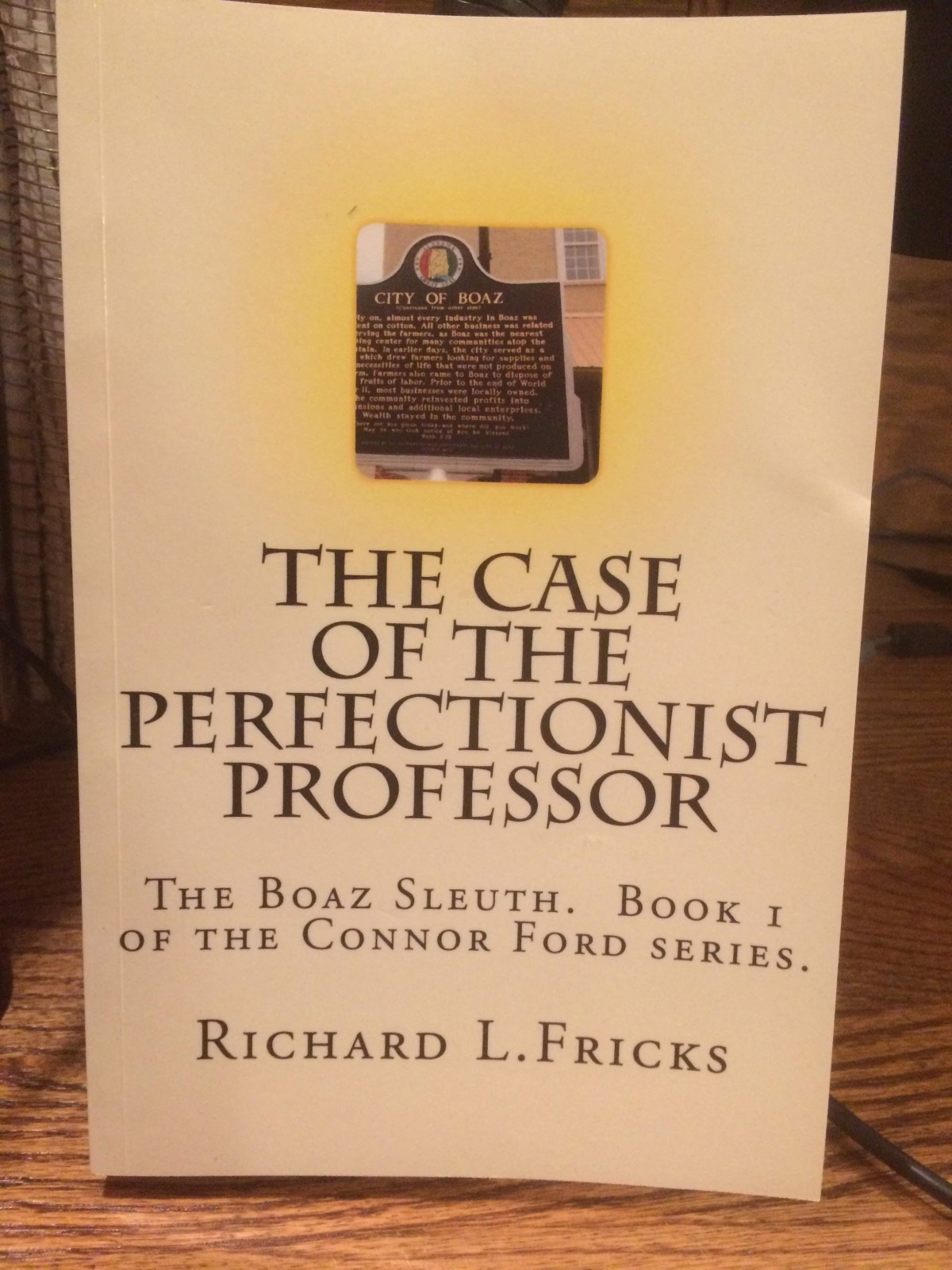
The Case of the Perfectionist Professor, written in 2018, is my sixth novel. I'll post a chapter a day over the next few weeks.
Book Blurb
Late on New Year’s Eve in the small town of Boaz, Alabama, Snead State Community College teacher Adam Parker was found dead slumped over in his car. A preliminary investigation indicated the fifty-year-old biology professor died of a heart attack. Marissa Booth, Adam’s daughter and Vanderbilt School of Divinity professor, didn’t agree.
Four days later, Marissa hired the local private detective firm of Connor Ford to investigate her father’s death. She declared local police officer Jake Stone had likely murdered her father. She pointed Ford to a multi-month Facebook feud between Adam and several local people, including Stone and Boaz City Councilman Lawton Hawks. The controversy allegedly related to Adam’s research that contended that, in layman’s terms, long-term indoctrination caused actual genetic mutations that directly affected future generation’s ability to reason.
Over the next year, Connor Ford discovered multiple and independent sources of motivation to quiet and possibly murder the controversial professor. Ford learned that a civil lawsuit and widespread public outcry had effectively run Adam out of Knoxville, where he was a biology professor for over thirteen years. Ford also learned that Adam had become the number one enemy of Roger Williams, a self-made local businessman, and his son Alex, who is a Republican candidate for governor of Alabama. Adam had discovered Alex and Glock, Inc., the Austrian-based gun manufacturer, was exploring not only the possibility of setting up a large facility in Boaz but also supplying pistols for Alex’s highly touted and controversial ‘arm the teachers’ proposal.
Connor Ford has his hands full enough with these suspects. Add in his need to determine whether Lawton Hawks and Jake Stone are friends or foes of Roger and Alex, which accentuate the pressure no normal small-town private detective can handle.
Will Connor’s discovery there is a link between Dayton, Tennessee, and the 1929 Scopes Monkey trial and a rogue group of CIA operatives bend Connor and his two associates to the breaking point?
Read this mystery/thriller to find out if Adam Parker was murdered and how, and what role the long-standing controversy between science and religion had in destroying the life of a single perfectionist professor.
Chapter 14
I had just returned from Pirates Cove with two large teas when I heard the ding from the back door. I had told Marissa to park behind our office. I sure hoped she could enlighten me about her father’s interest in the Scopes Monkey Trial. For forty-five minutes before walking across the street, I had read online about a test case brought by the ACLU to attack the State of Tennessee’s Butler Act which forbid the teaching of evolution in public schools.
“Come in. I’m in the conference room.”
Marissa was dressed in tight blue jeans and a black sleeveless blouse. It was tight too, and low-cut, revealing enough of her healthy bosom to make me realize I would have to work to fight this magnetic distraction. Why did women wear clothes that had the power to pull men’s eyes and thoughts from Heaven to haystacks? I don’t have a clue why my thoughts had leaped to my grandfather’s barn loft, high school days, and the first time Amy had allowed me to explore her young, vibrant, and exploding peaks and valleys. By the time Marissa had taken a sip of her tea, I had loosely tethered my mind to a gorgeous beautician with a $1,999 three-quarter diamond on her left-hand ring finger. I embraced a deep thankfulness for the mostly sweet Camilla. Not so much for the remaining nine payments I still owed Kay Jewelers at the Gadsden Mall.
“Thanks for meeting me on such short notice. I promise to not take all your afternoon.” I motioned for her to follow me back to my office and sit at the round oak table in the corner.
“Camilla’s working until five-thirty so I’m pretty flexible.”
“Connor, ever since Dad’s funeral and my time with mother I’ve known I needed to share with you something from his past. I’m not sure why I didn’t tell you this when I first came to you. I suppose I believed it didn’t have anything to do with his death. I’m still not sure.” Camilla said, fiddling with her iPhone. “It’s on vibrate now,” returning it to her purse sitting in the empty chair beside her.
“I’m all ears.”
“As I’ve said, Dad was a perfectionist. This necessarily meant he was never satisfied with the status quo, and was always trying to learn more, to make things better at least in his mind. Once he set his mind on something, katie-bar-the-door. He was extremely diligent and persistent, fully committed to doing whatever it takes to achieve his goal. Dad’s type always has one of two affects upon those around him. Either challenging them to do better themselves or antagonizing them with either his subject matter or his tenacity.”
“His perfectionism is written all over his journals. I wish I had met the man.” I said.
“I think it started in earnest after 9/11. I don’t remember him mentioning it before that horrible day. Mine and Dad’s relationship also changed when the Twin Towers came down. It wasn’t like it was bad before then. It was loving, caring, and kind. But, 9/11 made Dad realize how fragile life was. At the time I was twenty-three, four months shy of twenty-four, and I was just beginning work on my PhD at Harvard Divinity School, so I was extremely busy. From that day forward, he called me every day. Sorry, I got a little side-tracked. What I was about to say was that 9/11 also, someway, triggered an interest in Dad professionally.”
“Would you like me to pour your tea in a better cup?” I saw the condensation forming on both our paper cups. “Hold on, I’ll be right back.” I walked to the kitchen and returned with two red coke glasses and two coasters. After I transferred our drinks, Marissa continued.
“By this time, Dad had been at the University of Tennessee for a year and had met Kramer Dickson. He was an evolutionary psychologist there at UT. If you don’t know, here is the standard definition used. I can quote it, ‘evolutionary psychology is a theoretical approach to psychology that attempts to explain useful mental and psychological traits—such as memory, perception, or language—as adaptations, that is, as the functional products of natural selection.”
“Gosh, that’s a mouthful.” I said, revealing my intellectual capacity to grasp complex subjects. “Let me interrupt you if you don’t mind. Is this when Adam’s interest in Bullets, Babies, and Bullshit, began?”
“Oh my God, how on earth do you know that?” Marissa said with her green eyes wide enough to explode.
“My friend, Mark Hale, is an investigator with the Marshall County Sheriff’s office. Just this morning, he shared this phrase with me. Apparently, his detecting work has turned up an article written by a reporter at the Knoxville Sentinel News several years ago. I think this phrase was the article’s title, or part of it.” I said.
“Knoxville, for Dad, was like moving from Chicago to the Middle East. It was his first real exposure to fundamentalism, in his case, Southern Baptists. After a year of close observation, including being around a ton of southern students, Dad concluded there was something strange going on. To me, he expressed it like this, ‘it’s like these people have two brains, or two separate compartments to their brain. One is wholly reasonable, the other couldn’t get them out of a paper bag. They’re brainwashed and deluded. They lose connection with reality because of their allegiance to a mythical book.’ After he met Professor Dickson, his ideas, should I say, evolved. Dickson helped clarify Dad’s thinking and gave him the direction he needed. In essence, Dad began a journey to determine how a person’s environment influenced his thinking and, most importantly, whether this could produce actual gene modifications, adaptations, I think they’re called. In other words, whether one’s beliefs influenced their genes to create mutations that would be passed on to their offspring.”
“This may be changing the subject some but what can you tell me about your father’s interest in the Scopes Monkey Trial? I assume you’ve heard of that.” I asked.
“Oh, have I? Just to make sure we’re talking about the same thing, let me summarize. In the early to mid-1920’s, John Scopes was a young high school science teacher in Dayton, Tennessee. By the way, that’s only about ninety minutes from Knoxville; Dad made the trip on several occasions. Scopes was accused of teaching evolution in violation of a Tennessee state law, known as the Butler Act. That law was a misdemeanor punishable by fine. The law said it was a violation, and again I quote, ‘to teach any theory that denies the story of the Divine Creation of man as taught in the Bible, and to teach instead that man has descended from a lower order of animals.’
“Someway, Scopes intentionally got arrested and charged with violating the Butler Act and enlisted the aid of the American Civil Liberties Union (ACLU) to organize a defense. Apparently, the well-known William Jennings Bryan, a fundamentalist hero of a sort, and a three-time Democratic Party presidential candidate, agreed to assist in prosecuting the case. Not to be outdone, the ACLU enlisted the famous Clarence Darrow to defend Scopes. As you can see, this set the stage for one of America’s most famous trials.
“As the trial got underway, Dayton, Tennessee took on a carnival-like atmosphere with hordes of spectators and reporters. Preachers set up revival tents and kept the faithful stirred up.
Initially, the defense didn’t fare so well. Sorry, for the pun. The Judge shut-down Darrow’s attempt to argue the Butler Act was unconstitutional. The Judge also refused to stop his practice of opening each day’s proceedings with prayer.”
I knew Marissa must be needing a sip of tea, so I interjected. “See if you’ve heard this. I just read it before you arrived. There’s no doubt the scene outside the courthouse was quite a spectacle. There was an exhibit featuring two chimpanzees and a supposed ‘missing link.’ Vendors sold Bibles, toy monkeys, hot dogs, and lemonade. The missing link was in fact a man from Burlington, Vermont, a 51-year-old man, Jo Viens, I think was his name.”
“I have definitely read that. What happened in the courthouse was much more interesting to me. Not surprisingly, the Judge continued to destroy the defense’s strategy by ruling that expert scientific testimony on evolution was inadmissible.”
“Why on earth did he rule that?” I asked, almost feeling nostalgic towards a courtroom, recalling a few defendants I had represented who themselves proved humans were two chromosomes short of being a chimpanzee.
“The Judge said that it was Scopes who was on trial, and not the law he had violated.” Marissa said.
“That’s bullshit.”
“That’s what Did thought too. Obviously, the Judge was as much a fundamentalist as William Jennings Bryan and ninety-nine percent of everyone else in Dayton, Tennessee.”
“Get this, the Judge moved the trial outdoors, apparently, there were so many people in the courtroom he was afraid the floor would collapse.”
I was glad I had spent the time before Marissa arrived reading several articles from the Internet. “Clarence Darrow was brilliant. I read that for some reason this physical relocation caused him to change his trial strategy. He called Bryan as his only defense witness to discredit his literal interpretation of the Bible. Darrow was already known for his dissecting examinations. In law school, my trial practice professor had us read Darrow’s masterpiece. He subjected Bryan to severe ridicule and forced him to make ignorant and contradictory statements. I’m not sure how much the crowd was amused to see one of their own suffer such embarrassment.” I said.
Marissa jumped in and said, “I think it all turned out for the good. Darrow, in his closing argument, asked the jury to return a verdict of guilty in order that the case might be appealed. For some strange reason, under Tennessee law at the time, Bryan was denied the opportunity to deliver the closing speech he had been preparing for weeks. The jury, after only eight minutes I believe, returned with a guilty verdict. The Judge ordered Scopes to pay a fine of $100. Here’s the part I love, although Bryan won the case, he had been publicly humiliated, and his fundamentalist beliefs had been disgraced. Then, I think it was four or five days later, on July 26, he lay down for a Sunday afternoon nap and never woke up. That probably is a little mean of me.”
“Justice I guess. A year or so later, the Tennessee Supreme Court overturned the Monkey Trial verdict on a technicality but left the constitutional issues unresolved. And, here’s something even better. In 1968, the U.S. Supreme Court overturned a similar Arkansas law claiming it violated the First Amendment.” I said.
“One thing that didn’t change. The clear majority of American Christians still don’t want evolution taught in their public schools. The fundamentalists among them, you know the ones who hold to a literalistic interpretation of the Bible, they know evolution wholly obliterates Genesis and the creation story.”
Over the next hour, Marissa and I continued to talk, including about how Adam, from the early fall of 2001 until he was forced out of UT in May 2014, had continued to research and develop his evolutionary psychological theory, always with the capable assistance of his colleague, Dr. Kramer Dickson. Marissa even, without my prompting, shared the story of how her father believed he was a modern-day Galileo, labeled as a heretic in the South for his stance against the Southern Baptist community who deeply believed evolution was a lie, guns were as normal and necessary as breathing, and the Bible, every word of it, was written by God Himself. Right before Marissa changed our subject, I became convinced that both Galileo and Parker were either insane or virtually incomparable in their bravery in confronting two of the most powerful and dominating Christian organizations on the planet. I didn’t know much about Catholics, but I had grown up with Southern Baptists. I knew they were as dogmatic in their fundamentalism as William Jennings Bryan ever dared to be.
Before Marissa left a few minutes after three, she shared one other thing that had a lifelong affect upon her father. It was the death of her sister, Marianna, Adam and Anna Parker’s first child. Marissa described how her parents had learned during Anna’s pregnancy that the child was likely deformed or would likely suffer from some birth defect. Adam and Anna had struggled over the decision whether or to have an abortion. Adam had been for it. Anna against it. Adam never forgave himself for the pain Anna had endured during her pregnancy, having nearly died on two separate occasions. When Marianna was born dead, it nearly destroyed both parents, but Adam always blamed himself for not having the determination to persuade Anna once they learned of the baby’s condition.
After Marissa left, I sat and pondered the connection, if any, between Anna’s first pregnancy and the death of Marianna, and Adam’s apparent infatuation with both his abortion-related research, and his theory that bullets, babies, and bullshit were mutating genes, creating a whole new species of homo sapiens.

 Richard L. Fricks