
The primary aim of the "Novel Excerpts" blog category is to showcase my creative writing, specifically from the novels I've written. Hopefully, these posts will provide a glimpse into my storytelling style, themes, and narrative skills. It's an opportunity to share my artistic expressions and the worlds I've created through my novels.
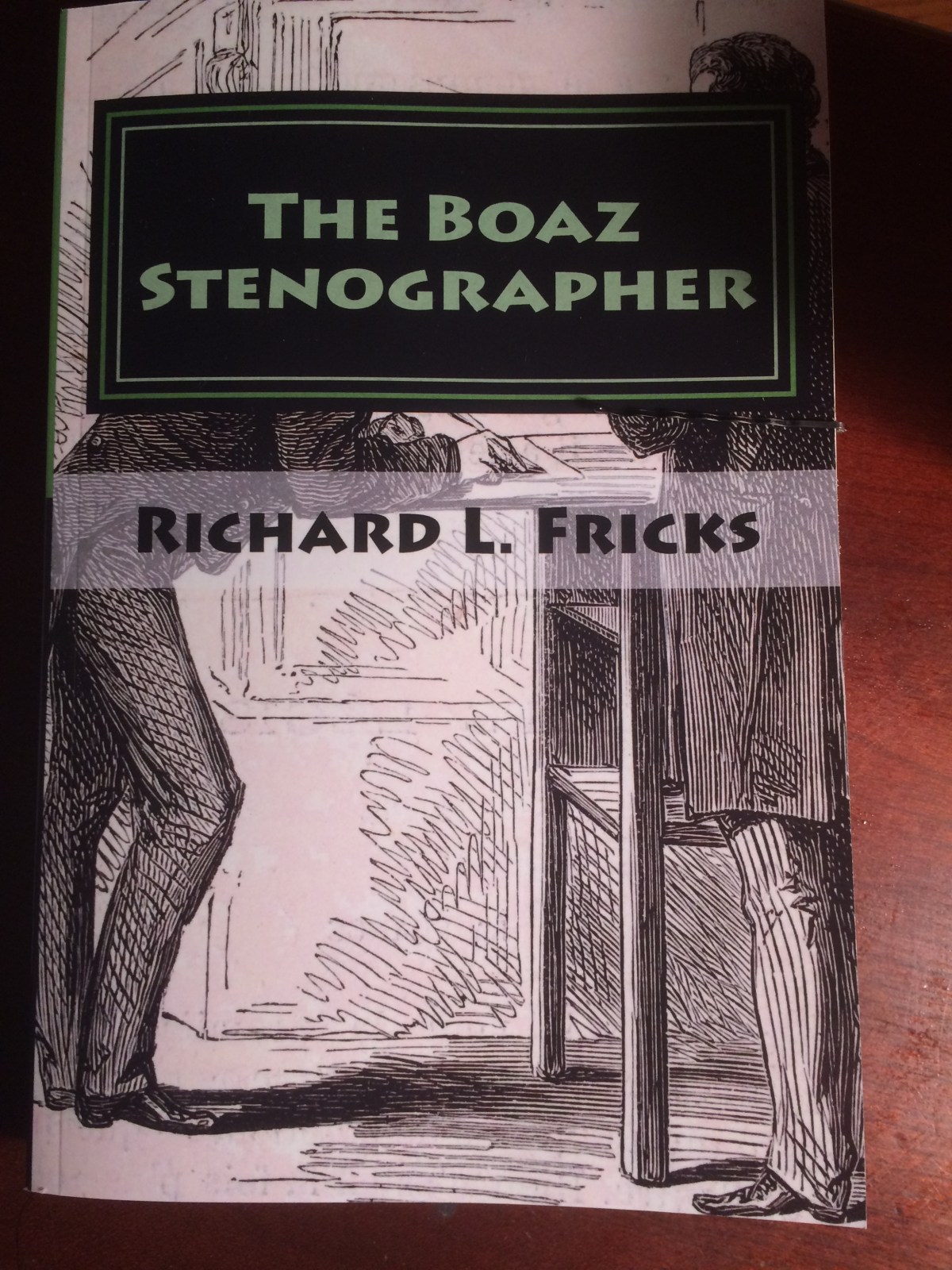
The Boaz Stenographer, written in 2018, is my fourth novel. I'll post a chapter a day over the next few weeks.
Book Blurb
Walt Shepherd, a 35 year veteran of the White House’s stenographic team, is fired by President Andrew Kane for refusing to lie.
Walt returns to his hometown of Boaz, Alabama and renews his relationship with Regina Gillan, his high school sweetheart, who he had ditched right before graduation to marry the daughter of a prominent local businessman. Regina has recently moved back to Boaz after forty years in Chicago working at the Tribune. She is now editor of the Sand Mountain Reporter, a local newspaper.
Walt and Regina’s relationship transforms into a once in life love at the same time they are being immersed in a growing local and national divide between Democrats and traditional Republicans, and extremist Republicans (known as Kanites) who are becoming more dogmatic about the revolution that began during President Kanes campaign.
Walt accepts two part-time jobs. One as a stenography instructor at Snead State Community College in Boaz, and one as an itinerant stenographer with Rains & Associates out of Birmingham.
Walt later learns the owner of Rains & Associates is also one of five men who created the Constitution Foundation and is involved in a sinister plot to destroy President Kane, but is using an unorthodox method to achieve its objective. The Foundation is doing everything it can to prevent President Kane from being reelected in 2020, and is scheming to initiate a civil war that will hopefully restore allegiance to the U.S. Constitution.
While Walt is writing a book, The Coming Civil War, he is, unwittingly, gathering key information for the Constitution Foundation.
Will Walt discover a connection between the Foundation and the deaths of three U.S. Congressmen in time to save his relationship with Regina, prevent President Kane from being reelected as the defacto head of a Christian theocracy, and the eruption of a civil war that could destroy the Nation ?
Chapter 60
I started working as Judge Broadside’s court reporter the Monday after Ginger made her request. For the past three weeks I had fallen into somewhat of a routine. Monday’s were reserved for a criminal motions docket. Things like hearings on a defendant’s motion to either set bond or reduce a bond. Also, I was surprised by the number of motions to suppress. These too were filed by criminal defendants who were attempting to persuade the Judge that law enforcement had illegally obtained evidence. I found the U.S. Constitution’s Fourth Amendment protections to be not only interesting but refreshing. It was good to know that America’s Founding Fathers believed in protecting citizens freedom. Tuesdays, for me, were devoted to cleaning up Monday’s transcripts, reviewing for errors and making corrections, and an occasional court appearance to record a criminal plea that, for some reason, couldn’t wait until the next criminal docket week. My few mistakes allowed me the luxury of leaving by early afternoon.
Wednesdays were for civil case motions. Sometimes these spilled over into Thursdays. By end of day on Thursday I was always caught up with my civil transcript review. I was off on Friday’s unless the Judge had a trial. Every two weeks was a trial week, either for a civil case or a criminal case. Sometimes there were several trials per week. This was my favorite part of the job. Every trial told a story. Often, the story was tragic, more than any fiction author could ever imagine.
I guess routines are made to be broken. Today, Judge Broadside agreed to hold the preliminary hearing for Anton Romanov. Normally, a District Court Judge hears these matters. But, both judges were in New Orleans at a Judge’s conference and the twenty-day deadline for Romanov’s preliminary hearing was today. Every criminal defendant has a legal right to a preliminary hearing within twenty days of arrest. If not, he must be released. District Attorney Charles Abbott certainly couldn’t allow that to happen. Judge Broadside reluctantly agreed.
Romanov was represented by Boaz attorney Micaden Tanner, a high school classmate of mine. All the time I was driving home after the Hearing I couldn’t help but think about what all he had gone through since we graduated in 1972. He endured as a criminal defendant in a trial in the same courtroom I now worked. Micaden had been falsely accused of kidnapping and murdering two girls from Douglas. His court ordeal ended in a mistrial. And if that weren’t enough trauma for one life, just recently he had been exonerated in the kidnapping and murder case of Gina Tillman. Since I had moved back to Boaz last December I had seen Micaden a few times around town. We had just chit-chatted. We had never been close friends but seemed to always share a mutual respect. After watching him in court today I felt I wanted to get to know him better. Anyone who had suffered as he had no doubt had a few interesting stories to tell.
Romanov’s hearing was straight-forward. I guess my ignorance shown through as I believed that the Prosecutor would ask all types of questions about Romanov’s relationship to Russian President Putin and how the two of them were involved in manipulating the 2016 Presidential election. I’m learning that court is a lot different than life, or the type of life where people are sitting around for a friendly, or not so friendly, chat. The Alabama Rules of Evidence were something I was learning a little about and a subject I intended to pursue.
District Attorney Abbott called Frankie Olinger to testify about what happened at Club Eden the weekend before Kip Brewer was shot and killed. Frankie acknowledged that Romanov was there, that he participated in their across-the-lake shooting practice, and that he had shot Frankie’s own 30-06 rifle. He also testified that his rifle had gone missing for over a week but suddenly and surprisingly reappeared, but he admitted that he was rather forgetful and could have simply forgotten how he had handled the rifle. Frankie’s examination ended with him sharing how Romanov talked about looking forward to seeing and hearing Kip Brewer at his upcoming Town Hall meeting in Boaz.
Regina had testified how she discovered Romanov’s photograph, or what she believed to be a photo of him. The security camera at the Quik-Mart in Aurora had caught Romanov around 8:30 a.m. on the morning Brewer was murdered. The store’s clerk also testified to authenticate the photo. He said he could not be sure that the man he saw in the store that morning was the same man sitting in the courtroom beside Micaden.
DA Abbot concluded his case presentation with a flurry of witnesses that all had only one or two points to make. Sean Miller, Kip Brewer’s lead Secret Service agent, testified about hearing a gunshot and finding Brewer dead on the back deck of his home. Angela Peterson with the Department of Forensic Sciences testified about Brewers autopsy and that he was killed by a single gunshot wound to the head. Her counterpart, Eric Tomlinson, from the ballistics office, testified the bullet that killed Brewer was from a 30-06 Springfield rifle. In fact, it was from the rifle seized during a search from the home of Frankie Olinger.
The prosecutor seemed to easily meet his burden, which was low. This wasn’t a trial. The purpose of a preliminary hearing is to determine if there is probable cause the defendant committed the alleged crime. It commanded only a low threshold of evidence. To me, of course I’m no lawyer, the burden is like a civil case where the term is ‘by the preponderance of the evidence.’ Many legal scholars called it the ‘more likely than not’ rule. It certainly seemed to me, given these things that were racing through my mind as I traveled Highway 431 South towards Boaz, more likely than not, Anton Romanov murdered Kip Brewer.
But, Micaden Tanner saw things totally different. He homed in on the issue of the photograph. His questioning, his cross-examining, was clear and direct. First, he attacked the photograph itself. After the hearing, I viewed the photo, since I am responsible for transferring Exhibits back to the Clerk’s office. I saw what Micaden was arguing about. Even though the photo was a little cloudy, I could see where a reasonable person could argue the man there on the Quik-Mart security camera was not Anton Romanov. His nose, to me, was all wrong. Micaden, argued to Judge Broadside, that DA Abbott had wholly failed to prove that the man in the photo was Anton Romanov, and even if it was, how did that lend any credibility to the accusation he had shot and killed Kip Brewer. Micaden’s other line of questioning dealt with the 3006 rifle itself. Micaden was almost sarcastic when he asked Eric Tomlinson to repeat whose fingerprints had been found on the rifle. He repeated, “Frankie Olinger.”
I learned a valuable lesson at court today. The prosecution’s power to pursue a criminal conviction against a defendant is enormous. If I had been the Judge in this case I truly believe I would have ruled against the State. I would have ruled that it failed to prove probable cause. But, that’s not what happened. Judge Broadside’s full statement before he slammed down his gavel was, “I find probable cause in the case of State of Alabama vs. Anton Romanov.”
Turning into my driveway I once again was alarmed that I didn’t remember anything about my drive from Guntersville. It was like I had been in a fog and someone else had transported me all the way. The thought that I had better start paying more attention to my driving left me as soon as I rounded the curve towards the back of my house. There, I was greeted with two beauties, Regina and Sandi, both sitting on the big wooden swing on the far end of the porch. I so loved them both and was a lucky man to have them in my life.

 Richard L. Fricks