
The primary aim of the "Novel Excerpts" blog category is to showcase my creative writing, specifically from the novels I've written. Hopefully, these posts will provide a glimpse into my storytelling style, themes, and narrative skills. It's an opportunity to share my artistic expressions and the worlds I've created through my novels.
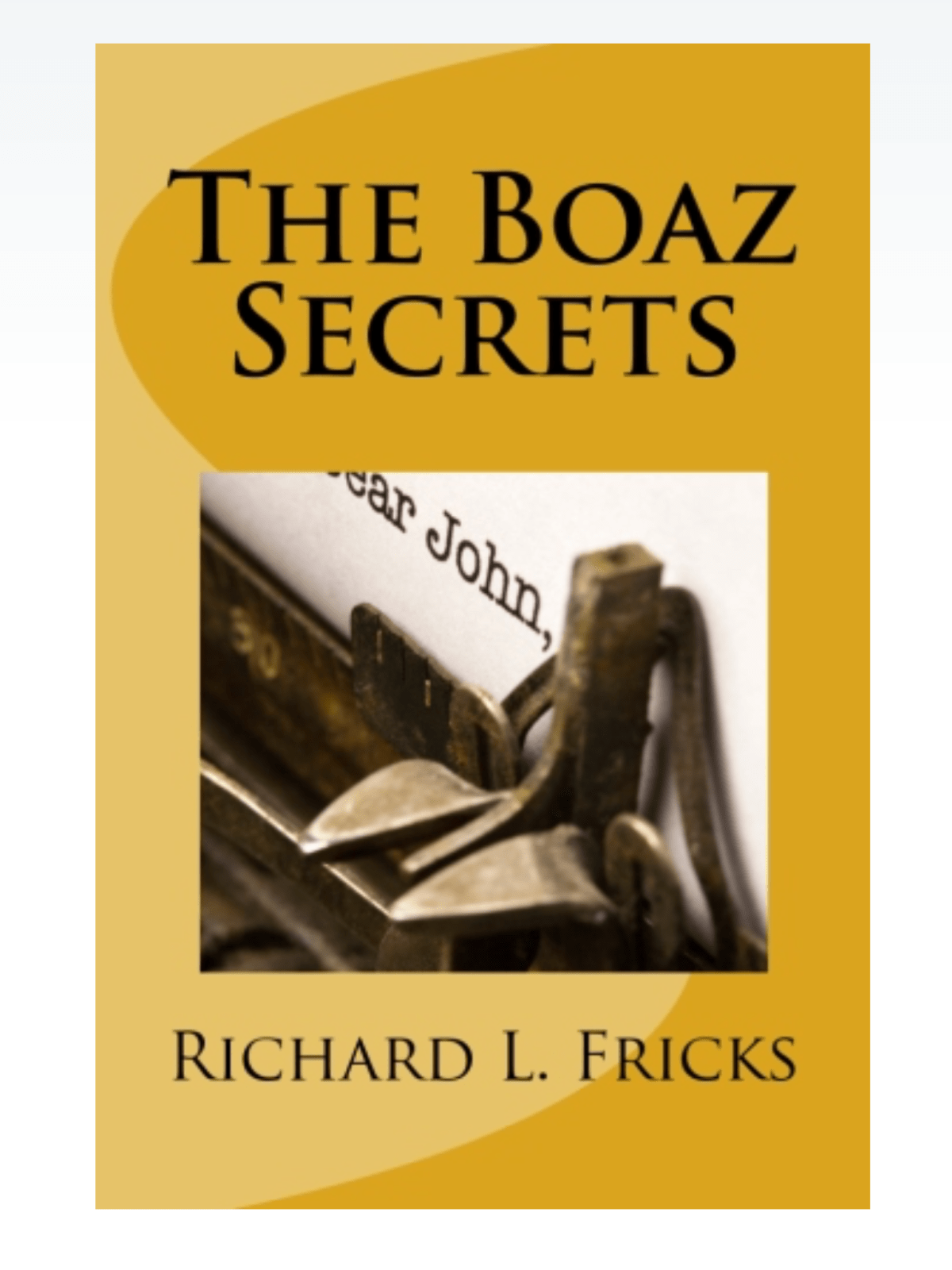
The Boaz Secrets, written in 2018, is my third novel. I'll post a chapter a day over the next few weeks.
Book Blurb
Fifteen year-old Matt Benson moves with Robert, his widowed father, to Boaz, Alabama for one year as Robert conducts research on Southern Baptist Fundamentalism. Robert, a professor of Bible History and new Testament Theology at the University of Chicago’s Divinity School enlists Matt to assist him as an undercover agent at First Baptist Church of Christ. Matt’s job is to befriend the most active young person in the Church’s youth group and learn the heart and mind of teenagers growing up as fundamentalist Southern Baptists.
Olivia Tillman is the fourteen year old daughter of Betty and Walter Tillman. He is the pastor of First Baptist Church of Christ. Robert and Matt move to Boaz in June 1970, and before high school begins in mid-August, Matt and Olivia become fast friends. Olivia’s life is centered around her faith, her family, and her friends. She is struck with Matt and his doubts and vows to win him to Christ. Over the next year, Matt and Olivia’s relationship blossoms into more than a teenage romance, despite their different religious beliefs.
June 1971 and Matt’s return to Chicago comes too quickly, but the two teenagers vow to never lose what they have, even promising to reunite at college in three years after Olivia graduates from Boaz High School.
The Boaz Secrets is told from the perspective of past and present. The story alternates between 1970-1971, and 2017-2018. After Matt left Boaz in June 1971, life happened and Olivia and Matt’s plans fell apart. However, in December 2017, their lives crossed again, almost miraculously, and they have a month in Boaz to catch up on forty-six years of being apart. They attempt to discover whether their teenage love can be rekindled and transformed into an adult romance even though Matt is 63 and Olivia is 61.
In 2017, Olivia and Matt are quick to learn they are vastly different people than they were as fifteen and sixteen year old teenagers– especially, when it comes to religion and faith. Will these religious differences unite them? The real issue is the secret Olivia has kept. Will Matt’s discovery destroy any chance he and Olivia have of rekindling their teenage relationship?
Chapter 14
December 14, 2017
Thursday couldn’t have come too soon. John and Paul’s plane was scheduled to arrive in Birmingham at 1:45 p.m. Olivia and I had decided to spend the morning in Talladega at the Federal Correctional Institution. It was here that Walter and Wade Tillman, and James Adams, were being held awaiting their criminal trials.
We arrived in Talladega at 9:00 a.m. after an hour’s drive reliving the three days we, along with sixty other members of the First Baptist Church of Christ youth group, had spent in Gatlinburg, Tennessee in December 1970. We had taken this trip during the Christmas break from school. For the first time, I could be completely honest with Olivia about how she had treated me that entire long weekend. She had provided John Ericson almost uninterrupted attention. Back then, after we had returned from Gatlinburg, she had told me that the two of them were just friends and that she was trying to get him to realize he was lost. She explained that a real Christian didn’t act and talk the way he did. Olivia expressed sincere grief over John’s disappearance (and assumed death), along with the same for Randall Radford and Fred Billingsley sometime during 2016. I was not one to hold a grudge, but I still didn’t feel any sadness over his disappearance and assumed death that had taken place last year.
For the next two hours, I sat before James, separated by impenetrable glass, holding an ancient phone, and talking non-stop. Olivia, I assumed was doing the same, except alternating her time between Walter and Wade. I wouldn’t have recognized James if it hadn’t been for his voice, and possibly his eyes. He didn’t seem nearly as tall as I remembered him. It could have been the way he walked, and slouched, even while sitting. I hadn’t seen him since the day Dad and I had left Boaz in June 1971. He was probably fifty pounds lighter, balding, and now wore glasses. His skin looked as yellow as someone about to die from liver failure. He seemed pleased that I had come. At first, I asked all the questions and he responded with the shortest answers possible. But, after thirty minutes he had taken control of the entire conversation. He wanted to know everything about my life. The last hour, he talked about his two children, Justin, and Loree Adams Neilson, and his four grandchildren. James seemed concerned that I had never had children. We didn’t talk about his predicament. I felt that he would have brought it up if he had wanted to talk about it. When my two hours were up, he placed his right hand upon the glass with his fingers splayed out as much as he could. He said, “The Flaming Five are dying a slow but certain death. Please remember Randall Radford, Fred Billingsley, and John Ericson. Pray they may be found and that they are alive.” I placed my left hand over his, almost feeling his slowing pulse although separated by the half-inch glass. The prison guard came for him and I didn’t know what to say. In hindsight it was stupid, but the only way I could give James hope was to say, “stay strong my friend because when we meet again I’m going to kick your butt in ping-pong.” He smiled as the guard led him away.
Olivia had arranged with John and Paul to meet us at the airport. During the entire drive from Talladega to Birmingham, it seemed all Olivia could do was cry. She didn’t gain control until we were parked on level four in the parking deck across from the airport terminal. “Thanks for respecting my need to let it all come out. I’ve kept it in for nearly half a century.”
“I’m sorry your visit with your father and brother were so painful.” I said as we walked toward the elevators.
“Seeing my father and Wade brought back such horrible memories. I relived every bad thing they ever did to me.”
“Try to recognize the flip side. You and I are here to meet our children. Olivia, we are eternally connected. To me, that is the most beautiful thing I could ever imagine. I love you today more than ever. Let’s try to forget the bad and focus on the good.”
“You’re right. Thanks. You have always had a way of making me feel safe and secure.”
John and Paul’s plane was delayed. Something about snow in Cleveland, Ohio. I had never been able to figure out airline logistics. Our two sons were flying from Dallas, Texas to Birmingham, Alabama. Why on earth would they fly through Ohio?
At 4:30 p.m., after over an hour and a half waiting, Olivia screamed with excitement as she elbowed me hard and said, “There they are.” She had recognized them instantly, the first moment they were visible walking from inside the long hallway from their plane.
I looked over and my mind raced back nearly fifty years. I thought I was seeing Wade as he looked in high school. My mind changed its framing the closer they got. Olivia had made one of the silly little signs that people use to connect with a long-lost friend or someone they had never met. Her sign read, ‘Olivia Tillman.’ She had drawn a large heart shape where she had written, ‘Mother loves her twins,’ in smaller letters. They must have heard Olivia’s scream although I didn’t think it was that loud. No doubt the three of them were already connecting because John and Paul were jogging towards us. Now, it seemed the two of them looked like Walter Tillman. I quickly did the math and thought it a strange coincidence that John and Paul were now only a few years older than Walter was when I moved to Boaz in 1970; Walter would have been around 40 to 41 and John and Paul would now be 44. They looked exactly like I remember Walter when I was fifteen years old.
“Mother.” They both said, sitting their carry-on bags down and reaching out for a visibly shaken Olivia. The three of them stood in a circle with arms enveloping arms while cheek-kisses abounded amid multiple streams of tears. I had never felt so alone. It was like I was invisible. Neither John nor Paul had even peeked a look at me. Finally, emotions subsided, or their arms grew weary of an uncomfortable embrace, and they all three turned to me.
“This is your father, Matthew William Benson.” Olivia said walking over to me and taking my hand. He is the reason you two are so good-looking.
I made the first move and took two steps forward. They responded as I had hoped. They both shook my hand and first, Paul, and then, John, reached out and gave me a man-type hug. They were both tall and slender. They certainly looked more like Olivia than me.
The four of us stood there for five minutes chatting about their flight and the delay from the heavy snowstorm in Cleveland. We finally decided to go to the Cracker Barrel restaurant in Trussville, just north of Birmingham. Olivia gave them the address and John and Paul left, but only after another hug. We went on ahead and let them grab their luggage and sign-out their rental car. By 5:15, we were all four sitting at a table in the far back corner of Olivia’s favorite restaurant.
As Olivia and her boys started the long process of attempting to compress half a century into a two-hour dinner, I watched the two middle-aged men. Paul was like a miniature version of John. They both had blue eyes, high cheekbones and dark hair. I concluded that these characteristics came from Walter’s side. He was the dark-haired ancestor. Olivia, no doubt, had inherited her blondness from Betty, her mother. Other than Paul being slightly smaller than John, his hair was more salt and pepper. It looked like Paul might have been dying his hair to retain a more youthful look.
As our visit continued, I learned there were much more than visible differences between John and Paul. Even though both were college professors, their chosen subjects could hardly contrast more. John was a paleoanthropologist at the University of Michigan. Paul was a professor of New Testament at Moody Theological Seminary in Chicago. At a high school in Dallas, they both had earned academic scholarships to Harvard, but Paul had transferred to Liberty University in Lynchburg, Virginia after his first semester. About an hour into our meal, I felt a rising antagonism building between the brothers. It didn’t take long for Olivia and me to notice that John was clearly an agnostic and Paul was virtually a spitting image of his grandfather regarding his fundamentalist Christian beliefs. I was relieved to see how Olivia diffused the mounting angst when she said, “I can see me in both of you. I have walked along both paths, that of faith and that of disbelief. I know and have known many people, most that I still consider as friends, who differed vastly concerning their religious positions, but one thing is central to all. We are humans. We may not know exactly how we got here, but we know that to survive, we must join hands and pull in the same direction. Now, who wants coconut pie?”
“I’m proud of you.” I told Olivia as we drove back to Boaz. She had held both her boys close once again as we all stood outside in the restaurant parking lot. I again shook their hands. No man hug was needed. John and Paul had shared how they were going to spend the next several days driving and reconnecting with the great outdoors. Both had been Eagle Scouts during high school and they wanted to hike a portion of the Appalachian Trail starting in North Georgia. They promised they would come to Boaz for Christmas.
“Why do you say that?” Olivia said, sitting leaning towards me across the console.
“You doused what I knew was a hot fire erupting between John and Paul. It was clear the two of them have some unsettled ground between them when it comes to the God question.”
“I’m trained you know. I know both sides and learned long ago that there’s not much to be gained by arguing over Jesus. It’s hard enough to deal with God, as a deist, the creator and now the silent and absent God, much less than dealing with Him having a son by a virgin girl who overcame death, and traveled back to Heaven. It’s such a waste of time.”
“I have a feeling that John’s evidence, his work with Lee Berger during the expedition in the excavation of Homo naledi at Rising Star Cave in South Africa, would give Paul a little difficulty.
“I doubt it. Paul would simply respond, “naledi wasn’t a human my dear brother. He, it, was just an ape.”
“I suppose you are correct. True believers, fundamentalist believers, know nothing of human evolution. They will die believing God created Adam and Eve in the Garden of Eden less than ten thousand years ago.” I said, reminded that my world of biology and genetics was waiting on me in Chicago, and I needed to buy a box of Christmas cards to send to my dearest friends and co-teachers.
During the next hour, all Olivia wanted to talk about was how things would have likely been if she and I had found a way nearly half a century ago to stay together, get married, and raise our two boys. I found the entire conversation debilitating. But, I did enjoy Olivia’s hand in mine.

 Richard L. Fricks