
The primary aim of the "Novel Excerpts" blog category is to showcase my creative writing, specifically from the novels I've written. Hopefully, these posts will provide a glimpse into my storytelling style, themes, and narrative skills. It's an opportunity to share my artistic expressions and the worlds I've created through my novels.
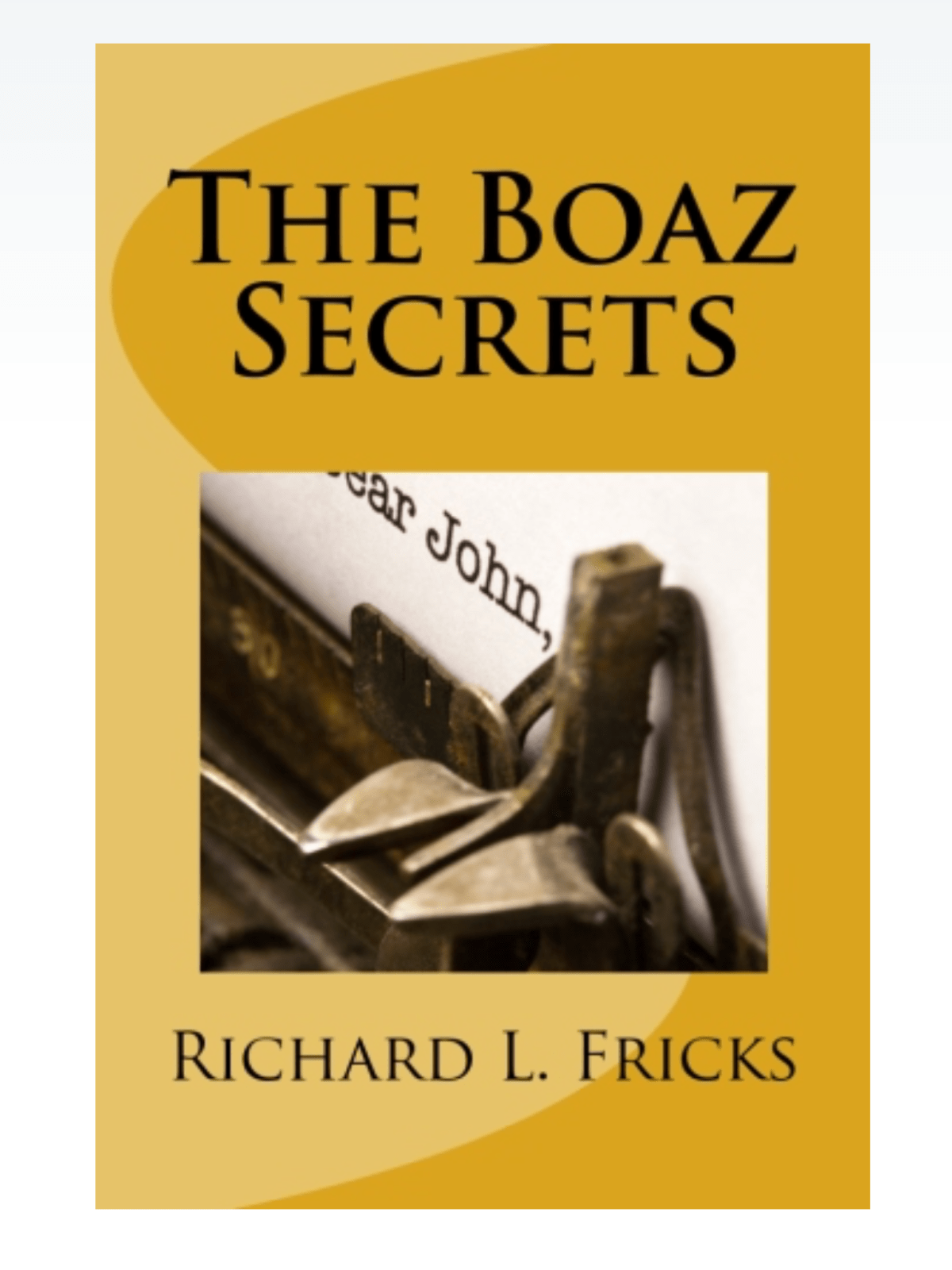
The Boaz Secrets, written in 2018, is my third novel. I'll post a chapter a day over the next few weeks.
Book Blurb
Fifteen year-old Matt Benson moves with Robert, his widowed father, to Boaz, Alabama for one year as Robert conducts research on Southern Baptist Fundamentalism. Robert, a professor of Bible History and new Testament Theology at the University of Chicago’s Divinity School enlists Matt to assist him as an undercover agent at First Baptist Church of Christ. Matt’s job is to befriend the most active young person in the Church’s youth group and learn the heart and mind of teenagers growing up as fundamentalist Southern Baptists.
Olivia Tillman is the fourteen year old daughter of Betty and Walter Tillman. He is the pastor of First Baptist Church of Christ. Robert and Matt move to Boaz in June 1970, and before high school begins in mid-August, Matt and Olivia become fast friends. Olivia’s life is centered around her faith, her family, and her friends. She is struck with Matt and his doubts and vows to win him to Christ. Over the next year, Matt and Olivia’s relationship blossoms into more than a teenage romance, despite their different religious beliefs.
June 1971 and Matt’s return to Chicago comes too quickly, but the two teenagers vow to never lose what they have, even promising to reunite at college in three years after Olivia graduates from Boaz High School.
The Boaz Secrets is told from the perspective of past and present. The story alternates between 1970-1971, and 2017-2018. After Matt left Boaz in June 1971, life happened and Olivia and Matt’s plans fell apart. However, in December 2017, their lives crossed again, almost miraculously, and they have a month in Boaz to catch up on forty-six years of being apart. They attempt to discover whether their teenage love can be rekindled and transformed into an adult romance even though Matt is 63 and Olivia is 61.
In 2017, Olivia and Matt are quick to learn they are vastly different people than they were as fifteen and sixteen year old teenagers– especially, when it comes to religion and faith. Will these religious differences unite them? The real issue is the secret Olivia has kept. Will Matt’s discovery destroy any chance he and Olivia have of rekindling their teenage relationship?
Chapter 2
December 1, 2017
Professor Olivia Tillman walked down the long corridor to Lecture Hall 201 in the Harborough Tower to her final lecture this semester. After her presentation she was leaving for an extended leave of absence to return to her hometown of Boaz, Alabama to support her father and brother who are facing criminal charges.
As usual, the large classroom was crowded and noisy. The 150 or so male and female students, were first and second year students at the University of North Carolina at Chapel Hill, and most came from Christian homes across the Southeast United States. As Olivia stood behind the lecture podium and opened her notebook she noticed three older men sitting side-by-side across the front row. “Good morning to everyone and especially to our three visitors.”
The oldest looking of the three, a man at least 70, short and stocky with a mountain of flowing gray hair that made his body look too small for his large head, stood as the other students grew still and silent, “Professor Tillman, I’m Bert Davis and this is Pete Appleton and Ralph Kindle. Our lovely wives asked us to join them here today for your last lecture.” Minnie Davis, Sarah Appleton, and Bernadette Kindle were three older students who both delighted and frustrated Olivia. It seemed they wanted themselves, almost believed themselves, to be the professor of Olivia’s New Testament History and Formation’s class.
“Nice to meet you and welcome to our class.” Olivia said with a smile and then looked out over an ocean of youth, all struggling to square what they had been exposed to this semester at the feet of Professor Olivia Tillman who for the past six years had filled the shoes of professor emeritus, Harrison Bolton, who retired in the summer of 2011. Her students were not the only ones who had struggled. Olivia, from the mid-1980s until 2011, had served as Professor of Systematic and Historical Theology at Southwestern Baptist Theological Seminary in Dallas, Texas where she had taught various subjects related to Systematic Theology, Historical Theology, Early Christianity, and Baptist Heritage. During Olivia’s last five years at Southwestern she had experienced the complete devolution of her faith. Skepticism and unease since the loss of her husband in 2008 had grown into a private but exhaustive exploration of every aspect of her long-held beliefs. Ultimately, the struggle to say and teach one thing to her Divinity students and live and believe quite the opposite, had heralded the complete transformation of her professional life, including a move to the secular world of Chapel Hill where Olivia was focused on teaching historical truths.
Bert responded with, “we’re excited to be here, and I apologize for interrupting. We’ll sit here and be good students.”
Olivia looked up and scanned the entire classroom. “Tomorrow is your final exam. Today, I will review. I strongly suggest you listen and take good notes. You might hear something important.” Olivia said fully present in body, but the true location of her mind was another matter. She was worried sick about her brother Wade, and father Walter, both former pastors of First Baptist Church of Christ in Boaz. Leading this church was a long tradition for the male side of the Tillman family. In addition to Walter and Wade, their forefathers, Rudolph, Morton, and Waymon had also held the same position. And currently, Wade’s son Warren was the head pastor at the Southern Baptist Church.
As Olivia glanced at her notes she wondered if there was something else working in her deep subconscious. She felt almost a foreboding spirit descending into the depths of her mind and heart.
“Class, first recall that we don’t know, historical evidence does not reveal the authors of the four gospels that made it into the final version of the Bible. We do know they were not Matthew, Mark, Luke, and John. Clearly, they were not written by the named person. These gospels were written by highly literate Greeks, not uneducated peasants such as Matthew, Mark, and John. Luke could have been some sort of doctor, but it is undisputed he spoke Armenian and not Greek. It is difficult, impossible to write in the Greek language if you do not speak that language. Recall, evidence indicates that the Gospel of Mark was written somewhere around 65 to 70 A.D., with Matthew and Luke following a generation later, say around 85 to 90 A.D. and the Gospel of John, most likely, around the year 120 A.D. It is important you note that there were many other competing gospels written during these same time frames and none of them were chosen to join the biblical canon. It may have been, in part, because of some of their more fantastical claims, such as Jesus, as a young man, a carpenter, causing some furniture to suddenly appear, or some lumber to mysteriously stretch to the lengths needed. Know that all original manuscripts are lost. And, what manuscripts we have are all copies of copies of copies, all containing countless discrepancies. As to the Bible, the earliest complete manuscript we have is dated around 900 A.D.”
Olivia spent the next hour covering a variety of topics her New Testament class had covered during the semester, including the Apostle Paul’s writings from 25 to 35 A.D., where he admitted his knowledge of Christ had come strictly from revelation and not directly from man. Other topics included Second Peter; other forgeries; a mini-lecture on how an illiterate peasant became an itinerant preacher and later developed a reputation of being the son of God. At 11:45 a.m., Olivia completed her lecture and dismissed the class. As she was gathering her things, Sarah Appleton approached the podium and asked if she had a few minutes to talk to her and her five friends.
“Sure, I’d be happy to, but I do have a lunch appointment at 12:30, downtown Chapel Hill.”
“Minnie, Bernadette, and I know your story, but our husbands don’t really believe we have been totally honest. They simply don’t see how a devoted Christian could ever leave the faith and stop believing in the existence of the Christian God, Jesus, and the Holy Spirit. Do you mind giving them a short version where they can hear it, pardon me, from the horse’s mouth. No disrespect intended of course.” Sarah no doubt was the queen bee of the sizzling six, the three older ladies and their husbands.
“I’m always willing to share my testimony, nobody knows it better than me. Thanks again Bert, Pete, and Ralph for coming today. It is an honor to meet you. I suspect you already know this, but you guys have wonderfully inquisitive wives and I have thoroughly enjoyed my time with them this semester. They each remind me of myself in so many ways. Now, let me say it is virtually impossible to give you, in the few minutes I now have, a full representation of every stage I went through in abandoning my faith and belief. So, keep that in mind.
“I grew up in Boaz, Alabama in a devout Christian home, my father, his father and on back for generations were all Southern Baptist preachers. From the time I could walk and talk I was sold out on Jesus and Christianity. I spent as much time in church as I did at home. I followed my father around like I was his shadow. From junior high throughout high school I was the ring leader of our youth group. My number one priority was sharing the gospel message. About the only regret I can recall from my high school years was failing to evangelize an eleventh-grade boy who had come to Boaz for one year. He was there with his father who taught at the local college on loan from a big school in Chicago. After high school I devoted the next ten years to earning four college degrees including a double masters and a Ph.D. in theology. After three years teaching at Liberty University’s School of Divinity, I spent the following 24 years at Southwestern Baptist Theological Seminary in Dallas, Texas, first as an associate professor and then as a full professor.
“In 2008 I lost my husband of nearly thirty years to cancer. Up until his sickness and death my faith had never faltered. Of course, there had been times of doubt. Looking back, these periods all revolved around some science subject. When Jack got sick I started reading about cancer and cancer research and got interested in chemistry and biology, and my reading expanded to a few atheist authors.
“The big turning point came in 2009, some three years or so after Jack’s diagnosis. I was sitting in my bedroom lounging chair early one morning having my devotion as I had done thousands of times during my life, when it hit me that I was living a lie. My thoughts centered on prayer and a study Harvard professor Herbert Benson had conducted in 2006. I had recently read several articles about the study, even read the peer review article in the Journal Nature. The results clearly showed that prayer didn’t work. Over 1800 coronary artery bypass surgery patients at six different hospitals participated in the study. It was a double-blind experiment, meaning no one, including the patients, their doctors, and anyone else involved with the study, knew which patients were being prayed for and which were not. Members of three congregations were asked to deliver the prayers, using the patients’ first names and the first initials of their last names. The bottom line was that prayers offered by strangers had no effect on the recovery of people who were undergoing heart surgery.
“I knew this study, in of itself, didn’t absolutely prove that prayer didn’t work. But, it sure got my attention and it triggered my interest and motivation to further explore my relationship, and beliefs, concerning prayer. After weeks of research and contemplating my own life, I realized that I truly had no proof, real proof, that prayer worked. Oh yea, I had countless stories, from my childhood, my youth, my almost half-a-century as a Christian adult, that, at least on the surface, indicated the power of prayer. But, that morning in 2009, I let it finally penetrate my closed mind that prayer, praying to the Christian God, worked about as well as praying to Santa Claus or Zeus. I got so frustrated sitting in my chair thinking what a fool I had been all my life to buy into Christianity. Finally, after an hour or so of growing angst, I literally threw my Bible, Oswald Chambers’ devotion book, my journal, and several commentaries out of my lap and across the floor hitting against my bedroom dresser.
“This led to more and more thought, contemplation, exploration, and exhaustion over the next two years until I finally was forced, internally, to confess to the Seminary’s Dean that I had to resign and why. After a few weeks of job-hunting, I wound up here at Chapel Hill. Now, I’ve never been happier from a spiritual standpoint. Of course, I’m still human and must deal with the same type things as all people do, including Christians.” Olivia tucked her notebook under her arm, shook hands with all six of her entranced visitors, thanked them again for coming, turned towards the exit, and walked away.
“Professor Tillman.” Sarah said standing up.
“Yes?” Olivia turned and said.
“Please know, we will be praying for you.” Sarah said as seriously as though she was standing before the twenty members of her Sunday School class at Olin T. Binkley Memorial Baptist Church.
Olivia smiled, waved, and continued toward the exit.

 Richard L. Fricks