
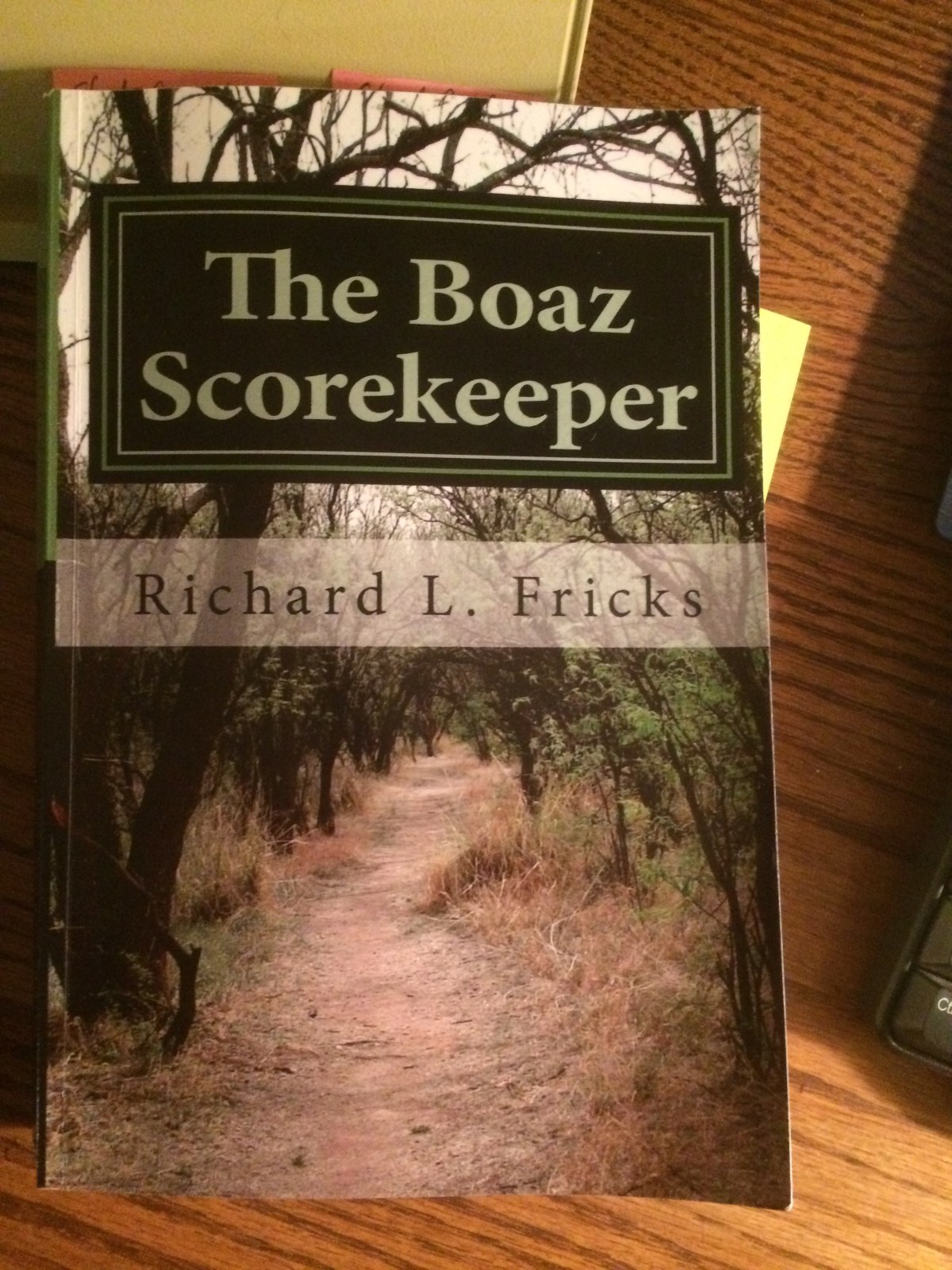
The primary aim of the "Novel Excerpts" blog category is to showcase my creative writing, specifically from the novels I've written. Hopefully, these posts will provide a glimpse into my storytelling style, themes, and narrative skills. It's an opportunity to share my artistic expressions and the worlds I've created through my novels.
The Boaz Scorekeeper, written in 2017, is my second novel. I'll post it a chapter a day over the next few weeks.
Nate concluded his article with the story of a remarkable Hispanic girl who had been called Golden Goose by Mateo, her preacher father.
Eighteen years prior, she had barely survived birth. Throughout the first five years of her life she had endured the pain and suffering of polio, before a complete healing at age six, a Mateo miracle their Christian brethren called it. From there, her life exploded into academic, sports, and spiritual achievement. Mateo said that she had single-handedly drawn together Hispanics from as far away as Oneonta to the south and Fort Payne to the northeast. All coming to Boaz and Esperanza Baptist Church to hear Mateo bring Jesus to life, always using Alma as the visual representation that the Son of God continues to perform miracles.
Friday, May 26, 2017, was graduation day for Alma and 115 fellow students from a mixed class of 46% Hispanics, 52% white, and 2% listed as ‘Other.’ Alma had a perfect 4.0 GPA, in fact, she had never received anything less than a B+ on any report card throughout her 13 years in the Boaz School System. And, that B+ was in the Sixth Grade in a Physical Education class where the long-gone teacher gave A’s only to students who could do 25 pull-ups in less than one minute. Alma did 24 even without the full use of her left hand that had been partially disabled from the polio.
Alma’s Valedictorian speech was scathing, and scintillating, but always respectful, and deeply heartfelt. She praised the school system for an excellent education but condemned community leaders for allowing blatant discrimination against Hispanics. Alma came close to calling the names of those she deeply believed were responsible for the disappearance of a dozen missing Hispanic girls, and four young men and their families. She ended her speech lauding the efforts First Baptist Church of Christ had tirelessly made in establishing Esperanza Baptist and by warmly welcoming the overflowing Hispanic congregation that could no longer crowd into its undersized auditorium.
Two months earlier, Club Eden had developed its plan to transfer Alma and Mateo to ‘a more suitable environment.’ If left unhindered, their influence would decimate the once all-white community, changing its face and its character in unacceptable ways. The Sunday morning worship hour attendance was already nearly 35% Hispanic.
But, there was another reason Alma and Mateo had to go. Thirty-seven-year-old Warren Tillman had fallen in love with the eighteen-year-old Alma. Wade knew this, although Alma did not. She had known Warren since she was a child and had always had the most respect for him. He had liked her from the beginning but as she grew and matured into a beautiful young woman he had become enamored with her. He arranged his schedule and her church involvement to make sure they were together working, planning, ministering as many hours per week as he could. He had never done anything inappropriate with her but fantasized someday being together as husband and wife. Wade had become keen to Warren’s infatuation several weeks earlier when, unnoticed, Wade had seen how Warren looked at and spoke with Alma. Just as his ancestor Waymon Tillman was against interracial marriages, Wade was even more bigoted, protesting even friendly relationships between his children and Hispanics or Negroes.
The initial plan was non-violent. Alma would be given a fully paid education at Harvard and Mateo and his wife would be moved to San Marcos, Texas, given a nice home in an even nicer suburban neighborhood, and a job as associate Pastor at First Baptist Church of San Marcos. Two weeks ago, Mateo and Alma had agreed, buying into Wade, James, and Fred’s argument that the Hispanic community was becoming too dependent upon the two of them, eventually causing a loss of faith and trust in God. Alma was scheduled to spend the summer in Mexico with the Tarahumara Indians, and Mateo and his wife were moving to San Marcos in two weeks.
Three hours before Alma’s speech and the graduation ceremony, Mateo and Alma changed their minds and told Wade Tillman and James Adams. They explained how they had prayed for nearly a week and had met with two other Hispanic pastors, one from Huntsville and the other from Birmingham, who both encouraged them to stay put, that God was at work and was not instructing them to leave.
After the graduation ceremony ended, Alma and her best friend Esmarelda Andres, along with several other Hispanic graduates, had plans to attend a celebration at St. William Catholic Church in Albertville where that City’s Hispanic graduates were also meeting. As the other Hispanic graduates drove out of the parking lot, Alma and Esmarelda were showered with gifts and congratulations from Wade and James before they too headed to St. William’s.
Eight minutes later Boaz Police Officers Chris Anderson and Paul Thomas blue-lighted Alma’s car on South Broad Street. Less than two minutes later, Alma and Esmarelda were lying in the trunk of Alma’s car, hands tied behind their back, with Paul Thomas driving and Chris Anderson in tow in the BPD car. Across town, Boaz Police Officers Dale Watson and Edward Hall had just completed their abduction of Mateo and Natamar Castenada. The police officers drove all four vehicles to 1675 Shady Grove Road and Club Eden’s 288-acre hideaway.
Upon arrival, Chris Anderson and Edward Hall loaded Esmarelda Andres into the trunk of a 2017 Chevrolet Malibu and set out for the airport in Muscle Shoals. Earlier, Club Eden and Gustav Nilsson had agreed to exchange Alma Castenada and $100,000 at 1:00 a.m. Saturday morning. Esmarelda and Alma, though unrelated, could pass for twins. Both were tall, almost 5 feet 7 inches. Their weights converged on 125 pounds. Both, of course, had long black hair. Both possessed stellar beauty. At 1:25 a.m., Gustav Nilsson and his two sons had stowed Esmarelda in their King Air 250 and were at 10,000 feet on a direct route northeasterly, to a destination unknown.
By 2:30 a.m., Mateo, Natamar, and Alma were laying side-by-side in the back of a 2017 Chevrolet Suburban courtesy of Adams Chevrolet, Buick & GMC. The three gentle and caring souls lay silent, sleeping an eternal sleep from a lethal dose of cyanide poisoning. Wade Tillman and James Adams were driving Interstate 59 northward to Valley Head and a 145-acre farm between Big Wills Creek and Rock Ridge Road that Club Eden had purchased in February for special purposes such as tonight’s.
It would be nearly nine months before Wade Tillman and James Adams were indicted for the kidnapping of Esmarelda Andres, and the kidnapping and murders of Mateo, Natamar, and Alma. Looking back from that day, February 2018, one hundred seventeen years had passed since the murders of Leroy and Toby Jones, and ninety-two years since the murders of David Howsley and Baynard Reed. All deaths were rooted in the hatred and bigotry of Club Eden’s full membership.

 Richard L. Fricks