
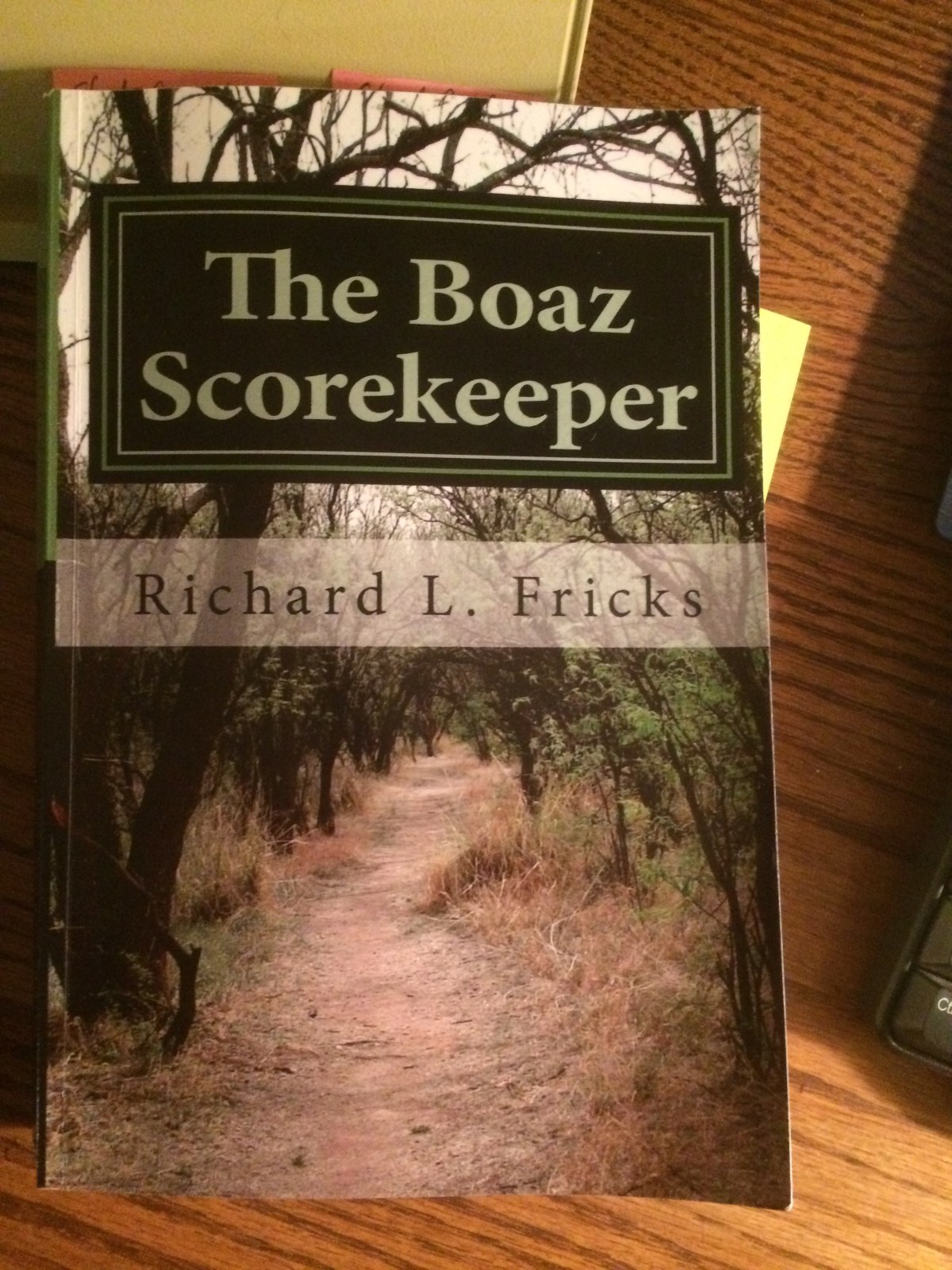
The primary aim of the "Novel Excerpts" blog category is to showcase my creative writing, specifically from the novels I've written. Hopefully, these posts will provide a glimpse into my storytelling style, themes, and narrative skills. It's an opportunity to share my artistic expressions and the worlds I've created through my novels.
The Boaz Scorekeeper, written in 2017, is my second novel. I'll post it a chapter a day over the next few weeks.
Nate’s New York Times article was published Sunday, July 1st. I couldn’t have been more surprised. I was expecting a slew of facts about Gina and Alma’s murder and all the indictments that were pending against Wade, James, their fathers, Raymond Radford and Franklin Ericson, and the three Boaz Police officers. Nate met my expectations here but the remainder of his article reached much farther back in history. I also thought the article title was rather odd: “City of Possibilities: A Southern Town Turns Good Myth into Bad Money.”
Up front, Nate shared his chief source, Rudolph Tillman (DOB 1911), the 106-year-old father of Walter Tillman, and grandfather of Wade Tillman. Rudolph resided at Creekside Nursing Home in Boaz. Years ago, Parkinson’s took away his mobility, but at the time of Nate’s interviews, his mind was a near perfect computer.
Nate’s article revealed Rudolph’s story, it was a story he had heard from the lips of his father, Morton Tillman (DOB 1873/DOD 1962), and his grandfather, Waymon Tillman (DOB 1844/DOD 1937).
Waymon was born October 16, 1844 in Jackson, Georgia, the county seat of Butt’s County located midway between Atlanta and Macon. He had an exceptional intellect and, at age 13, was accepted to Mercer University Preparatory School in Penfield, some 70 miles away. Here, he was exposed to the Hebrew language, Old Testament textual criticism, and professor and Baptist minister Adiel Sherwood. It was Sherwood’s love of the Biblical story of Boaz and Ruth, and his disdain for Abraham Lincoln, that rooted deep into Waymon’s subconsciousness.
Sherwood taught that Boaz was the perfect model of Christ, and that Waymon and his fellow students would find deep meaning and life purpose by adopting a redemptive mindset. He portrayed Boaz as the type leader all decent men should follow, often contrasting him with the bigoted Lincoln.
Sherwood was from Macon and subscribed to the Georgia Telegraph, a daily newspaper that was adamantly against the tall and lanky senator from Springfield, Illinois. In the Fall of 1858, Sherwood had shared with his class an article from the Telegraph which included a statement Lincoln had made on September 18th during his fourth debate with Stephen A. Douglas at Charleston, Illinois:
“I will say then that I am not, nor ever have been in favor of bringing about in anyway the social and political equality of the white and black races – that I am not nor ever have been in favor of making voters or jurors of negroes, nor of qualifying them to hold office, nor to intermarry with white people; and I will say in addition to this that there is a physical difference between the white and black races which I believe will forever forbid the two races living together on terms of social and political equality. And, in so much as they cannot so live, while they do remain together there must be the position of superior and inferior, and I as much as any other man am in favor of having the superior position assigned to the white race. I say upon this occasion I do not perceive that because the white man is to have the superior position the negro should be denied everything.”
Sherwood taught that, unlike Lincoln, Boaz was colorblind, accepting the Moab woman named Ruth without hesitation. Boaz saw her, not as a dark-skinned freak of nature, but simply a human being, made, like him, in God’s image. The professor painted Lincoln as more against the Southern way of life with its plantations and slaves, than for the best interests of the Negro. Sherwood’s viewpoint that blacks should have both social and political equality was certainly a minority view in the deep South just three years before the outbreak of the Civil War.
Waymon’s love for and faith in Yahweh grew by leaps and bounds during his first year at Mercer. Things changed when Azoulay Waxman, a visiting professor from Jerusalem, showed up during the summer of Waymon’s second year. Waxman was a middle-aged man whose forefathers were all scholars of the Hebrew language and the Jewish faith. It was during an August 1859 lecture on the Exodus story, where Moses led the Israelites out of Egypt and on their 40 years of wandering before reaching the Promised Land, that Waxman praised the power of myth and legend. He asked the class to consider the affects the Exodus story and the life of Moses had had on the world even though he never lived. This statement caused an uproar in class and led to Waxman saying that the value of story is not dependent on the historical veracity of its occurrence, but on the lesson, it teaches and, most importantly, whether people believe it to be true. Waymon would never forget the exact words Waxman said at the end of that day’s lecture. “I’m shocked that all of you, for the 15 or so years you have been living, actually believed that Adam and Eve, Noah, Moses, Abraham, David, all these Old Testament characters were historical figures.”
Waxman and his teaching was a light-bulb time for Waymon. During the remainder of his days at Mercer, he never doubted God’s existence but he interpreted scripture in a whole new light. Sherwood returned many times to the story of Boaz and Ruth with a clear objective of persuading Waymon and his fellow students to become true leaders by rejecting stereotypes and prejudice and by reaching out to the weak, colored, and disadvantaged. However, Waymon’s Hebrew interpretation approach, buttressed by Waxman’s revelation, developed into a rather practical method. Concerning the story of Boaz and Ruth, Waymon’s interest gravitated to Naomi, a character Professor Sherwood didn’t say much about. Reading and searching the story for its usefulness, Waymon concluded that it was Naomi’s desire to improve her and Ruth’s lot in life that was the true nugget of wisdom. Naomi was a plotter and a planner, a real-life schemer. Even though Boaz was kind and generous to Ruth by allowing her to glean his barley fields, it was Naomi that recognized opportunity when she saw it. Her thankfulness for the blessing of a steady supply of food didn’t deter her from shooting for the stars. Her plot to live like a queen at the expense of Boaz was what she wanted for her and her daughter-in-law Ruth.
In June 1861, Waymon graduated from Mercer Preparatory School. He left Penfield enlightened by the power of story and how it didn’t have to be historically true for the multitudes to believe it was true. His years at Mercer had produced in him the core principle that having a selfish and hidden purpose is acceptable if you are improving the life of those around you.
Another thing Waymon had learned at Mercer, was that a true leader is willing to fight for what he believes. Two days after returning to Jackson, Waymon forged his parents’ name on enlistment papers and joined the Confederate army. His purpose was not to fight for the right to own slaves but, as a chaplain, to spread the redemptive, but practical, message of Old Testament stories. Waymon would spend the next four years attempting to persuade young and scared soldiers to put their faith and trust in the Hebrew God who had a practical plan and purpose for their lives.
After four years of dodging bullets, enduring near-starvation, and searching for the hand of God among a pathway of bloody, lifeless bodies, Waymon returned to a much-destroyed Jackson. It was there, 1865, he met Earl Adams, Rufus Radford, Frasier Billingsley, and Abraham Ericson. All these men, except Frasier, had fought in the Civil War. Over the next fifteen years, they formed a brotherhood of sorts, centered mainly around their failed efforts to find direction and purpose, spending most of their time trying to till, tease, or cuss-out a living from the red Georgia clay. Finally, Waymon told them it was time to be a Naomi and go looking for their redeemer. They were easy to convince because they all knew, sure as hell, their redeemer didn’t live in Jackson, Georgia.
On a cold and snowy April morning in 1880, the five men, along with their wives and five children, left Jackson in wagons loaded down with every possession they owned. Their intended destination was Memphis, Tennessee. It seemed the further west they traveled the more they heard about a place called Sand Mountain. Two people, at two different places, had even referred to a high and lush Garden of Eden. Nine days later, they lost two wagons and nearly fifty-percent of their worldly goods in the flood waters of the Coosa River in a valley-community known as Gadsden, Alabama.
Dejected, depressed, and near defeat, the five men lost all vision and purpose and literally sat down to die. Gadsden wouldn’t have been a bad place to settle. It was a bustling community lying along the Coosa River, a community filled with a diverse population of hard-working whites, blacks, and American Indians. Named Gadsden in 1845, the city became the county seat of Etowah County.
The group spent three days licking their wounds, and half-way hoping to just die. They would have probably turned over and pulled their blankets over their heads if not for an itinerant preacher named Thaddeus Gibbons who set-up camp just upriver and began bellowing out a ‘never-die’ sermon rooted in the story of David and Goliath from 1st Samuel. It seemed Gibbons preached non-stop, and Waymon listened non-stop.
Four days after losing a battle with a belching and churning river, Waymon was determined not to lose the war. He pushed and prodded, and shouted and screamed, until the fifteen men, women, and children were rolling northward. A day later, they limped and crawled atop Sand Mountain, ten miles north-west of Gadsden, and camped that night under a star-filled sky in what became the Egypt community, sharing a meal of their remaining beef jerky and stale bread.
Before turning in for the night, Waymon told a story describing how Naomi truly felt upon her return to Bethlehem after ten years in Moab. “Don’t call me Naomi,” she told them. “Call me Mara, because the Almighty has made my life very bitter. I went away full, but the Lord has brought me back empty. Why call me Naomi? The Lord has afflicted me; the Almighty has brought misfortune upon me.” Waymon encouraged the tired and discouraged around him to take heart. Just like Naomi and Ruth found their paradise, they were now on the very outskirts of their own Garden of Eden. He encouraged them to take heart and seek the Lord through the night. The next morning, Waymon announced that during the darkest hour of the night, God had revealed himself, ordering them to forsake their Memphis plans and to set down roots in the next community they reached. Waymon declared that God was calling them to form an alliance before reaching their new home. He told the group that God had commanded them to form a secret club known as Club Eden and swear an oath that they would forever remain loyal to each other. After packing, the group of fifteen set off north on a narrow and rutty trail carved through a forest of pine, oak, and hickory.
At mid-afternoon, they pulled into a bustling little community they quickly learned was called Sparkstown. They were greeted warmly and kindly and experienced generosity like they had never known, hardly even realizing how they had found their way to the Garden of Eden. Abraham Ericson always speculated God had sent a mighty chariot commanded by the Archangel Michael who had swooped down and flew them all, including three wagons and six horses, to a barley-filled heaven on earth.
By early Fall, all five families were living in small cabins, the result of the community’s gift of labor, logs, lumber, and love. Although it could have been, in part, from the widespread belief that Sparkstown needed a church with an educated and visionary preacher. While Waymon preached and ministered, Earl Adams, Rufus Radford, Frasier Billingsley, and Abraham Ericson were busy building houses and learning they were not the only folks who heralded from Butts County, Georgia. An eleven wagon, forty-two-person caravan known as the Sparks Wagon Train of 1878 had taken only eleven days to make their way to Eden from central Georgia. It was this group that the vibrant community atop Sand Mountain had taken its name, Sparkstown.
Over the next six years, the five families, secretly known as Club Eden, built a foundation of prosperity that, to many, appeared eternal. Even though the group believed it was a miracle from God that brought them to Sparkstown, they all knew that it was Waymon and his belief in the practicality of Naomi that spawned their success. He again called on his education from Mercer Preparatory School, this time from an economics course taught by the School’s founder. It was there that Waymon learned there are five key ingredients for a thriving community, and that whoever controlled these, controlled the community. It was this structure that the Club Eden families pursued: Earl Adams and transportation (horses, mules, oxen, wagons and related gear); Rufus Radford and hardware and building materials; Frasier Billingsley and banking; Abraham Ericson and real estate trading and development. Finally, and to Waymon, the most important ingredient of all, religion, more particularly, the Christian faith.
It was Waymon’s discovery at Mercer Preparatory School, at the feet of visiting professor, Azoulay Waxman, that grounded Club Eden’s overarching plan. Controlling the four key areas of commerce was paramount, but controlling the minds of the general citizenry was the deeply rooted heart. Waxman’s revelation that virtually every Bible story was legendary but still taken as absolute truth fed Waymon’s idea to secure his own future. If he could contrive a story, no doubt tied to his favorite Old Testament character, the infamous Naomi, the community would hold him invincible forever. In his sermons, he began sharing how at Mercer he had learned he was a direct descendant of the Biblical Boaz, and how God had confirmed this in a revelation during their trip to Sand Mountain and the informally named Sparkstown.
Waymon’s luck could not have been better or more valuably timed. In mid-summer 1886 George M. Emory Mann applied for a post office. State authorities required a formal name. Rumors have it that it was a simple meal that generated the winning name for the small but vibrant community. The following Sunday, Mann asked his dinner guests their thoughts for a name. The Henry McCord’s, Mann’s in-laws, shared how Pastor Tillman had preached that day on the book of Ruth and how a man named Boaz had cared for this Moabite woman and her Jewish mother-in-law. Mrs. McCord had said that Boaz was a true man of God, exemplifying not only generosity but a lifestyle not blinded by prejudice. She shared how Boaz had treated Ruth, a dark-skinned foreigner, as an equal human being. Mr. McCord then exclaimed that there could be no better name for a city set on a hill than Boaz, a man of prosperity and piousness. Mann’s decision was made and the name Boaz was approved. Now, Waymon’s story gained the strength it needed. The next Sunday he announced how blessed he was that God had favored him, an ancestor of the Biblical Boaz, to live in a city that was named, uninfluenced by him, in honor of a true redeemer.
Success continued in every way for the Tillman’s and the other four Club Eden families. In 1897 the five men formally organized the Club by creating The Garden, Ltd. The wives were excluded. Club Eden became a man’s club. By now, there were five other entities surrounding the five club members: First Baptist Church of Christ, Adams Transportation, Radford Hardware & Building Supplies, First State Bank of Boaz, and Ericson Real Estate Sales & Development.

 Richard L. Fricks