
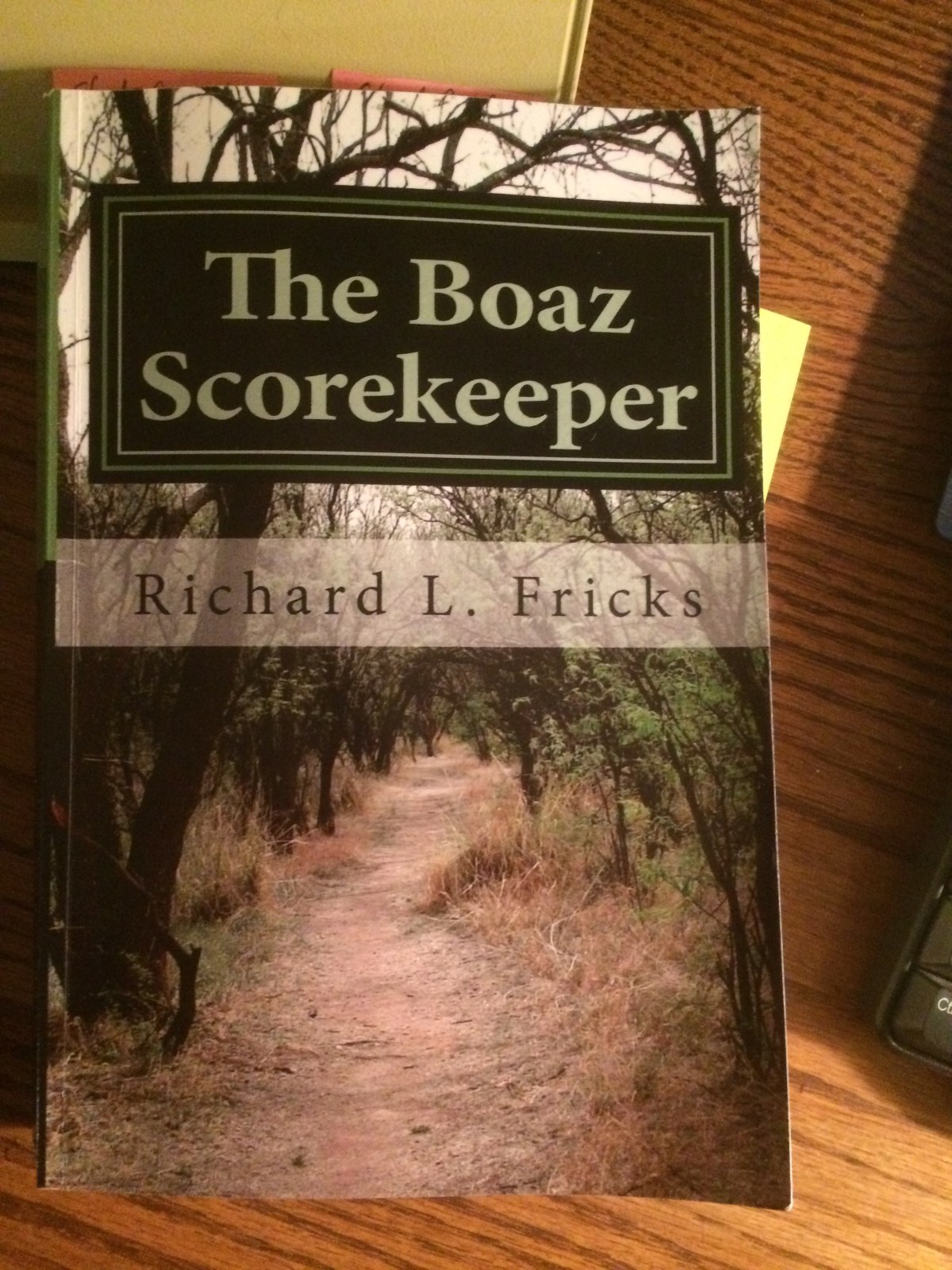
The primary aim of the "Novel Excerpts" blog category is to showcase my creative writing, specifically from the novels I've written. Hopefully, these posts will provide a glimpse into my storytelling style, themes, and narrative skills. It's an opportunity to share my artistic expressions and the worlds I've created through my novels.
The Boaz Scorekeeper, written in 2017, is my second novel. I'll post it a chapter a day over the next few weeks.
I was looking forward to the Preliminary Hearing if for no reason than to be outside my jail cell and to enjoy some sense of normalcy. I had for almost twenty years frequented each of the four courtrooms in the Judicial Building, often representing those charged with capital murder.
Monday mornings were the scheduled times for all preliminary hearings in Etowah County. But Judge Grant had specially scheduled my hearing for Monday afternoon since it was a capital murder case and would no doubt require more time than the run-of-the mill felony cases. Most defense attorneys waived their client’s preliminary hearing after a quick and casual discussion with one of the assistant district attorneys. In return for the waiver, the prosecution would allow the defense attorney to review the arresting officer’s incident and offense report, and any toxicology reports that might arrive later from the State Forensic Lab. Since the accused’s attorney knows that the prosecution has a rather low burden at the preliminary hearing, he will not risk losing the information gleaned from the DA’s file simply for the freak chance the judge might rule against the State. All the prosecutor must show is probable cause. The prosecution has met its burden when it can demonstrate to the court that law enforcement has facts and circumstances that would lead a reasonable person to believe the suspect has committed the crime.
Matt and I had known all along how the Preliminary Hearing would turn out. Judge Grant would issue his ruling that he finds probable cause that Gina Tillman was murdered and that I murdered her. Again, this doesn’t mean that I have been found guilty, only that the State had met its burden at this early stage of the criminal proceedings. Capital murder cases are very different from all other felony cases because they carry the death penalty as a possible punishment, unlike all the other felony cases. Good criminal defense attorneys always arrange a court reporter to be present to take down all testimony in a capital murder case. Here, the defense hoped that one of the prosecution’s witnesses would say something on the stand that would give the defendant some possible sliver of daylight to pursue and hopefully use at trial to persuade the jury in his favor.
Assistant District Attorney (ADA) Claire Gifford’s first witness was Detective Pete Morrow. After asking him how law enforcement had come to find a body, Morrow testified that on Monday, November 6, 2017 Dispatch had received an anonymous call that …. Matt was on his feet before Morrow could say anything about what Dispatch or the caller had said. Matt objected to Morrow giving hearsay testimony. Judge Grant normally would have allowed Morrow to provide this type testimony in any other preliminary hearing but was reluctant to do so in a capital murder case where the stakes were so high and appellate judges scrutinized lower court’s rulings with a powerful microscope.
Judge Grant did allow the ADA a fifteen-minute recess to get the dispatcher from her post next door into the courtroom. She testified that at approximately 8:20 a.m. on Monday, November 6, 2017, she received a call from an anonymous caller that … Again, Matt objected to her providing any hearsay testimony. This time Judge Grant overruled Matt and let the dispatcher continue. She testified the unnamed caller had simply said “Gina Tillman’s body could be found at the dead-end of Dogwood Trail off Cox Gap Road, behind a barn that had been a part of the Black’s home place for over sixty years.” She next stated that she delivered this message to her supervisor and she assumed he passed it on to the Sheriff. Matt sat still and allowed this hearsay to come into evidence knowing that nothing would be gained by having the ADA bring in the dispatcher’s supervisor.
The ADA recalled Detective Morrow and he testified that a search team with sniffer dogs was summoned to the location and within an hour the dogs had alerted to a body. The recover team with a front-end loader arrived on site and within an hour had discovered a body. By this time Morrow was on the scene. He testified to seeing a woman’s body that appeared to have been killed by some sort of blunt force to the head. He said that after the on-site forensic team had photographed the body, it was transferred to the State Lab in Birmingham for autopsy.
Morrow also testified that he had prepared an application for a search warrant with supporting affidavit while on the scene and had sent it via his assistant. Judge Grant issued the requested search warrant and Morrow and deputies searched the house located on the premises and found the house filled with documents and a computer. He said that several documents appeared to be manuscripts of stories. On the first page of each manuscript was the phrase, “By Micaden Lewis Tanner.” Morrow also said that they found several files that appeared to be legal case files. On the front cover of each one was ‘Bearden and Tanner, Attorneys at Law,’ along with their Boaz address and phone number. Morrow said from this he concluded that the house was occupied by attorney Micaden Tanner even though there were not many clothes in the closet. The ADA had him clarify where I lived, and that he had been there before.
The ADA apologized to the court for getting her presentation out of order. She then asked Morrow to report what he had observed the immediately preceding Saturday. Without objection from Matt he testified how I had called 911 reporting that Gina had been taken by James Adams and Wade Tillman. He gave a fairly detailed accounting of all efforts Saturday to locate James’ Impala. He told the Court that James and Wade had showed up at Wade’s house around 9:00 p.m. after a day of golfing and fishing. The last thing ADA Gifford asked Morrow about was what else was found besides Gina’s grave. Morrow said the dogs also alerted to two other bodies, that the backhoe operator dug up those sites and the recovery team extracted a multitude of bones that are now being examined at the State Lab.
Matt did an excellent job cross-examining Morrow. Matt made him admit that he had absolutely no evidence that tied me to the murder other than my things being found in the house. He also admitted that it could be interpreted as odd that a killer would call and notify law enforcement that someone else had abducted someone, the very someone that the caller had abducted and had either already murdered or was about to murder. Matt also got Morrow to admit that when he met with me Saturday night that I showed no signs that I had been involved in a crime, things such as cuts, bruises, torn, ragged, or dirty clothing or shoes, or any other indicators that something was amiss. Morrow also admitted that he had not attempted to verify the whereabouts of James and Wade at any time Saturday other than when they showed up at Wade’s house around 9:00 p.m. Morrow also testified that I had told him that I represented Gina in her upcoming divorce action against Wade and that I had even showed him the file the law office had set up when Gina came in to hire us.
ADA Gifford’s final witness was Sean Tolbert with the State Lab who testified that the body transferred from 1398 Dogwood Trail to the Birmingham division of the State Lab was that of Gina Culvert Tillman. He said that her husband Wade had identified her body. He also testified to obtaining copies of Gina’s dental records from her dentist and after comparison, identifying the teeth of those of Gina Tillman. Tolbert also testified that Gina had died from blunt force trauma to the head. He said in his professional opinion she had been struck several times across the face and head with a shovel. The only question Matt had for Tolbert was “do you have any evidence, because of your autopsy and work with the body of Gina Tillman, that would lead you to believe my client had anything to do with her death?” Of course, he said, “no.”
I was surprised, almost shocked, when ADA Gifford announced, “the State rests” after Sean Tolbert’s testimony. I thought, ‘it can’t be.’ Just as soon as Gifford made her announcement and sat down Matt and I just stared at each other. I knew what he was thinking, the same thing I was. This rarely happens in a capital murder case. Unless Matt and I were both having a total brain freeze it was clear to both of us that the State had failed to show probable cause. Truly, the only thing that they had proven was that Gina was dead, murdered, and that her body was found near a house where I wrote short stories and reviewed case files. The State had wholly failed to connect me to Gina’s death. We continued to sit staring at each other in silent conversation.
“Mr. Bearden, if you don’t know, Ms. Gifford’s little statement there is a signal for you to call your first witness.” Judge Grant said without a smile.
And, the Judge’s statement was our signal that he did not see things the same way Matt and I did.
Finally, Matt stood up and said, “the Defense calls Orin Synder.”
He was a Systems Controller at Verizon Cellular. He had driven up to Gadsden from their regional office in Birmingham. He hadn’t done this voluntarily. Matt had subpoenaed him but with the promise that one meal and his mileage would be fully reimbursed.
After quite a bit of needless wrangling with ADA Gifford, the Judge allowed Matt to solicit most of what he wanted. Synder testified that Verizon had provided service to two phones purchased on July 6th, 2017 at Walmart in Pell City. He provided the model types and serial numbers of the two phones, along with their accompanying phone numbers. Matt then said, “Mr. Synder can you identify Defense’s exhibit number 1?” while handing him my phone. This spawned another wave of objections from the ADA with Judge Grant calling her and Matt to the bench for a private conference. After a long and seemingly intense session Judge Grant waived both attorneys back to their tables.
Matt continued his examination and Mr. Synder said that Verizon did not have information on who purchased the phones but simply that they were purchased and a detailed activity log for their usage. He provided the Court with a certified copy of every call made on the two phones with detailed call location information, including latitude and longitude and the identification of the tower used to service each call.
Matt called Mr. Synder’s attention to the activity beginning on Saturday, November 4th, asking him to tell the court the locations of the two phones, their proximity to each other, and the times they were being used. Synder delivered a long and detailed incoherent statement that I’m sure he understood but left the Judge looking puzzled. The Judge interjected that maybe it would be clearer if Synder went to the whiteboard and attempted to sketch out what he was trying to say. Synder looked at the Judge, sat up straighter in his chair, and with an eager tone said, “I can do much better than that. We have a computer program that makes all this crystal clear. I have my computer and as long as I have Wi-Fi I can demonstrate it through your Smart Board there.”
ADA Gifford again objected but Matt didn’t even respond. He knew that Judge Grant had already made his decision having instructed the Bailiff to turn the Smart Board more towards his bench.
It didn’t take Synder but a few minutes to boot up his computer and access and project his program on the huge screen. He typed in the serial numbers of mine and Gina’s phones, and inserted November 4, 2017 in the ‘date-beginning’ field and clicked on ‘Activate.’ Almost immediately, a Google Map-like screen showed two blue dots, one labeled 1 and the other labeled 2. Synder clicked on ‘Pause,’ and looked at Judge Grant as though he was waiting on further instructions, who then motioned for Matt to continue.
With Matt’s questions, Synder again provided the Court with the activity of the two phones throughout Saturday, November 4th, however this time it was, as Synder had promised, ‘crystal clear.’ Verizon’s real-time program showed the two blue dots first light-up at 9:30 when Dot 1 was at Gina’s house on Sparks Avenue and Dot 2 was at my house off Cox Gap Road. By 9:32, both dots went dark but stayed fixed at their same locations. At 9:44 a.m., both dots lite up again but this time Dot 1 was moving west on Sparks Avenue. By this time, Judge Grant was fully engaged, having walked down from the bench to stand within 10 feet of the Smart Board. For the next ten minutes, everyone in the courtroom watched the two dots. As I sat and watched mine and Gina’s phones mirror the journey that was forever etched in my memory, I became nauseous when I saw how close I was to Gina when I turned right on Shady Grove Road after I had left the cabin at Club Eden. James and Wade, with Gina in his trunk, had turned left and pulled to the back side of Aurora Market’s property. I didn’t anything for the next several minutes.
The next thing I knew, Matt was nudging my shoulder and asking the Judge for a short break. Judge Grant ordered Matt to continue. He did. By this time, Synder was down in front of the Smart Board standing five feet from Judge Grant. Matt had Synder use a laser pointer to indicate the last place Dot 1, Gina’s phone, was used. He could rewind the activity to where Dot 1 turned left off Shady Grove Road and travel the five hundred yards or so to the Cabin at Club Eden. It was only seconds after the blue dot stopped moving that the glow disappeared. “That’s when the first phone went dead.” Synder said. The time on the screen was 9:54 a.m. on Saturday, November 4, 2017. “That was the last time this phone was used.”
The most valuable part of Synder’s testimony came when Matt asked him whether Dot 2 (my phone) had been at 1345 Dogwood Trail in Boaz since Friday, November 3rd. He reset the program’s date and activated the program beginning at 12:01 a.m. The program showed my phone at this address on Friday but that it had not returned at any time before Gina’s body was found. This fact didn’t prove I hadn’t been back there, but I hoped that it was the most logical conclusion given the proven use of my phone earlier Saturday and at several times throughout the day. To me, Synder’s testimony, at a minimum, pointed to someone else as the killer of Gina Tillman.
Judge Grant spoke up and said, “can you do this for any Verizon phone?” Synder replied in the affirmative. “What if I give you my phone, can you show its activity for any time I choose?” Again, Synder agreed saying all he needs is verification that it is the Judge’s phone. Judge Grant ordered a recess as he went to his office. After he returned, Synder verified the Judge’s paperwork and entered his phone’s serial number. Judge Grant asked Synder to show his phone’s activity for this past Sunday. After he entered the date and time to start, he activated the program. This time one blue dot appeared on the Google Map on Lockhart Street in Marietta, Georgia. Judge spoke up and said, “that’s correct. My wife and I spent Saturday night with my son and his wife in Georgia. I didn’t use my phone until after church. The screen revealed the phone stayed at Lockhart Street until 10:15 a.m., and then moved across town to Moulton Avenue. Google Maps even showed a symbol of the First Presbyterian Church. Then, at 1:15 p.m., the blue dot lite up indicating a call was being made.
It was only after ADA Gifford suggested to Judge Grant that she had to pick up her daughter at her babysitter by 5:30 p.m. that the Judge returned to his bench saying, “that is very interesting. You may cross examine the witness.” Gifford asked only one question, “Mr. Synder, as good as your program is, can it tell us who is using the phone, who has possession of the phone?” The answer obviously was no.
For the next two hours, I was on the stand and Matt had me communicate to Judge Grant a multitude of information including that I knew Gina from high school, how she gave false testimony against me in my 1973 trial, that I had never held a grudge against her, and how she had come to hire me as her divorce attorney, how she had spied on her husband Wade and that she was just about to go public with very incriminating evidence against not only Wade but James Adams. At one-point, Judge Grant virtually took over questioning, asking me about Oak Hollow and what I expected the State Lab to show after they completed their examination of the bones discovered in the two graves besides Gina’s. I told him that I had a hobby of adopting old horses, ones that no one else wants, and that I had buried two horses there back earlier this year. I reminded him that Detective Morrow’s report referred to three horses found on the premises. Matt had no further questions for me.
ADA Gifford tried her best to get me to break, or at a minimum, concede something that could create ever so small an opening for her to ram through. She didn’t. She even tried to paint me as a serial killer referencing the disappearances and likely deaths of John Ericson, Randall Radford, and Fred Billingsley, alleging in her questions that these three and Gina all were involved in the attempt to frame me for two murders that took place in 1972. Before Judge Grant cut her off, she did an excellent job hiding a question in her statement, “Mr. Tanner, you had the motive, the means, and the opportunity to kill Gina Tillman.” I responded ‘no’ to the none-question, even though I certainly knew that I had, at one time, had all three. The only truth to my response was that I truly had never contemplated killing Gina.
Right up until 5:15 p.m., ADA Gifford launched question after question at me. With my every response, she became more and more frustrated and eventually gave up. I’m not sure she gave up because of the time and her need to go pickup her daughter at her babysitter, or she finally and fully realized that I was at least as much an expert as her in cross examination. I had no doubt that in my 37 years of criminal defense work I had grown an armor that could protect the most hardened criminal.
When she sat down, Judge Grant didn’t wait for me to get halfway back to the defense table where Matt was seated. “I find that the State of Alabama has failed to show probable cause in the capital murder case of Micaden Lewis Tanner.” Once again, Matt and I sat shell-shocked staring at each other, both knowing Judge Grant had issued the correct legal ruling. But, we both also knew reality. It is a rare thing indeed, especially in a capital murder case, for the judge not to give the prosecutor the benefit of all doubts.
This was a major victory, but, it was only a win in a minor skirmish. I would remain in jail and wait until the District Attorney obtained an indictment. Alabama Rules of Criminal Procedure give the prosecutor the right to carry any case to a Grand Jury, regardless of whether he has obtained a ruling of probable cause from a District Court.
Judge Grant left the bench and returned to his Chambers as two deputies re-shackled me and led me back to the backdoor of the Courtroom. I looked back over my shoulder at Matt who gave me a thumb up.

 Richard L. Fricks