
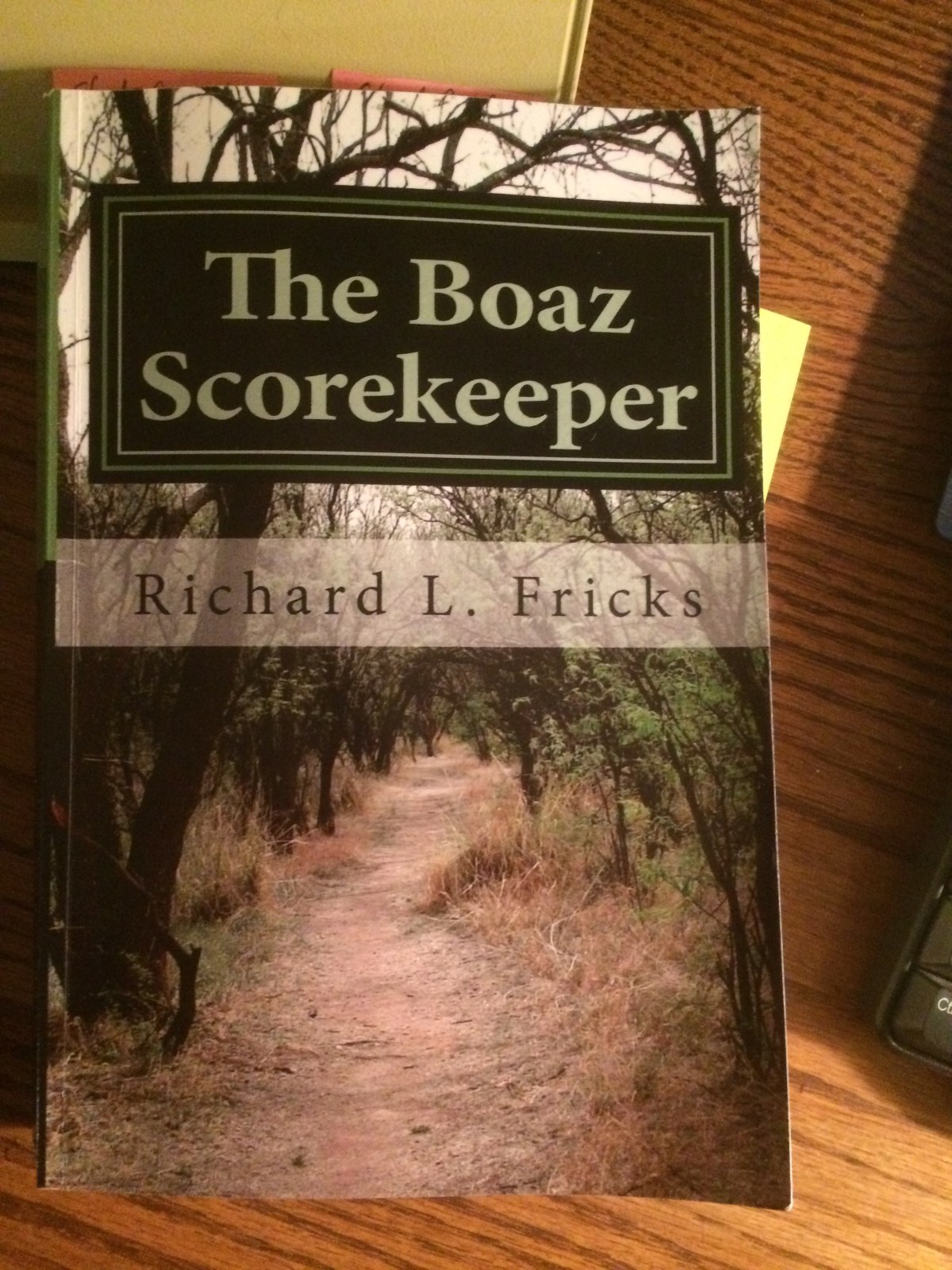
The primary aim of the "Novel Excerpts" category is to showcase my creative writing, specifically from the novels I've written. Hopefully, these posts will provide a glimpse into my storytelling style, themes, and narrative skills. It's an opportunity to share my artistic expressions and the worlds I've created through my novels.
The Boaz Scorekeeper, written in 2017, is my second novel. I'll post it, a chapter a day, over the next few weeks.
For the past several days I had toiled with the question whether to ‘go public’ with the John Ericson story. Two separate things determined my decision.
First, I didn’t like that Judith (and ultimately Franklin and the entire Ericson clan) had ignored the second commandment in my ransom letter. They had wholly failed to publish a letter of apology through Pastor Walter at church.
The second thing that gave me the answer I sought was the foresight I had had when I purchased Oak Hollow. Technically, Terry Lynn Gaines had purchased Carl and Betty Black’s property from their son and testator Andrew. Mr. Gaines was the defendant in the first criminal case I ever worked. It was during my days practicing law in Atlanta with the firm of Downs, Gambol & Stevens. Gaines was charged with viciously murdering an openly gay man in Loganville, Georgia in 1980. Because of great lawyering by my boss Greg Gambol, a 35-year criminal defense attorney veteran, the jury acquitted Gaines. This, despite his confession, “I was obedient to God when I killed Victor Semmes.” The wise or lucky thing for Gaines was that he had only confessed to Greg and me in privacy under the cool shade of the attorney-client privilege umbrella. The jury never knew Terry had confessed to committing the horrible murder.
My desire that the Flaming Five receive justice had been a long-term project. Certainly, when Andrew Black contacted me in 2013 asking whether I wanted to exercise my first right of refusal and purchase his parent’s 80 acres, I was at least subconsciously contemplating my future role.
In 2010, at age 73, Georgia resident Terry Lynn Gaines was elected to the U.S. Senate. Apparently, he had overcome the stigma of his criminally-accused past and gone on to win the respect of most Republican voters in Georgia. I attempted to contact Terry with the intentions of respectively, but strongly, suggesting he purchase Oak Hollow in his name. At first, he wouldn’t accept my call. Then, I told his assistant that Terry and I go way back, all the way to Loganville and Criswell Park in 1980. I guess this intrigued him. Ultimately, Terry agreed to be my strawman, even paying for the purchase at closing, even though I did later secretly repay him the funds. Our deal was simple. I would not anonymously leak his Semmes confession and he would transfer ownership in Oak Hollow if I asked him to in the future. I suspect Terry knew that it was unlikely that I would risk associating myself with such leakage for fear of losing my law license, but acting conservatively caused him to go along.
I was thankful for my foresight. Two days ago, I had anonymously mailed a letter to the Sand Mountain Reporter. I felt I could safely publish the statement the Ericson’s had failed to publish. I did this knowing that likely at some point law enforcement would eventually turn their attention to me. I could not hope that every sharp detective would ignore or never discover my motivation for killing every member of the Flaming Five. But, I was convinced investigators would not find I was, in all practical purposes, the real owner of Oak Hollow. I was confident they would eventually search Hickory Hollow but never realize how close they were to locating relevant and highly prejudicial evidence.
On Saturday May 27, 2017, the Sand Mountain Reporter reluctantly published my letter. I had followed my standard procedure in drafting, printing, and mailing this anonymous declaration. The Reporter made no changes to my writing:
“On Monday night May 15, 2017 John Ericson of Boaz was abducted as he exited the First Baptist Church of Christ Faith and Family Life Center on Sparks Avenue in Boaz. His family was contacted a few days later and asked to draft and have publicly read a formal apology for John’s rape and murder of Wendi and Cindi Murray in 1972. The formal statement was to have been read by Pastor Walter Tillman at First Baptist Church of Christ on Sunday, May 21, 2017. John’s family refused to comply with this request.
At a graduation party on the night of May 25, 1972, John Ericson, along with the other four members of a basketball team known as ‘The Flaming Five,’ repeatedly raped these two sweet and innocent young girls from Douglas, Alabama. Later that night, early on the morning of May 26th, the Flaming Five murdered these two girls and buried their bodies in a hidden grave that was only discovered in 1997. The fathers of the Flaming Five were also culpable in one murder, the burying of both bodies, and the ultimate long-term cover-up.
These ten men framed a young man named Micaden Lewis Tanner. He was jailed, indicted, and tried for the murders of Wendi and Cindi Murray. In 1973, a jury refused to convict him. Miraculously, 24 years later, Mr. Tanner as an attorney, along with his law partner Matt Bearden, represented Bill and Nellie Murray, the parents of Wendi and Cindi, in a wrongful death lawsuit against the Flaming Five and their fathers. On the morning of Monday, November 2, 1998, the day the trial was to begin, Bill and Nellie Murray were found dead in their bed at their home because of cyanide poisoning. The lawsuit died alongside the Murrays. The deaths of Bill and Nellie Murray, along with the rape and murder of Wendi and Cindi Murray, are officially unsolved.
Unofficially, justice has been served upon John Ericson. He has forever disappeared. But, the mighty wheels of justice do not rest. There are nine others laying in the wake of this coming ship; nine more are sure to suffer a similar fate. These nine are Franklin Ericson, Wade and Walter Tillman, James and David Adams, Randall and Raymond Radford, and Fred and Fritz Billingsley.”
By Sunday afternoon, after church and an hour on Facebook, I knew that Boaz, Alabama was fully aware of the severe accusations and clear threats that had been leveled against nine living members of this North Alabama community. I felt comfortable also that these nine people were experiencing terror like they had never known.
I sat out on my balcony all afternoon. The clouds were gray and it was cool, nearly cold, Blackberry winter of a sort was passing through even though old timers had said it had occurred nearly a month ago. I couldn’t help but ponder how fragile civilization truly is.
I was a murderer and everyone thought I was a good citizen, a valuable member of society. I was educated, a professional, a faithful church and Rotary Club member, and a consistent contributor to multiple hunger and homeless organizations. Yet, I was a murderer. As far as I knew no one except me knew the real me. Of course, I was justified. I suppose just like Undral Collins believed about himself.
I represented Mr. Collins from 2002 to 2004. His was a Madison County capital murder case. Collins was charged with four murders, two men and two women. He was ultimately convicted and sentenced to death. He remains on Alabama’s death row. From his case and others, along with general observations in my own life, I have learned that it often doesn’t take much to provoke someone, provoke them to action. Most times the action isn’t serious, most time it certainly never rises to the level of bodily harm or murder.
As criminal defendants often do, they tell their lawyers things they would never tell anyone else. They have this uncanny knowledge or belief that being open, even spilling the whole can of beans, is therapeutic, even contributory to a courtroom acquittal. Whether they are truly telling the truth gets muddled up a lot of the time. Nevertheless, Collins loved to talk.
His first victim was a friend of his mother. The friend had made an off-the-cuff statement one afternoon over lemonade on the front porch of his mother’s home. The woman said it was nice of Undral to look after his mother but unfortunate he had dropped out of college. The woman indicated that Undral was not smart enough to become a college graduate. Evidence at trial showed Undral had broken into the woman’s house and waited for her to return from grocery shopping. When she came in her back-door, Collins stabbed her repeatedly with a butcher knife he had taken from her kitchen. He then set her house on fire and left.
Collins stalked his second victim and shot him from a distance with a high-powered hunting rifle. Collins told me that this man was arrogant and a bigot. Collins said that he had visited the man’s church where he was the pastor. At some point in the sermon the man had said “Jesus was a man’s man, you wouldn’t see him wearing an earring.” One statement, one seemingly minor provocation, and this preacher’s fate was sealed.
Collins abducted his third victim, a 16-year-old girl. Her body was never found. She was collateral damage. Collins intended victim was the girl’s mother. She was a teacher at a local community college where Collins had taken a basic math class. He told me that the woman knew her material but often wandered into subjects she clearly didn’t understand. Although Collins didn’t have a college degree, he was intelligent and well-read. This teacher often made statements that reflected her belief in God and His powers. One evening another student came to class late and shared that her niece was in the hospital. The teacher said that she would say a prayer for the young girl that she would be healed. Collins took affront to this because he didn’t believe in prayer and even if he did, how could one truly know if it did any good.
Collins shot and killed his final victim while he was playing golf. The man was a banker and a former high school classmate of Collins. He said that the man was “a polished diamond on the outside but a pile of shit beneath the surface.” One-day Collins was mowing a yard in a well-to-do neighborhood when he saw the banker drive up next door. He said, “The asshole banker was looking straight at me and would have had to recognize me. If he didn’t remember me from high school he should have known me from being a customer at his bank.” Collins said the banker barely acknowledged him even though the mower wasn’t even running at the time. He was filling it with gasoline. Evidence at trial showed Collins, two days after this incident, followed the banker to the local golf course and covertly went ahead to the ninth hole and waited. As the banker completed his final putt Collins walked from behind a tree straight toward the man and made him look at him and call his name. Collins then shot him in the face.
No doubt Undral Collins was not the only human who was easily provoked. Surely everyone has heard of murders committed over things as insignificant as a pair of Air Jordan running shoes, and a young girl not being chosen as a cheerleader. I suppose if the full body of evidence on this subject could be examined these two examples would appear to be BIG things.
To most every reasonable person what had provoked Undral Collins wasn’t common. And, it certainly didn’t justify him committing all these murders. However, was I the only one in the world to believe I was justified in taking justice into my own hands and killing John? If I was, then just like all the Christians who continue to believe in a literal Noah’s Ark, they haven’t looked at the evidence.
Even though I believed that I was fully justified in bashing in the head of John Ericson, I couldn’t quite get away from the feeling that I was no better than Undral Collins.

 Richard L. Fricks