
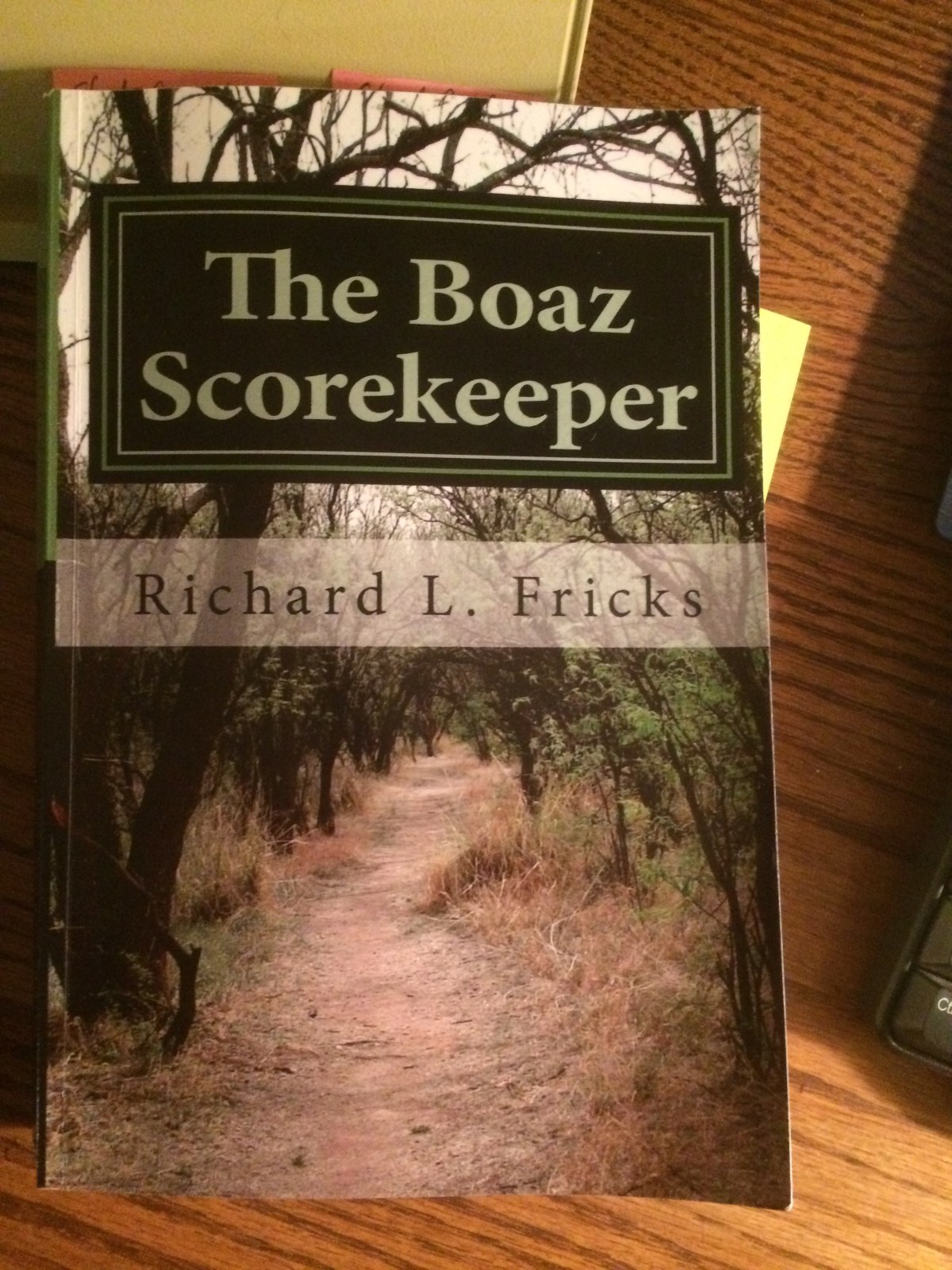
The Boaz Scorekeeper, written in 2017, is my second novel. I'll post it, a chapter a day, over the next few weeks.
It was the Monday afternoon before Boaz schools were slated to close for their traditional one-week Spring break in mid-March 1998. Tina’s granddaughter Danielle, as usual, rode the bus to our office to help until Tina’s 4:30 quitting time.
Danielle walked two letters and a discovery motion back to my office from Tina’s desk and said she had some news I might be interested in. She and half of Boaz High School had become enamored with something called Six Degrees. It was the first of its kind, a social media site before Facebook and certainly before the onslaught of lightweight smartphones. Yet, on a desktop, it worked pretty good.
Danielle said that during study hall today she went to the library and saw Bert Dickerson and Raynell Peterson sitting at a computer workstation snickering and getting into trouble with the librarian. Raynell called Danielle over pointing out a picture on Six Degrees of Tracie Simmons sitting in a red Chevelle. Tracie was a classmate of mine, a cheerleader, who, along with Nyra’s cousin Mandy Gibson, never attended any of the events at Club Eden.
Tracie, at age 43, had moved back to Boaz early last year after her teaching position at Vanderbilt had been eliminated. She soon got bored and asked if she could volunteer at the law office three days per week. Tracie and Danielle had become fast friends mainly rooted in the old stories Tracie glamorized from her days at Boaz High School.
Danielle shared that she kept standing next to Raynell looking over Bert’s shoulder as he kept scrolling through a bunch of other photos. Bert had found his father’s 1971 Boaz High School annual and, being a car nut, had made and posted several photos of cars and trucks that littered the pages.
Danielle said Bert was Justin Adam’s best and worst friend. He had come into the library and saw all of us giggling. He ignored us until Bert hollered out, “Justin, come see your old man’s shaggin wagon.” After Justin saw the photo of his father’s van, lettered with ‘Honey Wagon’ on the side, he went ballistic demanding to know where Bert had gotten the photo. Finally, Justin left in a rage. Bert then said, “I’m glad I didn’t show him the comment.”
Comments to postings were one of the main attractions for people using Six Degrees. The day after Bert posted the ‘Honey Wagon’ photo an Alvin Simmons had commented, “I think this is my uncle Ted’s van in Carrollton, Georgia.” Danielle said she knew this must be the infamous van from the stories she had heard concerning the disappearance of the Murray twins back in the early 70s. I thanked her for reminding me of that chapter in my life.
After she left I pondered the early life of that van and wondered what had become of it. In August 1971, Adams Buick, Chevrolet & GMC became the first dealership north of Birmingham to receive a GMC Vandura. It was a total makeover of the flat-nosed model that was introduced in 1964. The Van had the long 125-inch wheelbase and was equipped with a 250 CID L6 engine and a three-speed manual transmission with column shift.
David had promised James he would be the first owner in Marshall County of a Vandura with a StarCraft conversion. David fulfilled that promise when he handed the keys to James on September 29, 1971.
Shortly after Wendi and Cindi had gone missing, Sheriff Wayne Brown had questioned James. He admitted the girls had been in his van. He told the Sheriff that he and Randall and John had picked the girls up at the Dairy Queen and then had planned on dropping them off there after the graduation party, but at the last minute, I had insisted on carrying them home. The Sheriff’s office had seized and examined the van finding nothing incriminating.
The next day I asked Danielle if there was a way to contact Alvin, the guy who had commented on James’ van. She said sure. I gave her my chair and she sat down at my computer and logged onto her Six Degrees account. She found Bert Dickerson’s account and the van posting. She pulled up the only comment and sent Alvin Simmons a question asking if his uncle might be interested in selling the van and asked for his phone number.
Within an hour, Alvin responded saying that he doubted his uncle would sell but included his phone number. I called for Melvin Singer, his wife told me that he was in Atlanta on business and wouldn’t return until late. I told her what it concerned and asked her to have him call me as soon as possible, and it didn’t matter how late it was. I left her both my office and home telephone numbers.
At 1:00 a.m. my home phone rang. I had just laid down for the night. Melvin had pulled his file on the Vandura. After a couple of minutes, I could confirm that he owned the van that James and crew had used to transport the dead and dying Wendi, and a dead Cindi, from Little Cove Road back to their burial site off Martin Road. Melvin said that he had bought the van at the Atlanta Auto Auction in late summer 1972. He was in his 30’s at the time and was still reliving his high school days, buying the vehicle he could only dream about when he was 16. He said the van was still in mint condition, having been garaged ever since he bought it. He finally conceded that he would entertain selling it since he hadn’t driven it in almost ten years. At 1:50 a.m. I bought the 1971 GMC Vandura for $5,000 on a hunch that it might still provide evidence from the murders.
In the early 1970s law enforcement agencies had little to no ability to obtain and use forensic evidence in criminal cases. This changed in the mid-80s with the advent of DNA testing. This allowed for the testing of biological material such as skin, hair, blood, and other bodily fluids.
I had heard of this new method and had read several articles. I pulled out one such article that was included in a legal continuing education class I had taken last year at the University of Alabama. It read, in part, “DNA, or deoxyribonucleic acid, contains the complex genetic blueprint that distinguishes each person. Forensic testing can determine if distinctive patterns in the genetic material found at a crime scene matches the DNA in a potential perpetrator with better than 99% accuracy.” The article went on to tell how DNA testing had been used by prosecutors across the U.S. to gain convictions. “In 1987, Florida rapist Tommie Lee Andrews became the first person in the U.S. to be convicted because of DNA evidence; he was sentenced to 22 years behind bars. The next year, a Virginia killer dubbed the ‘South Side Strangler’ was sentenced to death after DNA linked him to several rapes and murders around Richmond. DNA is also responsible for snaring Gary Ridgway, the infamous ‘Green River Killer’ of Washington State, responsible for a string of murders around Seattle in the 1980s and ’90s. After being implicated by genetic testing, Ridgway pleaded guilty and was sentenced to 48 consecutive life sentences. Law-enforcement agencies around the world are assembling DNA databases, which have yielded matches that investigators may otherwise have missed. The FBI now has DNA records on more than 5 million convicted offenders, and sex offenders in all 50 states are required to submit DNA samples to law enforcement.”
I was also familiar with a case where the prosecution failed to obtain a conviction in large part because of the failure of DNA testing to convince a jury. No doubt, everyone in the United States could recall exactly where they were when the ‘Not Guilty’ verdict in the O.J. Simpson case was announced just a little over two years ago.
The next morning, I told Matt what I had done and I saw, for the first time ever, he had an anger button. Matt was as cool as they come no matter the pressure, but he almost came unhinged when I told him I had spent $5,000 of firm resources simply on a hunch. Fortunately for me, Matt recovered quickly and his strong genes for reason shut down his anger. He pulled me into the conference room and demanded I lay out my plan. I told him that I had arranged with two of Sheriff Mac Holcomb’s deputies to follow me and photograph the van, ‘as is,’ in Melvin Singer’s garage, and then to haul it to the State of Alabama’s Forensic Lab in Birmingham. They would perform a forensic inspection, and conduct testing if they obtained any DNA materials.
A little over a month after the 1971 GMC Vandura was delivered to the Forensic Lab, I received the miracle call. It had retrieved hair and blood samples. The extracted DNA material matched that obtained from the skull and bones found at Lot 13 in the Pebblebrook subdivision development. The teeth from the two skulls had previously been matched to Wendi and Cindi’s dental records, and DNA obtained from the recovered bones had been matched to samples obtained from the twin’s untouched bedroom.
My hunch was correct. This was great news for the wrongful death lawsuit. However, I couldn’t help but feel overwhelming sadness that no criminal charges would ever be brought against the Flaming Five. I could only hope that a Marshall County jury would award the Murray’s a multi-million-dollar civil verdict.
The second-best thing about this evidence was it would likely come as a total surprise at trial to the defendants. So far, they had not propounded a single discovery request that came close to requiring Matt and me to disclose this evidence.

 Richard L. Fricks