
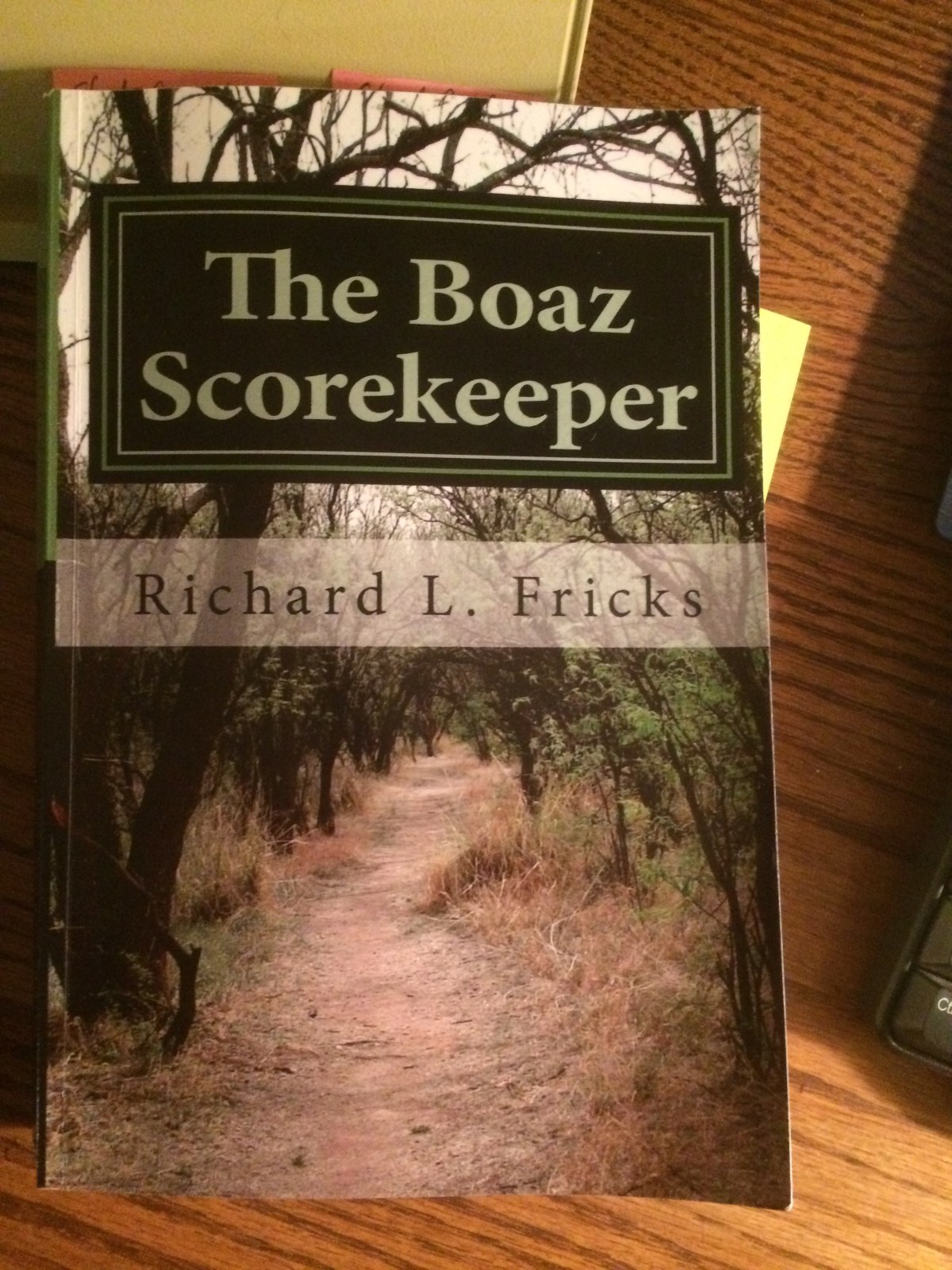
The Boaz Scorekeeper, written in 2017, is my second novel. I'll post it, a chapter a day, over the next few weeks.
The first chance I had to visit Mr. Maples was Thursday afternoon. I didn’t have any trouble finding where he lived. Matt had fished in his pond when he was a kid.
I had not called ahead. I figured my chance for talking with Harold was increased by a surprise visit. A middle-aged lady, who I later learned was Bea Rogers, Harold’s caregiver, answered the door bell. I gave her my business card and told her I needed a few minutes with Mr. Maples. She first said that he did not accept visitors. I told her that I thought he would make an exception for me since I was a lawyer and was there to decide whether my decision to include him in a lawsuit on behalf of the Sand Mountain Bank was the correct decision. I told her that he didn’t have to speak to me now if he had rather have the Sheriff come pick him up and take him to the county courthouse for a formal deposition. I did take a little liberty by enlisting the Sheriff’s help at this point. Ms. Rogers left me standing outside the front door on the porch to go discuss my offer with Harold. It took her nearly five minutes to return.
She invited me in and led me to a glassed-in room on the back of the house. With the afternoon sun and a five-brick gas heater, it felt like 125 degrees in the room, but Harold still had a heavy coverlet over his legs as he sat in a lounge chair. I introduced myself and told him that my purpose in coming was to make a friend and an ally and not an enemy. I told him about Matt and me buying the building downtown where the Sand Mountain Bank had started its operations in 1931. I also told him that I had figured out that he had embezzled 25% of the City’s occupational tax monies. I was surprised that he didn’t offer more resistance.
“What tipped you off?”
“I found one of your journals in a box upstairs in a storage room. It was in a wooden box with a bunch of receipts journals from 1972. It had a monthly entry detailing the ‘Occ tax’ and ‘CE’s share.’ I was familiar with Club Eden and figured that’s what ‘CE’ stood for. Actually, it was just a guess at first.”
“I’ve wondered for years what happened to that particular journal. When the bank moved I brought all my other personal journals home. I had kept them in my office in an old safe that Ron Garrett, the Bank’s President, gave me in the late 30’s when he renovated his office and bought a newer safe. By the way, you haven’t told me how you really figured out what I was doing.” Harold said.
“My law partner’s father worked for Majestic Mobile Homes as a bookkeeper in the Fifties. He said that the Boaz City Council had passed a 2% occupational tax in late 1945 and the Sand Mountain Bank was awarded the fiduciary contract. Every employer within the City limits had to file a monthly report and withhold 2% from each employee’s paycheck. The employer then had to remit this, along with the report, to the Bank by the 20th of the month following the withholding month. Truth is, I never figured out how you were diverting the money. Care to tell me?”
“You probably know that one of the Adams’ has held the Mayor’s job forever, probably seventy-five or eighty years. When the occupational tax started, Eugene Adams was the Mayor and I assume you know that he was a member of the Club.”
“I do.”
“Eugene set up an account at First State Bank of Boaz and was the only signatory. After the tax program started, I would write two checks per month. One to the City’s general fund for 75% of the tax, and one to the City’s fund at First State. It was surprising that no one ever asked to see the actual payroll tax reports. It didn’t hurt that Eugene was always doing favors for the City’s bookkeeper.”
“What happened to the tax funds in the account at First State Bank?”
“Again, I assume you know that Fitz Billingsley’s father, Farris Billingsley, was a Club member?”
“Yes, I do.”
“Eugene would write a monthly check to a rotating list of City vendors and Farris would cash the check. He would remove 10% for a tithe and then divide the remaining money into six parts, giving me a part and each of the five Club members a part.”
“Why on earth did he pay a tithe?”
“Are you a heathen? The tithe is the Lord’s. The money we received from the occupational tax was our earnings. We owed it to the Lord.”
“That’s about the strangest reasoning I’ve ever heard. But, I have another question.” I said with no doubt a puzzled look on my face.
“How did you get involved with the Club and this embezzlement scheme?”
“I was a plant from day one. What I mean is Eugene and the other four Club members approached me in 1930 when the Sand Mountain Bank was being organized. You might imagine that Farris’ First State Bank was against another bank in town. They tried to come up with a way to stop it altogether but it was probably the only time they were beaten. But, it didn’t stop them from conniving. I made a deal with them and applied for the bookkeeping job. I got the job. Of course, it didn’t hurt that I was highly qualified. By the way, the tax scheme was not the only creation I came up with.”
“I bet. But, for now I need to ask you another question.” I pulled out Journal 15 and opened to the first entry concerning Vincent Prader. “What did you mean here when you wrote, ‘Vincent Prader opened acct. $1,200.00. Needs lesson.’?”
“You do know that to open a new business in Boaz you have to have the Club’s approval and blessing?”
“I am beginning to recognize that.” I said.
“Most every business in Boaz is under the Club’s thumb. There are a lot of small, mom and pop businesses that have sprouted but they have little staying power. They are really a diversion. The Club can take them out most any time. The problem arises for new businesses if they are a direct competition to the Club, better put, to the Club members personal businesses. Vincent Prader had Boaz in the palm of his hand. What I mean is the citizens, almost the entire community, loved him. Gosh, he was a true war hero. But, Adams Chevrolet had a monopoly on new and used car sales in the City. The Club was committed to protecting its own. When I learned that Prader was investigating opening a Volkswagen dealership I told Fitz. And, to make matters even worse, the Club members hated Germans, rightly so because of the war. They would never stand for a German made car being sold in Boaz, Alabama.”
“What did they do?”
“I knew I had to keep the Club satisfied so I would offer advice to show them how much a team player I was. These tips usually earned me a nice bonus at the end of the year. You do see don’t you how that with me at the Sand Mountain Bank and with Fitz at First State Bank we pretty much were in the heartbeat of the Boaz economy. A banker knows more about the folks in the community than the preacher does.”
“So, what happened to Prader?” I asked.
“He and his wife, Helga Katz, moved back to Germany.”
“You know this for a fact?”
“Son, that’s code for they disappeared.”
“The Club killed them, didn’t it?”
“I have no knowledge of that.”
“Why do I think you are lying to me?”
“That’s your problem not mine.”
“Let’s see about that. There is no statute of limitations for murder. It sure looks like you conspired with the Club to murder Vincent Prader. I know you are old but do you really want to be arrested, go through a long trial, and end up spending your last days in a cold and damp jail cell?”
“I wouldn’t live a month in prison. Can we make a deal?”
“We can if you will be completely truthful with me. I need to know everything you know about the criminal activities of the Club and its members.” I said.
Harold’s caregiver came in and gave him his afternoon medicine and a small glass of water. She looked at me with a ‘are-you-about-done-look’ and said. “Harold needs his rest, you need to be wrapping this up.”
Harold ignored her and said, “There are two other murders that I’ve heard about. I don’t have any direct proof for either of them. I am confident that Vincent Prader and his wife are buried somewhere in a secret grave. I’m not as sure about the other two murders.”
“Tell me what you have heard.” I said.
“I don’t know much because they were before my involvement with the Club but they seem to fit its pattern. In 1901 Leroy Jones and his family moved to Boaz from Gadsden. From all I gathered, they were a loving, God-fearing family that wanted nothing more than to earn a living and raise a family. Problems started when they tried to attend First Baptist Church of Christ, and when Leroy tried to enroll his children in the Boaz schools. But, the triggering event was when Rudolph discovered his daughter was overly frisky with Leroy’s son Toby. Long story short is the Club was not about to have a black family living in Boaz.”
“So, they moved back to Gadsden?”
“Well, Leroy’s wife and daughter did. Sally, I think that was the daughter’s name. Leroy was found hanging from a big oak tree down close to Nedmore Store. Toby didn’t do any better.”
“Courtesy of the Club?”
“If I had to bet, yes. But, that’s just my opinion, not based on knowledge.”
“What about the other murder you mentioned?”
“It was 1926, same type of thing happened when a homosexual couple moved into town. By the time the Club found out about the two men’s sexual orientation, they had already leased a building for a flower shop. Actually, they had already received an initial shipment to stock their store.”
“What happened?”
“Seems the couple had a sudden change of plans and sold the shop to Benjamin Ericson’s girlfriend, the woman who became his wife.”
“Do you have a similar opinion about what happened to the homosexual couple?”
“I do, definitely.”
“One other question before I go. What made you decide to break your oath to the Club?”
“I didn’t take an oath.”
“You were or are a member of Club Eden, right?”
“No, absolutely not. You have to be a Tillman, an Adams, a Radford, a Billingsley, or an Ericson to be a member of that Club.”
“Do you know if the Club had any other ‘Harold Maples’ types that it dealt so closely with?”
“I feel confident there were many other little sheep like myself, but I don’t know. The Club is rather secretive if you know what I mean.”
“I do. Back to our deal. I will need you to submit to a deposition. It can take place here if you like.”
“Is that absolutely necessary. I’ve told you everything I know.”
“And, I appreciate that but all that will simply be hearsay coming from me. Why are you so reluctant? Does the Club still control you?”
“The Club is always in control. I’m just trying to weigh which is worse, prison or moving back to Germany if you know what I mean.”
“What if I talked to the District Attorney and he got you protection?”
“Oh, the hell with it, set up the deposition. I am 93 years old. I’ve lived a good life. It’s time to put an end to all this.”
“Thank you for your time today. I’ll be in touch.” I said as Harold pulled another coverlet from the floor across his legs.
I left and headed back to the office feeling that I had probably talked with Harold Maples for the last time.

 Richard L. Fricks