
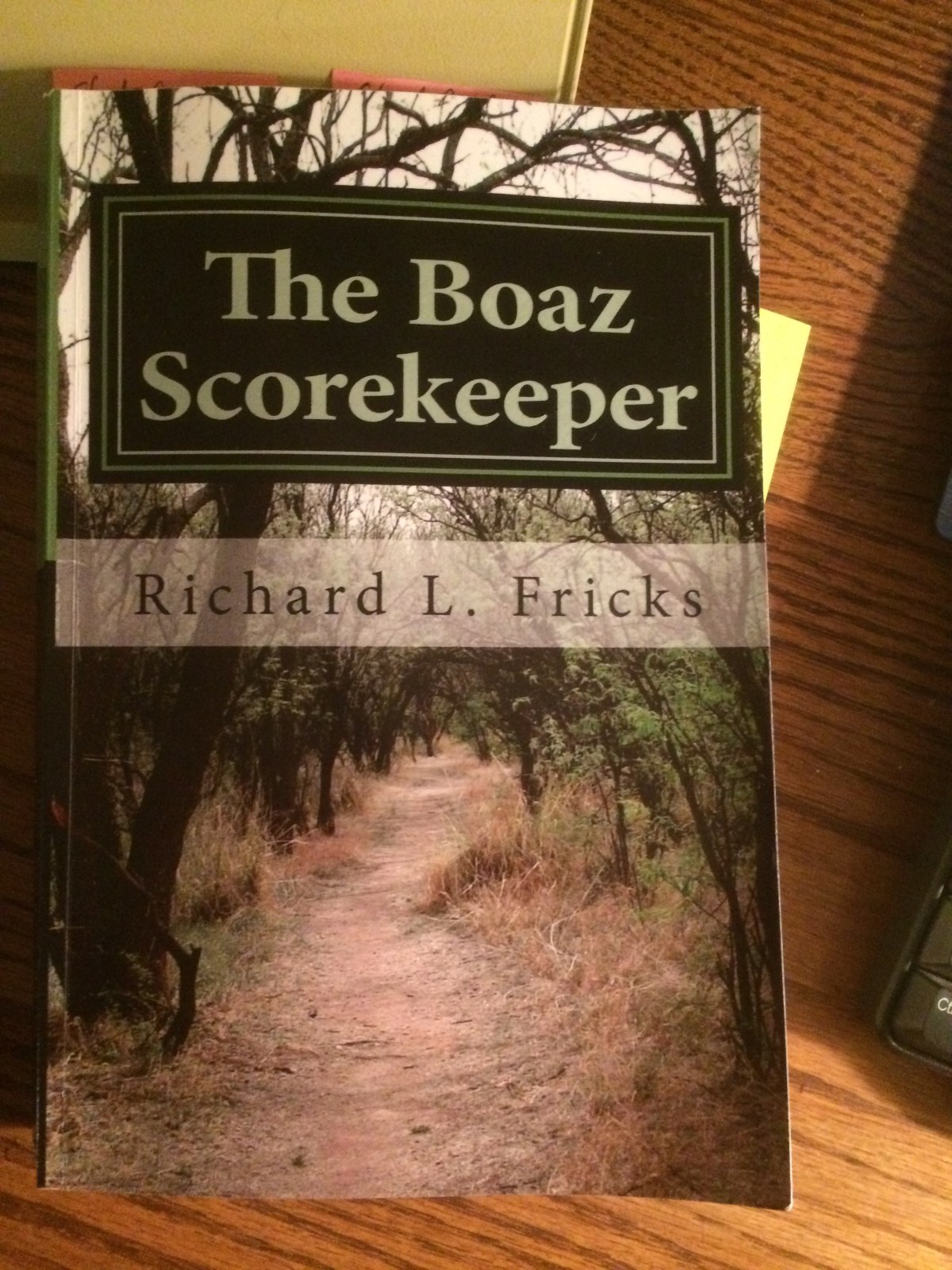
The Boaz Scorekeeper, written in 2017, is my second novel. I'll post it, a chapter a day, over the next few weeks.
I arrived home, unloaded the truck and set fire to the product of our day’s demolitions. Karla had cooked my favorite meal of pinto beans, cornbread, fried potatoes, and coconut pie. Even though I was tired, after supper, Karla and I took turns playing chess with Lewis. We were fortunate he was still at the age he would spend real quality time with his parents.
At 10:45 p.m., Lewis called it quits after capturing Karla’s King. He went to bed and Karla started reading her Sunday School lesson. I pulled my feet up in my lounging chair and dozed off. At midnight, Karla kissed my forehead and said goodnight. I got up and walked to the kitchen and saw Journal 15 laying on the counter. I drank a glass of water and brought the journal back to my chair. I was no longer sleepy.
All I knew before I started to read was Fitz and Harold were apparently friends and he was a bookkeeper at the Sand Mountain Bank. And, according to Fitz, a very creative bookkeeper. I assumed the letter had been written by Fitz Billingsley given the oddity of his first name. I didn’t know Harold’s last name. I was puzzled. I had found Journal 15 in an old storage room, a hidden one at that, of the Sand Mountain Bank, Fitz’ First State Bank of Boaz only competitor. I became even more puzzled when I read the first journal entry, dated January 21, 1946, one I assume was written by Harold:
Period: December 1945
Gross Wages $57,927.96
Tax $1,158.56
No. Workers 1049
Avg. No. Hours 227.28
Avg. Mo. Earnings $55.22
Avg. Hourly Rate $.2430
CE’s share $289.64
Tithe $28.96
This appeared to be some type of payroll tax report. For some reason, I flipped to the back of the journal and in the middle of the next to the last page was this entry:
Period: November 1946
Gross Wages $60,374.18
Tax $1,207.48
No. Workers 1093
Avg. No. Hours 226.13
Avg. Mo. Earnings $55.22
Avg. Hourly Rate $.2442
CE’s share $301.87
Tithe $30.19
I flipped back to the front and was even more confused after reading the second journal entry. It was dated February 3, 1946: “Vincent Prader opened acct. $1,200.00. Needs lesson.”
Even though it was nearly 11:00 p.m., I called Matt and read him these three entries. He had me calculate the tax as a percentage of the gross wages. In both entries, it was 2%. Matt said that sounded like the City’s occupational tax that started at the end of the war. I asked him did he have any idea who Harold was. He didn’t even pause to think but said, “Harold Maples. He is a landmark, worked 50 years at least for the Sand Mountain Bank. Started as a bookkeeper and stayed in that position all those years. The man has staying power that’s for sure. I bet he is nearly a 100 years old. As far as I know he still lives in the old home place where he grew up, down College Avenue.”
Matt and I speculated for a while about Harold and Fitz’ relationship. I told him it appeared that Journal 15 was personal to Harold and was not a part of the official banking records like the red and green journals I had found. He asked why then was the black journal in with these official journals. I said I didn’t have a clue. We hung up, leaving me just as confused and aggravated that I hadn’t asked Matt about Vincent Prader. I called Matt back but he couldn’t remember. I called it a night and went to bed.
Matt and I worked nearly all-day Sunday removing three layers of vinyl from the reception room floor. We didn’t venture up into the upstairs storage room.
Monday, before going into the law office, I dropped by the library and had Barbara Mills, the head librarian since the Boaz Library was formed in 1929, show me how to use the microfiche machine. I told her I wanted to review all issues of the 1945 and 1946 Sand Mountain Reporter, the oldest newspaper in the area. After an hour or so I found an article with the headline, “Invincible Prader Returns a Hero.” After reading the article I learned ‘Invincible’ was a nickname for Vincent Prader. He was a highly decorated army hero who returned home in mid-December 1945. Vincent had grown up south of Boaz in the Red Apple community and had graduated Boaz High School May 20, 1940, volunteering for the Army two days later. The article went on to describe how Prader had single-handedly fought four Germans to save his friend Malcom Jackson of Memphis. The article said Prader and his German born wife, Helga, were planning on opening a Volkswagen auto dealership in Boaz.
At 10:00 a.m., Barbara stuck her head in the cramped little media room and said that Matt had called and that my 10:30 appointment was already there. I closed my notebook and turned off the microfiche machine. When I was nearly to the Library exit, I turned and asked Barbara if she knew anything about a Vincent and Helga Prader. She said, “yes, sadly so. Vincent returned from World War II a hero and bought the Miller property on North Main to operate a Volkswagen dealership. A few days before it opened, right after a load of Beetle cars were delivered, I think it was around Thanksgiving 1946, he and his wife went missing. They never were found. I can’t believe you don’t remember. Oh, sorry. That was before your time. The bottom line is that story rocked Boaz for years.”
As I drove to the law office, I had a gut feeling that Fitz Billingsley and Harold Maples had taught Vincent and his wife a lesson. If possible, I was going to pay Mr. Maples a friendly visit.

 Richard L. Fricks