
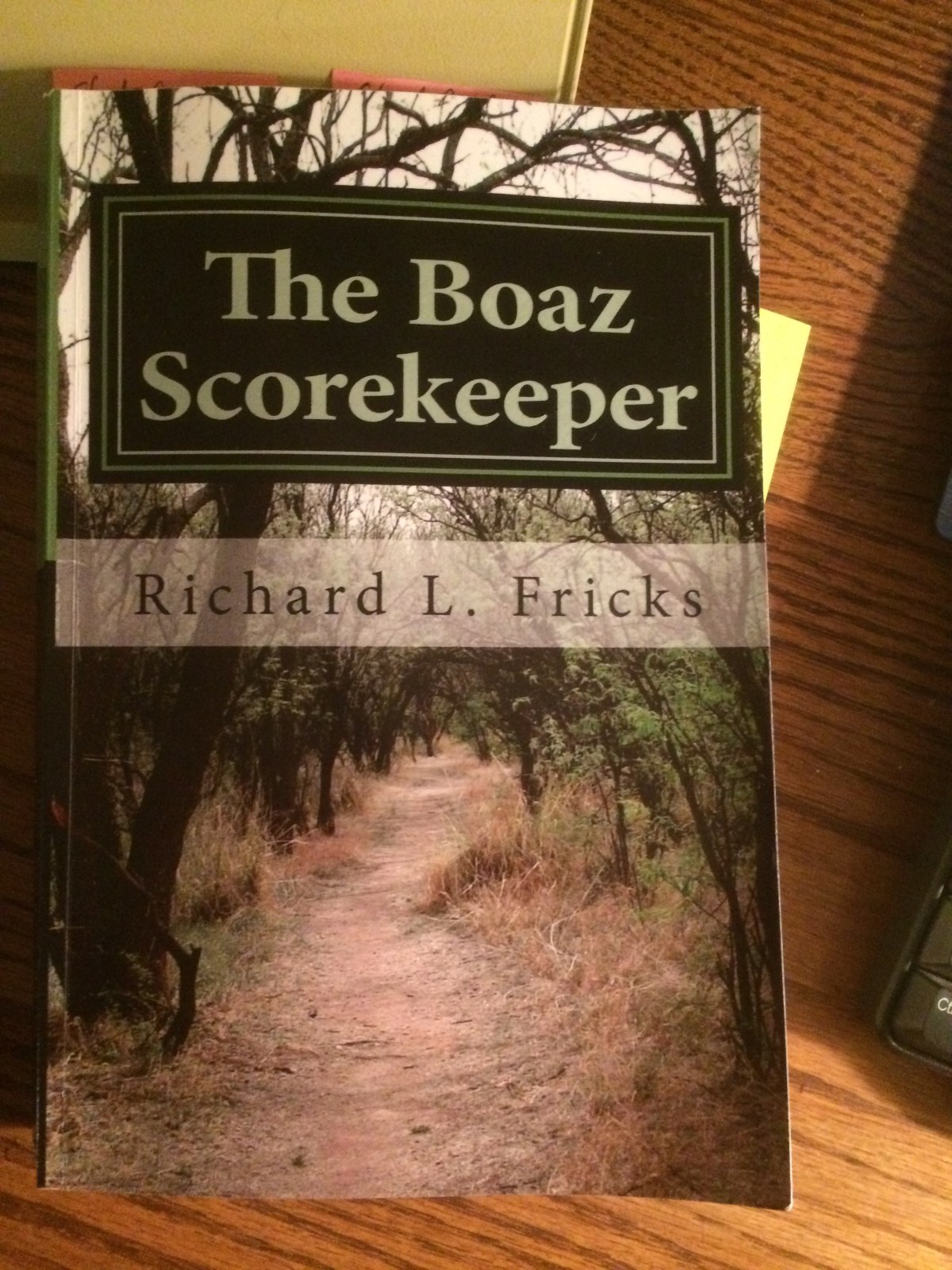
The Boaz Scorekeeper, written in 2017, is my second novel. I'll post it, a chapter a day, over the next few weeks.
After Sara Adams’ deathbed confession I filed notice of my intent to take the deposition of David Carl Adams. The next day his attorney, Tommy Brunner from Gadsden, called me. He said, as a courtesy he was letting me know that he was filing a Motion to Strike since I had no reasonable expectation of discovering any relevant evidence and that I should know that the Alabama Rules of Civil Procedure did not allow mere fishing expeditions. I thanked him for his call and asked whether he knew a good criminal defense attorney, that his client was going to need one. He acted shocked. I gave him the short version. He argued that since Mrs. Adams was now dead that the Prosecutor could not use her testimony. It would be hearsay. I agreed with him but let him know that Drake vs. Allbright would allow my affidavit to serve as the needed stepping stone to David’s deposition in a civil case. He said that I was correct if I had a corroborating witness that placed me and Mrs. Adams together at the time of the conversation. I assured Tommy that Loree Neilson was that witness.
The day before David’s deposition I felt like fishing. The kind Tommy Brunner spoke about. For years I had wondered who owned Club Eden. I felt David’s deposition might be a good opportunity to learn. Even though the Club was relevant as to where the graduation party took place I had mixed feelings whether a question about its ownership could slip by and generate a response. I thought it was worth a shot so I drove to the Etowah County Courthouse, Land Records Division, to see if I could develop a chain of title for Club Eden’s property at Aurora Lake.
I succeeded after two hours of reviewing plat maps, and with the help of Francis Frasier, an older heavy-set woman with silky red hair, who claimed to have worked in “these dusty dungeons” for over sixty years. We found a March 1892 deed from Larson Kittle to a company named The Garden, Ltd. The transfer included 288 acres along the south side of what became the Aurora Lake reservoir. There was no way to tell who owned The Garden company. Francis suggested I call the Secretary of State in Montgomery. She let me borrow her phone and the nice lady who answered had me an answer in less than five minutes.
The Garden, Ltd. was formed in 1890. There were five shareholders: Earnest Adams, Morton Tillman, Samuel Radford, Franklin Billingsley, and Joseph Ericson. I had no doubt these were the grandfathers, no, great grandfathers of the Flaming Five.
During David’s deposition, I had just explored Sara’s statements including the direct question whether he had killed Wendi Murray. Of course, he denied any such thing. I asked him if Walter Tillman was with him when he killed her. Again, he denied all involvement. Out of the blue I asked David if he was a shareholder in The Garden, Ltd. To my surprise he said yes. Again, to my astonishment he answered every question I could pose related to the Aurora Lake real estate. He said that he had inherited his shares from his father, Eugene, when he died in 1965. He also confirmed that the other shares were owned by Walter Tillman, Raymond Radford, Fitz Billingsley, and Franklin Ericson. When I asked about the name, The Garden, Ltd., and the purpose of this organization, David said he didn’t know. He also denied any knowledge about Club Eden.
A short while later I ended the deposition feeling I had wasted my time. David had been well coached, maybe a little too well coached. I couldn’t help but believe that he was lying.
I had dropped by the restroom on my way out of Tommy’s law office not wanting to engage in small talk as everyone was leaving. When I came out, Ralph Summerford, Wade Tillman’s lawyer, asked if he could buy me a cup of coffee saying that he had something I would want to hear.
We walked around the corner to a little diner on Chestnut Avenue. Ralph said that he was now representing Wade’s father, Walter, and wanted to make a deal. I asked him what he had in mind. Ralph said Walter would cooperate with me and Matt and pay $50,000 in exchange for confidentiality and an immunity agreement from the Prosecutor. Ralph asked if we could talk off the record. I agreed. Walter had admitted that he was present when David ended Wendi’s life. Ralph said that Walter had tried to stop David and encouraged him to go to the authorities before doing anything stupid.
I told Ralph that he knew my clients could not grant Walter any type of immunity, that would have to come from the District Attorney. Ralph said that he knew that but my encouragement might be enough to convince the DA, especially if Walter would agree to testify against David. I asked Ralph what Walter could offer concerning my client’s wrongful death case. If I took the deal, there would be no testimony from Walter Tillman but he would provide us with names and documents that would lead us to Club Eden and enough evidence that Matt and I should be able to tie David and the other three, Raymond Radford, Fitz Billingsley, and Franklin Ericson, and all members of the Flaming Five, to the deaths of Wendi and Cindi Murray.
I told Ralph that if he would draft the agreement, including the exact evidence that Walter had, that Matt and I would discuss it. I agreed with Ralph that if we failed to reach an agreement, Matt and I would treat these negotiations with strict confidence.
Two days later and right before 8:00 a.m., Ralph hand-delivered a packet to my office asking me to review the agreement draft and for an opportunity to meet before he drove back to Birmingham. I told him I had a motion docket in Albertville at 9:00 and could meet with him after lunch.
When Ralph arrived at 1:30, Matt and I had spent nearly two hours reviewing the agreement along with several exhibits. The first exhibit was a copy of the organizing document for Club Eden. It was dated June 23, 1899. The initial club members were Earnest Adams, Morton Tillman, Samuel Radford, Franklin Billingsley, and Joseph Ericson. The Club was formed for promoting and directing business operations and community life in Boaz, Alabama, and to enhance fellowship and progress among members. The second exhibit was a copy of Club Eden’s bylaws. All members were required to take an oath swearing to never disclose Club “business or non-business, or anything even remotely related to the Club.” Punishment included the branding of a cross on the forehead, and the option of death by hanging but only by unanimous decision.
Another exhibit stated that The Garden, Ltd. was formed in 1890 to purchase and manage the real estate that would become the headquarters of Club Eden. The Club was not officially documented until 1899.
Walter detailed the names and membership dates for all members since Club Eden was officially formed. This list included five generations. I quickly noticed that I was the only member from outside the Adams, Tillman, Radford, Billingsley, and Ericson families. Also, I noted that the Flaming Five’s sons were now members having all taken the oath last year, 1996, when the oldest of the youngest generation was 15.
Walter described in another exhibit that after each of their sons came home that Saturday morning that all ten of them met at the Church’s fellowship hall. They drove three cars, Wade and John’s Blazers, and James’ van, to Little Cove Road. The girls’ blue Plymouth was parked about 200 feet down a little lane, barely wide enough to ride a bicycle without scrapping outcropping limbs. The two girls were another fifty feet or so down a ravine with limbs and leaves and rocks piled over and around them. David, Franklin, Raymond and Fitz carried the two girls up the embankment and down to James’ van. That’s when they noticed one of the girls was still alive. James said that it was Wendi. Nothing was done to her there. The rest of them wiped down the inside of the Plymouth with bleach and water that they had brought. They piled into the three vehicles and drove to Franklin’s farm on Martin Road.
Walter then described how John had pulled a front-end loader out of the barn and Raymond and Fitz pulled the girls from the back of James’ van and put them in the front bucket of the loader. John drove the tractor to the backside of their property and David then dug a hole while the rest stood around watching. When David finished, he motioned for Walter to come over. They talked for quite a while about having a type of ceremony for the girls. Walter finally agreed to say a prayer but he didn’t want everybody there. David made everybody else go back to the barn and wait on him and Walter. When they were gone Walter said a prayer and David smothered Wendi. He used the front-end loader to push them into the hole and to pile dirt over them. David also pushed a dead tree over the grave that was on the ground nearby. They then scattered a ton of leaves over the grave. David and Walter walked back to the barn and without another word being said all ten of them got in the three vehicles, drove to the Church, where they all went their separate ways.
After reviewing all the exhibits, I noted a few discrepancies compared to statements made by Cynthia Radford and Sara Adams. I chose to ignore them, and instead, to read the agreement. It was simple. In exchange for the information contained in the packet and $50,000, my clients would release Walter from all liability related to the deaths of Wendi and Cindi Murray. Also, Matt and I would agree, on behalf of the Murrays, to encourage the District Attorney to grant Walter immunity from all prosecution in exchange for his truthful testimony.
I told Ralph that I felt like my clients would agree but obviously I had to have their approval. I promised him that I would meet with them as soon as possible. When Ralph was leaving, I told him that I had a question. Without letting me finish, he said, “I know you want to know why Walter didn’t try to include his son Wade in these negotiations.” I told him he was correct. Ralph said that he and Walter had discussed it but both had quickly agreed that there was no way in Hell, those were Walter’s words per Ralph, that the Murrays would agree. They would feel there was no amount large enough to appease for the actions of one of the five who had murdered their daughters. And, Ralph said, Walter barely could barely scrape together the $50,000.
Ralph left and I went to my office and stood by my window looking out at a mostly empty parking lot and a bubbling water fountain. The sun was at just the right angle to refract colored lights through the spewing water. I couldn’t help but associate water with life. Jesus said He was the Bread of Life. Wasn’t He also the Water of Life? I became angry when I wondered where this Supernatural being, this all-powerful and all-loving God, had been when Wendi and Cindi needed Him the most. Truthfully, if He is real, He was just as responsible for the deaths of those two precious girls as the Flaming Five and their fathers. How dark and foreboding this little community in North Alabama seemed, after hearing Pastor Walter describe the horror he and other faithful members of the First Baptist Church of Christ had so quickly and easily managed.

 Richard L. Fricks