
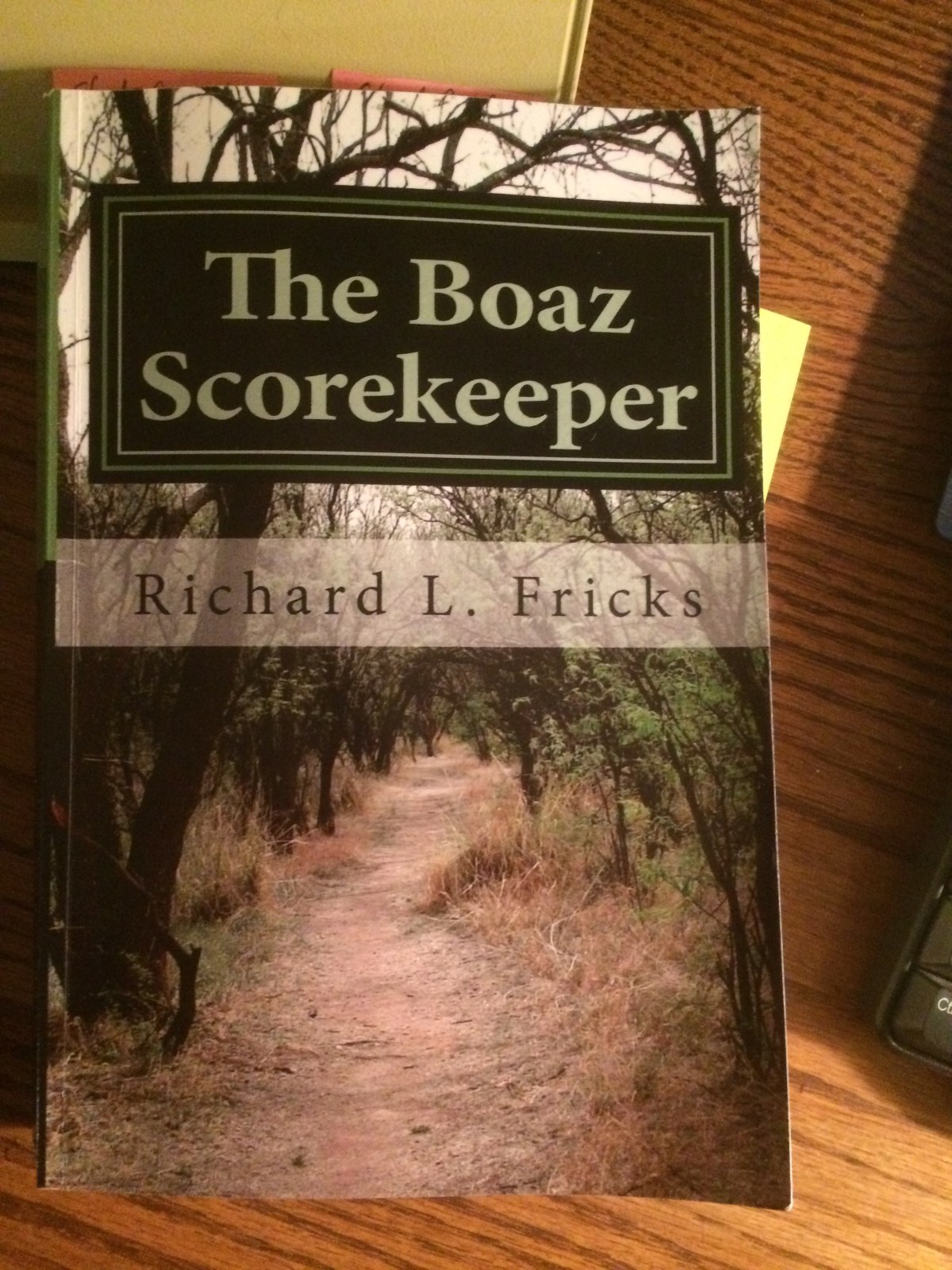
The Boaz Scorekeeper, written in 2017, is my second novel. I'll post it, a chapter a day, over the next few weeks.
In July, I was contacted by Nate Baker, a reporter with the New York Times. He said that he was in town researching a follow-up story to the Times’ 1986 article, Designer Outlets Transform a Town. Nate said the follow-up article had been scheduled for publication in early 1996 but the original reporter had both a personal and professional conflict. With the research deadline approaching, the newspaper’s chief editor decided to change the deadline transforming the assignment into an eleven-year expanded feature.
Nate asked if he could come by the office to discuss the Murray case. He said two months ago when he was assigned the project he did some preliminary research, including reading several local and state newspapers, and had learned about the wrongful death lawsuit against the five most prominent families in Boaz. He said he had decided to feature the 25-year unsolved case of Wendi and Cindi Murray alongside the devolution of the Boaz outlets.
I didn’t have any appointments and told Nate to come to the office. To my surprise, he had already spent six weeks in Boaz working on his story. He gave me a copy of the Times’ 1986 article about how Boaz was transformed by the outlets. I scanned the article and said I had vivid memories of visiting Boaz from my home in Atlanta during the late 1980s and seeing dozens and dozens of tour buses hauling in light-hearted folks with heavy pocketbooks to sometimes spend hundreds and even thousands of dollars each. I also said it was a shame that pride, ego, and jealousy could not have been set aside for the greater good. Nate asked me why I thought the outlets had failed.
I gave him my opinion. Boaz had pretty much always been ruled by five families. They were the only game in town, running things with a club mentality. They were a club, it was known as Club Eden. In the early to mid-80s club member Raymond Radford got a wild idea that Boaz needed to think outside the box so to speak and develop some type of unique draw for people far and wide. For years the H.D. Lee Company had a plant in Boaz making mainly blue-jeans. Radford did some research and learned that the Lee Company was owned by Vanity Fair and that it was planning on closing the Boaz sewing facility. Vanity Fair was a huge retailer with dozens of stores. Radford convinced the Club to develop an offer for Vanity Fair. Mayor Adams, also a Club member, convinced the City Council to waive all city sales taxes for 15 years and to provide over $300,000 in renovation funds. In exchange for these incentives, Vanity Fair would lease the twenty stores that surrounded its complex to the City. The Club, along with the Executive Director of the Chamber of Commerce, flew to Denver to present their plan. They were successful but someway the Club wound up controlling the outlying 20 stores which allowed it to re-lease them to manufacturer outlets. All was great in Boaz for nearly two years. Club Eden was in control, making thousands per month, and Boaz sales taxes from the 20 outlying stores were filling the City’s coffers with more sales taxes than all the other local retail merchants combined.
Club Eden was surprised in late 1987. On Black Friday, the Birmingham News featured an article about Atlanta retail developer Carter Livingston’s plans to build a 200-unit retail facility just up the street from the Vanity Fair Complex. The article said Livingston had already secured the 160-acre tract of land and would begin construction in early January 1987. For nearly 100 years Club Eden had controlled Boaz. No business of any significance could open within the city limits of Boaz without the Club’s unofficial approval. Those who had attempted to ignore the Club learned the hard way with several losing stores and inventories to unexplained fires. At least two people had lost their lives, or so it seemed.
Carter Livingston was true to his word. In record time, the Manufacturers’ Outlet Center of Boaz opened September 15, 1987 just one month before the stock market crash on October 19th. But, this didn’t seem to stop or even decrease sales that quadrupled those of the Vanity Fair center. This was great news for the City of Boaz bringing unimagined revenues from its 4% sales tax. But, it was worse than death for Club Eden. There was nothing more important than power and control to these five families. They would never accept defeat. Success was the only acceptable result. The short of it, over the next two years, Club Eden built six outlet shopping centers. None of them were in Boaz. The Club’s plan was truly long-term. They knew that people came in droves to Boaz because of the great deals. The Club also knew that all these thousands of customers were not loyal citizens of Boaz. They would abandon Boaz in a heartbeat if they had another choice. This is what Club Eden provided. By the early 1990s, the Boaz outlets were struggling and dozens of stores were closing. A skeleton of stores remained until mid-1995 when Carter Livingston bankrupted his Manufacturers’ Outlet Center of Boaz.
Nate thanked me for my detailed description of why the Boaz outlet phenomenon had failed. We went to lunch and returned. When we sat back down in the conference room, he asked me if I knew Clinton Murray? I said I did, that he was a cousin of Wendi and Cindi Murray. Nate said that when he first met with the Murray’s that Clinton was present but wouldn’t talk with him. But, after several visits he apparently realized that Nate was serious about telling Wendi and Cindi’s story.
Nate said that Clinton had found Cindi’s journal in 1996 when their parents finally decided to dismantle the twin’s bedroom. Clinton, with Bill and Nellie’s permission, had shared it with Nate. Apparently, Cindi had been to Club Eden once before the May 25, 1972 graduation party. She wrote an entry dated May 11, 1972: “met Randall and James at the Boaz Dairy Queen. We went to their clubhouse but I don’t know where it is since they made me wear a dark hood. They built a fire and we sat around and talked. They invited me to their graduation party in two weeks and asked if I could bring a girlfriend. I told them I had a twin sister but she was shy and didn’t even date. They said they would give me $200.00 if I brought Wendi with me.”
Nate also told me that he had five investigators working for him. Each of them had been assigned to one of the Flaming Five and charged with watching and recording their every move. Nate said that he was certain that every one of them except Wade Tillman was having an affair. James Adams meets a Sherry Sampson at either the Day’s Inn or the Red Roof Inn in Gadsden every Thursday at 11:00 a.m. Randall Radford goes either on Monday or Tuesday to a house on Pecan Avenue in Albertville to see Cissy Sprayberry. Fred Billingsley meets his secretary, Judy Killian, at her house on Pleasant Grove Road at least twice a week—usually over a weekday lunch. John Ericson is more discreet by meeting his housekeeper on Wednesday afternoon at his house while his wife makes her weekly shopping trip to Huntsville. But, Nate said, here is where it gets interesting. Wade’s wife Gina always goes to Huntsville on Wednesday with Ericson’s wife Judith. Apparently, they have found some very interesting stores at the Huntsville Hilton.
After Nate filled me in on random and non-recurring trysts by the Flaming Five, he announced that his article was scheduled for publication the middle of October.

 Richard L. Fricks