
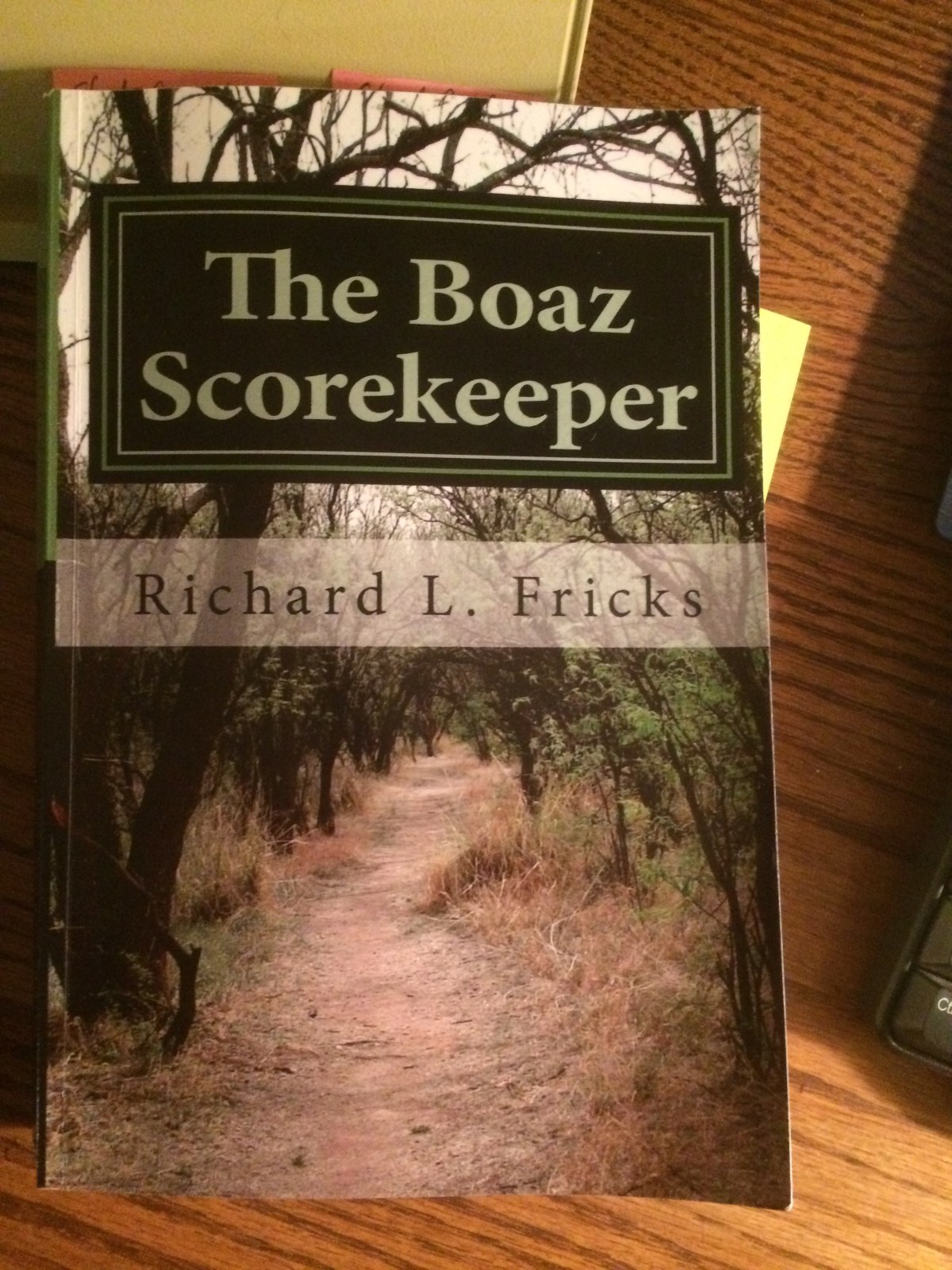
The Boaz Scorekeeper, written in 2017, is my second novel. I'll post it, a chapter a day, over the next few weeks.
On March 21st, 1997, a human skull was found when a bulldozer was clearing a spot for Stan and Jessica Jennings new house in the Pebblebrook subdivision being developed by Ericson Real Estate. Matt called with the news and speculated this could be Wendi and Cindi Murray’s way of showing up to demand justice. I told him I hoped he was right but I doubted it was true. It simply appeared unbelievable especially after Matt learned that the bulldozer operator had been clearing the wrong lot. Matt heard that the Jennings had met with Wilcox Construction Company’s owner, Brad Vickers, a week earlier. They had discussed exactly what they wanted done: which trees to remove, which to leave, and the location and dimensions of a partial basement included in their house plans. Brad was sick the day he was supposed to start work and sent his son Bradley. Someway he confused Lot signs 31 and 13 and wound up on the wrong side of Pebble Lane, the most remote street in the 300-acre subdivision.
Lot 13 became an official crime scene when the State’s forensic team unearthed two complete skeletons. Two weeks later, the State Lab released the results of their testing. Finally, after almost 25 years, the Douglas High School twin sisters had been found. Their graves had opened and Wendi and Cindi had walked out demanding justice.
What gave me absolute clarity that it was time to return to Boaz was what happened next. After my trial and before I left Boaz for Atlanta in 1973, I had met with Wendi and Cindi’s parents. Someway over the years they began to trust me, that I had had no part in their daughter’s pain and suffering. We had formed a mutually sad but satisfying relationship. Even though we rarely talked we did exchange Christmas cards every year. But, I was still shocked when Matt called me three days later telling me that the Murray’s had hired him to file a lawsuit against Wade Tillman, James Adams, Randall Radford, Fred Billingsley, and John Ericson. He said that Alabama law allowed such a delayed lawsuit based on newly discovered evidence that the plaintiff could not have reasonably discovered earlier.
Matt asked me to make sure I was sitting down. He described how he had, on a hunch, investigated the ownership of the subdivision property. County records revealed that Franklin Ericson, John’s father, had purchased the property in 1970 and had pretty much ignored it other than using the front 25 acres to maintain a few head of cattle. Also, Matt said that Lot 13 had been purchased by Boaz Land Company, an LLC (Limited Liability Company) that had two members, John Ericson and Wade Tillman. Before I could say anything, Matt said, “these discoveries are the clearest reasons you will ever have to justify moving to Boaz.” Without hesitation, I agreed.
Three weeks later Karla, Lewis, and I left Atlanta for Boaz and an unimaginable life. I should have been happy but was overwhelmed with grief over an incident I had been unable, until now, to even mention. It was the third anniversary of the suspicious fire that had destroyed the home place built by my great-grandfather in 1899, and that had killed my dear Mom and Dad. All during the drive home all I could think was that Lewis would never know the joy of experiencing life at Tannerville with grandparents who were the most joyous and happy couple I had ever known.

 Richard L. Fricks