
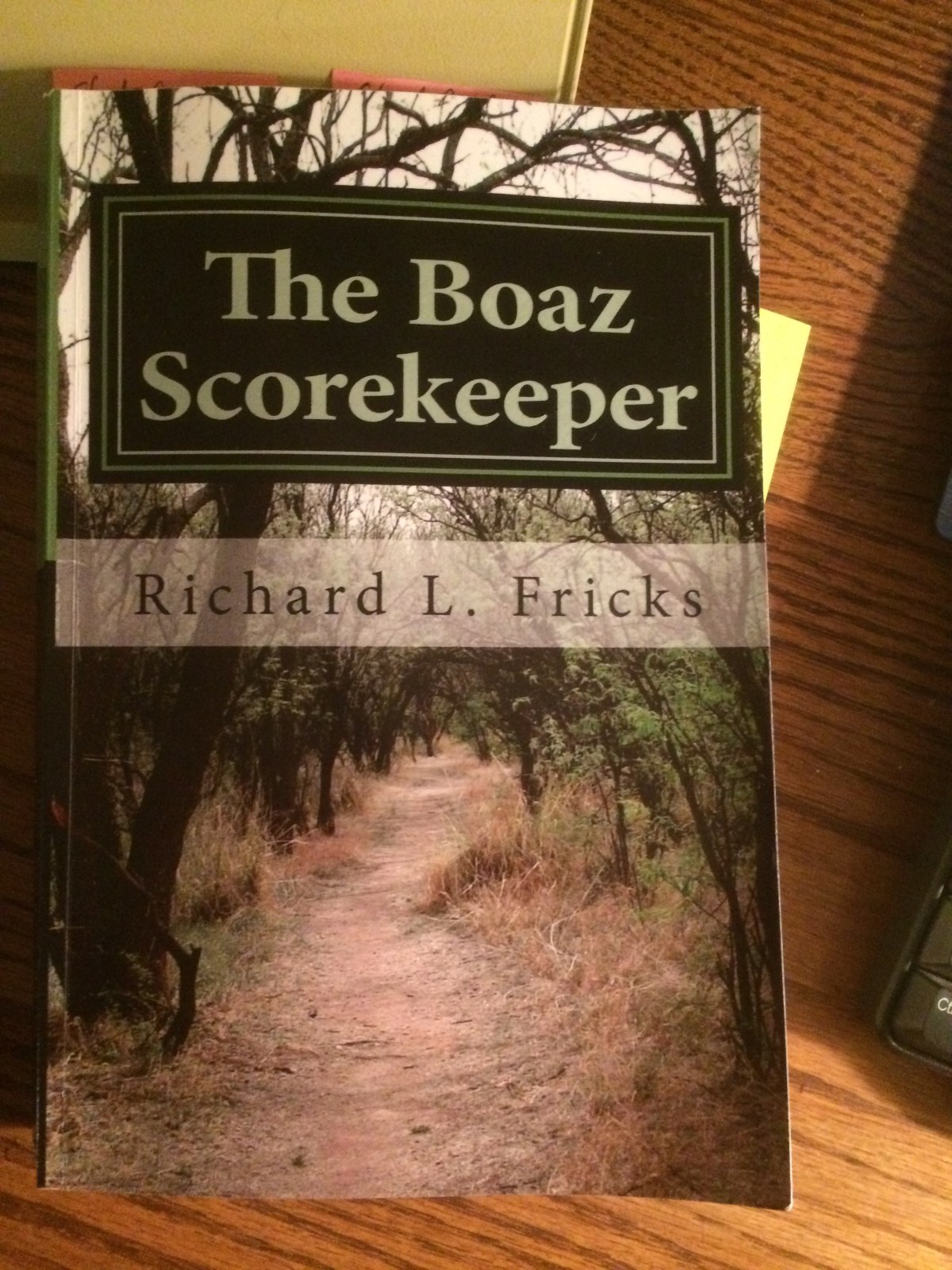
The Boaz Scorekeeper, written in 2017, is my second novel. I'll post it, a chapter a day, over the next few weeks.
The law firm of Downs, Gambol & Stevens offered me a job a few weeks before I graduated from law school. They said they felt, after observing me for the two semesters I had clerked for them, that I would make a good fit. I thanked them for their generous offer but told them I had always planned on returning to Boaz to practice with Matt.
However, my carefully laid plans changed radically the day I graduated. Matt had surprised me earlier that morning when he showed up at my apartment. He took me to breakfast and we mainly just hung out without talking seriously about anything. My parents arrived just in time for us to walk to Glenn Memorial Auditorium for me and my 125 other classmates to receive our J.D diplomas. After a nice dinner with my parents they returned to Boaz but Matt stayed the night. We sat out on my tiny balcony overlooking Peavine Creek right off Clifton Road and brainstormed a new case he had just taken in.
Around midnight, while I was dozing and trying to tell Matt I needed to go to bed, out of the blue he said, “Micaden, I can’t offer you a job right now.” He said he had thought a lot about me coming to work for him and decided that it was unfair for me if he didn’t encourage me to experience law practice from the perspective of a large firm in a big city. More specifically, he said he would never forgive himself if he didn’t try his best to persuade me to practice alongside Greg Gambol. Matt believed Greg was the best, if not one of the best, criminal defense attorneys in the nation. I hadn’t realized until now that Greg and Matt were law school classmates. They both had served as editors on the school’s Crime and Punishment Law Review and had become close friends. After they graduated they had gone their separate ways but had stayed in touch over the years. I knew that without Matt I would never have been selected to clerk for Downs, Gambol, & Stevens.
Matt said I needed to stay in Atlanta for at least five years. He planned on practicing in Boaz another 20 to 25 years, at least until he was 70 or 75 years old, assuming his health allowed him to. He stated that the experience I gained by working with Greg would make the firm of Bearden and Tanner much stronger.
At first, I fully opposed his idea but caved in after he asked me to do this as a favor to him. He told me about his experience with another big Atlanta firm after he graduated from Emory’s Law School in 1960, the year I turned six. He said that he believed those ten years developed and honed his skills and that without that experience he seriously doubted he would have been able to provide the level of legal service he had provided to me in my case. Matt asked me to consider this as full payment for his services for representing me in my kidnapping and murder case. I felt ashamed that I hadn’t thought about the sacrifice that Matt had made for me. Matt had responded so unselfishly when my Dad called him after my arrest. Matt had agreed to take my case without a large retainer, allowing my parents to pay what they could, when they could. They had paid a few thousand dollars over the years but not anything like the amount of fees Matt had diligently and honestly earned. Ultimately, I had no choice.
The next morning Matt arranged for us to meet Greg Gambol. As Matt drove us downtown I could hear Sheriff Brown say, “Tanner, you are under arrest for the kidnapping and murder of Wendi and Cindi Murray.” I felt sad that yet again a surprise had knocked at the door of my life and I had no ability to resist. I hoped Matt’s surprise was better than Brown’s. As Matt pulled into the parking deck across from Greg’s office I felt ashamed that I had associated these two events. Matt had been my salvation. It had been his wisdom and ability to persuade that had pulled me from the jaws of depression and despair and had led me, step by step, to victory. Now again, Matt was the visionary, who marshaled us both to ignore disappointment and embark upon another long journey towards a worthy goal. As I sat and listened to Matt argue with Greg why he should hire me I realized how blessed I was to have such an advocate.
Greg renewed his offer and I accepted. I was now the newest associate at Downs, Gambol & Stevens.
I spent the first three months—along with three other new associates—shadowing the Firm’s named partners and studying for the Bar Exam. In a large firm, a new lawyer doesn’t take on new cases. He simply assists the responsible lawyer. A new lawyer is merely an apprentice. I mainly conducted legal research and writing. In law school, I had learned the IRAC method of analyzing a legal issue: issue, rule, analysis, and conclusion. The analysis component was where the relevant law was applied to the facts of the case the firm was dealing with. The partner would give me the legal issue or question to answer. It was my job to determine what rule or law applied to the issue. This normally required days and days, sometimes 100 hours or more, in the Firm’s law library, searching for the relevant statutes (if any) and applicable case law. Once I felt I had exhausted the search I would outline my argument to determine if there were any logical fallacies leading me to the conclusion that I had already roughly formed in my mind. Once my outline was solid, I drafted a memorandum. This was a formal document laying out in detail how the relevant law required the conclusion I had reached after considering counter-arguments the other side would naturally posit.

 Richard L. Fricks