
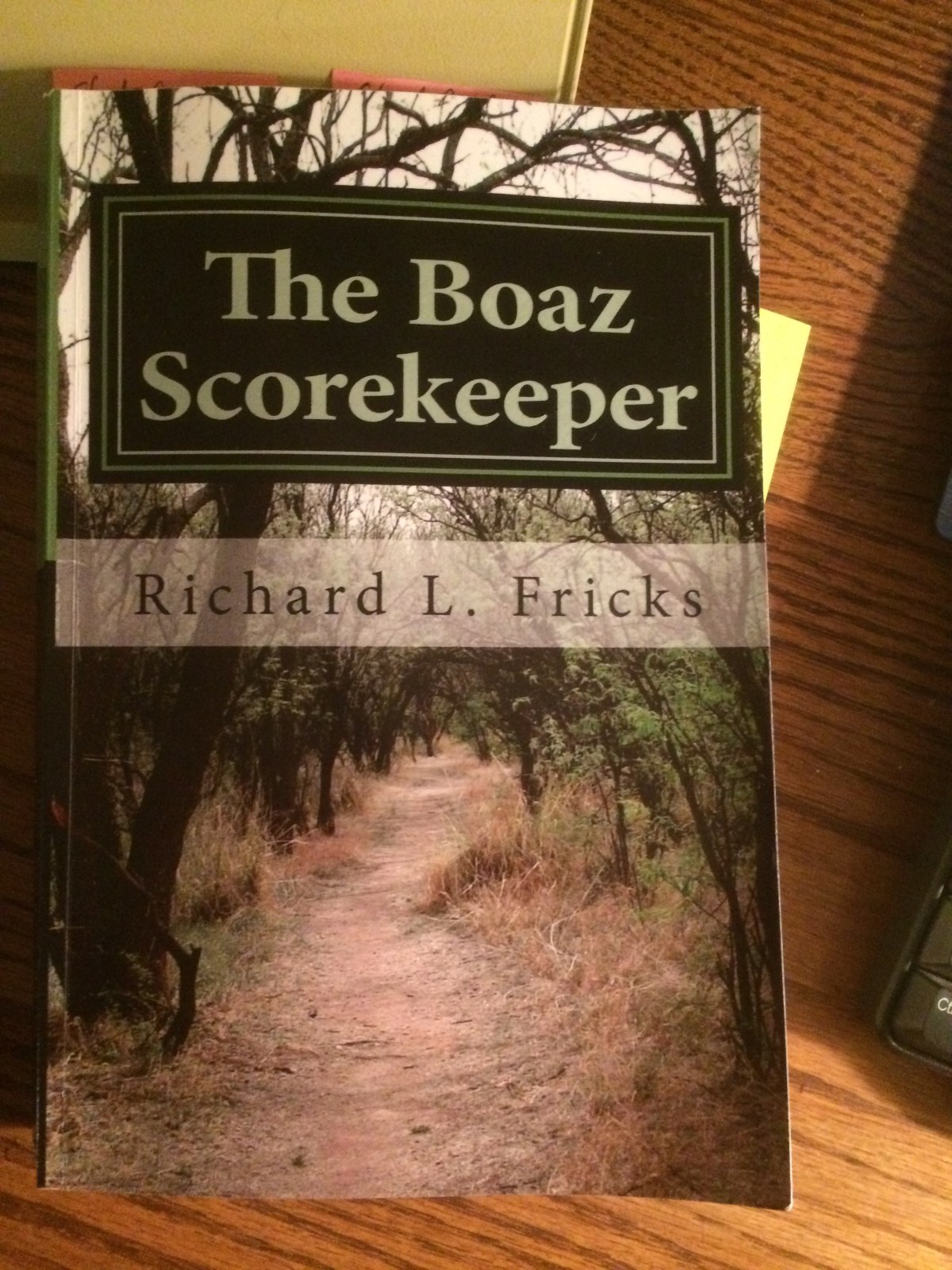
The Boaz Scorekeeper, written in 2017, is my second novel. I'll post it, a chapter a day, over the next few weeks.
I never did find a summer job, but I did on several occasions help our neighbor Floyd Parker haul hay from his fields.
It was the Tuesday after Labor Day when I found out what truth and justice were about, at least the version hovering like a misty fog over Boaz, Alabama. I had just returned home from my first day as a student at Snead State Junior College when I heard a knock on the front door. It was Sheriff Wayne Brown and his Deputy Carl Lauderdale. I could feel the same prickly sensations running up and down my spine that I had felt during their first visit at the beginning of the summer.
I walked out on the front porch and Brown said, “Tanner, you are under arrest for the kidnapping and murder of Wendi and Cindi Murray.” I literally collapsed and the Deputy had to lead me to the back seat of his car.
They carried me to an interrogation room inside the county jail at Guntersville. I knew from television and my High School Civics class that I had a right to an attorney but that didn’t seem to matter. Detective Kent Allison ignored my request and shouted out a barrage of questions: “where did you dump Wendi and Cindi?” “How did you kill them?” “Don’t you think you have put the girls’ parents through enough hell by withholding this evidence?”
He then told me that my five buddies had finally come forward and told him and Sheriff Brown what happened. He said, “we know now that it was you who drove Wendi and Cindi back to the Dairy Queen from where ya’ll had been partying all night. They don’t know what you did but all five of them have told us, separately I might add, the very same story. Also, the four other girls who were present told us the same thing. Tanner, you might as well confess, clean up your conscience, and give these two grieving parents some closure.”
I told the Detective that I was being framed, that Randall, James, and John were the ones who had left with Wendi and Cindi, while Fred, Wade, and I stayed at the camp. I told him that around 2:00 a.m. Saturday morning how Randall, James, and John had left with all six of the girls but had returned with Wendi and Cindi less than an hour later. I told him about how they had raped the girls in the tent and had forced me to stay by the campfire even though I tried to stop them.
Detective Allison asked me why I had lied to the Sheriff and Deputy Lauderdale when they came to see me the first of the summer. I told him that I knew how it would look if I told how I had seen Wendi and Cindi on Friday night, and early Saturday morning. I also told him about the oath the five had made me swear. I told him I knew it was wrong to swear but I also knew it was wrong to break an oath.
The detective made me write out my statement. Again, I simply told the truth. Deputy Lauderdale took me to a private cell and locked me up. Several hours later he came back for me and carried me back to the interrogation room where my Father and Mother were waiting, along with a man I had never seen. He introduced himself as Matt Bearden. He was a little shorter than me, maybe six feet, slim, and had curly black hair. He wore a white shirt, no tie, blue-jeans, and a pair of Converse tennis shoes.
Mother kept trying to hug me and Dad asked if I had anything to do with the disappearance of the girls. Before I could answer, Mr. Bearden instructed me not to say anything. He asked my parents to leave us alone. He then asked me if I had been present at a party with Wendi and Cindi after graduation as all five witnesses had said. I told him yes. He then asked me to describe what had happened that night but to limit my statements to what I had seen and heard. He wanted to know just exactly what I had observed with my five senses. When I finished he told me that it looked to him like I was the scapegoat. He told me how Nyra Sue Gibson, one of the four cheerleaders who were present most of that night, had come forward admitting she and three other Boaz cheerleaders had partied with us, and with Wendi and Cindi from Douglas. Nyra had said that I was the one who drove all the girls home from the party dropping off her and her three classmates at the High School. She said that I had driven off with Wendi and Cindi still in my car. I told Mr. Bearden that was an absolute lie. He said that the families of my five friends were all well connected in Boaz. He said he suspected they were choreographing this whole story.
My bail was set at $500,000, so I stayed in jail. My parents couldn’t post that type of bond. Over the next six months I found out who I really was. At first, I sank into deep depression and searched for a way to kill myself. If it hadn’t been for Matt Bearden, my attorney, and Brother G, I would never have made it.
Matt, as he made me call him, not only worked diligently on my case, he became a friend. He came to visit me at least once per week, usually on Saturday morning, early. He brought me law books and gave me homework of a sort. He asked me to read one preselected case per day trying to figure out the key issues and how the appeals court had resolved them. After the first week or two I started investing hours per week in this assignment because I knew Matt would have me verbally present each case to him during our time together on Saturday. Every case I read seemed to have something to do with my own case. Matt also brought me one novel per week. Matt had a way with words and encouraged me to focus my pleasure reading on fiction. There was something about In Cold Blood, To Kill a Mockingbird, and The Godfather, among many others, that steeled my mind, and stole my heart. They gave me hope. Just like the cases from the law books Matt had me read, the novels seemed to hold meaning to my circumstances. After my second reading of The Godfather, I began to wonder if the Corleone family represented, at least in some ways, the families of the Flaming Five. In addition to Matt’s weekly visits, he also reached out through the mail. I usually received one, sometimes two, letters per week. Each letter also included another homework assignment, this time a written assignment. He would pose one or two questions about the prior week’s novel. What made this a little difficult was that I was already reading a new novel. Looking back, I think Matt was training me to become a future lawyer. They don’t have the luxury of working just one case. They must keep up with facts and stories of maybe a dozen or more cases. I never knew how much money Matt spent on me. He furnished me with envelopes, stamps, a mountain of paper, and a ton of books. He convinced me that writing was therapeutic and that untold power resided in simple words. In a letter written two days before my trial, I told Matt that if he won my case that I wanted to become a lawyer like him. I thanked him for caring for me and showing me how a real criminal defense lawyer defends his client.
It was Matt that managed my head during these four months. But, it was Brother G, Gabriel Gorham, Gabe for short, that loved and innocently manipulated my heart. He always came late Tuesday afternoon, and he brought along one of his Deacons. A typical visit was both men with me in Interrogation One or Two. The Deacon would give me a short report about my family, sometimes handing me letters from Mama El and Mother. He would lead us in a prayer and then leave Brother G and me alone. He used emotion, where Matt used reason, to motivate me towards hope. I have never in my life been around anyone who could stir up my emotions like Brother G. He preached a sermon to me every week. Standing and strutting around the six by six cave. Four months of sermons and the two that most carried me to the finish line at the end of my trial were the stories of Joseph and David. Joseph in the Egyptian jail, and David’s fight with Goliath. “Micaden, you are a modern-day Joseph, a man placed here in this jail by God Himself. You see this as a prison. It is not. It is God’s schoolhouse. God is calling you to a mighty work. There is a town, a state, and a nation that someday soon will die from famine if you don’t learn the right lessons here today, tomorrow, and next week. There is one, two, maybe ten Goliaths that will enslave and murder unhindered if you do not let God shape your heart for His righteous work. And on and on Brother G would go. Every week. This continued until the middle of January 1973.
I knew something was different when he showed up Tuesday morning. By himself. He announced God had called him to First Baptist Church of Jonesborough, Tennessee. With tears in his eyes he gave me a scripture verse laminated on gold colored paper: “But without faith it is impossible to please him: for he that cometh to God must believe that he is, and that he is a rewarder of them that diligently seek him.” (Hebrews 11:6). Before he left, we embraced and he said a prayer pleading with God to hold me fast in the palm of His hand. As he walked out he said, “I love you Micaden and will see you again someday, if not on this earth, in Heaven.” That was the last time I ever saw Brother G.
My trial began on Monday, January 18th, 1973. The State’s case was strong. My nine classmates, the Flaming Five and the four cheerleaders, presented flawless testimonies. It was obvious to me they had spent much time rehearsing every detail. Of course, it didn’t help when Sheriff Brown and Deputy Lauderdale told the jury how I had lied when I was first confronted three days after the crime. At the end of Thursday, day four of my trial, there was no one in Marshall County who would have bet on me, who thought that I had a chance in Hell of being acquitted. No one, except Matt Bearden.
On Friday morning before Matt had a chance to call his first witness, Judge Garrison announced a recess until Monday morning. He said that he and the lawyers had some legal issues to deal with. Two deputies walked me back across the street to my cell. Matt came to see me around 3:00 p.m., and gave me an update of what had gone on since I left. He said that the Prosecutor was trying to stop us from putting on our main witness. The Prosecutor was arguing that Shawn Taylor was not competent to testify since he was only nine years old. The Judge deferred his ruling until Monday and said he would interview the child in his chambers before the trial resumed. I had not even heard of Shawn Taylor.
That weekend was the longest of my life. I was ready for the trial to be over. But, I feared what would follow if I was found guilty. On Monday after a long interview in his office, the Judge ruled Shawn Taylor could testify. My case and my future most likely rested on a scared little nine-year-old boy. Shawn was brave. He testified that he was inside the Dairy Queen early Saturday morning, the 26th day of May, last year. He said he was sitting at a table in the dining room waiting on his father to finish up cleaning. Shawn said that he saw Randall, James, and John drive into the parking lot beside a small blue car that had been there ever since he arrived. He stated he recognized all three of them because he knew them from First Baptist Church of Christ. Shawn said that Randall, James, and John had worked in Bible School the prior year. He also described the tag James had on the front bumper of his GMC van. He said it was a bucking horse rode by a pretty girl. Matt showed Shawn a picture of James’ van with the front tag clearly shown. Shawn told the jury that was the vehicle he saw. Shawn went on to testify that Randall and John had gotten out of James’ vehicle with two girls and then had gotten into the blue car. Then, they all drove off. The Prosecutor on cross-examination tried to convince Shawn he might have been mistaken about who he saw. Shawn held his ground leaving the Prosecutor rattled.
After my testimony, the Judge ordered a recess until after lunch, even agreeing for me to stay in an interview room off the courtroom while two deputies stood guard. Matt’s secretary brought lunch while he stayed with me. I appreciate how Matt treated me like an adult. He didn’t try to give me false hope. He said that Shawn had shot a big hole in the State’s case but that didn’t necessarily mean I would win. He said that he had seen juries do surprising things. He reminded me of what he had said at the beginning. Going to trial was like walking into a tiger’s cage, dangerous. At worst, you will be killed. At a minimum, you will lose an arm, a leg, the side of your face. But, for sure, you will be scarred forever.
The Prosecutor’s closing argument was predictable. He told the jury they had to conclude Wendi and Cindi were dead. He also argued that they must ignore Shawn Taylor’s testimony. The Judge reprimanded the Prosecutor when he said that the Defense had provided no proof that Shawn was even at the Dairy Queen that early morning. The Prosecutor said the only reasonable conclusion was for the jury to find me guilty. Matt argued that Shawn’s testimony created reasonable doubt. Matt emphasized that all nine of the State’s witnesses declared that Wendi and Cindi left in my car from the camp. He said, “hilarious, since Micaden’s car was a tiny Chevrolet Corvair, and it was parked at San Ann #1.” Matt described how close a relationship the Flaming Five had with the four cheerleaders. Matt reviewed with the jury my testimony of how Fred and Wade had threatened me with punishment and prison if I spoke one word about what happened on that fateful night. Matt said it would be unfair and a violation of their oath to disregard Shawn’s testimony that it was Randall, James, and John who had put Wendi and Cindi in their Father’s car parked at the Dairy Queen.
Court went late that Monday. It was almost five o’clock when the Judge finished charging the jury. He called a recess until 9:00 a.m. Tuesday morning and ordered them not to speak with anyone about the case. The jury deliberated for three days. At 10:25 a.m. on Friday morning, the jury foreman announced the jury was hopelessly deadlocked. After the Judge brought the jury back into the courtroom and strongly urged them to reach a verdict, the foreman asked to speak. He said that there was absolutely no need to continue deliberations, that there was one juror who had made it clear that he would never vote guilty in this case. The Judge ordered a mistrial.
Even though the Prosecutor could have retried the case, he never did. I had dodged the biggest bullet imaginable. I owed it all to Matt Bearden. He was the one who believed in me and persisted in his quest to find the infamous smoking gun. I don’t think Shawn Taylor’s parents would have ever allowed Shawn to testify if it hadn’t been for Matt’s ability to persuade them to have the courage to stand up against the families of the Flaming Five. I walked out of the Marshall County Courthouse on Friday, January 29th, 1973, a free man. Matt walked with me across the street to the jail to help me retrieve my things from my cell. I reminded him that I had decided to go to law school someday. As we walked out I promised him that I would treat my clients like he had treated me.

 Richard L. Fricks