
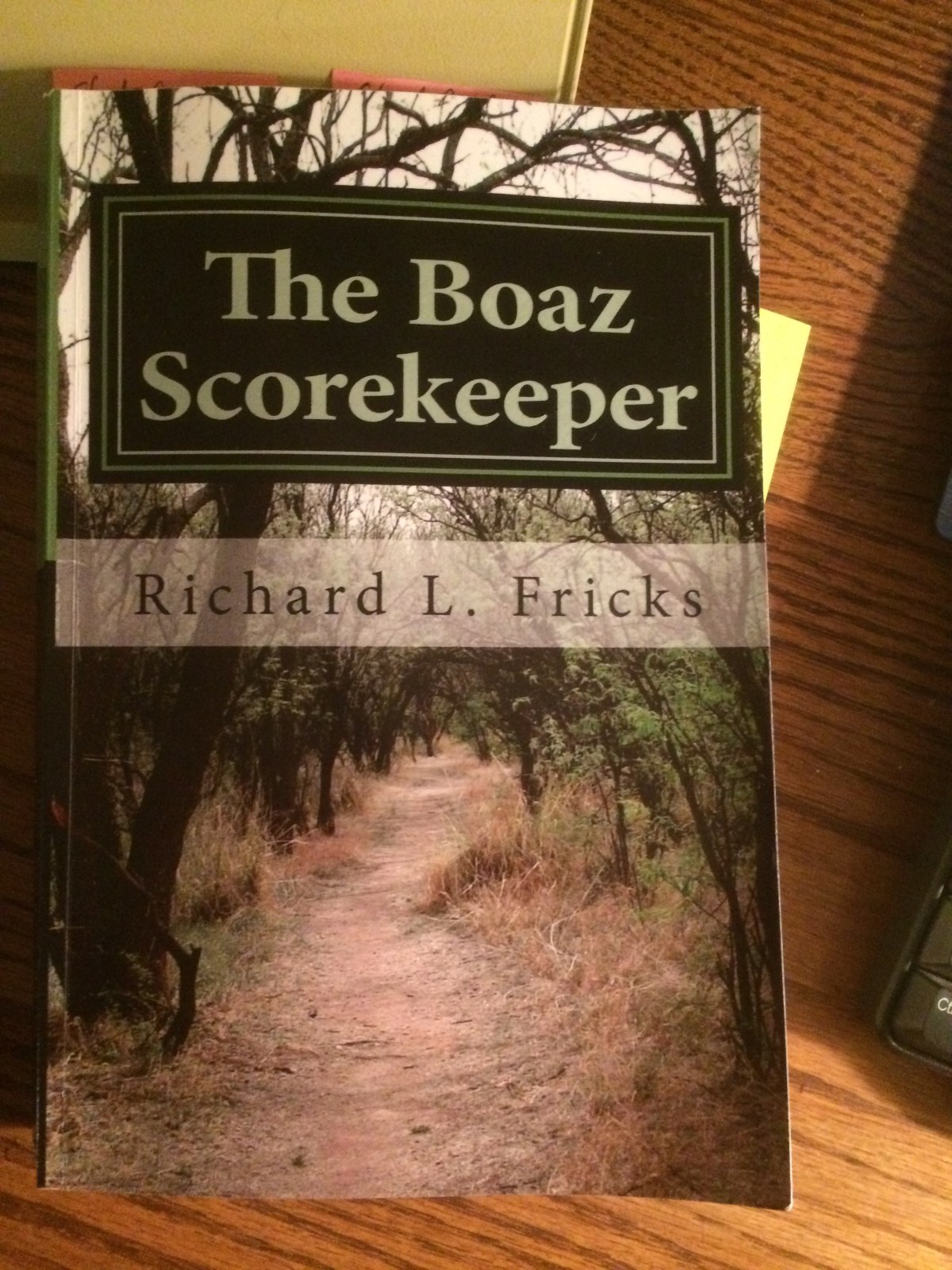
The Boaz Scorekeeper, written in 2017, is my second novel. I'll post it, a chapter a day, over the next few weeks.
There were no frills or extras around the Tanner household and farm. Except one. While in the Army my Dad had fallen in love with GMC trucks. I remember him and Gramp’s talking about the ‘Deuce-and-a-half.’ This was a GMC model CCKW350 series, two and a half-ton 6×6 truck. Dad said that it was ‘as stout as a tank and sexier than your mother.’
In 1954, Dad was working six nights a week at Boaz Spinning Mills and was investing nearly as many hours helping Mother, Mama El, and Gramp’s run the farm. But, he still couldn’t afford a ‘Deuce-and-a-half.’ Of course, he didn’t need a truck anywhere near that big. He knew that too but always joked about coming home with one after a hard night at the Mill.
The story goes that at 9:30 a.m. in late February, less than two months after I was born, Dad drove home in a like-new 1951 half-ton GMC 4 x 4 pickup. By then, Gramps’ 1929 1 1/2-ton Model AA was on its last leg. Dad couldn’t have been happier knowing that what otherwise would have been a frill was a necessity around a farm. However, the $1,150 price tag was an almost insurmountable problem, even with Dad’s $100 boot money.
For some strange reason, a day or two after Gramp’s funeral in 1965, Mother told me about the only argument between Gramp’s and Dad that she had ever witnessed. It was about that 1951 GMC pickup, or rather, how Dad had arranged to buy it. Mother said that Dad had seen the truck parked at Adams Chevrolet and stopped to look at it. David Adams insisted that Dad test drive the truck. When Dad returned he expressed his inability to afford such a high-priced vehicle. Adams insisted that Dad go see Fitz Billingsley at First State Bank of Boaz, even said he would give him a call as a recommendation. Long story short, the Banker offered Dad a low-interest loan with an extra year ‘for good measure if you hit the rough.’ Dad agreed, drove the truck home, and met Gramp’s coming out of the barn.
Mother said Gramp’s was always cool and calm, except when threatened. That day, he felt threatened by a thing called debt. He and his father were always against borrowing for anything unless it was a ‘piece of land.’ Gramp’s said that was the only thing that holds its value. Mother said her and Mama El heard shouting and came outside from the kitchen. Mama El was the only one who could get Gramps to settle down. She told him that Dad was right, they needed a reliable truck, and Dad had proven himself since the end of the war by working for almost ten years six days per week at the Mill. Within a couple of days Gramp’s loved the truck nearly as much as Dad.
Six months after Gramp’s died, the green 1951 GMC, known around the Tanner place as the ‘Green Giant’ had a heart attack of a different kind. Dad blamed himself and not the Giant. I don’t think Dad every got over Gramps’ death or what he claimed was his own stupidity for overloading the Giant. An old Pecan tree had blown over towards the house and Dad had tried to pull it using a long cable tied to the upper part of the tree and onto the rear axle of the truck. He also used our John Deere tractor but someway blew up the Giant’s motor. Adams Chevrolet laid out the cost of repair and the cost of trading. This time, the truck was a 1963 Chevrolet one ton 4 x 4. This time, Fitz made Dad an even better deal.
It was after Thanksgiving of my sixth-grade year. Fitz’s son Fred continued to struggle with his school work. Fitz had heard of me, through both my Dad and Fred. The day Dad went to First State Bank to sign the note to buy the 63 Chevy, Fitz introduced a unique banking twist. He would make the $35.00 per month payment on the truck if I would tutor Fred. Dad agreed and I had no choice, but I didn’t really mind since I kind of liked Fred.
For three years, nearly every afternoon after school, Fitz brought Fred to my house. Dad had suggested Fred ride the bus home with me but Fitz wouldn’t have it. He didn’t want anyone to know about his son’s learning problems. The only exception to this schedule was during the late Fall and early Winter in our 7th and 8th grade years when Fred was playing basketball on the Junior High team along with Wade Tillman, James Adams, Randall Radford, and John Ericson. During these times, Fitz would bring Fred over either after practice or early Saturday morning to stay all day.
By the end of the first semester of our 9th grade year, Fred was a solid B+ student. His problem had not been his IQ but his hyperactivity. When I started tutoring Fred, it didn’t take long for me to realize that his problem was his inability to stay focused. It was easy to see that Fred could not easily sit still working on a lesson at our kitchen table, but that out by the barn he could shoot a basketball forever without getting distracted one bit. Fitz never knew it as far as I know but about half the time Fred was at our place, we were outside fishing or hunting, and Fred fell in love with ‘Tannerville’ as he called it. I created games that helped Fred concentrate, things like tracking a rabbit, and watching one ant for an hour without looking up. I would tell Fred that reading or writing was like hunting and fishing. If he didn’t want to be the fish or the rabbit he had to learn the benefit of staying focused. I think, more than anything, Fred finally made the connection. By the end of Junior High, and certainly by the end of the first semester of our 9th grade year, Fred chose to be the hunter, the one in control. One other thing, I don’t think it hurt at all that I used a little psychology on Fred. I repeatedly told him the only way for him to someday have the resources to own a big place in the country like ‘Tannerville’ was to learn from the ant, with its slow and methodical routine.

 Richard L. Fricks