
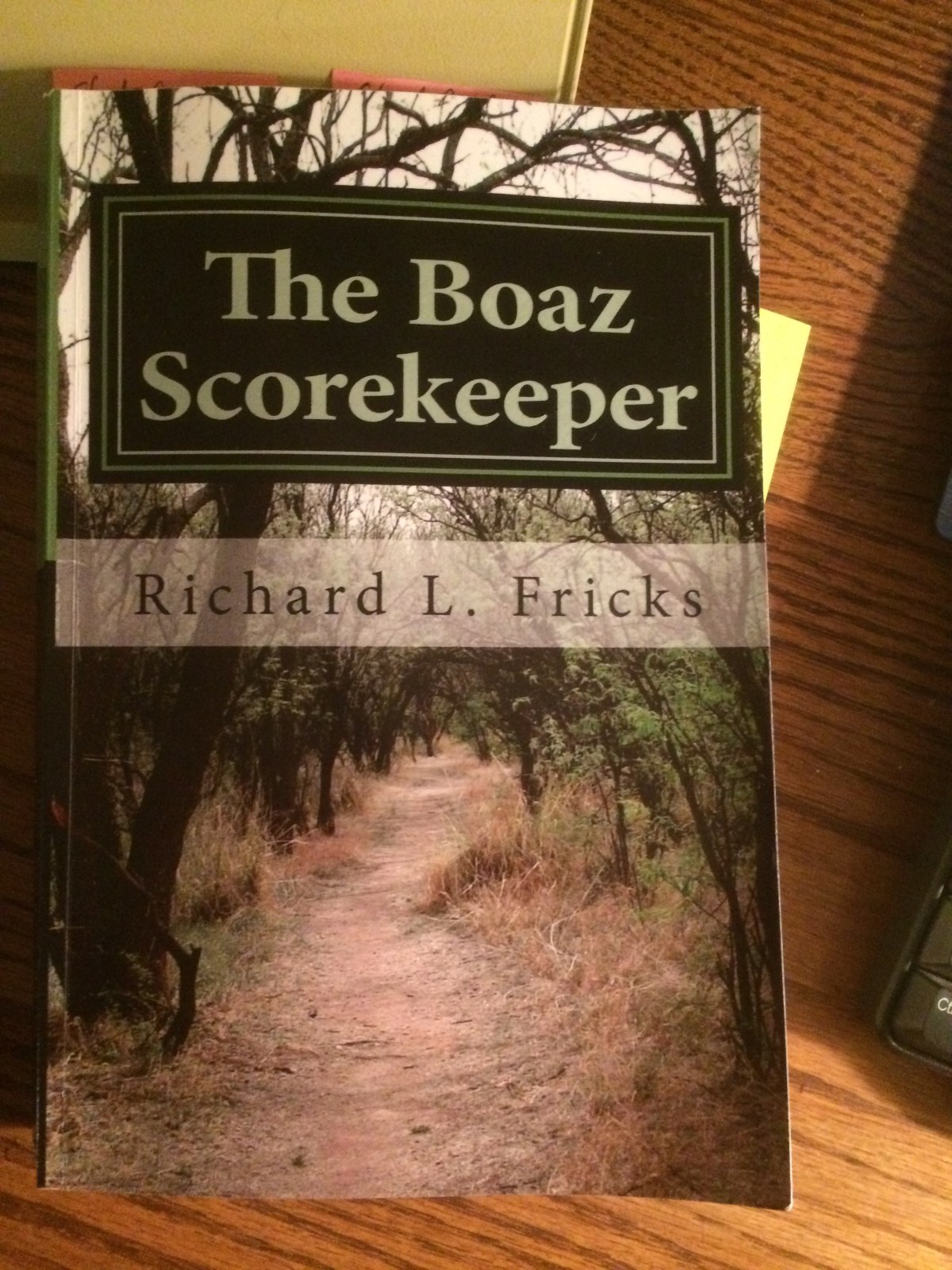
The Boaz Scorekeeper, written in 2017, is my second novel. I'll post it, a chapter a day, over the next few weeks.
I am Micaden Lewis Tanner. This is my life story. As you read, please keep in mind that I write legal memorandums and briefs, and scribble out a few short stories. However, I am not a novelist. But, don’t think that I don’t have a story to tell.
***
“Micaden, ‘vengeance is mine saith the Lord.’ You have been playing long enough. Pastor Gorham will be here in less than an hour.” Mom called out as she unpinned towels and underwear from the clothesline just off the back porch.
“Just a little longer. I promise I’ll be ready before he gets here.”
Gramp’s and I had finished feeding and milking before 5:00 and he was already dozing in his chair under the big oak in our backyard. I had played ‘Shoot to Kill’ two times already. It was more fun when Mama El was here to narrate but she was too busy cooking her cobbler. I ran to the barn with time to play one more time.
Bam, bam, bam, three shots rang out from the front yard. I was finishing my chores in the barn. I flung the pitchfork onto bales of hay and ran around the side of the house.
Daddy was lying in a pool of blood and an army of huge men were standing behind a big black Ford. With his last breath Daddy said, “Micaden, trouble has come, be brave, I love you.”
I grabbed Daddy’s rifle and started shooting. In fact, I picked up my slingshot and started knocking over oil cans lined up across the hood of an old and disabled Chevy. Nobody was a better shot than me.
The men kept shooting at me and they kept missing. When it was over, three men lay dead, and two more were begging for their lives. It was not until I walked over closer that I could tell they were police officers, and my friend Billy Baker was in the back seat of their vehicle.
All six years of my life I had heard how James David Kilpatrick, the sixteen-year-old son of Aubrey Kilpatrick, had meted out justice to the men who had gunned down his father in cold blood. That event had taken place less than a mile from where I stood. It happened in 1951 and James had only recently been released from prison. Both Gramp’s and my Father had shared this story with me since I was a baby.
I may be wrong but I think they were trying to teach me life isn’t always fair and to be ready to defend those you love when the law seems unconcerned.
“Micaden Lewis Tanner, get in here now and wash up, Brother Gorham will be here in ten minutes,” Mama El hollered from the front porch.
I gathered up my smooth stones scattered around the yard and went inside.
All my life Mother had cooked supper once per month for our pastor, Gabriel Gorham. He was tall and thin with sandy blond hair and never without his thick wire rim glasses. He always wore a black suit, white shirt, and a gold tie. He and his family had moved to the Arona Community in 1949 from Selma to shepherd Clear Creek Baptist Church. Tonight, his wife stayed home with their four children and a bushel of measles.
Mother, Gramp’s, Mama El, Brother Gorham, and I sat down to one of Mom’s feasts: half a dozen fried, steamed, baked, and broiled vegetables, sugar-cured smoked ham, Mama’s El’s sourdough bread, and her first prize blackberry cobbler. Dad was at the spinning mill.
Gramp’s said our blessing and we dug in. After what seemed too long a span of silence I spoke up, “Brother G,” that’s what he insisted all us kids call him, “why was James Kilpatrick sent to prison?”
Before he could respond Mom interrupted, “honey, why don’t we let Pastor Gorham enjoy his food?”
“Thanks Mary, I don’t mind, and by the way, everything is superb, excellent as always.” Turning to me Brother G said, “Micaden, I suspect you are referring to the 1951 incident where James shot and killed three law enforcement officers, correct?”
“Yes, Gramp’s said James has just been set free from prison.”
“Paroled.” Gramp’s said.
“Your question is a difficult one, especially so if you consider it from a theological viewpoint. The answer to your question boils down to the facts, what happened the night of May 17, 1951. There’s usually always two sides to every story but the Prosecutor argued that James had no legal right to shoot the officers because his father was breaking the law when he started firing. Defense attorneys Rogers and Brown had a very different take. They contended James had no idea he was shooting at the police. All he knew was he heard gunfire, ran around the corner of his house, saw his father laying in a pool of blood, and could see an unmarked vehicle with several men standing around with guns blazing.”
“I think James was innocent.” I said.
“I agree with you, but I wasn’t there nor at his trial. Again, the answer to your question depends on the facts, the truth of what actually happened.” Brother G said.
“What does God say about killing?” Gramp’s spoke up.
I could tell Mother was getting a little perturbed. “Mama El, why don’t you pass Pastor Gorham another slice of ham.”
“The Bible has much to say about civil disobedience, including illustrations of when the taking of another life is permitted, not sin that is. It speaks of war. You have heard me preach many times on David and the giant Goliath. Then, there’s self-defense. Which is what I think James was doing, protecting his family against an evil that had descended in the dark around his home and family. In a couple of weeks, I’m preaching on Acts 5:29 where Peter says, ‘we must obey God rather than men.’ Maybe, that would be a good time to expand on my remarks here. Yes, I think I will attempt to answer your question. Thanks, Micaden for asking it. Now, I can’t wait for Mama El’s blackberry cobbler.”
I kept my mouth shut the remainder of our meal. I sure wanted to hear Brother G talk about justice but instead I ate nearly two bowls of cobbler made from the blackberries me and Mama El had picked right after I finished my morning chores.
Brother G left a little before dark knowing I wouldn’t go to bed until he was gone. Tomorrow was my first day of school. Boaz Elementary was over three miles away and my school bus would be here at 6:30. I had to be standing out by the mailbox by 6:20 in case it was early. My 4:30 chore-time didn’t go away now that I was a student. I had to get to sleep.
But, I couldn’t, not for over an hour. I lay still for a minute and tossed for three, over and over it seemed. I felt both strong and weak. I wasn’t worried in the least about learning and completing my school assignments. Mother had me well prepared. From the time I was born, she had read to me. I started reading to myself at age 3. I knew my alphabet and could count like a fifth grader, according to Mom.
I also believed I was strong enough, brave enough, to deal with trouble if it came to me. No doubt it would. This is what Aubrey Kilpatrick had said according to Gramp’s. The story was that he had taught his oldest son James never to go looking for trouble. He wouldn’t have to because it would always find its way to him. When it did, don’t run but face it head-on and fear no man.
After an hour I was finally still, and halfway asleep. The last thought I had before consciousness collapsed was of a shepherd boy named David choosing five smooth stones, approaching and conversing with a giant named Goliath, and bravely declaring, “You come against me with sword and spear and javelin, but I come against you in the name of the Lord Almighty, the God of the armies of Israel, whom you defied. This day the Lord will deliver you into my hands, and I’ll strike you down and cut off your head.”

 Richard L. Fricks