
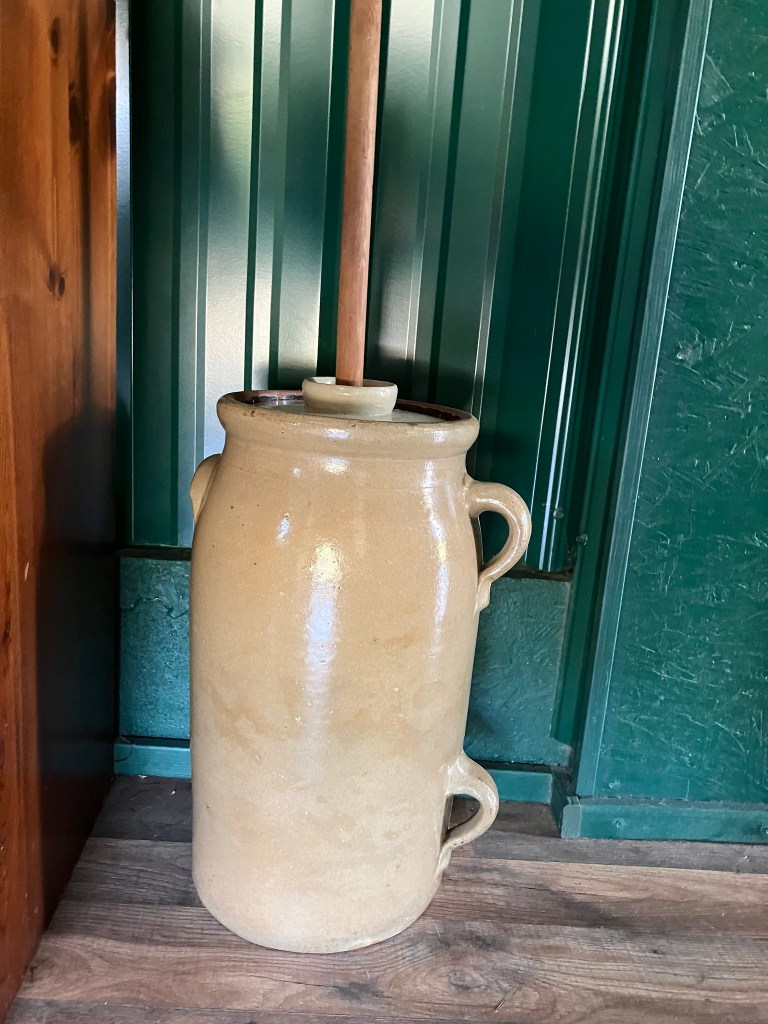
My maternal grandparent’s churn.
An imagined morning in their lives
In the heart of North Alabama, nestled in the tranquil countryside near Boaz, the Parker family lived a simple yet fulfilling life in the early 1900s. John and Nora Parker, a hardworking couple, owned a modest 40-acre farm that was their pride and joy. Their days began with the first rays of the sun, and on this particular morning, it was time for John to milk the cow.
As the first light of dawn kissed the rolling hills surrounding their farm, John stepped outside, greeted by the crisp, cool air that hinted at the arrival of fall. He was a sturdy man with calloused hands, a testament to the countless hours he spent tending to the land and caring for their animals. His trusty mule, Charlie, stood nearby, patiently awaiting his morning duties.
With a pail in one hand and a worn wooden stool in the other, John approached their gentle, brown cow, Bessie. She was a part of the family, and she knew it. Her warm, brown eyes met John’s as he sat down and began to methodically milk her, the rhythmic sound of the milk hitting the pail creating a soothing harmony with the songs of morning birds.
Inside the cozy farmhouse, Nora and their young daughter, Hazel, were already busy preparing for the day. Hazel, a curious and bright-eyed child, was eager to learn the ways of the farm. Today, she had a special task at hand – preparing cream to make butter with the old churn that had been passed down through generations.
Nora, a woman of unwavering patience and grace, guided Hazel through the process. They poured the freshly collected milk into a large, shallow pan and allowed it to sit. Over time, the cream naturally rose to the top, forming a thick layer. Nora explained to Hazel how the cream was the key ingredient for making butter, and they needed to separate it from the milk.
Using a long-handled ladle, Nora gently skimmed the cream from the top of the pan, carefully collecting it in a separate container. Before churning, she poured off the buttermilk, which would later be used for cooking or baking, ensuring that the remaining liquid was pure cream.
With the separated cream in hand, they moved to the churn, a well-worn wooden vessel with a sturdy handle. They poured the cream into the churn and sealed it tight. Hazel eagerly took her turn at the handle, and with her mother’s guidance, they began the rhythmic process of churning.
Back and forth, back and forth, they worked the churn. The cream inside began to change, thickening and transforming. It was hard work, but the reward was worth it. The sound of the wooden paddle striking the cream echoed through the kitchen, a comforting sound that filled the room.
As they continued to churn, the cream gradually changed its texture, becoming lumpy and then finally separating into butter and buttermilk. Nora carefully poured off the buttermilk into a separate container before removing the butter from the churn. She then shaped it into a smooth mound, while Hazel watched in awe at the miracle of transformation.
The family came together around the kitchen table, their faces illuminated by the soft morning light streaming through the windows. John, Nora, and Hazel shared a quiet moment of gratitude for the simple joys of rural life. A 40-acre farm, a trusty mule, a gentle cow, and the tradition of making butter served as the foundation of their existence, connecting them to the land and to each other.
As they enjoyed a breakfast of fresh biscuits slathered with their homemade butter, the Parker family cherished the moments of togetherness and the deep satisfaction that could only be found in the heart of North Alabama’s rural life in the early 1900s, where making butter was a labor of love and tradition, and where every drop of buttermilk was put to good use.

Unsure what it’s called, maybe a butter mold? Found inside the churn.

Here’s a link to a similar one.

 Richard L. Fricks